I Heard a Dog Crying Behind an Old Fence, but Nothing Prepared Me for What I Found
𝗙𝗨𝗟𝗟 𝗦𝗧𝗢𝗥𝗬
There was no dramatic declaration in her voice.
She said it as though the situation had presented us with only one acceptable choice.
I remember feeling enormously grateful for that certainty.
Until then, I’d been frightened that I was the only person willing to stay.
Now there were four of us.
Four strangers standing around a dirty, exhausted little dog, trying to determine how to free her without causing additional pain.
The younger man examined the metal bars.
“We might be able to open this section enough to release the pressure.”
The older man shook his head.
“Carefully. Look at her stomach.”
I moved closer.
There were dark marks across her abdomen where the fence had pressed against it.
Some areas looked badly bruised.
I felt sick.
“She must have been struggling for ages.”
Nobody answered.
There was nothing useful to say.
The older woman offered the dog a little water, but the animal was too exhausted to show much interest.
We were careful not to force anything into her mouth.
The immediate priority was freeing her from the fence and getting her out of the sun.
I knelt beside her head.
“Hey, sweetheart. We’re going to move you a little, okay?”
Her eyes followed my face.
I stroked her ear.
“You’re going to feel us touching you. We’re trying to help.”
The men began examining the section of fencing around her trapped body.
Every movement was deliberate.
They checked where the pressure was greatest and discussed how to create enough space to release her without dragging her abdomen across the metal.
I could hear the younger man’s breathing as he worked.
He was concentrating intensely.
The older man positioned himself on the opposite side.
“Don’t pull her yet.”
“I’m not.”
“We need to loosen this first.”
I kept one hand near the dog’s head.
Whenever she whimpered, I stopped speaking and waited until she settled.
The afternoon heat seemed to grow heavier around us.
Sweat ran down my back.
My knees ached against the hard ground.
But I barely noticed.
All I could think about was the little animal whose entire world had narrowed to the few inches of metal pressing into her body.
At one point, she tried to twist.
A sharp cry escaped her mouth.
“Stop!” I said.
Everyone froze.
She trembled violently.
I felt tears spring into my eyes.
“She’s hurting.”
The older man nodded.
“We need to take our time.”
I pressed my palm gently against the side of her head.
“You’re okay. Nobody’s going to pull you.”
She looked at me.
I wished I could explain what was happening.
I wished I could tell her that the hands surrounding her belonged to people who were trying to relieve her suffering, not cause it.
But all I could offer was the sound of my voice.
So I kept talking.
I told her she was a good girl.
I told her we were almost there.
I told her she wouldn’t have to fight the fence alone anymore.
And when fear made my voice tremble, I continued anyway.
The younger man adjusted his tools.
The older man carefully repositioned the metal.
For a moment, nothing seemed to change.
Then one section began to move.
“That’s it,” the older man said.
“Can you hold it?”
“I’ve got it.”
The younger man looked toward me.
“We’re making some space.”
I nodded.
The dog lifted her head.
“Easy, sweetheart.”
The men continued working.
The opening widened slightly.
Not enough to free her.
But enough that the pressure against one side of her body began to ease.
I watched her breathing.
She seemed to recognize that something was changing.
Her front paws shifted.
“Not yet,” the older man said gently. “Don’t let her struggle.”
I supported her head.
The younger man adjusted the metal again.
A few more inches.
Then he stopped.
“All right. I think we’ve got enough.”
My heart began pounding.
“Are you sure?”
“We need to support her while we move her.”
The older woman moved closer.
“I can help.”
We positioned ourselves around the dog.
One person supported her chest.
Another carefully supported her hindquarters.
The men held the loosened fencing steady.
I remained beside her head, talking to her in a voice that sounded much calmer than I felt.
“All right, baby. Here we go.”
We began moving her.
Slowly.
Carefully.
I watched her face, terrified that any sudden movement would cause more pain.
She whimpered.
We stopped immediately.
“Wait,” I said.
The older man adjusted his grip.
“Okay. Try again.”
We moved her another small distance.
Her abdomen cleared one section of the metal.
Then another.
For the first time since I’d found her, I could see that her body was almost completely free.
“Just a little more,” the younger man said.
I stroked her head.
“Come on, sweetheart.”
One final careful movement.
And suddenly she was no longer trapped.
Her body came free of the fence.
For a moment, nobody spoke.
I stared at the opening she’d been caught in.
Then I looked down at the dog resting in our arms.
“Oh, thank God.”
The older woman let out a shaky breath.
“We got her.”
I began crying.
I couldn’t help it.
I’d spent what felt like an eternity watching this animal suffer while we struggled to understand how to release her.
Now she was free.
But the relief lasted only a few seconds before another frightening realization settled over me.
She was still badly injured.
Her abdomen looked painful and bruised, and her body was so exhausted that she could barely lift her head.
The fence was no longer holding her.
But she still needed help.
“We need to get her out of the sun,” I said.
The older woman looked toward her house.
“I have an umbrella.”
“Please.”
She hurried away.
We carefully lowered the dog onto a safer patch of ground, away from the metal fence.
I crouched beside her.
Her eyes were open.
She seemed dazed.
I gently touched her head.
“You’re free, sweetheart.”
She made a soft sound.
I looked toward the men.
“Do you think she’s going to be okay?”
Neither answered immediately.
The older man examined the bruising on her abdomen.
“She needs proper care.”
I nodded.
I knew he was right.
We had managed to remove the immediate danger, but there was no way to determine the full extent of her injuries from looking at her.
Her abdomen had been compressed against the fence for an unknown amount of time.
Even if the damage appeared superficial, she could have additional injuries we couldn’t see.
She also looked severely exhausted and had spent too long exposed to the heat.
I didn’t want our relief to make us careless.
The older woman returned carrying a large umbrella.
She opened it and positioned it above the dog.
A circle of shade fell across her body.
I watched the sunlight disappear from her face.
Something about that small change made my chest ache.
For hours, she had been trapped against hot metal beneath the merciless afternoon sun.
Now she was lying on the ground, shaded by an umbrella held by a stranger.
It wasn’t an elaborate rescue operation.
There were no flashing emergency lights.
No professional team had arrived.
We didn’t have specialized equipment or impressive uniforms.
We had an umbrella.
A few tools.
Some water.
And four people who had decided that an injured animal deserved help.
I sat beside her while the others discussed how to arrange further care.
She was breathing heavily, but her body no longer strained against the fence.
The older woman gently brushed dirt away from her face.
“Poor little thing.”
The dog looked toward her.
Then she made a soft whimper.
It wasn’t the same desperate cry I’d heard when I first approached.
This sound was quieter.
Almost uncertain.
I wanted to believe she was beginning to understand that nobody was going to leave her trapped again.
I reached toward her.
She watched my hand.
Then, very slowly, she lowered her head against my fingers.
I felt tears running down my face.
“That’s it, sweetheart.”
Her eyes closed.
I continued stroking her head.
“Just rest.”
The younger man stood a few feet away, looking at the damaged section of fencing.
“She must have been trying to get through here.”
I glanced toward the opening.
It was narrower than it had looked from a distance.
“I don’t know how she got that far.”
The older man shook his head.
“Fear and hunger can make an animal try almost anything.”
I looked down at the dog.
I imagined her searching the neighborhood for food.
Perhaps she’d gone an entire day without finding enough to eat.
Perhaps she had discovered a quiet place on the other side of the fence where she hoped to rest.
And when she tried to squeeze through, her body had become caught.
I pictured her struggling alone.
Pulling.
Twisting.
Trying to push herself forward.
Then trying to back out.
Every movement making the situation worse.
I wondered when she’d started crying.
Had she called for help immediately?
Or had she fought silently until exhaustion forced her to surrender?
I looked at the scratches in the dirt beneath the fence.
The marks stretched farther than I’d noticed before.
She had tried desperately to escape.
And when she’d finally run out of strength, she’d been left hanging there in the heat.
I turned away.
I couldn’t bear to imagine the final hours she might have faced if nobody had stopped.
The older woman adjusted the umbrella.
“She looks a little more comfortable.”
I nodded.
But I remained worried about her abdomen.
The bruising was extensive enough that we knew she needed proper medical assessment, and I was determined that freeing her from the fence would not be the end of our responsibility.
We began discussing the safest way to move her.
The older man offered to help arrange transportation.
The younger man gathered his tools.
The older woman remained beside me, holding the umbrella while the dog rested.
For several minutes, we worked quietly around her.
Nobody complained about the heat.
Nobody mentioned the other things they had planned to do that afternoon.
The urgency of saving her had temporarily made everything else seem unimportant.
I remember looking at the faces around me and feeling something I hadn’t expected.
Gratitude.
These people hadn’t known me before that afternoon.
They hadn’t known the dog.
They had no reason to interrupt their lives except that someone had asked for help.
And they had come.
I wondered how different the day would have been if the first person I’d approached had simply closed the door.
What if the neighbors had decided the problem was too difficult?
What if we’d all assumed that someone more qualified would eventually arrive?
The dog would still have been hanging from that fence.
Possibly until it was too late.
Instead, she was resting beneath an umbrella while four strangers worked out what to do next.
I looked down at her.
“You’re a lucky girl,” I whispered.
Then I shook my head.
No.
Luck would have meant finding food before starvation forced her to squeeze through a dangerous opening.
Luck would have meant discovering a safe place to rest instead of becoming trapped in the heat.
What had happened to her wasn’t lucky.
But at least she was no longer alone.
As we prepared to move her to safety, the dog opened her eyes again.
She looked at me.
Her expression was still tired, but the wild panic I’d seen when I first approached the fence had begun to fade.
I touched her head.
“You’re doing so well.”
She gave another soft whimper.
I smiled through tears.
“I know. It’s been a terrible day.”
The older woman crouched beside us.
“She seems very gentle.”
“She is.”
I looked at the small animal lying between us.
Despite everything she’d endured, she hadn’t tried to bite anyone during the rescue.
She had been frightened.
She had cried when we moved her.
But even at her most vulnerable, she had allowed strangers to touch her and support her body while we worked to free her.
I knew pain and exhaustion could explain much of her behavior.
Still, I found myself deeply moved by her willingness to accept help.
At some point during the rescue, she’d stopped struggling against our hands.
Perhaps she’d recognized that we were trying to release her.
Perhaps she’d simply been too exhausted to resist.
Whatever the explanation, that moment had allowed us to help her safely.
I hoped she would never again find herself in a situation where trusting a stranger was her only chance of survival.
Eventually, we were ready to move her.
I carefully slipped my hands beneath her body while another person helped support her injured abdomen.
She whimpered as we lifted her.
“Easy, sweetheart.”
We paused until she settled.
Then we carried her away from the fence.
I remember taking those first few steps and feeling the enormous difference between moving her while she was trapped and carrying her now.
Before, every attempt to help had been restricted by the metal bars pressing against her body.
Now we could support her weight properly.
We could move her into the shade.
We could get her somewhere safer.
And we could finally begin addressing the injuries she’d suffered instead of simply trying to free her.
The older woman walked beside us, holding the umbrella.
The two men followed, ready to help whenever we needed them.
We moved slowly.
The dog rested against our hands.
Her breathing was still heavy, and I knew the road ahead might be difficult.
There would be injuries to evaluate.
Pain to manage.
Rest and healing that couldn’t be rushed.
And whatever had happened before she’d become trapped remained an unanswered question.
But there was one important difference between the hours she’d spent hanging from the fence and the moment we carried her away.
She no longer had to face those problems alone.
I glanced back once.
The old fence stood exactly where it had been when I’d first heard her crying.
From a distance, it looked ordinary.
There was nothing remarkable about the metal bars or the dusty ground beneath them.
Someone passing later might never imagine that a small dog had nearly lost her life there.
But I would remember.
I would remember the sound of her frightened cries.
The terrible exhaustion in her eyes.
The bruising across her abdomen.
And the frightening moment when we realized that the rescue service wasn’t coming.
Most of all, I would remember the people who came anyway.
The neighbor who left his house to help a stranger.
The younger man who brought the tools we needed.
The older woman who offered water, stayed beside the dog, and held an umbrella over her while we worked.
None of us had started the afternoon expecting to rescue an injured animal.
We had simply found ourselves standing in front of suffering and decided that walking away wasn’t an acceptable answer.
When we finally reached a safe place to rest, the little dog lowered her head.
The older woman adjusted the umbrella one last time.
I sat beside her and gently stroked the fur behind her ears.
“You’re safe now,” I whispered.
She opened her tired eyes.
For a moment, she looked directly at me.
Then she let out one small, exhausted whimper and closed them again.
I stayed beside her while we arranged the care she still needed.
I couldn’t promise that her recovery would be quick.
I couldn’t know how long her abdomen would remain painful or what other complications her ordeal might have caused.
But I knew she had survived the fence.
She was no longer hanging helplessly beneath the afternoon sun.
She had people protecting her, watching her breathing, and making sure she wouldn’t be abandoned again that day.
As I sat there, I thought about how close I’d come to walking past the place where she’d been trapped.
One faint cry had interrupted an ordinary afternoon.
I’d stopped because something about it sounded wrong.
And that single decision had brought together people who might otherwise have passed one another without exchanging a word.
I looked down at the little dog resting beneath the umbrella.
Her body was still weak.
Her injuries were still real.
But for the first time since I’d found her, she was able to rest without the metal fence pressing against her abdomen.
I gently touched her head.
She moved a little closer to my hand.
And I understood that the most important thing we’d given her that afternoon wasn’t the freedom to walk away.
It was the chance to rest without having to fight for her life.
The sun was beginning to sink when I finally stood.
The dog remained beneath the umbrella, surrounded by the people who had refused to leave her behind.
I looked once more toward the road where I’d first heard her crying.
Then I turned back to her.
“Rest now, sweetheart,” I whispered. “You’re not alone anymore.”
𝗧𝗛𝗘 𝗘𝗡𝗗
I Heard a Dog Crying Behind an Old Fence, but Nothing Prepared Me for What I Found
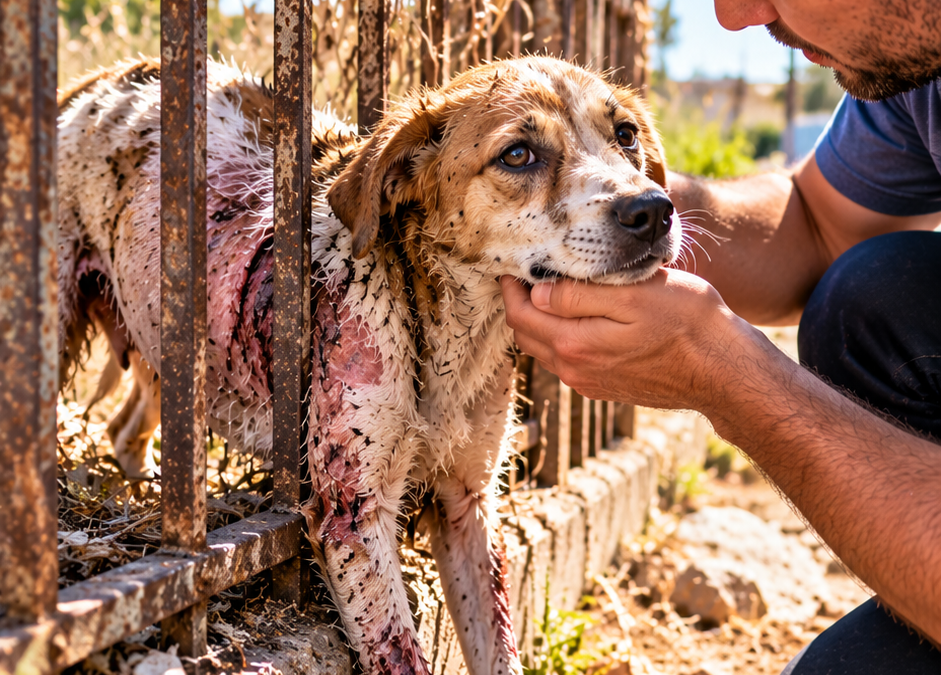
The little dog was hanging helplessly from a fence when I first heard her crying beneath the afternoon sun.
Her belly was trapped against the metal, her paws could barely touch the ground, and the terrible wounds on her body told me she had been struggling for much longer than anyone knew.
But when our desperate calls for professional help went unanswered, I realized that saving her would depend on a handful of strangers who had never attempted anything like this before.
My name isn’t particularly important to this story. I was simply an ordinary person walking through an ordinary neighborhood on an afternoon when the heat was so oppressive that even the streets seemed exhausted.
I wasn’t an animal rescuer. I had no veterinary training, no emergency equipment, and no experience freeing frightened dogs from dangerous places.
Until that afternoon, I had never imagined that I would find myself kneeling beside an injured animal, praying she wouldn’t die before we figured out how to save her.
It started with a sound I almost ignored.
I was walking along a quiet road bordered by vacant lots, weathered walls, and old fences when I heard what sounded like a dog whimpering.
At first, I assumed the animal was somewhere behind one of the nearby houses.
Stray dogs were common in the neighborhood. I had seen them searching through discarded food, drinking from dirty puddles, and sleeping beneath parked vehicles to escape the worst of the afternoon heat.
Most of them had learned to keep their distance from people.
They moved through the streets almost invisibly, surviving on whatever they could find and disappearing whenever someone approached too quickly.
But this sound was different.
It wasn’t an impatient bark or the ordinary complaint of a dog looking for attention.
It was a strained, broken cry, followed by a silence that made me stop walking.
I stood still and listened.
A vehicle passed somewhere behind me.
The hot wind carried the smell of dust and sunbaked pavement.
Then I heard it again.
A soft, miserable whimper.
I turned toward an old fence bordering an overgrown property.
“Hello?”
There was no response.
I moved closer.
“Where are you, sweetheart?”
Another weak cry came from the far end of the fence.
I followed it.
And then I saw her.
For a moment, I genuinely couldn’t understand what I was looking at.
A small dog was caught between the metal bars of the fence. Her body was twisted at an unnatural angle, her abdomen pressed painfully against the lower section of the structure.
Her front paws struggled to find support on the ground.
Her hindquarters were trapped.
She had apparently tried to squeeze through an opening that was far too narrow for her body, and now she was wedged so tightly that every attempt to move seemed to hurt her.
Her fur was filthy.
Thick layers of dirt clung to her coat, and her body was marked by the desperate struggle she had already endured.
But what frightened me most was how little she moved when she saw me.
A healthy, frightened stray might have barked, growled, or fought to escape.
This dog barely lifted her head.
Her eyes followed me for a moment before closing again.
“Oh, my God.”
I dropped my bag and crouched beside her.
“Hey, sweetheart. Can you hear me?”
She opened her eyes.
A faint whimper escaped her mouth.
I looked at the fence, trying to understand how she’d become trapped.
One side of her body was pressed against the metal. Her abdomen appeared swollen and bruised where the bars had been digging into her skin, and the ground beneath her was covered with disturbed dirt.
There were deep marks where her paws had scraped against the earth.
She must have been pulling and twisting for hours.
I imagined her finding the opening while searching for something to eat or somewhere safe to rest.
Perhaps she’d smelled discarded food on the other side.
Perhaps she’d been trying to escape the sun.
Perhaps she’d been frightened by something behind her and had rushed toward the first opening she could find.
I couldn’t know.
But the evidence of what had happened afterward was unmistakable.
She had tried to force herself through.
She had become stuck.
And then, as panic set in, she had fought harder.
Every movement must have pushed the metal more painfully against her body.
Eventually, exhaustion had overcome her.
Now she was hanging there in the heat, unable to move forward or backward, waiting for someone to notice.
I reached toward her.
She flinched.
“Okay,” I whispered. “Okay, I’m not going to hurt you.”
I slowly withdrew my hand.
Her breathing was heavy and uneven.
I could see her sides rising and falling beneath her dirty coat.
I looked up and down the road.
There was nobody nearby.
For the first time, I understood how easily an animal could suffer in plain sight while the world continued around it.
Cars had probably passed this fence all morning.
People might have walked along the opposite side of the road.
Somebody might even have heard her crying and assumed she belonged to a nearby property.
But nobody had freed her.
And now I was standing in front of a problem I had absolutely no idea how to solve.
I took out my phone and called for help.
I explained that a stray dog was trapped in a metal fence and appeared to be seriously injured.
I gave the location as clearly as possible.
Then I waited.
The dog whimpered again.
I crouched beside her.
“Help is coming,” I told her.
I wanted desperately to believe it.
The sun was directly overhead, and there was almost no shade along that section of the fence.
The metal felt hot when I touched it.
I looked at the dog’s exposed body and realized she had no way to move away from the sunlight.
I tried positioning myself to cast a little shade across her head.
It was almost useless.
I looked down the road again.
Nothing.
I checked my phone.
Still no response.
I called again.
The minutes passed with unbearable slowness.
I don’t know whether the rescue service was overwhelmed, unavailable, or simply unable to respond.
What I know is that no one came.
And the little dog was getting weaker.
I knelt beside her and spoke softly.
“Come on, sweetheart. Stay with me.”
Her eyes opened.
She tried to move her head toward my voice.
Then she lowered it again.
Something inside me shifted.
I had started that afternoon believing I simply needed to make a telephone call and wait for professionals to arrive.
Now I was beginning to understand that waiting might cost this dog her life.
I stood and looked toward the nearest houses.
Someone had to be home.
Someone had to know how to help.
I wasn’t going to leave her hanging there.
I hurried toward a nearby house and knocked.
A man opened the door.
“Can I help you?”
“There’s a dog trapped in the fence down the road. She’s hurt, and I can’t get anyone to come.”
His expression changed.
“Trapped how?”
“She’s wedged between the bars. I think she’s been there for hours.”
He stepped outside.
“Show me.”
We walked quickly back toward the fence.
When he saw the dog, he stopped.
“Good Lord.”
I crouched beside her again.
“She’s barely moving.”
The man examined the opening carefully.
He didn’t immediately try to pull her free.
That was the first thing he did that reassured me.
He understood, perhaps better than I did, that forcing her body against the metal could make her injuries worse.
“She’s caught pretty badly,” he said.
“Can we get her out?”
“We need more hands.”
He turned toward the road.
“I’ll get the neighbors.”
I stayed beside the dog while he hurried away.
For a few moments, the only sounds were the distant traffic and the animal’s labored breathing.
I had never felt so powerless.
I could see exactly what was hurting her.
I could touch the fence that held her prisoner.
But I couldn’t simply reach down and lift her into safety.
I needed to wait for people who might know what to do.
The dog opened her eyes.
“You’re going to be okay,” I whispered.
Then I corrected myself.
“We’re going to do everything we can.”
She rested her chin against the dirt.
I gently stroked the fur behind her ear.
This time, she didn’t flinch.
I couldn’t tell whether she was beginning to trust me or whether she simply no longer had the strength to react.
That uncertainty frightened me more than anything.
A few minutes later, the man returned with two neighbors.
One was an older woman carrying a bottle of water.
The other was a younger man who had brought a small collection of tools.
They approached carefully.
The older woman stopped when she saw the dog.
“Oh, you poor baby.”
She crouched beside me.
“How long has she been here?”
“I don’t know.”
“Has anyone called a rescue service?”
“I tried. Nobody’s responding.”
The woman looked at the dog again.
“Then we’ll have to help her ourselves.”
There was no dramatic declaration in her voice.
She said it as though the situation had presented us with only one acceptable choice.
I remember feeling enormously grateful for that certainty.
Until then, I’d been frightened that I was the only person willing to stay.
Now there were four of us.
Four strangers standing around a dirty, exhausted little dog, trying to determine how to free her without causing additional pain.
The younger man examined the metal bars.
“We might be able to open this section enough to release the pressure.”
The older man shook his head.
“Carefully. Look at her stomach.”
I moved closer.
There were dark marks across her abdomen where the fence had pressed against it.
Some areas looked badly bruised.
I felt sick.
“She must have been struggling for ages.”
Nobody answered.
There was nothing useful to say.
The older woman offered the dog a little water, but the animal was too exhausted to show much interest.
We were careful not to force anything into her mouth.
The immediate priority was freeing her from the fence and getting her out of the sun.
I knelt beside her head.
“Hey, sweetheart. We’re going to move you a little, okay?”
Her eyes followed my face.
I stroked her ear.
“You’re going to feel us touching you. We’re trying to help.”
The men began examining the section of fencing around her trapped body.
Every movement was deliberate.
They checked where the pressure was greatest and discussed how to create enough space to release her without dragging her abdomen across the metal.
I could hear the younger man’s breathing as he worked.
He was concentrating intensely.
The older man positioned himself on the opposite side.
“Don’t pull her yet.”
“I’m not.”
“We need to loosen this first.”
I kept one hand near the dog’s head.
Whenever she whimpered, I stopped speaking and waited until she settled.
The afternoon heat seemed to grow heavier around us.
Sweat ran down my back.
My knees ached against the hard ground.
But I barely noticed.
All I could think about was the little animal whose entire world had narrowed to the few inches of metal pressing into her body.
At one point, she tried to twist.
A sharp cry escaped her mouth.
“Stop!” I said.
Everyone froze.
She trembled violently.
I felt tears spring into my eyes.
“She’s hurting.”
The older man nodded.
“We need to take our time.”
I pressed my palm gently against the side of her head.
“You’re okay. Nobody’s going to pull you.”
She looked at me.
I wished I could explain what was happening.
I wished I could tell her that the hands surrounding her belonged to people who were trying to relieve her suffering, not cause it.
But all I could offer was the sound of my voice.
So I kept talking.
I told her she was a good girl.
I told her we were almost there.
I told her she wouldn’t have to fight the fence alone anymore.
And when fear made my voice tremble, I continued anyway.
The younger man adjusted his tools.
The older man carefully repositioned the metal.
For a moment, nothing seemed to change.
Then one section began to move.
“That’s it,” the older man said.
“Can you hold it?”
“I’ve got it.”
The younger man looked toward me.
“We’re making some space.”
I nodded.
The dog lifted her head.
“Easy, sweetheart.”
The men continued working.
The opening widened slightly.
Not enough to free her.
But enough that the pressure against one side of her body began to ease.
I watched her breathing.
She seemed to recognize that something was changing.
Her front paws shifted.
“Not yet,” the older man said gently. “Don’t let her struggle.”
I supported her head.
The younger man adjusted the metal again.
A few more inches.
Then he stopped.
“All right. I think we’ve got enough.”
My heart began pounding.
“Are you sure?”
“We need to support her while we move her.”
The older woman moved closer.
“I can help.”
We positioned ourselves around the dog.
One person supported her chest.
Another carefully supported her hindquarters.
The men held the loosened fencing steady.
I remained beside her head, talking to her in a voice that sounded much calmer than I felt.
“All right, baby. Here we go.”
We began moving her.
Slowly.
Carefully.
I watched her face, terrified that any sudden movement would cause more pain.
She whimpered.
We stopped immediately.
“Wait,” I said.
The older man adjusted his grip.
“Okay. Try again.”
We moved her another small distance.
Her abdomen cleared one section of the metal.
Then another.
For the first time since I’d found her, I could see that her body was almost completely free.
“Just a little more,” the younger man said.
I stroked her head.
“Come on, sweetheart.”
One final careful movement.
And suddenly she was no longer trapped.
Her body came free of the fence.
For a moment, nobody spoke.
I stared at the opening she’d been caught in.
Then I looked down at the dog resting in our arms.
“Oh, thank God.”
The older woman let out a shaky breath.
“We got her.”
I began crying.
I couldn’t help it.
I’d spent what felt like an eternity watching this animal suffer while we struggled to understand how to release her.
Now she was free.
But the relief lasted only a few seconds before another frightening realization settled over me.
She was still badly injured.
Her abdomen looked painful and bruised, and her body was so exhausted that she could barely lift her head.
The fence was no longer holding her.
But she still needed help.
“We need to get her out of the sun,” I said.
The older woman looked toward her house.
“I have an umbrella.”
“Please.”
She hurried away.
We carefully lowered the dog onto a safer patch of ground, away from the metal fence.
I crouched beside her.
Her eyes were open.
She seemed dazed.
I gently touched her head.
“You’re free, sweetheart.”
She made a soft sound.
I looked toward the men.
“Do you think she’s going to be okay?”
Neither answered immediately.
The older man examined the bruising on her abdomen.
“She needs proper care.”
I nodded.
I knew he was right.
We had managed to remove the immediate danger, but there was no way to determine the full extent of her injuries from looking at her.
Her abdomen had been compressed against the fence for an unknown amount of time.
Even if the damage appeared superficial, she could have additional injuries we couldn’t see.
She also looked severely exhausted and had spent too long exposed to the heat.
I didn’t want our relief to make us careless.
The older woman returned carrying a large umbrella.
She opened it and positioned it above the dog.
A circle of shade fell across her body.
I watched the sunlight disappear from her face.
Something about that small change made my chest ache.
For hours, she had been trapped against hot metal beneath the merciless afternoon sun.
Now she was lying on the ground, shaded by an umbrella held by a stranger.
It wasn’t an elaborate rescue operation.
There were no flashing emergency lights.
No professional team had arrived.
We didn’t have specialized equipment or impressive uniforms.
We had an umbrella.
A few tools.
Some water.
And four people who had decided that an injured animal deserved help.
I sat beside her while the others discussed how to arrange further care.
She was breathing heavily, but her body no longer strained against the fence.
The older woman gently brushed dirt away from her face.
“Poor little thing.”
The dog looked toward her.
Then she made a soft whimper.
It wasn’t the same desperate cry I’d heard when I first approached.
This sound was quieter.
Almost uncertain.
I wanted to believe she was beginning to understand that nobody was going to leave her trapped again.
I reached toward her.
She watched my hand.
Then, very slowly, she lowered her head against my fingers.
I felt tears running down my face.
“That’s it, sweetheart.”
Her eyes closed.
I continued stroking her head.
“Just rest.”
The younger man stood a few feet away, looking at the damaged section of fencing.
“She must have been trying to get through here.”
I glanced toward the opening.
It was narrower than it had looked from a distance.
“I don’t know how she got that far.”
The older man shook his head.
“Fear and hunger can make an animal try almost anything.”
I looked down at the dog.
I imagined her searching the neighborhood for food.
Perhaps she’d gone an entire day without finding enough to eat.
Perhaps she had discovered a quiet place on the other side of the fence where she hoped to rest.
And when she tried to squeeze through, her body had become caught.
I pictured her struggling alone.
Pulling.
Twisting.
Trying to push herself forward.
Then trying to back out.
Every movement making the situation worse.
I wondered when she’d started crying.
Had she called for help immediately?
Or had she fought silently until exhaustion forced her to surrender?
I looked at the scratches in the dirt beneath the fence.
The marks stretched farther than I’d noticed before.
She had tried desperately to escape.
And when she’d finally run out of strength, she’d been left hanging there in the heat.
I turned away.
I couldn’t bear to imagine the final hours she might have faced if nobody had stopped.
The older woman adjusted the umbrella.
“She looks a little more comfortable.”
I nodded.
But I remained worried about her abdomen.
The bruising was extensive enough that we knew she needed proper medical assessment, and I was determined that freeing her from the fence would not be the end of our responsibility.
We began discussing the safest way to move her.
The older man offered to help arrange transportation.
The younger man gathered his tools.
The older woman remained beside me, holding the umbrella while the dog rested.
For several minutes, we worked quietly around her.
Nobody complained about the heat.
Nobody mentioned the other things they had planned to do that afternoon.
The urgency of saving her had temporarily made everything else seem unimportant.
I remember looking at the faces around me and feeling something I hadn’t expected.
Gratitude.
These people hadn’t known me before that afternoon.
They hadn’t known the dog.
They had no reason to interrupt their lives except that someone had asked for help.
And they had come.
I wondered how different the day would have been if the first person I’d approached had simply closed the door.
What if the neighbors had decided the problem was too difficult?
What if we’d all assumed that someone more qualified would eventually arrive?
The dog would still have been hanging from that fence.
Possibly until it was too late.
Instead, she was resting beneath an umbrella while four strangers worked out what to do next.
I looked down at her.
“You’re a lucky girl,” I whispered.
Then I shook my head.
No.
Luck would have meant finding food before starvation forced her to squeeze through a dangerous opening.
Luck would have meant discovering a safe place to rest instead of becoming trapped in the heat.
What had happened to her wasn’t lucky.
But at least she was no longer alone.
As we prepared to move her to safety, the dog opened her eyes again.
She looked at me.
Her expression was still tired, but the wild panic I’d seen when I first approached the fence had begun to fade.
I touched her head.
“You’re doing so well.”
She gave another soft whimper.
I smiled through tears.
“I know. It’s been a terrible day.”
The older woman crouched beside us.
“She seems very gentle.”
“She is.”
I looked at the small animal lying between us.
Despite everything she’d endured, she hadn’t tried to bite anyone during the rescue.
She had been frightened.
She had cried when we moved her.
But even at her most vulnerable, she had allowed strangers to touch her and support her body while we worked to free her.
I knew pain and exhaustion could explain much of her behavior.
Still, I found myself deeply moved by her willingness to accept help.
At some point during the rescue, she’d stopped struggling against our hands.
Perhaps she’d recognized that we were trying to release her.
Perhaps she’d simply been too exhausted to resist.
Whatever the explanation, that moment had allowed us to help her safely.
I hoped she would never again find herself in a situation where trusting a stranger was her only chance of survival.
Eventually, we were ready to move her.
I carefully slipped my hands beneath her body while another person helped support her injured abdomen.
She whimpered as we lifted her.
“Easy, sweetheart.”
We paused until she settled.
Then we carried her away from the fence.
I remember taking those first few steps and feeling the enormous difference between moving her while she was trapped and carrying her now.
Before, every attempt to help had been restricted by the metal bars pressing against her body.
Now we could support her weight properly.
We could move her into the shade.
We could get her somewhere safer.
And we could finally begin addressing the injuries she’d suffered instead of simply trying to free her.
The older woman walked beside us, holding the umbrella.
The two men followed, ready to help whenever we needed them.
We moved slowly.
The dog rested against our hands.
Her breathing was still heavy, and I knew the road ahead might be difficult.
There would be injuries to evaluate.
Pain to manage.
Rest and healing that couldn’t be rushed.
And whatever had happened before she’d become trapped remained an unanswered question.
But there was one important difference between the hours she’d spent hanging from the fence and the moment we carried her away.
She no longer had to face those problems alone.
I glanced back once.
The old fence stood exactly where it had been when I’d first heard her crying.
From a distance, it looked ordinary.
There was nothing remarkable about the metal bars or the dusty ground beneath them.
Someone passing later might never imagine that a small dog had nearly lost her life there.
But I would remember.
I would remember the sound of her frightened cries.
The terrible exhaustion in her eyes.
The bruising across her abdomen.
And the frightening moment when we realized that the rescue service wasn’t coming.
Most of all, I would remember the people who came anyway.
The neighbor who left his house to help a stranger.
The younger man who brought the tools we needed.
The older woman who offered water, stayed beside the dog, and held an umbrella over her while we worked.
None of us had started the afternoon expecting to rescue an injured animal.
We had simply found ourselves standing in front of suffering and decided that walking away wasn’t an acceptable answer.
When we finally reached a safe place to rest, the little dog lowered her head.
The older woman adjusted the umbrella one last time.
I sat beside her and gently stroked the fur behind her ears.
“You’re safe now,” I whispered.
She opened her tired eyes.
For a moment, she looked directly at me.
Then she let out one small, exhausted whimper and closed them again.
I stayed beside her while we arranged the care she still needed.
I couldn’t promise that her recovery would be quick.
I couldn’t know how long her abdomen would remain painful or what other complications her ordeal might have caused.
But I knew she had survived the fence.
She was no longer hanging helplessly beneath the afternoon sun.
She had people protecting her, watching her breathing, and making sure she wouldn’t be abandoned again that day.
As I sat there, I thought about how close I’d come to walking past the place where she’d been trapped.
One faint cry had interrupted an ordinary afternoon.
I’d stopped because something about it sounded wrong.
And that single decision had brought together people who might otherwise have passed one another without exchanging a word.
I looked down at the little dog resting beneath the umbrella.
Her body was still weak.
Her injuries were still real.
But for the first time since I’d found her, she was able to rest without the metal fence pressing against her abdomen.
I gently touched her head.
She moved a little closer to my hand.
And I understood that the most important thing we’d given her that afternoon wasn’t the freedom to walk away.
It was the chance to rest without having to fight for her life.
The sun was beginning to sink when I finally stood.
The dog remained beneath the umbrella, surrounded by the people who had refused to leave her behind.
I looked once more toward the road where I’d first heard her crying.
Then I turned back to her.
“Rest now, sweetheart,” I whispered. “You’re not alone anymore.”








