𝗙𝗨𝗟𝗟 𝗦𝗧𝗢𝗥𝗬 I Found an Elderly French Bulldog Dying in a Garbage Dump, and the Way She Looked at Me Still Haunts Me
𝗙𝗨𝗟𝗟 𝗦𝗧𝗢𝗥𝗬
She closed her eyes.
I stayed beside her until the veterinary team was ready to move her.
The transfer to Marikina Hospital felt endless.
I sat close to her carrier, listening to every change in her breathing.
Patricia traveled with us, occasionally leaning forward to check whether the dog had moved.
“She’s still breathing, right?”
“Yes.”
A few minutes later, she asked again.
“She’s okay?”
I looked at the small body resting against the towel.
“She’s still with us.”
Neither of us wanted to say more.
We didn’t know whether she would survive the day.
When we arrived at the hospital, the veterinary team was prepared to receive her.
They reviewed the initial examination findings and began assessing the full extent of her injuries.
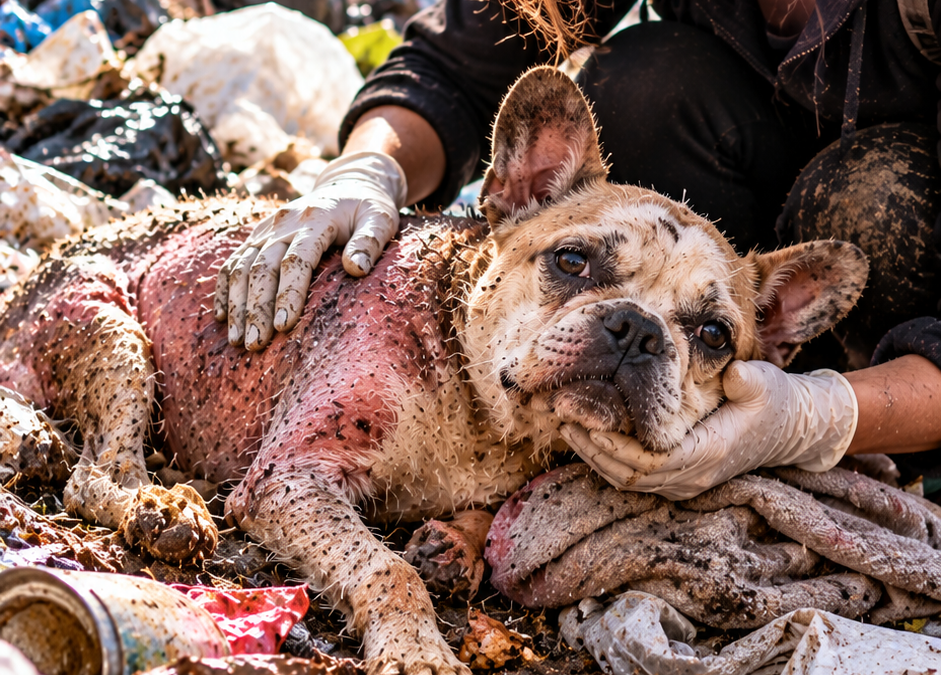
The wounds were even more complicated than they had appeared.
Clusters of maggots were embedded deep within damaged areas of skin, particularly along her back. The surrounding tissue required careful cleaning, and some of the injured areas had to be debrided to remove dead or contaminated material.
The process was medically necessary, but watching it was devastating.
I knew that maggots could develop in neglected wounds when flies laid eggs in exposed tissue.
I understood that proper treatment required thorough cleaning and repeated examinations to make sure none remained.
But understanding the medical explanation didn’t make it easier to see a living animal suffering from such advanced neglect.
The veterinarian spoke gently as she examined the dog’s back.
“We’ll have to clean these areas more than once. There may be additional larvae hidden deeper in the wounds.”
I nodded.
“Whatever she needs.”
“We also need to monitor her blood work and hydration. She’s extremely weak.”
“Do you think she’ll survive?”
The veterinarian looked at me.
“I can’t promise that yet.”
I had expected that answer.
It still hurt.
I looked down at the little dog.
Her eyes were closed.
Her body rested against the hospital bedding, surrounded by people who were finally trying to help her.
I wanted to believe that she understood she was safe.
But safety must have been an unfamiliar feeling after everything she had endured.
The hospital staff continued working.
They cleaned her wounds, removed maggots, and carefully assessed the damaged skin.
They examined her overgrown nails and the areas where they had curled painfully toward her paws.
The nails told their own disturbing story.
They hadn’t become that long in a few days.
They suggested that basic grooming and routine care had been neglected for an extended period.
I watched the veterinarian gently examine one of her paws.
The dog flinched.
My chest tightened.
Even her feet hurt.
There seemed to be no part of her body that had escaped the consequences of prolonged neglect.
As the examination continued, the medical team also began considering her history.
Her physical condition suggested that she might previously have been used for breeding.
We couldn’t confirm exactly where she had lived or how many litters she might have produced, but there were concerning indications that her reproductive history had played a significant role in her life.
I stared at her.
An elderly French Bulldog.
A breed that people often pay considerable amounts of money to acquire.
A dog who might once have been valued for the puppies she could produce.
And now she was lying in a hospital with wounds so severe that insects had infested them.
The possibility that she had been discarded after becoming sick or no longer being useful for breeding was heartbreaking.
We didn’t have enough information to establish her former owner’s motives.
But the suspicion alone made me feel sick.
I looked at her face.
There was something terribly gentle about it.
Even beneath the exhaustion, her features carried the unmistakable expression of an older dog who had spent far too long enduring things she couldn’t control.
“She needs a name,” Patricia said quietly.
I turned toward her.
“You’re right.”
The veterinarian finished examining another wound.
“Have you decided what to call her?”
I looked at the little Bulldog.
“Frenchy.”
Patricia smiled through her tears.
“Frenchy.”
I leaned closer.
“How does that sound, sweetheart?”
The dog didn’t respond.
But hearing her name spoken aloud changed something for me.
She was no longer simply the severely neglected animal we had brought from a garbage dump.
She was Frenchy.
A dog with a name.
A dog whose life mattered beyond the injuries recorded in her medical chart.
And from that moment forward, every decision we made would be about giving Frenchy the best chance at recovery.
Her first night at the hospital was difficult.
The veterinary team monitored her closely while continuing treatment for her wounds and weakened physical condition.
I went home late that evening, carrying the smell of antiseptic on my clothes and the image of her damaged body in my mind.
I took a shower.
I tried to eat dinner.
I sat on my couch with the television playing quietly in the background.
But nothing distracted me from thinking about her.
I kept remembering the way she had lain on the examination table.
The way her eyes had opened briefly when I spoke.
The way she had flinched when the veterinarian examined her paws.
And the terrible stillness of her body during the repeated wound-cleaning procedures.
I wondered whether she had ever known the comfort of a soft bed.
Whether anyone had spoken gently to her when she was frightened.
Whether she had once been someone’s beloved pet before her life deteriorated into neglect.
I couldn’t know.
But I knew that if she survived, I wanted her future to be different.
The following morning, I contacted the hospital as soon as the veterinary team was available.
“How is Frenchy?”
“She’s stable for now. We’re continuing her wound care and monitoring her closely.”
“Has she eaten?”
There was a brief pause.
“Actually, yes.”
I sat up.
“She ate?”
“She has a very good appetite.”
For the first time since Patricia’s call, I smiled without forcing it.
“Really?”
“She seems quite interested in food.”
I laughed.
It was such a simple thing.
But after seeing how little strength remained in her body, the fact that Frenchy still wanted to eat felt extraordinary.
I went to visit her that afternoon.
She was resting in her hospital enclosure, her wounds covered with clean dressings.
When I approached, she lifted her head slightly.
“Hello, Frenchy.”
Her eyes followed me.
I crouched beside her.
“I heard somebody enjoyed breakfast.”
She blinked.
I gently stroked her head.
“Good girl.”
The veterinarian explained that Frenchy’s appetite was encouraging, although her condition remained serious.
She still needed intensive wound care.
Additional maggots had been discovered during treatment, and the damaged areas required repeated cleaning.
Her blood work and general condition also needed continued monitoring.
But she was responding.
For the first time, we had something tangible to hold onto.
Frenchy wanted to eat.
And every meal helped provide the nourishment her body needed to begin repairing itself.
Over the next several days, I visited whenever possible.
Each time, I approached her enclosure slowly and spoke before touching her.
“Good morning, sweetheart.”
At first, she barely acknowledged me.
She seemed too exhausted to care who was standing beside her.
But gradually, I began noticing small changes.
She lifted her head when someone entered the room.
Her eyes followed the veterinary staff as they approached with food.
And when I gently stroked her forehead, she sometimes leaned toward my fingers.
I celebrated every little improvement.
Not because I expected a dramatic transformation overnight, but because those moments reminded me that Frenchy was still present beneath all the suffering.
She wasn’t merely an injured body.
She had preferences.
She recognized familiar routines.
And she was beginning to respond to the kindness surrounding her.
One afternoon, I arrived during her feeding time.
A veterinary technician placed her food nearby.
Frenchy’s eyes immediately brightened.
She lifted her head and began eating with an enthusiasm that seemed almost impossible for such a frail dog.
I watched, amazed.
“Look at you.”
The technician smiled.
“She’s our little food lover.”
Frenchy continued eating.
When the bowl was empty, she investigated it carefully, apparently unwilling to accept that the meal was finished.
I laughed.
“Well, somebody knows what she wants.”
The technician shook her head.
“She really does.”
I sat beside her while she rested afterward.
Her body still looked painfully fragile.
The wounds on her back were extensive, and the bandages reminded me how much healing remained.
But for the first time, I could imagine a future in which food wasn’t simply a means of survival.
Perhaps one day she would enjoy meals in a comfortable home.
Perhaps she would develop favorite treats.
Perhaps she would become one of those affectionate little dogs who followed their family into the kitchen every time someone opened a cupboard.
The thought made me smile.
But then I looked at the medical equipment surrounding her and remembered that we still had a long way to go.
Frenchy’s treatment continued day after day.
Her wounds were cleaned twice daily, and each session required extraordinary care.
Sometimes the staff discovered additional maggots hidden in damaged tissue.
Sometimes the wounds appeared cleaner and more encouraging than they had the previous day.
Her body was slowly beginning to respond, but the process was exhausting.
For Frenchy.
For the veterinary team.
And for everyone who had grown attached to her.
One morning, Patricia joined me at the hospital.
We stood beside Frenchy’s enclosure while a technician prepared her next treatment.
Patricia looked at the little dog for a long time.
“I keep thinking about where I found her.”
I nodded.
“Me too.”
“She was lying there like she’d already given up.”
I watched Frenchy lift her head when she heard the sound of a food container.
“She hasn’t given up.”
Patricia smiled faintly.
“No. She really hasn’t.”
We remained beside her until the technician was ready.
Before leaving the room, Patricia gently touched Frenchy’s head.
“You’ve got so many people looking after you now.”
Frenchy leaned toward her hand.
Patricia’s eyes filled with tears.
I understood exactly how she felt.
There was something deeply moving about watching this terribly neglected dog begin to accept affection.
She had every reason to fear human contact.
And yet, as her condition improved, she seemed increasingly willing to trust the people caring for her.
I wondered whether she remembered being loved before.
Or whether these gentle interactions were unfamiliar experiences she was only now discovering.
We would never know.
But we could make sure that kindness became part of her everyday life.
As the days passed, Frenchy’s condition gradually stabilized.
Her wounds still required extensive treatment, but the veterinary team was encouraged by her progress.
Her appetite remained strong.
Her body began tolerating the care she needed.
And eventually, the hospital determined that she could continue recovering in foster care under close supervision.
I remember the moment we received that news.
I was standing in the rescue center when my phone rang.
“Emily, Frenchy may be ready for discharge soon.”
I stopped walking.
“Really?”
“She’ll still need medication, regular wound cleaning, and follow-up appointments. But she’s stable enough for a foster environment.”
I looked toward the other volunteers.
Then I smiled so broadly that one of them immediately asked what had happened.
“Frenchy can come home.”
The room erupted in relieved laughter.
For days, we had been waiting for something that felt like a genuine turning point.
Now it had arrived.
But bringing Frenchy out of the hospital didn’t mean her recovery was complete.
In many ways, it marked the beginning of another demanding stage.
We needed a clean, comfortable space where her wounds could continue healing.
We needed a schedule for medication and wound care.
We needed to ensure that her food, bedding, and daily routine supported her weakened body.
And we needed to prepare ourselves for the possibility that her recovery would include difficult days.
I helped organize her foster space before she arrived.
We placed clean bedding in a quiet area where she could rest without being disturbed by the other dogs.
Her food and water bowls were positioned nearby.
We prepared the supplies needed for her wound care and reviewed the veterinary instructions carefully.
Then I stood in the middle of the room and imagined her lying there.
A little dog who had been found among rotting garbage would soon be sleeping in clean, soft bedding.
It seemed like such a small improvement compared with everything she had endured.
But I couldn’t stop smiling.
When Frenchy finally arrived, she looked around with quiet uncertainty.
She was still weak.
Her body remained covered in healing wounds, and her fur had not yet begun recovering in many areas.
She moved slowly, carefully adjusting her position with each step.
I crouched beside her.
“Welcome home, sweetheart.”
She sniffed the floor.
Then she investigated the edge of her bedding.
I watched her carefully, wondering whether she would understand that the soft space had been prepared especially for her.
She turned around once.
Then again.
Finally, she lowered herself onto the blanket with a long, exhausted sigh.
I sat beside her.
“That’s yours.”
She closed her eyes.
“Nobody’s taking it away.”
For a while, I simply watched her rest.
The room was quiet except for the distant sounds of the other rescue dogs.
Frenchy stretched her legs slightly and settled into a more comfortable position.
She looked peaceful.
Not completely healthy.
Not free from discomfort.
But peaceful in a way I hadn’t seen before.
I remembered the filthy ground where Patricia had found her.
The plastic bags.
The flies.
The open wounds.
And now here she was, sleeping in a clean bed.
I felt an unexpected rush of emotion.
For the first time, I allowed myself to believe that Frenchy might actually recover.
The foster-care routine was demanding from the beginning.
Her wounds required careful cleaning.
Her medications had to be administered according to the veterinary treatment plan.
We monitored her appetite, energy, and general condition.
Follow-up appointments remained essential.
And every day, we had to balance the activities she wanted to attempt with the rest her healing body still needed.
Sometimes she seemed almost impatient with us.
She would finish her food and begin investigating the room as though she had important business elsewhere.
I would gently redirect her toward her bedding.
“Not so fast, young lady.”
She would stare at me.
“You’re supposed to be resting.”
She would blink.
Then, as soon as I looked away, she would attempt to wander off again.
I began laughing more often.
It was a remarkable change from those first days when she had barely possessed the strength to lift her head.
Frenchy was developing opinions.
Strong ones.
And most of them involved food.
One afternoon, I discovered her investigating the bowls belonging to some of our other rescue dogs.
She had already eaten her own carefully prepared meal.
Apparently, that hadn’t been sufficient.
“Frenchy!”
She froze.
I stood in the doorway with my hands on my hips.
“What are you doing?”
She slowly turned toward me.
For a moment, we stared at each other.
Then she resumed investigating the nearest bowl.
I burst out laughing.
“Unbelievable.”
I gently guided her away and made sure she returned to her own feeding routine.
But I couldn’t stop smiling.
There was something wonderfully reassuring about her appetite.
The dog who had once lain motionless in a garbage dump was now healthy enough to develop a reputation for hunting down leftover food.
It was the kind of ordinary mischief that makes living with animals such a joy.
And I loved every moment of it.
Frenchy had another habit that gradually became one of her most endearing characteristics.
After going to the bathroom, she sometimes hurried into a corner, turned her back toward us, and hid her face.
The first time I saw her do it, I became concerned.
“Frenchy?”
She remained in the corner.
I approached slowly.
“What’s wrong, sweetheart?”
She glanced over her shoulder, then turned away again.
I checked to make sure she wasn’t uncomfortable or experiencing a medical problem.
When everything seemed fine, I crouched beside her.
“Are you hiding from me?”
She avoided my gaze.
I smiled.
“Oh, honey.”
I gently stroked her head.
“You’re allowed to use the bathroom. Nobody’s upset.”
After a few moments, she turned around and followed me back into the room.
Then, without the slightest hesitation, she began searching for leftover food again.
I laughed so hard that another volunteer came to investigate.
“What’s happening?”
“Frenchy’s apparently embarrassed about going to the bathroom.”
The volunteer looked toward the little dog.
Frenchy was thoroughly inspecting an empty bowl.
“She doesn’t look embarrassed now.”
“No,” I agreed. “She’s recovered remarkably quickly.”
That little routine became a familiar part of our days.
Frenchy would disappear into a corner after using the bathroom.
We would reassure her.
And eventually, she would emerge as though nothing had happened, ready to investigate whatever food might be available.
I sometimes wondered whether the habit had developed during her earlier life.
Perhaps she had been punished for ordinary bodily functions.
Perhaps she had simply become accustomed to seeking privacy.
Or perhaps we were assigning human meaning to a behavior that had a completely different explanation.
I couldn’t know.
But whatever the reason, I wanted her to feel safe.
I wanted her to discover that she could make ordinary mistakes, express discomfort, or seek privacy without fearing punishment.
And as the days passed, she began moving through the foster home with increasing confidence.
Her wounds gradually improved.
The inflamed areas became less severe.
Her body gained strength.
And she started showing interest in the other dogs.
At first, she watched them from a distance.
She seemed uncertain about their playful movements and sudden bursts of energy.
One of the younger dogs would occasionally approach her, hoping to initiate a game.
Frenchy would stare at him.
Then she would turn around and walk away.
I laughed.
“She’s not interested in your nonsense.”
The younger dog would watch her leave, apparently confused.
But eventually, Frenchy began approaching the other animals voluntarily.
She sniffed them.
She followed them around the room.
Sometimes she stood nearby while they played, watching with the quiet concentration of an older dog trying to understand why everyone was making such a fuss.
I loved seeing her become part of the household.
She had spent so much of her recovery surrounded by medical equipment and veterinary staff.
Now she was discovering ordinary companionship.
She could rest near other dogs.
Investigate unfamiliar sounds.
Walk around a comfortable home.
And, of course, continue searching for food.
Her progress wasn’t perfectly linear.
Some days, wound care remained difficult.
There were mornings when she seemed tired and needed additional rest.
There were occasions when we had to consult the veterinarian about changes in her skin or adjust aspects of her care according to professional advice.
I learned to stop measuring her recovery by dramatic milestones.
Healing was happening in dozens of smaller ways.
The amount of time she spent walking.
The enthusiasm with which she approached her food.
The ease with which she settled onto her bedding.
The growing confidence in her movements.
And the way she increasingly sought affection instead of simply tolerating it.
One evening, I was sitting on the floor after finishing her care routine.
Frenchy approached slowly.
I extended my hand.
“Come here, sweetheart.”
She stepped closer.
Then she pressed her head against my knee.
I began stroking her gently.
She moved forward again.
Before I realized what she was doing, she had settled against my legs, making it perfectly clear that she expected me to remain exactly where I was.
I smiled.
“Well, I guess I’m not going anywhere.”
She closed her eyes.
For a long time, we sat together.
I could feel her breathing.
The soft movement of her body against my legs.
The warmth of a living animal who had once been so close to death.
I looked down at her and felt tears gathering in my eyes.
I hadn’t known her before Patricia found her.
I didn’t know what her life had been like.
But I knew who she was becoming.
She was stubborn.
Food-obsessed.
Occasionally shy.
Surprisingly affectionate.
And increasingly determined to enjoy every comfort available to her.
I loved her for all of it.
As Frenchy grew stronger, we began thinking about introducing her to experiences outside the foster home.
We didn’t want to overwhelm her.
Her recovery was still important, and any outing had to be appropriate for her physical condition.
But eventually, she became healthy enough to attend an event.
I remember preparing her that morning.
She was standing near the door, watching us gather everything she would need.
“Are you ready for your big debut?”
She looked at me.
I smiled.
“You’re about to meet some new friends.”
Frenchy had no idea what I was talking about.
But the moment she realized we were leaving the house, her interest increased considerably.
We traveled to a mall where the event was being held.
I had been nervous about how she would respond.
There would be unfamiliar people, strange smells, new sounds, and an environment very different from the quiet spaces where she had spent most of her recovery.
But Frenchy surprised me.
She stepped forward cautiously at first.
Then she began investigating everything around her.
Her nose moved constantly.
She looked toward passing people.
She watched other dogs.
And when someone crouched to greet her, she approached with a confidence that made my heart swell.
“Is this Frenchy?” a woman asked.
I nodded.
“Yes.”
The woman knelt.
“Oh, sweetheart. You’re beautiful.”
Frenchy sniffed her hand.
Then she leaned forward, inviting affection.
I felt a lump forming in my throat.
There had been a time when Frenchy was so weak that she couldn’t lift her head when someone approached.
Now she was standing in the middle of a busy mall, accepting gentle attention from strangers.
People stopped to meet her.
Some recognized her from the rescue updates.
Others simply noticed the affectionate little Bulldog walking through the crowd.
They asked about her recovery.
They admired her progress.
And Frenchy seemed delighted by the attention.
At one point, she became so excited that she began moving faster than I had expected.
She hurried forward, then made a little hopping movement that looked almost playful.
I laughed.
“Frenchy! Where are you going?”
She continued forward.
Her tail was moving.
Her face seemed brighter than I had ever seen it.
For a few seconds, I could hardly reconcile the dog in front of me with the motionless creature Patricia had discovered among garbage.
Then Frenchy made another enthusiastic little movement.
I laughed through my tears.
“Look at you.”
She glanced back at me.
And there it was.
The expression I would remember long after the event ended.
Her mouth relaxed.
Her eyes brightened.
Her entire face seemed to open into a wonderful, unmistakably happy expression.
Frenchy was smiling.
I knew dogs don’t smile in exactly the same way humans do.
But I also knew what it felt like to watch an animal become comfortable enough to express joy.
And that afternoon, Frenchy looked happier than I had ever seen her.
I crouched beside her.
“There’s my girl.”
She approached me.
I gently held her face between my hands.
“You’re really doing it, aren’t you?”
She gave my fingers an enthusiastic lick.
I laughed.
“Okay. I know. You’re very busy.”
And apparently, she was.
Because Frenchy had discovered something else that day.
Air conditioning.
For a dog who had once been found lying in the heat and filth of a garbage dump, the cool air inside the mall seemed almost luxurious.
After a period of walking and greeting people, she began seeking out the coolest place she could find.
When she discovered a comfortable spot beneath the air-conditioning, she settled down with the unmistakable satisfaction of an animal who had found exactly what she wanted.
I watched her stretch out.
“Of course.”
One of the volunteers approached.
“What’s she doing?”
I gestured toward Frenchy.
“Enjoying her new favorite thing.”
The volunteer laughed.
“Air conditioning?”
“Apparently.”
Frenchy lifted her head when she heard our voices.
Then she lowered it again.
I smiled.
“She’s decided we’ve done enough walking.”
The volunteer shook her head affectionately.
“She knows how to enjoy life.”
I looked down at Frenchy.
Yes.
She was learning.
And every ordinary pleasure she discovered seemed to mean more because of everything she had survived.
By the time we returned to the foster home, she was exhausted.
She ate her dinner, investigated the other dogs’ bowls, and settled onto her favorite bedding.
I sat beside her for a while.
“You had a big day.”
She closed her eyes.
“Lots of people wanted to meet you.”
Her ears moved slightly.
“And you discovered air conditioning.”
She gave a long, contented sigh.
I smiled.
“That might have been your favorite part.”
That night, I looked back at the photographs from the event.
In one, Frenchy was walking through the mall.
In another, she was receiving affection from someone who had stopped to greet her.
And in my favorite photograph, her face was relaxed in that beautiful expression of happiness.
I placed it beside the first photograph Patricia had sent me.
For a moment, I couldn’t speak.
The contrast was almost impossible to comprehend.
In the first photograph, Frenchy was lying among garbage, her body covered in terrible wounds.
In the second, she was standing confidently in a bright public space, surrounded by people who wanted to greet her.
The same dog.
The same little body.
But an entirely different life.
One month after her rescue, Frenchy’s transformation was unmistakable.
Her wounds had healed significantly.
Her physical condition had improved.
And her personality had emerged so completely that it was difficult to imagine the foster home without her.
She had become one of the most memorable dogs we had cared for.
Not because her recovery had been easy.
It hadn’t.
And not because we could erase the damage caused by her earlier neglect.
We couldn’t.
She remained an older dog with medical needs and a history that required careful consideration.
But she had regained something that had seemed almost impossible when she was first discovered.
She had begun enjoying life again.
And with that progress came another important responsibility.
Finding her a permanent home.
I had known from the beginning that fostering Frenchy was supposed to be temporary.
Our role was to help her recover and prepare her for adoption.
But knowing that didn’t make the next stage emotionally simple.
By then, I had grown accustomed to her presence.
I knew exactly how she looked when she heard food being prepared.
I knew her peculiar habit of hiding her face after going to the bathroom.
I knew that she would investigate every unattended bowl if given the opportunity.
And I knew that when she wanted affection, she could become surprisingly determined.
I couldn’t imagine opening the door one morning and not seeing her waiting nearby.
But I also knew that Frenchy deserved more than temporary care.
She deserved a family who would love her through the rest of her life.
Someone prepared to continue her medication as required.
Someone who understood that she would need follow-up veterinary care and eventually be spayed when medically appropriate.
Someone who wouldn’t lose interest if her health became complicated again.
And someone who recognized that an elderly dog wasn’t less deserving of affection simply because her body had already endured so much.
We began reviewing adoption inquiries carefully.
I found myself feeling protective whenever someone expressed interest.
I wanted to know whether they understood Frenchy’s needs.
Whether they were prepared for the practical responsibilities of caring for an older dog.
And whether they would still want her after learning everything about her medical history.
I didn’t want anyone adopting her out of temporary sympathy.
I wanted her to be loved for the rest of her life.
Eventually, a family emerged who appeared prepared to give Frenchy exactly that.
They understood that her recovery had required extensive veterinary treatment.
They were willing to continue her care.
They accepted the responsibility of her future medical needs.
And most importantly, they wanted her to become part of their family.
I remember reading the adoption information and feeling an unexpected mixture of relief and sadness.
This was what we had worked toward.
This was the future we had imagined during those frightening first days in the hospital.
But now that it was becoming real, I found myself wishing I could have just a little more time.
When the adoption was approved, we began preparing Frenchy for her departure.
We gathered her medical records.
Reviewed her ongoing medication requirements.
Discussed her future veterinary care and spaying.
And made sure her new family understood the habits and routines that helped her feel comfortable.
I told them about her appetite.
Her fondness for cool spaces.
Her affectionate personality.
And her amusing habit of hiding after going to the bathroom.
I explained that she had made extraordinary progress but still deserved patience as she adjusted to another unfamiliar environment.
They listened carefully.
And with every conversation, I felt more confident that Frenchy was going somewhere she would be loved.
Still, the days leading up to her departure were difficult.
I found myself lingering beside her bedding.
Taking longer than necessary to prepare her meals.
Watching her wander through the foster home as though I were trying to memorize every movement.
Sometimes she approached me and pressed her head against my leg.
I would stroke her gently and wonder whether she understood that something was about to change.
On her final night with us, Frenchy was unusually clingy.
She followed me from room to room.
When I sat down, she settled beside me.
When I stood, she lifted her head and watched where I was going.
At bedtime, she seemed reluctant to leave my side.
I crouched beside her.
“What’s going on, sweetheart?”
She leaned against me.
I stroked her head.
“You’re going to have a family of your own.”
She remained close.
I smiled, although my eyes were beginning to fill with tears.
“You’re going to have people who love you every single day.”
She looked up at me.
I gently rubbed the soft skin beneath her chin.
“And you’re going to have a home.”
For a while, I stayed beside her.
I remembered the first night after Patricia called.
The terrible photographs.
The emergency treatment.
The transfer to Marikina Hospital.
The repeated wound cleaning.
The frightening uncertainty about whether she would survive.
Then I looked at the little dog resting against my legs.
Her body had healed so much.
Her face was relaxed.
Her breathing was comfortable.
And she was leaning against me because she wanted affection.
I felt the tears begin to fall.
I had spent weeks trying to help Frenchy understand that she was safe.
Now I had to trust that someone else would continue giving her that same security.
I placed my hand gently against her chest.
“You’re going to be okay.”
She closed her eyes.
I stayed beside her until she fell asleep.
The following morning, I woke earlier than usual.
Frenchy was already awake.
She greeted me with a little movement of her tail, then immediately began investigating whether breakfast was available.
I laughed.
“Some things never change.”
I prepared her food and watched her eat.
Afterward, she wandered around the room, greeted the other dogs, and returned to her favorite resting place.
Everything looked wonderfully ordinary.
And that somehow made the approaching goodbye harder.
When her new family arrived, I felt my heart beating faster.
We reviewed the final details and gathered her belongings.
Her familiar bedding.
Her food.
Her medication.
The medical instructions that would help her new family continue supporting her recovery.
Then I knelt beside Frenchy.
“Come here, sweetheart.”
She approached immediately.
I placed my hands gently against her shoulders.
For a moment, I couldn’t find the words.
She looked up at me.
I remembered Patricia’s description of finding her completely motionless among the garbage.
I remembered the way she had barely responded when the veterinary staff first examined her.
And I remembered the first time she had leaned toward my hand.
Now she was standing in front of me, waiting patiently for affection.
I smiled through my tears.
“You’re going home.”
She pressed her head against my fingers.
I kissed the top of her head.
“Be happy, Frenchy.”
Her new family approached gently.
She turned toward them, curious about the familiar voices she had begun to recognize.
They greeted her warmly and helped her settle comfortably for the journey.
I watched as she left the foster home.
For a few seconds, the room felt strangely empty.
Then one of our volunteers placed an arm around my shoulders.
“She’s going to have a wonderful life.”
I nodded.
“I know.”
But knowing didn’t stop the tears.
That was the strange thing about rescue.
We worked desperately to save animals from suffering.
We gave them food, medical care, attention, and time.
We helped them recover until they were strong enough to leave us.
Then, if everything went exactly as we hoped, we had to say goodbye.
I had experienced that bittersweet feeling before.
But Frenchy was different.
I had watched her return from a condition so severe that survival itself had seemed uncertain.
I had grown attached to her ridiculous food obsession, her affectionate habits, and her unmistakable delight in discovering everyday comforts.
And now she was leaving to begin the life we had always wanted for her.
I stood in the doorway until her new family’s vehicle disappeared.
Then I returned inside.
Her bedding was gone.
Her food bowl had been washed and put away.
And the corner where she sometimes hid after going to the bathroom was empty.
I laughed softly when I looked at it.
“Oh, Frenchy.”
I could almost imagine her standing there, pretending not to hear me, before wandering off in search of someone else’s leftovers.
The foster home felt quieter without her.
But the sadness was softened by knowing that her story wasn’t ending.
It was simply continuing somewhere else.
Soon afterward, we learned that Frenchy’s new family had given her another name.
Mami.
I smiled when I heard it.
The name suited her.
It was affectionate, warm, and full of belonging.
Frenchy had been the name we gave her when we were fighting to save her life.
Mami would be the name she carried into her permanent home.
And her new life was even more beautiful than I had dared to imagine.
She hadn’t simply gained owners.
She had become a daughter.
A sister.
A cherished member of a family who welcomed her without hesitation.
Her new home included a little girl who adored her.
Every morning, the child greeted Mami with affection.
She hugged her gently, spoke to her, and made her part of the ordinary routines of family life.
They rested together on the couch.
They shared quiet moments.
And the little girl developed the kind of bond with Mami that children sometimes form with animals who make them feel completely understood.
Whenever we received updates about them, I found myself smiling at the photographs.
There was Mami, resting comfortably beside her little human sister.
There she was again, surrounded by affection.
And there was that familiar expression of contentment on her face.
The dog who had once lain abandoned among garbage was now being treated as someone precious.
She had also gained four-legged siblings.
At first, Mami was shy in her new surroundings.
She needed time to understand the household’s routines and become comfortable with the other animals.
But her family gave her the patience she needed.
Gradually, she began interacting with the other dogs.
They introduced her to play.
They encouraged her to explore.
And they helped her discover the joy of belonging to a household where companionship was always nearby.
Her tail began wagging more freely.
Her movements became confident.
And her new family watched her personality continue emerging.
I loved hearing those updates.
They confirmed something I had hoped for throughout her recovery.
Frenchy’s healing hadn’t ended when she left our care.
She was continuing to grow emotionally in the safety of her permanent home.
She was learning that affection could be part of every day.
That play didn’t have to be followed by fear.
And that the people who loved her would still be there when she woke up the next morning.
One photograph stayed with me more than the others.
Mami was resting beside her little human sister.
The child had settled close to her, and Mami appeared completely comfortable, as though the two of them had always belonged together.
I stared at the picture for a long time.
I thought about how little we had known when Patricia first called.
We hadn’t known whether the dog would survive the journey to the clinic.
We hadn’t known how extensive her wounds were.
We hadn’t known whether she would respond to treatment.
And we certainly hadn’t known that one day she would be resting beside a child in a permanent home, surrounded by the companionship of an entire family.
I remembered the first photograph.
The garbage dump.
The exposed wounds.
The terrible condition of her nails.
The helpless stillness of her body.
Then I looked at Mami’s new photograph.
The contrast made my eyes fill with tears.
I realized that the most important part of her transformation wasn’t simply that her wounds had healed.
It was that her place in the world had changed.
When Patricia found her, she was lying among discarded objects.
Whatever circumstances had brought her there, she had been left in a place where no living animal should ever have to struggle for survival.
Now she belonged to a family that valued her presence.
She had people who looked forward to seeing her.
A child who greeted her every morning.
Other dogs who shared her daily life.
And a home where her medical needs were part of the responsibility her family had willingly accepted.
I thought about all the people who had helped make that possible.
Patricia, who discovered her and refused to walk away.
The veterinary staff at the first clinic, who began emergency treatment.
The medical team at Marikina Hospital, who worked through the difficult process of removing maggots and treating extensive wounds.
The volunteers who helped coordinate her care.
The foster team who continued cleaning her wounds, administering medication, and accompanying her to follow-up appointments.
And finally, the family who welcomed her into their lives.
Each had played a different role.
But together, they had given Mami something she had nearly lost.
The chance to live.
I remembered something a rescuer had said during one of her early treatments.
“Frenchy really has so much will to live!”
At the time, I had wanted desperately to believe it.
I had watched her lying almost motionless while the veterinary team worked around her.
Her body had seemed impossibly weak.
And although her appetite had eventually given us hope, there had been moments when I genuinely feared that her suffering was simply too extensive.
But now, looking at the photographs from her new home, I finally understood how far she had come.
Her determination had been visible in small, ordinary ways.
In every meal she ate.
In every tentative step after leaving the hospital.
In the first time she leaned toward my hand.
In the ridiculous enthusiasm with which she searched for leftover food.
And in the moment she began running and hopping through the mall, delighted by an experience she had never expected to have.
Those were the moments that had brought her back to life.
Not one dramatic miracle.
But weeks of medical care, patience, and the gradual return of ordinary happiness.
I sometimes wondered what Mami remembered about the garbage dump.
Whether she still associated unfamiliar places with fear.
Whether she ever became anxious when someone approached too quickly.
Whether certain smells or sounds reminded her of experiences we would never fully understand.
We couldn’t know exactly what remained of those memories.
But her new family had given her an environment in which she no longer had to depend on fear for survival.
She could rest.
She could eat.
She could play.
And she could approach the people around her with growing confidence.
I hoped that, over time, her old experiences would become less significant than the countless new memories she was making.
The sound of her little sister’s voice.
The familiar footsteps of her family approaching with breakfast.
The playful movements of her four-legged siblings.
The comfort of her favorite place to sleep.
And, knowing Mami, the extraordinary pleasure of finding the coolest spot in the house.
I laughed whenever I imagined that last part.
Somewhere in her new home, I was certain there was an air-conditioned corner she considered entirely her own.
It was a small thought.
But it made me happy.
Because Mami deserved those ordinary comforts.
She deserved to have preferences.
To become attached to favorite places.
To demand affection when she wanted it and retreat to a quiet space when she needed rest.
She deserved to live as a beloved dog rather than remain forever defined by the suffering she had endured.
One evening, I found myself looking through the collection of photographs we had taken during her recovery.
There was the first terrible image from the dump.
The hospital photographs.
The images of her eating.
The pictures documenting the gradual improvement of her wounds.
The first photograph in which her face appeared relaxed.
The mall outing.
And finally, the adoption photographs.
I stopped at the picture of Frenchy’s first smile.
I remembered how surprised I had been when I saw it.
The same little dog who had once seemed incapable of lifting her head was looking directly toward the camera, her expression open and joyful.
I had thought that photograph represented the happiest moment of her recovery.
But then I looked at the latest image from her adoptive family.
Mami was resting peacefully beside her little sister.
And I realized that her first smile had only been the beginning.
The most beautiful part of her story was everything that came afterward.
The mornings when she woke up in a home where she was wanted.
The afternoons when she played with the other dogs.
The quiet evenings when she rested beside the people who loved her.
And the ordinary moments when nobody was thinking about her past because they were too busy enjoying her presence.
I closed the photographs and sat quietly for a while.
There would always be animals who reminded me of how cruel the world could be.
There would always be rescues that left me exhausted, frightened, or uncertain.
And there would always be moments when I wondered whether the effort we were making could possibly be enough.
But then I would remember Mami.
I would remember an elderly French Bulldog lying almost lifeless among rotting garbage.
I would remember the desperate call from Patricia.
And I would remember the little dog who somehow found the strength to keep eating, keep healing, and eventually begin enjoying life again.
Most of all, I would remember the photograph of her beside the child who now called her family.
Because that image represented something none of us could have promised when the rescue began.
A future in which Mami was no longer unwanted.
A future in which the hands reaching toward her belonged to people who loved her.
A future in which her body could finally rest without the constant burden of untreated pain.
And a future in which she was valued simply because she was there.
I don’t know what happened during every year of Mami’s life before Patricia found her.
I don’t know who first brought her home, whether she was ever genuinely loved, or exactly how she ended up abandoned in a garbage dump.
Her past contains questions we may never be able to answer.
But I know what happened after someone finally stopped and recognized that she needed help.
She was taken to a veterinarian.
She received intensive medical treatment.
She survived repeated wound-cleaning procedures, recovered enough to leave the hospital, and slowly regained her strength in foster care.
She discovered affection.
She discovered play.
She discovered air conditioning.
She discovered that people could be trusted.
And eventually, she found a permanent family who gave her a beautiful new name.
Mami.
Sometimes I think about the contrast between the place where she was found and the place where she sleeps now.
There was a time when she lay among discarded plastic and rotting waste, her body covered in wounds, unable to stand.
Now she curls up in a home filled with warmth, laughter, and the companionship of people and animals who love her.
Her little human sister greets her each morning.
Her four-legged siblings invite her to play.
And her family gives her the care and affection she should have received throughout her life.
When I imagine her now, I no longer picture the garbage dump first.
I picture her resting on the couch beside that little girl, her body relaxed, her face peaceful, and her tail moving gently whenever someone speaks her name.
She is no longer the dog nobody wanted.
She is no longer simply Frenchy, the terribly neglected rescue whose survival was once uncertain.
She is Mami.
A daughter.
A sister.
A beloved member of a family.
And after everything she endured, she finally has a place in the world where she will never again be treated as something disposable.
She is home.








