𝗙𝗨𝗟𝗟 𝗦𝗧𝗢𝗥𝗬 I Found a Stray Dog Trapped in a Fence, and the Way She Looked at Me Broke My Heart
𝗙𝗨𝗟𝗟 𝗦𝗧𝗢𝗥𝗬
Neither did I.
The little dog had been exposed to the sun for an unknown amount of time. Her body was exhausted, and every attempt to reposition herself seemed painful.
We needed to act.
But I couldn’t stop thinking about how vulnerable she was.
A healthy dog might have fought against strangers approaching her.
This dog barely moved.
I wasn’t sure whether she trusted us or simply had nothing left with which to resist.
Either possibility broke my heart.
I lowered myself onto the ground beside her.
“Hey, little girl.”
Her eyes shifted toward me.
“You’re not alone anymore.”
I didn’t know whether those words meant anything to her.
But I needed to say them.
A few minutes earlier, she’d been trapped beside a road where people could pass without realizing she was there.
Now several strangers were standing around her, trying to work out how to save her.
I hoped she could sense the difference.
The woman with the phone tried the rescue service again.
No answer.
She looked up, visibly frustrated.
“What are we supposed to do?”
The man beside the fence examined the opening.
“We might be able to free her ourselves.”
“Will that hurt her?”
“I don’t know. But leaving her like this isn’t an option.”
We exchanged worried glances.
None of us had arrived expecting to perform an animal rescue.
We had no specialized equipment, no veterinary training, and no idea how much internal damage the pressure against her abdomen might already have caused.
But we had something she desperately needed.
We were there.
I looked at the little dog again.
“All right, sweetheart,” I whispered. “We’re going to try.”
I had no idea how long she’d been wandering the neighborhood before becoming trapped.
Looking at her thin body, I suspected that food had been difficult to find.
Her ribs were visible beneath her dirty coat, and her small frame appeared exhausted by more than the immediate ordeal.
Stray animals often spend their days searching for the things most household pets never have to worry about.
A little food.
A drink of water.
Somewhere to escape the heat.
A place to lie down without being chased away.
For an animal living that way, even a small opening in a fence might represent an opportunity.
Perhaps there had been food on the other side.
Perhaps she’d noticed a shaded patch of ground beyond the metal bars.
Perhaps she’d simply been trying to take a shortcut through the neighborhood.
Whatever had drawn her toward the fence, the decision had left her trapped.
And once she’d become stuck, everything she did to escape might have made the situation worse.
I wondered how many times she’d tried.
How many times she’d pulled backward until the metal pressed against her abdomen.
How many times she’d pushed forward, believing she needed only a little more effort to squeeze through.
How long she’d cried before exhaustion silenced her.
There was no way to know.
I could only see the aftermath.
The disturbed ground.
The matted fur.
The trembling legs.
And those exhausted eyes that kept following our movements.
The neighbor beside me gently touched the fence.
“It’s not moving much.”
He tested another section.
The little dog reacted immediately.
Her body stiffened.
“Stop,” I said.
He withdrew his hand.
“Sorry.”
“It’s okay. We just need to figure out where she’s caught.”
I moved closer and studied the metal opening.
Her body was compressed at an awkward angle. The fence seemed to be holding her around the abdomen, leaving little room for her to move either forward or backward.
I was frightened that the pressure had already caused significant bruising.
The woman with the water bottle crouched beside me.
“Can she drink?”
“Let’s see.”
She poured a little water into a shallow container.
I placed it near the dog’s mouth.
The dog looked at it.
For several seconds, she didn’t move.
Then she extended her tongue.
One small lap.
Another.
She stopped and rested her chin against the dirt.
My throat tightened.
I moved the container a little closer so she wouldn’t have to stretch.
“That’s it, sweetheart.”
She drank again.
The woman beside me covered her mouth.
“She’s so weak.”
I nodded.
I couldn’t remember the last time I’d felt so desperate to make a simple movement easier for another living creature.
She wasn’t asking for anything extraordinary.
She needed water.
She needed shade.
She needed the metal removed from around her body.
And she needed somebody to care enough to stay.
The man stood and walked toward a nearby house.
“I’ll see if there’s something we can use.”
I watched him hurry away.
Another resident remained near the road, making sure nobody accidentally approached the little dog too quickly.
The woman beside me continued trying to contact the rescue service.
I stayed on the ground.
Every few minutes, I spoke quietly to the dog.
Sometimes her eyes moved toward me.
Sometimes she seemed too exhausted to respond.
Once, I extended my hand toward her head.
She flinched.
I immediately stopped.
“It’s okay. I won’t touch you.”
She watched me.
I left my hand on the ground a short distance from her.
After a while, she lowered her head again.
I didn’t want her to feel that she had to defend herself against the very people trying to help.
She had already struggled enough.
The man returned with another neighbor.
They examined the fence carefully.
One of them suggested trying to create a little more space around her body rather than dragging her through the opening.
That seemed safer.
We discussed how to support her if the pressure suddenly released.
I volunteered to remain beside her head.
The woman with the water offered to help keep her calm.
The others positioned themselves near the fence.
For a moment, we simply looked at one another.
There was no guarantee that she wouldn’t panic.
There was no certainty that we’d understood exactly where she was caught.
And there was the painful possibility that freeing her might reveal injuries more serious than we could manage ourselves.
But none of us wanted to walk away.
“Ready?” the man asked.
I nodded.
“Let’s do it slowly.”
He began carefully adjusting the section of fencing around her.
The metal shifted slightly.
The dog lifted her head.
A frightened whimper escaped her.
“Easy,” I whispered. “You’re okay.”
She looked directly at me.
For the first time, I noticed how young she seemed beneath the exhaustion.
Her face was small and delicate.
Her ears were dirty and flattened against her head.
There was something terribly vulnerable about the way she watched me, as though she were trying to decide whether the hands surrounding her would bring relief or more pain.
I wished I could explain everything.
I wished I could tell her that the pressure would soon disappear.
That we weren’t trying to hurt her.
That nobody was going to leave her trapped there.
But she couldn’t understand our plans.
She could only experience each movement as it happened.
The metal shifted again.
Her body trembled.
“Wait,” I said.
Everyone stopped.
I leaned closer.
“You’re doing so well, sweetheart.”
Her eyes remained fixed on me.
I gently placed my hand near her shoulder.
This time, she didn’t pull away.
I let my fingers rest lightly against her fur.
Her coat felt rough beneath my hand, stiff with dirt and dust.
I could feel her body trembling.
For several seconds, I couldn’t speak.
There is a particular kind of helplessness that comes from touching a suffering animal and realizing that comfort is the only thing you can offer at that exact moment.
I couldn’t erase the hours she’d spent trapped.
I couldn’t undo the bruising around her abdomen.
I couldn’t make the heat disappear.
But I could stay beside her.
So I did.
The neighbors resumed their careful work.
The fence moved a little farther.
One person gently supported her body while another worked to create enough space for her to come free.
She let out a sharper whimper.
My heart jumped.
“Stop!”
The movement ceased immediately.
The man looked toward me.
“She’s almost out.”
I glanced at the opening.
He was right.
The metal was no longer pressing as tightly against one side of her abdomen.
But her body remained awkwardly positioned.
I was afraid that moving her too quickly might cause another injury.
“Let’s give her a second.”
We waited.
She breathed heavily.
Her eyes closed briefly.
Then she opened them again.
The woman beside me gently adjusted the water container.
The dog didn’t drink.
She simply watched us.
I looked at the people gathered around her.
A short time earlier, we’d all been strangers going about our individual routines.
Now we were kneeling together beside a fence, working carefully to save a little dog none of us knew.
Nobody was asking who would take responsibility afterward.
Nobody was arguing about whose property the fence belonged to.
Nobody was complaining about the time.
All our attention was focused on one small, frightened animal.
The man near the fence looked at me.
“One more try.”
I took a breath.
“Okay.”
He carefully created a little more space.
Another neighbor supported the dog’s body.
For a moment, nothing happened.
Then the pressure began to release.
I saw her abdomen shift away from the metal.
“That’s it,” I whispered.
The man adjusted his grip.
“Almost there.”
I kept my hand near her shoulder.
She trembled, but she didn’t struggle.
Then, with one final careful movement, her body came free.
For a second, nobody spoke.
We were all watching her.
The man slowly moved his hands away from the fence.
The woman beside me let out a shaky breath.
“She’s out.”
I looked down at the little dog.
She was lying on the ground, no longer trapped between the metal bars.
Her body was free.
But she didn’t attempt to stand.
She remained exactly where we’d placed her, breathing heavily, her eyes moving between the strangers gathered around her.
I felt tears rising.
“Oh, sweetheart.”
I reached toward her.
She didn’t flinch.
I gently stroked the side of her head.
“You did it. You’re out.”
The dog gave a faint whimper.
It was such a small sound that I almost missed it.
But after watching her struggle against the fence, hearing that little cry affected me more deeply than I expected.
I couldn’t know whether she understood what had happened.
I couldn’t know whether the sound came from pain, exhaustion, or the sudden release of pressure.
But I knew that she was finally free.
And that was the first moment I allowed myself to feel relief.
The relief didn’t last long.
As soon as we could see her entire body, the extent of her injuries became more apparent.
Her abdomen was bruised and tender.
The fur around the areas where she’d been trapped was dirty and disturbed.
Her breathing remained heavy, and her legs trembled whenever she attempted to reposition herself.
The woman beside me looked toward the exposed skin.
“Oh, that poor baby.”
I swallowed.
“She’s going to need medical attention.”
The man who had helped free her nodded.
“Definitely.”
I looked down at her again.
She was no longer trapped, but she was still exhausted and vulnerable.
The fence had been only the most immediate danger.
We still had to protect her from the heat and make sure her injuries received proper care.
The afternoon sun had become almost unbearable.
The ground was hot, and there was very little shade beside the road.
One of the neighbors hurried back to her house.
“I have an umbrella.”
I looked toward her.
“Please bring it.”
She returned a moment later carrying a large umbrella.
Together, we positioned it above the little dog, shielding her from the direct sunlight.
The difference was immediate.
The harsh brightness disappeared from her face, replaced by a patch of gentle shade.
She blinked.
Then she lowered her head against the ground.
I sat beside her.
The woman holding the umbrella adjusted it so that her entire body remained protected.
“Is that better, little one?” she whispered.
The dog didn’t respond.
But her breathing gradually appeared less frantic.
I looked up at the woman.
“Thank you.”
She shook her head.
“Poor thing. I can’t believe she was stuck like that.”
Neither could I.
Now that the immediate struggle was over, the emotional weight of what we’d witnessed began to settle around us.
The little dog had been fighting alone.
She’d pulled and twisted against the fence until she had no strength left.
Then she’d lain in the heat, unable to move away, waiting for something she had no reason to expect.
I wondered what would have happened if I’d walked past without noticing her.
I tried not to imagine it.
The man who had helped free her crouched nearby.
“She really fought to get out.”
I looked at the disturbed dirt beneath the fence.
“She must have been terrified.”
He nodded.
Then he glanced toward her bruised abdomen.
“At least she’s not stuck anymore.”
I stroked her head.
“At least she’s not alone.”
The little dog lifted her eyes toward me.
For several seconds, we looked at one another.
There was no sudden transformation.
She didn’t leap to her feet or begin wagging her tail.
She didn’t seem miraculously healed because we’d removed the fence from around her.
She was still a terribly exhausted stray who had suffered a frightening ordeal.
But she could finally lie in a position that didn’t force her abdomen against the metal.
She could drink water without stretching toward a container while trapped.
And she could rest beneath the shade of an umbrella held by someone who cared about her.
Those things mattered.
I offered her a little water again.
This time, she managed a few cautious laps.
“Good girl.”
She stopped and looked at me.
I smiled.
“That’s enough for now.”
The woman beside me crouched a little lower.
“She’s beautiful.”
I studied the dog’s dirty coat.
At first glance, there was nothing remarkable about her appearance.
She was small, thin, covered in dust, and visibly injured.
But as I watched her lying quietly beneath the umbrella, I understood what the woman meant.
There was something extraordinary about the vulnerability of an animal who had endured so much and still allowed us to sit beside her.
The dog’s eyes followed the woman’s hand.
After a moment, she allowed her to touch the top of her head.
The woman smiled through tears.
“Oh, sweetheart.”
A faint whimper escaped the dog.
I looked away.
I hadn’t expected the rescue to affect me this deeply.
I had simply stopped because something beside the fence looked unusual.
Now I was sitting on the ground with strangers, trying not to cry over an animal whose name I didn’t even know.
We remained beside her while the afternoon continued around us.
Vehicles passed.
Doors opened and closed in nearby houses.
Ordinary conversations drifted along the street.
But the little patch of shade beside the fence had become the center of our attention.
One neighbor offered to bring another container of water.
Another said she would continue trying to reach the rescue service.
The man who had helped release the dog examined the opening in the fence, concerned that another animal might become trapped there.
Everyone seemed to have found something useful to do.
I stayed beside the dog.
Every so often, I spoke to her.
“How are you doing, sweetheart?”
She usually answered by looking at me.
Sometimes she lowered her head again.
Once, when I gently touched the fur near her neck, she leaned slightly toward my hand.
I stopped moving.
“That’s it.”
Her eyes softened.
The movement was small, but it made something inside me ache.
For a dog who had been trapped, injured, and surrounded by strangers, leaning toward a human hand required trust.
I couldn’t know whether she had once belonged to somebody.
I couldn’t know whether she’d been abandoned or had spent her entire life living on the streets.
And I didn’t want to invent a tragic past simply because the present was already heartbreaking.
What mattered was that she was frightened and hurt now.
And what happened next would depend on whether the people around her continued caring after the excitement of the rescue had passed.
The woman holding the umbrella looked toward me.
“What do you think she was trying to get through there for?”
I glanced at the fence.
“Food, maybe. Or somewhere to sleep.”
She shook her head.
“Imagine getting trapped just because you’re hungry.”
I looked at the little dog.
The thought was almost unbearable.
A household pet might walk from one room to another when it wanted food.
It might scratch at a door when it wanted to go outside.
It might curl up on a comfortable blanket when it grew tired.
This little dog had no such guarantees.
Every day might have required another search.
Another attempt to find something edible.
Another struggle to locate water.
Another place where she hoped she could rest without being disturbed.
And on this particular day, that search had led her into a trap.
I wondered how many people had passed her while she struggled.
Perhaps nobody had noticed.
Perhaps the fence had hidden her from the road.
Perhaps someone had seen movement but assumed she could free herself.
I didn’t know.
And I had no right to condemn strangers whose circumstances I couldn’t see.
Still, looking at her exhausted body, I wished that someone had found her sooner.
The bruising along her abdomen reminded me that freeing her was only the beginning.
She needed time to recover.
She needed careful examination.
She needed a safe place where her body could rest without the constant threat of another dangerous encounter.
I hoped we could arrange all of that.
But for the moment, I focused on the things directly in front of me.
Keeping her shaded.
Making water available.
Avoiding unnecessary movement.
And ensuring she didn’t have to face another frightening situation alone.
The little dog shifted slightly.
I watched her carefully.
She brought one front paw closer to her chest, then settled again.
The woman beside me leaned forward.
“Is she trying to stand?”
“I don’t think she’s ready.”
The dog made another small adjustment.
Her hind legs trembled.
I gently rested my hand near her shoulder, making sure she had room to settle comfortably.
“Don’t rush, baby.”
She lowered her head.
I let out a breath.
After seeing how tightly she’d been trapped, I was afraid of every movement that might cause her more pain.
The man beside the fence looked toward us.
“Do you think she’s going to be okay?”
I wanted to say yes.
I wanted to reassure everyone that the hardest part was over.
But her injuries were serious enough that I couldn’t make promises.
“I think she has a chance now,” I said.
He nodded slowly.
“That’s something.”
I looked at the little dog.
It was more than she’d had when I first found her.
The rescue had begun with a frightening discovery and several unanswered phone calls.
None of us had known how to remove her from the fence.
We had worried about hurting her.
We had hesitated, discussed our options, and tried to act as carefully as possible.
But we’d stayed.
And because we’d stayed, she was no longer trapped.
I thought about that while she rested beneath the umbrella.
There are moments when the most important thing a person can do is refuse to walk away simply because a situation is difficult.
Not because they know everything.
Not because they’re certain of the outcome.
But because the life in front of them needs help, and leaving would make an already terrible situation worse.
I watched the little dog’s eyes close.
For the first time since finding her, she seemed able to rest without the metal fence pressing into her body.
I kept my hand beside her.
The woman continued holding the umbrella.
And the others remained close enough to help if we needed them.
I don’t know how long we stayed that way.
Time seemed to move differently once the emergency had passed.
Every small improvement caught our attention.
A calmer breath.
A slight movement of her ears.
A cautious sip of water.
A moment when she relaxed enough to close her eyes.
We treated each one as a reason to be hopeful.
Not because those signs guaranteed recovery.
But because we’d seen how close she had come to losing every bit of strength she possessed.
The woman with the phone eventually returned to our little group.
She was still trying to arrange additional assistance.
I looked at her.
“Any luck?”
“Not yet.”
She glanced at the dog.
“How’s she doing?”
“She’s resting.”
The woman crouched beside us.
Her expression softened.
“She looks a little more comfortable.”
I nodded.
“I think the shade is helping.”
The little dog opened her eyes at the sound of our voices.
She looked from one person to another.
Then she lowered her head again.
The woman reached out cautiously.
“Can I pet her?”
“Just be gentle. She’s still hurting.”
She touched the dog’s head.
The dog allowed it.
For a few moments, nobody said anything.
Three strangers sat beside a small injured animal while another held an umbrella above her.
It was such a simple scene.
Yet I knew I would remember it long after the details of that afternoon had faded.
I would remember the man’s worried expression as he examined the fence.
I would remember the repeated unanswered calls.
I would remember the woman returning with the umbrella and holding it above a dog she had never met.
And I would remember the faint whimper the little animal made when she was finally free.
That sound stayed with me most.
It wasn’t loud.
It wasn’t dramatic.
It was simply the exhausted voice of a creature who had endured more than her small body should have been asked to bear.
I looked at her bruised abdomen again.
We had managed to remove the immediate danger, but I knew her body still had healing ahead of it.
She would need patience.
She would need careful handling.
She would need people willing to see her recovery through rather than assuming that freedom from the fence meant she no longer required help.
I gently brushed a little loose dirt from her fur.
She watched me.
“You’re going to need some time, aren’t you?”
Her eyes remained fixed on my face.
I smiled sadly.
“That’s okay. You’ve already worked hard enough for one day.”
She lowered her head.
The woman beside me quietly adjusted the umbrella as the sun shifted.
I looked around at the people who had gathered.
Nobody had expected to spend the afternoon rescuing a stray dog.
We’d been strangers or casual neighbors, people whose lives might never have crossed beyond an occasional greeting.
But an exhausted little animal had brought us together.
And now, sitting beside her, I found myself feeling grateful for every person who had stopped.
The man who had helped create space around the fence.
The woman who’d offered water.
The neighbor who’d repeatedly attempted to contact the rescue service.
The person who’d thought to bring an umbrella.
None of those actions had seemed especially dramatic on their own.
Together, they had given the dog something she hadn’t possessed while trapped.
A way out.
A little comfort.
And people who were no longer willing to overlook her suffering.
I thought about how differently the afternoon might have ended.
Then I looked at the little dog resting beneath the shade and pushed that thought away.
She was here.
She was breathing.
She was free.
And for now, that was where I wanted to keep my attention.
As the afternoon wore on, I found myself wondering what a safe life might look like for her.
I imagined her resting somewhere clean, no longer forced to search for shelter beneath the unforgiving sun.
I imagined her receiving proper food and medical care.
I imagined the bruising fading, her body becoming stronger, and the fear slowly disappearing from her eyes.
Perhaps one day she would learn to approach people without hesitation.
Perhaps she would discover the comfort of a soft bed.
Perhaps someone would give her a name and recognize the sound of her footsteps moving through their home.
Those were hopes, not promises.
We still had to address the injuries she’d suffered.
But as I watched her resting beside us, I wanted her future to contain something more than another desperate search for food.
I wanted her to experience a day when she could simply lie down because she was tired, not because she’d exhausted herself fighting against a fence.
A day when an approaching stranger meant a gentle hand rather than another reason to be frightened.
A day when she could sleep without worrying about where she would find water the next morning.
I looked at her small body and wondered whether those ordinary comforts would ever become part of her life.
The woman holding the umbrella noticed my expression.
“What are you thinking?”
I hesitated.
“Just that she deserves better than this.”
She looked down at the dog.
“She certainly does.”
For a while, we sat in silence.
The heat remained oppressive beyond the shade.
But underneath the umbrella, the little dog seemed more comfortable.
She no longer struggled against the metal.
She no longer pulled at the ground in a hopeless attempt to escape.
She rested with her eyes partially closed, occasionally looking toward the people sitting beside her.
At one point, she lifted her head and gave another soft whimper.
I leaned closer.
“Hey, sweetheart.”
She looked at me.
I placed my hand gently against the side of her face.
“It’s all right. You’re not stuck anymore.”
Her eyes closed.
She remained still beneath my hand.
And I felt a familiar ache behind my eyes.
I didn’t need her to wag her tail.
I didn’t need her to stand up and demonstrate that everything was suddenly fine.
I didn’t need a dramatic gesture that made us feel like heroes.
Her willingness to rest while we sat beside her was enough.
We had found her at a moment when she had almost no strength left.
Now, at least, she didn’t have to spend that remaining strength trying to escape.
The fence stood a short distance away, its opening no longer wrapped around her body.
I glanced at the disturbed ground beneath it.
The marks of her struggle were still visible.
It was difficult to look at them without imagining the hours she might have spent trapped there.
I wondered how she had kept going.
What had driven her to continue pulling and twisting long after the effort must have become painful.
Perhaps it was nothing more complicated than the instinct to survive.
Perhaps she had simply refused to stop until her body could no longer continue.
Whatever the reason, she had endured long enough for someone to find her.
And when we finally removed the fence from around her, she had allowed us to help.
I looked down at the little dog and gently stroked her head.
“You’ve been very brave.”
She opened one eye.
I smiled.
“Very, very brave.”
The woman beside me laughed softly through her tears.
“She has.”
We couldn’t know what the dog understood.
But I liked to think that the tone of our voices had become familiar.
That she could recognize the difference between the frightening movements of being trapped and the gentle hands now surrounding her.
That after hours of struggling alone, she had begun to understand that she no longer had to solve every problem by herself.
I stayed beside her while the other residents continued arranging the help she needed.
Nobody suggested putting her back near the fence.
Nobody treated the rescue as finished simply because we’d managed to pull her free.
We all understood that her bruised abdomen and exhausted body required further attention.
And although none of us could predict how quickly she would recover, we were determined not to let her return immediately to the same desperate circumstances in which we’d found her.
The moment that affected me most came as I prepared to move away from her side.
I had been sitting on the ground for so long that my legs were beginning to ache.
I shifted carefully, intending to stand and give the others a little more room.
The little dog’s eyes opened.
She lifted her head slightly.
Then she made a faint sound.
I stopped.
For a moment, I wondered whether the movement had frightened her.
I lowered myself again.
“Hey. I’m still here.”
She looked directly at me.
I extended my hand.
Her nose moved toward my fingers.
Then she rested her head against the ground again.
I felt my throat tighten.
I couldn’t know whether she’d been asking me to stay.
But after seeing how frightened and exhausted she’d been, I found it impossible to walk away at that moment.
I sat beside her again.
“All right,” I whispered. “I’ll stay a little longer.”
The woman with the umbrella smiled.
“Looks like she likes you.”
I looked at the dog.
“Maybe she’s just tired of being alone.”
The woman didn’t answer.
She didn’t need to.
We sat quietly while the little dog rested between us.
I thought about all the times I’d walked past fences without noticing what lay on the other side.
All the times I’d seen stray animals moving through neighborhoods and wondered vaguely where they slept.
I’d known, in an abstract way, that life was difficult for animals without homes.
But abstract knowledge felt very different from kneeling beside a small dog whose abdomen was bruised from struggling against metal.
It felt different when I could see the dirt embedded in her fur.
When I could hear her exhausted breathing.
When I could feel her trembling beneath my hand.
The experience had made suffering impossible to keep at a comfortable distance.
This wasn’t an anonymous stray anymore.
She was a living creature I’d met at one of the worst moments of her life.
And for reasons I couldn’t fully explain, I felt responsible for making sure that the next moments were better.
The sun had begun moving lower by the time I finally stood.
The umbrella still shielded her from the heat.
The water remained nearby.
The neighbors were continuing to make arrangements for her care.
I looked down at the little dog one last time.
She was lying comfortably enough to rest, although her injuries were still plainly visible.
Her eyes followed me as I moved.
I crouched again.
“You’re a good girl.”
She blinked.
I gently stroked her head.
“You’ve been through something terrible today. But you’re not alone now.”
Her tail didn’t wag.
She didn’t leap into my arms.
She simply lowered her head against the ground and let me touch her.
And after everything I’d witnessed, that small moment felt deeply meaningful.
I thought about the first time I’d seen her beside the fence.
How frightened I’d been by her stillness.
How uncertain we’d all felt when the rescue service failed to answer.
How carefully we’d worked, stopping whenever she cried and trying to create enough space to release her without making the injury worse.
I remembered the moment her body finally came free.
And I remembered the way everyone around her seemed to breathe again.
The afternoon hadn’t unfolded the way any of us expected.
We had gone from strangers passing one another on a village road to people working together to save an injured animal.
We hadn’t possessed specialized equipment or the confidence that comes from years of rescue experience.
We had simply recognized that she needed help and remained beside her until we found a way to provide it.
Now she was resting beneath an umbrella, surrounded by people who cared what happened to her next.
It wasn’t the end of her recovery.
Her bruised abdomen still needed attention.
Her exhausted body still needed rest.
And her future remained uncertain.
But the terrible struggle against the fence was over.
For the first time since becoming trapped, she could lie down without metal pressing painfully into her body.
She could drink water.
She could rest in the shade.
And when she opened her eyes, she no longer saw an empty roadside.
She saw people sitting beside her.
I looked at her once more before turning my attention to the neighbors arranging her next steps.
The little dog rested her head on the ground.
A soft whimper escaped her.
Then she closed her eyes.
I stayed close, watching the gentle rise and fall of her chest, grateful that we’d reached her before her strength disappeared completely.
I didn’t know what her life had been like before that afternoon.
I didn’t know how long she’d been hungry, how many nights she’d spent searching for somewhere safe to sleep, or how many people had passed her without noticing.
But I knew what had happened when she finally needed help most.
Someone had stopped.
Others had gathered.
And together, we’d freed her.
As I sat beside that little dog beneath the umbrella, I realized that the moment I would remember most wasn’t the instant we pulled her from the fence.
It was what happened afterward.
She had nothing left to fight against.
And for the first time that afternoon, she was finally able to rest.
𝗧𝗛𝗘 𝗘𝗡𝗗
I Found a Stray Dog Trapped in a Fence, and the Way She Looked at Me Broke My Heart
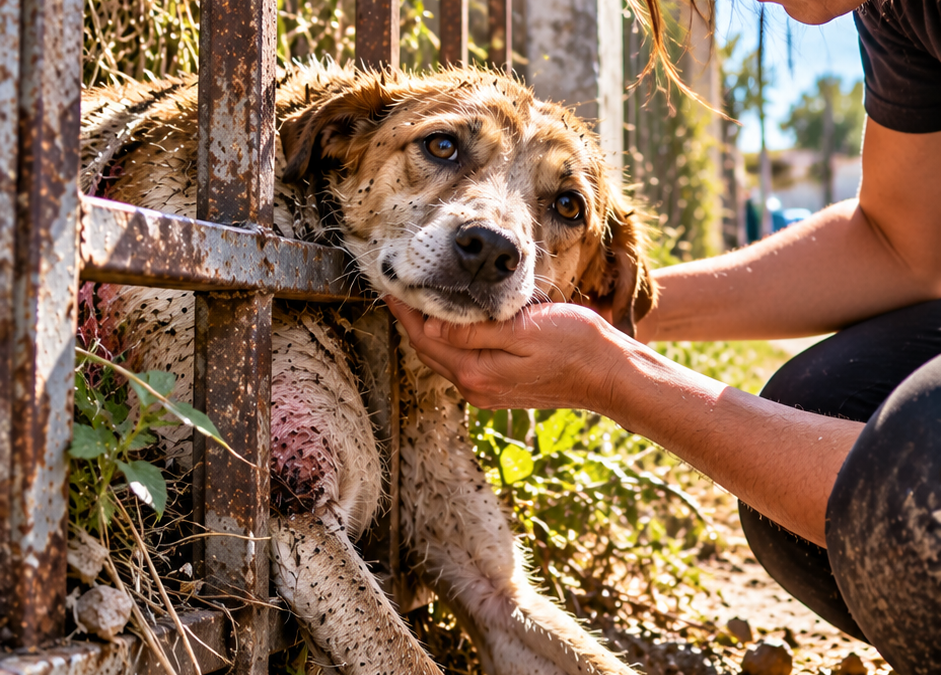
At first, I thought the little dog lying against the fence had already died.
Then I saw her chest rise, and her exhausted eyes slowly turned toward me.
When I knelt beside her and discovered how tightly the metal had trapped her fragile body, I realized that helping her would be far more difficult than I had imagined.
I will never forget the afternoon I found her.
The sun was beating down on the narrow village road, and the heat seemed to rise directly from the pavement. I had been walking through the neighborhood, thinking about the ordinary things that fill an ordinary day, when something beside an old fence caught my attention.
At first, I couldn’t tell what it was.
A small shape lay motionless against the metal, partially hidden by weeds and the shadows cast by the fence posts.
I almost continued walking.
Then I noticed a patch of dirty fur.
I stopped.
Something about the shape didn’t look right.
I stepped closer, pushed aside a few overgrown branches, and felt my stomach tighten.
It was a dog.
A small, terribly thin female dog whose body was wedged between the metal sections of the fence. Her legs were stretched awkwardly beneath her, and her abdomen appeared to be caught against the lower bars.
Her fur was covered in dirt. There were tangled weeds around her body and disturbed patches of earth beneath her paws.
She looked as though she’d been struggling for a very long time.
But what frightened me most was how still she had become.
“Hey, sweetheart,” I whispered. “Can you hear me?”
One of her ears moved.
Then her eyes opened a little wider.
She looked directly at me.
I had seen frightened stray dogs before, but there was something devastating about this little animal’s expression. She didn’t have the strength to bark or pull away. She simply watched me, breathing slowly through her open mouth.
Her sides rose and fell with obvious effort.
I crouched beside the fence.
“Oh, you poor thing. What happened to you?”
She attempted to move her head.
The effort caused her body to shift against the metal.
She immediately stopped.
A faint whimper escaped her.
I froze.
“Okay. Don’t move. Please don’t move.”
I looked at the fence again, trying to understand exactly how she had become trapped.
It appeared that she’d attempted to squeeze through an opening near the bottom. Perhaps she’d smelled food on the other side. Perhaps she had been searching for somewhere shaded and quiet to rest.
I couldn’t know.
All I could see was that she’d managed to push part of her body through before becoming stuck.
The more she’d struggled, the worse her position had become.
The ground around her bore the signs of those desperate attempts.
Loose dirt had been scraped away beneath her paws. Several weeds were flattened, and her fur had become tangled around the lower section of the fence.
I imagined her pulling backward, then trying to push forward, unable to understand why neither movement brought her freedom.
Eventually, she must have exhausted herself.
Now she was lying almost motionless beneath the afternoon sun.
I reached toward her, then stopped.
Her abdomen looked painfully compressed.
I was afraid that pulling her in the wrong direction might cause further injury.
For a moment, I felt completely helpless.
I was close enough to touch her.
She was looking directly at me.
And yet I had no idea how to get her out.
“Just give me a minute,” I whispered. “I’m going to find somebody who can help.”
I stood and looked down the road.
A few houses stood nearby, their doors closed against the afternoon heat. Farther along the street, several people were going about their usual routines.
I called out.
“Excuse me! Can somebody help me?”
A man walking nearby turned toward me.
“What’s wrong?”
“There’s a dog trapped in this fence. I think she’s hurt.”
He hurried over.
When he saw her, his expression changed.
“Oh, my God.”
He immediately crouched beside me.
“How long has she been here?”
“I don’t know. I just found her.”
He examined the position of the metal.
“She’s really stuck.”
“I know.”
He reached toward the fence, then hesitated.
The little dog watched his hand.
She tried to lift her head again, but her strength seemed to disappear halfway through the movement.
The man looked at me.
“We need to get her out of there.”
I nodded.
“But we have to be careful. Look at her stomach.”
He leaned closer.
His face tightened.
“That doesn’t look good.”
I felt an unpleasant chill despite the heat.
The longer I studied her condition, the more concerned I became.
She was painfully thin. Her coat was matted with dirt, and her breathing was slow and heavy. The skin around her abdomen looked irritated where it pressed against the metal.
Even if we managed to free her, she would need rest and proper care.
I didn’t want to imagine what might happen if we left her where she was.
The man stood and called toward one of the nearby houses.
Within minutes, two more residents came over.
A woman brought a bottle of water. Another neighbor appeared with a phone, already searching for the number of a local animal rescue service.
For a brief moment, I felt hopeful.
Surely the professionals would know exactly what to do.
Surely someone with proper rescue equipment could arrive and remove her safely.
The woman with the phone dialed.
We waited.
The call rang.
And rang.
Nobody answered.
She tried again.
Still nothing.
I looked toward the little dog.
Her head had lowered until her chin was almost touching the dirt.
“Try another number,” I said.
The woman nodded and began searching again.
The man beside me crouched near the fence.
“I don’t think she can wait very long.”
Neither did I.
The little dog had been exposed to the sun for an unknown amount of time. Her body was exhausted, and every attempt to reposition herself seemed painful.
We needed to act.
But I couldn’t stop thinking about how vulnerable she was.
A healthy dog might have fought against strangers approaching her.
This dog barely moved.
I wasn’t sure whether she trusted us or simply had nothing left with which to resist.
Either possibility broke my heart.
I lowered myself onto the ground beside her.
“Hey, little girl.”
Her eyes shifted toward me.
“You’re not alone anymore.”
I didn’t know whether those words meant anything to her.
But I needed to say them.
A few minutes earlier, she’d been trapped beside a road where people could pass without realizing she was there.
Now several strangers were standing around her, trying to work out how to save her.
I hoped she could sense the difference.
The woman with the phone tried the rescue service again.
No answer.
She looked up, visibly frustrated.
“What are we supposed to do?”
The man beside the fence examined the opening.
“We might be able to free her ourselves.”
“Will that hurt her?”
“I don’t know. But leaving her like this isn’t an option.”
We exchanged worried glances.
None of us had arrived expecting to perform an animal rescue.
We had no specialized equipment, no veterinary training, and no idea how much internal damage the pressure against her abdomen might already have caused.
But we had something she desperately needed.
We were there.
I looked at the little dog again.
“All right, sweetheart,” I whispered. “We’re going to try.”
I had no idea how long she’d been wandering the neighborhood before becoming trapped.
Looking at her thin body, I suspected that food had been difficult to find.
Her ribs were visible beneath her dirty coat, and her small frame appeared exhausted by more than the immediate ordeal.
Stray animals often spend their days searching for the things most household pets never have to worry about.
A little food.
A drink of water.
Somewhere to escape the heat.
A place to lie down without being chased away.
For an animal living that way, even a small opening in a fence might represent an opportunity.
Perhaps there had been food on the other side.
Perhaps she’d noticed a shaded patch of ground beyond the metal bars.
Perhaps she’d simply been trying to take a shortcut through the neighborhood.
Whatever had drawn her toward the fence, the decision had left her trapped.
And once she’d become stuck, everything she did to escape might have made the situation worse.
I wondered how many times she’d tried.
How many times she’d pulled backward until the metal pressed against her abdomen.
How many times she’d pushed forward, believing she needed only a little more effort to squeeze through.
How long she’d cried before exhaustion silenced her.
There was no way to know.
I could only see the aftermath.
The disturbed ground.
The matted fur.
The trembling legs.
And those exhausted eyes that kept following our movements.
The neighbor beside me gently touched the fence.
“It’s not moving much.”
He tested another section.
The little dog reacted immediately.
Her body stiffened.
“Stop,” I said.
He withdrew his hand.
“Sorry.”
“It’s okay. We just need to figure out where she’s caught.”
I moved closer and studied the metal opening.
Her body was compressed at an awkward angle. The fence seemed to be holding her around the abdomen, leaving little room for her to move either forward or backward.
I was frightened that the pressure had already caused significant bruising.
The woman with the water bottle crouched beside me.
“Can she drink?”
“Let’s see.”
She poured a little water into a shallow container.
I placed it near the dog’s mouth.
The dog looked at it.
For several seconds, she didn’t move.
Then she extended her tongue.
One small lap.
Another.
She stopped and rested her chin against the dirt.
My throat tightened.
I moved the container a little closer so she wouldn’t have to stretch.
“That’s it, sweetheart.”
She drank again.
The woman beside me covered her mouth.
“She’s so weak.”
I nodded.
I couldn’t remember the last time I’d felt so desperate to make a simple movement easier for another living creature.
She wasn’t asking for anything extraordinary.
She needed water.
She needed shade.
She needed the metal removed from around her body.
And she needed somebody to care enough to stay.
The man stood and walked toward a nearby house.
“I’ll see if there’s something we can use.”
I watched him hurry away.
Another resident remained near the road, making sure nobody accidentally approached the little dog too quickly.
The woman beside me continued trying to contact the rescue service.
I stayed on the ground.
Every few minutes, I spoke quietly to the dog.
Sometimes her eyes moved toward me.
Sometimes she seemed too exhausted to respond.
Once, I extended my hand toward her head.
She flinched.
I immediately stopped.
“It’s okay. I won’t touch you.”
She watched me.
I left my hand on the ground a short distance from her.
After a while, she lowered her head again.
I didn’t want her to feel that she had to defend herself against the very people trying to help.
She had already struggled enough.
The man returned with another neighbor.
They examined the fence carefully.
One of them suggested trying to create a little more space around her body rather than dragging her through the opening.
That seemed safer.
We discussed how to support her if the pressure suddenly released.
I volunteered to remain beside her head.
The woman with the water offered to help keep her calm.
The others positioned themselves near the fence.
For a moment, we simply looked at one another.
There was no guarantee that she wouldn’t panic.
There was no certainty that we’d understood exactly where she was caught.
And there was the painful possibility that freeing her might reveal injuries more serious than we could manage ourselves.
But none of us wanted to walk away.
“Ready?” the man asked.
I nodded.
“Let’s do it slowly.”
He began carefully adjusting the section of fencing around her.
The metal shifted slightly.
The dog lifted her head.
A frightened whimper escaped her.
“Easy,” I whispered. “You’re okay.”
She looked directly at me.
For the first time, I noticed how young she seemed beneath the exhaustion.
Her face was small and delicate.
Her ears were dirty and flattened against her head.
There was something terribly vulnerable about the way she watched me, as though she were trying to decide whether the hands surrounding her would bring relief or more pain.
I wished I could explain everything.
I wished I could tell her that the pressure would soon disappear.
That we weren’t trying to hurt her.
That nobody was going to leave her trapped there.
But she couldn’t understand our plans.
She could only experience each movement as it happened.
The metal shifted again.
Her body trembled.
“Wait,” I said.
Everyone stopped.
I leaned closer.
“You’re doing so well, sweetheart.”
Her eyes remained fixed on me.
I gently placed my hand near her shoulder.
This time, she didn’t pull away.
I let my fingers rest lightly against her fur.
Her coat felt rough beneath my hand, stiff with dirt and dust.
I could feel her body trembling.
For several seconds, I couldn’t speak.
There is a particular kind of helplessness that comes from touching a suffering animal and realizing that comfort is the only thing you can offer at that exact moment.
I couldn’t erase the hours she’d spent trapped.
I couldn’t undo the bruising around her abdomen.
I couldn’t make the heat disappear.
But I could stay beside her.
So I did.
The neighbors resumed their careful work.
The fence moved a little farther.
One person gently supported her body while another worked to create enough space for her to come free.
She let out a sharper whimper.
My heart jumped.
“Stop!”
The movement ceased immediately.
The man looked toward me.
“She’s almost out.”
I glanced at the opening.
He was right.
The metal was no longer pressing as tightly against one side of her abdomen.
But her body remained awkwardly positioned.
I was afraid that moving her too quickly might cause another injury.
“Let’s give her a second.”
We waited.
She breathed heavily.
Her eyes closed briefly.
Then she opened them again.
The woman beside me gently adjusted the water container.
The dog didn’t drink.
She simply watched us.
I looked at the people gathered around her.
A short time earlier, we’d all been strangers going about our individual routines.
Now we were kneeling together beside a fence, working carefully to save a little dog none of us knew.
Nobody was asking who would take responsibility afterward.
Nobody was arguing about whose property the fence belonged to.
Nobody was complaining about the time.
All our attention was focused on one small, frightened animal.
The man near the fence looked at me.
“One more try.”
I took a breath.
“Okay.”
He carefully created a little more space.
Another neighbor supported the dog’s body.
For a moment, nothing happened.
Then the pressure began to release.
I saw her abdomen shift away from the metal.
“That’s it,” I whispered.
The man adjusted his grip.
“Almost there.”
I kept my hand near her shoulder.
She trembled, but she didn’t struggle.
Then, with one final careful movement, her body came free.
For a second, nobody spoke.
We were all watching her.
The man slowly moved his hands away from the fence.
The woman beside me let out a shaky breath.
“She’s out.”
I looked down at the little dog.
She was lying on the ground, no longer trapped between the metal bars.
Her body was free.
But she didn’t attempt to stand.
She remained exactly where we’d placed her, breathing heavily, her eyes moving between the strangers gathered around her.
I felt tears rising.
“Oh, sweetheart.”
I reached toward her.
She didn’t flinch.
I gently stroked the side of her head.
“You did it. You’re out.”
The dog gave a faint whimper.
It was such a small sound that I almost missed it.
But after watching her struggle against the fence, hearing that little cry affected me more deeply than I expected.
I couldn’t know whether she understood what had happened.
I couldn’t know whether the sound came from pain, exhaustion, or the sudden release of pressure.
But I knew that she was finally free.
And that was the first moment I allowed myself to feel relief.
The relief didn’t last long.
As soon as we could see her entire body, the extent of her injuries became more apparent.
Her abdomen was bruised and tender.
The fur around the areas where she’d been trapped was dirty and disturbed.
Her breathing remained heavy, and her legs trembled whenever she attempted to reposition herself.
The woman beside me looked toward the exposed skin.
“Oh, that poor baby.”
I swallowed.
“She’s going to need medical attention.”
The man who had helped free her nodded.
“Definitely.”
I looked down at her again.
She was no longer trapped, but she was still exhausted and vulnerable.
The fence had been only the most immediate danger.
We still had to protect her from the heat and make sure her injuries received proper care.
The afternoon sun had become almost unbearable.
The ground was hot, and there was very little shade beside the road.
One of the neighbors hurried back to her house.
“I have an umbrella.”
I looked toward her.
“Please bring it.”
She returned a moment later carrying a large umbrella.
Together, we positioned it above the little dog, shielding her from the direct sunlight.
The difference was immediate.
The harsh brightness disappeared from her face, replaced by a patch of gentle shade.
She blinked.
Then she lowered her head against the ground.
I sat beside her.
The woman holding the umbrella adjusted it so that her entire body remained protected.
“Is that better, little one?” she whispered.
The dog didn’t respond.
But her breathing gradually appeared less frantic.
I looked up at the woman.
“Thank you.”
She shook her head.
“Poor thing. I can’t believe she was stuck like that.”
Neither could I.
Now that the immediate struggle was over, the emotional weight of what we’d witnessed began to settle around us.
The little dog had been fighting alone.
She’d pulled and twisted against the fence until she had no strength left.
Then she’d lain in the heat, unable to move away, waiting for something she had no reason to expect.
I wondered what would have happened if I’d walked past without noticing her.
I tried not to imagine it.
The man who had helped free her crouched nearby.
“She really fought to get out.”
I looked at the disturbed dirt beneath the fence.
“She must have been terrified.”
He nodded.
Then he glanced toward her bruised abdomen.
“At least she’s not stuck anymore.”
I stroked her head.
“At least she’s not alone.”
The little dog lifted her eyes toward me.
For several seconds, we looked at one another.
There was no sudden transformation.
She didn’t leap to her feet or begin wagging her tail.
She didn’t seem miraculously healed because we’d removed the fence from around her.
She was still a terribly exhausted stray who had suffered a frightening ordeal.
But she could finally lie in a position that didn’t force her abdomen against the metal.
She could drink water without stretching toward a container while trapped.
And she could rest beneath the shade of an umbrella held by someone who cared about her.
Those things mattered.
I offered her a little water again.
This time, she managed a few cautious laps.
“Good girl.”
She stopped and looked at me.
I smiled.
“That’s enough for now.”
The woman beside me crouched a little lower.
“She’s beautiful.”
I studied the dog’s dirty coat.
At first glance, there was nothing remarkable about her appearance.
She was small, thin, covered in dust, and visibly injured.
But as I watched her lying quietly beneath the umbrella, I understood what the woman meant.
There was something extraordinary about the vulnerability of an animal who had endured so much and still allowed us to sit beside her.
The dog’s eyes followed the woman’s hand.
After a moment, she allowed her to touch the top of her head.
The woman smiled through tears.
“Oh, sweetheart.”
A faint whimper escaped the dog.
I looked away.
I hadn’t expected the rescue to affect me this deeply.
I had simply stopped because something beside the fence looked unusual.
Now I was sitting on the ground with strangers, trying not to cry over an animal whose name I didn’t even know.
We remained beside her while the afternoon continued around us.
Vehicles passed.
Doors opened and closed in nearby houses.
Ordinary conversations drifted along the street.
But the little patch of shade beside the fence had become the center of our attention.
One neighbor offered to bring another container of water.
Another said she would continue trying to reach the rescue service.
The man who had helped release the dog examined the opening in the fence, concerned that another animal might become trapped there.
Everyone seemed to have found something useful to do.
I stayed beside the dog.
Every so often, I spoke to her.
“How are you doing, sweetheart?”
She usually answered by looking at me.
Sometimes she lowered her head again.
Once, when I gently touched the fur near her neck, she leaned slightly toward my hand.
I stopped moving.
“That’s it.”
Her eyes softened.
The movement was small, but it made something inside me ache.
For a dog who had been trapped, injured, and surrounded by strangers, leaning toward a human hand required trust.
I couldn’t know whether she had once belonged to somebody.
I couldn’t know whether she’d been abandoned or had spent her entire life living on the streets.
And I didn’t want to invent a tragic past simply because the present was already heartbreaking.
What mattered was that she was frightened and hurt now.
And what happened next would depend on whether the people around her continued caring after the excitement of the rescue had passed.
The woman holding the umbrella looked toward me.
“What do you think she was trying to get through there for?”
I glanced at the fence.
“Food, maybe. Or somewhere to sleep.”
She shook her head.
“Imagine getting trapped just because you’re hungry.”
I looked at the little dog.
The thought was almost unbearable.
A household pet might walk from one room to another when it wanted food.
It might scratch at a door when it wanted to go outside.
It might curl up on a comfortable blanket when it grew tired.
This little dog had no such guarantees.
Every day might have required another search.
Another attempt to find something edible.
Another struggle to locate water.
Another place where she hoped she could rest without being disturbed.
And on this particular day, that search had led her into a trap.
I wondered how many people had passed her while she struggled.
Perhaps nobody had noticed.
Perhaps the fence had hidden her from the road.
Perhaps someone had seen movement but assumed she could free herself.
I didn’t know.
And I had no right to condemn strangers whose circumstances I couldn’t see.
Still, looking at her exhausted body, I wished that someone had found her sooner.
The bruising along her abdomen reminded me that freeing her was only the beginning.
She needed time to recover.
She needed careful examination.
She needed a safe place where her body could rest without the constant threat of another dangerous encounter.
I hoped we could arrange all of that.
But for the moment, I focused on the things directly in front of me.
Keeping her shaded.
Making water available.
Avoiding unnecessary movement.
And ensuring she didn’t have to face another frightening situation alone.
The little dog shifted slightly.
I watched her carefully.
She brought one front paw closer to her chest, then settled again.
The woman beside me leaned forward.
“Is she trying to stand?”
“I don’t think she’s ready.”
The dog made another small adjustment.
Her hind legs trembled.
I gently rested my hand near her shoulder, making sure she had room to settle comfortably.
“Don’t rush, baby.”
She lowered her head.
I let out a breath.
After seeing how tightly she’d been trapped, I was afraid of every movement that might cause her more pain.
The man beside the fence looked toward us.
“Do you think she’s going to be okay?”
I wanted to say yes.
I wanted to reassure everyone that the hardest part was over.
But her injuries were serious enough that I couldn’t make promises.
“I think she has a chance now,” I said.
He nodded slowly.
“That’s something.”
I looked at the little dog.
It was more than she’d had when I first found her.
The rescue had begun with a frightening discovery and several unanswered phone calls.
None of us had known how to remove her from the fence.
We had worried about hurting her.
We had hesitated, discussed our options, and tried to act as carefully as possible.
But we’d stayed.
And because we’d stayed, she was no longer trapped.
I thought about that while she rested beneath the umbrella.
There are moments when the most important thing a person can do is refuse to walk away simply because a situation is difficult.
Not because they know everything.
Not because they’re certain of the outcome.
But because the life in front of them needs help, and leaving would make an already terrible situation worse.
I watched the little dog’s eyes close.
For the first time since finding her, she seemed able to rest without the metal fence pressing into her body.
I kept my hand beside her.
The woman continued holding the umbrella.
And the others remained close enough to help if we needed them.
I don’t know how long we stayed that way.
Time seemed to move differently once the emergency had passed.
Every small improvement caught our attention.
A calmer breath.
A slight movement of her ears.
A cautious sip of water.
A moment when she relaxed enough to close her eyes.
We treated each one as a reason to be hopeful.
Not because those signs guaranteed recovery.
But because we’d seen how close she had come to losing every bit of strength she possessed.
The woman with the phone eventually returned to our little group.
She was still trying to arrange additional assistance.
I looked at her.
“Any luck?”
“Not yet.”
She glanced at the dog.
“How’s she doing?”
“She’s resting.”
The woman crouched beside us.
Her expression softened.
“She looks a little more comfortable.”
I nodded.
“I think the shade is helping.”
The little dog opened her eyes at the sound of our voices.
She looked from one person to another.
Then she lowered her head again.
The woman reached out cautiously.
“Can I pet her?”
“Just be gentle. She’s still hurting.”
She touched the dog’s head.
The dog allowed it.
For a few moments, nobody said anything.
Three strangers sat beside a small injured animal while another held an umbrella above her.
It was such a simple scene.
Yet I knew I would remember it long after the details of that afternoon had faded.
I would remember the man’s worried expression as he examined the fence.
I would remember the repeated unanswered calls.
I would remember the woman returning with the umbrella and holding it above a dog she had never met.
And I would remember the faint whimper the little animal made when she was finally free.
That sound stayed with me most.
It wasn’t loud.
It wasn’t dramatic.
It was simply the exhausted voice of a creature who had endured more than her small body should have been asked to bear.
I looked at her bruised abdomen again.
We had managed to remove the immediate danger, but I knew her body still had healing ahead of it.
She would need patience.
She would need careful handling.
She would need people willing to see her recovery through rather than assuming that freedom from the fence meant she no longer required help.
I gently brushed a little loose dirt from her fur.
She watched me.
“You’re going to need some time, aren’t you?”
Her eyes remained fixed on my face.
I smiled sadly.
“That’s okay. You’ve already worked hard enough for one day.”
She lowered her head.
The woman beside me quietly adjusted the umbrella as the sun shifted.
I looked around at the people who had gathered.
Nobody had expected to spend the afternoon rescuing a stray dog.
We’d been strangers or casual neighbors, people whose lives might never have crossed beyond an occasional greeting.
But an exhausted little animal had brought us together.
And now, sitting beside her, I found myself feeling grateful for every person who had stopped.
The man who had helped create space around the fence.
The woman who’d offered water.
The neighbor who’d repeatedly attempted to contact the rescue service.
The person who’d thought to bring an umbrella.
None of those actions had seemed especially dramatic on their own.
Together, they had given the dog something she hadn’t possessed while trapped.
A way out.
A little comfort.
And people who were no longer willing to overlook her suffering.
I thought about how differently the afternoon might have ended.
Then I looked at the little dog resting beneath the shade and pushed that thought away.
She was here.
She was breathing.
She was free.
And for now, that was where I wanted to keep my attention.
As the afternoon wore on, I found myself wondering what a safe life might look like for her.
I imagined her resting somewhere clean, no longer forced to search for shelter beneath the unforgiving sun.
I imagined her receiving proper food and medical care.
I imagined the bruising fading, her body becoming stronger, and the fear slowly disappearing from her eyes.
Perhaps one day she would learn to approach people without hesitation.
Perhaps she would discover the comfort of a soft bed.
Perhaps someone would give her a name and recognize the sound of her footsteps moving through their home.
Those were hopes, not promises.
We still had to address the injuries she’d suffered.
But as I watched her resting beside us, I wanted her future to contain something more than another desperate search for food.
I wanted her to experience a day when she could simply lie down because she was tired, not because she’d exhausted herself fighting against a fence.
A day when an approaching stranger meant a gentle hand rather than another reason to be frightened.
A day when she could sleep without worrying about where she would find water the next morning.
I looked at her small body and wondered whether those ordinary comforts would ever become part of her life.
The woman holding the umbrella noticed my expression.
“What are you thinking?”
I hesitated.
“Just that she deserves better than this.”
She looked down at the dog.
“She certainly does.”
For a while, we sat in silence.
The heat remained oppressive beyond the shade.
But underneath the umbrella, the little dog seemed more comfortable.
She no longer struggled against the metal.
She no longer pulled at the ground in a hopeless attempt to escape.
She rested with her eyes partially closed, occasionally looking toward the people sitting beside her.
At one point, she lifted her head and gave another soft whimper.
I leaned closer.
“Hey, sweetheart.”
She looked at me.
I placed my hand gently against the side of her face.
“It’s all right. You’re not stuck anymore.”
Her eyes closed.
She remained still beneath my hand.
And I felt a familiar ache behind my eyes.
I didn’t need her to wag her tail.
I didn’t need her to stand up and demonstrate that everything was suddenly fine.
I didn’t need a dramatic gesture that made us feel like heroes.
Her willingness to rest while we sat beside her was enough.
We had found her at a moment when she had almost no strength left.
Now, at least, she didn’t have to spend that remaining strength trying to escape.
The fence stood a short distance away, its opening no longer wrapped around her body.
I glanced at the disturbed ground beneath it.
The marks of her struggle were still visible.
It was difficult to look at them without imagining the hours she might have spent trapped there.
I wondered how she had kept going.
What had driven her to continue pulling and twisting long after the effort must have become painful.
Perhaps it was nothing more complicated than the instinct to survive.
Perhaps she had simply refused to stop until her body could no longer continue.
Whatever the reason, she had endured long enough for someone to find her.
And when we finally removed the fence from around her, she had allowed us to help.
I looked down at the little dog and gently stroked her head.
“You’ve been very brave.”
She opened one eye.
I smiled.
“Very, very brave.”
The woman beside me laughed softly through her tears.
“She has.”
We couldn’t know what the dog understood.
But I liked to think that the tone of our voices had become familiar.
That she could recognize the difference between the frightening movements of being trapped and the gentle hands now surrounding her.
That after hours of struggling alone, she had begun to understand that she no longer had to solve every problem by herself.
I stayed beside her while the other residents continued arranging the help she needed.
Nobody suggested putting her back near the fence.
Nobody treated the rescue as finished simply because we’d managed to pull her free.
We all understood that her bruised abdomen and exhausted body required further attention.
And although none of us could predict how quickly she would recover, we were determined not to let her return immediately to the same desperate circumstances in which we’d found her.
The moment that affected me most came as I prepared to move away from her side.
I had been sitting on the ground for so long that my legs were beginning to ache.
I shifted carefully, intending to stand and give the others a little more room.
The little dog’s eyes opened.
She lifted her head slightly.
Then she made a faint sound.
I stopped.
For a moment, I wondered whether the movement had frightened her.
I lowered myself again.
“Hey. I’m still here.”
She looked directly at me.
I extended my hand.
Her nose moved toward my fingers.
Then she rested her head against the ground again.
I felt my throat tighten.
I couldn’t know whether she’d been asking me to stay.
But after seeing how frightened and exhausted she’d been, I found it impossible to walk away at that moment.
I sat beside her again.
“All right,” I whispered. “I’ll stay a little longer.”
The woman with the umbrella smiled.
“Looks like she likes you.”
I looked at the dog.
“Maybe she’s just tired of being alone.”
The woman didn’t answer.
She didn’t need to.
We sat quietly while the little dog rested between us.
I thought about all the times I’d walked past fences without noticing what lay on the other side.
All the times I’d seen stray animals moving through neighborhoods and wondered vaguely where they slept.
I’d known, in an abstract way, that life was difficult for animals without homes.
But abstract knowledge felt very different from kneeling beside a small dog whose abdomen was bruised from struggling against metal.
It felt different when I could see the dirt embedded in her fur.
When I could hear her exhausted breathing.
When I could feel her trembling beneath my hand.
The experience had made suffering impossible to keep at a comfortable distance.
This wasn’t an anonymous stray anymore.
She was a living creature I’d met at one of the worst moments of her life.
And for reasons I couldn’t fully explain, I felt responsible for making sure that the next moments were better.
The sun had begun moving lower by the time I finally stood.
The umbrella still shielded her from the heat.
The water remained nearby.
The neighbors were continuing to make arrangements for her care.
I looked down at the little dog one last time.
She was lying comfortably enough to rest, although her injuries were still plainly visible.
Her eyes followed me as I moved.
I crouched again.
“You’re a good girl.”
She blinked.
I gently stroked her head.
“You’ve been through something terrible today. But you’re not alone now.”
Her tail didn’t wag.
She didn’t leap into my arms.
She simply lowered her head against the ground and let me touch her.
And after everything I’d witnessed, that small moment felt deeply meaningful.
I thought about the first time I’d seen her beside the fence.
How frightened I’d been by her stillness.
How uncertain we’d all felt when the rescue service failed to answer.
How carefully we’d worked, stopping whenever she cried and trying to create enough space to release her without making the injury worse.
I remembered the moment her body finally came free.
And I remembered the way everyone around her seemed to breathe again.
The afternoon hadn’t unfolded the way any of us expected.
We had gone from strangers passing one another on a village road to people working together to save an injured animal.
We hadn’t possessed specialized equipment or the confidence that comes from years of rescue experience.
We had simply recognized that she needed help and remained beside her until we found a way to provide it.
Now she was resting beneath an umbrella, surrounded by people who cared what happened to her next.
It wasn’t the end of her recovery.
Her bruised abdomen still needed attention.
Her exhausted body still needed rest.
And her future remained uncertain.
But the terrible struggle against the fence was over.
For the first time since becoming trapped, she could lie down without metal pressing painfully into her body.
She could drink water.
She could rest in the shade.
And when she opened her eyes, she no longer saw an empty roadside.
She saw people sitting beside her.
I looked at her once more before turning my attention to the neighbors arranging her next steps.
The little dog rested her head on the ground.
A soft whimper escaped her.
Then she closed her eyes.
I stayed close, watching the gentle rise and fall of her chest, grateful that we’d reached her before her strength disappeared completely.
I didn’t know what her life had been like before that afternoon.
I didn’t know how long she’d been hungry, how many nights she’d spent searching for somewhere safe to sleep, or how many people had passed her without noticing.
But I knew what had happened when she finally needed help most.
Someone had stopped.
Others had gathered.
And together, we’d freed her.
As I sat beside that little dog beneath the umbrella, I realized that the moment I would remember most wasn’t the instant we pulled her from the fence.
It was what happened afterward.
She had nothing left to fight against.
And for the first time that afternoon, she was finally able to rest.








