𝗙𝗨𝗟𝗟 𝗦𝗧𝗢𝗥𝗬 I Found a Puppy Hiding Beneath a Fallen Labrador—What He Was Waiting For Broke Me
𝗙𝗨𝗟𝗟 𝗦𝗧𝗢𝗥𝗬
The puppy screamed when we separated the mats.
That was the first sound he made.
Not a bark.
Not even a normal puppy cry.
A high, broken wail that stopped everyone in the treatment room.
I had placed the Labrador on one padded mat and the puppy on another, maybe three feet apart.
Protocol.
Space to examine them.
Separate equipment.
Separate monitoring.
The puppy didn’t care about protocol.
The moment the Labrador moved away, his entire body changed.
He scrambled forward.
His left front paw dragged slightly.
He slipped on the towel.
Tried again.
The sound coming out of him was pure panic.
“Stop.”
One of the technicians looked at me.
“We need room.”
“I know.”
The puppy lunged toward the Labrador again.
“Put the mats together.”
She hesitated.
“Do it.”
We pushed them side by side.
The puppy immediately crawled against the Labrador’s chest.
Silence.
Instant.
His shaking didn’t stop, but the screaming did.
The Labrador’s eyes opened.
He turned his muzzle toward the pup.
Then rested his head partly over him.
The puppy disappeared beneath that golden neck.
“Okay.”
I exhaled.
“So that’s how this is going to work.”
The veterinarian, Dr. Park, crouched beside them.
“Apparently.”
We started with the Labrador.
Male.
Older adult.
Maybe seven or eight.
Dehydrated.
Hypothermic despite the mild California temperature because prolonged flood exposure steals heat differently than open air.
Multiple abrasions.
Possible aspiration.
His breathing was wrong.
Wet.
Effortful.
The puppy watched every hand.
Every instrument.
Every movement.
“Can someone hold him?” Dr. Park asked.
I reached.
The puppy flattened.
No growl.
No bite.
Just terror.
I pulled back.
“I’ll work around him.”
We did.
Slowly.
The Labrador tolerated everything.
Oxygen.
IV.
Temperature check.
Chest auscultation.
He never fought.
But every time the puppy shifted, his eyes opened.
Checking.
Even half-conscious, he was checking.
“One protective old man,” the technician whispered.
I looked at him.
“Yeah.”
We scanned both for microchips.
Nothing.
No collars.
No tags.
The Labrador had a strip of torn green fabric tangled around his neck.
Heavy material.
Camping tarp, maybe.
No identifying mark.
The puppy had nothing.
No chip.
No collar.
No clue.
We needed names for records.
Someone asked, “What are we calling them?”
I looked at the Labrador.
“Hugo.”
“Why?”
“Looks like a Hugo.”
Nobody argued.
Then the puppy.
He watched me from beneath Hugo’s chin.
White shepherd.
Sharp little face.
Mud almost dry around his ears.
“Axel.”
The technician wrote both names.
HUGO — ADULT MALE LABRADOR.
AXEL — APPROX. 3-MONTH-OLD MALE GERMAN SHEPHERD.
Found together.
Flood zone.
Watsonville.
That was all we knew.
Hugo took fluids well.
Axel refused everything.
Food.
Water.
Even electrolyte gel.
If Hugo licked a wet towel, Axel would lick the same place afterward.
If Hugo touched a bowl, Axel might take one sip.
Otherwise nothing.
“He’s medically stable enough to eat,” Dr. Park said.
“Trauma?”
“Probably.”
Axel watched us.
“What happened to you?”
His ears lowered.
No answer.
The damaged front paw turned out to be soft-tissue trauma.
No fracture.
Likely strain or impact.
Compared with everything else, that was good news.
Hugo worried us more.
His oxygen saturation improved briefly.
Then dropped.
His breathing became increasingly labored.
By evening, crackles deepened across both lungs.
Dr. Park’s expression tightened.
“Aspiration.”
“How much?”
“Enough.”
“Pneumonia?”
“Possibly beginning.”
Axel pressed his face into Hugo’s chest.
Hugo breathed around him.
Slow.
Heavy.
Wrong.
I stayed.
Not because I had to.
My shift had technically ended hours earlier.
The roads were still bad.
There were other animals coming in.
Plenty to do.
But every time I tried to step away, Axel watched.
Not me.
Hugo.
Like leaving the room might cause him to disappear.
I sat on the floor instead.
Around midnight, most of the center had quieted.
Generators hummed.
Rain tapped the windows.
Hugo slept badly.
Axel did not sleep at all.
Every time Hugo’s breathing changed, Axel’s head snapped up.
He would crawl closer.
Place one paw against Hugo’s ribs.
Wait.
Breath.
Breath.
Breath.
Then settle again.
It looked like he was counting.
Are you still here?
Still?
Still?
Around three in the morning, Hugo’s breathing worsened quickly.
I was sitting beside them when he stretched his neck and coughed.
A deep, wet cough.
Foam appeared around his mouth.
“Dr. Park!”
She came running.
Monitor.
Oxygen.
Assessment.
Hugo tried to lift his head.
Failed.
Axel stood over him.
The puppy’s entire body shook.
Dr. Park looked at me.
“We need to drain fluid and evaluate his chest immediately.”
“Sedation?”
“Yes.”
Axel would have to move.
I knew what was coming before I touched him.
“Buddy.”
His eyes turned toward me.
“We need Hugo.”
I reached.
Axel snapped.
Not to bite.
He closed his teeth against air several inches from my hand.
Then planted himself between Hugo and us.
Three months old.
Maybe twenty pounds.
Wet.
Limping.
Terrified.
Standing against four adults.
His tail tucked beneath him.
His ears flat.
His teeth visible.
He had no chance of stopping us.
Still he stood.
“No.”
I crouched.
“Axel.”
His breath came fast.
“We’re not taking him away.”
He trembled harder.
“We’re helping.”
I pointed toward Hugo.
The dog coughed again.
Axel turned.
Sniffed his face.
Then looked back at me.
“You want him here?”
His ears flicked.
“Then let us do this.”
Ridiculous conversation.
Yet I swear the puppy listened.
He looked at Hugo.
Then at Dr. Park.
Then at me.
Slowly, he stepped sideways.
One foot.
Nothing more.
But enough.
“Thank you.”
We moved Hugo.
Axel followed immediately.
Step.
Drag.
Step.
Drag.
His damaged paw struggling to keep up.
When we reached the procedure-room door, I blocked him.
“No.”
He tried to squeeze through.
“Axel.”
He screamed.
That sound went straight through me.
He clawed at the door after it closed.
Again.
Again.
Again.
I picked him up.
He twisted.
“Stop.”
He fought harder.
Not against me.
Toward the door.
“Hugo is right there.”
Another scream.
I set him down.
Axel planted himself against the bottom crack beneath the door.
Nose pressed to it.
Waiting.
I sat beside him.
Three hours.
That was how long Hugo remained inside.
Dr. Park sedated him.
Removed fluid.
Cleared debris.
Supported his breathing.
Treated aspiration injury.
The material they removed was brown-gray and foul.
Floodwater.
Mud.
Field debris.
Whatever Hugo had inhaled while keeping himself above water.
Dr. Park later said it was astonishing he had stayed conscious as long as he did.
I looked at Axel.
Maybe that was why.
Axel refused food again.
Wouldn’t drink.
Didn’t lie down.
Just sat.
Nose near the door.
At some point I said, “You’re going to make yourself sick.”
His ears twitched.
“Helpful advice from a human who hasn’t slept either.”
Nothing.
I leaned against the wall.
And then the past showed up.
I was twelve when my younger brother drowned.
His name was Caleb.
Seven years old.
Our parents had left us near the lake behind our house.
I was supposed to watch him.
I turned away.
How long?
Two minutes?
Five?
Time becomes unreliable around guilt.
When I looked again, Caleb was gone.
I found him in the water.
Pulled him out.
Held him.
Waited for him to move.
People came.
Ambulance.
Paramedics.
My mother screaming.
But the thing I remembered most was the weight.
I held him tightly because some part of me believed letting go would make death permanent.
If I held on, maybe he was still my brother.
Maybe he would open his eyes.
Watching Axel beneath that door, I felt twelve years old again.
Waiting.
Begging silently.
Please come back.
I put one hand beside the puppy.
Didn’t touch him.
“Yeah.”
Axel remained focused on the door.
“I know.”
Three hours passed.
Then a sound came from inside.
A thump.
Axel exploded upward.
One bark.
The first real bark I had heard from him.
He scratched at the door.
“Wait.”
Another thump.
I opened it before someone could stop me.
Hugo lay on the procedure table.
Awake.
Barely.
A drainage tube ran from his side.
His eyes were half-open.
But they were searching.
Axel shot between my legs.
“Axel!”
Too late.
He jumped against the table.
Couldn’t reach.
I lifted him.
“Easy.”
He twisted free enough to press himself against Hugo’s chest.
Dr. Park started to intervene.
Then stopped.
Hugo’s head moved.
Slow.
His paw lifted.
Shook.
Then settled over Axel’s back.
Everyone froze.
Axel stopped trembling.
Completely.
He buried his face beneath Hugo’s chin.
Hugo closed his eyes.
His paw remained there.
Dr. Park whispered, “Well.”
I swallowed.
“Yeah.”
We left them that way as long as medically safe.
No one spoke much.
There wasn’t much to say.
Sometimes animals create a scene so emotionally precise that language only makes it smaller.
Hugo had spent hours protecting Axel from floodwater.
Now he was barely awake from sedation, and the first thing he did was place a paw over him again.
Still here.
Still yours.
Still.
Hugo improved over the next forty-eight hours.
Slowly.
His lungs sounded better.
Oxygen requirement dropped.
He ate.
Axel began eating too.
Not much.
But if Hugo put his face near a bowl, Axel followed.
If Hugo drank, Axel drank.
We joked that Hugo was his official food tester.
It wasn’t funny enough to hide what it meant.
Axel did not trust survival unless Hugo demonstrated it first.
Then Ellie arrived.
Two days after Hugo woke, reception called me.
“Woman here about the Labrador.”
I walked into the lobby.
She stood holding a folder and a blanket.
Mid-thirties maybe.
Mud dried along her boots.
Red-rimmed eyes.
She looked like someone operating on almost no sleep.
“I’m Ellie Mercer.”
“You think Hugo belongs to you?”
Her mouth trembled when she heard the name.
“Hugo.”
She pressed one hand to her lips.
“That’s him.”
She showed photographs.
Hugo on a couch.
Hugo beside a tent.
Hugo wearing a black bandana.
Hugo with a man in a baseball cap.
Hugo standing beside a truck.
Same markings.
Same scar near the right ear.
No doubt.
I exhaled.
“Come with me.”
She stopped.
“Is he alive?”
“Yes.”
Her knees nearly gave.
I caught her elbow.
“Sorry.”
“No.”
She covered her face.
“I’ve been looking.”
I waited.
Then she said the sentence that changed our understanding of everything.
“He was with my husband.”
The man in the photographs.
Cole.
They had been camping near the river when the flash flood warnings became evacuation orders.
Water rose faster than expected.
Cole went to secure the truck and retrieve Hugo.
Neither returned.
Ellie escaped with another camper.
Search teams found Cole downstream the following day.
Dead.
Hugo was missing.
Until our post.
Ellie cried quietly while telling me.
No performance.
No collapse.
The controlled grief of someone who had already repeated the story to police, rescue teams, family, and herself a hundred times.
“I thought Hugo died with him.”
“He almost did.”
She looked toward the treatment rooms.
“Can I see him?”
“Yes.”
I hesitated.
“There’s something else.”
“What?”
“We found him protecting a puppy.”
Her expression changed.
“What puppy?”
“You don’t know him?”
“No.”
“White German Shepherd. Around three months.”
She shook her head.
“We only had Hugo.”
I explained.
The road.
Floodwater.
Axel underneath.
Hugo shielding him.
Ellie closed her eyes.
A painful smile appeared.
“That sounds like him.”
“What?”
“Hugo.”
She looked down at the blanket she carried.
“He once climbed into a drainage ditch because a baby goat fell in.”
I smiled.
“Of course he did.”
“He hates swimming.”
I stared.
She laughed through tears.
“Really. He hates deep water. Cole used to joke Hugo would step around a puddle unless somebody needed help. Then he’d go through anything.”
We reached Hugo’s recovery room.
Axel saw Ellie first.
His body stiffened.
She stopped.
“Is that him?”
“Yes.”
Axel moved in front of Hugo.
Not growling.
Not barking.
Simply positioning himself.
Ellie took one slow step.
Axel lowered his head.
“That’s enough,” I said.
She immediately stopped.
“I’m sorry.”
“No, you’re doing fine.”
Hugo lifted his head.
He smelled the air.
Then everything changed.
His ears rose.
His eyes widened.
He struggled upright.
Ellie made a sound between a laugh and a sob.
“Hugo.”
His tail hit the mat.
Once.
Twice.
Harder.
He tried to stand.
“Don’t.”
She dropped to her knees.
Hugo dragged himself forward.
Axel blocked her for one second.
Then Hugo pushed past him.
Ellie wrapped both arms around the Labrador’s neck.
“I thought you were dead.”
Hugo whined.
A deep, aching sound.
“I’m sorry.”
He licked her face.
“I’m sorry.”
Axel stood several feet away.
Watching.
Confused.
Afraid.
Hugo belonged to somebody.
For the first time since we found him, Axel faced a threat worse than water.
He might lose the one creature keeping his world together.
Ellie noticed him.
Her hand remained on Hugo.
“Come here.”
Axel backed up.
“No.”
She withdrew her hand.
“Okay.”
I sat beside him.
“He doesn’t know what this means.”
Ellie looked at me.
“What do you mean?”
“If Hugo goes home and Axel stays…”
Her face changed.
“I can’t.”
“I know.”
“Not after…”
“I know.”
She stared at the puppy.
Axel crept toward Hugo.
Placed himself against his side.
Hugo immediately lowered his head over him.
Ellie cried again.
Then she sat on the floor.
“All right.”
I waited.
“Hugo doesn’t leave without him.”
I stared.
“You’re sure?”
She nodded.
“Cole would never forgive me.”
“That’s a lot to decide in one minute.”
“No.”
She wiped her face.
“I’ve known Hugo eight years.”
Her gaze went to Axel.
“If he kept that baby alive through a flood, then Hugo already decided.”
Axel watched her.
Ellie placed her palm on the floor several feet away.
No reaching.
No pressure.
“I’m not taking him.”
Axel’s nose moved.
“Neither of you.”
That first visit lasted an hour.
Ellie told stories.
Hugo stealing hamburgers from a picnic table.
Hugo sleeping with his head on Cole’s work boots.
Hugo barking at inflatable lawn decorations.
Hugo avoiding swimming pools while happily jumping into irrigation canals if another animal needed help.
Axel listened.
Or maybe just listened to her tone.
Eventually, he moved closer.
Then closer again.
By the time Ellie left, Axel lay near her leg.
Not touching.
But no longer hiding behind Hugo.
Progress.
The next morning, I found Axel standing several feet away from Hugo.
Alone.
That mattered.
Until then, every voluntary movement had ended with him pressed against the Labrador.
But now he stood by the recovery-room door.
Ears forward.
Watching the hallway.
Hugo slept.
Axel glanced back every few seconds.
Still checking.
But he wasn’t attached physically.
“Look at you.”
His head tilted.
“Independent citizen.”
Nothing.
“Don’t get arrogant.”
I opened the door to the courtyard later that morning.
Hugo wore a support harness.
His lungs were improving, but weakness remained.
Axel followed.
The sun had finally returned.
Watsonville after a flood looked wounded.
Mud lines on walls.
Debris piles.
Standing water.
But the sky was bright.
Axel reached the grass.
Stopped.
Smelled.
A bird flew overhead.
His ears lifted.
Hugo moved beside him.
Axel’s tail twitched.
Then wagged.
One small movement.
I almost missed it.
Ellie arrived carrying a black bandana.
“Hugo’s.”
She showed me.
Soft fabric.
Worn.
“Cole bought it.”
She tied it around Hugo’s neck.
The Labrador seemed to sit taller.
Then Ellie removed another bandana from her pocket.
Smaller.
Black.
White paw prints.
“I had this made yesterday.”
I laughed softly.
“For Axel?”
“If he’ll let me.”
We crouched.
Axel sniffed it.
Backed away.
Hugo sniffed it.
Axel returned.
Of course.
Ellie moved slowly.
The fabric settled around his neck.
Axel froze.
Then relaxed.
Two dogs.
Two black bandanas.
Ellie stared at them.
“I think Cole would’ve liked this.”
I believed her.
The fire department invitation came because somebody shared the original rescue photograph.
Hugo’s golden body in muddy water.
Axel barely visible beneath him.
One of the Watsonville-area crews had assisted during flood evacuations.
They asked whether the dogs could visit once they were healthier.
Not as official therapy dogs.
Just a quiet morale visit.
We debated.
Hugo was social.
Axel wasn’t ready for chaos.
Captain Ray agreed to keep the station calm.
One truck bay.
A few firefighters.
No sirens.
No crowd.
Controlled.
We tried.
The morning we arrived, Hugo recognized humans as his natural audience.
He walked directly to Ray.
Pressed his head against the captain’s chest.
Ray laughed.
“Well, hello.”
Axel remained behind Hugo.
White body half hidden.
Ray saw him.
Didn’t reach.
Smart man.
“Your turn whenever you want.”
Axel watched.
Hugo relaxed.
That gave him permission.
One step.
Then another.
He sniffed Ray’s boot.
Then hand.
Ray waited.
Axel sat beside Hugo.
“Good enough,” Ray whispered.
We toured the bay.
Slowly.
Hugo investigated everything.
Axel followed.
Boot racks.
Hoses.
A folded turnout coat.
Truck tires.
Metal floor drains.
Every new sound made him pause.
Every pause ended with him looking at Hugo.
Still there?
Always.
Then somebody accidentally triggered a short test chirp from the alert system.
Sharp.
Sudden.
Axel dropped instantly.
Flat.
Tail underneath.
Eyes huge.
Before I moved, Hugo turned.
Walked back.
Lay beside him.
Not on top.
Beside.
Shoulder pressed across Axel’s back.
The whole room went quiet.
Ray stared.
“That’s what he did in the flood?”
“Basically.”
Axel trembled.
Hugo remained.
Thirty seconds.
One minute.
The alarm was gone.
Axel lifted his head.
Looked around.
Hugo stood.
Took one step.
Waited.
Axel stood too.
He moved forward.
I swallowed.
“That part is new.”
“What?”
“He didn’t run.”
Ray nodded.
“He recovered.”
Exactly.
Trauma isn’t measured by whether fear arrives.
Sometimes it is measured by what happens afterward.
By the end of the visit, Axel slept under Hugo’s neck on a station blanket.
One firefighter walked past and whispered, “That doesn’t even look comfortable.”
“It doesn’t need to make sense.”
Ray sat beside me outside.
“Could they come again?”
“Maybe.”
“Once a week.”
“For what?”
He thought.
“Nothing formal.”
That answer surprised me.
“Guys come back from difficult calls. Sometimes they don’t want a counselor immediately. They don’t want questions. Maybe they sit with a dog.”
I looked through the window.
Hugo asleep.
Axel against him.
“That I understand.”
The visits continued.
Twice a month first.
Then weekly.
No titles.
No claims that animals were magic.
They simply became familiar.
Hugo walked into the firehouse like a retired captain.
Axel entered cautiously.
Then a little less cautiously.
We began structured therapy-dog training through a professional program.
Basic obedience.
Handling.
Crowds.
Wheelchairs.
Sudden motion.
Children.
Different surfaces.
Hugo learned quickly.
Axel learned carefully.
That was different.
When he became uncertain, he stopped.
Looked.
Processed.
Then chose.
One exercise used a child-sized mannequin on the floor.
Axel froze.
Hugo sniffed it.
Nothing happened.
Axel approached.
Circle.
Sniff.
Pause.
Then he lay beside it.
Head across the plastic arm.
The trainer looked at me.
“Interesting.”
“What?”
“He seeks proximity when something appears vulnerable.”
I looked at Hugo.
“Learned behavior?”
“Maybe. Temperament. Experience. Association. Hard to know.”
No need to romanticize.
The behavior was enough.
Several weeks later, a firefighter brought his eight-year-old daughter to a supervised session.
She had cerebral palsy and used mobility aids.
Her movements were slower and sometimes unpredictable.
Axel noticed immediately.
He did not retreat.
He approached cautiously.
Sat beside her knee.
She reached.
Touched one ear.
Axel closed his eyes.
The girl smiled.
“Soft.”
Her father turned away.
I saw him wipe his face.
Hugo watched from several feet away.
For the first time, he wasn’t between Axel and the world.
Axel was doing this alone.
That realization hit me unexpectedly.
Hugo had carried him far enough that Axel could begin choosing people for himself.
Ellie saw it too.
“He’s growing up.”
“Unfortunately.”
“Why unfortunately?”
“Puppies are easier to carry.”
She smiled.
Axel eventually began walking slightly ahead of Hugo on familiar routes.
Not far.
He always checked.
Three steps.
Look back.
Five steps.
Look back.
Hugo followed.
Quiet.
Steady.
One evening we walked them along a levy trail.
Sun low over fields.
Earth still marked by storm damage.
Axel moved ahead.
A cyclist passed.
He paused.
Didn’t flatten.
The woman waved.
Axel’s tail moved.
One wag.
Then he continued.
I looked at Hugo.
“You see that?”
Hugo sniffed a bush.
“Excellent mentorship.”
Ellie laughed.
The adoption question became complicated.
Technically, Hugo was Ellie’s.
Axel had no owner.
No microchip.
No missing report.
Nothing.
The rescue received applications after his photograph circulated.
People wanted him.
White shepherd.
Beautiful.
Young.
Survivor story.
The problem was everyone wanted Axel.
Or Hugo.
Not both.
One application asked whether Axel could be “weaned off dependence” on Hugo.
I closed it.
Another family had space for Hugo but not a second large dog.
No.
Another offered a wonderful home for Axel.
No.
People told me I was being sentimental.
Maybe.
But we were watching the dogs.
Axel was gaining independence.
That did not mean the bond had become disposable.
Hugo regulated him during stress.
Axel motivated Hugo through recovery.
Separating them permanently for convenience made no sense.
I wrote across their shared file:
DO NOT SEPARATE.
Ellie saw it.
“Good.”
“You sure?”
She looked at Hugo.
Then Axel.
“Yes.”
She could have simply reclaimed Hugo and adopted Axel herself.
Life wasn’t that simple.
Ellie had lost her husband.
Her home situation was unstable after the flood.
Temporary housing restrictions.
Insurance problems.
A thousand ugly administrative details that arrive after disaster.
She visited constantly.
Paid what she could.
Participated in training.
But permanent placement would have to wait.
The firehouse solved part of it.
A community sponsor program covered care costs while the rescue retained responsibility.
The dogs spent increasing supervised time at the station.
Hugo became an unofficial support dog before any certificate existed.
He had a talent for finding the person who didn’t want attention.
He would simply lie nearby.
No pressure.
Axel followed.
Then eventually started doing it first.
One evening, firefighter Chris returned from a flood-response call.
Teenager trapped in a basement.
They couldn’t save her.
Nobody told me what happened.
They didn’t need to.
Chris walked through the bay.
Removed his gear.
Sat behind the building.
Head down.
Axel noticed.
He looked at Hugo.
Hugo stayed where he was.
That surprised me.
Axel walked out alone.
I followed at a distance.
He approached Chris.
Stopped.
Chris didn’t look up.
Axel sat.
Nothing.
Then stepped closer.
Chris finally saw him.
“Hey, kid.”
Axel climbed halfway into his lap.
Chris wrapped both arms around him.
And broke.
No speeches.
No explanation.
Just grief.
Axel stayed.
Hugo stood in the doorway.
Watching.
Not intervening.
I realized why.
Hugo wasn’t failing to protect Axel.
He was trusting him.
That mattered more.
Axel returned to Hugo afterward.
Hugo sniffed him.
One.
Two.
Three.
Old habit.
Axel lay beside him.
Two bodies.
One shape.
The official support-dog program came later.
Training.
Veterinary clearances.
Behavioral evaluations.
Liability requirements.
Scheduling.
Nothing cinematic.
Eventually Hugo earned a support-dog role at the station.
Axel was designated a junior support dog while he matured and continued training.
The ceremony was small.
Firefighters.
Families.
A few rescue volunteers.
Ellie.
Me.
Two black vests.
HUGO — SUPPORT DOG.
AXEL — JUNIOR SUPPORT DOG.
Ray knelt in front of Axel.
The puppy—larger now—stood still while the vest buckled around him.
Months earlier, a strap touching his body would have sent him scrambling.
Now he looked toward Hugo.
Hugo sat calmly.
Axel looked forward.
Applause began.
Soft.
We had warned everyone not to make it overwhelming.
Axel’s ears lifted.
No panic.
Tail wag.
Then the door opened.
A boy stepped into the bay with his mother.
Nine years old.
Mateo.
Their family had also lost their home in the flood.
He had spoken very little since.
His mother worked with one of the community recovery programs and had asked whether he could meet the dogs.
Nobody expected anything.
That was important.
Dogs are not machines for producing emotional breakthroughs.
Children aren’t either.
Mateo stood near the door.
Axel saw him.
No one called.
Axel approached.
Slowly.
Stopped several feet away.
Sat.
Mateo stared.
Then walked forward.
One step.
Another.
His hand trembled.
Axel waited.
Mateo touched the top of his head.
Axel leaned.
Hugo approached next.
Lay beside the boy’s shoes.
Mateo looked down at both dogs.
His mother covered her mouth.
After several seconds, he whispered:
“Thank you.”
Two words.
The room stayed silent.
His mother began crying.
Mateo knelt.
He put one arm around Axel.
One hand on Hugo.
Nobody clapped.
Nobody broke the moment.
We simply let it exist.
Later, Ray stood beside me.
“You saw that?”
“Yeah.”
“Hugo saved Axel.”
I watched the white shepherd resting beside Mateo.
“And Axel’s learning what to do with that.”
The station visits continued.
Elementary schools.
Community recovery meetings.
Hospital waiting rooms.
Always supervised.
Always within training limits.
Always with the understanding that comfort animals support people; they do not replace professional care.
Hugo became older.
Recovery from the flood had taken something from him physically.
His endurance dropped.
Arthritis appeared.
His lungs remained sensitive after severe aspiration injury.
Axel grew.
Broader chest.
Longer legs.
The white puppy became a striking young shepherd.
The limp faded until only fatigue brought it back.
Their roles changed.
Hugo used to walk first.
Axel behind.
Eventually Axel walked ahead.
Then checked.
Hugo there?
Yes.
Move.
Check.
Yes.
Move.
The first time Hugo couldn’t keep pace on the levy, Axel noticed after perhaps twenty feet.
He stopped.
Turned.
Ran back.
Then walked beside him.
I smiled.
Full circle.
One dog once slowed himself to protect a puppy.
Now the puppy slowed for him.
We never learned where Axel came from.
No owner ever surfaced.
No photograph.
No missing poster.
No breeder.
No explanation.
For a while, I obsessed over it.
Had he belonged to another flooded property?
Had someone abandoned him before the storm?
Had the current carried him?
Did Hugo find him struggling?
How far?
When?
Did they know each other before?
Eventually I stopped.
Not because those questions didn’t matter.
Because they didn’t change what happened afterward.
Hugo found Axel.
Or Axel found Hugo.
Either way, when I discovered them, one was lying over the other.
That was the fact.
A large Labrador nearly drowning beneath rain and debris had decided that a terrified puppy deserved the safest space available.
His own body.
That decision became Axel’s first understanding of safety.
Everything else grew from it.
There was one strange incident about two weeks before the support-dog announcement.
Axel disappeared.
We were in the enclosed back field behind the station.
He had become reliable enough for controlled off-leash training inside the fencing.
Hugo lay in the grass chewing a rope.
I turned to speak with Ray.
Looked back.
No Axel.
At first I assumed he was behind the equipment shed.
Nothing.
We called.
No response.
Gate closed.
Fence line.
Then we found a section damaged by storm debris, just wide enough for a determined shepherd to squeeze through.
My stomach dropped.
“Axel!”
Everyone moved.
Flashlights.
Vehicles.
Search.
The young dog who had spent months afraid of losing Hugo was gone.
I blamed myself immediately.
Shouldn’t have trusted the field.
Should have checked the fence.
Should have kept the long line.
Guilt works fast.
Hugo stood near the broken fence.
Nose lifted.
Then moved toward the trees beyond.
“Follow him.”
We did.
An hour passed.
Then another.
Finally, a flashlight caught white fur.
Axel stood near a fallen oak.
Mud to his belly.
Something in his mouth.
“Axel.”
His tail moved.
I ran.
He walked toward me and dropped the object.
Orange tennis ball.
Old.
Waterlogged.
Half torn open.
Beside the tree lay a piece of faded green tarp.
My breath stopped.
Same material that had been tangled around Hugo’s neck when we found him.
I looked around.
The landscape had changed after cleanup.
Drainage channels reshaped.
Debris moved.
But the location was only a short distance from the flooded road.
Axel hadn’t fled randomly.
Something had drawn him back.
Scent?
Memory?
The ball?
Hugo’s tarp?
Impossible to know.
I crouched.
“You remember this place?”
Axel pushed his head against my chest.
No shaking.
No panic.
Just one long exhale.
Hugo arrived behind us.
Slower.
Axel turned.
They touched noses.
Then something happened that struck me harder than it should have.
Axel walked first.
Toward the station.
Hugo followed.
No hiding.
No crawling beneath him.
Axel led us home.
I carried the tennis ball.
We kept it.
Not as some mystical artifact.
Just an old, ugly ball from a flooded field.
But I understood why objects matter after trauma.
Sometimes you need proof that a place is behind you.
Axel had gone back.
And returned.
Years have passed since the flood now.
Hugo eventually retired from regular station visits.
Age made the decision.
He still attended short events.
Still wore his bandana.
Still considered every person with food a close personal friend.
Axel took on more responsibility as he matured.
Not because Hugo disappeared from his life.
Because Hugo had made independence safe.
That is the difference.
People sometimes assume strong bonds create weakness.
Dependence.
But secure attachment can do the opposite.
When you know someone will be there, the world becomes easier to explore.
Hugo never needed Axel to stay small.
He protected him until Axel learned he could stand.
Then he let him walk ahead.
I saw it repeatedly.
A child approached.
Hugo watched.
Axel handled it.
A firefighter sat alone.
Hugo stayed back.
Axel went.
Crowded room.
Axel checked once.
Hugo there.
Then worked.
The guardian became the witness.
The puppy became the comforter.
Ellie remained part of their life.
Always.
The first anniversary of Cole’s death was difficult.
She came to the station carrying Hugo’s old black bandana.
We sat outside.
Hugo leaned against her.
Axel lay at her feet.
“I used to think losing Cole meant I lost everything connected to him,” she said.
I listened.
“Then Hugo came back.”
She scratched his ear.
“With a puppy.”
I smiled.
“Unexpected baggage.”
She laughed.
“Cole would’ve loved that.”
Her expression changed.
“I keep wondering whether Hugo tried to find him.”
“Cole?”
“After the water.”
I didn’t answer.
Maybe.
Maybe Hugo searched.
Maybe the flood separated them.
Maybe at some point he found Axel and chose the living creature he could still save.
We would never know.
Ellie looked toward the dogs.
“I used to be angry at Hugo.”
That surprised me.
“For surviving?”
Her eyes filled.
“Isn’t that terrible?”
“No.”
“I kept thinking, why did he come back?”
She wiped her cheek.
“Then I saw Axel.”
Hugo’s head rested on her knee.
“And I realized maybe Hugo needed somebody too.”
That stayed with me.
We always described Hugo as Axel’s rescuer.
Fair.
But perhaps caring for Axel had given Hugo a reason to keep moving after Cole disappeared.
Maybe the protection went both directions long before we understood.
Axel needed a body to hide beneath.
Hugo needed a life to protect.
Survival is complicated that way.
Years later, Captain Ray showed me the old local article from the flood.
The photograph was grainy.
Hugo on a rescue stretcher.
Axel barely visible beside him.
Headline about a Labrador protecting a puppy.
Ray asked, “Think that was the moment?”
“What moment?”
“When Axel became what he is now.”
I shook my head.
“No.”
He looked surprised.
“When then?”
I thought about it.
“Every moment after.”
The flood didn’t make Axel compassionate.
Suffering alone doesn’t automatically make anyone kinder.
Sometimes trauma makes the world harder.
Smaller.
More frightening.
What changed Axel was what followed the trauma.
Hugo staying.
Humans slowing down.
Ellie respecting his fear.
Training without force.
A station full of people who let him decide when to approach.
Safety repeated enough times that fear stopped making every decision.
That was the story.
Not pain becoming purpose by magic.
Pain met with patience.
Again.
Again.
Again.
Until a frightened puppy had enough safety inside him to share some with somebody else.
Hugo died years later.
Old.
At home.
Ellie beside him.
Axel beside him too.
I arrived before the veterinarian came.
Hugo had stopped eating two days earlier.
His breathing was tired.
Not like the flood.
Not an emergency.
Age.
His body simply reaching the end.
Axel knew.
Animals often do.
He lay pressed against Hugo.
Just as he had in the rescue center.
But this time nobody tried to move him.
Ellie stroked Hugo’s head.
I sat on the floor.
When the veterinarian arrived, everything was quiet.
Hugo went peacefully.
His head in Ellie’s lap.
Axel’s body against his side.
Afterward, Axel remained there.
I feared what would happen.
All those old behaviors.
Panic.
Refusing food.
Searching.
But grief is not the same thing as trauma repeating itself exactly.
Axel sniffed Hugo.
Lay beside him.
Waited.
Then eventually stood.
He walked to Ellie.
Pressed his head into her hands.
She cried.
Then he came to me.
Then back to Hugo.
One last check.
One.
Still.
No breath.
Axel stood there for perhaps a minute.
Then turned away.
He understood something had changed.
Not in human language.
But enough.
For several weeks, he was quieter.
He slept with Hugo’s bandana.
We let him.
At the station, he searched the doorway sometimes.
Then stopped.
His work continued.
The first time he returned to a community visit alone, I worried.
He entered the room.
Paused.
Looked behind him.
No Hugo.
I crouched.
“You’ve got this.”
Axel looked at me.
Then ahead.
A firefighter recovering from surgery sat nearby.
Axel walked over.
Lay at his feet.
The world did not end.
That was Hugo’s final gift.
He had taught Axel how to live without hiding beneath him forever.
Years earlier, in floodwater, Hugo’s body had been a shelter.
Later, his presence became a bridge.
Eventually Axel learned to cross without him.
We hung Hugo’s black bandana near the station office.
Nothing elaborate.
Just fabric.
Below it, a small plaque:
HUGO
HE STAYED.
That was all Ray wanted written.
It was enough.
Axel continued wearing his own black bandana with white paw prints.
Eventually his muzzle began to gray.
Children who once met him as a young shepherd returned as teenagers.
Firefighters retired.
New recruits arrived already knowing the story.
“Is that Axel?”
Sometimes they expected something dramatic.
A heroic dog.
A legend.
Then Axel would steal somebody’s sandwich and destroy the mystique.
Good.
Legends are dangerous when they make living beings seem simple.
Axel was brave.
Also stubborn.
Gentle.
Also capable of barking at cardboard boxes.
Excellent with grieving children.
Terrible about rain if it became heavy.
He hated deep water his entire life.
Nobody forced him to enjoy it.
Healing does not require loving the thing that hurt you.
It requires knowing you can survive being reminded.
During thunderstorms, Axel sometimes searched for Hugo.
Even years later.
Then he would find me instead.
Lie against my leg.
I let him.
We don’t outgrow every need.
Nor should we.
The last time I walked Axel near the old flood road, strawberry fields had returned.
Cars moved normally.
No debris.
No brown water.
You could drive through and never imagine what it had looked like that morning.
Axel stopped near the shoulder.
Sniffed.
I stood beside him.
For a moment I remembered everything.
Golden fur under muddy water.
White puppy beneath ribs.
Hugo opening his eyes just enough to make sure I saw.
Shielding.
That was the word I had understood before knowing anything else.
Axel looked at me.
Then toward the road.
Then back.
His tail moved.
We continued.
He no longer needed to hide there.
The flood had become part of his history.
Not his home.
At the station that afternoon, a young firefighter sat alone after a difficult call.
Axel saw him.
Older now.
Slower.
He walked over.
Lowered himself carefully.
Placed his head across the firefighter’s boot.
The man looked down.
His hand disappeared into white fur.
Neither moved.
I stood across the bay.
And for one impossible second, I saw both dogs.
Axel on the floor.
Hugo around him.
Then the image was gone.
Only Axel remained.
That was enough.
People often ask what Hugo was waiting for when I found him in the flood.
Was he waiting for rescue?
For Ellie?
For Cole?
For the water to drop?
I can’t know.
But I know what his eyes said when I reached him.
He looked at me.
Then at Axel.
Not himself.
The puppy.
See him.
That was the last job Hugo believed he had left.
Make sure somebody saw the puppy.
Make sure the little life underneath him did not disappear when his own strength ran out.
So I did.
I saw him.
And because Hugo held on long enough, Axel eventually became impossible to miss.
The terrified puppy who wouldn’t eat unless Hugo touched the bowl became the dog children reached for when they couldn’t find words.
The puppy who screamed when Hugo crossed a room became the dog who could walk into a hospital hallway on his own.
The puppy who hid beneath another body eventually became the one who sat beside people when their own world felt like it was collapsing.
None of that erased the flood.
It completed the promise.
Hugo protected him until protection could become confidence.
Confidence became trust.
Trust became connection.
And connection became something Axel could give away without losing it.
That is why, when people asked me years later what I remembered most about that rescue, I never said the water.
Not the rain.
Not the damaged fields.
Not the medical equipment.
Not even Hugo’s near-death night.
I remembered one tiny white German Shepherd puppy under a golden Labrador.
Pressed flat against the road.
Waiting.
And I remembered Hugo’s eyes opening just enough to find mine.
He had already spent every ounce of strength he possessed.
He didn’t need me to save him first.
He needed me to understand what mattered.
The puppy beneath him.
So we carried them out together.
Exactly the way Hugo wanted.
And from that day until the end of his life, whenever Axel became afraid and looked around for the dog who had once covered him against the flood, Hugo was there.
At first beside him.
Later a few steps behind.
And eventually, when Hugo was gone, in every brave thing Axel had learned how to do on his own.
Have you finished reading the story and want to read it again?
I Found a Puppy Hiding Beneath a Fallen Labrador—What He Was Waiting For Broke Me
I thought the Labrador was dead.
Then something moved beneath him.
The puppy underneath was still waiting for his protector to wake up.
By the time I stepped out of the rescue truck, the road outside Watsonville no longer looked like a road.
Floodwater reached my knees.
It smelled like oil, mud, fertilizer, and something metallic carried out of drainage ditches and flooded fields. Strawberry rows disappeared beneath brown water. Pieces of fencing leaned at strange angles. Plastic bins, branches, broken irrigation pipe, and somebody’s blue lawn chair drifted past like objects from several different lives thrown into the same dirty river.
Rain still fell.
Not hard anymore.
Just steadily enough to remind us the storm hadn’t completely finished.
I moved slowly because the asphalt beneath the water had become impossible to read.
“Watch the power lines!” somebody shouted behind me.
I looked up.
One line sagged low across the road.
Farther ahead, where the current had weakened near a shallow rise, something golden lay partly submerged.
Dog.
Large.
Motionless.
My stomach dropped.
We had already found two animals that morning we couldn’t save.
I started toward him anyway.
Then I noticed something white beneath his ribs.
At first I thought it was debris.
A plastic bag.
Foam.
Then it trembled.
“Wait.”
I splashed faster.
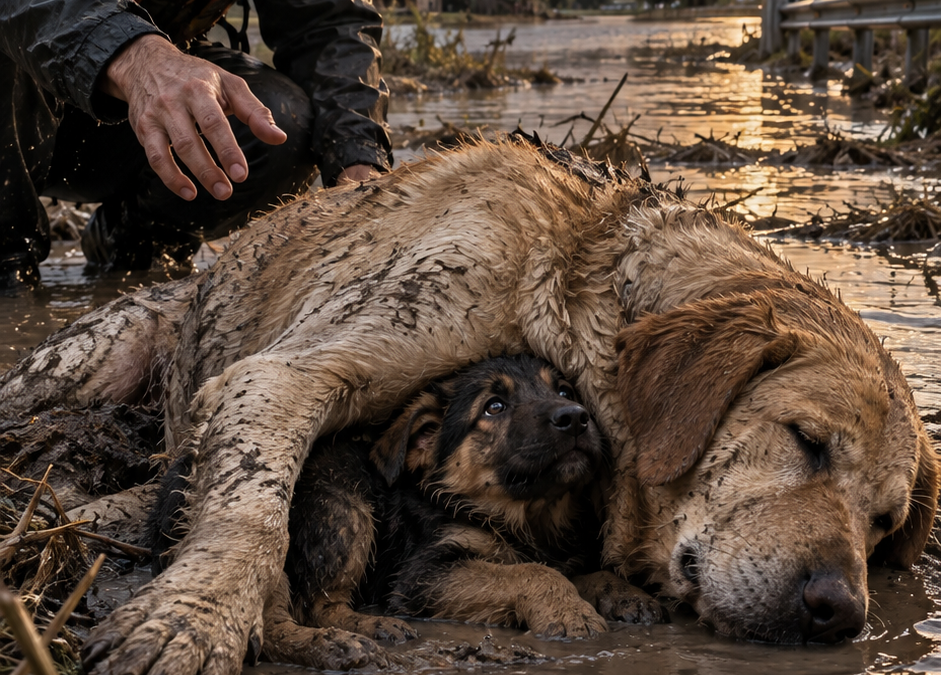
The golden dog was a Labrador, maybe seventy pounds, soaked through and coated in silt, grass, and pieces of weed. One ear lay flat against the road.
And tucked beneath his chest was a puppy.
German Shepherd.
Maybe three months old.
Mostly white, though mud had turned half his coat gray-brown.
He had pushed himself so deeply beneath the Labrador that only his head, one shoulder, and two terrified eyes were visible.
“I’ve got two!” I shouted toward the truck. “One puppy alive!”
Then the Labrador breathed.
His chest rose.
Slowly.
Barely.
I froze.
“Both alive!”
I dropped into the water beside them.
The Labrador opened his eyes.
He didn’t lift his head.
Didn’t growl.
Didn’t attempt to stand.
He simply looked at me.
Then he shifted his gaze toward the puppy under him.
That was when I understood.
He wasn’t lying on the puppy.
He was covering him.
Shielding him.
The current had carried branches, metal, trash, and freezing rainwater down that road, and this exhausted Labrador had turned his own body into a wall.
I reached toward him.
He let out a long, low breath.
Not warning.
Relief.
The puppy pressed deeper beneath him.
“Hey.”
His whole body shook.
“You’re okay.”
I tried to touch the puppy.
He whimpered and clawed at the pavement, desperate to stay underneath the Labrador.
So I stopped.
“All right.”
The Labrador’s eyes remained on mine.
“I’m not separating you.”
His eyelids lowered.
I radioed for blankets, oxygen, and a stretcher.
Then I did the only thing that made sense.
I wrapped one tarp around both dogs.
The Labrador was too weak to help.
The puppy refused to move unless his body remained against him.
So we carried them out together.
One large golden dog barely conscious.
One tiny shepherd hidden against his ribs.
As we lifted them into the rescue truck, the puppy finally looked directly at me.
Those eyes were too old for his face.
Wide.
Dark.
Waiting.
Not for me.
For the Labrador.
And before I knew either of their names, I understood one thing with absolute certainty.
Whatever had happened in that flood, the puppy believed he was alive for one reason.
The dog beside him had refused to let him die.
PART2
The puppy screamed when we separated the mats.
That was the first sound he made.
Not a bark.
Not even a normal puppy cry.
A high, broken wail that stopped everyone in the treatment room.
I had placed the Labrador on one padded mat and the puppy on another, maybe three feet apart.
Protocol.
Space to examine them.
Separate equipment.
Separate monitoring.
The puppy didn’t care about protocol.
The moment the Labrador moved away, his entire body changed.
He scrambled forward.
His left front paw dragged slightly.
He slipped on the towel.
Tried again.
The sound coming out of him was pure panic.
“Stop.”
One of the technicians looked at me.
“We need room.”
“I know.”
The puppy lunged toward the Labrador again.
“Put the mats together.”
She hesitated.
“Do it.”
We pushed them side by side.
The puppy immediately crawled against the Labrador’s chest.
Silence.
Instant.
His shaking didn’t stop, but the screaming did.
The Labrador’s eyes opened.
He turned his muzzle toward the pup.
Then rested his head partly over him.
The puppy disappeared beneath that golden neck.
“Okay.”
I exhaled.
“So that’s how this is going to work.”
The veterinarian, Dr. Park, crouched beside them.
“Apparently.”
We started with the Labrador.
Male.
Older adult.
Maybe seven or eight.
Dehydrated.
Hypothermic despite the mild California temperature because prolonged flood exposure steals heat differently than open air.
Multiple abrasions.
Possible aspiration.
His breathing was wrong.
Wet.
Effortful.
The puppy watched every hand.
Every instrument.
Every movement.
“Can someone hold him?” Dr. Park asked.
I reached.
The puppy flattened.
No growl.
No bite.
Just terror.
I pulled back.
“I’ll work around him.”
We did.
Slowly.
The Labrador tolerated everything.
Oxygen.
IV.
Temperature check.
Chest auscultation.
He never fought.
But every time the puppy shifted, his eyes opened.
Checking.
Even half-conscious, he was checking.
“One protective old man,” the technician whispered.
I looked at him.
“Yeah.”
We scanned both for microchips.
Nothing.
No collars.
No tags.
The Labrador had a strip of torn green fabric tangled around his neck.
Heavy material.
Camping tarp, maybe.
No identifying mark.
The puppy had nothing.
No chip.
No collar.
No clue.
We needed names for records.
Someone asked, “What are we calling them?”
I looked at the Labrador.
“Hugo.”
“Why?”
“Looks like a Hugo.”
Nobody argued.
Then the puppy.
He watched me from beneath Hugo’s chin.
White shepherd.
Sharp little face.
Mud almost dry around his ears.
“Axel.”
The technician wrote both names.
HUGO — ADULT MALE LABRADOR.
AXEL — APPROX. 3-MONTH-OLD MALE GERMAN SHEPHERD.
Found together.
Flood zone.
Watsonville.
That was all we knew.
Hugo took fluids well.
Axel refused everything.
Food.
Water.
Even electrolyte gel.
If Hugo licked a wet towel, Axel would lick the same place afterward.
If Hugo touched a bowl, Axel might take one sip.
Otherwise nothing.
“He’s medically stable enough to eat,” Dr. Park said.
“Trauma?”
“Probably.”
Axel watched us.
“What happened to you?”
His ears lowered.
No answer.
The damaged front paw turned out to be soft-tissue trauma.
No fracture.
Likely strain or impact.
Compared with everything else, that was good news.
Hugo worried us more.
His oxygen saturation improved briefly.
Then dropped.
His breathing became increasingly labored.
By evening, crackles deepened across both lungs.
Dr. Park’s expression tightened.
“Aspiration.”
“How much?”
“Enough.”
“Pneumonia?”
“Possibly beginning.”
Axel pressed his face into Hugo’s chest.
Hugo breathed around him.
Slow.
Heavy.
Wrong.
I stayed.
Not because I had to.
My shift had technically ended hours earlier.
The roads were still bad.
There were other animals coming in.
Plenty to do.
But every time I tried to step away, Axel watched.
Not me.
Hugo.
Like leaving the room might cause him to disappear.
I sat on the floor instead.
Around midnight, most of the center had quieted.
Generators hummed.
Rain tapped the windows.
Hugo slept badly.
Axel did not sleep at all.
Every time Hugo’s breathing changed, Axel’s head snapped up.
He would crawl closer.
Place one paw against Hugo’s ribs.
Wait.
Breath.
Breath.
Breath.
Then settle again.
It looked like he was counting.
Are you still here?
Still?
Still?
Around three in the morning, Hugo’s breathing worsened quickly.
I was sitting beside them when he stretched his neck and coughed.
A deep, wet cough.
Foam appeared around his mouth.
“Dr. Park!”
She came running.
Monitor.
Oxygen.
Assessment.
Hugo tried to lift his head.
Failed.
Axel stood over him.
The puppy’s entire body shook.
Dr. Park looked at me.
“We need to drain fluid and evaluate his chest immediately.”
“Sedation?”
“Yes.”
Axel would have to move.
I knew what was coming before I touched him.
“Buddy.”
His eyes turned toward me.
“We need Hugo.”
I reached.
Axel snapped.
Not to bite.
He closed his teeth against air several inches from my hand.
Then planted himself between Hugo and us.
Three months old.
Maybe twenty pounds.
Wet.
Limping.
Terrified.
Standing against four adults.
His tail tucked beneath him.
His ears flat.
His teeth visible.
He had no chance of stopping us.
Still he stood.
“No.”
I crouched.
“Axel.”
His breath came fast.
“We’re not taking him away.”
He trembled harder.
“We’re helping.”
I pointed toward Hugo.
The dog coughed again.
Axel turned.
Sniffed his face.
Then looked back at me.
“You want him here?”
His ears flicked.
“Then let us do this.”
Ridiculous conversation.
Yet I swear the puppy listened.
He looked at Hugo.
Then at Dr. Park.
Then at me.
Slowly, he stepped sideways.
One foot.
Nothing more.
But enough.
“Thank you.”
We moved Hugo.
Axel followed immediately.
Step.
Drag.
Step.
Drag.
His damaged paw struggling to keep up.
When we reached the procedure-room door, I blocked him.
“No.”
He tried to squeeze through.
“Axel.”
He screamed.
That sound went straight through me.
He clawed at the door after it closed.
Again.
Again.
Again.
I picked him up.
He twisted.
“Stop.”
He fought harder.
Not against me.
Toward the door.
“Hugo is right there.”
Another scream.
I set him down.
Axel planted himself against the bottom crack beneath the door.
Nose pressed to it.
Waiting.
I sat beside him.
Three hours.
That was how long Hugo remained inside.
Dr. Park sedated him.
Removed fluid.
Cleared debris.
Supported his breathing.
Treated aspiration injury.
The material they removed was brown-gray and foul.
Floodwater.
Mud.
Field debris.
Whatever Hugo had inhaled while keeping himself above water.
Dr. Park later said it was astonishing he had stayed conscious as long as he did.
I looked at Axel.
Maybe that was why.
Axel refused food again.
Wouldn’t drink.
Didn’t lie down.
Just sat.
Nose near the door.
At some point I said, “You’re going to make yourself sick.”
His ears twitched.
“Helpful advice from a human who hasn’t slept either.”
Nothing.
I leaned against the wall.
And then the past showed up.
I was twelve when my younger brother drowned.
His name was Caleb.
Seven years old.
Our parents had left us near the lake behind our house.
I was supposed to watch him.
I turned away.
How long?
Two minutes?
Five?
Time becomes unreliable around guilt.
When I looked again, Caleb was gone.
I found him in the water.
Pulled him out.
Held him.
Waited for him to move.
People came.
Ambulance.
Paramedics.
My mother screaming.
But the thing I remembered most was the weight.
I held him tightly because some part of me believed letting go would make death permanent.
If I held on, maybe he was still my brother.
Maybe he would open his eyes.
Watching Axel beneath that door, I felt twelve years old again.
Waiting.
Begging silently.
Please come back.
I put one hand beside the puppy.
Didn’t touch him.
“Yeah.”
Axel remained focused on the door.
“I know.”
Three hours passed.
Then a sound came from inside.
A thump.
Axel exploded upward.
One bark.
The first real bark I had heard from him.
He scratched at the door.
“Wait.”
Another thump.
I opened it before someone could stop me.
Hugo lay on the procedure table.
Awake.
Barely.
A drainage tube ran from his side.
His eyes were half-open.
But they were searching.
Axel shot between my legs.
“Axel!”
Too late.
He jumped against the table.
Couldn’t reach.
I lifted him.
“Easy.”
He twisted free enough to press himself against Hugo’s chest.
Dr. Park started to intervene.
Then stopped.
Hugo’s head moved.
Slow.
His paw lifted.
Shook.
Then settled over Axel’s back.
Everyone froze.
Axel stopped trembling.
Completely.
He buried his face beneath Hugo’s chin.
Hugo closed his eyes.
His paw remained there.
Dr. Park whispered, “Well.”
I swallowed.
“Yeah.”
We left them that way as long as medically safe.
No one spoke much.
There wasn’t much to say.
Sometimes animals create a scene so emotionally precise that language only makes it smaller.
Hugo had spent hours protecting Axel from floodwater.
Now he was barely awake from sedation, and the first thing he did was place a paw over him again.
Still here.
Still yours.
Still.
Hugo improved over the next forty-eight hours.
Slowly.
His lungs sounded better.
Oxygen requirement dropped.
He ate.
Axel began eating too.
Not much.
But if Hugo put his face near a bowl, Axel followed.
If Hugo drank, Axel drank.
We joked that Hugo was his official food tester.
It wasn’t funny enough to hide what it meant.
Axel did not trust survival unless Hugo demonstrated it first.
Then Ellie arrived.
Two days after Hugo woke, reception called me.
“Woman here about the Labrador.”
I walked into the lobby.
She stood holding a folder and a blanket.
Mid-thirties maybe.
Mud dried along her boots.
Red-rimmed eyes.
She looked like someone operating on almost no sleep.
“I’m Ellie Mercer.”
“You think Hugo belongs to you?”
Her mouth trembled when she heard the name.
“Hugo.”
She pressed one hand to her lips.
“That’s him.”
She showed photographs.
Hugo on a couch.
Hugo beside a tent.
Hugo wearing a black bandana.
Hugo with a man in a baseball cap.
Hugo standing beside a truck.
Same markings.
Same scar near the right ear.
No doubt.
I exhaled.
“Come with me.”
She stopped.
“Is he alive?”
“Yes.”
Her knees nearly gave.
I caught her elbow.
“Sorry.”
“No.”
She covered her face.
“I’ve been looking.”
I waited.
Then she said the sentence that changed our understanding of everything.
“He was with my husband.”
The man in the photographs.
Cole.
They had been camping near the river when the flash flood warnings became evacuation orders.
Water rose faster than expected.
Cole went to secure the truck and retrieve Hugo.
Neither returned.
Ellie escaped with another camper.
Search teams found Cole downstream the following day.
Dead.
Hugo was missing.
Until our post.
Ellie cried quietly while telling me.
No performance.
No collapse.
The controlled grief of someone who had already repeated the story to police, rescue teams, family, and herself a hundred times.
“I thought Hugo died with him.”
“He almost did.”
She looked toward the treatment rooms.
“Can I see him?”
“Yes.”
I hesitated.
“There’s something else.”
“What?”
“We found him protecting a puppy.”
Her expression changed.
“What puppy?”
“You don’t know him?”
“No.”
“White German Shepherd. Around three months.”
She shook her head.
“We only had Hugo.”
I explained.
The road.
Floodwater.
Axel underneath.
Hugo shielding him.
Ellie closed her eyes.
A painful smile appeared.
“That sounds like him.”
“What?”
“Hugo.”
She looked down at the blanket she carried.
“He once climbed into a drainage ditch because a baby goat fell in.”
I smiled.
“Of course he did.”
“He hates swimming.”
I stared.
She laughed through tears.
“Really. He hates deep water. Cole used to joke Hugo would step around a puddle unless somebody needed help. Then he’d go through anything.”
We reached Hugo’s recovery room.
Axel saw Ellie first.
His body stiffened.
She stopped.
“Is that him?”
“Yes.”
Axel moved in front of Hugo.
Not growling.
Not barking.
Simply positioning himself.
Ellie took one slow step.
Axel lowered his head.
“That’s enough,” I said.
She immediately stopped.
“I’m sorry.”
“No, you’re doing fine.”
Hugo lifted his head.
He smelled the air.
Then everything changed.
His ears rose.
His eyes widened.
He struggled upright.
Ellie made a sound between a laugh and a sob.
“Hugo.”
His tail hit the mat.
Once.
Twice.
Harder.
He tried to stand.
“Don’t.”
She dropped to her knees.
Hugo dragged himself forward.
Axel blocked her for one second.
Then Hugo pushed past him.
Ellie wrapped both arms around the Labrador’s neck.
“I thought you were dead.”
Hugo whined.
A deep, aching sound.
“I’m sorry.”
He licked her face.
“I’m sorry.”
Axel stood several feet away.
Watching.
Confused.
Afraid.
Hugo belonged to somebody.
For the first time since we found him, Axel faced a threat worse than water.
He might lose the one creature keeping his world together.
Ellie noticed him.
Her hand remained on Hugo.
“Come here.”
Axel backed up.
“No.”
She withdrew her hand.
“Okay.”
I sat beside him.
“He doesn’t know what this means.”
Ellie looked at me.
“What do you mean?”
“If Hugo goes home and Axel stays…”
Her face changed.
“I can’t.”
“I know.”
“Not after…”
“I know.”
She stared at the puppy.
Axel crept toward Hugo.
Placed himself against his side.
Hugo immediately lowered his head over him.
Ellie cried again.
Then she sat on the floor.
“All right.”
I waited.
“Hugo doesn’t leave without him.”
I stared.
“You’re sure?”
She nodded.
“Cole would never forgive me.”
“That’s a lot to decide in one minute.”
“No.”
She wiped her face.
“I’ve known Hugo eight years.”
Her gaze went to Axel.
“If he kept that baby alive through a flood, then Hugo already decided.”
Axel watched her.
Ellie placed her palm on the floor several feet away.
No reaching.
No pressure.
“I’m not taking him.”
Axel’s nose moved.
“Neither of you.”
That first visit lasted an hour.
Ellie told stories.
Hugo stealing hamburgers from a picnic table.
Hugo sleeping with his head on Cole’s work boots.
Hugo barking at inflatable lawn decorations.
Hugo avoiding swimming pools while happily jumping into irrigation canals if another animal needed help.
Axel listened.
Or maybe just listened to her tone.
Eventually, he moved closer.
Then closer again.
By the time Ellie left, Axel lay near her leg.
Not touching.
But no longer hiding behind Hugo.
Progress.
The next morning, I found Axel standing several feet away from Hugo.
Alone.
That mattered.
Until then, every voluntary movement had ended with him pressed against the Labrador.
But now he stood by the recovery-room door.
Ears forward.
Watching the hallway.
Hugo slept.
Axel glanced back every few seconds.
Still checking.
But he wasn’t attached physically.
“Look at you.”
His head tilted.
“Independent citizen.”
Nothing.
“Don’t get arrogant.”
I opened the door to the courtyard later that morning.
Hugo wore a support harness.
His lungs were improving, but weakness remained.
Axel followed.
The sun had finally returned.
Watsonville after a flood looked wounded.
Mud lines on walls.
Debris piles.
Standing water.
But the sky was bright.
Axel reached the grass.
Stopped.
Smelled.
A bird flew overhead.
His ears lifted.
Hugo moved beside him.
Axel’s tail twitched.
Then wagged.
One small movement.
I almost missed it.
Ellie arrived carrying a black bandana.
“Hugo’s.”
She showed me.
Soft fabric.
Worn.
“Cole bought it.”
She tied it around Hugo’s neck.
The Labrador seemed to sit taller.
Then Ellie removed another bandana from her pocket.
Smaller.
Black.
White paw prints.
“I had this made yesterday.”
I laughed softly.
“For Axel?”
“If he’ll let me.”
We crouched.
Axel sniffed it.
Backed away.
Hugo sniffed it.
Axel returned.
Of course.
Ellie moved slowly.
The fabric settled around his neck.
Axel froze.
Then relaxed.
Two dogs.
Two black bandanas.
Ellie stared at them.
“I think Cole would’ve liked this.”
I believed her.
The fire department invitation came because somebody shared the original rescue photograph.
Hugo’s golden body in muddy water.
Axel barely visible beneath him.
One of the Watsonville-area crews had assisted during flood evacuations.
They asked whether the dogs could visit once they were healthier.
Not as official therapy dogs.
Just a quiet morale visit.
We debated.
Hugo was social.
Axel wasn’t ready for chaos.
Captain Ray agreed to keep the station calm.
One truck bay.
A few firefighters.
No sirens.
No crowd.
Controlled.
We tried.
The morning we arrived, Hugo recognized humans as his natural audience.
He walked directly to Ray.
Pressed his head against the captain’s chest.
Ray laughed.
“Well, hello.”
Axel remained behind Hugo.
White body half hidden.
Ray saw him.
Didn’t reach.
Smart man.
“Your turn whenever you want.”
Axel watched.
Hugo relaxed.
That gave him permission.
One step.
Then another.
He sniffed Ray’s boot.
Then hand.
Ray waited.
Axel sat beside Hugo.
“Good enough,” Ray whispered.
We toured the bay.
Slowly.
Hugo investigated everything.
Axel followed.
Boot racks.
Hoses.
A folded turnout coat.
Truck tires.
Metal floor drains.
Every new sound made him pause.
Every pause ended with him looking at Hugo.
Still there?
Always.
Then somebody accidentally triggered a short test chirp from the alert system.
Sharp.
Sudden.
Axel dropped instantly.
Flat.
Tail underneath.
Eyes huge.
Before I moved, Hugo turned.
Walked back.
Lay beside him.
Not on top.
Beside.
Shoulder pressed across Axel’s back.
The whole room went quiet.
Ray stared.
“That’s what he did in the flood?”
“Basically.”
Axel trembled.
Hugo remained.
Thirty seconds.
One minute.
The alarm was gone.
Axel lifted his head.
Looked around.
Hugo stood.
Took one step.
Waited.
Axel stood too.
He moved forward.
I swallowed.
“That part is new.”
“What?”
“He didn’t run.”
Ray nodded.
“He recovered.”
Exactly.
Trauma isn’t measured by whether fear arrives.
Sometimes it is measured by what happens afterward.
By the end of the visit, Axel slept under Hugo’s neck on a station blanket.
One firefighter walked past and whispered, “That doesn’t even look comfortable.”
“It doesn’t need to make sense.”
Ray sat beside me outside.
“Could they come again?”
“Maybe.”
“Once a week.”
“For what?”
He thought.
“Nothing formal.”
That answer surprised me.
“Guys come back from difficult calls. Sometimes they don’t want a counselor immediately. They don’t want questions. Maybe they sit with a dog.”
I looked through the window.
Hugo asleep.
Axel against him.
“That I understand.”
The visits continued.
Twice a month first.
Then weekly.
No titles.
No claims that animals were magic.
They simply became familiar.
Hugo walked into the firehouse like a retired captain.
Axel entered cautiously.
Then a little less cautiously.
We began structured therapy-dog training through a professional program.
Basic obedience.
Handling.
Crowds.
Wheelchairs.
Sudden motion.
Children.
Different surfaces.
Hugo learned quickly.
Axel learned carefully.
That was different.
When he became uncertain, he stopped.
Looked.
Processed.
Then chose.
One exercise used a child-sized mannequin on the floor.
Axel froze.
Hugo sniffed it.
Nothing happened.
Axel approached.
Circle.
Sniff.
Pause.
Then he lay beside it.
Head across the plastic arm.
The trainer looked at me.
“Interesting.”
“What?”
“He seeks proximity when something appears vulnerable.”
I looked at Hugo.
“Learned behavior?”
“Maybe. Temperament. Experience. Association. Hard to know.”
No need to romanticize.
The behavior was enough.
Several weeks later, a firefighter brought his eight-year-old daughter to a supervised session.
She had cerebral palsy and used mobility aids.
Her movements were slower and sometimes unpredictable.
Axel noticed immediately.
He did not retreat.
He approached cautiously.
Sat beside her knee.
She reached.
Touched one ear.
Axel closed his eyes.
The girl smiled.
“Soft.”
Her father turned away.
I saw him wipe his face.
Hugo watched from several feet away.
For the first time, he wasn’t between Axel and the world.
Axel was doing this alone.
That realization hit me unexpectedly.
Hugo had carried him far enough that Axel could begin choosing people for himself.
Ellie saw it too.
“He’s growing up.”
“Unfortunately.”
“Why unfortunately?”
“Puppies are easier to carry.”
She smiled.
Axel eventually began walking slightly ahead of Hugo on familiar routes.
Not far.
He always checked.
Three steps.
Look back.
Five steps.
Look back.
Hugo followed.
Quiet.
Steady.
One evening we walked them along a levy trail.
Sun low over fields.
Earth still marked by storm damage.
Axel moved ahead.
A cyclist passed.
He paused.
Didn’t flatten.
The woman waved.
Axel’s tail moved.
One wag.
Then he continued.
I looked at Hugo.
“You see that?”
Hugo sniffed a bush.
“Excellent mentorship.”
Ellie laughed.
The adoption question became complicated.
Technically, Hugo was Ellie’s.
Axel had no owner.
No microchip.
No missing report.
Nothing.
The rescue received applications after his photograph circulated.
People wanted him.
White shepherd.
Beautiful.
Young.
Survivor story.
The problem was everyone wanted Axel.
Or Hugo.
Not both.
One application asked whether Axel could be “weaned off dependence” on Hugo.
I closed it.
Another family had space for Hugo but not a second large dog.
No.
Another offered a wonderful home for Axel.
No.
People told me I was being sentimental.
Maybe.
But we were watching the dogs.
Axel was gaining independence.
That did not mean the bond had become disposable.
Hugo regulated him during stress.
Axel motivated Hugo through recovery.
Separating them permanently for convenience made no sense.
I wrote across their shared file:
DO NOT SEPARATE.
Ellie saw it.
“Good.”
“You sure?”
She looked at Hugo.
Then Axel.
“Yes.”
She could have simply reclaimed Hugo and adopted Axel herself.
Life wasn’t that simple.
Ellie had lost her husband.
Her home situation was unstable after the flood.
Temporary housing restrictions.
Insurance problems.
A thousand ugly administrative details that arrive after disaster.
She visited constantly.
Paid what she could.
Participated in training.
But permanent placement would have to wait.
The firehouse solved part of it.
A community sponsor program covered care costs while the rescue retained responsibility.
The dogs spent increasing supervised time at the station.
Hugo became an unofficial support dog before any certificate existed.
He had a talent for finding the person who didn’t want attention.
He would simply lie nearby.
No pressure.
Axel followed.
Then eventually started doing it first.
One evening, firefighter Chris returned from a flood-response call.
Teenager trapped in a basement.
They couldn’t save her.
Nobody told me what happened.
They didn’t need to.
Chris walked through the bay.
Removed his gear.
Sat behind the building.
Head down.
Axel noticed.
He looked at Hugo.
Hugo stayed where he was.
That surprised me.
Axel walked out alone.
I followed at a distance.
He approached Chris.
Stopped.
Chris didn’t look up.
Axel sat.
Nothing.
Then stepped closer.
Chris finally saw him.
“Hey, kid.”
Axel climbed halfway into his lap.
Chris wrapped both arms around him.
And broke.
No speeches.
No explanation.
Just grief.
Axel stayed.
Hugo stood in the doorway.
Watching.
Not intervening.
I realized why.
Hugo wasn’t failing to protect Axel.
He was trusting him.
That mattered more.
Axel returned to Hugo afterward.
Hugo sniffed him.
One.
Two.
Three.
Old habit.
Axel lay beside him.
Two bodies.
One shape.
The official support-dog program came later.
Training.
Veterinary clearances.
Behavioral evaluations.
Liability requirements.
Scheduling.
Nothing cinematic.
Eventually Hugo earned a support-dog role at the station.
Axel was designated a junior support dog while he matured and continued training.
The ceremony was small.
Firefighters.
Families.
A few rescue volunteers.
Ellie.
Me.
Two black vests.
HUGO — SUPPORT DOG.
AXEL — JUNIOR SUPPORT DOG.
Ray knelt in front of Axel.
The puppy—larger now—stood still while the vest buckled around him.
Months earlier, a strap touching his body would have sent him scrambling.
Now he looked toward Hugo.
Hugo sat calmly.
Axel looked forward.
Applause began.
Soft.
We had warned everyone not to make it overwhelming.
Axel’s ears lifted.
No panic.
Tail wag.
Then the door opened.
A boy stepped into the bay with his mother.
Nine years old.
Mateo.
Their family had also lost their home in the flood.
He had spoken very little since.
His mother worked with one of the community recovery programs and had asked whether he could meet the dogs.
Nobody expected anything.
That was important.
Dogs are not machines for producing emotional breakthroughs.
Children aren’t either.
Mateo stood near the door.
Axel saw him.
No one called.
Axel approached.
Slowly.
Stopped several feet away.
Sat.
Mateo stared.
Then walked forward.
One step.
Another.
His hand trembled.
Axel waited.
Mateo touched the top of his head.
Axel leaned.
Hugo approached next.
Lay beside the boy’s shoes.
Mateo looked down at both dogs.
His mother covered her mouth.
After several seconds, he whispered:
“Thank you.”
Two words.
The room stayed silent.
His mother began crying.
Mateo knelt.
He put one arm around Axel.
One hand on Hugo.
Nobody clapped.
Nobody broke the moment.
We simply let it exist.
Later, Ray stood beside me.
“You saw that?”
“Yeah.”
“Hugo saved Axel.”
I watched the white shepherd resting beside Mateo.
“And Axel’s learning what to do with that.”
The station visits continued.
Elementary schools.
Community recovery meetings.
Hospital waiting rooms.
Always supervised.
Always within training limits.
Always with the understanding that comfort animals support people; they do not replace professional care.
Hugo became older.
Recovery from the flood had taken something from him physically.
His endurance dropped.
Arthritis appeared.
His lungs remained sensitive after severe aspiration injury.
Axel grew.
Broader chest.
Longer legs.
The white puppy became a striking young shepherd.
The limp faded until only fatigue brought it back.
Their roles changed.
Hugo used to walk first.
Axel behind.
Eventually Axel walked ahead.
Then checked.
Hugo there?
Yes.
Move.
Check.
Yes.
Move.
The first time Hugo couldn’t keep pace on the levy, Axel noticed after perhaps twenty feet.
He stopped.
Turned.
Ran back.
Then walked beside him.
I smiled.
Full circle.
One dog once slowed himself to protect a puppy.
Now the puppy slowed for him.
We never learned where Axel came from.
No owner ever surfaced.
No photograph.
No missing poster.
No breeder.
No explanation.
For a while, I obsessed over it.
Had he belonged to another flooded property?
Had someone abandoned him before the storm?
Had the current carried him?
Did Hugo find him struggling?
How far?
When?
Did they know each other before?
Eventually I stopped.
Not because those questions didn’t matter.
Because they didn’t change what happened afterward.
Hugo found Axel.
Or Axel found Hugo.
Either way, when I discovered them, one was lying over the other.
That was the fact.
A large Labrador nearly drowning beneath rain and debris had decided that a terrified puppy deserved the safest space available.
His own body.
That decision became Axel’s first understanding of safety.
Everything else grew from it.
There was one strange incident about two weeks before the support-dog announcement.
Axel disappeared.
We were in the enclosed back field behind the station.
He had become reliable enough for controlled off-leash training inside the fencing.
Hugo lay in the grass chewing a rope.
I turned to speak with Ray.
Looked back.
No Axel.
At first I assumed he was behind the equipment shed.
Nothing.
We called.
No response.
Gate closed.
Fence line.
Then we found a section damaged by storm debris, just wide enough for a determined shepherd to squeeze through.
My stomach dropped.
“Axel!”
Everyone moved.
Flashlights.
Vehicles.
Search.
The young dog who had spent months afraid of losing Hugo was gone.
I blamed myself immediately.
Shouldn’t have trusted the field.
Should have checked the fence.
Should have kept the long line.
Guilt works fast.
Hugo stood near the broken fence.
Nose lifted.
Then moved toward the trees beyond.
“Follow him.”
We did.
An hour passed.
Then another.
Finally, a flashlight caught white fur.
Axel stood near a fallen oak.
Mud to his belly.
Something in his mouth.
“Axel.”
His tail moved.
I ran.
He walked toward me and dropped the object.
Orange tennis ball.
Old.
Waterlogged.
Half torn open.
Beside the tree lay a piece of faded green tarp.
My breath stopped.
Same material that had been tangled around Hugo’s neck when we found him.
I looked around.
The landscape had changed after cleanup.
Drainage channels reshaped.
Debris moved.
But the location was only a short distance from the flooded road.
Axel hadn’t fled randomly.
Something had drawn him back.
Scent?
Memory?
The ball?
Hugo’s tarp?
Impossible to know.
I crouched.
“You remember this place?”
Axel pushed his head against my chest.
No shaking.
No panic.
Just one long exhale.
Hugo arrived behind us.
Slower.
Axel turned.
They touched noses.
Then something happened that struck me harder than it should have.
Axel walked first.
Toward the station.
Hugo followed.
No hiding.
No crawling beneath him.
Axel led us home.
I carried the tennis ball.
We kept it.
Not as some mystical artifact.
Just an old, ugly ball from a flooded field.
But I understood why objects matter after trauma.
Sometimes you need proof that a place is behind you.
Axel had gone back.
And returned.
Years have passed since the flood now.
Hugo eventually retired from regular station visits.
Age made the decision.
He still attended short events.
Still wore his bandana.
Still considered every person with food a close personal friend.
Axel took on more responsibility as he matured.
Not because Hugo disappeared from his life.
Because Hugo had made independence safe.
That is the difference.
People sometimes assume strong bonds create weakness.
Dependence.
But secure attachment can do the opposite.
When you know someone will be there, the world becomes easier to explore.
Hugo never needed Axel to stay small.
He protected him until Axel learned he could stand.
Then he let him walk ahead.
I saw it repeatedly.
A child approached.
Hugo watched.
Axel handled it.
A firefighter sat alone.
Hugo stayed back.
Axel went.
Crowded room.
Axel checked once.
Hugo there.
Then worked.
The guardian became the witness.
The puppy became the comforter.
Ellie remained part of their life.
Always.
The first anniversary of Cole’s death was difficult.
She came to the station carrying Hugo’s old black bandana.
We sat outside.
Hugo leaned against her.
Axel lay at her feet.
“I used to think losing Cole meant I lost everything connected to him,” she said.
I listened.
“Then Hugo came back.”
She scratched his ear.
“With a puppy.”
I smiled.
“Unexpected baggage.”
She laughed.
“Cole would’ve loved that.”
Her expression changed.
“I keep wondering whether Hugo tried to find him.”
“Cole?”
“After the water.”
I didn’t answer.
Maybe.
Maybe Hugo searched.
Maybe the flood separated them.
Maybe at some point he found Axel and chose the living creature he could still save.
We would never know.
Ellie looked toward the dogs.
“I used to be angry at Hugo.”
That surprised me.
“For surviving?”
Her eyes filled.
“Isn’t that terrible?”
“No.”
“I kept thinking, why did he come back?”
She wiped her cheek.
“Then I saw Axel.”
Hugo’s head rested on her knee.
“And I realized maybe Hugo needed somebody too.”
That stayed with me.
We always described Hugo as Axel’s rescuer.
Fair.
But perhaps caring for Axel had given Hugo a reason to keep moving after Cole disappeared.
Maybe the protection went both directions long before we understood.
Axel needed a body to hide beneath.
Hugo needed a life to protect.
Survival is complicated that way.
Years later, Captain Ray showed me the old local article from the flood.
The photograph was grainy.
Hugo on a rescue stretcher.
Axel barely visible beside him.
Headline about a Labrador protecting a puppy.
Ray asked, “Think that was the moment?”
“What moment?”
“When Axel became what he is now.”
I shook my head.
“No.”
He looked surprised.
“When then?”
I thought about it.
“Every moment after.”
The flood didn’t make Axel compassionate.
Suffering alone doesn’t automatically make anyone kinder.
Sometimes trauma makes the world harder.
Smaller.
More frightening.
What changed Axel was what followed the trauma.
Hugo staying.
Humans slowing down.
Ellie respecting his fear.
Training without force.
A station full of people who let him decide when to approach.
Safety repeated enough times that fear stopped making every decision.
That was the story.
Not pain becoming purpose by magic.
Pain met with patience.
Again.
Again.
Again.
Until a frightened puppy had enough safety inside him to share some with somebody else.
Hugo died years later.
Old.
At home.
Ellie beside him.
Axel beside him too.
I arrived before the veterinarian came.
Hugo had stopped eating two days earlier.
His breathing was tired.
Not like the flood.
Not an emergency.
Age.
His body simply reaching the end.
Axel knew.
Animals often do.
He lay pressed against Hugo.
Just as he had in the rescue center.
But this time nobody tried to move him.
Ellie stroked Hugo’s head.
I sat on the floor.
When the veterinarian arrived, everything was quiet.
Hugo went peacefully.
His head in Ellie’s lap.
Axel’s body against his side.
Afterward, Axel remained there.
I feared what would happen.
All those old behaviors.
Panic.
Refusing food.
Searching.
But grief is not the same thing as trauma repeating itself exactly.
Axel sniffed Hugo.
Lay beside him.
Waited.
Then eventually stood.
He walked to Ellie.
Pressed his head into her hands.
She cried.
Then he came to me.
Then back to Hugo.
One last check.
One.
Still.
No breath.
Axel stood there for perhaps a minute.
Then turned away.
He understood something had changed.
Not in human language.
But enough.
For several weeks, he was quieter.
He slept with Hugo’s bandana.
We let him.
At the station, he searched the doorway sometimes.
Then stopped.
His work continued.
The first time he returned to a community visit alone, I worried.
He entered the room.
Paused.
Looked behind him.
No Hugo.
I crouched.
“You’ve got this.”
Axel looked at me.
Then ahead.
A firefighter recovering from surgery sat nearby.
Axel walked over.
Lay at his feet.
The world did not end.
That was Hugo’s final gift.
He had taught Axel how to live without hiding beneath him forever.
Years earlier, in floodwater, Hugo’s body had been a shelter.
Later, his presence became a bridge.
Eventually Axel learned to cross without him.
We hung Hugo’s black bandana near the station office.
Nothing elaborate.
Just fabric.
Below it, a small plaque:
HUGO
HE STAYED.
That was all Ray wanted written.
It was enough.
Axel continued wearing his own black bandana with white paw prints.
Eventually his muzzle began to gray.
Children who once met him as a young shepherd returned as teenagers.
Firefighters retired.
New recruits arrived already knowing the story.
“Is that Axel?”
Sometimes they expected something dramatic.
A heroic dog.
A legend.
Then Axel would steal somebody’s sandwich and destroy the mystique.
Good.
Legends are dangerous when they make living beings seem simple.
Axel was brave.
Also stubborn.
Gentle.
Also capable of barking at cardboard boxes.
Excellent with grieving children.
Terrible about rain if it became heavy.
He hated deep water his entire life.
Nobody forced him to enjoy it.
Healing does not require loving the thing that hurt you.
It requires knowing you can survive being reminded.
During thunderstorms, Axel sometimes searched for Hugo.
Even years later.
Then he would find me instead.
Lie against my leg.
I let him.
We don’t outgrow every need.
Nor should we.
The last time I walked Axel near the old flood road, strawberry fields had returned.
Cars moved normally.
No debris.
No brown water.
You could drive through and never imagine what it had looked like that morning.
Axel stopped near the shoulder.
Sniffed.
I stood beside him.
For a moment I remembered everything.
Golden fur under muddy water.
White puppy beneath ribs.
Hugo opening his eyes just enough to make sure I saw.
Shielding.
That was the word I had understood before knowing anything else.
Axel looked at me.
Then toward the road.
Then back.
His tail moved.
We continued.
He no longer needed to hide there.
The flood had become part of his history.
Not his home.
At the station that afternoon, a young firefighter sat alone after a difficult call.
Axel saw him.
Older now.
Slower.
He walked over.
Lowered himself carefully.
Placed his head across the firefighter’s boot.
The man looked down.
His hand disappeared into white fur.
Neither moved.
I stood across the bay.
And for one impossible second, I saw both dogs.
Axel on the floor.
Hugo around him.
Then the image was gone.
Only Axel remained.
That was enough.
People often ask what Hugo was waiting for when I found him in the flood.
Was he waiting for rescue?
For Ellie?
For Cole?
For the water to drop?
I can’t know.
But I know what his eyes said when I reached him.
He looked at me.
Then at Axel.
Not himself.
The puppy.
See him.
That was the last job Hugo believed he had left.
Make sure somebody saw the puppy.
Make sure the little life underneath him did not disappear when his own strength ran out.
So I did.
I saw him.
And because Hugo held on long enough, Axel eventually became impossible to miss.
The terrified puppy who wouldn’t eat unless Hugo touched the bowl became the dog children reached for when they couldn’t find words.
The puppy who screamed when Hugo crossed a room became the dog who could walk into a hospital hallway on his own.
The puppy who hid beneath another body eventually became the one who sat beside people when their own world felt like it was collapsing.
None of that erased the flood.
It completed the promise.
Hugo protected him until protection could become confidence.
Confidence became trust.
Trust became connection.
And connection became something Axel could give away without losing it.
That is why, when people asked me years later what I remembered most about that rescue, I never said the water.
Not the rain.
Not the damaged fields.
Not the medical equipment.
Not even Hugo’s near-death night.
I remembered one tiny white German Shepherd puppy under a golden Labrador.
Pressed flat against the road.
Waiting.
And I remembered Hugo’s eyes opening just enough to find mine.
He had already spent every ounce of strength he possessed.
He didn’t need me to save him first.
He needed me to understand what mattered.
The puppy beneath him.
So we carried them out together.
Exactly the way Hugo wanted.
And from that day until the end of his life, whenever Axel became afraid and looked around for the dog who had once covered him against the flood, Hugo was there.
At first beside him.
Later a few steps behind.
And eventually, when Hugo was gone, in every brave thing Axel had learned how to do on his own.








