𝗣𝗔𝗥𝗧 𝟮 I Found a Puppy Guarding a Shattered Phone in the Snow—Then “Mom” Called Again
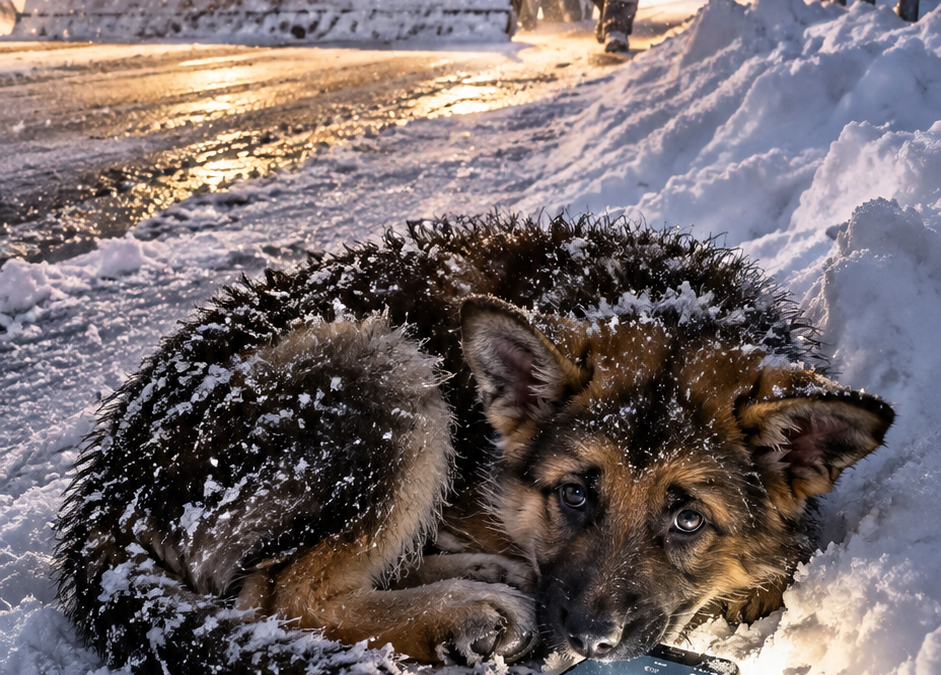
𝗣𝗔𝗥𝗧 𝟮
The cab of my plow had never felt luxurious until I put that puppy inside it.
Normally, it smelled like old coffee, wet gloves, road salt, diesel, and whatever fast-food mistake I’d made around midnight.
That night, it felt like a five-star hotel compared with the shoulder.
I turned the heater as high as it would go.
The vents roared.
Warm air rolled across the bench seat.
The puppy stood there for a second, legs spread wide because they were too stiff to balance properly.
Then they folded.
He dropped onto his belly.
I grabbed an old reflective safety vest from behind the seat and wrapped it around him.
It swallowed him.
Then I found a gray hoodie I kept for emergencies and folded that around him too.
He looked ridiculous.
A tiny German Shepherd wrapped like a construction worker who had lost an argument with a laundry basket.
Under normal circumstances, I might have laughed.
I didn’t.
He was shaking too hard.
I set the phone beside him.
Immediately, one paw moved over it.
The reaction was automatic.
Possessive wasn’t the right word.
Protective was closer.
He didn’t look like a puppy guarding an object.
He looked like a kid holding somebody’s hand in an emergency room.
I stared at the cracked screen.
No passcode notification.
Several missed calls.
All from the same contact.
Mom.
“Okay,” I muttered. “Let’s figure out what kind of disaster you’ve brought me into.”
His ears twitched at my voice.
I lifted the radio microphone.
“County, Unit Seven.”
Static.
Then the dispatcher answered.
“Go ahead, Seven.”
“I’ve got damage to a guardrail about half a mile west of my current position. And I’ve picked up a dog.”
There was a pause.
“A dog?”
“That’s what I said.”
“On the highway?”
“Unless German Shepherds started growing naturally out of snowbanks, yes.”
The dispatcher ignored my sarcasm.
They had worked with me long enough to know sarcasm was what happened when I was worried.
“Stand by.”
I looked down.
The puppy’s eyes were fixed on the phone.
It buzzed again.
He flinched so violently that the vest slipped off one shoulder.
The screen lit.
MOM.
His head lowered.
His nose hovered over the glass.
“She’s persistent,” I said quietly.
The ringing stopped before I touched it.
He stared at the dark screen.
There was something unbearable about the way he waited.
Dogs don’t understand missed calls.
They don’t understand batteries.
They don’t understand towers, hospitals, ambulances, unconsciousness, or the spectacular human talent for building machines complicated enough to connect two people while still leaving both of them helpless.
He just knew that sometimes the little rectangle made a sound connected to the person he wanted.
And then it stopped.
“Unit Seven.”
I lifted the radio.
“Go ahead.”
“State Patrol shows a single-vehicle collision close to your location approximately one hour ago. Female driver. Vehicle left roadway through the guardrail. Driver was transported unconscious.”
My hand tightened around the microphone.
“Any passengers?”
“None reported.”
“Dog?”
A pause.
“Nothing in the report.”
I looked at the puppy.
He looked at the phone.
“No phone recovered from the vehicle either,” dispatch added.
I stared through the windshield.
Snow erased the tracks behind me.
A woman had crashed.
An ambulance had taken her.
Somewhere in the chaos, a four-month-old puppy had ended up outside the car.
The phone had ended up with him.
And nobody had realized either was missing.
“Hospital?”
“I can get you the facility.”
“Do that.”
The puppy shifted closer to the phone.
I reached toward it.
His paw moved over the screen again.
“Kid,” I said, “if you’re hoping I solve this without touching your magic brick, you’re expecting entirely too much from county government.”
His eyes stayed on mine.
I had dealt with frightened dogs before.
You learn quickly that fear makes honesty more important than confidence.
So I didn’t grab.
I let my hand rest on the seat several inches away.
“I’m not taking it.”
His ears moved.
“I’m trying to find her.”
The word meant nothing to him.
The tone apparently didn’t.
His shoulders relaxed slightly.
I turned the truck around.
“Unit Seven returning to the crash site.”
“Copy.”
The plow crawled through its own tracks.
The puppy struggled upright and braced his front paws against the dashboard.
I steadied him with one hand.
“No.”
He tried again.
“You weigh twelve pounds soaking wet and currently have the coordination of a drunk raccoon. Sit down.”
He ignored me.
German Shepherd.
Of course.
Breed intelligence gets advertised heavily.
Breed stubbornness gets placed in the fine print.
I finally let him sit against my hip where he could see ahead.
Every time the truck hit a rut, his claws dug into the seat.
His eyes never left the highway.
When my headlights reached the broken guardrail, his entire body changed.
He stiffened.
Ears forward.
Breathing faster.
There was the gap.
Metal rails bent outward.
A slope disappearing into darkness.
Fresh snow had softened the scene, but not enough.
I could see where tires had left the pavement.
Where the car had gone through.
Where emergency crews had worked.
I parked.
Before I could secure the brake, the puppy lunged toward the passenger door.
“Absolutely not.”
He scrambled over my arm.
“You’re four months old, hypothermic, and apparently suicidal.”
He kept fighting toward the door.
I opened it carefully.
The instant cold hit us.
He whined.
Not because of the temperature.
He was looking past the guardrail.
Toward the slope.
I carried him outside.
One arm around him.
Phone in my other hand.
His body twisted toward the crash site.
The snow showed pieces of what had happened.
Boot prints.
A half-buried medical glove.
Grooves where equipment had been dragged.
A dark patch near the rail.
The puppy began paddling his legs in the air.
Trying to get down.
Trying to go back.
“She’s not here.”
He struggled harder.
“I know.”
Another whine.
“She’s not here, kid.”
His nails caught my sleeve.
I looked over that torn rail and imagined the scene an hour earlier.
The car leaving the road.
Metal screaming.
Glass breaking.
A terrified puppy thrown loose or escaping through a broken door.
His person being pulled away by strangers.
Lights everywhere.
Noise.
Then the ambulance leaving.
The storm closing in.
Maybe he’d followed until he couldn’t.
Maybe he’d found the phone where it had fallen and stayed because her scent was on it.
Maybe none of that was exactly right.
But there are moments when you don’t need the whole story to understand the important part.
He had waited.
The radio on my shoulder cracked.
“Unit Seven.”
I answered.
“Hospital confirmed the driver is in ICU.”
I swallowed.
“Condition?”
“Unconscious. Serious but stable.”
The puppy kept staring toward the slope.
Then dispatch said, “They gave us one more detail.”
“Go ahead.”
“The patient has been intermittently responsive. Apparently she keeps repeating the same phrase.”
I waited.
“My puppy.”
I closed my eyes for a second.
Of course.
Of course she did.
I looked at the trembling animal in my arms.
“Tell the hospital we found him.”
“Copy.”
“And tell them he’s alive.”
The puppy turned his head at my voice.
“Tell them he’s cold, bruised, stubborn, and currently making my life difficult.”
There was a faint laugh through the radio.
“Copy that too.”
For the first time that night, something inside my chest loosened.
Not relief.
Not yet.
But direction.
A storm is easier to fight once you know where you’re going.
I brought the puppy back to the truck.
This time he didn’t struggle as hard.
Maybe he was exhausted.
Maybe he had understood something in my voice.
Maybe I was giving myself too much credit.
We headed toward an emergency veterinary clinic in Denver.
The puppy pressed against my side.
The phone remained between his paws.
I kept glancing at him.
There was an absurdity to the whole scene that would have been funny if it hadn’t hurt so much.
A forty-six-year-old highway worker covered in salt.
A freezing puppy wearing government-issued reflective clothing.
A broken smartphone being treated with more security than the governor.
And somewhere across town, an unconscious woman asking for a dog nobody had known existed.
The veterinary clinic looked almost painfully bright after the highway.
White tile.
Fluorescent lights.
Clean counters.
Machines.
People who looked awake despite the hour, which I considered suspicious.
A veterinary technician came around the desk as soon as she saw the bundle in my arms.
“What happened?”
“Crash victim.”
She looked at me.
“The dog, not me.”
Her mouth twitched.
“Exam room.”
The puppy stiffened the moment she reached for him.
“It’s okay,” she said.
He allowed her to touch the vest.
Then her hand moved toward the phone.
His head snapped around.
A warning growl escaped him.
She stopped.
“Interesting.”
“That’s a polite word for it.”
“What is it?”
“Belongs to his owner. She was in the wreck.”
The technician looked from the phone to him.
“He won’t let it go?”
“Not unless you’d like to donate a finger.”
She smiled faintly.
“Let him keep it for now.”
They examined him with the phone lying near his nose.
Mild hypothermia.
Several abrasions.
Bruising along his chest and abdomen.
No obvious fractures.
No internal bleeding that they could detect.
Dehydrated.
Underweight, though whether from the night or before it was impossible to know.
“He’s lucky,” the veterinarian told me.
I looked at the puppy.
“That’s one word.”
“He probably wouldn’t have survived much longer outside.”
I knew.
I didn’t need her to say it.
The thought of arriving five minutes later had already started haunting me.
They warmed him slowly.
Fluids.
Blankets.
Monitoring.
Every time the phone screen went dark, he became restless.
When it lit from a notification, he relaxed.
The veterinarian eventually looked at me.
“Battery is almost dead.”
I checked.
Four percent.
I hadn’t considered that.
Apparently neither had civilization, which had spent several decades inventing smarter phones while still allowing them to become useless after one long afternoon.
“Do you have a charger?”
The technician brought one.
The case was damaged, but the port worked.
We plugged it in.
The puppy watched the cable as if we were performing surgery.
“There,” I told him. “Congratulations. Your emotional-support smartphone is receiving life support.”
The veterinarian gave me a look.
“What?”
“Nothing.”
“I use humor during disasters.”
“I noticed.”
They placed the phone on a folded towel inside his kennel.
Only then did his eyes begin to close.
I stood nearby until his breathing slowed.
The transformation was tiny.
His muscles relaxed one group at a time.
Jaw.
Shoulders.
Front paws.
Finally, his muzzle settled against the edge of the towel beside the phone.
He slept.
I should have left.
My shift wasn’t technically over.
The road still needed clearing.
My supervisor would be thrilled to hear that Unit Seven had temporarily become an animal ambulance.
But my hand stayed on the exam-room door.
Then the phone buzzed.
The puppy’s eyes flew open.
His head jerked up.
Unknown number.
He looked at me.
Then at the doorway.
Then he let out a howl.
It wasn’t loud.
That made it worse.
It sounded raw.
Thin.
Like everything he had been holding together finally tore in one place.
I walked back.
“Hey.”
He tried to stand.
The IV line pulled.
“Easy.”
I crouched.
“I’m not taking it.”
He stared at me.
“I’m coming back.”
Obviously, he didn’t understand.
So I did the only thing I could.
I sat down again.
Five minutes.
Then ten.
When he finally rested his head, I slipped out.
By sunrise, I had finished enough of the route to avoid being fired, which I considered one of the night’s smaller miracles.
The clinic called a Denver rescue organization that worked with trauma cases.
The puppy needed a quieter place once he was medically stable.
I volunteered to drive him there after shift.
I told myself I was doing it because I already knew the case.
That was a lie.
The embarrassing thing about getting attached to a dog is how quickly you begin lying to yourself.
You’re not attached.
You’re just checking.
You’re not worried.
You’re being responsible.
You’re not rearranging your day around a twelve-pound animal who has known you for six hours.
You’re simply “helping with transportation.”
Sure.
The rescue facility sat behind a row of warehouses, the kind of building you would pass a hundred times without guessing that inside it were dozens of animals waiting for somebody else’s life to make room for them.
A staff member named Elena met us.
“We heard about him.”
“Already?”
“Clinic staff talks.”
“Apparently confidentiality ends where puppies begin.”
She laughed.
The puppy didn’t.
He remained pressed against my side.
Still wrapped in the orange vest.
Still tracking the phone.
Inside, they prepared a quiet kennel with thick blankets.
I set him down.
He circled once.
Then twice.
His eyes searched.
I placed the phone on the blanket.
He immediately curled around it.
Elena watched.
“Wow.”
“That’s been the program all night.”
“Has the owner been identified?”
“Hospital has her.”
“Family?”
“Don’t know.”
“Dog’s name?”
“Don’t know that either.”
She crouched outside the kennel.
“We’ll figure it out.”
The puppy stared at the phone.
“Yeah,” I said. “That seems to be tonight’s theme.”
I went home.
I showered.
I slept two hours.
Then I woke up thinking about him.
I blamed my age.
My conscience.
My coffee intake.
Anything except the obvious.
By that evening, I was back.
The puppy was lying beside the phone when I entered.
He heard the latch.
His body tensed.
Then his nose lifted.
He smelled me.
His tail moved once.
One little tap against the blanket.
I stopped walking.
“Well.”
Another tiny tap.
“That’s a dangerous amount of enthusiasm. Pace yourself.”
He stood.
Not fully.
Just enough to come closer to the kennel door.
Then the phone lit.
His attention snapped away from me.
I should have been offended.
I wasn’t.
The rescue had used the device to contact the hospital.
The owner had no close family in Colorado.
She lived alone.
The number labeled Mom apparently belonged to her mother, who lived several states away.
The mother’s repeated calls had been attempts to reach her daughter after police contacted the family.
That explained the screen.
It didn’t change anything for the puppy.
The rescue had also learned something else.
Every time the woman became conscious enough to communicate, she asked about her dog.
By the second evening, hospital staff agreed to a short phone call.
I happened to be there when it came.
Or maybe I had arranged my timing around it.
I refuse to answer questions without an attorney.
Elena placed the phone on speaker outside the kennel.
The puppy heard hospital noise first.
Wheels.
Voices.
A monitor.
He lifted his head.
Then came a woman’s voice.
Weak.
Raspy.
But unmistakably tender.
“Hey, baby.”
The puppy froze.
Not metaphorically.
Every muscle stopped.
His ears rose.
His eyes widened.
The woman breathed unevenly through the speaker.
“I’m so sorry.”
The puppy took one step.
“I didn’t leave you.”
Another step.
“I didn’t leave you, okay?”
He reached the phone.
His nose touched the speaker.
The sound he made then was unlike anything I’d heard from him.
Half whine.
Half sob.
A little broken noise pulled from somewhere deeper than fear.
The woman heard it.
“Oh, sweetheart.”
He crouched.
Then folded down beside the phone.
His breathing changed.
Until that moment, I hadn’t realized how shallow it had been.
He had spent days breathing as if the world might punish him for taking up too much air.
Now his ribs expanded.
One slow breath.
Then another.
He licked the cracked edge of the case.
The woman laughed weakly.
“Is he okay?”
Elena leaned closer.
“He’s safe. He’s warm. He’s eating.”
At the word eating, I glanced at his food bowl.
“Mostly.”
Elena kicked my boot.
I shut up.
“Can he hear me?”
“Definitely.”
“Baby.”
His ears lifted again.
“I’m coming back.”
I looked away.
There are moments when witnessing love feels intrusive.
That was one.
The call lasted less than two minutes.
A doctor eventually interrupted.
The patient needed rest.
Before the line ended, the woman said one last thing.
“His name is Marlo.”
Then silence.
Marlo stared at the phone.
His name.
Finally.
“Marlo,” I said.
His ear twitched.
“Well, that’s better than ‘kid.'”
Tail tap.
“Don’t get emotional.”
Another tap.
And that was how I learned his name.
The problem with hope is that once it appears, everybody starts making plans around it.
The next few days filled with meetings.
Hospital coordinators.
Rescue staff.
Social workers.
Veterinary follow-ups.
People used words that sounded practical and reasonable.
Rehabilitation.
Mobility.
Housing.
Discharge planning.
Support system.
Temporary placement.
Contingency care.
I understood all of them.
Marlo understood none.
He spent most of his time beside the kennel door, phone tucked beneath his front legs.
Whenever shoes appeared in the hallway, he looked up.
Every pair.
Every time.
Waiting.
I sat outside his kennel one afternoon while three people discussed what might happen if his owner couldn’t care for him immediately.
Marlo watched the hall.
One social worker said, “We need a realistic plan.”
Another said, “She may be in rehabilitation for months.”
Elena said, “We can keep him temporarily, but long-term—”
Marlo’s eyes followed a nurse-shaped volunteer down the hallway.
I sighed.
“You’re all having a very sophisticated conversation in front of a dog who has already made his decision.”
The social worker looked at me.
“What decision?”
I pointed.
“That one.”
Marlo had pressed his chest against the kennel door.
“He has a home.”
“We understand emotionally—”
“No, you understand administratively.”
That came out sharper than I intended.
She blinked.
I softened my tone.
“I know you have to plan. I’m not criticizing that.”
Although I was, a little.
“But he doesn’t think he’s homeless. He thinks she’s missing.”
Nobody answered.
There it was.
The difference.
We saw a dog needing placement.
Marlo saw a person who had failed to come back yet.
Humans love paperwork because it gives us the illusion that reality waits for signatures.
Dogs are less impressed.
A few days later, the hospital arranged a video call.
They asked me to hold the phone because Marlo had started associating me with it.
That sentence should have worried me more than it did.
I sat inside his kennel.
Elena opened the call.
The screen showed a woman in a hospital bed.
Her face was pale.
There was tape near her cheek.
Her hair was tangled.
Machines surrounded her.
Marlo saw none of that the way we did.
He saw her.
His whole body jolted.
“Hey, baby,” she whispered.
Tail.
One thump.
Then another.
“There you are.”
Marlo moved closer.
His nose hit the screen.
Fog spread across her face.
She laughed.
Not much.
But enough.
I watched something change in her too.
Until that second, she looked like a patient.
Then she looked like a dog owner.
A person.
Herself.
Marlo began wagging harder.
The back half of his body wiggled.
He tried to climb into the phone.
“Easy,” I said.
His paw landed on my wrist.
“Right. Apparently I’m the unreasonable one.”
She smiled.
“He’s always been dramatic.”
“He’s a German Shepherd.”
“Fair.”
That was the first real conversation I had with her.
Her name was Rachel.
She had adopted Marlo only several weeks before the crash.
He was young, energetic, curious, and already completely attached to her.
She had been driving home during worsening weather when the car lost traction.
She remembered the impact.
After that, fragments.
Cold.
Glass.
Voices.
Then nothing.
She didn’t know Marlo had escaped.
She didn’t know the phone had gone with him.
When police eventually contacted her mother from identification found at the hospital, her mother had kept calling Rachel’s phone.
Those were the calls I had seen.
The little glowing word Marlo had guarded through the snow.
“Do you know where they found him?” Rachel asked.
I hesitated.
“Near the crash.”
“How near?”
“Close enough.”
Her face changed.
Marlo licked the screen.
Rachel closed her eyes.
“He stayed.”
“Looks that way.”
“Oh, God.”
“Don’t do that to yourself.”
She opened her eyes.
“What?”
“Start imagining every version where things went worse.”
“Hard not to.”
“I drive a snowplow. Imagining ways things can go worse is practically part of my job description.”
That earned another weak smile.
“But here’s the version that happened,” I said. “He stayed. I saw him. He’s here. You’re here.”
Rachel looked at Marlo.
“You’re here,” she whispered.
For two minutes, the hospital room and rescue kennel disappeared.
Then the doctor ended the call.
Afterward, Marlo remained pressed against the dark screen.
A physician who had joined remotely stayed on the line with Elena and me.
“Her rehabilitation is going to be significant,” he said.
“How significant?” I asked.
“Too early to know.”
I hated that phrase.
Too early to know is professional language for Please stop asking us to predict the future.
“She may need mobility assistance for some time. She won’t be able to manage an energetic puppy immediately.”
Marlo sneezed.
I looked at him.
“Energetic is generous.”
The doctor continued.
“He needs temporary housing. Potentially longer, depending on her outcome.”
Elena looked at me.
I knew that look.
I hated that look too.
“No.”
She said nothing.
“No.”
Marlo put his paw on my boot.
Traitor.
Elena smiled.
“I haven’t asked anything.”
“Your face asked.”
The doctor cleared his throat.
“If needed, would you consider fostering him?”
“No.”
Marlo climbed halfway into my lap.
I stared down at him.
He stared up at me.
Then at the phone.
Then back at me.
I rubbed my forehead.
“I hate everybody involved in this conversation.”
Elena’s smile widened.
“Is that a yes?”
“It’s a temporary yes.”
“Of course.”
“Temporary.”
“Absolutely.”
“And if anybody uses the word adoption, I’m leaving.”
Marlo rested his chin on my knee.
Elena nodded very seriously.
“Understood.”
I had been manipulated by professionals.
And a puppy.
Mostly the puppy.
The arrangement wasn’t immediate.
Marlo remained at the rescue while Rachel stabilized.
I visited almost every day.
The staff claimed he behaved differently when I was around.
I claimed they were exaggerating.
Then came the setback.
The hospital called early one evening.
Rachel had developed complications.
Her ICU stay would be extended.
The doctors were concerned.
Nobody said the words we were all thinking.
Nobody needed to.
The room changed.
You can feel bad news before people finish delivering it.
Marlo changed too.
Not instantly.
Over the next day.
Then another.
He stopped finishing meals.
Then he stopped starting them.
He lay by the kennel door with his nose against the phone.
His eyes lost something.
Energy.
Expectation.
Hope, if you want the dangerous word.
I brought him chicken.
He sniffed it.
Turned away.
“You’re a German Shepherd refusing chicken. Now you’re just being theatrical.”
Nothing.
I sat beside him.
He didn’t move.
The rescue had grown quiet.
Night staff moved through the hallway.
Dogs shifted in sleep.
A bowl clinked somewhere.
I looked at Marlo’s full dish.
Then the phone.
Then him.
“I know that trick,” I said.
His eyes moved toward me.
“The one where you decide not to want anything.”
His ears twitched.
“Can’t lose something if you stop caring whether you get it.”
He watched me.
“Very clever.”
I rested my back against the wall.
“Also complete nonsense.”
He turned his face away.
“Yeah, I know.”
Maybe I wasn’t talking to him anymore.
There had been years in my own life when work had been easier than people.
Roads were straightforward.
Snow fell.
You moved it.
Ice formed.
You salted it.
A guardrail broke.
You replaced it.
People were more difficult.
People could leave.
People could disappoint you.
People could disappear in ways no truck could pull back onto the road.
Maybe that was why I understood what Marlo was doing.
He was preparing himself for another absence.
Dogs don’t have language for grief, but they understand patterns.
She vanished once.
Now her voice was vanishing too.
I reached for the phone.
Marlo immediately lifted his head.
“Relax.”
I picked it up.
He stood.
“You want this? Follow me.”
I walked toward the office.
He followed along the inside of the kennel until the fencing stopped him.
Elena opened the gate.
Marlo came with me.
I called the hospital.
It rang.
And rang.
Finally, a nurse answered.
I explained.
There was a pause.
Then she said, “She’s stable tonight.”
I exhaled.
“Can she talk?”
“Not much.”
“Does she know about Marlo?”
“Every time she wakes up, she asks.”
I looked down.
Marlo was staring at the phone.
“Can we arrange another call?”
The nurse hesitated.
“I’ll ask.”
“Please.”
That word did not come easily to me.
She heard it.
“I’ll try.”
An hour later, the phone rang.
We brought it into Marlo’s kennel.
He lay with his back toward us.
I placed the phone on the floor.
The line connected.
Hospital sounds.
Then Rachel.
“Hey, baby.”
Marlo’s head snapped around.
I will remember that movement until I die.
One moment, he was an exhausted animal lying on concrete.
The next, every part of him was awake.
“It’s me.”
He pushed himself upright.
His legs trembled.
“Marlo.”
Tail tap.
“I need you to keep trying.”
Another tap.
He stepped toward the phone.
Rachel’s voice shook.
“I’m trying too.”
Marlo reached the screen.
He lowered his nose.
The tail began moving faster.
“I know you’re waiting for me.”
His whole back end started swaying.
“I know.”
He put one paw beside the phone.
“I need a little more time.”
I turned my face away.
Elena did too.
Some things deserve privacy even when everybody is in the same room.
Rachel talked until she was too tired.
She told him nonsense.
Good nonsense.
Things people say to dogs because dogs understand the parts that matter.
You’re a good boy.
I’m coming back.
Don’t worry.
I love you.
Stay with Harris.
That last one made me look up.
“Excuse me?”
Rachel laughed weakly.
Marlo’s tail thumped.
“Oh, don’t encourage her.”
“I heard you’re his favorite.”
“Defamation.”
“You found him.”
“Technically, my headlights found him.”
“Thank you.”
The sarcasm left me.
Rachel looked through the screen.
Not at Marlo.
At me.
“Thank you for stopping.”
I swallowed.
“Anybody would’ve.”
“No.”
The word was quiet.
“No, they wouldn’t.”
I didn’t know what to say.
So I settled for, “Get better.”
“I’m trying.”
When the call ended, Marlo remained standing.
Then he walked to his food bowl.
Elena and I stared.
He sniffed.
Ate one bite.
Then another.
I pointed.
“There. That’s right. Make me look dramatic.”
He kept eating.
Elena wiped her face.
“I’m not crying.”
“Of course not.”
“Allergies.”
“In February.”
“Very aggressive allergies.”
Within minutes, Marlo had eaten half the bowl.
I don’t believe one phone call magically cured him.
Life isn’t that tidy.
Medicine isn’t that sentimental.
Dogs aren’t machines with reset buttons.
But something had changed.
He had heard her.
For that night, it was enough.
Rachel improved slowly.
Very slowly.
Her condition stabilized.
Then the ICU updates became less terrifying.
Breathing independently.
Sitting upright.
Beginning physical therapy.
Transfer to rehabilitation.
Each milestone sounded small until you remembered where she’d started.
Marlo improved alongside her.
He ate.
He gained weight.
His bruises faded.
His coat filled out.
His paws grew at a speed that suggested nature had accidentally ordered the adult-sized equipment before the rest of the dog was ready.
He started playing.
At first, only briefly.
A tennis ball rolled through the rescue yard.
He chased it three steps.
Stopped.
Looked back toward the building.
Then chased again.
Always checking.
Always making sure the door was still there.
I started taking him home overnight.
Temporary fostering.
Remember that.
Temporary.
The first night, he walked through my house as if inspecting a crime scene.
Kitchen.
Living room.
Hallway.
Bedroom.
Back to kitchen.
He sniffed everything.
Then he discovered the couch.
That was the end of humility.
Within twenty minutes, the traumatized rescue puppy had claimed approximately seventy percent of it.
“I found you in a snowbank.”
He stretched farther.
“You owned nothing.”
One paw hung off the cushion.
“I gave you heat.”
He yawned.
“I personally transported your priceless telephone.”
Eyes closed.
“Unbelievable.”
He slept.
But around three in the morning, I woke to a soft sound.
Marlo stood beside the bed.
Watching me.
“What?”
He moved closer.
His nose touched my hand.
Then he looked toward the nightstand.
His phone was there.
Charging.
“She’s fine.”
He stared.
“As far as I know.”
His ears lowered.
I picked up the phone.
No missed calls.
I showed him the screen.
“See?”
He sniffed it.
Then lay down beside the bed.
That became our routine.
Marlo didn’t trust silence yet.
Silence had once meant separation.
So we taught him new versions.
Quiet house.
Quiet car.
Quiet room.
Quiet phone.
Nothing terrible happening.
Just quiet.
The first visit at Rachel’s rehabilitation center happened a couple weeks later.
Denver had finally gotten one of those impossibly clear winter days that make people forgive the city for the previous month.
The sky was pale blue.
Snowbanks glittered along the sidewalks.
I drove Marlo in the rescue van.
He sensed something.
Dogs always do.
He paced inside the crate.
Whined.
Sat.
Stood again.
“You’re making me nervous.”
More pacing.
“That’s impressive because I’ve driven heavy equipment through whiteout conditions.”
Whine.
“Fine. You’re scarier.”
At the rehabilitation center, staff led us toward an accessible entrance.
Marlo’s claws clicked against pavement.
Wheelchairs moved past.
Doors opened.
People talked.
He lowered his body.
Too many new things.
Then a voice came from ahead.
“Marlo.”
He stopped.
Rachel sat in a wheelchair near the curb.
Blanket over her legs.
Hair shorter than before.
Face thinner.
But smiling.
“Marlo.”
His ears rose.
Everything else disappeared.
He moved forward.
Slowly at first.
One step.
Then another.
No pulling.
No panic.
Recognition pulled him more effectively than any leash.
Rachel held out one hand.
Marlo reached her.
He didn’t jump.
That surprised me.
Four-month-old Shepherds generally approach emotional restraint as an optional hobby.
Instead, he placed his front paws carefully beside her feet.
Then laid his head across her knees.
Rachel’s hand came down onto his neck.
Marlo closed his eyes.
Nobody spoke.
There are reunions where people cheer.
This wasn’t one.
It was too deep for that.
Rachel bent over him.
Marlo listened to her breathing.
She listened to his.
And gradually, their rhythm matched.
In.
Out.
In.
Out.
Like both of them had spent weeks forgetting how to do something simple and were finally relearning it together.
I stepped back.
Elena stood beside me.
“So,” she whispered, “temporary foster.”
“Don’t.”
“I’m just saying.”
“Don’t.”
Marlo shifted closer to Rachel.
Rachel laughed through tears.
“Still temporary?”
“I can leave both of you here.”
Elena smiled.
A social worker approached me.
Her expression was gentle but practical.
“Can we talk?”
Those four words are rarely followed by free money.
We moved several feet away.
“Rachel should eventually be able to keep Marlo.”
“Good.”
“But she’s going to need help.”
“All right.”
“Appointments. Bad mobility days. Possibly another hospitalization. She doesn’t have family nearby.”
I already knew where this was going.
The social worker continued.
“We don’t want the pressure of caring for him to jeopardize her rehabilitation.”
“Of course.”
“And we don’t want him losing her again without a plan.”
I looked at Marlo.
His head still rested in Rachel’s lap.
“What’s the plan?”
“We were hoping you might be part of it.”
I sighed.
There are moments when life pretends to offer you a choice after already arranging all the furniture.
“What exactly does that mean?”
“Backup caregiver. Temporary placement when needed. Transportation. Someone he already trusts.”
“So basically I become the understudy.”
She smiled.
“That’s one way to describe it.”
“Do I get union benefits?”
“No.”
“Terrible organization.”
“But you would do it?”
I watched Rachel scratching Marlo’s ears.
He looked completely at peace.
The first time I had seen that dog, he had been freezing in darkness, wrapped around broken glass.
Now he had his person back beneath his head.
“Yeah,” I said.
“I’ll do it.”
The social worker smiled.
I pointed at her.
“But nobody calls me his dad.”
She nodded.
“Understood.”
Elena, from behind me, said, “Dog uncle?”
“I will leave.”
Rachel laughed.
That laugh mattered.
Because it sounded stronger.
Weeks became months.
Rachel left rehabilitation.
Not completely healed.
Recovery doesn’t work like movies.
There was no miraculous morning where she jumped out of bed and everything returned to normal.
She had pain.
Weakness.
Appointments.
Physical therapy.
Bad days.
Days when stairs looked like mountains.
Days when frustration made her quiet.
Days when Marlo seemed to understand before anybody else that she had reached her limit.
The rescue helped find her a more manageable apartment.
Not perfect.
But safe.
Enough sunlight.
A short staircase she could handle carefully.
Handrails.
Room for a dog who was getting bigger every time I blinked.
Marlo went home.
Really home.
The day we brought him there, he inspected every room the way he had inspected mine.
Then Rachel sat on the couch.
Marlo walked straight to her feet.
Turned twice.
Lay down.
That was it.
Property claimed.
Case closed.
The cracked phone stayed with them.
Rachel could have replaced it.
Eventually she did buy another one.
But she kept the old phone.
Dead battery.
Spiderweb cracks.
Scratched case.
She placed it on a shelf beside a framed photo of Marlo.
One afternoon, I asked why.
She looked at it.
“Because he waited with it.”
I nodded.
“Fair.”
“And because somebody answered.”
I looked at her.
She smiled.
“Eventually.”
The phrase stuck with me.
Because technically, I had never answered that first call.
Marlo hadn’t let me.
But in another sense, all of us had answered.
The dispatcher.
The veterinary staff.
The rescue.
The hospital nurses.
Elena.
The social worker.
Me.
Rachel.
Every person had picked up one tiny part of the same emergency.
Not because any of us had planned to.
Not because a system worked perfectly.
It hadn’t.
Systems almost never do.
The ambulance had taken Rachel without Marlo.
The phone had been missed.
The puppy had been left at a crash scene.
No villain had arranged it.
That almost made it worse.
Bad things don’t always require evil people.
Sometimes disaster only needs darkness, confusion, weather, and five minutes when everyone is looking in the wrong direction.
But that was also what made the ending feel like a victory.
Because the storm had done everything right.
It had hidden him.
Buried his tracks.
Frozen the shoulder.
Covered the wreck.
Separated him from Rachel.
Turned the highway into an empty white tunnel where one small animal should have disappeared without anyone ever knowing.
It nearly won.
Nearly.
But Marlo was stubborn.
Rachel was stubborn.
And, unfortunately for everyone who has ever worked with me, I was stubborn too.
The storm never stood a chance once it accidentally assembled that team.
By spring, Marlo no longer looked like the fragile puppy I’d lifted from the snow.
His legs had grown.
His ears had finally reached an agreement with gravity.
His chest had widened.
His coat shone.
He still had one habit left from the accident.
Phones.
Any time Rachel’s phone rang, Marlo reacted.
At first, he rushed toward it.
Later, after he learned that ringing didn’t mean someone was disappearing, he became more dignified.
Which for Marlo meant walking over and staring accusingly until somebody handled the situation.
If Rachel let her morning alarm ring too long, he would nose the phone toward her hand.
Once, during coffee at her apartment, I watched him shove it nearly six inches across the nightstand.
Rachel opened one eye.
“Marlo.”
He pushed again.
“I heard it.”
Push.
“I’m awake.”
Push.
“Traitor.”
I laughed.
She pointed at me.
“This is your fault.”
“My fault?”
“You encouraged him.”
“I taught him nothing.”
“You taught him phones matter.”
“He arrived with that philosophy fully developed.”
Marlo finally pushed the phone into her palm.
Alarm stopped.
He lay down.
Job completed.
I shook my head.
“He’s management material.”
Rachel smiled.
“Absolutely not.”
The old cracked phone became almost ceremonial.
Marlo occasionally sniffed it.
Sometimes he’d nudge it toward Rachel.
Then walk away.
He no longer guarded it.
He didn’t need to.
That mattered more than anything.
The first time I realized he had truly changed happened during another snowstorm.
Not a severe one.
Nothing like the night of the crash.
Rachel had called because the steps outside her apartment were icing.
I brought salt.
Naturally, by “brought salt,” I mean I arrived with salt, a shovel, two bags of groceries she hadn’t requested, and a replacement bulb for a hallway fixture I had noticed three weeks earlier.
I was becoming the kind of middle-aged man who repairs things instead of discussing feelings.
Marlo approved.
He followed me between the apartment and stairs.
Snow collected across his back.
At one point, Rachel’s phone rang inside.
Months earlier, that sound would have sent him running.
This time, Marlo lifted his head.
Listened.
Looked through the doorway.
Rachel answered.
He watched for one second.
Then turned back to me.
And shoved his nose into the bag of salt.
“No.”
He sniffed harder.
“That is literally road salt.”
Tail wag.
“You cannot eat infrastructure.”
He sneezed.
Then trotted down the steps beside me.
I stopped.
The phone was still ringing faintly inside as Rachel talked.
Marlo didn’t care.
Because Rachel was there.
The phone was finally just a phone.
That night, driving home, I understood how far he’d come.
His victory wasn’t simply surviving the snow.
It wasn’t finding Rachel again.
It wasn’t getting adopted, rehabilitated, photographed, documented, or turned into somebody’s official success story.
His real victory was smaller.
He had learned he no longer needed to guard the bridge because the person on the other side had come home.
I returned to my winter route the following season.
Same plow.
Same overnight shifts.
Same coffee that could probably remove paint.
The guardrail had been repaired.
If you didn’t know where to look, there was nothing remarkable about that stretch of highway.
Just asphalt.
Reflectors.
Snow.
A slope dropping away beyond the rail.
But every time I passed it, I slowed.
Not enough to annoy dispatch.
Usually.
I still saw him there.
Not literally.
Memory does that.
My headlights would strike the shoulder, and for half a second I could see the shape again.
Small body.
Black-and-tan fur.
Snow collecting on his back.
One broken square of light beneath his chest.
MOM CALLING.
I thought about how close everything had come to ending differently.
Five minutes later.
A little more snow.
A dead battery.
A driver looking at the wrong side of the road.
One tired man deciding the dark lump ahead really was garbage.
That’s all it would have taken.
People like dramatic explanations because they make survival feel organized.
It usually isn’t.
Sometimes survival is a chain of ordinary decisions made quickly enough.
Brake.
Stop.
Look.
Pick him up.
Make the call.
Drive back.
Ask again.
Show up tomorrow.
Keep the phone charged.
Sit on the floor.
Answer when the hospital calls.
Say yes when somebody asks whether you can help.
None of those things felt heroic while they were happening.
Most felt inconvenient.
Cold.
Exhausting.
Confusing.
Some involved paperwork, which automatically prevents heroism.
But stacked together, they became the path that brought Marlo home.
The storm had separated him from Rachel in seconds.
Putting them back together took weeks.
That is usually how destruction works.
Fast going down.
Slow coming back.
Rachel once asked me whether I thought Marlo had understood what the phone was that night.
I told her no.
Not the way we do.
He didn’t know it was a phone.
He didn’t know about cellular networks.
He didn’t know his owner’s mother was calling from another state.
He didn’t know an ICU existed.
He didn’t know what trauma care meant.
He didn’t know that doctors were working to keep Rachel alive.
But he understood the only thing that mattered.
It smelled like her.
It sounded like people connected to her.
Her voice had come through it before.
So when the world took everything else away, he guarded the one object that still seemed to lead back.
Humans like to think intelligence is complicated.
Sometimes intelligence is simply knowing what not to let go of.
Marlo knew.
That was enough.
Years of highway work taught me that snow eventually gives back what it hides.
Cars.
Signs.
Branches.
Debris.
Sometimes worse.
But that winter, it gave something back alive.
A four-month-old German Shepherd puppy who had no business surviving the night.
A woman who had no idea he was waiting.
A cracked phone that should have been meaningless.
And a lesson I have never managed to shake.
The worst night of Marlo’s life began with everything being ripped away from him.
His car.
His safety.
His person.
His warmth.
His sense of where home was.
The storm dumped him on the side of a highway and seemed to make the decision for him.
You’re alone now.
That was the message.
The snow said it.
The empty road said it.
The departing ambulance said it.
The silence said it.
Marlo rejected the verdict.
He curled around the last thing that smelled like Rachel and waited.
He didn’t know whether anyone was coming.
He didn’t know whether she was alive.
He didn’t know whether the phone would ring again.
He simply stayed.
And in the end, that stubborn little act defeated everything the night had thrown at him.
The cold lost.
The distance lost.
The confusion lost.
The hospital walls lost.
The months of separation lost.
Even that cracked phone eventually lost its job.
Marlo got his person back.
Rachel got the puppy she had been asking for since the moment she woke.
And I got something I hadn’t been looking for at all.
A family I could pretend wasn’t partly mine.
I still visited.
Often.
Too often, according to Rachel.
Not often enough, according to Marlo.
I fixed things.
Brought groceries.
Salted stairs.
Drove Marlo to appointments when Rachel couldn’t.
Watched him when rehabilitation wore her down.
He spent occasional nights at my house and continued treating my couch like ancestral property.
The rescue eventually listed me as his official backup caregiver.
Rachel called me his godfather.
I objected.
She ignored me.
Marlo had no position on the title as long as snacks remained available.
One cold evening, I sat at Rachel’s kitchen table drinking coffee while snow drifted past the window.
Marlo lay across our feet.
Half his body on mine.
Half on hers.
Like he couldn’t quite trust us to remain in the same room unless he physically anchored both parties.
Rachel looked down.
“He’s ridiculous.”
“He’s a German Shepherd.”
“You’ve used that excuse for two years.”
“Because it keeps being accurate.”
She laughed.
Marlo opened one eye.
Her phone buzzed on the table.
He glanced at it.
Then closed his eye again.
Rachel and I both noticed.
Neither of us said anything for a moment.
Finally, she smiled.
“He doesn’t care.”
“Nope.”
“He used to lose his mind.”
“I remember.”
She reached down and touched his ear.
“You’re okay now, huh?”
Marlo sighed.
Deep.
Content.
The sound of an animal with nothing left to guard.
Rachel looked at me.
“Do you ever think about what would’ve happened if you hadn’t seen him?”
“Yes.”
“Me too.”
I stared into my coffee.
“Try not to.”
“Why?”
“Because that version didn’t happen.”
She nodded.
Outside, the snow continued falling.
Inside, Marlo slept.
The phone remained unanswered on the table.
And nobody panicked.
That might have been the most satisfying ending imaginable.
Not fireworks.
Not applause.
Not some grand reward.
Just a dog sleeping through a ringing phone because he finally knew the person he loved wasn’t going anywhere.
The storm had once convinced him that one missed connection meant the end of his world.
Marlo eventually learned better.
So did I.
And every winter, when my plow lights sweep across that same repaired guardrail outside Denver, I still slow down.
I still look.
Not because I expect another puppy.
Because I remember the one who refused to surrender.
A little German Shepherd curled around shattered glass.
A dying battery.
A frozen highway.
One word glowing through the snow.
MOM.
He guarded that phone because he thought it was the last piece of home he had left.
He couldn’t have known that a tired plow driver would stop.
He couldn’t have known an ICU nurse would answer.
He couldn’t have known strangers would keep passing his story from one pair of hands to another until it reached the only person he wanted.
And he certainly couldn’t have known that months later he would be sleeping inside a warm apartment, sprawled across Rachel’s feet, annoyed by morning alarms and spoiled beyond reason.
All he knew that night was this:
Something connected him to her.
So he held on.
Sometimes that is what survival looks like.
Not bravery without fear.
Not certainty.
Not some perfect understanding of what comes next.
Sometimes survival is a freezing puppy in the dark, trembling over one broken thing and refusing to let the storm take that too.
The storm tried.
It buried the road.
It covered the crash.
It swallowed their footprints.
It separated them.
It nearly erased Marlo before anyone even knew he was missing.
But Marlo stayed.
Rachel fought her way back.
And the rest of us, one call at a time, kept the line open until they found each other again.
The storm got the car.
It got the guardrail.
It got one terrible night.
But it never got the puppy.
And it never got his home.








