𝗣𝗔𝗥𝗧 𝟮 I Found a German Shepherd Puppy Alone on a Moving Train—Then I Read the Note Hidden in His Sweater
𝗣𝗔𝗥𝗧 𝟮
The depot at night has a different personality than the subway people know.
During service, everything feels rushed.
Announcements.
Footsteps.
Doors.
Arguments.
Music leaking from somebody’s headphones.
Afterward, in the yard, the city seems to exhale.
The lights hum.
Metal clicks as it cools.
Water drips somewhere you can’t immediately identify.
Every sound travels farther.
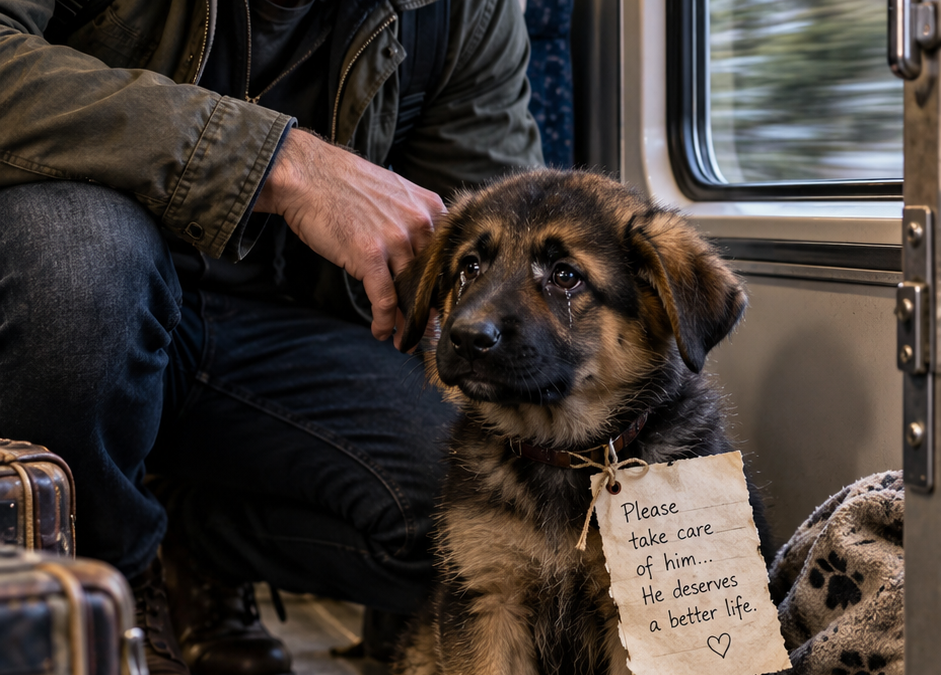
That night, the empty train felt enormous around one very small dog.
The puppy remained on the seat.
I approached slowly.
No toolbox now.
No reason to pretend I was still working.
“Okay, kid.”
His eyes followed me.
“I don’t know what happened.”
One ear moved.
“But I’m pretty sure this isn’t how you’re supposed to commute.”
Nothing.
I stopped a few feet away and lowered myself into a crouch.
At fifty-two, crouching is a decision with consequences.
My knees voiced several objections.
I ignored them.
The puppy watched.
Up close, he looked worse.
His ribs pressed visibly against the sweater.
The fabric hung loose over his sides.
There was dirt around his paws and a patch of matted fur near his chest.
His nose looked dry.
The sweater smelled faintly of laundry detergent.
That scent bothered me.
It was clean enough to suggest a home.
Not yesterday maybe.
But recently.
Someone had washed that little sweater.
Someone had dressed him.
Someone had touched him carefully enough to fit his legs through the sleeves.
Then someone had left him alone on a moving train.
I wasn’t ready to decide what kind of person did that.
Anger likes easy answers.
Real life usually provides messier ones.
Still, I wasn’t feeling charitable.
I held out one hand.
Palm up.
“No tricks.”
The puppy stared.
His nostrils moved.
I kept still.
A minute passed.
Maybe more.
He leaned forward.
Stopped.
Pulled back.
Tried again.
That tiny act of hesitation told me more than any bite would have.
He wasn’t aggressive.
He wasn’t wild.
He had known people.
And people had become complicated.
“Take your time.”
His nose reached my fingertips.
One sniff.
Then another.
His body trembled.
Not violently.
Just enough that I could see it beneath the sweater.
“Yeah.”
I lowered my voice.
“I’d be suspicious too.”
The puppy touched my knuckles with his nose.
Then immediately looked toward the train doors again.
Waiting.
That nearly did me in.
I glanced at the MetroCard.
The dollar.
“Generous.”
My voice hardened.
“A whole dollar.”
The puppy looked at me.
“New York real estate prices what they are, that’s practically inheritance.”
No reaction.
“Tough crowd.”
I slid the money aside and picked up the MetroCard.
I put both in my work jacket.
Evidence, I told myself.
Not sentiment.
That was a lie.
I reached toward the puppy again.
This time he didn’t retreat.
When my hand touched the sweater, his entire body stiffened.
I stopped.
“Okay.”
His breathing quickened.
I removed my hand.
“Your call.”
A long moment passed.
Then the puppy leaned forward on his own.
Just an inch.
Then another.
His nose pressed against my sleeve.
I swallowed.
“That’s enough permission for me.”
I slid one arm beneath his chest and the other under his back legs.
He was so light I almost lifted too fast.
I caught myself.
His body tensed for half a second.
Then collapsed into mine.
No struggle.
No squirming.
He buried his muzzle against my jacket.
I could feel his heartbeat.
Fast.
Hard.
Terrified.
“I’ve got you.”
His body shook.
“I know that doesn’t mean much yet.”
I stood carefully.
“But I’m going to keep saying it until maybe it does.”
The moment I took the first step down the aisle, his front paws tightened around my sleeve.
I stopped.
“It’s okay.”
His face disappeared deeper into my coat.
“Nobody’s putting you back.”
I carried him off the train.
The depot’s fluorescent lights made him squint.
A maintenance cart rolled in the distance.
Metal clanged.
The puppy jerked so hard I almost lost my grip.
“Easy.”
I tucked him tighter against my chest.
“Just noise.”
His breathing came faster.
I felt every rib beneath the sweater.
He was warmer than I expected.
Too warm maybe.
I couldn’t tell whether it was fear, fever, or just the trapped heat of the sweater.
That meant one thing.
Vet.
Home could wait.
Naming could wait.
My questions could wait.
A body that small didn’t get to wait if something was wrong.
I called Luis from the night crew.
He answered on the third ring.
“What’s up?”
“I need someone to cover the rest of my shift.”
Silence.
“You dying?”
“No.”
“Then why—”
“I found a puppy.”
Another silence.
Then laughter.
“Of course you did.”
“You’re a compassionate man.”
“You’re calling me at one in the morning because you found a dog.”
“Yes.”
“What kind?”
“German Shepherd.”
“How big?”
“Maybe twenty pounds.”
“Where?”
“Train car.”
He stopped laughing.
“What?”
“Long story.”
“You stealing MTA property now?”
“I don’t believe the MTA owns him.”
“You sure? They own everything else miserable in the subway.”
I looked at the puppy.
“Can you cover?”
Luis sighed.
“Yeah.”
“Thanks.”
“You owe me.”
“Put it on my tab.”
“That tab could fund a small country.”
I hung up.
The puppy lifted his head when the phone disappeared.
“See?”
His ears moved.
“I have friends.”
He looked unconvinced.
“Fair.”
I carried him through the service corridor toward the parking lot.
The night air hit us hard outside.
Cold.
Wet.
Rain had started.
The puppy gasped softly.
I wrapped my jacket around him.
“Almost there.”
He tucked his face into the crook of my arm.
The streets beyond the depot glowed with wet pavement and traffic lights.
New York at two in the morning isn’t quiet.
It just replaces one set of noises with another.
Sirens in the distance.
Tires across slick asphalt.
A horn from somebody whose personal emergency was apparently the existence of another vehicle.
The puppy flinched at every sharp sound.
I put him on the passenger seat of my old Ford.
He stood immediately.
Then his legs shook.
He sat.
Then lowered himself.
His eyes remained fixed on me.
“Veterinarian first.”
His head tilted.
“You’re going to hate it.”
Nothing.
“So will my bank account.”
His nose touched my arm.
“Manipulative already.”
I started the engine.
The veterinarian I used was a twenty-four-hour emergency clinic in the Bronx.
Twelve minutes away if traffic cooperated.
Eighteen if New York remembered it was New York.
The puppy tried to stay awake.
He failed.
His head lowered slowly until it rested against my forearm.
I drove one-handed for a block before realizing I was letting a twenty-pound stranger dictate vehicle ergonomics.
I adjusted carefully.
He woke.
His eyes widened.
“Still here.”
He stared.
“You’re starting to take that personally.”
His head lowered again.
At the clinic, the woman at reception barely got through “How can I—” before she saw what I was carrying.
“Found him on a train.”
She stood.
“How long alone?”
“No idea.”
“Age?”
“Maybe three months.”
“Any vomiting? Seizures?”
“No.”
“Responsive?”
“Yes.”
A veterinary technician came through the doors.
“Let’s take him.”
The puppy tensed when she reached for him.
His paws clutched my jacket.
My chest tightened.
“I’m coming.”
The technician looked at me.
“You can walk with us.”
“Good.”
He loosened his grip.
That tiny choice affected me more than it should have.
Treatment room.
Metal table.
Bright lights.
The puppy froze.
The vet introduced herself as Dr. Morris.
Early forties.
Calm eyes.
Efficient hands.
She examined him while asking questions.
“Where exactly?”
“Subway seat.”
“Alone?”
“Yes.”
“Food nearby?”
“No.”
“Water?”
“No.”
“Collar?”
“No. Sweater.”
“I see that.”
Her fingers moved along his neck.
The puppy flinched.
She stopped immediately.
“Good boy.”
I watched.
“Something there?”
“Rubbed fur. Could’ve worn a collar recently.”
My jaw tightened.
“Microchip?”
“We’ll scan.”
Nothing.
Again.
Nothing.
Dr. Morris frowned.
“Underweight.”
“How badly?”
“For his age, significantly.”
The puppy looked at me.
I hated that question in his eyes.
“What else?”
“Mild dehydration. Elevated temperature, but that could be stress. Heart sounds okay. Lungs clear.”
“Anything broken?”
“Not that I can tell.”
She examined his paws.
“Some abrasions.”
“Train?”
“Could be.”
She lifted the sweater slightly.
The puppy tensed again.
His stomach was thin enough that the skin pulled close against bone.
I looked away for a second.
Then looked back.
You don’t get to rescue something and then avoid seeing how bad it is.
Dr. Morris noticed.
“He’s lucky.”
“Lucky isn’t the first word I’d use.”
“He’s alive, responsive, and apparently willing to trust you.”
The puppy stared at me.
“I think ‘willing’ is doing a lot of work there.”
Dr. Morris smiled.
“We’ll do fluids. Parasite test. Basic bloodwork.”
“Do it.”
“Any chance you’re taking him to a shelter tonight?”
I looked down.
The puppy’s paw had moved onto my wrist.
Not gripping.
Just resting.
“No.”
Dr. Morris raised an eyebrow.
“Temporary.”
“Of course.”
“One night.”
“Naturally.”
She smiled again.
Veterinarians have a specific smile for people lying to themselves.
I didn’t appreciate it.
The tests showed dehydration, mild anemia, and signs of poor nutrition.
Nothing immediately life-threatening.
No parvovirus.
No obvious infection.
That felt like winning the lottery after buying a ticket from a burning kiosk.
Dr. Morris gave him fluids.
He tolerated the needle without crying.
Again, I hated that.
A puppy should complain.
It means the world hasn’t convinced him complaints are pointless.
When the fluids finished, he looked slightly more awake.
Dr. Morris handed me a feeding schedule.
“Small meals.”
“Got it.”
“Don’t let him gorge.”
“I know.”
“Water available, but monitor.”
“Okay.”
“Keep him warm, but don’t overheat.”
“Yes.”
“And bring him back if the fever rises, he stops eating, vomits, becomes lethargic, or anything feels wrong.”
“Anything?”
“You’re the kind who notices.”
I looked at her.
“What kind?”
“The kind who’ll call me because a dog blinked differently.”
“That seems medically responsible.”
She laughed.
I carried him out.
The entire visit had taken two hours.
The city was approaching dawn.
I set him in the passenger seat again.
This time he curled against the door, sweater bunched awkwardly around his shoulders.
I pulled it straight.
His eyes opened.
“You’re going home with me.”
He stared.
“Temporarily.”
One ear twitched.
“Don’t judge.”
I drove.
When we reached my building, I parked beneath a streetlight that flickered as though the electrical department had personally insulted it.
The puppy woke instantly when the engine stopped.
His whole body went rigid.
That hurt.
He had learned that motion stopping meant something might be about to happen.
Doors.
Separation.
Being left.
I opened my door.
He tracked every movement.
Then I opened his.
He moved backward against the seat.
I stopped.
“Not taking you out?”
He stared.
“Fine.”
I sat on the curb beside the open truck.
Rain tapped against the roof.
For a full minute, neither of us moved.
Then he leaned forward.
Sniffed.
One paw touched the edge of the seat.
Then withdrew.
“You don’t have to be brave every second.”
He looked at me.
“People oversell bravery.”
Another paw forward.
“You can be scared.”
He climbed slowly toward me.
When his chest reached the edge, I lifted him.
No resistance.
His face immediately disappeared into my coat.
“That’s easier.”
I carried him upstairs.
My apartment was nothing special.
Third floor.
Two bedrooms, technically, although the second had become a storage room because apparently adulthood means paying for square footage so you can keep broken lamps you intend to fix someday.
The hallway smelled like bleach, old paint, and somebody’s fried onions.
Inside, I lowered the lights.
The puppy surveyed the room.
Couch.
Coffee table.
Books.
Tools.
Work boots.
Window facing the street.
He looked small enough to get lost between pieces of furniture.
I set him gently on the couch.
He stayed exactly where I placed him.
“No.”
I shook my head.
“We’re not doing train rules here.”
He watched.
“You can move.”
Nothing.
I went to the kitchen and filled a bowl with water.
When I returned, he had not changed position.
I set the bowl three feet away.
He stared at it.
Then at me.
“Yours.”
No movement.
I backed up.
He looked at the bowl again.
One paw.
Another.
He approached slowly.
Then drank.
Not desperately.
Carefully.
As though he expected someone to remove it.
Every few seconds, he stopped and looked at me.
I stayed still.
“Keep going.”
Eventually he finished enough and backed away.
I prepared a small portion of softened kibble according to Dr. Morris’s instructions.
He smelled it immediately.
That got more interest.
He moved toward the bowl.
Then stopped.
Looked at me.
I frowned.
“Eat.”
Still looking.
“Seriously.”
Nothing.
I pointed.
“Food.”
His ears moved.
I sat on the floor.
“You’re waiting for permission.”
That realization made my stomach turn.
“Go ahead.”
He ate.
Fast at first.
Then slower.
Halfway through, he lifted his head as though checking whether the meal was still allowed.
“Keep going.”
He did.
When he finished, he licked the bowl for another full minute.
“You’ve removed the molecular evidence.”
He looked up.
“Very efficient.”
The first hint of a tail movement.
Maybe.
I wasn’t sure.
“Did you just wag?”
He turned away.
“Fine. Keep your secrets.”
I spread an old blanket beside the radiator.
He sniffed it.
Ignored it.
Walked back toward the couch.
Climbed halfway.
Failed.
I caught him.
“Ambitious.”
His ears lowered.
“No shame.”
I lifted him onto the couch.
He curled immediately into the corner.
The blue sweater bunched around his front leg.
I fixed it.
Again his body tensed.
I stopped.
“I’m going to take this off later.”
He watched.
“Not yet.”
I sat on the floor beside the couch.
He slowly relaxed.
Outside, a subway train rumbled beneath the neighborhood.
The vibration came through the building.
The puppy’s head snapped up.
His eyes widened.
His breathing changed.
I didn’t touch him.
“Train.”
He stared toward the window.
“You’re not on it.”
His chest moved faster.
“You’re here.”
Another rumble.
His ears flattened.
I placed my hand on the couch cushion between us.
Not on him.
Just there.
After a moment, his nose moved toward it.
Then his chin lowered onto the back of my hand.
I stopped breathing for a second.
“Okay.”
The train faded.
He stayed.
I don’t know when I fell asleep.
Probably sitting against the couch.
At some point around five, I woke because something scraped against the fabric.
The puppy was trying to stand.
His legs shook.
He managed two steps.
Then sat.
I lifted my hand.
He froze.
I left it suspended.
“Your call.”
He sniffed.
Approached.
Placed one paw in my palm.
Deliberate.
Gentle.
His weight barely registered.
Emotionally, it hit like a truck.
“Well.”
My throat tightened.
“You make a strong argument.”
He stepped closer.
The second paw came forward.
Then his whole body.
He pressed his forehead against my chest.
I put one hand along his back.
No flinch.
“All right.”
His tail moved.
Once.
Definitely.
“That’s it.”
Another weak wag.
“We start over.”
I didn’t have a name for him.
The train puppy.
Kid.
Buddy.
None were enough.
Morning light filled the apartment.
The blue sweater looked brighter.
A yellow rocket on one sleeve.
Pink thread along the inside hem.
I finally removed it carefully.
He stiffened at first.
Then allowed it.
Underneath, his body looked even thinner.
No major wounds.
Just abrasions, collar rub, and the unmistakable evidence of not enough food for too long.
I held the sweater.
It looked absurdly small in my hands.
Something was stitched inside the hem.
Two initials.
The thread had frayed too badly for me to read them clearly.
Maybe M.R.
Maybe N.R.
Maybe nothing.
The puppy sniffed the fabric.
His expression changed.
Not dramatic.
But he leaned toward it.
Recognition.
I set it beside him.
“Somebody mattered.”
He looked up.
“Question is who.”
I washed the sweater gently in the sink.
City grime ran from the cloth.
The little rocket brightened.
The puppy watched from the kitchen doorway.
“You need a name.”
His head tilted.
I considered several.
None fit.
Then one came to me.
“Kellen.”
His ears moved.
I said it again.
“Kellen.”
Tail.
One small tap.
“That’s suspiciously convenient.”
Another tap.
“Kellen it is.”
I touched my chest.
“Michael.”
Then pointed toward him.
“Kellen.”
He stared.
“This is advanced education.”
No concern.
I put the dried sweater back on him later.
He relaxed the instant the fabric settled around his body.
That told me he associated it with something safe.
Whatever else had happened, the sweater was not part of the fear.
That mattered.
The MetroCard and dollar sat on my coffee table.
I kept looking at them.
A fare.
One dollar.
The kind of objects that made abandonment seem planned.
I felt anger returning.
I imagined someone dressing him.
Setting him on the train.
Leaving money.
Walking away.
Cowardice disguised as preparation.
I hated the unseen person easily.
Too easily.
Kellen walked over.
He sniffed the MetroCard.
Then pushed it with his nose.
The plastic scraped against the wood.
“You remember that?”
His eyes tracked it.
I picked it up.
Stamped time: 3:47 p.m.
No useful identity.
Just evidence that somebody had thought far enough ahead to give a dog a ride.
I put it back.
Kellen touched my wrist with his nose.
I looked down.
His tail moved again.
“You know, you’re making it difficult to stay angry.”
He leaned into my leg.
The first week became a series of tiny victories.
Kellen ate regularly.
Drank.
Gained energy.
Followed me from room to room.
If I walked into the kitchen, he came.
Bathroom, he waited outside.
Bedroom, he stood at the door until I waved him in.
He did not like being separated.
At all.
The first time I closed the bathroom door completely, I heard scratching within five seconds.
Then silence.
I opened it.
Kellen sat outside.
Head down.
No whining.
Just waiting.
That was worse.
“Come on.”
His ears lifted.
“I was brushing my teeth, not relocating to Europe.”
He followed me.
I left the door open after that.
Dignity is overrated.
The vet estimated he was between twelve and fourteen weeks old.
He gained two pounds during the first week.
Not enough to look healthy yet.
Enough to look less fragile.
His personality also started emerging.
Kellen liked socks.
Not shoes.
Socks.
Specifically clean ones.
I found the first one under my couch.
Then three more.
“Explain.”
He sat.
“You don’t even wear them.”
Tail wag.
“This is theft.”
He looked away.
“Organized theft.”
No remorse.
I discovered the full collection behind a chair.
Eight socks.
None damaged.
Just relocated.
Apparently I had adopted a shepherd with an interest in textile logistics.
He also hated the vacuum cleaner.
I turned it on once.
Kellen launched backward.
I shut it off immediately.
“Okay.”
He stared.
“Noted.”
The vacuum stayed away for a week.
Later, I let him inspect it while it was off.
He sniffed.
Circled.
Touched it with one paw.
I gave him a treat.
A few days later, I moved it without turning it on.
No panic.
Then ran it briefly from another room.
Progress.
This is the part people misunderstand about trust.
They think love is enough.
Love helps.
But consistency does the work.
Predictable meals.
Predictable hands.
Predictable sounds.
The same person coming back through the same door.
Again.
Again.
Again.
You don’t convince a frightened dog the world is safe.
You bore fear to death with repetition.
One evening, thunder rolled over the Bronx.
Kellen froze.
We were on the couch.
His head lifted.
Second thunder.
Closer.
He moved toward the floor.
Then stopped.
Looked at me.
Lightning flashed.
The windows shook.
Kellen flinched.
I turned off the television.
No competing noise.
I sat still.
“You can come over.”
He didn’t.
Another thunderclap.
His body tightened.
I extended one hand.
He approached.
Slowly.
Then pressed his nose into my palm.
I didn’t pull him closer.
He did that himself.
Climbed against my leg.
Curled.
The next thunder came.
His muscles tensed.
But he stayed.
“It’s weather.”
His head pushed beneath my arm.
“Badly behaved weather.”
Another thunderclap.
Kellen lifted his head suddenly.
Then barked.
One sharp sound.
He startled himself.
I stared.
He stared at me.
Then thunder rolled again.
Kellen barked louder.
I laughed.
“That’s your plan?”
Bark.
“Intimidate the atmosphere?”
Another bark.
I scratched his chest.
“Strong strategy.”
The storm eventually passed.
Kellen slept against my leg.
The next morning, he stood by the apartment door.
That was new.
“You want out?”
He looked at me.
Tail movement.
I bought him a proper harness.
Red.
No pressure on the neck.
We went downstairs.
The sidewalk hit him like an explosion.
Traffic.
People.
Buses.
Brakes.
Voices.
A delivery bicycle nearly took ten years off my life.
Kellen froze.
I shortened the leash without pulling.
“Take your time.”
A truck rumbled past.
He lowered.
I stayed.
A woman carrying coffee walked by.
Kellen sniffed.
A pigeon hopped near the curb.
His ears lifted.
Curiosity began competing with fear.
Good.
A block later, he walked beside me.
Not confidently.
But moving.
Then we reached the subway entrance.
Kellen stopped dead.
His body lowered.
Tail tucked.
My chest tightened.
Below us came the familiar roar.
Train arriving.
He stared at the stairs.
I didn’t pull him.
People moved around us.
One man muttered because we were partially blocking the entrance.
New York remained committed to compassion.
I moved aside.
Kellen kept looking downward.
“You don’t have to.”
His ears moved toward me.
“We can walk away.”
He looked at the stairs again.
I crouched.
A train screamed below.
Kellen trembled.
“You can look.”
His eyes met mine.
“But we don’t live there anymore.”
I don’t know whether words matter to dogs.
Tone does.
Presence does.
He stepped toward the first stair.
Sniffed.
Stopped.
I waited.
One paw down.
Then back.
“Enough.”
I stood.
“We’re done.”
I turned away from the entrance.
Kellen followed immediately.
After half a block, his tail returned to neutral.
By the time we reached home, he was interested in trash bags again.
That counted as success.
Three days later, Kellen didn’t greet me at the bedroom door.
I woke late.
Seven-thirty.
Normally he was already watching me by six.
No shepherd.
“Kellen?”
Nothing.
I found him by the living-room window.
Curled.
Eyes half closed.
I touched his ears.
Warm.
Then his nose.
Too warm.
My chest tightened.
“Hey.”
He looked up slowly.
No tail.
I checked his gums.
Called Dr. Morris.
She heard my voice and said, “Bring him.”
We went.
This time I took the subway.
Why?
Because traffic was worse than usual, and the train was faster.
I regretted the decision the moment Kellen saw the station.
He froze.
I lifted him.
“Sorry.”
His face tucked against my coat.
The train arrived.
I carried him into a nearly empty car.
His body shook when the doors closed.
“Different ride.”
His breathing quickened.
“I’m here.”
I sat with him against my chest.
“Nobody’s leaving.”
The train moved.
Kellen’s head lifted.
He looked at the seats.
The windows.
The doors.
Then at me.
I realized he probably recognized the environment.
Maybe not the specific line.
But the sound.
The vibration.
The smell.
Fear lives through details we don’t understand.
I kept my hand on his side.
One station.
Two.
By the third, his breathing slowed.
At the fourth, his head lowered onto my arm.
That felt enormous.
At the clinic, the diagnosis was less dramatic than my imagination had prepared for.
Mild infection.
Likely his body still recovering from malnutrition, stress, parasites, and exposure.
Fluids.
Antibiotics.
Rest.
Dr. Morris looked at me.
“He’s going to be okay.”
I exhaled.
“You could have led with that.”
“I did.”
“You said ‘probably.'”
“Medicine likes accuracy.”
“I prefer reassurance.”
“I’ve noticed.”
Kellen had a small bandage on his front leg from the IV.
He looked betrayed.
“It’s fashion.”
He licked it.
“Don’t.”
He licked again.
“Excellent compliance.”
We returned home.
That evening, I washed his blue sweater again.
It had picked up grime from the clinic floor.
I turned it inside out.
And felt something.
A thickness in the small front pocket.
I froze.
I had checked the sweater before.
Or thought I had.
The pocket was nearly stitched shut along one side.
Something had been pushed deep behind the lining.
I slid two fingers inside.
Paper.
Folded.
My heart began beating harder.
Kellen lay near the radiator.
He watched me.
I pulled out a small scrap.
Damp stains.
Creased corners.
Handwriting visible through the folds.
For some reason, I sat down before opening it.
Maybe some part of me understood that the anonymous person I had spent days judging was about to become real.
I unfolded the paper.
Four words.
Please love him right.
That was all.
I read them again.
Then a third time.
Please love him right.
My anger didn’t disappear.
It changed.
Which was worse.
Until that moment, abandonment had been easy.
Someone cruel.
Someone selfish.
Someone who decided a puppy was inconvenient and left him with a dollar like a tip.
Now I had four words written by a hand I could imagine trembling.
Four words from somebody who apparently cared enough to dress him for warmth.
Cared enough to hide a note where it would stay close to him.
Cared enough to ask something of the stranger who found him.
But not enough—or not able—to stay.
I hated not knowing the difference.
Kellen stood.
Walked toward me.
He sniffed the note.
Then pressed his nose against my wrist.
I looked at him.
“Who were they?”
His ears shifted.
“Someone loved you.”
Tail movement.
“That’s the problem.”
I folded the note carefully.
There were no initials.
No phone number.
No explanation.
Nothing on the back.
Just the plea.
Please love him right.
It made the sweater different.
The MetroCard different.
The dollar different.
Even the train different.
Maybe the dollar had not been contempt.
Maybe it had been all someone had.
Maybe the MetroCard was not a joke.
Maybe somebody thought leaving him in a populated train car would guarantee discovery.
A terrible plan.
A desperate plan.
But perhaps not a cruel one.
That distinction wouldn’t change what Kellen suffered.
Intent doesn’t erase consequence.
But truth matters.
I sat on the floor.
Kellen leaned against my chest.
“All right.”
I showed him the paper.
“Apparently I’ve been given instructions.”
His tail moved.
“Very demanding previous management.”
He licked my chin.
“Yes.”
I held him.
“I’ll do my best.”
I reported the note to the shelter network and transit lost-property system.
Not because I planned to hand Kellen over to anyone who appeared with a convincing story.
Because if someone had loved him enough to write that note, maybe there was context.
Maybe a family in crisis.
Maybe illness.
Housing.
Domestic violence.
Poverty.
Something.
People sometimes abandon animals because they are heartless.
Sometimes they surrender them because every formal door has closed and desperation makes people do irrational things.
Both exist.
I wanted facts before judgment.
We posted no full image of the note publicly.
Only enough information that a genuine person might identify details.
Nothing came.
A week passed.
Then two.
No owner.
No message matching the sweater initials.
No one who could describe the MetroCard, dollar, rocket design, or hidden note accurately.
Kellen became legally mine after the proper hold period and documentation.
The day I signed the adoption paperwork, the shelter clerk looked at me.
“Name?”
“Kellen.”
“Last name?”
I stared.
“He’s a dog.”
She waited.
I sighed.
“Ortega.”
She typed.
Kellen Ortega.
Ridiculous.
Perfect.
I bought him a proper ID tag.
Microchip.
Vaccinations.
Insurance.
Food that cost more per pound than several meals I had willingly eaten myself.
Apparently fatherhood was expensive even when the child ate from the floor.
Kellen grew fast.
His ribs disappeared.
The legs became longer.
The ears finally stood.
Both.
Mostly.
One still tilted when he was tired.
I loved that.
His bark deepened.
His confidence improved.
He remained cautious around sudden separations.
If I left for work, he waited by the door.
Not all day—my neighbor Mrs. Ruiz checked on him and reported he moved eventually—but for the first ten minutes after I left, he sat.
Waiting.
So I created a ritual.
Jacket.
Keys.
Treat.
“Back later.”
Same words every time.
Then leave.
Then come back.
At first, Kellen rushed me the moment the door opened.
Whining.
Jumping.
Circling.
Eventually, after months, he stopped panicking about my return.
He still greeted me.
Enthusiastically.
But with the confidence of a dog who expected me.
That difference mattered.
One evening I came home from a fourteen-hour shift after a signal problem had turned half of Manhattan into a deeply organized complaint.
I opened the door.
Kellen stood at the end of the hall.
Now nearly sixty pounds.
He looked at me.
Tail wag.
No frantic rushing.
I set down my bag.
“That’s it?”
He approached calmly.
“After everything I’ve done?”
He leaned against my leg.
“Cold.”
Then he pressed his head against my hip.
I put my hand on his neck.
“Okay.”
Tail wag.
“Accepted.”
A year after I found him, Kellen and I went back to the same line.
Not by accident.
I had been avoiding that specific car route whenever possible.
Which was ridiculous.
I worked for the subway.
Avoiding trains while employed by the subway is logistically ambitious.
Still, I’d never brought Kellen back to the exact station.
96th Street.
Same platform.
Same late-afternoon light.
Same sound of brakes entering the tunnel.
Kellen was fully grown enough to look impressive but still had puppy awkwardness in his movements.
He wore a red harness.
The blue sweater no longer fit.
I had kept it folded in a drawer.
The note too.
Kellen stopped at the top of the stairs.
Looked down.
I let the leash hang loose.
“No pressure.”
He sniffed.
A train arrived.
His ears moved backward.
Not flat.
Just alert.
We descended one step.
Then another.
Halfway down, he stopped.
I stopped.
Crowds flowed around us.
A man stepped over the leash and sighed loudly.
New York’s empathy remained undefeated.
Kellen watched people.
Then the platform.
Then me.
“Your decision.”
He took another step.
We reached the bottom.
The train stood with doors open.
Kellen’s breathing quickened.
I almost turned around.
Then he moved.
One paw into the car.
Then another.
He sniffed.
Looked at the blue seats.
I could see memory passing through his body even if I couldn’t name it.
He froze near one.
A child sat across the aisle holding his mother’s hand.
“Can I pet him?” the boy asked.
His mother looked at me.
“Is he friendly?”
I looked at Kellen.
“You want to say hello?”
The boy waited.
Didn’t grab.
Didn’t lean.
Good kid.
Kellen approached.
Sniffed the offered hand.
Then licked it.
The boy laughed.
Kellen’s tail started.
I nearly lost it right there.
The seat behind him looked almost exactly like the one I’d found him on.
A year earlier, people had photographed him because he was alone.
Now a child touched him because he was loved enough to be safe.
The doors chimed.
Kellen looked toward them.
No panic.
We rode one station.
Then two.
At the third, he lay down against my boots.
Just like that.
The train was no longer where his story stopped.
It was transportation.
Noise.
Ordinary.
I scratched his ear.
“Show-off.”
His eyes closed.
We got off at the next stop.
On the platform, a woman recognized my MTA badge and laughed.
“Taking your dog to work?”
“He’s management.”
Kellen looked at her.
“That explains the attitude,” she said.
“Exactly.”
We walked home from there.
That night, I took the old note from the drawer.
Please love him right.
I had interpreted those words a hundred ways.
An apology.
A command.
A plea.
A confession.
Sometimes they made me angry.
Sometimes sad.
Sometimes grateful.
I still didn’t know who wrote them.
Maybe I never would.
But I understood something I hadn’t when I first found Kellen.
The note wasn’t his identity.
Neither was the train.
Neither was whoever left him.
He was not “the abandoned puppy.”
That was something that happened to him.
Not what he was.
Kellen was stubborn.
Observant.
Protective.
Deeply suspicious of vacuum cleaners.
Unreasonably interested in cheese.
He knew the sound of my work boots.
He hated pigeons with a theological intensity.
He loved Mrs. Ruiz.
He stole only my left socks now, which I suspected was intentional.
He slept on his back when he felt safe.
He barked at thunderstorms and occasionally at the refrigerator when the compressor clicked unexpectedly.
He was a dog.
A whole dog.
Not a tragedy.
And the person who wrote that note—whoever they were—had asked one thing.
Love him right.
I used to think that meant protect him from everything.
It doesn’t.
You can’t.
You can’t stop every loud noise.
Every illness.
Every frightening memory.
Every loss.
Loving something right isn’t making sure nothing bad ever happens.
It’s making sure they don’t face it alone.
Kellen taught me that.
The embarrassing part is that I worked maintenance my whole life.
Repairing systems.
Replacing broken components.
Fixing what failed.
I understood machines because they tell you what is wrong.
A signal malfunctions.
A relay fails.
A cable burns.
Find the fault.
Replace it.
Test.
Done.
Living things don’t work like that.
You can’t remove fear with a wrench.
You don’t replace memory.
You don’t tighten trust until it stops rattling.
You stay.
That’s the repair.
One ordinary day after another.
Months later, I was walking Kellen near Riverside when a woman stopped us.
“Beautiful shepherd.”
“Thanks.”
“How old?”
“About eighteen months.”
She crouched.
Kellen sniffed.
She smiled.
“Rescue?”
“Yeah.”
“From where?”
I almost said, “The train.”
That’s the short version.
The dramatic version.
Instead I said, “New York.”
She laughed.
“That explains the personality.”
Kellen leaned against her.
She scratched his ears.
“You’re lucky.”
I looked at him.
He looked up at me.
“Yeah.”
She meant me.
Maybe both of us.
Another year passed.
Kellen became eighty pounds of intelligence, fur, and unsolicited supervision.
He waited by the bathroom.
Followed me while I did repairs.
Sat beside my toolbox.
If I crawled under the sink, his head appeared beside mine.
“This is not a two-man job.”
He licked my ear.
“Union violation.”
No concern.
On weekends, we walked long distances.
Eventually, I started volunteering with a transit employee animal-rescue group that handled strays found near stations and yards.
Mostly logistical support.
Transport.
Contacts.
Temporary crates.
Kellen occasionally came along when appropriate.
He was surprisingly gentle with frightened dogs.
Maybe because he understood stillness.
One evening, we helped transport a little terrier found near a station.
The terrier trembled inside a crate.
Kellen sat outside.
No barking.
No pawing.
Just sitting.
The terrier eventually moved closer to the crate door.
I watched.
“Where’d you learn that?”
Kellen looked at me.
Of course I knew.
Waiting.
He had turned the thing that once hurt him into patience for something else.
That felt like revenge on the past.
The useful kind.
Years later, I still had the dollar.
The MetroCard.
The sweater.
The note.
I put them in a small box.
Not as evidence anymore.
History.
The blue sweater became impossibly tiny beside the dog Kellen grew into.
One winter, I pulled it out.
Kellen sniffed it.
His ears moved.
He placed his nose against the fabric.
Then looked at me.
“Recognize it?”
Tail wag.
I held it beside him.
It wouldn’t have fit over his head.
“You’ve gained some weight.”
He looked offended.
“Healthy weight.”
Tail.
“Relax.”
The rocket patch was nearly falling off.
I had thought about repairing it.
Never did.
Some things don’t need to look new to matter.
The note remained folded inside a plastic sleeve.
Please love him right.
Four words.
No name.
No answer.
And eventually I stopped needing one.
Whoever left Kellen on that train made a terrible choice.
Maybe the least terrible choice they believed they had.
Maybe not.
I can hold both possibilities without pretending they’re the same.
Kellen suffered because of it.
That is fact.
But someone also tried to give him warmth.
Fare.
Money.
A note.
Those are facts too.
Life isn’t always generous enough to provide a clean villain.
At first, that disappointed me.
I wanted somebody to blame.
Some person I could imagine regretting what they had done.
But later, I realized abandonment itself had lost.
That was enough.
The frightened puppy who wouldn’t cry learned to bark.
The dog who waited for someone to return learned that I always would.
The train that represented his worst memory became something he could ride beside me without trembling.
The sweater that once proved he had been left became proof that someone had cared, however badly they handled the goodbye.
The note stopped sounding like a desperate request.
It became a promise kept.
One rainy evening, Kellen and I were coming home when thunder rolled over the city.
Years earlier, he’d pressed himself against me during storms.
This time he stopped on the sidewalk.
Looked up.
Thunder.
He barked.
Once.
I laughed.
“You still think you can fight weather.”
Another thunderclap.
Kellen barked again.
“Consistent.”
We went inside.
He shook rain across my entryway.
“Perfect.”
He wagged.
“I just cleaned that.”
No remorse.
I dried him with a towel.
He leaned his whole body into me.
Eighty pounds.
Completely trusting.
I thought of the puppy who had once leaned only an inch toward my hand.
Trust rarely arrives dramatically.
It accumulates.
Inches become steps.
Steps become rooms.
Rooms become years.
Sometimes people ask me why I kept him.
I never know how to answer.
Because there wasn’t one moment.
Not really.
Maybe when he put his paw on my hand.
Maybe when he slept against my arm.
Maybe when I read the note.
Maybe before all of that, when I watched an entire subway car empty and realized he was still waiting.
Maybe there was never a decision.
Maybe I simply reached the point where imagining him somewhere else felt absurd.
Kellen was mine.
I was his.
Paperwork eventually caught up.
A few months before I retired, Luis found the old photo someone had posted online from that first day.
The puppy on the subway seat.
Blue sweater.
MetroCard.
Dollar.
He showed it to me in the maintenance break room.
“Look.”
I stared.
The photograph hurt.
Not because Kellen looked thin.
Although he did.
Not because he looked alone.
He was.
What hurt was recognizing the expression now.
I knew him well enough to understand it.
He wasn’t empty.
He was focused.
Waiting.
Expecting a specific person to come through the door.
Luis looked at me.
“You ever find out who left him?”
“No.”
“Still want to?”
I considered.
“No.”
He looked surprised.
“Really?”
“I used to.”
“What changed?”
I looked at the photograph.
Then at another picture on my phone.
Kellen in my living room, asleep upside down with all four legs in the air.
“That matters more.”
Luis nodded.
“Dog won the lottery.”
I smiled.
“Don’t say that around him.”
“Why?”
“Already arrogant.”
When I retired, the crew gave me a framed MTA sign.
Luis gave Kellen a toy subway car.
Kellen destroyed it in eleven minutes.
I considered that appropriate.
Retirement changed our schedule.
For the first time, I was home almost every morning.
Kellen seemed suspicious.
He watched me drink coffee.
Watched me read.
Watched me remain in sweatpants past seven.
Finally, I said, “I’m retired.”
His head tilted.
“No work.”
Still staring.
“Apparently this is my life now.”
He walked to the door.
“You want a walk.”
Tail wag.
“Of course.”
Retirement became walking.
Parks.
Long afternoons.
Occasional volunteer calls.
More time.
The thing people think they have until suddenly they realize they don’t.
Kellen got older.
Gray appeared around his muzzle.
Not much at first.
Then more.
He still moved well.
Still alert.
But he stopped launching himself onto the couch and began using the little ramp I bought him.
I pretended the ramp was for “joint prevention.”
We both knew age had entered the room.
One evening, I opened the memory box.
Sweater.
Dollar.
MetroCard.
Note.
Kellen lay beside me.
Older now.
He sniffed each thing.
The dollar meant nothing.
The MetroCard, maybe something.
The sweater interested him most.
He rested his head on it.
I laughed softly.
“Still yours.”
His eyes closed.
I touched the note.
“Remember this?”
He did not.
Or maybe he did.
Dogs don’t owe us explanations.
I read it aloud.
“Please love him right.”
Kellen sighed.
I leaned back.
“Did I?”
His tail tapped the floor.
Once.
I smiled.
“I’ll take that.”
Years after the train, a young maintenance worker found a frightened mixed-breed dog near a station yard and called me.
“Mr. Ortega?”
“Michael.”
“Right. Sorry.”
“What happened?”
“Dog near the tracks. Won’t come close.”
“Stay back.”
“I am.”
“Don’t chase.”
“Okay.”
“Food?”
“Yeah.”
“Sit down.”
“What?”
“Sit.”
There was hesitation.
“On the platform?”
“Safe area?”
“Yeah.”
“Then sit. Stop staring. Put food near you. Wait.”
“That’s it?”
“That’s it.”
Twenty minutes later, he called again.
“She’s closer.”
“Keep waiting.”
Another fifteen.
“She’s eating.”
“Good.”
“What do I do?”
“Nothing.”
A laugh.
“You really like nothing.”
“It’s underrated.”
Eventually animal control secured the dog safely.
Afterward, the worker texted me a picture.
The dog wrapped in a blanket.
Eyes tired.
Alive.
Kellen was sleeping nearby.
I showed him.
“See?”
One ear moved.
“You started something.”
He didn’t wake.
That was the quiet legacy of him.
Not viral videos.
Not strangers taking photos.
Not the sentimental story people told about the puppy on the train.
Patience.
Notice.
Stop walking.
That was the lesson.
People had passed Kellen because they assumed someone else would handle it.
I stopped.
That doesn’t make me brave.
It makes me the person who happened to notice that everyone else was leaving.
Sometimes courage is dramatic.
Sometimes it’s pulling someone off train tracks.
Sometimes it’s running into fire.
And sometimes courage is simply refusing to accept the crowd’s decision that a living thing is not your problem.
Kellen never needed the whole city.
He needed one person not to walk away.
That fact followed me longer than any maintenance rule I learned underground.
The last time I took Kellen to 96th Street, he was older.
Much older.
His muzzle gray.
Steps slower.
Still dignified.
Still stubborn.
We stood near the spot where I’d first seen him.
The city had changed.
Different advertisements.
Different phones.
Same impatience.
A train came in.
Doors opened.
Kellen looked at it.
No fear.
No hesitation.
He stepped inside.
We sat together.
I chose a blue seat.
He settled at my feet.
People boarded.
A little girl smiled at him.
“Can I pet him?”
Her father looked at me.
I nodded.
“Slowly.”
She offered her hand.
Kellen sniffed.
Then leaned forward.
She stroked his head.
“He’s old.”
I laughed.
“Don’t tell him.”
Her father smiled.
“How long have you had him?”
I looked down.
Kellen’s head rested against my shoe.
“A long time.”
“Where’d you get him?”
The little girl waited.
I almost gave the dramatic answer.
Then I said, “Right here.”
Her eyes widened.
“This train?”
“Almost.”
“Was he lost?”
I looked at Kellen.
“No.”
The word felt wrong.
Then I corrected myself.
“Actually, yeah.”
I scratched his ear.
“He was.”
“Then you found him.”
I smiled.
“Something like that.”
The train moved.
Kellen closed his eyes.
No trembling.
No scanning doors.
No waiting for someone who wasn’t coming.
Just an old dog resting beside the man he expected to remain.
I thought about the note in my pocket.
I had brought it intentionally.
Please love him right.
For years, I had treated it as an instruction addressed to me.
That day, I understood it differently.
Maybe the person who wrote it had no idea who would find Kellen.
Maybe they were writing to the whole world.
Please.
Whoever you are.
Whoever stops.
Do better than I can.
Love him right.
I don’t know whether I fulfilled every meaning hidden in those words.
I made mistakes.
I worked late.
I lost my patience when he chewed my boots.
I fed him cheese even when the vet said not to overdo it.
I once forgot to buy his food and had to cook chicken at eleven at night while Kellen watched me like a disappointed supervisor.
I wasn’t perfect.
Love isn’t perfect.
It is consistent.
I came back.
That was the part Kellen needed most.
At our stop, I stood.
Kellen rose slowly.
The girl waved.
“Bye!”
Kellen’s tail moved.
We stepped onto the platform.
The doors closed behind us.
Train gone.
Kellen looked up at me.
“Home?”
He wagged.
“Yeah.”
We started walking.
Slowly.
No hurry.
For the first time in my life, I wasn’t trying to keep New York moving.
I had spent twenty-seven years making sure trains got where they were going.
Kellen taught me something the subway never could.
Getting somewhere isn’t always the same as arriving.
He had ridden through the city alone.
Ticket beside him.
A dollar beside him.
A sweater around his ribs.
And one note hidden where no stranger could see it.
He had reached the end of the line.
But his life had not.
That was the mistake abandonment made.
It assumed leaving him behind was the end of the decision.
It wasn’t.
It was only the moment somebody else got a choice.
Mine was easy.
Stay.
Feed him.
Treat him.
Name him.
Come back.
Love him.
Again.
Again.
Again.
The child-sized sweater eventually became too fragile to handle much.
The yellow rocket almost detached completely.
The MetroCard expired.
The dollar stayed wrinkled.
The note faded.
Kellen grew old.
Everything changed.
But those four words stayed clear.
Please love him right.
So I did the best I knew how.
And when I look back at that crowded train now, I don’t remember the people holding phones.
I don’t remember the teenagers laughing.
I don’t remember the commuters walking past.
Not really.
I remember one puppy who had every reason to stop expecting kindness.
And still, when I held out my hand, he leaned toward it.
One inch.
That was all.
One inch of trust.
Enough to change both our lives.
People like to say I rescued Kellen because I carried him off the train.
That’s not the part I think about.
Anybody can lift a puppy.
The harder thing is staying after the dramatic moment ends.
Staying when he gets sick.
Staying when he wakes from nightmares.
Staying when progress reverses.
Staying when trust takes longer than you hoped.
Staying when nobody is filming.
Staying after the story stops being interesting to strangers.
That’s what the note meant to me in the end.
Not rescue him.
Not save him.
Love him right.
The difference is time.
Kellen once sat alone on a train waiting for someone who never came back.
After that night, he never had to do that again.
Not once.
And years later, whenever I grabbed my jacket and reached for the door, he still watched me.
Older eyes.
Calmer eyes.
But the same question somewhere deep inside them.
Are you coming back?
Every time, I touched his head.
“Always.”
And every time I returned, Kellen was there.
Not because he was afraid anymore.
Because he knew exactly how the story ended.
The door opened.
I came home.
And nobody left him behind again.








