𝗙𝗨𝗟𝗟 𝗦𝗧𝗢𝗥𝗬 I Found a Family of Cats Freezing in the Storm, but Something About Their Desperate Huddle Haunted Me
𝗣𝗔𝗥𝗧 𝟮
I had seen what a hard rain could do to an outdoor cat colony. The ground flooded quickly in low areas, discarded cardboard became useless once soaked, and even places that looked reasonably sheltered in daylight could turn dangerous when water began rushing through the streets.
For tiny kittens, the danger was much greater.
Their small bodies lost heat quickly, and prolonged exposure to cold rain could become life-threatening.
I looked again at the adult male.
He was resting with the kittens pressed against him, apparently unaware of how much worse the weather might become.
I wanted to gather them all into my arms immediately.
But I still didn’t know where their mother was, whether there were other kittens nearby, or how easily the protective male would allow us to handle the babies.
A rushed attempt could scatter the family or frighten a hidden mother into moving the remaining kittens somewhere we couldn’t find them.
We needed to approach the situation carefully.
I left with the intention of returning and ensuring that the entire family could be brought in together.
As I walked away, I looked over my shoulder.
The male cat was watching me.
One kitten had climbed awkwardly over his front leg.
He lowered his head and gently guided it back toward the others.
I remember thinking how fortunate those babies were to have someone guarding them.
I had no idea how much that protection would matter before morning.
The storm arrived faster and more violently than I had anticipated.
By evening, rain was hammering against the streets.
The wind grew stronger, driving water sideways between buildings and shaking loose anything that wasn’t secured.
I stood near a window and watched the rain turn the pavement into a sheet of moving water.
All I could think about was the little family beside the wall.
I remembered the kittens’ tiny paws.
Their dirty fur.
The way they had crowded around the food.
And the exhausted male cat who had allowed them to eat before taking anything for himself.
I kept imagining the wall where we’d found them.
There was barely enough shelter for an adult cat, let alone a cluster of vulnerable kittens.
I hoped their mother had returned.
I hoped she’d found somewhere dry.
Most of all, I hoped the entire family had moved before the worst of the storm reached them.
But the longer the rain continued, the harder it became to reassure myself.
Outside, the wind seemed determined to drive water into every exposed corner of the neighborhood.
I thought of the kittens sleeping against the male cat’s belly.
If they were still there, they would be getting wet.
And once they were wet, staying warm would become increasingly difficult.
I tried to picture the male leading them somewhere safer.
But the babies were so small.
They couldn’t run very far, and moving them one by one would be dangerous in the middle of a storm.
I felt sick thinking about the possibility that some might become separated.
When I finally went to bed, I couldn’t stop hearing the rain.
Every gust of wind reminded me of the wall.
Every time I closed my eyes, I saw that male cat lowering his head toward the smallest kitten.
I had met them for only a short time, but I was already desperately afraid of what the morning might bring.
The following day, the neighborhood looked completely different.
Rainwater had collected along the curbs. Pieces of debris were scattered across the pavement, and the ground was soaked from hours of relentless weather.
The air felt colder than it had the day before.
I headed straight for the place where we’d found the kittens.
As I approached the wall, I slowed down.
At first, I couldn’t see anything.
The little corner looked empty from a distance, and my stomach tightened.
I moved closer.
Then I noticed a dark, irregular shape tucked against the base of the wall.
Something moved.
I stopped.
“Oh, thank God.”
The cats were still there.
But the relief lasted only a second before I saw their condition.
They were soaked.
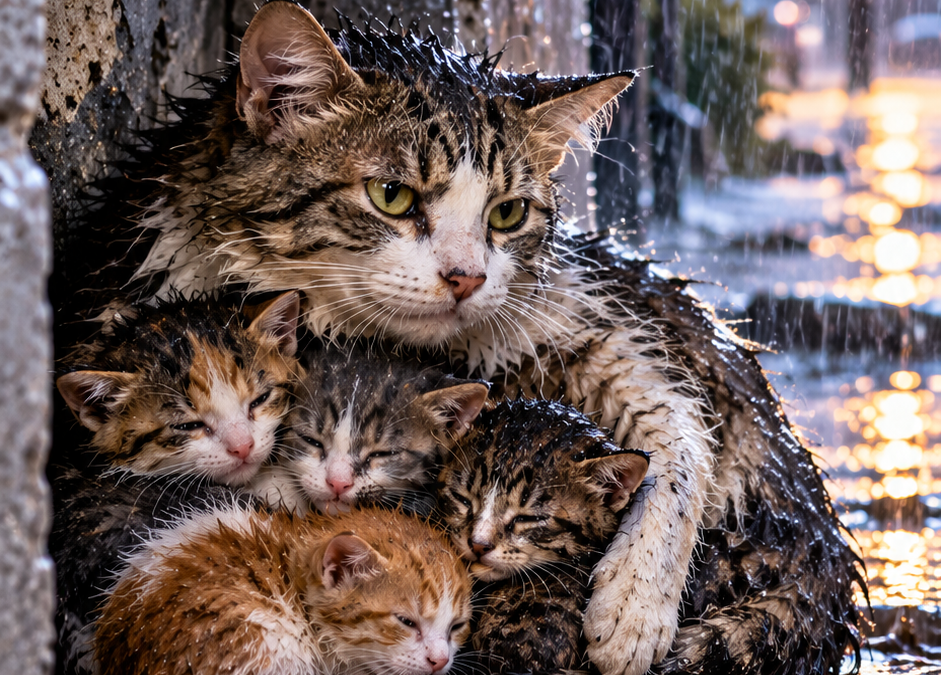
The kittens were crowded together in the same small space, their fur flattened by the rain. Their bodies were pressed so tightly against one another that I could hardly distinguish their individual shapes.
And around them was the male cat.
He had curled himself into a protective barrier, pressing his body against the babies as if he could somehow keep the cold away through sheer determination.
His coat was wet.
His ears were held low, and his exhausted eyes followed me as I approached.
One of the kittens was trembling visibly.
Another had tucked its face beneath the male’s chest.
The smallest looked as though it could barely keep its head raised.
I crouched beside them.
“Oh, babies.”
My voice broke.
There is a terrible difference between imagining an animal suffering and seeing it happen in front of you.
The night before, I’d pictured the family searching for shelter.
I’d imagined the mother returning, the kittens being carried somewhere dry, and the male cat following them to safety.
Instead, they had endured the storm beside that wall.
The male hadn’t left them.
Even though he was wet and exhausted himself, he was still curled around the little bodies he’d been protecting the day before.
I stared at him.
“You’re still here.”
He lifted his head slightly.
His eyes were tired, but he didn’t move away.
I reached for the food I’d brought, my hands suddenly clumsy with urgency.
“All right. Let’s get something into you.”
I placed the food near the little group.
The scent stirred the kittens almost immediately.
One lifted its head.
Another tried to crawl forward.
The male watched them, then shifted his body enough to allow them access.
I could see how exhausted he was.
Every movement seemed slow, and his wet fur clung to his body.
But he was still paying attention to the babies.
Still allowing them to eat.
Still watching over them when he looked as though he desperately needed help himself.
I swallowed hard.
“You’ve done enough, sweetheart.”
Of course, he couldn’t understand me.
But I wanted someone to tell him.
I wanted him to know that he didn’t have to keep doing this alone.
As the kittens began eating, I looked around for their mother.
There was no sign of her.
The surrounding area was littered with wet debris, and several possible hiding places were scattered along the walls and behind discarded materials.
I knew she might be nearby.
I also knew that approaching too quickly could frighten her.
So I waited.
The male cat remained beside the kittens, watching as they ate.
Occasionally, he looked toward the open street.
I followed his gaze, wondering whether he had heard something I hadn’t.
Then I saw movement near one of the hiding places.
A cat emerged.
She was moving carefully, keeping her body low as she crossed the wet ground.
At first, I thought she was simply another stray approaching the food.
Then I realized she was carrying something.
A kitten.
I froze.
The mother cat was coming toward us with a tiny kitten held gently in her mouth.
Her fur was damp, and she looked tired. She crossed the pavement carefully, placing each paw with the concentration of an animal determined not to lose its precious burden.
I instinctively moved back.
“There’s Mama.”
The male cat raised his head.
The mother approached the little cluster, stepped around the food, and lowered her kitten beside the others.
Almost immediately, she began checking the babies.
She sniffed one, then another, touching their faces with her nose and nudging them as they crowded toward her.
The kitten she’d carried began pressing into the group.
She turned back toward it and gently groomed its damp fur.
I watched without speaking.
Until that moment, I’d known only that a male cat was protecting a group of kittens.
Now I was seeing the rest of the family.
Their mother hadn’t abandoned them.
She had been nearby, and she had returned carrying another baby.
I felt relief rush through me.
But it was mixed with a new and more troubling thought.
If she’d been carrying one kitten from somewhere else, how many more might still be hidden nearby?
The mother continued tending to the kittens.
Then she lifted her head toward the male cat.
For a moment, the two adults stood close together.
I had no way of knowing precisely what their relationship was, but there was an unmistakable familiarity in the way they interacted.
Neither showed aggression.
The male remained beside the babies as the mother settled near them.
She seemed comfortable with his presence, and he made no attempt to leave.
I watched her touch her nose toward him before returning to the kittens.
The gesture was brief.
Almost ordinary.
But after seeing him curled around her babies through the storm, I found it incredibly moving.
Whether he was their father or simply a trusted companion, he had helped keep them alive during a dangerous night.
And now their mother was back.
I wanted desperately to believe that meant everyone was safe.
I placed more food nearby.
Both adults began eating, although they continued paying attention to the kittens.
The babies crowded around them, taking turns at the soft food and moving back toward their mother.
For several minutes, I simply watched.
After the fear of the previous night, seeing the family eating together felt extraordinary.
The mother was alive.
The male had survived.
The kittens I’d seen the day before were still with us.
And another baby had been returned to the group.
But something wasn’t right.
I couldn’t explain it at first.
I looked at the mother.
Then at the kittens.
Then toward the hiding place she’d emerged from.
I began counting the babies again.
I wasn’t certain how many kittens she’d moved overnight or whether the ones in front of me represented her entire litter.
But after watching her arrive with another kitten, I couldn’t ignore the possibility that there were more.
I looked toward the discarded materials farther down the wall.
“Where did you come from, Mama?”
The mother continued grooming one of her babies.
I stood and began searching.
At first, I examined the area immediately around the family.
There were narrow spaces beneath discarded objects, small openings between the wall and piles of debris, and several sheltered corners that a cat might have chosen as a temporary hiding place.
The storm had changed everything.
Cardboard had collapsed beneath the weight of the rain.
Plastic bags clung to the pavement.
Water had carried scraps of garbage into places that might have been relatively clean the previous afternoon.
I crouched near one pile and listened.
Nothing.
I moved to another.
Still nothing.
The sound of water dripping from nearby structures made it difficult to hear anything else.
I kept looking.
I was afraid of what I might find.
A tiny kitten trapped beneath soaked debris.
A baby too cold to cry.
An empty hiding place that had been washed out during the storm.
I tried not to let my imagination get ahead of me.
The mother had brought one kitten back alive.
That meant at least one of her hiding places had offered some protection.
Perhaps the others were still there.
Perhaps she was simply waiting for a safe opportunity to retrieve them.
But I couldn’t assume that she would manage it on her own.
Not after the night they’d endured.
I returned briefly to the family.
The male cat was still lying close to the kittens while the mother moved around them.
I watched her for a moment, hoping she might lead me toward another hiding place.
Then I continued searching.
I examined the edges of the discarded materials, looking for openings just large enough for a cat to slip through.
There was a makeshift cover nearby, formed by objects that had been thrown away and left leaning against one another.
From the street, it looked like nothing more than another pile of garbage.
But I noticed a small space beneath it.
I lowered myself toward the ground.
“Hello?”
It felt ridiculous to speak into a pile of discarded materials.
But I couldn’t help it.
“Any little babies in there?”
For a moment, there was only the sound of dripping water.
Then I heard something.
It was so faint that I thought I might have imagined it.
A tiny cry.
I held perfectly still.
There it was again.
My heart started pounding.
“Oh, sweetheart.”
I moved closer, carefully shifting the materials that blocked my view.
The space beneath them was dark and damp.
I leaned down and looked inside.
Two tiny faces stared back at me.
I covered my mouth.
There were two more kittens hiding beneath the makeshift shelter.
They were alive.
For several seconds, I could do nothing but stare.
I’d spent the entire morning afraid that the storm had taken some of the babies away.
Now two of them were right in front of me.
They looked weak and frightened, and they had no way of knowing that the person peering into their hiding place was there to help.
One gave a small cry.
The other pressed closer to its sibling.
“I’m here,” I whispered. “I’ve got you.”
I carefully reached into the space.
The first kitten was so small that it seemed to disappear inside my hand.
Its body was cold and damp, and it immediately tried to curl inward when I lifted it.
I brought it close to my chest.
Then I reached for the second.
For a moment, it pressed farther into the hiding place.
I stopped and waited, terrified of frightening it into a space I couldn’t reach.
“Easy, baby.”
When I finally managed to gather it safely, I felt a rush of relief so powerful that my hands began shaking.
Two more.
Two more living kittens.
I held them securely and made my way back toward the family.
The mother cat noticed us before I reached the wall.
She lifted her head, her attention fixed on the tiny bodies in my hands.
I crouched carefully and placed the kittens close enough for her to approach.
She immediately hurried toward them.
For a second, she simply sniffed.
Then she began grooming the first kitten with urgent, repetitive movements, working over its damp fur while the little animal pressed toward her.
She turned to the second and did the same.
The babies tried to move closer to their siblings.
Within moments, they were part of the huddled group again.
I sat back and let out a breath I hadn’t realized I was holding.
“There you go, Mama.”
She barely glanced at me.
She was too busy tending to her babies.
I didn’t mind.
I watched her move from one kitten to another, checking them and nudging them closer.
The male cat remained beside the group.
He leaned toward the newly returned kittens and sniffed them before settling back into his protective position.
The sight nearly brought me to tears.
They had survived a night of freezing rain, and now the little family was coming back together.
But I knew our work wasn’t finished.
Finding those two kittens had confirmed that the mother was using more than one hiding place.
And although the little group in front of me was larger now, I couldn’t be certain there were no more babies somewhere nearby.
I looked at the discarded materials again.
How many other places could a tiny kitten disappear into?
How many hiding spots had the mother used while trying to protect her babies from the weather?
The more I searched, the more I realized how difficult her situation had been.
She was trying to raise a litter in an environment where almost nothing was safe.
Every time she left to find food, the kittens were vulnerable.
Every time the weather changed, she had to decide whether to move them or hope their current shelter would hold.
And when the storm arrived, she had been forced to manage a family scattered between hiding places while the rain flooded the ground around her.
I looked toward the male.
He was still watching the kittens.
I couldn’t help wondering what would have happened without him.
Would the babies beside the wall have survived the night?
Would the mother have been able to move all of them before the rain became too heavy?
There was no way to know.
But I had seen enough to understand that his presence had mattered.
I began organizing the next steps.
The entire family needed to be brought somewhere dry and warm.
The kittens needed veterinary examinations, and the adults looked exhausted after surviving the storm.
But before removing them, we had to make sure we weren’t leaving any babies behind.
I searched the surrounding area more thoroughly.
Every narrow space seemed worth checking.
Every faint sound made me stop and listen.
The mother continued tending to the kittens while the male remained nearby.
Occasionally, I looked back to make sure the family was still together.
I could see their little bodies moving against one another.
The sight encouraged me to keep going.
If we’d found two hidden kittens beneath one pile of debris, there might be more.
And I couldn’t bear the thought of carrying the visible family to safety while another baby waited somewhere nearby for a mother who would never return.
As we investigated further, we began learning more about the mother cat and the kittens living in the area.
It became apparent that this wasn’t the first litter she’d struggled to raise outdoors.
She had given birth before, and there were additional kittens connected to her earlier litters.
The discovery changed the scope of the rescue.
What had initially seemed to be a single little family sheltering beside a wall was part of a larger group of vulnerable young cats.
Some were hiding in places we hadn’t noticed during our first visits.
Others were old enough to move farther from their mother, making them more difficult to locate.
I felt my heart sink as I considered how many days they might have spent trying to survive in those streets.
I thought of the mother carrying her tiny kitten through the rain.
How many times had she done something similar?
How many storms had she endured?
How often had she gone searching for food while her babies waited in whatever shelter she could find?
I wanted to believe every kitten she’d ever given birth to was still alive somewhere.
But life outdoors can be unforgiving, especially for newborn animals.
We couldn’t account for everything that had happened before we arrived.
What we could do was search carefully for the kittens still living in the area and bring them into safety.
So that became our priority.
Over the following days, the search continued.
We checked the places where cats might hide from people and weather, paying particular attention to the corners and discarded structures that offered shelter.
Sometimes there was nothing.
Sometimes we found signs that animals had been there recently.
And sometimes, after a long stretch of searching, we discovered another frightened kitten who needed help.
Each discovery brought a familiar mixture of relief and sadness.
Relief because the kitten was alive.
Sadness because it had been forced to survive outdoors without reliable food, warmth, or protection.
I found myself becoming increasingly attached to the little group.
Every kitten had its own way of reacting to our presence.
Some remained perfectly still when they saw us, pressing themselves into the narrowest available spaces.
Others cried when we approached.
A few were curious enough to watch us closely, although they weren’t yet ready to trust unfamiliar hands.
I tried to be patient with all of them.
Fear had helped keep them alive.
It would take time for them to learn that the people reaching toward them weren’t another danger.
As the additional kittens were found, we brought them to safety one by one.
I couldn’t stop thinking about the mother.
She had spent so much of her life trying to protect her young in a world that offered them almost nothing.
Now, finally, there were people who could help carry that responsibility.
The hardest part of any rescue is often the uncertainty.
You can search for hours and still worry that you’ve missed something.
You can examine every hiding place and still wonder whether an animal is waiting just beyond the range of your flashlight.
And when the lives you’re searching for belong to tiny, vulnerable kittens, the possibility of overlooking one is difficult to bear.
I kept thinking about the two we’d found beneath the discarded materials.
If I hadn’t stopped to listen, I might never have heard their faint cries.
They had been so close to the family, yet almost invisible.
That memory stayed with me throughout the remaining search.
It reminded me to examine the places that seemed empty.
To wait when I didn’t immediately hear anything.
To check once more before deciding that a hiding place had been abandoned.
Eventually, after continuing our search and accounting for the family and the additional kittens we’d located, we were ready to focus on getting everyone the care they needed.
By then, the first group had already shown us just how urgently shelter was needed.
The mother and male cat were exhausted.
The kittens had endured prolonged exposure to cold, wet conditions.
And although they were eating, we had no way of knowing whether any had developed medical problems that weren’t immediately visible.
I remembered the way the smallest kitten had trembled against the male’s body that morning.
I didn’t want any of them to spend another night in the cold.
We carefully prepared to transport the cats.
The adults needed to be handled with care, especially after the strain of protecting their babies through the storm.
The kittens had to be kept secure and warm.
And throughout the process, we paid attention to the relationships we’d observed among them.
The mother was closely bonded with her babies.
The male had remained beside them through dangerous weather.
We wanted to preserve that sense of familiarity wherever possible while ensuring everyone could be examined and cared for safely.
I remember looking at the male as we prepared to leave.
His fur had begun drying, but he still looked tired.
He watched us with the same cautious attention he’d shown during our first encounter.
Only now, instead of standing between us and an unknown group of kittens, he was surrounded by people working to protect them.
“You’re coming, too,” I told him.
He blinked.
“All of you are.”
For a moment, I imagined how strange the entire experience must have been for him.
One day, he was guarding the kittens beside a wall, surviving on whatever food he could find.
The next, he’d endured a violent storm and watched unfamiliar humans appear, disappear, and return with missing babies.
Now those same humans were gathering the family and taking them away from the place he’d been protecting.
He couldn’t know what waited for them.
But I could.
Warmth.
Food.
Veterinary care.
A safe place where the kittens could sleep without the rain soaking through their fur.
I wanted to explain all of it to him.
Instead, I kept my voice gentle and moved carefully.
Once the family was safely prepared for transport, we headed toward the veterinary clinic.
The ride felt completely different from the journey we’d made to the neighborhood that morning.
Earlier, I’d been driving toward a place where I was terrified of finding dead or missing kittens.
Now we were carrying living animals toward medical care.
I kept thinking about how close some of them had come to being overlooked.
The two hidden beneath the debris.
The kitten the mother had carried through the rain.
The babies we’d discovered during our continued search.
And the little group that had survived because an exhausted male cat had remained beside them.
I glanced toward the secured carriers.
For the first time since the storm began, I felt that the most immediate danger was behind us.
But I knew there was still an important question waiting at the clinic.
Had the cold and rain caused any lasting harm?
The veterinary team began examining the cats as soon as we arrived.
After the chaos of the streets, the clinic felt almost impossibly calm.
There were clean examination tables, warm towels, fresh bedding, and people who knew exactly what to look for.
The kittens were checked carefully for signs of dehydration, illness, and injury.
Their tiny bodies were weighed and examined.
The adults received their own assessments after the exhausting ordeal they’d endured.
I stood nearby, watching the veterinarian move from one patient to another.
Every time someone lifted a kitten, I found myself holding my breath.
“How does that one look?”
The veterinarian examined the little animal carefully.
“We’ll check everyone.”
I nodded, although patience was becoming difficult.
I’d spent so much time worrying about them that I wanted all the answers at once.
I wanted to know that the mother was healthy.
That the male hadn’t become ill after lying in the freezing rain.
That the smallest kittens hadn’t suffered any lasting damage.
That the babies we’d found hidden beneath the debris were going to recover from their ordeal.
But medicine doesn’t work according to the pace of our fears.
Each cat needed to be examined properly.
And each examination revealed another part of the picture.
One small kitten had ticks and mites.
I felt my stomach tighten when I heard the news, remembering how vulnerable the babies had already been.
But the veterinarian explained that the condition was treatable and didn’t appear to be life-threatening.
The kitten would receive appropriate care.
I felt a wave of relief.
After everything the family had endured, I was grateful that the problem was one we could address.
The examinations continued.
And gradually, the news became more encouraging.
Considering the conditions they’d survived, the rest of the family was in remarkably good health.
There were no signs of the widespread tragedy I’d feared during the storm.
The kittens needed nourishment, warmth, monitoring, and continued care, but they had made it through.
I looked toward the mother cat.
She was resting on clean bedding, her babies close to her.
The male was nearby.
For a moment, I could barely speak.
They had spent the previous night exposed to freezing wind and relentless rain.
Now they were inside a veterinary clinic, surrounded by warmth and people who understood their needs.
The change was so complete that it almost didn’t seem real.
I remembered the mother emerging from her hiding place with a kitten in her mouth.
I remembered the male curled around the soaked babies.
And I remembered holding the two tiny kittens we’d found beneath the discarded materials.
All those frightening moments had led here.
To clean towels.
To medical examinations.
To kittens who were alive and receiving care.
I walked closer to the family.
“Well, look at you.”
The mother raised her head briefly.
One of the kittens was already asleep.
Another shifted against its siblings before settling again.
The male stretched out on the bedding.
It was such a simple movement that I almost missed its significance.
For the first time since I’d met him, he wasn’t curled tightly around the kittens, ready to respond to every sound.
He was stretching his body.
Resting.
Allowing himself to occupy a little space without using every inch of it to shield someone smaller.
I watched him lower his head.
His eyes gradually closed.
And I felt tears gather before I could stop them.
He was finally getting a chance to rest.
I didn’t know whether he was the father of the kittens, and I still couldn’t explain exactly how he’d become their protector.
But I knew what I’d seen.
He’d spent a dangerous night beside those babies.
He’d allowed them to eat before him.
He’d stayed close while their mother was away.
And when the storm left them soaked and trembling, he’d curled his body around them as though keeping them together was the only thing that mattered.
Now he could sleep.
He didn’t have to guard a wall against the weather.
He didn’t have to remain alert while the babies searched for scraps of warmth.
There were people watching over all of them.
I stood beside him for a moment.
“You did good,” I whispered.
He didn’t open his eyes.
I smiled through my tears.
“Get some sleep, sweetheart.”
The mother seemed to relax as well.
Her babies were nearby, safe and warm, and she no longer had to move them between hiding places or carry them across wet pavement.
She could remain with them without constantly searching for shelter.
There was clean food and water within reach.
The bedding beneath her was soft and dry.
She lowered herself beside the kittens and began grooming one of them with slow, deliberate movements.
Then she settled down.
Watching her rest was one of the most emotional moments of the entire rescue.
I had seen how carefully she’d carried her kitten through the rain.
I’d seen her hurry toward the two babies we’d recovered from their hiding place.
And I’d learned that she’d been raising kittens outdoors for longer than we’d initially realized.
Now, for once, she didn’t need to solve the next problem.
She could simply lie beside her babies.
They were safe.
The clinic staff continued monitoring the family, ensuring that the kittens were eating properly and receiving the attention they needed.
As their immediate needs were addressed, I began to see changes in their behavior.
The kittens who had seemed almost motionless with exhaustion during the storm began responding more actively to their surroundings.
They shifted across the bedding, pressed against one another, and looked toward unfamiliar sounds with growing curiosity.
The mother remained attentive, but the tension in her body gradually eased.
And the male, once constantly watchful, seemed increasingly comfortable resting nearby.
I found myself returning to that image again and again.
A tired cat lying on a soft blanket.
There was nothing spectacular about it.
But after seeing him endure the storm, it felt like a reward he’d earned a hundred times over.
When the family was ready to leave the veterinary clinic, the next stage of their journey began.
They were transferred to a shelter where they could receive continued care, proper nourishment, and the opportunity to eventually find permanent homes.
I knew the shelter couldn’t erase the hardships they’d endured outdoors.
Their experiences had shaped the way they responded to the world.
Some of the kittens were naturally more curious than others.
Some were frightened by sudden movements.
The adults had spent a long time relying on vigilance to survive.
It would take patience to help them understand that their new surroundings were safe.
But now we had something we hadn’t possessed when we first found them beside the wall.
Time.
We weren’t racing against the weather.
We weren’t searching beneath piles of debris while worrying that a hidden kitten might be freezing.
We weren’t wondering whether the family had enough food to survive another day.
The cats were warm, fed, and receiving proper care.
That meant we could help them adjust at their own pace.
The first days at the shelter were a period of discovery for the kittens.
They were surrounded by unfamiliar sounds and scents, and every new experience seemed to demand their attention.
Some approached the volunteers cautiously, their bodies held low until they decided the humans were safe.
Others seemed delighted by the possibility of playing with anything that moved.
I loved watching their different personalities begin to emerge.
A kitten who had once been part of an indistinguishable, shivering cluster beside a wall was now a curious little individual exploring a safe environment.
Another preferred remaining close to its siblings, occasionally lifting its head when a volunteer approached.
The contrast with the morning after the storm was astonishing.
Back then, their entire world had consisted of cold pavement, wet fur, and the protective body of the adult cat beside them.
Now they had clean bedding, regular meals, and people who were happy to spend time with them.
The shelter volunteers began helping them become comfortable with human interaction.
Gentle voices replaced the frightening sounds of the storm.
Patient hands replaced the uncertainty of approaching strangers in the street.
The kittens gradually learned that being picked up didn’t mean danger.
That a person sitting nearby might offer affection.
That unfamiliar sounds didn’t always signal something they needed to hide from.
Some accepted attention quickly.
Others required more time.
We respected that.
After everything they’d endured, there was no reason to rush their trust.
I remember watching one particularly cautious kitten approach a volunteer’s hand.
It stretched its neck forward, sniffed the offered fingers, and immediately stepped backward.
The volunteer didn’t pursue it.
She simply waited.
A few moments later, the kitten approached again.
This time, it remained close enough to receive a gentle touch.
I smiled.
It was a tiny milestone, but I’d learned how much those moments mattered.
Trust was something the kittens had never been able to take for granted outdoors.
Now they were being given the opportunity to develop it.
The adults had their own adjustments to make.
The mother was still attentive to the kittens, but she was gradually becoming accustomed to a life where she didn’t need to move them whenever the weather changed.
She no longer had to leave them behind while searching for food.
She could eat a regular meal, drink clean water, and return to comfortable bedding.
I often wondered what she made of the transformation.
For so long, she had been responsible for finding ways to keep her babies alive under circumstances that constantly worked against her.
Now there were people helping her.
Her kittens were growing.
They were healthy enough to play, explore, and begin interacting with humans.
She could rest while they occupied themselves nearby.
Sometimes I watched her and felt an almost overwhelming sense of admiration.
I couldn’t know what she had experienced during her earlier litters.
I didn’t know how many storms she’d survived or how often she’d been forced to move her babies from one hiding place to another.
But I knew what she had endured during the storm we’d witnessed.
And I knew that her determination had brought one of her kittens back to the family when the rain had finally begun to ease.
She deserved every bit of comfort she was receiving.
The male cat remained one of my greatest sources of fascination.
Even at the shelter, I found myself studying him.
When I’d first seen him, he had been so focused on the kittens that I’d mistaken him for their mother.
His behavior had challenged my assumptions about the little group from the very beginning.
I still couldn’t say whether he was related to them biologically.
But that uncertainty didn’t diminish what he’d done.
He had protected them.
He had stayed.
And his presence had given those tiny babies a better chance of surviving a dangerous night.
Now he was learning that he, too, could receive care.
I remember seeing him settled comfortably on a blanket, his body relaxed and his eyes half-closed.
I approached slowly.
“Remember me?”
He looked up.
I sat nearby, allowing him to decide whether he wanted to come closer.
He studied me for a moment before settling down again.
I laughed softly.
“Fair enough. You’ve earned a little peace.”
I sat there for a while, thinking about the first time I’d seen him beside the wall.
He had looked exhausted even before the storm arrived.
I’d watched him step aside so the kittens could eat, then curl himself around them when they finished.
And when I returned the following morning, he’d still been there.
Soaking wet.
Trembling with cold.
Yet unwilling to leave the little group he’d been guarding.
Now he was warm.
He had a full stomach.
He could close his eyes without needing to watch every movement along a busy street.
I didn’t need him to recognize me.
I didn’t need him to approach me or show affection.
Seeing him comfortable was enough.
As the kittens grew more confident, the shelter began preparing them for the possibility of permanent homes.
They were learning to interact with humans and becoming accustomed to the routines of indoor life.
Their physical health was being monitored, and their nutritional needs were being met.
The adults were adjusting, too.
Each had a different temperament and different needs, but all were finally living in an environment where care was predictable.
I sometimes thought about the families who might eventually welcome them.
I imagined someone discovering that the cautious kitten who hid during its first meeting was actually wonderfully affectionate once it felt safe.
I imagined another family falling in love with the most playful member of the group.
And I hoped the adults would find people who understood how much they’d endured and were willing to give them the patience and kindness they deserved.
But I didn’t want to rush toward an imaginary happy ending.
At that moment, their greatest achievement was already real.
They were alive.
They were safe.
They were receiving the care they’d needed for so long.
And they had the opportunity to build lives that were no longer controlled by hunger, exposure, and fear.
I returned to visit the little family whenever I could.
The shelter was nothing like the place where I’d first found them.
There was no freezing rain blowing between buildings.
No wet cardboard collapsing beneath the weight of a storm.
No discarded materials concealing frightened kittens.
Instead, there were clean enclosures, soft bedding, and volunteers moving from one animal to another with food, water, and affection.
The kittens had become increasingly active.
Sometimes I found them playing together, their little paws batting at toys or reaching toward one another.
Other times, they were sleeping in a tangled heap that reminded me of the way they’d huddled beneath the wall.
Only now, their bodies weren’t pressed together in desperation.
They were simply enjoying the comfort of being close.
I remember watching them one afternoon as they settled into a little pile.
One kitten climbed awkwardly over two of its siblings before finding a comfortable position.
Another lifted its head, seemed briefly annoyed by the disturbance, and then returned to sleep.
I couldn’t help laughing.
“You have no idea what you put us through.”
Of course, they didn’t.
They had no reason to remember every terrifying moment of the rescue.
They didn’t need to remember the freezing rain.
They didn’t need to remember hiding beneath discarded materials while we searched desperately for them.
They didn’t need to understand how close their family had come to tragedy.
Their future could be filled with much simpler things.
Regular meals.
Warm places to sleep.
Safe surroundings.
Human hands that offered kindness.
And, one day, perhaps permanent homes with people who would love them for the rest of their lives.
I watched them sleep for a long time.
Their tiny chests rose and fell in a peaceful rhythm.
Occasionally, one shifted or stretched a little paw.
Then the group settled again.
I thought about how different everything might have been if the male cat had abandoned them when the storm intensified.
I could easily imagine him searching for a safer hiding place.
He was an adult, after all.
He could move faster than the kittens, climb higher, and squeeze into places too difficult for the little babies to reach.
He might have found shelter somewhere dry while they struggled beside the wall.
But when we returned, he was still there.
That choice—or instinct, or bond, or whatever had driven him to remain—had become the defining image of the entire rescue for me.
I knew better than to pretend I understood every thought passing through an animal’s mind.
But I didn’t need to assign human motives to him to recognize the importance of his behavior.
He had provided warmth.
He had remained physically close.
And he’d stayed beside the kittens through conditions that could easily have separated them.
The mother had done her part as well.
She had carried a baby back to the group despite the exhaustion and difficulty of moving across the wet ground.
She had immediately attended to her kittens when she reached them.
And when we brought the two hidden babies back, she’d rushed forward to groom them.
I thought about the quiet moment when the two adults stood together beside the reunited kittens.
No dramatic display.
No struggle over territory.
Just two exhausted cats who appeared familiar with one another, remaining close to a group of vulnerable babies.
It was one of the most memorable scenes I’d witnessed during my rescue work.
Not because it looked extraordinary from a distance.
To someone passing by, they might have appeared to be nothing more than a collection of strays resting near a wall.
But I’d seen what happened when the weather turned against them.
I’d seen the male curled around the freezing kittens.
I’d seen the mother return.
I’d seen the hidden babies reunited with their family.
And I’d seen what became possible once we were able to bring them indoors.
There was no grand moment when everything suddenly changed.
The rescue had happened through a series of small decisions.
Stopping to investigate an adult cat behaving unusually beside a wall.
Offering food and recognizing that he was protecting kittens.
Returning after the storm instead of assuming they’d moved somewhere else.
Waiting long enough to see their mother emerge from hiding.
Questioning whether we’d found every kitten.
Searching beneath discarded materials.
Continuing to investigate when we learned there were additional kittens in the area.
And finally, bringing the family into medical care and shelter.
Each step had mattered.
If we’d treated the first group of kittens as the entire family, the two hidden babies might have remained alone beneath the debris.
If we’d ignored the mother arriving with another kitten, we might never have realized that there were multiple hiding places.
And if we’d focused only on the kittens, we might have overlooked the exhaustion of the two adults who had spent so much energy keeping them safe.
I was grateful we’d continued searching.
I was grateful the veterinary examinations had brought such encouraging news.
And I was especially grateful that the family had been given the opportunity to recover together.
As time passed, the kittens became increasingly comfortable in the shelter.
Their movements grew more confident, and they seemed to approach each day with the uncomplicated curiosity of young animals discovering that the world could be an enjoyable place.
They were no longer using every bit of energy simply to stay warm.
They could play.
They could explore.
They could sleep deeply without being awakened by freezing water soaking their fur.
I watched one kitten stretch across a blanket and roll onto its side.
It looked completely content.
For a moment, I remembered the same tiny bodies pressed together beneath the wall.
The comparison brought tears to my eyes.
I had been afraid that morning.
More afraid than I’d wanted to admit.
When I first saw them trembling in the rain, I wasn’t certain whether every kitten would survive.
They looked so small.
So vulnerable.
And the male cat appeared almost as exhausted as the babies he was protecting.
I had imagined the worst before we’d even finished examining the group.
Now I was looking at kittens who were healthy enough to play with one another.
Their mother was receiving the support she needed.
The male could rest without constant vigilance.
And the additional kittens we’d found had been brought into safety rather than left to face the unpredictable dangers of outdoor life.
It was the kind of outcome that made every frightening moment feel worthwhile.
One afternoon, I sat near the male while the kittens played.
He was resting comfortably when I arrived.
I looked at him and smiled.
“I’ve got to tell you something.”
He opened his eyes briefly.
“You scared me half to death.”
He blinked.
I laughed.
“I spent an entire night worrying about you and those babies.”
He stretched one front leg before settling again.
“Apparently, you’re not very impressed.”
He closed his eyes.
I sat beside him, listening to the faint sounds of the shelter around us.
A volunteer was preparing food nearby.
Somewhere farther down the room, another cat was meowing.
The kittens were moving around their bedding, occasionally tumbling into one another.
Everything felt wonderfully ordinary.
And after the storm, ordinary was exactly what I wanted for them.
I stayed until the kittens began settling down for another nap.
The mother moved closer to them.
The male remained nearby, relaxed and comfortable.
For a few minutes, the little family was almost completely still.
I studied their faces.
The mother who’d carried her baby through the rain.
The male who’d guarded the group.
The kittens who’d survived the storm.
And the babies we’d found after refusing to stop searching.
I thought about how vulnerable they’d been when we first encountered them.
None of them had chosen to live outdoors.
None of them had the power to prevent the storm or create a safe shelter when the weather became dangerous.
They’d survived by relying on whatever food and protection they could find—and on the bonds that had developed among them.
But survival had required far more than it should have.
The adults had been exhausted.
The kittens had been cold and hungry.
And every additional hour in the rain had increased the danger.
I was relieved that they no longer had to face those conditions.
Eventually, it was time for me to leave.
I stood quietly, trying not to disturb the sleeping kittens.
The mother looked up for a moment, then lowered her head again.
The male opened his eyes when I passed.
I crouched beside him one last time.
“You can rest now.”
I gently offered my hand, giving him the choice to approach or remain where he was.
He stayed comfortably on his blanket.
I smiled.
“That’s all right.”
I looked at the kittens sleeping nearby.
“They’re safe.”
Then I stood and walked toward the door.
Outside, the weather was calm.
The pavement was dry, and the sky was bright enough that I could hardly reconcile it with the violent storm that had nearly overwhelmed the little family.
I found myself thinking about the old wall.
The narrow space where we’d first seen the male caring for the kittens was still there.
So were the discarded materials and the small corners where the mother had hidden her babies.
But the little family no longer needed to survive in those places.
They had been given something better.
I knew there would still be challenges ahead as the kittens grew and the adults continued adjusting to shelter life.
Permanent homes would need to be found, and the cats would require patient, consistent care as they became accustomed to living around people.
But their immediate struggle was over.
The kittens were warm.
Their mother had access to everything she needed to care for them.
The exhausted male had finally been given a place where he could sleep without keeping watch through the night.
And the additional kittens we’d discovered had been brought into safety.
I thought about the morning after the storm one final time.
The cold pavement.
The dripping debris.
The tiny, trembling bodies pressed against one another.
And the male cat who’d curled himself around them, refusing to leave.
At the time, I’d been terrified of what we might discover.
But I had also witnessed something I would never forget.
A small family had stayed together when the world around them became frightening and dangerous.
Their mother had returned carrying another baby.
Their protector had remained beside the kittens.
And when we arrived, exhausted and afraid for their survival, they had given us the opportunity to help.
Now those same kittens could sleep on soft blankets instead of cold pavement.
They could eat proper meals rather than wait for the next scraps of food.
They could grow up surrounded by people who cared whether they were hungry, frightened, sick, or lonely.
And perhaps, when the time came, each of them would find a permanent home where those simple comforts would continue for the rest of their lives.
But the image I carried with me wasn’t of the shelter, or the veterinary clinic, or even the kittens playing on their clean bedding.
It was of that exhausted male cat curled around the freezing babies beneath the wall.
His fur had been soaked.
His body had been trembling.
And he had looked so terribly tired.
Yet he remained close enough for the kittens to press against him, offering whatever warmth and protection he could.
He had nothing else to give them.
And still, he stayed.
Whenever I remember that little family, I think about the moment he finally stretched out on the clean bedding at the veterinary clinic and closed his eyes.
There was no more storm to endure.
No freezing wind.
No soaking rain.
No desperate struggle to keep the babies warm.
Their mother was nearby.
Their kittens were safe.
And the cat who had spent the night protecting them could finally rest.
For the first time since we’d met, he didn’t need to hold the entire family together with his exhausted body.
They were together, warm, and cared for.
And that was enough.
THE END








