𝗣𝗔𝗥𝗧 𝟮 I Followed a Faint Cry Into a Frozen Garden, Unaware of What Was Waiting Beneath the Old Tree
𝗣𝗔𝗥𝗧 𝟮
The kitten blinked.
I felt tears gathering in my eyes.
I knew it couldn’t answer me.
But the question hurt anyway.
I wondered how long it had been waiting there.
Had it cried all afternoon?
Had somebody heard it and kept walking?
Had it crawled beneath the tree because it was searching for shelter, only to discover that the roots offered almost no protection from the freezing wind?
I thought about leaving it there.
Not because I wanted to.
Because I was frightened.
I didn’t know how badly it was injured, whether I could safely carry it, or where I would find help at that hour.
I had never rescued an animal in such terrible condition.
But as I looked at the kitten’s trembling body, I realized something that made the decision for me.
If I walked away, it might not survive the night.
I took off my scarf.
It was thick, soft, and still warm from being wrapped around my neck.
I spread it across my lap and moved my hand a little closer.
“Come here, sweetheart.”
The kitten opened its mouth.
Another faint cry escaped.
I gently touched the fur behind its ears.
It flinched again.
Then it became still.
I stroked its head once.
Its eyes closed for the briefest moment.
“That’s it,” I whispered. “I’m not going to hurt you.”
I carefully slipped one hand beneath its chest and supported its hindquarters with the other.
The kitten was alarmingly light.
I could feel the fragile outline of its ribs beneath my gloves.
When I lifted it from beneath the roots, it let out a frightened squeak and tried to curl around its injured paw.
“I’m sorry,” I whispered. “I’m sorry, baby.”
I lowered it onto my scarf.
Then I wrapped the fabric around its body, leaving its little face uncovered.
It stared at me.
Its whiskers were stiff with frost.
I pulled the bundle against my chest and opened my coat enough to shelter it from the wind.
For a moment, I simply knelt there.
The kitten’s tiny heartbeat seemed impossibly fast.
I could feel it trembling against me.
And I was suddenly terrified that I had found it too late.
“Please,” I whispered. “Just stay with me.”
I stood carefully.
The kitten made another weak sound.
I tucked the scarf more securely around it and hurried toward the garden gate.
The walk back toward town felt much longer than it should have.
Every few steps, I lowered my head to check the kitten’s face.
Sometimes its eyes were open.
Sometimes they were closed.
Whenever it became too quiet, fear rose in my throat.
“Hey, little one.”
I gently touched its head.
“Stay awake for me.”
I didn’t know whether keeping it awake mattered. I only knew I was frightened by how still it became whenever it stopped crying.
The wind blew harder as I reached the road.
I turned my back against it and held the kitten closer.
My phone showed that the temperature was continuing to fall.
I needed help.
There was no way I could carry an injured kitten through the streets indefinitely, especially when I didn’t know whether it was suffering from hypothermia, dehydration, or something even more serious.
I looked toward the nearest houses.
Most of their windows were dark.
But a small yellow light glowed behind the curtains of a house near the corner.
I hesitated.
Knocking on a stranger’s door at night wasn’t something I ordinarily would have considered.
But the kitten trembled against my chest.
I walked up the path and knocked.
For several seconds, nothing happened.
Then I heard footsteps.
The door opened a few inches.
An elderly woman peered out at me.
“Yes, dear?”
“I’m sorry to bother you.”
She looked at my wet hair, my reddened face, and the bundle in my arms.
“Good heavens. What’s happened?”
“I found a kitten in the old garden. It’s freezing, and I think its paw is hurt.”
Her expression changed immediately.
“Oh, you poor thing. Come inside.”
I stepped into the warm hallway.
The sudden change in temperature made my face sting.
The woman closed the door behind me and hurried toward a cupboard.
“Sit down, sweetheart.”
I lowered myself onto a chair near the kitchen.
She returned carrying a thick blanket.
“Here. Wrap the little darling in this.”
I carefully transferred the kitten into the blanket, keeping my scarf beneath its body.
The woman leaned closer.
“Oh, my goodness.”
Her voice became very quiet.
The kitten looked impossibly small against the blanket.
The woman touched its head gently.
“Where did you find this poor baby?”
“Under the big tree in the abandoned garden.”
“All alone?”
I nodded.
She shook her head.
“On a night like this?”
My eyes filled.
“I don’t know how long it’s been there.”
She looked at me for a moment.
Then she placed a hand on my shoulder.
“Well, it’s not there anymore.”
Something about those words nearly made me cry.
Until then, I had been moving almost entirely on fear.
I’d found the kitten, lifted it, and carried it away because I couldn’t imagine doing anything else.
But standing inside that warm kitchen, surrounded by the ordinary comfort of somebody else’s home, I suddenly felt how frightened I’d been.
The woman brought over a small bowl of milk.
“Perhaps it’s hungry.”
I looked down at the kitten.
Its tiny nose moved when it smelled the bowl, but it was too weak to approach.
“I think it needs a veterinarian first,” I said uncertainly. “It’s so cold.”
The woman nodded.
“Of course. You’re right.”
She set the bowl aside and helped me arrange the blanket so the kitten was protected without overheating.
“Do you know where I could find a vet?” I asked.
“Not one who’s open this late, I’m afraid.”
My heart sank.
“But the shop at the end of the street is still open. The owner has lived here forever. He may know where you can go.”
I glanced at the kitten.
The elderly woman noticed.
“Take the blanket, dear.”
“I couldn’t.”
“Nonsense.”
She tucked it around the little bundle.
“That baby needs it more than my linen closet does.”
I tried to thank her.
But my voice caught.
She smiled gently.
“Go on. And keep that little one close.”
I carried the kitten back outside.
The wind felt even colder after the warmth of her kitchen.
But now I had a blanket wrapped around the kitten, and somebody else knew it existed.
For some reason, that made me feel a little less alone.
I hurried down the street toward the small shop.
Its windows glowed beneath a faded awning, and the owner was pulling down one of the metal shutters when I arrived.
“Excuse me!”
He turned.
“Sorry, we’re closing.”
“Please. I just need to ask you something.”
He looked at the bundle in my arms.
“What’ve you got there?”
“A kitten. I found it outside, and it’s hurt.”
I unfolded the blanket just enough for him to see its face.
His expression softened.
“Oh, no.”
He stepped closer.
“Poor little thing.”
“Do you know a veterinarian who might still be open?”
He thought for a moment.
“There’s a clinic a few streets over. They sometimes handle emergencies after hours.”
He gave me directions and helped me find the telephone number.
While I called, he disappeared into the shop.
The kitten stirred against my chest.
“Hang on,” I whispered.
The clinic answered.
I explained as much as I could.
The person on the telephone asked several questions about the kitten’s condition and told me to bring it in for assessment.
When I ended the call, the shopkeeper was standing beside me with a small bag.
“Here.”
Inside was some suitable kitten food and a few supplies.
“I can’t pay for all this,” I told him.
He waved my words away.
“Get the little one looked at first.”
I stared at him.
He smiled.
“There’s plenty of time to worry about everything else.”
I thanked him and turned toward the road.
As I hurried away, I realized that the kitten had stopped trembling quite so violently.
I didn’t know whether that meant it was warming up or becoming weaker.
The uncertainty frightened me.
I held it close and continued walking.
A few minutes later, a young couple approached from the opposite direction.
They were carrying shopping bags and laughing about something until they noticed my expression.
“Are you okay?” the woman asked.
I almost said yes.
It was the automatic answer I’d given people my entire life.
But then I looked down at the kitten.
“No,” I admitted. “I found this kitten outside. It’s hurt, and I’m trying to get to the veterinary clinic.”
The man stepped closer.
“Where’s the clinic?”
I explained.
The woman looked into the blanket.
“Oh, sweetheart.”
The kitten opened its eyes.
She covered her mouth.
“That poor baby.”
For a moment, nobody spoke.
Then the man asked whether I needed help getting there.
I told him I had the directions.
“Are you sure?”
I nodded.
“We’ll be all right.”
The woman gently touched my arm.
“You’re doing a wonderful thing.”
I didn’t feel wonderful.
I felt cold, frightened, and completely unprepared.
But her kindness steadied me.
“Thank you.”
She smiled.
“Keep going. You’re almost there.”
I continued toward the clinic.
By the time I reached it, my fingers were stiff, my legs ached, and I was terrified that the kitten had become too quiet.
I pushed through the entrance and approached the reception desk.
“Please,” I said. “I found a kitten outside.”
The receptionist looked at the bundle in my arms.
Then she immediately called for someone from the medical team.
A veterinary technician came through the doorway.
“Let’s see what we’ve got.”
I carefully unfolded the blanket.
The kitten lay curled against my scarf.
Its eyes opened when the technician touched its head.
“Oh, sweetheart.”
She looked at me.
“How long has it been outside?”
“I don’t know. I found it beneath a tree. It was crying.”
“Has it eaten?”
“Not since I found it.”
“All right. Let’s get it examined.”
She lifted the kitten carefully.
For the first time since leaving the garden, my arms were empty.
I hadn’t realized how tightly I’d been holding it until somebody took it away.
The technician disappeared into the examination area.
I stood there for a moment.
Then I sat down.
My scarf was damp.
My coat was dirty.
And my hands wouldn’t stop shaking.
I stared at the closed door and thought about the kitten’s injured paw.
What if it was broken?
What if the cold had already done too much damage?
What if it had an infection?
What if the few minutes I’d spent deciding whether to enter the garden had been the difference between life and death?
I rubbed my palms together.
There was nothing I could do now except wait.
Eventually, the veterinarian came to speak with me.
The kitten was dangerously cold and exhausted, and its injured paw needed attention.
The veterinary team was working to stabilize it.
I listened carefully as the veterinarian explained that gradual, controlled warming and proper assessment were important for an animal in that condition.
“What about its paw?”
“We’ll examine it thoroughly and determine what treatment it needs.”
“Is it going to survive?”
The veterinarian paused.
I hated that pause.
“We’re going to give it the care it needs. You did the right thing by bringing it here.”
I looked toward the examination room.
“Can I see it?”
“When it’s ready.”
I nodded.
I wanted certainty.
I wanted someone to promise that the kitten would recover completely and that one day this terrible night would become nothing more than a frightening memory.
But the veterinarian couldn’t make that promise.
And I knew it.
After the initial examination and care, the veterinary team gave me instructions for what would come next.
The kitten needed warmth, carefully managed feeding, attention to its injured paw, and close monitoring.
I listened to every word.
I asked questions whenever I didn’t understand.
I wrote down the instructions because I was afraid exhaustion would make me forget something important.
When I was finally able to hold the kitten again, it looked very small beneath its fresh blanket.
But it was breathing steadily.
And when I spoke, its ears moved.
“Hey, little one.”
I touched its head.
“You scared me.”
The kitten blinked.
I smiled through tears.
“Let’s get you somewhere warm.”
The following days changed the rhythm of my life.
I’d expected to spend the winter following the same familiar routine: getting up, going about my responsibilities, coming home, and waiting for spring.
Instead, almost every spare thought belonged to a tiny injured kitten.
I prepared a warm, quiet place where it could rest.
I followed the veterinary team’s instructions carefully, watched its condition, and made sure its injured paw was protected while it healed.
At first, the kitten slept for long stretches.
Sometimes I would sit nearby and watch its chest rise and fall.
Its small body looked almost lost among the blankets.
I worried whenever it became unusually quiet.
I worried when it hesitated before eating.
I worried when it moved its injured paw.
And I worried about the possibility that I might miss some important sign that it needed more help.
One morning, I found myself kneeling beside its resting place, whispering the same words I’d spoken beneath the old tree.
“You’re okay. I’m right here.”
The kitten opened its eyes.
Then, very slowly, it extended one tiny paw toward my hand.
I froze.
Its claws caught lightly against my finger.
And it held on.
I felt my throat tighten.
“Well, hello to you, too.”
I stroked its head.
For the first time, it began to purr.
The sound was so quiet that I initially thought I’d imagined it.
Then I felt the faint vibration beneath my fingers.
I started crying.
I couldn’t help it.
I’d first heard this kitten crying alone in a frozen garden, frightened and too weak to protect itself.
Now it was purring beneath my hand.
It was such a small thing.
But after everything that had happened, it felt like the most beautiful sound in the world.
As the days passed, its strength gradually returned.
Its appetite improved.
Its eyes became brighter.
And although its injured paw still required care, it began showing signs of the curiosity that every healthy kitten seems to possess.
It watched the movements of my hands.
It followed unfamiliar sounds.
And whenever I entered the room, its little head would rise as though it expected something interesting to happen.
I began to recognize its personality.
It was cautious but affectionate.
It preferred approaching me on its own terms.
And once it felt safe, it seemed determined to stay close.
Sometimes I would sit beside it after a long day, exhausted from balancing its care with everything else I needed to do.
The kitten would stretch toward me, press its tiny head against my hand, and settle down.
Those moments were the easiest part of the entire experience.
The hardest part was knowing that I couldn’t simply assume I was the right person to keep it forever.
I wanted to.
Of course I wanted to.
Every time it purred, every time it looked up at me with those brightening eyes, and every time it curled into a little ball beneath the blanket, I found myself imagining what it would be like to have it beside me for years.
But I knew that wanting to keep an animal and being able to provide everything it needed were not always the same thing.
The kitten deserved a permanent home.
It deserved people who were prepared to care for it through every stage of its life.
And it deserved a future that didn’t depend entirely on the desperate circumstances that had brought us together.
So while it recovered, I began searching.
I contacted local shelters.
I asked people in the community whether they knew anyone looking to adopt a kitten.
I followed up on every promising possibility.
Some conversations went nowhere.
Some people were interested until they learned that the kitten had been injured and might require additional medical care.
Others already had animals they couldn’t accommodate another pet alongside.
I tried not to become discouraged.
But it was difficult.
Every unsuccessful conversation made me imagine the kitten waiting longer for the home it deserved.
And every evening, when I returned to find it resting peacefully, I wondered whether I would ever be able to let it go.
One afternoon, I received a message about a family who had been looking for a pet.
They had heard about the kitten through people in the community.
They wanted to meet it.
I read the message several times.
For a moment, I felt excited.
Then an unexpected sadness settled over me.
This was what I’d been working toward.
So why did the thought of saying goodbye hurt so much?
I looked toward the kitten.
It was resting on its blanket, one little paw tucked beneath its chest.
“Somebody wants to meet you,” I whispered.
It opened its eyes.
I smiled.
“Don’t look at me like that.”
The kitten stretched.
I sat beside it.
“I think they might be able to give you a really good home.”
It pressed its head into my hand.
I swallowed.
“That’s what I want for you.”
When the family arrived, I was more nervous than I’d expected.
They spoke gently.
They asked questions about the kitten’s health, the injured paw, its feeding routine, and the veterinary care it had received.
They listened while I explained how I’d found it beneath the tree.
I told them about the freezing wind.
About the scarf.
About knocking on doors and desperately searching for somebody who knew where I could find a veterinarian.
I told them how weak the kitten had been during those first hours and how slowly its strength had returned.
I tried to remain composed.
But when I described the first time it had purred, my voice began to tremble.
The family listened without interrupting.
Then one of them gently asked whether they could hold it.
I nodded.
I carefully lifted the kitten from its blanket and placed it in their arms.
For a moment, I held my breath.
I didn’t know how it would react.
It had become accustomed to me, and unfamiliar people could still make it cautious.
But the family remained patient.
They allowed it to look around.
They stroked its head gently.
And after a little while, the kitten settled against them.
Its small body relaxed.
Its eyes began to close.
I felt tears gathering again.
There was something almost unbearably tender about watching an animal that had once been terrified of the world discover another person who wanted to protect it.
The family smiled.
“It’s beautiful.”
I nodded.
“It really is.”
They looked at the kitten.
Then at me.
“We’d love to give it a home.”
I wanted to say yes immediately.
But there was one final question I needed to ask.
“You understand that it might still need care while its paw finishes healing?”
“Of course.”
“And you’ll make sure it sees the veterinarian?”
“Absolutely.”
I looked down at the kitten.
It was resting peacefully in their arms.
I knew then that I had found what I’d been searching for.
The family prepared a warm place for it and made arrangements to continue its medical care.
We discussed its routine, the progress it had made, and the things that seemed to help it feel comfortable.
I gave them the information I’d written down during the recovery.
The details that had occupied so many anxious hours of my life were now becoming part of someone else’s responsibility.
I should have felt nothing but relief.
Instead, I discovered that happiness and sadness could exist in exactly the same moment.
On the day the kitten left, I held it one last time.
It had grown stronger since the night I’d found it.
Its fur was softer.
Its eyes were brighter.
And its little body no longer trembled helplessly against my chest.
I wrapped it gently in the scarf I’d carried through the frozen garden.
The fabric had become a reminder of everything we’d survived together.
I stroked its head.
“Do you remember this?”
The kitten sniffed the scarf.
I laughed softly.
“Probably not.”
It looked up at me.
I pressed my cheek against its fur.
“I remember.”
I remembered the terrible cold.
The darkness.
The sound of its frightened cries.
I remembered kneeling beneath the tree and feeling its tiny body tremble in my hands.
I remembered every door I’d knocked on, every moment of fear, and every time I’d wondered whether I was doing enough.
And I remembered the people who’d helped us.
The elderly woman who had welcomed a frightened stranger into her kitchen.
The shopkeeper who’d stopped closing his store to help me find veterinary care.
The young couple who’d offered assistance and encouragement when I was close to tears.
The medical team who’d treated an injured animal as though its life mattered enormously.
And now this family, who were opening their home to a kitten they hadn’t known existed just days earlier.
I looked down at the small creature in my arms.
“You have no idea how many people care about you.”
The kitten purred.
I smiled through tears.
Then I placed it gently into its new family’s arms.
They thanked me.
I tried to answer.
But all I could manage was a small nod.
As they carried it toward the door, the kitten lifted its head.
For a moment, our eyes met.
I raised my hand.
“Goodbye, sweetheart.”
Then they were gone.
The room felt strangely quiet afterward.
I sat down beside the empty blanket and stared at the place where the kitten had spent so many hours recovering.
Its tiny food bowl was still there.
So were the notes I’d written about its care.
I picked up the blanket and folded it carefully.
Then I finally allowed myself to cry.
I missed it immediately.
I missed the quiet purring, the curious little face that appeared whenever I entered the room, and the feeling of a tiny paw resting against my fingers.
But beneath the sadness was something else.
Peace.
I knew the kitten was no longer depending on chance to survive.
It had a home.
It had people who wanted it.
And it had a future that stretched far beyond the frightened hours we’d spent together.
In the weeks that followed, the family sent me updates.
At first, they were simple messages letting me know that the kitten was settling in well.
Then the photographs began arriving.
In one picture, it was asleep in a comfortable bed.
In another, it was sitting near a sunny window, watching something outside with intense curiosity.
Later, I received a photograph of it playing.
I stared at that picture for a long time.
The kitten’s fur had grown soft and glossy.
Its injured paw had healed.
And the fragile little animal I’d once carried through freezing streets was now chasing toys and exploring a warm home.
I found myself laughing at the photographs.
Sometimes I cried.
Mostly, I felt an overwhelming gratitude that was difficult to explain.
One evening, the family sent me another update.
The kitten had discovered a favorite sunny spot on the floor.
Every afternoon, it would stretch out in the warmth, close its eyes, and fall asleep as though it had never known anything other than comfort.
I looked at the photograph and thought about the old garden.
That deserted place was still there.
The broken gate.
The frozen flowerbeds.
The enormous tree whose exposed roots had sheltered a frightened little animal from the wind.
I wondered what would have happened if I’d taken a different route home that night.
If I’d been wearing headphones.
If I’d dismissed that faint cry as the sound of the wind.
Or if I’d decided somebody else would probably stop and investigate.
I would never know.
And I no longer needed to.
The kitten was alive.
It had recovered.
And it was loved.
One afternoon, after the worst of winter had passed, I walked along the familiar path beside the abandoned garden.
The air was still cold, but sunlight was beginning to soften the frozen ground.
I stopped beside the broken gate.
For a moment, I could almost hear that faint cry again.
I stepped inside and walked toward the old tree.
The exposed roots were exactly as I remembered them.
I crouched beside the small hollow where I’d found the kitten.
There was nothing there now.
No trembling little body.
No frightened eyes.
No desperate cry.
Only bare earth and a few fallen leaves.
I placed my hand against the rough bark.
Then I thought about the photograph waiting on my phone.
The kitten sleeping peacefully in the sunlight.
I smiled.
The last time I’d stood beneath that tree, I’d been terrified that I wouldn’t be able to save it.
Now, somewhere in a warm house, the same kitten was growing stronger, discovering the world, and learning that human hands could bring comfort instead of fear.
I stood there for a few moments longer.
Then I turned and walked home.
I had entered that garden because I heard a frightened animal crying in the darkness.
I had left it carrying a responsibility I wasn’t sure I could fulfill.
And somewhere along the way, strangers had helped me turn one desperate decision into a life that was finally safe.
I hadn’t been able to give the kitten everything it needed on my own.
Fortunately, I hadn’t needed to.
The elderly woman had given us warmth.
The shopkeeper had helped us find medical care.
The couple had reminded me that I wasn’t alone.
The veterinary team had helped it recover.
And its new family had given it the one thing I had been searching for since the moment I lifted it from beneath that tree.
A place to belong.
That night, another photograph arrived.
The kitten was asleep beside its new family, curled into a small, comfortable ball.
Its once-injured paw rested gently against someone’s hand.
I looked at the picture for a long time.
Then I remembered the first time that tiny paw had reached toward me.
Back then, I’d been afraid that the kitten might never survive.
Now it was sleeping in a warm home, surrounded by people who loved it.
Outside my window, the winter wind was beginning to rise again.
I pulled my blanket closer and smiled at the photograph.
For the first time, the sound of that wind didn’t remind me of the frightened cries beneath the old tree.
It reminded me of the little life we’d brought home from the cold.
And somewhere, safe in the warmth, that little life was sleeping peacefully.
𝗧𝗛𝗘 𝗘𝗡𝗗
I Followed a Faint Cry Into a Frozen Garden, Unaware of What Was Waiting Beneath the Old Tree
I almost walked past the abandoned garden when I heard something crying beneath the frozen ground’s winter silence.
A tiny kitten was curled beneath an old tree, trembling so violently that I was afraid its little body might not survive another hour.
When I wrapped it in my scarf and started knocking on strangers’ doors, I had no idea how much that night would change both our lives.
I still remember the sound of the wind that evening.
It wasn’t the gentle kind of winter breeze that makes bare branches sway or sends fallen leaves skittering across the sidewalk. It was a bitter, relentless wind that slipped beneath my coat, found the gaps between my gloves and sleeves, and made every exposed inch of skin ache.
The sky had been dark for nearly an hour, although it wasn’t particularly late. Heavy clouds had swallowed the moon, and the streetlights cast pale yellow circles across the frozen pavement.
I was walking home along the narrow path bordering an old garden on the outskirts of town.
In warmer months, the place had been beautiful.
I remembered passing it during the summer, when flowers spilled over the edges of the beds and butterflies floated between the bushes. There had been roses near the entrance, climbing vines along the wooden fence, and an enormous old tree whose branches stretched across the far corner.
But nobody had maintained the garden for a long time.
The flowerbeds were overgrown, the wooden gate hung crookedly from one hinge, and fallen branches littered the narrow paths. That winter, the entire place seemed to have surrendered to the cold.
I pulled my coat tighter and quickened my pace.
All I wanted was to get home, remove my damp boots, and warm my hands around a cup of something hot.
Then I heard it.
At first, I thought it was the wind passing through the damaged fence.
A thin, wavering sound drifted out of the darkness and disappeared almost immediately.
I kept walking.
Then it came again.
I stopped.
For several seconds, I stood completely still, listening.
The wind rattled the bare branches overhead. Somewhere down the street, a car passed, its tires hissing against the damp pavement.
Then I heard the sound a third time.
It was a cry.
Not a human cry, although there was something terribly human about the desperation in it.
It was small and strained, as if whatever made it barely had enough strength left to be heard.
I turned toward the garden.
“Hello?”
The wind carried my voice into the darkness.
No answer came.
I stepped closer to the broken gate.
“Is somebody there?”
Another faint cry reached me.
This time, I recognized it.
A kitten.
I had always loved animals, particularly cats, but there was something about that sound that made my stomach tighten. It wasn’t the impatient meow of a kitten waiting for dinner or the curious complaint of an animal demanding attention.
It was the sound of something frightened.
Something alone.
Something that needed help immediately.
I looked toward the road.
There were no pedestrians nearby. The houses beyond the garden were dark, and the nearest occupied building appeared to be several blocks away.
For a moment, I considered running home and asking someone to come back with me.
But then I heard the kitten cry again.
I couldn’t bring myself to leave.
“All right,” I whispered. “I’m coming.”
I pushed through the broken gate.
The frozen ground crunched beneath my boots as I stepped onto the abandoned path. I switched on my phone’s flashlight and swept its narrow beam across the garden.
Dead plants stood stiffly in their beds.
A rusted watering can lay beside an overturned flowerpot.
The wind moved through the branches of the old trees, making them creak above me.
“Where are you, little one?”
The cry came again.
I turned toward the far corner of the garden.
The enormous old tree stood there, its twisted branches reaching into the darkness. Its exposed roots spread across the frozen soil like the fingers of a giant hand.
I walked toward it carefully.
The beam from my phone moved over the trunk, the roots, and the dead grass.
Then I saw something move.
At first, it looked like a small bundle of dirty fabric wedged between two roots.
I crouched.
The bundle lifted its head.
And my heart dropped.
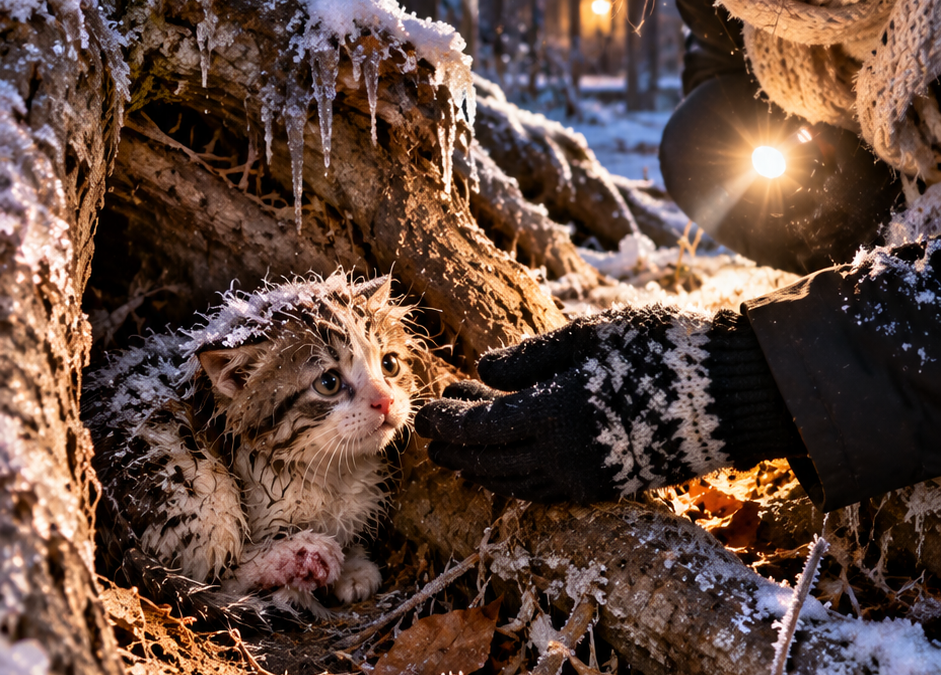
A tiny kitten was curled against the base of the tree.
Its fur was tangled and damp, with tiny crystals of frost clinging to the ends. Its eyes were wide and frightened, and its little body trembled so violently that I could see the movement even in the weak light from my phone.
One front paw was tucked awkwardly against its chest.
It tried to move when I approached.
Instead, it let out a miserable little cry and pressed itself farther into the space beneath the roots.
“Oh, sweetheart.”
I dropped to my knees.
The frozen ground immediately soaked through my jeans, but I barely noticed.
The kitten stared at me.
Its ears were flattened, and its tiny mouth opened again.
A sound came out that was barely more than a whisper.
I had never seen an animal look so frightened and exhausted at the same time.
“Hey,” I whispered. “It’s okay.”
I held out one gloved hand.
The kitten flinched.
I stopped moving.
“All right. I won’t touch you yet.”
I lowered myself closer to the ground and waited.
The wind blew through the garden, sending a fresh wave of cold against my face.
The kitten shivered.
Its eyes remained fixed on my hand.
I could see now that it was painfully thin. Its little belly looked sunken, and its fur was too dirty and tangled to offer much protection from the cold.
The injured paw worried me most.
It held the limb close to its body and seemed unwilling to put any weight on it.
I wondered whether it had fallen, become trapped beneath something, or been injured while trying to find shelter.
There was no way to tell.
I looked around the garden.
No mother cat appeared.
There were no other kittens.
Only this tiny creature, alone beneath an old tree on a night cold enough to freeze the ground solid.
“Where’s your mama?” I whispered.
The kitten blinked.
I felt tears gathering in my eyes.
I knew it couldn’t answer me.
But the question hurt anyway.
I wondered how long it had been waiting there.
Had it cried all afternoon?
Had somebody heard it and kept walking?
Had it crawled beneath the tree because it was searching for shelter, only to discover that the roots offered almost no protection from the freezing wind?
I thought about leaving it there.
Not because I wanted to.
Because I was frightened.
I didn’t know how badly it was injured, whether I could safely carry it, or where I would find help at that hour.
I had never rescued an animal in such terrible condition.
But as I looked at the kitten’s trembling body, I realized something that made the decision for me.
If I walked away, it might not survive the night.
I took off my scarf.
It was thick, soft, and still warm from being wrapped around my neck.
I spread it across my lap and moved my hand a little closer.
“Come here, sweetheart.”
The kitten opened its mouth.
Another faint cry escaped.
I gently touched the fur behind its ears.
It flinched again.
Then it became still.
I stroked its head once.
Its eyes closed for the briefest moment.
“That’s it,” I whispered. “I’m not going to hurt you.”
I carefully slipped one hand beneath its chest and supported its hindquarters with the other.
The kitten was alarmingly light.
I could feel the fragile outline of its ribs beneath my gloves.
When I lifted it from beneath the roots, it let out a frightened squeak and tried to curl around its injured paw.
“I’m sorry,” I whispered. “I’m sorry, baby.”
I lowered it onto my scarf.
Then I wrapped the fabric around its body, leaving its little face uncovered.
It stared at me.
Its whiskers were stiff with frost.
I pulled the bundle against my chest and opened my coat enough to shelter it from the wind.
For a moment, I simply knelt there.
The kitten’s tiny heartbeat seemed impossibly fast.
I could feel it trembling against me.
And I was suddenly terrified that I had found it too late.
“Please,” I whispered. “Just stay with me.”
I stood carefully.
The kitten made another weak sound.
I tucked the scarf more securely around it and hurried toward the garden gate.
The walk back toward town felt much longer than it should have.
Every few steps, I lowered my head to check the kitten’s face.
Sometimes its eyes were open.
Sometimes they were closed.
Whenever it became too quiet, fear rose in my throat.
“Hey, little one.”
I gently touched its head.
“Stay awake for me.”
I didn’t know whether keeping it awake mattered. I only knew I was frightened by how still it became whenever it stopped crying.
The wind blew harder as I reached the road.
I turned my back against it and held the kitten closer.
My phone showed that the temperature was continuing to fall.
I needed help.
There was no way I could carry an injured kitten through the streets indefinitely, especially when I didn’t know whether it was suffering from hypothermia, dehydration, or something even more serious.
I looked toward the nearest houses.
Most of their windows were dark.
But a small yellow light glowed behind the curtains of a house near the corner.
I hesitated.
Knocking on a stranger’s door at night wasn’t something I ordinarily would have considered.
But the kitten trembled against my chest.
I walked up the path and knocked.
For several seconds, nothing happened.
Then I heard footsteps.
The door opened a few inches.
An elderly woman peered out at me.
“Yes, dear?”
“I’m sorry to bother you.”
She looked at my wet hair, my reddened face, and the bundle in my arms.
“Good heavens. What’s happened?”
“I found a kitten in the old garden. It’s freezing, and I think its paw is hurt.”
Her expression changed immediately.
“Oh, you poor thing. Come inside.”
I stepped into the warm hallway.
The sudden change in temperature made my face sting.
The woman closed the door behind me and hurried toward a cupboard.
“Sit down, sweetheart.”
I lowered myself onto a chair near the kitchen.
She returned carrying a thick blanket.
“Here. Wrap the little darling in this.”
I carefully transferred the kitten into the blanket, keeping my scarf beneath its body.
The woman leaned closer.
“Oh, my goodness.”
Her voice became very quiet.
The kitten looked impossibly small against the blanket.
The woman touched its head gently.
“Where did you find this poor baby?”
“Under the big tree in the abandoned garden.”
“All alone?”
I nodded.
She shook her head.
“On a night like this?”
My eyes filled.
“I don’t know how long it’s been there.”
She looked at me for a moment.
Then she placed a hand on my shoulder.
“Well, it’s not there anymore.”
Something about those words nearly made me cry.
Until then, I had been moving almost entirely on fear.
I’d found the kitten, lifted it, and carried it away because I couldn’t imagine doing anything else.
But standing inside that warm kitchen, surrounded by the ordinary comfort of somebody else’s home, I suddenly felt how frightened I’d been.
The woman brought over a small bowl of milk.
“Perhaps it’s hungry.”
I looked down at the kitten.
Its tiny nose moved when it smelled the bowl, but it was too weak to approach.
“I think it needs a veterinarian first,” I said uncertainly. “It’s so cold.”
The woman nodded.
“Of course. You’re right.”
She set the bowl aside and helped me arrange the blanket so the kitten was protected without overheating.
“Do you know where I could find a vet?” I asked.
“Not one who’s open this late, I’m afraid.”
My heart sank.
“But the shop at the end of the street is still open. The owner has lived here forever. He may know where you can go.”
I glanced at the kitten.
The elderly woman noticed.
“Take the blanket, dear.”
“I couldn’t.”
“Nonsense.”
She tucked it around the little bundle.
“That baby needs it more than my linen closet does.”
I tried to thank her.
But my voice caught.
She smiled gently.
“Go on. And keep that little one close.”
I carried the kitten back outside.
The wind felt even colder after the warmth of her kitchen.
But now I had a blanket wrapped around the kitten, and somebody else knew it existed.
For some reason, that made me feel a little less alone.
I hurried down the street toward the small shop.
Its windows glowed beneath a faded awning, and the owner was pulling down one of the metal shutters when I arrived.
“Excuse me!”
He turned.
“Sorry, we’re closing.”
“Please. I just need to ask you something.”
He looked at the bundle in my arms.
“What’ve you got there?”
“A kitten. I found it outside, and it’s hurt.”
I unfolded the blanket just enough for him to see its face.
His expression softened.
“Oh, no.”
He stepped closer.
“Poor little thing.”
“Do you know a veterinarian who might still be open?”
He thought for a moment.
“There’s a clinic a few streets over. They sometimes handle emergencies after hours.”
He gave me directions and helped me find the telephone number.
While I called, he disappeared into the shop.
The kitten stirred against my chest.
“Hang on,” I whispered.
The clinic answered.
I explained as much as I could.
The person on the telephone asked several questions about the kitten’s condition and told me to bring it in for assessment.
When I ended the call, the shopkeeper was standing beside me with a small bag.
“Here.”
Inside was some suitable kitten food and a few supplies.
“I can’t pay for all this,” I told him.
He waved my words away.
“Get the little one looked at first.”
I stared at him.
He smiled.
“There’s plenty of time to worry about everything else.”
I thanked him and turned toward the road.
As I hurried away, I realized that the kitten had stopped trembling quite so violently.
I didn’t know whether that meant it was warming up or becoming weaker.
The uncertainty frightened me.
I held it close and continued walking.
A few minutes later, a young couple approached from the opposite direction.
They were carrying shopping bags and laughing about something until they noticed my expression.
“Are you okay?” the woman asked.
I almost said yes.
It was the automatic answer I’d given people my entire life.
But then I looked down at the kitten.
“No,” I admitted. “I found this kitten outside. It’s hurt, and I’m trying to get to the veterinary clinic.”
The man stepped closer.
“Where’s the clinic?”
I explained.
The woman looked into the blanket.
“Oh, sweetheart.”
The kitten opened its eyes.
She covered her mouth.
“That poor baby.”
For a moment, nobody spoke.
Then the man asked whether I needed help getting there.
I told him I had the directions.
“Are you sure?”
I nodded.
“We’ll be all right.”
The woman gently touched my arm.
“You’re doing a wonderful thing.”
I didn’t feel wonderful.
I felt cold, frightened, and completely unprepared.
But her kindness steadied me.
“Thank you.”
She smiled.
“Keep going. You’re almost there.”
I continued toward the clinic.
By the time I reached it, my fingers were stiff, my legs ached, and I was terrified that the kitten had become too quiet.
I pushed through the entrance and approached the reception desk.
“Please,” I said. “I found a kitten outside.”
The receptionist looked at the bundle in my arms.
Then she immediately called for someone from the medical team.
A veterinary technician came through the doorway.
“Let’s see what we’ve got.”
I carefully unfolded the blanket.
The kitten lay curled against my scarf.
Its eyes opened when the technician touched its head.
“Oh, sweetheart.”
She looked at me.
“How long has it been outside?”
“I don’t know. I found it beneath a tree. It was crying.”
“Has it eaten?”
“Not since I found it.”
“All right. Let’s get it examined.”
She lifted the kitten carefully.
For the first time since leaving the garden, my arms were empty.
I hadn’t realized how tightly I’d been holding it until somebody took it away.
The technician disappeared into the examination area.
I stood there for a moment.
Then I sat down.
My scarf was damp.
My coat was dirty.
And my hands wouldn’t stop shaking.
I stared at the closed door and thought about the kitten’s injured paw.
What if it was broken?
What if the cold had already done too much damage?
What if it had an infection?
What if the few minutes I’d spent deciding whether to enter the garden had been the difference between life and death?
I rubbed my palms together.
There was nothing I could do now except wait.
Eventually, the veterinarian came to speak with me.
The kitten was dangerously cold and exhausted, and its injured paw needed attention.
The veterinary team was working to stabilize it.
I listened carefully as the veterinarian explained that gradual, controlled warming and proper assessment were important for an animal in that condition.
“What about its paw?”
“We’ll examine it thoroughly and determine what treatment it needs.”
“Is it going to survive?”
The veterinarian paused.
I hated that pause.
“We’re going to give it the care it needs. You did the right thing by bringing it here.”
I looked toward the examination room.
“Can I see it?”
“When it’s ready.”
I nodded.
I wanted certainty.
I wanted someone to promise that the kitten would recover completely and that one day this terrible night would become nothing more than a frightening memory.
But the veterinarian couldn’t make that promise.
And I knew it.
After the initial examination and care, the veterinary team gave me instructions for what would come next.
The kitten needed warmth, carefully managed feeding, attention to its injured paw, and close monitoring.
I listened to every word.
I asked questions whenever I didn’t understand.
I wrote down the instructions because I was afraid exhaustion would make me forget something important.
When I was finally able to hold the kitten again, it looked very small beneath its fresh blanket.
But it was breathing steadily.
And when I spoke, its ears moved.
“Hey, little one.”
I touched its head.
“You scared me.”
The kitten blinked.
I smiled through tears.
“Let’s get you somewhere warm.”
The following days changed the rhythm of my life.
I’d expected to spend the winter following the same familiar routine: getting up, going about my responsibilities, coming home, and waiting for spring.
Instead, almost every spare thought belonged to a tiny injured kitten.
I prepared a warm, quiet place where it could rest.
I followed the veterinary team’s instructions carefully, watched its condition, and made sure its injured paw was protected while it healed.
At first, the kitten slept for long stretches.
Sometimes I would sit nearby and watch its chest rise and fall.
Its small body looked almost lost among the blankets.
I worried whenever it became unusually quiet.
I worried when it hesitated before eating.
I worried when it moved its injured paw.
And I worried about the possibility that I might miss some important sign that it needed more help.
One morning, I found myself kneeling beside its resting place, whispering the same words I’d spoken beneath the old tree.
“You’re okay. I’m right here.”
The kitten opened its eyes.
Then, very slowly, it extended one tiny paw toward my hand.
I froze.
Its claws caught lightly against my finger.
And it held on.
I felt my throat tighten.
“Well, hello to you, too.”
I stroked its head.
For the first time, it began to purr.
The sound was so quiet that I initially thought I’d imagined it.
Then I felt the faint vibration beneath my fingers.
I started crying.
I couldn’t help it.
I’d first heard this kitten crying alone in a frozen garden, frightened and too weak to protect itself.
Now it was purring beneath my hand.
It was such a small thing.
But after everything that had happened, it felt like the most beautiful sound in the world.
As the days passed, its strength gradually returned.
Its appetite improved.
Its eyes became brighter.
And although its injured paw still required care, it began showing signs of the curiosity that every healthy kitten seems to possess.
It watched the movements of my hands.
It followed unfamiliar sounds.
And whenever I entered the room, its little head would rise as though it expected something interesting to happen.
I began to recognize its personality.
It was cautious but affectionate.
It preferred approaching me on its own terms.
And once it felt safe, it seemed determined to stay close.
Sometimes I would sit beside it after a long day, exhausted from balancing its care with everything else I needed to do.
The kitten would stretch toward me, press its tiny head against my hand, and settle down.
Those moments were the easiest part of the entire experience.
The hardest part was knowing that I couldn’t simply assume I was the right person to keep it forever.
I wanted to.
Of course I wanted to.
Every time it purred, every time it looked up at me with those brightening eyes, and every time it curled into a little ball beneath the blanket, I found myself imagining what it would be like to have it beside me for years.
But I knew that wanting to keep an animal and being able to provide everything it needed were not always the same thing.
The kitten deserved a permanent home.
It deserved people who were prepared to care for it through every stage of its life.
And it deserved a future that didn’t depend entirely on the desperate circumstances that had brought us together.
So while it recovered, I began searching.
I contacted local shelters.
I asked people in the community whether they knew anyone looking to adopt a kitten.
I followed up on every promising possibility.
Some conversations went nowhere.
Some people were interested until they learned that the kitten had been injured and might require additional medical care.
Others already had animals they couldn’t accommodate another pet alongside.
I tried not to become discouraged.
But it was difficult.
Every unsuccessful conversation made me imagine the kitten waiting longer for the home it deserved.
And every evening, when I returned to find it resting peacefully, I wondered whether I would ever be able to let it go.
One afternoon, I received a message about a family who had been looking for a pet.
They had heard about the kitten through people in the community.
They wanted to meet it.
I read the message several times.
For a moment, I felt excited.
Then an unexpected sadness settled over me.
This was what I’d been working toward.
So why did the thought of saying goodbye hurt so much?
I looked toward the kitten.
It was resting on its blanket, one little paw tucked beneath its chest.
“Somebody wants to meet you,” I whispered.
It opened its eyes.
I smiled.
“Don’t look at me like that.”
The kitten stretched.
I sat beside it.
“I think they might be able to give you a really good home.”
It pressed its head into my hand.
I swallowed.
“That’s what I want for you.”
When the family arrived, I was more nervous than I’d expected.
They spoke gently.
They asked questions about the kitten’s health, the injured paw, its feeding routine, and the veterinary care it had received.
They listened while I explained how I’d found it beneath the tree.
I told them about the freezing wind.
About the scarf.
About knocking on doors and desperately searching for somebody who knew where I could find a veterinarian.
I told them how weak the kitten had been during those first hours and how slowly its strength had returned.
I tried to remain composed.
But when I described the first time it had purred, my voice began to tremble.
The family listened without interrupting.
Then one of them gently asked whether they could hold it.
I nodded.
I carefully lifted the kitten from its blanket and placed it in their arms.
For a moment, I held my breath.
I didn’t know how it would react.
It had become accustomed to me, and unfamiliar people could still make it cautious.
But the family remained patient.
They allowed it to look around.
They stroked its head gently.
And after a little while, the kitten settled against them.
Its small body relaxed.
Its eyes began to close.
I felt tears gathering again.
There was something almost unbearably tender about watching an animal that had once been terrified of the world discover another person who wanted to protect it.
The family smiled.
“It’s beautiful.”
I nodded.
“It really is.”
They looked at the kitten.
Then at me.
“We’d love to give it a home.”
I wanted to say yes immediately.
But there was one final question I needed to ask.
“You understand that it might still need care while its paw finishes healing?”
“Of course.”
“And you’ll make sure it sees the veterinarian?”
“Absolutely.”
I looked down at the kitten.
It was resting peacefully in their arms.
I knew then that I had found what I’d been searching for.
The family prepared a warm place for it and made arrangements to continue its medical care.
We discussed its routine, the progress it had made, and the things that seemed to help it feel comfortable.
I gave them the information I’d written down during the recovery.
The details that had occupied so many anxious hours of my life were now becoming part of someone else’s responsibility.
I should have felt nothing but relief.
Instead, I discovered that happiness and sadness could exist in exactly the same moment.
On the day the kitten left, I held it one last time.
It had grown stronger since the night I’d found it.
Its fur was softer.
Its eyes were brighter.
And its little body no longer trembled helplessly against my chest.
I wrapped it gently in the scarf I’d carried through the frozen garden.
The fabric had become a reminder of everything we’d survived together.
I stroked its head.
“Do you remember this?”
The kitten sniffed the scarf.
I laughed softly.
“Probably not.”
It looked up at me.
I pressed my cheek against its fur.
“I remember.”
I remembered the terrible cold.
The darkness.
The sound of its frightened cries.
I remembered kneeling beneath the tree and feeling its tiny body tremble in my hands.
I remembered every door I’d knocked on, every moment of fear, and every time I’d wondered whether I was doing enough.
And I remembered the people who’d helped us.
The elderly woman who had welcomed a frightened stranger into her kitchen.
The shopkeeper who’d stopped closing his store to help me find veterinary care.
The young couple who’d offered assistance and encouragement when I was close to tears.
The medical team who’d treated an injured animal as though its life mattered enormously.
And now this family, who were opening their home to a kitten they hadn’t known existed just days earlier.
I looked down at the small creature in my arms.
“You have no idea how many people care about you.”
The kitten purred.
I smiled through tears.
Then I placed it gently into its new family’s arms.
They thanked me.
I tried to answer.
But all I could manage was a small nod.
As they carried it toward the door, the kitten lifted its head.
For a moment, our eyes met.
I raised my hand.
“Goodbye, sweetheart.”
Then they were gone.
The room felt strangely quiet afterward.
I sat down beside the empty blanket and stared at the place where the kitten had spent so many hours recovering.
Its tiny food bowl was still there.
So were the notes I’d written about its care.
I picked up the blanket and folded it carefully.
Then I finally allowed myself to cry.
I missed it immediately.
I missed the quiet purring, the curious little face that appeared whenever I entered the room, and the feeling of a tiny paw resting against my fingers.
But beneath the sadness was something else.
Peace.
I knew the kitten was no longer depending on chance to survive.
It had a home.
It had people who wanted it.
And it had a future that stretched far beyond the frightened hours we’d spent together.
In the weeks that followed, the family sent me updates.
At first, they were simple messages letting me know that the kitten was settling in well.
Then the photographs began arriving.
In one picture, it was asleep in a comfortable bed.
In another, it was sitting near a sunny window, watching something outside with intense curiosity.
Later, I received a photograph of it playing.
I stared at that picture for a long time.
The kitten’s fur had grown soft and glossy.
Its injured paw had healed.
And the fragile little animal I’d once carried through freezing streets was now chasing toys and exploring a warm home.
I found myself laughing at the photographs.
Sometimes I cried.
Mostly, I felt an overwhelming gratitude that was difficult to explain.
One evening, the family sent me another update.
The kitten had discovered a favorite sunny spot on the floor.
Every afternoon, it would stretch out in the warmth, close its eyes, and fall asleep as though it had never known anything other than comfort.
I looked at the photograph and thought about the old garden.
That deserted place was still there.
The broken gate.
The frozen flowerbeds.
The enormous tree whose exposed roots had sheltered a frightened little animal from the wind.
I wondered what would have happened if I’d taken a different route home that night.
If I’d been wearing headphones.
If I’d dismissed that faint cry as the sound of the wind.
Or if I’d decided somebody else would probably stop and investigate.
I would never know.
And I no longer needed to.
The kitten was alive.
It had recovered.
And it was loved.
One afternoon, after the worst of winter had passed, I walked along the familiar path beside the abandoned garden.
The air was still cold, but sunlight was beginning to soften the frozen ground.
I stopped beside the broken gate.
For a moment, I could almost hear that faint cry again.
I stepped inside and walked toward the old tree.
The exposed roots were exactly as I remembered them.
I crouched beside the small hollow where I’d found the kitten.
There was nothing there now.
No trembling little body.
No frightened eyes.
No desperate cry.
Only bare earth and a few fallen leaves.
I placed my hand against the rough bark.
Then I thought about the photograph waiting on my phone.
The kitten sleeping peacefully in the sunlight.
I smiled.
The last time I’d stood beneath that tree, I’d been terrified that I wouldn’t be able to save it.
Now, somewhere in a warm house, the same kitten was growing stronger, discovering the world, and learning that human hands could bring comfort instead of fear.
I stood there for a few moments longer.
Then I turned and walked home.
I had entered that garden because I heard a frightened animal crying in the darkness.
I had left it carrying a responsibility I wasn’t sure I could fulfill.
And somewhere along the way, strangers had helped me turn one desperate decision into a life that was finally safe.
I hadn’t been able to give the kitten everything it needed on my own.
Fortunately, I hadn’t needed to.
The elderly woman had given us warmth.
The shopkeeper had helped us find medical care.
The couple had reminded me that I wasn’t alone.
The veterinary team had helped it recover.
And its new family had given it the one thing I had been searching for since the moment I lifted it from beneath that tree.
A place to belong.
That night, another photograph arrived.
The kitten was asleep beside its new family, curled into a small, comfortable ball.
Its once-injured paw rested gently against someone’s hand.
I looked at the picture for a long time.
Then I remembered the first time that tiny paw had reached toward me.
Back then, I’d been afraid that the kitten might never survive.
Now it was sleeping in a warm home, surrounded by people who loved it.
Outside my window, the winter wind was beginning to rise again.
I pulled my blanket closer and smiled at the photograph.
For the first time, the sound of that wind didn’t remind me of the frightened cries beneath the old tree.
It reminded me of the little life we’d brought home from the cold.
And somewhere, safe in the warmth, that little life was sleeping peacefully.








