𝗣𝗔𝗥𝗧 𝟮 I Followed a Cry Beneath the Street and Found a Kitten No One Could See
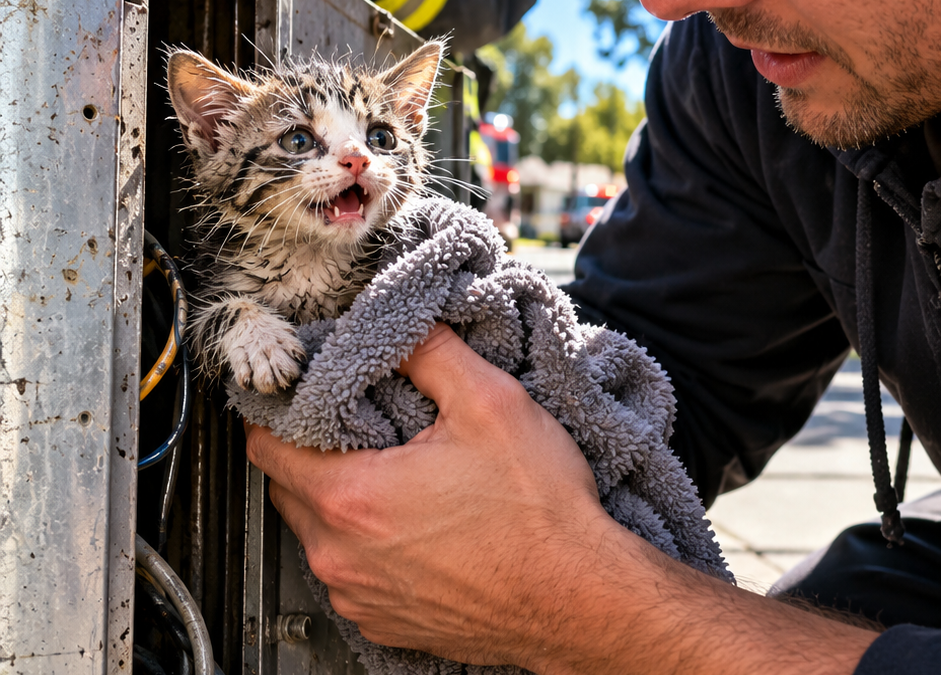
𝗣𝗔𝗥𝗧 𝟮
When I approached the kitten’s enclosure, it was curled against the soft bedding.
Its breathing looked less labored.
I lowered myself until my face was near the glass.
“Hello again, little one.”
One ear twitched.
I smiled through tears.
“You’re certainly giving everyone a scare.”
Over the following days, I kept in contact with the veterinary team and the rescuers caring for it.
At first, the updates were small.
Its temperature was improving.
It had started accepting nourishment.
Its trembling had decreased.
Then came the update I had been waiting for.
The kitten was moving around.
The first time I saw it properly awake, I barely recognized the fragile animal that had emerged from the utility pole.
It still looked terribly small, but its eyes followed movement. Its ears turned toward familiar voices. When a caretaker approached, it raised its head instead of curling farther into the bedding.
“Look at you,” I whispered.
The kitten regarded me with the serious expression that only very young cats seem capable of producing.
Then it sneezed.
I laughed so suddenly that the caretaker looked up.
“Sorry,” I said. “I just never thought I’d hear it do that.”
The caretaker smiled.
“Wait until it discovers toys.”
She was right.
As the kitten grew stronger, its curiosity returned.
At first, it explored only the immediate area around its bed. It inspected the edges of its enclosure, sniffed its food bowl, and watched every movement beyond the door.
Then one morning, a caretaker placed a small toy nearby.
The kitten stared at it.
The toy rolled slightly.
One tiny paw shot forward.
I watched the video they sent me at least a dozen times.
There was something almost unbearable about seeing that little creature play.
Not long before, it had been trapped in a place where it could barely move.
Now it was trying to catch a toy that was hardly larger than its head.
The rescuers continued helping it adjust to human contact.
Although the kitten had accepted their care from the beginning, unfamiliar movements sometimes startled it. Sudden noises could send it retreating toward its bedding.
No one rushed the process.
They let it approach when it felt safe, offered gentle affection, and gave it predictable routines.
Gradually, the animal that had once trembled in darkness began seeking out the very hands that had carried it into the light.
Eventually, the conversation turned toward adoption.
The rescue team wanted more than someone willing to take home an adorable kitten.
They wanted a family prepared to provide stability, patience, and lifelong care.
After everything the little animal had endured, it deserved a home where it would never again have to fight simply to feel safe.
When a suitable family came forward, the rescuers introduced them to the kitten.
They were patient, gentle people who understood that the smallest member of their household might need time to adjust.
The kitten approached them cautiously.
It sniffed an offered hand, retreated a few steps, then returned.
I watched with my heart in my throat.
It was a simple introduction, but I knew how much had happened to make that moment possible.
The adoption went forward once the kitten was healthy and ready.
Its new family prepared a quiet space with comfortable bedding, fresh water, appropriate food, and toys.
On the first day, the kitten investigated its surroundings slowly.
It examined the room from beneath a chair before venturing toward a patch of sunlight on the floor.
When it finally curled up in that sunlight, its new family sent us a photograph.
I stared at it for a long time.
The kitten’s little body was stretched across the warm floor, one paw resting beneath its chin.
Its eyes were closed.
There was no metal surrounding it.
No darkness.
No reason to cry for someone who might never hear.
In the weeks that followed, the family shared more updates.
The kitten became bolder, exploring its new home and discovering favorite places to sleep. Its once-fragile body grew stronger. Its eyes brightened, and its movements became lively and confident.
It developed an unmistakable fondness for soft blankets and sunny windows.
I loved that detail more than I could explain.
Every ordinary comfort seemed extraordinary when I remembered where its life had almost ended.
The last time I visited, the kitten climbed onto the couch beside me and investigated my hand.
For a moment, it placed one tiny paw against my fingers.
I thought of the rescuer who had lifted it from the utility pole and the first fragile movement it had made against his hand.
I didn’t know whether the kitten remembered any of that.
I hoped it didn’t.
I hoped its life had become so full of warmth and safety that the darkness beneath the street had faded into something distant and unimportant.
As it settled beside me, I gently stroked its head.
Outside, traffic continued moving through the neighborhood.
Cars passed.
Doors opened and closed.
People went about their ordinary lives.
And somewhere in a warm house, a little kitten that had once cried from inside a metal pole was sleeping peacefully, unaware of how many hearts it had changed simply by surviving.
I Found Two Soaked Kittens Beside the Trash Can, but Only One Was Still Crying
One kitten was crying when I found them.
The other lay so still that I was afraid to touch it.
I carried them both inside, terrified that I had already arrived too late.
I remember almost everything about that morning, although there was absolutely nothing remarkable about it until I walked toward the trash cans.
The sky was gray, the ground was wet, and the cold air carried the unpleasant smell of damp garbage.
I had a trash bag in one hand and a long list of ordinary responsibilities running through my mind.
I was thinking about what I needed to buy from the grocery store when I heard something strange.
At first, I ignored it.
It was a small, thin sound, almost lost beneath the noise of a passing vehicle.
Then I heard it again.
Meow.
I stopped walking.
The sound came from somewhere near the trash cans.
I looked behind the first container, expecting to find a stray cat searching for food.
Instead, I saw what appeared to be a bundle of wet cloth lying against the pavement.
I almost turned away.
Then something moved.
I stepped closer and felt my stomach drop.
There were two kittens.
They were pressed against each other, their fur completely soaked and their little bodies trembling in the cold.
One lifted its head with enormous effort and released another faint cry.
The second didn’t move.
For several seconds, I couldn’t make myself do anything.
I had never seen kittens so small and helpless. Their bodies looked painfully fragile, and the dirty water soaking their fur made them appear even smaller.
“Oh, my God.”
I dropped the trash bag.
“Where’s your mother?”
I looked around desperately.
There was no adult cat nearby.
No movement beneath the parked cars.
No answering cry from the bushes.
The kittens lay exposed beside the garbage, where anyone could have stepped past them without noticing.
I couldn’t know how they had ended up there.
Perhaps someone had abandoned them.
Perhaps their mother had been unable to return.
But as I knelt beside them, the question of how they had arrived suddenly seemed less important than what would happen if I left them there.
The crying kitten opened its mouth again.
Almost no sound came out.
I reached toward the motionless one.
Its little body was frighteningly cold.
“No, no, no.”
I gently gathered both kittens into my arms.
The one that had been crying moved weakly against my palm.
The other remained limp.
I used the plastic bag I had brought outside as a temporary shield against the wind and rain, keeping it away from their faces while I carried them toward the house.
My hands were shaking so badly that I struggled to open the front door.
“Please,” I whispered. “Please, just stay with me.”
Inside, I hurried to the living room and laid both kittens on a soft towel.
They were so wet that the fabric beneath them immediately darkened.
I gently patted their tiny bodies, trying to remove as much moisture as possible without hurting them.
I knew they needed warmth, but I was terrified of making another mistake.
I prepared a warm water bottle, wrapped it securely in a towel, and positioned it near them so they could receive gentle warmth without direct contact.
Then I sat beside them.
The crying kitten moved its head.
The other didn’t.
I leaned closer, searching for the slightest movement in its chest.
“Come on, baby.”
Nothing.
My throat tightened.
I had found them only minutes earlier, yet the thought of losing either one felt unbearable.
I touched the motionless kitten with one finger.
Its fur was still cold.
“Please don’t leave your brother or sister alone.”
I didn’t even know whether they were brothers or sisters.
I only knew they had been lying together in the rain, two tiny bodies pressed against each other because there was nothing else in the world offering them warmth.
Then I saw it.
A tiny movement.
One paw twitched.
I leaned closer.
“That’s it. Come on.”
The kitten’s chest rose.
It was such a small movement that I almost doubted what I had seen.
Then it happened again.
I covered my mouth with one hand.
“Oh, thank God.”
The kitten let out a weak, raspy sound.
I began crying.
Both of them were alive.
That was all I knew.
I had no idea whether they would survive the next hour, let alone the next day.
But suddenly, there was something worth fighting for.
As they gradually warmed, I examined them more carefully.
What I discovered made me feel sick.
Their tiny bodies were covered with fleas.
The parasites moved through their soaked fur and clustered around areas where the skin was exposed.
I had never seen such a severe infestation on animals so young.
“How long have you two been out there?” I whispered.
The kittens couldn’t answer.
Their eyes were barely developed, and their movements were weak and uncoordinated.
There were no obvious wounds or broken limbs, but their condition frightened me.
I understood that they were newborns and that caring for them would require far more than a blanket and a bowl of milk.
I had never raised newborn kittens.
Not once.
I loved animals, but loving them and knowing how to keep them alive were suddenly two very different things.
I reached for my phone.
My first searches were frantic and badly worded.
How to save newborn kittens.
What to do when kittens are cold.
How often newborn kittens need feeding.
How to remove fleas from tiny kittens.
I read until the words began blurring together.
Then I contacted someone experienced in caring for rescued kittens and sought veterinary guidance.
The advice made one thing clear.
These babies needed gentle warmth, appropriate nourishment, careful monitoring, and attention to their serious flea infestation.
I had to approach everything cautiously.
Once they were sufficiently stabilized, I carefully cleaned them and dealt with the fleas, using warm water and gentle handling while avoiding unnecessary exposure to the cold.
Even that simple task frightened me.
They were so small that I could support each one in a single hand.
Every time I touched them, I worried about pressing too hard.
Every time one stopped moving, I wondered whether something terrible was happening.
When they were clean and dry, I wrapped them in soft old clothing and prepared a warm, protected nest.
For the first time since finding them, they looked almost comfortable.
One pressed its face into the other’s fur.
I watched them settle together and felt something deep inside my chest loosen.
“All right,” I whispered. “We’ve made it this far.”
But feeding them was another battle entirely.
By then, I understood that a newborn kitten needed appropriate kitten milk replacement and carefully controlled feeding.
I obtained what I needed and prepared their first feeding.
I thought they would immediately recognize the food and begin drinking.
They didn’t.
The first kitten turned away.
The second barely reacted.
I tried again, taking care not to force liquid into their mouths.
Nothing.
I checked the feeding guidance, adjusted my approach, and tried to remain calm.
“Come on, sweetheart. You need to eat.”
The bolder kitten opened its mouth but didn’t latch properly.
I could feel panic returning.
What if they had already gone too long without food?
What if I had brought them inside only to watch them starve because I didn’t know how to help?
I contacted the experienced caretaker again, explained what was happening, and followed the advice I received.
After several attempts, one kitten finally accepted a small amount of formula.
I stared at it.
“That’s it!”
Its little mouth moved again.
I nearly laughed.
“Good baby. That’s my good baby.”
The other kitten still refused.
My happiness disappeared as quickly as it had arrived.
I returned my attention to the smaller one, working patiently and carefully.
Eventually, it accepted a little nourishment too.
I don’t think I had ever felt so relieved by something so small.
That first successful feeding was nowhere near enough to solve everything.
But it gave us a beginning.
The following days were exhausting.
I learned to organize my life around the kittens’ needs.
Feedings came at regular intervals.
Their bedding had to remain clean and comfortably warm.
I monitored their weight, watched their behavior, and learned how to provide the additional care that kittens too young to eliminate independently require.
Before every feeding, I checked on them.
After every feeding, I checked again.
I began waking in the middle of the night before the alarm sounded, convinced I had heard one of them crying.
Sometimes I had.
Sometimes I hadn’t.
Either way, I got up.
There were mornings when I could barely keep my eyes open.
I would sit beside their nest with a bottle of formula and wonder whether I was capable of doing this.
Then one of them would move toward my hand.
And I would remember that there were two little lives depending on me.
Their progress wasn’t dramatic.
It came in tiny increments.
One day, they drank a little more.
Another day, they felt stronger when I lifted them.
Then they began responding more readily when they sensed I was nearby.
Their fur gradually became softer and healthier.
Their bodies no longer felt like little bundles of bones beneath my fingers.
I started weighing them regularly and recording the numbers.
Whenever the scale showed even a small, healthy increase, I felt a ridiculous surge of pride.
“Look at you two,” I would say. “You’re actually growing.”
As the days passed, I began noticing differences in their personalities.
One was determined to investigate everything.
Even before it could walk properly, it tried to crawl beyond the safety of the nest.
The other preferred staying close to its sibling, settling contentedly against the warm bedding.
I came to recognize their different cries.
One seemed to announce every inconvenience in the world.
The other made small, almost apologetic sounds when it was hungry.
They were still fragile, but they were becoming individuals.
The first time one of them managed to stand on its unsteady legs, I happened to be sitting beside their nest.
It planted its front paws against the blanket, raised its little body, and tried to move forward.
For one glorious second, it stood.
Then it toppled sideways.
I burst out laughing.
“Oh, sweetheart!”
The kitten seemed entirely unconcerned by its failure.
It immediately tried again.
I watched with tears running down my face.
The image of those two motionless bodies beside the trash cans flashed through my mind.
I remembered the rain.
The cold pavement.
The dreadful silence from the second kitten.
Now one was determined to walk.
And the other was beginning to follow.
As they developed, their eyes opened fully, and the world seemed to become an endless source of fascination.
They stared at ordinary objects as though discovering entirely new planets.
The edge of a blanket was worth investigating.
A moving shadow could hold their attention for several minutes.
And each other’s tails became irresistible targets.
I began creating a safer, more stimulating space for them.
I arranged a small enclosure with comfortable bedding, room to explore, and age-appropriate toys.
They quickly turned it into their own little kingdom.
The bolder kitten was usually first to investigate something new.
Its more cautious sibling watched from a safe distance before deciding whether the adventure was worth joining.
Sometimes they fought over the same toy, rolling clumsily across the bedding with their paws wrapped around each other.
Then, without warning, they would fall asleep in one tangled heap.
Those were my favorite moments.
I could watch them sleep for ages.
Their tiny chests rose and fell in a steady rhythm.
Occasionally, one would stretch a paw across the other’s face.
The second kitten would protest with an indignant little squeak, reposition itself, and immediately fall asleep again.
I never grew tired of it.
There were still difficult days.
Sometimes one had less appetite than usual.
Sometimes I worried because their weight gain seemed slower than I expected.
Sometimes exhaustion made me question whether I was doing enough.
I continued seeking veterinary advice and adjusting their care as they grew.
But gradually, the emergency that had consumed my entire life began transforming into something else.
I was no longer simply trying to keep two kittens alive.
I was raising them.
The realization came one afternoon when I entered the room and found both kittens waiting near the front of their enclosure.
The moment they recognized me, they began moving toward me.
One reached the opening first.
Its sibling followed.
I knelt and held out my hands.
Both climbed clumsily toward me.
“Well, hello to you too.”
They pressed against my fingers, sniffed my sleeves, and began investigating my lap.
I felt an unexpected lump forming in my throat.
For the first time, they seemed less interested in the food I might be carrying than in being close to me.
Perhaps they simply associated my presence with comfort.
Perhaps I was reading too much into the moment.
I didn’t care.
I gently gathered them against my chest.
Their little bodies were warm.
Their fur was dry.
Their hearts beat steadily beneath my hands.
I remembered carrying them into the house while wondering whether either would survive.
Now they were climbing over each other to reach my face.
As they grew older, their appetite improved, their movements became coordinated, and their curiosity expanded beyond their small enclosure.
I introduced new toys and safe spaces for exploration.
They chased soft balls, pounced on moving strings under supervision, and occasionally became so excited that they stumbled over their own feet.
The bolder kitten discovered that it could surprise its sibling by hiding behind a cushion.
The cautious one eventually learned to retaliate.
Their little games filled my home with a kind of happiness I hadn’t realized was missing.
I began leaving more room in my daily schedule simply to sit with them.
Sometimes I would stretch out on the floor and let them climb over me.
One would attack the drawstring on my sweatshirt.
The other would investigate my hair.
I endured their tiny, determined ambushes with complete happiness.
They had once been too weak to move.
Now they seemed personally offended whenever I attempted to sit still.
One evening, after a particularly exhausting day, I settled beside their enclosure and watched them play.
The bolder kitten was wrestling a stuffed toy.
Its sibling sat nearby, apparently deciding whether intervention was necessary.
Suddenly, both abandoned their activities and came toward me.
They climbed onto my lap and curled against each other.
Within minutes, they were asleep.
I rested one hand beside them.
I don’t know how long I sat there.
The house was quiet.
Rain began tapping against the window.
The sound immediately carried me back to the morning I had found them.
I could still see the wet pavement beside the trash cans.
I could still hear that almost nonexistent cry.
I looked down at the two warm, sleeping bodies in my lap and began to cry.
Not because I was frightened anymore.
Because I finally understood how close I had come to losing them.
Had I taken the trash out a little later, I might never have heard them.
Had I mistaken their bodies for discarded cloth and walked away, they might have remained unnoticed.
Had the little crying kitten become too weak to call out, I might never have looked behind the containers at all.
But none of those things had happened.
They were here.
They had survived their most vulnerable days, and they had become two energetic, affectionate kittens with a future ahead of them.
As they continued growing, I settled into the routines of caring for them.
Their enclosure became a familiar part of my home.
Their feeding times became part of my days.
Their personalities became part of my life.
I no longer thought of them as the two kittens I had found beside the trash.
They were my companions.
They had brought a new kind of purpose into my home, one that came with sleepless nights, endless cleaning, unexpected expenses, and more worry than I had ever imagined.
And I wouldn’t have traded any of it.
Sometimes, when I watched them tumble across the floor or curl up together in a patch of sunlight, I thought about the fragile little bodies I had carried through my front door.
They had been cold, soaked, infested with fleas, and desperately hungry.
One had cried for help.
The other had barely moved.
Now both were growing stronger, exploring their world, and discovering the simple pleasures that every young animal deserves.
I couldn’t change whatever had happened to them before that morning.
I couldn’t give them back the warmth they had lost or erase the hours they had spent exposed to the cold.
But I could make sure their lives were no longer defined by that terrible beginning.
And every time I entered the room and heard two eager little voices calling for me, I knew I had given them something far more important than temporary shelter.
I had given them a home.
The Little Dog on the Burning Road Was Too Exhausted to Ask for Help
The dog was barely standing when I first saw it.
Every step looked as though it might be its last.
What frightened me most was the way it kept trying to walk.
The heat that afternoon was almost unbearable.
The sun hung directly above the road, and the air seemed to shimmer above the asphalt. Even the smallest movement left me uncomfortable, and I had been looking forward to getting somewhere cool.
I was walking along the roadside when something moving in the distance caught my attention.
At first, I thought it was a stray dog searching for shade.
Then I noticed the way it walked.
Its movements were slow and uneven.
Every few steps, it paused, lowered its head, and seemed to gather whatever strength remained before forcing itself forward again.
As I approached, I realized how terribly thin it was.
Its ribs were visible beneath its dull, matted coat. Its legs trembled under its weight, and its head hung so low that it appeared to be watching the ground immediately beneath its paws.
There was no shade nearby.
No bowl of water.
No person walking beside it.
“Hey, little one.”
The dog stopped.
It turned its head toward me, and I saw an expression I will never forget.
Its eyes were cautious, but it didn’t run.
Perhaps it was too exhausted.
Perhaps it had simply stopped expecting anything good from strangers.
I crouched several feet away.
“It’s okay. I’m not going to hurt you.”
The dog watched me.
Its tail remained low.
I could see the rapid movement of its chest as it breathed beneath the relentless sun.
I looked along the road, hoping to see someone searching for a missing pet.
There was nobody.
The little dog took another step.
One of its legs trembled so violently that I thought it might collapse.
“Wait,” I said softly.
I couldn’t bear the thought of watching it continue down that burning road.
I found fresh water and placed a bowl on the ground several feet in front of me.
Then I moved back.
The dog stared at the bowl.
It looked at me.
For a moment, neither of us moved.
“Go ahead,” I whispered. “It’s yours.”
The little animal approached cautiously.
It stretched its neck toward the water, sniffed, and began drinking.
I watched as it took small, eager laps.
Its entire body seemed focused on that bowl.
I wondered how long it had been since anyone had offered it water.
I wanted to give it everything it needed immediately, but its weakened condition made me cautious.
I allowed it to drink at a comfortable pace while observing its breathing and behavior.
When it finally raised its head, water dripped from its muzzle.
It looked at me again.
Something in my chest tightened.
“There you go, sweetheart.”
I offered a small portion of suitable food.
The dog hesitated before approaching.
Then hunger overcame its uncertainty.
It ate carefully, stopping occasionally to glance toward me.
I remained where I was, speaking softly.
“That’s good. You’re doing great.”
Its ribs moved beneath its skin.
Its coat looked as though it hadn’t been properly cared for in a long time.
I tried not to imagine how many hot afternoons it had spent searching for food or shelter.
There was no way to know whether it had been abandoned, lost, or surviving on the streets for weeks.
All I could see was what prolonged hunger, exposure, and exhaustion had done to its body.
After a few minutes, the dog settled onto the ground.
I knelt nearby.
“Feeling a little better?”
It looked at me with tired eyes.
Then, unexpectedly, its tail moved.
Only once.
A tiny, hesitant movement.
I smiled.
“Well, hello there.”
It was such a small response, but after watching the dog struggle along the road, I felt as though I had witnessed an enormous victory.
I stayed with it while considering what to do next.
Leaving it there was out of the question.
Even if the food and water helped temporarily, it was still dangerously thin and exhausted.
It needed medical attention, shelter, and people who knew how to assess animals in poor condition.
I contacted a nearby animal rescue center and explained what I had found.
When I described the dog’s appearance and weakness, the staff encouraged me to bring it in safely.
I looked down at the little animal.
“All right, buddy. We’re going somewhere better.”
I approached slowly and let it see my hands.
It watched me but didn’t attempt to escape.
I gently lifted it, supporting its fragile body.
It felt terribly light.
That was the moment its condition became even more real to me.
A living creature should not feel so insubstantial in someone’s arms.
The dog rested against me, too exhausted to protest.
I carried it to my vehicle, arranged a safe place for it, and began the short journey to the rescue center.
Throughout the drive, I found myself glancing toward it.
Every time I did, its eyes seemed to be watching me.
“Almost there,” I said.
The rescue center was busy when we arrived.
I stepped through the entrance carrying the little dog, and a staff member immediately approached.
“Oh, sweetheart,” she said.
Her expression told me she understood what she was seeing.
“I found it walking along the road in the heat,” I explained. “It was barely able to stand.”
She helped me bring the dog into a quiet examination area.
“Has it had any water?”
“Yes. I gave it some fresh water and a little food.”
“Good. We’ll take it from here and have it assessed.”
I gently lowered the dog onto a comfortable surface.
For the first time since I had found it, I was able to step back and look at the entire animal without worrying that it might wander into traffic.
It looked painfully small.
Its legs were thin.
Its fur was dull and tangled.
But its eyes were still moving, following the staff members as they prepared to examine it.
One caretaker approached slowly.
“Hello, little one.”
The dog sniffed her hand.
Then it allowed her to touch its head.
I watched the interaction with unexpected relief.
It was still cautious, but it hadn’t lost the ability to accept kindness.
The staff began assessing its condition, paying particular attention to dehydration, nutritional needs, possible illness, and signs of injury.
They explained that an animal in such a weakened state needed careful care rather than an immediate return to normal feeding and activity.
The dog would have a safe place to rest while they determined its medical needs.
I felt enormous gratitude toward the people working around it.
They were calm, experienced, and gentle.
Everything about their behavior told me that this little animal was no longer facing its ordeal alone.
I remained nearby while they completed the initial assessment.
The dog eventually lowered its head onto the soft bedding.
Its eyes began closing.
For a moment, I felt frightened.
Then the caretaker smiled.
“It’s resting.”
Resting.
The word nearly brought me to tears.
Only a short time earlier, this little dog had been forcing itself down a road beneath a burning sun, its body trembling with every step.
Now it had food, water, professional care, and somewhere safe to sleep.
I crouched beside it.
“You’re going to be okay, buddy.”
I knew I couldn’t guarantee that every medical problem would disappear or that recovery would be easy.
But I could see that it had finally reached people who would help it.
The dog opened its eyes.
I extended my hand.
After a moment, it moved its muzzle toward my fingers.
I gently stroked its head.
“That’s right. You can rest now.”
When it was time for me to leave, I struggled more than I expected.
I had known this dog for only a few hours.
I didn’t know its history.
I didn’t even know whether it had ever had a name.
But carrying it away from that scorching roadside had created a connection I couldn’t easily explain.
I stood beside its resting place for another moment.
“Take good care of this one,” I said to the caretaker.
She nodded.
“We will.”
Outside, the afternoon sun was still blazing.
The road looked exactly as it had before.
Cars passed.
People hurried through their daily responsibilities.
The world had continued moving while a small, exhausted dog struggled to remain on its feet.
I sat in my vehicle for several minutes before starting the engine.
I kept remembering its eyes.
Not because I imagined that it understood everything I had done.
But because I had watched those eyes gradually lose some of their fear as the dog received food, water, and gentle attention.
Its future was still uncertain.
It needed time to regain weight and strength. The rescue center would continue assessing its health and arranging the care it required.
Eventually, when it was ready, the staff could begin looking for a suitable permanent home.
I hoped that home would belong to someone patient.
Someone who would understand that an animal recovering from hardship might need time to feel comfortable.
Someone who would provide clean water without the dog having to search for it.
Someone who would offer food, shade, affection, and a place to sleep without fear.
I imagined the little dog waking up one morning in a comfortable home and stretching beneath a ceiling fan while sunlight filtered gently through a window.
Perhaps it would have a favorite blanket.
Perhaps it would learn to recognize the sound of its owner’s footsteps.
Perhaps, one day, it would run across a yard with the effortless happiness of an animal that no longer had to conserve every ounce of energy.
I didn’t know whether any of those things would happen.
But for the first time since seeing it on that road, they were possible.
And that mattered.
Before going home, I glanced once more toward the rescue center.
Somewhere inside, the little dog was resting.
It no longer had to keep walking simply because stopping on the roadside might mean never getting up again.
That afternoon, I had set out expecting nothing more than an ordinary walk beneath a scorching sun.
Instead, I had crossed paths with a fragile life that was desperately close to running out of strength.
I couldn’t undo the hunger it had endured or the miles it might have traveled alone.
But I had been there when it needed water.
I had been there when it needed help.
And when I left, it was no longer alone.
The Evening Kiwan Curled Up and Stopped Defending Himself Broke My Heart
Kiwan didn’t run when the children surrounded him.
He curled up and cried as their hands pulled at his frail body.
When I reached him, I realized there was something terribly wrong with the old dog.
At my age, I’ve learned that getting older changes the way you see the world.
You become more patient with certain things and less willing to tolerate others.
You understand how easily strength disappears, how quickly ordinary movements become difficult, and how much dignity matters when your body no longer obeys you the way it once did.
Perhaps that’s why I noticed Kiwan.
Or perhaps I would have noticed him at any age.
I remember the evening clearly.
The light was beginning to fade, and I was making my way through the neighborhood when I heard a distressed animal crying.
It wasn’t an ordinary bark.
It was a frightened, high-pitched sound that made me stop immediately.
I turned toward it and saw several children gathered around a dog.
At first, I couldn’t tell what they were doing.
Then I saw one of them lifting him awkwardly while another reached toward his legs.
“Hey!”
My voice came out louder than I intended.
The children looked up.
“Put him down.”
One of them hesitated.
“We’re just playing.”
I moved toward them as quickly as my aging legs would allow.
“He’s not a toy.”
When I reached the group, I saw the dog clearly for the first time.
He was old.
Terribly thin.
His fur looked neglected, and his eyes had the cloudy, uncertain appearance of an animal whose vision was deteriorating.
One of his paws appeared injured.
He was trying to curl his body inward, making himself as small as possible.
He didn’t bark at the children.
He didn’t snap.
He didn’t even attempt to run.
He simply trembled and cried.
“Please,” I said, keeping my voice controlled. “Leave him alone.”
The children stepped back.
I knelt beside the dog.
“Hello, old boy.”
He flinched when my hand approached.
I immediately stopped.
“It’s all right. I’m not going to hurt you.”
His body was shaking.
His eyes moved uncertainly in my direction.
I waited until he seemed less frightened before gently touching his head.
“That’s it.”
He lowered his muzzle.
Then he let out another little cry.
I felt something inside me break.
There was no anger in that sound.
No aggression.
Only fear.
I looked up at the children.
“Do you see how frightened he is?”
Nobody answered.
“He’s old. He’s hurt. He can’t play the way you want him to.”
One child looked toward the ground.
Another stepped away.
I didn’t know whether they understood the seriousness of what had happened.
I only knew they needed to stop.
Once they had moved away, I returned my attention to the dog.
He had curled himself into a tight little shape, his injured paw tucked close to his body.
“Come here, sweetheart.”
He didn’t move.
I realized he probably couldn’t.
When I carefully examined him, I noticed that his back seemed extremely sensitive. Even slight movements caused him to tense.
His breathing was shallow, and his entire body looked exhausted.
I wondered how long he had been living in that condition.
How many days had he struggled to find food?
How many times had he tried to escape pain he couldn’t understand?
I gently positioned myself beside him.
“Well, old boy, I suppose you and I have something in common.”
He turned his cloudy eyes toward my voice.
“Neither of us moves quite as quickly as we used to.”
I tried to smile.
But my eyes were burning.
I couldn’t leave him there.
Whatever had happened before that evening, Kiwan needed help.
I carefully arranged for him to be moved without placing unnecessary strain on his back and injured paw.
Throughout the process, I kept talking to him.
“Easy now.”
He trembled.
“I know. I know it hurts.”
When he was safely settled, I stayed close.
The frightened little dog seemed to relax slightly whenever he heard my voice.
That small response was enough to make me determined to see him through the next stage of his ordeal.
We arranged veterinary care.
The examination revealed that Kiwan’s problems went far beyond the frightening encounter I had witnessed.
He had a severe back injury.
His eyesight was deteriorating.
One of his paws was injured, making every attempt to move even more difficult.
He was also suffering from serious anemia and malnutrition.
I listened as the veterinarian explained each problem.
With every new finding, I felt a heavier weight settling inside my chest.
“He’s been through a great deal,” the veterinarian said.
I looked toward Kiwan.
He lay quietly on the examination table.
His eyes were half closed.
He seemed exhausted by the simple act of remaining awake.
“Is there anything we can do?”
“We can provide treatment, appropriate nutrition, pain management, and supportive care. But he’ll need time, and some of his problems may require ongoing attention.”
I nodded.
“Then that’s what we’ll give him.”
I don’t know why I said it so confidently.
I had no idea how long his recovery would take.
I didn’t know whether he would ever regain comfortable movement or how much his eyesight might deteriorate.
But I knew he would not be returning to the place where I had found him.
Not if I could help it.
When he was ready to leave the clinic, I prepared a quiet, comfortable place for him.
He needed somewhere warm and safe, with enough space to rest without being disturbed.
I arranged soft bedding and made sure his necessities were close enough that he wouldn’t have to struggle unnecessarily.
The first time I brought him home, he looked around uncertainly.
Or perhaps he was simply following the unfamiliar sounds and smells.
His eyesight made it difficult to know exactly what he could see.
“Welcome home, old boy.”
He stood still.
I could tell that even remaining upright required effort.
I guided him carefully toward his resting place.
“That’s yours.”
He lowered his head and sniffed the bedding.
Then, very slowly, he settled onto it.
I sat beside him.
For several minutes, neither of us moved.
I watched the tension gradually leave his body.
His breathing slowed.
His eyes closed.
It was the first time I had seen him rest without trembling.
I hadn’t realized how desperately I needed that moment until it arrived.
Over the following days, I followed the veterinary instructions and focused on making Kiwan as comfortable as possible.
His nourishment had to be managed carefully because of his weakened condition.
His injured paw required attention.
His back had to be protected from unnecessary strain.
And his worsening vision meant that sudden changes in his surroundings could confuse or frighten him.
I quickly learned that the simplest things mattered most.
Keeping his bedding in the same place.
Speaking before approaching him.
Making sure he could find his food and water without difficulty.
Allowing him to rest whenever he needed.
One afternoon, I found him standing beside the sofa.
He seemed uncertain about where to go.
“Looking for somewhere comfortable?”
His ears moved toward my voice.
I approached and gently helped him settle onto the soft cushions, taking care not to aggravate his injuries.
He lay down with an enormous sigh.
I laughed.
“Well, would you look at that?”
He closed his eyes.
“That’s a pretty good life, isn’t it?”
For several minutes, I sat beside him and watched him sleep.
The sunlight falling through the window touched his fur.
His injured paw rested carefully against the cushion.
He looked so peaceful that I found myself thinking about the terrified dog I had first seen surrounded by children.
The difference was almost impossible to understand.
He was still frail.
Still recovering.
Still facing medical problems that wouldn’t disappear simply because someone loved him.
But he was safe.
No one was pulling at his body.
No one expected him to run or defend himself.
No one treated his suffering as entertainment.
He could finally rest.
As the days passed, I began learning more about his personality.
He was a gentle old dog.
Even when he was uncomfortable, he rarely complained.
He seemed to appreciate quiet companionship and responded especially well when I approached him slowly and spoke in a familiar voice.
Sometimes, he would raise his head when he heard me enter the room.
Other times, he would simply move his tail against the cushion.
I came to treasure that little movement.
It was never particularly energetic.
Just a slow, gentle acknowledgment.
But every time it happened, I felt as though Kiwan was telling me that he recognized my presence.
One evening, I settled into the chair beside his sofa.
He was awake, watching me through those cloudy eyes.
“Well, old friend,” I said, “how are we doing tonight?”
His tail moved.
I smiled.
“Better than before, I hope.”
I reached out and gently stroked his head.
He leaned into my hand.
For a moment, I couldn’t speak.
I remembered the way he had flinched when I first approached him.
I remembered his frightened cries and the desperate effort he had made to curl himself into a smaller shape.
Now he was leaning toward me.
Not because he had suddenly become young or strong again.
Not because his injuries had disappeared.
But because he had begun to feel safe.
That was the beginning of something I hadn’t expected.
Kiwan was no longer simply an injured dog I had rescued.
He had become part of my daily life.
I thought about him when I woke in the morning.
I checked on him before settling down for the night.
His medication, meals, rest, and veterinary appointments became part of my routine.
I learned to recognize the small changes in his behavior that might signal discomfort or improvement.
And I became increasingly aware of how much his presence meant to me.
There is something about caring for an old animal that makes time feel different.
You know you cannot give back the years already lost.
You cannot restore every bit of strength or guarantee that illness will never return.
You can only make the days ahead as comfortable and meaningful as possible.
I understood that Kiwan’s recovery might be long and uncertain.
He would need ongoing medical attention, patient care, and the kind of gentle handling his condition required.
Some days would undoubtedly be more difficult than others.
But he would face them in a place where he was wanted.
One morning, I entered the living room and found him resting on the sofa.
He raised his head when he heard my footsteps.
“Good morning, Kiwan.”
His tail moved gently against the cushion.
I sat beside him.
For a little while, we simply remained there together.
Outside, children were playing somewhere along the street.
Their voices drifted faintly through the window.
Kiwan heard them too.
His ears moved.
But this time, he didn’t curl into himself or begin trembling.
He lowered his head against the cushion and continued resting.
I looked at him and felt an immense sense of relief.
I couldn’t know exactly what he remembered about that frightening evening.
I couldn’t know how much pain he would still have to overcome.
But I knew that his story had changed direction.
The frightened old dog who had once been too weak to defend himself now had a comfortable place to sleep, nourishing food, veterinary attention, and someone who understood that his remaining years deserved gentleness.
I rested my hand against his head.
“You’re safe here, old boy.”
Kiwan closed his eyes.
His breathing settled into a quiet, steady rhythm.
And as I sat beside him in the warm morning light, I realized that I hadn’t rescued him because I believed I could make him young again.
I had rescued him because growing old should never mean being abandoned to suffering.
He still had a difficult road ahead.
But he would no longer have to travel it alone.








