𝗙𝗨𝗟𝗟 𝗦𝗧𝗢𝗥𝗬 I Could See the Kitten’s Face Sticking Out of Concrete, but I Had No Idea How to Reach Him
𝗙𝗨𝗟𝗟 𝗦𝗧𝗢𝗥𝗬
The kitten was trapped so tightly that even a small fragment of concrete breaking in the wrong direction could injure him.
We would have to remove the material around the pipe without allowing debris to fall onto his body.
And before we attempted that, we needed to understand exactly how he was positioned inside.
I walked around to the opposite side of the block.
There was another opening, partially hidden beneath loose gravel and construction debris.
I crouched and shone a small flashlight inside.
At first, I saw nothing but darkness.
Then something moved.
A tiny paw.
I leaned closer.
The kitten’s body was compressed inside the narrow passage, his legs drawn into awkward positions.
He had apparently entered the pipe from this side and pushed himself forward until his head emerged from the opposite opening.
His shoulders had become wedged somewhere inside.
I couldn’t see enough to determine whether the rest of his body could move freely.
“Can you see him?” Sarah called.
“Part of him.”
“Is he hurt?”
“I can’t tell yet.”
I put away the flashlight and returned to the kitten’s head.
He was staring at me again.
I couldn’t help imagining how he had ended up there.
Perhaps he had spotted a mouse disappearing into the pipe.
Perhaps some small movement had awakened the hunting instincts that make even the youngest cats believe they are fearsome predators.
Or perhaps the opening had simply looked like an irresistible place to explore.
Cats have an extraordinary talent for investigating spaces that seem impossible for their bodies to occupy.
Usually, their flexibility allows them to escape the consequences of their curiosity.
But this kitten had made one terrible miscalculation.
He had managed to squeeze his head through an opening that couldn’t accommodate the rest of him.
And now the little hunter was completely helpless.
I checked my watch.
We needed to work quickly, but haste was the one thing we couldn’t afford.
“Let’s move everyone back a little,” I said.
Sarah helped create some space around the block.
The kitten was already frightened, and the crowd of unfamiliar faces leaning toward him wasn’t making the situation easier.
I stayed crouched nearby, allowing him to hear my voice.
“You’re doing okay, buddy.”
He stared at me.
I offered him another finger.
He sniffed it and made a tiny, questioning sound.
“Yeah,” I whispered. “I know. This is a terrible place to take a nap.”
Sarah laughed nervously.
For the first time since my arrival, some of the tension around us eased.
But when the kitten attempted to move again, the atmosphere changed immediately.
His shoulders shifted somewhere inside the pipe.
His front paws scraped against the concrete.
He tried to push forward.
Nothing happened.
Then he attempted to pull backward.
His body remained trapped.
He let out another desperate meow.
I reached toward him instinctively, stopping just short of touching his neck.
“Easy. Easy, sweetheart.”
He went still.
His breathing became rapid.
For several seconds, I watched him carefully, trying to determine whether he was merely frightened or beginning to struggle physically.
His head remained free enough for him to breathe, but he was clearly distressed.
We couldn’t leave him there.
And we couldn’t solve the problem by simply pulling harder.
Our rescue coordinator, Daniel, arrived shortly afterward with two volunteers and additional equipment.
He approached the block, took one look at the kitten, and stopped.
“Well,” he said quietly, “that’s a new one.”
I nodded.
“His head is through, but his shoulders are wedged inside. We need to remove enough concrete to reach him safely.”
Daniel examined both ends of the pipe.
“Has anybody checked whether the block can be moved?”
“Not safely with him inside,” I answered. “And I don’t want us rotating it without knowing where his body is.”
He agreed.
The construction worker introduced himself as Mark and explained that he had brought basic tools.
Daniel inspected the concrete around the opening.
“If we can carefully break away the outer section, we might be able to expose enough of the pipe to release him.”
“Without collapsing anything inward,” I added.
“Exactly.”
We discussed the safest approach while one of our volunteers contacted a local veterinarian for guidance and alerted the clinic that we might be bringing in a rescued kitten.
Nobody knew how long he had been trapped.
The afternoon was growing warmer, and he had no access to water.
Even if he hadn’t suffered any injuries yet, we couldn’t assume he would remain unharmed indefinitely.
I looked at him again.
He was watching a small insect crawling across the concrete.
Despite everything, his eyes followed it with remarkable concentration.
I almost laughed.
Of all the things he could have been thinking about, he was apparently still interested in hunting.
“You’re not going after that,” I told him.
He looked at me.
“You’ve done enough exploring for one day.”
Daniel returned with a pair of protective gloves.
“Ready?”
I nodded.
“Let’s do it.”
We began by clearing loose debris from around the block.
Mark helped identify a section of concrete that could be removed without immediately disturbing the pipe.
The work was slower than anyone expected.
Each movement had to be deliberate.
Whenever a tool touched the concrete, the kitten startled.
His ears flattened.
His eyes widened.
Sometimes he attempted to retreat, only to discover again that he couldn’t move.
I stayed near his head, speaking to him constantly.
“That’s just us, buddy. You’re okay.”
A small piece of concrete broke away.
The sound was sharp.
The kitten flinched.
I placed my hand gently against the side of his face.
“It’s all right.”
Daniel paused.
“How’s he doing?”
“Scared, but he’s breathing.”
“Tell me if you want us to stop.”
I nodded.
We continued.
Another fragment broke loose.
Then another.
The block was thick, and the narrow passage running through it offered very little room for error.
I began to understand just how difficult this rescue was going to be.
We weren’t simply breaking a piece of concrete.
We were trying to dismantle part of the structure surrounding a living animal who couldn’t move away from the danger.
Every fragment had to be controlled.
Every movement required someone to consider what was happening inside the pipe.
And throughout the process, the kitten remained trapped, unable to understand why the world around him had suddenly become so noisy.
I could see fear building in his expression.
He began meowing more frequently.
At one point, he pressed his chin against the edge of the opening and closed his eyes.
My chest tightened.
“Hey, little guy.”
His ears moved.
“Stay with me.”
He opened his eyes.
I gently stroked the fur between his ears.
For a moment, he stopped struggling.
Then he began purring.
It was so faint that I initially thought I had imagined it.
I leaned closer.
There it was again.
A tiny vibration beneath my fingertips.
Sarah, who was kneeling beside me, looked astonished.
“Is he purring?”
“I think so.”
She pressed a hand over her mouth.
“Oh, sweetheart.”
I didn’t know whether the purring reflected comfort, stress, or some complicated combination of the two.
Cats sometimes purr when they are frightened or hurting.
But hearing that tiny sound while we worked around him made the situation feel unbearably personal.
He wasn’t simply an animal trapped inside a construction material.
He was a frightened little creature trying to make sense of the only world available to him.
And for the moment, that world consisted of rough concrete, unfamiliar voices, and the hope that someone would finally help him escape.
Daniel managed to remove another section of the outer block.
A narrow crack appeared along the concrete.
He stopped immediately to examine it.
“That’s progress.”
I glanced toward him.
“Can you reach the pipe?”
“Not yet. We need a little more room.”
Mark adjusted his position.
“If we work from this side, we can avoid striking directly above him.”
Daniel nodded.
“Slowly.”
I looked at the kitten.
He was staring directly into my eyes.
“Did you hear that?” I whispered. “We’re making progress.”
He blinked.
I smiled.
“You’re not impressed, are you?”
Sarah laughed again.
But the relief was short-lived.
As the next section of concrete loosened, a larger fragment shifted unexpectedly.
Daniel immediately stopped working.
“Hold it.”
Everyone froze.
The kitten’s eyes widened at the sudden movement.
I felt my heart racing.
For one terrible second, I imagined the fragment falling inward.
Daniel carefully stabilized the loosened piece while Mark helped remove it.
Only after the fragment had been taken away did I realize how tightly I had been holding my breath.
Sarah looked at me.
“Are you okay?”
I nodded.
“Yeah.”
But my hands were trembling.
The kitten remained motionless.
I stroked his head.
“That was a little too exciting, wasn’t it?”
He made a soft, irritated sound.
I couldn’t blame him.
We paused briefly to reassess the structure.
Daniel examined the newly exposed area and confirmed that we were approaching the pipe.
The good news was that the concrete was beginning to separate.
The bad news was that we still couldn’t see enough of the kitten’s body to release him.
I looked at my watch again.
Time seemed to be moving both too quickly and impossibly slowly.
The kitten had been trapped before Sarah contacted me.
We had already spent considerable time assessing the situation and removing concrete.
He was growing tired.
His head occasionally drooped against the edge of the opening.
Whenever I spoke, he lifted it again.
I was increasingly worried about how long he could tolerate his position.
“We need to keep going,” I told Daniel.
He nodded.
“I know.”
Sarah offered to get more water for the volunteers.
I asked her to bring some for the kitten as well, although we would need to be careful about how we offered it while he remained trapped.
She hurried toward a nearby shop.
When she returned, she was carrying bottles of water and a small container of cat food.
“I thought he might be hungry,” she said.
I looked at the food.
“That might actually help.”
Daniel glanced toward me.
“How?”
“If we can get him interested in eating, maybe he’ll stay calmer while we work.”
We weren’t going to force him to eat in such an awkward position, but the smell of food might distract him from the noise and unfamiliar activity surrounding him.
I opened the container and held it near his nose.
His reaction was immediate.
His whiskers twitched.
His ears lifted.
He sniffed enthusiastically.
Then he tried to reach forward.
I nearly laughed.
“There he is.”
Sarah smiled.
“Apparently, somebody’s hungry.”
The kitten opened his mouth and let out a demanding little meow.
For the first time, the sound didn’t seem entirely frightened.
It sounded impatient.
I offered him a small amount of food where he could reach it comfortably.
He licked it eagerly.
His eyes remained fixed on the container.
“Well,” I murmured, “at least we know your appetite survived this adventure.”
Daniel leaned closer.
“He’s eating?”
“Like he hasn’t had a meal in a week.”
“That’s encouraging.”
I agreed.
But I couldn’t ignore the painful irony of the situation.
If the kitten really had entered the pipe while chasing something he wanted to eat, we were now tempting him with food while trying to undo the consequences of that decision.
The little hunter had become the center of an increasingly complicated rescue operation.
And judging by the way he stared at the food, he had absolutely no intention of reflecting on his mistakes.
For several minutes, we used the opportunity to keep him occupied while Daniel and Mark continued their careful work.
The food didn’t eliminate his fear.
Whenever the concrete shifted or a tool made a sharp sound, he startled.
But he seemed less inclined to struggle continuously.
And every moment he remained still made the work a little safer.
As more material came away, we finally exposed part of the pipe surrounding his shoulders.
Daniel leaned closer.
“I can see where he’s wedged.”
I carefully moved to his side.
The kitten’s body was compressed inside the narrow passage, with almost no room to adjust his position.
It was astonishing that he had managed to push himself so far into such a small opening.
The exposed section also confirmed what I had feared.
We couldn’t simply pull him backward in his current position.
His shoulders were wedged too tightly.
We needed to remove more of the surrounding material before attempting to guide him out.
I returned to his head.
“You’re quite the little troublemaker, aren’t you?”
He licked another small amount of food from my fingers.
“You’re lucky you’re adorable.”
Sarah smiled.
“He really is.”
I looked around.
The crowd had grown since we arrived.
Several people were standing farther back, watching quietly.
Some had stopped after noticing our rescue vehicles.
Others had apparently heard about the kitten from neighbors.
A few were taking photographs or recording short videos.
Normally, I preferred keeping crowds away from frightened animals.
But people were maintaining their distance, and Sarah was helping make sure nobody interfered with the rescue.
At one point, a man standing near the road called out, “Is that really a cat in there?”
I glanced up.
“Very much a cat.”
“How did he get inside?”
“Excellent question.”
The man shook his head.
“I’ve seen cats do some strange things, but this…”
He gestured helplessly toward the block.
I understood completely.
There was something almost absurd about the image.
A tiny feline head protruded from a massive piece of concrete as though the kitten had somehow become part of the construction material itself.
If I hadn’t seen the fear in his eyes or heard his desperate cries, I might have found the scene funny.
But I knew how quickly the situation could become dangerous.
The same curiosity that had led him inside the pipe had left him completely vulnerable.
And until we removed enough concrete, his safety depended entirely on the patience of the strangers surrounding him.
Daniel continued working.
Slowly, the opening around the kitten’s shoulders became more accessible.
The process required repeated pauses.
We checked his position after every significant change.
We watched for signs of distress.
We adjusted our approach whenever a section of concrete proved more difficult to remove than expected.
At one point, the kitten became especially agitated.
He began twisting his head from side to side.
His front paws scraped frantically inside the passage.
I immediately stopped offering food.
“Everybody pause.”
The tools fell silent.
I crouched directly in front of him.
“Hey. Hey, little guy.”
He continued struggling.
“Look at me.”
His eyes darted toward my face.
I spoke quietly.
“You’re okay. Nobody’s going to pull you.”
He tried to move backward again.
His head shifted awkwardly.
He cried out.
My heart seemed to stop.
“Easy.”
I gently steadied him without forcing his head into position.
“Just stay still for a minute.”
His breathing was rapid.
I could feel the tension running through his small body.
Sarah knelt beside me.
“Should we take a break?”
I nodded.
“Just a short one.”
We gave him a few minutes without the noise of tools or the movement of unfamiliar hands.
I continued speaking softly.
Eventually, his breathing slowed.
His ears rose slightly.
He sniffed my fingers.
Then, incredibly, he began looking toward the food container again.
I almost laughed from sheer relief.
“You’re unbelievable.”
Sarah smiled.
“He’s determined to finish his lunch.”
“Apparently.”
But the moment had frightened me more than I wanted to admit.
Until then, I had been able to focus on each practical step of the rescue.
Remove a little concrete.
Check his position.
Keep him calm.
Continue.
But watching him struggle against an opening that refused to release him reminded me how helpless he truly was.
He couldn’t understand that we were trying to help.
He couldn’t understand why the concrete was breaking around him.
He only knew that he was trapped and that his attempts to escape weren’t working.
I placed my hand beside his face.
“I know you’re scared,” I whispered.
His whiskers brushed my fingers.
“I would be too.”
For the first time that afternoon, I allowed myself to imagine what would happen if we failed.
He could remain wedged there until exhaustion overwhelmed him.
He could injure himself trying to escape.
Or he could become increasingly distressed as the heat and lack of movement took their toll.
The thought made my stomach turn.
I looked toward Daniel.
“Let’s get him out.”
He nodded.
“We’re close.”
And this time, I believed him.
The next section of concrete came away more cleanly.
Mark helped clear the debris while Daniel carefully examined the exposed pipe.
The kitten remained relatively still, distracted by Sarah’s quiet voice and the occasional small offering of food.
When Daniel finally removed another piece, he straightened and looked at me.
“I think we’ve got enough access.”
I stared at him.
“Are you sure?”
“Come look.”
I moved around the block.
The concrete surrounding the critical section had been removed, exposing enough of the pipe for us to reach the kitten’s shoulders without applying force through the narrow opening.
I could finally understand the position of his body.
He had squeezed himself forward until his head emerged from the opposite end, but his chest and shoulders had become firmly lodged inside.
The opening hadn’t allowed him enough space to reverse the movement.
Now, with the surrounding material removed, we had room to work.
Daniel looked at me.
“We need to guide him backward carefully.”
I nodded.
“I’ll support his head.”
“All right.”
We discussed the movement before touching him.
Nobody wanted a sudden struggle at the last moment.
The kitten had already endured enough.
I returned to the side where his head protruded.
He looked exhausted.
His eyes were still alert, but his ears hung lower than before.
He had stopped trying to investigate every movement around him.
Even the food seemed less interesting.
I crouched in front of him.
“Hey, little guy.”
He lifted his head slightly.
“Remember me?”
His nose twitched.
I gently stroked his forehead.
“We’re almost finished.”
Sarah moved beside me with a clean towel.
Daniel and Mark positioned themselves where they could safely support the kitten’s body.
For a moment, everyone became quiet.
The entire afternoon seemed to narrow to that single opening in the concrete.
I could hear traffic moving along the distant road.
I could hear someone shifting their feet on the gravel.
And I could hear the kitten breathing.
I placed my hands carefully around his head, supporting him without twisting his neck.
“Okay, sweetheart.”
His eyes widened.
“We’re going to help you move backward.”
Daniel spoke from the other side.
“Ready when you are.”
I nodded.
“Ready.”
We began the movement slowly.
At first, nothing happened.
The kitten’s body remained resistant.
I stopped immediately.
“Wait.”
Daniel adjusted his position.
“He’s still caught slightly at the shoulders.”
He carefully checked the exposed section.
Then he asked us to pause while he created just a little more clearance.
I kept my hands steady.
The kitten stared at me.
For a moment, I was afraid we had misjudged the situation.
What if the opening still wasn’t wide enough?
What if his body had swollen from remaining trapped?
What if we couldn’t move him without causing pain?
I could feel my pulse beating in my throat.
Daniel spoke again.
“Okay. Try now.”
We resumed.
This time, I felt the smallest change.
The kitten’s head moved backward a fraction of an inch.
I stopped.
“He’s moving.”
Sarah leaned closer.
“Oh, thank God.”
“Not yet,” I whispered. “Not yet.”
We continued carefully.
Another fraction of an inch.
Then a little more.
The kitten made a frightened sound and attempted to pull away from my hands.
“Easy, baby.”
I kept my touch gentle.
“You’re doing it.”
His whiskers brushed the edge of the opening.
His ears flattened.
For one frightening moment, I worried he might panic and twist his head.
But Daniel was supporting his body, and we kept the movement slow and controlled.
Then his head slipped back through the narrowest part of the pipe.
I felt the resistance suddenly disappear.
“He’s through!”
Daniel immediately continued guiding him toward the cleared opening.
The kitten’s shoulders emerged.
Then his front legs.
Then the rest of his small body.
And finally, after what felt like an entire afternoon of holding my breath, he was free.
For a second, none of us moved.
Daniel was holding the kitten securely, one hand supporting his chest and the other beneath his hindquarters.
The little cat stared around him in complete bewilderment.
His ears were flattened.
His whiskers were dusty.
And he looked profoundly offended by everything that had happened.
Then Sarah began crying.
“Oh, my God. He’s out.”
I laughed.
I couldn’t help it.
The sound burst out of me before I realized I was laughing.
Daniel looked down at the kitten.
“Well, buddy. That was quite an adventure.”
The little cat answered with an indignant meow.
Everyone nearby began smiling.
A few people applauded.
Mark stepped backward and wiped his forehead.
“I never thought I’d spend my afternoon taking apart concrete for a cat.”
I looked at him.
“Would you do it again?”
He glanced at the kitten.
“In a heartbeat.”
Sarah handed Daniel the clean towel.
We carefully wrapped the little cat and moved him away from the broken concrete.
He was trembling, but he was alert.
His head moved toward every unfamiliar sound.
When I gently checked him, I couldn’t see any obvious injuries.
There were no visible wounds from the pipe, no apparent fractures, and no immediate signs that the rescue had caused physical harm.
Nevertheless, we wanted him examined before assuming everything was fine.
His prolonged confinement and the stress of the rescue justified taking precautions.
I carefully settled him into a secure carrier.
He immediately turned around, investigated the back corner, and sat down.
Then he looked directly at me.
I crouched beside the carrier.
“Really?”
He blinked.
“You’re going to pretend none of this happened?”
He began washing one front paw.
Sarah laughed through her tears.
“He’s embarrassed.”
I smiled.
“If I had just needed an entire rescue team to break apart a concrete block, I’d probably pretend nothing happened too.”
The kitten continued grooming himself.
His composure was astonishing.
Only minutes earlier, he had been trapped in a narrow passage, frightened and unable to move.
Now he was sitting in a carrier, apparently determined to restore his dignity as quickly as possible.
I found myself laughing again.
And this time, there was no fear beneath it.
We had reached him.
He was safe.
The terrible pressure of uncertainty that had followed me since Sarah’s first message was finally lifting.
As we gathered our equipment, I noticed several people approaching Sarah.
They wanted to know how the kitten was doing.
One woman asked whether he had been hurt.
Another wanted to know how long he had been trapped.
A teenager showed me a photograph she had taken earlier in the afternoon.
The image showed the kitten’s head protruding from the concrete, his eyes wide and his ears pressed awkwardly against the opening.
It was an extraordinary photograph.
Without the context of his distress, he almost looked like a mischievous little animal playing some elaborate practical joke.
“That face,” Sarah said when she saw it.
I shook my head.
“He looks like he made one terrible decision and immediately regretted it.”
Everyone laughed.
The teenager asked whether she could share the photograph online.
I glanced toward the carrier.
The kitten was still washing his paws.
“As long as it doesn’t interfere with getting him checked,” I answered.
She smiled.
“I think people are going to love him.”
I had no idea how right she would be.
By the time we finished cleaning the rescue area, photographs and short videos of the incident were already spreading through local social media groups.
People were sharing images of the tiny head sticking out of the concrete.
Some were amazed that a kitten could squeeze into such a narrow space.
Others expressed concern about how frightened he must have been.
Many praised the rescuers who had spent the afternoon carefully removing the concrete around him.
And, inevitably, people began making jokes.
One commenter suggested the kitten had seriously overestimated his hunting abilities.
Another wondered whether he had been attempting to turn himself into a piece of construction equipment.
Someone else wrote that his expression looked exactly like the face of a child caught doing something forbidden.
I laughed when Sarah showed me the comments.
But I also remembered the frightened little cries he had made when he tried to move backward.
The photographs were funny because we knew he had been rescued.
During the rescue itself, there had been nothing amusing about the possibility of leaving him trapped.
I looked at the carrier beside my feet.
The kitten was sleeping.
His body was curled comfortably against the towel.
Occasionally, one ear twitched.
I felt an overwhelming sense of relief.
We took him for a veterinary examination.
He remained quiet during the journey, although he occasionally shifted whenever the vehicle changed direction.
I placed the carrier where I could see him safely.
“How are you doing back there?”
He opened one eye.
I smiled.
“Don’t worry. There are no concrete blocks in here.”
He closed his eye again.
At the clinic, the veterinarian examined him carefully.
She checked his breathing, assessed his movement, and looked for any injuries that might have been hidden while he was trapped.
We explained how we had found him and described the rescue.
When I showed her the photograph of his head protruding from the block, she raised her eyebrows.
“How on earth did he manage that?”
I shook my head.
“I’ve been asking myself the same question all afternoon.”
She looked down at the kitten.
He was sitting quietly on the examination table, staring toward an unfamiliar sound near the door.
“Curiosity can be a dangerous thing.”
“Apparently.”
Fortunately, the examination was reassuring.
Despite the frightening circumstances, the kitten had escaped without any evident serious injury.
He was tired and stressed, but his body had survived the ordeal remarkably well.
I felt the last of my anxiety begin to dissolve.
“You’re sure he’s okay?”
The veterinarian smiled.
“He looks very fortunate.”
I glanced at him.
He was attempting to investigate the edge of her sleeve.
“Fortunate might be an understatement.”
She laughed.
“Keep him somewhere safe and give him a chance to rest.”
I nodded.
“With absolutely no pipes.”
“Preferably.”
By the time we returned to the rescue center, the kitten’s photograph had spread far beyond our neighborhood.
Sarah sent me screenshots from several different pages.
People were sharing the story of the tiny cat who had somehow become trapped inside a concrete block.
The photographs of the rescue attracted even more attention.
There were images of volunteers carefully breaking away the surrounding material.
A short video showed me crouched beside the kitten, speaking softly while he stared at the camera.
Another captured the moment he was finally freed.
His wide-eyed expression was already becoming famous.
I watched the video several times.
Not because I wanted to relive the danger.
But because I was fascinated by the contrast between what the camera showed and what I remembered feeling.
In the video, everyone appeared calm and purposeful.
Daniel worked steadily.
Mark removed fragments of concrete.
Sarah crouched nearby with the food container.
And I kept one hand close to the kitten’s head while speaking to him.
From the outside, the rescue looked organized and controlled.
But I remembered the fear.
I remembered the sudden shift of the large concrete fragment.
I remembered the kitten’s frantic attempts to pull himself free.
And I remembered the terrible moment when we began moving him backward and nothing happened.
There had been so many opportunities for things to go wrong.
The fact that everything had ended safely felt almost unbelievable.
Sarah called that evening.
“Have you seen how many people are sharing his picture?”
I laughed.
“A few.”
“A few? He’s everywhere.”
She began reading comments aloud.
Some people were calling him the world’s most ambitious hunter.
Others joked that he had discovered the first cat-sized apartment in a concrete wall.
One person suggested he needed lessons in estimating his own dimensions.
I laughed so hard that I had to sit down.
Then Sarah’s voice softened.
“I’m glad we found him.”
I looked toward the kitten’s temporary resting area.
He was sleeping comfortably, completely unaware that photographs of his embarrassing afternoon were traveling across the internet.
“Me too.”
“I keep thinking about what would have happened if nobody had noticed him.”
I understood.
Before she contacted us, someone had been walking past the construction site and happened to see a small face protruding from a concrete block.
It would have been easy to mistake the movement for something insignificant.
It would have been easy to assume the kitten would eventually free himself.
And it would have been easy for someone unfamiliar with frightened animals to pull on him, hoping that enough force would solve the problem.
Instead, the people who found him recognized that he needed help.
They contacted rescuers.
They waited.
And they allowed us to take the time necessary to remove the concrete safely.
That combination of concern and patience had made all the difference.
I looked at the sleeping kitten again.
“I don’t think he understands how lucky he is.”
Sarah laughed.
“He’s probably dreaming about whatever he was chasing.”
“Hopefully, he catches it somewhere with a much wider entrance.”
After we ended the call, I sat beside the kitten for a while.
He opened his eyes when I approached.
“Hello, trouble.”
His ears lifted.
I gently stroked his head.
He leaned toward my hand.
There was something wonderfully ordinary about the moment.
A small cat.
A warm towel.
A quiet room.
No concrete.
No tools.
No crowd of frightened strangers.
Just a kitten receiving the kind of gentle attention he should have been enjoying all along.
I watched him stretch.
He extended his front paws, arched his little back, and settled into a more comfortable position.
Then he began purring.
I smiled.
“You’re very pleased with yourself, aren’t you?”
He closed his eyes.
I couldn’t help thinking about the contrast between his tiny body and the massive block that had trapped him.
The concrete had seemed almost indestructible when I first arrived.
It was heavy, rough, and completely indifferent to the frightened animal wedged inside.
Yet a small group of people had spent hours carefully breaking it apart for the sake of one little life.
We hadn’t accomplished anything grand.
We hadn’t solved every problem faced by stray animals in our city.
But we had rescued a kitten who couldn’t rescue himself.
And that mattered.
Over the following days, the story continued spreading online.
More people shared the photographs.
More comments appeared beneath the videos.
Some viewers were amused by the kitten’s expression.
Others were moved by the amount of effort the volunteers had invested in saving him.
Several people asked whether he had been injured.
We were able to reassure them that he had been examined and was doing well.
The final photograph I shared showed him resting comfortably after his rescue.
His eyes were no longer wide with panic.
His ears were relaxed.
And his entire body seemed to express the deep satisfaction of a creature who had survived a thoroughly unpleasant experience and intended never to discuss it again.
The response was immediate.
People loved him.
They loved his absurd misadventure.
They loved his bewildered expression.
And they loved knowing that the little cat from the concrete block had been freed without serious injury.
Some people joked that he should give up hunting and pursue a career as a social media personality.
Others declared that he had clearly used up several of his nine lives.
I smiled as I read the comments.
But the photographs that mattered most to me were not the funny ones.
They were the images of the volunteers working around the block.
Daniel kneeling beside the exposed pipe.
Mark carefully removing loose material.
Sarah holding food near the kitten’s nose.
And the moment when the little cat finally emerged from the passage that had held him captive.
Those images reminded me that the rescue hadn’t been accomplished by one person.
Sarah had recognized the danger and contacted us.
The passerby who first noticed the kitten had stopped instead of continuing down the road.
Mark had offered his knowledge and equipment.
Daniel and the other volunteers had worked patiently to free the animal without injuring him.
And everyone had understood that the kitten’s safety mattered more than completing the rescue quickly.
I had simply been fortunate enough to be there.
A few days later, I returned to the construction site to collect a small piece of equipment we had accidentally left behind.
The concrete block was still there, although it no longer resembled the massive structure that had frightened me when I first arrived.
Broken fragments lay around the remaining section.
The narrow pipe was exposed.
And the opening that had once held a terrified kitten was now empty.
I stood beside it for a moment.
The site was quiet.
A warm breeze moved through the weeds.
Somewhere in the distance, a bird was calling.
I crouched and looked at the remains of the concrete.
It was difficult to believe that such a small opening had caused so much trouble.
I tried imagining the kitten approaching it for the first time.
Perhaps he had seen something move inside.
Perhaps he had lowered his head, extended one paw, and decided that the mysterious passage deserved further investigation.
Maybe he had been so determined to reach whatever lay beyond it that he hadn’t noticed the pipe becoming narrower around his body.
Then, suddenly, he had found himself unable to move.
The thought made me smile.
But it also made me shiver.
His curiosity had led him into danger so quickly.
And he had been completely dependent on strangers to get him out.
I stood up and looked toward the road.
Cars passed without slowing.
People continued their ordinary routines.
The construction site was simply another forgotten corner of the city.
Nothing about it suggested that a tiny animal had recently become the center of an extraordinary rescue operation.
And perhaps that was what I found most moving.
There are countless places like that in every city.
Empty lots.
Drainage pipes.
Abandoned buildings.
Piles of construction materials.
Places that seem completely unremarkable to the people who pass them every day.
But for a curious young animal, an ordinary opening can become an irresistible invitation.
And sometimes, the difference between a harmless adventure and a dangerous accident is smaller than anyone realizes.
I returned to my car.
Before starting the engine, I opened my phone and looked at the latest photograph of the kitten.
He was sitting comfortably, his head lifted and his ears alert.
He looked healthy.
Confident.
And, judging by his expression, entirely capable of getting himself into trouble again.
I laughed.
“You little menace.”
Then I put my phone away and drove back to the rescue center.
The next time I saw him, he was playing.
He had discovered a small toy and was batting it across the floor with enormous enthusiasm.
I stood in the doorway, watching.
He crouched low, wiggled his hindquarters, and launched himself toward it.
The toy rolled away.
He chased it immediately.
There he was.
The fearless hunter.
The master of ambush.
The tiny descendant of magnificent wild predators.
The same ridiculous little creature who had managed to trap himself inside a piece of concrete while apparently pursuing something much smaller than himself.
I leaned against the doorway and laughed.
He stopped playing and looked at me.
“Don’t look at me like that,” I told him.
He tilted his head.
“I saw the pictures.”
He approached and rubbed against my shoe.
I knelt to stroke him.
He immediately began purring.
For a moment, I thought about the frightened face I had first seen protruding from the concrete.
Those enormous eyes.
The flattened ears.
The desperate cries.
And the terrible feeling of helplessness as we tried to determine how to reach the rest of his body.
Then I looked at the little cat in front of me.
He was warm, safe, and entirely absorbed in the pleasures of being a kitten.
His extraordinary adventure had made people laugh across the internet.
But the part of his story that stayed with me had nothing to do with fame.
It was the moment when we finally guided his head backward through the pipe.
The instant his shoulders came free.
The first relieved breath I took when Daniel lifted him out of the broken concrete.
And the sight of him resting peacefully afterward, completely unaware of how many people had worked to give him that simple comfort.
I scratched him gently behind one ear.
“You’re quite a little celebrity now.”
He closed his eyes and leaned into my hand.
“But I think you should stick to chasing toys for a while.”
He opened one eye.
Then, as if determined to prove that my advice meant absolutely nothing to him, he spotted the toy on the floor and hurried after it.
I watched him scamper away.
And I smiled.
Because after everything that had happened, the most beautiful part of the entire rescue was seeing that little kitten free to run wherever he wanted.
No narrow pipe.
No concrete pressing against his body.
No frightened cries.
Just a curious young cat discovering the world again, one wonderfully ridiculous adventure at a time.
𝗧𝗛𝗘 𝗘𝗡𝗗
I Could See the Kitten’s Face Sticking Out of Concrete, but I Had No Idea How to Reach Him
At first, I thought the tiny face protruding from the concrete belonged to a kitten hiding from the afternoon heat. Then he tried to pull his head backward, and the desperate sound that escaped him made my stomach drop. When I realized his entire body was trapped somewhere inside the block, I knew that one careless movement could turn a frightening accident into something far worse.
I had been volunteering with our local animal rescue group for almost four years when I received a photograph that made me stare at my phone in disbelief.
The message came from a woman named Sarah, who lived near an unfinished construction site on the outskirts of town.
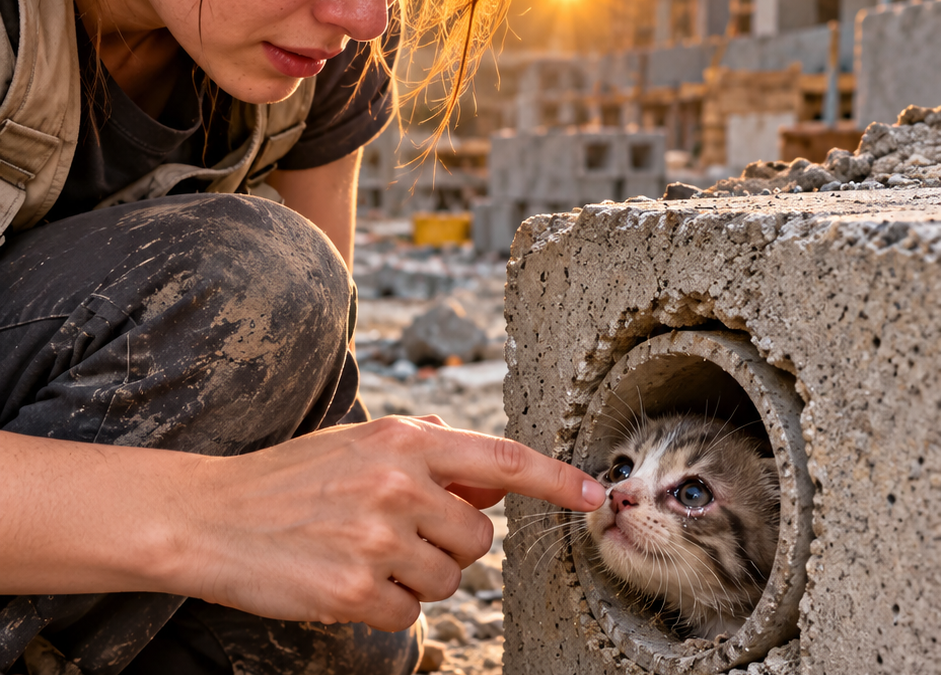
The photograph showed a gray concrete block lying beside a pile of discarded building materials. A small circular opening ran through its center, and protruding from that opening was the head of a young cat.
Two enormous eyes stared directly into the camera.
His ears were flattened, his whiskers were pushed awkwardly against the rough edges of the opening, and his expression seemed to contain every possible emotion a frightened kitten could experience.
At first, I couldn’t understand what I was seeing.
Was the kitten hiding behind the block?
Was the photograph taken from an unusual angle?
Then another message appeared.
He’s stuck. We can’t get him out.
I immediately called Sarah.
“Tell me exactly what’s happening.”
Her voice was strained.
“There’s a kitten trapped inside a concrete pipe. His head is sticking out one end, but the rest of him won’t move.”
“How long has he been there?”
“We don’t know. A man walking past noticed him about twenty minutes ago.”
“Is he breathing normally?”
“I think so. He’s frightened, and he keeps trying to pull backward.”
I was already reaching for my car keys.
“Don’t pull on him,” I said. “Please make sure nobody tries to force him out.”
“Somebody suggested pushing him through.”
“Don’t do that either. We don’t know how tightly he’s trapped.”
She fell silent for a moment.
Then I heard a faint, distressed meow in the background.
“Oh, God,” she whispered. “Please hurry.”
I told her to keep the kitten as calm as possible and contact our rescue coordinator while I drove over.
Then I grabbed my emergency animal rescue kit and hurried outside.
I had helped retrieve cats from trees, storm drains, abandoned sheds, and the narrow spaces beneath parked vehicles. I had once spent nearly three hours persuading a terrified kitten to leave the engine compartment of a delivery truck.
But I had never encountered an animal trapped inside solid concrete.
And the photograph Sarah had sent me suggested that this rescue would require more than patience and a handful of treats.
When I reached the construction site, a small crowd had gathered beside the road.
Several people were standing near a stack of concrete blocks, looking down at something I couldn’t immediately see.
Sarah recognized my car and hurried toward me.
“He’s over here.”
I followed her across the uneven ground.
The site appeared to have been abandoned temporarily. Stacks of unused materials stood beneath dusty plastic sheets, and broken sections of concrete were scattered around the perimeter.
Near the edge of the property lay a large rectangular block containing a narrow pipe.
And inside that pipe was the kitten.
I stopped walking.
The photograph hadn’t prepared me for seeing him in person.
His little head protruded from one end of the opening, while his body remained completely hidden inside the concrete.
His eyes moved rapidly between the people standing around him.
Every few seconds, his whiskers twitched.
He looked young, perhaps only a few months old, with soft fur, oversized ears, and a face that still carried the roundness of kittenhood.
I crouched a short distance away.
“Hey, little guy.”
His ears turned toward me.
I spoke again, softer this time.
“It’s okay. I’m here.”
He attempted to move backward.
His head shifted slightly, but his body didn’t follow.
He immediately stopped and let out a frightened cry.
The sound was so sharp that Sarah covered her mouth.
“That’s what he’s been doing,” she whispered.
I moved closer and examined the opening.
The concrete was thick, and the pipe running through it was considerably narrower than it had appeared in the photograph.
The kitten’s head had emerged from one side, but his shoulders and chest were trapped farther inside.
He couldn’t move forward.
He couldn’t retreat.
And every attempt to escape seemed to increase his fear.
I gently extended one finger toward him.
He sniffed it.
Then, to my surprise, he pressed his nose against my hand.
That small gesture nearly broke my heart.
He was surrounded by strangers, unable to escape, and frightened by everything happening around him.
Yet he was still curious enough to investigate the first gentle hand offered to him.
“All right, sweetheart,” I whispered. “We’re going to figure this out.”
I looked up at Sarah.
“Has anyone tried pulling him?”
She shook her head.
“One man touched his shoulders from the other side, but he couldn’t reach far enough to help.”
“Good. We need to avoid putting pressure on his neck.”
A man standing beside her stepped forward.
“I work in construction,” he said. “I brought a hammer, but I didn’t want to start breaking anything until somebody knew what they were doing.”
I looked at the concrete block.
He was right to hesitate.
The kitten was trapped so tightly that even a small fragment of concrete breaking in the wrong direction could injure him.
We would have to remove the material around the pipe without allowing debris to fall onto his body.
And before we attempted that, we needed to understand exactly how he was positioned inside.
I walked around to the opposite side of the block.
There was another opening, partially hidden beneath loose gravel and construction debris.
I crouched and shone a small flashlight inside.
At first, I saw nothing but darkness.
Then something moved.
A tiny paw.
I leaned closer.
The kitten’s body was compressed inside the narrow passage, his legs drawn into awkward positions.
He had apparently entered the pipe from this side and pushed himself forward until his head emerged from the opposite opening.
His shoulders had become wedged somewhere inside.
I couldn’t see enough to determine whether the rest of his body could move freely.
“Can you see him?” Sarah called.
“Part of him.”
“Is he hurt?”
“I can’t tell yet.”
I put away the flashlight and returned to the kitten’s head.
He was staring at me again.
I couldn’t help imagining how he had ended up there.
Perhaps he had spotted a mouse disappearing into the pipe.
Perhaps some small movement had awakened the hunting instincts that make even the youngest cats believe they are fearsome predators.
Or perhaps the opening had simply looked like an irresistible place to explore.
Cats have an extraordinary talent for investigating spaces that seem impossible for their bodies to occupy.
Usually, their flexibility allows them to escape the consequences of their curiosity.
But this kitten had made one terrible miscalculation.
He had managed to squeeze his head through an opening that couldn’t accommodate the rest of him.
And now the little hunter was completely helpless.
I checked my watch.
We needed to work quickly, but haste was the one thing we couldn’t afford.
“Let’s move everyone back a little,” I said.
Sarah helped create some space around the block.
The kitten was already frightened, and the crowd of unfamiliar faces leaning toward him wasn’t making the situation easier.
I stayed crouched nearby, allowing him to hear my voice.
“You’re doing okay, buddy.”
He stared at me.
I offered him another finger.
He sniffed it and made a tiny, questioning sound.
“Yeah,” I whispered. “I know. This is a terrible place to take a nap.”
Sarah laughed nervously.
For the first time since my arrival, some of the tension around us eased.
But when the kitten attempted to move again, the atmosphere changed immediately.
His shoulders shifted somewhere inside the pipe.
His front paws scraped against the concrete.
He tried to push forward.
Nothing happened.
Then he attempted to pull backward.
His body remained trapped.
He let out another desperate meow.
I reached toward him instinctively, stopping just short of touching his neck.
“Easy. Easy, sweetheart.”
He went still.
His breathing became rapid.
For several seconds, I watched him carefully, trying to determine whether he was merely frightened or beginning to struggle physically.
His head remained free enough for him to breathe, but he was clearly distressed.
We couldn’t leave him there.
And we couldn’t solve the problem by simply pulling harder.
Our rescue coordinator, Daniel, arrived shortly afterward with two volunteers and additional equipment.
He approached the block, took one look at the kitten, and stopped.
“Well,” he said quietly, “that’s a new one.”
I nodded.
“His head is through, but his shoulders are wedged inside. We need to remove enough concrete to reach him safely.”
Daniel examined both ends of the pipe.
“Has anybody checked whether the block can be moved?”
“Not safely with him inside,” I answered. “And I don’t want us rotating it without knowing where his body is.”
He agreed.
The construction worker introduced himself as Mark and explained that he had brought basic tools.
Daniel inspected the concrete around the opening.
“If we can carefully break away the outer section, we might be able to expose enough of the pipe to release him.”
“Without collapsing anything inward,” I added.
“Exactly.”
We discussed the safest approach while one of our volunteers contacted a local veterinarian for guidance and alerted the clinic that we might be bringing in a rescued kitten.
Nobody knew how long he had been trapped.
The afternoon was growing warmer, and he had no access to water.
Even if he hadn’t suffered any injuries yet, we couldn’t assume he would remain unharmed indefinitely.
I looked at him again.
He was watching a small insect crawling across the concrete.
Despite everything, his eyes followed it with remarkable concentration.
I almost laughed.
Of all the things he could have been thinking about, he was apparently still interested in hunting.
“You’re not going after that,” I told him.
He looked at me.
“You’ve done enough exploring for one day.”
Daniel returned with a pair of protective gloves.
“Ready?”
I nodded.
“Let’s do it.”
We began by clearing loose debris from around the block.
Mark helped identify a section of concrete that could be removed without immediately disturbing the pipe.
The work was slower than anyone expected.
Each movement had to be deliberate.
Whenever a tool touched the concrete, the kitten startled.
His ears flattened.
His eyes widened.
Sometimes he attempted to retreat, only to discover again that he couldn’t move.
I stayed near his head, speaking to him constantly.
“That’s just us, buddy. You’re okay.”
A small piece of concrete broke away.
The sound was sharp.
The kitten flinched.
I placed my hand gently against the side of his face.
“It’s all right.”
Daniel paused.
“How’s he doing?”
“Scared, but he’s breathing.”
“Tell me if you want us to stop.”
I nodded.
We continued.
Another fragment broke loose.
Then another.
The block was thick, and the narrow passage running through it offered very little room for error.
I began to understand just how difficult this rescue was going to be.
We weren’t simply breaking a piece of concrete.
We were trying to dismantle part of the structure surrounding a living animal who couldn’t move away from the danger.
Every fragment had to be controlled.
Every movement required someone to consider what was happening inside the pipe.
And throughout the process, the kitten remained trapped, unable to understand why the world around him had suddenly become so noisy.
I could see fear building in his expression.
He began meowing more frequently.
At one point, he pressed his chin against the edge of the opening and closed his eyes.
My chest tightened.
“Hey, little guy.”
His ears moved.
“Stay with me.”
He opened his eyes.
I gently stroked the fur between his ears.
For a moment, he stopped struggling.
Then he began purring.
It was so faint that I initially thought I had imagined it.
I leaned closer.
There it was again.
A tiny vibration beneath my fingertips.
Sarah, who was kneeling beside me, looked astonished.
“Is he purring?”
“I think so.”
She pressed a hand over her mouth.
“Oh, sweetheart.”
I didn’t know whether the purring reflected comfort, stress, or some complicated combination of the two.
Cats sometimes purr when they are frightened or hurting.
But hearing that tiny sound while we worked around him made the situation feel unbearably personal.
He wasn’t simply an animal trapped inside a construction material.
He was a frightened little creature trying to make sense of the only world available to him.
And for the moment, that world consisted of rough concrete, unfamiliar voices, and the hope that someone would finally help him escape.
Daniel managed to remove another section of the outer block.
A narrow crack appeared along the concrete.
He stopped immediately to examine it.
“That’s progress.”
I glanced toward him.
“Can you reach the pipe?”
“Not yet. We need a little more room.”
Mark adjusted his position.
“If we work from this side, we can avoid striking directly above him.”
Daniel nodded.
“Slowly.”
I looked at the kitten.
He was staring directly into my eyes.
“Did you hear that?” I whispered. “We’re making progress.”
He blinked.
I smiled.
“You’re not impressed, are you?”
Sarah laughed again.
But the relief was short-lived.
As the next section of concrete loosened, a larger fragment shifted unexpectedly.
Daniel immediately stopped working.
“Hold it.”
Everyone froze.
The kitten’s eyes widened at the sudden movement.
I felt my heart racing.
For one terrible second, I imagined the fragment falling inward.
Daniel carefully stabilized the loosened piece while Mark helped remove it.
Only after the fragment had been taken away did I realize how tightly I had been holding my breath.
Sarah looked at me.
“Are you okay?”
I nodded.
“Yeah.”
But my hands were trembling.
The kitten remained motionless.
I stroked his head.
“That was a little too exciting, wasn’t it?”
He made a soft, irritated sound.
I couldn’t blame him.
We paused briefly to reassess the structure.
Daniel examined the newly exposed area and confirmed that we were approaching the pipe.
The good news was that the concrete was beginning to separate.
The bad news was that we still couldn’t see enough of the kitten’s body to release him.
I looked at my watch again.
Time seemed to be moving both too quickly and impossibly slowly.
The kitten had been trapped before Sarah contacted me.
We had already spent considerable time assessing the situation and removing concrete.
He was growing tired.
His head occasionally drooped against the edge of the opening.
Whenever I spoke, he lifted it again.
I was increasingly worried about how long he could tolerate his position.
“We need to keep going,” I told Daniel.
He nodded.
“I know.”
Sarah offered to get more water for the volunteers.
I asked her to bring some for the kitten as well, although we would need to be careful about how we offered it while he remained trapped.
She hurried toward a nearby shop.
When she returned, she was carrying bottles of water and a small container of cat food.
“I thought he might be hungry,” she said.
I looked at the food.
“That might actually help.”
Daniel glanced toward me.
“How?”
“If we can get him interested in eating, maybe he’ll stay calmer while we work.”
We weren’t going to force him to eat in such an awkward position, but the smell of food might distract him from the noise and unfamiliar activity surrounding him.
I opened the container and held it near his nose.
His reaction was immediate.
His whiskers twitched.
His ears lifted.
He sniffed enthusiastically.
Then he tried to reach forward.
I nearly laughed.
“There he is.”
Sarah smiled.
“Apparently, somebody’s hungry.”
The kitten opened his mouth and let out a demanding little meow.
For the first time, the sound didn’t seem entirely frightened.
It sounded impatient.
I offered him a small amount of food where he could reach it comfortably.
He licked it eagerly.
His eyes remained fixed on the container.
“Well,” I murmured, “at least we know your appetite survived this adventure.”
Daniel leaned closer.
“He’s eating?”
“Like he hasn’t had a meal in a week.”
“That’s encouraging.”
I agreed.
But I couldn’t ignore the painful irony of the situation.
If the kitten really had entered the pipe while chasing something he wanted to eat, we were now tempting him with food while trying to undo the consequences of that decision.
The little hunter had become the center of an increasingly complicated rescue operation.
And judging by the way he stared at the food, he had absolutely no intention of reflecting on his mistakes.
For several minutes, we used the opportunity to keep him occupied while Daniel and Mark continued their careful work.
The food didn’t eliminate his fear.
Whenever the concrete shifted or a tool made a sharp sound, he startled.
But he seemed less inclined to struggle continuously.
And every moment he remained still made the work a little safer.
As more material came away, we finally exposed part of the pipe surrounding his shoulders.
Daniel leaned closer.
“I can see where he’s wedged.”
I carefully moved to his side.
The kitten’s body was compressed inside the narrow passage, with almost no room to adjust his position.
It was astonishing that he had managed to push himself so far into such a small opening.
The exposed section also confirmed what I had feared.
We couldn’t simply pull him backward in his current position.
His shoulders were wedged too tightly.
We needed to remove more of the surrounding material before attempting to guide him out.
I returned to his head.
“You’re quite the little troublemaker, aren’t you?”
He licked another small amount of food from my fingers.
“You’re lucky you’re adorable.”
Sarah smiled.
“He really is.”
I looked around.
The crowd had grown since we arrived.
Several people were standing farther back, watching quietly.
Some had stopped after noticing our rescue vehicles.
Others had apparently heard about the kitten from neighbors.
A few were taking photographs or recording short videos.
Normally, I preferred keeping crowds away from frightened animals.
But people were maintaining their distance, and Sarah was helping make sure nobody interfered with the rescue.
At one point, a man standing near the road called out, “Is that really a cat in there?”
I glanced up.
“Very much a cat.”
“How did he get inside?”
“Excellent question.”
The man shook his head.
“I’ve seen cats do some strange things, but this…”
He gestured helplessly toward the block.
I understood completely.
There was something almost absurd about the image.
A tiny feline head protruded from a massive piece of concrete as though the kitten had somehow become part of the construction material itself.
If I hadn’t seen the fear in his eyes or heard his desperate cries, I might have found the scene funny.
But I knew how quickly the situation could become dangerous.
The same curiosity that had led him inside the pipe had left him completely vulnerable.
And until we removed enough concrete, his safety depended entirely on the patience of the strangers surrounding him.
Daniel continued working.
Slowly, the opening around the kitten’s shoulders became more accessible.
The process required repeated pauses.
We checked his position after every significant change.
We watched for signs of distress.
We adjusted our approach whenever a section of concrete proved more difficult to remove than expected.
At one point, the kitten became especially agitated.
He began twisting his head from side to side.
His front paws scraped frantically inside the passage.
I immediately stopped offering food.
“Everybody pause.”
The tools fell silent.
I crouched directly in front of him.
“Hey. Hey, little guy.”
He continued struggling.
“Look at me.”
His eyes darted toward my face.
I spoke quietly.
“You’re okay. Nobody’s going to pull you.”
He tried to move backward again.
His head shifted awkwardly.
He cried out.
My heart seemed to stop.
“Easy.”
I gently steadied him without forcing his head into position.
“Just stay still for a minute.”
His breathing was rapid.
I could feel the tension running through his small body.
Sarah knelt beside me.
“Should we take a break?”
I nodded.
“Just a short one.”
We gave him a few minutes without the noise of tools or the movement of unfamiliar hands.
I continued speaking softly.
Eventually, his breathing slowed.
His ears rose slightly.
He sniffed my fingers.
Then, incredibly, he began looking toward the food container again.
I almost laughed from sheer relief.
“You’re unbelievable.”
Sarah smiled.
“He’s determined to finish his lunch.”
“Apparently.”
But the moment had frightened me more than I wanted to admit.
Until then, I had been able to focus on each practical step of the rescue.
Remove a little concrete.
Check his position.
Keep him calm.
Continue.
But watching him struggle against an opening that refused to release him reminded me how helpless he truly was.
He couldn’t understand that we were trying to help.
He couldn’t understand why the concrete was breaking around him.
He only knew that he was trapped and that his attempts to escape weren’t working.
I placed my hand beside his face.
“I know you’re scared,” I whispered.
His whiskers brushed my fingers.
“I would be too.”
For the first time that afternoon, I allowed myself to imagine what would happen if we failed.
He could remain wedged there until exhaustion overwhelmed him.
He could injure himself trying to escape.
Or he could become increasingly distressed as the heat and lack of movement took their toll.
The thought made my stomach turn.
I looked toward Daniel.
“Let’s get him out.”
He nodded.
“We’re close.”
And this time, I believed him.
The next section of concrete came away more cleanly.
Mark helped clear the debris while Daniel carefully examined the exposed pipe.
The kitten remained relatively still, distracted by Sarah’s quiet voice and the occasional small offering of food.
When Daniel finally removed another piece, he straightened and looked at me.
“I think we’ve got enough access.”
I stared at him.
“Are you sure?”
“Come look.”
I moved around the block.
The concrete surrounding the critical section had been removed, exposing enough of the pipe for us to reach the kitten’s shoulders without applying force through the narrow opening.
I could finally understand the position of his body.
He had squeezed himself forward until his head emerged from the opposite end, but his chest and shoulders had become firmly lodged inside.
The opening hadn’t allowed him enough space to reverse the movement.
Now, with the surrounding material removed, we had room to work.
Daniel looked at me.
“We need to guide him backward carefully.”
I nodded.
“I’ll support his head.”
“All right.”
We discussed the movement before touching him.
Nobody wanted a sudden struggle at the last moment.
The kitten had already endured enough.
I returned to the side where his head protruded.
He looked exhausted.
His eyes were still alert, but his ears hung lower than before.
He had stopped trying to investigate every movement around him.
Even the food seemed less interesting.
I crouched in front of him.
“Hey, little guy.”
He lifted his head slightly.
“Remember me?”
His nose twitched.
I gently stroked his forehead.
“We’re almost finished.”
Sarah moved beside me with a clean towel.
Daniel and Mark positioned themselves where they could safely support the kitten’s body.
For a moment, everyone became quiet.
The entire afternoon seemed to narrow to that single opening in the concrete.
I could hear traffic moving along the distant road.
I could hear someone shifting their feet on the gravel.
And I could hear the kitten breathing.
I placed my hands carefully around his head, supporting him without twisting his neck.
“Okay, sweetheart.”
His eyes widened.
“We’re going to help you move backward.”
Daniel spoke from the other side.
“Ready when you are.”
I nodded.
“Ready.”
We began the movement slowly.
At first, nothing happened.
The kitten’s body remained resistant.
I stopped immediately.
“Wait.”
Daniel adjusted his position.
“He’s still caught slightly at the shoulders.”
He carefully checked the exposed section.
Then he asked us to pause while he created just a little more clearance.
I kept my hands steady.
The kitten stared at me.
For a moment, I was afraid we had misjudged the situation.
What if the opening still wasn’t wide enough?
What if his body had swollen from remaining trapped?
What if we couldn’t move him without causing pain?
I could feel my pulse beating in my throat.
Daniel spoke again.
“Okay. Try now.”
We resumed.
This time, I felt the smallest change.
The kitten’s head moved backward a fraction of an inch.
I stopped.
“He’s moving.”
Sarah leaned closer.
“Oh, thank God.”
“Not yet,” I whispered. “Not yet.”
We continued carefully.
Another fraction of an inch.
Then a little more.
The kitten made a frightened sound and attempted to pull away from my hands.
“Easy, baby.”
I kept my touch gentle.
“You’re doing it.”
His whiskers brushed the edge of the opening.
His ears flattened.
For one frightening moment, I worried he might panic and twist his head.
But Daniel was supporting his body, and we kept the movement slow and controlled.
Then his head slipped back through the narrowest part of the pipe.
I felt the resistance suddenly disappear.
“He’s through!”
Daniel immediately continued guiding him toward the cleared opening.
The kitten’s shoulders emerged.
Then his front legs.
Then the rest of his small body.
And finally, after what felt like an entire afternoon of holding my breath, he was free.
For a second, none of us moved.
Daniel was holding the kitten securely, one hand supporting his chest and the other beneath his hindquarters.
The little cat stared around him in complete bewilderment.
His ears were flattened.
His whiskers were dusty.
And he looked profoundly offended by everything that had happened.
Then Sarah began crying.
“Oh, my God. He’s out.”
I laughed.
I couldn’t help it.
The sound burst out of me before I realized I was laughing.
Daniel looked down at the kitten.
“Well, buddy. That was quite an adventure.”
The little cat answered with an indignant meow.
Everyone nearby began smiling.
A few people applauded.
Mark stepped backward and wiped his forehead.
“I never thought I’d spend my afternoon taking apart concrete for a cat.”
I looked at him.
“Would you do it again?”
He glanced at the kitten.
“In a heartbeat.”
Sarah handed Daniel the clean towel.
We carefully wrapped the little cat and moved him away from the broken concrete.
He was trembling, but he was alert.
His head moved toward every unfamiliar sound.
When I gently checked him, I couldn’t see any obvious injuries.
There were no visible wounds from the pipe, no apparent fractures, and no immediate signs that the rescue had caused physical harm.
Nevertheless, we wanted him examined before assuming everything was fine.
His prolonged confinement and the stress of the rescue justified taking precautions.
I carefully settled him into a secure carrier.
He immediately turned around, investigated the back corner, and sat down.
Then he looked directly at me.
I crouched beside the carrier.
“Really?”
He blinked.
“You’re going to pretend none of this happened?”
He began washing one front paw.
Sarah laughed through her tears.
“He’s embarrassed.”
I smiled.
“If I had just needed an entire rescue team to break apart a concrete block, I’d probably pretend nothing happened too.”
The kitten continued grooming himself.
His composure was astonishing.
Only minutes earlier, he had been trapped in a narrow passage, frightened and unable to move.
Now he was sitting in a carrier, apparently determined to restore his dignity as quickly as possible.
I found myself laughing again.
And this time, there was no fear beneath it.
We had reached him.
He was safe.
The terrible pressure of uncertainty that had followed me since Sarah’s first message was finally lifting.
As we gathered our equipment, I noticed several people approaching Sarah.
They wanted to know how the kitten was doing.
One woman asked whether he had been hurt.
Another wanted to know how long he had been trapped.
A teenager showed me a photograph she had taken earlier in the afternoon.
The image showed the kitten’s head protruding from the concrete, his eyes wide and his ears pressed awkwardly against the opening.
It was an extraordinary photograph.
Without the context of his distress, he almost looked like a mischievous little animal playing some elaborate practical joke.
“That face,” Sarah said when she saw it.
I shook my head.
“He looks like he made one terrible decision and immediately regretted it.”
Everyone laughed.
The teenager asked whether she could share the photograph online.
I glanced toward the carrier.
The kitten was still washing his paws.
“As long as it doesn’t interfere with getting him checked,” I answered.
She smiled.
“I think people are going to love him.”
I had no idea how right she would be.
By the time we finished cleaning the rescue area, photographs and short videos of the incident were already spreading through local social media groups.
People were sharing images of the tiny head sticking out of the concrete.
Some were amazed that a kitten could squeeze into such a narrow space.
Others expressed concern about how frightened he must have been.
Many praised the rescuers who had spent the afternoon carefully removing the concrete around him.
And, inevitably, people began making jokes.
One commenter suggested the kitten had seriously overestimated his hunting abilities.
Another wondered whether he had been attempting to turn himself into a piece of construction equipment.
Someone else wrote that his expression looked exactly like the face of a child caught doing something forbidden.
I laughed when Sarah showed me the comments.
But I also remembered the frightened little cries he had made when he tried to move backward.
The photographs were funny because we knew he had been rescued.
During the rescue itself, there had been nothing amusing about the possibility of leaving him trapped.
I looked at the carrier beside my feet.
The kitten was sleeping.
His body was curled comfortably against the towel.
Occasionally, one ear twitched.
I felt an overwhelming sense of relief.
We took him for a veterinary examination.
He remained quiet during the journey, although he occasionally shifted whenever the vehicle changed direction.
I placed the carrier where I could see him safely.
“How are you doing back there?”
He opened one eye.
I smiled.
“Don’t worry. There are no concrete blocks in here.”
He closed his eye again.
At the clinic, the veterinarian examined him carefully.
She checked his breathing, assessed his movement, and looked for any injuries that might have been hidden while he was trapped.
We explained how we had found him and described the rescue.
When I showed her the photograph of his head protruding from the block, she raised her eyebrows.
“How on earth did he manage that?”
I shook my head.
“I’ve been asking myself the same question all afternoon.”
She looked down at the kitten.
He was sitting quietly on the examination table, staring toward an unfamiliar sound near the door.
“Curiosity can be a dangerous thing.”
“Apparently.”
Fortunately, the examination was reassuring.
Despite the frightening circumstances, the kitten had escaped without any evident serious injury.
He was tired and stressed, but his body had survived the ordeal remarkably well.
I felt the last of my anxiety begin to dissolve.
“You’re sure he’s okay?”
The veterinarian smiled.
“He looks very fortunate.”
I glanced at him.
He was attempting to investigate the edge of her sleeve.
“Fortunate might be an understatement.”
She laughed.
“Keep him somewhere safe and give him a chance to rest.”
I nodded.
“With absolutely no pipes.”
“Preferably.”
By the time we returned to the rescue center, the kitten’s photograph had spread far beyond our neighborhood.
Sarah sent me screenshots from several different pages.
People were sharing the story of the tiny cat who had somehow become trapped inside a concrete block.
The photographs of the rescue attracted even more attention.
There were images of volunteers carefully breaking away the surrounding material.
A short video showed me crouched beside the kitten, speaking softly while he stared at the camera.
Another captured the moment he was finally freed.
His wide-eyed expression was already becoming famous.
I watched the video several times.
Not because I wanted to relive the danger.
But because I was fascinated by the contrast between what the camera showed and what I remembered feeling.
In the video, everyone appeared calm and purposeful.
Daniel worked steadily.
Mark removed fragments of concrete.
Sarah crouched nearby with the food container.
And I kept one hand close to the kitten’s head while speaking to him.
From the outside, the rescue looked organized and controlled.
But I remembered the fear.
I remembered the sudden shift of the large concrete fragment.
I remembered the kitten’s frantic attempts to pull himself free.
And I remembered the terrible moment when we began moving him backward and nothing happened.
There had been so many opportunities for things to go wrong.
The fact that everything had ended safely felt almost unbelievable.
Sarah called that evening.
“Have you seen how many people are sharing his picture?”
I laughed.
“A few.”
“A few? He’s everywhere.”
She began reading comments aloud.
Some people were calling him the world’s most ambitious hunter.
Others joked that he had discovered the first cat-sized apartment in a concrete wall.
One person suggested he needed lessons in estimating his own dimensions.
I laughed so hard that I had to sit down.
Then Sarah’s voice softened.
“I’m glad we found him.”
I looked toward the kitten’s temporary resting area.
He was sleeping comfortably, completely unaware that photographs of his embarrassing afternoon were traveling across the internet.
“Me too.”
“I keep thinking about what would have happened if nobody had noticed him.”
I understood.
Before she contacted us, someone had been walking past the construction site and happened to see a small face protruding from a concrete block.
It would have been easy to mistake the movement for something insignificant.
It would have been easy to assume the kitten would eventually free himself.
And it would have been easy for someone unfamiliar with frightened animals to pull on him, hoping that enough force would solve the problem.
Instead, the people who found him recognized that he needed help.
They contacted rescuers.
They waited.
And they allowed us to take the time necessary to remove the concrete safely.
That combination of concern and patience had made all the difference.
I looked at the sleeping kitten again.
“I don’t think he understands how lucky he is.”
Sarah laughed.
“He’s probably dreaming about whatever he was chasing.”
“Hopefully, he catches it somewhere with a much wider entrance.”
After we ended the call, I sat beside the kitten for a while.
He opened his eyes when I approached.
“Hello, trouble.”
His ears lifted.
I gently stroked his head.
He leaned toward my hand.
There was something wonderfully ordinary about the moment.
A small cat.
A warm towel.
A quiet room.
No concrete.
No tools.
No crowd of frightened strangers.
Just a kitten receiving the kind of gentle attention he should have been enjoying all along.
I watched him stretch.
He extended his front paws, arched his little back, and settled into a more comfortable position.
Then he began purring.
I smiled.
“You’re very pleased with yourself, aren’t you?”
He closed his eyes.
I couldn’t help thinking about the contrast between his tiny body and the massive block that had trapped him.
The concrete had seemed almost indestructible when I first arrived.
It was heavy, rough, and completely indifferent to the frightened animal wedged inside.
Yet a small group of people had spent hours carefully breaking it apart for the sake of one little life.
We hadn’t accomplished anything grand.
We hadn’t solved every problem faced by stray animals in our city.
But we had rescued a kitten who couldn’t rescue himself.
And that mattered.
Over the following days, the story continued spreading online.
More people shared the photographs.
More comments appeared beneath the videos.
Some viewers were amused by the kitten’s expression.
Others were moved by the amount of effort the volunteers had invested in saving him.
Several people asked whether he had been injured.
We were able to reassure them that he had been examined and was doing well.
The final photograph I shared showed him resting comfortably after his rescue.
His eyes were no longer wide with panic.
His ears were relaxed.
And his entire body seemed to express the deep satisfaction of a creature who had survived a thoroughly unpleasant experience and intended never to discuss it again.
The response was immediate.
People loved him.
They loved his absurd misadventure.
They loved his bewildered expression.
And they loved knowing that the little cat from the concrete block had been freed without serious injury.
Some people joked that he should give up hunting and pursue a career as a social media personality.
Others declared that he had clearly used up several of his nine lives.
I smiled as I read the comments.
But the photographs that mattered most to me were not the funny ones.
They were the images of the volunteers working around the block.
Daniel kneeling beside the exposed pipe.
Mark carefully removing loose material.
Sarah holding food near the kitten’s nose.
And the moment when the little cat finally emerged from the passage that had held him captive.
Those images reminded me that the rescue hadn’t been accomplished by one person.
Sarah had recognized the danger and contacted us.
The passerby who first noticed the kitten had stopped instead of continuing down the road.
Mark had offered his knowledge and equipment.
Daniel and the other volunteers had worked patiently to free the animal without injuring him.
And everyone had understood that the kitten’s safety mattered more than completing the rescue quickly.
I had simply been fortunate enough to be there.
A few days later, I returned to the construction site to collect a small piece of equipment we had accidentally left behind.
The concrete block was still there, although it no longer resembled the massive structure that had frightened me when I first arrived.
Broken fragments lay around the remaining section.
The narrow pipe was exposed.
And the opening that had once held a terrified kitten was now empty.
I stood beside it for a moment.
The site was quiet.
A warm breeze moved through the weeds.
Somewhere in the distance, a bird was calling.
I crouched and looked at the remains of the concrete.
It was difficult to believe that such a small opening had caused so much trouble.
I tried imagining the kitten approaching it for the first time.
Perhaps he had seen something move inside.
Perhaps he had lowered his head, extended one paw, and decided that the mysterious passage deserved further investigation.
Maybe he had been so determined to reach whatever lay beyond it that he hadn’t noticed the pipe becoming narrower around his body.
Then, suddenly, he had found himself unable to move.
The thought made me smile.
But it also made me shiver.
His curiosity had led him into danger so quickly.
And he had been completely dependent on strangers to get him out.
I stood up and looked toward the road.
Cars passed without slowing.
People continued their ordinary routines.
The construction site was simply another forgotten corner of the city.
Nothing about it suggested that a tiny animal had recently become the center of an extraordinary rescue operation.
And perhaps that was what I found most moving.
There are countless places like that in every city.
Empty lots.
Drainage pipes.
Abandoned buildings.
Piles of construction materials.
Places that seem completely unremarkable to the people who pass them every day.
But for a curious young animal, an ordinary opening can become an irresistible invitation.
And sometimes, the difference between a harmless adventure and a dangerous accident is smaller than anyone realizes.
I returned to my car.
Before starting the engine, I opened my phone and looked at the latest photograph of the kitten.
He was sitting comfortably, his head lifted and his ears alert.
He looked healthy.
Confident.
And, judging by his expression, entirely capable of getting himself into trouble again.
I laughed.
“You little menace.”
Then I put my phone away and drove back to the rescue center.
The next time I saw him, he was playing.
He had discovered a small toy and was batting it across the floor with enormous enthusiasm.
I stood in the doorway, watching.
He crouched low, wiggled his hindquarters, and launched himself toward it.
The toy rolled away.
He chased it immediately.
There he was.
The fearless hunter.
The master of ambush.
The tiny descendant of magnificent wild predators.
The same ridiculous little creature who had managed to trap himself inside a piece of concrete while apparently pursuing something much smaller than himself.
I leaned against the doorway and laughed.
He stopped playing and looked at me.
“Don’t look at me like that,” I told him.
He tilted his head.
“I saw the pictures.”
He approached and rubbed against my shoe.
I knelt to stroke him.
He immediately began purring.
For a moment, I thought about the frightened face I had first seen protruding from the concrete.
Those enormous eyes.
The flattened ears.
The desperate cries.
And the terrible feeling of helplessness as we tried to determine how to reach the rest of his body.
Then I looked at the little cat in front of me.
He was warm, safe, and entirely absorbed in the pleasures of being a kitten.
His extraordinary adventure had made people laugh across the internet.
But the part of his story that stayed with me had nothing to do with fame.
It was the moment when we finally guided his head backward through the pipe.
The instant his shoulders came free.
The first relieved breath I took when Daniel lifted him out of the broken concrete.
And the sight of him resting peacefully afterward, completely unaware of how many people had worked to give him that simple comfort.
I scratched him gently behind one ear.
“You’re quite a little celebrity now.”
He closed his eyes and leaned into my hand.
“But I think you should stick to chasing toys for a while.”
He opened one eye.
Then, as if determined to prove that my advice meant absolutely nothing to him, he spotted the toy on the floor and hurried after it.
I watched him scamper away.
And I smiled.
Because after everything that had happened, the most beautiful part of the entire rescue was seeing that little kitten free to run wherever he wanted.
No narrow pipe.
No concrete pressing against his body.
No frightened cries.
Just a curious young cat discovering the world again, one wonderfully ridiculous adventure at a time.








