𝗣𝗔𝗥𝗧 𝟮 I Closed the Door on This German Shepherd Puppy—What He Did Next Broke Through Everything I’d Buried
PART2
“You have got to be kidding me.”
The puppy tilted his head.
His fur was dry along the back now, but damp around the paws.
The red scarf had twisted sideways.
His eyes looked tired.
I crouched.
“Did you sleep?”
Tail tap.
“That’s not an answer.”
I moved the water bowl closer.
He drank.
Then sat again.
No attempt to wander away.
No frantic interest in the neighborhood.
No looking down the street for an owner.
Just me.
“You really picked a house.”
He watched.
“Bad judgment.”
I stood.
Opened the door wider.
“Fine.”
The puppy didn’t move.
I stepped backward.
“Come in.”
Nothing.
“You scratched on the door for this.”
He looked into the hallway.
Then at me.
I waited.
Finally, he rose.
One paw crossed the threshold.
He paused.
Then the rest of him followed.
Slowly.
No excitement.
No racing around.
He entered the house the way someone enters a church after years away.
Carefully.
Quietly.
He sniffed the baseboards.
The edge of the rug.
The legs of a small table.
Then walked directly into the living room.
Stopped beside the fireplace.
Sat.
I stared.
The fireplace hadn’t worked in years.
Sarah used to complain about it.
“We have a fireplace that exists only decoratively.”
“Historic charm.”
“It’s a hole in the wall.”
That had been during the good years.
Before every conversation became logistics.
Before silence.
Before lawyers.
Before she packed half the kitchen into boxes and left the photograph of us on the mantel because neither of us knew whether taking it would be sadder.
The puppy sat beneath that photograph.
Of course he did.
“You have terrible timing.”
He looked up.
I went to the kitchen.
Opened plain canned chicken.
The sound brought him immediately.
He stopped in the doorway.
Sat.
No begging.
No jumping.
No whining.
“Who taught you manners?”
His tail swept once.
I spooned food into a bowl.
“Slow.”
He ate exactly that way.
Every few bites, his eyes lifted to make sure I remained.
The behavior bothered me.
Not because it was inconvenient.
Because it looked practiced.
Like he had learned people could vanish while he wasn’t watching.
When he finished, he lay near the bowl.
I crouched and reached toward the red fleece.
His whole body stiffened.
I stopped.
“Okay.”
Ears back.
“I won’t take it.”
I let my hand fall.
His muscles softened.
Interesting.
Whatever that scarf meant, it mattered.
Later, while he slept, I looked more closely.
Faded red fleece.
Lavender laundry detergent.
One edge hand-cut, not hemmed.
No label.
No writing.
Could have come from anything.
But it still looked like a child had tied it.
That afternoon, I canceled my plans.
My plans had consisted of grocery shopping and pretending I liked spending Sunday alone, so the sacrifice was manageable.
The puppy slept.
I read.
He woke whenever I moved.
Followed me to the kitchen.
Back to the living room.
Not close enough to touch.
Close enough to track.
By sunset, he’d relaxed enough to lie on his side.
I sat in the recliner.
Looked at him.
A name arrived without permission.
“Benny.”
His head came up.
I frowned.
“Benny?”
Tail.
One thump.
“No.”
I leaned forward.
“Is that actually your name?”
The puppy stood.
Walked toward me.
Sat at my feet.
Tail sweeping.
I stared.
“Benny.”
Thump.
“Well, that’s suspicious.”
Maybe he’d known someone with a similar word.
Maybe he simply liked my voice.
Didn’t matter.
Benny was Benny.
I reached down.
Slowly.
He allowed one scratch behind the ear.
Then leaned his head into my knee.
That tiny pressure went through me like electricity.
I hadn’t touched a dog with affection in years.
Forgotten how natural it felt.
“You’re making this difficult.”
Benny sighed.
That night, I unrolled an old sleeping bag beside the couch.
He circled it.
Lay down.
At two in the morning, I woke and walked into the living room.
Still there.
Curled.
Paws moving faintly in a dream.
The red scarf against his neck.
I stood in darkness for a while.
Then returned to bed.
I told myself he would go to a shelter in the morning.
I was lying.
Morning brought our first walk.
I didn’t own a leash.
So I made one from an old rope until I could buy proper supplies.
Benny seemed to understand immediately.
No pulling.
No tangling around my legs.
He walked beside me, occasionally drifting ahead, then looking back.
Milwaukee smelled like October.
Cold earth.
Wood smoke.
Wet leaves.
Coffee drifting from a corner shop.
We headed toward Elm Street.
I hadn’t planned to go to the park.
My feet did.
Sarah and I used to walk there.
Before the divorce.
Before everything became divided into mine and hers.
Benny reached the gate first.
Stopped.
Looked back.
“Don’t.”
He entered.
I followed.
The playground was empty.
Leaves covered the ground beneath the swings.
Benny wandered toward one pile near the edge.
Sniffed.
Pushed his nose deep into the leaves.
Then pulled out a green rubber dinosaur.
Mud-darkened.
One leg partially chewed.
My stomach dropped.
I knew that dinosaur.
My nephew Caleb carried it everywhere when he was little.
Sarah’s sister used to bring him to our house on weekends.
He would march around making dinosaur sounds until somebody begged for mercy.
One autumn afternoon, we’d lost that toy at this park.
Caleb had cried.
Sarah had promised we’d find it.
We never did.
Until now.
“How?”
Benny placed it at my feet.
Sat.
I picked it up.
Same bite mark near the tail.
Same faded black marker C beneath the belly.
Impossible.
Not impossible logically.
The toy had simply stayed somewhere around the park.
Buried beneath leaves.
Moved by weather or children.
Benny found it because he had a dog’s nose.
Nothing supernatural.
Still, memory doesn’t care whether something has a rational explanation.
The moment I held that dinosaur, I heard Caleb laughing.
He was seventeen now.
I hadn’t seen him in more than a year.
Divorce does strange things to extended families.
No legal order says you stop loving nieces and nephews who came through the other side of the marriage.
You just become awkwardly optional.
Phone calls decline.
Birthdays shift.
Then enough time passes that reaching out feels harder than continuing not to.
Benny nudged my wrist.
I looked at him.
“You’re trouble.”
Tail wag.
We brought the dinosaur home.
I cleaned it.
Put it on the mantel beneath the photograph of Sarah and me.
Benny watched.
I told myself that was all.
It wasn’t.
Over the next week, he settled into my house with unnerving ease.
No accidents after the second day.
No destructive chewing except one unfortunate magazine.
No food aggression.
No door panic.
He behaved less like a stray than a dog waiting for somebody to explain why his old life had vanished.
I posted his picture online.
Called shelters.
Checked lost-dog groups.
No one claimed him.
A neighborhood vet scanned for a microchip.
Nothing.
The veterinarian, Dr. Patel, estimated six months.
“Underweight but not severely.”
She examined his paws.
“He’s been walking a lot.”
“How can you tell?”
“Pads. Wear. Small abrasions.”
She touched the scarf.
Benny stiffened.
Dr. Patel immediately stopped.
“That important to him?”
“Seems like it.”
“No need to remove it unless it’s irritating his skin.”
“Can we put a collar under it?”
“Sure.”
I bought a temporary collar.
No tag yet.
That felt like a line I wasn’t ready to cross.
Dr. Patel gave vaccines.
Parasite treatment.
Basic bloodwork.
Healthy.
Someone had cared for Benny.
At least at some point.
Good coat beneath the mud.
Familiarity with human handling.
Basic manners.
Yet no chip.
No report.
No owner.
“How does a dog like this disappear?” I asked.
Dr. Patel shrugged.
“Lots of ways.”
I didn’t like any of them.
Back home, Benny studied the photograph on the mantel.
Sarah and me.
Sixth anniversary.
Rain.
She had thrown her arms around my neck after we got caught walking home from dinner.
Someone on the sidewalk took the photo for us.
Both soaked.
Both laughing.
I had forgotten that version of us existed.
Benny sat beneath it.
“That’s Sarah.”
He looked at me.
“My wife.”
I corrected myself.
“Ex-wife.”
Benny lay down.
I sat beside him.
“She wanted a shepherd.”
His ear lifted.
“For years.”
I rubbed my hands together.
“She said they were loyal.”
Benny moved closer.
“She said our house was too quiet.”
That one hurt.
Because she had been right long before she left.
We didn’t divorce because of some dramatic betrayal.
No affair.
No screaming revelation.
We eroded.
Work.
Family grief.
Misunderstandings.
Things unsaid long enough to become structural.
Sarah’s mother died.
Sarah withdrew.
I gave her space when she needed pursuit.
Then when I withdrew, she interpreted it as indifference.
We became experts at guessing wrong.
Eventually she said:
“I feel alone while you’re sitting three feet away.”
I had no answer.
Months later, she left.
Now Benny rested against my thigh.
No demands.
No interpretation.
Presence.
That afternoon, I took him into the backyard.
He discovered leaves.
Apparently the composed soldier routine had limitations.
Benny jumped into a pile.
Disappeared.
Emerged with a leaf stuck to his forehead.
I laughed.
He froze.
Looked at me.
Then launched himself into the next pile.
I laughed harder.
For five minutes, he became pure puppy.
No mysterious scarf.
No searching eyes.
No lost owner.
Just a German Shepherd with enormous paws attacking autumn.
Something in my chest loosened.
I’d forgotten laughter could happen when nobody else was in the room to hear it.
Later, we sat on the back steps.
Benny pressed against me.
“You sure you don’t belong somewhere?”
His head rested on my leg.
I looked toward the street beyond the fence.
“No one’s looking.”
At least not where I had searched.
Benny sighed.
That night, he slept closer to my bedroom.
The following morning, he woke me before sunrise.
Not barking.
He stood in the hallway.
Looked at the front door.
Then at me.
“Bathroom?”
He turned.
Walked toward the door.
“Fine.”
I dressed.
We went out.
Benny didn’t take our normal route.
He headed north.
Purposefully.
I let him lead within reason.
Past the shuttered bakery.
Across the old pedestrian bridge.
Toward Maple Hollow Community Park.
I stopped outside the entrance.
“No.”
Benny looked back.
This park carried different memories.
Sarah’s niece, Lily.
Picnics.
Cider.
A huge oak.
Saturday mornings when marriage had still felt easy.
Benny entered.
I followed.
He went straight toward the oak.
Sniffed near the roots.
Scratched once at leaves.
Then again.
I crouched.
“Benny.”
He dug just enough to uncover something pink.
A child’s mitten.
Wool.
Faded.
Tiny.
I knew that too.
Lily had lost one mitten there years earlier.
We had searched until dark.
Sarah had promised her we’d come back the next day.
We did.
Never found it.
Now I held it.
Cold.
Dirty.
Impossible not because a dog had located buried fabric.
Dogs do that.
Impossible because Benny kept leading me toward objects connected to a life I’d abandoned emotionally after the divorce.
The rational explanation was simple.
My old routes overlapped his wandering.
He smelled fabric humans couldn’t.
He investigated.
I supplied meaning.
Fine.
But meaning still exists even when your brain helps create it.
I sat beneath the oak.
Benny beside me.
The mitten in my palm.
“I don’t know what you’re doing.”
He leaned into my shoulder.
That evening, I placed the mitten beside the dinosaur.
The mantel had become an archaeological site.
Sarah’s photo.
Caleb’s dinosaur.
Lily’s mitten.
Benny lay beneath them.
“You’re creepy.”
Tail.
The next night, I made a mistake.
I left the back door partly open.
Fenced yard.
Cool weather.
Benny liked lying near the threshold.
I fell asleep early.
At five in the morning, he was gone.
The door remained open.
My heart stopped.
“Benny?”
No response.
I checked the yard.
Gate.
Somehow unlatched.
I don’t remember putting on my boots.
One second I was standing barefoot in the kitchen.
The next, I was outside with a flashlight shouting his name.
“Benny!”
Nothing.
Panic strips away every argument you’ve made to yourself.
He wasn’t temporary.
Not in that moment.
Not when I thought he’d vanished.
I ran toward Maple Hollow.
Called.
Checked alleys.
Under parked cars.
The rational part of my brain tried to calculate.
How far can a six-month shepherd travel in several hours?
Traffic.
Cold.
Other dogs.
I hated every answer.
Near the trailhead, I heard leaves move.
I swung the flashlight.
Two trees.
Shadow.
Then Benny stepped out.
Limping slightly.
“Benny.”
He walked toward me.
Something in his mouth.
I dropped to my knees.
He placed it at my feet.
Blue fleece mitten.
Yellow star stitched near the wrist.
I stared.
Lily’s other mitten.
The matching one.
Years ago she called them her lucky-star gloves.
We thought the second had been lost later.
Apparently not.
Or memory had blurred.
Either way, Benny had found it.
“Benny.”
He sat.
Chest heaving.
One paw scraped.
“You left the house for this?”
No answer.
My fear converted instantly into anger.
“You could’ve been hit by a car.”
Tail lowered.
I stopped.
He didn’t deserve anger because I had left a gate unsecured.
I pulled him against me.
“You scared the hell out of me.”
His head pressed under my chin.
I sat on wet ground hugging a muddy dog before sunrise and discovered the exact moment denial became impossible.
I loved him.
Already.
Too late to negotiate.
At home, I cleaned his paw.
Minor scrape.
Nothing deep.
Benny licked my wrist while I wrapped it.
The blue mitten joined the pink one on the mantel.
I stared at the pair.
Then at Sarah’s picture.
Something in me made a decision.
I found her number.
Still memorized.
Didn’t call.
Not yet.
But I didn’t close the contact screen either.
The days changed after that.
Not dramatically.
Quietly.
Coffee tasted better because I drank it on walks.
Mornings had structure.
Benny needed breakfast.
Exercise.
Training.
I started opening blinds earlier.
Played music while cooking.
Stopped eating dinner over the sink.
I bought groceries with another creature in mind.
Routine.
That’s what companionship often looks like from the outside.
Boring logistics.
Inside, it can be resurrection.
Benny didn’t heal me.
I wasn’t ill.
He interrupted habits that had become too narrow.
That’s different.
He forced the day to have edges.
Morning walk.
Noon break.
Evening meal.
Play.
Sleep.
Somebody waited.
That mattered.
One afternoon, I finally opened the closet box containing Sarah’s belongings.
Not everything she’d owned.
Just objects neither of us could decide where to put during the divorce.
Scarves.
Letters.
Photographs.
A cracked charger.
Movie tickets.
Near the bottom, a Polaroid.
Sarah and Lily at Maple Hollow.
Both wearing ridiculous matching knitted hats.
Lily holding one of the star mittens.
I sat on the floor.
Benny beside me.
He pushed his head under my arm.
“She would have loved you.”
Tail.
“Actually, she probably would have claimed you.”
I looked at the photo.
“I don’t know whether that would’ve been better.”
Benny sneezed.
“Exactly.”
A few days later, our walk took us five blocks south.
Benny became unusually focused.
Nose low.
Then up.
He stopped outside a yellow house with a cracked driveway.
Plastic tricycle on the porch.
Before I could redirect him, the front door opened.
A teenage girl stepped outside.
She saw Benny.
Stopped.
“Is that your dog?”
“Sort of.”
Still saying that.
She came closer.
“He’s a shepherd?”
“Yeah.”
“He looks like Max.”
“Who’s Max?”
“Our dog. He disappeared a few months ago.”
My chest tightened.
“How old?”
“Ten.”
I exhaled internally.
Benny was nowhere near ten.
The girl noticed.
“Not him.”
“No.”
“Same eyes, though.”
A woman called from inside.
The girl looked toward the door.
“Weird.”
“Yeah.”
“Max used to wear red.”
I froze.
“What?”
“Bandanna.”
My eyes dropped to Benny’s faded scarf.
The girl followed.
“Oh.”
She stepped closer.
“Can I see?”
Benny moved behind my leg.
“No.”
She stopped immediately.
Good.
“Sorry.”
“Did Max have puppies?”
“No. He was neutered.”
That eliminated the obvious fantasy.
She studied Benny.
“Where’d you get him?”
“He came to my house.”
“Huh.”
We exchanged information.
Later, I sent a photo.
Their family confirmed Benny was not connected to Max as far as they knew.
Coincidence.
Another strange thread.
No answer.
Benny seemed satisfied after visiting the house.
On the walk back, he no longer looked over his shoulder.
Maybe scent had interested him.
Maybe the old dog smell.
Maybe nothing.
Dogs are allowed mysteries that aren’t about us.
I stopped trying to turn every choice into a message.
That helped.
The veterinary follow-up was uneventful.
Healthy.
Weight improving.
Paw healed.
No chip still.
No owner located.
Dr. Patel asked:
“You keeping him?”
I looked down.
Benny looked up.
“I think he’s keeping me.”
“That’s usually how it works.”
That evening, I opened my junk drawer.
Old keys.
Batteries.
Loose screws.
A brass dog tag still sealed in packaging.
Sarah had bought it at a shelter fundraiser years earlier.
She’d held it up and joked:
“You never know.”
I’d rolled my eyes.
Then kept it after the divorce.
Apparently.
I drove Benny to the pet store.
The employee took the blank tag.
“Name?”
I looked down.
“Benny.”
“Phone?”
I gave mine.
Ten minutes later, BENNY was engraved across the front.
My number on the back.
I bought a blue collar.
Kept the red scarf above it.
Benny stood still while I buckled everything.
Click.
He leaned against my legs.
I swallowed.
“Official.”
Tail wag.
“Don’t let this go to your head.”
It went directly to his head.
Within two weeks he had learned the couch despite a rule against it.
My side of the couch.
Naturally.
He learned sit.
Down.
Stay.
Come.
Leave it.
“Drop the sock” required separate diplomatic negotiations.
His personality unfolded.
He loved cheese.
Hated bananas.
Distrusted snow shovels.
Loved the mailman.
Barked exactly once at a plastic Halloween skeleton and then spent ten minutes trying to sniff its feet.
He also slept beside my bed now.
Not near the front door.
That mattered.
A dog expecting to leave sleeps ready.
A dog expecting tomorrow sleeps wherever he’s comfortable.
One morning, I woke before him.
Sun through blinds.
Benny on his side.
Paws loose.
Red scarf barely visible above his collar.
I realized I couldn’t remember the last time the house had felt empty.
That frightened me.
Attachment always does when you’ve spent years trying not to need anything.
Then Benny got sick.
It began before dawn.
A sound.
Low whine.
I opened my eyes.
“Benny?”
No response.
He was lying near the bedroom doorway.
Not curled.
Flat.
I touched his side.
Warm.
Too warm.
His breathing shallow.
“Benny.”
Eyes opened halfway.
My heart detonated.
I was dressed in less than two minutes.
Wrapped him in the old fleece blanket.
Carried him to the truck.
Benny was heavier now, but adrenaline doesn’t negotiate with backs.
“Stay with me.”
He rested his head against my arm.
Every red light felt personal.
The clinic wasn’t open.
I called the emergency number.
Dr. Patel redirected me to an affiliated twenty-four-hour hospital.
Another twelve minutes.
Longest drive of my life.
Benny whimpered once.
“I’m here.”
His eyes opened.
“I’m not going anywhere.”
Those words landed differently now.
At the hospital, they took him immediately.
I hated letting go.
The second his weight left my arms, I felt hollow.
I paced.
Sat.
Stood.
Checked the clock.
Thought of Duke.
Then Sarah.
Then every terrible version of the next conversation.
When the vet came out, she smiled.
I almost collapsed.
“He’s okay.”
“What happened?”
“Likely gastrointestinal infection. Mild fever, dehydration. We’re giving fluids and anti-nausea medication. Bloodwork looks reassuring.”
“He’s not dying?”
She looked surprised.
“No.”
I sat.
Covered my face.
“Sorry.”
“Don’t apologize.”
Twenty minutes later, Benny walked out slowly.
The moment he saw me, tail wag.
Once.
Twice.
I knelt.
He leaned into my chest.
“You absolute jerk.”
Lick.
“You scared me.”
Another lick.
“Stop using affection to avoid accountability.”
The technician laughed.
I didn’t care.
On the ride home, Benny slept with his head on my thigh.
I kept one hand on him.
When we reached the house, I carried him inside.
Set him on the couch.
This time, no rule.
I sat beside him for hours.
At some point, I said out loud:
“You’re family.”
Benny slept.
Didn’t need ceremony.
The next morning, he ate chicken and rice.
Slowly.
By afternoon, he wanted a walk.
“Five minutes.”
He looked offended.
“Medical orders.”
Tail.
“Fine. Seven.”
Recovery took several days.
My fear took longer.
I started checking his breathing while he slept.
Dr. Patel told me to stop.
“You’re going to make yourself crazy.”
“Too late.”
“He’s healthy.”
“I know.”
“Then let him be healthy.”
Good advice.
Hard.
Love makes monitoring tempting.
But care isn’t control.
I worked on that.
Weeks later, I finally called Sarah.
Not because Benny brought me a magical object.
Not because he stared at her photograph.
Because I wanted to.
She answered after four rings.
“Mark?”
“Hi.”
Pause.
“Is everything okay?”
“Yeah.”
Another pause.
“I found Lily’s mittens.”
Silence.
“What?”
“At Maple Hollow.”
“Both?”
“Long story.”
She laughed softly.
God, I hadn’t heard that laugh in years.
“That sounds like you.”
“Actually, it involves a dog.”
“A dog?”
“German Shepherd.”
Longer silence.
“You got a shepherd?”
“He got me.”
Sarah laughed again.
I smiled.
We talked twenty minutes.
Not reconciliation.
Not dramatic closure.
Just two people who had once loved each other very much remembering they didn’t have to become strangers.
I mailed Lily the mittens.
Caleb got the dinosaur.
He texted me a photo holding it.
NO WAY.
Then:
Uncle Mark, you still alive?
That one hurt.
I called him.
We talked an hour.
Benny slept at my feet.
Again, he hadn’t performed a miracle.
He had simply dragged old objects into daylight until I stopped pretending old relationships had to remain buried with them.
Winter arrived.
Milwaukee cold.
Real cold.
Benny loved snow.
His first storm transformed him into an idiot.
He plowed his face through drifts.
Leaped at snowflakes.
Barked at the shovel.
I bought him a proper winter vest.
The red scarf stayed.
One day I tried washing it.
I let Benny watch.
Removed it.
He became tense.
I placed it into a laundry bag.
Gentle cycle.
Lavender-free detergent.
When I returned it, clean but still faded, Benny sniffed.
Then licked my hand.
I still didn’t know who had tied it.
Never would.
That became okay.
We searched missing-dog records for months.
No match.
No one claimed him.
The city eventually processed his found-animal period.
My adoption became official.
Paperwork.
Signature.
Fee.
Simple.
I celebrated by buying him a steak.
Dr. Patel said not too much.
Benny disagreed.
Over the next year, the house changed.
Not renovated.
Used.
Dog bed by the fireplace.
Leashes by the door.
Mud towels.
Basket of toys.
Water bowl in the kitchen.
A small scratch on the hardwood from one enthusiastic turn.
I stopped caring about pristine floors.
Friends came over more often because Benny apparently had a better social network than I did.
My neighbor Mrs. Givens brought treats.
The mailman knew his name.
Children on the block asked whether they could pet him.
Only if Benny approached.
He usually did.
One little boy said:
“Why is he wearing that old red thing?”
I touched the scarf.
“Because it matters to him.”
“Why?”
“I don’t know.”
The boy considered this.
Then nodded.
Kids handle uncertainty better than adults.
At two years old, Benny was beautiful.
Broad chest.
Strong.
Black saddle.
Warm tan legs.
One ear still slightly folded.
That never changed.
He still carried the quiet steadiness he’d had on my porch.
But now it wasn’t sadness.
Just temperament.
He watched.
Thought.
Then acted.
We returned often to Maple Hollow.
The bench became ours.
Sometimes Benny climbed beside me.
Sometimes sat at my feet.
One October afternoon, Sarah visited Milwaukee.
First time since the divorce.
Not for me.
Her sister.
But she called.
“Can I meet the dog?”
“Sure.”
I was more nervous than I expected.
Sarah arrived at the park wearing a dark green coat.
Benny saw her from twenty yards away.
Stopped.
She crouched.
Didn’t call.
Didn’t reach.
Smart.
Benny approached.
Sniffed.
Then sat directly in front of her.
Sarah looked at me.
“Seriously?”
“Apparently.”
She scratched his chest.
Benny leaned against her.
Her eyes filled.
“You finally got the shepherd.”
“Technically late.”
“Very.”
We sat on the bench.
Talked.
No romance returned.
That wasn’t the point.
Something gentler did.
History without hostility.
Sarah noticed the red scarf.
“Where’d that come from?”
“He had it when he showed up.”
She touched one edge.
Benny allowed it.
“Looks like a kid tied it.”
“That’s what I thought.”
She smiled sadly.
“Maybe somebody loved him.”
“I think somebody did.”
That was the conclusion I’d reached.
Whatever ended badly, Benny hadn’t begun unwanted.
His manners.
His trust.
That scarf.
Someone had touched him kindly once.
I liked believing that.
No need to invent tragedy.
Maybe a family lost him.
Maybe circumstances scattered people.
Maybe a child wondered for years where he went.
If so, I wished I could tell them:
He was okay.
More than okay.
He was loved.
Years passed.
Benny became my calendar.
Morning walk.
Work.
Lunch break.
Evening walk.
Saturday park.
Sunday slower.
He aged.
So did I.
Gray appeared around my temples.
Then his muzzle.
At seven, arthritis began mildly.
At eight, stairs became slower.
I installed carpet runners.
At nine, he preferred shorter walks.
Still carried the red scarf.
By then it was fragile.
I had a seamstress reinforce the underside with soft matching fabric so the original remained visible.
Benny tolerated the repair.
A woman at the shop asked:
“Sentimental?”
“His.”
She smiled.
“Sure.”
I didn’t explain.
At ten, Benny had another health scare.
Not a virus this time.
A benign growth near his shoulder.
Surgery.
I sat in another waiting room.
Older.
Marginally better at panic.
When Dr. Patel called and said everything had gone well, I cried anyway.
She pretended not to notice when I picked him up.
At eleven, Benny stopped jumping onto the couch.
I bought steps.
He used them once.
Then stared at me until I lifted him.
“You weigh seventy-five pounds.”
Tail.
“Manipulative.”
He climbed into my lap as much as an elderly German Shepherd can climb into anyone’s lap.
His front half on me.
Back half still on couch.
Good enough.
The house was never quiet anymore.
Even when Benny slept, his breathing filled it.
Then one morning, I realized how frightening that had become.
Because one day the breathing would stop.
I had known that since the porch.
That’s why I hadn’t let him in.
Not because I didn’t care.
Because some part of me understood exactly what accepting him meant.
An ending.
Eventually.
The mistake had been thinking endings erase everything before them.
Duke should have taught me better.
Sarah too.
Relationships can end and still have been worth having.
Benny certainly did.
At twelve, kidney disease arrived.
Manageable.
Diet.
Medication.
More vet visits.
Good months.
At thirteen, his hind legs weakened.
Walks became short loops.
Sometimes just the front yard.
One crisp October afternoon, almost exactly thirteen years after he’d scratched on my door, Benny walked onto the porch.
Same welcome mat style, though replaced several times.
He sat.
Red scarf against gray fur.
I sat beside him.
Leaves scraped along the sidewalk.
Same sound.
Dry whispers.
I laughed.
“What are the odds?”
Benny looked at me.
“You remember?”
Probably not as narrative.
Maybe scent.
Maybe body.
Maybe nothing.
I reached into my pocket.
Turkey.
Still his favorite.
He took it.
Chewed slowly.
Watched me.
Just like the first day.
My throat tightened.
“I closed the door on you.”
Tail tap.
“Remember that?”
Another.
“Best bad decision I ever corrected.”
Benny leaned his body against mine.
Heavy now.
Old.
Warm.
I rested my cheek on his head.
The scarf smelled like him more than anything else after all those years.
No lavender left.
Just dog.
Home.
His final decline came three months later.
Cancer.
Aggressive.
The vet explained options.
Surgery maybe.
Chemotherapy maybe.
Age and kidneys complicated everything.
I asked the question I had learned to ask honestly.
“What gives him the best life, not the longest calendar?”
Dr. Patel looked relieved.
“Comfort care.”
So we chose that.
Good food.
Pain medication.
Short walks.
No unnecessary hospital days.
Benny slept near the fireplace.
The one that had finally been repaired years earlier.
Sarah joked when I told her:
“Took a dog to fix your fireplace.”
“Apparently.”
She visited once during Benny’s final month.
Sat on the rug beside him.
He put his head in her lap.
She cried.
“Thank you,” she whispered.
I don’t know whether she meant for choosing me.
For connecting us again.
For simply existing.
Maybe all of it.
Benny’s last morning was cold.
Sun bright.
He couldn’t stand without help.
I carried him to the porch.
Wrapped him in a blanket.
He sniffed the air.
Leaves.
Snow coming later that week.
Somebody’s fireplace.
The city.
I sat beside him.
No dramatic speech prepared.
That’s not how we had ever worked.
I touched the red scarf.
“Can I take this off?”
Benny looked at me.
I untied it carefully.
For the first time in thirteen years, his neck was bare except for his blue collar.
I folded the scarf.
Placed it beside him.
“You don’t need it to tell me who you are.”
His eyes closed.
Dr. Patel came to the house that afternoon.
Benny lay on his favorite rug.
I sat on the floor.
His head in my lap.
Exactly where it belonged.
The first injection relaxed him.
His breathing deepened.
I stroked the folded ear.
“Remember when you scratched my door?”
Tail moved faintly.
“I pretended I didn’t need you.”
Another tiny movement.
“That was embarrassing.”
Dr. Patel smiled through tears.
I bent closer.
“You didn’t rescue me.”
I wanted to say it correctly.
Benny’s eyes found mine.
“You gave me a reason to stop hiding.”
That was true.
“You gave me somebody to come home to.”
His breathing slowed.
“And somehow you gave me parts of my old life back without asking me to live in the past.”
I thought of Caleb.
Lily.
Sarah.
Duke.
My father.
The red scarf.
The mitten.
The dinosaur.
All the doors I’d closed because open doors frightened me.
My hand rested on Benny’s chest.
“You were family.”
His eyes softened.
“You still are.”
Then the final medication.
One breath.
Another.
Long exhale.
Stillness.
I kept my hand there.
The house did not collapse.
Neither did I.
I cried.
Hard.
Held him.
But beneath the grief was something younger Mark would never have understood.
Gratitude.
Thirteen years.
That was what saying yes had bought me.
Not loss.
Thirteen years.
The loss was one day.
Love had thousands.
After Benny died, I kept the red scarf.
Not around a picture.
Not in a memorial display.
In my top dresser drawer.
Sometimes I opened it.
Touched the worn fleece.
Remembered the muddy puppy on the porch.
For months, the house felt wrong.
Too quiet.
But not the same quiet as before Benny.
This quiet had evidence behind it.
Scratches on the floor.
A dent in the couch cushion.
Dog hair I kept finding despite vacuuming.
Relationships leave traces.
I no longer rushed to erase them.
One spring morning, I walked to Maple Hollow alone.
Sat on our bench.
Children played.
A German Shepherd passed with a young couple.
The dog looked at me.
I smiled.
Didn’t ache the way I expected.
At the old oak, I thought about the mittens Benny found.
I still couldn’t explain why he had taken me to those places.
I no longer tried.
Maybe he wandered routes he’d known before.
Maybe my scent, Sarah’s old scent embedded in clothing, neighborhoods, whatever, connected him.
Maybe pure coincidence.
Maybe I supplied all the meaning because I needed it.
That’s fine.
Meaning isn’t invalid just because humans participate in creating it.
The outcome was real.
I called Caleb.
I spoke to Lily.
Sarah and I became occasional friends.
I opened the house again.
Not to another dog immediately.
I wasn’t ready.
Then, two years later, a rescue coordinator I knew sent me a photograph.
Adult shepherd mix.
Five years old.
Owner had died.
Quiet.
Good with older adults.
Needed a foster.
I stared at the photo.
Then laughed.
“No.”
I put my phone down.
Picked it up again.
Read the message.
Temporary foster.
I knew that word.
Dangerous.
That evening, the dog arrived.
Her name was June.
No mysterious scarf.
No old toy.
No apparent destiny.
She entered my hallway.
Sniffed everything.
Immediately stole a dish towel.
Normal.
Wonderful.
I fostered her for six weeks.
Then adopted her.
Not because Benny needed replacing.
He didn’t.
June occupied her own place.
That’s another thing Benny taught me.
Love is not a chair with one seat.
Nothing gets pushed out when something new arrives.
The heart is structurally unreasonable.
It expands.
Years later, people still occasionally ask where Benny came from.
I tell them:
“My porch.”
They laugh.
“No, before that.”
“I don’t know.”
And that’s the truth.
No owner ever surfaced.
No microchip.
No record.
The yellow house led nowhere.
The red scarf carried no name.
I never learned whether Benny had actually been called Benny before I said it.
Maybe his tail thumped because he liked the sound.
Maybe we invented him together.
That mystery stopped bothering me.
I knew where he ended up.
That’s more important.
He ended up sleeping beside my bed.
Running through autumn leaves.
Eating turkey from my hand.
Wearing a blue collar with his name.
Getting old in a house he chose before I understood the decision.
And on his last day, he died in that house knowing no door was going to close him out again.
For a long time, I thought the important moment in Benny’s story was when I finally let him inside.
It wasn’t.
The important moment happened first.
I closed the door.
And he stayed.
No barking.
No clawing desperately.
No anger.
He curled up on the towel I’d given him and waited through the night.
Not because he knew I would change my mind.
I don’t believe dogs see the future.
He stayed because, for whatever reason, that porch felt like the safest option he had.
Then morning came.
I opened the door again.
That’s the part I carry.
We all close doors sometimes.
Fear.
Grief.
Pride.
Habit.
Sometimes we close them on people.
Sometimes on opportunities.
Sometimes on a muddy German Shepherd puppy wearing a torn red scarf.
Closing the door isn’t always the final decision.
Sometimes morning gives you another chance.
Benny gave me mine.
And the best thing I ever did was open it.
Have you finished reading the story and want to read it again?
I Closed the Door on This German Shepherd Puppy—What He Did Next Broke Through Everything I’d Buried
I closed the door on him.
He stayed on the porch all night.
By morning, I realized he hadn’t come looking only for shelter.
The scratching started a little after noon.
Soft.
Steady.
Scratch.
Pause.
Scratch.
I sat at my kitchen table with a mug of coffee that had gone cold twenty minutes earlier, listening to October wind push dead leaves along the sidewalk outside my house in Milwaukee.
At first, I ignored it.
My neighborhood had squirrels ambitious enough to challenge garbage cans, branches that scraped siding, and delivery drivers who sometimes leaned packages against the storm door.
Then I heard it again.
Three slow scratches.
Not frantic.
Not random.
Intentional.
I stood.
My name is Mark Ellison. I was forty-five then, divorced for almost three years, no children, no roommates, no pets, and very little in my house that could make noise without my permission.
That was how I liked it.
Or at least that was what I told myself.
I opened the front door.
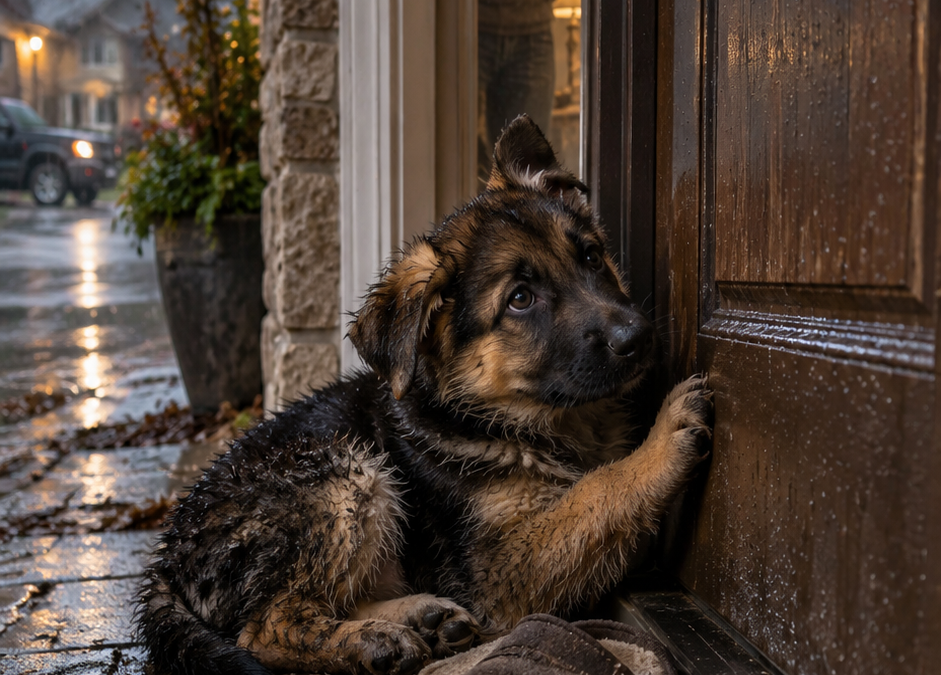
A German Shepherd puppy sat on my welcome mat.
Black and tan.
Maybe six months old.
Too thin.
Mud streaked across his chest and legs. His coat was wet from the puddles left by the morning rain, one ear stood high while the other folded slightly at the tip, and his paws trembled on the concrete.
He wore no collar.
Instead, someone had tied a strip of faded red fleece around his neck.
Not tightly.
Not professionally.
It looked like the torn end of a child’s scarf.
The knot was lopsided.
The fabric was worn soft.
That was what stopped me.
Not the ribs.
Not the mud.
The scarf.
It looked personal.
Like somebody small had tied it there because they thought he needed to be dressed for cold weather.
The puppy looked up.
No barking.
No whining.
No scratching now that I had opened the door.
He simply sat.
Watching me.
“Where did you come from?”
One ear twitched.
His eyes moved past me into the hallway.
Then back to my face.
“No.”
I don’t know why that was my first real answer.
Maybe because I knew what opening the door could become.
A bowl becomes feeding.
Feeding becomes responsibility.
Responsibility becomes attachment.
Attachment becomes loss.
I’d learned that sequence young.
My father brought home a shepherd mix named Duke when I was ten, not long after my mother left.
Dad had found him near a gas station outside Kenosha.
I remember asking whether we were keeping him.
Dad scratched Duke behind the ears and said, “Some dogs don’t wait around to be rescued. They find the person they’re supposed to bother.”
At ten, I thought that was profound.
At forty-five, I thought my father had been trying to make abandonment sound less frightening for both of us.
Duke lived thirteen years.
Losing him hurt.
Then marriage hurt.
Then divorce hurt differently.
I had become good at arranging my life around things that couldn’t leave me.
Furniture.
Books.
Work.
A house.
Very dependable.
The puppy shivered.
I sighed.
“Stay there.”
He did.
Of course he did.
I found an old towel.
Set it on the porch.
Filled a chipped ceramic bowl with warm water and another with some leftover turkey.
I placed both several feet from him.
He sniffed the turkey.
Looked at me.
Then ate.
Slowly.
That surprised me.
A starving dog should have inhaled it.
This puppy took one piece, chewed, swallowed, checked that I was still standing there, then took another.
When the bowl was empty, he drank.
I watched the red fleece move against his throat.
“You belong to somebody.”
Tail moved once.
“I am not that somebody.”
Another tiny movement.
“Don’t negotiate.”
The wind gusted.
He shivered harder.
I looked inside my warm house.
Then at him.
For five full seconds, I almost invited him in.
Instead, I put the towel beneath the covered part of the porch.
“Stay as long as you need.”
He walked onto it.
Turned twice.
Lay down.
Head on his paws.
Like that settled the issue.
I closed the door.
Not hard.
Not cruelly.
But completely.
For the rest of the afternoon, I kept finding excuses to walk through the front room.
Every time, I looked through the curtain.
The puppy remained.
At four, sleeping.
At five, awake and watching the street.
At six, curled tighter against the cold.
I brought more food.
He ate.
“You’re leaving after this.”
He looked at me.
“I mean it.”
Nothing.
At eight, I checked local missing-pet pages.
No obvious match.
At nine, I called the non-emergency animal control line.
Voicemail.
At ten, I stood inside the front window while the puppy slept outside beneath the red scarf.
I could have opened the door.
I didn’t.
I went to bed telling myself that if he belonged to someone, bringing him inside would complicate things.
Reasonable.
Responsible.
Cowardly.
At six the next morning, I opened the front door.
He was sitting on the towel.
Wide awake.
Waiting.
And when he saw me, his tail thumped once against the porch boards as if he had known all night that eventually I would come back.
PART2
“You have got to be kidding me.”
The puppy tilted his head.
His fur was dry along the back now, but damp around the paws.
The red scarf had twisted sideways.
His eyes looked tired.
I crouched.
“Did you sleep?”
Tail tap.
“That’s not an answer.”
I moved the water bowl closer.
He drank.
Then sat again.
No attempt to wander away.
No frantic interest in the neighborhood.
No looking down the street for an owner.
Just me.
“You really picked a house.”
He watched.
“Bad judgment.”
I stood.
Opened the door wider.
“Fine.”
The puppy didn’t move.
I stepped backward.
“Come in.”
Nothing.
“You scratched on the door for this.”
He looked into the hallway.
Then at me.
I waited.
Finally, he rose.
One paw crossed the threshold.
He paused.
Then the rest of him followed.
Slowly.
No excitement.
No racing around.
He entered the house the way someone enters a church after years away.
Carefully.
Quietly.
He sniffed the baseboards.
The edge of the rug.
The legs of a small table.
Then walked directly into the living room.
Stopped beside the fireplace.
Sat.
I stared.
The fireplace hadn’t worked in years.
Sarah used to complain about it.
“We have a fireplace that exists only decoratively.”
“Historic charm.”
“It’s a hole in the wall.”
That had been during the good years.
Before every conversation became logistics.
Before silence.
Before lawyers.
Before she packed half the kitchen into boxes and left the photograph of us on the mantel because neither of us knew whether taking it would be sadder.
The puppy sat beneath that photograph.
Of course he did.
“You have terrible timing.”
He looked up.
I went to the kitchen.
Opened plain canned chicken.
The sound brought him immediately.
He stopped in the doorway.
Sat.
No begging.
No jumping.
No whining.
“Who taught you manners?”
His tail swept once.
I spooned food into a bowl.
“Slow.”
He ate exactly that way.
Every few bites, his eyes lifted to make sure I remained.
The behavior bothered me.
Not because it was inconvenient.
Because it looked practiced.
Like he had learned people could vanish while he wasn’t watching.
When he finished, he lay near the bowl.
I crouched and reached toward the red fleece.
His whole body stiffened.
I stopped.
“Okay.”
Ears back.
“I won’t take it.”
I let my hand fall.
His muscles softened.
Interesting.
Whatever that scarf meant, it mattered.
Later, while he slept, I looked more closely.
Faded red fleece.
Lavender laundry detergent.
One edge hand-cut, not hemmed.
No label.
No writing.
Could have come from anything.
But it still looked like a child had tied it.
That afternoon, I canceled my plans.
My plans had consisted of grocery shopping and pretending I liked spending Sunday alone, so the sacrifice was manageable.
The puppy slept.
I read.
He woke whenever I moved.
Followed me to the kitchen.
Back to the living room.
Not close enough to touch.
Close enough to track.
By sunset, he’d relaxed enough to lie on his side.
I sat in the recliner.
Looked at him.
A name arrived without permission.
“Benny.”
His head came up.
I frowned.
“Benny?”
Tail.
One thump.
“No.”
I leaned forward.
“Is that actually your name?”
The puppy stood.
Walked toward me.
Sat at my feet.
Tail sweeping.
I stared.
“Benny.”
Thump.
“Well, that’s suspicious.”
Maybe he’d known someone with a similar word.
Maybe he simply liked my voice.
Didn’t matter.
Benny was Benny.
I reached down.
Slowly.
He allowed one scratch behind the ear.
Then leaned his head into my knee.
That tiny pressure went through me like electricity.
I hadn’t touched a dog with affection in years.
Forgotten how natural it felt.
“You’re making this difficult.”
Benny sighed.
That night, I unrolled an old sleeping bag beside the couch.
He circled it.
Lay down.
At two in the morning, I woke and walked into the living room.
Still there.
Curled.
Paws moving faintly in a dream.
The red scarf against his neck.
I stood in darkness for a while.
Then returned to bed.
I told myself he would go to a shelter in the morning.
I was lying.
Morning brought our first walk.
I didn’t own a leash.
So I made one from an old rope until I could buy proper supplies.
Benny seemed to understand immediately.
No pulling.
No tangling around my legs.
He walked beside me, occasionally drifting ahead, then looking back.
Milwaukee smelled like October.
Cold earth.
Wood smoke.
Wet leaves.
Coffee drifting from a corner shop.
We headed toward Elm Street.
I hadn’t planned to go to the park.
My feet did.
Sarah and I used to walk there.
Before the divorce.
Before everything became divided into mine and hers.
Benny reached the gate first.
Stopped.
Looked back.
“Don’t.”
He entered.
I followed.
The playground was empty.
Leaves covered the ground beneath the swings.
Benny wandered toward one pile near the edge.
Sniffed.
Pushed his nose deep into the leaves.
Then pulled out a green rubber dinosaur.
Mud-darkened.
One leg partially chewed.
My stomach dropped.
I knew that dinosaur.
My nephew Caleb carried it everywhere when he was little.
Sarah’s sister used to bring him to our house on weekends.
He would march around making dinosaur sounds until somebody begged for mercy.
One autumn afternoon, we’d lost that toy at this park.
Caleb had cried.
Sarah had promised we’d find it.
We never did.
Until now.
“How?”
Benny placed it at my feet.
Sat.
I picked it up.
Same bite mark near the tail.
Same faded black marker C beneath the belly.
Impossible.
Not impossible logically.
The toy had simply stayed somewhere around the park.
Buried beneath leaves.
Moved by weather or children.
Benny found it because he had a dog’s nose.
Nothing supernatural.
Still, memory doesn’t care whether something has a rational explanation.
The moment I held that dinosaur, I heard Caleb laughing.
He was seventeen now.
I hadn’t seen him in more than a year.
Divorce does strange things to extended families.
No legal order says you stop loving nieces and nephews who came through the other side of the marriage.
You just become awkwardly optional.
Phone calls decline.
Birthdays shift.
Then enough time passes that reaching out feels harder than continuing not to.
Benny nudged my wrist.
I looked at him.
“You’re trouble.”
Tail wag.
We brought the dinosaur home.
I cleaned it.
Put it on the mantel beneath the photograph of Sarah and me.
Benny watched.
I told myself that was all.
It wasn’t.
Over the next week, he settled into my house with unnerving ease.
No accidents after the second day.
No destructive chewing except one unfortunate magazine.
No food aggression.
No door panic.
He behaved less like a stray than a dog waiting for somebody to explain why his old life had vanished.
I posted his picture online.
Called shelters.
Checked lost-dog groups.
No one claimed him.
A neighborhood vet scanned for a microchip.
Nothing.
The veterinarian, Dr. Patel, estimated six months.
“Underweight but not severely.”
She examined his paws.
“He’s been walking a lot.”
“How can you tell?”
“Pads. Wear. Small abrasions.”
She touched the scarf.
Benny stiffened.
Dr. Patel immediately stopped.
“That important to him?”
“Seems like it.”
“No need to remove it unless it’s irritating his skin.”
“Can we put a collar under it?”
“Sure.”
I bought a temporary collar.
No tag yet.
That felt like a line I wasn’t ready to cross.
Dr. Patel gave vaccines.
Parasite treatment.
Basic bloodwork.
Healthy.
Someone had cared for Benny.
At least at some point.
Good coat beneath the mud.
Familiarity with human handling.
Basic manners.
Yet no chip.
No report.
No owner.
“How does a dog like this disappear?” I asked.
Dr. Patel shrugged.
“Lots of ways.”
I didn’t like any of them.
Back home, Benny studied the photograph on the mantel.
Sarah and me.
Sixth anniversary.
Rain.
She had thrown her arms around my neck after we got caught walking home from dinner.
Someone on the sidewalk took the photo for us.
Both soaked.
Both laughing.
I had forgotten that version of us existed.
Benny sat beneath it.
“That’s Sarah.”
He looked at me.
“My wife.”
I corrected myself.
“Ex-wife.”
Benny lay down.
I sat beside him.
“She wanted a shepherd.”
His ear lifted.
“For years.”
I rubbed my hands together.
“She said they were loyal.”
Benny moved closer.
“She said our house was too quiet.”
That one hurt.
Because she had been right long before she left.
We didn’t divorce because of some dramatic betrayal.
No affair.
No screaming revelation.
We eroded.
Work.
Family grief.
Misunderstandings.
Things unsaid long enough to become structural.
Sarah’s mother died.
Sarah withdrew.
I gave her space when she needed pursuit.
Then when I withdrew, she interpreted it as indifference.
We became experts at guessing wrong.
Eventually she said:
“I feel alone while you’re sitting three feet away.”
I had no answer.
Months later, she left.
Now Benny rested against my thigh.
No demands.
No interpretation.
Presence.
That afternoon, I took him into the backyard.
He discovered leaves.
Apparently the composed soldier routine had limitations.
Benny jumped into a pile.
Disappeared.
Emerged with a leaf stuck to his forehead.
I laughed.
He froze.
Looked at me.
Then launched himself into the next pile.
I laughed harder.
For five minutes, he became pure puppy.
No mysterious scarf.
No searching eyes.
No lost owner.
Just a German Shepherd with enormous paws attacking autumn.
Something in my chest loosened.
I’d forgotten laughter could happen when nobody else was in the room to hear it.
Later, we sat on the back steps.
Benny pressed against me.
“You sure you don’t belong somewhere?”
His head rested on my leg.
I looked toward the street beyond the fence.
“No one’s looking.”
At least not where I had searched.
Benny sighed.
That night, he slept closer to my bedroom.
The following morning, he woke me before sunrise.
Not barking.
He stood in the hallway.
Looked at the front door.
Then at me.
“Bathroom?”
He turned.
Walked toward the door.
“Fine.”
I dressed.
We went out.
Benny didn’t take our normal route.
He headed north.
Purposefully.
I let him lead within reason.
Past the shuttered bakery.
Across the old pedestrian bridge.
Toward Maple Hollow Community Park.
I stopped outside the entrance.
“No.”
Benny looked back.
This park carried different memories.
Sarah’s niece, Lily.
Picnics.
Cider.
A huge oak.
Saturday mornings when marriage had still felt easy.
Benny entered.
I followed.
He went straight toward the oak.
Sniffed near the roots.
Scratched once at leaves.
Then again.
I crouched.
“Benny.”
He dug just enough to uncover something pink.
A child’s mitten.
Wool.
Faded.
Tiny.
I knew that too.
Lily had lost one mitten there years earlier.
We had searched until dark.
Sarah had promised her we’d come back the next day.
We did.
Never found it.
Now I held it.
Cold.
Dirty.
Impossible not because a dog had located buried fabric.
Dogs do that.
Impossible because Benny kept leading me toward objects connected to a life I’d abandoned emotionally after the divorce.
The rational explanation was simple.
My old routes overlapped his wandering.
He smelled fabric humans couldn’t.
He investigated.
I supplied meaning.
Fine.
But meaning still exists even when your brain helps create it.
I sat beneath the oak.
Benny beside me.
The mitten in my palm.
“I don’t know what you’re doing.”
He leaned into my shoulder.
That evening, I placed the mitten beside the dinosaur.
The mantel had become an archaeological site.
Sarah’s photo.
Caleb’s dinosaur.
Lily’s mitten.
Benny lay beneath them.
“You’re creepy.”
Tail.
The next night, I made a mistake.
I left the back door partly open.
Fenced yard.
Cool weather.
Benny liked lying near the threshold.
I fell asleep early.
At five in the morning, he was gone.
The door remained open.
My heart stopped.
“Benny?”
No response.
I checked the yard.
Gate.
Somehow unlatched.
I don’t remember putting on my boots.
One second I was standing barefoot in the kitchen.
The next, I was outside with a flashlight shouting his name.
“Benny!”
Nothing.
Panic strips away every argument you’ve made to yourself.
He wasn’t temporary.
Not in that moment.
Not when I thought he’d vanished.
I ran toward Maple Hollow.
Called.
Checked alleys.
Under parked cars.
The rational part of my brain tried to calculate.
How far can a six-month shepherd travel in several hours?
Traffic.
Cold.
Other dogs.
I hated every answer.
Near the trailhead, I heard leaves move.
I swung the flashlight.
Two trees.
Shadow.
Then Benny stepped out.
Limping slightly.
“Benny.”
He walked toward me.
Something in his mouth.
I dropped to my knees.
He placed it at my feet.
Blue fleece mitten.
Yellow star stitched near the wrist.
I stared.
Lily’s other mitten.
The matching one.
Years ago she called them her lucky-star gloves.
We thought the second had been lost later.
Apparently not.
Or memory had blurred.
Either way, Benny had found it.
“Benny.”
He sat.
Chest heaving.
One paw scraped.
“You left the house for this?”
No answer.
My fear converted instantly into anger.
“You could’ve been hit by a car.”
Tail lowered.
I stopped.
He didn’t deserve anger because I had left a gate unsecured.
I pulled him against me.
“You scared the hell out of me.”
His head pressed under my chin.
I sat on wet ground hugging a muddy dog before sunrise and discovered the exact moment denial became impossible.
I loved him.
Already.
Too late to negotiate.
At home, I cleaned his paw.
Minor scrape.
Nothing deep.
Benny licked my wrist while I wrapped it.
The blue mitten joined the pink one on the mantel.
I stared at the pair.
Then at Sarah’s picture.
Something in me made a decision.
I found her number.
Still memorized.
Didn’t call.
Not yet.
But I didn’t close the contact screen either.
The days changed after that.
Not dramatically.
Quietly.
Coffee tasted better because I drank it on walks.
Mornings had structure.
Benny needed breakfast.
Exercise.
Training.
I started opening blinds earlier.
Played music while cooking.
Stopped eating dinner over the sink.
I bought groceries with another creature in mind.
Routine.
That’s what companionship often looks like from the outside.
Boring logistics.
Inside, it can be resurrection.
Benny didn’t heal me.
I wasn’t ill.
He interrupted habits that had become too narrow.
That’s different.
He forced the day to have edges.
Morning walk.
Noon break.
Evening meal.
Play.
Sleep.
Somebody waited.
That mattered.
One afternoon, I finally opened the closet box containing Sarah’s belongings.
Not everything she’d owned.
Just objects neither of us could decide where to put during the divorce.
Scarves.
Letters.
Photographs.
A cracked charger.
Movie tickets.
Near the bottom, a Polaroid.
Sarah and Lily at Maple Hollow.
Both wearing ridiculous matching knitted hats.
Lily holding one of the star mittens.
I sat on the floor.
Benny beside me.
He pushed his head under my arm.
“She would have loved you.”
Tail.
“Actually, she probably would have claimed you.”
I looked at the photo.
“I don’t know whether that would’ve been better.”
Benny sneezed.
“Exactly.”
A few days later, our walk took us five blocks south.
Benny became unusually focused.
Nose low.
Then up.
He stopped outside a yellow house with a cracked driveway.
Plastic tricycle on the porch.
Before I could redirect him, the front door opened.
A teenage girl stepped outside.
She saw Benny.
Stopped.
“Is that your dog?”
“Sort of.”
Still saying that.
She came closer.
“He’s a shepherd?”
“Yeah.”
“He looks like Max.”
“Who’s Max?”
“Our dog. He disappeared a few months ago.”
My chest tightened.
“How old?”
“Ten.”
I exhaled internally.
Benny was nowhere near ten.
The girl noticed.
“Not him.”
“No.”
“Same eyes, though.”
A woman called from inside.
The girl looked toward the door.
“Weird.”
“Yeah.”
“Max used to wear red.”
I froze.
“What?”
“Bandanna.”
My eyes dropped to Benny’s faded scarf.
The girl followed.
“Oh.”
She stepped closer.
“Can I see?”
Benny moved behind my leg.
“No.”
She stopped immediately.
Good.
“Sorry.”
“Did Max have puppies?”
“No. He was neutered.”
That eliminated the obvious fantasy.
She studied Benny.
“Where’d you get him?”
“He came to my house.”
“Huh.”
We exchanged information.
Later, I sent a photo.
Their family confirmed Benny was not connected to Max as far as they knew.
Coincidence.
Another strange thread.
No answer.
Benny seemed satisfied after visiting the house.
On the walk back, he no longer looked over his shoulder.
Maybe scent had interested him.
Maybe the old dog smell.
Maybe nothing.
Dogs are allowed mysteries that aren’t about us.
I stopped trying to turn every choice into a message.
That helped.
The veterinary follow-up was uneventful.
Healthy.
Weight improving.
Paw healed.
No chip still.
No owner located.
Dr. Patel asked:
“You keeping him?”
I looked down.
Benny looked up.
“I think he’s keeping me.”
“That’s usually how it works.”
That evening, I opened my junk drawer.
Old keys.
Batteries.
Loose screws.
A brass dog tag still sealed in packaging.
Sarah had bought it at a shelter fundraiser years earlier.
She’d held it up and joked:
“You never know.”
I’d rolled my eyes.
Then kept it after the divorce.
Apparently.
I drove Benny to the pet store.
The employee took the blank tag.
“Name?”
I looked down.
“Benny.”
“Phone?”
I gave mine.
Ten minutes later, BENNY was engraved across the front.
My number on the back.
I bought a blue collar.
Kept the red scarf above it.
Benny stood still while I buckled everything.
Click.
He leaned against my legs.
I swallowed.
“Official.”
Tail wag.
“Don’t let this go to your head.”
It went directly to his head.
Within two weeks he had learned the couch despite a rule against it.
My side of the couch.
Naturally.
He learned sit.
Down.
Stay.
Come.
Leave it.
“Drop the sock” required separate diplomatic negotiations.
His personality unfolded.
He loved cheese.
Hated bananas.
Distrusted snow shovels.
Loved the mailman.
Barked exactly once at a plastic Halloween skeleton and then spent ten minutes trying to sniff its feet.
He also slept beside my bed now.
Not near the front door.
That mattered.
A dog expecting to leave sleeps ready.
A dog expecting tomorrow sleeps wherever he’s comfortable.
One morning, I woke before him.
Sun through blinds.
Benny on his side.
Paws loose.
Red scarf barely visible above his collar.
I realized I couldn’t remember the last time the house had felt empty.
That frightened me.
Attachment always does when you’ve spent years trying not to need anything.
Then Benny got sick.
It began before dawn.
A sound.
Low whine.
I opened my eyes.
“Benny?”
No response.
He was lying near the bedroom doorway.
Not curled.
Flat.
I touched his side.
Warm.
Too warm.
His breathing shallow.
“Benny.”
Eyes opened halfway.
My heart detonated.
I was dressed in less than two minutes.
Wrapped him in the old fleece blanket.
Carried him to the truck.
Benny was heavier now, but adrenaline doesn’t negotiate with backs.
“Stay with me.”
He rested his head against my arm.
Every red light felt personal.
The clinic wasn’t open.
I called the emergency number.
Dr. Patel redirected me to an affiliated twenty-four-hour hospital.
Another twelve minutes.
Longest drive of my life.
Benny whimpered once.
“I’m here.”
His eyes opened.
“I’m not going anywhere.”
Those words landed differently now.
At the hospital, they took him immediately.
I hated letting go.
The second his weight left my arms, I felt hollow.
I paced.
Sat.
Stood.
Checked the clock.
Thought of Duke.
Then Sarah.
Then every terrible version of the next conversation.
When the vet came out, she smiled.
I almost collapsed.
“He’s okay.”
“What happened?”
“Likely gastrointestinal infection. Mild fever, dehydration. We’re giving fluids and anti-nausea medication. Bloodwork looks reassuring.”
“He’s not dying?”
She looked surprised.
“No.”
I sat.
Covered my face.
“Sorry.”
“Don’t apologize.”
Twenty minutes later, Benny walked out slowly.
The moment he saw me, tail wag.
Once.
Twice.
I knelt.
He leaned into my chest.
“You absolute jerk.”
Lick.
“You scared me.”
Another lick.
“Stop using affection to avoid accountability.”
The technician laughed.
I didn’t care.
On the ride home, Benny slept with his head on my thigh.
I kept one hand on him.
When we reached the house, I carried him inside.
Set him on the couch.
This time, no rule.
I sat beside him for hours.
At some point, I said out loud:
“You’re family.”
Benny slept.
Didn’t need ceremony.
The next morning, he ate chicken and rice.
Slowly.
By afternoon, he wanted a walk.
“Five minutes.”
He looked offended.
“Medical orders.”
Tail.
“Fine. Seven.”
Recovery took several days.
My fear took longer.
I started checking his breathing while he slept.
Dr. Patel told me to stop.
“You’re going to make yourself crazy.”
“Too late.”
“He’s healthy.”
“I know.”
“Then let him be healthy.”
Good advice.
Hard.
Love makes monitoring tempting.
But care isn’t control.
I worked on that.
Weeks later, I finally called Sarah.
Not because Benny brought me a magical object.
Not because he stared at her photograph.
Because I wanted to.
She answered after four rings.
“Mark?”
“Hi.”
Pause.
“Is everything okay?”
“Yeah.”
Another pause.
“I found Lily’s mittens.”
Silence.
“What?”
“At Maple Hollow.”
“Both?”
“Long story.”
She laughed softly.
God, I hadn’t heard that laugh in years.
“That sounds like you.”
“Actually, it involves a dog.”
“A dog?”
“German Shepherd.”
Longer silence.
“You got a shepherd?”
“He got me.”
Sarah laughed again.
I smiled.
We talked twenty minutes.
Not reconciliation.
Not dramatic closure.
Just two people who had once loved each other very much remembering they didn’t have to become strangers.
I mailed Lily the mittens.
Caleb got the dinosaur.
He texted me a photo holding it.
NO WAY.
Then:
Uncle Mark, you still alive?
That one hurt.
I called him.
We talked an hour.
Benny slept at my feet.
Again, he hadn’t performed a miracle.
He had simply dragged old objects into daylight until I stopped pretending old relationships had to remain buried with them.
Winter arrived.
Milwaukee cold.
Real cold.
Benny loved snow.
His first storm transformed him into an idiot.
He plowed his face through drifts.
Leaped at snowflakes.
Barked at the shovel.
I bought him a proper winter vest.
The red scarf stayed.
One day I tried washing it.
I let Benny watch.
Removed it.
He became tense.
I placed it into a laundry bag.
Gentle cycle.
Lavender-free detergent.
When I returned it, clean but still faded, Benny sniffed.
Then licked my hand.
I still didn’t know who had tied it.
Never would.
That became okay.
We searched missing-dog records for months.
No match.
No one claimed him.
The city eventually processed his found-animal period.
My adoption became official.
Paperwork.
Signature.
Fee.
Simple.
I celebrated by buying him a steak.
Dr. Patel said not too much.
Benny disagreed.
Over the next year, the house changed.
Not renovated.
Used.
Dog bed by the fireplace.
Leashes by the door.
Mud towels.
Basket of toys.
Water bowl in the kitchen.
A small scratch on the hardwood from one enthusiastic turn.
I stopped caring about pristine floors.
Friends came over more often because Benny apparently had a better social network than I did.
My neighbor Mrs. Givens brought treats.
The mailman knew his name.
Children on the block asked whether they could pet him.
Only if Benny approached.
He usually did.
One little boy said:
“Why is he wearing that old red thing?”
I touched the scarf.
“Because it matters to him.”
“Why?”
“I don’t know.”
The boy considered this.
Then nodded.
Kids handle uncertainty better than adults.
At two years old, Benny was beautiful.
Broad chest.
Strong.
Black saddle.
Warm tan legs.
One ear still slightly folded.
That never changed.
He still carried the quiet steadiness he’d had on my porch.
But now it wasn’t sadness.
Just temperament.
He watched.
Thought.
Then acted.
We returned often to Maple Hollow.
The bench became ours.
Sometimes Benny climbed beside me.
Sometimes sat at my feet.
One October afternoon, Sarah visited Milwaukee.
First time since the divorce.
Not for me.
Her sister.
But she called.
“Can I meet the dog?”
“Sure.”
I was more nervous than I expected.
Sarah arrived at the park wearing a dark green coat.
Benny saw her from twenty yards away.
Stopped.
She crouched.
Didn’t call.
Didn’t reach.
Smart.
Benny approached.
Sniffed.
Then sat directly in front of her.
Sarah looked at me.
“Seriously?”
“Apparently.”
She scratched his chest.
Benny leaned against her.
Her eyes filled.
“You finally got the shepherd.”
“Technically late.”
“Very.”
We sat on the bench.
Talked.
No romance returned.
That wasn’t the point.
Something gentler did.
History without hostility.
Sarah noticed the red scarf.
“Where’d that come from?”
“He had it when he showed up.”
She touched one edge.
Benny allowed it.
“Looks like a kid tied it.”
“That’s what I thought.”
She smiled sadly.
“Maybe somebody loved him.”
“I think somebody did.”
That was the conclusion I’d reached.
Whatever ended badly, Benny hadn’t begun unwanted.
His manners.
His trust.
That scarf.
Someone had touched him kindly once.
I liked believing that.
No need to invent tragedy.
Maybe a family lost him.
Maybe circumstances scattered people.
Maybe a child wondered for years where he went.
If so, I wished I could tell them:
He was okay.
More than okay.
He was loved.
Years passed.
Benny became my calendar.
Morning walk.
Work.
Lunch break.
Evening walk.
Saturday park.
Sunday slower.
He aged.
So did I.
Gray appeared around my temples.
Then his muzzle.
At seven, arthritis began mildly.
At eight, stairs became slower.
I installed carpet runners.
At nine, he preferred shorter walks.
Still carried the red scarf.
By then it was fragile.
I had a seamstress reinforce the underside with soft matching fabric so the original remained visible.
Benny tolerated the repair.
A woman at the shop asked:
“Sentimental?”
“His.”
She smiled.
“Sure.”
I didn’t explain.
At ten, Benny had another health scare.
Not a virus this time.
A benign growth near his shoulder.
Surgery.
I sat in another waiting room.
Older.
Marginally better at panic.
When Dr. Patel called and said everything had gone well, I cried anyway.
She pretended not to notice when I picked him up.
At eleven, Benny stopped jumping onto the couch.
I bought steps.
He used them once.
Then stared at me until I lifted him.
“You weigh seventy-five pounds.”
Tail.
“Manipulative.”
He climbed into my lap as much as an elderly German Shepherd can climb into anyone’s lap.
His front half on me.
Back half still on couch.
Good enough.
The house was never quiet anymore.
Even when Benny slept, his breathing filled it.
Then one morning, I realized how frightening that had become.
Because one day the breathing would stop.
I had known that since the porch.
That’s why I hadn’t let him in.
Not because I didn’t care.
Because some part of me understood exactly what accepting him meant.
An ending.
Eventually.
The mistake had been thinking endings erase everything before them.
Duke should have taught me better.
Sarah too.
Relationships can end and still have been worth having.
Benny certainly did.
At twelve, kidney disease arrived.
Manageable.
Diet.
Medication.
More vet visits.
Good months.
At thirteen, his hind legs weakened.
Walks became short loops.
Sometimes just the front yard.
One crisp October afternoon, almost exactly thirteen years after he’d scratched on my door, Benny walked onto the porch.
Same welcome mat style, though replaced several times.
He sat.
Red scarf against gray fur.
I sat beside him.
Leaves scraped along the sidewalk.
Same sound.
Dry whispers.
I laughed.
“What are the odds?”
Benny looked at me.
“You remember?”
Probably not as narrative.
Maybe scent.
Maybe body.
Maybe nothing.
I reached into my pocket.
Turkey.
Still his favorite.
He took it.
Chewed slowly.
Watched me.
Just like the first day.
My throat tightened.
“I closed the door on you.”
Tail tap.
“Remember that?”
Another.
“Best bad decision I ever corrected.”
Benny leaned his body against mine.
Heavy now.
Old.
Warm.
I rested my cheek on his head.
The scarf smelled like him more than anything else after all those years.
No lavender left.
Just dog.
Home.
His final decline came three months later.
Cancer.
Aggressive.
The vet explained options.
Surgery maybe.
Chemotherapy maybe.
Age and kidneys complicated everything.
I asked the question I had learned to ask honestly.
“What gives him the best life, not the longest calendar?”
Dr. Patel looked relieved.
“Comfort care.”
So we chose that.
Good food.
Pain medication.
Short walks.
No unnecessary hospital days.
Benny slept near the fireplace.
The one that had finally been repaired years earlier.
Sarah joked when I told her:
“Took a dog to fix your fireplace.”
“Apparently.”
She visited once during Benny’s final month.
Sat on the rug beside him.
He put his head in her lap.
She cried.
“Thank you,” she whispered.
I don’t know whether she meant for choosing me.
For connecting us again.
For simply existing.
Maybe all of it.
Benny’s last morning was cold.
Sun bright.
He couldn’t stand without help.
I carried him to the porch.
Wrapped him in a blanket.
He sniffed the air.
Leaves.
Snow coming later that week.
Somebody’s fireplace.
The city.
I sat beside him.
No dramatic speech prepared.
That’s not how we had ever worked.
I touched the red scarf.
“Can I take this off?”
Benny looked at me.
I untied it carefully.
For the first time in thirteen years, his neck was bare except for his blue collar.
I folded the scarf.
Placed it beside him.
“You don’t need it to tell me who you are.”
His eyes closed.
Dr. Patel came to the house that afternoon.
Benny lay on his favorite rug.
I sat on the floor.
His head in my lap.
Exactly where it belonged.
The first injection relaxed him.
His breathing deepened.
I stroked the folded ear.
“Remember when you scratched my door?”
Tail moved faintly.
“I pretended I didn’t need you.”
Another tiny movement.
“That was embarrassing.”
Dr. Patel smiled through tears.
I bent closer.
“You didn’t rescue me.”
I wanted to say it correctly.
Benny’s eyes found mine.
“You gave me a reason to stop hiding.”
That was true.
“You gave me somebody to come home to.”
His breathing slowed.
“And somehow you gave me parts of my old life back without asking me to live in the past.”
I thought of Caleb.
Lily.
Sarah.
Duke.
My father.
The red scarf.
The mitten.
The dinosaur.
All the doors I’d closed because open doors frightened me.
My hand rested on Benny’s chest.
“You were family.”
His eyes softened.
“You still are.”
Then the final medication.
One breath.
Another.
Long exhale.
Stillness.
I kept my hand there.
The house did not collapse.
Neither did I.
I cried.
Hard.
Held him.
But beneath the grief was something younger Mark would never have understood.
Gratitude.
Thirteen years.
That was what saying yes had bought me.
Not loss.
Thirteen years.
The loss was one day.
Love had thousands.
After Benny died, I kept the red scarf.
Not around a picture.
Not in a memorial display.
In my top dresser drawer.
Sometimes I opened it.
Touched the worn fleece.
Remembered the muddy puppy on the porch.
For months, the house felt wrong.
Too quiet.
But not the same quiet as before Benny.
This quiet had evidence behind it.
Scratches on the floor.
A dent in the couch cushion.
Dog hair I kept finding despite vacuuming.
Relationships leave traces.
I no longer rushed to erase them.
One spring morning, I walked to Maple Hollow alone.
Sat on our bench.
Children played.
A German Shepherd passed with a young couple.
The dog looked at me.
I smiled.
Didn’t ache the way I expected.
At the old oak, I thought about the mittens Benny found.
I still couldn’t explain why he had taken me to those places.
I no longer tried.
Maybe he wandered routes he’d known before.
Maybe my scent, Sarah’s old scent embedded in clothing, neighborhoods, whatever, connected him.
Maybe pure coincidence.
Maybe I supplied all the meaning because I needed it.
That’s fine.
Meaning isn’t invalid just because humans participate in creating it.
The outcome was real.
I called Caleb.
I spoke to Lily.
Sarah and I became occasional friends.
I opened the house again.
Not to another dog immediately.
I wasn’t ready.
Then, two years later, a rescue coordinator I knew sent me a photograph.
Adult shepherd mix.
Five years old.
Owner had died.
Quiet.
Good with older adults.
Needed a foster.
I stared at the photo.
Then laughed.
“No.”
I put my phone down.
Picked it up again.
Read the message.
Temporary foster.
I knew that word.
Dangerous.
That evening, the dog arrived.
Her name was June.
No mysterious scarf.
No old toy.
No apparent destiny.
She entered my hallway.
Sniffed everything.
Immediately stole a dish towel.
Normal.
Wonderful.
I fostered her for six weeks.
Then adopted her.
Not because Benny needed replacing.
He didn’t.
June occupied her own place.
That’s another thing Benny taught me.
Love is not a chair with one seat.
Nothing gets pushed out when something new arrives.
The heart is structurally unreasonable.
It expands.
Years later, people still occasionally ask where Benny came from.
I tell them:
“My porch.”
They laugh.
“No, before that.”
“I don’t know.”
And that’s the truth.
No owner ever surfaced.
No microchip.
No record.
The yellow house led nowhere.
The red scarf carried no name.
I never learned whether Benny had actually been called Benny before I said it.
Maybe his tail thumped because he liked the sound.
Maybe we invented him together.
That mystery stopped bothering me.
I knew where he ended up.
That’s more important.
He ended up sleeping beside my bed.
Running through autumn leaves.
Eating turkey from my hand.
Wearing a blue collar with his name.
Getting old in a house he chose before I understood the decision.
And on his last day, he died in that house knowing no door was going to close him out again.
For a long time, I thought the important moment in Benny’s story was when I finally let him inside.
It wasn’t.
The important moment happened first.
I closed the door.
And he stayed.
No barking.
No clawing desperately.
No anger.
He curled up on the towel I’d given him and waited through the night.
Not because he knew I would change my mind.
I don’t believe dogs see the future.
He stayed because, for whatever reason, that porch felt like the safest option he had.
Then morning came.
I opened the door again.
That’s the part I carry.
We all close doors sometimes.
Fear.
Grief.
Pride.
Habit.
Sometimes we close them on people.
Sometimes on opportunities.
Sometimes on a muddy German Shepherd puppy wearing a torn red scarf.
Closing the door isn’t always the final decision.
Sometimes morning gives you another chance.
Benny gave me mine.
And the best thing I ever did was open it.








