𝗙𝗨𝗟𝗟 𝗦𝗧𝗢𝗥𝗬 I Came Home a Billionaire to Find the HOA Throwing My Dad’s Life Onto the Lawn—They Had No Idea Who I Was
𝗙𝗨𝗟𝗟 𝗦𝗧𝗢𝗥𝗬
I made my first call from the back porch.
Priya Anand answered on the fourth ring.
“Grant, it’s eleven at night.”
“I need a favor.”
“You sold your company. You’re supposed to stop calling me at eleven at night asking for favors.”
“An HOA is throwing my father’s furniture onto his lawn.”
Silence.
Then:
“I’m awake.”
Priya had been general counsel for my company through three financing rounds, two threatened lawsuits, an intellectual property fight, and the acquisition that had made everybody suddenly describe me as a “visionary,” despite several years of describing me as “that guy sleeping in the office.”
She had the rare ability to become more cheerful as legal situations became uglier.
“Start from the beginning.”
I explained.
The fines.
The alleged notices.
The fence.
The hedge.
The removal crew.
Regina’s claim that the board had authorized everything.
When I finished, Priya asked, “Did your father receive formal hearing notice?”
“He says no.”
“Board-meeting notice?”
“No.”
“Certified mail?”
“Nothing.”
“You recorded Voss?”
“Yes.”
“Send me the video.”
I did.
“Anything else?”
“Find their governing documents. Every version. Original covenants, amendments, meeting rules, enforcement authority.”
“County records?”
“Everything.”
“Do you want me to send a cease-and-desist?”
“No.”
Priya paused.
“You sure?”
“For now.”
“You have more than enough resources to make these people regret learning the word ‘hedge.'”
“I know.”
“So why wait?”
I looked through the kitchen window.
Dad was on the floor folding shirts that had spilled out of one of the boxes.
He was handling every shirt carefully, as though neatness could erase humiliation.
“The speed bothers me,” I said. “Ninety days of alleged violations, and suddenly they’re physically removing property forty-eight hours after the latest notice? That’s not normal escalation.”
“What do you think it is?”
“I don’t know.”
“And until you do?”
“We stay quiet.”
Priya laughed softly.
“You want to go undercover in your childhood home.”
“I want Regina to keep thinking I’m harmless.”
“You’re wearing the old sneakers, aren’t you?”
I looked down.
“Maybe.”
“You realize having money has made you very strange.”
“Find the documents.”
“I’ll call you tomorrow.”
I spent the next three days making myself as unimpressive as possible.
Which, according to Regina’s worldview, wasn’t difficult.
I drove Dad’s fifteen-year-old pickup.
I wore his old work jacket.
I mowed the lawn myself and deliberately left a slightly uneven strip near the mailbox.
Six hours later, a laminated violation notice appeared.
INCONSISTENT LAWN MAINTENANCE.
Fine: seventy-five dollars.
I stood at the mailbox for nearly a minute staring at it.
Then I laughed.
I actually laughed.
Whoever had issued it had unknowingly done me an enormous favor.
I’d wanted to know whether the enforcement was routine or targeted.
Apparently Millbrook Point’s grass emergency response unit operated faster than most paramedics.
I photographed the notice.
Front.
Back.
Timestamp.
Signature.
Plastic zip tie.
Everything.
That night, Priya emailed me the original 1974 covenant.
Sixty-one pages.
I read all of them.
Then again.
I found what I was looking for shortly after midnight on the third night.
Section Nine, Article Three.
I read it once.
Then twice.
Then aloud.
Any removal or seizure of personal property related to compliance enforcement required approval by majority vote of the full board at a properly noticed meeting. The affected homeowner had the right to appear and be heard.
I opened my recording.
Regina’s voice played through my headphones.
“The board authorized removal.”
I checked board notices.
No meeting.
No hearing.
No vote.
No authorization.
Regina had lied.
That alone would have been enough to stop Dad’s case.
But I didn’t call her.
Because by then I was certain the lie was not the story.
It was only the door.
The knock came after ten the following night.
Soft.
Three taps.
Pause.
Two more.
I opened the door.
A man in his mid-twenties stood on the porch holding a laptop bag.
He looked like he hadn’t slept properly in a week.
“Grant Ashford?”
“Yes.”
“My name is Caleb Voss.”
I didn’t react visibly.
Internally, everything sharpened.
“Voss?”
“Regina’s my aunt.”
His hands were trembling.
“I know how that sounds.”
“Not great.”
“I work for Halbrook Meridian Development.”
That name meant nothing to me yet.
It would.
Caleb swallowed.
“I need to show you something.”
“Why?”
“Because I can’t sleep anymore.”
I studied him.
“Come in.”
We sat at the kitchen table beneath the brass light fixture Dad had installed when I was eleven.
Caleb opened his laptop.
A spreadsheet filled the screen.
Seventeen addresses.
I recognized several.
Some were in Millbrook Point.
Others bordered the retention pond and old service road.
Columns showed fines.
Sale dates.
Estimated values.
Final sale prices.
Buyer entities.
Then I saw a column labeled:
HOLDCO RV INTEREST
“What am I looking at?”
Caleb rubbed his hands together.
“Halbrook Meridian is assembling land for a mixed-use development.”
“Where?”
He opened a map.
My father’s property sat near the southern boundary.
The development wrapped around the pond.
“Forty acres total when assembled,” Caleb said. “Retail, residential, offices. Projected valuation just over two hundred million.”
“And my father’s house?”
“Anchor parcel.”
I leaned closer.
“Explain.”
“Because of the pond easement and the shape of the service road, the southern access plan doesn’t work without your father’s lot. They can redesign, but it adds millions and triggers another round of approvals.”
“Who owns HoldCo RV?”
“Technically? Marcus Delgado.”
“Who is Marcus Delgado?”
“Regina’s cousin.”
I sat back.
Caleb continued.
“He’s a nominee. Everybody at Halbrook who’s been around long enough knows Regina controls the interest.”
“What interest?”
“A percentage of profit associated with parcels acquired below target price.”
The room became very still.
“Say that again.”
“She gets paid when targeted properties sell cheaply.”
“And who controls the HOA fines?”
“She does.”
There it was.
A little machine.
Almost elegant in its ugliness.
Pick the properties.
Pressure the owners.
Generate violations.
Escalate fines.
Create exhaustion.
Wait for homeowners to decide peace is worth more than equity.
Then have a friendly buyer conveniently appear.
I looked down the spreadsheet.
“Eleven sold?”
“Eleven acquired. Six remaining.”
“My father is number twelve.”
“Yes.”
“Why now?”
“The developer’s option expires in six weeks.”
“And Dad refused to sell.”
“Twice.”
I looked up.
“Who made the offers?”
“Agents. Informal. Nothing with Halbrook’s name.”
Dad had mentioned them before.
People who “loved the neighborhood.”
A “young couple.”
A “family looking for exactly this kind of property.”
How charming.
Apparently wholesome suburban homebuyers now traveled with two-hundred-million-dollar development projections.
Caleb pulled up another document.
“This isn’t everything.”
County stamp.
Eleven years earlier.
Property modification permit.
Address belonging to Regina Voss.
Fence extension.
I read it carefully.
“No board approval.”
“None.”
“Same section she used against Dad?”
“Exactly.”
“Has she cited anyone else for this?”
“Nine families that I found.”
Of course.
The queen had exempted the palace.
“Why give this to me?”
Caleb closed the laptop.
“My mom went through a bad divorce when I was a kid. Your father fixed our fence.”
I remembered vaguely.
“She couldn’t afford it,” Caleb said. “He did it anyway. Never sent a bill.”
That sounded like Dad.
“I didn’t recognize the address when it first appeared in our acquisition system. Then last week I saw the name.”
He took a breath.
“I started digging.”
“And?”
“And once you understand what you’re looking at, you can’t unknow it.”
“Why not take this to a reporter?”
“I considered it.”
“County?”
“They’re backlogged. A journalist runs a story, Regina gets a lawyer, Halbrook denies knowledge, the holding company gets blamed on Marcus, and two years later maybe something happens.”
“So why me?”
He looked almost embarrassed.
“I looked you up.”
“Ah.”
“I saw the acquisition announcement.”
“The one I’m hoping Dad hasn’t seen yet.”
“He probably hasn’t. It wasn’t widely covered.”
“Good.”
Caleb looked at me.
“I know you have resources.”
Money.
He meant money.
People always did.
But resources meant more than money.
Lawyers.
Auditors.
Researchers.
Contract specialists.
People trained to turn vague suspicions into documents that could survive cross-examination.
“I’m not asking you to ruin her,” Caleb said.
“I don’t plan to.”
Relief flickered across his face.
“I’m going to stop her.”
The relief disappeared.
I pointed at the laptop.
“Can you prove every number?”
“Yes.”
“Every property?”
“Yes.”
“Every payment?”
“Most of them. Some need tracing.”
“Can you give me everything?”
Caleb reached into his pocket and placed a flash drive on the table.
“I already did.”
I stared at it.
“How long have you been carrying that?”
“Three days.”
“Why tonight?”
“I finally got tired of being afraid.”
I picked up the drive.
“That makes two of us.”
The story about my company broke locally the following afternoon.
Not because I released anything.
Not because Priya did.
A technology blogger three states away was digging through acquisition documents for an unrelated article and found my name.
The headline called it a “quiet nine-figure exit.”
I hated the phrase immediately.
It made me sound like I’d robbed a bank politely.
By six that evening, Regina knew.
I learned later what happened next through records, messages, and eventually Caleb.
She sat in her sunroom staring at the article while her cousin Marcus sent her screenshots followed by increasingly panicked punctuation.
Apparently Regina’s first reaction was not fear.
It was calculation.
Which tells you almost everything worth knowing about Regina.
Normal person:
The man whose father I harassed turns out to have enormous resources. Perhaps I should immediately stop.
Regina:
Excellent. A wealthier target.
She called the next morning.
Her voice had changed dramatically.
If you have ever watched a rattlesnake attempt customer service, you have heard approximately the tone Regina used.
“Grant.”
“Regina.”
“If I may call you Grant.”
“You just did.”
A pause.
“I think there has been a genuine misunderstanding.”
Amazing.
Four days earlier, Dad was eleven thousand four hundred dollars worth of irresponsible vegetation.
Now we had a misunderstanding.
“I’d really like the opportunity to make this right quietly between us.”
“Quietly?”
“I don’t think either of us benefits from unnecessary conflict.”
Interesting.
Conflict had been perfectly necessary when she thought I was broke.
“Perhaps we could meet.”
“I’d like that.”
She sounded relieved.
“Just the two of us.”
“Of course.”
“I think once you understand the full context, you’ll realize none of this was personal.”
I nearly admired the sentence.
She had targeted Dad’s house to profit from a development deal, but apparently targeting somebody’s home wasn’t personal.
Maybe Regina considered personal behavior limited to birthday cards and homicide.
“We’ll talk,” I said.
When the call ended, I phoned Priya.
“She knows.”
“About the money?”
“Yes.”
“Good.”
“How’s the audit?”
“Better than good.”
Priya’s voice had the particular energy she got when somebody had been stupid in writing.
“The holding company received distributions tied to eleven property acquisitions. We can establish beneficial control well enough for civil proceedings.”
“Regina?”
“Marcus is nominal owner. But messages, transfer instructions, and related records Caleb provided strongly indicate Regina directed transactions.”
“Anything criminal?”
“I’m not making that conclusion yet.”
Fair.
Priya was never dramatic when facts were available.
“There’s more,” she continued.
“The enforcement vendor.”
“Millbrook compliance?”
“Coastal Compliance Partners. Family-owned. They administer the HOA actions under contract.”
“So?”
“It’s for sale.”
I sat up.
“How for sale?”
“Quietly. Owner is retiring. No family succession.”
“Price?”
She told me.
I laughed.
“Why are you laughing?”
“Because I spent more than that on one failed server migration.”
“Grant.”
“Can we buy it?”
Silence.
Then:
“I knew you were going there.”
“Can we?”
“Yes.”
“How fast?”
“Cash transaction through a holding entity? If the seller cooperates, days.”
“Do it.”
“You’re buying an entire compliance company because an HOA president irritated you.”
“No.”
“That is precisely what you’re doing.”
“I’m buying the company because it’s the enforcement mechanism she depends on.”
“That sounds much more respectable when you say it slowly.”
“Priya.”
“I’m already drafting the offer.”
That’s why I’d trusted her with my company.
She could mock an idea while executing it flawlessly.
Two days later, I owned Coastal Compliance Partners.
Regina did not know.
And then she made the mistake that ended any chance I might have given her to walk away quietly.
The lien notice appeared at seven in the morning.
Dad found it.
I woke to silence.
Not ordinary morning silence.
Heavy silence.
I came downstairs and saw the front door open.
Dad was sitting on the porch steps in his robe holding a piece of paper.
I stepped outside.
“Dad?”
He didn’t answer.
I sat beside him.
The top of the notice read:
FORMAL NOTICE OF INTENT TO LIEN
His name below it.
His address.
HOA signature.
Regina Voss.
I read it twice.
“Dad—”
“I raised you here.”
His voice cracked.
I looked at him.
He was staring at the driveway.
“Your mother died upstairs.”
“I know.”
“I paid this house off.”
“I know.”
“Thirty-three years.”
His fingers tightened around the paper.
“Never missed a mortgage payment. Never missed taxes. I fixed half the houses on this street when people couldn’t afford contractors.”
He looked at me.
“And she thinks she can take it over a fence board.”
His eyes were wet.
Not weak.
Not defeated.
Furious.
Tired.
Humiliated.
“I don’t care what it costs anymore,” he said. “I want it over.”
That was the moment my last hesitation disappeared.
Until then, some part of me had still believed Regina might choose an exit ramp.
Apologize.
Reverse the fines.
Return the property.
Resign quietly.
Instead, after personally calling me to discuss a friendly solution, she escalated to a lien.
She hadn’t mistaken restraint for decency.
She had mistaken restraint for weakness.
I photographed the notice.
Sent it to Priya.
One sentence.
Use everything.
Her response came thirty seconds later.
Understood.
I called Caleb.
He answered immediately.
“She filed a lien notice.”
“I know.”
“How?”
“Marcus told people at Halbrook this morning. She wants you to know she isn’t afraid.”
I looked at the document again.
“There are easier ways to communicate insecurity.”
Caleb exhaled.
“Grant, I think this is the moment I stopped feeling guilty.”
“Good.”
“About what?”
“Tonight.”
He went quiet.
“What happens tonight?”
“Regina gets her meeting.”
The clubhouse looked almost exactly as I remembered it from childhood.
Same beige walls.
Same fluorescent lighting designed to make everyone look mildly deceased.
Same folding tables.
Same framed watercolor of the retention pond pretending it wasn’t basically a mosquito resort.
The only major difference was the chairs.
Forty of them.
Every chair occupied.
Regina walked in at 7:03 p.m.
She stopped immediately.
Her expression was priceless.
Not theatrical shock.
Arithmetic.
She was counting witnesses.
“What is this?”
I stood near the projector.
“Meeting.”
“We agreed to speak privately.”
“No. You requested to speak privately. I said we’d talk.”
“This is completely inappropriate.”
That word.
Inappropriate.
Used by a woman who had removed a widower’s belongings without authorization.
The confidence would have been impressive if it weren’t so exhausting.
“This is an emergency HOA session,” I said.
“You don’t have standing to call a meeting.”
“I don’t.”
Her face brightened.
For about half a second.
“My father does.”
I nodded toward the back.
Dad sat with his arms folded.
Regina looked at him.
“He requested the session under Section Nine, Article Three of the 1974 covenant.”
I clicked the projector.
The relevant language appeared.
“A section you may remember.”
She stared.
“If not, it’s the same section requiring a properly noticed board vote before removal of a homeowner’s personal property.”
Nobody moved.
“Which is awkward,” I continued, “because you told me the board had authorized removing my father’s property.”
“I was speaking generally.”
“No.”
I played the recording.
Her own voice filled the clubhouse.
The board authorized removal.
I stopped it.
“Past tense. Very specific.”
A woman near the second row whispered, “Oh my God.”
Regina’s jaw tightened.
“Administrative procedures are not always reflected immediately in minutes.”
“Excellent point.”
I changed slides.
“Here are the board minutes.”
Nothing.
“Here are meeting notices.”
Nothing.
“Here are voting records.”
Nothing.
“You didn’t forget paperwork.”
I looked directly at her.
“You skipped the board.”
People began shifting in their chairs.
Regina crossed her arms.
“My enforcement authority allows emergency action.”
“Show me where.”
“It is understood.”
“Show me.”
She didn’t.
“Page number?”
Silence.
“Article?”
Nothing.
I waited.
Regina finally said, “This is becoming unnecessarily adversarial.”
I almost smiled.
“No. Adversarial was carrying my father’s recliner across his lawn.”
I clicked again.
Regina’s fence permit appeared.
County stamp.
Date.
Address.
Eleven years earlier.
“This is your property.”
Her face changed.
“That has absolutely nothing to do with—”
“Fence extension.”
“An old administrative matter.”
“Without board approval.”
“A paperwork oversight.”
I nodded.
“Perfect.”
Another slide.
Petroski family.
Fine.
Six hundred dollars.
Same violation.
Next.
Alvarez family.
Eight hundred dollars.
Next.
Hendersons.
Next.
Another.
Nine households.
“Apparently your paperwork oversight qualified as a minor administrative matter for eleven years. Everyone else’s cost money.”
A murmur spread through the room.
Regina’s voice sharpened.
“These cases involved completely different circumstances.”
“Of course.”
I clicked again.
“I expected that answer, so the files include photographs, violation descriptions, and relevant covenant language.”
More records appeared.
The circumstances weren’t different.
Not meaningfully.
Regina had enforced a rule she was simultaneously violating.
Against old people.
Families.
Widows.
Anyone inconvenient.
Mrs. Okafor stood up.
“You fined my husband while he was dying.”
The room went silent.
Regina looked at her.
“Mrs. Okafor, that situation was handled according to—”
“Three thousand two hundred dollars.”
Her voice trembled.
“You fined us because the garage door needed repainting while I was driving him to chemotherapy.”
Regina glanced around.
Wrong move.
For years, she’d dealt with these people one at a time.
Alone.
Scared.
Embarrassed.
That night they could see each other.
Mrs. Porter spoke next.
Then Mr. Henderson.
Then Walter Grimby, the silver-haired man from the corner property.
One story after another.
Bushes.
Roof shingles.
Driveway cracks.
Mailbox posts.
Paint.
Fences.
Rules applied with scientific precision whenever somebody owned a property Regina wanted.
Then I put the spreadsheet on the screen.
Seventeen addresses.
Regina stopped breathing for a second.
It was visible.
“These are targeted acquisition parcels connected to Halbrook Meridian Development.”
Nobody spoke.
“Eleven have already changed hands.”
I highlighted sale prices.
“Every one below estimated market value.”
Highlighted fines.
“Every seller experienced escalating HOA enforcement beforehand.”
Highlighted the holding-company column.
“Every acquisition generated an interest payment connected to HoldCo RV.”
Regina stepped forward.
“Where did you get that?”
“Does it matter?”
“Those are proprietary documents.”
Interesting.
Not false documents.
Proprietary documents.
Her lawyer, if she’d had one sitting beside her, would probably have tackled her.
“You have no idea what you’re looking at.”
“I’ve heard that sentence a lot from people right before accountants arrive.”
“That spreadsheet proves nothing.”
“By itself? Perhaps not.”
I changed slides.
Transfer records.
Corporate registration.
Marcus Delgado.
Communications.
Enough to make her skin turn pale.
“I’m not going to litigate this here,” I said. “That’s what lawyers are for.”
“You are threatening me.”
“No.”
I pointed at the screen.
“Documents are not threats.”
“You think because you suddenly have money you can come back here and bully everyone?”
That finally made me laugh.
Not loudly.
I couldn’t help it.
“Regina.”
I looked around the room.
“My father was sitting in a recliner on his lawn five days ago while your contractors carried his belongings out.”
Then back at her.
“If you’re searching for the bully in this story, I recommend widening the mirror.”
Her expression hardened.
“You don’t live here anymore.”
“Correct.”
“You don’t understand this community.”
“I understand eleven distressed property sales.”
“You don’t know what it takes to maintain standards.”
“There it is.”
“What?”
“The standards speech.”
I leaned against the table.
“It’s always standards. Never control. Never leverage. Never selective enforcement. Standards.”
Several people smiled.
Regina didn’t.
“The community elected me.”
“And tonight it can unelect you.”
She looked toward the board members.
That was when I gave her the piece she’d never anticipated.
“Before anyone votes, there’s one additional matter.”
I clicked off the projector.
“As of eleven o’clock this morning, Coastal Compliance Partners has a new owner.”
Regina frowned.
“What does that have to do with anything?”
“Quite a lot.”
I let the silence settle.
“I own it.”
Her face emptied.
Not anger.
Not disbelief.
Emptied.
“The company your HOA contracts to administer fines, compliance notices, inspections, and removal actions?”
I tapped the table.
“Mine.”
Someone in the room laughed.
Then covered it with a cough.
Regina stared.
“That’s impossible.”
“No.”
“Coastal is privately held.”
“It was.”
“The owners wouldn’t sell to—”
“They sold.”
She seemed to realize halfway through the sentence how bad arguing about my acquisition made her position look.
“Effective today,” I said, “Coastal Compliance Partners has terminated its enforcement contract with Millbrook Point HOA for repeated unauthorized directives inconsistent with governing documents.”
“You can’t do that.”
“I assure you I spent enough money to confirm I can.”
Her mouth opened.
Nothing came out.
“The termination is effective immediately. Coastal will not execute another fine, removal, inspection order, or lien-related action for this board unless and until independent review confirms the order complies with governing procedures.”
I pulled Dad’s lien notice from my folder.
“This one doesn’t.”
I tore a photocopy in half.
Not the original.
Priya would have killed me.
“The actual notice has been preserved as evidence.”
A few people laughed.
Regina didn’t appreciate my clarification.
Walter Grimby rose from the first row.
He spoke with the calm tone of a man who had apparently been waiting years for precisely one sentence.
“I move to remove Regina Voss as president of the Millbrook Point Homeowners Association, effective immediately, pending a full independent audit.”
Mrs. Okafor stood.
“Second.”
Regina spun around.
“You cannot possibly—”
Walter didn’t even look at her.
“All in favor?”
Hands went up.
Mrs. Okafor.
The Hendersons.
Board members.
Homeowners.
One.
Five.
Ten.
Twenty.
Nearly every hand in the clubhouse.
Dad raised his last.
Slowly.
He looked straight at Regina when he did it.
That one seemed to hurt her most.
Regina stood at the front of the room where she’d spent years being the most feared person in Millbrook Point.
No clipboard could fix it.
No violation letter.
No threat.
No inspection.
No whispered development contact.
Nothing.
The mechanism only worked while people believed she controlled it.
Now everybody could see the machinery.
Once fear becomes visible, it gets surprisingly fragile.
Regina picked up her handbag.
“You think this is over?”
I had been wondering when we’d get that line.
People like Regina apparently shared dialogue writers.
“Actually,” I said, “there is one more thing.”
She stopped.
“Halbrook Meridian.”
That landed.
Her shoulders stiffened.
“I spoke with their legal department this morning.”
Now she looked at me.
Really looked.
“The development option depended on obtaining the remaining anchor parcels within the agreed period.”
I walked closer.
“My father’s house is no longer available at any price.”
Her eyes narrowed.
“And after Halbrook learned that multiple acquisition targets might be tied to disputed HOA enforcement and undisclosed beneficial interests, they suspended the entire phase-two acquisition process.”
“You’re lying.”
“I don’t need to.”
“They would never abandon two hundred million dollars because of one complaint.”
“Not one complaint.”
I glanced at the room.
“Eleven transactions.”
Her face changed again.
“And because the option period expires before the compliance issues can be cleared, the current project structure is dead.”
She stared at me.
Every expression she had worn that week disappeared.
The authority.
The condescension.
The customer-service warmth.
What remained was fear.
Not fear of me.
Fear of loss.
The project.
The holding-company interest.
The leverage.
The money she’d apparently convinced herself was already hers.
Gone.
“You did this out of revenge.”
I shook my head.
“No.”
“Don’t insult me.”
“I’m not.”
“You bought a company just to hurt me.”
“I bought a company so you couldn’t use it to hurt anyone else.”
She laughed bitterly.
“That’s supposed to make you noble?”
“No.”
I looked toward Dad.
“It makes the problem solved.”
Regina stared at me for several seconds.
I expected another threat.
Maybe litigation.
Maybe an accusation.
Maybe one last attempt to control the room.
Instead, she set her clipboard on the folding table.
The same type of clipboard she’d held on my father’s lawn.
Then she walked toward the door.
Nobody looked away.
That mattered.
Five days earlier, neighbors had hidden behind lawnmowers and watering cans because watching Regina felt dangerous.
Now forty people watched her leave.
Not jeering.
Not applauding.
Just watching.
Fear had changed sides.
The door closed behind her.
For several seconds nobody spoke.
Then Walter said, “Well.”
Everybody laughed.
Even Dad.
Especially Dad.
The meeting lasted another hour.
An interim board was established.
Walter Grimby and Mrs. Okafor agreed to co-chair until a formal election.
Every pending fine issued during Regina’s unilateral enforcement period was frozen for review.
Every previous forced sale tied to the targeted parcels would be examined by outside counsel.
Someone suggested I join the board.
“No.”
Several people looked surprised.
Walter raised an eyebrow.
“You sure?”
“I haven’t lived here in years.”
“You’ve been fairly active this week.”
“I’m visiting my father.”
That got a laugh.
More importantly, I didn’t want to replace one concentration of power with another.
It would have been absurd to spend a week exposing somebody for controlling everything and then celebrate by controlling everything myself.
“I’ll help with the transition,” I said. “But this community needs a system that doesn’t depend on one person being decent.”
That was the real lesson.
Regina wasn’t dangerous because she was uniquely clever.
She was dangerous because nobody had built enough friction into the system.
One signature.
One contractor.
One closed-door decision.
One frightened homeowner at a time.
That was fixable.
Before the room emptied, I stood again.
“There’s something else.”
Dad looked at me.
He didn’t know about this part.
“I’m establishing a restitution fund.”
Mrs. Okafor frowned.
“For what?”
“For families who were pressured by enforcement actions during the past five years.”
The room quieted.
“Independent administration. Outside foundation. No HOA president controls it. I don’t control individual decisions.”
I looked at the Hendersons.
Mrs. Okafor.
The older man with the cane whose wife’s rose garden had been cited after she died.
“If a family sold a property below market value after questionable enforcement pressure, the fund will pay for independent legal review.”
Mrs. Okafor covered her mouth.
“And where records support it,” I continued, “we’ll compensate the difference.”
Someone whispered, “Grant…”
“It’s not charity.”
I hated that word for what had happened here.
“Call it restitution.”
Dad looked down.
His shoulders started shaking slightly.
For one alarming moment, I thought he was laughing.
Then I realized he was crying.
Quietly.
Dad almost never cried.
I’d seen him cry at Mom’s funeral.
That was about it.
I walked over and put a hand on his shoulder.
He covered my hand with his.
Neither of us said anything.
We didn’t need to.
Caleb wasn’t at the meeting.
He had asked not to be.
I understood.
Ending wrongdoing doesn’t automatically erase family.
Regina was still his aunt.
He could know she’d done terrible things and still remember birthdays, Christmas mornings, childhood cookouts, whatever version of her existed before money and control hollowed the rest out.
Two nights earlier, I’d offered him a job.
Coastal needed a property analytics division.
More importantly, it needed people who understood how numbers could become weapons when nobody questioned why they were being collected.
“We’d build transparency into every compliance recommendation,” I’d told him. “If a client suddenly issues ten times more violations in an acquisition zone, the system flags it.”
“You want me to design that?”
“I want you to make what happened here difficult to repeat.”
He stared at me.
“Why me?”
“Because you walked up to my father’s door when staying quiet would have been easier.”
Caleb accepted before I finished discussing salary.
For once, money was the least important part.
Dad and I walked home after dark.
No reporters.
No lawyers.
No compliance trucks.
Just the two of us.
Birchwood Lane looked exactly as it always had.
Porch lights.
Sprinklers.
Televisions glowing behind curtains.
The same crack in the sidewalk near the Porters’ house.
The same maple tree Dad had once threatened to cut down every autumn for twenty consecutive years and never touched.
When we reached our driveway, the recliner was still under the porch overhang.
Somebody had moved it there before the rain.
Walter, I suspected.
He never admitted it.
Dad grabbed one end.
I grabbed the other.
“You’ve gotten soft,” he said.
“I’m carrying your chair.”
“Badly.”
“You are seventy-four.”
“And apparently still stronger than my billionaire son.”
“Please never say billionaire son again.”
He grinned.
“Why?”
“Because you sound like a terrible newspaper headline.”
We wrestled the chair through the doorway.
For a moment, it became stuck sideways.
Dad blamed me.
I blamed the chair.
The chair offered no comment.
Eventually we got it back into the living room.
Exactly where it had been.
Then I picked up Mom’s photograph.
The frame was cracked.
The glass had a small chip in the corner.
Dad watched me place it on the mantel.
“You could replace the frame.”
“I know.”
“You probably ought to.”
“I don’t think I will.”
He looked at it.
“Neither do I.”
Some damage deserved repair.
Some deserved remembering.
Dad lowered himself into the recliner.
He leaned back.
Closed his eyes.
Then let out one long breath.
I hadn’t realized until that moment how much tension he’d been carrying.
A year of letters.
Fines.
Warnings.
Watching envelopes arrive and wondering what minor defect somebody had turned into another bill.
Watching strangers inspect the house he’d paid for.
Being treated like a delinquent on property he owned outright.
All while refusing to tell me because he didn’t want to be a burden.
“I never got those three notices,” he said.
“I know.”
“I check the mailbox every day.”
“I know.”
He opened his eyes.
“You believe me?”
“Completely.”
The evidence suggested someone had interfered with the process, but we still didn’t have enough to prove exactly how every notice had disappeared.
It didn’t matter anymore.
The fines were frozen.
The lien was void.
The enforcement action was under review.
And the woman behind it no longer controlled anything.
Dad stared toward the mantel.
“You really sold the company?”
“Yes.”
“For that much money?”
“Unfortunately.”
He frowned.
“Unfortunately?”
“You’ll understand once distant cousins start remembering your phone number.”
He laughed.
A real laugh.
First one I’d heard since coming home.
Then he became serious.
“You could have told me.”
“I wanted one week.”
“One week?”
“Where nobody cared about the number.”
He nodded slowly.
“Just wanted to be my kid again.”
“Yeah.”
He looked around the living room.
“Bad week for it.”
I laughed.
“Very bad timing.”
“No.”
Dad leaned back in the chair.
“Maybe perfect timing.”
Outside, somebody was walking down the sidewalk.
Neighbors were talking again.
Not whispering.
Actually talking.
Within a month, Millbrook Point held formal elections.
Walter and Mrs. Okafor won seats.
Enforcement rules were rewritten.
No fine above a modest threshold could be imposed without independent board review.
No property seizure.
No lien.
No forced compliance action without written notice, documented hearing rights, and recorded votes.
Conflict-of-interest disclosures became mandatory.
Vendor decisions required multiple signatures.
Every homeowner received digital access to board minutes and financial reports.
Boring reforms.
Beautiful reforms.
The kind nobody puts in movies because watching somebody update governance procedures isn’t exactly car-chase material.
But boring systems prevent dramatic abuse.
Regina’s financial records went to attorneys and auditors.
Halbrook Meridian formally abandoned phase two.
Without Dad’s parcel and with the surrounding acquisitions tied up in review, the math no longer worked.
The grand two-hundred-million-dollar project dissolved into legal memos and irritated investors.
Regina’s holding-company interest became what financial professionals politely call impaired.
Dad called it something simpler.
“Toast.”
Several prior homeowners pursued claims.
The restitution fund handled costs.
Some families received settlements.
Others simply wanted records corrected.
One elderly couple used their compensation to move back closer to their grandchildren.
Mrs. Okafor didn’t sell.
She repainted her garage door the exact same color it had always been.
Walter joked that he planned to nominate it for historical protection.
My father’s hedge remained slightly overgrown.
Deliberately.
When the new board asked whether he planned to trim it, Dad looked at me and said, “I’m considering letting it become an ecosystem.”
Nobody fined him.
Regina moved out of Millbrook Point eight months later.
Her house sold for less than she’d originally wanted.
Dad found that detail hilarious.
I tried to be mature about it.
I failed.
The strangest part was that after everything, revenge wasn’t the thing I remembered most.
Not Regina’s face when she learned I owned Coastal.
Not the vote.
Not Halbrook pulling out.
Not even the moment the entire room realized her power was gone.
What I remember most clearly is the photograph.
Mom smiling.
Me beside her at nine.
Mud on the frame.
A cracked corner.
Because that photograph was the moment I understood what Regina had mistaken.
She believed houses were assets.
Parcels.
Numbers.
Leverage.
My father’s house was valuable to Halbrook because of acreage and geometry.
To Regina, it was a piece needed to complete a development puzzle.
But that wasn’t what she was trying to take.
That house was the hallway where I learned to walk.
The kitchen where Mom made pancakes on Sunday mornings.
The porch where Dad taught me how to tie fishing knots.
The bedroom where I stayed awake the night before leaving for college because I was secretly terrified.
The upstairs room where my mother spent her final weeks.
You can put a market value on the land.
You can calculate square footage.
You can estimate resale potential.
You cannot spreadsheet thirty-three years of someone’s life.
Regina never understood that.
And because she didn’t, she made the mistake people like her always eventually make.
She assumed resistance had a price.
She thought Dad would sell once the fines became painful enough.
She thought I would write a check once I became wealthy enough.
She thought neighbors would remain silent because silence had worked before.
Every calculation depended on one assumption:
That everybody cared about money the same way she did.
She was wrong.
Dad cared about home.
Caleb cared about being able to sleep at night.
Mrs. Okafor cared about dignity.
Walter cared about fairness.
And I cared about making sure the man who spent his life protecting me didn’t spend the end of his life being bullied out of the home he built.
A few weeks after everything settled down, Dad and I finally went fishing.
That had been the plan from the beginning.
We took his old truck to the lake before sunrise.
No lawyers.
No board meetings.
No laptops.
Dad packed sandwiches.
I brought coffee.
For almost three hours, neither of us caught anything.
Dad blamed my technique.
I reminded him he hadn’t caught anything either.
“Different problem,” he said.
Naturally.
Around ten, he leaned back in his folding chair and looked across the water.
“You staying around a little while?”
“I can.”
“You don’t have to work?”
“I sold the company, remember?”
“Oh, right.”
He paused.
“My billionaire son.”
I groaned.
He smiled.
Then he said, “Your mother would’ve been proud.”
That one got me.
I stared at the water because looking at him would have made it worse.
“Of the company?”
“No.”
I finally looked over.
Dad adjusted his cap.
“Of what you did after.”
I didn’t answer.
There are moments when anything you say cheapens the thing being said.
So I sat beside my father.
The lake was still.
The sun was coming through the trees.
Somewhere miles behind us stood the house Regina Voss had nearly convinced him he could lose over a fence board.
The hedge was still uneven.
The mailbox still had ASHFORD painted across the side in Mom’s fading handwriting.
The recliner was back in the living room.
Her photograph was back on the mantel.
And the HOA president who had once stood on our lawn and casually ordered my father’s life carried to the curb was gone.
She had threatened the wrong old man.
She had underestimated the wrong son.
But more than anything, she had finally encountered the one thing a bully can never survive forever.
People who stopped being afraid.
Have you finished reading the story and want to read it again?
I Came Home a Billionaire to Find the HOA Throwing My Dad’s Life Onto the Lawn—They Had No Idea Who I Was
I came home expecting a quiet week with my father.
Instead, strangers were carrying his life out of the house.
And the woman ordering them around had no idea whose family she had just threatened.
The taxi hadn’t even stopped moving when I saw the flashing orange lights at the end of Birchwood Lane.
For one confused second, I thought there had been an accident.
Then I saw the tow truck.
Then the white box truck parked crooked across my father’s driveway with Millbrook Point Compliance Services printed along the side.
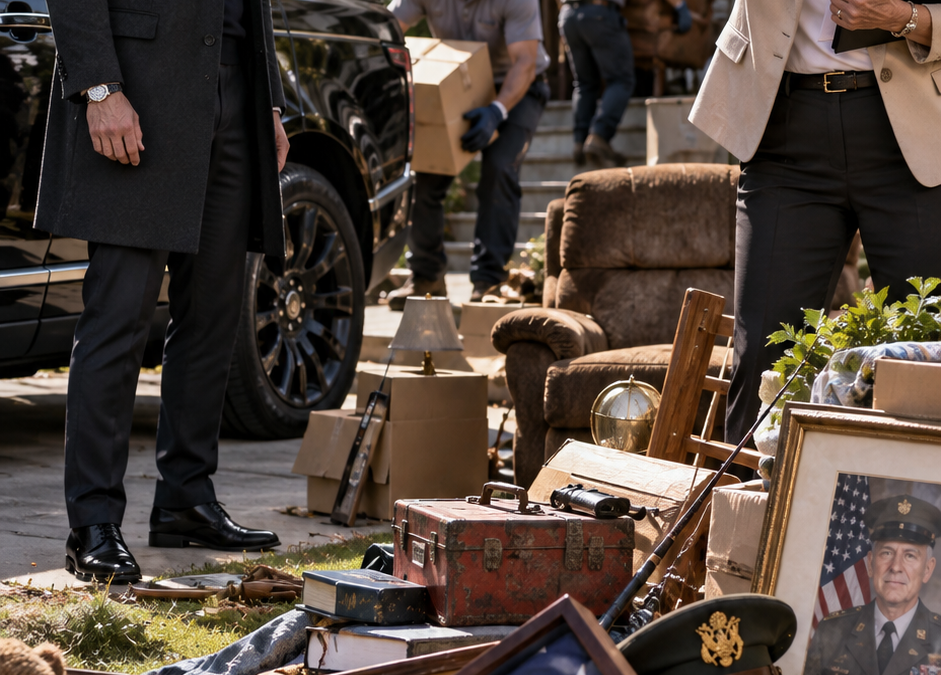
Then I saw two men in gray polo shirts carrying my father’s recliner across the front lawn.
That was when the eighteen-hour flight, the jet lag, and the pleasant little speech I’d been rehearsing about surprising Dad disappeared from my mind.
“Stop here,” I told the driver.
He glanced at me through the rearview mirror.
“Sir, we’re not quite—”
“Here.”
The cab was still rolling when I opened the door.
I stepped onto the same cracked sidewalk I’d ridden my skateboard down thirty years earlier, laptop bag across my chest, carry-on dragging behind me. I was wearing a wrinkled T-shirt, faded jeans, and sneakers I’d owned longer than some startup founders had owned their companies.
Six weeks earlier, I’d signed documents in a glass conference room in San Francisco that ended with a wire transfer containing more zeros than my father would have believed if I’d shown him the screen.
Nobody in Millbrook Point knew that.
Not the neighbors.
Not the HOA.
Not even Dad.
I’d deliberately kept it that way.
I wanted to come home before the articles multiplied and distant acquaintances suddenly remembered that we’d once shared third-grade math. I wanted a few days where I was still simply Grant Ashford, Elias Ashford’s son.
Maybe we’d fish.
Maybe we’d fix the loose step on the back porch.
Maybe we’d sit around doing absolutely nothing.
Instead, somebody was carrying the chair my father had fallen asleep in every night for eleven years toward the curb.
“Dad!”
Elias turned.
I will never forget his face.
My father had been a residential contractor for more than thirty years. He’d broken two fingers with a framing hammer and finished the workday before going to the emergency room. He’d buried my mother after twenty-eight years of marriage and somehow still remembered to make me breakfast the next morning.
Elias Ashford did not crumble.
But when he saw me standing there, his face almost did.
Just for a second.
Then his shoulders straightened.
“Grant? What are you doing here?”
I dropped my suitcase.
“What am I doing here? What are they doing here?”
“It’s nothing.”
Behind him, a man emerged from our front door carrying a cardboard box full of my father’s clothes.
I stared at Dad.
“This looks remarkably ambitious for nothing.”
He lowered his voice.
“It’s a misunderstanding.”
That was when a woman stepped between us.
Clipboard.
Sunglasses.
Perfectly maintained blonde hair.
A cream-colored blouse so immaculate it made the entire scene look like a corporate photo shoot called Foreclosure, But Make It Suburban.
“Can I help you?”
Her tone suggested that helping me ranked slightly below cleaning gutters with her tongue.
She looked me up and down.
Wrinkled shirt.
Old shoes.
Carry-on bag.
Apparently, I had failed the Birchwood Lane wealth inspection.
“That’s my father’s house,” I said. “What’s going on?”
“Compliance action.”
She said it with the effortless confidence of somebody announcing the weather.
“My name is Regina Voss. I’m president of the Millbrook Point Homeowners Association. Mr. Ashford has remained in violation of Section Four, Subsection C for ninety days. Overgrown hedge, unauthorized fence repair, and accumulated fines.”
“How much?”
“Eleven thousand four hundred dollars.”
I looked at my father.
His eyes dropped.
That hurt more than the number.
“Eleven thousand four hundred dollars for a hedge?”
“And the fence.”
Naturally.
Civilization itself had apparently been hanging by one improperly stained fence board.
“And what exactly gives you the right to remove his property?”
“The board authorized it.”
She said that casually.
Too casually.
I had spent four years negotiating venture contracts, acquisition agreements, regulatory disclosures, financing covenants, and enough legal language to make normal people consider farming.
Words mattered.
Past tense mattered.
Authorization mattered.
“The board authorized this?”
“Correct.”
“When?”
Her mouth tightened.
“All necessary procedures were followed.”
That wasn’t an answer.
Before I could press her, one of the gray-shirted men came through the door carrying a framed photograph.
I recognized it immediately.
My mother.
She was standing in our garden seventeen years before she died, sunlight in her hair. I was nine, beside her, holding a garden hose like a fishing pole.
The man placed the picture on the grass.
Face down.
The glass cracked against a stone.
Something inside me went silent.
Not angry.
Silent.
There is a kind of rage that shouts.
There is another kind that starts taking notes.
I picked up the photograph, wiped mud from the frame with my sleeve, and looked at Regina.
“I’m going to need your full name.”
She gave me a faint smile.
“Regina Voss.”
“HOA president?”
“Correct.”
I pulled out my phone.
Her smile disappeared.
“What are you doing?”
“Documenting.”
“For what?”
“I haven’t decided yet.”
That was the first moment she actually looked at me.
Not through me.
At me.
Behind us, neighbors stood at the edges of their properties pretending very hard not to watch.
Mr. Reynolds across the street was mowing grass that looked short enough for a putting green.
Mrs. Porter two houses down was watering the same flowerpot for so long I wondered if she was attempting to drown it.
Nobody spoke.
Nobody challenged Regina.
Nobody helped Dad.
That bothered me almost as much as the furniture.
This wasn’t indifference.
It was training.
A neighborhood had learned to keep its head down.
By the time the compliance truck finally drove away, it had taken the porch swing, several boxes, and two side tables.
It left the recliner.
It left some clothes.
And it left my mother’s photograph sitting beside the porch with a crack in the glass.
My father lowered himself onto the recliner in the middle of the front lawn.
Seventy-four years old.
Sitting in his own chair outside his own house because somebody with a clipboard had apparently decided property rights became optional when paired with landscaping violations.
I crouched in front of him.
“How long?”
He looked away.
“Dad.”
“A year, maybe.”
“A year?”
“It started small.”
Of course it did.
Things like this always started small.
A hedge.
A mailbox.
A paint color.
A board.
Nobody opens with, Good afternoon, we’re going to financially exhaust you until you surrender your house.
Too honest.
“They sent me a letter about the hedge,” Dad said. “Then the fence blew loose in that storm last spring. I replaced one board.”
“And?”
“Wrong shade of brown.”
I stared at him.
“How wrong?”
He almost smiled.
“Apparently civilization-ending wrong.”
There was my father.
Still in there.
“They fined me two hundred dollars. I paid it. Then there was another fine. Then another.”
“Why didn’t you tell me?”
“You were building your company.”
“So?”
“You were busy.”
“Dad.”
“I didn’t want to be one more problem.”
I looked at him for several seconds.
There are statements parents make that instantly transport you back to being twelve.
That was one of them.
He had spent my entire childhood solving every problem before I knew it existed.
Roof leaking?
Fixed.
Car dying?
Fixed.
Tuition short?
Somehow fixed.
Then he got old enough to need help and decided apparently that accepting it would violate a building code.
I sat on the grass.
“Dad, I sold the company.”
He blinked.
“What?”
“Six weeks ago.”
“Sold it?”
“Yes.”
“Why didn’t you tell me?”
I almost laughed.
“Interesting question.”
He gave me a tired look.
“How’d you do?”
There was no elegant answer.
“Very well.”
“Meaning?”
“Meaning the money isn’t a problem.”
“Grant.”
“Meaning if this really is eleven thousand four hundred dollars, I could pay it before dinner.”
His expression changed.
Not relief.
Concern.
He knew me well enough to hear what I hadn’t said.
“But you’re not going to.”
“No.”
Dad looked at Regina’s truck disappearing around the corner.
“Why?”
“Because I don’t think this is about eleven thousand four hundred dollars.”
I picked up Mom’s picture again.
The corner of the frame had split.
“I think somebody wants something.”
I just didn’t know what yet.
That changed quickly.
By the end of the week, Regina Voss would understand two things she should have understood before putting my father’s belongings on wet grass.
First, I had money.
Second, money was nowhere near the most dangerous thing I’d brought home with me.
I had learned how to read paperwork.
And people like Regina always left paperwork.
I made my first call from the back porch.
Priya Anand answered on the fourth ring.
“Grant, it’s eleven at night.”
“I need a favor.”
“You sold your company. You’re supposed to stop calling me at eleven at night asking for favors.”
“An HOA is throwing my father’s furniture onto his lawn.”
Silence.
Then:
“I’m awake.”
Priya had been general counsel for my company through three financing rounds, two threatened lawsuits, an intellectual property fight, and the acquisition that had made everybody suddenly describe me as a “visionary,” despite several years of describing me as “that guy sleeping in the office.”
She had the rare ability to become more cheerful as legal situations became uglier.
“Start from the beginning.”
I explained.
The fines.
The alleged notices.
The fence.
The hedge.
The removal crew.
Regina’s claim that the board had authorized everything.
When I finished, Priya asked, “Did your father receive formal hearing notice?”
“He says no.”
“Board-meeting notice?”
“No.”
“Certified mail?”
“Nothing.”
“You recorded Voss?”
“Yes.”
“Send me the video.”
I did.
“Anything else?”
“Find their governing documents. Every version. Original covenants, amendments, meeting rules, enforcement authority.”
“County records?”
“Everything.”
“Do you want me to send a cease-and-desist?”
“No.”
Priya paused.
“You sure?”
“For now.”
“You have more than enough resources to make these people regret learning the word ‘hedge.'”
“I know.”
“So why wait?”
I looked through the kitchen window.
Dad was on the floor folding shirts that had spilled out of one of the boxes.
He was handling every shirt carefully, as though neatness could erase humiliation.
“The speed bothers me,” I said. “Ninety days of alleged violations, and suddenly they’re physically removing property forty-eight hours after the latest notice? That’s not normal escalation.”
“What do you think it is?”
“I don’t know.”
“And until you do?”
“We stay quiet.”
Priya laughed softly.
“You want to go undercover in your childhood home.”
“I want Regina to keep thinking I’m harmless.”
“You’re wearing the old sneakers, aren’t you?”
I looked down.
“Maybe.”
“You realize having money has made you very strange.”
“Find the documents.”
“I’ll call you tomorrow.”
I spent the next three days making myself as unimpressive as possible.
Which, according to Regina’s worldview, wasn’t difficult.
I drove Dad’s fifteen-year-old pickup.
I wore his old work jacket.
I mowed the lawn myself and deliberately left a slightly uneven strip near the mailbox.
Six hours later, a laminated violation notice appeared.
INCONSISTENT LAWN MAINTENANCE.
Fine: seventy-five dollars.
I stood at the mailbox for nearly a minute staring at it.
Then I laughed.
I actually laughed.
Whoever had issued it had unknowingly done me an enormous favor.
I’d wanted to know whether the enforcement was routine or targeted.
Apparently Millbrook Point’s grass emergency response unit operated faster than most paramedics.
I photographed the notice.
Front.
Back.
Timestamp.
Signature.
Plastic zip tie.
Everything.
That night, Priya emailed me the original 1974 covenant.
Sixty-one pages.
I read all of them.
Then again.
I found what I was looking for shortly after midnight on the third night.
Section Nine, Article Three.
I read it once.
Then twice.
Then aloud.
Any removal or seizure of personal property related to compliance enforcement required approval by majority vote of the full board at a properly noticed meeting. The affected homeowner had the right to appear and be heard.
I opened my recording.
Regina’s voice played through my headphones.
“The board authorized removal.”
I checked board notices.
No meeting.
No hearing.
No vote.
No authorization.
Regina had lied.
That alone would have been enough to stop Dad’s case.
But I didn’t call her.
Because by then I was certain the lie was not the story.
It was only the door.
The knock came after ten the following night.
Soft.
Three taps.
Pause.
Two more.
I opened the door.
A man in his mid-twenties stood on the porch holding a laptop bag.
He looked like he hadn’t slept properly in a week.
“Grant Ashford?”
“Yes.”
“My name is Caleb Voss.”
I didn’t react visibly.
Internally, everything sharpened.
“Voss?”
“Regina’s my aunt.”
His hands were trembling.
“I know how that sounds.”
“Not great.”
“I work for Halbrook Meridian Development.”
That name meant nothing to me yet.
It would.
Caleb swallowed.
“I need to show you something.”
“Why?”
“Because I can’t sleep anymore.”
I studied him.
“Come in.”
We sat at the kitchen table beneath the brass light fixture Dad had installed when I was eleven.
Caleb opened his laptop.
A spreadsheet filled the screen.
Seventeen addresses.
I recognized several.
Some were in Millbrook Point.
Others bordered the retention pond and old service road.
Columns showed fines.
Sale dates.
Estimated values.
Final sale prices.
Buyer entities.
Then I saw a column labeled:
HOLDCO RV INTEREST
“What am I looking at?”
Caleb rubbed his hands together.
“Halbrook Meridian is assembling land for a mixed-use development.”
“Where?”
He opened a map.
My father’s property sat near the southern boundary.
The development wrapped around the pond.
“Forty acres total when assembled,” Caleb said. “Retail, residential, offices. Projected valuation just over two hundred million.”
“And my father’s house?”
“Anchor parcel.”
I leaned closer.
“Explain.”
“Because of the pond easement and the shape of the service road, the southern access plan doesn’t work without your father’s lot. They can redesign, but it adds millions and triggers another round of approvals.”
“Who owns HoldCo RV?”
“Technically? Marcus Delgado.”
“Who is Marcus Delgado?”
“Regina’s cousin.”
I sat back.
Caleb continued.
“He’s a nominee. Everybody at Halbrook who’s been around long enough knows Regina controls the interest.”
“What interest?”
“A percentage of profit associated with parcels acquired below target price.”
The room became very still.
“Say that again.”
“She gets paid when targeted properties sell cheaply.”
“And who controls the HOA fines?”
“She does.”
There it was.
A little machine.
Almost elegant in its ugliness.
Pick the properties.
Pressure the owners.
Generate violations.
Escalate fines.
Create exhaustion.
Wait for homeowners to decide peace is worth more than equity.
Then have a friendly buyer conveniently appear.
I looked down the spreadsheet.
“Eleven sold?”
“Eleven acquired. Six remaining.”
“My father is number twelve.”
“Yes.”
“Why now?”
“The developer’s option expires in six weeks.”
“And Dad refused to sell.”
“Twice.”
I looked up.
“Who made the offers?”
“Agents. Informal. Nothing with Halbrook’s name.”
Dad had mentioned them before.
People who “loved the neighborhood.”
A “young couple.”
A “family looking for exactly this kind of property.”
How charming.
Apparently wholesome suburban homebuyers now traveled with two-hundred-million-dollar development projections.
Caleb pulled up another document.
“This isn’t everything.”
County stamp.
Eleven years earlier.
Property modification permit.
Address belonging to Regina Voss.
Fence extension.
I read it carefully.
“No board approval.”
“None.”
“Same section she used against Dad?”
“Exactly.”
“Has she cited anyone else for this?”
“Nine families that I found.”
Of course.
The queen had exempted the palace.
“Why give this to me?”
Caleb closed the laptop.
“My mom went through a bad divorce when I was a kid. Your father fixed our fence.”
I remembered vaguely.
“She couldn’t afford it,” Caleb said. “He did it anyway. Never sent a bill.”
That sounded like Dad.
“I didn’t recognize the address when it first appeared in our acquisition system. Then last week I saw the name.”
He took a breath.
“I started digging.”
“And?”
“And once you understand what you’re looking at, you can’t unknow it.”
“Why not take this to a reporter?”
“I considered it.”
“County?”
“They’re backlogged. A journalist runs a story, Regina gets a lawyer, Halbrook denies knowledge, the holding company gets blamed on Marcus, and two years later maybe something happens.”
“So why me?”
He looked almost embarrassed.
“I looked you up.”
“Ah.”
“I saw the acquisition announcement.”
“The one I’m hoping Dad hasn’t seen yet.”
“He probably hasn’t. It wasn’t widely covered.”
“Good.”
Caleb looked at me.
“I know you have resources.”
Money.
He meant money.
People always did.
But resources meant more than money.
Lawyers.
Auditors.
Researchers.
Contract specialists.
People trained to turn vague suspicions into documents that could survive cross-examination.
“I’m not asking you to ruin her,” Caleb said.
“I don’t plan to.”
Relief flickered across his face.
“I’m going to stop her.”
The relief disappeared.
I pointed at the laptop.
“Can you prove every number?”
“Yes.”
“Every property?”
“Yes.”
“Every payment?”
“Most of them. Some need tracing.”
“Can you give me everything?”
Caleb reached into his pocket and placed a flash drive on the table.
“I already did.”
I stared at it.
“How long have you been carrying that?”
“Three days.”
“Why tonight?”
“I finally got tired of being afraid.”
I picked up the drive.
“That makes two of us.”
The story about my company broke locally the following afternoon.
Not because I released anything.
Not because Priya did.
A technology blogger three states away was digging through acquisition documents for an unrelated article and found my name.
The headline called it a “quiet nine-figure exit.”
I hated the phrase immediately.
It made me sound like I’d robbed a bank politely.
By six that evening, Regina knew.
I learned later what happened next through records, messages, and eventually Caleb.
She sat in her sunroom staring at the article while her cousin Marcus sent her screenshots followed by increasingly panicked punctuation.
Apparently Regina’s first reaction was not fear.
It was calculation.
Which tells you almost everything worth knowing about Regina.
Normal person:
The man whose father I harassed turns out to have enormous resources. Perhaps I should immediately stop.
Regina:
Excellent. A wealthier target.
She called the next morning.
Her voice had changed dramatically.
If you have ever watched a rattlesnake attempt customer service, you have heard approximately the tone Regina used.
“Grant.”
“Regina.”
“If I may call you Grant.”
“You just did.”
A pause.
“I think there has been a genuine misunderstanding.”
Amazing.
Four days earlier, Dad was eleven thousand four hundred dollars worth of irresponsible vegetation.
Now we had a misunderstanding.
“I’d really like the opportunity to make this right quietly between us.”
“Quietly?”
“I don’t think either of us benefits from unnecessary conflict.”
Interesting.
Conflict had been perfectly necessary when she thought I was broke.
“Perhaps we could meet.”
“I’d like that.”
She sounded relieved.
“Just the two of us.”
“Of course.”
“I think once you understand the full context, you’ll realize none of this was personal.”
I nearly admired the sentence.
She had targeted Dad’s house to profit from a development deal, but apparently targeting somebody’s home wasn’t personal.
Maybe Regina considered personal behavior limited to birthday cards and homicide.
“We’ll talk,” I said.
When the call ended, I phoned Priya.
“She knows.”
“About the money?”
“Yes.”
“Good.”
“How’s the audit?”
“Better than good.”
Priya’s voice had the particular energy she got when somebody had been stupid in writing.
“The holding company received distributions tied to eleven property acquisitions. We can establish beneficial control well enough for civil proceedings.”
“Regina?”
“Marcus is nominal owner. But messages, transfer instructions, and related records Caleb provided strongly indicate Regina directed transactions.”
“Anything criminal?”
“I’m not making that conclusion yet.”
Fair.
Priya was never dramatic when facts were available.
“There’s more,” she continued.
“The enforcement vendor.”
“Millbrook compliance?”
“Coastal Compliance Partners. Family-owned. They administer the HOA actions under contract.”
“So?”
“It’s for sale.”
I sat up.
“How for sale?”
“Quietly. Owner is retiring. No family succession.”
“Price?”
She told me.
I laughed.
“Why are you laughing?”
“Because I spent more than that on one failed server migration.”
“Grant.”
“Can we buy it?”
Silence.
Then:
“I knew you were going there.”
“Can we?”
“Yes.”
“How fast?”
“Cash transaction through a holding entity? If the seller cooperates, days.”
“Do it.”
“You’re buying an entire compliance company because an HOA president irritated you.”
“No.”
“That is precisely what you’re doing.”
“I’m buying the company because it’s the enforcement mechanism she depends on.”
“That sounds much more respectable when you say it slowly.”
“Priya.”
“I’m already drafting the offer.”
That’s why I’d trusted her with my company.
She could mock an idea while executing it flawlessly.
Two days later, I owned Coastal Compliance Partners.
Regina did not know.
And then she made the mistake that ended any chance I might have given her to walk away quietly.
The lien notice appeared at seven in the morning.
Dad found it.
I woke to silence.
Not ordinary morning silence.
Heavy silence.
I came downstairs and saw the front door open.
Dad was sitting on the porch steps in his robe holding a piece of paper.
I stepped outside.
“Dad?”
He didn’t answer.
I sat beside him.
The top of the notice read:
FORMAL NOTICE OF INTENT TO LIEN
His name below it.
His address.
HOA signature.
Regina Voss.
I read it twice.
“Dad—”
“I raised you here.”
His voice cracked.
I looked at him.
He was staring at the driveway.
“Your mother died upstairs.”
“I know.”
“I paid this house off.”
“I know.”
“Thirty-three years.”
His fingers tightened around the paper.
“Never missed a mortgage payment. Never missed taxes. I fixed half the houses on this street when people couldn’t afford contractors.”
He looked at me.
“And she thinks she can take it over a fence board.”
His eyes were wet.
Not weak.
Not defeated.
Furious.
Tired.
Humiliated.
“I don’t care what it costs anymore,” he said. “I want it over.”
That was the moment my last hesitation disappeared.
Until then, some part of me had still believed Regina might choose an exit ramp.
Apologize.
Reverse the fines.
Return the property.
Resign quietly.
Instead, after personally calling me to discuss a friendly solution, she escalated to a lien.
She hadn’t mistaken restraint for decency.
She had mistaken restraint for weakness.
I photographed the notice.
Sent it to Priya.
One sentence.
Use everything.
Her response came thirty seconds later.
Understood.
I called Caleb.
He answered immediately.
“She filed a lien notice.”
“I know.”
“How?”
“Marcus told people at Halbrook this morning. She wants you to know she isn’t afraid.”
I looked at the document again.
“There are easier ways to communicate insecurity.”
Caleb exhaled.
“Grant, I think this is the moment I stopped feeling guilty.”
“Good.”
“About what?”
“Tonight.”
He went quiet.
“What happens tonight?”
“Regina gets her meeting.”
The clubhouse looked almost exactly as I remembered it from childhood.
Same beige walls.
Same fluorescent lighting designed to make everyone look mildly deceased.
Same folding tables.
Same framed watercolor of the retention pond pretending it wasn’t basically a mosquito resort.
The only major difference was the chairs.
Forty of them.
Every chair occupied.
Regina walked in at 7:03 p.m.
She stopped immediately.
Her expression was priceless.
Not theatrical shock.
Arithmetic.
She was counting witnesses.
“What is this?”
I stood near the projector.
“Meeting.”
“We agreed to speak privately.”
“No. You requested to speak privately. I said we’d talk.”
“This is completely inappropriate.”
That word.
Inappropriate.
Used by a woman who had removed a widower’s belongings without authorization.
The confidence would have been impressive if it weren’t so exhausting.
“This is an emergency HOA session,” I said.
“You don’t have standing to call a meeting.”
“I don’t.”
Her face brightened.
For about half a second.
“My father does.”
I nodded toward the back.
Dad sat with his arms folded.
Regina looked at him.
“He requested the session under Section Nine, Article Three of the 1974 covenant.”
I clicked the projector.
The relevant language appeared.
“A section you may remember.”
She stared.
“If not, it’s the same section requiring a properly noticed board vote before removal of a homeowner’s personal property.”
Nobody moved.
“Which is awkward,” I continued, “because you told me the board had authorized removing my father’s property.”
“I was speaking generally.”
“No.”
I played the recording.
Her own voice filled the clubhouse.
The board authorized removal.
I stopped it.
“Past tense. Very specific.”
A woman near the second row whispered, “Oh my God.”
Regina’s jaw tightened.
“Administrative procedures are not always reflected immediately in minutes.”
“Excellent point.”
I changed slides.
“Here are the board minutes.”
Nothing.
“Here are meeting notices.”
Nothing.
“Here are voting records.”
Nothing.
“You didn’t forget paperwork.”
I looked directly at her.
“You skipped the board.”
People began shifting in their chairs.
Regina crossed her arms.
“My enforcement authority allows emergency action.”
“Show me where.”
“It is understood.”
“Show me.”
She didn’t.
“Page number?”
Silence.
“Article?”
Nothing.
I waited.
Regina finally said, “This is becoming unnecessarily adversarial.”
I almost smiled.
“No. Adversarial was carrying my father’s recliner across his lawn.”
I clicked again.
Regina’s fence permit appeared.
County stamp.
Date.
Address.
Eleven years earlier.
“This is your property.”
Her face changed.
“That has absolutely nothing to do with—”
“Fence extension.”
“An old administrative matter.”
“Without board approval.”
“A paperwork oversight.”
I nodded.
“Perfect.”
Another slide.
Petroski family.
Fine.
Six hundred dollars.
Same violation.
Next.
Alvarez family.
Eight hundred dollars.
Next.
Hendersons.
Next.
Another.
Nine households.
“Apparently your paperwork oversight qualified as a minor administrative matter for eleven years. Everyone else’s cost money.”
A murmur spread through the room.
Regina’s voice sharpened.
“These cases involved completely different circumstances.”
“Of course.”
I clicked again.
“I expected that answer, so the files include photographs, violation descriptions, and relevant covenant language.”
More records appeared.
The circumstances weren’t different.
Not meaningfully.
Regina had enforced a rule she was simultaneously violating.
Against old people.
Families.
Widows.
Anyone inconvenient.
Mrs. Okafor stood up.
“You fined my husband while he was dying.”
The room went silent.
Regina looked at her.
“Mrs. Okafor, that situation was handled according to—”
“Three thousand two hundred dollars.”
Her voice trembled.
“You fined us because the garage door needed repainting while I was driving him to chemotherapy.”
Regina glanced around.
Wrong move.
For years, she’d dealt with these people one at a time.
Alone.
Scared.
Embarrassed.
That night they could see each other.
Mrs. Porter spoke next.
Then Mr. Henderson.
Then Walter Grimby, the silver-haired man from the corner property.
One story after another.
Bushes.
Roof shingles.
Driveway cracks.
Mailbox posts.
Paint.
Fences.
Rules applied with scientific precision whenever somebody owned a property Regina wanted.
Then I put the spreadsheet on the screen.
Seventeen addresses.
Regina stopped breathing for a second.
It was visible.
“These are targeted acquisition parcels connected to Halbrook Meridian Development.”
Nobody spoke.
“Eleven have already changed hands.”
I highlighted sale prices.
“Every one below estimated market value.”
Highlighted fines.
“Every seller experienced escalating HOA enforcement beforehand.”
Highlighted the holding-company column.
“Every acquisition generated an interest payment connected to HoldCo RV.”
Regina stepped forward.
“Where did you get that?”
“Does it matter?”
“Those are proprietary documents.”
Interesting.
Not false documents.
Proprietary documents.
Her lawyer, if she’d had one sitting beside her, would probably have tackled her.
“You have no idea what you’re looking at.”
“I’ve heard that sentence a lot from people right before accountants arrive.”
“That spreadsheet proves nothing.”
“By itself? Perhaps not.”
I changed slides.
Transfer records.
Corporate registration.
Marcus Delgado.
Communications.
Enough to make her skin turn pale.
“I’m not going to litigate this here,” I said. “That’s what lawyers are for.”
“You are threatening me.”
“No.”
I pointed at the screen.
“Documents are not threats.”
“You think because you suddenly have money you can come back here and bully everyone?”
That finally made me laugh.
Not loudly.
I couldn’t help it.
“Regina.”
I looked around the room.
“My father was sitting in a recliner on his lawn five days ago while your contractors carried his belongings out.”
Then back at her.
“If you’re searching for the bully in this story, I recommend widening the mirror.”
Her expression hardened.
“You don’t live here anymore.”
“Correct.”
“You don’t understand this community.”
“I understand eleven distressed property sales.”
“You don’t know what it takes to maintain standards.”
“There it is.”
“What?”
“The standards speech.”
I leaned against the table.
“It’s always standards. Never control. Never leverage. Never selective enforcement. Standards.”
Several people smiled.
Regina didn’t.
“The community elected me.”
“And tonight it can unelect you.”
She looked toward the board members.
That was when I gave her the piece she’d never anticipated.
“Before anyone votes, there’s one additional matter.”
I clicked off the projector.
“As of eleven o’clock this morning, Coastal Compliance Partners has a new owner.”
Regina frowned.
“What does that have to do with anything?”
“Quite a lot.”
I let the silence settle.
“I own it.”
Her face emptied.
Not anger.
Not disbelief.
Emptied.
“The company your HOA contracts to administer fines, compliance notices, inspections, and removal actions?”
I tapped the table.
“Mine.”
Someone in the room laughed.
Then covered it with a cough.
Regina stared.
“That’s impossible.”
“No.”
“Coastal is privately held.”
“It was.”
“The owners wouldn’t sell to—”
“They sold.”
She seemed to realize halfway through the sentence how bad arguing about my acquisition made her position look.
“Effective today,” I said, “Coastal Compliance Partners has terminated its enforcement contract with Millbrook Point HOA for repeated unauthorized directives inconsistent with governing documents.”
“You can’t do that.”
“I assure you I spent enough money to confirm I can.”
Her mouth opened.
Nothing came out.
“The termination is effective immediately. Coastal will not execute another fine, removal, inspection order, or lien-related action for this board unless and until independent review confirms the order complies with governing procedures.”
I pulled Dad’s lien notice from my folder.
“This one doesn’t.”
I tore a photocopy in half.
Not the original.
Priya would have killed me.
“The actual notice has been preserved as evidence.”
A few people laughed.
Regina didn’t appreciate my clarification.
Walter Grimby rose from the first row.
He spoke with the calm tone of a man who had apparently been waiting years for precisely one sentence.
“I move to remove Regina Voss as president of the Millbrook Point Homeowners Association, effective immediately, pending a full independent audit.”
Mrs. Okafor stood.
“Second.”
Regina spun around.
“You cannot possibly—”
Walter didn’t even look at her.
“All in favor?”
Hands went up.
Mrs. Okafor.
The Hendersons.
Board members.
Homeowners.
One.
Five.
Ten.
Twenty.
Nearly every hand in the clubhouse.
Dad raised his last.
Slowly.
He looked straight at Regina when he did it.
That one seemed to hurt her most.
Regina stood at the front of the room where she’d spent years being the most feared person in Millbrook Point.
No clipboard could fix it.
No violation letter.
No threat.
No inspection.
No whispered development contact.
Nothing.
The mechanism only worked while people believed she controlled it.
Now everybody could see the machinery.
Once fear becomes visible, it gets surprisingly fragile.
Regina picked up her handbag.
“You think this is over?”
I had been wondering when we’d get that line.
People like Regina apparently shared dialogue writers.
“Actually,” I said, “there is one more thing.”
She stopped.
“Halbrook Meridian.”
That landed.
Her shoulders stiffened.
“I spoke with their legal department this morning.”
Now she looked at me.
Really looked.
“The development option depended on obtaining the remaining anchor parcels within the agreed period.”
I walked closer.
“My father’s house is no longer available at any price.”
Her eyes narrowed.
“And after Halbrook learned that multiple acquisition targets might be tied to disputed HOA enforcement and undisclosed beneficial interests, they suspended the entire phase-two acquisition process.”
“You’re lying.”
“I don’t need to.”
“They would never abandon two hundred million dollars because of one complaint.”
“Not one complaint.”
I glanced at the room.
“Eleven transactions.”
Her face changed again.
“And because the option period expires before the compliance issues can be cleared, the current project structure is dead.”
She stared at me.
Every expression she had worn that week disappeared.
The authority.
The condescension.
The customer-service warmth.
What remained was fear.
Not fear of me.
Fear of loss.
The project.
The holding-company interest.
The leverage.
The money she’d apparently convinced herself was already hers.
Gone.
“You did this out of revenge.”
I shook my head.
“No.”
“Don’t insult me.”
“I’m not.”
“You bought a company just to hurt me.”
“I bought a company so you couldn’t use it to hurt anyone else.”
She laughed bitterly.
“That’s supposed to make you noble?”
“No.”
I looked toward Dad.
“It makes the problem solved.”
Regina stared at me for several seconds.
I expected another threat.
Maybe litigation.
Maybe an accusation.
Maybe one last attempt to control the room.
Instead, she set her clipboard on the folding table.
The same type of clipboard she’d held on my father’s lawn.
Then she walked toward the door.
Nobody looked away.
That mattered.
Five days earlier, neighbors had hidden behind lawnmowers and watering cans because watching Regina felt dangerous.
Now forty people watched her leave.
Not jeering.
Not applauding.
Just watching.
Fear had changed sides.
The door closed behind her.
For several seconds nobody spoke.
Then Walter said, “Well.”
Everybody laughed.
Even Dad.
Especially Dad.
The meeting lasted another hour.
An interim board was established.
Walter Grimby and Mrs. Okafor agreed to co-chair until a formal election.
Every pending fine issued during Regina’s unilateral enforcement period was frozen for review.
Every previous forced sale tied to the targeted parcels would be examined by outside counsel.
Someone suggested I join the board.
“No.”
Several people looked surprised.
Walter raised an eyebrow.
“You sure?”
“I haven’t lived here in years.”
“You’ve been fairly active this week.”
“I’m visiting my father.”
That got a laugh.
More importantly, I didn’t want to replace one concentration of power with another.
It would have been absurd to spend a week exposing somebody for controlling everything and then celebrate by controlling everything myself.
“I’ll help with the transition,” I said. “But this community needs a system that doesn’t depend on one person being decent.”
That was the real lesson.
Regina wasn’t dangerous because she was uniquely clever.
She was dangerous because nobody had built enough friction into the system.
One signature.
One contractor.
One closed-door decision.
One frightened homeowner at a time.
That was fixable.
Before the room emptied, I stood again.
“There’s something else.”
Dad looked at me.
He didn’t know about this part.
“I’m establishing a restitution fund.”
Mrs. Okafor frowned.
“For what?”
“For families who were pressured by enforcement actions during the past five years.”
The room quieted.
“Independent administration. Outside foundation. No HOA president controls it. I don’t control individual decisions.”
I looked at the Hendersons.
Mrs. Okafor.
The older man with the cane whose wife’s rose garden had been cited after she died.
“If a family sold a property below market value after questionable enforcement pressure, the fund will pay for independent legal review.”
Mrs. Okafor covered her mouth.
“And where records support it,” I continued, “we’ll compensate the difference.”
Someone whispered, “Grant…”
“It’s not charity.”
I hated that word for what had happened here.
“Call it restitution.”
Dad looked down.
His shoulders started shaking slightly.
For one alarming moment, I thought he was laughing.
Then I realized he was crying.
Quietly.
Dad almost never cried.
I’d seen him cry at Mom’s funeral.
That was about it.
I walked over and put a hand on his shoulder.
He covered my hand with his.
Neither of us said anything.
We didn’t need to.
Caleb wasn’t at the meeting.
He had asked not to be.
I understood.
Ending wrongdoing doesn’t automatically erase family.
Regina was still his aunt.
He could know she’d done terrible things and still remember birthdays, Christmas mornings, childhood cookouts, whatever version of her existed before money and control hollowed the rest out.
Two nights earlier, I’d offered him a job.
Coastal needed a property analytics division.
More importantly, it needed people who understood how numbers could become weapons when nobody questioned why they were being collected.
“We’d build transparency into every compliance recommendation,” I’d told him. “If a client suddenly issues ten times more violations in an acquisition zone, the system flags it.”
“You want me to design that?”
“I want you to make what happened here difficult to repeat.”
He stared at me.
“Why me?”
“Because you walked up to my father’s door when staying quiet would have been easier.”
Caleb accepted before I finished discussing salary.
For once, money was the least important part.
Dad and I walked home after dark.
No reporters.
No lawyers.
No compliance trucks.
Just the two of us.
Birchwood Lane looked exactly as it always had.
Porch lights.
Sprinklers.
Televisions glowing behind curtains.
The same crack in the sidewalk near the Porters’ house.
The same maple tree Dad had once threatened to cut down every autumn for twenty consecutive years and never touched.
When we reached our driveway, the recliner was still under the porch overhang.
Somebody had moved it there before the rain.
Walter, I suspected.
He never admitted it.
Dad grabbed one end.
I grabbed the other.
“You’ve gotten soft,” he said.
“I’m carrying your chair.”
“Badly.”
“You are seventy-four.”
“And apparently still stronger than my billionaire son.”
“Please never say billionaire son again.”
He grinned.
“Why?”
“Because you sound like a terrible newspaper headline.”
We wrestled the chair through the doorway.
For a moment, it became stuck sideways.
Dad blamed me.
I blamed the chair.
The chair offered no comment.
Eventually we got it back into the living room.
Exactly where it had been.
Then I picked up Mom’s photograph.
The frame was cracked.
The glass had a small chip in the corner.
Dad watched me place it on the mantel.
“You could replace the frame.”
“I know.”
“You probably ought to.”
“I don’t think I will.”
He looked at it.
“Neither do I.”
Some damage deserved repair.
Some deserved remembering.
Dad lowered himself into the recliner.
He leaned back.
Closed his eyes.
Then let out one long breath.
I hadn’t realized until that moment how much tension he’d been carrying.
A year of letters.
Fines.
Warnings.
Watching envelopes arrive and wondering what minor defect somebody had turned into another bill.
Watching strangers inspect the house he’d paid for.
Being treated like a delinquent on property he owned outright.
All while refusing to tell me because he didn’t want to be a burden.
“I never got those three notices,” he said.
“I know.”
“I check the mailbox every day.”
“I know.”
He opened his eyes.
“You believe me?”
“Completely.”
The evidence suggested someone had interfered with the process, but we still didn’t have enough to prove exactly how every notice had disappeared.
It didn’t matter anymore.
The fines were frozen.
The lien was void.
The enforcement action was under review.
And the woman behind it no longer controlled anything.
Dad stared toward the mantel.
“You really sold the company?”
“Yes.”
“For that much money?”
“Unfortunately.”
He frowned.
“Unfortunately?”
“You’ll understand once distant cousins start remembering your phone number.”
He laughed.
A real laugh.
First one I’d heard since coming home.
Then he became serious.
“You could have told me.”
“I wanted one week.”
“One week?”
“Where nobody cared about the number.”
He nodded slowly.
“Just wanted to be my kid again.”
“Yeah.”
He looked around the living room.
“Bad week for it.”
I laughed.
“Very bad timing.”
“No.”
Dad leaned back in the chair.
“Maybe perfect timing.”
Outside, somebody was walking down the sidewalk.
Neighbors were talking again.
Not whispering.
Actually talking.
Within a month, Millbrook Point held formal elections.
Walter and Mrs. Okafor won seats.
Enforcement rules were rewritten.
No fine above a modest threshold could be imposed without independent board review.
No property seizure.
No lien.
No forced compliance action without written notice, documented hearing rights, and recorded votes.
Conflict-of-interest disclosures became mandatory.
Vendor decisions required multiple signatures.
Every homeowner received digital access to board minutes and financial reports.
Boring reforms.
Beautiful reforms.
The kind nobody puts in movies because watching somebody update governance procedures isn’t exactly car-chase material.
But boring systems prevent dramatic abuse.
Regina’s financial records went to attorneys and auditors.
Halbrook Meridian formally abandoned phase two.
Without Dad’s parcel and with the surrounding acquisitions tied up in review, the math no longer worked.
The grand two-hundred-million-dollar project dissolved into legal memos and irritated investors.
Regina’s holding-company interest became what financial professionals politely call impaired.
Dad called it something simpler.
“Toast.”
Several prior homeowners pursued claims.
The restitution fund handled costs.
Some families received settlements.
Others simply wanted records corrected.
One elderly couple used their compensation to move back closer to their grandchildren.
Mrs. Okafor didn’t sell.
She repainted her garage door the exact same color it had always been.
Walter joked that he planned to nominate it for historical protection.
My father’s hedge remained slightly overgrown.
Deliberately.
When the new board asked whether he planned to trim it, Dad looked at me and said, “I’m considering letting it become an ecosystem.”
Nobody fined him.
Regina moved out of Millbrook Point eight months later.
Her house sold for less than she’d originally wanted.
Dad found that detail hilarious.
I tried to be mature about it.
I failed.
The strangest part was that after everything, revenge wasn’t the thing I remembered most.
Not Regina’s face when she learned I owned Coastal.
Not the vote.
Not Halbrook pulling out.
Not even the moment the entire room realized her power was gone.
What I remember most clearly is the photograph.
Mom smiling.
Me beside her at nine.
Mud on the frame.
A cracked corner.
Because that photograph was the moment I understood what Regina had mistaken.
She believed houses were assets.
Parcels.
Numbers.
Leverage.
My father’s house was valuable to Halbrook because of acreage and geometry.
To Regina, it was a piece needed to complete a development puzzle.
But that wasn’t what she was trying to take.
That house was the hallway where I learned to walk.
The kitchen where Mom made pancakes on Sunday mornings.
The porch where Dad taught me how to tie fishing knots.
The bedroom where I stayed awake the night before leaving for college because I was secretly terrified.
The upstairs room where my mother spent her final weeks.
You can put a market value on the land.
You can calculate square footage.
You can estimate resale potential.
You cannot spreadsheet thirty-three years of someone’s life.
Regina never understood that.
And because she didn’t, she made the mistake people like her always eventually make.
She assumed resistance had a price.
She thought Dad would sell once the fines became painful enough.
She thought I would write a check once I became wealthy enough.
She thought neighbors would remain silent because silence had worked before.
Every calculation depended on one assumption:
That everybody cared about money the same way she did.
She was wrong.
Dad cared about home.
Caleb cared about being able to sleep at night.
Mrs. Okafor cared about dignity.
Walter cared about fairness.
And I cared about making sure the man who spent his life protecting me didn’t spend the end of his life being bullied out of the home he built.
A few weeks after everything settled down, Dad and I finally went fishing.
That had been the plan from the beginning.
We took his old truck to the lake before sunrise.
No lawyers.
No board meetings.
No laptops.
Dad packed sandwiches.
I brought coffee.
For almost three hours, neither of us caught anything.
Dad blamed my technique.
I reminded him he hadn’t caught anything either.
“Different problem,” he said.
Naturally.
Around ten, he leaned back in his folding chair and looked across the water.
“You staying around a little while?”
“I can.”
“You don’t have to work?”
“I sold the company, remember?”
“Oh, right.”
He paused.
“My billionaire son.”
I groaned.
He smiled.
Then he said, “Your mother would’ve been proud.”
That one got me.
I stared at the water because looking at him would have made it worse.
“Of the company?”
“No.”
I finally looked over.
Dad adjusted his cap.
“Of what you did after.”
I didn’t answer.
There are moments when anything you say cheapens the thing being said.
So I sat beside my father.
The lake was still.
The sun was coming through the trees.
Somewhere miles behind us stood the house Regina Voss had nearly convinced him he could lose over a fence board.
The hedge was still uneven.
The mailbox still had ASHFORD painted across the side in Mom’s fading handwriting.
The recliner was back in the living room.
Her photograph was back on the mantel.
And the HOA president who had once stood on our lawn and casually ordered my father’s life carried to the curb was gone.
She had threatened the wrong old man.
She had underestimated the wrong son.
But more than anything, she had finally encountered the one thing a bully can never survive forever.
People who stopped being afraid.








