𝗙𝗨𝗟𝗟 𝗦𝗧𝗢𝗥𝗬 I Brought Five Children to His Grandfather’s Funeral, and the One Woman Who Knew Their Secret Begged Me to Leave
𝗙𝗨𝗟𝗟 𝗦𝗧𝗢𝗥𝗬
I turned.
Hearing my name in his voice after ten years affected me more than I wanted to admit.
“Hello, Garrett.”
He barely seemed to hear me.
His eyes kept returning to my children.
Gavin stood straight beside me.
Mason watched Garrett with quiet curiosity.
Lucas moved protectively closer to his sisters.
And Audrey, apparently untroubled by the significance of the moment, began examining a small stone angel near the path.
Garrett swallowed.
“What is this?”
I reached inside my coat and removed the sealed envelope I’d brought from the SUV.
Inside were documents I had spent years trying to forget.
A paternity report.
An old hotel folio.
And a notarized statement that Felicia had once believed would never surface again.
I looked toward Theodore’s casket.
I had promised myself that his funeral wouldn’t become a spectacle.
But Felicia had confronted us before we could even reach his grave.
And now Garrett was standing in front of the children he’d never known.
“This,” I told him, holding up the envelope, “is what you left behind ten years ago.”
Felicia took a sharp breath.
“Jacqueline. Don’t.”
Garrett looked at her.
Something in her voice caught his attention.
It caught mine, too.
She wasn’t surprised.
She wasn’t confused.
She looked terrified of information she already understood.
Garrett turned back toward me.
His voice became so quiet that I almost couldn’t hear him.
“Are they mine?”
I had imagined that question a thousand times.
Sometimes I dreamed of Garrett asking it when Gavin and Mason were newborns.
Other times, I imagined him standing in our kitchen while the children were playing outside.
I’d never pictured answering him beside his grandfather’s grave.
I glanced at Gavin.
His face was pale.
The last thing I wanted was for my children to stand there while their parents argued about events that had happened before they were born.
“Mason, take your sisters over to Mrs. Bell.”
Mrs. Bell stood a short distance away, wrapped in a charcoal wool coat.
She had been Theodore’s housekeeper for forty-two years.
When she saw me looking toward her, she immediately approached.
“Come along, children. We’ll find somewhere warmer to stand.”
Lucas followed Mason and the girls.
Gavin remained beside me.
“Gavin.”
“Mom.”
“Please.”
He looked at Garrett.
For a moment, father and son stared directly at each other.
They had the same dark eyebrows.
The same strong jaw.
The same narrow crease between their eyes whenever they were worried.
Garrett looked as though someone had struck him.
Gavin finally nodded.
“Okay.”
He followed the others.
Only when they were safely with Mrs. Bell did I turn back to Garrett.
“Yes.”
He stared at me.
“Yes?”
“Yes, Garrett. They’re yours.”
His face lost all its color.
“All five?”
“All five.”
He looked toward them again.
I watched him try to understand how five children could exist in the world without his knowing anything about them.
Then he turned back.
“Why didn’t you tell me?”
I stared at him.
Of all the questions he could have asked, that one hurt the most.
“I tried.”
He shook his head.
“No.”
“You gave me ten minutes in a lawyer’s conference room.”
“You told me you were pregnant.”
“I tried to tell you everything.”
“You said the timing was complicated.”
“Because it was.”
He opened his mouth again, but Felicia stepped closer.
“This is hardly appropriate.”
For once, I agreed with her.
“No. It isn’t.”
“Then perhaps you should have thought of that before bringing five children here to cause a scene.”
“Enough.”
Garrett’s voice cut through the conversation.
Felicia stopped.
I looked at him.
In all the years I’d known them, I couldn’t remember him ever speaking to her that way.
He turned toward me.
“Where are you staying?”
“The Harrington Inn.”
“We need to talk.”
“We do.”
“Today.”
I looked toward my children.
They were standing beside Mrs. Bell, waiting patiently while the adults around them tried to pretend they weren’t staring.
“After the funeral.”
Garrett nodded.
“And they eat first. No one interrogates them. No one tells them what to think about you, me, or anything that happened.”
“Agreed.”
“Whatever we discuss stays between us until we decide what they need to know.”
He swallowed.
“Agreed.”
I started toward Mrs. Bell.
As I passed Felicia, she leaned close enough that only I could hear her.
“You should have stayed gone.”
I stopped.
For ten years, I’d carried the memory of this woman’s voice in some of the darkest corners of my mind.
I’d imagined confronting her.
I’d imagined shouting at her.
Sometimes I’d even imagined demanding to know why she had hated me enough to help destroy my marriage.
But standing there in my uniform, with five children waiting for me, I discovered that I no longer wanted anything from her.
“I didn’t come back for you.”
Then I walked away.
Theodore’s funeral service was short and painfully beautiful.
The minister spoke about his years in business, his love for his family, and the stubborn independence that had defined him until the end of his life.
I listened with my hands folded.
Gavin stood on my right.
Audrey held my left hand.
When the minister invited family members to place flowers on the casket, I hesitated.
Then Clara looked up.
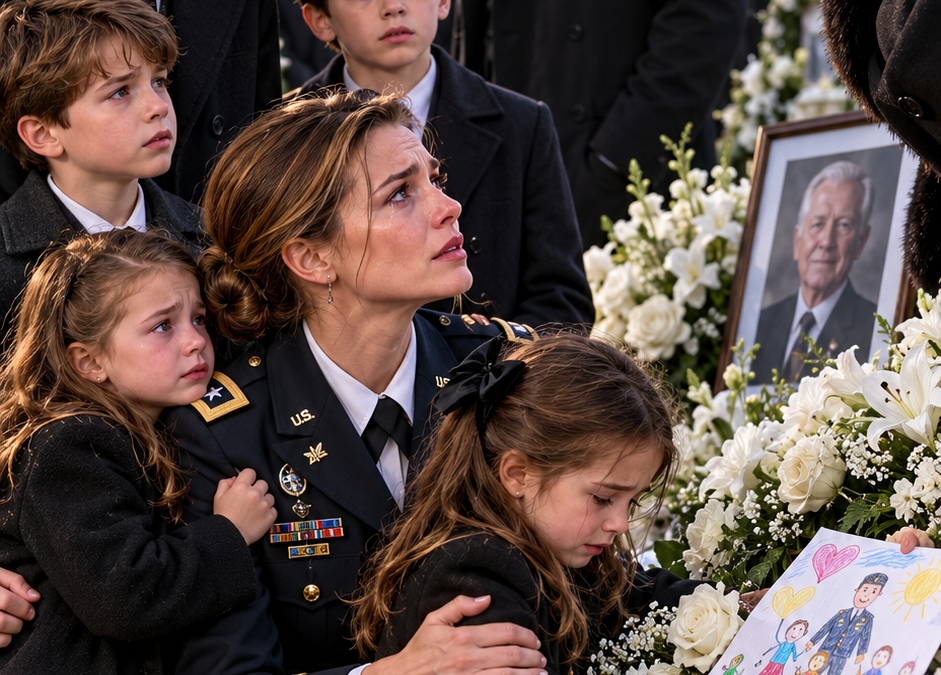
“Mom, can I give Grandpa my picture now?”
I nodded.
She stepped forward carrying a folded sheet of paper.
She had drawn a tall gray-haired man standing beneath a bright yellow sun, surrounded by five children.
She’d never met Theodore.
Everything she knew about him came from my stories.
But she’d spent nearly an hour creating that drawing in our hotel room the previous evening because she believed a grandfather deserved something made especially for him.
She placed it gently beside the flowers.
“Goodbye, Grandpa Theodore.”
I felt Gavin’s hand settle against my shoulder.
Behind us, someone began crying.
I didn’t turn to see who it was.
I was too busy trying to keep my own tears from falling.
When the service ended, Mrs. Bell approached.
“Mrs. Briggs?”
I turned.
She had continued calling me by my maiden name even during my marriage.
“Yes?”
“The children are welcome at the house. Mr. Theodore would have wanted that.”
Felicia, who had followed Garrett toward us, gave a dismissive laugh.
“You can’t possibly know what Theodore would have wanted.”
Mrs. Bell looked at her.
“I worked for him forty-two years.”
Felicia straightened.
“And?”
“And you knew him for eleven.”
I almost smiled.
Mrs. Bell had always possessed a remarkable ability to end an argument without raising her voice.
Garrett stepped forward.
“Please come to the house, Jacqueline.”
I considered refusing.
The Remington mansion contained some of the happiest and most painful memories of my adult life.
I’d promised myself I’d never enter it again.
But Theodore had spent almost seventy years there.
And I wasn’t going to let Felicia keep my children from seeing the home their grandfather had loved.
“All right.”
Garrett nodded.
“Thank you.”
I didn’t answer.
I wasn’t doing it for him.
Not yet.
The Remington mansion looked smaller than I remembered.
At twenty-eight, I’d thought its pale limestone walls, enormous windows, and sweeping driveway represented a kind of power I would never fully understand.
At thirty-eight, after ten years of military housing, temporary assignments, and building a home for five children near Fort Campbell, I recognized it for what it was.
A very large house.
A house that had once made me feel very small.
Audrey stared up at the vaulted ceiling when we entered.
“Mom? Do people actually live here?”
Mrs. Bell answered before I could.
“One very stubborn man did.”
Audrey smiled.
“Grandpa Theodore?”
“Yes, sweetheart.”
“Was he nice?”
Mrs. Bell considered the question.
“He could be.”
I laughed.
“That means sometimes.”
Mrs. Bell smiled at me.
“You always understood him.”
“He made sure I did.”
For a moment, her expression became terribly sad.
Then she led the children into Theodore’s library, where sandwiches, soup, fruit, and hot chocolate had been arranged on a long table.
I recognized the room immediately.
Theodore used to sit beside the fireplace on winter evenings, reading the newspaper while I pretended not to notice him secretly giving biscuits to his elderly golden retriever.
He’d been the first person in Garrett’s family who asked what I wanted to do with my life rather than what I intended to contribute to the Remington legacy.
When I admitted I was considering a military career, he’d simply asked whether I understood the commitment.
Then he told me to pursue it seriously if it was what I wanted.
I’d never forgotten that conversation.
Now my children were sitting in his library, eating sandwiches while trying to understand why their mother had brought them into a family they’d never met.
Gavin was the first to speak.
“Mom, are we hiding in here?”
I looked at him.
“No.”
“Because it feels like we’re hiding.”
“We’re giving everyone a chance to calm down.”
He glanced toward the doorway.
“That includes us?”
“Especially us.”
Garrett appeared before Gavin could answer.
He stopped just outside the room.
“Your mother asked that no one overwhelm you.”
Gavin studied him.
“Are you going to?”
Garrett’s expression changed.
“No.”
He swallowed.
“At least, I’m going to try very hard not to.”
Something in his answer surprised me.
Ten years earlier, Garrett would have insisted that everything needed to be resolved immediately.
He hated uncertainty.
He disliked waiting.
And when he was frightened, he had a habit of demanding answers before anyone else had time to understand the questions.
Now he stood quietly in the doorway, looking at five children who had apparently rearranged his entire understanding of the past.
“I’ll be in Grandfather’s study,” he told me.
“I’ll come when they’re finished eating.”
He nodded and walked away.
Mason watched him disappear.
“He looks like Gavin.”
Lucas frowned.
“Gavin looks like him.”
“That’s the same thing.”
“No, it isn’t.”
“Enough,” I said, although I couldn’t keep the amusement out of my voice.
Clara put down her sandwich.
“Mom?”
I looked at her.
“Yes?”
“Is that man our dad?”
The room became quiet.
I’d known this conversation was coming.
I simply hadn’t expected to have it while sitting beneath Theodore Remington’s collection of antique hunting prints.
“Yes.”
Audrey blinked.
“Our real dad?”
“Your biological father.”
“What does that mean?”
“It means you inherited half your DNA from him.”
She thought about it.
“Is that why Lucas has weird toes?”
Lucas nearly dropped his spoon.
“My toes aren’t weird!”
“They bend funny.”
“They’re normal!”
Even Gavin laughed.
And for one precious moment, the impossible situation surrounding us became an ordinary family lunch.
Then Mason looked at me.
“Did he know about us?”
I took a breath.
“No.”
The room went quiet again.
Gavin leaned forward.
“Why?”
“Because when I tried to tell him, things went wrong between us.”
“What things?”
“Things that happened before any of you were born.”
He frowned.
“That doesn’t tell us very much.”
“I know.”
“Are you going to tell us?”
“Yes. When I can explain everything properly.”
Gavin looked toward the door.
“Did he leave because he didn’t want us?”
My heart nearly stopped.
I reached across the table.
“No, sweetheart. He didn’t know you existed.”
“But he left you.”
“Yes.”
“Why?”
I considered how much a fifteen-year-old deserved to know about his parents’ mistakes.
“Because we stopped trusting each other. Someone told him things about me that weren’t true, and he believed them.”
“Did you do something wrong?”
“I made mistakes in our marriage, but I didn’t do what he accused me of doing.”
Gavin stared at his hands.
“Do you hate him?”
I had asked myself that question more times than I could count.
There had been days when I genuinely believed I did.
But hatred had never survived very long beneath the demands of raising five children.
There were lunches to pack, homework assignments to supervise, military responsibilities to fulfill, and birthdays to celebrate.
Eventually, there simply hadn’t been enough room in my life to keep feeding the anger.
“No,” I answered.
“I don’t hate him.”
“Do you love him?”
That was harder.
“I loved him a very long time ago.”
Gavin looked up.
“That’s not what I asked.”
I smiled sadly.
“I know.”
Clara interrupted.
“Do we have to call him Dad?”
“No.”
She looked relieved.
“You can call him Garrett until you decide what feels comfortable. Nobody gets to demand that you feel something before you’re ready.”
Audrey examined her cookie.
“Can I still call him Garrett if I like him?”
“Of course.”
“And what if I don’t?”
“That’s okay, too.”
Gavin leaned back.
“Does he want to know us?”
I looked toward the doorway.
“I think he does.”
“You think?”
“I haven’t spoken to him enough to promise anything.”
My oldest son considered that answer.
Then he nodded.
“Okay.”
Mrs. Bell arrived carrying a plate of freshly baked cookies.
“Your mother once ate seven of these in one afternoon.”
I stared at her.
“That information was classified.”
“It certainly was not.”
Audrey immediately reached for the plate.
“Can we have seven?”
“Two.”
Mrs. Bell sighed dramatically.
“Your mother has become terribly strict.”
“Army,” I explained.
“Tragic.”
The children burst out laughing.
And for the first time since arriving at the cemetery, I felt my shoulders relax.
They were still children.
Whatever Garrett and I had to confront, I intended to keep them that way.
When I finally entered Theodore’s study, Garrett was standing beside the fireplace.
His tie was loosened, and he was holding a cup of coffee that appeared to have gone cold.
“You still drink coffee?” he asked.
“Yes.”
“I asked Mrs. Bell to bring some.”
“Thank you.”
He glanced toward the hallway.
“How are they?”
“Confused. Curious. Hungry.”
A faint smile crossed his face.
“That sounds about right.”
Then it disappeared.
“I don’t know where to begin.”
I took the sealed envelope from my coat.
“Neither do I.”
Theodore’s study hadn’t changed much.
His mahogany desk still faced the tall windows overlooking the river. Books filled three walls, and his old brass reading lamp illuminated a stack of correspondence that someone had arranged neatly beside the blotter.
I remembered sitting in that room during my first Thanksgiving as Garrett’s wife.
Theodore had poured me a glass of cider after I escaped an exhausting conversation about whether I planned to abandon my career to produce the next generation of Remington heirs.
He’d listened while I complained.
Then he’d said something I had carried with me ever since.
“You don’t have to become someone else to belong here, Jacqueline.”
At the time, I hadn’t understood how rare that permission was.
Now I placed my envelope on his desk.
Garrett sat opposite me.
For several seconds, neither of us touched it.
Then he opened it and removed the paternity report.
His eyes traveled down the first page.
He looked up.
“Where did you get this?”
“Walter Reed.”
“You had testing done?”
“After Audrey was born.”
“Why?”
“Because I was tired of wondering whether anyone would ever believe me.”
He looked back at the document.
Then he reached for the accompanying medical records.
The explanation was complicated, but the truth was straightforward.
During the last year of our marriage, Garrett and I had been undergoing fertility treatment.
We had wanted children desperately.
After an early pregnancy ended in miscarriage, we’d agreed to another cycle, creating and preserving additional embryos.
Then our marriage began falling apart.
Garrett’s responsibilities at Remington Industries consumed nearly every waking hour.
I was considering military service, and he increasingly treated that possibility as a rejection of the life we’d built together.
Felicia was already close to him.
When she began suggesting that my frequent absences meant I was seeing another man, he believed her.
By the time I discovered that our final treatment cycle had succeeded, our divorce was underway.
I gave birth to Gavin and Mason after leaving Ohio.
Several embryos remained frozen under the agreement we’d signed during treatment.
Years later, after establishing a stable life and seeking medical and legal advice, I chose to use them.
Lucas was born first.
Clara and Audrey followed in subsequent years.
Five children, all biologically ours.
Five children born from a marriage that had ended before their father ever learned they existed.
Garrett studied the medical records.
“All five?”
“Yes.”
“The embryos were created while we were married?”
“Yes.”
He stared at the page.
Then he covered his mouth.
For a long moment, he seemed unable to speak.
Finally, he whispered, “We spent all those years trying to have children.”
I looked away.
“I remember.”
“And you raised five of them.”
“Yes.”
“Without me.”
The words weren’t accusatory.
They sounded almost disbelieving.
I folded my hands.
“I didn’t know any other way.”
He picked up the old hotel folio.
I recognized it immediately.
The Renaissance Cincinnati Hotel.
Four dates circled in red ink.
Those four dates had nearly destroyed me.
Garrett studied the document.
“Felicia showed me this.”
“I know.”
“She said you were meeting another man.”
“I know.”
“The room was registered in your name.”
“Because I booked it.”
“And the second room?”
I looked directly at him.
“Colonel Dana Whitaker.”
He frowned.
“What?”
“Colonel Dana Whitaker. She was helping evaluate me for an Army medical commissioning program.”
His expression changed.
“She?”
“Yes, Garrett. A woman.”
“But Felicia said—”
“Felicia told you I was meeting Daniel Whitaker. Dana’s husband.”
Garrett looked down at the hotel folio.
“His name was on a restaurant receipt.”
“Yes.”
“And you were there for medical appointments?”
“I told you that.”
He shook his head.
“You said recruiting.”
“I said I was attending appointments connected to a possible military commissioning program.”
He sat back.
“I never checked.”
“No.”
“I never called the hotel.”
“No.”
“I never spoke to this colonel.”
“No.”
His eyes filled.
“God, Jacqueline.”
I didn’t answer.
For ten years, those hotel records had existed in my memory as the moment Garrett decided that another woman’s accusations mattered more than anything his wife could say.
Now he was finally examining them.
Ten years too late.
“Why didn’t you explain?”
The question made me laugh without humor.
“I tried.”
“I remember you saying the program was confidential.”
“Some of the medical details were private. My career plans weren’t.”
He rubbed his forehead.
“I thought you were having an affair.”
“I know.”
“Felicia said you were planning to leave me.”
“I was considering leaving Ohio.”
“That felt like the same thing.”
“It wasn’t.”
He looked up.
“Wasn’t it?”
I stared at him.
“I asked you to come with me.”
“When?”
“The night of your father’s anniversary dinner.”
He frowned.
“You said you couldn’t live here anymore.”
“And then I said, ‘Come with me.'”
He stared.
“I thought you meant leave the dinner.”
Despite everything, I laughed.
It was such a perfectly Garrett misunderstanding that for one terrible second, I remembered why I’d fallen in love with him.
“Apparently, we were having two different conversations.”
He looked down.
“I was angry.”
“So was I.”
“I thought you hated my family.”
“I hated feeling as though I needed their permission to make decisions about my own life.”
“I thought you were rejecting everything I worked for.”
“And I thought you cared more about your family’s company than you cared about me.”
He nodded slowly.
Neither of us spoke for a while.
Felicia hadn’t invented every problem in our marriage.
She’d found two people who were already struggling to communicate and given one of them a reason to stop listening altogether.
Garrett picked up the final document.
The notarized statement.
His brow furrowed as he read the first paragraph.
“Elise Warren?”
“Felicia’s former assistant.”
“And her college roommate,” he said quietly.
He continued reading.
Elise had written the statement six months after our divorce.
She described hearing Felicia admit that she’d altered copies of my hotel records and encouraged Garrett to believe I was meeting another man.
According to Elise, Felicia had also selectively forwarded messages to Garrett while deleting other emails from a shared office server.
Garrett read the statement twice.
Then he looked up.
“She fabricated it?”
“She manipulated the documents and the information you received.”
He covered his eyes.
I waited.
When he finally lowered his hands, there were tears on his cheeks.
“You had this statement all along?”
“I received it six months after the divorce.”
“You could have sent it to me.”
“I did.”
He froze.
“What?”
“Twice.”
“Jacqueline, I never saw it.”
“The first copy went to your office. The second went by certified mail to this house.”
He stared at me.
Then his gaze shifted toward the door.
I knew exactly what he was thinking.
Felicia had worked in his executive office during those years.
She had access to his correspondence.
She’d also become increasingly involved in managing the Remington household after our divorce.
He whispered something I almost couldn’t hear.
“I married her.”
“I know.”
“Three years after you left.”
“I saw the announcement.”
He looked up.
“You did?”
“An old friend sent it to me while I was stationed in Texas.”
“What did you do?”
I remembered the photograph.
Felicia in an elaborate ivory wedding gown.
Garrett standing beside her, smiling the same smile he’d worn in our wedding pictures.
I had been sitting on the edge of my bunk when I opened the message.
I remembered staring at it for perhaps half a minute.
Then I’d put my phone away because I had an early training assignment the next morning.
“I went back to work.”
He looked as though that answer hurt.
But I wasn’t going to apologize for surviving without him.
“We separated last year,” he said.
I blinked.
“I didn’t know.”
“We haven’t announced it because of Grandfather’s health.”
“I’m sorry about Theodore.”
Garrett looked toward the old man’s desk.
“So am I.”
Then he reached for a yellow legal pad.
“Can you tell me their birthdays?”
The question caught me completely off guard.
“What?”
“The children. Their birthdays.”
I told him.
He wrote each name carefully.
Gavin and Mason.
Lucas.
Clara.
Audrey.
Then he looked at the list for a very long time.
“I missed everything.”
I watched him silently count the years.
“First steps,” he whispered. “First words. Their first days at school.”
He stopped.
“I’m sorry.”
I wanted to tell him how difficult it had been.
How frightening it was to discover I was carrying twins while preparing to begin a new career.
How many nights I’d spent walking the floor with two crying babies, wondering whether I had enough strength to raise them alone.
How much it hurt when Gavin first asked why his friends had fathers who came to school events and he didn’t.
But I also remembered the extraordinary people who had helped me.
My mother, who had traveled to Texas when the boys were born.
My military colleagues, who’d brought meals and offered support.
The neighbors who had watched the children when unexpected assignments disrupted my carefully organized schedule.
I’d built a family.
It hadn’t been the family Garrett and I had imagined, but it was real.
And I was proud of it.
“You missed a lot,” I said quietly.
He looked at me.
“But they’re still here.”
His eyes filled again.
“Would you let me know them?”
I considered the man sitting across from me.
He was no longer the thirty-one-year-old husband who had treated my explanations as inconveniences.
But I couldn’t determine in one afternoon whether he had become someone worthy of my children’s trust.
“Slowly.”
He nodded immediately.
“Whatever you think is best.”
“No promises you can’t keep.”
“I understand.”
“And you don’t get to walk into their lives expecting them to love you simply because you’re their father.”
His jaw tightened, but he nodded.
“I understand that, too.”
I studied him.
“Do you?”
He looked toward the library door.
“I think I’m beginning to.”
Then I asked the question that had been troubling me since we left the cemetery.
“Did you ever wonder what happened to me?”
Garrett looked startled.
“Of course.”
“Then why didn’t you contact me?”
He stared at the floor.
“Because I was proud. And angry. And because every time I thought about calling, I remembered what I believed you’d done.”
I let the answer settle.
Ten years.
Five children.
An entire lifetime built around an accusation he’d never bothered to verify.
Before I could respond, someone knocked.
Mrs. Bell appeared.
“Mrs. Briggs? I’m sorry to interrupt, but there’s someone waiting in the hall.”
“Who?”
“Felicia.”
I almost laughed.
Of course she was.
Garrett looked toward the door.
“Tell her we’re busy.”
Mrs. Bell hesitated.
“Actually, there is something else.”
She held a small wooden box against her chest.
I recognized it immediately.
Theodore had kept his personal correspondence in boxes just like that for decades.
A brass nameplate was attached to the lid.
Mrs. Bell crossed the room and placed it in my hands.
I looked down.
JACQUELINE.
My throat tightened.
“What is this?”
“Mr. Theodore left instructions for you.”
I stared at her.
“He knew I was coming?”
“No.”
She smiled sadly.
“But I believe he hoped you might someday.”
Garrett leaned forward.
“What’s inside?”
“I don’t know,” Mrs. Bell replied. “But he was very particular about who should receive it.”
A strange feeling moved through me.
I looked at the box, then toward the hallway.
And suddenly I understood why Felicia had been so desperate to speak to us.
She wasn’t afraid of the documents I’d brought.
She was afraid of something Theodore had left behind.
Felicia was waiting in the front hall when I left the study.
She stood beside a table crowded with condolence cards, her arms folded so tightly that her knuckles were white.
Her eyes immediately dropped to the wooden box in my hands.
“You gave him the papers.”
“Yes.”
She exhaled.
“You always did enjoy dramatic timing.”
I looked toward the black mourning dress she wore.
“We’re at Theodore’s funeral, Felicia. I’d prefer not to argue.”
“Then why did you come?”
“For Theodore.”
“You could have visited him while he was alive.”
That hurt more than I wanted to admit.
“I wrote to him.”
Her expression flickered.
It happened so quickly that someone who didn’t know her might have missed it.
But I remembered how Felicia looked whenever a conversation approached something she wanted concealed.
I took a step closer.
“What?”
“Nothing.”
“Theodore sent me Christmas cards. I wrote back. Did he know where I was?”
She looked away.
“People knew you were in the Army.”
“That wasn’t my question.”
“What exactly do you want from me?”
“The truth would be something new.”
Her eyes narrowed.
“You think Garrett is suddenly going to become the man you wanted because you’ve arrived with five children?”
“This isn’t about getting Garrett back.”
“Please.”
“I don’t want him back, Felicia.”
She studied me.
“Then what do you want?”
I looked toward the library, where my children were laughing with Mrs. Bell.
“I want them to know where they came from.”
“And if that destroys everyone else’s life?”
I stared at her.
“My children existing isn’t what destroyed anything. The choices people made are what we’re dealing with now.”
Her gaze returned to the box.
“There’s nothing in there worth upsetting the family over.”
My fingers tightened around the wooden lid.
“How do you know what’s inside?”
She went still.
Before she could answer, Mrs. Bell appeared beside us.
“Mrs. Briggs, Mr. Theodore wanted you to open that privately.”
Felicia turned sharply.
“Theodore was very ill toward the end. We should be careful about treating everything he wrote as reliable.”
Mrs. Bell’s expression hardened.
“He was perfectly lucid when he prepared those instructions.”
Garrett entered the hall behind us.
“What’s going on?”
Felicia immediately turned toward him.
“Your grandfather left Jacqueline some old correspondence. I was simply suggesting that this might not be the best day to reopen family disagreements.”
Garrett looked at the box.
“Did you know he was leaving her something?”
“No.”
“Then why are you worried about it?”
“I’m not worried.”
He studied her.
“You clearly are.”
She laughed nervously.
“You spend one hour with Jacqueline, and suddenly everyone is treating me like a criminal.”
I watched him.
For ten years, Garrett had accepted Felicia’s explanations almost automatically.
This time, he said nothing.
I looked toward the staircase.
“Mrs. Bell, where can I open this?”
“Theodore’s upstairs sitting room.”
I started walking.
Garrett followed.
I turned.
“Not yet.”
He stopped.
“Jacqueline—”
“He left it to me.”
Something moved across his face.
Disappointment, perhaps.
Then he stepped back.
“All right.”
That small gesture mattered more than I expected.
Ten years earlier, Garrett would have demanded that we examine the contents together.
Now, for the first time, he was allowing me to decide how much of my own life I wanted to share with him.
I climbed the stairs alone.
Theodore’s sitting room overlooked the river.
It was smaller and far more comfortable than the formal rooms downstairs.
Two worn leather chairs faced a modest fireplace. A small radio sat beside a stack of mystery novels, and a framed photograph of Theodore and his late wife, Margaret, rested on the mantel.
I sat beside the window and opened the box.
Inside were letters.
Dozens of them.
All addressed to me.
I picked up the first.
Theodore’s familiar handwriting covered the page.
He began with a joke about Mrs. Bell ignoring his instructions and ended the opening paragraph by explaining that old men sometimes found it easier to tell the truth when they didn’t have to sit through the response.
I smiled through the sudden tightness in my throat.
That was Theodore.
Stubborn even when apologizing.
He wrote about my divorce.
He admitted that he’d believed Garrett was wrong to end our marriage without properly listening to me.
Then he confessed something I hadn’t expected.
He had done nothing meaningful to stop it.
He’d told himself that interfering in his grandson’s marriage would only make matters worse.
He’d called it respect for our privacy.
Looking back, he wrote, it had also been cowardice.
I lowered the letter.
I had spent years believing Theodore had been the only member of Garrett’s family who truly understood how badly I’d been treated.
Now I realized that understanding hadn’t necessarily made him courageous enough to intervene.
I opened another letter.
It was dated eight years earlier.
He mentioned receiving my Christmas card.
Then he referred to the photograph I’d enclosed of Gavin and Mason.
My breath caught.
I read the sentence again.
He had seen my boys.
He’d even joked that they had inherited Garrett’s ears.
I searched through the stack.
Another letter mentioned Lucas.
A later one discussed Clara.
Then I found one referring to Audrey’s birth.
Five children.
Theodore had known about every one of them.
My hands began shaking.
At the bottom of the box, I discovered copies of letters I’d sent him over the years.
Letters I had believed went unanswered.
And beside them were his replies.
Some still carried envelopes.
Others were unfinished drafts.
I remembered checking my mail during my first assignment, hoping for some acknowledgment after the twins were born.
I remembered sending Theodore a photograph of Lucas because I couldn’t bear the thought of him never knowing that another grandson existed.
I had written when Clara arrived.
And again after Audrey’s birth.
Eventually, I stopped.
I assumed Theodore had decided that maintaining a relationship with me would create too much conflict within his family.
But now I was holding years of correspondence proving that he had known almost everything.
I found a final letter near the bottom.
It was dated six weeks earlier.
Theodore explained that if I was reading it, he was probably gone.
Then he admitted something that made my chest tighten.
Garrett had never known about the children.
Theodore had.
And Theodore had deliberately kept that information from him.
I stared at the page.
He explained that when the twins were born, Garrett had been furious about the divorce and determined to prove that he’d made the right decision.
Theodore feared that revealing the babies would trigger another bitter legal fight.
He believed I deserved peace as I began my military career.
He convinced himself that allowing me to raise the children without interference was an act of protection.
Then the months passed.
Garrett remarried.
Years went by.
And Theodore kept waiting for a moment when telling the truth would no longer hurt anyone.
By the time Lucas was born, he had delayed too long.
Then came Clara.
Then Audrey.
Every year made the truth more difficult to reveal.
I pressed the letter against my chest.
For years, I’d pictured Theodore as the one Remington who had never failed me.
Now I discovered that he’d made perhaps the most consequential decision of all.
He had known.
He could have told his grandson.
He could have helped arrange a conversation between us.
Instead, he’d allowed five children to grow up without their biological father because he believed he knew what was best for everyone.
I began crying.
Not only because I was angry.
But because I loved him.
And now he was dead, leaving me to reconcile the generous man I remembered with the frightened man who had concealed the truth.
There was more.
The next paragraph explained that Felicia had known about Gavin and Mason before she married Garrett.
She had brought Theodore my original letter announcing the twins’ birth.
I read the sentence again.
Felicia knew.
Before she became Garrett’s wife.
Before the wedding photographs.
Before the years of carefully manufactured family happiness.
She had known that Garrett had two sons living in Texas with a mother who was struggling to rebuild her life.
And she had chosen silence.
A knock sounded at the door.
Mrs. Bell entered.
She stopped when she saw my face.
“You found it.”
I held up Theodore’s letter.
“You knew.”
She closed the door.
“I knew he’d received your correspondence.”
“Did you know Felicia intercepted it?”
“Not at first.”
“When?”
“Years later.”
“Why didn’t Theodore tell Garrett?”
Mrs. Bell sat across from me.
“He was afraid Garrett would try to take the boys away from you.”
“He couldn’t simply take them.”
“I know that.”
“Then why did he believe it?”
Her eyes filled.
“Because after your divorce, Garrett became so angry that his grandfather didn’t recognize the man he’d raised.”
I looked away.
“That doesn’t excuse hiding my children from their father.”
“No.”
“Did Theodore understand that?”
“In the end.”
I wiped my eyes.
“What happened to the letters he sent me?”
“Some were mailed.”
“I never received them.”
“I know.”
“How?”
Mrs. Bell hesitated.
“Several came back from the Remington corporate mailroom.”
I stared at her.
“From the corporate mailroom?”
“Before they ever left the building.”
“Who controlled the mail?”
“Felicia supervised Garrett’s executive office during those years. Much of Theodore’s business correspondence passed through that department.”
I closed my eyes.
I’d spent years wondering whether Theodore had forgotten me.
Apparently, Felicia had helped make certain that any remaining connection between us was gradually severed.
At the very bottom of the box, beneath the letters, lay a sealed envelope addressed to Garrett.
I picked it up.
“What’s in this?”
Mrs. Bell shook her head.
“I don’t know.”
“Did you ever ask?”
“Theodore said Garrett should receive it if you returned.”
I stared at the envelope.
Even after death, Theodore was asking me to make a difficult decision for his family.
It seemed terribly unfair.
I almost laughed.
Then I stood.
“Let’s finish this.”
When I returned downstairs, Garrett was waiting in the hall.
Felicia stood several feet away.
The children were preparing to leave, and Gavin had already helped Audrey into her coat.
I glanced at all five of them before approaching Garrett.
Safe.
Still laughing.
Still unaware of the worst details.
That was how I intended to keep it.
“Garrett, we need to talk.”
He looked at the envelope.
“What did Grandfather say?”
“He knew about Gavin and Mason.”
His face went still.
“For how long?”
“Almost their entire lives.”
Garrett looked toward the staircase.
“Why didn’t he tell me?”
“Because he thought he was protecting everyone.”
He gave a bitter laugh.
“That sounds like him.”
I hesitated.
“There’s more.”
Felicia suddenly stepped forward.
“Jacqueline.”
Garrett turned.
“Stay out of this.”
She stopped.
I held up Theodore’s letter.
“Felicia knew, too.”
Garrett looked at me.
“What?”
“She knew about the twins before you married her.”
The hallway fell silent.
Felicia closed her eyes.
Garrett stared at her.
“Is that true?”
She didn’t answer immediately.
Then she whispered, “Yes.”
One word.
Ten years of silence.
Garrett took a step backward.
“You knew I had sons?”
“Yes.”
“For ten years?”
Her eyes filled.
“Yes.”
He looked at her as though she had become a stranger.
“And you said nothing?”
“I thought Theodore would tell you.”
“That’s not an answer.”
She began crying.
“I was afraid.”
“Of what?”
“That you’d go after Jacqueline. That you’d try to get the children. You were so angry after the divorce, Garrett. Everyone around you treated winning as though it was the same thing as healing.”
I looked at her.
“Then why didn’t you tell me that Theodore knew?”
She hesitated.
“Because I didn’t want everything to start again.”
Garrett’s face changed.
“You married me while knowing I had children.”
“I loved you.”
“Then why did you keep my children from me?”
“Because I was selfish.”
Her voice broke.
“I thought if I told you, everything between us would become about Jacqueline again.”
Garrett shook his head.
“So you chose for me.”
She lowered her eyes.
“Yes.”
I had no satisfaction in watching her cry.
Nothing she said could restore the years that had passed.
And nothing I said could make Garrett understand how many opportunities he’d lost to become a father.
I handed him Theodore’s sealed letter.
“This belongs to you.”
He accepted it with trembling hands.
Before he opened it, Mrs. Bell appeared carrying another folder.
“There’s something else.”
She placed it on the table.
Three words were written across the cover in Theodore’s handwriting.
THE FIRST LETTER.
Inside was a photocopy of the first letter I’d sent announcing Gavin and Mason’s birth.
I immediately recognized my handwriting.
But a note had been added across the top.
It wasn’t Theodore’s.
It was Felicia’s.
I read the note aloud.
“Mr. Remington, Garrett cannot know yet. Dennis says he is too angry to make a reasonable decision.”
Garrett looked up.
“Dennis?”
“Dennis Halpern,” I said.
His former divorce attorney.
Mrs. Bell nodded.
“Theodore discovered last year that Dennis had also known about the twins. He’d advised delaying the disclosure.”
Garrett stared at the note.
“He was my attorney.”
I remembered the letter Dennis had sent after my divorce, instructing me to direct all future communications through counsel.
I’d interpreted it as Garrett’s final rejection.
Now I wondered how many other people had participated in making certain we never spoke again.
“Do you still have the letter Dennis sent you?” Garrett asked.
“Yes.”
“May I see it?”
“When I get home.”
He nodded.
Then he opened Theodore’s envelope.
I watched his eyes move across the page.
His expression changed.
He read the opening paragraph again.
Then he looked at me.
“What?” I asked.
He turned the letter toward me.
Theodore had written that one person had tried to tell Garrett the truth.
Someone Garrett had refused to hear.
A name appeared beneath the paragraph.
Samuel Remington.
Garrett’s younger brother.
The same man who had left Ohio shortly after our divorce and rarely returned to the family estate.
Garrett stared at the name.
“My brother knew?”
Mrs. Bell nodded.
“He knew enough to realize something was wrong.”
“Where is he?”
She looked toward Theodore’s study.
“Your grandfather wanted you to find that out.”
For a long moment, Garrett stood perfectly still.
Then he looked toward my children.
I recognized the expression on his face.
It was the look of a man who had spent ten years defending one version of the truth and was discovering that almost every person closest to him had known something he hadn’t.
But I had reached the end of what I was willing to uncover at a funeral.
I took my coat from the hall table.
“Garrett, my children are exhausted. They need to go back to the hotel.”
He glanced toward them.
“Of course.”
“We can continue this another day.”
“Jacqueline—”
I stopped.
He looked down at Theodore’s letter.
“Will you give me a chance to make this right?”
I thought about the five children waiting beside the door.
“You can’t make the past right.”
His expression fell.
“But you can decide what kind of person you’re going to be from now on.”
He nodded slowly.
Then I took my children’s hands and walked out of the Remington mansion.
For the first time in ten years, I didn’t feel as though I was leaving in defeat.
I was taking my family home.
That evening, after the children had fallen asleep at the Harrington Inn, I sat beside the window with Theodore’s letters spread across my bed.
I read every one of them.
Some made me laugh.
Others made me so angry that I had to put them down.
There were letters describing his memories of Garrett as a little boy, advice about raising stubborn children, and observations about how quickly life could pass when a person kept postponing difficult conversations.
I found one written shortly after Audrey’s birth.
Theodore had congratulated me on my fifth child, then admitted he had rehearsed telling Garrett the truth more times than he could count.
He had never found the courage.
Near the bottom, he’d written that he hoped I would someday bring the children to Ohio.
I pressed the letter against my chest.
“I did come back,” I whispered.
But he was no longer there to hear me.
The following morning, Garrett called.
He had found Samuel’s current address through an old family attorney and wanted to speak with him.
I agreed to join the conversation, provided we kept it away from the children.
Samuel had been twenty-six when Garrett and I divorced.
He was the quieter Remington brother, far less interested in the family business and far more willing to challenge his father and grandfather when he believed they were wrong.
I remembered him confronting Garrett after the accusations about my supposed affair first surfaced.
I’d been too overwhelmed by the collapse of my marriage to understand how much that confrontation mattered.
When Samuel answered Garrett’s call, I heard the astonishment in his voice.
“Garrett?”
“It’s me.”
A long silence followed.
“Is Grandfather all right?”
Garrett closed his eyes.
“No. He’s gone.”
Samuel didn’t speak for several seconds.
Then he asked about the funeral.
Garrett told him what had happened, including my unexpected return and the discovery that he had five children.
Samuel listened quietly.
Finally, he said, “So you know.”
Garrett’s face tightened.
“You tried to tell me?”
“Yes.”
“About the twins?”
“I knew Jacqueline was pregnant when she left. I also knew the hotel story didn’t add up.”
“Why didn’t you tell me what you suspected?”
“I did, Garrett. You told me to mind my own business.”
I watched my ex-husband stare at the telephone.
Samuel continued.
“I tried to explain that you were trusting Felicia without checking anything. You accused me of taking Jacqueline’s side because I didn’t want to work for the company.”
Garrett covered his eyes.
“I remember.”
“You said some things that day I never forgot.”
“I’m sorry.”
Samuel was quiet.
Then he answered.
“So am I.”
There was no dramatic reconciliation.
No sudden forgiveness.
Only two brothers acknowledging a conversation that had divided them for a decade.
Before ending the call, Samuel asked to speak with me.
“Jacqueline?”
“Hello, Samuel.”
His voice softened.
“I’m glad you’re okay.”
I hadn’t realized how much I needed to hear those words.
“Thank you.”
“I’m sorry I didn’t do more.”
I looked at the stack of Theodore’s letters beside me.
“Apparently, a lot of people thought they were doing the right thing by staying quiet.”
Samuel sighed.
“Grandfather was complicated.”
“Yes.”
“He loved you.”
“I know.”
“And he was wrong.”
My eyes filled.
“I know that, too.”
When the conversation ended, Garrett remained seated across from me.
He looked exhausted.
“I spent ten years believing everyone had betrayed me.”
I folded my hands.
“And I spent ten years believing no one in your family cared enough to listen.”
He looked toward the window.
“We were both wrong about some things.”
“Yes.”
Then I met his eyes.
“But Garrett, that doesn’t erase what you did.”
He nodded.
“I know.”
“You had ten minutes to listen to me in that lawyer’s office. Ten minutes to ask questions. Ten minutes to decide whether our marriage deserved more than an accusation.”
His eyes filled.
“And I wasted them.”
“Yes.”
He reached for a tissue.
“I can’t get them back.”
“No.”
For a long moment, we sat in silence.
Then I told him something I’d been considering since the funeral.
“When we get home, I want the children to have time to decide whether they’re comfortable speaking to you again.”
He looked up.
“Again?”
“They met you yesterday. If they want to meet you again, we’ll arrange it.”
He nodded.
“No pressure.”
“None.”
“And if they don’t?”
“Then you give them time.”
His expression became serious.
“I can do that.”
I hoped he meant it.
Over the following months, Garrett began learning what it meant to become a father to children who had already built their lives without him.
Our attorneys helped establish an appropriate parenting arrangement while we worked through the complicated history of the fertility agreements and the circumstances surrounding the children’s births.
A family counselor helped us approach the situation without making the children responsible for adult guilt.
Garrett started with short video calls.
Gavin was cautious.
Mason wanted to know everything about the Remington factory.
Lucas asked whether Garrett had played baseball when he was younger.
Clara wanted stories about Theodore.
And Audrey, who had absolutely no interest in making anyone’s emotional journey easier, asked whether Garrett owned any dogs.
He eventually adopted an elderly golden retriever from a local shelter.
Audrey declared this an excellent beginning.
It took longer for Gavin.
My oldest son understood more about the divorce than the others, and he resented the years his father had missed.
One afternoon, after a difficult telephone conversation, he found me in the kitchen.
“Mom?”
I turned.
“What’s wrong?”
“Do I have to forgive him?”
I put down the dish towel.
“No.”
“Everyone keeps saying he didn’t know about us.”
“He didn’t.”
“But he didn’t believe you.”
I looked at my son.
“No. He didn’t.”
Gavin swallowed.
“What if he stops believing me someday?”
I crossed the kitchen and hugged him.
“Then you’ll know you deserve better.”
He held me tightly.
“And if he doesn’t?”
“Then maybe the two of you can build something good together.”
It was the most I could honestly promise him.
And for once, he didn’t ask for more.
The investigation into Felicia’s interference with our correspondence continued separately from the decisions Garrett and I made about our children.
The old records helped establish what had happened, although not every missing letter or disputed conversation could be reconstructed.
Dennis Halpern’s involvement also raised serious questions about the advice he’d given and whose interests he’d actually been protecting.
I let my attorney handle those matters.
I’d spent ten years living with the consequences of other people’s secrecy.
I wasn’t going to spend the next ten allowing their explanations to consume my children’s lives.
Garrett and Felicia completed their separation.
He never asked me to return to the Remington mansion as his wife.
And I never suggested that we should try again.
Whatever love had existed between us belonged to two people who were no longer there.
We had changed.
We’d made mistakes.
And we’d built lives that couldn’t simply be erased because the truth had finally emerged.
But Garrett became part of our children’s lives.
Not immediately.
Not perfectly.
There were missed opportunities that hurt him and difficult conversations that left all of us exhausted.
There were also birthday cards, school performances, baseball games, and afternoons when Audrey insisted that everyone stop arguing long enough to take the dog outside.
Slowly, the children began to understand that having Garrett in their lives didn’t diminish the family I’d already built for them.
A year after Theodore’s funeral, we returned to Ohio.
This time, there were no whispers when our SUV entered the cemetery.
No accusations.
No Felicia waiting beside the gate.
Only Garrett standing near Theodore’s grave with a bouquet of white flowers.
Gavin approached him first.
Then Mason and Lucas.
Clara placed another drawing beside the headstone.
And Audrey carefully arranged five small stones along its base.
I stood a short distance away, watching Garrett kneel beside his children as they told their grandfather about everything that had happened during the past year.
For a moment, I wished Theodore could see them.
Then I remembered the letters.
The apologies.
The years of silence.
I loved him, but I no longer needed to pretend he’d been incapable of making terrible mistakes.
He had helped give me a place in the Remington family when I needed one.
And he’d helped keep my children from their father when he should have trusted us to face the truth.
Both things could be true.
Garrett rose and walked toward me.
“Thank you for bringing them.”
I looked at the children laughing beside the grave.
“They wanted to come.”
He nodded.
“Do you think Grandfather would be happy?”
I considered that.
Then I smiled sadly.
“I think he’d be relieved.”
Garrett laughed softly.
“Probably.”
We stood together for a moment, watching the children.
Then Audrey called from across the grass.
“Mom! Garrett! Come here!”
I looked at my ex-husband.
He looked back at me.
And for the first time since our divorce, there was no accusation in his eyes.
No suspicion.
No expectation that I needed to explain myself.
We walked toward our children.
Ten years earlier, I’d left Ohio believing that Garrett Remington had taken my future away.
I knew better now.
I’d built a future he had never been there to see.
And when I returned with five children beside me, I wasn’t bringing them back to repair a broken marriage.
I was giving them the opportunity to know their family without inheriting its silence.
As we left Theodore’s grave that afternoon, Gavin walked ahead with his brothers and sisters, telling Garrett an elaborate story about something that had happened at school.
Garrett listened to every word.
I watched them from behind.
For years, I’d wondered what my life might have looked like if my husband had believed me when I needed him most.
Now I finally had an answer to a more important question.
What would our children’s lives look like if we stopped allowing the mistakes of the past to decide their future?
I couldn’t give them back the years we’d lost.
But I could give them the truth.
And this time, every one of them would have the freedom to decide what to do with it.








