𝗙𝗨𝗟𝗟 𝗦𝗧𝗢𝗥𝗬 I Brought a Court Order to Save My Grandson, but the Police Captain Had No Idea Who He Was Locking Up
𝗙𝗨𝗟𝗟 𝗦𝗧𝗢𝗥𝗬
I obtained the authorized sealed copy shortly afterward.
By the time I reached Brook Haven Central Station, it was approaching midnight.
The building stood beneath harsh exterior lights, its brick facade streaked by years of rain.
Several patrol vehicles were parked near the entrance.
Through the glass front doors, I could see officers moving behind the reception counter.
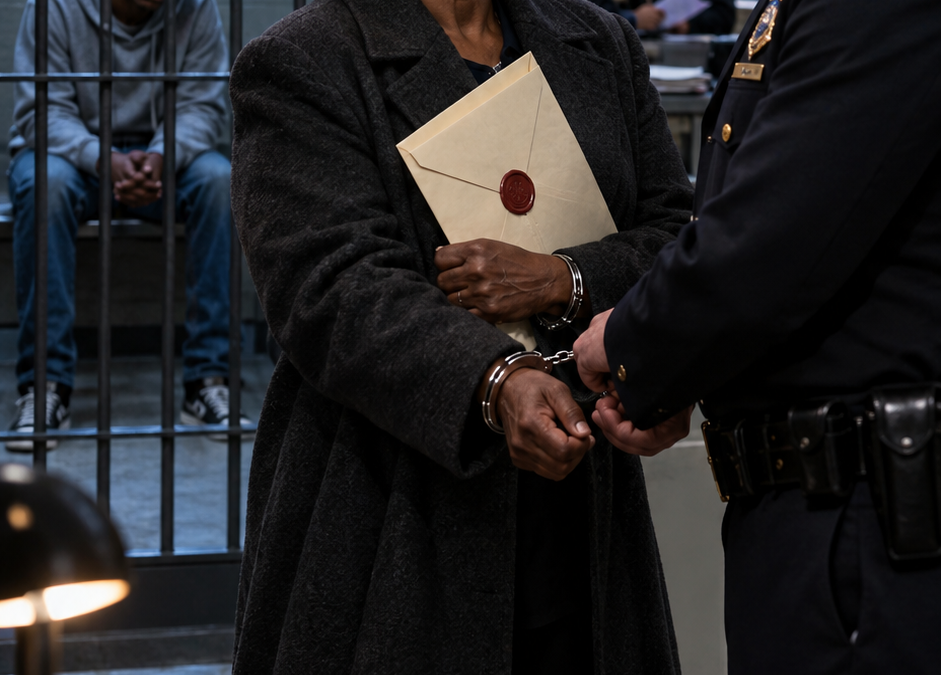
I parked the Buick near the curb, retrieved the sealed envelope, and went inside.
Sergeant Dale Ror was standing behind the front desk.
He looked at my old car through the window before turning his attention to me.
Then his gaze traveled from my worn shoes to my plain gray coat.
His expression changed into the kind of smile I had learned to recognize long before becoming a judge.
It was the smile of someone who believed he had already determined how much respect another person deserved.
“Can I help you?”
“My grandson was brought here earlier tonight. His name is Malik Carter.”
He glanced toward a computer.
“Juvenile robbery suspect?”
“He’s seventeen. I have an emergency court order concerning his detention.”
I placed the sealed envelope on the counter.
Ror looked at it.
Then he laughed.
“Lady, where did you get this?”
“From the court.”
“Of course you did.”
He picked up the envelope and examined the official seal.
I kept my voice controlled.
“The order requires you to stop questioning Malik, give him access to counsel, and explain the legal basis for holding him.”
He tore open the envelope.
“Take that paper off my desk.”
I stared at him.
“Sergeant, you need to read it.”
“I know what these scams look like.”
“Then verify the docket number.”
“I don’t need a docket number to recognize a fake order.”
I could feel my heartbeat accelerating.
But I had spent far too many years in difficult courtrooms to mistake anger for effectiveness.
“Sergeant, you’re holding a sealed federal document. Call the clerk and verify it.”
He leaned across the counter.
“And I’ve got authority in this station.”
I looked directly into his eyes.
“Authority doesn’t relieve you of the obligation to verify a court order.”
His smile disappeared.
Behind him, a young officer stopped typing.
She was small, athletic, and had dark hair pulled into a tight knot.
Her nameplate read ORTIZ.
“Sergeant,” she said carefully, “we should probably call the clerk.”
Ror ignored her.
Then Captain Wade Mercer entered from the hallway.
He was tall, silver-haired, and immaculately dressed despite the hour.
His movements were composed, and his voice carried the polished patience of a man who rarely needed to shout because other people had learned to fear disappointing him.
“What’s going on?”
Ror held up the envelope.
“This woman claims she has some kind of federal order for the robbery kid.”
Mercer took the document.
He opened it and began reading.
I watched his expression.
At first, he seemed merely annoyed.
Then his eyes reached the docket number.
Something changed.
It happened so quickly that another person might have missed it.
His fingers tightened against the page.
His gaze moved toward the seal.
Then back to the docket information.
For the first time, I suspected he recognized exactly what he was holding.
“Captain,” I said, “I need to see my grandson.”
He folded the order.
“And you expect my officers to release a robbery suspect because a stranger brought expensive stationery into my station?”
“I expect you to obey a lawful order.”
He looked at Ror.
“Arrest her.”
The sergeant blinked.
“Captain?”
“Obstruction. Suspected impersonation of a federal official.”
Officer Ortiz stepped away from her terminal.
“Captain, we haven’t verified the document.”
Mercer turned toward her.
“Return to your desk.”
I looked past him toward the hallway.
Through an open doorway, I could see a small interview room.
Malik was sitting at a metal table.
His wrists were secured to a ring fixed beneath its edge.
An officer stood beside him holding a sheet of paper.
Even through the observation glass, I recognized the way Malik lowered his head when he was trying not to cry.
The officer pushed a pen toward him.
Malik shook his head.
My heart seemed to stop.
“Malik!”
I took one step toward the hallway.
Ror grabbed my arm.
“You’re not going back there.”
“He’s a minor, and I have a valid order requiring you to stop questioning him.”
“Turn around.”
The handcuffs closed around my wrists.
I didn’t resist.
I didn’t shout.
I watched Mercer fold the torn envelope beneath his hand and walk toward his office.
Then I looked up at the black camera dome above the reception counter.
“Preserve every recording made tonight,” I said.
Ror laughed.
“Lady, you don’t give orders here.”
I held his gaze.
“From this moment forward, nobody should delete anything.”
Mercer stopped walking.
He didn’t turn around.
But I noticed that he had stopped.
Then Ror led me toward the holding rooms.
I could hear Malik protesting behind the closed interview-room door.
“I was on the bus!”
The officer questioning him answered sharply.
“Then explain why somebody saw you near the store.”
“I wasn’t there!”
I closed my eyes.
The handcuffs were cutting into my wrists.
I had presided over cases involving wrongful detention, false statements, and coerced confessions.
I knew how language could be manipulated inside an interrogation room.
But hearing my grandson’s frightened voice from the other side of a concrete wall was different from reading a transcript.
He was seventeen.
His mother was gone.
And he had been taught his entire life that if he told the truth, adults would eventually listen.
Now he was learning how terrifying it could be when the adults in charge had no interest in hearing it.
The holding room was barely wide enough for the metal bench bolted against one wall.
Its paint had once been white.
Years of damp air and dirty hands had turned it gray.
A fluorescent light buzzed overhead.
I sat down and rested my cuffed hands in my lap.
For several minutes, I listened.
A door slammed somewhere in the hallway.
Someone laughed.
A chair scraped across a hard floor.
Then Malik’s voice reached me again.
“I already told you. I was on the bus.”
An officer answered.
“You don’t have to admit you went inside. Just say you stood outside and watched the door.”
“I didn’t.”
“Sign it, and this gets easier.”
I gripped my hands together.
I recognized what was happening.
The officer was trying to give Malik a smaller accusation to admit so it could become part of a larger case.
If he signed, the statement could be used to suggest he had participated in the robbery even if he had never entered the store.
I knew Malik.
He was cautious, intelligent, and stubborn.
But he was also frightened.
And fear could make almost anyone desperate enough to sign something simply to end an unbearable situation.
I thought about him at nine years old, sitting at our kitchen table after his mother’s funeral.
He had spent nearly an hour trying to repair a broken toy robot.
When I offered to help, he shook his head.
“I can figure it out, Grandma.”
Now he was sitting in an interview room while an officer tried to convince him that the truth was wrong.
I pressed my cuffed hands together so tightly that my fingers began to ache.
“Stay strong, sweetheart,” I whispered.
Two hallways away, Officer Lena Ortiz was facing a decision of her own.
I didn’t know Lena before that night.
Later, I learned that she had joined the Brook Haven Police Department because she believed the job could give her an opportunity to protect people who had no one else willing to stand beside them.
She had been an officer long enough to understand how the department actually worked.
During the previous six months, she had noticed troubling discrepancies in arrest records, missing camera recordings, and disciplinary complaints that seemed to disappear whenever the allegations involved certain supervisors.
She had asked questions.
Her questions had made her unpopular.
Her older brother, a public defender, had died suddenly two years earlier.
He used to tell her that evidence itself had no opinions.
People decided whether evidence survived.
That night, she remembered his words.
From her workstation, Lena could see the interview feed showing Malik and Officer Travis Bell.
She could also see that the juvenile intake time didn’t match the arrest log.
Malik had requested his grandmother four times.
He had requested an attorney twice.
None of those requests appeared in the official report.
Lena approached Mercer’s office.
“Captain, the intake record is inaccurate.”
Mercer barely looked up.
“Correct it.”
“Malik asked for counsel.”
“Officer Bell is handling the interview.”
“The emergency order requires questioning to stop.”
Mercer placed the folded document on his desk.
“That document hasn’t been verified.”
“Then why aren’t we calling the clerk?”
His expression hardened.
“Officer Ortiz, I suggest you remember who supervises this station.”
She remained standing.
After several seconds, Mercer handed her a supplemental report.
It stated that I had entered the station shouting, attempted to force my way into a restricted hallway, and physically resisted when Ror detained me.
Lena stared at the paper.
“She didn’t resist.”
Mercer leaned back.
“You were completing paperwork.”
“I watched him handcuff her.”
“Then write that she created a reasonable safety concern.”
For several seconds, the room was silent.
Mercer spoke again.
“Reports have consequences, Officer.”
Lena took the document without answering.
Then Mercer summoned the overnight systems technician.
His name was Greg Sutter.
Greg was forty-one, thin, nervous, and much more comfortable working with computers than confronting senior officers.
Mercer gave him a short instruction.
“Take the camera network offline from eleven until one. Log it as a security fault.”
Greg hesitated.
“That could erase the active buffers.”
“That’s why we maintain backups.”
Greg knew the backup system had failed several times that year.
He also knew who approved his salary.
He nodded and left.
Lena returned to her desk.
Then she reached inside her patrol bag and removed a small black storage drive.
It had belonged to her brother.
She connected it to her workstation.
The first recording showed Bell pushing the prepared confession toward Malik.
The second showed Mercer tearing open the sealed envelope.
The front-desk microphone had captured Ror laughing and admitting that he hadn’t verified the docket number before declaring the order fraudulent.
The access logs showed that a deletion request had originated from Mercer’s administrative account.
Lena copied the files.
Then she noticed something she hadn’t expected.
Beneath the camera archive was a hidden directory containing forty-three files labeled as corrupted data.
The dates extended across eighteen months.
She opened the index.
Names appeared on the screen.
Most belonged to Black residents, immigrants, or teenagers whose criminal charges had later been dismissed.
Several complaints described missing body camera footage.
Three files contained internal notes instructing officers not to discuss the incidents outside the department.
Lena felt sick.
The progress bar continued moving.
Seventy-four percent.
Eighty-one.
Ninety-two.
Then the server-room door opened.
Mercer stood in the doorway.
His expression had lost every trace of its earlier composure.
“Give me the drive.”
Lena closed her fingers around it.
“Captain—”
“Now.”
She didn’t move.
Then something extraordinary happened.
A warning appeared across the network monitors.
Federal preservation hold.
The station’s electronic security system began engaging controlled-access restrictions.
Steel bolts slammed into place at several secured doors.
The front entrance locked.
The rear access corridor was restricted.
The underground garage entrance closed.
Mercer turned toward the screen.
“What the hell is that?”
Far beyond Brook Haven, a protected judicial notification had already reached federal authorities.
The court order Ror had tried to dismiss had not been an ordinary piece of paper.
Its protected docket number was associated with a judicial oversight matter involving Brook Haven Central Station.
When Ror entered it into the department computer, the attempted access generated an alert requiring federal authorization.
Subsequent activity associated with the document and the evidence systems had escalated that alert.
Now a federal preservation order had been issued.
Mercer had spent years believing he could control what happened inside his station.
For the first time, he was discovering that someone outside the building had been watching.
The first dark federal SUV turned through the entrance shortly afterward.
Then another.
Then three more.
Their headlights swept across the parking lot.
Two vehicles blocked the rear gate.
Another stopped beside the underground garage.
Men and women wearing jackets marked U.S. MARSHALS and DEPARTMENT OF JUSTICE stepped onto the pavement.
Inside the holding room, I heard the sudden commotion.
Boots striking the corridor floor.
Radios crackling.
Someone shouting an instruction.
Then a voice I didn’t recognize.
“Step away from the computers and telephones. Keep your hands visible.”
For the first time that night, I allowed myself to hope.
Deputy U.S. Marshal Daniel Brooks entered through the front doors with his team after the restricted access was released for federal personnel.
He was forty-six, tall and broad-shouldered, with closely shaved hair and the measured voice of someone accustomed to managing dangerous situations without making them more dangerous than necessary.
He announced that the building was subject to a federal evidence-preservation order.
No employee could leave with evidence, alter a report, remove a device, destroy recordings, or interfere with the execution of the order.
Mercer emerged from the hallway.
He had straightened his uniform.
His expression was calm again.
“There’s been a misunderstanding.”
Daniel looked at him.
“Captain Mercer?”
“An agitated woman entered with a fraudulent document and attempted to interfere with an active robbery investigation.”
Daniel didn’t argue.
“Take me to her.”
Mercer hesitated.
For the first time, there was no one inside the building he could order to make the problem disappear.
Two Justice Department investigators moved toward the server room.
The woman leading them was Naomi Price, a digital forensic specialist with twelve years of experience recovering deleted and altered government records.
Lena stepped into the hallway as Naomi approached.
“I copied evidence.”
Naomi stopped.
“My captain ordered the recordings deleted.”
Lena opened her hand.
The black storage drive rested against her palm.
Mercer appeared behind them.
“Officer Ortiz removed restricted departmental material.”
Daniel approached.
He looked toward Lena.
“Did you alter any files?”
“No.”
“Did you preserve the original metadata?”
“Yes.”
“Is the source system still available?”
“As far as I know. There’s an active deletion process.”
Naomi immediately continued toward the server room.
Lena looked at Daniel.
“Am I under arrest?”
“No, Officer Ortiz.”
He instructed his team to separate her from station personnel, secure the evidence, and arrange appropriate whistleblower protections while investigators established exactly what had happened.
Lena’s shoulders relaxed slightly.
For months, she had believed she might lose her career if she spoke openly about the missing recordings.
Now she had handed investigators evidence that could not simply be explained away.
Meanwhile, Daniel continued toward the holding rooms.
Before he reached me, another visitor arrived.
Chief Judge Eleanor Whitmore.
Eleanor was sixty-eight, slender, silver-haired, and possessed the kind of quiet authority that came from spending decades making decisions other powerful people were required to respect.
She had served on the federal appellate bench for twenty-two years.
We had known each other for most of our professional lives.
She had also supported the independent judicial oversight arrangement under which I was scheduled to begin reviewing complaints against Brook Haven Central Station the following week.
That assignment was confidential.
It had been created after repeated concerns about missing evidence, unexplained case closures, and the department’s handling of civil rights complaints.
I had never imagined the first time I encountered the station’s internal procedures personally would be through Malik’s arrest.
Eleanor entered the hallway beside Daniel.
The holding-room door opened.
I stood.
My wrists were still cuffed.
Eleanor stopped.
For a moment, her expression changed from professional concentration to something much more personal.
Then she turned toward the officers standing nearby.
“Remove those restraints from Judge Carter.”
The hallway became silent.
Ror stared at me.
Mercer’s composure finally broke.
An officer unlocked the handcuffs.
I slowly brought my hands forward.
Red marks circled both wrists.
Eleanor stepped closer.
“Are you hurt?”
“No.”
“Where’s Malik?”
“Interview room. They were trying to make him sign a confession.”
Her expression hardened.
Daniel immediately directed agents toward the interview room.
Ror was still staring at me.
“Judge?”
I turned toward him.
He looked as though he had forgotten how to speak.
Eleanor addressed the surrounding officers.
“Judge Evelyn Carter has served on the federal bench for eighteen years. She’s also the appointed judicial supervisor for the independent review of complaints involving this station.”
Mercer tried to speak.
“Your Honor, if we’d known—”
I stopped him.
“You knew I was Malik’s grandmother. You knew I brought you a sealed court order. You knew the docket number could be verified.”
He swallowed.
“Judge Carter—”
“I wasn’t scheduled to begin the formal review until next week. I came here tonight because my grandson was arrested.”
I looked toward the hallway where Malik was being held.
“This wasn’t a test arranged for your officers.”
Then I faced Mercer again.
“You created the evidence yourselves.”
Within minutes, Naomi discovered the deletion program running beneath the station’s camera software.
It had been activated twelve minutes after Ror entered the protected docket number.
The program targeted the lobby, Malik’s interview room, my holding area, and twelve older case folders.
Naomi isolated the network before the relevant files could be erased.
Then she uncovered something even more disturbing.
The station’s maintenance contract belonged to Blueline Data Solutions.
Its owner, Calvin Shaw, was Mercer’s brother-in-law.
Whenever Brook Haven reported corrupted camera footage, Blueline billed the city for emergency recovery services.
The payments had reached hundreds of thousands of dollars.
Some invoices corresponded to incidents in which footage had disappeared immediately before a disciplinary hearing or a criminal case became difficult to prosecute.
Naomi began preserving every associated record.
But while investigators examined the station’s computers, another important piece of evidence arrived from across town.
Dr. Samuel Green, Malik’s robotics instructor, had been working late at Brook Haven Technical Academy.
He had supervised Malik’s Safe Route project for nearly two years.
That evening, Malik was supposed to participate in an online scholarship rehearsal.
He hadn’t appeared.
Samuel checked the Safe Route server and found that the system had preserved Malik’s authorized travel data from bus 18.
At the exact time the robbery occurred, Malik was aboard the bus more than three miles from the store.
The location records were corroborated by transit camera footage.
Samuel had attempted to contact the police station earlier.
A dispatcher told him the suspect was cooperating and ended the call before he could explain what he knew.
Now he sent the evidence directly to Rachel Bennett.
Rachel had been outside the locked station documenting the refusal to confirm whether Malik and I were being held.
When she received Samuel’s message, she immediately forwarded the information through the proper federal channels.
Within minutes, investigators confirmed that Malik could not have participated in the robbery.
The officers holding him were instructed to remove his restraints.
I was standing in the hallway when the interview-room door opened.
Malik appeared between two federal agents.
His blue hoodie was wrinkled.
His eyes were red.
His shoulders were hunched in the way they always became when he was trying desperately to keep his emotions under control.
Then he saw me.
“Grandma?”
I opened my arms.
He crossed the hallway so quickly that one of the agents had to step aside.
He wrapped his arms around me.
For several seconds, he couldn’t speak.
Neither could I.
I placed one hand against the back of his head.
The same way I had comforted him when he was nine years old and waking from nightmares about his mother.
“I’m here, sweetheart.”
His body began shaking.
“I didn’t do anything.”
“I know.”
“I kept telling them I was on the bus.”
“I know.”
“They said if I signed it, I could go home.”
I held him tighter.
“You did the right thing by telling the truth.”
He pulled back just enough to look at me.
“They arrested you, too?”
I nodded.
He looked horrified.
“Because of me?”
“No, baby.”
I touched his cheek.
“Because some people in this building made decisions they’re going to have to explain.”
He began crying again.
And this time, I didn’t ask him to be brave.
I simply held him until he was ready to let go.
By three o’clock in the morning, federal agents had secured every hallway inside Brook Haven Central Station.
Evidence markers covered desks and workstations.
Computer systems had been isolated.
Officers who normally moved through the building with casual authority were waiting for instructions from people they could not intimidate.
Daniel Brooks approached me with a preliminary evidence summary.
The forty-three missing or corrupted recordings had been linked to twelve potentially wrongful arrests, several suspected coerced confessions, and significant concerns involving municipal funds.
I read the summary.
Then I looked toward Malik.
He was sitting beside Rachel with a blanket around his shoulders, drinking water from a paper cup.
I wanted to take him home immediately.
I wanted to make him breakfast, put him to bed, and pretend the entire night had been a nightmare.
But the evidence unfolding around us made it impossible to ignore what had happened to other families.
I turned toward Daniel.
“Those twelve cases. Have their families been contacted?”
“Not all of them yet.”
“They need to know.”
He nodded.
Eleanor approached me a moment later.
“We can arrange a formal apology from the department.”
I looked at her.
“No.”
She seemed surprised.
“Evelyn—”
“I don’t need thirty officers apologizing because they discovered my title.”
My voice was quieter than I intended.
“I need them to understand what happened to people whose titles they never bothered to learn.”
With Eleanor’s support and the investigators’ approval, the available station personnel were assembled in the briefing room.
It was a windowless space with county maps pinned to the walls and rows of gray chairs normally used for shift assignments.
Mercer stood near the front.
Ror remained several feet away from him, as though physical distance might separate one man’s responsibility from the other’s.
Naomi entered carrying a recovered case index.
Beside her was Marcus Reid, a Justice Department investigator who had spent twenty years examining civil rights complaints and government misconduct.
Marcus opened the first file.
“Jamal Brooks.”
He placed a photograph on the screen.
Jamal was thirty-six, a warehouse supervisor and father of two.
He had been arrested after an officer claimed he matched the description of someone breaking into parked vehicles.
He spent three days in custody before workplace security footage established that he had been unloading trucks twelve miles away when the crime occurred.
The charges were dismissed.
But he had missed two shifts and lost his job.
His family fell behind on rent.
Marcus turned to the next file.
“Tiana Reed.”
Tiana was twenty, a nursing student.
She had been stopped for a broken taillight and arrested for resisting after asking whether she could contact an attorney.
The relevant body camera recording disappeared before her hearing.
Her arrest cost her a clinical placement and delayed her graduation by a year.
“Henry Dawson.”
Henry was fifty-eight, an Army veteran with an injured knee.
He had entered the station to dispute an incorrect warrant.
An officer knocked him to the floor inside a holding room whose camera was later listed as malfunctioning.
He required surgery.
For months afterward, he slept with the lights on because darkness reminded him of the room where nobody believed him.
“Luis Mendoza.”
Luis was a restaurant cook whose name resembled that of another man with an active warrant.
He spent a night in custody while his daughter waited outside the station.
For seven hours, officers repeatedly told her they had no record of him being held there.
“Isaiah Cole.”
Isaiah was sixteen when officers pressured him into signing a burglary confession without a parent or attorney present.
They told him he could go home if he cooperated.
Fingerprints later established that someone else had committed the crime.
Marcus continued reading until all twelve names had been spoken.
I watched the officers.
Some looked down.
Others stared straight ahead.
A few appeared uncomfortable.
Mercer finally stepped forward.
“These incidents were handled by inexperienced personnel. No department can eliminate every individual error.”
Naomi turned a monitor toward the room.
The restored administrative logs showed Mercer’s username approving altered arrest times, closing internal complaints, and authorizing the deletion of footage in seven of the twelve cases.
“These weren’t simply individual errors,” she said.
“They involved supervisory decisions.”
Ror’s face turned pale.
He looked toward Mercer.
Then toward Daniel Brooks standing beside the door.
“I followed orders.”
Mercer turned sharply.
“Be careful, Dale.”
Ror’s voice rose.
“He told us the city only cared about cleared cases. He said unanswered complaints made everybody vulnerable.”
Mercer stared at him.
“Stop talking.”
But Ror had already begun.
“Blueline changed the files whenever he asked. They billed the city for recovery work after corrupting the originals.”
The room went silent.
Ror swallowed.
“I have messages. I kept them because I knew one day he’d try to blame me.”
Daniel signaled for an investigator.
Ror was separated from the other officers and taken to a secure interview room.
Mercer remained standing.
For the first time, he looked less like the man who had ordered my arrest and more like someone realizing that every method he had used to protect himself was beginning to fail.
I didn’t feel triumphant.
I thought about Jamal’s children.
Tiana’s lost year.
Henry’s injured knee.
Luis’s daughter waiting outside a building where nobody would acknowledge her father was being held.
And Isaiah, who had been the same age as Malik when police convinced him to confess to something he hadn’t done.
The thought made me physically sick.
Meanwhile, Lena had been taken to a separate federal interview location.
She was exhausted.
Her hands wouldn’t stop trembling.
She called her mother.
Rosa Ortiz was sixty-one, a retired school secretary who had raised her children to believe that silence could become a form of participation when someone was being harmed.
“I saw things months ago,” Lena admitted.
Her voice broke.
“I kept telling myself I needed more proof.”
“You were afraid,” Rosa said.
“I was also quiet.”
For a moment, neither spoke.
Then Lena whispered, “I won’t be quiet again.”
By morning, the station’s hidden records had revealed an arrangement far larger than Malik’s wrongful arrest.
The recovered logs connected altered detention records, missing camera footage, suspicious maintenance invoices, and pressure to close cases before annual city budget reviews.
The department had repeatedly reported unusually high clearance rates.
Those statistics helped justify requests for additional funding.
But some cases had been counted as resolved through coerced statements, manipulated records, or administrative decisions that concealed serious investigative failures.
Blueline Data Solutions had profited from the resulting camera problems.
And financial records suggested portions of those payments had eventually reached accounts connected to Mercer and his family.
Naomi also recovered a damaged video fragment from an older archive.
The image shook before clearing.
Mercer appeared inside his office, speaking to three supervisors.
“We closed these arrests before the annual budget review,” he said.
“I don’t care what it takes.”
Then he glanced toward the camera.
“Turn that thing off.”
I watched the restored recording once.
That was enough.
For years, this department had treated human lives as numbers that could be adjusted until the paperwork looked acceptable.
Now the people behind those numbers finally had a chance to be heard.
By eight o’clock the following morning, the federal courthouse was crowded.
Reporters filled the rear rows.
Families connected to the disputed arrests occupied several benches near the aisle.
Police officers waited beside attorneys who had spent the night trying to understand how quickly the investigation had expanded.
I did not sit behind the bench.
Because Malik was my grandson, I had formally removed myself from every judicial decision involving his arrest.
I remained present as a witness and in my authorized oversight capacity, with the conflict carefully documented.
Judge Nathaniel Grant presided over the emergency hearing.
He was sixty-four, an experienced federal judge known for allowing attorneys to explain difficult issues thoroughly but having very little patience for attempts to mislead the court.
Assistant U.S. Attorney Rebecca Sloan presented the initial evidence.
She began with the emergency order.
The document appeared on the courtroom screen.
“The clerk issued this order at 11:42 p.m.,” she explained.
“The seal is authentic. The docket number is authentic. The delivery authorization is authentic.”
She paused.
“The clerk has confirmed that nobody from Brook Haven Central Station called to verify the document before Judge Carter was arrested.”
Then she played the front-desk recording.
Ror’s voice filled the courtroom.
He laughed as he dismissed the order and admitted that he hadn’t checked its authenticity.
Several people in the gallery turned toward him.
He lowered his head.
The lobby footage came next.
Mercer appeared on the screen tearing open the sealed envelope.
He folded the document and ordered Lena to describe me as aggressive.
The original report appeared beside the revised version.
The first contained no allegation that I had threatened anyone or physically resisted.
The second claimed both.
Mercer’s attorney stood.
“My client was responding to a rapidly developing security concern.”
Judge Grant removed his reading glasses.
“The rapidly developing concern appears to have been a lawful court order.”
The room became very quiet.
Rebecca continued.
The video from Malik’s interview room appeared on the screen.
I could barely make myself watch.
There was my grandson.
Seventeen years old.
Wearing his blue hoodie.
Sitting at a metal table with his wrists secured.
Officer Bell pushed the prepared confession toward him.
Malik asked for me.
Then he asked for an attorney.
Bell ignored both requests.
“Sign this, and you go home sooner.”
My grandson shook his head.
“I didn’t do it.”
Bell pushed the paper closer.
I felt tears gathering.
I had spent eighteen years listening to testimony about events that had already occurred.
I knew how evidence could establish responsibility.
But watching someone pressure Malik to admit to a crime he hadn’t committed brought every protective instinct I possessed painfully to the surface.
Eleanor reached over and touched my hand.
I kept watching.
Dr. Samuel Green testified remotely.
He explained how Safe Route had recorded Malik’s location aboard bus 18.
The school server data was compared with transit authority footage.
At the exact time of the robbery, Malik was seated near the rear window of the bus more than three miles away.
The evidence established that he could not have participated in the robbery as alleged.
Next came the digital forensic findings.
Naomi presented the server logs.
Twelve minutes after the protected judicial number was entered, Mercer’s administrative account initiated the deletion sequence.
The targeted files included recordings of my arrest, Malik’s questioning, and twelve earlier cases.
Blueline appeared in forty-seven municipal invoices over eighteen months.
Each supposed camera malfunction had generated additional recovery charges.
Calvin Shaw, the company’s owner, was Mercer’s brother-in-law.
Bank records connected portions of the payments to an investment account associated with Mercer and his wife.
Rebecca presented the financial records without dramatics.
The numbers were disturbing enough on their own.
By the time Lena took the witness stand, the courtroom had become unnaturally quiet.
She wore a plain navy suit instead of her police uniform.
Without the badge, she looked younger.
But there was a steadiness in her voice that hadn’t been present when I first saw her behind the station counter.
She admitted noticing missing footage months before Malik’s arrest.
She explained that Mercer had warned officers against embarrassing the department.
Then she placed a small notebook on the evidence table.
Inside were dates, camera numbers, arrest records, and the exact times officers had ordered systems shut down.
She had begun keeping the notebook after the third unexplained failure.
Rebecca asked why she hadn’t reported the pattern earlier.
Lena looked toward the gallery.
“I was afraid of losing my career.”
She paused.
“But the people in those rooms were losing much more than that.”
I looked at her.
She had been frightened that night.
I had seen it.
She had also chosen to preserve evidence while the man controlling her career was trying to erase it.
Her testimony gave the court something Mercer couldn’t destroy.
A witness who had decided she would no longer remain silent.
Ror’s attorney subsequently announced that his client intended to cooperate with federal prosecutors.
Ror agreed to provide messages connecting Mercer to Blueline, altered reports, and pressure to close cases before budget reviews.
By late afternoon, Judge Grant issued emergency orders.
Malik’s wrongful arrest would be addressed through appropriate judicial proceedings, with the resulting records cleared.
All forty-three cases involving missing footage would receive independent review.
Brook Haven Central Station would remain closed while investigators secured the evidence and assessed the department’s operations.
County personnel would assume necessary patrol responsibilities under outside supervision.
Blueline’s relevant accounts would be frozen under the applicable court orders.
And a process would be established to compensate people harmed by the confirmed misconduct.
Mercer was suspended and faced federal charges involving obstruction, destruction of evidence, false statements, civil rights violations, and the fraudulent contracting arrangement.
When the hearing ended, I sat for several minutes without moving.
The previous night felt impossibly distant.
I had entered a police station carrying a lawful document.
I had been mocked, arrested, and locked inside a holding room.
My grandson had been pressured to confess to a robbery he couldn’t possibly have committed.
And now an entire department’s records were under federal examination.
I wanted to believe the worst was over.
Then Malik came running toward me from the courthouse hallway.
“Grandma!”
He held up his phone.
His hands were shaking.
“Read this.”
I took the phone.
It was an email from the scholarship committee.
They had reviewed his project and offered him full funding.
He had also been invited to continue developing Safe Route through the university.
For a moment, the words blurred.
Then I looked up at him.
“Baby, you did it.”
He was smiling and crying at the same time.
“They want me to come.”
I wrapped my arms around him.
“Of course they do.”
He laughed.
“I thought they were going to reject me after everything that happened.”
I held his face between my hands.
“Malik, what those officers did isn’t who you are.”
He nodded.
But I could see he was still struggling to believe it.
That night had changed him.
He had learned how quickly people could decide he was guilty based on a description that barely identified anyone at all.
He had also learned that a signed confession could be more important to an officer than the truth of what happened.
I knew those memories wouldn’t disappear simply because a judge cleared his record.
But I hoped the scholarship would give him something to move toward rather than forcing him to spend the next several years living only with what he had survived.
As the courthouse began emptying, Marcus Reid approached me with the complete historical list of disputed detentions.
I took the folder.
Most of the names were unfamiliar.
Then I turned a page.
And my hand stopped.
Thomas Carter.
For several seconds, I couldn’t breathe.
Thomas was my younger brother.
He had been nineteen years old when Brook Haven officers detained him without charge in 1994.
They held him for twelve hours.
When they finally released him through a side entrance, his cheek was swollen, and he had been warned not to complain.
I remembered the night he came to my apartment afterward.
He was furious.
Humiliated.
Terrified.
He told me he hadn’t done anything.
I believed him.
But the station claimed it had no record of the detention.
Thomas never forgot what happened.
He carried that humiliation long after the bruising disappeared.
He died years later believing that the evidence had vanished forever.
Now his name was sitting in a file recovered during the investigation into Malik’s arrest.
I stared at the date.
Thirty-two years.
For thirty-two years, the truth about my brother had been buried inside the same institution that tried to force my grandson into a false confession.
I closed the folder.
Marcus Reid watched me carefully.
“Judge Carter?”
I looked up.
“He’s my brother.”
The investigator said nothing.
I pressed my fingers against the cover.
“I want every surviving record connected to this case preserved.”
He nodded.
“We’ll include it in the historical review.”
I handed the folder back.
For years, I had thought about Thomas’s experience as one of the reasons I eventually devoted my career to examining abuses of government authority.
Now I understood that Brook Haven’s problems had begun long before Mercer became captain.
The corruption he had exploited had grown inside an institution where complaints were routinely minimized, inconvenient records disappeared, and people without influence struggled to make anyone listen.
Mercer had modernized the methods.
He hadn’t created the underlying culture.
That realization made the case even more painful.
I couldn’t bring Thomas back.
I couldn’t recover the years he spent believing nobody would ever acknowledge what happened to him.
But I could make sure his complaint became part of the historical record.
I gave the file to the federal review team and asked them to compare it with every surviving complaint from previous administrations.
The investigation widened.
Records from four police chiefs were examined.
The historical review found repeated allegations involving Black residents labeled uncooperative, immigrant families denied interpreters, and complaints closed without interviewing the people who filed them.
Some records were incomplete.
Others were missing entirely.
Investigators could not reconstruct every incident.
But the surviving material showed that the department had spent decades failing to address warning signs that should have demanded serious attention.
Mercer had inherited an institution accustomed to protecting itself.
He had turned that institutional weakness into a deliberate system of altered records, inflated clearance statistics, and profitable maintenance contracts.
I thought about Thomas often during the following months.
Sometimes, when Malik was working late at his desk, I would stand in the hallway and listen to the quiet clicking of his keyboard.
I would remember Thomas sitting at my kitchen table years earlier, telling me nobody would ever believe him.
Then I would look at my grandson.
And I would think about how close he had come to experiencing the same fate.
Six months later, the major federal proceedings reached their conclusion.
Mercer was convicted of destroying evidence, obstructing the investigation, and committing fraud through the Blueline contracting arrangement.
Additional findings addressed his involvement in altering records and concealing misconduct.
Ror received a reduced sentence after cooperating with prosecutors and providing messages, payment records, and instructions linking Mercer to the scheme.
He was barred from future law enforcement employment and required to testify in related civil proceedings.
Other personnel faced individual reviews based on their conduct.
Officers who had not participated in the misconduct could return only after completing new training and appearing before an independent review panel.
The panel included residents, educators, business owners, youth representatives, and relatives of people harmed by the department’s previous practices.
Jamal Brooks, whose wrongful arrest had cost him his warehouse job, became one of its members.
His presence mattered to me.
For years, decisions about police accountability had been made almost entirely by people who had never experienced the consequences of an unjustified detention.
Now people who had lost jobs, opportunities, and their sense of security had a voice in evaluating how the department should operate.
Lena Ortiz was restored to duty.
She was offered a senior leadership position.
She declined the large office and the impressive title.
Instead, she asked to lead the new Evidence Integrity and Civil Complaints Unit.
When I asked her why, she smiled.
“I don’t need the biggest office.”
She looked toward the secure evidence systems installed inside the renovated building.
“I want to work where the records go.”
Under the revised procedures, camera recordings were automatically copied to an independent county server.
No officer could delete, edit, or classify footage without appropriate outside authorization and a documented audit trail.
Residents received tracking numbers for every formal complaint.
Closed cases required written explanations accessible to the civilian oversight board.
Independent personnel could examine patterns across incidents instead of treating every allegation as an isolated event.
All twelve confirmed victims had their records cleared and received compensation.
Jamal recovered enough money to stabilize his family’s finances.
Tiana returned to nursing school.
Henry’s outstanding medical debts were addressed.
Luis received a formal apology in both English and Spanish.
Isaiah entered his final year of high school without the false confession attached to his name.
The remaining thirty-one disputed cases continued through independent review.
Brook Haven Central Station remained closed until the required conditions had been satisfied.
When it finally reopened, the room where Malik had been pressured to confess had been converted into a public records office with glass walls facing the main corridor.
Visitors could see inside from the hallway.
The design wasn’t a substitute for effective oversight.
But it was a visible reminder of the department’s obligation to maintain transparent procedures.
The first time I walked through the renovated building, I stood outside that room for several minutes.
I remembered seeing Malik through the observation glass.
His wrists secured.
The paper in front of him.
The officer insisting he sign.
Then I looked through the new glass walls at the records staff assisting residents.
A young mother was asking about a complaint.
An elderly man was reviewing a document.
A clerk was explaining how to request a copy of an incident report.
For the first time, I felt that the building might eventually become something different from the place my family had learned to fear.
Malik received his full computer engineering scholarship.
At the university, he expanded Safe Route into a privacy-protected system that could preserve travel evidence without exposing a person’s everyday movements to unauthorized access.
He named the new version Carter Shield.
When I first heard the name, I assumed he was honoring my judicial career.
He corrected me immediately.
“It’s for Uncle Thomas, too.”
I looked at him.
“And Mom,” he added.
He explained that the system was intended for students, late-shift workers, and anyone who needed a reliable way to establish where they had been without surrendering control of their private information.
He wanted people to have evidence when someone falsely accused them.
But he was equally determined that the technology itself should not become another tool for unnecessary surveillance.
I listened to him explain the design.
Then I thought about the frightened seventeen-year-old boy who had once sat inside a police interview room, trying to convince adults that he had been riding a bus.
He had built something out of that experience.
Not because the arrest had made him stronger.
I would never describe what happened to him as a gift.
But because he had refused to allow that night to become the only story anyone ever told about his life.
On the morning Malik left for university, my old Buick refused to start.
I turned the key three times.
The engine coughed.
Then silence.
I looked toward the sky.
“William, your grandson’s leaving, and your ridiculous car has decided today is the day.”
Malik burst out laughing.
“Grandma, get out. Let me see.”
He placed his boxes on the sidewalk and lifted the hood.
For several minutes, he examined the battery connections while I stood beside him offering advice he absolutely did not need.
Then he tightened a loose terminal.
“Try it now.”
I climbed into the driver’s seat.
The engine coughed once.
Then settled into its familiar, uneven rhythm.
Malik tapped the hood twice.
“Told you.”
I smiled through the windshield.
He closed the hood, picked up his boxes, and came around to my window.
For a moment, neither of us spoke.
He looked taller than he had beneath the fluorescent lights of the police station.
More certain of himself.
More willing to imagine a future that belonged to him.
I got out of the car.
Then I held him tightly.
“Your mother would be so proud of you.”
He buried his face against my shoulder.
“I wish she could see this.”
I closed my eyes.
“Me, too, sweetheart.”
We stood there until he finally pulled away.
Then he smiled.
“You’re going to call me every day, aren’t you?”
“Probably twice.”
“Grandma.”
“Three times if you forget to eat.”
He laughed.
I watched him load the last box and climb into the car.
A few minutes later, we drove toward the university.
The morning sunlight moved across the windshield.
There were no police lights behind us.
No sealed envelopes waiting to be opened.
No officer demanding that Malik explain a crime he hadn’t committed.
Just my grandson talking excitedly about his dormitory, his classes, and the engineering laboratory where he hoped to spend most of his time.
I thought about the night I entered Brook Haven Central Station wearing my old gray coat.
Ror had looked at my car and my clothes and decided I couldn’t possibly possess any authority worth respecting.
Mercer had looked at a lawful court order and believed he could bury it beneath another false report.
Both men had assumed the truth would remain whatever they decided to write down.
They were wrong.
But the part of the story that stayed with me wasn’t the federal convoy surrounding the station.
It wasn’t the courtroom where Mercer finally faced the evidence he had tried to destroy.
It was the sound of Malik calling my name when he emerged from that interview room.
It was Lena Ortiz standing alone with a storage drive in her hand, deciding that her career mattered less than the evidence she had sworn to preserve.
And it was the twelve families who finally heard someone acknowledge that what happened to them had been real.
I couldn’t undo their suffering.
I couldn’t give Thomas back the years he spent carrying a humiliation that never belonged to him.
But I could make sure their names remained in the record.
And I could help ensure that when the next frightened grandmother walked into a police station looking for her grandchild, nobody would need to discover that she was a federal judge before treating her with dignity.
As we approached the university, Malik looked over from the passenger seat.
“Grandma?”
“Yes, sweetheart?”
“Do you think Mom would’ve liked Carter Shield?”
I glanced toward him.
His mother’s eyes were looking back at me.
“She would’ve loved it.”
He smiled and turned toward the campus buildings appearing ahead of us.
I reached across the center console and squeezed his hand.
Then I drove him toward the future he had worked so hard to earn, grateful that the terrible night in Brook Haven had not taken away the chance for either of us to see it.








