𝗙𝗨𝗟𝗟 𝗦𝗧𝗢𝗥𝗬 I Almost Drove Past the Dying Puppy Crawling Toward Me on an Empty Road
𝗙𝗨𝗟𝗟 𝗦𝗧𝗢𝗥𝗬
I described how I had found her crawling along the road.
For a moment, he said nothing.
Then he gently adjusted the blanket near her paws.
“Well,” he said quietly, “now it’s our turn to do the hard work.”
I went home that night, but I barely slept.
Every time I closed my eyes, I saw Tika struggling through the tall grass.
I remembered her trembling paw touching my shoe.
I remembered the terrible lightness of her body when I lifted her.
And I remembered the way she had looked at me as though she had used the last of her strength to reach someone who might help.
The following morning, I returned to the clinic before my usual volunteer shift.
Rachel met me near the entrance.
“She’s still with us.”
I had not realized how tightly I was holding my breath until she said those words.
“Has she eaten?”
“A little. We’re being careful.”
“Did she sleep?”
“Some. She’s exhausted.”
I hurried toward her recovery area.
Tika was lying on her side, wrapped in clean blankets. Her bandages were still in place, and she looked almost impossibly small against the bedding.
But when I approached, one of her ears twitched.
“Good morning, sweetheart.”
She opened her eyes.
For several seconds, she simply stared at me.
Then her tail moved.
It was barely noticeable.
One tiny movement against the towel.
But I saw it.
“Rachel,” I called softly. “Did you see that?”
She came over.
“What?”
“Her tail.”
Rachel leaned closer.
Tika’s tail moved again.
Rachel grinned.
“Well, hello there, little girl.”
I laughed, although my eyes were already filling with tears.
It was such a small thing.
A movement most people would never notice.
But the previous afternoon, I had carried a nearly lifeless puppy out of a ditch.
Now she was greeting us.
I knew better than to mistake that moment for a guarantee.
Tika still had severe injuries, an infection to overcome, and a dangerously weakened body.
Her recovery would not happen overnight.
But that little movement gave me something I had desperately needed.
It gave me hope.
Over the following days, my schedule began revolving around Tika.
I visited whenever I could, helped prepare her bedding, and sat beside her during the quieter hours of the afternoon.
Rachel and the veterinary team handled her medical treatment, carefully monitoring her wounds and adjusting her care as needed.
Feeding was especially important.
Tika was desperately hungry, but her body had been deprived of adequate nourishment for so long that she could not safely return to normal meals immediately.
We began with small portions under veterinary supervision.
The first time I offered her food, she stared at the bowl without moving.
I wondered whether she was too exhausted to eat.
Then she slowly lifted her head and began licking.
She ate with the cautious urgency of an animal who did not know when another meal would come.
When the small portion was finished, she searched the bowl.
“It’s okay,” I whispered. “There will be more.”
She looked up at me.
I wished I could explain that she would never have to search for food along that road again.
I wished I could tell her that the next meal was already planned, that clean water would always be available, and that she no longer had to spend every waking moment fighting for survival.
But those were human promises.
Tika would have to discover their meaning through experience.
So I stayed beside her while she rested.
And when the time came, I brought her another carefully measured meal.
Each day followed a routine of medical examinations, wound care, food, rest, and gentle reassurance.
Some days, Tika appeared a little brighter.
Other days, she seemed almost as exhausted as she had been when I found her.
Her body was doing an enormous amount of work.
Injured skin had to heal. Infection had to be controlled. Her weakened muscles needed nourishment, and her immune system needed time to recover.
There were mornings when she could barely keep her eyes open.
There were afternoons when a difficult bandage change left her too tired to respond to my voice.
And there were nights when I went home wondering whether the progress I had seen that morning would still be there when I returned.
One afternoon, I arrived to find Rachel changing Tika’s bedding.
The puppy was awake, but she was unusually quiet.
“She’s had a difficult morning,” Rachel told me.
I immediately felt a knot forming in my stomach.
“What’s wrong?”
“She’s tired. Some of the wounds are still causing problems, and the doctor is keeping a close eye on them.”
I knelt beside her.
“Hey, little girl.”
Tika turned her head toward me.
Her eyes were dull with exhaustion.
I placed my hand on the clean towel beside her, allowing her to approach if she wanted contact.
For a moment, she did nothing.
Then she shifted her head until her chin rested against my fingers.
I sat there for nearly an hour.
I did not talk much.
There are moments when words feel inadequate, especially when the creature you are trying to comfort cannot understand them.
Instead, I remained still and let her rest.
Occasionally, her eyes opened to check whether I was still there.
Each time, I gently moved my fingers.
Eventually, she fell asleep.
That afternoon taught me something important about her recovery.
Tika did not need every day to be extraordinary.
She did not need to surprise us with dramatic improvements or prove how determined she was.
She had already struggled more than any puppy should have to struggle.
What she needed now was the freedom to heal at her own pace.
And that meant accepting difficult days without treating them as failures.
As the first week passed, the medical team began noticing more encouraging changes.
Her hydration improved.
Her breathing became steadier.
She started showing greater interest in her surroundings.
When someone entered the recovery room, she sometimes lifted her head to see who it was.
She developed a particular interest in Rachel, whose voice she seemed to recognize.
Whenever Rachel approached with food, Tika’s ears would rise.
“Someone knows what time it is,” Rachel would say.
Tika would stare at her with intense concentration.
“Yes, yes. I’m coming.”
Watching those small exchanges brought a warmth to the clinic that had been missing during Tika’s first desperate hours.
The puppy who had been too weak to lift her head was beginning to participate in the world again.
One morning, I found her sitting up.
I stopped in the doorway.
Rachel was kneeling beside the recovery area, smiling.
“Look who’s waiting for you.”
Tika sat awkwardly on her bedding, her front paws spread slightly for balance.
Her bandages made her look even smaller.
But she was sitting.
By herself.
“Tika?”
Her head turned toward my voice.
For an instant, she seemed almost surprised to see me.
Then her tail began moving against the blanket.
I crouched beside her.
“Would you look at you?”
She leaned forward as though she wanted to come closer.
“Easy, sweetheart.”
I placed my hand near her chest to prevent her from losing her balance.
She settled against me with a tiny sigh.
I could feel her breathing through the towel between us.
Her body was still thin, and several wounds still needed careful attention, but there was more substance to her than there had been when I first carried her inside.
She was beginning to feel like a puppy rather than a collection of injuries.
That afternoon, Dr. Harris examined her and allowed himself a small smile.
“She’s making progress.”
I had waited a long time to hear those words.
“Real progress?”
“Yes. We still have a way to go, but she’s moving in the right direction.”
I looked down at Tika.
She was trying to investigate the cuff of his sleeve.
He gently moved his hand away before she could nibble it.
“Apparently, she’s also developing opinions.”
I laughed.
It was the first time I had laughed without immediately feeling afraid for her.
The following weeks brought changes I had once been afraid to imagine.
Tika began spending more time awake.
She became interested in the sounds outside her recovery area.
She watched people move through the clinic and followed them with her eyes.
Sometimes, when I arrived, she would lift her head before I spoke.
I liked to believe she recognized my footsteps.
One afternoon, Rachel told me she had something to show me.
She helped Tika into a comfortable position on the floor, where a clean mat provided a stable surface.
The puppy looked around uncertainly.
“Come here, little girl,” Rachel encouraged.
Tika placed her front paws beneath her chest.
Her hind legs trembled.
She pushed upward.
For one brief moment, she stood.
Then her legs gave way, and Rachel gently supported her back onto the mat.
I stared at her.
“She did it.”
Rachel nodded.
“She did.”
Tika looked mildly offended by the entire experience.
I laughed and stroked an uninjured spot behind her ear.
“That was incredible.”
She leaned into my hand.
We did not make her try again immediately.
Her body was still rebuilding strength, and the medical team was careful not to rush her.
But that first attempt marked another important step.
She had spent so long lying down that standing was no longer a simple movement.
Her muscles needed time to recover.
Her injured skin needed to tolerate movement.
Her confidence had to grow alongside her physical strength.
Over the next several days, she began standing for slightly longer periods.
Sometimes she managed only a few seconds.
Sometimes she took a step and immediately sat down.
We celebrated quietly, careful not to overwhelm her.
The first time she walked toward me without assistance, I nearly forgot how to speak.
I was sitting on the floor a short distance away.
Rachel had encouraged Tika to stand, and the little puppy was looking around as though deciding what to do next.
I held out my hand.
“Come on, sweetheart.”
She took one uncertain step.
Then another.
Her legs trembled, but she kept moving.
When she finally reached me, she pressed her head against my knee and sat down.
I wrapped my arms around her carefully, avoiding the areas that were still healing.
“Oh, Tika.”
My voice broke.
Rachel was watching from the doorway.
“You’re crying.”
“I know.”
“She’s going to think every walk deserves applause.”
I looked down at the puppy resting against me.
“Every walk she takes absolutely does.”
Rachel smiled.
For the first time, I allowed myself to imagine Tika running.
Not struggling across broken pavement.
Not crawling through grass with infected wounds.
Running simply because she wanted to.
Running toward someone she loved, with no fear of being left behind.
That image stayed with me through the remainder of her recovery.
Gradually, the most serious wounds began to close.
The raw areas of damaged skin were replaced by new tissue, and her dressings became smaller as the veterinarian determined they were no longer needed.
Some areas healed more slowly than others.
Some left visible scars.
But the smell of infection that had surrounded her on the roadside disappeared.
Her coat began recovering where the damage allowed new fur to grow.
With regular meals and veterinary supervision, she gained weight.
The sharp outline of her ribs softened.
Her face became fuller.
And her eyes, once clouded by pain and exhaustion, developed a lively curiosity that seemed to grow stronger every day.
One morning, I brought her a small soft toy.
It was nothing elaborate, just a washable stuffed animal that was safe for her to investigate.
I placed it on the floor in front of her.
Tika stared at it.
Then she looked at me.
“Go ahead.”
She leaned forward and sniffed it.
Nothing happened.
She sniffed it again.
Then she reached out one paw and tapped it.
The toy rolled slightly.
Tika jumped backward.
Rachel, who had been watching from behind me, covered her mouth to hide a laugh.
“She’s never seen anything like it.”
Tika approached the toy again, this time with greater confidence.
She sniffed its ears, investigated its legs, and finally took one corner gently between her teeth.
When I moved it slightly, she gave a startled little hop.
Then, for the first time since I had found her, she began to play.
Not for long.
She still tired easily, and after only a few minutes, she settled onto the mat with the toy between her paws.
But I sat beside her, smiling so broadly that my cheeks hurt.
A puppy should have toys.
It seemed like such an ordinary statement.
Yet I could not stop thinking about everything that ordinary statement represented.
Tika was beginning to experience a life that involved something other than suffering.
She could explore without searching for food.
She could sleep without struggling to remain alert.
She could approach people without immediately expecting pain.
And now, she could play.
Her personality began emerging in unexpected ways.
She was affectionate but not demanding.
Curious but cautious.
She preferred approaching new things slowly, investigating them thoroughly before deciding whether they deserved her attention.
She developed a habit of following Rachel around the recovery room whenever she was allowed to walk.
If Rachel stopped, Tika stopped.
If Rachel turned, Tika turned.
If Rachel disappeared behind a door, Tika waited.
One afternoon, I found her sitting directly outside the small storage room where Rachel kept the clean towels.
“What are you doing there?” I asked.
Tika looked up at me.
From inside the storage room, Rachel called, “She’s supervising.”
A moment later, Rachel emerged carrying fresh bedding.
Tika immediately stood and followed her.
I watched them cross the room together.
There had been a time when Tika could not have followed anyone.
Now she appeared personally responsible for ensuring that Rachel completed her duties.
It was wonderful.
But beneath the laughter and the daily improvements, I remained aware of something that frightened me.
Eventually, Tika would have to leave.
At first, that thought had seemed impossibly distant.
When I brought her into the clinic, I had been concerned with keeping her alive through the next hour.
Then the next night.
Then the next week.
I had measured her progress in breaths, meals, and small movements.
But now she was growing stronger.
Her wounds were healing.
She was walking, eating, playing, and learning to trust.
Soon, she would be ready for a permanent home.
That was what we wanted.
It was what every rescue volunteer hoped to achieve.
And yet, when I imagined the day she would leave, I felt an unexpected ache.
I had become accustomed to seeing her every morning.
I knew the way she tilted her head when she heard an unfamiliar sound.
I knew how she preferred to sleep with her front paws stretched out in front of her.
I knew that she liked gentle scratches behind her ears and became impatient whenever Rachel prepared her food.
Most importantly, I knew how far she had come.
I had seen her at her lowest.
I had carried her when she could not carry herself.
And somewhere along the way, the puppy I had found dying beside the road had become an important part of my life.
I mentioned my feelings to Rachel one afternoon.
We were watching Tika investigate a corner of the recovery room.
“She’s going to be ready soon,” I said.
Rachel glanced at me.
“For adoption?”
I nodded.
“That’s the goal.”
“I know.”
She studied my expression.
“You’re going to miss her.”
“More than I expected.”
Rachel looked toward Tika.
The puppy had discovered a loose corner of her blanket and was attempting to drag it across the floor.
“Of course you are,” Rachel said.
I smiled faintly.
“I just keep remembering how she looked when I found her.”
Rachel was quiet for a moment.
Then she said, “That’s why it’s going to mean so much when she leaves here healthy.”
I knew she was right.
Still, I wondered how I would manage to hand Tika over to people I had never met.
The answer came sooner than I expected.
A family contacted the rescue organization after learning about her.
They had heard how she had been found and followed the updates about her recovery. They wanted to meet her and discuss whether they could offer her a permanent home.
I read their message several times.
They asked thoughtful questions about her medical needs, her temperament, and what kind of environment would help her continue recovering.
They wanted to know whether she was comfortable around people, how she handled unfamiliar places, and whether she would need additional care after leaving the clinic.
There was nothing extraordinary about those questions.
But after everything Tika had endured, their concern mattered deeply to me.
I wanted her new family to understand that she was not simply an inspiring rescue story.
She was a living animal with needs, preferences, fears, and an entire future ahead of her.
Her scars might be visible long after her wounds had healed.
She might need patience in unfamiliar situations.
She deserved people who would love her when she was energetic and playful, but also when she was frightened, tired, or uncertain.
We arranged a meeting.
On the morning of their visit, I arrived early.
Tika was curled up on her bedding, sleeping with her nose tucked beneath one paw.
When I entered, she lifted her head.
“Good morning, beautiful.”
Her tail began moving.
I sat beside her.
“Someone special is coming to meet you today.”
She stretched, yawned, and rolled onto her side.
I laughed.
“Clearly, you’re very concerned about making a good impression.”
She reached out one paw and rested it against my knee.
I gently rubbed the fur behind her ear.
For a while, we stayed like that.
I thought about the lonely road where I had found her.
The tall grass.
The terrible smell of infection.
The small, trembling body dragging itself toward me.
Then I looked at the healthy, curious puppy resting beside my leg.
Her scars were still visible in places, but they no longer dominated her appearance.
Her eyes were bright.
Her breathing was comfortable.
She was no longer fighting simply to survive.
She was preparing to begin a life.
When the family arrived, I felt an unreasonable surge of nervousness.
What if Tika became frightened?
What if they were disappointed by her scars?
What if they decided that her history was too complicated?
I had met many compassionate adopters over the years, but I suddenly found myself examining every possible reason this meeting might go wrong.
Rachel noticed.
“You’re pacing,” she whispered.
“I am not.”
She glanced pointedly at my feet.
I stopped.
“Fine. Maybe a little.”
She smiled.
“Give them a chance to meet her.”
I took a breath and opened the door.
The family entered quietly.
They did not rush toward Tika or overwhelm her with attention.
Instead, they sat down and allowed her to approach.
At first, she remained close to my legs.
She watched the visitors carefully, her ears lifted and her tail moving in slow, uncertain motions.
One of the adults extended an open hand.
“Hello, Tika.”
The puppy leaned forward.
She sniffed the offered fingers.
Then she took one cautious step closer.
I watched without speaking.
After another moment, Tika approached fully and allowed herself to be stroked.
Her tail began moving faster.
The family smiled.
“She’s even sweeter than we imagined,” one of them said.
I felt some of the tension leave my shoulders.
They asked about her recovery.
I explained how she had been found, how serious her condition had been, and how carefully the veterinary team had treated her wounds and malnutrition.
I told them about her first attempts to stand.
About her determination to follow Rachel through the clinic.
About the morning she discovered her first toy.
And about the way she had gradually transformed from a frightened, exhausted puppy into a gentle little dog who seemed fascinated by everything around her.
They listened.
They asked questions.
They did not look away when I described the difficult parts.
At one point, Tika moved closer to the person sitting nearest her and rested her head against their leg.
The room became very quiet.
A hand gently stroked her head.
“Poor little sweetheart,” the person murmured.
Tika closed her eyes.
Something in my chest tightened.
I had spent weeks watching her learn that human hands could bring comfort instead of pain.
Now she was offering that trust to someone new.
And the person receiving it seemed to understand how precious it was.
The meeting lasted much longer than any of us had expected.
Tika explored the visitors’ shoes, investigated their clothing, and eventually settled between them as though she had known them for years.
They discussed her ongoing needs with the rescue staff and made it clear that they were prepared to continue giving her the care she required.
When they finally stood to leave, Tika followed them toward the door.
I looked at Rachel.
She looked back at me.
Neither of us said anything.
We did not need to.
The family had found their dog.
And Tika had found the people who would give her the permanent home she deserved.
The adoption arrangements were completed soon afterward.
As the day of her departure approached, I found myself experiencing two emotions that seemed impossible to reconcile.
I was overjoyed.
And I was heartbroken.
I had always understood that rescue work involved saying goodbye.
The purpose was not to keep every animal we saved.
It was to help them reach a place where they would never need rescuing again.
But knowing that did not make the farewell easy.
On Tika’s final morning at the clinic, I arrived carrying the soft toy she had learned to play with.
She greeted me with her usual enthusiastic tail wag.
“Look what I brought.”
She immediately recognized the toy.
Her ears rose, and she hurried toward me.
I placed it on the floor.
She picked it up and shook it gently.
I sat beside her, laughing.
“That’s yours, sweetheart. You’re taking it home.”
She dropped it beside my knee and looked up at me.
I rubbed her head.
There were so many things I wanted to tell her.
I wanted to tell her that she would have a warm place to sleep.
That her family would prepare meals for her.
That she would have toys, affection, and people who would notice whenever she was frightened or unwell.
I wanted to tell her that she would no longer have to drag herself toward strangers in the hope that one of them might care.
But most of all, I wanted her to understand that she had not been rescued simply so we could celebrate her recovery.
She had been rescued because her life mattered.
Because she deserved to experience the ordinary happiness that had been denied to her.
Because somewhere beyond the walls of the clinic, an entirely different future was waiting.
When her family arrived, Tika recognized them almost immediately.
Her tail began wagging.
She walked toward them with growing excitement, pausing only long enough to glance back at me.
“Go ahead,” I whispered.
She continued forward.
Her new family knelt to greet her.
They had brought a comfortable carrier, a soft blanket, and everything needed to take her home safely.
We reviewed her care instructions and discussed the importance of continuing to monitor her health.
Then came the moment I had been anticipating and dreading.
It was time for her to leave.
I knelt beside her one last time.
She approached me with the quiet confidence that had become so familiar.
I gently held her face between my hands.
“Do you remember me, little girl?”
She licked my fingers.
I laughed through my tears.
“Of course you do.”
I stroked her head.
“You’re going to have such a wonderful life.”
She leaned against me.
For a few seconds, I closed my eyes.
I remembered the weight of her fragile body when I first lifted her.
I remembered the uncertainty of those first nights.
I remembered the tiny movement of her tail when she recognized my voice.
And I remembered the first time she walked toward me without assistance.
Every difficult moment had led to this one.
When I opened my eyes, her family was waiting patiently.
I kissed the top of her head.
“Be happy, Tika.”
Then I stood and stepped aside.
She walked toward her new family.
They settled her comfortably for the journey and placed her favorite toy beside her.
As they prepared to leave, Tika looked back through the open door.
For one brief moment, our eyes met.
I raised my hand.
“Goodbye, sweetheart.”
Then she was gone.
I stood outside the clinic long after the vehicle disappeared.
Rachel eventually came to stand beside me.
“How are you doing?”
I wiped my cheeks.
“I knew this part was coming.”
“That doesn’t make it easy.”
I shook my head.
“No.”
She looked toward the road.
“But she gets to go home.”
I smiled.
“She gets to go home.”
Those words stayed with me throughout the day.
Home.
Such a simple word.
For most people, it means a familiar doorway, a comfortable bed, and the security of knowing someone will be there when they return.
For Tika, it meant something even more profound.
It meant the end of being alone.
It meant that the next time she felt hungry, someone would feed her.
The next time she became frightened, someone would comfort her.
And the next time she fell asleep, she would not have to worry about waking up beside an empty road.
The clinic felt unusually quiet after she left.
I passed her recovery area several times that afternoon.
The clean bedding had been removed, and the space was being prepared for another animal who needed help.
For a moment, I felt the familiar ache of missing her.
Then I remembered the way she had walked toward her new family.
Not crawling.
Not trembling.
Walking with her head lifted and her tail wagging.
I knew then that we had given her the one thing I had desperately hoped she would have when I first carried her away from that field.
A future.
In the weeks that followed, her new family sent updates.
Tika had settled into her home.
She was eating well, enjoying her toys, and becoming increasingly comfortable in her new surroundings.
She had discovered the pleasures of soft blankets and long naps.
She loved spending time with her family and had developed an affectionate habit of staying close whenever someone sat down.
The photographs were almost impossible to reconcile with my memories of the puppy I had found beside the road.
In one, she was resting comfortably on a soft bed.
In another, she was exploring her new surroundings with bright, curious eyes.
And in my favorite photograph, she was looking directly at the camera, her mouth slightly open and her tail blurred from movement.
She looked happy.
Not merely safe.
Happy.
I stared at that picture for a long time.
Then I placed it beside the first photograph we had taken of her at the clinic.
The difference was extraordinary.
In the first image, she was lying motionless beneath a blanket, her wounds covered with fresh bandages.
Her eyes were exhausted.
Her body looked unbearably fragile.
In the second, she was alert and confident, surrounded by the comfort of her new home.
Her scars remained, but they were no longer the first thing I noticed.
I noticed her expression.
The softness around her eyes.
The way she appeared completely at ease.
I thought about everything that had happened between those two photographs.
The hours of medical treatment.
The careful feeding.
The difficult bandage changes.
The uncertain nights.
The first movement of her tail.
The first time she sat up.
The first shaky steps.
The day she discovered how to play.
And the moment she had approached the family who would eventually take her home.
None of those moments had happened quickly.
Recovery had required patience, compassion, and the dedicated work of people who refused to abandon her when her condition seemed almost hopeless.
But Tika had contributed something essential, too.
She had kept moving when every movement seemed impossible.
She had endured treatment when she was frightened and exhausted.
She had gradually learned to trust again.
And when the opportunity finally arrived, she had embraced her new life with the same gentle curiosity that had emerged during her recovery.
I returned to the road where I had found her several weeks later.
The grass had grown taller, and the fields were beginning to change with the season.
I pulled over in approximately the same place and stepped out of my vehicle.
For a moment, I stood beside the shoulder, looking toward the ditch.
It was an ordinary stretch of road.
There was nothing to indicate that a tiny puppy had once struggled there, desperately dragging herself toward passing vehicles.
Cars occasionally drove by without slowing.
The breeze moved through the grass.
Life continued.
I walked a few steps along the shoulder and stopped.
I remembered seeing Tika’s small head emerge above the weeds.
I remembered the way she had reached toward my shoe.
And I remembered how frightened I had been when I realized the extent of her injuries.
At the time, I had not known whether she would survive the drive to the clinic.
I certainly had not imagined that one day I would receive photographs of her sleeping peacefully in a home filled with people who loved her.
Yet that was exactly what had happened.
I stood there for several minutes before returning to my car.
As I drove away, I thought about the first promise I had made to her.
I had told her I was going to get her help.
I had not known whether I could keep that promise.
But I had been able to carry her away from the road.
And with the dedication of the veterinary team, the patience of her caregivers, and the love of her new family, that single act had become the beginning of an entirely different life.
Tika would always have scars.
Some of the damage caused by her suffering would remain visible long after the memories of the clinic had faded.
But those scars were only one part of her story.
They did not describe the puppy who had learned to play with her first toy.
They did not capture the excitement in her tail when she recognized the people who cared for her.
And they could never explain the happiness she had discovered after finding her permanent home.
Months earlier, she had been a tiny, desperately injured puppy crawling through the grass because she had nowhere else to go.
Now she was a beloved member of a family, surrounded by warmth, comfort, and affection.
She had food when she was hungry.
She had a soft place to rest when she was tired.
And whenever she wanted companionship, there was someone waiting to welcome her.
The last photograph her family sent showed Tika sleeping peacefully, curled beneath a blanket with her favorite toy nearby.
Her eyes were closed.
Her body was relaxed.
She looked completely untroubled by the world around her.
I smiled when I saw it.
Because the puppy I had once begged to keep breathing no longer had to struggle through every moment of her life.
For the first time, Tika had something far more precious than survival.
She had a home where she could finally rest, knowing that when she opened her eyes, she would still be loved.
𝗧𝗛𝗘 𝗘𝗡𝗗
I Almost Drove Past the Dying Puppy Crawling Toward Me on an Empty Road
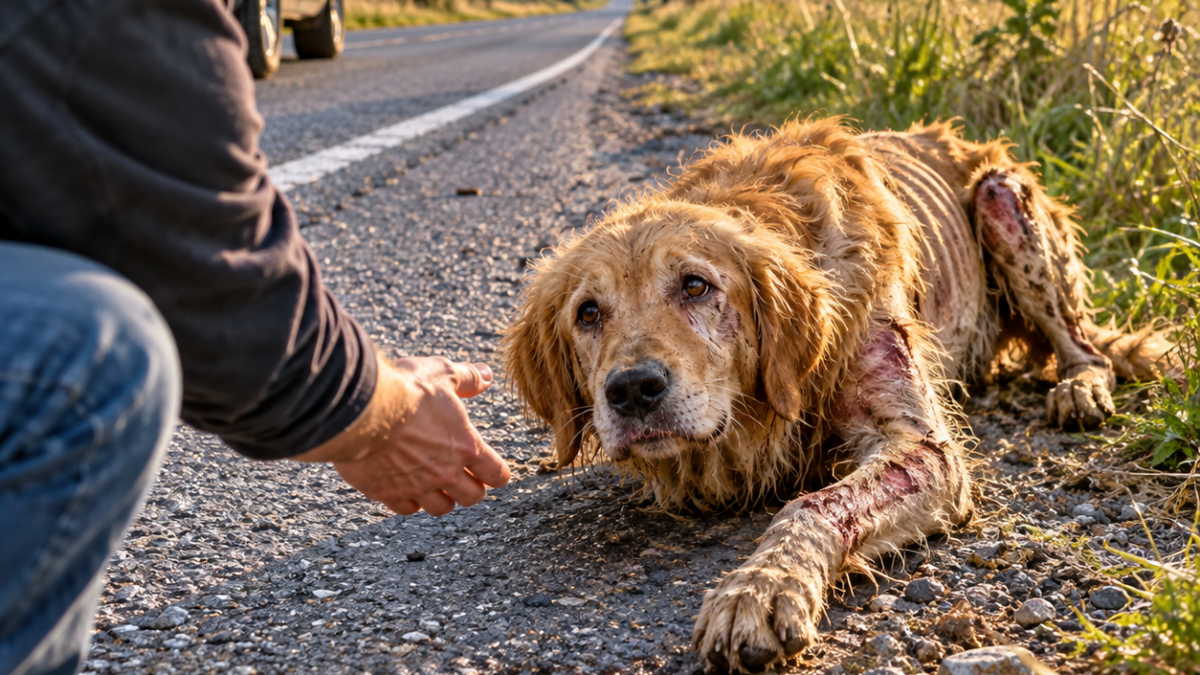
At first, I thought the movement in the tall grass was nothing more than the wind. Then a tiny, terribly wounded puppy lifted her head and began dragging herself toward my car. When I stepped onto the road and saw the condition of her body, I realized she might have only minutes left, and I had no idea whether I could save her.
The road was almost completely deserted that afternoon.
On either side, open fields stretched toward a distant line of trees. The grass had grown tall along the shoulders, bending beneath a warm breeze. There were no houses nearby, no pedestrians, and no other vehicles in sight.
I had driven that road dozens of times during my years volunteering with an animal rescue organization. I knew its potholes, its sharp curves, and the places where the gravel shoulder disappeared into drainage ditches.
But I had never noticed how lonely it could feel until that afternoon.
I was returning from a routine rescue call when something moved near the edge of the pavement.
It was such a small movement that I nearly missed it.
I slowed down, expecting to see a bird struggling in the grass or perhaps a piece of discarded fabric being blown across the ground.
Instead, I saw two thin front legs reaching forward.
Then a small head appeared above the weeds.
I pulled over immediately.
For several seconds, I remained behind the steering wheel, trying to understand what I was looking at.
The creature beside the road was a puppy, although her condition made it difficult to recognize her as one. She was terribly thin, with patches of missing fur and extensive wounds covering parts of her body. Her legs trembled so violently that every attempt to move seemed almost impossible.
She managed another few inches before collapsing.
I grabbed the clean towels I kept in the back of my vehicle and hurried toward her.
As I approached, a terrible smell reached me.
It was the unmistakable odor of infected wounds.
I stopped just a few feet away, horrified by what I saw.
The puppy’s ribs protruded sharply beneath her damaged skin. Her hips were prominent, and her stomach was hollow. Several wounds appeared old enough to have become badly infected, while others were still raw.
Flies gathered around the exposed injuries.
She was so weak that she could barely lift her head.
Yet when she noticed me standing there, she began moving again.
She dragged herself toward my shoes.
“Oh, sweetheart,” I whispered. “What happened to you?”
Her mouth opened slightly, but no sound came out.
I knelt beside her.
She did not growl or try to escape. Instead, she extended one trembling paw until it touched the toe of my shoe.
That small movement nearly broke me.
I had encountered frightened animals, aggressive animals, and animals so traumatized that they could no longer tolerate human contact.
But this puppy was different.
She seemed to have exhausted every possibility available to her. She had no strength to defend herself, nowhere to hide, and no apparent reason to believe that the stranger kneeling beside her would be kind.
Still, she had crawled toward me.
I gently placed a folded towel on the ground and spoke to her while preparing to lift her.
“You’re coming with me. I’m going to get you some help.”
Her eyes followed my hands.
When I touched her shoulder, she flinched.
I immediately withdrew my hand.
“It’s okay,” I whispered. “I know it hurts.”
I waited until she stopped trembling quite so violently, then carefully slipped the towel beneath her body.
She was frighteningly light.
For a moment, I felt as though I were lifting little more than a collection of bones.
I carried her to my vehicle, placed her on the passenger seat, and called the veterinary clinic we worked with.
“This is an emergency,” I told the receptionist. “I have a critically injured puppy. Severe wounds, obvious infection, extreme malnutrition. She’s barely responsive.”
“How far away are you?”
“About twenty minutes.”
“Bring her straight in. I’ll let the doctor know.”
I looked at the puppy.
Her head rested sideways against the towel. Her eyes were half-open, and her breathing was shallow.
“Please,” I murmured. “Just stay with me.”
I drove toward the clinic with one hand gripping the steering wheel and the other resting close enough to reassure her without touching her injured skin.
Every few seconds, I glanced at her chest.
Whenever I saw it rise, I felt a little less afraid.
Whenever she remained motionless for too long, I found myself holding my breath.
I had no idea how long she had been lying beside that road.
Her wounds suggested she had suffered for days, possibly longer. Some appeared consistent with a violent attack, but there was no way to know exactly what had happened.
Had she escaped from somewhere?
Had someone abandoned her after she became injured?
Had she been born on the streets and spent her short life trying to survive?
I could not answer any of those questions.
All I knew was that she had been alone, in terrible pain, and desperate enough to crawl toward a stranger.
The clinic doors opened before I had even switched off my engine.
A veterinary technician named Rachel hurried toward me with a stretcher.
“Is this her?”
I nodded.
Rachel looked down at the puppy, and her expression changed.
“Oh, my goodness.”
“She’s still breathing,” I said quickly.
“Okay. Let us take her.”
We carefully transferred her onto the stretcher. The puppy briefly lifted her head as the clinic doors opened, then let it fall back against the towel.
I followed the medical team inside.
The veterinarian, Dr. Harris, examined her immediately.
He checked her breathing and circulation before carefully assessing her wounds.
“She’s severely dehydrated,” he said. “And extremely underweight.”
He looked at the worst injuries.
“There’s significant infection here. We need to start treatment right away.”
“Is she going to make it?”
He did not answer immediately.
Instead, he continued examining her, gently moving her legs and checking the damaged areas of skin.
Finally, he looked at me.
“I can’t promise anything yet. She’s in very poor condition.”
I had heard those words before.
In rescue work, there are moments when the distance between hope and heartbreak becomes unbearably small.
This was one of them.
The medical team began stabilizing her. They administered fluids to address her dehydration and pain medication to ease her suffering.
Once she was stable enough for further treatment, they began cleaning her wounds.
It was a slow process.
Dirt and infected material had accumulated around several injuries. The veterinarians carefully removed what they could, examined the damaged tissue, and applied protective dressings.
I remained nearby, assisting whenever I was needed.
The puppy lay quietly through most of the procedure.
Occasionally, she tensed or tried to move away when someone touched a particularly painful area.
Each time, Rachel paused and spoke softly.
“I know, baby. We’re almost finished with this part.”
The puppy would look toward her voice, exhausted and frightened.
Then, gradually, she would settle again.
I found myself watching her face rather than her wounds.
There was something unbearably young about her eyes.
She was still a puppy, a little creature who should have been chasing leaves, tumbling over her own paws, and discovering the world through play.
Instead, she was lying beneath the harsh lights of a treatment room, fighting an infection that had already stolen most of her strength.
As the medical team worked, I thought about the moment I had first seen her struggling through the grass.
What if I had been driving a little faster?
What if I had mistaken her movement for something else?
What if I had passed that stretch of road ten minutes earlier?
I forced myself to stop thinking about those questions.
She was here now.
That was what mattered.
When the initial treatment was finished, the staff prepared a quiet recovery space with clean bedding and warm blankets.
The puppy was too weak to stand.
Rachel settled her carefully onto a soft towel.
“Does she have a name?” she asked.
I shook my head.
“I found her beside the road. There was no collar, and I haven’t found anyone who knows her.”
Rachel looked down at her.
“She deserves one.”
I studied the puppy’s small face.
“Tika,” I said.
Rachel smiled faintly.
“Tika?”
I nodded.
“Something short and gentle.”
At the sound of our voices, the puppy opened her eyes.
“Hello, Tika,” Rachel whispered.
Her ears moved slightly.
It was the first time I had seen anything resembling curiosity in her expression.
I stayed at the clinic much longer than I had intended.
There was paperwork to complete, rescue arrangements to make, and a treatment plan to organize. But even after everything practical had been handled, I could not bring myself to leave.
I sat beside Tika’s recovery area while she rested.
Her breathing had become a little steadier.
Occasionally, she opened her eyes and looked toward me.
“I’m still here,” I told her.
She closed them again.
I wondered whether she understood that the danger outside had passed.
Perhaps she was too exhausted to recognize the difference between the cold roadside and the warm bedding beneath her.
Perhaps she was still expecting to be hurt.
Or perhaps, for the first time in days, she was simply able to sleep.
As evening approached, Dr. Harris returned to examine her.
“How is she doing?” I asked.
“She’s responding to treatment, but she’s still critical. The next few days will tell us a lot.”
He checked her bandages.
“Her body is severely depleted. We have to rebuild her strength gradually while controlling the infection.”
“She tried so hard to reach me,” I said.
He glanced up.
“What do you mean?”
I described how I had found her crawling along the road.
For a moment, he said nothing.
Then he gently adjusted the blanket near her paws.
“Well,” he said quietly, “now it’s our turn to do the hard work.”
I went home that night, but I barely slept.
Every time I closed my eyes, I saw Tika struggling through the tall grass.
I remembered her trembling paw touching my shoe.
I remembered the terrible lightness of her body when I lifted her.
And I remembered the way she had looked at me as though she had used the last of her strength to reach someone who might help.
The following morning, I returned to the clinic before my usual volunteer shift.
Rachel met me near the entrance.
“She’s still with us.”
I had not realized how tightly I was holding my breath until she said those words.
“Has she eaten?”
“A little. We’re being careful.”
“Did she sleep?”
“Some. She’s exhausted.”
I hurried toward her recovery area.
Tika was lying on her side, wrapped in clean blankets. Her bandages were still in place, and she looked almost impossibly small against the bedding.
But when I approached, one of her ears twitched.
“Good morning, sweetheart.”
She opened her eyes.
For several seconds, she simply stared at me.
Then her tail moved.
It was barely noticeable.
One tiny movement against the towel.
But I saw it.
“Rachel,” I called softly. “Did you see that?”
She came over.
“What?”
“Her tail.”
Rachel leaned closer.
Tika’s tail moved again.
Rachel grinned.
“Well, hello there, little girl.”
I laughed, although my eyes were already filling with tears.
It was such a small thing.
A movement most people would never notice.
But the previous afternoon, I had carried a nearly lifeless puppy out of a ditch.
Now she was greeting us.
I knew better than to mistake that moment for a guarantee.
Tika still had severe injuries, an infection to overcome, and a dangerously weakened body.
Her recovery would not happen overnight.
But that little movement gave me something I had desperately needed.
It gave me hope.
Over the following days, my schedule began revolving around Tika.
I visited whenever I could, helped prepare her bedding, and sat beside her during the quieter hours of the afternoon.
Rachel and the veterinary team handled her medical treatment, carefully monitoring her wounds and adjusting her care as needed.
Feeding was especially important.
Tika was desperately hungry, but her body had been deprived of adequate nourishment for so long that she could not safely return to normal meals immediately.
We began with small portions under veterinary supervision.
The first time I offered her food, she stared at the bowl without moving.
I wondered whether she was too exhausted to eat.
Then she slowly lifted her head and began licking.
She ate with the cautious urgency of an animal who did not know when another meal would come.
When the small portion was finished, she searched the bowl.
“It’s okay,” I whispered. “There will be more.”
She looked up at me.
I wished I could explain that she would never have to search for food along that road again.
I wished I could tell her that the next meal was already planned, that clean water would always be available, and that she no longer had to spend every waking moment fighting for survival.
But those were human promises.
Tika would have to discover their meaning through experience.
So I stayed beside her while she rested.
And when the time came, I brought her another carefully measured meal.
Each day followed a routine of medical examinations, wound care, food, rest, and gentle reassurance.
Some days, Tika appeared a little brighter.
Other days, she seemed almost as exhausted as she had been when I found her.
Her body was doing an enormous amount of work.
Injured skin had to heal. Infection had to be controlled. Her weakened muscles needed nourishment, and her immune system needed time to recover.
There were mornings when she could barely keep her eyes open.
There were afternoons when a difficult bandage change left her too tired to respond to my voice.
And there were nights when I went home wondering whether the progress I had seen that morning would still be there when I returned.
One afternoon, I arrived to find Rachel changing Tika’s bedding.
The puppy was awake, but she was unusually quiet.
“She’s had a difficult morning,” Rachel told me.
I immediately felt a knot forming in my stomach.
“What’s wrong?”
“She’s tired. Some of the wounds are still causing problems, and the doctor is keeping a close eye on them.”
I knelt beside her.
“Hey, little girl.”
Tika turned her head toward me.
Her eyes were dull with exhaustion.
I placed my hand on the clean towel beside her, allowing her to approach if she wanted contact.
For a moment, she did nothing.
Then she shifted her head until her chin rested against my fingers.
I sat there for nearly an hour.
I did not talk much.
There are moments when words feel inadequate, especially when the creature you are trying to comfort cannot understand them.
Instead, I remained still and let her rest.
Occasionally, her eyes opened to check whether I was still there.
Each time, I gently moved my fingers.
Eventually, she fell asleep.
That afternoon taught me something important about her recovery.
Tika did not need every day to be extraordinary.
She did not need to surprise us with dramatic improvements or prove how determined she was.
She had already struggled more than any puppy should have to struggle.
What she needed now was the freedom to heal at her own pace.
And that meant accepting difficult days without treating them as failures.
As the first week passed, the medical team began noticing more encouraging changes.
Her hydration improved.
Her breathing became steadier.
She started showing greater interest in her surroundings.
When someone entered the recovery room, she sometimes lifted her head to see who it was.
She developed a particular interest in Rachel, whose voice she seemed to recognize.
Whenever Rachel approached with food, Tika’s ears would rise.
“Someone knows what time it is,” Rachel would say.
Tika would stare at her with intense concentration.
“Yes, yes. I’m coming.”
Watching those small exchanges brought a warmth to the clinic that had been missing during Tika’s first desperate hours.
The puppy who had been too weak to lift her head was beginning to participate in the world again.
One morning, I found her sitting up.
I stopped in the doorway.
Rachel was kneeling beside the recovery area, smiling.
“Look who’s waiting for you.”
Tika sat awkwardly on her bedding, her front paws spread slightly for balance.
Her bandages made her look even smaller.
But she was sitting.
By herself.
“Tika?”
Her head turned toward my voice.
For an instant, she seemed almost surprised to see me.
Then her tail began moving against the blanket.
I crouched beside her.
“Would you look at you?”
She leaned forward as though she wanted to come closer.
“Easy, sweetheart.”
I placed my hand near her chest to prevent her from losing her balance.
She settled against me with a tiny sigh.
I could feel her breathing through the towel between us.
Her body was still thin, and several wounds still needed careful attention, but there was more substance to her than there had been when I first carried her inside.
She was beginning to feel like a puppy rather than a collection of injuries.
That afternoon, Dr. Harris examined her and allowed himself a small smile.
“She’s making progress.”
I had waited a long time to hear those words.
“Real progress?”
“Yes. We still have a way to go, but she’s moving in the right direction.”
I looked down at Tika.
She was trying to investigate the cuff of his sleeve.
He gently moved his hand away before she could nibble it.
“Apparently, she’s also developing opinions.”
I laughed.
It was the first time I had laughed without immediately feeling afraid for her.
The following weeks brought changes I had once been afraid to imagine.
Tika began spending more time awake.
She became interested in the sounds outside her recovery area.
She watched people move through the clinic and followed them with her eyes.
Sometimes, when I arrived, she would lift her head before I spoke.
I liked to believe she recognized my footsteps.
One afternoon, Rachel told me she had something to show me.
She helped Tika into a comfortable position on the floor, where a clean mat provided a stable surface.
The puppy looked around uncertainly.
“Come here, little girl,” Rachel encouraged.
Tika placed her front paws beneath her chest.
Her hind legs trembled.
She pushed upward.
For one brief moment, she stood.
Then her legs gave way, and Rachel gently supported her back onto the mat.
I stared at her.
“She did it.”
Rachel nodded.
“She did.”
Tika looked mildly offended by the entire experience.
I laughed and stroked an uninjured spot behind her ear.
“That was incredible.”
She leaned into my hand.
We did not make her try again immediately.
Her body was still rebuilding strength, and the medical team was careful not to rush her.
But that first attempt marked another important step.
She had spent so long lying down that standing was no longer a simple movement.
Her muscles needed time to recover.
Her injured skin needed to tolerate movement.
Her confidence had to grow alongside her physical strength.
Over the next several days, she began standing for slightly longer periods.
Sometimes she managed only a few seconds.
Sometimes she took a step and immediately sat down.
We celebrated quietly, careful not to overwhelm her.
The first time she walked toward me without assistance, I nearly forgot how to speak.
I was sitting on the floor a short distance away.
Rachel had encouraged Tika to stand, and the little puppy was looking around as though deciding what to do next.
I held out my hand.
“Come on, sweetheart.”
She took one uncertain step.
Then another.
Her legs trembled, but she kept moving.
When she finally reached me, she pressed her head against my knee and sat down.
I wrapped my arms around her carefully, avoiding the areas that were still healing.
“Oh, Tika.”
My voice broke.
Rachel was watching from the doorway.
“You’re crying.”
“I know.”
“She’s going to think every walk deserves applause.”
I looked down at the puppy resting against me.
“Every walk she takes absolutely does.”
Rachel smiled.
For the first time, I allowed myself to imagine Tika running.
Not struggling across broken pavement.
Not crawling through grass with infected wounds.
Running simply because she wanted to.
Running toward someone she loved, with no fear of being left behind.
That image stayed with me through the remainder of her recovery.
Gradually, the most serious wounds began to close.
The raw areas of damaged skin were replaced by new tissue, and her dressings became smaller as the veterinarian determined they were no longer needed.
Some areas healed more slowly than others.
Some left visible scars.
But the smell of infection that had surrounded her on the roadside disappeared.
Her coat began recovering where the damage allowed new fur to grow.
With regular meals and veterinary supervision, she gained weight.
The sharp outline of her ribs softened.
Her face became fuller.
And her eyes, once clouded by pain and exhaustion, developed a lively curiosity that seemed to grow stronger every day.
One morning, I brought her a small soft toy.
It was nothing elaborate, just a washable stuffed animal that was safe for her to investigate.
I placed it on the floor in front of her.
Tika stared at it.
Then she looked at me.
“Go ahead.”
She leaned forward and sniffed it.
Nothing happened.
She sniffed it again.
Then she reached out one paw and tapped it.
The toy rolled slightly.
Tika jumped backward.
Rachel, who had been watching from behind me, covered her mouth to hide a laugh.
“She’s never seen anything like it.”
Tika approached the toy again, this time with greater confidence.
She sniffed its ears, investigated its legs, and finally took one corner gently between her teeth.
When I moved it slightly, she gave a startled little hop.
Then, for the first time since I had found her, she began to play.
Not for long.
She still tired easily, and after only a few minutes, she settled onto the mat with the toy between her paws.
But I sat beside her, smiling so broadly that my cheeks hurt.
A puppy should have toys.
It seemed like such an ordinary statement.
Yet I could not stop thinking about everything that ordinary statement represented.
Tika was beginning to experience a life that involved something other than suffering.
She could explore without searching for food.
She could sleep without struggling to remain alert.
She could approach people without immediately expecting pain.
And now, she could play.
Her personality began emerging in unexpected ways.
She was affectionate but not demanding.
Curious but cautious.
She preferred approaching new things slowly, investigating them thoroughly before deciding whether they deserved her attention.
She developed a habit of following Rachel around the recovery room whenever she was allowed to walk.
If Rachel stopped, Tika stopped.
If Rachel turned, Tika turned.
If Rachel disappeared behind a door, Tika waited.
One afternoon, I found her sitting directly outside the small storage room where Rachel kept the clean towels.
“What are you doing there?” I asked.
Tika looked up at me.
From inside the storage room, Rachel called, “She’s supervising.”
A moment later, Rachel emerged carrying fresh bedding.
Tika immediately stood and followed her.
I watched them cross the room together.
There had been a time when Tika could not have followed anyone.
Now she appeared personally responsible for ensuring that Rachel completed her duties.
It was wonderful.
But beneath the laughter and the daily improvements, I remained aware of something that frightened me.
Eventually, Tika would have to leave.
At first, that thought had seemed impossibly distant.
When I brought her into the clinic, I had been concerned with keeping her alive through the next hour.
Then the next night.
Then the next week.
I had measured her progress in breaths, meals, and small movements.
But now she was growing stronger.
Her wounds were healing.
She was walking, eating, playing, and learning to trust.
Soon, she would be ready for a permanent home.
That was what we wanted.
It was what every rescue volunteer hoped to achieve.
And yet, when I imagined the day she would leave, I felt an unexpected ache.
I had become accustomed to seeing her every morning.
I knew the way she tilted her head when she heard an unfamiliar sound.
I knew how she preferred to sleep with her front paws stretched out in front of her.
I knew that she liked gentle scratches behind her ears and became impatient whenever Rachel prepared her food.
Most importantly, I knew how far she had come.
I had seen her at her lowest.
I had carried her when she could not carry herself.
And somewhere along the way, the puppy I had found dying beside the road had become an important part of my life.
I mentioned my feelings to Rachel one afternoon.
We were watching Tika investigate a corner of the recovery room.
“She’s going to be ready soon,” I said.
Rachel glanced at me.
“For adoption?”
I nodded.
“That’s the goal.”
“I know.”
She studied my expression.
“You’re going to miss her.”
“More than I expected.”
Rachel looked toward Tika.
The puppy had discovered a loose corner of her blanket and was attempting to drag it across the floor.
“Of course you are,” Rachel said.
I smiled faintly.
“I just keep remembering how she looked when I found her.”
Rachel was quiet for a moment.
Then she said, “That’s why it’s going to mean so much when she leaves here healthy.”
I knew she was right.
Still, I wondered how I would manage to hand Tika over to people I had never met.
The answer came sooner than I expected.
A family contacted the rescue organization after learning about her.
They had heard how she had been found and followed the updates about her recovery. They wanted to meet her and discuss whether they could offer her a permanent home.
I read their message several times.
They asked thoughtful questions about her medical needs, her temperament, and what kind of environment would help her continue recovering.
They wanted to know whether she was comfortable around people, how she handled unfamiliar places, and whether she would need additional care after leaving the clinic.
There was nothing extraordinary about those questions.
But after everything Tika had endured, their concern mattered deeply to me.
I wanted her new family to understand that she was not simply an inspiring rescue story.
She was a living animal with needs, preferences, fears, and an entire future ahead of her.
Her scars might be visible long after her wounds had healed.
She might need patience in unfamiliar situations.
She deserved people who would love her when she was energetic and playful, but also when she was frightened, tired, or uncertain.
We arranged a meeting.
On the morning of their visit, I arrived early.
Tika was curled up on her bedding, sleeping with her nose tucked beneath one paw.
When I entered, she lifted her head.
“Good morning, beautiful.”
Her tail began moving.
I sat beside her.
“Someone special is coming to meet you today.”
She stretched, yawned, and rolled onto her side.
I laughed.
“Clearly, you’re very concerned about making a good impression.”
She reached out one paw and rested it against my knee.
I gently rubbed the fur behind her ear.
For a while, we stayed like that.
I thought about the lonely road where I had found her.
The tall grass.
The terrible smell of infection.
The small, trembling body dragging itself toward me.
Then I looked at the healthy, curious puppy resting beside my leg.
Her scars were still visible in places, but they no longer dominated her appearance.
Her eyes were bright.
Her breathing was comfortable.
She was no longer fighting simply to survive.
She was preparing to begin a life.
When the family arrived, I felt an unreasonable surge of nervousness.
What if Tika became frightened?
What if they were disappointed by her scars?
What if they decided that her history was too complicated?
I had met many compassionate adopters over the years, but I suddenly found myself examining every possible reason this meeting might go wrong.
Rachel noticed.
“You’re pacing,” she whispered.
“I am not.”
She glanced pointedly at my feet.
I stopped.
“Fine. Maybe a little.”
She smiled.
“Give them a chance to meet her.”
I took a breath and opened the door.
The family entered quietly.
They did not rush toward Tika or overwhelm her with attention.
Instead, they sat down and allowed her to approach.
At first, she remained close to my legs.
She watched the visitors carefully, her ears lifted and her tail moving in slow, uncertain motions.
One of the adults extended an open hand.
“Hello, Tika.”
The puppy leaned forward.
She sniffed the offered fingers.
Then she took one cautious step closer.
I watched without speaking.
After another moment, Tika approached fully and allowed herself to be stroked.
Her tail began moving faster.
The family smiled.
“She’s even sweeter than we imagined,” one of them said.
I felt some of the tension leave my shoulders.
They asked about her recovery.
I explained how she had been found, how serious her condition had been, and how carefully the veterinary team had treated her wounds and malnutrition.
I told them about her first attempts to stand.
About her determination to follow Rachel through the clinic.
About the morning she discovered her first toy.
And about the way she had gradually transformed from a frightened, exhausted puppy into a gentle little dog who seemed fascinated by everything around her.
They listened.
They asked questions.
They did not look away when I described the difficult parts.
At one point, Tika moved closer to the person sitting nearest her and rested her head against their leg.
The room became very quiet.
A hand gently stroked her head.
“Poor little sweetheart,” the person murmured.
Tika closed her eyes.
Something in my chest tightened.
I had spent weeks watching her learn that human hands could bring comfort instead of pain.
Now she was offering that trust to someone new.
And the person receiving it seemed to understand how precious it was.
The meeting lasted much longer than any of us had expected.
Tika explored the visitors’ shoes, investigated their clothing, and eventually settled between them as though she had known them for years.
They discussed her ongoing needs with the rescue staff and made it clear that they were prepared to continue giving her the care she required.
When they finally stood to leave, Tika followed them toward the door.
I looked at Rachel.
She looked back at me.
Neither of us said anything.
We did not need to.
The family had found their dog.
And Tika had found the people who would give her the permanent home she deserved.
The adoption arrangements were completed soon afterward.
As the day of her departure approached, I found myself experiencing two emotions that seemed impossible to reconcile.
I was overjoyed.
And I was heartbroken.
I had always understood that rescue work involved saying goodbye.
The purpose was not to keep every animal we saved.
It was to help them reach a place where they would never need rescuing again.
But knowing that did not make the farewell easy.
On Tika’s final morning at the clinic, I arrived carrying the soft toy she had learned to play with.
She greeted me with her usual enthusiastic tail wag.
“Look what I brought.”
She immediately recognized the toy.
Her ears rose, and she hurried toward me.
I placed it on the floor.
She picked it up and shook it gently.
I sat beside her, laughing.
“That’s yours, sweetheart. You’re taking it home.”
She dropped it beside my knee and looked up at me.
I rubbed her head.
There were so many things I wanted to tell her.
I wanted to tell her that she would have a warm place to sleep.
That her family would prepare meals for her.
That she would have toys, affection, and people who would notice whenever she was frightened or unwell.
I wanted to tell her that she would no longer have to drag herself toward strangers in the hope that one of them might care.
But most of all, I wanted her to understand that she had not been rescued simply so we could celebrate her recovery.
She had been rescued because her life mattered.
Because she deserved to experience the ordinary happiness that had been denied to her.
Because somewhere beyond the walls of the clinic, an entirely different future was waiting.
When her family arrived, Tika recognized them almost immediately.
Her tail began wagging.
She walked toward them with growing excitement, pausing only long enough to glance back at me.
“Go ahead,” I whispered.
She continued forward.
Her new family knelt to greet her.
They had brought a comfortable carrier, a soft blanket, and everything needed to take her home safely.
We reviewed her care instructions and discussed the importance of continuing to monitor her health.
Then came the moment I had been anticipating and dreading.
It was time for her to leave.
I knelt beside her one last time.
She approached me with the quiet confidence that had become so familiar.
I gently held her face between my hands.
“Do you remember me, little girl?”
She licked my fingers.
I laughed through my tears.
“Of course you do.”
I stroked her head.
“You’re going to have such a wonderful life.”
She leaned against me.
For a few seconds, I closed my eyes.
I remembered the weight of her fragile body when I first lifted her.
I remembered the uncertainty of those first nights.
I remembered the tiny movement of her tail when she recognized my voice.
And I remembered the first time she walked toward me without assistance.
Every difficult moment had led to this one.
When I opened my eyes, her family was waiting patiently.
I kissed the top of her head.
“Be happy, Tika.”
Then I stood and stepped aside.
She walked toward her new family.
They settled her comfortably for the journey and placed her favorite toy beside her.
As they prepared to leave, Tika looked back through the open door.
For one brief moment, our eyes met.
I raised my hand.
“Goodbye, sweetheart.”
Then she was gone.
I stood outside the clinic long after the vehicle disappeared.
Rachel eventually came to stand beside me.
“How are you doing?”
I wiped my cheeks.
“I knew this part was coming.”
“That doesn’t make it easy.”
I shook my head.
“No.”
She looked toward the road.
“But she gets to go home.”
I smiled.
“She gets to go home.”
Those words stayed with me throughout the day.
Home.
Such a simple word.
For most people, it means a familiar doorway, a comfortable bed, and the security of knowing someone will be there when they return.
For Tika, it meant something even more profound.
It meant the end of being alone.
It meant that the next time she felt hungry, someone would feed her.
The next time she became frightened, someone would comfort her.
And the next time she fell asleep, she would not have to worry about waking up beside an empty road.
The clinic felt unusually quiet after she left.
I passed her recovery area several times that afternoon.
The clean bedding had been removed, and the space was being prepared for another animal who needed help.
For a moment, I felt the familiar ache of missing her.
Then I remembered the way she had walked toward her new family.
Not crawling.
Not trembling.
Walking with her head lifted and her tail wagging.
I knew then that we had given her the one thing I had desperately hoped she would have when I first carried her away from that field.
A future.
In the weeks that followed, her new family sent updates.
Tika had settled into her home.
She was eating well, enjoying her toys, and becoming increasingly comfortable in her new surroundings.
She had discovered the pleasures of soft blankets and long naps.
She loved spending time with her family and had developed an affectionate habit of staying close whenever someone sat down.
The photographs were almost impossible to reconcile with my memories of the puppy I had found beside the road.
In one, she was resting comfortably on a soft bed.
In another, she was exploring her new surroundings with bright, curious eyes.
And in my favorite photograph, she was looking directly at the camera, her mouth slightly open and her tail blurred from movement.
She looked happy.
Not merely safe.
Happy.
I stared at that picture for a long time.
Then I placed it beside the first photograph we had taken of her at the clinic.
The difference was extraordinary.
In the first image, she was lying motionless beneath a blanket, her wounds covered with fresh bandages.
Her eyes were exhausted.
Her body looked unbearably fragile.
In the second, she was alert and confident, surrounded by the comfort of her new home.
Her scars remained, but they were no longer the first thing I noticed.
I noticed her expression.
The softness around her eyes.
The way she appeared completely at ease.
I thought about everything that had happened between those two photographs.
The hours of medical treatment.
The careful feeding.
The difficult bandage changes.
The uncertain nights.
The first movement of her tail.
The first time she sat up.
The first shaky steps.
The day she discovered how to play.
And the moment she had approached the family who would eventually take her home.
None of those moments had happened quickly.
Recovery had required patience, compassion, and the dedicated work of people who refused to abandon her when her condition seemed almost hopeless.
But Tika had contributed something essential, too.
She had kept moving when every movement seemed impossible.
She had endured treatment when she was frightened and exhausted.
She had gradually learned to trust again.
And when the opportunity finally arrived, she had embraced her new life with the same gentle curiosity that had emerged during her recovery.
I returned to the road where I had found her several weeks later.
The grass had grown taller, and the fields were beginning to change with the season.
I pulled over in approximately the same place and stepped out of my vehicle.
For a moment, I stood beside the shoulder, looking toward the ditch.
It was an ordinary stretch of road.
There was nothing to indicate that a tiny puppy had once struggled there, desperately dragging herself toward passing vehicles.
Cars occasionally drove by without slowing.
The breeze moved through the grass.
Life continued.
I walked a few steps along the shoulder and stopped.
I remembered seeing Tika’s small head emerge above the weeds.
I remembered the way she had reached toward my shoe.
And I remembered how frightened I had been when I realized the extent of her injuries.
At the time, I had not known whether she would survive the drive to the clinic.
I certainly had not imagined that one day I would receive photographs of her sleeping peacefully in a home filled with people who loved her.
Yet that was exactly what had happened.
I stood there for several minutes before returning to my car.
As I drove away, I thought about the first promise I had made to her.
I had told her I was going to get her help.
I had not known whether I could keep that promise.
But I had been able to carry her away from the road.
And with the dedication of the veterinary team, the patience of her caregivers, and the love of her new family, that single act had become the beginning of an entirely different life.
Tika would always have scars.
Some of the damage caused by her suffering would remain visible long after the memories of the clinic had faded.
But those scars were only one part of her story.
They did not describe the puppy who had learned to play with her first toy.
They did not capture the excitement in her tail when she recognized the people who cared for her.
And they could never explain the happiness she had discovered after finding her permanent home.
Months earlier, she had been a tiny, desperately injured puppy crawling through the grass because she had nowhere else to go.
Now she was a beloved member of a family, surrounded by warmth, comfort, and affection.
She had food when she was hungry.
She had a soft place to rest when she was tired.
And whenever she wanted companionship, there was someone waiting to welcome her.
The last photograph her family sent showed Tika sleeping peacefully, curled beneath a blanket with her favorite toy nearby.
Her eyes were closed.
Her body was relaxed.
She looked completely untroubled by the world around her.
I smiled when I saw it.
Because the puppy I had once begged to keep breathing no longer had to struggle through every moment of her life.
For the first time, Tika had something far more precious than survival.
She had a home where she could finally rest, knowing that when she opened her eyes, she would still be loved.








