𝗣𝗔𝗥𝗧 𝟮 HOA Used My Valley Free for 22 Years—So I Hit Them With a $3.6 Million Back-Rent Judgment
𝗣𝗔𝗥𝗧 𝟮
That evening, I carried three old file boxes into the kitchen.
My father kept everything.
Tax statements.
Insurance records.
Receipts for fence wire from 1998.
A tractor manual written for a machine we had sold before I finished high school.
My mother used to complain that he threw away nothing.
That night, I silently thanked him for it.
I started with the obvious documents.
Deed.
County plat.
Property tax history.
No transfer.
No HOA ownership.
No permanent easement.
Then, near the bottom of the second box, I found a manila envelope marked:
CREST VIEW – 2004.
Inside was a document.
Not a deed.
Not an easement.
A license.
More specifically:
REVOCABLE COMMERCIAL LAND USE LICENSE.
I sat down.
The agreement had been signed in 2004, when Crest View Ridge was expanding.
It gave the HOA limited permission to use two defined routes across Red Hollow.
Purpose one: installation and maintenance of drainage infrastructure.
Purpose two: storage of a specified amount of maintenance equipment.
Purpose three: limited operational access connected to subdivision upkeep.
There it was.
The roads.
The pipes.
The equipment yard.
Everything Lorraine had waved around as proof of ownership had started as permission.
Then I found the payment section.
My father had not given them the land for free.
The HOA agreed to pay an annual license fee.
That fee adjusted according to:
Acreage used.
Intensity of use.
Land values.
Additional operational footprint.
I read it again.
Then I reached the second page.
One paragraph was underlined.
I do not know whether my father had done it or the attorney who drafted the agreement.
The language was unusually clear.
Continued use of the licensed premises did not create ownership.
It did not create a prescriptive easement.
It did not create adverse possession rights.
It did not matter how long the use continued.
Permission remained permission.
I leaned back.
Lorraine had spent that afternoon arguing that twenty-two years of use had transformed Crest View Ridge into the practical owner.
Somebody in 2004 had predicted exactly that argument.
Then prevented it.
I kept searching.
That was when things became almost funny.
There was an acknowledgment dated 2008.
Signed by a Crest View Ridge president.
It stated that the association continued using Red Hollow under the 2004 license and asserted no ownership.
Another from 2014.
Same thing.
Another from two years earlier.
Same thing.
Different board.
Different signatures.
Same admission.
For twenty-two years, Crest View Ridge had periodically signed documents confirming:
We are using someone else’s land.
We know we do not own it.
We know continued use does not make it ours.
And Lorraine had just arrived at my gate telling me the opposite.
I called Amelia Rowan.
Amelia was a real estate litigation attorney I had worked with years earlier.
It was nearly nine at night.
She answered anyway.
“This better involve land or money.”
“Both.”
“Go ahead.”
I read her the license language.
Then the acknowledgment clause.
Then the payment formula.
She went quiet.
“How many years?”
“Twenty-two.”
“Have they paid?”
“I don’t know yet.”
“Do not evict them.”
That surprised me.
“They’re on my property.”
“I heard you.”
“They cut roads across it.”
“I heard that too.”
“You don’t think I should revoke the license?”
“Not yet.”
“Why?”
“Because if I’m hearing this correctly, removing them may be the cheapest outcome available to them.”
That got my attention.
The next morning, I scanned everything.
Amelia verified the recording number.
The license had been filed properly with the county in 2004.
That mattered.
It meant Crest View Ridge could not credibly say the document had been hidden in my father’s private files.
It was public.
Recorded.
Searchable.
Anyone doing a competent title review could have found it.
Including Lorraine.
Especially Lorraine.
Amelia spent most of the day reviewing it.
Then she called.
“It’s real.”
“I assumed.”
“I don’t assume anything once litigation starts.”
“Fair.”
“The payment clause is enforceable on its face.”
“How much?”
“Too early.”
“Ballpark.”
“No.”
“Amelia.”
“Mason, if I give you a number now, you’ll fall in love with it. Then I’ll have to kill your favorite number later.”
“I hate when lawyers become philosophical.”
“You called me.”
She told me to gather everything connected to HOA use.
Current roads.
Equipment.
Drainage area.
Contractor routes.
Photographs.
Dates.
Expansion history.
Then we sent a formal request to Crest View Ridge.
It was deliberately boring.
No accusations.
No dramatic threats.
We asked the board to:
Stop expanding its use.
Provide a full accounting.
Disclose financial records tied to Red Hollow.
Identify the legal basis for continued occupancy.
Preserve all related documents.
I sent it certified.
Lorraine responded publicly.
Two days later, flyers appeared around Crest View Ridge announcing an emergency homeowner meeting.
The subject:
HOSTILE LAND CLAIM AGAINST COMMUNITY INFRASTRUCTURE.
That was efficient.
I had gone from landowner to hostile outsider in forty-eight hours.
Amelia sent me a photograph of the notice.
“You going?”
“No.”
“Good.”
“Why?”
“Because nothing useful happens when sixty angry homeowners are encouraged to believe you’re stealing something they never owned.”
The meeting drew around sixty residents.
I obtained the audio later.
Lorraine stood at the front and told them Red Hollow had served Crest View Ridge for more than two decades.
True.
She said the valley had become essential community infrastructure.
Probably true.
She said no single landowner could suddenly undo that arrangement.
Less true.
Then she called my request extortion.
That was almost flattering.
I had not even sent a number yet.
Three days later, Lorraine made her first truly serious mistake.
She sent maintenance crews to cut my lock.
I happened to be near the house when they arrived.
Two workers.
HOA pickup.
Bolt cutters.
I stayed back.
I turned on my phone.
The video showed everything.
The truck entering.
The workers getting out.
The new sign.
The lock.
One man cutting it.
The broken lock landing on the gravel.
The gate opening.
HOA vehicles driving through.
I did not confront them.
I did not yell.
I did not touch anyone.
I sent the video to Amelia.
No commentary.
She replied eleven minutes later.
That helps.
The following morning, Crest View Ridge received a formal notice of unauthorized commercial occupancy.
The video was attached.
Lorraine called me that evening.
“You will never see a dollar from this association.”
I was standing in my kitchen.
“I haven’t asked you for a dollar yet.”
“I know exactly what this is.”
“Do you?”
“You’re trying to profit from land we improved.”
“Lorraine.”
“What?”
“Why have you been charging residents a valley access fee?”
Silence.
It was short.
Maybe four seconds.
But four seconds is an eternity when someone usually answers everything instantly.
“What are you talking about?”
“The valley access and infrastructure fee.”
“That is an internal association matter.”
“So it exists.”
“It covers community services.”
“Services performed on my land.”
No answer.
“How long have you been charging it?”
“That is none of your concern.”
“It became my concern when you started charging residents for access to property you say has no rental value.”
She hung up.
That phone call changed the case.
I had found the fee schedule earlier that day.
Old HOA records were available through archived homeowner portals.
One line appeared repeatedly.
VALLEY ACCESS AND INFRASTRUCTURE FEE.
Charged per adult homeowner.
Year after year.
Crest View Ridge had been collecting money based on use of Red Hollow.
Residents paid the association.
The association used my land.
My family received nothing.
Within hours of my call with Lorraine, the online fee schedule changed.
The valley line disappeared.
Too late.
I had already downloaded it.
Timestamp and all.
Amelia called after reviewing both versions.
“That was stupid.”
“Removing it?”
“Removing it after you asked about it.”
“Maybe they were updating the website.”
“Maybe I’m six foot seven.”
“You’re not.”
“Exactly.”
Lorraine brought in Patrick Hensley.
Patrick had handled routine Crest View Ridge legal work for years.
He sent a formal demand.
It was much more polished than Lorraine’s folder.
The HOA claimed it had acquired a prescriptive easement through twenty-two years of continuous use.
It demanded:
Removal of my gate.
Unrestricted HOA access.
Formal recognition of permanent easement rights.
And reimbursement of more than $900,000 for “improvements” Crest View Ridge had made to Red Hollow.
I read the letter.
Then called Amelia.
“Should I panic now?”
“No.”
“He sounds expensive.”
“He is.”
“Prescriptive easement?”
“Probably dead.”
“Probably?”
“I’m a lawyer. We enjoy conditional language.”
“Explain.”
“Prescriptive use generally requires use adverse to the owner. Without permission.”
“Right.”
“You have a recorded license.”
“Yes.”
“You also have twenty-two years of acknowledgments confirming permission.”
“Yes.”
“So their position is essentially: we gained rights by using land without permission, while repeatedly signing documents saying we were using it with permission.”
“That sounds bad.”
“It’s not ideal.”
Nolan found something even better.
Three years earlier, Crest View Ridge had submitted a site plan to the county planning department.
One portion of Red Hollow was labeled:
PRIVATE PROPERTY – TEMPORARY LICENSE AREA.
Their own filing.
Their own map.
Their own label.
Patrick had not seen it.
That became obvious.
His next letter was less aggressive.
Still firm.
But less theatrical.
Lorraine, meanwhile, apparently believed litigation worked like a staring contest.
She kept using the land.
So Amelia filed suit.
Then we asked for discovery.
Twenty-two years of financial records tied to Red Hollow.
Patrick objected.
He argued the dispute was about access, not accounting.
Judge Margaret Keane disagreed.
Her reasoning was simple.
If Crest View Ridge wanted to rely on twenty-two years of use, then the nature of those twenty-two years mattered.
Financial records could show whether the parties treated the relationship as ownership, permission, rent, or something else.
The HOA had invoked history.
Judge Keane let us read it.
Boxes began arriving at Amelia’s office.
Ledgers.
Old board minutes.
Fee schedules.
Budgets.
Contracts.
Maintenance invoices.
Consultant reports.
Insurance records.
Twenty-two years of institutional memory.
Most of it boring.
Some of it devastating.
We hired Brian Whitlock.
Brian specialized in commercial land-use valuation.
He spent nearly three weeks breaking Red Hollow into categories.
Service roads.
Drainage corridor.
Storage yard.
Contractor access.
Operational staging.
Affected acreage.
Then he reconstructed the original 2004 fee formula year by year.
Historical land values.
Usage changes.
Additional acreage.
Commercial rates.
He did not produce a number quickly.
That reassured me.
People who produce giant numbers quickly usually want something.
Brian wanted his math right.
Eventually, Amelia called me into the conference room.
Brian sat at one end of the table.
Spreadsheet open.
Stacks of comparables beside him.
He turned the screen.
“Base unpaid license obligation.”
I looked.
$2,640,000.
I said nothing.
Then he switched tabs.
“Interest under the agreement.”
$960,000.
I looked at Amelia.
She nodded.
Brian spoke again.
“Combined exposure based on our calculation: approximately $3.6 million.”
I leaned back.
“That can’t be right.”
Brian did not look offended.
“Good.”
“Good?”
“You should question it.”
He walked me through every year.
The early years were small.
Then usage expanded.
More drainage.
Wider roads.
More storage.
Higher land values.
The annual obligation grew.
Then interest accumulated.
Nothing exploded overnight.
Twenty-two years did the work.
I asked the obvious question.
“Will a judge accept this?”
Brian folded his hands.
“A judge may disagree with some assumptions.”
“By how much?”
“I don’t know.”
“Could this become one million?”
“Possible.”
“Two?”
“Possible.”
“Zero?”
He shook his head.
“Not based on the documents I’ve seen.”
Then he smiled slightly.
“And there’s something else.”
He handed Amelia an old Crest View Ridge consultant report.
Years earlier, before formalizing the valley access fee, the HOA had hired its own outside firm to value the access rights it was providing residents.
I read the summary.
Their estimate was higher than Brian’s.
I laughed.
Actually laughed.
Amelia smiled.
“They did our valuation work.”
“They valued my land?”
“To justify charging residents.”
“At more than Brian calculated?”
“Yes.”
“So if Lorraine says your number is inflated—”
“She has to explain why her own association once valued the same access higher.”
That was the first moment I understood how complete the paper problem had become for Crest View Ridge.
They had told residents:
The valley is valuable, so pay us.
They had told my family:
The valley costs nothing, so we owe you nothing.
Then they told the court:
The valley is ours because we used it long enough.
Three stories.
One piece of land.
None compatible.
Lorraine called the $3.6 million figure fabricated at another homeowner meeting.
According to the minutes, she described me as an opportunist using obscure historical paperwork to raid community reserves.
Obscure historical paperwork.
Meaning the contract her own association signed.
Then I got a phone call from Denise Calder.
I had never met her.
“I used to be treasurer.”
“For Crest View Ridge?”
“Yes.”
“How did you get my number?”
“Public records.”
That answer was vague enough to be believable.
“What can I do for you?”
“You’re missing something.”
“What?”
“The association knew.”
“About the license?”
“About the money.”
She came to my house two days later carrying a small banker’s box.
Denise was in her late sixties.
Soft voice.
Precise.
She set the box on my table.
“I kept copies.”
“Why?”
“Because people kept telling me to delete things that I thought should exist.”
Amelia joined us.
Denise produced old budgets.
There it was.
LAND ACCESS OBLIGATION.
Year after year.
Not every budget.
But many.
Money had been allocated specifically to Red Hollow.
My father had never received it.
Neither had I.
“Where did it go?” I asked.
“Reallocated.”
“To what?”
She turned pages.
Clubhouse renovations.
Landscaping.
Legal expenses.
Management contracts.
Pool improvements.
Decorative entrance work.
“You’re saying the board budgeted the payment.”
“Yes.”
“Then moved the money somewhere else.”
“Yes.”
“Repeatedly.”
“Yes.”
“Why?”
Denise gave me a sad smile.
“Because nobody was asking.”
That sentence bothered me more than Lorraine’s threats.
Nobody was asking.
So they spent it.
Not because they believed nothing was owed.
Because enforcement never came.
Denise produced meeting notes.
One exchange had been recorded nearly word for word.
A board member asked:
What happens if the landowner demands full payment?
Response:
ADDRESS IF AND WHEN ENFORCEMENT OCCURS.
That was the strategy.
Wait.
Use the land.
Collect resident fees.
Spend the money.
And hope the owner never audits the relationship.
Then Denise handed Amelia an email.
Lorraine had written it during her first year as president.
AFTER THIS MANY YEARS, THE VALLEY IS EFFECTIVELY OURS ALREADY.
Below it was a reply from Crest View Ridge’s former attorney.
It stated clearly that licensed use did not convert into ownership regardless of duration.
Lorraine had been warned.
Directly.
In writing.
And she still stood at my gate telling me twenty-two years made the valley theirs.
Amelia read the email twice.
“This is ugly.”
“For her?”
“For credibility.”
Denise had one more file.
Resident fee schedules.
Crest View Ridge continued collecting the valley access fee during years when internal board records said the land-access obligation should have been paid.
Same year.
Money in from residents.
No money out to owner.
I looked at Amelia.
“What now?”
She closed the folder.
“Now we stop discussing discounted settlement.”
I agreed.
We amended our demand.
Full amount.
Lorraine responded with a countersuit.
Crest View Ridge wanted roughly $900,000 from me.
Their theory:
They had improved Red Hollow.
Roads.
Drainage.
Fencing.
Gate.
Landscaping.
Therefore, I had been enriched.
I read the claim.
Then looked out my office window toward an equipment shelter I had never requested.
“Amelia.”
“Yes?”
“Can I bill someone for painting their house if they never asked me to paint it?”
“Depends.”
“I hate you.”
She laughed.
The countersuit sounded better in a headline than under examination.
Lorraine sat for deposition.
Amelia asked:
“Did Mr. Aldridge authorize the roads?”
“They were necessary.”
“That wasn’t my question.”
“They were consistent with association use.”
“Did he authorize them?”
“No.”
“Did his father?”
“I don’t know.”
“Do you have written authorization?”
“No.”
“Drainage system?”
“It serves the community.”
“Does it benefit Red Hollow?”
“It manages stormwater.”
“From where?”
“Crest View Ridge.”
“So the system primarily moves subdivision runoff onto or through Mr. Aldridge’s land?”
Lorraine hesitated.
“Yes.”
Equipment storage?
HOA equipment.
Service roads?
HOA contractors.
Electronic gate?
HOA access control.
Most of their $900,000 in “improvements” existed for themselves.
They were effectively asking me to reimburse them for building infrastructure they used while not paying to occupy the underlying land.
That was the kind of argument only an institution can make with a straight face.
During a break, Patrick pulled Lorraine aside.
I did not hear the conversation then.
I learned about it later.
He asked whether she had known about the historical acknowledgments before hiring him.
She did not answer directly.
Patrick understood.
That evening, he formally advised the association that his continued representation would be reassessed.
He did not walk away immediately.
Professional obligations prevented that.
But something changed.
His filings became narrower.
More technical.
Less confident.
The case went to trial before Judge Margaret Keane.
Day one was ownership.
Patrick emphasized twenty-two years.
Continuous use.
Essential infrastructure.
Reliance.
Investment.
Operational necessity.
Then Amelia stood.
“Your Honor, we agree Crest View Ridge used Red Hollow for twenty-two years.”
Patrick looked surprised.
Judge Keane noticed.
Amelia continued.
“The question is whether twenty-two years of permitted use can be rewritten as twenty-two years of adverse use merely because payment eventually became inconvenient.”
That became the case.
Nolan testified first.
Boundary markers.
Recorded plat.
Survey points.
Every road.
Every pipe.
Every structure.
All on Red Hollow.
None on Crest View Ridge land.
Brian testified next.
He explained valuation.
Slowly.
Comparables.
Historical rates.
License formula.
Usage growth.
Interest.
Patrick challenged assumptions.
Brian answered.
Then Amelia introduced Crest View Ridge’s own old valuation report.
Patrick stopped attacking market value after that.
Denise testified.
Budget line:
LAND ACCESS OBLIGATION.
Year after year.
Then the minutes.
Address if and when enforcement occurs.
Judge Keane looked toward the HOA table after that one.
Not angry.
Judges rarely need theatrical expressions.
A raised eyebrow can ruin an entire afternoon.
Then came the acknowledgments.
Recent.
Every one signed by Crest View Ridge leadership.
Every one stating:
Licensed use.
No ownership.
No prescriptive rights.
No adverse possession.
Patrick had spent months saying duration mattered.
The association’s own signatures said duration did not change the relationship.
Then Lorraine took the stand.
Amelia approached slowly.
“Ms. Voss, have you publicly described Red Hollow Valley as Crest View Ridge property?”
“In practical terms.”
“Does Crest View Ridge own Red Hollow Valley?”
She hesitated.
“No.”
“Any deed?”
“No.”
“Permanent recorded easement?”
“No.”
“Any purchase contract?”
“No.”
“Any condemnation proceeding?”
“No.”
“Any court order transferring rights?”
“No.”
Amelia displayed Lorraine’s email.
AFTER THIS MANY YEARS, THE VALLEY IS EFFECTIVELY OURS ALREADY.
“Did you write this?”
“Yes.”
Then she displayed the attorney response.
Licensed use does not convert into ownership regardless of duration.
“Did you receive that response?”
“Yes.”
Judge Keane looked up.
“Ms. Voss.”
Lorraine turned.
“Yes, Your Honor?”
“You received advice from association counsel specifically warning that continued use did not create ownership?”
“Yes.”
“Before you asserted that the association had permanent rights?”
Lorraine’s voice dropped.
“Yes.”
That was the moment.
Not the $3.6 million spreadsheet.
Not the survey.
Not the fee schedule.
That answer.
Lorraine knew.
Two weeks later, Judge Keane issued the ruling.
No HOA ownership.
No permanent easement.
No prescriptive easement.
The court emphasized the obvious legal contradiction:
Prescriptive rights depended on adverse, unpermitted use.
Crest View Ridge had entered under express permission.
Then repeatedly acknowledged that permission.
The association could not transform authorized use into hostile use simply by failing to pay.
The $900,000 improvement countersuit was largely rejected.
The roads served Crest View Ridge.
The drainage served Crest View Ridge.
The storage served Crest View Ridge.
The gate served Crest View Ridge.
Those were operational investments made for the HOA’s benefit, not gifts I had requested.
Then came damages.
Judge Keane adopted Brian’s calculation almost entirely.
Unpaid license obligations:
$2,640,000.
Contractual accrued interest:
$960,000.
Total judgment:
$3,600,000.
Lorraine did not move.
Residents behind her whispered.
Patrick looked down at his notes.
I felt no urge to celebrate.
Honestly, I felt tired.
Twenty-two years of avoided obligations had been condensed into one number.
Three million six hundred thousand dollars.
The exact kind of number Lorraine said I would never receive.
Then Crest View Ridge missed the first payment deadline.
Of course they did.
Amelia initiated post-judgment discovery.
Reserve funds had recently moved into accounts labeled for operational expenses.
The timing was suspicious.
The money was traceable.
We found it.
At that point, residents started paying attention.
Not because they suddenly cared about property doctrine.
Because a court-appointed receiver became a real possibility.
Nobody wants a stranger controlling HOA finances because the board cannot satisfy a judgment.
An emergency community meeting was called.
This time, Lorraine did not organize it.
Homeowners did.
The room was packed.
Residents learned the full history.
Original license.
Acknowledgments.
Payment formula.
Land access obligation.
Money budgeted and reallocated.
Valley fees charged to residents.
Attorney warnings.
The deleted online fee schedule.
The $3.6 million judgment.
Denise spoke.
She explained that she had raised the obligation internally years earlier.
A homeowner asked:
“What did the board say?”
Denise answered:
“That it would be addressed when enforcement occurred.”
The room changed.
That was no longer Mason Aldridge versus Crest View Ridge.
That was residents realizing their leadership had gambled with community finances.
One resident shouted:
“So you knew?”
Another:
“You charged us for access!”
Another:
“Where did that money go?”
Lorraine tried to restore order.
Nobody listened.
There is a particular moment when institutional authority disappears.
Usually no one announces it.
People simply stop caring that you are holding the microphone.
Within weeks, Lorraine was removed as president.
The board cited her handling of Red Hollow.
Failure to disclose legal risk.
Continued assertion of claims after receiving contrary legal advice.
Improper management of the dispute.
Selective disclosure to residents.
She lost signing authority.
Board authority.
Control over association counsel.
Access to internal administrative decisions.
The new board ordered a review of other contracts.
That produced more unpleasant surprises.
One management agreement negotiated under Lorraine contained provisions unusually favorable to people connected with her professional network.
Nothing in my case required proving criminal wrongdoing.
I did not care to expand it.
The new board renegotiated.
Cut expenses.
Sold nonessential association assets.
Created a structured repayment plan.
A fixed portion of annual HOA revenue went toward satisfying the judgment.
Amelia asked whether I wanted aggressive enforcement against homeowners.
“No.”
“Good.”
“They didn’t sign the license.”
“Correct.”
“They didn’t redirect the money personally.”
“Correct.”
“I’m not taking families’ houses because boards made bad decisions.”
“So we focus on association assets.”
“Yes.”
That was what we did.
Reserve funds.
Receivables.
Nonessential common assets.
Contract savings.
Structured payments.
No ordinary homeowner lost a house because I wanted revenge.
I did not want revenge.
I wanted accounting.
Eventually, something unexpected happened.
The new Crest View Ridge president called me.
His name was Harold Mercer.
No relation.
“We still need the valley.”
“I know.”
“Drainage.”
“I know.”
“Maintenance access.”
“Yes.”
“And equipment storage.”
“Also yes.”
He paused.
“Would you consider a new agreement?”
That surprised Amelia more than me.
We met.
No threats.
No security guards.
No homemade property theories.
Just a conference table.
I offered a short-term commercial lease.
Clear rent.
Defined acreage.
Insurance requirement.
Inspection rights.
Storage limits.
Road-use limits.
Drainage obligations.
Termination clause.
No prescriptive rights.
No adverse possession.
No ownership claim.
No interpretation that duration created permanent access.
Harold read it.
Then smiled.
“You really covered that part.”
“Your association inspired the drafting.”
Fair.
The board approved it.
Then, for the first time in twenty-two years, Crest View Ridge paid me rent.
Actual money.
Deposited on schedule.
Not as goodwill.
Not as settlement theater.
Rent.
For land they used.
A remarkable innovation.
Several weeks later, I saw Lorraine outside the HOA administrative office.
She was carrying a box.
Personal belongings.
She looked different.
Older.
Or maybe simply less certain.
She saw me.
“You almost destroyed this association.”
I stopped.
“No.”
“You knew what a judgment that size would do.”
“Yes.”
“You barely used that valley.”
I looked toward Red Hollow.
“That matters?”
“You let it sit there.”
“It was mine to let sit.”
“People depended on it.”
“Then the association should have paid for it.”
She shook her head.
“You took advantage of technical language.”
That made me laugh.
“What technical language?”
“The license.”
“The contract your HOA signed?”
“You know what I mean.”
“The acknowledgments?”
She said nothing.
“The budget line?”
Nothing.
“The access fees you charged residents?”
Her face tightened.
“Lorraine, I didn’t invent any of this.”
I reached into my document case.
I had come from Amelia’s office and still carried a certified copy of the final judgment.
I handed it to her.
The first page showed the amount.
$3,600,000.
“You created the number yourselves.”
She looked down.
“Your association signed the license.”
I pointed toward the valley.
“You valued the access.”
Then toward Crest View Ridge.
“You charged residents for it.”
Then back at her.
“You budgeted for the obligation.”
Her hands tightened around the judgment.
“You just stopped paying.”
She handed it back.
“You think you won.”
“No.”
I folded the document.
“I think somebody finally opened the file.”
She walked away.
Months later, I stood at the Red Hollow gate as a Crest View Ridge maintenance truck approached.
The old sign was gone.
No more:
CREST VIEW RIDGE SERVICE AREA.
The new sign read:
RED HOLLOW VALLEY
PRIVATE PROPERTY
AUTHORIZED LEASE ACCESS ONLY
The driver stopped.
Scanned his access credential.
Waited.
The gate opened.
He drove through.
No argument.
No claim of ownership.
No security guard cutting my lock.
Just a tenant entering leased property according to a written agreement.
Exactly how it should have worked in 2004.
People sometimes asked why I did not simply kick Crest View Ridge out permanently.
I could have.
The license was revocable.
The court had confirmed ownership.
But destroying useful infrastructure out of spite would have been stupid.
The roads already existed.
The drainage system already existed.
The HOA still needed access.
I owned the land.
They needed the land.
That is what leases are for.
The difference was that the new agreement treated reality honestly.
Their use had value.
My ownership had meaning.
Their access had limits.
Everyone knew where the line stood.
Most importantly, everyone knew silence would not erase the contract.
Crest View Ridge spent twenty-two years believing time was working in its favor.
It was not.
Every year they used Red Hollow under the license added another year of permission.
Every acknowledgment reinforced my ownership.
Every budget line documented the obligation.
Every resident fee proved the land had economic value.
Every maintenance invoice proved use.
Every old board minute added another page.
Lorraine thought the paper trail was stale.
It was accumulating.
That was the irony.
If Crest View Ridge had truly occupied the land openly, hostilely, and without permission, their legal position might have been more complicated.
Instead, they kept protecting my position for me.
They signed acknowledgments.
They recorded maps.
They budgeted rent.
They commissioned valuations.
They charged fees.
Then they forgot the one part that mattered.
Pay the owner.
My grandfather used to say fences were only useful if people respected what they meant.
At the time, I thought he was talking about cattle.
Turns out the same rule applies to contracts.
A line on a map means something.
A signature means something.
A recorded agreement means something.
And twenty-two years does not erase those things merely because nobody has sent the invoice yet.
Crest View Ridge used my valley for twenty-two years without paying.
I did not bulldoze their roads.
I did not rip out their drainage pipes.
I did not seize their clubhouse.
I did not threaten residents.
I opened the files.
I read the agreement.
I counted the years.
Then I sent them the bill they had spent more than two decades writing themselves.
$3.6 million.
In the end, Lorraine had been right about one thing.
Twenty-two years mattered.
Just not in the way she thought.
Have you finished reading the story and want to read it again?
HOA Used My Valley Free for 22 Years—So I Hit Them With a $3.6 Million Back-Rent Judgment
For twenty-two years, the HOA used my valley for free.
Then its president told me they practically owned it.
So I stopped arguing and started calculating.
My name is Mason Aldridge, and Red Hollow Valley had been in my family longer than Crest View Ridge had existed.
My grandfather bought the land when the eastern side of the county was still mostly pasture, timber, and two-lane roads. He cleared the original gravel track himself, installed the first cattle fence, and spent the better part of forty years making sure every boundary marker stayed exactly where the deed said it belonged.
Then my father inherited it.
Eventually, I did.
By then I had spent years away from the valley working with commercial property leases and industrial land contracts. That turned out to be useful, because when I returned one gray morning in early spring, Red Hollow looked considerably different from the place I remembered.
There were two graded service roads across the valley floor.
Not dirt tracks.
Actual maintained roads wide enough for utility trucks.
A corrugated equipment shelter stood near the northern slope with mowers, trailers, fuel cans, and maintenance equipment parked beneath it.
Drainage pipes came down from the direction of Crest View Ridge.
An electronic gate had been installed at the main entrance.
And bolted beside it was a small sign:
CREST VIEW RIDGE
SERVICE AREA
I sat in my truck staring at it.
For a moment, I genuinely wondered whether I had missed something in the estate paperwork.
Maybe my father had sold an easement.
Maybe somebody had negotiated a permanent license.
Maybe Crest View Ridge had purchased part of the valley while I was away.
I did not know.
And I had learned long ago that not knowing something was a terrible reason to start shouting.
So I did not.
I called Nolan Pierce.
Nolan was a licensed surveyor who had worked on a boundary dispute for me several years earlier. He had the emotional range of a fence post and the professional habit of checking every measurement twice.
Perfect qualities for property disputes.
He spent two full days walking Red Hollow.
When he finally called, I was standing beside the old barn.
“Mason.”
“Tell me.”
“You own all of it.”
“All of what?”
“The roads. The storage yard. The drainage corridor. Gate. Shelter. Everything.”
“Any HOA property?”
“Not one square foot.”
“Easement?”
“Nothing recorded.”
“Right-of-way?”
“No.”
“Are you sure?”
A pause.
“Mason, if I weren’t sure, I wouldn’t be calling you.”
That afternoon, I replaced the lock on the gate.
Then I put up a sign.
PRIVATE PROPERTY
ACCESS BY WRITTEN AUTHORIZATION ONLY
I expected a maintenance supervisor.
Maybe a confused contractor.
Instead, less than two hours later, a white sedan came down the county road followed by an HOA pickup and two private security guards.
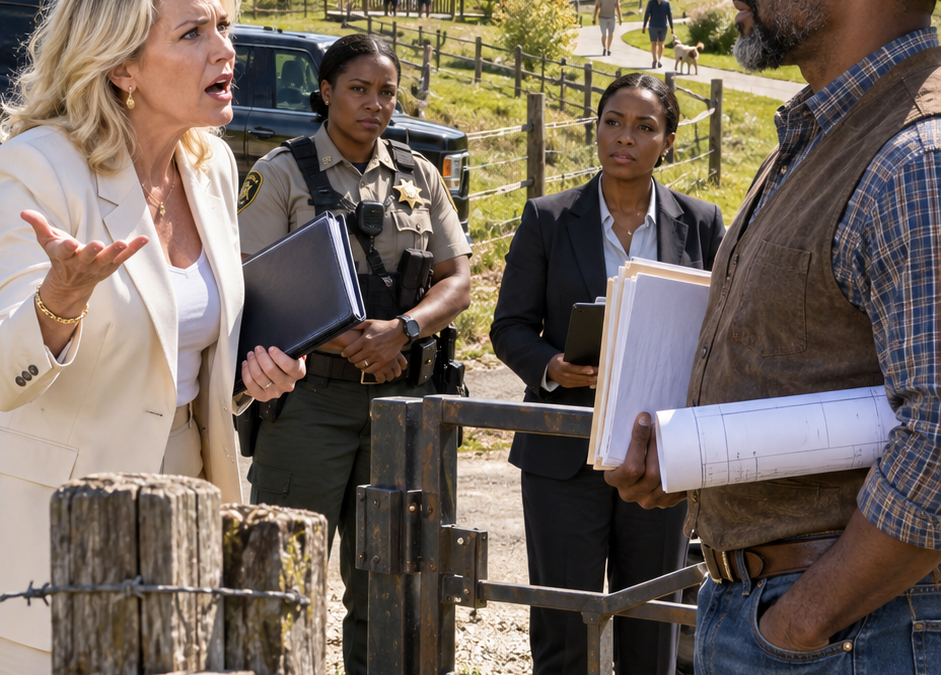
Lorraine Voss stepped out.
President of Crest View Ridge.
Perfect blazer.
Expensive shoes.
Thin folder under one arm.
She did not ask who I was.
She did not ask why the lock had changed.
She pointed at it.
“Remove that.”
I looked behind me.
“Which part?”
“The lock.”
“No.”
She turned toward one of the security men.
“Cut it.”
I stepped forward.
“I wouldn’t.”
Lorraine finally looked directly at me.
“You must be Mason Aldridge.”
“I must be.”
“This valley belongs to Crest View Ridge.”
“Interesting.”
“It has been under association control for more than twenty years.”
I held out my hand.
“Then show me the deed.”
She smiled.
And that smile told me she did not have one.
What she handed me instead was a folder filled with maintenance logs, HOA maps, work orders, and internal memos.
Lots of paper.
No ownership.
Lorraine crossed her arms.
“You cannot show up after twenty-two years and suddenly pretend this land is exclusively yours.”
I looked toward the roads her association had built across my property.
Then back at her.
“Lorraine, twenty-two years is exactly why you should be worried.”
She thought I meant the land.
I was talking about the bill.
PART2
That evening, I carried three old file boxes into the kitchen.
My father kept everything.
Tax statements.
Insurance records.
Receipts for fence wire from 1998.
A tractor manual written for a machine we had sold before I finished high school.
My mother used to complain that he threw away nothing.
That night, I silently thanked him for it.
I started with the obvious documents.
Deed.
County plat.
Property tax history.
No transfer.
No HOA ownership.
No permanent easement.
Then, near the bottom of the second box, I found a manila envelope marked:
CREST VIEW – 2004.
Inside was a document.
Not a deed.
Not an easement.
A license.
More specifically:
REVOCABLE COMMERCIAL LAND USE LICENSE.
I sat down.
The agreement had been signed in 2004, when Crest View Ridge was expanding.
It gave the HOA limited permission to use two defined routes across Red Hollow.
Purpose one: installation and maintenance of drainage infrastructure.
Purpose two: storage of a specified amount of maintenance equipment.
Purpose three: limited operational access connected to subdivision upkeep.
There it was.
The roads.
The pipes.
The equipment yard.
Everything Lorraine had waved around as proof of ownership had started as permission.
Then I found the payment section.
My father had not given them the land for free.
The HOA agreed to pay an annual license fee.
That fee adjusted according to:
Acreage used.
Intensity of use.
Land values.
Additional operational footprint.
I read it again.
Then I reached the second page.
One paragraph was underlined.
I do not know whether my father had done it or the attorney who drafted the agreement.
The language was unusually clear.
Continued use of the licensed premises did not create ownership.
It did not create a prescriptive easement.
It did not create adverse possession rights.
It did not matter how long the use continued.
Permission remained permission.
I leaned back.
Lorraine had spent that afternoon arguing that twenty-two years of use had transformed Crest View Ridge into the practical owner.
Somebody in 2004 had predicted exactly that argument.
Then prevented it.
I kept searching.
That was when things became almost funny.
There was an acknowledgment dated 2008.
Signed by a Crest View Ridge president.
It stated that the association continued using Red Hollow under the 2004 license and asserted no ownership.
Another from 2014.
Same thing.
Another from two years earlier.
Same thing.
Different board.
Different signatures.
Same admission.
For twenty-two years, Crest View Ridge had periodically signed documents confirming:
We are using someone else’s land.
We know we do not own it.
We know continued use does not make it ours.
And Lorraine had just arrived at my gate telling me the opposite.
I called Amelia Rowan.
Amelia was a real estate litigation attorney I had worked with years earlier.
It was nearly nine at night.
She answered anyway.
“This better involve land or money.”
“Both.”
“Go ahead.”
I read her the license language.
Then the acknowledgment clause.
Then the payment formula.
She went quiet.
“How many years?”
“Twenty-two.”
“Have they paid?”
“I don’t know yet.”
“Do not evict them.”
That surprised me.
“They’re on my property.”
“I heard you.”
“They cut roads across it.”
“I heard that too.”
“You don’t think I should revoke the license?”
“Not yet.”
“Why?”
“Because if I’m hearing this correctly, removing them may be the cheapest outcome available to them.”
That got my attention.
The next morning, I scanned everything.
Amelia verified the recording number.
The license had been filed properly with the county in 2004.
That mattered.
It meant Crest View Ridge could not credibly say the document had been hidden in my father’s private files.
It was public.
Recorded.
Searchable.
Anyone doing a competent title review could have found it.
Including Lorraine.
Especially Lorraine.
Amelia spent most of the day reviewing it.
Then she called.
“It’s real.”
“I assumed.”
“I don’t assume anything once litigation starts.”
“Fair.”
“The payment clause is enforceable on its face.”
“How much?”
“Too early.”
“Ballpark.”
“No.”
“Amelia.”
“Mason, if I give you a number now, you’ll fall in love with it. Then I’ll have to kill your favorite number later.”
“I hate when lawyers become philosophical.”
“You called me.”
She told me to gather everything connected to HOA use.
Current roads.
Equipment.
Drainage area.
Contractor routes.
Photographs.
Dates.
Expansion history.
Then we sent a formal request to Crest View Ridge.
It was deliberately boring.
No accusations.
No dramatic threats.
We asked the board to:
Stop expanding its use.
Provide a full accounting.
Disclose financial records tied to Red Hollow.
Identify the legal basis for continued occupancy.
Preserve all related documents.
I sent it certified.
Lorraine responded publicly.
Two days later, flyers appeared around Crest View Ridge announcing an emergency homeowner meeting.
The subject:
HOSTILE LAND CLAIM AGAINST COMMUNITY INFRASTRUCTURE.
That was efficient.
I had gone from landowner to hostile outsider in forty-eight hours.
Amelia sent me a photograph of the notice.
“You going?”
“No.”
“Good.”
“Why?”
“Because nothing useful happens when sixty angry homeowners are encouraged to believe you’re stealing something they never owned.”
The meeting drew around sixty residents.
I obtained the audio later.
Lorraine stood at the front and told them Red Hollow had served Crest View Ridge for more than two decades.
True.
She said the valley had become essential community infrastructure.
Probably true.
She said no single landowner could suddenly undo that arrangement.
Less true.
Then she called my request extortion.
That was almost flattering.
I had not even sent a number yet.
Three days later, Lorraine made her first truly serious mistake.
She sent maintenance crews to cut my lock.
I happened to be near the house when they arrived.
Two workers.
HOA pickup.
Bolt cutters.
I stayed back.
I turned on my phone.
The video showed everything.
The truck entering.
The workers getting out.
The new sign.
The lock.
One man cutting it.
The broken lock landing on the gravel.
The gate opening.
HOA vehicles driving through.
I did not confront them.
I did not yell.
I did not touch anyone.
I sent the video to Amelia.
No commentary.
She replied eleven minutes later.
That helps.
The following morning, Crest View Ridge received a formal notice of unauthorized commercial occupancy.
The video was attached.
Lorraine called me that evening.
“You will never see a dollar from this association.”
I was standing in my kitchen.
“I haven’t asked you for a dollar yet.”
“I know exactly what this is.”
“Do you?”
“You’re trying to profit from land we improved.”
“Lorraine.”
“What?”
“Why have you been charging residents a valley access fee?”
Silence.
It was short.
Maybe four seconds.
But four seconds is an eternity when someone usually answers everything instantly.
“What are you talking about?”
“The valley access and infrastructure fee.”
“That is an internal association matter.”
“So it exists.”
“It covers community services.”
“Services performed on my land.”
No answer.
“How long have you been charging it?”
“That is none of your concern.”
“It became my concern when you started charging residents for access to property you say has no rental value.”
She hung up.
That phone call changed the case.
I had found the fee schedule earlier that day.
Old HOA records were available through archived homeowner portals.
One line appeared repeatedly.
VALLEY ACCESS AND INFRASTRUCTURE FEE.
Charged per adult homeowner.
Year after year.
Crest View Ridge had been collecting money based on use of Red Hollow.
Residents paid the association.
The association used my land.
My family received nothing.
Within hours of my call with Lorraine, the online fee schedule changed.
The valley line disappeared.
Too late.
I had already downloaded it.
Timestamp and all.
Amelia called after reviewing both versions.
“That was stupid.”
“Removing it?”
“Removing it after you asked about it.”
“Maybe they were updating the website.”
“Maybe I’m six foot seven.”
“You’re not.”
“Exactly.”
Lorraine brought in Patrick Hensley.
Patrick had handled routine Crest View Ridge legal work for years.
He sent a formal demand.
It was much more polished than Lorraine’s folder.
The HOA claimed it had acquired a prescriptive easement through twenty-two years of continuous use.
It demanded:
Removal of my gate.
Unrestricted HOA access.
Formal recognition of permanent easement rights.
And reimbursement of more than $900,000 for “improvements” Crest View Ridge had made to Red Hollow.
I read the letter.
Then called Amelia.
“Should I panic now?”
“No.”
“He sounds expensive.”
“He is.”
“Prescriptive easement?”
“Probably dead.”
“Probably?”
“I’m a lawyer. We enjoy conditional language.”
“Explain.”
“Prescriptive use generally requires use adverse to the owner. Without permission.”
“Right.”
“You have a recorded license.”
“Yes.”
“You also have twenty-two years of acknowledgments confirming permission.”
“Yes.”
“So their position is essentially: we gained rights by using land without permission, while repeatedly signing documents saying we were using it with permission.”
“That sounds bad.”
“It’s not ideal.”
Nolan found something even better.
Three years earlier, Crest View Ridge had submitted a site plan to the county planning department.
One portion of Red Hollow was labeled:
PRIVATE PROPERTY – TEMPORARY LICENSE AREA.
Their own filing.
Their own map.
Their own label.
Patrick had not seen it.
That became obvious.
His next letter was less aggressive.
Still firm.
But less theatrical.
Lorraine, meanwhile, apparently believed litigation worked like a staring contest.
She kept using the land.
So Amelia filed suit.
Then we asked for discovery.
Twenty-two years of financial records tied to Red Hollow.
Patrick objected.
He argued the dispute was about access, not accounting.
Judge Margaret Keane disagreed.
Her reasoning was simple.
If Crest View Ridge wanted to rely on twenty-two years of use, then the nature of those twenty-two years mattered.
Financial records could show whether the parties treated the relationship as ownership, permission, rent, or something else.
The HOA had invoked history.
Judge Keane let us read it.
Boxes began arriving at Amelia’s office.
Ledgers.
Old board minutes.
Fee schedules.
Budgets.
Contracts.
Maintenance invoices.
Consultant reports.
Insurance records.
Twenty-two years of institutional memory.
Most of it boring.
Some of it devastating.
We hired Brian Whitlock.
Brian specialized in commercial land-use valuation.
He spent nearly three weeks breaking Red Hollow into categories.
Service roads.
Drainage corridor.
Storage yard.
Contractor access.
Operational staging.
Affected acreage.
Then he reconstructed the original 2004 fee formula year by year.
Historical land values.
Usage changes.
Additional acreage.
Commercial rates.
He did not produce a number quickly.
That reassured me.
People who produce giant numbers quickly usually want something.
Brian wanted his math right.
Eventually, Amelia called me into the conference room.
Brian sat at one end of the table.
Spreadsheet open.
Stacks of comparables beside him.
He turned the screen.
“Base unpaid license obligation.”
I looked.
$2,640,000.
I said nothing.
Then he switched tabs.
“Interest under the agreement.”
$960,000.
I looked at Amelia.
She nodded.
Brian spoke again.
“Combined exposure based on our calculation: approximately $3.6 million.”
I leaned back.
“That can’t be right.”
Brian did not look offended.
“Good.”
“Good?”
“You should question it.”
He walked me through every year.
The early years were small.
Then usage expanded.
More drainage.
Wider roads.
More storage.
Higher land values.
The annual obligation grew.
Then interest accumulated.
Nothing exploded overnight.
Twenty-two years did the work.
I asked the obvious question.
“Will a judge accept this?”
Brian folded his hands.
“A judge may disagree with some assumptions.”
“By how much?”
“I don’t know.”
“Could this become one million?”
“Possible.”
“Two?”
“Possible.”
“Zero?”
He shook his head.
“Not based on the documents I’ve seen.”
Then he smiled slightly.
“And there’s something else.”
He handed Amelia an old Crest View Ridge consultant report.
Years earlier, before formalizing the valley access fee, the HOA had hired its own outside firm to value the access rights it was providing residents.
I read the summary.
Their estimate was higher than Brian’s.
I laughed.
Actually laughed.
Amelia smiled.
“They did our valuation work.”
“They valued my land?”
“To justify charging residents.”
“At more than Brian calculated?”
“Yes.”
“So if Lorraine says your number is inflated—”
“She has to explain why her own association once valued the same access higher.”
That was the first moment I understood how complete the paper problem had become for Crest View Ridge.
They had told residents:
The valley is valuable, so pay us.
They had told my family:
The valley costs nothing, so we owe you nothing.
Then they told the court:
The valley is ours because we used it long enough.
Three stories.
One piece of land.
None compatible.
Lorraine called the $3.6 million figure fabricated at another homeowner meeting.
According to the minutes, she described me as an opportunist using obscure historical paperwork to raid community reserves.
Obscure historical paperwork.
Meaning the contract her own association signed.
Then I got a phone call from Denise Calder.
I had never met her.
“I used to be treasurer.”
“For Crest View Ridge?”
“Yes.”
“How did you get my number?”
“Public records.”
That answer was vague enough to be believable.
“What can I do for you?”
“You’re missing something.”
“What?”
“The association knew.”
“About the license?”
“About the money.”
She came to my house two days later carrying a small banker’s box.
Denise was in her late sixties.
Soft voice.
Precise.
She set the box on my table.
“I kept copies.”
“Why?”
“Because people kept telling me to delete things that I thought should exist.”
Amelia joined us.
Denise produced old budgets.
There it was.
LAND ACCESS OBLIGATION.
Year after year.
Not every budget.
But many.
Money had been allocated specifically to Red Hollow.
My father had never received it.
Neither had I.
“Where did it go?” I asked.
“Reallocated.”
“To what?”
She turned pages.
Clubhouse renovations.
Landscaping.
Legal expenses.
Management contracts.
Pool improvements.
Decorative entrance work.
“You’re saying the board budgeted the payment.”
“Yes.”
“Then moved the money somewhere else.”
“Yes.”
“Repeatedly.”
“Yes.”
“Why?”
Denise gave me a sad smile.
“Because nobody was asking.”
That sentence bothered me more than Lorraine’s threats.
Nobody was asking.
So they spent it.
Not because they believed nothing was owed.
Because enforcement never came.
Denise produced meeting notes.
One exchange had been recorded nearly word for word.
A board member asked:
What happens if the landowner demands full payment?
Response:
ADDRESS IF AND WHEN ENFORCEMENT OCCURS.
That was the strategy.
Wait.
Use the land.
Collect resident fees.
Spend the money.
And hope the owner never audits the relationship.
Then Denise handed Amelia an email.
Lorraine had written it during her first year as president.
AFTER THIS MANY YEARS, THE VALLEY IS EFFECTIVELY OURS ALREADY.
Below it was a reply from Crest View Ridge’s former attorney.
It stated clearly that licensed use did not convert into ownership regardless of duration.
Lorraine had been warned.
Directly.
In writing.
And she still stood at my gate telling me twenty-two years made the valley theirs.
Amelia read the email twice.
“This is ugly.”
“For her?”
“For credibility.”
Denise had one more file.
Resident fee schedules.
Crest View Ridge continued collecting the valley access fee during years when internal board records said the land-access obligation should have been paid.
Same year.
Money in from residents.
No money out to owner.
I looked at Amelia.
“What now?”
She closed the folder.
“Now we stop discussing discounted settlement.”
I agreed.
We amended our demand.
Full amount.
Lorraine responded with a countersuit.
Crest View Ridge wanted roughly $900,000 from me.
Their theory:
They had improved Red Hollow.
Roads.
Drainage.
Fencing.
Gate.
Landscaping.
Therefore, I had been enriched.
I read the claim.
Then looked out my office window toward an equipment shelter I had never requested.
“Amelia.”
“Yes?”
“Can I bill someone for painting their house if they never asked me to paint it?”
“Depends.”
“I hate you.”
She laughed.
The countersuit sounded better in a headline than under examination.
Lorraine sat for deposition.
Amelia asked:
“Did Mr. Aldridge authorize the roads?”
“They were necessary.”
“That wasn’t my question.”
“They were consistent with association use.”
“Did he authorize them?”
“No.”
“Did his father?”
“I don’t know.”
“Do you have written authorization?”
“No.”
“Drainage system?”
“It serves the community.”
“Does it benefit Red Hollow?”
“It manages stormwater.”
“From where?”
“Crest View Ridge.”
“So the system primarily moves subdivision runoff onto or through Mr. Aldridge’s land?”
Lorraine hesitated.
“Yes.”
Equipment storage?
HOA equipment.
Service roads?
HOA contractors.
Electronic gate?
HOA access control.
Most of their $900,000 in “improvements” existed for themselves.
They were effectively asking me to reimburse them for building infrastructure they used while not paying to occupy the underlying land.
That was the kind of argument only an institution can make with a straight face.
During a break, Patrick pulled Lorraine aside.
I did not hear the conversation then.
I learned about it later.
He asked whether she had known about the historical acknowledgments before hiring him.
She did not answer directly.
Patrick understood.
That evening, he formally advised the association that his continued representation would be reassessed.
He did not walk away immediately.
Professional obligations prevented that.
But something changed.
His filings became narrower.
More technical.
Less confident.
The case went to trial before Judge Margaret Keane.
Day one was ownership.
Patrick emphasized twenty-two years.
Continuous use.
Essential infrastructure.
Reliance.
Investment.
Operational necessity.
Then Amelia stood.
“Your Honor, we agree Crest View Ridge used Red Hollow for twenty-two years.”
Patrick looked surprised.
Judge Keane noticed.
Amelia continued.
“The question is whether twenty-two years of permitted use can be rewritten as twenty-two years of adverse use merely because payment eventually became inconvenient.”
That became the case.
Nolan testified first.
Boundary markers.
Recorded plat.
Survey points.
Every road.
Every pipe.
Every structure.
All on Red Hollow.
None on Crest View Ridge land.
Brian testified next.
He explained valuation.
Slowly.
Comparables.
Historical rates.
License formula.
Usage growth.
Interest.
Patrick challenged assumptions.
Brian answered.
Then Amelia introduced Crest View Ridge’s own old valuation report.
Patrick stopped attacking market value after that.
Denise testified.
Budget line:
LAND ACCESS OBLIGATION.
Year after year.
Then the minutes.
Address if and when enforcement occurs.
Judge Keane looked toward the HOA table after that one.
Not angry.
Judges rarely need theatrical expressions.
A raised eyebrow can ruin an entire afternoon.
Then came the acknowledgments.
Recent.
Every one signed by Crest View Ridge leadership.
Every one stating:
Licensed use.
No ownership.
No prescriptive rights.
No adverse possession.
Patrick had spent months saying duration mattered.
The association’s own signatures said duration did not change the relationship.
Then Lorraine took the stand.
Amelia approached slowly.
“Ms. Voss, have you publicly described Red Hollow Valley as Crest View Ridge property?”
“In practical terms.”
“Does Crest View Ridge own Red Hollow Valley?”
She hesitated.
“No.”
“Any deed?”
“No.”
“Permanent recorded easement?”
“No.”
“Any purchase contract?”
“No.”
“Any condemnation proceeding?”
“No.”
“Any court order transferring rights?”
“No.”
Amelia displayed Lorraine’s email.
AFTER THIS MANY YEARS, THE VALLEY IS EFFECTIVELY OURS ALREADY.
“Did you write this?”
“Yes.”
Then she displayed the attorney response.
Licensed use does not convert into ownership regardless of duration.
“Did you receive that response?”
“Yes.”
Judge Keane looked up.
“Ms. Voss.”
Lorraine turned.
“Yes, Your Honor?”
“You received advice from association counsel specifically warning that continued use did not create ownership?”
“Yes.”
“Before you asserted that the association had permanent rights?”
Lorraine’s voice dropped.
“Yes.”
That was the moment.
Not the $3.6 million spreadsheet.
Not the survey.
Not the fee schedule.
That answer.
Lorraine knew.
Two weeks later, Judge Keane issued the ruling.
No HOA ownership.
No permanent easement.
No prescriptive easement.
The court emphasized the obvious legal contradiction:
Prescriptive rights depended on adverse, unpermitted use.
Crest View Ridge had entered under express permission.
Then repeatedly acknowledged that permission.
The association could not transform authorized use into hostile use simply by failing to pay.
The $900,000 improvement countersuit was largely rejected.
The roads served Crest View Ridge.
The drainage served Crest View Ridge.
The storage served Crest View Ridge.
The gate served Crest View Ridge.
Those were operational investments made for the HOA’s benefit, not gifts I had requested.
Then came damages.
Judge Keane adopted Brian’s calculation almost entirely.
Unpaid license obligations:
$2,640,000.
Contractual accrued interest:
$960,000.
Total judgment:
$3,600,000.
Lorraine did not move.
Residents behind her whispered.
Patrick looked down at his notes.
I felt no urge to celebrate.
Honestly, I felt tired.
Twenty-two years of avoided obligations had been condensed into one number.
Three million six hundred thousand dollars.
The exact kind of number Lorraine said I would never receive.
Then Crest View Ridge missed the first payment deadline.
Of course they did.
Amelia initiated post-judgment discovery.
Reserve funds had recently moved into accounts labeled for operational expenses.
The timing was suspicious.
The money was traceable.
We found it.
At that point, residents started paying attention.
Not because they suddenly cared about property doctrine.
Because a court-appointed receiver became a real possibility.
Nobody wants a stranger controlling HOA finances because the board cannot satisfy a judgment.
An emergency community meeting was called.
This time, Lorraine did not organize it.
Homeowners did.
The room was packed.
Residents learned the full history.
Original license.
Acknowledgments.
Payment formula.
Land access obligation.
Money budgeted and reallocated.
Valley fees charged to residents.
Attorney warnings.
The deleted online fee schedule.
The $3.6 million judgment.
Denise spoke.
She explained that she had raised the obligation internally years earlier.
A homeowner asked:
“What did the board say?”
Denise answered:
“That it would be addressed when enforcement occurred.”
The room changed.
That was no longer Mason Aldridge versus Crest View Ridge.
That was residents realizing their leadership had gambled with community finances.
One resident shouted:
“So you knew?”
Another:
“You charged us for access!”
Another:
“Where did that money go?”
Lorraine tried to restore order.
Nobody listened.
There is a particular moment when institutional authority disappears.
Usually no one announces it.
People simply stop caring that you are holding the microphone.
Within weeks, Lorraine was removed as president.
The board cited her handling of Red Hollow.
Failure to disclose legal risk.
Continued assertion of claims after receiving contrary legal advice.
Improper management of the dispute.
Selective disclosure to residents.
She lost signing authority.
Board authority.
Control over association counsel.
Access to internal administrative decisions.
The new board ordered a review of other contracts.
That produced more unpleasant surprises.
One management agreement negotiated under Lorraine contained provisions unusually favorable to people connected with her professional network.
Nothing in my case required proving criminal wrongdoing.
I did not care to expand it.
The new board renegotiated.
Cut expenses.
Sold nonessential association assets.
Created a structured repayment plan.
A fixed portion of annual HOA revenue went toward satisfying the judgment.
Amelia asked whether I wanted aggressive enforcement against homeowners.
“No.”
“Good.”
“They didn’t sign the license.”
“Correct.”
“They didn’t redirect the money personally.”
“Correct.”
“I’m not taking families’ houses because boards made bad decisions.”
“So we focus on association assets.”
“Yes.”
That was what we did.
Reserve funds.
Receivables.
Nonessential common assets.
Contract savings.
Structured payments.
No ordinary homeowner lost a house because I wanted revenge.
I did not want revenge.
I wanted accounting.
Eventually, something unexpected happened.
The new Crest View Ridge president called me.
His name was Harold Mercer.
No relation.
“We still need the valley.”
“I know.”
“Drainage.”
“I know.”
“Maintenance access.”
“Yes.”
“And equipment storage.”
“Also yes.”
He paused.
“Would you consider a new agreement?”
That surprised Amelia more than me.
We met.
No threats.
No security guards.
No homemade property theories.
Just a conference table.
I offered a short-term commercial lease.
Clear rent.
Defined acreage.
Insurance requirement.
Inspection rights.
Storage limits.
Road-use limits.
Drainage obligations.
Termination clause.
No prescriptive rights.
No adverse possession.
No ownership claim.
No interpretation that duration created permanent access.
Harold read it.
Then smiled.
“You really covered that part.”
“Your association inspired the drafting.”
Fair.
The board approved it.
Then, for the first time in twenty-two years, Crest View Ridge paid me rent.
Actual money.
Deposited on schedule.
Not as goodwill.
Not as settlement theater.
Rent.
For land they used.
A remarkable innovation.
Several weeks later, I saw Lorraine outside the HOA administrative office.
She was carrying a box.
Personal belongings.
She looked different.
Older.
Or maybe simply less certain.
She saw me.
“You almost destroyed this association.”
I stopped.
“No.”
“You knew what a judgment that size would do.”
“Yes.”
“You barely used that valley.”
I looked toward Red Hollow.
“That matters?”
“You let it sit there.”
“It was mine to let sit.”
“People depended on it.”
“Then the association should have paid for it.”
She shook her head.
“You took advantage of technical language.”
That made me laugh.
“What technical language?”
“The license.”
“The contract your HOA signed?”
“You know what I mean.”
“The acknowledgments?”
She said nothing.
“The budget line?”
Nothing.
“The access fees you charged residents?”
Her face tightened.
“Lorraine, I didn’t invent any of this.”
I reached into my document case.
I had come from Amelia’s office and still carried a certified copy of the final judgment.
I handed it to her.
The first page showed the amount.
$3,600,000.
“You created the number yourselves.”
She looked down.
“Your association signed the license.”
I pointed toward the valley.
“You valued the access.”
Then toward Crest View Ridge.
“You charged residents for it.”
Then back at her.
“You budgeted for the obligation.”
Her hands tightened around the judgment.
“You just stopped paying.”
She handed it back.
“You think you won.”
“No.”
I folded the document.
“I think somebody finally opened the file.”
She walked away.
Months later, I stood at the Red Hollow gate as a Crest View Ridge maintenance truck approached.
The old sign was gone.
No more:
CREST VIEW RIDGE SERVICE AREA.
The new sign read:
RED HOLLOW VALLEY
PRIVATE PROPERTY
AUTHORIZED LEASE ACCESS ONLY
The driver stopped.
Scanned his access credential.
Waited.
The gate opened.
He drove through.
No argument.
No claim of ownership.
No security guard cutting my lock.
Just a tenant entering leased property according to a written agreement.
Exactly how it should have worked in 2004.
People sometimes asked why I did not simply kick Crest View Ridge out permanently.
I could have.
The license was revocable.
The court had confirmed ownership.
But destroying useful infrastructure out of spite would have been stupid.
The roads already existed.
The drainage system already existed.
The HOA still needed access.
I owned the land.
They needed the land.
That is what leases are for.
The difference was that the new agreement treated reality honestly.
Their use had value.
My ownership had meaning.
Their access had limits.
Everyone knew where the line stood.
Most importantly, everyone knew silence would not erase the contract.
Crest View Ridge spent twenty-two years believing time was working in its favor.
It was not.
Every year they used Red Hollow under the license added another year of permission.
Every acknowledgment reinforced my ownership.
Every budget line documented the obligation.
Every resident fee proved the land had economic value.
Every maintenance invoice proved use.
Every old board minute added another page.
Lorraine thought the paper trail was stale.
It was accumulating.
That was the irony.
If Crest View Ridge had truly occupied the land openly, hostilely, and without permission, their legal position might have been more complicated.
Instead, they kept protecting my position for me.
They signed acknowledgments.
They recorded maps.
They budgeted rent.
They commissioned valuations.
They charged fees.
Then they forgot the one part that mattered.
Pay the owner.
My grandfather used to say fences were only useful if people respected what they meant.
At the time, I thought he was talking about cattle.
Turns out the same rule applies to contracts.
A line on a map means something.
A signature means something.
A recorded agreement means something.
And twenty-two years does not erase those things merely because nobody has sent the invoice yet.
Crest View Ridge used my valley for twenty-two years without paying.
I did not bulldoze their roads.
I did not rip out their drainage pipes.
I did not seize their clubhouse.
I did not threaten residents.
I opened the files.
I read the agreement.
I counted the years.
Then I sent them the bill they had spent more than two decades writing themselves.
$3.6 million.
In the end, Lorraine had been right about one thing.
Twenty-two years mattered.
Just not in the way she thought.








