𝗣𝗔𝗥𝗧 𝟮 HOA Used Fake Deputies to Steal My Family Farm—They Never Expected Who Would Come Back Through That Gate
𝗣𝗔𝗥𝗧 𝟮
The first April after she died, I nearly didn’t repaint the sign.
Then I imagined what she’d say about that.
So I leaned the ladder against the barn alone.
Same white paint.
Same two-inch brush.
Same letters.
I suppose that was what the farm meant to me.
Not acreage.
Continuity.
Proof that somebody had stood in one place long enough for years to leave marks.
Then Howerin Land Partners purchased the land east of my fence.
Cypress Hollow Estates began going up that spring.
Model homes.
Decorative streetlights.
Sidewalks so new they still looked white.
A stone entrance monument illuminated at night like a resort.
Phase One called for ninety houses.
Phase Two would nearly double it.
And Phase Three, though I didn’t know much about it then, was where my trouble had already begun.
They built a road toward my north property line and stopped it less than a hundred feet short.
I remember standing on a tractor one afternoon looking at that unfinished pavement.
It seemed strange.
A road that ended facing my hayfield.
I assumed another subdivision street would eventually turn off.
I was wrong.
In June, a glossy welcome packet appeared in my mailbox.
“Cypress Hollow Estates.”
Approved mailbox dimensions.
Approved exterior colors.
Rules governing landscaping.
Requirements for holiday decorations.
On the second page, my address appeared under a heading:
MEMBER IN GOOD STANDING.
I laughed.
Actually laughed out loud.
I was standing beside the county road in muddy boots holding a packet telling me what color I was allowed to paint a house built before most of the subdivision’s board members were born.
I carried it inside and tossed it into a kitchen drawer.
You don’t throw away something with your address printed on it.
Eleven days later, the first violation notice arrived.
AGRICULTURAL ODOR NUISANCE.
Fine: $50.
I read it twice.
Then I set it beside the welcome packet.
The second violation called my father’s barn an “unapproved accessory structure.”
The third said livestock violated Article Six of the Cypress Hollow covenants.
Then came notices about fencing.
Hay storage.
Equipment visibility.
Exterior maintenance.
Unauthorized commercial agricultural activity.
By Christmas, envelopes were arriving two and three at a time.
At the bottom of each one sat a running balance.
$3,800.
$7,250.
$11,600.
$18,400.
The letters were written in calm administrative language, which somehow made them worse.
Nobody threatened me directly.
Nobody screamed.
It was simply a stack of paper growing taller on my kitchen counter while I fed cattle.
I answered them.
One page.
Polite.
I attached my deed and highlighted the legal description.
I drove the packet personally to the management company and handed it to the receptionist.
“I’d like a stamped copy showing you received it.”
She looked surprised but stamped it.
Nobody answered.
No phone call.
No letter.
The next violation arrived exactly on schedule.
I met Marilyn Vaughn for the first time in February.
She parked on the county shoulder and walked toward my gate with a clipboard against one hip.
Her phone was already in her other hand.
“Mr. Turner?”
“I know who you are.”
She smiled as if I’d complimented her.
“I’m president of the association.”
“Then maybe you can explain why your association thinks my barn is any of its business.”
Her smile barely changed.
“Because your parcel is inside the recorded declaration.”
“No, it isn’t.”
“It is.”
“My family has owned this place since 1926.”
“That doesn’t prevent annexation.”
“I never signed anything.”
“Nobody has to ask you.”
I stared at her.
She tapped the clipboard with her pen.
“It’s recorded. That’s how land works.”
The confidence in her voice irritated me more than if she’d shouted.
She had discovered a tone that made disagreement sound childish.
“I’ve got the deed.”
“You can present whatever documentation you like at the next board hearing.”
“I’ll do that.”
“You’ll have three minutes.”
The hearing took place in the Cypress Hollow clubhouse.
The room smelled like new carpet and fresh drywall.
Maybe ten people sat facing a folding table where Marilyn and the board members were seated.
I carried a manila folder containing my deed, tax maps, and a certified legal description.
When my name was called, I stood.
“My family owns 186 acres on County Road Twelve. The legal description begins—”
I started reading the metes and bounds.
I thought facts were enough.
That was my first mistake.
I believed if you put the correct document in front of people, reasonable people would stop doing the incorrect thing.
At exactly two minutes, Marilyn interrupted.
“Thank you, Mr. Turner.”
“I’ve got another minute.”
“Thank you, Mr. Turner.”
“I’m not finished.”
A man at the end of the table raised his hand.
“I move that enforcement proceed.”
“Second.”
Marilyn called the vote.
It passed while I was still standing with my deed open.
She never looked at me.
She wrote something on a legal pad as though the matter had already become boring.
As I walked toward the exit, someone touched my sleeve.
An older woman.
Gray hair.
Sixties.
She still wore a Cypress Hollow board name tag.
“Nora Kesler.”
She leaned close.
“Careful.”
That was all she said.
Someone called her name from behind us.
Nora moved away immediately.
I sat in my truck for fifteen minutes afterward wondering what she meant.
A week later, I learned part of it.
A certified letter arrived.
NOTICE OF LIEN.
$18,400 secured against my 186 acres.
My farm had gone ninety-nine years without a lien.
Now an HOA I had never joined claimed an interest in it.
Below the amount appeared another line in bold capital letters:
FINAL NOTICE OF ENFORCEMENT ACTION.
I read those words six or seven times.
The letter never explained what “enforcement action” meant.
I called the management company twice.
Voicemail.
Six days later, at 10:06 in the morning, I found out.
Twenty minutes after Corwin threatened to arrest me, I walked away from everything I owned.
At one that afternoon, I called the Branick County Sheriff’s Office from a gas station on Route 12.
The dispatcher asked if I’d been injured.
“No.”
“Did anyone physically assault you?”
“No.”
“Did anyone force entry into your residence?”
“They ordered me out of it.”
“Sir, property ownership disputes are generally civil matters.”
“They had badges.”
There was a pause.
“You’d probably need to speak with an attorney.”
I looked through the windshield at the highway.
“Two men dressed as deputies removed me from my farm.”
“I understand, sir.”
No.
She didn’t.
But I also understood she had a screen in front of her telling her what category my call belonged in.
Civil.
The word followed me everywhere.
I drove to the sheriff’s office.
A young deputy named Hollis met me at the public counter.
I explained everything again.
He searched Ridgeline Compliance Group on his terminal.
“They’re registered.”
“As what?”
“Private security.”
“Not deputies?”
“No.”
“Then why are they wearing tan uniforms with six-point stars and driving a white Tahoe marked like a sheriff’s unit?”
Hollis looked at the screen a little longer.
Then he gave me half a shrug.
“Uniforms aren’t really regulated that way.”
“That’s a strange answer.”
“I know.”
I think he genuinely felt bad.
He just didn’t know where to put what I was telling him.
That night, I slept in my truck behind the farmers market.
I rolled my jacket against the window for a pillow.
Fifty-one years old.
First night of my life I had not slept on Turner ground.
At around three in the morning, unable to sleep, I went through the photographs I’d taken at the gate.
Four pictures.
Three were useless.
The fourth showed the driver’s side of the white Tahoe from about six feet away.
I enlarged the image.
Then I enlarged it again.
At the upper edge of the gold star decal, the corner had curled away from the paint.
I sat upright so quickly I hit my head on the cab.
I knew patrol vehicles.
That star wasn’t part of any county marking package.
Somebody had stuck it on.
That meant somebody had purchased it.
Somebody had chosen its shape.
Somebody had made a decision about exactly what those men were supposed to look like when they arrived at my farm.
For the first time since leaving my gate, I felt something other than humiliation.
I felt curious.
At dawn, I remembered the trail camera.
Years earlier, coyotes had been getting close to the calves, so I’d mounted a cheap camera on a corner post.
It recorded short clips.
Eleven seconds of video and audio whenever the motion sensor triggered.
I pulled the card.
There it was.
Gray morning.
My gate.
Corwin’s voice.
“If you resist, we’ll place you under arrest.”
I listened four times.
Then I copied the clip onto two thumb drives.
I mailed one to myself at my post office box.
Maybe that was the old deputy in me.
You don’t know what evidence matters until somebody tries to make it disappear.
Monday morning, I was waiting when the county clerk’s office opened.
Dorothy, the clerk at the counter, had known me since I was a boy.
“I need a certified copy of my deed.”
“Easy enough.”
“And the original recorded plat attached to the Cypress Hollow declaration.”
“That one may take a while. Basement microfilm.”
“I’ve got time.”
The microfilm reader looked older than me.
It hummed loudly and smelled faintly of heated dust.
Dorothy threaded the reel.
Two hours later, I found the original Cypress Hollow declaration.
Then the exhibit map.
I turned the crank until the eastern boundary came into focus.
I traced it with my finger.
The line followed the far side of County Road Twelve.
My farm sat entirely outside it.
All 186 acres.
Not annexed.
Not included.
Not touched.
I leaned back.
“It’s not even in there.”
Nobody answered.
I was alone in the basement.
I called the management company.
Voicemail.
I called Marilyn.
No answer.
Then I drove to my farm.
They had installed a metal sign on my gate.
NO TRESPASSING
BY ORDER OF THE ASSOCIATION
Corwin sat forty feet inside the fence in the same Tahoe.
Eating breakfast.
I stepped across the cattle guard.
He was out before my second boot landed.
This time, he didn’t call Marilyn.
He called somebody else.
“Yes, ma’am. Male subject crossed the posted line. Turner. T-U-R-N-E-R.”
Twelve minutes later, a real Branick County cruiser arrived with its light bar flashing.
A real deputy stepped out.
I showed him my deed.
I told him the land was mine.
He listened.
Then he asked me to return to the public road.
“This needs to get worked out in court.”
“My cattle haven’t been fed properly.”
“I understand.”
“If you understand, let me feed them.”
“I can’t do that.”
“They’re standing on my land.”
He lowered his voice.
“Mr. Turner, if we get called back out here, I’ll have to cite you.”
I stood outside my own fence watching sixty-two cattle crowd an empty feeder.
They knew my truck.
They knew my schedule.
They bawled when they saw me.
My phone vibrated.
A message from Marilyn.
You should have just paid the fines.
The next morning, I went back to Dorothy.
“I need the declaration again.”
She smiled.
“You wore that thing out yesterday.”
“Not the original. I want whatever’s attached to it now.”
Her smile disappeared.
She printed the current exhibit.
I placed the basement microfilm copy beside it.
Same document number.
Same declaration.
Different boundary.
The new version crossed County Road Twelve and wrapped around all 186 acres of my property.
Dorothy came around the counter.
“That’s not the same map.”
“No, ma’am.”
She studied the recording stamps.
Then she tapped one with her thumbnail.
“Well, that’s wrong.”
“What is?”
“The declaration was recorded three years ago. This exhibit was recorded eleven months ago.”
“Can they update it?”
“Not like this.”
She turned toward the computer.
“If it’s a corrected exhibit, it has to be recorded as a separate instrument.”
Less than two minutes later, she found it.
CORRECTED EXHIBIT A
ANNEXATION OF ADJACENT PARCEL.
One signature appeared at the bottom.
Marilyn Vaughn
President
Not mine.
I pulled the declaration and read the annexation clause.
Then I read it again.
New property could only be brought into Cypress Hollow through a joinder signed by the owner of the parcel being annexed.
The owner.
Me.
I had signed nothing.
Marilyn hadn’t mistaken my property for association land.
She had inserted it.
I requested the board minutes.
Three sets.
One meeting had occurred before my first violation.
In those minutes, Cypress Hollow’s attorney had advised the board that the Turner parcel was outside the recorded declaration and that enforcement against it could create significant legal exposure.
The very next entry read:
Motion by President Vaughn to proceed with compliance enforcement.
She knew.
That distinction mattered.
Confusion can be corrected.
A mistake can be forgiven.
Knowledge followed by action is something else.
I copied everything.
Twice.
That afternoon, Nora Kesler found me at a diner off Main Street.
She sat across from me without ordering food.
“You found the exhibit.”
It wasn’t a question.
“It’s forged.”
She turned the coffee cup slowly between her hands.
“That’s not the part that’ll help you.”
“What do you mean?”
“You’re asking what Marilyn did.”
“What should I be asking?”
“What she needed.”
“I don’t understand.”
Nora stared toward the window.
“Ask what Phase Three needs.”
Then she left two dollars on the table for coffee she had never ordered and walked out.
I went back to the county planning office.
Phase Three had been designed before the first home in Phase One sold.
A development of that size required secondary emergency access.
A second entrance.
There was only one practical route.
Nine hundred feet along the north edge of my hayfield.
Howerin Land Partners had an option agreement tied to that frontage.
Phase Three could not proceed unless Howerin secured access across my parcel.
The agreement was signed four days before the first $50 odor fine reached my mailbox.
Four days.
I spread the paperwork across a table.
Suddenly the past eight months lined up.
The fines.
The annexation.
The lien.
The removal.
None of it had been about cows.
None of it had been about an old barn.
They needed my ground.
Then I found the investor schedule.
One LLC caught my eye.
I didn’t recognize the company.
I recognized the address.
Marilyn Vaughn’s home.
I sat in my truck afterward and felt something strange.
Relief.
For eight months, people had spoken to me as though I was too ignorant to understand paperwork.
Marilyn had practically built her public performance around it.
He doesn’t understand the paperwork.
Except I did understand.
I simply hadn’t been allowed to see all of it at once.
I built a red folder.
Original exhibit.
Corrected exhibit.
Annexation clause.
Board minutes.
Phase Three option agreement.
Investor schedule.
Photograph of the peeling star decal.
Thumb drive containing Corwin’s threat.
Then I took it to Sheriff Lyall Rowan.
Because that was what I still believed a person was supposed to do.
Take evidence to the law.
Rowan had been sheriff for three terms.
Large man.
Slow voice.
Handshake like a closing door.
He let me speak for ten minutes without interrupting.
I thought he was listening better than anybody had listened yet.
When I finished, he squared the documents neatly.
“That’s a lot, Silas.”
“Yes, sir.”
“Let me look at it.”
“Thank you.”
He placed one hand flat over my folder.
Then he asked, “Who else have you shown this to?”
“Nobody besides the clerk.”
He nodded.
“I’ll be in touch.”
Three days passed.
Then four.
The only person who contacted me was a process server.
He found me in the farmers market parking lot.
Marilyn Vaughn had filed for a civil harassment restraining order.
Her sworn affidavit said I had threatened her at my gate.
The temporary hearing lasted eleven minutes.
Marilyn sat with a lawyer.
I sat alone.
She cried quietly into a tissue already in her hand.
The judge granted the temporary order.
One hundred yards.
I didn’t understand what that meant until I reached the courthouse steps and read the listed protected locations.
Her residence.
Her workplace.
Cypress Hollow Estates site office.
The site office sat roughly four hundred feet from my north property line.
She had removed me from my farm.
Now she had obtained a court order that effectively kept me away from it.
I went back inside and filed for an evidentiary hearing.
It was scheduled six weeks later.
Six weeks.
Cattle don’t recognize court calendars.
Hay doesn’t postpone growing because a judge is busy.
I went to District Attorney Grant Mercer.
He read my documents.
He looked at the fake unit.
The altered annexation.
The minutes.
Then he pushed the folder slightly toward me.
“Silas, this is primarily a civil dispute.”
“They threatened to arrest me.”
“Did they touch you?”
“No.”
“Did they explicitly say they were Branick County deputies?”
“He introduced himself as Deputy Corwin.”
Mercer leaned back.
“Ridgeline is licensed security.”
“They dressed themselves as police officers.”
“That can be argued.”
“They forged an annexation.”
“The association will say it’s a title dispute.”
“A title dispute?”
He sighed.
“You may have a very good civil case. But I don’t see something I can responsibly prosecute from this file.”
I picked up the folder.
At the door, I stopped.
“Who owns Ridgeline?”
“Gil Prentice.”
“I don’t know him.”
Mercer looked at me.
“Sure you do. He’s Sheriff Rowan’s brother-in-law.”
I stood with my hand on the door.
That night, I searched county campaign finance records.
Howerin Land Partners had been Rowan’s largest single campaign donor in each of his previous two elections.
I finally understood Rowan’s question.
Who else have you shown this to?
He hadn’t been asking how much evidence existed.
He wanted to know how contained it was.
Nine days later, Cypress Hollow executed on its lien.
Not against the land first.
Against my cattle.
A livestock hauler arrived at daylight accompanied by a state brand inspector.
Everything looked legal on paper.
And paper was exactly what had gotten me there.
The permanent restraining-order hearing was still three weeks away.
I wasn’t allowed close enough to interfere.
So I stood beside the county road and watched strangers load sixty-two cattle from my farm.
That’s the only moment in this story when I cried.
Not when they locked me out.
Not when the judge issued the order.
Not when I discovered the forged document.
The cattle did it.
I knew every animal.
I knew which cow would walk calmly into a trailer.
I knew which one would fight a gate.
I knew whose calf had nearly died during the spring freeze.
I knew the red cow that always came when I shook a feed bucket and the black baldy that wouldn’t let anyone except me touch her head.
They left in four loads.
The sale took place Friday in Cordell.
I stood against the back rail.
The auctioneer sold them in lots.
The rhythm of his chant never changed.
That seemed obscene to me.
Something could be part of your life for years and still become numbers in twenty seconds.
The herd brought a little over $31,000.
Cypress Hollow took $18,400.
I didn’t see the rest.
That night, I parked on the road outside my gate.
The brass padlock reflected moonlight.
Beyond it stood the barn.
I could barely see my father’s board.
TURNER & SON
EST. 1926.
Ellen was gone.
My father was gone.
The cattle were gone.
I was sleeping in a truck.
And I had enough evidence in the passenger seat to prove nearly every important part of what had happened.
None of it mattered.
Because evidence and authority are not the same thing.
That realization changed my life.
The next morning, I went to the clerk’s office for more copies.
While Dorothy worked, I read the bulletin board.
Public hearings.
A 4-H notice.
Tax dates.
One sheet curled at the corner.
BRANICK COUNTY GENERAL ELECTION
CANDIDATE FILING CLOSES IN 11 DAYS.
I read down the offices.
County commission.
Clerk.
Sheriff.
I stared at that word.
Sheriff.
The office wasn’t appointed.
The people chose it.
Lyall Rowan had been unopposed for years because nobody had bothered running against him.
Dorothy walked up behind me.
“You need anything else, Silas?”
I pointed toward the notice.
“What does it cost to file?”
She looked at the paper.
Then at me.
She didn’t smile.
She simply walked behind the counter and brought me the form.
I filled it out with a pen attached to a chain.
Name.
Address.
Office sought.
Sheriff.
I paid the filing fee in cash.
My hand never shook.
If nobody wearing a badge was willing to touch my case, I had decided I would go earn one.
My campaign headquarters was my truck.
My campaign budget was roughly eight hundred dollars.
My sign was plywood.
I painted it myself.
TURNER FOR SHERIFF.
My first gathering was six people under a carport.
I made the mistake of telling them my entire story.
Within ninety seconds, their expressions became polite.
Everybody has a property dispute.
Everybody thinks their case is outrageous.
I understood.
So the next night, standing in a driveway in Ellisburg, I changed the question.
“Show of hands. Anybody here ever get a letter with a star on it?”
Four hands went up.
There were only nineteen people present.
Bernice Kulvin was eighty-one.
She told me two men in tan uniforms had come to her door regarding an HOA hedge violation.
“They said if I wouldn’t sign the agreement, they’d have to take me in.”
“Take you where?”
“I thought jail.”
“Did they say sheriff’s office?”
“No.”
“Why did you think they were deputies?”
She looked genuinely confused by the question.
“Because they looked like deputies.”
She had signed.
Then she had paid $110 every month for fourteen months.
Gene Ashby had served in the Army.
Ridgeline came to his house over a boat trailer.
One man warned him he could be arrested for interfering with enforcement.
Gene’s six-year-old son had been standing in the driveway.
“I didn’t care about the fine,” Gene told me. “I cared that my boy watched me back down because he thought those men were police.”
By the end of one week, I had nine households.
Three Howerin subdivisions.
Same contractor.
Same tan uniforms.
Same stars.
Same threat.
Nobody had reported it.
Why?
Every person gave me some version of the same answer.
“I thought they were with the sheriff.”
That was when my campaign stopped being entirely about my farm.
I wish I could tell you I reached some noble conclusion immediately.
I didn’t.
I was still angry.
I still wanted my ground.
I still wanted somebody to answer for my cattle.
But every time another elderly homeowner or young family described the same uniform, my story became less unique.
Marilyn understood the danger before I did.
Her mailer arrived countywide on a Tuesday.
Heavy glossy paper.
My photograph on the front.
Five words:
MEET THE MAN UNDER RESTRAINING ORDER.
It was effective because it was technically true.
There is no twelve-second doorstep explanation for a restraining order.
Then Cypress Hollow challenged my residency.
Candidates for sheriff had to reside in Branick County.
Their argument was almost elegant.
Silas Turner does not currently reside at the address he claims.
He has not slept there for months.
No utilities are active in his name.
No livestock remains there.
He admits he has been living from a vehicle.
Marilyn had thrown me off my property.
Now she was using my absence to remove me from the ballot.
I read the petition in my truck.
For a few seconds, I laughed.
Then I put my forehead against the steering wheel.
Because I thought it might work.
The election board hearing took place Wednesday.
Their attorney talked about occupancy.
Abandonment.
Intent.
When my turn came, I placed one document on the table.
My certified deed.
“I own 186 acres in Branick County. I’ve never rented or owned another residence anywhere in my fifty-one years. The only reason I’m not currently sleeping on my farm is that the party seated at that table removed me.”
The chairman turned toward Cypress Hollow’s attorney.
“Counsel, is your client the party responsible for removing Mr. Turner from the property?”
The lawyer adjusted his papers.
“The association took lawful enforcement action.”
“That’s a yes.”
The board voted three to zero.
I stayed on the ballot.
The Branick County paper ran the story on the front page.
Suddenly my phone began ringing.
People who wouldn’t give me fifteen seconds at their front door wanted to talk.
Then Nora Kesler came back.
One Sunday evening, she pulled beside my truck in the farmers market lot.
She didn’t get out.
She held an envelope through the window.
“You didn’t get this from me.”
“Nora—”
“I sat in those meetings for two years. Never once opened the vendor file. I opened it last week.”
Her hands trembled.
“I should have opened it sooner.”
Inside the envelope was the service agreement between Cypress Hollow Estates and Ridgeline Compliance Group.
Signed by Marilyn Vaughn.
Attached was the scope of work.
Uniform:
Tan shirt.
Tan trousers.
Duty belt.
Insignia:
Six-point gold star worn over left breast.
Vehicle:
White full-size SUV bearing star decals on front doors, appearance consistent with county law enforcement.
Then came the contact instructions.
ADVISE SUBJECT THAT FAILURE TO COMPLY WILL RESULT IN ARREST.
A check was attached.
$9,600 from Cypress Hollow’s operating account.
I sat there for nearly an hour.
For months, everybody had explained the uniforms away.
Unfortunate wardrobe.
Private security.
Overzealous contractors.
No.
Marilyn had designed the deception.
She had written down what law enforcement looked like and paid somebody to imitate it.
I could have unveiled it at the candidate forum that Thursday.
It probably would have ended the election immediately.
But something stopped me.
If I used that document as a campaign weapon, every defense lawyer would call the case political.
They would say Candidate Turner manufactured a scandal to defeat Sheriff Rowan and destroy Marilyn Vaughn.
So I sealed the original in a protective sleeve.
The next morning, I sent it by registered mail to the state attorney general.
Along with a request for a special prosecutor.
I explained my conflict.
I explained Sheriff Rowan’s conflict.
I explained Ridgeline’s ownership.
Then I went back to knocking on doors.
I never mentioned the contract publicly.
Election night came November 4.
About thirty people gathered at the farmers market.
We watched results on a laptop sitting on a folding table.
Rowan led early.
I expected that.
Then the rural precincts began reporting.
The gap narrowed.
Then disappeared.
When the final count arrived, I had won by 1,142 votes.
Nobody shouted at first.
I think we were all too surprised.
Then Bernice Kulvin hugged me so hard my shoulder hurt.
I looked at the numbers again.
Silas Turner.
Sheriff-elect.
I thought I would feel victorious.
Instead, I thought about the barn.
I was sworn in January 2.
Eleven days before that, Cypress Hollow filed paperwork for “final site clearing” on the Turner parcel.
Fence removal.
Grading.
Demolition of existing accessory structures.
Scheduled January 9.
My father’s barn had been given an execution date.
I took the oath in the courthouse rotunda.
Around sixty people attended.
Then I went upstairs and signed my peace-officer recertification paperwork.
I wanted that completed before anything ceremonial.
A sheriff who cannot legally exercise police authority is just a man wearing a star.
I had already met too many of those.
The badge felt heavier than the one I’d worn in my twenties.
Maybe it wasn’t.
Maybe I was.
The special prosecutor appointed by the attorney general was Claire Bosworth.
The first time we spoke, she made the rules clear.
“You are a witness.”
“Yes, ma’am.”
“You are not investigating this case.”
“I understand.”
“No grand jury access.”
“Understood.”
“No calling my investigators.”
“Understood.”
“If you interfere with the charging decision, Vaughn’s lawyer gets exactly what he wants. He’ll say the new sheriff used his office to prosecute a political enemy.”
“I know.”
“I’m serious.”
“So am I.”
She paused.
“I’ve already interviewed six of the other complainants.”
That was how I knew the evidence had become larger than me.
I ran the sheriff’s office.
Payroll.
Radios.
The jail contract.
Traffic calls.
Two overdose deaths.
A barn fire.
I never asked Bosworth what her grand jury was doing.
It was probably the hardest act of restraint in my life.
On January 8 at four in the afternoon, Bosworth called.
“Grand jury returned a true bill.”
I closed my office door.
“On Vaughn?”
“Among others.”
I said nothing.
“Judge Rakes signed the arrest warrants twenty minutes ago.”
“Read me the top line.”
Paper moved on her end.
Then she read:
“To the Sheriff of Branick County, or any peace officer of this state, you are commanded to arrest the following named defendant…”
She stopped.
“Silas, I’d prefer to send state investigators.”
“Why?”
“Because you’re a complaining witness.”
“Is it unlawful for me to serve it?”
“No.”
“Does the warrant run to my office?”
“Yes.”
“Judge’s position?”
“He says it’s your call.”
I stayed at the office long after dark.
The warrant sat on my desk.
I kept thinking about Bernice.
Eighty-one years old.
Signing away money because men wearing six-point stars told her arrest was the alternative.
If the real sheriff disappeared on the day accountability finally arrived, what exactly had I run for?
The next morning was January 9.
At 10:06, I drove toward my farm in a marked Branick County Sheriff’s unit.
Exactly ten months after they had come for me.
Bosworth sent two state investigators behind me.
Gray Charger.
Body cameras activated before we left pavement.
I heard the bulldozer before I saw it.
Diesel engines carry across winter hay ground.
Low.
Steady.
Patient.
My gate stood open.
The chain had been cut.
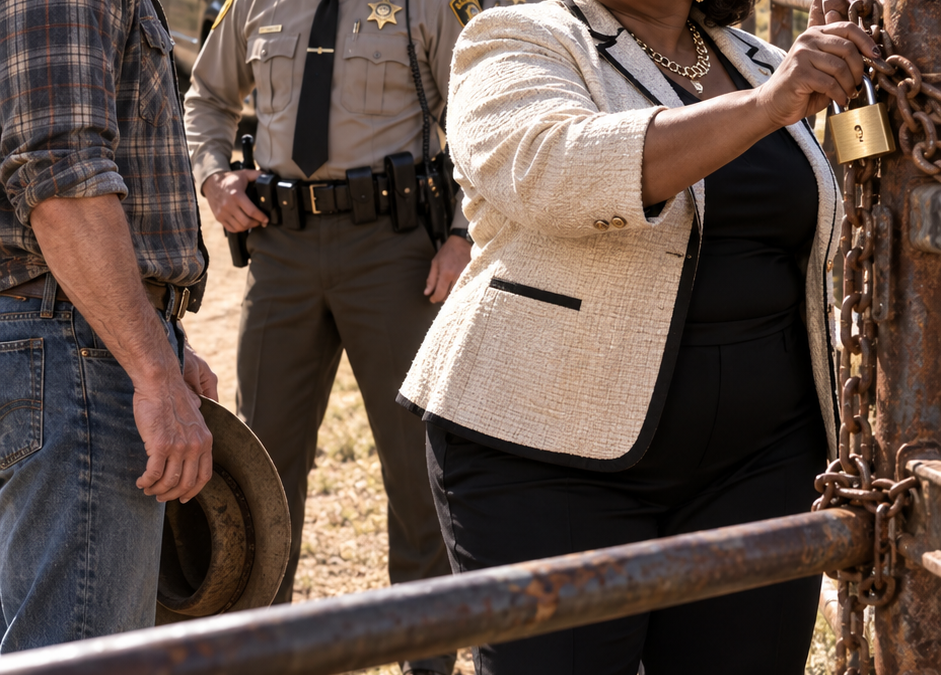
Marilyn’s brass padlock lay in the grass, still closed around a short section of severed chain.
The bulldozer sat roughly forty feet from the barn.
Blade raised.
Dale Corwin and Roy Mabry stood beside the building.
Tan shirts.
Tan trousers.
Duty belts.
Six-point gold stars.
Ten months had passed.
They hadn’t changed anything.
Why would they?
Until that morning, the costume had always worked.
Marilyn stood on the running board of her SUV.
Phone raised.
Recording.
Her free hand pointed toward the board over my father’s barn.
I drove over the cattle guard.
The rattle traveled straight through me.
Corwin stepped into the track and raised his palm.
Automatic gesture.
Stop.
He did it before he looked at the vehicle.
Then he saw the sheriff’s markings.
Then he saw me.
His hand lowered.
Slowly.
I parked.
Stepped out.
“Shut the machine off.”
The bulldozer operator looked toward Marilyn.
She didn’t answer.
He shut it down anyway.
The blade lowered into the grass.
The engine died.
Suddenly the property became quiet.
Wind.
Dry stubble.
The distant movement of bare branches.
Marilyn climbed down.
Her phone stayed raised.
“Mr. Turner, you’re violating a restraining order.”
Same voice.
Pleasant.
Certain.
As if the last ten months had taught her nothing.
“That order was dissolved November sixth.”
For the first time, her expression shifted.
Barely.
“The court heard the gate recording,” I continued. “Your affidavit claimed I threatened you. The recording shows Corwin threatening me with arrest. You weren’t even standing near me when it happened.”
Her eyes moved toward Corwin.
Behind me, the state investigators stepped from the Charger.
Marilyn looked at them.
Then she lifted her chin.
“Ridgeline is licensed security. They serve civil process. I never told anybody to say they were deputies.”
There it was.
After ten months, she finally said the sentence aloud.
On her own camera.
On my land.
I reached into my jacket.
Removed a protective sleeve.
“Service agreement. Cypress Hollow Estates Homeowners Association and Ridgeline Compliance Group.”
She stopped filming me and looked at the paper.
I read.
“Scope of work. Uniform: tan shirt, tan trousers, duty belt. Insignia: six-point gold star worn at left breast. Vehicle: white full-size SUV marked with star decals on front doors, appearance consistent with county law enforcement.”
Nobody moved.
I turned the page.
“Subject contact protocol: advise subject that failure to comply will result in arrest.”
Her face changed.
Finally.
I turned the contract toward her.
“Your signature.”
Then I held up the attached check.
“$9,600 from the association operating account.”
Mabry took two steps away from Corwin.
I’ve worked enough scenes to know what that movement means.
People separate themselves from the person they think is about to become evidence.
The bulldozer operator climbed down without being told.
Hands visible.
Marilyn’s phone remained raised, but her arm began dropping.
I’ve seen the video.
You can identify the exact second she understands that the people behind me aren’t HOA security.
They are state investigators.
“Marilyn Vaughn.”
She looked at me.
“I have a warrant for your arrest returned by the Branick County grand jury on January eighth and signed by Judge Rakes.”
I opened the warrant.
“Charges include conspiracy to impersonate a peace officer, forgery of a government record, theft by conversion involving sixty-two head of cattle, and perjury.”
One of the investigators moved toward Corwin.
Another approached Mabry.
Their six-point badges were removed from their shirts and sealed in evidence bags.
I didn’t expect that sight to affect me.
It did.
For ten months, those stars had opened every door while the truth remained outside.
Now they were plastic and metal in evidence bags.
Nothing more.
I approached Marilyn.
“Turn around.”
She stared at me.
“Turn around, ma’am.”
Her phone slipped from her fingers.
It hit the cattle guard.
The screen cracked.
The recording continued, camera pointed toward the winter sky.
She turned.
I placed one wrist in a cuff.
Then the other.
She wasn’t scared.
I want to be fair about that.
Marilyn Vaughn looked offended.
As though the universe itself had violated procedure.
Then she said the words I will probably remember until I die.
“Who do you think you are?”
I checked the cuffs.
Double-locked them.
Then I looked toward the barn.
My father’s sign was still there.
The bulldozer had stopped forty feet short.
I turned back to Marilyn.
“Ma’am, I’m the sheriff of Branick County.”
The state investigators walked her toward their vehicle.
I stepped into the grass.
Picked up the brass padlock.
It still held the severed piece of chain.
I put it in my coat pocket.
Then I stood inside my own open gate and watched Marilyn Vaughn leave my farm.
This time, she was the one who didn’t decide when she could come back.
The criminal cases took most of that year.
Marilyn eventually pleaded guilty to forgery and perjury.
She took the impersonation conspiracy count to trial.
The jury deliberated for less than three hours.
She received four years in state custody.
The court permanently barred her from serving in an HOA office or fiduciary position in the state.
Restitution was set at $386,000, jointly and severally with the other responsible defendants.
At sentencing, Marilyn gave a statement about protecting community standards and property values.
She never said my name.
Gil Prentice, Ridgeline’s owner and Lyall Rowan’s brother-in-law, was convicted of conspiracy.
The state permanently revoked Ridgeline Compliance Group’s license.
The company dissolved within months.
Dale Corwin and Roy Mabry cooperated with prosecutors.
Both admitted they had been trained to use law-enforcement language.
Corwin repeated the line on the witness stand.
“Advise subject that failure to comply will result in arrest.”
They received probation and fines.
There was a time I would have wanted more.
Prison.
Something dramatic.
But they provided the evidence that established where the script originated.
Sometimes justice is less emotionally satisfying than revenge.
That doesn’t make it less useful.
Lyall Rowan was already out of office.
The attorney general opened a separate review into how his department handled complaints involving Ridgeline and the Howerin developments.
I gave one statement.
Then I stayed out of it.
I had learned the cost of letting personal anger become part of official work.
The corrected Exhibit A was declared void.
A judge looked at the original microfilm and said what Dorothy and I had known months earlier.
My 186 acres had never been annexed.
Never been subject to Cypress Hollow’s covenants.
Never been lawfully exposed to a single HOA fine.
The lien was released.
The $18,400 came back in a certified check.
I carried that check in my truck for almost a week before depositing it.
Every time I looked at it, I thought about the sale barn.
That money had existed on paper.
My cattle had existed in flesh and blood.
Paper returned easily.
Living things don’t.
Cypress Hollow’s entire board resigned.
Nora Kesler ran in the replacement election.
She received more votes than anyone else.
Every Christmas, she sends me a card.
She still pretends she had very little to do with what happened.
I let her pretend.
The nine other households were included in the restitution order.
Bernice Kulvin received every dollar of those $110 payments back, plus interest.
The first time she came into my office after the restitution cleared, she brought cookies.
She put them on the counter.
“You know what I bought?”
“What?”
“A new hedge trimmer.”
I laughed.
“What are you going to do with it?”
“Whatever I damn well please.”
That was Bernice.
Gene Ashby received a written apology.
He told me he keeps it in a drawer.
“For my boy.”
“He’s young.”
“Exactly. Someday he’ll understand.”
Those cases became the part I cared most about.
Not because they were bigger than mine.
Because they proved mine wasn’t an isolated mistake.
A uniform works because people believe something larger stands behind it.
Law.
Authority.
Consequences.
When somebody steals that appearance, they’re not merely wearing the wrong shirt.
They’re borrowing public trust.
And people hand over things they would never surrender to an ordinary stranger.
Money.
Signatures.
Property.
Dignity.
Sometimes their home.
The restitution money came through in March.
Cattle prices had changed.
I bought back forty-four head.
People kept telling me, “You got your cattle back.”
I always corrected them.
“No. I got cattle back.”
There’s a difference.
The sixty-two animals taken from me were gone.
The new herd didn’t know the sound of my truck.
The first week, they watched me suspiciously from the pasture.
The second week, a few came closer.
Within a month, they knew the feed bucket.
Animals learn routine quickly.
Maybe people do too.
The bulldozer never touched my father’s barn.
Forty feet.
That’s as close as it got.
Its tracks cut deep scars into the sod.
They stayed visible through spring.
Through summer.
I mowed over them again and again.
Eventually the grass filled them.
By fall, you had to know where to look.
I knew.
In April, I took out the ladder.
Same ladder.
Same paint.
Same two-inch brush.
I leaned it against the barn door.
For a second, I could almost hear Ellen.
You’re missing a corner, Silas.
I smiled.
Then I climbed.
TURNER & SON.
The grooves my father cut were still deep beneath nearly sixty years of paint.
EST. 1926.
I worked slowly.
I always do.
When I finished the first line, I climbed down, moved the ladder, and looked across the pasture.
Forty-four cattle grazed beyond the fence.
Not the same cattle.
But mine.
The road toward Phase Three still ended at the edge of Cypress Hollow.
It never crossed my hayfield.
I picked up my sheriff’s badge from where I’d hung it on a fence nail before climbing the ladder.
People sometimes ask why I take it off while painting.
Simple.
I don’t want white paint on it.
But I don’t leave it locked in the house either.
It hangs where I can see it until the job is finished.
The farm and the badge are different kinds of responsibility.
For a long time, I thought one had nearly cost me the other.
Now I understand that losing the farm for those months taught me what the badge was supposed to mean.
The brass padlock Marilyn placed on my gate is still in the top drawer of my desk at the sheriff’s office.
It isn’t displayed.
Nobody sees it unless I choose to show them.
I didn’t keep it as a trophy.
I kept it because every few weeks somebody walks into that office carrying a folder.
Sometimes they’re angry.
Sometimes embarrassed.
Sometimes scared they won’t be believed.
They have dirt on their boots or work uniforms still on because they came straight from a job.
Usually their story starts small.
A notice.
A letter.
A boundary.
A contractor.
A landlord.
A neighbor.
A person with a title.
Sometimes the story sounds confusing.
Sometimes it takes twenty minutes before I understand what they’re actually trying to tell me.
And sometimes they reach the point where their voice changes.
That’s usually when they say:
“I already went somewhere else.”
Or:
“They told me it was civil.”
Or the sentence I understand better than any other:
“Nobody would help me.”
When that happens, I don’t promise them they’re right.
A sheriff shouldn’t decide who’s right before seeing the evidence.
I don’t promise an arrest.
I don’t promise a case.
But I listen.
All the way through.
And sometimes, when somebody looks like they’re about to apologize for taking my time, I open the top drawer.
I put that brass padlock on the desk.
It is scratched now.
One side still has a short piece of the chain the bulldozer crew cut from my gate.
Most people don’t know what they’re looking at.
So I tell them.
Ten months before I became sheriff, somebody put that lock on my own farm gate.
Men wearing fake badges told me I would be arrested if I crossed it.
I went to the sheriff’s office.
I went to the district attorney.
I carried documents proving the land was mine.
For a while, nobody helped me either.
Then I put the lock back in the drawer.
And I ask them to start their story again from the beginning.
Because sometimes the most important thing a person with authority can do is not make somebody prove they deserve to be heard before he listens.
I learned that lesson standing outside my own fence.
I learned it while watching sixty-two cattle disappear down a county road.
I learned it sleeping in a truck with a red folder beside me.
And I learned it for good the morning I came back through that gate.
Marilyn had believed authority was something you could manufacture.
A gold star.
A tan shirt.
A marked SUV.
A threat spoken confidently enough.
For almost a year, she was right.
People moved when she told them to move.
Signed when she told them to sign.
Paid when she told them to pay.
Even I walked away from my own land.
But real authority isn’t a costume.
It is a responsibility.
It means the same law that gives you the power to put someone in handcuffs also limits when you are allowed to do it.
It means evidence matters even when the victim is inconvenient.
It means a farmer with mud on his boots deserves the same attention as a developer with lawyers.
And it means when somebody walks into my office carrying a folder and saying the impossible is happening to them, I don’t ask first whether the story sounds important.
I ask what happened.
Then I listen.
Every April, I still repaint my father’s sign.
TURNER & SON.
EST. 1926.
The letters have survived storms, droughts, Ellen’s death, my father’s absence, an HOA, a forged annexation, a lien, an auction, and a bulldozer that stopped forty feet short.
Some years, I think about changing it.
There hasn’t been a “son” working beside my father in decades.
He’s gone.
I’m the old man now.
But I never change the words.
My father carved them that way.
So that’s how they stay.
And when I’m done painting, I climb down, wipe my hands on an old rag, take the star off the fence nail, and pin it back onto my shirt.
Then I go to work.








