𝗣𝗔𝗥𝗧 𝟮 HOA Tried to Break Into My Backyard Bunker—She Had No Idea What I’d Find Before the Vote
𝗣𝗔𝗥𝗧 𝟮 ”
She didn’t answer.
Instead, she said, “Before somebody gets hurt, you should cooperate.”
Something in her tone bothered me.
Not anger.
Fear.
Real fear.
I had seen that particular tension before.
People imagining the worst because they lacked information.
But fear did not make burglary legal.
“Get off my property.”
“Nathan—”
“Now.”
She hesitated.
Then she walked toward the greenbelt.
Before disappearing into the darkness, she looked over her shoulder.
“You have thirty days.”
She paused.
“I’d use them to come clean.”
I stood there in wet grass for several minutes after she left.
Come clean.
About what?
I went inside, changed clothes, sat at my kitchen table, and did something the Army had trained into me years earlier.
Facts on one side of a legal pad.
Assumptions on the other.
FACT:
The bunker was documented.
FACT:
The HOA suddenly claimed it was illegal.
FACT:
Diane had personally attempted to open it.
FACT:
She believed something inside could hurt people.
ASSUMPTION:
This was retaliation over the trash can.
That assumption now looked too simple.
By six the next morning, I had three pages of notes and no theory that explained everything.
The demolition letter cited an undeclared underground structure.
But the bunker was literally printed on my property survey.
Why use an obviously weak violation?
If the real concern was dangerous material, why not call the fire marshal?
Or police?
Or county code enforcement?
Why personally pick the lock?
There was only one explanation I could make fit.
Diane believed there was something dangerous inside and wanted access before formal agencies became involved.
But what?
That morning, I found the first clue.
My neighbor Walt Higgins was watering tomatoes beside his fence when I walked over.
“Morning, Walt.”
“Morning.”
“Can I ask you something strange?”
He chuckled.
“In this neighborhood?”
Fair point.
“Have you heard anything about me storing something dangerous in the bunker?”
His face changed.
Very slightly.
That was enough.
“What?”
“Nathan, look…”
He shut off the hose.
“A couple months ago, I saw you unloading something from your truck late at night.”
I immediately remembered.
A military surplus shipping crate.
I had bought a pallet of used diesel components from a government liquidation auction two counties away.
Injector pumps.
Filter housings.
An alternator.
Generator hardware.
The auction house shipped them in an old military crate covered in faded stenciling.
I got home around eleven.
Rain was forecast.
I moved it into the bunker.
That was all.
Walt rubbed the back of his neck.
“I told Carol it looked military.”
“Carol down the street?”
“Yeah.”
“And then?”
“I might’ve joked that you were building something down there.”
I closed my eyes.
Of course.
A joke.
The most dangerous communications technology ever invented.
“I didn’t mean anything by it.”
“I know.”
And I did.
Walt wasn’t malicious.
He was bored.
Boredom and suburbia have destroyed more reputations than espionage.
By lunch, I had traced the gossip.
Walt told Carol.
Carol told her sister.
Her sister served on the HOA landscaping committee.
Somewhere along that chain, the story evolved.
Nathan carried engine parts into his workshop became:
Nathan carried a military crate into a bunker.
That became:
The veteran is storing military equipment underground.
And eventually:
Nathan Cole might be stockpiling weapons.
Suddenly Diane’s behavior made a disturbing kind of sense.
From her perspective, I was a former Army ordnance technician maintaining a reinforced underground room while neighbors reported mysterious military containers arriving after dark.
Then I had publicly lost my temper over an HOA fine.
That did not justify what she did.
But I could understand the fear.
For several hours, my anger cooled.
Maybe this wasn’t revenge.
Maybe Diane genuinely believed she was protecting people.
Then I reread the demolition notice.
And the entire theory fell apart.
Because if Diane genuinely believed explosives or weapons were being stored beneath my backyard, she had chosen the stupidest legal mechanism imaginable.
A public-safety concern required inspection.
The letter demanded demolition.
Those were not the same thing.
You do not need authority to destroy a structure in order to determine what is inside it.
You only need demolition authority if you want the structure itself gone.
That distinction sat in my head all evening.
Finally, I called Walt again.
“Do you remember when you told Diane about the crate?”
There was silence.
“Well…”
“You told her personally?”
“Fourth of July barbecue.”
Three months earlier.
“What did she say?”
“She asked questions.”
“What kind?”
“How big the crate was. Whether I saw markings. When you brought it home.”
That bothered me even more.
If Diane believed in July that I posed a danger, why wait until September?
Why wait until immediately after Priya’s complaint?
I didn’t know Priya existed yet.
I would soon.
The next morning, I started reading HOA board minutes.
It was the bureaucratic equivalent of self-harm.
Fence colors.
Pool furniture replacements.
Arguments about holiday decorations.
Complaints about basketball hoops.
Then something in the March minutes caught my attention.
Motion to reallocate $47,000 from Reserve Fund Line 12—Common Area Safety and Lighting Maintenance—to Discretionary Improvements Fund.
Passed three votes to two.
Forty-seven thousand dollars.
The safety and lighting account paid for greenbelt lamps, retention-pond fencing, playground safety equipment, and emergency infrastructure.
I thought about the dark path lights behind my house.
Interesting.
The “discretionary improvements” account had almost no detail attached.
No meaningful breakdown.
No completed-project summary.
No visible destination.
Money went in.
Then silence.
I filed a formal records request.
Homeowners had a right to see the financial documents.
The HOA was supposed to respond within a defined period.
They delivered late.
And incomplete.
Which naturally made me much more interested.
I began cross-referencing payments with county permits.
That was how I found Larkspur Terrace.
Diane’s street.
Forty-seven thousand dollars had been shifted through two bookkeeping categories before being paid toward landscaping, stonework, electrical installation, and hardscape improvements on a small northern cul-de-sac.
Specifically, a decorative stone entrance.
Custom lighting.
An expanded patio.
And other improvements that happened to sit beside Diane Worth’s property.
Very beside it.
Almost impressively beside it.
The so-called common patio effectively increased the usable outdoor area next to her backyard.
Meanwhile, greenbelt lights were dead.
The retention pond fencing needed repair.
The playground emergency call box still required a battery.
Apparently those things lacked decorative stonework.
Then I found Priya Anand.
Her name appeared in cached copies of deleted community forum posts.
Two months earlier, she had asked a very simple question.
Where had the safety money gone?
Her first post was polite.
The second was polite.
The third was noticeably less polite.
She pointed out that the greenbelt lighting remained broken despite money having been budgeted for repairs.
Then she referenced the March fund transfer.
Shortly after that, her posts disappeared.
Her records request went unanswered.
And suddenly the bunker rumor became community conversation again.
The timeline practically arranged itself.
Priya raised financial questions.
The questions started gaining attention.
Her forum posts vanished.
A dormant rumor about me returned.
Then my argument with Diane gave her the perfect personal justification to escalate.
Two days later, she mailed my demolition notice.
Suddenly nobody was talking about broken lights or forty-seven thousand dollars.
They were talking about Nathan Cole’s terrifying underground bunker.
It was brilliant.
Morally bankrupt.
But brilliant.
Fear always beats accounting.
Tell one hundred homeowners that reserve funds might have been mishandled, and half of them will say they’ll look into it after dinner.
Tell them a former ordnance technician might be storing weapons fifteen feet from where children play?
Everybody pays attention.
The bunker was never just a target.
It was a distraction.
I sat at my kitchen table surrounded by printouts, permits, invoices, board minutes, screenshots, and notes.
For the first time, I understood why Diane had been so desperate to see inside.
Opening the bunker gave her two possible wins.
If she found something remotely unusual, she could feed the panic.
If she found nothing, she could still use the structure violation to force demolition while framing herself as the president who had “acted decisively.”
Either way, people kept looking at me.
Not her.
That realization made me angrier than the demolition notice ever had.
I had been used.
Not merely accused.
Used.
My military background.
My workshop.
My temper.
My privacy.
Every piece of my life had been arranged into a convenient silhouette of danger so one woman could hide what she had done with everybody else’s money.
That night I read Priya’s deleted posts again.
Something about their restraint bothered me.
She had never accused Diane of stealing.
She asked questions.
Reasonable ones.
Where did the money go?
Why were repairs unfinished?
Why did the financial reporting stop?
That was it.
And those mild questions had been buried.
I decided then that saving the bunker wasn’t enough.
If I walked into the board meeting and proved only that my workshop was legal, Diane could survive.
Embarrassed, maybe.
Weakened.
But still president.
Six months later, she could target somebody else.
So I built a case.
Not an argument.
A case.
I downloaded every board minute from the previous fourteen months.
I obtained county permit records.
I documented the dates when Priya posted.
The dates her posts disappeared.
The date the bunker rumor resurfaced.
The date Diane filed my violation.
The date my demolition vote was scheduled.
Then I discovered something useful.
The annual HOA meeting was scheduled six days before my demolition deadline.
Final enforcement required board approval.
That meant Diane needed the membership angry at me when the vote happened.
I needed them looking somewhere else.
Not through manipulation.
Through documentation.
Six days before the meeting, I went to the county recorder’s office for certified copies.
That was when I made my first mistake.
The clerk processing my request happened to live in Fallbrook Ridge.
She told her husband.
Her husband golfed with HOA vice president Cliff Banister.
Cliff had voted for the reserve transfer.
Within hours, Diane knew I was collecting records.
That night, my phone rang.
“Is this Nathan Cole?”
“Yes.”
“My name is Priya Anand.”
I sat straighter.
She continued.
“You’ve been asking about the safety fund.”
“How did you know?”
“Nothing stays private here.”
Fair.
“You need to know they called an emergency session tonight.”
“Who?”
“Diane. Cliff. Another board member.”
“What happened?”
“The annual meeting was moved.”
I froze.
“Moved where?”
“Not where. When.”
The meeting had been scheduled for the fourteenth.
Now it was scheduled for the ninth.
Five days earlier.
Diane had discovered I was collecting evidence and accelerated the vote.
Subtle.
Like driving a bulldozer through a library.
I looked at the folder on my table.
It wasn’t finished.
I still needed the cleanest possible contractor trail.
I also needed Priya herself.
“Would you testify?”
Silence.
“I need you to understand what that means,” I said. “Your name. Publicly. In front of everybody.”
“My husband wants me to drop this.”
“I understand.”
“I’ve spent two months telling myself I tried.”
Another pause.
Then her voice hardened.
“But if you can prove where the money went, I’m finished being quiet.”
“I can prove most of it.”
“Then prove the rest.”
The meeting was Tuesday.
I spent the weekend chasing documents.
One contractor repeatedly appeared in the permit paperwork.
Hearthstone Grounds LLC.
The company was only eighteen months old and registered to a UPS mailbox.
That didn’t prove wrongdoing.
But it did make my eyebrows rise.
The electrical subcontractor was easier.
His name was Ruiz.
I contacted him under the legitimate premise that I was interested in similar work and asked about the Larkspur Terrace installation.
He remembered it.
He also remembered the payment.
“The HOA paid us,” he said.
“Not Diane Worth personally?”
“No. Association check.”
“Would you confirm that in writing?”
“As long as you’re not claiming I did something wrong.”
“I’m not.”
He sent a short statement.
That helped.
Then I visited Larkspur Terrace.
From the public sidewalk, the improvements were visible.
Stone pillars.
Wrought-iron detailing.
Custom outdoor lights.
Flagstone patio.
Built-in fire pit.
Cedar posts.
It looked excellent.
That somehow made it worse.
Forty-seven thousand dollars had not vanished.
It had been transformed into a genuinely beautiful amenity.
For Diane.
Paid for by residents whose children were walking past dead lights and damaged fencing.
I photographed everything visible from public property.
Then I cross-referenced each feature with permits and invoices.
Stonework.
Electrical.
Patio.
Lighting.
Every trail led back to the reallocated safety fund.
By Monday night, I had six complete binders.
One for each board member.
One for the official record.
Every claim had a citation.
Every photograph had a permit reference.
Every payment had a date.
Every board action had minutes attached.
It was boring.
That was intentional.
Drama can be dismissed.
Paperwork is harder.
Tuesday morning, my phone rang.
Diane.
“I heard you’ve been busy.”
No fake warmth this time.
“I’ve had hobbies.”
“You think you’ve discovered something.”
“I found records.”
“The board approved those expenditures.”
“Great.”
I leaned back.
“Then presenting them publicly shouldn’t cause any problem.”
Silence.
“The demolition vote is first on tonight’s agenda,” she finally said.
“I know.”
“It will happen before new business.”
“I know.”
“I suggest you think carefully about which fight matters more.”
That was the clearest threat she ever made.
Get distracted exposing me, and I’ll destroy your bunker first.
She hung up.
I checked the bylaws again.
Cover to cover.
Article Nine, Section Four.
I almost missed it.
Any homeowner in good standing could demand an emergency point of order involving documented financial impropriety before the regular agenda, provided the evidence was submitted to the board secretary at least two hours before the meeting.
I checked the clock.
Four hours.
I called Priya.
“We’re going early.”
“How early?”
“Exactly two hours.”
The clubhouse officially seated eighty.
That night, at least one hundred twenty people showed up.
Apparently rumors about underground weapons were excellent for attendance.
Priya and I arrived at five.
The meeting started at seven.
Board secretary Terrence was already setting up.
I handed him the written request.
He read the heading.
Then looked at the binders.
Then looked at me.
His face had the expression of a man who had just realized his quiet Tuesday was about to become local history.
“I need this timestamped,” I said.
He stamped it.
5:04 p.m.
“I also need confirmation that Article Nine, Section Four requires this to be heard first.”
Terrence sighed.
“It does.”
“Thank you.”
He looked at the stack again.
“I didn’t realize anyone read these bylaws.”
“Neither did I until somebody threatened my bunker.”
Diane arrived ten minutes before seven.
Perfect hair.
Professional smile.
Calm handshake.
She moved through the room like somebody who already knew the result.
She did not know about my filing.
At 7:02, she called the meeting to order.
“Item one tonight concerns enforcement action regarding an undeclared underground—”
Terrence stood.
“Before the posted agenda, we have a properly filed emergency point of order.”
Diane stopped.
For half a second, her face went completely blank.
Then the mask returned.
“What point of order?”
“Article Nine, Section Four. Financial impropriety.”
The room changed.
You could feel it.
People shifted.
Heads turned.
Diane looked at Terrence.
“When was this filed?”
“5:04.”
She tried immediately.
“I believe scheduled enforcement should proceed first due to deadline concerns.”
Terrence shook his head.
“The bylaw requires the financial point to be heard first.”
“I think the board has discretion.”
“It does not.”
I stood.
“The language is pretty clear.”
Everybody looked at me.
I walked forward carrying a binder.
Priya stood beside me.
That mattered.
Because now this wasn’t Nathan versus Diane.
Two different residents.
Two different complaints.
One trail.
Diane folded her arms.
“Fine.”
She said the word like it tasted poisonous.
“Proceed.”
I faced the room.
“Most of you know me because you’ve heard there’s something dangerous inside a bunker behind my house.”
Silence.
“I’ll explain that rumor.”
I looked toward Priya.
“But first, you need to hear about something that happened before anybody cared about my bunker.”
I introduced her.
Then I explained her records request.
The broken lights.
The damaged pond fence.
The missing answers.
The deleted posts.
Then I held up the March minutes.
“In March, forty-seven thousand dollars was moved out of the fund responsible for these repairs.”
People started whispering.
“It was transferred into something called discretionary improvements.”
I opened the binder.
“I’d like to show you the improvements.”
Page by page.
No speeches.
No insults.
Just records.
County permits.
Hearthstone invoices.
Ruiz’s written statement.
HOA checks.
Photographs of the stone gate.
The patio.
The custom lighting.
Then the address.
Diane Worth’s.
A man near the back actually said, “You have got to be kidding me.”
Diane stood.
“These were improvements to shared common areas.”
I looked at the photograph projected on the clubhouse screen.
The expanded patio was practically touching her backyard.
“Then everyone here should be able to use that patio.”
She opened her mouth.
Closed it.
I continued.
“The safety fund paid for these improvements while our greenbelt lamps stayed broken.”
A woman raised her voice.
“My daughter walks that greenbelt every morning.”
Another voice.
“The pond fence has been broken since spring.”
The room began boiling.
Diane lifted both hands.
“Please. Everyone needs to remain orderly.”
Nothing irritates angry taxpayers like being told to remain orderly by the person explaining where their money went.
Priya spoke next.
She described filing her request.
Waiting.
Posting questions.
Watching the posts disappear.
“I never accused anyone of stealing,” she said. “I asked where the money went.”
She looked directly at Diane.
“You never answered.”
That hit harder than anything I could have said.
Diane shifted strategy.
“This entire presentation is retaliation from a homeowner currently facing a serious compliance action.”
I nodded.
“Correct. I am facing a compliance action.”
She looked briefly satisfied.
Then I continued.
“And now we should discuss how that action began.”
I explained Walt’s crate.
The engine parts.
The rumor.
The military surplus markings.
Then I told them about midnight.
“You’re claiming I trespassed?” Diane interrupted.
“I’m claiming I watched you standing at my bunker hatch at 11:52 p.m. holding a screwdriver and a tension wrench.”
The room went silent.
Someone whispered, “Jesus.”
“I told you I believed there was a safety risk.”
“Then why didn’t you call the fire marshal?”
She paused.
“If you believed I had explosives, why did you personally try to open the door?”
No answer.
“Why did you wait months after hearing the rumor?”
Still nothing.
“And why was my alleged danger suddenly urgent right when Priya started asking where forty-seven thousand dollars went?”
The room erupted.
Diane tried to talk over it.
“This is conjecture.”
“No.”
I held up the documentation.
“The motive is my interpretation.”
I tapped the binder.
“The dates aren’t.”
That distinction mattered.
I wasn’t pretending the documents could read her mind.
I didn’t need them to.
They showed the sequence.
Priya complains.
Her posts disappear.
The bunker rumor resurfaces.
I argue with Diane.
The demolition notice appears.
I begin investigating the safety fund.
The meeting gets moved forward five days.
Everybody could draw their own conclusion.
Then Cliff Banister stood up.
Vice president.
One of the people who had approved the transfer.
He looked terrible.
“I voted for the reallocation.”
Diane turned sharply.
“Cliff—”
He kept talking.
“You told us it was for a shared drainage and improvement project serving the northern cul-de-sac.”
“It does serve—”
“I didn’t know this was being built beside your house.”
That was it.
That was the moment she lost the room.
Not because of anything I said.
Because one of her own allies looked around at one hundred twenty neighbors and admitted he had not understood what he voted for.
Cliff faced Terrence.
“I want that statement entered into the official record.”
Terrence nodded.
Diane said, “Cliff, we can discuss this privately.”
A woman near the back shouted, “Why privately?”
That got applause.
Then somebody yelled, “No-confidence vote.”
Another person immediately shouted, “Second.”
Diane looked toward Terrence.
“You cannot do that from the floor.”
Terrence opened the bylaws.
Actually smiled a little.
“Yes, they can.”
For six years, Diane had ruled Fallbrook Ridge through procedure.
Now procedure had turned around and bitten her.
Beautiful.
The motion was formally stated.
Members raised their hands.
I had never seen a vote that lopsided outside military training when somebody asked whether we wanted to leave early.
Terrence looked across the room.
Then at Diane.
“The motion carries.”
Nobody needed a recount.
Diane Worth was removed as HOA president.
Right there.
No dramatic speech.
No heroic music.
Just hands in the air.
Six years of control ended because neighbors finally read the paperwork she assumed they would never bother reading.
She sat down.
For the first time since I had known her, Diane had nothing to say.
Then Cliff, now serving as temporary chair, turned to my issue.
“The proposed demolition enforcement appears to originate from questionable circumstances.”
He looked at the original citation.
“And Mr. Cole has provided property documentation showing the structure predates the HOA covenants.”
I handed him the deed and survey.
He read them.
A board member beside him whispered something.
Cliff nodded.
“I move that the violation be withdrawn permanently, that the bunker’s grandfathered status be entered into association records, and that no future enforcement action regarding the structure be taken absent an actual county code violation.”
Seconded.
Passed.
Just like that.
Thirty days became zero.
No demolition.
No contractor.
No forced entry.
My bunker stayed exactly where it had been since 1962.
I expected the meeting to end there.
It didn’t.
An older man named Frank Delgado raised his hand.
I barely knew him.
“I have a riding mower that hasn’t started in two years.”
People laughed.
Frank pointed at me.
“You rebuild engines down there, right?”
“Sometimes.”
“You ever teach?”
I laughed.
“Teach what?”
“That.”
Then another neighbor spoke.
“I’ve got a generator I’d like to understand before the next outage.”
Someone else mentioned small-engine maintenance.
Another person wanted to learn welding basics.
Within ten minutes, the room was discussing the same bunker they had arrived believing might contain weapons.
Frank made a motion.
Official community recognition of my bunker as an optional resident skills workshop, with me retaining ownership and control while volunteering limited scheduled sessions for neighbors interested in basic mechanical work.
I stared at him.
“You people spent three weeks thinking I was building missiles.”
He shrugged.
“Now we know you’re building generators.”
Fair.
Then somebody suggested something that nearly made me laugh myself unconscious.
The discretionary improvements account should fund shared tools under transparent oversight.
The same account Diane had used.
The irony was so perfect I couldn’t improve it.
The motion passed unanimously.
Diane remained seated through the entire discussion.
Speechless.
There was no better ending I could have designed.
She had tried to turn my bunker into the symbol of everything dangerous in the neighborhood.
By ten o’clock that night, the neighborhood had officially voted to treat it as a community workshop.
I walked out beside Priya.
The parking lot buzzed with conversations.
Residents were already demanding a full audit of association finances.
Cliff promised the safety funds would be restored.
Someone had volunteered for a new finance committee.
Someone else wanted the forum deletion policy reviewed.
Apparently transparency becomes very fashionable immediately after people discover what opacity costs.
Priya stopped beside her car.
“Thank you.”
“For what?”
“For believing me.”
I shook my head.
“You had the right question before I even knew there was a problem.”
“Yeah.”
She looked back toward the clubhouse.
“Nobody listened.”
“They’re listening now.”
The interim board arranged repairs almost immediately.
Within the week, the greenbelt lights worked again.
The retention pond fencing was scheduled for replacement.
The emergency call box battery finally got replaced, which apparently required a financial scandal and one attempted bunker break-in to accomplish.
HOA efficiency.
A mysterious thing.
The board also commissioned an outside financial review.
Several expenditures made during Diane’s presidency were reopened.
I never heard the complete details of what happened between Diane and the association after that.
I didn’t need to.
She resigned from every remaining committee before the end of the month.
The decorative gate stayed.
The patio stayed.
But the board reclassified the disputed portion, adjusted the property boundaries governing community use, and required repayment arrangements related to improperly allocated expenditures.
I avoided celebrating too loudly.
Mostly.
A few weeks later, Frank brought over his dead riding mower.
We rolled it down the bunker ramp together.
The carburetor was clogged.
Fuel line cracked.
Spark plug looked prehistoric.
He watched while I pulled it apart.
“So this is the terrifying military facility?”
I handed him a wrench.
“Careful.”
He raised an eyebrow.
“Why?”
I lowered my voice.
“Classified.”
He laughed so hard he dropped the wrench.
Eventually, Saturday workshops became a small tradition.
Nothing formal.
Nothing dramatic.
A couple neighbors at a time.
Generators.
Mowers.
Motorcycle engines.
Basic tool safety.
Sometimes teenagers came with their parents and learned how combustion worked.
I kept the military surplus crate, too.
Mostly because I found it funny.
One afternoon, Walt spotted it sitting beneath my workbench.
“That’s it?”
“That’s it.”
“The mysterious military box?”
I opened the lid.
Inside were gasket sets and injector parts.
Walt stared.
“You’ve got to be kidding.”
“Nope.”
He rubbed his forehead.
“I may have accidentally started a neighborhood panic over fuel filters.”
“Pretty much.”
“Sorry.”
I handed him an old injector pump.
“You owe me fifty hours of labor.”
He looked horrified.
I smiled.
“Kidding.”
Mostly.
Months later, I stood in my backyard one evening looking at the hatch.
Same steel.
Same faded green paint.
Same old mechanical lock.
I had replaced the cylinder after Diane’s midnight visit, although part of me had considered preserving the damage as a monument to HOA ambition.
The greenbelt beyond my fence was fully lit.
Every lamp.
Kids rode bikes along the path.
Parents walked dogs.
Nobody seemed particularly afraid of the bunker anymore.
Which was funny.
Nothing inside had changed.
Same benches.
Same tools.
Same generator project.
Same shelves.
The only thing that changed was the story people had been told about it.
That was the lesson I carried away from the whole mess.
Diane never needed the rumor about me to be completely true.
She only needed it to be frightening enough.
A frightening story gets repeated before anybody checks whether it makes sense.
A boring financial transfer does not.
That was her advantage.
For a while.
What she underestimated was something I had learned years earlier.
When people want to manipulate you, they usually rely on speed.
Confusion.
Emotion.
Pressure.
They need you reacting before you understand what is happening.
The best defense is often painfully simple.
Slow everything down.
Write down the facts.
Check the dates.
Follow the money.
Keep copies.
And never underestimate how uncomfortable six organized binders can make a person who expected everybody else to rely on rumors.
The demolition letter stayed in my desk.
I considered throwing it away.
Instead, I framed it.
Not because I enjoyed looking at it.
Because it reminded me how close I came to treating the wrong thing as the fight.
I thought I was defending an underground workshop.
I wasn’t.
I was defending the difference between accusation and evidence.
Between authority and accountability.
Between someone controlling the story and everyone finally seeing the record.
Diane had tried everything to get into my bunker.
Letters.
Rumors.
Deadlines.
Board procedure.
Even lockpicks at midnight.
And in the end, she never got inside.
She didn’t need to.
Because when the truth finally came out, the thing that left her speechless wasn’t hidden beneath six feet of soil.
It was sitting in six boring binders on a folding table in front of one hundred twenty neighbors.
Every invoice.
Every permit.
Every date.
Every dollar.
Written down.
Timestamped.
And impossible to bury.
Have you finished reading the story and want to read it again?
HOA Tried to Break Into My Backyard Bunker—She Had No Idea What I’d Find Before the Vote
The HOA wanted my bunker opened.
Then I caught their president at the lock after midnight.
That was when I realized the bunker wasn’t what she was really trying to hide.
The letter was sitting on my kitchen table when I came back from my six-in-the-morning run.
I was still breathing hard, my shirt soaked through, when I tore open the envelope and read the first sentence.
UNDECLARED SUBTERRANEAN STRUCTURE VIOLATION. DEMOLITION COMPLIANCE REQUIRED WITHIN 30 DAYS.
Thirty days.
I read it again.
Then a third time.
Then once more because apparently my brain believed HOA nonsense might become less ridiculous through repetition.
It didn’t.
According to the notice, the Fallbrook Ridge Homeowners Association claimed it had authority to arrange contractor access to my property if I failed to comply voluntarily.
Contractor access.
Meaning strangers could theoretically walk into my backyard, force open a sixty-year-old steel hatch, and start dismantling a reinforced concrete fallout shelter that had existed beneath the property since John F. Kennedy was president.
I set the letter down very carefully.
My name is Nathan Cole.
I was thirty-eight years old, and before civilian life taught me that grown adults could wage holy war over recycling bins, I spent eleven years in the Army as an ordnance and mechanical technician.
That sounds more glamorous than it was.
Mostly, it meant I spent my days taking apart machinery capable of killing people and putting it back together correctly enough that it didn’t kill the wrong ones.
After leaving the service, I bought my house in Fallbrook Ridge for one unusual reason.
The backyard came with a Cold War fallout shelter.
The realtor treated it like an embarrassing plumbing defect.
I treated it like a selling point.
The bunker sat beneath roughly six feet of soil, accessible through a heavy steel hatch built into a low earthen mound near the back fence. According to the property records, a previous owner had constructed it sometime around 1962, presumably while staring nervously at television footage of Khrushchev and wondering whether suburban California would survive the week.
I wasn’t preparing for nuclear war.
I needed a workshop.
Fifteen feet by twenty feet of reinforced concrete with independent ventilation turned out to be nearly perfect.
Over two years, I installed steel benches, electrical outlets, tool cabinets, shelving, a parts washer, and a ventilation upgrade.
Nothing exotic.
Nothing illegal.
Unless rebuilding diesel engines had recently become a federal offense.
More importantly, the bunker appeared on the deed, the survey, and the county property documentation from the sale.
It predated the HOA covenants by more than a decade.
Grandfathered.
Exempt.
Legally speaking, none of Diane Worth’s business.
Diane Worth, unfortunately, had never allowed legality to interfere with enthusiasm.
She had been HOA president for six years.
Our latest disagreement had occurred two days earlier over my trash can.
Pickup happened Thursday morning.
I returned the bin beside my garage Thursday afternoon.
Unfortunately, I committed this heinous act four hours later than the association’s preferred deadline.
Diane issued a two-hundred-dollar fine.
I objected publicly.
She objected to my objection.
Voices rose.
Neighbors watched.
Nobody died.
Apparently democracy survived.
Two days later, I received a demolition notice for my bunker.
Coincidence was theoretically possible.
So was being struck by lightning while holding a winning lottery ticket.
I called the HOA office three times.
Voicemail every time.
By the third attempt, I put the phone down because experience had taught me that angry words have a remarkable ability to become calm exhibits at future hearings.
That night, I couldn’t sleep.
It wasn’t the demolition notice itself.
Any decent property attorney could probably dismantle that argument before lunch.
Something else bothered me.
Timing.
HOA letters did not materialize instantly.
Someone drafted them.
Someone reviewed them.
Someone approved them.
This one arrived almost immediately after my argument with Diane.
That meant either the HOA had discovered administrative efficiency for the first time in recorded history, or someone had already been preparing to come after the bunker.
At 11:52 p.m., the motion light beside my back fence switched on.
I was already awake.
I went to the window.
The greenbelt behind my house was dark except for a few path lights.
Half of them weren’t working.
At the time, that seemed like another ordinary example of what our dues apparently did not pay for.
Then I saw the figure crouched beside the bunker hatch.
I didn’t grab a weapon.
I didn’t shout.
I walked outside in my socks.
The person had a flashlight clenched between their teeth.
One hand held a screwdriver.
The other held a narrow tension wrench inserted into my lock.
I stopped ten feet away.
“Hey.”
The flashlight snapped toward my face.
When my eyes adjusted, I almost laughed.
Not because it was funny.
Because sometimes reality becomes so stupid that laughter is the brain’s emergency response.
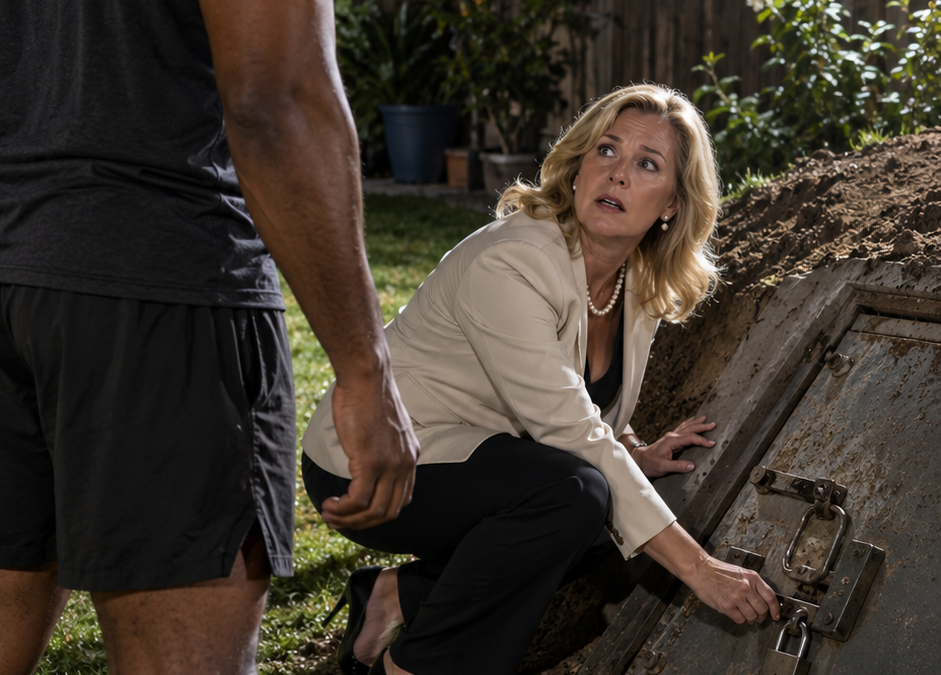
Diane Worth was crouching beside my Cold War bunker at midnight with lockpicking tools.
Her hair was still immaculate.
Of course it was.
Some people could crawl out of a tornado looking ready for a board luncheon.
“Diane?”
She slowly stood.
“What exactly are you doing?”
She didn’t apologize.
She didn’t pretend she had gotten lost.
Instead, she looked at me and said quietly:
“You need to let someone inspect what’s down there.”
That sentence changed everything.
PART2
I stared at her.
“Inspect?”
I pointed toward the tools in her hands.
“That’s an interesting inspection technique.”
“Nathan, this is serious.”
“You’re on my property at midnight trying to defeat my lock.”
“I know what you’re keeping down there.”
That stopped me.
Not because I was scared.
Because I genuinely had no idea what she was talking about.
“My socket wrench collection?”
Her expression didn’t move.
“I know why you don’t want anyone looking.”
I almost admired the confidence.
There are people who need evidence before making accusations.
Then there are HOA presidents.
“But this isn’t only your business anymore,” she continued. “Not when that structure is fifteen feet from neighboring homes.”
I looked at the hatch.
Then at her.
Then at the screwdriver.
“What exactly do you think is down there?”
She didn’t answer.
Instead, she said, “Before somebody gets hurt, you should cooperate.”
Something in her tone bothered me.
Not anger.
Fear.
Real fear.
I had seen that particular tension before.
People imagining the worst because they lacked information.
But fear did not make burglary legal.
“Get off my property.”
“Nathan—”
“Now.”
She hesitated.
Then she walked toward the greenbelt.
Before disappearing into the darkness, she looked over her shoulder.
“You have thirty days.”
She paused.
“I’d use them to come clean.”
I stood there in wet grass for several minutes after she left.
Come clean.
About what?
I went inside, changed clothes, sat at my kitchen table, and did something the Army had trained into me years earlier.
Facts on one side of a legal pad.
Assumptions on the other.
FACT:
The bunker was documented.
FACT:
The HOA suddenly claimed it was illegal.
FACT:
Diane had personally attempted to open it.
FACT:
She believed something inside could hurt people.
ASSUMPTION:
This was retaliation over the trash can.
That assumption now looked too simple.
By six the next morning, I had three pages of notes and no theory that explained everything.
The demolition letter cited an undeclared underground structure.
But the bunker was literally printed on my property survey.
Why use an obviously weak violation?
If the real concern was dangerous material, why not call the fire marshal?
Or police?
Or county code enforcement?
Why personally pick the lock?
There was only one explanation I could make fit.
Diane believed there was something dangerous inside and wanted access before formal agencies became involved.
But what?
That morning, I found the first clue.
My neighbor Walt Higgins was watering tomatoes beside his fence when I walked over.
“Morning, Walt.”
“Morning.”
“Can I ask you something strange?”
He chuckled.
“In this neighborhood?”
Fair point.
“Have you heard anything about me storing something dangerous in the bunker?”
His face changed.
Very slightly.
That was enough.
“What?”
“Nathan, look…”
He shut off the hose.
“A couple months ago, I saw you unloading something from your truck late at night.”
I immediately remembered.
A military surplus shipping crate.
I had bought a pallet of used diesel components from a government liquidation auction two counties away.
Injector pumps.
Filter housings.
An alternator.
Generator hardware.
The auction house shipped them in an old military crate covered in faded stenciling.
I got home around eleven.
Rain was forecast.
I moved it into the bunker.
That was all.
Walt rubbed the back of his neck.
“I told Carol it looked military.”
“Carol down the street?”
“Yeah.”
“And then?”
“I might’ve joked that you were building something down there.”
I closed my eyes.
Of course.
A joke.
The most dangerous communications technology ever invented.
“I didn’t mean anything by it.”
“I know.”
And I did.
Walt wasn’t malicious.
He was bored.
Boredom and suburbia have destroyed more reputations than espionage.
By lunch, I had traced the gossip.
Walt told Carol.
Carol told her sister.
Her sister served on the HOA landscaping committee.
Somewhere along that chain, the story evolved.
Nathan carried engine parts into his workshop became:
Nathan carried a military crate into a bunker.
That became:
The veteran is storing military equipment underground.
And eventually:
Nathan Cole might be stockpiling weapons.
Suddenly Diane’s behavior made a disturbing kind of sense.
From her perspective, I was a former Army ordnance technician maintaining a reinforced underground room while neighbors reported mysterious military containers arriving after dark.
Then I had publicly lost my temper over an HOA fine.
That did not justify what she did.
But I could understand the fear.
For several hours, my anger cooled.
Maybe this wasn’t revenge.
Maybe Diane genuinely believed she was protecting people.
Then I reread the demolition notice.
And the entire theory fell apart.
Because if Diane genuinely believed explosives or weapons were being stored beneath my backyard, she had chosen the stupidest legal mechanism imaginable.
A public-safety concern required inspection.
The letter demanded demolition.
Those were not the same thing.
You do not need authority to destroy a structure in order to determine what is inside it.
You only need demolition authority if you want the structure itself gone.
That distinction sat in my head all evening.
Finally, I called Walt again.
“Do you remember when you told Diane about the crate?”
There was silence.
“Well…”
“You told her personally?”
“Fourth of July barbecue.”
Three months earlier.
“What did she say?”
“She asked questions.”
“What kind?”
“How big the crate was. Whether I saw markings. When you brought it home.”
That bothered me even more.
If Diane believed in July that I posed a danger, why wait until September?
Why wait until immediately after Priya’s complaint?
I didn’t know Priya existed yet.
I would soon.
The next morning, I started reading HOA board minutes.
It was the bureaucratic equivalent of self-harm.
Fence colors.
Pool furniture replacements.
Arguments about holiday decorations.
Complaints about basketball hoops.
Then something in the March minutes caught my attention.
Motion to reallocate $47,000 from Reserve Fund Line 12—Common Area Safety and Lighting Maintenance—to Discretionary Improvements Fund.
Passed three votes to two.
Forty-seven thousand dollars.
The safety and lighting account paid for greenbelt lamps, retention-pond fencing, playground safety equipment, and emergency infrastructure.
I thought about the dark path lights behind my house.
Interesting.
The “discretionary improvements” account had almost no detail attached.
No meaningful breakdown.
No completed-project summary.
No visible destination.
Money went in.
Then silence.
I filed a formal records request.
Homeowners had a right to see the financial documents.
The HOA was supposed to respond within a defined period.
They delivered late.
And incomplete.
Which naturally made me much more interested.
I began cross-referencing payments with county permits.
That was how I found Larkspur Terrace.
Diane’s street.
Forty-seven thousand dollars had been shifted through two bookkeeping categories before being paid toward landscaping, stonework, electrical installation, and hardscape improvements on a small northern cul-de-sac.
Specifically, a decorative stone entrance.
Custom lighting.
An expanded patio.
And other improvements that happened to sit beside Diane Worth’s property.
Very beside it.
Almost impressively beside it.
The so-called common patio effectively increased the usable outdoor area next to her backyard.
Meanwhile, greenbelt lights were dead.
The retention pond fencing needed repair.
The playground emergency call box still required a battery.
Apparently those things lacked decorative stonework.
Then I found Priya Anand.
Her name appeared in cached copies of deleted community forum posts.
Two months earlier, she had asked a very simple question.
Where had the safety money gone?
Her first post was polite.
The second was polite.
The third was noticeably less polite.
She pointed out that the greenbelt lighting remained broken despite money having been budgeted for repairs.
Then she referenced the March fund transfer.
Shortly after that, her posts disappeared.
Her records request went unanswered.
And suddenly the bunker rumor became community conversation again.
The timeline practically arranged itself.
Priya raised financial questions.
The questions started gaining attention.
Her forum posts vanished.
A dormant rumor about me returned.
Then my argument with Diane gave her the perfect personal justification to escalate.
Two days later, she mailed my demolition notice.
Suddenly nobody was talking about broken lights or forty-seven thousand dollars.
They were talking about Nathan Cole’s terrifying underground bunker.
It was brilliant.
Morally bankrupt.
But brilliant.
Fear always beats accounting.
Tell one hundred homeowners that reserve funds might have been mishandled, and half of them will say they’ll look into it after dinner.
Tell them a former ordnance technician might be storing weapons fifteen feet from where children play?
Everybody pays attention.
The bunker was never just a target.
It was a distraction.
I sat at my kitchen table surrounded by printouts, permits, invoices, board minutes, screenshots, and notes.
For the first time, I understood why Diane had been so desperate to see inside.
Opening the bunker gave her two possible wins.
If she found something remotely unusual, she could feed the panic.
If she found nothing, she could still use the structure violation to force demolition while framing herself as the president who had “acted decisively.”
Either way, people kept looking at me.
Not her.
That realization made me angrier than the demolition notice ever had.
I had been used.
Not merely accused.
Used.
My military background.
My workshop.
My temper.
My privacy.
Every piece of my life had been arranged into a convenient silhouette of danger so one woman could hide what she had done with everybody else’s money.
That night I read Priya’s deleted posts again.
Something about their restraint bothered me.
She had never accused Diane of stealing.
She asked questions.
Reasonable ones.
Where did the money go?
Why were repairs unfinished?
Why did the financial reporting stop?
That was it.
And those mild questions had been buried.
I decided then that saving the bunker wasn’t enough.
If I walked into the board meeting and proved only that my workshop was legal, Diane could survive.
Embarrassed, maybe.
Weakened.
But still president.
Six months later, she could target somebody else.
So I built a case.
Not an argument.
A case.
I downloaded every board minute from the previous fourteen months.
I obtained county permit records.
I documented the dates when Priya posted.
The dates her posts disappeared.
The date the bunker rumor resurfaced.
The date Diane filed my violation.
The date my demolition vote was scheduled.
Then I discovered something useful.
The annual HOA meeting was scheduled six days before my demolition deadline.
Final enforcement required board approval.
That meant Diane needed the membership angry at me when the vote happened.
I needed them looking somewhere else.
Not through manipulation.
Through documentation.
Six days before the meeting, I went to the county recorder’s office for certified copies.
That was when I made my first mistake.
The clerk processing my request happened to live in Fallbrook Ridge.
She told her husband.
Her husband golfed with HOA vice president Cliff Banister.
Cliff had voted for the reserve transfer.
Within hours, Diane knew I was collecting records.
That night, my phone rang.
“Is this Nathan Cole?”
“Yes.”
“My name is Priya Anand.”
I sat straighter.
She continued.
“You’ve been asking about the safety fund.”
“How did you know?”
“Nothing stays private here.”
Fair.
“You need to know they called an emergency session tonight.”
“Who?”
“Diane. Cliff. Another board member.”
“What happened?”
“The annual meeting was moved.”
I froze.
“Moved where?”
“Not where. When.”
The meeting had been scheduled for the fourteenth.
Now it was scheduled for the ninth.
Five days earlier.
Diane had discovered I was collecting evidence and accelerated the vote.
Subtle.
Like driving a bulldozer through a library.
I looked at the folder on my table.
It wasn’t finished.
I still needed the cleanest possible contractor trail.
I also needed Priya herself.
“Would you testify?”
Silence.
“I need you to understand what that means,” I said. “Your name. Publicly. In front of everybody.”
“My husband wants me to drop this.”
“I understand.”
“I’ve spent two months telling myself I tried.”
Another pause.
Then her voice hardened.
“But if you can prove where the money went, I’m finished being quiet.”
“I can prove most of it.”
“Then prove the rest.”
The meeting was Tuesday.
I spent the weekend chasing documents.
One contractor repeatedly appeared in the permit paperwork.
Hearthstone Grounds LLC.
The company was only eighteen months old and registered to a UPS mailbox.
That didn’t prove wrongdoing.
But it did make my eyebrows rise.
The electrical subcontractor was easier.
His name was Ruiz.
I contacted him under the legitimate premise that I was interested in similar work and asked about the Larkspur Terrace installation.
He remembered it.
He also remembered the payment.
“The HOA paid us,” he said.
“Not Diane Worth personally?”
“No. Association check.”
“Would you confirm that in writing?”
“As long as you’re not claiming I did something wrong.”
“I’m not.”
He sent a short statement.
That helped.
Then I visited Larkspur Terrace.
From the public sidewalk, the improvements were visible.
Stone pillars.
Wrought-iron detailing.
Custom outdoor lights.
Flagstone patio.
Built-in fire pit.
Cedar posts.
It looked excellent.
That somehow made it worse.
Forty-seven thousand dollars had not vanished.
It had been transformed into a genuinely beautiful amenity.
For Diane.
Paid for by residents whose children were walking past dead lights and damaged fencing.
I photographed everything visible from public property.
Then I cross-referenced each feature with permits and invoices.
Stonework.
Electrical.
Patio.
Lighting.
Every trail led back to the reallocated safety fund.
By Monday night, I had six complete binders.
One for each board member.
One for the official record.
Every claim had a citation.
Every photograph had a permit reference.
Every payment had a date.
Every board action had minutes attached.
It was boring.
That was intentional.
Drama can be dismissed.
Paperwork is harder.
Tuesday morning, my phone rang.
Diane.
“I heard you’ve been busy.”
No fake warmth this time.
“I’ve had hobbies.”
“You think you’ve discovered something.”
“I found records.”
“The board approved those expenditures.”
“Great.”
I leaned back.
“Then presenting them publicly shouldn’t cause any problem.”
Silence.
“The demolition vote is first on tonight’s agenda,” she finally said.
“I know.”
“It will happen before new business.”
“I know.”
“I suggest you think carefully about which fight matters more.”
That was the clearest threat she ever made.
Get distracted exposing me, and I’ll destroy your bunker first.
She hung up.
I checked the bylaws again.
Cover to cover.
Article Nine, Section Four.
I almost missed it.
Any homeowner in good standing could demand an emergency point of order involving documented financial impropriety before the regular agenda, provided the evidence was submitted to the board secretary at least two hours before the meeting.
I checked the clock.
Four hours.
I called Priya.
“We’re going early.”
“How early?”
“Exactly two hours.”
The clubhouse officially seated eighty.
That night, at least one hundred twenty people showed up.
Apparently rumors about underground weapons were excellent for attendance.
Priya and I arrived at five.
The meeting started at seven.
Board secretary Terrence was already setting up.
I handed him the written request.
He read the heading.
Then looked at the binders.
Then looked at me.
His face had the expression of a man who had just realized his quiet Tuesday was about to become local history.
“I need this timestamped,” I said.
He stamped it.
5:04 p.m.
“I also need confirmation that Article Nine, Section Four requires this to be heard first.”
Terrence sighed.
“It does.”
“Thank you.”
He looked at the stack again.
“I didn’t realize anyone read these bylaws.”
“Neither did I until somebody threatened my bunker.”
Diane arrived ten minutes before seven.
Perfect hair.
Professional smile.
Calm handshake.
She moved through the room like somebody who already knew the result.
She did not know about my filing.
At 7:02, she called the meeting to order.
“Item one tonight concerns enforcement action regarding an undeclared underground—”
Terrence stood.
“Before the posted agenda, we have a properly filed emergency point of order.”
Diane stopped.
For half a second, her face went completely blank.
Then the mask returned.
“What point of order?”
“Article Nine, Section Four. Financial impropriety.”
The room changed.
You could feel it.
People shifted.
Heads turned.
Diane looked at Terrence.
“When was this filed?”
“5:04.”
She tried immediately.
“I believe scheduled enforcement should proceed first due to deadline concerns.”
Terrence shook his head.
“The bylaw requires the financial point to be heard first.”
“I think the board has discretion.”
“It does not.”
I stood.
“The language is pretty clear.”
Everybody looked at me.
I walked forward carrying a binder.
Priya stood beside me.
That mattered.
Because now this wasn’t Nathan versus Diane.
Two different residents.
Two different complaints.
One trail.
Diane folded her arms.
“Fine.”
She said the word like it tasted poisonous.
“Proceed.”
I faced the room.
“Most of you know me because you’ve heard there’s something dangerous inside a bunker behind my house.”
Silence.
“I’ll explain that rumor.”
I looked toward Priya.
“But first, you need to hear about something that happened before anybody cared about my bunker.”
I introduced her.
Then I explained her records request.
The broken lights.
The damaged pond fence.
The missing answers.
The deleted posts.
Then I held up the March minutes.
“In March, forty-seven thousand dollars was moved out of the fund responsible for these repairs.”
People started whispering.
“It was transferred into something called discretionary improvements.”
I opened the binder.
“I’d like to show you the improvements.”
Page by page.
No speeches.
No insults.
Just records.
County permits.
Hearthstone invoices.
Ruiz’s written statement.
HOA checks.
Photographs of the stone gate.
The patio.
The custom lighting.
Then the address.
Diane Worth’s.
A man near the back actually said, “You have got to be kidding me.”
Diane stood.
“These were improvements to shared common areas.”
I looked at the photograph projected on the clubhouse screen.
The expanded patio was practically touching her backyard.
“Then everyone here should be able to use that patio.”
She opened her mouth.
Closed it.
I continued.
“The safety fund paid for these improvements while our greenbelt lamps stayed broken.”
A woman raised her voice.
“My daughter walks that greenbelt every morning.”
Another voice.
“The pond fence has been broken since spring.”
The room began boiling.
Diane lifted both hands.
“Please. Everyone needs to remain orderly.”
Nothing irritates angry taxpayers like being told to remain orderly by the person explaining where their money went.
Priya spoke next.
She described filing her request.
Waiting.
Posting questions.
Watching the posts disappear.
“I never accused anyone of stealing,” she said. “I asked where the money went.”
She looked directly at Diane.
“You never answered.”
That hit harder than anything I could have said.
Diane shifted strategy.
“This entire presentation is retaliation from a homeowner currently facing a serious compliance action.”
I nodded.
“Correct. I am facing a compliance action.”
She looked briefly satisfied.
Then I continued.
“And now we should discuss how that action began.”
I explained Walt’s crate.
The engine parts.
The rumor.
The military surplus markings.
Then I told them about midnight.
“You’re claiming I trespassed?” Diane interrupted.
“I’m claiming I watched you standing at my bunker hatch at 11:52 p.m. holding a screwdriver and a tension wrench.”
The room went silent.
Someone whispered, “Jesus.”
“I told you I believed there was a safety risk.”
“Then why didn’t you call the fire marshal?”
She paused.
“If you believed I had explosives, why did you personally try to open the door?”
No answer.
“Why did you wait months after hearing the rumor?”
Still nothing.
“And why was my alleged danger suddenly urgent right when Priya started asking where forty-seven thousand dollars went?”
The room erupted.
Diane tried to talk over it.
“This is conjecture.”
“No.”
I held up the documentation.
“The motive is my interpretation.”
I tapped the binder.
“The dates aren’t.”
That distinction mattered.
I wasn’t pretending the documents could read her mind.
I didn’t need them to.
They showed the sequence.
Priya complains.
Her posts disappear.
The bunker rumor resurfaces.
I argue with Diane.
The demolition notice appears.
I begin investigating the safety fund.
The meeting gets moved forward five days.
Everybody could draw their own conclusion.
Then Cliff Banister stood up.
Vice president.
One of the people who had approved the transfer.
He looked terrible.
“I voted for the reallocation.”
Diane turned sharply.
“Cliff—”
He kept talking.
“You told us it was for a shared drainage and improvement project serving the northern cul-de-sac.”
“It does serve—”
“I didn’t know this was being built beside your house.”
That was it.
That was the moment she lost the room.
Not because of anything I said.
Because one of her own allies looked around at one hundred twenty neighbors and admitted he had not understood what he voted for.
Cliff faced Terrence.
“I want that statement entered into the official record.”
Terrence nodded.
Diane said, “Cliff, we can discuss this privately.”
A woman near the back shouted, “Why privately?”
That got applause.
Then somebody yelled, “No-confidence vote.”
Another person immediately shouted, “Second.”
Diane looked toward Terrence.
“You cannot do that from the floor.”
Terrence opened the bylaws.
Actually smiled a little.
“Yes, they can.”
For six years, Diane had ruled Fallbrook Ridge through procedure.
Now procedure had turned around and bitten her.
Beautiful.
The motion was formally stated.
Members raised their hands.
I had never seen a vote that lopsided outside military training when somebody asked whether we wanted to leave early.
Terrence looked across the room.
Then at Diane.
“The motion carries.”
Nobody needed a recount.
Diane Worth was removed as HOA president.
Right there.
No dramatic speech.
No heroic music.
Just hands in the air.
Six years of control ended because neighbors finally read the paperwork she assumed they would never bother reading.
She sat down.
For the first time since I had known her, Diane had nothing to say.
Then Cliff, now serving as temporary chair, turned to my issue.
“The proposed demolition enforcement appears to originate from questionable circumstances.”
He looked at the original citation.
“And Mr. Cole has provided property documentation showing the structure predates the HOA covenants.”
I handed him the deed and survey.
He read them.
A board member beside him whispered something.
Cliff nodded.
“I move that the violation be withdrawn permanently, that the bunker’s grandfathered status be entered into association records, and that no future enforcement action regarding the structure be taken absent an actual county code violation.”
Seconded.
Passed.
Just like that.
Thirty days became zero.
No demolition.
No contractor.
No forced entry.
My bunker stayed exactly where it had been since 1962.
I expected the meeting to end there.
It didn’t.
An older man named Frank Delgado raised his hand.
I barely knew him.
“I have a riding mower that hasn’t started in two years.”
People laughed.
Frank pointed at me.
“You rebuild engines down there, right?”
“Sometimes.”
“You ever teach?”
I laughed.
“Teach what?”
“That.”
Then another neighbor spoke.
“I’ve got a generator I’d like to understand before the next outage.”
Someone else mentioned small-engine maintenance.
Another person wanted to learn welding basics.
Within ten minutes, the room was discussing the same bunker they had arrived believing might contain weapons.
Frank made a motion.
Official community recognition of my bunker as an optional resident skills workshop, with me retaining ownership and control while volunteering limited scheduled sessions for neighbors interested in basic mechanical work.
I stared at him.
“You people spent three weeks thinking I was building missiles.”
He shrugged.
“Now we know you’re building generators.”
Fair.
Then somebody suggested something that nearly made me laugh myself unconscious.
The discretionary improvements account should fund shared tools under transparent oversight.
The same account Diane had used.
The irony was so perfect I couldn’t improve it.
The motion passed unanimously.
Diane remained seated through the entire discussion.
Speechless.
There was no better ending I could have designed.
She had tried to turn my bunker into the symbol of everything dangerous in the neighborhood.
By ten o’clock that night, the neighborhood had officially voted to treat it as a community workshop.
I walked out beside Priya.
The parking lot buzzed with conversations.
Residents were already demanding a full audit of association finances.
Cliff promised the safety funds would be restored.
Someone had volunteered for a new finance committee.
Someone else wanted the forum deletion policy reviewed.
Apparently transparency becomes very fashionable immediately after people discover what opacity costs.
Priya stopped beside her car.
“Thank you.”
“For what?”
“For believing me.”
I shook my head.
“You had the right question before I even knew there was a problem.”
“Yeah.”
She looked back toward the clubhouse.
“Nobody listened.”
“They’re listening now.”
The interim board arranged repairs almost immediately.
Within the week, the greenbelt lights worked again.
The retention pond fencing was scheduled for replacement.
The emergency call box battery finally got replaced, which apparently required a financial scandal and one attempted bunker break-in to accomplish.
HOA efficiency.
A mysterious thing.
The board also commissioned an outside financial review.
Several expenditures made during Diane’s presidency were reopened.
I never heard the complete details of what happened between Diane and the association after that.
I didn’t need to.
She resigned from every remaining committee before the end of the month.
The decorative gate stayed.
The patio stayed.
But the board reclassified the disputed portion, adjusted the property boundaries governing community use, and required repayment arrangements related to improperly allocated expenditures.
I avoided celebrating too loudly.
Mostly.
A few weeks later, Frank brought over his dead riding mower.
We rolled it down the bunker ramp together.
The carburetor was clogged.
Fuel line cracked.
Spark plug looked prehistoric.
He watched while I pulled it apart.
“So this is the terrifying military facility?”
I handed him a wrench.
“Careful.”
He raised an eyebrow.
“Why?”
I lowered my voice.
“Classified.”
He laughed so hard he dropped the wrench.
Eventually, Saturday workshops became a small tradition.
Nothing formal.
Nothing dramatic.
A couple neighbors at a time.
Generators.
Mowers.
Motorcycle engines.
Basic tool safety.
Sometimes teenagers came with their parents and learned how combustion worked.
I kept the military surplus crate, too.
Mostly because I found it funny.
One afternoon, Walt spotted it sitting beneath my workbench.
“That’s it?”
“That’s it.”
“The mysterious military box?”
I opened the lid.
Inside were gasket sets and injector parts.
Walt stared.
“You’ve got to be kidding.”
“Nope.”
He rubbed his forehead.
“I may have accidentally started a neighborhood panic over fuel filters.”
“Pretty much.”
“Sorry.”
I handed him an old injector pump.
“You owe me fifty hours of labor.”
He looked horrified.
I smiled.
“Kidding.”
Mostly.
Months later, I stood in my backyard one evening looking at the hatch.
Same steel.
Same faded green paint.
Same old mechanical lock.
I had replaced the cylinder after Diane’s midnight visit, although part of me had considered preserving the damage as a monument to HOA ambition.
The greenbelt beyond my fence was fully lit.
Every lamp.
Kids rode bikes along the path.
Parents walked dogs.
Nobody seemed particularly afraid of the bunker anymore.
Which was funny.
Nothing inside had changed.
Same benches.
Same tools.
Same generator project.
Same shelves.
The only thing that changed was the story people had been told about it.
That was the lesson I carried away from the whole mess.
Diane never needed the rumor about me to be completely true.
She only needed it to be frightening enough.
A frightening story gets repeated before anybody checks whether it makes sense.
A boring financial transfer does not.
That was her advantage.
For a while.
What she underestimated was something I had learned years earlier.
When people want to manipulate you, they usually rely on speed.
Confusion.
Emotion.
Pressure.
They need you reacting before you understand what is happening.
The best defense is often painfully simple.
Slow everything down.
Write down the facts.
Check the dates.
Follow the money.
Keep copies.
And never underestimate how uncomfortable six organized binders can make a person who expected everybody else to rely on rumors.
The demolition letter stayed in my desk.
I considered throwing it away.
Instead, I framed it.
Not because I enjoyed looking at it.
Because it reminded me how close I came to treating the wrong thing as the fight.
I thought I was defending an underground workshop.
I wasn’t.
I was defending the difference between accusation and evidence.
Between authority and accountability.
Between someone controlling the story and everyone finally seeing the record.
Diane had tried everything to get into my bunker.
Letters.
Rumors.
Deadlines.
Board procedure.
Even lockpicks at midnight.
And in the end, she never got inside.
She didn’t need to.
Because when the truth finally came out, the thing that left her speechless wasn’t hidden beneath six feet of soil.
It was sitting in six boring binders on a folding table in front of one hundred twenty neighbors.
Every invoice.
Every permit.
Every date.
Every dollar.
Written down.
Timestamped.
And impossible to bury.








