𝗣𝗔𝗥𝗧 𝟮 HOA Trenched a Storm Drain Through My Farm—Then the County Ordered Every Foot Dug Back Out
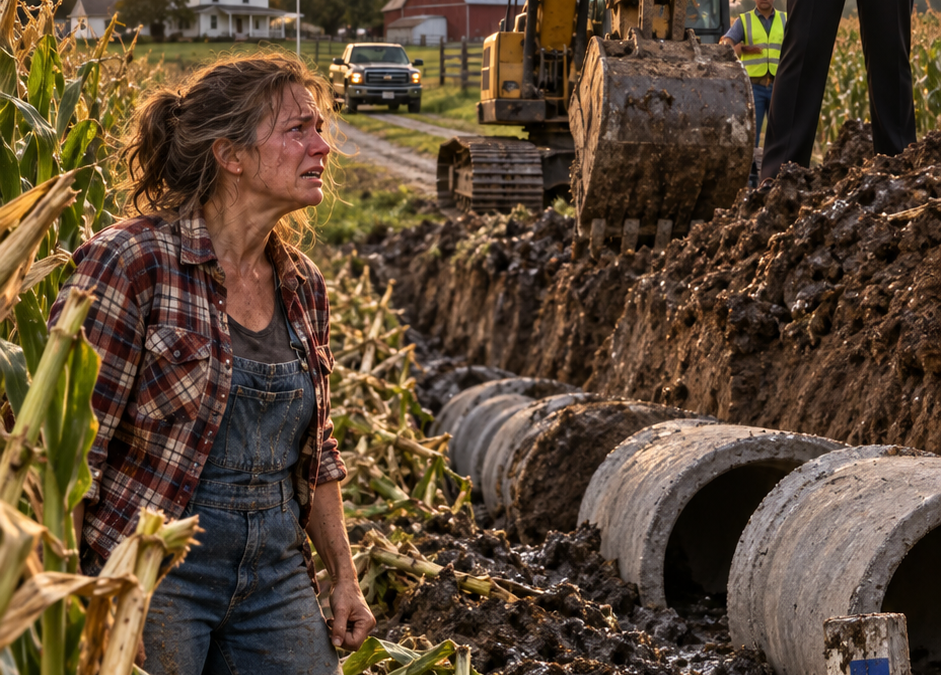
𝗣𝗔𝗥𝗧 𝟮
Two weeks earlier, there had been no excavator.
No trench.
No broken tile.
No floodwater standing over twenty-two acres.
My name is Tessa Fletcher.
I was forty-four when this happened.
The Fletcher farm is eighty-two acres my grandfather bought in 1931.
My father worked it until the week he died.
Corn on the east.
Soybeans on the west.
Machine shed near the lane.
A farmhouse that had been renovated so many times there were three different kinds of electrical outlets depending on which room you stood in.
The machine shed still smelled faintly of my father’s cigarettes six years after we buried him.
I hated those cigarettes while he was alive.
After he died, I sometimes opened the shed door just to smell them.
Grief is stupid that way.
The most important thing he left me was not a tractor or bank account.
It was the ground.
And underneath that ground was something even older.
In 1938, my grandfather installed clay drainage tile across the entire farm.
No laser grading.
No GPS.
No hydraulic trenching machine.
He and several neighbors dug sections by hand and laid tile one piece at a time.
When he finished, he drew the whole system in pencil on a sheet of plywood.
Every main.
Every lateral.
Every junction.
Every outlet.
He wrote 1938 in block letters in the upper-right corner.
Then hung the plywood on four nails inside the machine shed.
That map stayed there through my childhood.
Through my father’s life.
Through droughts.
Flood years.
Land loans.
Two barn roofs.
Three tractors.
And one family argument in 1994 that nobody ever explained to me properly.
Without the tile, the East 80 held water.
The soil was rich but heavy.
Enough spring rain and it turned into mud deep enough to swallow a boot.
The tile made farming possible.
For six years after Dad died, I never took that plywood map off the wall.
I did not need to.
I knew the drainage system well enough.
Or I thought I did.
Four years before the trenching, Stonebridge Meadows had been built against the west side of my farm.
One hundred forty houses.
Three cul-de-sacs.
Vinyl siding.
Sidewalks.
A stone entrance sign with uplighting.
The kind of neighborhood where homeowners argued seriously about whether dark bronze mailboxes were sufficiently compatible with black bronze mailboxes.
The subdivision replaced the old Ackerman ground.
For four years, Stonebridge and I had a perfect relationship.
They ignored me.
I ignored them.
Once in a while, some child climbed through the fence chasing a soccer ball.
I handed it back.
Once, a resident complained about harvest dust.
I suggested October.
That was about it.
Then a letter arrived.
Heavy paper.
HOA logo.
Laser printer.
Everything about it said someone had paid a management company to make ordinary words look expensive.
Dear Ms. Fletcher,
Stonebridge Meadows Homeowners Association appreciates your anticipated cooperation regarding upcoming drainage improvements benefiting the community.
Work would begin in the fall.
Temporary access would be required across the eastern portion of my property.
Signed:
Marilyn Hollis, President.
I read it twice.
Then a third time.
“Anticipated cooperation.”
That was a charming way to describe permission nobody had asked for.
I did not live in Stonebridge.
My farm was not inside their subdivision.
It was not even ambiguously touching some internal common area.
The farm existed forty years before Stonebridge appeared on a planner’s desk.
I paid county taxes.
I answered to my bank.
That was the complete membership list of institutions with routine authority over me.
I wrote back that afternoon.
Two polite paragraphs.
I explained that I was not a Stonebridge member.
My property was outside the subdivision plat.
I had granted no access.
I asked them to confirm they understood.
Nothing.
No reply.
No call.
No clarification.
Instead, the following Tuesday Marilyn appeared at my machine shed with two men wearing Hardgrove Excavating shirts.
She carried a rolled-up plat under one arm like scripture.
The men stood behind her.
Silent.
Contractors learn early when to let the client do the talking.
Marilyn unrolled the sheet on the hood of my truck.
“There.”
Her finger landed on a shaded strip.
DRAINAGE EASEMENT.
1,240 FT.
The strip crossed the eastern portion of my farm.
Or appeared to.
I leaned closer.
Field lines.
Fence.
Ditch.
A printed corridor running across all of it.
“It’s already recorded,” she said.
“This is a notification, not a negotiation.”
I looked at her.
“Who granted it?”
“The association maintains community drainage infrastructure.”
“That’s not what I asked.”
“The plat establishes the easement.”
“Who signed it?”
She started talking about mobilization dates.
I put my palm on the paper.
“Marilyn.”
She stopped.
“Show me the signature that gives your HOA the right to cross my farm.”
Her expression changed.
Slow patience.
Condescension.
“The plat is the record.”
“No. The plat depicts something. Who granted it?”
“If you have legal questions, bring them to the board.”
“I’m asking the president of the board.”
“You’re asking a woman with a construction window.”
She began rolling the sheet.
That was when I asked:
“Why are you crossing my farm at all? You’ve got a detention basin inside Stonebridge.”
She stopped.
Only half a second.
But I saw it.
“The basin is being addressed.”
Then she left.
Later, I learned what that meant.
Stonebridge’s detention basin had failed county inspection that spring.
Three houses on the low cul-de-sac had water in their backyards every time rain came hard.
The owners had started complaining loudly.
The proper solution required rebuilding and enlarging the basin.
That meant money.
Money meant assessments.
Assessments meant one hundred forty homeowners asking why their reserve funds had not handled the problem.
At the time, I knew none of that.
All I knew was Marilyn had shown me a stripe across my land without telling me who put it there.
The next morning, I called the Bellamy County Recorder’s Office.
The clerk told me Stonebridge’s plat was oversized.
“If you want to review the full subdivision file, you’ll have to come in.”
“I’ll come in.”
I should have gone that day.
Instead, harvest problems intervened.
My combine was down.
A hired man had quit in August.
I had enough work for three people and approximately one person available.
And I made one stupid assumption.
Paperwork would stay paperwork until I had time to investigate it.
Ten days later, I walked into the East 80 at dawn and found pink survey ribbons tied every fifty feet.
Straight through my corn.
Somebody had entered the farm without me.
Marked a route.
Then left.
I stood there counting flags.
The line ran from the west fence toward the Sheridan Ditch.
Nobody had shown me a signature.
Nobody had produced an easement.
Yet someone was confident enough to stake construction.
That morning, I was standing at the recorder’s counter when the office opened.
The clerk pulled my deed.
1931 acquisition by my grandfather.
1964 transfer to my father.
Transfer to me six years earlier.
The legal description had not changed.
“Anything recorded against it?” I asked.
“Meaning?”
“Easements. Rights-of-way. Drainage. Anything with Fletcher attached.”
She searched.
Utility line along the road from 1962.
That was it.
“Search again.”
She did.
Nothing.
“Can you search under my father?”
“Yes.”
Nothing.
“Grandfather?”
Nothing relevant.
I held the printout while it was still warm.
No drainage easement.
No Stonebridge agreement.
No grant.
No deed.
I should have felt relieved.
Instead, I felt exposed.
Because my deed was words.
Metes and bounds.
Acreage.
Bearings.
Marilyn had a drawing.
People trust pictures.
So I called a surveyor.
Nora Delaney arrived Thursday in a mud-streaked truck.
About fifty.
Sunburn across the back of her neck.
Equipment case she carried herself.
She asked two questions.
“Where are the original pins?”
I showed her.
“Who’s in a hurry?”
I pointed toward Stonebridge.
“They are.”
Nora spent six hours in the field.
Tripod.
Rod.
Tablet.
Measurements.
Notes.
I stayed out of her way.
Around four, she returned to the tailgate.
“Your deed closes.”
“That sounds good.”
“It is.”
She turned the tablet toward me.
Two lines.
One represented my boundary.
One represented the pink flags.
“They’re inside.”
“How far?”
“Closest point, about one hundred ninety feet.”
I swallowed.
“And the east end?”
“Almost three hundred.”
I looked toward the flagged corridor.
“So not a surveying mistake.”
Nora closed the equipment case.
“You do not accidentally miss a property line by three hundred feet for twelve hundred feet.”
“Then what happened?”
“Somebody chose a route.”
That sentence changed my mood completely.
By Friday morning, I had her sealed survey.
I emailed it to Marilyn.
The property manager.
Every board member address publicly listed.
Subject:
BOUNDARY SURVEY — NO RECORDED EASEMENT.
I attached the deed search too.
Then waited.
One day.
Two.
Three.
Four.
Nothing.
On day five, I attended Stonebridge’s open board meeting.
The clubhouse looked exactly how you would expect.
Neutral carpet.
Coffee urn.
Framed photographs of the entrance sign in different seasons.
Twenty residents in folding chairs.
At the front sat Marilyn.
Beside her was a man in a gray suit.
She had an actual gavel.
I watched her use it to begin the meeting.
That told me more than I wanted to know.
They spent fifty minutes on landscaping bids, pool maintenance, and a discussion about mailbox finishes so detailed I briefly considered confessing to crimes just to be removed from the room.
Finally:
“Public comment. Three minutes each.”
Marilyn looked directly at me.
I stood.
“My name is Tessa Fletcher. I own the farm east of Stonebridge.”
A few residents turned.
“I had the proposed drainage corridor surveyed by a licensed surveyor. Every construction flag is on my property. The route is between one hundred ninety and approximately three hundred feet inside my deed line.”
I held up the survey.
“There is no drainage easement recorded against my land.”
A timer chirped.
Marilyn said:
“Three minutes. Thank you.”
“I would like an answer.”
“Public comment is not a discussion.”
The gray-suited man leaned toward his microphone.
“Gerald Voss, counsel to the association.”
He spoke pleasantly.
“The association is acting pursuant to recorded rights.”
That was all.
Recorded rights.
Marilyn moved to adjourn.
A woman near the door opened it for me.
Would not meet my eyes.
I sat in my truck afterward repeating those two words.
Recorded rights.
Recorded where?
I had just searched the place where recorded rights live.
The answer arrived the following morning.
An excavator sat on a lowboy in Stonebridge’s back cul-de-sac.
Behind it was a semi loaded with thirty-inch concrete pipe.
I stood near my fence counting joints.
Enough to cross the field.
I called the sheriff.
The deputy was young.
Polite.
He looked at my deed.
Nora’s survey.
Title search.
Then walked over to Stonebridge.
Marilyn showed him something.
He came back twelve minutes later.
“They have a plat showing a drainage easement.”
“I have a certified survey and a title search showing no easement.”
“I understand.”
“So stop them.”
His expression tightened.
“I can’t.”
“Why?”
“Both sides have documents. That makes this a civil property dispute.”
“They can excavate my field while we debate paper?”
“I’m not saying they’re right.”
“That is exactly what happens if you leave.”
“I can’t adjudicate easement rights roadside.”
He handed my folder back.
“You need an attorney.”
Then drove away.
I stood there with the survey against my chest.
That was when I understood something humiliating.
There was no emergency number for “somebody is confidently wrong about property law.”
The next morning, at six, they crossed the fence.
That brings me back to Marilyn on the spoil pile.
My corn temporary.
My grandfather’s tile breaking in the bucket.
By sunset, the trench had reached four hundred feet.
The excavator had severed the main tile.
Twenty-two acres stopped draining.
I could already see water gathering in the lower ground.
I called my attorney.
Her name was Rachel Morgan.
“Tessa, document everything.”
“They’re destroying the field.”
“I know.”
“Can we stop them today?”
“I can seek emergency relief.”
“How fast?”
“Not as fast as an excavator.”
That was not the answer I wanted.
Monday morning, I returned to the recorder’s office.
This time I asked for the entire Stonebridge plat file.
The clerk led me to a back room.
Flat-file cabinets six feet wide.
Steel drawers.
She pulled out the Stonebridge Meadows sheets.
I worked through them one at a time.
Then found it.
Preliminary plat.
Same shaded strip Marilyn had shown me.
DRAINAGE EASEMENT.
Exactly.
“That’s it.”
The clerk looked.
“That’s preliminary.”
“What?”
“The recorded final should be under it.”
She pulled the next large sheet.
Same subdivision.
Same corridor.
But across the proposed drainage easement was a heavy diagonal strike.
Beside it, in survey lettering:
EASEMENT VACATED — NOT ACQUIRED.
I read it once.
Then again.
Then four more times.
“What does that mean?”
The clerk shrugged.
“What it says. They proposed an easement. They didn’t acquire it. Developer probably couldn’t get the owner’s signature, so the final plan changed.”
My father.
It must have been my father.
Some developer had probably stood at our lane decades earlier asking to drain across the farm.
Dad said no.
Then never told me because, to him, the matter had ended.
Marilyn was not holding an easement.
She was holding the draft version of one that never existed.
And she had used it at a board meeting.
Shown it to the sheriff.
Used it to send an excavator into my corn.
I walked out holding certified copies.
Sat in my truck.
Turned the heater on even though it was not cold enough.
Then realized something.
If Stonebridge’s proposed easement had been removed, the county still had to approve a real stormwater plan.
So where was the subdivision legally supposed to send its runoff?
County Planning required a written records request.
It took nine days.
Nine days while the excavator kept moving.
When the file finally came, it was nearly three inches thick.
Approved Stormwater Management Plan.
Stonebridge Meadows.
Stamped.
Engineering sheets.
Hydrology calculations.
Inlets.
Pipes.
Culverts.
I am not a civil engineer.
But I can follow arrows.
Every storm line in Stonebridge led to the southwest corner.
Basin 2.
The HOA’s detention basin.
The approved plan showed no drainage pipe crossing my farm.
Not one foot.
Not one revision.
Nothing.
Then near the back of the file, I found a contractor estimate.
Hardgrove Excavating.
Two alternatives.
OPTION A:
RECONSTRUCT AND ENLARGE BASIN 2.
OPTION B:
EAST OUTFALL ROUTE.
Difference:
$186,000.
I stared at the number.
Until that moment, I had been allowing myself one charitable explanation.
Maybe Marilyn had grabbed the wrong plat.
Maybe somebody confused preliminary and final drawings.
Maybe the board made a bad assumption and was now too embarrassed to stop.
The contractor estimate killed that explanation.
Stonebridge’s basin had failed.
Fixing it correctly cost more.
Routing water across my farm cost $186,000 less.
My land was not an accidental route.
It was the cheap route.
I copied everything.
Then mailed certified packets to every board member individually.
Not to Stonebridge.
To them.
Home addresses.
Their names.
Inside:
The final plat showing the easement vacated.
The approved stormwater plan showing Basin 2.
The contractor comparison showing the $186,000 difference.
Two days later, Gerald Voss sent me a warning letter.
According to him, contacting board members individually, entering the “work corridor,” and photographing contractors could constitute interference with association operations.
That was a special kind of arrogance.
Stonebridge had a track hoe nine hundred feet inside my farm.
And I was being warned about trespassing in the trench.
But certified mail does something useful.
People sign for it.
One of those signatures belonged to Paul Osgood.
Stonebridge board member.
He called me that evening.
His voice was low.
I heard a door close behind him.
“I received your packet.”
“Did you read it?”
“All of it.”
Pause.
“Ms. Fletcher, I need to ask you something.”
“All right.”
“Is that pipe really on your land?”
“One hundred ninety feet inside my line at the closest point. Nearly three hundred at the east end.”
“I never saw your survey.”
“I emailed it to every board address three weeks ago.”
Silence.
Then:
“I didn’t receive it.”
I let that sit.
“Paul, when did your board vote to build the east route?”
Another long silence.
“That’s the thing.”
“What?”
“I’ve been going through the minutes.”
“And?”
“I don’t remember voting on it.”
My stomach tightened.
“The board approved something.”
“Yes. Basin 2 repairs.”
“When?”
“April.”
“The east route?”
“I cannot find a vote.”
That was worse than I expected.
The next morning, I filed a formal complaint with county planning.
I asked for a stop-work order.
I brought everything.
Deed.
Title search.
Nora’s survey.
Final plat.
Approved stormwater plan.
Contractor estimate.
Planner named Fitch reviewed the file.
Fifteen minutes.
He kept returning to the final plat.
At one point he whispered:
“Huh.”
I almost cried with relief.
Finally, he closed the binder.
“Ms. Fletcher, I believe you.”
“Good. Stop them.”
His face fell.
“I can’t.”
I stared.
“You just said I’m right.”
“I said your documentation appears persuasive.”
“So stop them.”
“The permit authority for Stonebridge’s subdivision does not give this office power to resolve a private easement dispute on your farm.”
“Their approved drainage plan is not what they’re building.”
“Correct.”
“So?”
“The subdivision itself remains under an approved plan. Their off-site construction creates a private property-right dispute.”
I felt something inside me collapse.
“That’s it?”
“You need court intervention.”
“They can keep digging?”
“I’m not saying it’s lawful.”
“You are saying you cannot stop it.”
“Yes.”
I drove home with the binder in the passenger seat.
The trench had passed eight hundred feet.
The crew barely looked at me anymore.
Then Marilyn produced her best document yet.
Gerald Voss circulated it to planning.
Sheriff.
Board.
My attorney.
A typewritten drainage agreement dated 1983.
At the bottom:
Raymond Fletcher.
My father.
His signature.
I knew it instantly.
The hard downward stroke in the R.
The way the F leaned.
My father had been dead six years, and suddenly his handwriting was being used against me.
The agreement authorized surface water to cross Fletcher property.
Voss called it “long-standing Fletcher family consent.”
I sat at my kitchen table staring at Dad’s signature until it became difficult to breathe.
Had I been wrong?
Had he agreed to something and never told me?
Had Marilyn known more than I did all along?
For the first time, doubt got inside.
I called Rachel.
“File suit.”
“We can.”
“I want an injunction.”
“We can seek one.”
“And then?”
She was quiet.
“Tessa, you need to understand the practical road.”
“Tell me.”
“Discovery. Motions. Competing property claims. Their counsel is on retainer. Mine is hourly.”
“How long?”
“Potentially eighteen months to trial.”
“Cost?”
“Twenty-five thousand before trial would not surprise me.”
“And if I win?”
“A judge chooses a remedy.”
“Remove the pipe.”
“Maybe.”
“Maybe?”
“Courts do not love ordering buried infrastructure removed after it becomes operational for one hundred forty homes.”
I stood at the dark kitchen window.
“So they trespass long enough and win?”
“I did not say win.”
“What happens?”
“Damages. An imposed easement. Compensation.”
“A check.”
“Possibly.”
“I don’t want their money.”
“I know.”
“I want my field.”
“I know.”
Two days later, a deputy delivered a trespass complaint against me.
Stonebridge accused me of entering its work corridor.
On my farm.
Gerald sent another letter accusing me of harassing contractors by photographing them.
I read it twice because sometimes absurdity deserves appreciation.
That week, we got an inch and a half of rain.
I walked the East 80 at dusk.
Twenty-two acres stood in shallow water.
Corn reflected in gray sheets.
The broken tile could not carry anything.
My insurance adjuster used the word unusual four times and promised nothing.
I walked into the machine shed dripping rainwater.
Turned on the light.
And looked up.
The plywood map.
Granddad’s drawing.
Still hanging on its four nails.
I had been running around county offices, title rooms, board meetings, legal consultations, trying to defeat Stonebridge with their paperwork.
I had forgotten my own.
I took the plywood down.
Set it on the bench.
Wiped dust off with my sleeve.
Pencil lines spread across it.
Mains.
Laterals.
Junctions.
I found the section Hardgrove cut.
Traced it east.
At the far edge of the farm, Granddad had written two words.
CO. DRAIN.
County drain.
I stopped.
Not ditch.
Not creek.
Not outlet.
County drain.
I read it again.
Then looked toward the east wall as though I could see through metal siding and across the whole farm.
For five weeks, I had been asking:
Who gave Stonebridge the right to cross my land?
Planning kept saying:
That is a private dispute.
And technically they were right.
But Stonebridge’s pipe did not simply cross my land.
It ended somewhere.
Sheridan Ditch.
If my grandfather’s map was right, that ditch belonged to the county.
I had been fighting the wrong end of the pipe.
The next morning, I found the Bellamy County Surveyor’s Office one floor below Planning.
End of a hallway.
No fancy lobby.
No digital kiosk.
Owen Brandt had been county surveyor nineteen years.
Rolled sleeves.
Reading glasses on top of his head.
Behind him hung a county drainage map full of blue lines.
I did not bring the binder.
I asked one question.
“Sheridan Ditch, Section Four, Bellamy Township. Is it a regulated drain?”
Owen looked at the wall for about three seconds.
“Yes.”
“County?”
“Legal drain established 1926. Reconstructed in the sixties. Drainage board jurisdiction.”
I felt my pulse change.
“Who controls connections into it?”
“Drainage board.”
“What if somebody installs a thirty-inch stormwater outfall into it?”
His eyes moved to me.
“Who?”
“Stonebridge Meadows.”
He sat down.
Typed.
Scrolled.
Typed again.
Then turned the monitor toward me.
Empty search result.
“No permit.”
“What?”
“No petition. No connection request. No drainage-board correspondence. Nothing.”
“How serious is that?”
Owen took his glasses down and cleaned them on his shirt.
I later learned that was what he did instead of swearing.
“Let me explain exactly.”
I waited.
“I have no authority to decide whether Stonebridge has an easement across your farm.”
“I know.”
“But Sheridan Ditch is not yours.”
“I know.”
“And it sure isn’t theirs.”
Something inside me started lifting.
“Nobody discharges into a county regulated drain without drainage-board approval. Homeowner, city, utility, church, subdivision—doesn’t matter.”
“They never applied?”
“No.”
“What happens?”
He put his glasses back on.
“The board can order unauthorized work removed and the corridor restored.”
I stood there.
Five weeks.
Sheriff.
Planning.
Lawyer.
Civil dispute.
Money damages.
Eighteen months.
And the answer had been one floor below Planning.
“What did you say?”
“Removal.”
“The pipe?”
“If the board finds the connection unauthorized.”
“All of it?”
“Everything affecting the regulated drain and whatever restoration order accompanies it.”
I leaned against the chair.
Owen looked at me.
“You all right?”
“I think so.”
“You look pale.”
“I’ve been told for a month they’ll bury the pipe and nobody will ever make them take it back out.”
He smiled without humor.
“Then they probably should have called us before burying it.”
I filed the complaint that afternoon.
Owen personally routed it.
Hearing date:
Fourteenth.
Two weeks away.
Notice would go certified to Stonebridge.
Before I left, Owen said:
“Tessa.”
“Yes?”
“Do not interfere physically.”
“I haven’t.”
“Keep it that way.”
“They’re still digging.”
“I know.”
“You’re not stopping them?”
“I’m telling you to photograph every joint.”
“Why?”
“Because if the board orders removal, somebody needs to know what was installed.”
The certified notice reached Stonebridge Tuesday.
I know because Tuesday was when Marilyn doubled the crew.
Two excavators.
Second dozer.
Lights.
Extended shifts.
Concrete trucks.
Pipe deliveries.
They worked before sunrise.
After dark.
In four days, they installed more pipe than they had during the previous two weeks.
I stood at my fence watching them try to outrun a hearing date with diesel fuel.
And I understood the strategy.
Get it finished.
Buried.
Connected.
Operational.
Walk into the hearing and say:
You cannot possibly make us remove infrastructure serving one hundred forty homes.
Most people would hesitate.
Marilyn was counting on hesitation.
Then she did something worse.
She recorded an affidavit of easement against my farm.
Two notarized pages.
Filed in the recorder’s office.
Stonebridge claimed a drainage easement based on the preliminary plat and my father’s 1983 agreement.
The affidavit entered my chain of title.
My grandfather’s land now carried a public claim from a homeowners association saying it possessed rights across it.
I called Rachel furious.
“She clouded my title.”
“Yes.”
“Can she just do that?”
“She can record an affidavit.”
“With no easement?”
“That does not make the claim valid.”
“It makes it public.”
“Yes.”
“What do we do?”
“Slander of title claim.”
Then Rachel paused.
“Tessa.”
“What?”
“Think about what she just did.”
“I am.”
“No. Think.”
Silence.
“If Marilyn genuinely believed the old plat already gave Stonebridge a recorded easement, why record an affidavit now?”
I sat down.
Rachel continued.
“She has been shown the final plat.”
“Yes.”
“She has been shown your title search.”
“Yes.”
“She has your survey.”
“Yes.”
“And nine days before the drainage-board hearing she creates and records a document asserting the right she claims already exists.”
I stared at the wall.
“She knew.”
“At minimum, that affidavit could become evidence of what she knew and when.”
Marilyn had tried to strengthen her position.
Instead, she may have dated her own awareness.
Two days later, Paul Osgood called again.
No fear this time.
Exhaustion.
“I pulled every board minute since spring.”
“And?”
“Landscaping. Pool contract. Reserve study. Mailboxes. Basin 2.”
My hand tightened around the phone.
“What about the east route?”
“There is no vote.”
“Nothing?”
“The board voted in April to repair Basin 2.”
“That’s it?”
“That’s the only drainage authorization.”
“What about the $186,000 east-route change?”
“I went to management.”
He rustled papers.
“I found the change order.”
“How many signatures?”
“One.”
I knew before asking.
“Marilyn?”
“Yes.”
The night before the hearing, I stood at the fence.
Floodlights turned my cornfield white.
Hardgrove crews worked around the clock.
Outfall concrete was being formed against Sheridan Ditch.
The trench behind them was being backfilled.
Fresh earth covered the pipe.
All 1,240 feet nearly complete.
A month earlier, watching that would have broken me.
Instead, I stood there quietly.
Let them bury it.
Every foot underground was another foot they might be ordered to excavate twice.
The Bellamy County Drainage Board met in the courthouse annex.
Fluorescent lights.
Horseshoe table.
Forty public chairs.
Thirty occupied.
County gossip travels faster than broadband.
Lorraine Pike chaired the board.
Sixties.
Half glasses.
Mechanical pencil.
The kind of woman who could make a room quiet simply by waiting.
Owen Brandt sat at one end.
Laptop open.
Stonebridge arrived eight strong.
Gerald Voss.
Two Hardgrove representatives.
Three board members.
Paul among them.
And Marilyn Hollis.
Front row.
Rolled plat across her lap.
I sat two rows back with one folder.
Lorraine opened.
“Complaint regarding unauthorized construction within the Sheridan Ditch regulated corridor.”
She looked toward Gerald.
“Association first.”
Gerald stood.
Buttoned his jacket.
Smooth voice.
The improvement was complete.
Functional.
Necessary.
Protected one hundred forty homes.
Resolved flooding.
Stonebridge had relied on recorded drainage rights and long-standing Fletcher family consent.
He asked the board to recognize the work as constructed.
Then Marilyn handed him the rolled plat.
He opened it on the table.
“Recorded drainage easement.”
Lorraine did not look down.
“Mr. Brandt?”
Owen tapped his keyboard.
A projector came on.
Preliminary Stonebridge plat.
Same easement corridor.
Then Owen changed the image.
Recorded final.
Heavy strike through the corridor.
EASEMENT VACATED — NOT ACQUIRED.
The room shifted.
Not a gasp.
Just thirty people moving at once.
Gerald stared at the screen.
Maybe two seconds.
Maybe three.
Long enough.
Then:
“The association also relies upon a drainage agreement executed by Ms. Fletcher’s predecessor.”
He placed my father’s 1983 agreement on the table.
Lorraine looked toward me.
I stood.
“May I?”
“Go ahead.”
That agreement had terrified me the first time I saw it.
Dad’s signature had dominated everything.
I read it dozens of times.
Then one evening I finally stopped staring at the signature and read what was above it.
“Two problems,” I said.
Gerald turned slightly.
“First, the parcel number.”
I pointed.
“This agreement does not describe my East 80.”
Lorraine looked down.
“It doesn’t?”
“No. It describes the North 40 across the county road. My father sold that parcel in 1998.”
Gerald reached for the page.
“Second.”
I pointed at the operative paragraph.
“It allows surface water to drain naturally across that tract.”
I looked at Marilyn.
“Surface water.”
Then back to Lorraine.
“No buried pipe. No thirty-inch concrete sewer. No construction right. No trench. No outfall structure.”
I set the page down.
“My father agreed that water could run downhill.”
I paused.
“He did not give Stonebridge permission to bury a storm sewer through this farm.”
Lorraine wrote something.
Marilyn looked at Gerald.
He did not look back.
Lorraine asked:
“Mr. Brandt, what does Stonebridge’s county-approved stormwater plan require?”
Owen opened another file.
“All subdivision drainage routes to Basin 2 on association common property at the southwest corner.”
“No east outfall?”
“No.”
“No pipe through Fletcher?”
“No.”
“Any approved revision adding one?”
“No.”
The room shifted again.
Then Marilyn stood.
Gerald extended a hand low.
She ignored him.
“Can I say something?”
Lorraine looked at her.
Marilyn did not wait.
“Our basin failed inspection in March.”
Her voice shook.
“Three families had water entering their yards. Three. I sat in those houses. I listened to them. I saw what they were dealing with.”
I believed her.
That is important.
I do not think she invented the flooding.
“I was told the proper reconstruction would cost this association money we do not have.”
She looked around the room.
“We have retirees. Young families. People already struggling with mortgage payments. Somebody had to solve this.”
Her voice rose.
“So I solved it.”
For two seconds, I felt the room almost lean toward her.
Because necessity is persuasive.
People had flooding.
Marilyn acted.
Then Lorraine removed her glasses.
“Mrs. Hollis.”
Marilyn stopped.
“One question.”
“All right.”
“Did Stonebridge apply to this drainage board for a permit to connect to Sheridan Ditch?”
Marilyn’s mouth opened.
Nothing.
Lorraine turned.
“Mr. Brandt?”
Owen did not even look at his computer.
“No application.”
“No petition?”
“No.”
“Any correspondence?”
“No.”
“Any request for connection review?”
“No.”
Marilyn tried:
“We were advised—”
“By whom?”
Silence.
She sat down.
Lorraine put her glasses back on.
“I want the record clear.”
She looked across the room.
“This board is not deciding the ownership dispute between Stonebridge Meadows and Ms. Fletcher.”
Good.
“We are not determining easement rights over her farm.”
Good.
“Our jurisdiction is Sheridan Ditch.”
She turned toward Marilyn.
“That outfall was constructed into a county regulated drain.”
Then toward Gerald.
“No permit was requested.”
He shifted slightly.
“No engineering review occurred.”
Silence.
“No board approval was issued.”
Marilyn looked down.
“You did not need Ms. Fletcher’s permission to ask us.”
Lorraine’s voice remained almost gentle.
“You needed ours before touching Sheridan Ditch.”
Gerald stood.
“Madam Chair, the association is prepared to resolve this cooperatively.”
There it was.
The pivot.
“We would request a retroactive permit.”
Lorraine shook her head.
“No.”
He barely paused.
“In the alternative, the association will pay full restoration damages to Ms. Fletcher while allowing the pipe to remain.”
“No.”
Gerald’s face tightened.
“Then Stonebridge would consider purchasing a permanent easement at appraised value.”
“No.”
Three offers.
Three answers.
Maybe twelve seconds.
Gerald tried again.
“Madam Chair, this infrastructure now serves one hundred forty residences.”
Lorraine leaned slightly forward.
“That is precisely why the board requires approval before infrastructure connects to a regulated drain.”
Silence.
“We do not inspect buried concrete after the applicant decides what we should have approved.”
Gerald sat.
Lorraine looked at me.
“Ms. Fletcher, anything further?”
I stood.
“Three documents.”
I placed them on the table.
“First, Stonebridge’s change order approving the east route.”
One signature.
Marilyn Hollis.
“Second, board minutes for the entire year.”
No vote authorizing the east route.
Only the approved motion to repair Basin 2.
“Third, the affidavit of easement Stonebridge recorded against my property nine days ago.”
Lorraine picked it up.
I continued.
“This affidavit claims an easement using the preliminary plat after Stonebridge had already been sent the recorded final showing that easement was never acquired.”
Marilyn’s face went hard.
I stopped.
“That’s all.”
Lorraine read.
The room went quiet enough to hear the ventilation system.
Finally, she spoke.
“For this record, I note that the affidavit is a private title claim beyond this board’s jurisdiction.”
She placed it down.
“A court may address that separately.”
Then she picked up the contractor estimate.
“I also note Stonebridge’s own project documents compare two options.”
She read.
“Basin 2 reconstruction.”
Then:
“East route across Fletcher property.”
She looked at Marilyn.
“The east route was cheaper by one hundred eighty-six thousand dollars.”
Marilyn said nothing.
Lorraine’s voice stayed flat.
“That is not an emergency decision.”
She looked toward the other board members.
“That is a purchasing decision using someone else’s property and an unpermitted county drain.”
Then:
“I will entertain a motion.”
I remember every word.
Remove the entire 1,240-foot storm line.
Remove the outfall.
Remove all appurtenant structures.
Restore the Sheridan Ditch corridor to pre-construction condition.
Restore Fletcher property.
Repair the severed agricultural tile system.
All work performed at Stonebridge Meadows HOA expense.
All work subject to county surveyor inspection.
Thirty days to complete.
Daily penalty thereafter.
“Second.”
Lorraine looked down the table.
“All in favor?”
Three hands.
Unanimous.
For a moment, Marilyn did not move.
Then she stood.
“Who is supposed to pay for that?”
Lorraine gathered her pencil.
“The party that built it.”
That was the first time in the entire dispute I smiled in public.
Nine days later, Hardgrove came back.
Same yellow excavator.
Same scratched cab.
Same operator.
His name was Dell.
First day, he would not look at me.
I did not blame him.
Contractors work from instructions.
By day three, he was drinking coffee from my thermos on the tailgate.
“Never had to dig the same trench twice,” he said.
“Educational.”
“For somebody.”
They started at Sheridan Ditch.
Broke open the restored backfill.
Found the thirty-inch pipe.
Lifted it out section by section.
Concrete joints swung from the excavator and landed on the headland with a deep hollow sound.
Like a bell inside a barrel.
One joint.
Then another.
Then another.
They stacked the pipe along my fence.
The row grew every day.
Stonebridge residents gathered near the cul-de-sac to watch.
They could finally see what had been hidden underground.
Twelve hundred forty feet is not a line on paper when it is stacked above ground.
It is a lot of concrete.
The outfall structure could not be removed intact.
They broke it apart inside the drain corridor.
Owen Brandt stood in rubber boots at the bottom of Sheridan Ditch.
He inspected the bank.
Grades.
Protection.
Restoration.
He signed nothing until he was satisfied.
Then a tile contractor came.
They found my grandfather’s main.
Broken ends.
Old clay.
Eighty-eight years underground.
The repair section was modern plastic.
I hated it.
I also loved it.
Old clay tied into new pipe.
History does not survive by pretending damage never happens.
It survives because somebody repairs what gets broken.
I stood there when they opened the line.
At first, nothing.
Then water moved.
Low sound.
A pull beneath the ground.
The main began carrying water again.
Within four days, the standing water dropped from the East 80.
The corn was lost.
That season was gone.
But the field came back.
Solid.
Draining.
Mine.
Then the bills arrived.
Removal.
Restoration.
Drainage-corridor reconstruction.
Tile repair.
County inspection.
Crop loss.
Legal expenses.
Total fallout associated with the project eventually reached about $412,000.
Stonebridge submitted the claim to its insurer.
The carrier investigated.
Then denied coverage for much of it.
Their position was brutal.
The work had been initiated without proper board authorization.
The east-route change carried Marilyn’s signature alone.
Construction entered property the HOA had no established right to occupy.
The drainage-board permit had never been obtained.
The carrier would not simply absorb the consequences of an officer’s unauthorized project.
That left Stonebridge with an expensive problem.
The same homeowners Marilyn claimed she was saving from a $186,000 basin reconstruction were now facing a much larger bill.
In November, Stonebridge held a special membership meeting.
I did not attend.
Paul called afterward.
“How’d it go?”
“Long.”
“And?”
“Marilyn’s out.”
“Vote close?”
He laughed without humor.
“No.”
The new board amended its procedures to prevent one officer from authorizing comparable projects without full board approval.
They also barred Marilyn from future board service under the newly adopted eligibility rules.
Then, on advice of new counsel, the association pursued her personally for portions of the loss tied to actions outside her authority.
That litigation took longer.
Eventually, a judgment followed.
Paul told me she would be paying against it for years.
I felt less triumph about that than I expected.
Maybe because by then the field mattered more.
My own title case was cleaner.
Rachel challenged Marilyn’s recorded affidavit.
The easement claim was removed.
My chain of title was cleared.
The final ruling attached to the release made the history visible.
Someone looking at the property record in the future would not just see Stonebridge’s claim.
They would see that the claim had failed.
Gerald Voss eventually sent me a settlement letter.
Mutual release.
Confidentiality.
No admissions.
Both sides walk away.
I read it.
Then put it in the file.
I never signed.
Some things should remain public.
Not for revenge.
For memory.
Private settlements are excellent at creating institutional amnesia.
Stonebridge Meadows rebuilt Basin 2 the following spring.
The approved solution.
On its own common ground.
The work cost what the board had tried to avoid paying in the first place.
It fixed the flooding.
The three houses on the low cul-de-sac stopped taking water in their backyards.
Nobody needed my farm.
Nobody needed a storm sewer across the East 80.
Nobody needed a fake easement.
They had needed to repair their own basin all along.
Marilyn’s cheap route became the expensive route.
By a spectacular margin.
Owen’s office later issued an updated regulated-drain corridor map.
Sheridan Ditch clearly marked.
Protected corridor.
My property boundary.
Stonebridge boundary.
Survey pins Nora had recovered.
A thick line showing where one set of authority ended and another began.
It looked almost comically simple.
I pinned a copy inside the machine shed.
Right beside Granddad’s plywood map.
That fall, I ran the combine over the East 80.
First full harvest after restoration.
The ground came off dry.
You could feel it through the seat.
No soft patches.
No standing water.
Header level.
Corn flowing.
I drove all the way toward Sheridan Ditch, turned, and looked back across the field.
For months, that land had been a legal argument.
Easements.
Plats.
Surveys.
County jurisdiction.
Insurance.
Affidavits.
Board minutes.
Now it was a field again.
That was all I had wanted.
The plywood map went back on its original four nails.
Granddad’s pencil lines remained.
Main.
Laterals.
Junctions.
At the place Hardgrove cut the old tile, I added one new mark.
110 FT NEW MAIN SECTION.
Fresh graphite.
My handwriting beside his.
I thought I would feel like I had damaged something by changing his map.
Instead, it felt right.
A farm is not a museum.
You inherit it.
Break things.
Fix things.
Add lines.
Hand it forward.
Sometimes people ask what part of the fight made me angriest.
Marilyn calling my corn temporary?
Close.
The excavator breaking my grandfather’s tile?
Closer.
The trespass complaint against me for entering my own field?
That was almost funny.
The affidavit against my title?
That one came close to unforgivable.
But the thing I remember most clearly is her saying:
“You farm. You don’t read plats.”
Because that sentence contained the entire mistake.
She believed expertise belonged to whoever carried the folder.
She believed authority belonged to whoever sounded certain.
I was a farmer.
Therefore, I was supposed to look at her map and step aside.
What she forgot was that farmers spend their lives reading things.
Weather.
Soil.
Water.
Equipment.
Markets.
Animals.
Land.
And when someone tries to take twelve hundred forty feet of your ground, you learn to read their paperwork too.
I learned preliminary plats.
Final plats.
Recorded easements.
Metes and bounds.
Stormwater plans.
Drainage-board jurisdiction.
Insurance exclusions.
Title affidavits.
Board minutes.
Not because I wanted a second career.
Because Marilyn left me no choice.
She also taught me something else.
A document is only as useful as the question you ask of it.
For weeks, I asked:
Does Stonebridge have a right across my farm?
Important question.
But county planning kept telling me the answer belonged in court.
I had deed records.
Survey.
Plat.
Still no fast remedy.
Then Granddad’s plywood changed the question.
Where does their pipe go?
Sheridan Ditch.
Who controls Sheridan Ditch?
Bellamy County Drainage Board.
Did Stonebridge ask permission?
No.
That was the doorway.
Same pipe.
Same farm.
Different jurisdiction.
Different remedy.
Civil property dispute might produce damages years later.
Unauthorized work in a regulated county drain produced a removal order in weeks.
That was the difference between losing the land beneath infrastructure and watching the infrastructure come back out.
The board’s removal order became local legend for a while.
People I barely knew stopped me at the feed store.
“You’re the pipe lady.”
“I prefer farmer.”
A guy at the fuel station asked:
“Did they really pull all of it?”
“Every joint.”
“No way.”
I showed him a photo of the pipe stacked along the fence.
He whistled.
“That had to hurt.”
“Concrete has poor emotional sensitivity.”
The attention faded.
Good.
I did not want to become famous for fighting an HOA.
I wanted to farm.
Stonebridge’s new board became easier to deal with.
Paul stayed for one more term.
One afternoon he came by.
No folder.
No lawyer.
Just himself.
“I owe you an apology.”
“You didn’t authorize the pipe.”
“I sat on the board.”
“You also called me.”
“Late.”
“Yes.”
He nodded.
“Still.”
I accepted it.
Then he looked across the East 80.
“You think Marilyn really believed she was saving the neighborhood?”
“Yes.”
He seemed surprised.
“I do.”
“After all that?”
“Believing you have a good reason doesn’t make your authority bigger.”
Paul looked toward Stonebridge.
“That’s probably the whole problem.”
“It usually is.”
I never thought Marilyn was a cartoon villain.
That would have made everything easier.
She had three flooded families.
A failing basin.
An expensive repair.
And a cheaper option.
She convinced herself the ends justified the shortcut.
Then every time a document contradicted her, she found another document.
Preliminary plat.
Old agreement.
Affidavit.
She kept reinforcing the story because admitting the first assumption was wrong would have meant stopping.
And stopping would have meant explaining the $186,000 choice to one hundred forty homeowners.
So she accelerated instead.
More equipment.
More pipe.
More letters.
More legal threats.
More concrete.
She mistook progress for legitimacy.
The faster the project moved, the more she believed nobody would dare reverse it.
That was almost true.
Courts might not have.
Planning would not.
Sheriff could not.
But she connected to the one piece of land in the entire project that came with a removal remedy.
Sheridan Ditch.
The county drain.
She had spent weeks acting like my property line was the obstacle.
The real obstacle was waiting at the end of her pipe.
Every once in a while, I drive past Stonebridge’s rebuilt Basin 2.
It is not pretty.
Detention basins rarely are.
Graded slopes.
Water-control structures.
Maintenance grass.
But it works.
When hard rain comes, runoff goes where the approved plan said it should go.
Their ground.
Their infrastructure.
Their responsibility.
Novel concept.
My farm drains into Sheridan Ditch through the system my grandfather laid nearly ninety years ago.
No thirty-inch Stonebridge line.
No concrete outfall.
No HOA easement.
Rain falls.
Water moves.
Corn grows.
After the title case ended, I pulled my own property records one more time.
There was Marilyn’s affidavit.
Then the release.
Then the judgment establishing the claim lacked the foundation Stonebridge asserted.
I stared at her name.
Not with anger.
With something closer to satisfaction.
She had tried to put her version of reality into my chain of title.
Instead, the permanent record now showed both her claim and its defeat.
That felt appropriate.
Records should remember.
Stonebridge eventually paid its special assessment.
People complained.
Of course they did.
Paul told me some homeowners blamed Marilyn.
Some blamed the old board.
Some blamed the contractor.
A few blamed me.
I expected that.
I had, after all, committed the unforgivable act of owning the land their cheaper drainage route needed.
One man reportedly asked why I had not simply taken compensation.
That question followed me for years.
Why not take a check?
Because not every problem is about price.
A buried storm sewer changes land.
Maintenance access.
Future repairs.
Permanent encumbrance.
Crop disruption.
Drainage behavior.
Title.
A one-time payment would not magically turn Stonebridge’s infrastructure into something I wanted under my farm forever.
There is also a dangerous assumption behind the question.
That if somebody wants your property badly enough, eventually the discussion should become:
How much?
Sometimes the answer is:
It isn’t for sale.
My father apparently understood that.
The final plat proved the original developer had proposed essentially the same concept decades earlier.
Dad had refused.
Easement vacated.
Not acquired.
Three words.
Marilyn looked at the preliminary drawing and pretended those words had never happened.
For a while, I wondered why Dad never told me.
Then I realized why.
To him, there was no story.
Developer asked.
Dad said no.
Plan changed.
Done.
He probably forgot about it before supper.
That was his personality.
He would have hated everything that happened later.
Especially the lawyers.
But he would have liked the removal order.
I can almost hear him.
“Told them no the first time.”
Nothing else.
One spring morning, several years after the dispute, I took the plywood map down again.
Not because something was wrong.
I wanted to clean behind it.
Dust had built up around the edges.
I set it on the workbench.
Granddad’s handwriting.
Dad’s grease marks.
My new graphite line.
Three generations on one ugly piece of plywood.
I traced the main toward Sheridan Ditch.
CO. DRAIN.
Two little words.
Those two words saved more of my farm than all the polished paperwork Stonebridge ever mailed me.
Not because Granddad understood HOA law.
HOAs barely existed when he drew it.
He understood water.
He knew where it went.
And he labeled the thing at the end correctly.
That was enough.
I hung the map back on its nails.
Outside, the East 80 was planted.
Rows straight.
No trench.
No spoil pile.
No concrete pipe.
If you visited the farm today, you would never know Stonebridge had once buried twelve hundred forty feet of storm sewer through it.
That is my favorite part.
The ending is not a scar.
It is absence.
The pipe is gone.
The title is clean.
The tile works.
The field grows corn.
Marilyn is no longer on the board.
Stonebridge rebuilt the basin it should have repaired in the first place.
And Sheridan Ditch runs along the east end exactly as it did before anybody tried to turn my ground into a discount drainage corridor.
Every autumn, when the combine reaches that side of the field, I remember the morning Marilyn stood on my spoil pile.
Safety vest.
Arms crossed.
Telling me the project was already decided.
“Your corn was always temporary.”
She was right about one thing.
Corn is temporary.
You plant it.
Harvest it.
Plant again.
What she misunderstood was the land underneath.
My grandfather knew that.
My father knew it.
And eventually, after twelve hundred forty feet of concrete had been installed, buried, inspected, condemned, excavated, stacked, and hauled back out, Stonebridge Meadows learned it too.
The corn came back the next spring.
Her pipe never did.








