𝗙𝗨𝗟𝗟 𝗦𝗧𝗢𝗥𝗬 HOA Towed My Truck Off My Own Land—Then the Court Handed Me All 15 Mansions
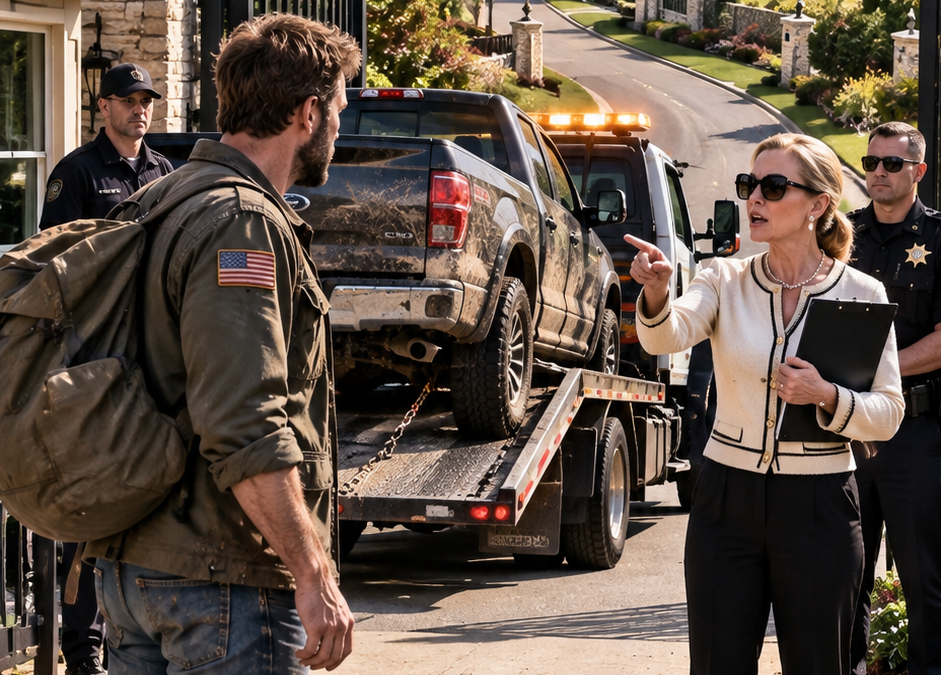
𝗣𝗔𝗥𝗧 𝟮
Sandra Whitfield recovered quickly.
People like her usually do.
She shifted the clipboard against her chest and gave me a look that was supposed to turn me from property owner into problem.
“If you are looking for construction work,” she said, “all vendors must apply through the HOA.”
I almost laughed.
“You think I’m here looking for landscaping work?”
Her eyes moved over me again.
My skin.
My old truck.
My military duffel bags.
The dust still worked into the seams of my boots.
“If you have legitimate business here, you can submit it through the appropriate channels.”
“I’m telling you my legitimate business.”
I pointed through the bars.
“You’re standing on it.”
Her mouth became a thin line.
“We have families here, Mr. Vance. Retirees. Professionals. People who paid substantial sums for security and privacy.”
“I’m happy for them.”
“We do not tolerate people driving onto the property making ownership claims.”
“Then your developer should have bought the property before building houses on it.”
The guard looked down.
Sandra turned toward him.
“If this vehicle is still here in five minutes, call Deputy Reyes. Tell him we have an unauthorized solicitor refusing to leave.”
I watched her walk back to her Lexus.
Granddad’s voice came back to me so clearly I could almost hear him in the passenger seat.
Never argue with a bully until you know exactly what’s in his hand and exactly what’s in yours.
I put the truck in reverse.
Sandra smiled as though she had won.
That was fine.
I wanted her comfortable.
I drove directly to the county recorder’s office.
The building looked exactly as it had when my grandfather used to drag me there as a teenager.
Sun-bleached brick.
Small windows.
Industrial carpet.
The smell of paper, dust, and toner.
Behind the counter sat Eleanor Briggs, a county records clerk who had known my grandfather since before I was born.
Her reading glasses hung from a silver chain.
When she looked up and recognized me, her whole face softened.
“Jordan?”
“Morning, Eleanor.”
“I heard you were home.”
“Got in yesterday.”
She came around the counter and hugged me.
“Your grandfather would have been proud.”
“I hope so.”
“Oh, he would’ve pretended not to be. Different thing.”
That made me smile.
Then her expression shifted.
“What happened?”
“What makes you think something happened?”
“You have Elias’s courthouse face.”
I leaned on the counter.
“I need the chain of title for parcel 4471B.”
Her eyebrows rose.
“The lake acreage?”
“Yes.”
She sat down at the terminal.
“What are we looking for?”
“I’d rather you tell me.”
Her hands moved over the keyboard.
The old system loaded slowly.
Parcel number.
Owner history.
Tax status.
Recorded instruments.
Then Eleanor stopped.
She leaned closer to the monitor.
“Jordan.”
“What?”
“This is still yours.”
I felt my shoulders loosen slightly.
“Completely?”
“Completely.”
She clicked again.
“No deed transfer. No warranty deed. No quitclaim. No easement granting development rights. No probate release. Nothing.”
“What about Cedarwood Estates?”
Now she looked genuinely confused.
“What?”
“There are fifteen houses on the property.”
She stared at me.
“Fifteen what?”
“Mansions.”
That sent her back to the keyboard.
She searched adjacent parcels.
Subdivision plats.
Land-use filings.
Development applications.
Finally, she found it.
“Well.”
That one word did not sound encouraging.
“What?”
“A developer named Marcus Webb filed a subdivision plat two years ago.”
“On my property?”
“Looks like he treated your parcel as part of the tract immediately east of it.”
“How?”
“Emergency reclassification portal.”
“Based on what conveyance?”
She searched.
Nothing.
Her mouth tightened.
“None.”
“So the plat just exists?”
“Administratively.”
“But title?”
“Still yours.”
She printed the record.
Then another.
Then the tax history.
Every quarterly payment had cleared.
My military account number appeared in the payment records.
No delinquency.
Not once.
Eleanor tapped the papers.
“This matters.”
“I know.”
“No, Jordan. It really matters.”
She lowered her voice.
“Whatever paperwork they filed, your title chain never broke. You kept paying the taxes while you were deployed. There isn’t even a gap they can exploit.”
She pulled up the original deed.
My grandfather’s name.
Then the later transfer to me.
Recorded.
Stamped.
Clean.
She shook her head.
“Your grandfather always said paper outlives politicians.”
“He said a lot of things.”
“He was usually loud enough to make sure everyone heard them.”
I paid for certified copies.
Before I left, Eleanor touched my arm.
“Be careful.”
“I will.”
“These people built fifteen houses. That is a lot of money sitting on top of one very serious mistake.”
“That’s why I’m not going back to argue.”
“Good.”
I held up the certified deed.
“I’m going to let them argue with this.”
Back in the truck, I called James Callaway.
James had handled my grandfather’s estate.
He was the kind of lawyer who could spend four hours discussing the difference between an easement and a license and somehow make you grateful for the explanation.
He listened without interrupting.
Gate.
Mansions.
Sandra.
Recorder’s office.
Subdivision plat.
Clean title.
When I finished, he asked one question.
“You paid the property taxes during deployment?”
“Every quarter.”
“Proof?”
“Bank records and county receipts.”
A pause.
Then I heard something rare from James.
A laugh.
Not loud.
More like air leaving through his nose.
“Good.”
“That good?”
“Very.”
“Explain.”
“If they try adverse possession, they have a serious problem. Your continuous tax payments and recorded ownership cut directly against the story they’ll need.”
“So I go down there with the deed?”
“No.”
That surprised me.
“No?”
“Not yet.”
“Why?”
“Because at the moment, they have committed a mistake.”
He paused.
“I want to know whether they’re willing to turn it into misconduct.”
I looked out the windshield.
“And how do we find out?”
“Let them keep behaving like they own it.”
That was the first time I understood the advantage of patience.
I had spent fifteen months taking orders.
Now I was going to let Sandra Whitfield give some.
For the next two weeks, I stayed at a motel ten miles away.
Cheap place.
Buzzing ice machine.
Curtains that never fully closed.
A television remote held together with tape.
I kept my truck parked where the county road met the western boundary.
Then I started documenting.
I mounted four cellular trail cameras.
One facing the entrance gate.
One covering the internal road.
Two overlooking the creek and shoreline where the HOA had poured a concrete boat ramp and built a private dock.
Every image uploaded automatically to a secure drive shared with James.
Timestamp.
Date.
Location.
No editing.
No interpretation.
Just facts.
During the day, I walked the surrounding valley.
That was when I learned Cedarwood Estates was not Sandra’s first experiment in authority.
Mrs. Rita Alvarez lived on two acres just outside the development.
Small white house.
Sun-faded porch.
Flowerpots along the steps.
Her late husband Alberto had been one of my grandfather’s closest friends.
When I knocked, she opened the door holding an HOA newsletter.
She froze.
“Jordan?”
“Yes, ma’am.”
“Walter’s boy.”
“My father’s Walter.”
She smiled faintly.
“You know what I mean.”
I did.
Everybody in that valley still defined people by whichever older man had taught them to use a shovel.
She invited me inside.
Her kitchen smelled like cinnamon and furniture polish.
On the table, she placed a shoebox held shut by an old rubber band.
“I kept these.”
Inside were violation notices.
Dozens.
Same cream-colored paper.
Same gold crest.
Same signature.
Sandra Whitfield.
The earliest notice dated back three years.
Holiday wreath violation.
Three hundred dollars.
Exterior landscaping violation.
Twelve hundred.
Trash receptacle placement.
Five hundred.
Garden bed noncompliance.
Seven hundred fifty.
Mrs. Alvarez folded her hands.
“I was in the hospital when the wreath notice came.”
“For how long?”
“Four days.”
“And they fined you?”
“Sandra said the rules didn’t have a medical exception.”
I looked down at the notice.
“She threatened a lien?”
“Yes.”
“Did she file one?”
“I don’t know.”
“Did you pay?”
Her eyes dropped.
“I was afraid not to.”
More than six thousand dollars.
Three years.
Pension money.
Savings.
She had even sold Alberto’s fishing boat after one fine.
“What was wrong with the garden bed?”
She looked embarrassed.
“I raised it.”
“That’s all?”
“My back is bad. Alberto built it higher so I wouldn’t have to bend.”
I sat there for a moment.
“What rule did Sandra cite?”
Mrs. Alvarez slid over another paper.
I recognized the problem almost immediately.
This was not a recorded covenant.
It looked like a neighborhood handbook.
Glossy paper.
Cheap print job.
I photographed the relevant pages and sent them to James.
His response came back twelve minutes later.
Not recorded.
Not adopted.
Not enforceable as covenant restrictions.
I stared at the message.
Sandra had apparently discovered an extraordinary business model.
Print rules.
Threaten elderly residents.
Collect money.
Call it community standards.
Before I left, Mrs. Alvarez opened a kitchen drawer and gave me an email printout.
It involved the Patel family.
Sandra had written that certain owners did not “fit the community character” and suggested they consider whether the valley suited them long term.
“Why did she care about the Patels?”
Mrs. Alvarez looked toward the window.
“Her husband’s construction company wanted their lot.”
That was useful.
My next stop was Dev Patel’s house.
He met me on the porch.
Thirty-something.
IT consultant.
Sleep-deprived eyes.
Four-year-old daughter playing with a wooden truck near the steps.
“I heard what happened at the gate,” he said.
“You hear things fast out here.”
“We’ve been waiting for someone to push back.”
Inside, he opened his laptop.
Last summer, the Patels had tried to sell.
They had a buyer.
Signed contract.
Closing scheduled.
Two days before closing, the buyer’s lender received a letter from Cedarwood Estates HOA.
Claimed there was an active $4,200 lien for a driveway violation.
The lender froze financing.
Buyer walked.
Dev called Sandra.
Asked for the recorded lien.
She refused.
Told him legal would handle it.
To salvage their finances, the Patels borrowed money at a terrible rate and paid the HOA.
I asked the obvious question.
“Did you ever pull the county record?”
“No.”
“I did.”
Dev stopped moving.
“There’s no lien.”
He stared at me.
“What?”
“No recorded lien.”
“That’s impossible.”
“It isn’t.”
I turned his laptop back toward him.
“She told your buyer’s lender you had an active encumbrance that apparently did not exist in the county record.”
Dev’s face changed.
Some anger is loud.
His wasn’t.
His went still.
“I want to testify.”
“We may not be there yet.”
“I don’t care.”
“Good. But for now, keep every email.”
“I have backups.”
“Print them too.”
He nodded.
“My grandfather would like you.”
“Why?”
“Because you’re the first person under forty I’ve met who backs things up properly.”
By the end of the week, my binder was three inches thick.
Alvarez notices.
Patel correspondence.
HOA letters.
County records.
Photographs.
Maps.
Tax statements.
Trail-camera captures.
The situation had stopped being a land dispute.
It was becoming an archive of what happens when authority goes unchallenged for too long.
Then Sandra made the mistake James had been waiting for.
My phone buzzed at 8:06 one morning.
Camera alert.
I opened the feed.
A Ridge Recovery tow truck sat near my Ford.
Sandra stood beside it.
The driver was Mike Talley.
I had played high school football with him.
I turned up the audio.
“The truck has been flagged for seven days,” Sandra told him.
Mike looked at the work order.
“It’s on the county shoulder.”
“The bylaws cover the entrance corridor.”
“My contract covers roads inside the development.”
Sandra’s voice sharpened.
“He owes eighty-seven thousand dollars in back dues and remediation costs.”
I nearly dropped the phone.
Eighty-seven thousand?
I had been home less than a month.
That was impressive even by HOA standards.
Mike scratched his chin.
“I need sheriff authorization to tow from a public right-of-way.”
Sandra stepped closer.
“If you refuse, your company loses the Cedarwood contract.”
Mike looked miserable.
I understood.
He had employees.
Bills.
A business.
Sandra understood too.
That was why she said it.
Finally, he attached the chain.
Sandra laughed.
“This kid thinks he can play soldier and ignore our rules. He’s about to learn that the land belongs to the people who can afford lawyers.”
I watched my grandfather’s old truck climb onto the flatbed.
Every word recorded.
Every movement timestamped.
I did not drive over.
Did not yell.
Did not interfere.
I opened my spreadsheet.
Date.
Time.
Vehicle.
Tow company.
Location.
Work order number.
Video file.
Recovery fee.
Six hundred forty dollars.
Then I called James.
“They towed it.”
“Good.”
I paused.
“You realize most lawyers do not say good after their client’s truck gets stolen.”
“Did you get the recording?”
“Yes.”
“Then I stand by my statement.”
The next morning, a process server handed me a twenty-eight-page complaint.
Cedarwood Estates HOA v. Jordan Vance.
Quiet-title action.
Sandra and her attorney had officially stopped making mistakes and begun putting those mistakes under oath.
According to the complaint, my fifteen-month deployment amounted to abandonment.
The HOA claimed it had developed and maintained the property continuously.
It referenced roads.
Water lines.
The gate.
Landscaping.
Utilities.
More than a million dollars in improvements.
Then came Sandra’s affidavit.
She swore the association had openly maintained the land for years.
That interested James immediately.
Because we had dated photographs.
Old trail-camera records.
Tax records.
Satellite imagery.
And witnesses showing the land had remained undeveloped until the bulldozers arrived.
Near the back of the complaint was an offer.
Sign a quitclaim deed.
Surrender parcel 4471B.
They would waive $87,400 in invented fines.
Refund my towing cost.
And pay me $75,000.
I read it twice.
Then called James.
“They’re offering seventy-five.”
“Generous.”
“For twelve acres and fifteen mansions.”
“They must like you.”
“They also say I owe eighty-seven thousand.”
“Then perhaps you should counteroffer by waiving their eighty-seven thousand if they return your land.”
I laughed.
“Court?”
“Thursday.”
That night, I ironed my dress uniform.
It was not a costume.
I did not wear it for sympathy.
I wore it because the central argument against me depended on my absence.
They wanted the court to see fifteen months away as abandonment.
I wanted the record to show exactly where I had been.
On my motel table sat everything.
Certified deed.
Tax receipts.
Military payment records.
Subdivision filings.
HOA notices.
Tow footage.
Mrs. Alvarez’s documents.
Patel emails.
My grandfather’s old pocketknife rested beside the binder.
At 8:45 Thursday morning, James and I walked into county court.
The gallery was already half full.
Mrs. Alvarez sat in the second row.
Dev Patel sat near the aisle.
Several Cedarwood homeowners were there.
Their faces told me something I had not fully appreciated.
They were terrified too.
Whatever had happened, most of those fifteen families had purchased their houses believing they were legal.
They had mortgages.
Children.
Retirement savings.
They were not Marcus Webb.
And they were not Sandra.
I decided then that whatever happened, I would remember the difference.
Sandra sat at the plaintiff’s table wearing navy blue.
Her lawyer, Richard Holt, arranged three large binders.
James placed one manila folder in front of himself.
I leaned over.
“That’s all you brought?”
“No.”
He nodded toward my stack.
“You brought the rest.”
Judge Rosemary Alvarez entered at nine.
We stood.
The hearing began.
Holt was good.
I will give him that.
He had the smooth tone of a lawyer who believed confidence could turn procedural mud into concrete.
He described my land as an “abandoned agricultural tract.”
He described Cedarwood as a “transformative residential development.”
He described millions in improvements.
Roads.
Drainage.
Utilities.
Landscaping.
Then he pointed toward me.
“Sergeant Vance returned after a prolonged absence and now seeks to leverage an administrative defect to obtain a windfall at the expense of fifteen innocent families.”
I looked at James.
He wrote three words on his legal pad.
Let him finish.
So I did.
Holt continued.
The HOA had acted in good faith.
The developer had relied on county approval.
The homeowners had relied on the recorded plat.
Removing improvements would create catastrophe.
They had even offered me seventy-five thousand dollars.
Judge Alvarez finally raised her head.
“Counselor.”
Holt stopped.
“Did your firm perform a complete title-chain search before filing this action?”
“We relied on the recorded subdivision plat.”
“That was not my question.”
A pause.
“We reviewed the plat and supporting administrative filings.”
“Did you review the deed?”
Holt’s posture changed slightly.
“Yes, Your Honor.”
“Whose name appears as owner?”
“Jordan Vance.”
The courtroom became quieter.
“And is there a conveyance from Mr. Vance to Marcus Webb?”
“No.”
“To Cedarwood Estates?”
“No.”
“To your client?”
“No.”
“Recorded easement?”
“No.”
“Purchase agreement?”
“No.”
Judge Alvarez leaned back.
“Then explain why your complaint repeatedly uses the word acquisition.”
Holt began discussing equitable doctrines.
Reliance.
Improvements.
Constructive ownership.
Reclassification authority.
The judge allowed him to talk.
Then she asked another question.
“Is a plat map a deed?”
Holt paused.
“No, Your Honor.”
James stood.
That was his moment.
He connected his laptop to the projector.
The screen displayed a county tax record.
Parcel 4471B.
Owner: Jordan Vance.
Payment status: current.
Payment date: one day before Marcus Webb’s boundary affidavit.
Payment source: military savings account.
James spoke quietly.
“This is the county’s own record from April thirteenth of last year.”
Next slide.
Marcus Webb’s affidavit dated April fourteenth.
James read the relevant statement.
The land was allegedly tax delinquent.
Owner allegedly deceased or unreachable.
James turned toward the judge.
“My client was not deceased.”
A few people laughed before catching themselves.
James continued.
“He was deployed.”
Next document.
Military orders.
“Mr. Webb could have discovered that the owner was alive, the taxes were current, and the deed remained active by checking the same county records he was asking the county to modify.”
Sandra stared at the screen.
James displayed the tax history.
Quarter after quarter.
Paid.
Paid.
Paid.
Paid.
No lapse.
Then photographs.
Undeveloped field.
Dates visible.
Then development equipment appearing much later.
Then the gate.
Then the mansions.
Then the trail-camera clip.
Sandra ordering my truck towed.
Her voice filled the courtroom.
“This kid thinks he can play soldier and ignore our rules. He’s about to learn that the land belongs to the people who can afford the lawyers.”
The recording ended.
Nobody moved.
Holt slowly turned toward Sandra.
I almost felt sorry for him.
Almost.
Judge Alvarez took off her glasses.
“Ms. Whitfield.”
Sandra looked up.
“Did you know Mr. Vance claimed ownership before the vehicle was towed?”
She swallowed.
“He made an unsupported verbal assertion.”
“Did you request documentation?”
“No.”
“Did you check the county title record?”
“The developer had already—”
“That was not my question.”
“No.”
“Did you authorize the tow?”
Sandra hesitated.
“Yes.”
“From the public shoulder?”
“I believed the HOA’s authority extended—”
“Yes or no.”
“Yes.”
The judge looked at Holt.
“Do you have any deed bearing Mr. Vance’s signature?”
“No, Your Honor.”
“Any deed bearing Elias Vance’s signature conveying the parcel to your client or developer?”
“No.”
“Any written authorization permitting construction of fifteen residences?”
“No.”
The judge looked down at the record.
Then back up.
“What exactly is the plaintiff asking me to do?”
Holt spoke carefully.
“To recognize an equitable interest reflecting substantial investment and innocent third-party reliance.”
“By overriding legal title?”
“In essence—”
“No.”
One word.
Nothing dramatic.
But the entire room changed.
Judge Alvarez reviewed the plat.
The affidavit.
The deed.
Then she issued the ruling.
The reclassification was void.
The title remained mine.
The HOA’s quiet-title claim failed.
With prejudice.
I heard somebody inhale sharply behind me.
The judge continued.
The gate.
Road.
Dock.
Utility improvements.
And homes constructed on parcel 4471B were unauthorized permanent encroachments.
Then came the sentence nobody in Cedarwood Estates had expected.
Because those permanent fixtures had been attached to my land without lawful conveyance, they were legally bound to the parcel.
The buildings did not give the HOA ownership of my land.
The land gave me ownership rights over the structures attached to it.
Fifteen mansions.
I watched Sandra’s face lose color.
The woman who had stood behind iron bars telling me I didn’t belong had just been informed that the iron bars, the road behind them, and every house along that road sat on property legally belonging to me.
James stood again.
“Your Honor, one additional matter.”
Judge Alvarez nodded.
“My client recognizes that the homeowners themselves appear to be victims of the developer’s conduct.”
Several people behind me shifted.
“He does not intend to seek immediate demolition or mass eviction.”
I looked back.
David Morris sat with his wife Helen.
Both looked as though they had not slept.
James continued.
“My client is prepared to grant each affected household a renewable five-year ground lease at fair market rent, allowing residents to remain in their homes while preserving his ownership rights.”
Holt looked genuinely surprised.
Judge Alvarez looked at me.
“Mr. Vance, is that your position?”
I stood.
“Yes, Your Honor.”
“You understand that you may have other remedies?”
“I do.”
“And you voluntarily prefer leasing rather than immediate ejectment?”
“Yes.”
“Why?”
I glanced at the homeowners.
“Because they bought houses.”
Then at Sandra.
“They didn’t steal my land.”
That was the first moment anyone in the gallery moved.
Mrs. Alvarez bowed her head.
Helen Morris covered her mouth.
Judge Alvarez nodded.
“The court will not dictate private lease terms beyond applicable law, but the distinction is noted.”
James then requested referral of Marcus Webb’s filings and Sandra’s sworn statements for investigation.
The judge granted that too.
Then she looked directly at Sandra.
“I have served on this bench for nineteen years.”
Sandra sat perfectly still.
“I have seen forged signatures. Fraudulent liens. Boundary disputes. Title-company negligence.”
A pause.
“I have never seen fifteen luxury residences constructed on land for which nobody bothered to obtain a deed.”
Sandra looked down.
Her clipboard lay on the table.
For the first time since I had met her, she did not touch it.
Court adjourned.
The gavel struck once.
That sound changed everything.
Outside the courtroom, David Morris reached me first.
He was in his sixties.
Retired engineer.
One of the mansion owners.
“I didn’t know.”
“I know.”
“We bought through Webb.”
“I know.”
“We had a title policy.”
“I know.”
He looked miserable.
“What happens to us?”
“You heard James.”
“Four thousand a month?”
“That’s the proposed ground rent.”
He nodded slowly.
“It’s less than I was afraid you’d ask.”
“I’m not interested in punishing you.”
He looked back toward the courtroom.
“Sandra told us you were trying to steal the neighborhood.”
“That would require impressive timing.”
For the first time, he smiled.
Then shook my hand.
Sandra came out minutes later.
No clipboard.
No security guard.
No Lexus keys swinging from one finger.
Just Sandra.
She stopped when she saw me.
For one second, I wondered whether she would apologize.
She didn’t.
“This isn’t over.”
I looked at her.
“It is for the deed.”
“You think those families will just pay you?”
“They can decide for themselves.”
“You’re exploiting them.”
That almost impressed me.
“Two weeks ago, you had my truck towed from a public road.”
“You were harassing residents.”
“You built your house on my land.”
“We relied on the developer.”
“Then perhaps your problem is with him.”
Her jaw tightened.
“You ruined everything.”
“No, Sandra.”
I glanced back at the courtroom door.
“I came home.”
That was the last private conversation we ever had.
Three weeks later, Marcus Webb was arrested.
False filings.
Fraud allegations.
Financial crimes tied to the development.
His assets were frozen.
The title company connected with the transactions came under state investigation.
I stayed out of most of that.
I had gotten what I needed.
My land.
My title.
My future.
The fifteen households held an emergency meeting.
This time I drove through the front gate.
Nobody stopped me.
The guardhouse was empty.
The brass Cedarwood Estates sign still hung between the pillars.
Inside the clubhouse, thirty-seven people sat in folding chairs.
I stood where Sandra used to stand.
No clipboard.
No gold crest.
No stack of violation notices.
Just fifteen lease agreements.
Plain white paper.
“I want to make something clear,” I told them.
“You were sold houses by people who had no legal right to sell the ground beneath them.”
Nobody spoke.
“I could ask the court to remove structures.”
A child coughed somewhere near the back.
“I’m not doing that.”
A few shoulders dropped.
“The proposed ground rent is four thousand dollars per month per household.”
David Morris nodded.
“The lease is renewable every five years. Basic maintenance obligations are listed. No architectural dictatorship. No fines because a wreath stays up two days too long.”
Someone laughed.
Mrs. Alvarez sat near the aisle.
I continued.
“No private enforcement company photographing vegetable beds. No invented liens. No security guard deciding who looks expensive enough to belong here.”
Dev Patel looked down and smiled.
“The road will remain open to lawful residents and guests. The creek remains protected. The dock can stay for community use under the lease structure.”
I paused.
“The HOA itself is finished.”
That earned the first real reaction.
Not cheering.
Relief.
One woman started crying.
David Morris stood.
“What happens if somebody doesn’t sign?”
“Then we deal with that individually.”
“No immediate eviction?”
“No.”
He walked forward.
Picked up the first agreement.
Read the signature page.
Then signed.
Helen signed beside him.
He shook my hand.
“We sleep better now.”
Thirteen more families signed that evening.
Sandra’s mansion remained unsigned.
Unsurprisingly.
Her lender foreclosed.
Two months later, the house sold.
A schoolteacher and his wife bought it after their attorney spent what I assume was a very nervous week reviewing my ground lease.
They had two daughters.
The first thing they did was paint the front door yellow.
Sandra would have hated it.
That made me like them immediately.
The second thing they did was build a wooden swing set in the backyard.
No architectural committee reviewed it.
Nobody photographed it.
Nobody fined them.
The girls just played.
Mrs. Alvarez eventually recovered part of the money she had paid through a restitution process connected to the investigation.
The Patels pursued their own claim for the false lien representation that destroyed their sale.
I didn’t involve myself beyond providing records.
One evening, Dev came by with his daughter.
She handed me a drawing.
It showed my truck beside a giant house.
“Is this accurate?” I asked.
She nodded seriously.
“What is that?”
She pointed.
“Bad lady.”
Dev looked mortified.
I laughed so hard I had to sit down.
“That,” I told him, “is the most concise legal brief I’ve seen all year.”
My truck came home too.
Ridge Recovery refunded the tow charge.
Mike called me personally.
“I should’ve refused.”
“You should have.”
“I’m sorry.”
“I know why you did it.”
“That doesn’t make it right.”
“No.”
A pause.
“You suing me?”
“No.”
“Why not?”
“Because Sandra already taught you the expensive part of the lesson.”
He laughed nervously.
“That she did.”
I repaired the truck myself.
The front axle had taken some stress during the tow.
Nothing serious.
I kept the receipt anyway.
Granddad would have insisted.
By late spring, the valley looked different.
Not physically.
The houses were still absurdly large.
The lawns still looked manicured enough to require emotional support.
The gate still stood.
But I removed the lock.
Then I took down the brass sign.
Cedarwood Estates.
I set it on the floor of Granddad’s old shed.
Not as a trophy.
More as a reminder.
A man can spend a fortune putting his name on something and still fail to own it.
I made the replacement myself.
Simple cedar plank.
Hand-carved.
VANCE RANCH
EST. 1974
PRIVATE PROPERTY
RESIDENTS AND GUESTS WELCOME
James saw it and shook his head.
“You realize that sounds friendly.”
“I’m trying something new.”
“How’s it going?”
“Exhausting.”
The first lease payments arrived at the beginning of the next month.
Fourteen checks.
Then the fifteenth from the schoolteacher’s family.
Four thousand dollars each.
Sixty thousand dollars in total ground rent.
Per month.
I spread the envelopes across Granddad’s old porch table.
For months, people had used phrases like windfall.
Lottery ticket.
Jackpot.
I never thought of it that way.
Those checks represented a solution to a mess I had not created.
A way for fifteen families to keep their homes.
A way for me to retain what had been mine all along.
The money mattered.
Of course it mattered.
I was not going to pretend otherwise.
But what mattered more was sitting on that porch looking across land that had nearly disappeared from my life without my permission.
Granddad’s rocking chair sat beside me.
I ran my thumb across his old pocketknife.
I remembered the sentence he repeated every time I complained about paperwork.
“Lines matter, Jordan.”
When I was fifteen, I thought he meant fences.
Later, I thought he meant surveys.
Now I understood.
He meant everything.
Deed lines.
Legal lines.
Moral lines.
The line between mistake and fraud.
Between authority and intimidation.
Between someone who trusts a bad document and someone who knowingly uses one.
That distinction was why the Cedarwood families stayed.
It was why Sandra didn’t.
The local newspaper eventually ran a story.
SUBDIVISION BUILT ON FRAUD, COURT RULES.
The earlier stories had made me sound like a returning veteran trying to throw families out of luxury homes.
The later stories discovered nuance.
Funny how that happens after a judge speaks.
I ignored most of it.
Reporters called.
I declined.
Television station asked for an interview.
Declined.
One producer wanted me standing in front of the gate in uniform.
Definitely declined.
I had not defended the land to become scenery for somebody else’s outrage segment.
I wanted my quiet back.
Gradually, I got it.
Mrs. Alvarez started bringing empanadas on Sundays.
Dev helped me set up a better security network.
David Morris, who turned out to be a structural engineer with too much free time, inspected the old ranch porch and informed me with great enthusiasm that half of it had been built wrong.
“My grandfather built that porch.”
“Your grandfather was not a structural engineer.”
“He was armed.”
David considered that.
“Then it is an excellent porch.”
The residents stopped referring to themselves as Cedarwood Estates.
Some still called it Cedarwood out of habit.
Others just said “the ridge.”
The formal HOA disappeared.
We replaced it with a simple maintenance agreement covering shared road upkeep, drainage, and the dock.
No fines.
No board president.
No power to threaten homes.
If the road needed repair, everybody saw the invoice.
If a decision affected everyone, we met.
If someone wanted a red mailbox, civilization somehow survived.
The schoolteacher whose family bought Sandra’s former mansion once asked me whether I planned to raise the rent dramatically at renewal.
“No.”
“Why not?”
“Fair is useful.”
He looked confused.
“Useful?”
“Greed created this entire mess.”
That answered him.
Sandra’s name faded.
There were rumors about the investigation.
Civil claims.
Financial trouble.
Her Lexus disappeared before she did.
I heard she sold it to cover legal fees.
Later I heard she moved out of state.
Maybe true.
Maybe not.
I did not check.
I had spent enough time letting Sandra occupy land.
I did not intend to let her occupy my thoughts too.
One Saturday morning, I finally started building the cabin I had dreamed about overseas.
Not on the ridge with the mansions.
Farther west.
Near the creek.
Small footprint.
Wide porch.
Tin roof.
I marked the corners myself.
David came down to help.
“You know you can afford a contractor now.”
“I know.”
“You are voluntarily doing this?”
“Yes.”
“Why?”
“Because I spent fifteen months imagining it.”
He handed me the level.
“That is irrational.”
“Probably.”
We worked until sunset.
At one point, a black SUV slowed near the road.
Old instincts made me watch it.
Then the rear window rolled down.
One of the neighborhood kids waved.
I waved back.
The SUV continued.
No security guard.
No questions.
No gate closing behind them.
That felt better than I expected.
Months later, the cabin was finished.
Two rocking chairs on the porch.
I left them both.
Still living alone.
Still no immediate candidate for chair number two.
But some futures deserve space even before they have names.
One evening, James visited.
He brought bourbon.
We sat overlooking the water.
“You know,” he said, “there was a moment when I thought Sandra might accept your deed and simply settle.”
“When?”
“The first week.”
“I never thought that.”
“That’s because you met her.”
He poured another drink.
“She really had your truck towed.”
“She did.”
“Still remarkable.”
“She thought the tow would humiliate me.”
“Did it?”
I considered that.
“No.”
“What did?”
“The gate.”
He looked over.
“Why?”
“Because for about five seconds, I doubted myself.”
That admission surprised even me.
“I knew where I was. Knew the land. Knew the deed. But fifteen mansions were sitting there. Stone pillars. Security guard. Brass sign.”
I stared across the creek.
“When enough expensive things tell you that you’re wrong, there’s a moment when you wonder if maybe they’re right.”
James nodded.
“That is why title insurance exists.”
“Thank you for ruining the emotional point.”
“My specialty.”
I laughed.
Then grew serious again.
“The dangerous part wasn’t that Sandra had authority.”
“It was that she looked like she did.”
“Exactly.”
Uniformed guard.
Private gate.
Lawyers.
Letterhead.
Clipboard.
Fines.
A giant sign.
All of it said the same thing.
We belong here.
You do not.
Yet the oldest document in the whole dispute said otherwise.
Elias Vance.
Twelve acres.
Recorded.
Everything else had been built on top of that fact.
Literally.
I thought about my first conversation with Sandra.
She had told me I was trespassing.
She had threatened to call the sheriff.
She had suggested I apply as a landscaper.
Later, she ordered my truck removed.
Then she swore in a legal filing that her organization had superior rights to my land.
She did all of that because nobody before me had made her prove what she claimed.
Mrs. Alvarez paid because she was afraid.
The Patels paid because their financing was at risk.
Mike towed because his business contract was threatened.
The mansion owners bought because a developer showed them a county-stamped plat.
Everyone in the chain had made one small compromise with doubt.
Fine.
Maybe they know something I don’t.
Fine.
Maybe the paperwork exists somewhere.
Fine.
Maybe fighting costs too much.
Fine.
Maybe I should just pay.
Enough small surrenders eventually become somebody else’s empire.
Sandra’s was built from paper.
Mine was restored by paper.
That irony has never been lost on me.
The following summer, I stood at the entrance repairing one of the cedar posts.
Exactly eighteen inches inside the recorded boundary.
I knew because I measured twice.
The old iron gate remained open.
I had considered removing it completely.
Then decided against it.
It had become useful.
Not as a barrier.
As a reminder.
David pulled up and lowered his window.
“You planning to close that thing?”
“No.”
“Then why keep it?”
“Decoration.”
He stared at the enormous iron structure.
“That’s your idea of decoration?”
“Property values.”
He laughed.
“I’m reporting you to the HOA.”
“Good luck finding it.”
He drove on.
I went back to work.
A few minutes later, I stopped and looked down the road.
Fifteen houses.
Fourteen original families plus the new family in Sandra’s former place.
Children riding bicycles.
Somebody washing a car.
A dog barking.
Ordinary life.
That was probably the strangest part.
When I first saw those mansions, they looked like an invasion.
By then, they looked like houses.
The people had changed the meaning.
Maybe that was why I never wanted revenge on them.
A home is not a fraud because the family inside it was deceived.
A deed can be fixed.
Money can be litigated.
A foreclosure can be processed.
But dragging fifteen families into the street so I could enjoy a cleaner ending would have made me more like Sandra than I was willing to become.
Her greatest mistake had been forgetting that property law involved people.
I was not going to repeat it from the other side.
That did not mean I felt sorry for her.
I want to be clear about that.
There are consequences for arrogance.
She simply received hers.
She began as the woman who told a returning property owner to apply for landscaping work if he wanted access to his own land.
She ended with no office, no HOA, no mansion, and no authority over the people she had spent years intimidating.
Her rules vanished.
Her gate stayed open.
Her house went to another family.
And every month, the ground beneath what had once been her front porch generated rent payable to me.
I never needed a more theatrical ending than that.
By early fall, I had placed Granddad’s pocketknife in a wooden display case inside the cabin.
Not because it was valuable.
It wasn’t.
The blade had been sharpened so many times it had narrowed.
The handle was scratched.
One side had a burn mark from an accident I never heard the full story about.
Under it I placed a copy of the 1974 deed.
Visitors probably thought it was sentimental decoration.
It was.
But it was also instruction.
One afternoon, Mrs. Alvarez visited the cabin.
She stood in front of the display.
“Your grandfather carried that knife everywhere.”
“Even church.”
“He sliced an apple with it during Alberto’s funeral reception.”
“That sounds like him.”
She smiled.
Then looked at the deed.
“He would have fought them.”
“Yes.”
“Louder than you.”
“Definitely.”
“He would have yelled at Sandra.”
“For several hours.”
She laughed.
“You didn’t yell.”
“No.”
“Why?”
I thought about it.
“Because she was waiting for anger.”
Mrs. Alvarez nodded slowly.
“She knew how to handle angry people.”
“Yes.”
“But not patient people.”
“No.”
She looked toward the houses on the ridge.
“Maybe that’s why you won.”
I almost corrected her.
Lawyers hate simple explanations.
But she wasn’t wrong.
Patience gave Sandra room to keep making choices.
Call the guard.
Threaten the sheriff.
Invent dues.
Order the tow.
File the lawsuit.
Sign the affidavit.
Every time she had the opportunity to stop, she doubled down.
By the time we reached the courtroom, I barely had to tell a story.
Her documents told it for me.
That was Granddad’s lesson all along.
The paperwork holds them off.
Years later, I still keep every tax receipt.
Autopay remains active.
County records get checked annually.
James says this is excessive.
I remind him that fifteen houses disagree.
The leases remain stable.
The residents formed a cooperative for road maintenance.
The dock is used constantly in summer.
One resident planted vegetable beds along the southern slope.
Mrs. Alvarez laughed until she cried when she saw them.
Dev eventually sold his house.
This time, nobody sent a fake lien to the lender.
The closing happened on schedule.
He came by afterward.
“First time I’ve ever been happy to sign thirty-seven pages.”
“Thirty-seven?”
“Thirty-eight. I stopped counting.”
His daughter was older by then.
Before leaving, she handed me another drawing.
This one showed the open gate.
No bad lady.
Just houses.
A creek.
And a giant truck that looked more like a monster truck than my Ford.
I framed it.
Not the newspaper story.
Not the court order.
Her picture.
Because that was the real outcome.
Not fifteen mansions becoming mine.
Not Sandra losing hers.
Not Marcus Webb getting arrested.
Not the rent checks.
Those things mattered.
But the part that stayed with me was simpler.
I came home expecting twelve quiet acres where I could build a cabin.
Instead, I found a community built on top of them.
I could have treated everyone behind that gate as an enemy.
Sandra certainly expected me to.
Instead, once the fraud was stripped away, I discovered fifteen families who wanted exactly what I had wanted during deployment.
A safe place.
A home.
A future they believed belonged to them.
The solution was not to pretend their houses were legal.
They weren’t.
The solution was to stop pretending my ownership did not matter either.
Respect both truths.
Put them on paper.
Sign.
Move forward.
One cool morning, I sat outside the cabin drinking coffee.
The lake was flat.
Mist hung above the water.
The ridge was quiet.
From where I sat, I could just barely see the open gate in the distance.
I thought about the day I returned.
Sandra behind the bars.
Me in the truck.
Her telling me I didn’t belong.
I wish I could say I had known then exactly how it would end.
I didn’t.
I was angry.
Confused.
Tired.
For a moment, I felt like the stranger she wanted me to be.
Then I drove to the recorder’s office.
That decision changed everything.
Not because the county clerk gave me ownership.
I already had it.
She gave me proof.
And proof is a beautiful thing when somebody has spent too long confusing confidence with legality.
I finished my coffee and walked toward the pasture fence.
One cedar post leaned slightly after the spring rains.
I brought a shovel.
Level.
Tape measure.
The replacement went exactly eighteen inches inside my recorded line.
I checked twice.
Then I stood back and looked at it.
Straight.
Level.
Mine.
Beyond it, fifteen mansions caught the morning light.
Their roofs glowed gold.
Their windows reflected the valley.
For a long time, I thought coming home would mean finding everything exactly as I left it.
Same field.
Same quiet.
Same dirt road.
Same plans.
I was wrong.
Home had changed without asking me.
The question was whether I would let somebody else decide what that change meant.
Sandra believed the expensive gate settled ownership.
Marcus Webb believed a county stamp could replace a deed.
Their lawyers believed enough construction money could turn a legal fiction into reality.
I believed one thing.
Read the record.
And in the end, the oldest piece of paper in the room beat the biggest houses, the fanciest gate, the private security, the HOA fines, the tow truck, and every lawyer they could afford.
They called the police because they thought I was trespassing.
They towed my truck because they thought embarrassment would make me disappear.
Then they sued me because they thought money could rewrite ownership.
Instead, the court read the deed.
The HOA disappeared.
Sandra lost the mansion she had ruled from.
The families stayed under leases they could understand.
The gate stayed open.
And those fifteen enormous houses?
They remained exactly where Marcus Webb had built them.
On my land.
Which meant the woman who once threatened to have me removed from my own property had managed to accomplish something almost impressive.
She had spent years protecting a gated neighborhood from outsiders.
Then she discovered the only person she never had the legal authority to keep out was the man who owned everything inside the gate.
Have you finished reading the story and want to read it again?
HOA Towed My Truck Off My Own Land—Then the Court Handed Me All 15 Mansions
They called the sheriff on me for trespassing on my own land.
Then they had my truck towed just to prove they were in control.
What they didn’t know was that every mansion behind their gate was sitting on a deed with my name on it.
I knew the road before I could even see it.
Eight years away had not erased the third bend where cedar roots buckled the asphalt, the low stretch that always collected fog after rain, or the place where the valley opened suddenly enough to reveal the lake through a gap in the pines. I could have driven those last two miles with my eyes closed.
I had imagined returning to that road during fifteen months overseas more times than I could count.
When the heat pushed past miserable and into something physical, when sleep came in ninety-minute fragments, when every day felt like a negotiation with exhaustion, I pictured twelve quiet acres back home.
My twelve acres.
Technically, they had belonged to my grandfather Elias before they belonged to me.
He acquired the land in 1974, fenced it himself, paid every tax bill, argued with every county planner who tried to redraw a boundary, and transferred the parcel to me when I turned eighteen.
Clean deed.
No mortgage.
No easement.
No liens.
No partners.
Just twelve acres in a valley my grandfather used to call the only place left where a man could hear himself think.
Before I deployed, I put the property taxes on automatic payment through my military bank account.
Quarterly.
No exceptions.
My grandfather had taught me that much.
“Men can lie, Jordan,” he once told me. “Governments can lose files. Developers can invent stories. But if your deed is recorded and your taxes are current, they have to explain themselves on paper.”
I carried his old pocketknife through my deployment.
When things got bad, I touched the cold metal through my pocket and pictured the little cabin I planned to build after I came home.
Wide porch.
Tin roof.
Two rocking chairs even though I lived alone.
A stupid detail, maybe.
But somewhere inside me, I had always assumed one chair would eventually belong to somebody else.
That future had kept me anchored.
So when my truck rounded the final curve and I saw the gate, my mind refused to understand it at first.
Two stone pillars.
Black wrought iron.
A brass sign polished bright enough to catch the morning sun.
CEDARWOOD ESTATES.
I slowed my old Ford F-150 until the engine was barely crawling.
Beyond the gate sat fifteen enormous houses.
Not construction sites.
Completed mansions.
Three-car garages.
Stone facades.
Circular driveways.
Perfect lawns.
Landscape lighting.
Imported trees.
A paved private road ran straight through the middle of the field where my grandfather and I had once cut hay.
For a few seconds, I honestly wondered if deployment had broken something in my memory.
Then I recognized the creek.
The line of white oaks.
The rise of the hill.
There was no mistake.
Someone had built an entire luxury development on my land.
I rolled down my window.
A security guard stepped out of a brick booth.
He looked first at my rusty truck.
Then at the duffel bags in the bed.
Then at me.
“I need you to turn around,” he said.
“I own this property.”
He stared at me.
Not curious.
Not confused.
Dismissive.
Then he reached for the telephone.
Ten minutes later, a white Lexus came gliding down the road.
The woman behind the wheel parked across the entrance so I physically could not move forward.
She stepped out wearing a cream cardigan, pearl earrings, expensive shoes, and the expression of someone who had never once considered the possibility that a stranger might refuse an instruction.
She carried a clipboard.
Of course she carried a clipboard.
“Can I help you?” she asked through the gate.
“I’m Jordan Vance.”
Nothing.
“I own parcel 4471B.”
That got something.
Not surprise exactly.
A flicker.
Calculation.
Then it vanished.
“There must be some misunderstanding,” she said. “This is Cedarwood Estates. The property was lawfully acquired by the developer.”
“Who signed the deed?”
Her face hardened.
“That information is not your concern.”
I looked through the iron bars at fifteen houses worth several million dollars each.
“I think it might become my concern.”
She stepped closer.
“You are trespassing.”
“On my own land?”
“You are obstructing access to a private residential community.”
“Then show me the transfer deed.”
Her voice sharpened.
“If you do not move your vehicle, I will contact the sheriff.”
I smiled.
“Go ahead.”
She stared at me.
“Excuse me?”
“Call him.”
I pointed through the gate.
“And when he arrives, tell him to bring fifteen eviction notices.”
That was the moment Sandra Whitfield decided I was not simply an inconvenience.
I was a threat.
I would soon learn she had built most of her authority on one assumption:
People became easier to control when they were afraid of losing something.
What she did not understand was that I had spent the last fifteen months learning exactly how much fear a man could carry and still keep walking.
PART2
Sandra Whitfield recovered quickly.
People like her usually do.
She shifted the clipboard against her chest and gave me a look that was supposed to turn me from property owner into problem.
“If you are looking for construction work,” she said, “all vendors must apply through the HOA.”
I almost laughed.
“You think I’m here looking for landscaping work?”
Her eyes moved over me again.
My skin.
My old truck.
My military duffel bags.
The dust still worked into the seams of my boots.
“If you have legitimate business here, you can submit it through the appropriate channels.”
“I’m telling you my legitimate business.”
I pointed through the bars.
“You’re standing on it.”
Her mouth became a thin line.
“We have families here, Mr. Vance. Retirees. Professionals. People who paid substantial sums for security and privacy.”
“I’m happy for them.”
“We do not tolerate people driving onto the property making ownership claims.”
“Then your developer should have bought the property before building houses on it.”
The guard looked down.
Sandra turned toward him.
“If this vehicle is still here in five minutes, call Deputy Reyes. Tell him we have an unauthorized solicitor refusing to leave.”
I watched her walk back to her Lexus.
Granddad’s voice came back to me so clearly I could almost hear him in the passenger seat.
Never argue with a bully until you know exactly what’s in his hand and exactly what’s in yours.
I put the truck in reverse.
Sandra smiled as though she had won.
That was fine.
I wanted her comfortable.
I drove directly to the county recorder’s office.
The building looked exactly as it had when my grandfather used to drag me there as a teenager.
Sun-bleached brick.
Small windows.
Industrial carpet.
The smell of paper, dust, and toner.
Behind the counter sat Eleanor Briggs, a county records clerk who had known my grandfather since before I was born.
Her reading glasses hung from a silver chain.
When she looked up and recognized me, her whole face softened.
“Jordan?”
“Morning, Eleanor.”
“I heard you were home.”
“Got in yesterday.”
She came around the counter and hugged me.
“Your grandfather would have been proud.”
“I hope so.”
“Oh, he would’ve pretended not to be. Different thing.”
That made me smile.
Then her expression shifted.
“What happened?”
“What makes you think something happened?”
“You have Elias’s courthouse face.”
I leaned on the counter.
“I need the chain of title for parcel 4471B.”
Her eyebrows rose.
“The lake acreage?”
“Yes.”
She sat down at the terminal.
“What are we looking for?”
“I’d rather you tell me.”
Her hands moved over the keyboard.
The old system loaded slowly.
Parcel number.
Owner history.
Tax status.
Recorded instruments.
Then Eleanor stopped.
She leaned closer to the monitor.
“Jordan.”
“What?”
“This is still yours.”
I felt my shoulders loosen slightly.
“Completely?”
“Completely.”
She clicked again.
“No deed transfer. No warranty deed. No quitclaim. No easement granting development rights. No probate release. Nothing.”
“What about Cedarwood Estates?”
Now she looked genuinely confused.
“What?”
“There are fifteen houses on the property.”
She stared at me.
“Fifteen what?”
“Mansions.”
That sent her back to the keyboard.
She searched adjacent parcels.
Subdivision plats.
Land-use filings.
Development applications.
Finally, she found it.
“Well.”
That one word did not sound encouraging.
“What?”
“A developer named Marcus Webb filed a subdivision plat two years ago.”
“On my property?”
“Looks like he treated your parcel as part of the tract immediately east of it.”
“How?”
“Emergency reclassification portal.”
“Based on what conveyance?”
She searched.
Nothing.
Her mouth tightened.
“None.”
“So the plat just exists?”
“Administratively.”
“But title?”
“Still yours.”
She printed the record.
Then another.
Then the tax history.
Every quarterly payment had cleared.
My military account number appeared in the payment records.
No delinquency.
Not once.
Eleanor tapped the papers.
“This matters.”
“I know.”
“No, Jordan. It really matters.”
She lowered her voice.
“Whatever paperwork they filed, your title chain never broke. You kept paying the taxes while you were deployed. There isn’t even a gap they can exploit.”
She pulled up the original deed.
My grandfather’s name.
Then the later transfer to me.
Recorded.
Stamped.
Clean.
She shook her head.
“Your grandfather always said paper outlives politicians.”
“He said a lot of things.”
“He was usually loud enough to make sure everyone heard them.”
I paid for certified copies.
Before I left, Eleanor touched my arm.
“Be careful.”
“I will.”
“These people built fifteen houses. That is a lot of money sitting on top of one very serious mistake.”
“That’s why I’m not going back to argue.”
“Good.”
I held up the certified deed.
“I’m going to let them argue with this.”
Back in the truck, I called James Callaway.
James had handled my grandfather’s estate.
He was the kind of lawyer who could spend four hours discussing the difference between an easement and a license and somehow make you grateful for the explanation.
He listened without interrupting.
Gate.
Mansions.
Sandra.
Recorder’s office.
Subdivision plat.
Clean title.
When I finished, he asked one question.
“You paid the property taxes during deployment?”
“Every quarter.”
“Proof?”
“Bank records and county receipts.”
A pause.
Then I heard something rare from James.
A laugh.
Not loud.
More like air leaving through his nose.
“Good.”
“That good?”
“Very.”
“Explain.”
“If they try adverse possession, they have a serious problem. Your continuous tax payments and recorded ownership cut directly against the story they’ll need.”
“So I go down there with the deed?”
“No.”
That surprised me.
“No?”
“Not yet.”
“Why?”
“Because at the moment, they have committed a mistake.”
He paused.
“I want to know whether they’re willing to turn it into misconduct.”
I looked out the windshield.
“And how do we find out?”
“Let them keep behaving like they own it.”
That was the first time I understood the advantage of patience.
I had spent fifteen months taking orders.
Now I was going to let Sandra Whitfield give some.
For the next two weeks, I stayed at a motel ten miles away.
Cheap place.
Buzzing ice machine.
Curtains that never fully closed.
A television remote held together with tape.
I kept my truck parked where the county road met the western boundary.
Then I started documenting.
I mounted four cellular trail cameras.
One facing the entrance gate.
One covering the internal road.
Two overlooking the creek and shoreline where the HOA had poured a concrete boat ramp and built a private dock.
Every image uploaded automatically to a secure drive shared with James.
Timestamp.
Date.
Location.
No editing.
No interpretation.
Just facts.
During the day, I walked the surrounding valley.
That was when I learned Cedarwood Estates was not Sandra’s first experiment in authority.
Mrs. Rita Alvarez lived on two acres just outside the development.
Small white house.
Sun-faded porch.
Flowerpots along the steps.
Her late husband Alberto had been one of my grandfather’s closest friends.
When I knocked, she opened the door holding an HOA newsletter.
She froze.
“Jordan?”
“Yes, ma’am.”
“Walter’s boy.”
“My father’s Walter.”
She smiled faintly.
“You know what I mean.”
I did.
Everybody in that valley still defined people by whichever older man had taught them to use a shovel.
She invited me inside.
Her kitchen smelled like cinnamon and furniture polish.
On the table, she placed a shoebox held shut by an old rubber band.
“I kept these.”
Inside were violation notices.
Dozens.
Same cream-colored paper.
Same gold crest.
Same signature.
Sandra Whitfield.
The earliest notice dated back three years.
Holiday wreath violation.
Three hundred dollars.
Exterior landscaping violation.
Twelve hundred.
Trash receptacle placement.
Five hundred.
Garden bed noncompliance.
Seven hundred fifty.
Mrs. Alvarez folded her hands.
“I was in the hospital when the wreath notice came.”
“For how long?”
“Four days.”
“And they fined you?”
“Sandra said the rules didn’t have a medical exception.”
I looked down at the notice.
“She threatened a lien?”
“Yes.”
“Did she file one?”
“I don’t know.”
“Did you pay?”
Her eyes dropped.
“I was afraid not to.”
More than six thousand dollars.
Three years.
Pension money.
Savings.
She had even sold Alberto’s fishing boat after one fine.
“What was wrong with the garden bed?”
She looked embarrassed.
“I raised it.”
“That’s all?”
“My back is bad. Alberto built it higher so I wouldn’t have to bend.”
I sat there for a moment.
“What rule did Sandra cite?”
Mrs. Alvarez slid over another paper.
I recognized the problem almost immediately.
This was not a recorded covenant.
It looked like a neighborhood handbook.
Glossy paper.
Cheap print job.
I photographed the relevant pages and sent them to James.
His response came back twelve minutes later.
Not recorded.
Not adopted.
Not enforceable as covenant restrictions.
I stared at the message.
Sandra had apparently discovered an extraordinary business model.
Print rules.
Threaten elderly residents.
Collect money.
Call it community standards.
Before I left, Mrs. Alvarez opened a kitchen drawer and gave me an email printout.
It involved the Patel family.
Sandra had written that certain owners did not “fit the community character” and suggested they consider whether the valley suited them long term.
“Why did she care about the Patels?”
Mrs. Alvarez looked toward the window.
“Her husband’s construction company wanted their lot.”
That was useful.
My next stop was Dev Patel’s house.
He met me on the porch.
Thirty-something.
IT consultant.
Sleep-deprived eyes.
Four-year-old daughter playing with a wooden truck near the steps.
“I heard what happened at the gate,” he said.
“You hear things fast out here.”
“We’ve been waiting for someone to push back.”
Inside, he opened his laptop.
Last summer, the Patels had tried to sell.
They had a buyer.
Signed contract.
Closing scheduled.
Two days before closing, the buyer’s lender received a letter from Cedarwood Estates HOA.
Claimed there was an active $4,200 lien for a driveway violation.
The lender froze financing.
Buyer walked.
Dev called Sandra.
Asked for the recorded lien.
She refused.
Told him legal would handle it.
To salvage their finances, the Patels borrowed money at a terrible rate and paid the HOA.
I asked the obvious question.
“Did you ever pull the county record?”
“No.”
“I did.”
Dev stopped moving.
“There’s no lien.”
He stared at me.
“What?”
“No recorded lien.”
“That’s impossible.”
“It isn’t.”
I turned his laptop back toward him.
“She told your buyer’s lender you had an active encumbrance that apparently did not exist in the county record.”
Dev’s face changed.
Some anger is loud.
His wasn’t.
His went still.
“I want to testify.”
“We may not be there yet.”
“I don’t care.”
“Good. But for now, keep every email.”
“I have backups.”
“Print them too.”
He nodded.
“My grandfather would like you.”
“Why?”
“Because you’re the first person under forty I’ve met who backs things up properly.”
By the end of the week, my binder was three inches thick.
Alvarez notices.
Patel correspondence.
HOA letters.
County records.
Photographs.
Maps.
Tax statements.
Trail-camera captures.
The situation had stopped being a land dispute.
It was becoming an archive of what happens when authority goes unchallenged for too long.
Then Sandra made the mistake James had been waiting for.
My phone buzzed at 8:06 one morning.
Camera alert.
I opened the feed.
A Ridge Recovery tow truck sat near my Ford.
Sandra stood beside it.
The driver was Mike Talley.
I had played high school football with him.
I turned up the audio.
“The truck has been flagged for seven days,” Sandra told him.
Mike looked at the work order.
“It’s on the county shoulder.”
“The bylaws cover the entrance corridor.”
“My contract covers roads inside the development.”
Sandra’s voice sharpened.
“He owes eighty-seven thousand dollars in back dues and remediation costs.”
I nearly dropped the phone.
Eighty-seven thousand?
I had been home less than a month.
That was impressive even by HOA standards.
Mike scratched his chin.
“I need sheriff authorization to tow from a public right-of-way.”
Sandra stepped closer.
“If you refuse, your company loses the Cedarwood contract.”
Mike looked miserable.
I understood.
He had employees.
Bills.
A business.
Sandra understood too.
That was why she said it.
Finally, he attached the chain.
Sandra laughed.
“This kid thinks he can play soldier and ignore our rules. He’s about to learn that the land belongs to the people who can afford lawyers.”
I watched my grandfather’s old truck climb onto the flatbed.
Every word recorded.
Every movement timestamped.
I did not drive over.
Did not yell.
Did not interfere.
I opened my spreadsheet.
Date.
Time.
Vehicle.
Tow company.
Location.
Work order number.
Video file.
Recovery fee.
Six hundred forty dollars.
Then I called James.
“They towed it.”
“Good.”
I paused.
“You realize most lawyers do not say good after their client’s truck gets stolen.”
“Did you get the recording?”
“Yes.”
“Then I stand by my statement.”
The next morning, a process server handed me a twenty-eight-page complaint.
Cedarwood Estates HOA v. Jordan Vance.
Quiet-title action.
Sandra and her attorney had officially stopped making mistakes and begun putting those mistakes under oath.
According to the complaint, my fifteen-month deployment amounted to abandonment.
The HOA claimed it had developed and maintained the property continuously.
It referenced roads.
Water lines.
The gate.
Landscaping.
Utilities.
More than a million dollars in improvements.
Then came Sandra’s affidavit.
She swore the association had openly maintained the land for years.
That interested James immediately.
Because we had dated photographs.
Old trail-camera records.
Tax records.
Satellite imagery.
And witnesses showing the land had remained undeveloped until the bulldozers arrived.
Near the back of the complaint was an offer.
Sign a quitclaim deed.
Surrender parcel 4471B.
They would waive $87,400 in invented fines.
Refund my towing cost.
And pay me $75,000.
I read it twice.
Then called James.
“They’re offering seventy-five.”
“Generous.”
“For twelve acres and fifteen mansions.”
“They must like you.”
“They also say I owe eighty-seven thousand.”
“Then perhaps you should counteroffer by waiving their eighty-seven thousand if they return your land.”
I laughed.
“Court?”
“Thursday.”
That night, I ironed my dress uniform.
It was not a costume.
I did not wear it for sympathy.
I wore it because the central argument against me depended on my absence.
They wanted the court to see fifteen months away as abandonment.
I wanted the record to show exactly where I had been.
On my motel table sat everything.
Certified deed.
Tax receipts.
Military payment records.
Subdivision filings.
HOA notices.
Tow footage.
Mrs. Alvarez’s documents.
Patel emails.
My grandfather’s old pocketknife rested beside the binder.
At 8:45 Thursday morning, James and I walked into county court.
The gallery was already half full.
Mrs. Alvarez sat in the second row.
Dev Patel sat near the aisle.
Several Cedarwood homeowners were there.
Their faces told me something I had not fully appreciated.
They were terrified too.
Whatever had happened, most of those fifteen families had purchased their houses believing they were legal.
They had mortgages.
Children.
Retirement savings.
They were not Marcus Webb.
And they were not Sandra.
I decided then that whatever happened, I would remember the difference.
Sandra sat at the plaintiff’s table wearing navy blue.
Her lawyer, Richard Holt, arranged three large binders.
James placed one manila folder in front of himself.
I leaned over.
“That’s all you brought?”
“No.”
He nodded toward my stack.
“You brought the rest.”
Judge Rosemary Alvarez entered at nine.
We stood.
The hearing began.
Holt was good.
I will give him that.
He had the smooth tone of a lawyer who believed confidence could turn procedural mud into concrete.
He described my land as an “abandoned agricultural tract.”
He described Cedarwood as a “transformative residential development.”
He described millions in improvements.
Roads.
Drainage.
Utilities.
Landscaping.
Then he pointed toward me.
“Sergeant Vance returned after a prolonged absence and now seeks to leverage an administrative defect to obtain a windfall at the expense of fifteen innocent families.”
I looked at James.
He wrote three words on his legal pad.
Let him finish.
So I did.
Holt continued.
The HOA had acted in good faith.
The developer had relied on county approval.
The homeowners had relied on the recorded plat.
Removing improvements would create catastrophe.
They had even offered me seventy-five thousand dollars.
Judge Alvarez finally raised her head.
“Counselor.”
Holt stopped.
“Did your firm perform a complete title-chain search before filing this action?”
“We relied on the recorded subdivision plat.”
“That was not my question.”
A pause.
“We reviewed the plat and supporting administrative filings.”
“Did you review the deed?”
Holt’s posture changed slightly.
“Yes, Your Honor.”
“Whose name appears as owner?”
“Jordan Vance.”
The courtroom became quieter.
“And is there a conveyance from Mr. Vance to Marcus Webb?”
“No.”
“To Cedarwood Estates?”
“No.”
“To your client?”
“No.”
“Recorded easement?”
“No.”
“Purchase agreement?”
“No.”
Judge Alvarez leaned back.
“Then explain why your complaint repeatedly uses the word acquisition.”
Holt began discussing equitable doctrines.
Reliance.
Improvements.
Constructive ownership.
Reclassification authority.
The judge allowed him to talk.
Then she asked another question.
“Is a plat map a deed?”
Holt paused.
“No, Your Honor.”
James stood.
That was his moment.
He connected his laptop to the projector.
The screen displayed a county tax record.
Parcel 4471B.
Owner: Jordan Vance.
Payment status: current.
Payment date: one day before Marcus Webb’s boundary affidavit.
Payment source: military savings account.
James spoke quietly.
“This is the county’s own record from April thirteenth of last year.”
Next slide.
Marcus Webb’s affidavit dated April fourteenth.
James read the relevant statement.
The land was allegedly tax delinquent.
Owner allegedly deceased or unreachable.
James turned toward the judge.
“My client was not deceased.”
A few people laughed before catching themselves.
James continued.
“He was deployed.”
Next document.
Military orders.
“Mr. Webb could have discovered that the owner was alive, the taxes were current, and the deed remained active by checking the same county records he was asking the county to modify.”
Sandra stared at the screen.
James displayed the tax history.
Quarter after quarter.
Paid.
Paid.
Paid.
Paid.
No lapse.
Then photographs.
Undeveloped field.
Dates visible.
Then development equipment appearing much later.
Then the gate.
Then the mansions.
Then the trail-camera clip.
Sandra ordering my truck towed.
Her voice filled the courtroom.
“This kid thinks he can play soldier and ignore our rules. He’s about to learn that the land belongs to the people who can afford the lawyers.”
The recording ended.
Nobody moved.
Holt slowly turned toward Sandra.
I almost felt sorry for him.
Almost.
Judge Alvarez took off her glasses.
“Ms. Whitfield.”
Sandra looked up.
“Did you know Mr. Vance claimed ownership before the vehicle was towed?”
She swallowed.
“He made an unsupported verbal assertion.”
“Did you request documentation?”
“No.”
“Did you check the county title record?”
“The developer had already—”
“That was not my question.”
“No.”
“Did you authorize the tow?”
Sandra hesitated.
“Yes.”
“From the public shoulder?”
“I believed the HOA’s authority extended—”
“Yes or no.”
“Yes.”
The judge looked at Holt.
“Do you have any deed bearing Mr. Vance’s signature?”
“No, Your Honor.”
“Any deed bearing Elias Vance’s signature conveying the parcel to your client or developer?”
“No.”
“Any written authorization permitting construction of fifteen residences?”
“No.”
The judge looked down at the record.
Then back up.
“What exactly is the plaintiff asking me to do?”
Holt spoke carefully.
“To recognize an equitable interest reflecting substantial investment and innocent third-party reliance.”
“By overriding legal title?”
“In essence—”
“No.”
One word.
Nothing dramatic.
But the entire room changed.
Judge Alvarez reviewed the plat.
The affidavit.
The deed.
Then she issued the ruling.
The reclassification was void.
The title remained mine.
The HOA’s quiet-title claim failed.
With prejudice.
I heard somebody inhale sharply behind me.
The judge continued.
The gate.
Road.
Dock.
Utility improvements.
And homes constructed on parcel 4471B were unauthorized permanent encroachments.
Then came the sentence nobody in Cedarwood Estates had expected.
Because those permanent fixtures had been attached to my land without lawful conveyance, they were legally bound to the parcel.
The buildings did not give the HOA ownership of my land.
The land gave me ownership rights over the structures attached to it.
Fifteen mansions.
I watched Sandra’s face lose color.
The woman who had stood behind iron bars telling me I didn’t belong had just been informed that the iron bars, the road behind them, and every house along that road sat on property legally belonging to me.
James stood again.
“Your Honor, one additional matter.”
Judge Alvarez nodded.
“My client recognizes that the homeowners themselves appear to be victims of the developer’s conduct.”
Several people behind me shifted.
“He does not intend to seek immediate demolition or mass eviction.”
I looked back.
David Morris sat with his wife Helen.
Both looked as though they had not slept.
James continued.
“My client is prepared to grant each affected household a renewable five-year ground lease at fair market rent, allowing residents to remain in their homes while preserving his ownership rights.”
Holt looked genuinely surprised.
Judge Alvarez looked at me.
“Mr. Vance, is that your position?”
I stood.
“Yes, Your Honor.”
“You understand that you may have other remedies?”
“I do.”
“And you voluntarily prefer leasing rather than immediate ejectment?”
“Yes.”
“Why?”
I glanced at the homeowners.
“Because they bought houses.”
Then at Sandra.
“They didn’t steal my land.”
That was the first moment anyone in the gallery moved.
Mrs. Alvarez bowed her head.
Helen Morris covered her mouth.
Judge Alvarez nodded.
“The court will not dictate private lease terms beyond applicable law, but the distinction is noted.”
James then requested referral of Marcus Webb’s filings and Sandra’s sworn statements for investigation.
The judge granted that too.
Then she looked directly at Sandra.
“I have served on this bench for nineteen years.”
Sandra sat perfectly still.
“I have seen forged signatures. Fraudulent liens. Boundary disputes. Title-company negligence.”
A pause.
“I have never seen fifteen luxury residences constructed on land for which nobody bothered to obtain a deed.”
Sandra looked down.
Her clipboard lay on the table.
For the first time since I had met her, she did not touch it.
Court adjourned.
The gavel struck once.
That sound changed everything.
Outside the courtroom, David Morris reached me first.
He was in his sixties.
Retired engineer.
One of the mansion owners.
“I didn’t know.”
“I know.”
“We bought through Webb.”
“I know.”
“We had a title policy.”
“I know.”
He looked miserable.
“What happens to us?”
“You heard James.”
“Four thousand a month?”
“That’s the proposed ground rent.”
He nodded slowly.
“It’s less than I was afraid you’d ask.”
“I’m not interested in punishing you.”
He looked back toward the courtroom.
“Sandra told us you were trying to steal the neighborhood.”
“That would require impressive timing.”
For the first time, he smiled.
Then shook my hand.
Sandra came out minutes later.
No clipboard.
No security guard.
No Lexus keys swinging from one finger.
Just Sandra.
She stopped when she saw me.
For one second, I wondered whether she would apologize.
She didn’t.
“This isn’t over.”
I looked at her.
“It is for the deed.”
“You think those families will just pay you?”
“They can decide for themselves.”
“You’re exploiting them.”
That almost impressed me.
“Two weeks ago, you had my truck towed from a public road.”
“You were harassing residents.”
“You built your house on my land.”
“We relied on the developer.”
“Then perhaps your problem is with him.”
Her jaw tightened.
“You ruined everything.”
“No, Sandra.”
I glanced back at the courtroom door.
“I came home.”
That was the last private conversation we ever had.
Three weeks later, Marcus Webb was arrested.
False filings.
Fraud allegations.
Financial crimes tied to the development.
His assets were frozen.
The title company connected with the transactions came under state investigation.
I stayed out of most of that.
I had gotten what I needed.
My land.
My title.
My future.
The fifteen households held an emergency meeting.
This time I drove through the front gate.
Nobody stopped me.
The guardhouse was empty.
The brass Cedarwood Estates sign still hung between the pillars.
Inside the clubhouse, thirty-seven people sat in folding chairs.
I stood where Sandra used to stand.
No clipboard.
No gold crest.
No stack of violation notices.
Just fifteen lease agreements.
Plain white paper.
“I want to make something clear,” I told them.
“You were sold houses by people who had no legal right to sell the ground beneath them.”
Nobody spoke.
“I could ask the court to remove structures.”
A child coughed somewhere near the back.
“I’m not doing that.”
A few shoulders dropped.
“The proposed ground rent is four thousand dollars per month per household.”
David Morris nodded.
“The lease is renewable every five years. Basic maintenance obligations are listed. No architectural dictatorship. No fines because a wreath stays up two days too long.”
Someone laughed.
Mrs. Alvarez sat near the aisle.
I continued.
“No private enforcement company photographing vegetable beds. No invented liens. No security guard deciding who looks expensive enough to belong here.”
Dev Patel looked down and smiled.
“The road will remain open to lawful residents and guests. The creek remains protected. The dock can stay for community use under the lease structure.”
I paused.
“The HOA itself is finished.”
That earned the first real reaction.
Not cheering.
Relief.
One woman started crying.
David Morris stood.
“What happens if somebody doesn’t sign?”
“Then we deal with that individually.”
“No immediate eviction?”
“No.”
He walked forward.
Picked up the first agreement.
Read the signature page.
Then signed.
Helen signed beside him.
He shook my hand.
“We sleep better now.”
Thirteen more families signed that evening.
Sandra’s mansion remained unsigned.
Unsurprisingly.
Her lender foreclosed.
Two months later, the house sold.
A schoolteacher and his wife bought it after their attorney spent what I assume was a very nervous week reviewing my ground lease.
They had two daughters.
The first thing they did was paint the front door yellow.
Sandra would have hated it.
That made me like them immediately.
The second thing they did was build a wooden swing set in the backyard.
No architectural committee reviewed it.
Nobody photographed it.
Nobody fined them.
The girls just played.
Mrs. Alvarez eventually recovered part of the money she had paid through a restitution process connected to the investigation.
The Patels pursued their own claim for the false lien representation that destroyed their sale.
I didn’t involve myself beyond providing records.
One evening, Dev came by with his daughter.
She handed me a drawing.
It showed my truck beside a giant house.
“Is this accurate?” I asked.
She nodded seriously.
“What is that?”
She pointed.
“Bad lady.”
Dev looked mortified.
I laughed so hard I had to sit down.
“That,” I told him, “is the most concise legal brief I’ve seen all year.”
My truck came home too.
Ridge Recovery refunded the tow charge.
Mike called me personally.
“I should’ve refused.”
“You should have.”
“I’m sorry.”
“I know why you did it.”
“That doesn’t make it right.”
“No.”
A pause.
“You suing me?”
“No.”
“Why not?”
“Because Sandra already taught you the expensive part of the lesson.”
He laughed nervously.
“That she did.”
I repaired the truck myself.
The front axle had taken some stress during the tow.
Nothing serious.
I kept the receipt anyway.
Granddad would have insisted.
By late spring, the valley looked different.
Not physically.
The houses were still absurdly large.
The lawns still looked manicured enough to require emotional support.
The gate still stood.
But I removed the lock.
Then I took down the brass sign.
Cedarwood Estates.
I set it on the floor of Granddad’s old shed.
Not as a trophy.
More as a reminder.
A man can spend a fortune putting his name on something and still fail to own it.
I made the replacement myself.
Simple cedar plank.
Hand-carved.
VANCE RANCH
EST. 1974
PRIVATE PROPERTY
RESIDENTS AND GUESTS WELCOME
James saw it and shook his head.
“You realize that sounds friendly.”
“I’m trying something new.”
“How’s it going?”
“Exhausting.”
The first lease payments arrived at the beginning of the next month.
Fourteen checks.
Then the fifteenth from the schoolteacher’s family.
Four thousand dollars each.
Sixty thousand dollars in total ground rent.
Per month.
I spread the envelopes across Granddad’s old porch table.
For months, people had used phrases like windfall.
Lottery ticket.
Jackpot.
I never thought of it that way.
Those checks represented a solution to a mess I had not created.
A way for fifteen families to keep their homes.
A way for me to retain what had been mine all along.
The money mattered.
Of course it mattered.
I was not going to pretend otherwise.
But what mattered more was sitting on that porch looking across land that had nearly disappeared from my life without my permission.
Granddad’s rocking chair sat beside me.
I ran my thumb across his old pocketknife.
I remembered the sentence he repeated every time I complained about paperwork.
“Lines matter, Jordan.”
When I was fifteen, I thought he meant fences.
Later, I thought he meant surveys.
Now I understood.
He meant everything.
Deed lines.
Legal lines.
Moral lines.
The line between mistake and fraud.
Between authority and intimidation.
Between someone who trusts a bad document and someone who knowingly uses one.
That distinction was why the Cedarwood families stayed.
It was why Sandra didn’t.
The local newspaper eventually ran a story.
SUBDIVISION BUILT ON FRAUD, COURT RULES.
The earlier stories had made me sound like a returning veteran trying to throw families out of luxury homes.
The later stories discovered nuance.
Funny how that happens after a judge speaks.
I ignored most of it.
Reporters called.
I declined.
Television station asked for an interview.
Declined.
One producer wanted me standing in front of the gate in uniform.
Definitely declined.
I had not defended the land to become scenery for somebody else’s outrage segment.
I wanted my quiet back.
Gradually, I got it.
Mrs. Alvarez started bringing empanadas on Sundays.
Dev helped me set up a better security network.
David Morris, who turned out to be a structural engineer with too much free time, inspected the old ranch porch and informed me with great enthusiasm that half of it had been built wrong.
“My grandfather built that porch.”
“Your grandfather was not a structural engineer.”
“He was armed.”
David considered that.
“Then it is an excellent porch.”
The residents stopped referring to themselves as Cedarwood Estates.
Some still called it Cedarwood out of habit.
Others just said “the ridge.”
The formal HOA disappeared.
We replaced it with a simple maintenance agreement covering shared road upkeep, drainage, and the dock.
No fines.
No board president.
No power to threaten homes.
If the road needed repair, everybody saw the invoice.
If a decision affected everyone, we met.
If someone wanted a red mailbox, civilization somehow survived.
The schoolteacher whose family bought Sandra’s former mansion once asked me whether I planned to raise the rent dramatically at renewal.
“No.”
“Why not?”
“Fair is useful.”
He looked confused.
“Useful?”
“Greed created this entire mess.”
That answered him.
Sandra’s name faded.
There were rumors about the investigation.
Civil claims.
Financial trouble.
Her Lexus disappeared before she did.
I heard she sold it to cover legal fees.
Later I heard she moved out of state.
Maybe true.
Maybe not.
I did not check.
I had spent enough time letting Sandra occupy land.
I did not intend to let her occupy my thoughts too.
One Saturday morning, I finally started building the cabin I had dreamed about overseas.
Not on the ridge with the mansions.
Farther west.
Near the creek.
Small footprint.
Wide porch.
Tin roof.
I marked the corners myself.
David came down to help.
“You know you can afford a contractor now.”
“I know.”
“You are voluntarily doing this?”
“Yes.”
“Why?”
“Because I spent fifteen months imagining it.”
He handed me the level.
“That is irrational.”
“Probably.”
We worked until sunset.
At one point, a black SUV slowed near the road.
Old instincts made me watch it.
Then the rear window rolled down.
One of the neighborhood kids waved.
I waved back.
The SUV continued.
No security guard.
No questions.
No gate closing behind them.
That felt better than I expected.
Months later, the cabin was finished.
Two rocking chairs on the porch.
I left them both.
Still living alone.
Still no immediate candidate for chair number two.
But some futures deserve space even before they have names.
One evening, James visited.
He brought bourbon.
We sat overlooking the water.
“You know,” he said, “there was a moment when I thought Sandra might accept your deed and simply settle.”
“When?”
“The first week.”
“I never thought that.”
“That’s because you met her.”
He poured another drink.
“She really had your truck towed.”
“She did.”
“Still remarkable.”
“She thought the tow would humiliate me.”
“Did it?”
I considered that.
“No.”
“What did?”
“The gate.”
He looked over.
“Why?”
“Because for about five seconds, I doubted myself.”
That admission surprised even me.
“I knew where I was. Knew the land. Knew the deed. But fifteen mansions were sitting there. Stone pillars. Security guard. Brass sign.”
I stared across the creek.
“When enough expensive things tell you that you’re wrong, there’s a moment when you wonder if maybe they’re right.”
James nodded.
“That is why title insurance exists.”
“Thank you for ruining the emotional point.”
“My specialty.”
I laughed.
Then grew serious again.
“The dangerous part wasn’t that Sandra had authority.”
“It was that she looked like she did.”
“Exactly.”
Uniformed guard.
Private gate.
Lawyers.
Letterhead.
Clipboard.
Fines.
A giant sign.
All of it said the same thing.
We belong here.
You do not.
Yet the oldest document in the whole dispute said otherwise.
Elias Vance.
Twelve acres.
Recorded.
Everything else had been built on top of that fact.
Literally.
I thought about my first conversation with Sandra.
She had told me I was trespassing.
She had threatened to call the sheriff.
She had suggested I apply as a landscaper.
Later, she ordered my truck removed.
Then she swore in a legal filing that her organization had superior rights to my land.
She did all of that because nobody before me had made her prove what she claimed.
Mrs. Alvarez paid because she was afraid.
The Patels paid because their financing was at risk.
Mike towed because his business contract was threatened.
The mansion owners bought because a developer showed them a county-stamped plat.
Everyone in the chain had made one small compromise with doubt.
Fine.
Maybe they know something I don’t.
Fine.
Maybe the paperwork exists somewhere.
Fine.
Maybe fighting costs too much.
Fine.
Maybe I should just pay.
Enough small surrenders eventually become somebody else’s empire.
Sandra’s was built from paper.
Mine was restored by paper.
That irony has never been lost on me.
The following summer, I stood at the entrance repairing one of the cedar posts.
Exactly eighteen inches inside the recorded boundary.
I knew because I measured twice.
The old iron gate remained open.
I had considered removing it completely.
Then decided against it.
It had become useful.
Not as a barrier.
As a reminder.
David pulled up and lowered his window.
“You planning to close that thing?”
“No.”
“Then why keep it?”
“Decoration.”
He stared at the enormous iron structure.
“That’s your idea of decoration?”
“Property values.”
He laughed.
“I’m reporting you to the HOA.”
“Good luck finding it.”
He drove on.
I went back to work.
A few minutes later, I stopped and looked down the road.
Fifteen houses.
Fourteen original families plus the new family in Sandra’s former place.
Children riding bicycles.
Somebody washing a car.
A dog barking.
Ordinary life.
That was probably the strangest part.
When I first saw those mansions, they looked like an invasion.
By then, they looked like houses.
The people had changed the meaning.
Maybe that was why I never wanted revenge on them.
A home is not a fraud because the family inside it was deceived.
A deed can be fixed.
Money can be litigated.
A foreclosure can be processed.
But dragging fifteen families into the street so I could enjoy a cleaner ending would have made me more like Sandra than I was willing to become.
Her greatest mistake had been forgetting that property law involved people.
I was not going to repeat it from the other side.
That did not mean I felt sorry for her.
I want to be clear about that.
There are consequences for arrogance.
She simply received hers.
She began as the woman who told a returning property owner to apply for landscaping work if he wanted access to his own land.
She ended with no office, no HOA, no mansion, and no authority over the people she had spent years intimidating.
Her rules vanished.
Her gate stayed open.
Her house went to another family.
And every month, the ground beneath what had once been her front porch generated rent payable to me.
I never needed a more theatrical ending than that.
By early fall, I had placed Granddad’s pocketknife in a wooden display case inside the cabin.
Not because it was valuable.
It wasn’t.
The blade had been sharpened so many times it had narrowed.
The handle was scratched.
One side had a burn mark from an accident I never heard the full story about.
Under it I placed a copy of the 1974 deed.
Visitors probably thought it was sentimental decoration.
It was.
But it was also instruction.
One afternoon, Mrs. Alvarez visited the cabin.
She stood in front of the display.
“Your grandfather carried that knife everywhere.”
“Even church.”
“He sliced an apple with it during Alberto’s funeral reception.”
“That sounds like him.”
She smiled.
Then looked at the deed.
“He would have fought them.”
“Yes.”
“Louder than you.”
“Definitely.”
“He would have yelled at Sandra.”
“For several hours.”
She laughed.
“You didn’t yell.”
“No.”
“Why?”
I thought about it.
“Because she was waiting for anger.”
Mrs. Alvarez nodded slowly.
“She knew how to handle angry people.”
“Yes.”
“But not patient people.”
“No.”
She looked toward the houses on the ridge.
“Maybe that’s why you won.”
I almost corrected her.
Lawyers hate simple explanations.
But she wasn’t wrong.
Patience gave Sandra room to keep making choices.
Call the guard.
Threaten the sheriff.
Invent dues.
Order the tow.
File the lawsuit.
Sign the affidavit.
Every time she had the opportunity to stop, she doubled down.
By the time we reached the courtroom, I barely had to tell a story.
Her documents told it for me.
That was Granddad’s lesson all along.
The paperwork holds them off.
Years later, I still keep every tax receipt.
Autopay remains active.
County records get checked annually.
James says this is excessive.
I remind him that fifteen houses disagree.
The leases remain stable.
The residents formed a cooperative for road maintenance.
The dock is used constantly in summer.
One resident planted vegetable beds along the southern slope.
Mrs. Alvarez laughed until she cried when she saw them.
Dev eventually sold his house.
This time, nobody sent a fake lien to the lender.
The closing happened on schedule.
He came by afterward.
“First time I’ve ever been happy to sign thirty-seven pages.”
“Thirty-seven?”
“Thirty-eight. I stopped counting.”
His daughter was older by then.
Before leaving, she handed me another drawing.
This one showed the open gate.
No bad lady.
Just houses.
A creek.
And a giant truck that looked more like a monster truck than my Ford.
I framed it.
Not the newspaper story.
Not the court order.
Her picture.
Because that was the real outcome.
Not fifteen mansions becoming mine.
Not Sandra losing hers.
Not Marcus Webb getting arrested.
Not the rent checks.
Those things mattered.
But the part that stayed with me was simpler.
I came home expecting twelve quiet acres where I could build a cabin.
Instead, I found a community built on top of them.
I could have treated everyone behind that gate as an enemy.
Sandra certainly expected me to.
Instead, once the fraud was stripped away, I discovered fifteen families who wanted exactly what I had wanted during deployment.
A safe place.
A home.
A future they believed belonged to them.
The solution was not to pretend their houses were legal.
They weren’t.
The solution was to stop pretending my ownership did not matter either.
Respect both truths.
Put them on paper.
Sign.
Move forward.
One cool morning, I sat outside the cabin drinking coffee.
The lake was flat.
Mist hung above the water.
The ridge was quiet.
From where I sat, I could just barely see the open gate in the distance.
I thought about the day I returned.
Sandra behind the bars.
Me in the truck.
Her telling me I didn’t belong.
I wish I could say I had known then exactly how it would end.
I didn’t.
I was angry.
Confused.
Tired.
For a moment, I felt like the stranger she wanted me to be.
Then I drove to the recorder’s office.
That decision changed everything.
Not because the county clerk gave me ownership.
I already had it.
She gave me proof.
And proof is a beautiful thing when somebody has spent too long confusing confidence with legality.
I finished my coffee and walked toward the pasture fence.
One cedar post leaned slightly after the spring rains.
I brought a shovel.
Level.
Tape measure.
The replacement went exactly eighteen inches inside my recorded line.
I checked twice.
Then I stood back and looked at it.
Straight.
Level.
Mine.
Beyond it, fifteen mansions caught the morning light.
Their roofs glowed gold.
Their windows reflected the valley.
For a long time, I thought coming home would mean finding everything exactly as I left it.
Same field.
Same quiet.
Same dirt road.
Same plans.
I was wrong.
Home had changed without asking me.
The question was whether I would let somebody else decide what that change meant.
Sandra believed the expensive gate settled ownership.
Marcus Webb believed a county stamp could replace a deed.
Their lawyers believed enough construction money could turn a legal fiction into reality.
I believed one thing.
Read the record.
And in the end, the oldest piece of paper in the room beat the biggest houses, the fanciest gate, the private security, the HOA fines, the tow truck, and every lawyer they could afford.
They called the police because they thought I was trespassing.
They towed my truck because they thought embarrassment would make me disappear.
Then they sued me because they thought money could rewrite ownership.
Instead, the court read the deed.
The HOA disappeared.
Sandra lost the mansion she had ruled from.
The families stayed under leases they could understand.
The gate stayed open.
And those fifteen enormous houses?
They remained exactly where Marcus Webb had built them.
On my land.
Which meant the woman who once threatened to have me removed from my own property had managed to accomplish something almost impressive.
She had spent years protecting a gated neighborhood from outsiders.
Then she discovered the only person she never had the legal authority to keep out was the man who owned everything inside the gate.








