𝗙𝗨𝗟𝗟 𝗦𝗧𝗢𝗥𝗬 HOA Towed My Farm Truck From My Own Yard—Then I Pulled Their Vendor Contract
𝗣𝗔𝗥𝗧 𝟮
The east loading yard sat close enough to Silver Pines that an aerial photograph could mislead somebody who had never stood there.
From above, the HOA clubhouse and my ranch almost touched.
On the ground, the difference was obvious.
Silver Pines had a paved lot.
Striped spaces.
Curbs.
Decorative trees.
Light poles.
Concrete walkways.
Beyond that was the community pool.
My side of the swale looked like what it was.
A farm.
Gravel.
A feed shed.
A scale pad.
Stacks of fence posts.
Pallets.
Equipment.
Mud when it rained.
Dust when it didn’t.
Feed trucks entered from my farm lane, backed across the yard, unloaded beside the shed, and left without ever touching HOA property.
No one had ever referred to it as parking.
Certainly not me.
That afternoon, I went into my office and pulled fourteen years of records.
Gravel invoices.
Grading receipts.
Aerial photos from insurance inspections.
Delivery tickets.
Farm-business records.
Equipment photographs.
Old images of my flatbed parked in the same location Lauren had just declared an HOA tow zone.
I wasn’t fooling myself.
A stack of gravel receipts doesn’t prove title.
But it proves continuity.
I had used the ground.
Maintained it.
Improved it.
Silver Pines had not.
Before sunset, my email chimed.
I opened it.
SILVER PINES HOA — PARKING VIOLATION
The notice identified my flatbed as an unauthorized commercial vehicle parked in an HOA-controlled overflow area.
Two hundred fifty dollars.
I read it again.
Then leaned back.
That was useful.
Silver Pines wasn’t blaming North Valley Recovery.
They weren’t saying the driver misunderstood.
They were officially claiming parking authority over my yard.
I downloaded the notice.
Then every attachment.
The HOA parking policy was surprisingly detailed.
Clubhouse parking.
Pool parking.
Resident permits.
Guest passes.
Fire lanes.
Street restrictions.
Event procedures.
Towing authorization.
I searched the entire document for:
Loading yard.
East gravel.
Zone C.
Farm parcel.
Overflow.
Nothing connecting the policy to my property.
I printed the notice anyway.
Then I walked outside.
The temporary signs were still there.
I left them.
My neighbor Paul Grady stopped his pickup near the gate while I was photographing one.
“You leaving those things up?”
“For now.”
“If it were my place, they’d be in a dumpster.”
“That’s why they’re staying.”
He frowned.
“Explain.”
“They show exactly how far Silver Pines thinks its authority extends.”
Paul looked toward the sign.
Then toward me.
“You really do enjoy paperwork more than normal people.”
“No. I enjoy winning arguments without having to repeat myself.”
The next morning, I walked the yard before sunrise.
I photographed each sign relative to fixed features.
One sign stood twenty feet from the loading shed.
Another near the scale pad.
The third well inside the gravel area.
None sat in some ambiguous strip beside the public road.
Then my phone rang.
It was Ellis Feed Supply.
“Grant, your driver says you’ve got HOA tow signs at the east entrance.”
“They’re not valid.”
“He doesn’t want his tractor-trailer impounded while unloading.”
“Can’t blame him.”
“You want us to hold?”
I rescheduled the delivery.
Forty-five minutes of disruption.
Nothing catastrophic.
But now Lauren’s decision had started affecting my business.
That mattered.
I photographed the empty parking position where the flatbed normally sat.
Then I pulled out the towing receipt.
North Valley Recovery.
Dispatch number.
Tow time.
Storage yard.
Requesting account:
SILVER PINES HOA
Site code:
SP-C
I called North Valley.
A woman named Jessica answered.
“I need the full authorization packet for a tow performed yesterday.”
“Are you the registered owner?”
“Yes.”
“Vehicle?”
I gave her the information.
She found it.
“What are you disputing?”
“The requesting party does not own or control the property where the vehicle was removed.”
“That may be a civil matter between you and the HOA.”
“Maybe. But your company created records during the tow.”
“Yes.”
“I want them.”
“What specifically?”
“Driver photographs, dispatch coordinates, site designation, vehicle-condition report, requesting-account information, and whatever property authorization is associated with the zone.”
There was a pause.
“You’re asking for client records.”
“I’m asking why your company towed my truck from my property.”
Another pause.
“I can submit a compliance request.”
“Please do.”
Then I wrote Silver Pines.
No insults.
No threats.
No six-page rant about constitutional rights.
I stated:
The gravel loading yard was privately owned ranch property.
I had never authorized HOA parking.
I disputed the tow.
I disputed the fine.
I requested preservation of all records relating to towing-zone changes, parking maps, signage, vendor instructions, and event-parking plans.
Lauren responded the same afternoon.
Her message began:
Mr. Holloway, the Association will continue to enforce duly adopted parking restrictions in designated overflow areas.
She had capitalized Association.
People like Lauren often capitalize authority when evidence is thin.
I saved the email.
North Valley responded first.
The packet contained driver photographs.
Very clear photographs.
My flatbed beside my loading shed.
My gravel scale pad.
My hay-equipment building visible in the distance.
No clubhouse pavement.
No HOA curb.
No pool.
Then came the GPS record.
North Valley’s dispatch software recorded where the driver marked the vehicle before removal.
I put the coordinate into a mapping application.
The point landed well inside my loading yard.
Not near the swale.
Not near the property edge.
Inside.
So there was no location confusion.
The truck had been where I said it was.
The operator had towed it because his system said the location was enforceable.
A screenshot showed why.
Bright red.
Clubhouse.
Pool.
My yard.
Label:
ZONE C
I searched every public Silver Pines document again.
No Zone C.
I called Jessica.
“What is Zone C?”
She transferred me to client services.
A man named Trevor picked up.
“It looks like an operational parking sub-zone.”
“Is it one of Silver Pines’s approved properties?”
“I’d need to review the site file.”
“Please do.”
“Why?”
“Because Zone C is currently sitting on my ranch.”
He went quiet.
“Send me the tow number.”
I did.
That request took longer.
Silver Pines, meanwhile, doubled down.
A second violation arrived.
This one warned that continued commercial-vehicle use of overflow parking could result in additional towing.
I was now apparently a repeat offender for using my own truck beside my own shed.
Then I noticed another detail.
Silver Pines had a large summer event scheduled the following month.
Pool reopening.
Food vendors.
Music.
Guests.
The event announcement mentioned expanded parking arrangements.
My property was not named.
But three new directional signs appeared on the HOA side of the swale.
One arrow pointed east.
Straight toward my yard.
I photographed it.
Now I had a theory.
Parking shortage.
Convenient gravel.
Lauren looking for a solution.
But theories are cheap.
I needed the contract.
North Valley finally sent the site-enrollment packet the following Tuesday.
I opened the master services agreement first.
The towing relationship was real.
Silver Pines had hired North Valley almost two years earlier.
The contract covered private-property towing for designated HOA locations.
Attached was an enrollment schedule.
Each approved site had:
A site name.
Address.
Photographs.
Diagram.
Authorized contacts.
Property-control certification.
The clubhouse lot was there.
Pool lot.
Visitor lot North.
Visitor lot South.
My loading yard was not.
Zone C was not.
I read the contract again.
One section caught my attention.
ADDITION OF NEW ENFORCEMENT PROPERTY
Any new property had to be enrolled separately.
The client had to certify that it owned, leased, managed, or otherwise possessed written authority to regulate parking at that location.
There it was.
Boring contract language.
My favorite kind.
The agreement also discussed operational map adjustments.
Those were different.
North Valley’s portal allowed clients to edit internal enforcement zones for practical reasons.
Maybe guest parking moved.
Maybe one row closed temporarily.
Maybe construction changed traffic flow.
But those adjustments were presumed to occur within already authorized properties.
The contract did not say:
Drag red polygon anywhere you want and congratulations, you now control the land.
I printed the section.
Then I compared site codes.
My tow receipt said SP-C.
The clubhouse account used the same prefix.
That suggested somebody had created a sub-zone inside the existing Silver Pines account rather than enrolling a new property.
I called Trevor.
“I want the revision history for Zone C.”
“I can’t release administrative logs casually.”
“My vehicle was removed from land that does not appear anywhere in your approved site schedule.”
Silence.
Then:
“Send a written preservation request.”
I did.
At the same time, I searched Silver Pines board packets.
Most were public.
Two months of minutes showed the HOA had a real parking problem.
The pool had recently undergone an expensive renovation.
Attendance was expected to increase.
Several events were scheduled.
One parking committee memo estimated a shortage of nearly forty spaces during peak gatherings.
Options included:
Roadside overflow.
Remote parking.
Shuttle service.
Temporary use of adjacent areas.
Then one worksheet used the phrase:
Adjacent gravel — operationally preferable
My yard.
No parcel number.
No owner’s name.
No rental estimate.
No request for consent.
Just:
Adjacent gravel.
Operationally preferable.
That sentence summarized the whole mindset.
They needed space.
Mine was close.
Therefore, someone treated proximity like permission.
I searched my email.
Mail.
Voicemail.
Business records.
Nothing.
Silver Pines had never asked to rent the yard.
Never requested a temporary license.
Never asked whether event guests could park there.
Never offered payment.
They skipped the conversation entirely.
Three days later, Trevor sent the full-resolution tow photographs.
One image gave me another piece.
A temporary Silver Pines towing sign stood behind my flatbed.
Timestamp:
Installed before the tow request was finalized.
The sequence was now visible.
Digital zone changed.
Physical signs installed.
Tow request made.
My truck removed.
This was not a driver accidentally crossing the wrong driveway.
It was implementation.
North Valley agreed to release my flatbed while its compliance review continued.
I drove to the storage yard.
Before moving the truck, I photographed it from every side.
A fresh scrape ran along the lower edge of the rear mud guard.
Not serious.
But new.
I had maintenance photographs from two weeks earlier.
So into the file it went.
When I returned to the ranch, I did something that annoyed me enormously.
I parked the flatbed inside the equipment building.
Not in the yard.
Because the signs were still there.
Because the digital zone still existed.
Because even though I knew the land was mine, I did not know whether another North Valley driver might receive another dispatch.
Lauren’s decision had made me alter my behavior on my own property.
That was the moment the issue stopped being merely irritating.
Then Trevor called.
“Mr. Holloway?”
“Speaking.”
“Our compliance group reviewed the site file.”
“And?”
“We need your parcel documentation to identify the disputed location.”
“I’ll send the deed and tax map.”
“We are not making a title determination.”
“I don’t need you to.”
“What exactly are you asking us to determine?”
“Whether the GPS point where your driver towed my truck is covered by property-control documents in Silver Pines’s client file.”
He paused.
“Yes. That’s something we can review.”
Perfect.
I sent everything.
Deed.
Tax parcel.
Survey excerpt.
Photographs.
Tow GPS.
Sign locations.
Two days later, the account-history export arrived.
I opened it at my kitchen table.
Nineteen days before the tow, a Silver Pines administrator logged into North Valley’s portal.
The previous enforcement map stopped inside the HOA’s paved property.
Then the eastern boundary changed.
It crossed the swale.
Extended across my loading yard.
Saved.
The system stored:
Date.
Time.
Revision number.
User.
LAUREN PIKE
I sat back.
There are moments when suspicion turns into evidence so cleanly that it feels almost quiet.
Lauren had personally moved the zone.
But that wasn’t enough by itself.
As president, she had legitimate administrator access.
Maybe she believed she was allowed to adjust maps.
The next part mattered more.
Associated new-site enrollment:
NONE
Updated property-control certification:
NONE
Lease:
None.
Management agreement:
None.
Owner authorization:
None.
Compliance review for added land:
None.
The pixels moved.
The documents did not.
Trevor later explained it in plain language.
“The mapping tool isn’t a property-rights tool.”
“I figured.”
“Clients can adjust zones within approved sites.”
“Lauren expanded one outside the approved site.”
“That appears to be what happened.”
“Why didn’t the system stop her?”
“Because the software assumes the administrator is only mapping property the client controls.”
“That’s a dangerous assumption.”
“We are discussing that internally.”
“Your driver did exactly what the system told him.”
“Yes.”
“He wasn’t the original failure.”
“No.”
I actually felt better hearing that.
The tow operator wasn’t some rogue driver stealing trucks.
He had received a valid dispatch through a legitimate client account.
The map showed enforcement.
The signs matched.
My truck lacked an HOA permit.
From his perspective, it looked routine.
The failure happened upstream.
Lauren had placed my land into a system whose downstream users assumed the property question had already been answered.
I hired Nina Morales.
Property attorney.
I gave her one instruction.
“Don’t start with the towing company.”
She smiled.
“Good.”
“Start with the land.”
“Even better.”
She reviewed my title.
The loading yard sat entirely within my agricultural parcel.
No HOA easement.
No parking agreement.
No shared-use provision.
No management right.
No recorded interest allowing Silver Pines to control vehicles there.
Then she reviewed my purchase file.
Nothing.
Then HOA documents.
Nothing.
Then their internal event diagram.
Nothing.
She placed the papers down.
“This is refreshingly boring.”
“That sounds good.”
“It is.”
“No hidden easement?”
“No.”
“No twenty-year-old maintenance covenant?”
“No.”
“No weird common-access clause?”
“No.”
“So what do they have?”
“A red shape.”
I laughed.
Nina picked up North Valley’s master agreement.
“This is actually the most important document after title.”
“The vendor contract.”
“Yes.”
She found the new-site clause.
“Silver Pines can request towing from properties it controls.”
“Agreed.”
“For a new property, it must provide documentation establishing control.”
“Agreed.”
“They didn’t.”
“Correct.”
She pointed toward the operational-map language.
“This lets them manage workflow inside those properties.”
“Not create new ones.”
“Exactly.”
I leaned back.
“So their software controlled the workflow.”
“And your deed controlled the ground.”
“Can I quote that?”
“Billing starts now.”
North Valley’s compliance department reached the same operational conclusion without pretending it had become a court.
The company could not verify required site-control documents for the expanded Zone C area.
Result:
Zone C towing suspended.
Then North Valley went further.
It froze Silver Pines’s ability to alter enforcement boundaries directly while every active site was reverified.
That changed everything.
Silver Pines could still argue with me.
Could retain counsel.
Could claim good faith.
Could offer to rent the property.
But it could not send another North Valley truck into my yard using the red polygon.
The map was disabled.
The signs became nothing but plastic.
Nina sent a formal demand.
Withdraw both violations.
Remove all signs.
Refund towing and storage.
Pay documented truck damage.
Reimburse the disrupted feed delivery.
Cover title-review costs.
Contribute to legal fees.
Confirm in writing that Silver Pines possessed no parking-enforcement right over the loading yard absent a future lawful agreement.
No accusations of theft.
No criminal threats.
No emotional language.
Just:
You did this.
Here are the records.
Here is what it cost.
Fix it.
Lauren responded through Silver Pines management.
The HOA had acted in good faith to address parking shortages.
I called Nina.
“Apparently towing my truck from my property was good faith.”
“Intent and authority are different questions.”
“Does good faith create a parking easement?”
“No.”
“Then I’m still having a good day.”
Silver Pines launched an internal review.
That produced another useful document.
Their vendor-administration policy allowed the president and property manager to make routine operational changes without full board approval.
Parking hours.
Guest areas.
Temporary closures.
Contact information.
Small map adjustments.
All reasonable.
Inside HOA-controlled property.
No one had written the policy imagining the president would drag an enforcement zone over the ranch next door.
That explained how Lauren had done so much without a major board vote.
The process had been designed for speed.
She mistook efficiency for authority.
Board minutes revealed the rest.
Summer parking shortage.
Event planners nervous.
Roadside spaces rejected as unsafe.
Remote lot considered inconvenient.
Shuttle described as expensive.
Then:
Adjacent gravel area offers simplest overflow option.
Mine.
The next line was even better.
Vendor map can be adjusted administratively.
There it was.
Not:
Lease the property.
Ask the owner.
Verify title.
Negotiate temporary use.
Just:
Move the map.
An internal event-parking diagram shaded my entire loading yard.
No signature from me.
No agreement.
No owner name.
It was just colored.
I stared at it in Nina’s office.
“They really liked maps.”
“Maps are comforting.”
“Why?”
“Because they make complicated assumptions look flat.”
The board attorney apparently agreed with Nina’s reading.
My parking violations changed from active to suspended.
Then withdrawn.
The signs disappeared two days later.
Two HOA maintenance workers arrived.
I met them near the loading shed.
“We’re removing the parking signs.”
“Please.”
One man pulled the first.
Then the second.
Then the third.
He held one up.
“Want to keep it?”
“No.”
“You sure?”
“I have photographs.”
He shrugged and put it in the utility cart.
That was a small satisfying moment.
My yard was visually mine again.
But the money wasn’t settled.
North Valley reversed the tow and storage charges through its dispute process.
The mud-guard scrape went to their damage department.
Silver Pines’s insurer opened a claim for the business disruption, title review, and part of Nina’s fees.
Then came the meeting.
Silver Pines scheduled a special board session about parking management.
Nina asked if I wanted to attend.
“Yes.”
“Don’t argue.”
“I know.”
“Don’t interrupt.”
“I know.”
“Don’t call Lauren a cartographer.”
“I hadn’t planned to.”
“You are now.”
“Fair.”
The clubhouse room was packed.
Not because residents cared deeply about my flatbed.
Because the HOA’s parking program affected everyone.
Lauren sat at the front.
Crimson blazer.
I was beginning to suspect she owned no other color.
She moved through regular business first.
Pool maintenance.
Landscaping.
A complaint about trash cans.
Then parking.
She called the incident:
“An unfortunate misunderstanding regarding the eastern overflow area.”
I looked at Nina.
She didn’t move.
A board member named Daniel Ross leaned toward his microphone.
“Do we own the eastern gravel area?”
Lauren answered:
“It has historically been treated as overflow capacity associated with the clubhouse.”
Daniel frowned.
“That wasn’t my question.”
No answer.
The HOA attorney spoke.
“The title review is complete.”
The room quieted.
“The gravel loading yard is part of Mr. Holloway’s agricultural parcel.”
A few heads turned toward me.
Daniel asked:
“Do we lease it?”
“No.”
“Have any parking rights?”
“No.”
“Easement?”
“No.”
“Management agreement?”
“No.”
“Then why was it in our towing system?”
Lauren sat straighter.
“The vendor platform permits administrators to make operational changes.”
The attorney answered before Daniel could.
“Within property already under association control.”
Lauren looked at him.
The attorney continued.
“Expanding an operational map does not create a legal interest in real property.”
I could have gone home right then.
Everything else was decoration.
Daniel looked directly at Lauren.
“Did you expand the zone?”
“Yes.”
“Did you know the loading yard was outside the paved HOA parcel?”
“It is adjacent.”
“Did you verify ownership?”
“We had event-planning diagrams showing it as overflow.”
“That’s not what I asked.”
Her jaw tightened.
“The parking committee had identified the area as the most practical solution.”
Daniel stared at her.
“Did you ask Mr. Holloway?”
“No.”
“Did anyone?”
Lauren looked toward the management company.
The property manager shook her head.
“No.”
Daniel sat back.
“So we needed parking, saw gravel nearby, and put it into the towing map without asking who owned it.”
Lauren’s face hardened.
“That is an unfair characterization.”
A man behind me whispered:
“Sounds pretty fair.”
Lauren continued.
“The HOA had legitimate parking and traffic concerns. We had hundreds of residents preparing for the summer event.”
Daniel nodded.
“I’m not disputing the parking problem.”
“Then you understand why we needed flexibility.”
“Flexibility isn’t ownership.”
That line got a few murmurs.
Then another director asked:
“How did his farm truck become a violation?”
Lauren answered:
“Once the enforcement zone was expanded, vehicles inside it became subject to the existing permit rules.”
I raised my hand.
Daniel recognized me.
I stood.
“That’s the entire problem.”
Lauren turned toward me.
I continued.
“The software changed.”
I pointed toward the floor.
“The dirt didn’t.”
Silence.
I sat back down.
Nina whispered:
“Acceptable.”
“Thank you.”
North Valley had submitted a written compliance summary.
Daniel read from it.
The portal’s mapping features were intended for operational adjustments within properties whose parking-control authority had already been documented.
Adding a new property required separate enrollment.
Silver Pines did not submit that documentation for my yard.
Then came the audit-log entry.
Lauren Pike.
Date.
Time.
Revision.
The room got quieter.
A resident asked:
“Did the towing company know we didn’t own the lot?”
The attorney answered.
“No. Their driver relied on the active enforcement map and dispatch.”
Another asked:
“So Lauren made it look like we controlled the property?”
The attorney chose his words carefully.
“The association’s administrator expanded the operational enforcement zone without completing the required property-control process.”
Everyone knew what that meant.
Lauren tried again.
“I believed the adjacent area was covered by our event-use authority.”
The attorney asked:
“What event-use authority?”
That was the moment she stopped talking.
Because there wasn’t one.
No lease.
No temporary permit.
No written consent.
No anything.
Just belief.
Daniel introduced a motion.
Effective immediately, no single administrator could materially expand a towing-enforcement boundary.
Any site addition required:
Second-person approval.
Proof of property control.
Vendor compliance confirmation.
Board notice for new locations.
The motion passed.
Lauren voted against it.
That was almost funny.
The board then voted to suspend her individual administrative access to North Valley’s portal.
Passed.
She remained HOA president.
But the mechanism she had used was taken away.
I liked that.
Punishment is often less useful than removing the tool that allowed the mistake.
Then came the summer parking problem.
Still real.
Still unresolved.
The HOA needed space.
Daniel went through alternatives.
Roadside parking.
Too dangerous.
Attendance limits.
Unpopular.
Remote commercial lot with shuttle.
More expensive.
Then somebody asked:
“Can we rent Mr. Holloway’s yard?”
Every head turned toward me.
Daniel said:
“Would you consider it?”
“No.”
Lauren smiled faintly.
I continued.
“It is an active agricultural loading area. I have commercial deliveries and equipment movement throughout the weekend.”
Daniel nodded.
“Understood.”
“There is a commercial property two miles south that sits almost empty on Saturdays.”
“We’ve contacted them.”
“And?”
“Available.”
“Problem solved.”
Lauren spoke.
“At nearly three times the projected cost.”
I looked at her.
“You know what’s cheaper than renting land?”
She said nothing.
“Using someone else’s without permission.”
A few people laughed.
Daniel rubbed his forehead.
“We’re renting the commercial lot.”
Motion passed.
Silver Pines hired a shuttle.
For once, the red lines stayed where they belonged.
Nina negotiated the financial resolution over the following weeks.
North Valley reversed all tow and storage charges.
Their insurer paid the mud-guard repair.
Silver Pines withdrew both fines.
The HOA insurer reimbursed my documented delivery disruption and title-review costs.
Silver Pines paid an agreed portion of Nina’s fees.
But the most important part was not the money.
It was one paragraph in the settlement:
Silver Pines Homeowners Association acknowledges that the agricultural loading yard located on the Holloway parcel is not part of the Association’s parking program and that the Association possesses no authority to regulate parking, place towing signage, or request vehicle removal from that property absent written permission or another lawful property-control interest.
I read that paragraph three times.
Then signed.
Event weekend arrived.
By nine Saturday morning, Silver Pines was full of cars.
Clubhouse lot.
Pool lot.
Visitor spaces.
Then overflow to the remote commercial property.
A small shuttle bus ran continuously.
Volunteers directed traffic.
My loading yard?
Empty.
Exactly as it should have been.
At eleven, Ellis Feed called.
“Still good for delivery?”
“Come in.”
The driver turned into my ranch.
Backed across the gravel.
Stopped beside the loading shed.
No tow signs.
No permit requirement.
No Lauren.
No amber lights.
We unloaded feed.
Then I moved the flatbed out of the equipment building and parked it beside the shed.
Back where it belonged.
I stood there for a moment looking at it.
For fourteen years, that space had been so ordinary I never thought about it.
Then Lauren turned it red on a computer.
And suddenly parking my own truck there felt like reclaiming something.
Across the swale, the shuttle went by.
Silver Pines residents rode to a parking lot the HOA had actually rented.
It worked.
Was it less convenient?
Sure.
Permission often is.
That’s why some people prefer assumptions.
But nothing collapsed.
Nobody missed the event.
The pool remained open.
The neighborhood survived the shocking discovery that the nearest empty gravel wasn’t automatically theirs.
Several months later, North Valley contacted me.
Not about a claim.
About their updated system.
A driver was reverifying Silver Pines sites.
He stopped near my ranch.
“Mr. Holloway?”
“Yes.”
He held up a tablet.
The HOA enforcement zones appeared in red.
Clubhouse.
Pool.
Visitor lots.
The line stopped cleanly at the swale.
My yard was gray.
Not covered.
No label.
No Zone C.
He asked:
“This match your understanding?”
I looked at the screen.
“Perfect.”
He seemed surprised by how happy I was.
“You really like gray?”
“Today I do.”
North Valley had changed its own process.
Material geofence expansions now triggered compliance review before becoming active.
That had not been part of my settlement demand.
The company did it because it understood its risk.
One client had dragged an operational line beyond an approved property.
One driver had then acted on it.
The software had made the mistake scalable.
North Valley fixed the mechanism.
Silver Pines did too.
Daniel eventually became HOA president.
Lauren stepped down at the next election.
Her public statement said she wanted to “reduce her administrative workload and focus on personal priorities.”
That’s one way to describe having your towing access removed, your mapping decisions audited, and your parking policy rewritten around you.
I did not celebrate publicly.
I didn’t need to.
The results were visible.
Every future vendor boundary change required documentation.
Any proposed use of neighboring property required written permission.
Event plans had to identify whether overflow areas were owned, leased, or merely proposed.
Simple things.
Things most adults would assume were already happening.
Daniel called me one afternoon.
“You know what the board discovered?”
“What?”
“We had at least six internal maps using slightly different boundaries.”
“I believe it.”
“Some were event diagrams. Some were landscaping. Some were vendor maps.”
“And people treated them like title maps.”
“Exactly.”
He sighed.
“We’re fixing the archive.”
“Label them.”
“We are.”
“Big letters.”
“Already done.”
“Good.”
Then he laughed.
“You really enjoyed that vendor contract.”
“Page fourteen.”
“Of course you know the page.”
“New Site Enrollment.”
“You underlined it.”
“Twice.”
“Lauren said three times.”
“She exaggerates.”
“She showed me the copy.”
“Fine. Three.”
One year after the tow, I ran into Lauren at a county farm-supply store.
No red blazer.
Jeans.
Gray sweater.
She was standing near the automotive aisle.
We both saw each other.
Neither could pretend otherwise.
“Grant.”
“Lauren.”
She glanced at the box of trailer lights in my hand.
“How’s the flatbed?”
“Fine.”
“I’m glad.”
“Thank you.”
Awkward silence.
Then she said:
“I’ve thought about that parking situation a lot.”
I waited.
“We were under real pressure.”
“I know.”
“Residents had complained about parking for months.”
“I know.”
“The event would’ve been chaos.”
“Maybe.”
She looked at me.
“I wasn’t trying to steal your property.”
“I never said you were.”
That surprised her.
“Then what did you think I was doing?”
“Solving your problem with something that belonged to me.”
She crossed her arms.
“The aerial planning map made the yard look connected.”
“It is connected geographically.”
“Exactly.”
“So is your backyard connected to your neighbor’s.”
She looked away.
“The vendor system let me extend the zone.”
I almost laughed.
“There it is.”
“What?”
“The system.”
“What about it?”
“You still talk like the portal gave you authority.”
“It allowed the edit.”
“Yes.”
“The distinction wasn’t obvious.”
“It was written in the contract.”
Her jaw tightened.
I didn’t need to press harder.
Eventually she said:
“I should’ve checked.”
“Yes.”
“And contacted you.”
“Yes.”
“Would you have rented it?”
“No.”
She gave me a frustrated look.
“So we’d still have had the parking problem.”
“Yes.”
“But not the tow.”
“No.”
She nodded slowly.
That was probably the closest we’d ever come to agreement.
Then she said:
“You’re very difficult.”
I smiled.
“Mostly when people tow my equipment.”
She almost laughed.
Then walked away.
The next Silver Pines summer event used the same remote lot.
No controversy.
By then, residents were used to the shuttle.
What had once been dismissed as too expensive or inconvenient had become routine.
That was another lesson.
People often call the lawful option impractical only because the unlawful shortcut is cheaper.
Take away the shortcut.
Suddenly the practical solution changes.
My east yard returned to its ordinary life.
Feed.
Seed.
Fencing supplies.
Flatbed.
Delivery trucks.
Occasional mud.
No permit signs.
No digital Zone C.
No HOA volunteers wandering around with clipboards.
I repaired the flatbed’s mud guard and eventually threw the damaged one into the scrap pile.
I did not want the truck becoming a museum.
But I did keep the paperwork.
Tow packet.
GPS record.
Audit log.
Lauren’s administrator revision.
Event diagram.
North Valley contract.
Settlement.
I put them into one binder.
On the front I wrote:
SILVER PINES PARKING — CLOSED
Nina saw it.
“You kept everything.”
“Of course.”
“Why?”
“Because somebody will eventually say it didn’t happen that way.”
She smiled.
“You would’ve made a good lawyer.”
“No.”
“Why?”
“I prefer livestock.”
One afternoon, I framed a single page.
Not the fine.
Not Lauren’s email.
Not the tow photo.
Page fourteen of North Valley’s contract.
The new-property enrollment clause.
Underneath it, I mounted a small brass plate:
A RED LINE ON A SCREEN DOESN’T MOVE A DEED.
Daniel saw it when he stopped by to discuss a drainage maintenance issue near the swale.
He laughed.
“You really framed it.”
“Important literature.”
“You’re never letting this go.”
“I let it go.”
“You framed the contract.”
“That’s different.”
We walked toward the swale.
Daniel carried a current parcel map.
Not an event diagram.
Not an HOA sketch.
A real boundary reference.
He pointed toward the drainage area.
“We need vegetation cleared along our side before storm season.”
“Your side?”
He smiled.
“Very specifically our side.”
“Then we’re getting somewhere.”
The crew came the next week.
They stayed exactly within Silver Pines property.
No drama.
No lawyer.
No vendor dispute.
No towing.
It was one of the most satisfying boring afternoons of my life.
Years of property conflicts tend to make people think the solution is stronger fences.
Sometimes it is.
But more often, it’s stronger habits.
Ask.
Verify.
Document.
Don’t confuse software permissions with land rights.
Don’t confuse convenience with consent.
And never assume an official-looking map has answered a legal question it was never designed to answer.
The morning my flatbed was towed, Lauren had every visual advantage.
Red blazer.
Tow truck.
Signs.
Digital map.
Active vendor account.
A driver doing exactly what the system told him.
I was just a rancher standing in gravel with a phone.
But the system had one weakness.
It kept logs.
Who changed the map?
Lauren.
When?
Nineteen days before the tow.
What document supported the new property?
None.
Was my yard enrolled?
No.
Did the contract require property-control certification?
Yes.
Had Silver Pines supplied it?
No.
Once those answers lined up, the red polygon stopped looking authoritative.
It started looking like what it actually was.
A drawing.
Lauren’s biggest mistake wasn’t calling North Valley.
It wasn’t the signs.
It wasn’t even towing the truck.
Her biggest mistake was assuming that because the software allowed her to move the boundary, nobody would ever ask what contract allowed her to move the authority.
I asked.
North Valley checked.
Nina checked.
The board checked.
And the answer stayed the same.
There wasn’t one.
Late one afternoon, I parked the flatbed in its usual spot beside the loading shed.
Same gravel.
Same building.
Same yard.
Across the swale, cars moved through Silver Pines.
A shuttle wasn’t needed that day.
No event.
No overflow.
Just an ordinary neighborhood evening.
I climbed down from the cab.
Locked the truck.
Then glanced toward the place where Lauren’s temporary tow sign had once stood.
Nothing there.
Just gravel.
That was exactly how I wanted it.
Silver Pines still had parking rules.
North Valley still towed unauthorized vehicles from places the HOA actually controlled.
Lauren had been allowed to move on with her life.
Nobody had gone to jail.
Nobody lost a house.
Nobody needed some million-dollar courtroom verdict to make the ending satisfying.
The right people paid the actual costs.
The bad tow disappeared.
The violations were withdrawn.
The system was fixed.
Lauren lost the power she had misused.
And my property stayed mine.
Sometimes that is what winning really looks like.
Not fireworks.
Not revenge.
Just putting everything back where it belonged.
Including the red line.
Have you finished reading the story and want to read it again?
HOA Towed My Farm Truck From My Own Yard—Then I Pulled Their Vendor Contract
They towed my farm truck from land the HOA had never owned.
Their president had already painted my private loading yard red on the towing company’s digital map.
Then I found the contract clause she apparently hoped nobody would ever read.
The tow truck had my flatbed halfway off the ground when I turned into the east gravel yard.
One rear tire hung several inches above the stone.
Amber lights flashed against the weathered siding of my loading shed, and the hydraulic wheel lift had already locked under the rear axle.
For half a second, I assumed the driver had made a mistake.
Then I saw Lauren Pike.
She stood beside the tow truck wearing a crimson-red blazer, dark slacks, and the expression of a woman supervising a project she believed belonged entirely to her.
Lauren was president of the Silver Pines Homeowners Association.
She also happened to be standing in the middle of my ranch.
That distinction was apparently less important to her than it was to me.
I slowed my pickup and stopped near the entrance.
My name is Grant Holloway. I was fifty-one years old, and I had owned that ranch for fourteen years.
The flatbed being hauled away was not a decorative vehicle I parked there to irritate suburban neighbors.
I used it for feed pallets.
Fence posts.
Seed.
Mineral tubs.
Water trough parts.
Occasionally a broken mower deck.
Anything too large, dirty, or awkward for a standard pickup went onto that truck.
It was parked exactly where I had left it the previous evening—beside the loading shed on gravel I had paid to spread, grade, compact, and maintain for more than a decade.
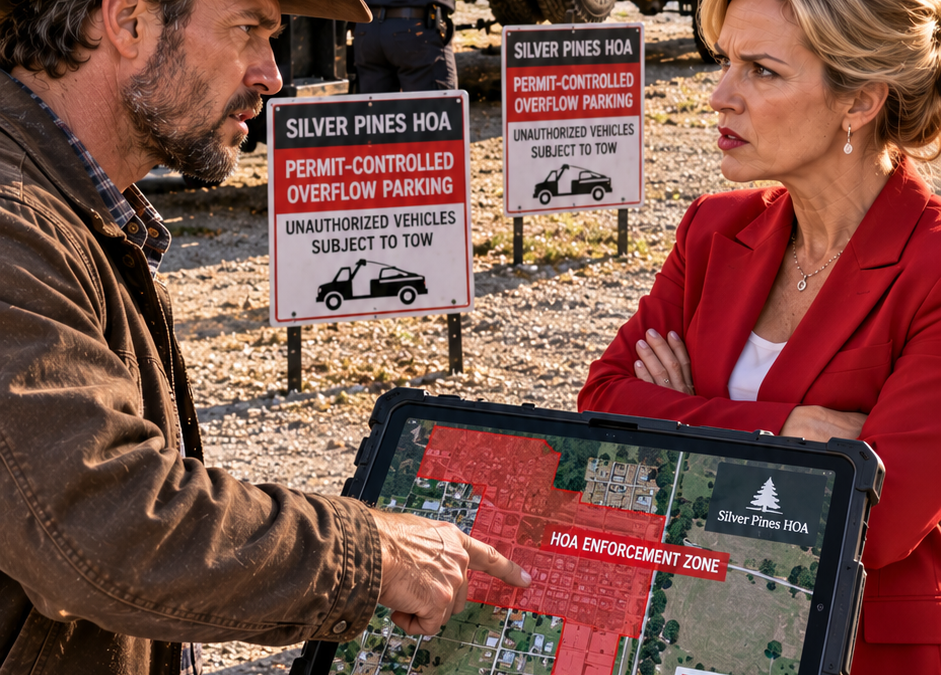
Now three temporary signs stood around the yard.
All three displayed the Silver Pines logo.
PERMIT-CONTROLLED OVERFLOW PARKING
UNAUTHORIZED VEHICLES SUBJECT TO TOW
I had never seen them before.
I shut off my pickup.
Then I took out my phone.
Lauren watched.
“You can take as many pictures as you want,” she said. “The truck is still being removed.”
I photographed the tow vehicle first.
Company name.
Unit number.
License plate.
Then my flatbed.
Wheel lift.
Chains.
Truck position.
Then each sign.
One near the loading shed.
One near the gravel scale pad.
One close to the shallow drainage swale that separated my ranch from the Silver Pines clubhouse parcel.
The operator climbed into his cab to enter something into a mounted tablet.
That was when I saw the map.
The clubhouse parking lot appeared in bright red.
So did the pool lot.
Then the red enforcement area crossed the swale.
And spread directly across my loading yard.
I walked closer.
Not toward the operator.
Toward the screen.
My yard had been turned into an HOA parking zone electronically.
“Lauren.”
She looked at me.
“What?”
“Who put my property into that system?”
She crossed her arms.
“This area is designated overflow parking.”
“By whom?”
“The board.”
“The board doesn’t own it.”
“It is functionally connected to the clubhouse property.”
I stared at her.
Functionally connected.
That was a remarkable phrase.
My barn was functionally connected to the county road too.
That did not make it county property.
“The lot belongs to me.”
“It is being administered as part of the event-parking program.”
“Administered by what legal right?”
She gave me the look people use when they think procedure is more important than ownership.
“You’ve already been warned about unauthorized commercial vehicles.”
“On my own loading yard?”
She ignored the question.
The tow operator finished entering his information.
I glanced at the tablet again.
A small label appeared inside the red shape.
SILVER PINES — ZONE C
I’d never heard of Zone C.
Lauren clearly had.
The operator completed the hookup.
I did not grab the truck.
I did not stand in front of the tow rig.
I did not start yelling.
I’ve dealt with enough equipment disputes, insurance claims, and county inspections to know that once machinery is already moving, the smartest thing you can do is preserve the record.
So I photographed everything.
The signs.
The tablet.
Lauren.
The loading shed.
The boundary swale.
My truck leaving.
The amber lights disappeared onto the county road.
Lauren remained behind.
Another temporary sign was installed near my yard entrance.
Then she looked at me.
“If you continue parking unpermitted commercial vehicles here, the association will continue enforcement.”
I glanced at the empty space beside the shed.
Then back at her.
“Good.”
Her eyebrows lifted.
“Good?”
“Now I know this wasn’t the tow driver’s mistake.”
For the first time that morning, her expression changed.
Only slightly.
But enough.
By then, I wasn’t thinking about getting the truck back.
Not yet.
I wanted to know who had decided an HOA could drag a red line across my property, attach towing authority to it, and then act as though the software had changed who owned the ground.
And somewhere behind that red polygon, I knew there had to be paperwork.
Or, as I would discover, a very important lack of it.
PART2
The east loading yard sat close enough to Silver Pines that an aerial photograph could mislead somebody who had never stood there.
From above, the HOA clubhouse and my ranch almost touched.
On the ground, the difference was obvious.
Silver Pines had a paved lot.
Striped spaces.
Curbs.
Decorative trees.
Light poles.
Concrete walkways.
Beyond that was the community pool.
My side of the swale looked like what it was.
A farm.
Gravel.
A feed shed.
A scale pad.
Stacks of fence posts.
Pallets.
Equipment.
Mud when it rained.
Dust when it didn’t.
Feed trucks entered from my farm lane, backed across the yard, unloaded beside the shed, and left without ever touching HOA property.
No one had ever referred to it as parking.
Certainly not me.
That afternoon, I went into my office and pulled fourteen years of records.
Gravel invoices.
Grading receipts.
Aerial photos from insurance inspections.
Delivery tickets.
Farm-business records.
Equipment photographs.
Old images of my flatbed parked in the same location Lauren had just declared an HOA tow zone.
I wasn’t fooling myself.
A stack of gravel receipts doesn’t prove title.
But it proves continuity.
I had used the ground.
Maintained it.
Improved it.
Silver Pines had not.
Before sunset, my email chimed.
I opened it.
SILVER PINES HOA — PARKING VIOLATION
The notice identified my flatbed as an unauthorized commercial vehicle parked in an HOA-controlled overflow area.
Two hundred fifty dollars.
I read it again.
Then leaned back.
That was useful.
Silver Pines wasn’t blaming North Valley Recovery.
They weren’t saying the driver misunderstood.
They were officially claiming parking authority over my yard.
I downloaded the notice.
Then every attachment.
The HOA parking policy was surprisingly detailed.
Clubhouse parking.
Pool parking.
Resident permits.
Guest passes.
Fire lanes.
Street restrictions.
Event procedures.
Towing authorization.
I searched the entire document for:
Loading yard.
East gravel.
Zone C.
Farm parcel.
Overflow.
Nothing connecting the policy to my property.
I printed the notice anyway.
Then I walked outside.
The temporary signs were still there.
I left them.
My neighbor Paul Grady stopped his pickup near the gate while I was photographing one.
“You leaving those things up?”
“For now.”
“If it were my place, they’d be in a dumpster.”
“That’s why they’re staying.”
He frowned.
“Explain.”
“They show exactly how far Silver Pines thinks its authority extends.”
Paul looked toward the sign.
Then toward me.
“You really do enjoy paperwork more than normal people.”
“No. I enjoy winning arguments without having to repeat myself.”
The next morning, I walked the yard before sunrise.
I photographed each sign relative to fixed features.
One sign stood twenty feet from the loading shed.
Another near the scale pad.
The third well inside the gravel area.
None sat in some ambiguous strip beside the public road.
Then my phone rang.
It was Ellis Feed Supply.
“Grant, your driver says you’ve got HOA tow signs at the east entrance.”
“They’re not valid.”
“He doesn’t want his tractor-trailer impounded while unloading.”
“Can’t blame him.”
“You want us to hold?”
I rescheduled the delivery.
Forty-five minutes of disruption.
Nothing catastrophic.
But now Lauren’s decision had started affecting my business.
That mattered.
I photographed the empty parking position where the flatbed normally sat.
Then I pulled out the towing receipt.
North Valley Recovery.
Dispatch number.
Tow time.
Storage yard.
Requesting account:
SILVER PINES HOA
Site code:
SP-C
I called North Valley.
A woman named Jessica answered.
“I need the full authorization packet for a tow performed yesterday.”
“Are you the registered owner?”
“Yes.”
“Vehicle?”
I gave her the information.
She found it.
“What are you disputing?”
“The requesting party does not own or control the property where the vehicle was removed.”
“That may be a civil matter between you and the HOA.”
“Maybe. But your company created records during the tow.”
“Yes.”
“I want them.”
“What specifically?”
“Driver photographs, dispatch coordinates, site designation, vehicle-condition report, requesting-account information, and whatever property authorization is associated with the zone.”
There was a pause.
“You’re asking for client records.”
“I’m asking why your company towed my truck from my property.”
Another pause.
“I can submit a compliance request.”
“Please do.”
Then I wrote Silver Pines.
No insults.
No threats.
No six-page rant about constitutional rights.
I stated:
The gravel loading yard was privately owned ranch property.
I had never authorized HOA parking.
I disputed the tow.
I disputed the fine.
I requested preservation of all records relating to towing-zone changes, parking maps, signage, vendor instructions, and event-parking plans.
Lauren responded the same afternoon.
Her message began:
Mr. Holloway, the Association will continue to enforce duly adopted parking restrictions in designated overflow areas.
She had capitalized Association.
People like Lauren often capitalize authority when evidence is thin.
I saved the email.
North Valley responded first.
The packet contained driver photographs.
Very clear photographs.
My flatbed beside my loading shed.
My gravel scale pad.
My hay-equipment building visible in the distance.
No clubhouse pavement.
No HOA curb.
No pool.
Then came the GPS record.
North Valley’s dispatch software recorded where the driver marked the vehicle before removal.
I put the coordinate into a mapping application.
The point landed well inside my loading yard.
Not near the swale.
Not near the property edge.
Inside.
So there was no location confusion.
The truck had been where I said it was.
The operator had towed it because his system said the location was enforceable.
A screenshot showed why.
Bright red.
Clubhouse.
Pool.
My yard.
Label:
ZONE C
I searched every public Silver Pines document again.
No Zone C.
I called Jessica.
“What is Zone C?”
She transferred me to client services.
A man named Trevor picked up.
“It looks like an operational parking sub-zone.”
“Is it one of Silver Pines’s approved properties?”
“I’d need to review the site file.”
“Please do.”
“Why?”
“Because Zone C is currently sitting on my ranch.”
He went quiet.
“Send me the tow number.”
I did.
That request took longer.
Silver Pines, meanwhile, doubled down.
A second violation arrived.
This one warned that continued commercial-vehicle use of overflow parking could result in additional towing.
I was now apparently a repeat offender for using my own truck beside my own shed.
Then I noticed another detail.
Silver Pines had a large summer event scheduled the following month.
Pool reopening.
Food vendors.
Music.
Guests.
The event announcement mentioned expanded parking arrangements.
My property was not named.
But three new directional signs appeared on the HOA side of the swale.
One arrow pointed east.
Straight toward my yard.
I photographed it.
Now I had a theory.
Parking shortage.
Convenient gravel.
Lauren looking for a solution.
But theories are cheap.
I needed the contract.
North Valley finally sent the site-enrollment packet the following Tuesday.
I opened the master services agreement first.
The towing relationship was real.
Silver Pines had hired North Valley almost two years earlier.
The contract covered private-property towing for designated HOA locations.
Attached was an enrollment schedule.
Each approved site had:
A site name.
Address.
Photographs.
Diagram.
Authorized contacts.
Property-control certification.
The clubhouse lot was there.
Pool lot.
Visitor lot North.
Visitor lot South.
My loading yard was not.
Zone C was not.
I read the contract again.
One section caught my attention.
ADDITION OF NEW ENFORCEMENT PROPERTY
Any new property had to be enrolled separately.
The client had to certify that it owned, leased, managed, or otherwise possessed written authority to regulate parking at that location.
There it was.
Boring contract language.
My favorite kind.
The agreement also discussed operational map adjustments.
Those were different.
North Valley’s portal allowed clients to edit internal enforcement zones for practical reasons.
Maybe guest parking moved.
Maybe one row closed temporarily.
Maybe construction changed traffic flow.
But those adjustments were presumed to occur within already authorized properties.
The contract did not say:
Drag red polygon anywhere you want and congratulations, you now control the land.
I printed the section.
Then I compared site codes.
My tow receipt said SP-C.
The clubhouse account used the same prefix.
That suggested somebody had created a sub-zone inside the existing Silver Pines account rather than enrolling a new property.
I called Trevor.
“I want the revision history for Zone C.”
“I can’t release administrative logs casually.”
“My vehicle was removed from land that does not appear anywhere in your approved site schedule.”
Silence.
Then:
“Send a written preservation request.”
I did.
At the same time, I searched Silver Pines board packets.
Most were public.
Two months of minutes showed the HOA had a real parking problem.
The pool had recently undergone an expensive renovation.
Attendance was expected to increase.
Several events were scheduled.
One parking committee memo estimated a shortage of nearly forty spaces during peak gatherings.
Options included:
Roadside overflow.
Remote parking.
Shuttle service.
Temporary use of adjacent areas.
Then one worksheet used the phrase:
Adjacent gravel — operationally preferable
My yard.
No parcel number.
No owner’s name.
No rental estimate.
No request for consent.
Just:
Adjacent gravel.
Operationally preferable.
That sentence summarized the whole mindset.
They needed space.
Mine was close.
Therefore, someone treated proximity like permission.
I searched my email.
Mail.
Voicemail.
Business records.
Nothing.
Silver Pines had never asked to rent the yard.
Never requested a temporary license.
Never asked whether event guests could park there.
Never offered payment.
They skipped the conversation entirely.
Three days later, Trevor sent the full-resolution tow photographs.
One image gave me another piece.
A temporary Silver Pines towing sign stood behind my flatbed.
Timestamp:
Installed before the tow request was finalized.
The sequence was now visible.
Digital zone changed.
Physical signs installed.
Tow request made.
My truck removed.
This was not a driver accidentally crossing the wrong driveway.
It was implementation.
North Valley agreed to release my flatbed while its compliance review continued.
I drove to the storage yard.
Before moving the truck, I photographed it from every side.
A fresh scrape ran along the lower edge of the rear mud guard.
Not serious.
But new.
I had maintenance photographs from two weeks earlier.
So into the file it went.
When I returned to the ranch, I did something that annoyed me enormously.
I parked the flatbed inside the equipment building.
Not in the yard.
Because the signs were still there.
Because the digital zone still existed.
Because even though I knew the land was mine, I did not know whether another North Valley driver might receive another dispatch.
Lauren’s decision had made me alter my behavior on my own property.
That was the moment the issue stopped being merely irritating.
Then Trevor called.
“Mr. Holloway?”
“Speaking.”
“Our compliance group reviewed the site file.”
“And?”
“We need your parcel documentation to identify the disputed location.”
“I’ll send the deed and tax map.”
“We are not making a title determination.”
“I don’t need you to.”
“What exactly are you asking us to determine?”
“Whether the GPS point where your driver towed my truck is covered by property-control documents in Silver Pines’s client file.”
He paused.
“Yes. That’s something we can review.”
Perfect.
I sent everything.
Deed.
Tax parcel.
Survey excerpt.
Photographs.
Tow GPS.
Sign locations.
Two days later, the account-history export arrived.
I opened it at my kitchen table.
Nineteen days before the tow, a Silver Pines administrator logged into North Valley’s portal.
The previous enforcement map stopped inside the HOA’s paved property.
Then the eastern boundary changed.
It crossed the swale.
Extended across my loading yard.
Saved.
The system stored:
Date.
Time.
Revision number.
User.
LAUREN PIKE
I sat back.
There are moments when suspicion turns into evidence so cleanly that it feels almost quiet.
Lauren had personally moved the zone.
But that wasn’t enough by itself.
As president, she had legitimate administrator access.
Maybe she believed she was allowed to adjust maps.
The next part mattered more.
Associated new-site enrollment:
NONE
Updated property-control certification:
NONE
Lease:
None.
Management agreement:
None.
Owner authorization:
None.
Compliance review for added land:
None.
The pixels moved.
The documents did not.
Trevor later explained it in plain language.
“The mapping tool isn’t a property-rights tool.”
“I figured.”
“Clients can adjust zones within approved sites.”
“Lauren expanded one outside the approved site.”
“That appears to be what happened.”
“Why didn’t the system stop her?”
“Because the software assumes the administrator is only mapping property the client controls.”
“That’s a dangerous assumption.”
“We are discussing that internally.”
“Your driver did exactly what the system told him.”
“Yes.”
“He wasn’t the original failure.”
“No.”
I actually felt better hearing that.
The tow operator wasn’t some rogue driver stealing trucks.
He had received a valid dispatch through a legitimate client account.
The map showed enforcement.
The signs matched.
My truck lacked an HOA permit.
From his perspective, it looked routine.
The failure happened upstream.
Lauren had placed my land into a system whose downstream users assumed the property question had already been answered.
I hired Nina Morales.
Property attorney.
I gave her one instruction.
“Don’t start with the towing company.”
She smiled.
“Good.”
“Start with the land.”
“Even better.”
She reviewed my title.
The loading yard sat entirely within my agricultural parcel.
No HOA easement.
No parking agreement.
No shared-use provision.
No management right.
No recorded interest allowing Silver Pines to control vehicles there.
Then she reviewed my purchase file.
Nothing.
Then HOA documents.
Nothing.
Then their internal event diagram.
Nothing.
She placed the papers down.
“This is refreshingly boring.”
“That sounds good.”
“It is.”
“No hidden easement?”
“No.”
“No twenty-year-old maintenance covenant?”
“No.”
“No weird common-access clause?”
“No.”
“So what do they have?”
“A red shape.”
I laughed.
Nina picked up North Valley’s master agreement.
“This is actually the most important document after title.”
“The vendor contract.”
“Yes.”
She found the new-site clause.
“Silver Pines can request towing from properties it controls.”
“Agreed.”
“For a new property, it must provide documentation establishing control.”
“Agreed.”
“They didn’t.”
“Correct.”
She pointed toward the operational-map language.
“This lets them manage workflow inside those properties.”
“Not create new ones.”
“Exactly.”
I leaned back.
“So their software controlled the workflow.”
“And your deed controlled the ground.”
“Can I quote that?”
“Billing starts now.”
North Valley’s compliance department reached the same operational conclusion without pretending it had become a court.
The company could not verify required site-control documents for the expanded Zone C area.
Result:
Zone C towing suspended.
Then North Valley went further.
It froze Silver Pines’s ability to alter enforcement boundaries directly while every active site was reverified.
That changed everything.
Silver Pines could still argue with me.
Could retain counsel.
Could claim good faith.
Could offer to rent the property.
But it could not send another North Valley truck into my yard using the red polygon.
The map was disabled.
The signs became nothing but plastic.
Nina sent a formal demand.
Withdraw both violations.
Remove all signs.
Refund towing and storage.
Pay documented truck damage.
Reimburse the disrupted feed delivery.
Cover title-review costs.
Contribute to legal fees.
Confirm in writing that Silver Pines possessed no parking-enforcement right over the loading yard absent a future lawful agreement.
No accusations of theft.
No criminal threats.
No emotional language.
Just:
You did this.
Here are the records.
Here is what it cost.
Fix it.
Lauren responded through Silver Pines management.
The HOA had acted in good faith to address parking shortages.
I called Nina.
“Apparently towing my truck from my property was good faith.”
“Intent and authority are different questions.”
“Does good faith create a parking easement?”
“No.”
“Then I’m still having a good day.”
Silver Pines launched an internal review.
That produced another useful document.
Their vendor-administration policy allowed the president and property manager to make routine operational changes without full board approval.
Parking hours.
Guest areas.
Temporary closures.
Contact information.
Small map adjustments.
All reasonable.
Inside HOA-controlled property.
No one had written the policy imagining the president would drag an enforcement zone over the ranch next door.
That explained how Lauren had done so much without a major board vote.
The process had been designed for speed.
She mistook efficiency for authority.
Board minutes revealed the rest.
Summer parking shortage.
Event planners nervous.
Roadside spaces rejected as unsafe.
Remote lot considered inconvenient.
Shuttle described as expensive.
Then:
Adjacent gravel area offers simplest overflow option.
Mine.
The next line was even better.
Vendor map can be adjusted administratively.
There it was.
Not:
Lease the property.
Ask the owner.
Verify title.
Negotiate temporary use.
Just:
Move the map.
An internal event-parking diagram shaded my entire loading yard.
No signature from me.
No agreement.
No owner name.
It was just colored.
I stared at it in Nina’s office.
“They really liked maps.”
“Maps are comforting.”
“Why?”
“Because they make complicated assumptions look flat.”
The board attorney apparently agreed with Nina’s reading.
My parking violations changed from active to suspended.
Then withdrawn.
The signs disappeared two days later.
Two HOA maintenance workers arrived.
I met them near the loading shed.
“We’re removing the parking signs.”
“Please.”
One man pulled the first.
Then the second.
Then the third.
He held one up.
“Want to keep it?”
“No.”
“You sure?”
“I have photographs.”
He shrugged and put it in the utility cart.
That was a small satisfying moment.
My yard was visually mine again.
But the money wasn’t settled.
North Valley reversed the tow and storage charges through its dispute process.
The mud-guard scrape went to their damage department.
Silver Pines’s insurer opened a claim for the business disruption, title review, and part of Nina’s fees.
Then came the meeting.
Silver Pines scheduled a special board session about parking management.
Nina asked if I wanted to attend.
“Yes.”
“Don’t argue.”
“I know.”
“Don’t interrupt.”
“I know.”
“Don’t call Lauren a cartographer.”
“I hadn’t planned to.”
“You are now.”
“Fair.”
The clubhouse room was packed.
Not because residents cared deeply about my flatbed.
Because the HOA’s parking program affected everyone.
Lauren sat at the front.
Crimson blazer.
I was beginning to suspect she owned no other color.
She moved through regular business first.
Pool maintenance.
Landscaping.
A complaint about trash cans.
Then parking.
She called the incident:
“An unfortunate misunderstanding regarding the eastern overflow area.”
I looked at Nina.
She didn’t move.
A board member named Daniel Ross leaned toward his microphone.
“Do we own the eastern gravel area?”
Lauren answered:
“It has historically been treated as overflow capacity associated with the clubhouse.”
Daniel frowned.
“That wasn’t my question.”
No answer.
The HOA attorney spoke.
“The title review is complete.”
The room quieted.
“The gravel loading yard is part of Mr. Holloway’s agricultural parcel.”
A few heads turned toward me.
Daniel asked:
“Do we lease it?”
“No.”
“Have any parking rights?”
“No.”
“Easement?”
“No.”
“Management agreement?”
“No.”
“Then why was it in our towing system?”
Lauren sat straighter.
“The vendor platform permits administrators to make operational changes.”
The attorney answered before Daniel could.
“Within property already under association control.”
Lauren looked at him.
The attorney continued.
“Expanding an operational map does not create a legal interest in real property.”
I could have gone home right then.
Everything else was decoration.
Daniel looked directly at Lauren.
“Did you expand the zone?”
“Yes.”
“Did you know the loading yard was outside the paved HOA parcel?”
“It is adjacent.”
“Did you verify ownership?”
“We had event-planning diagrams showing it as overflow.”
“That’s not what I asked.”
Her jaw tightened.
“The parking committee had identified the area as the most practical solution.”
Daniel stared at her.
“Did you ask Mr. Holloway?”
“No.”
“Did anyone?”
Lauren looked toward the management company.
The property manager shook her head.
“No.”
Daniel sat back.
“So we needed parking, saw gravel nearby, and put it into the towing map without asking who owned it.”
Lauren’s face hardened.
“That is an unfair characterization.”
A man behind me whispered:
“Sounds pretty fair.”
Lauren continued.
“The HOA had legitimate parking and traffic concerns. We had hundreds of residents preparing for the summer event.”
Daniel nodded.
“I’m not disputing the parking problem.”
“Then you understand why we needed flexibility.”
“Flexibility isn’t ownership.”
That line got a few murmurs.
Then another director asked:
“How did his farm truck become a violation?”
Lauren answered:
“Once the enforcement zone was expanded, vehicles inside it became subject to the existing permit rules.”
I raised my hand.
Daniel recognized me.
I stood.
“That’s the entire problem.”
Lauren turned toward me.
I continued.
“The software changed.”
I pointed toward the floor.
“The dirt didn’t.”
Silence.
I sat back down.
Nina whispered:
“Acceptable.”
“Thank you.”
North Valley had submitted a written compliance summary.
Daniel read from it.
The portal’s mapping features were intended for operational adjustments within properties whose parking-control authority had already been documented.
Adding a new property required separate enrollment.
Silver Pines did not submit that documentation for my yard.
Then came the audit-log entry.
Lauren Pike.
Date.
Time.
Revision.
The room got quieter.
A resident asked:
“Did the towing company know we didn’t own the lot?”
The attorney answered.
“No. Their driver relied on the active enforcement map and dispatch.”
Another asked:
“So Lauren made it look like we controlled the property?”
The attorney chose his words carefully.
“The association’s administrator expanded the operational enforcement zone without completing the required property-control process.”
Everyone knew what that meant.
Lauren tried again.
“I believed the adjacent area was covered by our event-use authority.”
The attorney asked:
“What event-use authority?”
That was the moment she stopped talking.
Because there wasn’t one.
No lease.
No temporary permit.
No written consent.
No anything.
Just belief.
Daniel introduced a motion.
Effective immediately, no single administrator could materially expand a towing-enforcement boundary.
Any site addition required:
Second-person approval.
Proof of property control.
Vendor compliance confirmation.
Board notice for new locations.
The motion passed.
Lauren voted against it.
That was almost funny.
The board then voted to suspend her individual administrative access to North Valley’s portal.
Passed.
She remained HOA president.
But the mechanism she had used was taken away.
I liked that.
Punishment is often less useful than removing the tool that allowed the mistake.
Then came the summer parking problem.
Still real.
Still unresolved.
The HOA needed space.
Daniel went through alternatives.
Roadside parking.
Too dangerous.
Attendance limits.
Unpopular.
Remote commercial lot with shuttle.
More expensive.
Then somebody asked:
“Can we rent Mr. Holloway’s yard?”
Every head turned toward me.
Daniel said:
“Would you consider it?”
“No.”
Lauren smiled faintly.
I continued.
“It is an active agricultural loading area. I have commercial deliveries and equipment movement throughout the weekend.”
Daniel nodded.
“Understood.”
“There is a commercial property two miles south that sits almost empty on Saturdays.”
“We’ve contacted them.”
“And?”
“Available.”
“Problem solved.”
Lauren spoke.
“At nearly three times the projected cost.”
I looked at her.
“You know what’s cheaper than renting land?”
She said nothing.
“Using someone else’s without permission.”
A few people laughed.
Daniel rubbed his forehead.
“We’re renting the commercial lot.”
Motion passed.
Silver Pines hired a shuttle.
For once, the red lines stayed where they belonged.
Nina negotiated the financial resolution over the following weeks.
North Valley reversed all tow and storage charges.
Their insurer paid the mud-guard repair.
Silver Pines withdrew both fines.
The HOA insurer reimbursed my documented delivery disruption and title-review costs.
Silver Pines paid an agreed portion of Nina’s fees.
But the most important part was not the money.
It was one paragraph in the settlement:
Silver Pines Homeowners Association acknowledges that the agricultural loading yard located on the Holloway parcel is not part of the Association’s parking program and that the Association possesses no authority to regulate parking, place towing signage, or request vehicle removal from that property absent written permission or another lawful property-control interest.
I read that paragraph three times.
Then signed.
Event weekend arrived.
By nine Saturday morning, Silver Pines was full of cars.
Clubhouse lot.
Pool lot.
Visitor spaces.
Then overflow to the remote commercial property.
A small shuttle bus ran continuously.
Volunteers directed traffic.
My loading yard?
Empty.
Exactly as it should have been.
At eleven, Ellis Feed called.
“Still good for delivery?”
“Come in.”
The driver turned into my ranch.
Backed across the gravel.
Stopped beside the loading shed.
No tow signs.
No permit requirement.
No Lauren.
No amber lights.
We unloaded feed.
Then I moved the flatbed out of the equipment building and parked it beside the shed.
Back where it belonged.
I stood there for a moment looking at it.
For fourteen years, that space had been so ordinary I never thought about it.
Then Lauren turned it red on a computer.
And suddenly parking my own truck there felt like reclaiming something.
Across the swale, the shuttle went by.
Silver Pines residents rode to a parking lot the HOA had actually rented.
It worked.
Was it less convenient?
Sure.
Permission often is.
That’s why some people prefer assumptions.
But nothing collapsed.
Nobody missed the event.
The pool remained open.
The neighborhood survived the shocking discovery that the nearest empty gravel wasn’t automatically theirs.
Several months later, North Valley contacted me.
Not about a claim.
About their updated system.
A driver was reverifying Silver Pines sites.
He stopped near my ranch.
“Mr. Holloway?”
“Yes.”
He held up a tablet.
The HOA enforcement zones appeared in red.
Clubhouse.
Pool.
Visitor lots.
The line stopped cleanly at the swale.
My yard was gray.
Not covered.
No label.
No Zone C.
He asked:
“This match your understanding?”
I looked at the screen.
“Perfect.”
He seemed surprised by how happy I was.
“You really like gray?”
“Today I do.”
North Valley had changed its own process.
Material geofence expansions now triggered compliance review before becoming active.
That had not been part of my settlement demand.
The company did it because it understood its risk.
One client had dragged an operational line beyond an approved property.
One driver had then acted on it.
The software had made the mistake scalable.
North Valley fixed the mechanism.
Silver Pines did too.
Daniel eventually became HOA president.
Lauren stepped down at the next election.
Her public statement said she wanted to “reduce her administrative workload and focus on personal priorities.”
That’s one way to describe having your towing access removed, your mapping decisions audited, and your parking policy rewritten around you.
I did not celebrate publicly.
I didn’t need to.
The results were visible.
Every future vendor boundary change required documentation.
Any proposed use of neighboring property required written permission.
Event plans had to identify whether overflow areas were owned, leased, or merely proposed.
Simple things.
Things most adults would assume were already happening.
Daniel called me one afternoon.
“You know what the board discovered?”
“What?”
“We had at least six internal maps using slightly different boundaries.”
“I believe it.”
“Some were event diagrams. Some were landscaping. Some were vendor maps.”
“And people treated them like title maps.”
“Exactly.”
He sighed.
“We’re fixing the archive.”
“Label them.”
“We are.”
“Big letters.”
“Already done.”
“Good.”
Then he laughed.
“You really enjoyed that vendor contract.”
“Page fourteen.”
“Of course you know the page.”
“New Site Enrollment.”
“You underlined it.”
“Twice.”
“Lauren said three times.”
“She exaggerates.”
“She showed me the copy.”
“Fine. Three.”
One year after the tow, I ran into Lauren at a county farm-supply store.
No red blazer.
Jeans.
Gray sweater.
She was standing near the automotive aisle.
We both saw each other.
Neither could pretend otherwise.
“Grant.”
“Lauren.”
She glanced at the box of trailer lights in my hand.
“How’s the flatbed?”
“Fine.”
“I’m glad.”
“Thank you.”
Awkward silence.
Then she said:
“I’ve thought about that parking situation a lot.”
I waited.
“We were under real pressure.”
“I know.”
“Residents had complained about parking for months.”
“I know.”
“The event would’ve been chaos.”
“Maybe.”
She looked at me.
“I wasn’t trying to steal your property.”
“I never said you were.”
That surprised her.
“Then what did you think I was doing?”
“Solving your problem with something that belonged to me.”
She crossed her arms.
“The aerial planning map made the yard look connected.”
“It is connected geographically.”
“Exactly.”
“So is your backyard connected to your neighbor’s.”
She looked away.
“The vendor system let me extend the zone.”
I almost laughed.
“There it is.”
“What?”
“The system.”
“What about it?”
“You still talk like the portal gave you authority.”
“It allowed the edit.”
“Yes.”
“The distinction wasn’t obvious.”
“It was written in the contract.”
Her jaw tightened.
I didn’t need to press harder.
Eventually she said:
“I should’ve checked.”
“Yes.”
“And contacted you.”
“Yes.”
“Would you have rented it?”
“No.”
She gave me a frustrated look.
“So we’d still have had the parking problem.”
“Yes.”
“But not the tow.”
“No.”
She nodded slowly.
That was probably the closest we’d ever come to agreement.
Then she said:
“You’re very difficult.”
I smiled.
“Mostly when people tow my equipment.”
She almost laughed.
Then walked away.
The next Silver Pines summer event used the same remote lot.
No controversy.
By then, residents were used to the shuttle.
What had once been dismissed as too expensive or inconvenient had become routine.
That was another lesson.
People often call the lawful option impractical only because the unlawful shortcut is cheaper.
Take away the shortcut.
Suddenly the practical solution changes.
My east yard returned to its ordinary life.
Feed.
Seed.
Fencing supplies.
Flatbed.
Delivery trucks.
Occasional mud.
No permit signs.
No digital Zone C.
No HOA volunteers wandering around with clipboards.
I repaired the flatbed’s mud guard and eventually threw the damaged one into the scrap pile.
I did not want the truck becoming a museum.
But I did keep the paperwork.
Tow packet.
GPS record.
Audit log.
Lauren’s administrator revision.
Event diagram.
North Valley contract.
Settlement.
I put them into one binder.
On the front I wrote:
SILVER PINES PARKING — CLOSED
Nina saw it.
“You kept everything.”
“Of course.”
“Why?”
“Because somebody will eventually say it didn’t happen that way.”
She smiled.
“You would’ve made a good lawyer.”
“No.”
“Why?”
“I prefer livestock.”
One afternoon, I framed a single page.
Not the fine.
Not Lauren’s email.
Not the tow photo.
Page fourteen of North Valley’s contract.
The new-property enrollment clause.
Underneath it, I mounted a small brass plate:
A RED LINE ON A SCREEN DOESN’T MOVE A DEED.
Daniel saw it when he stopped by to discuss a drainage maintenance issue near the swale.
He laughed.
“You really framed it.”
“Important literature.”
“You’re never letting this go.”
“I let it go.”
“You framed the contract.”
“That’s different.”
We walked toward the swale.
Daniel carried a current parcel map.
Not an event diagram.
Not an HOA sketch.
A real boundary reference.
He pointed toward the drainage area.
“We need vegetation cleared along our side before storm season.”
“Your side?”
He smiled.
“Very specifically our side.”
“Then we’re getting somewhere.”
The crew came the next week.
They stayed exactly within Silver Pines property.
No drama.
No lawyer.
No vendor dispute.
No towing.
It was one of the most satisfying boring afternoons of my life.
Years of property conflicts tend to make people think the solution is stronger fences.
Sometimes it is.
But more often, it’s stronger habits.
Ask.
Verify.
Document.
Don’t confuse software permissions with land rights.
Don’t confuse convenience with consent.
And never assume an official-looking map has answered a legal question it was never designed to answer.
The morning my flatbed was towed, Lauren had every visual advantage.
Red blazer.
Tow truck.
Signs.
Digital map.
Active vendor account.
A driver doing exactly what the system told him.
I was just a rancher standing in gravel with a phone.
But the system had one weakness.
It kept logs.
Who changed the map?
Lauren.
When?
Nineteen days before the tow.
What document supported the new property?
None.
Was my yard enrolled?
No.
Did the contract require property-control certification?
Yes.
Had Silver Pines supplied it?
No.
Once those answers lined up, the red polygon stopped looking authoritative.
It started looking like what it actually was.
A drawing.
Lauren’s biggest mistake wasn’t calling North Valley.
It wasn’t the signs.
It wasn’t even towing the truck.
Her biggest mistake was assuming that because the software allowed her to move the boundary, nobody would ever ask what contract allowed her to move the authority.
I asked.
North Valley checked.
Nina checked.
The board checked.
And the answer stayed the same.
There wasn’t one.
Late one afternoon, I parked the flatbed in its usual spot beside the loading shed.
Same gravel.
Same building.
Same yard.
Across the swale, cars moved through Silver Pines.
A shuttle wasn’t needed that day.
No event.
No overflow.
Just an ordinary neighborhood evening.
I climbed down from the cab.
Locked the truck.
Then glanced toward the place where Lauren’s temporary tow sign had once stood.
Nothing there.
Just gravel.
That was exactly how I wanted it.
Silver Pines still had parking rules.
North Valley still towed unauthorized vehicles from places the HOA actually controlled.
Lauren had been allowed to move on with her life.
Nobody had gone to jail.
Nobody lost a house.
Nobody needed some million-dollar courtroom verdict to make the ending satisfying.
The right people paid the actual costs.
The bad tow disappeared.
The violations were withdrawn.
The system was fixed.
Lauren lost the power she had misused.
And my property stayed mine.
Sometimes that is what winning really looks like.
Not fireworks.
Not revenge.
Just putting everything back where it belonged.
Including the red line.








