𝗣𝗔𝗥𝗧 𝟮 HOA Sued Me Over My New 2,500 Acres—Then the Judge Learned Their Only Entrance Was Inside My Deed
𝗣𝗔𝗥𝗧 𝟮
That much was elementary.
I drove directly to the county recorder’s office.
Didn’t call Margaret.
Didn’t call the HOA attorney.
Didn’t argue.
I pulled the original 1996 Milbrook Estates plat.
Spread it across an examination table.
Then I began tracing.
Slowly.
Boundary by boundary.
I had done the same thing thousands of times.
Fifteen minutes later, I stopped.
Looked at the road.
Looked at the boundary.
Then looked again.
I stayed another half hour just to make sure I wasn’t seeing what I wanted to see.
When you’ve spent your career settling other people’s mistakes, you learn that excitement is dangerous.
So I checked it again.
Then once more.
Margaret Harlo had walked onto my property that morning and told me I didn’t understand what I’d bought.
By filing that lawsuit, she’d given me the first reason I’d had to read every line of my own deed like a hostile survey.
And something in the plat wasn’t right.
I folded the copy.
Placed it beside the lawsuit.
Then drove home.
That night, I called my attorney.
Not because I needed help understanding a boundary.
I called because I wanted to know whether what I suspected had ever been cured legally.
Before I tell you what we found, you should understand what I had bought.
The land had belonged to the Alderman family since 1971.
Gerald Alderman ran cattle on it for decades.
His son later tried hay production.
Then the son died without children.
The estate sat tied up in probate for three years before it finally came to market.
I knew the parcel before I purchased it.
I’d surveyed neighboring properties twice during my county career.
Flat eastern ground.
Rolling pasture westward.
A creek bed near the western edge.
Good cattle land.
Quiet land.
The kind I’d wanted for years.
I had been planning my retirement operation long before I retired.
Barn here.
Handling pens there.
Water lines.
Perimeter fence.
A service road down toward the creek.
I bought the acreage thinking about cattle.
I barely thought about Milbrook Estates.
Ninety-four homes sat along my eastern boundary.
Community pool.
Brick entrance.
Decorative gate.
HOA.
Margaret Harlo had been its president for eleven years.
I knew her reputation before I knew her personally.
Three weeks after closing, I had a survey crew confirm my eastern corners.
Routine work.
Two days later, the first HOA letter arrived.
Margaret informed me that my survey activity was creating a dust nuisance for residents.
Any work within fifty feet of the subdivision, she wrote, needed prior coordination with the board.
There was no statute.
No covenant citation.
No ordinance.
Just HOA letterhead and Margaret’s signature.
I filed it.
Didn’t answer.
A week later came another.
This one complained about a temporary storage container I had placed on my own acreage.
Equipment storage.
Nothing permanent.
Margaret said it was “aesthetically inconsistent” with Milbrook Estates standards and needed to be screened or removed.
My container wasn’t inside Milbrook Estates.
It wasn’t even close.
Again, I filed the letter.
Then came a bill.
Three hundred fifty dollars.
No hearing.
No itemized authority.
No explanation beyond “community compliance.”
I put that one in the same folder.
By then I understood the pattern.
Margaret wasn’t testing whether she had jurisdiction.
She was testing whether I would behave as though she did.
Inside Milbrook Estates, people usually did.
Margaret had moved there in 2004.
After her husband died around 2016, the HOA seemed to become the center of her life.
She had no legal training.
But she had Gerald Finch.
Finch was the HOA’s retained attorney.
Four thousand dollars a month.
Homeowners funded him through their dues whether they understood how often he was being used or not.
Finch wrote intimidating letters.
He wrote them well.
His letters sounded expensive.
They sounded final.
Most people never asked whether the threat behind them was real.
Mrs. Patton did not.
She was seventy-nine.
Widow.
Lived on the north side of Milbrook Estates.
She had her driveway resurfaced in a gravel called Riverstone.
The HOA decided Riverstone did not comply with the approved color palette.
Six-thousand-dollar fine.
She paid.
Didn’t challenge it.
Didn’t know how.
Dale Mercer lived several streets away.
Retired Army.
Property immaculate.
He put small garden flags along his front border.
Seasonal colors.
No slogans.
Margaret called them unauthorized signage.
Finch sent a letter threatening lien and foreclosure action if the flags weren’t removed.
Dale removed them.
But he kept the letter.
He kept every letter.
Six years of them, organized in a box in his garage.
Margaret had learned a dangerous lesson from all of this.
People obeyed.
After eleven years, obedience started feeling like proof that she had been right.
Her claim against my 2,500 acres came from language in the original development documents.
When Cascade Development Group built Milbrook Estates in 1996, the master deed referenced “buffer zone acreage” to the east and south.
Finch’s theory was that certain use restrictions benefiting Milbrook Estates attached to those lands and continued against future owners.
Including me.
Whether that argument had legal merit was one issue.
But there was another.
A much simpler one.
The entrance road.
Ten days after Margaret personally served me, Finch sent a second package.
Heavy law-office envelope.
He was seeking a preliminary injunction.
If granted, I would be prohibited from fencing, grading, building, or materially altering land within three hundred feet of Milbrook Estates while the lawsuit proceeded.
Three hundred feet.
That would freeze roughly six hundred acres on my eastern side.
The best ground.
Flattest.
Closest to the county road.
Exactly where I planned the barn and cattle facilities.
The complaint also demanded $180,000 plus attorney fees.
Then came the part that mattered most.
Finch wanted a permanent restriction recorded against the land.
Not temporary.
Forever.
I could own it.
Pay taxes on it.
Maintain it.
But future use would remain subject to HOA restrictions.
I drank my coffee.
Read it twice.
Then called Ray Caldwell.
No relation.
Just coincidence.
Ray had spent eighteen years as a county judge before going into private practice.
I’d known him two decades.
He read documents the way surgeons look at scans.
Quietly.
Completely.
I drove to his office.
He read the lawsuit.
The injunction request.
The earlier HOA letters.
Then looked at me.
“They’re serious.”
“Do they have a case?”
“Finch isn’t inventing the covenant theory from nothing.”
That got my attention.
“It’s not airtight,” Ray continued. “But it’s arguable enough that you don’t ignore it.”
“Could they freeze the land?”
“Possibly.”
He tapped the injunction.
“Depends on the judge. Depends on what Finch convinces the court the covenant language means.”
Then he tapped the damages request.
“This number is theater.”
“One hundred eighty thousand?”
“Mostly.”
“And the injunction?”
“Not theater.”
He wanted every closing document.
Title commitment.
Deed.
Title policy.
Prior plats.
Everything.
I told him I had already pulled the 1996 Milbrook plat.
“I found something.”
Ray looked up.
“What?”
“I want to confirm it before I say.”
That earned a nod.
“Bring me the deed.”
I went back to the recorder’s office that afternoon.
This time, I pulled two sets of documents.
The 1996 subdivision plat.
And the original Alderman parcel description.
I laid them side by side.
Then traced the entrance road.
The road came off the county highway and ran westward into Milbrook Estates.
Two lanes.
Stone pillars.
Gate.
The only ingress and egress for all ninety-four homes.
Something didn’t close.
The western boundary of the road corridor appeared to cross beyond the recorded subdivision line.
Into the Alderman parcel.
My parcel.
I checked the bearings.
Distances.
Reference points.
Then checked again.
I needed the complete metes-and-bounds description from my closing deed to be certain.
But I knew enough to feel the hair rise along my arms.
The road had either been built in the wrong place—
or somebody had built it intentionally on private land and forgotten to record the right to use it.
That evening, while I was studying photographs of the plat at home, Margaret sent a mass email to Milbrook residents.
I learned about it later.
Subject:
LEGAL UPDATE — PROTECTING OUR COMMUNITY
She referred to me as an “outside developer.”
I wasn’t developing houses.
I wanted cattle.
A barn.
Fence.
But “retired surveyor planning a modest cattle operation” doesn’t scare homeowners.
Outside developer does.
Margaret said the lawsuit was progressing well.
She used the phrase:
Victory in progress.
People asked what exactly I planned to build.
Margaret answered vaguely.
Finch has it under control.
People asked what the covenant really said.
Finch has it under control.
People asked what happened if the HOA lost.
Finch has it under control.
That night, Ray called around nine.
His voice was flat.
Careful.
“Come in tomorrow morning.”
“Something wrong?”
“Bring your deed.”
Pause.
“I found something Margaret Harlo isn’t going to like.”
PART2
Ray had my deed spread on the table when I arrived.
Beside it was his own certified copy of the Milbrook Estates plat.
Yellow legal pad.
Three notes.
Coffee that smelled like it had been sitting since sunrise.
He didn’t bother with small talk.
“Sit.”
I did.
He put his finger on the legal description in my deed.
Then traced the corresponding boundary on the subdivision plat.
“Tell me what you see.”
It took me less than a minute.
The entire entrance corridor—
both lanes—
the pillars—
the gate—
the paved approach—
sat inside the metes-and-bounds description of my 2,500-acre parcel.
Not touching it.
Not partially overlapping it.
Inside.
I straightened.
“No easement?”
Ray shook his head.
“I checked three indexes.”
“Nothing?”
“Nothing.”
“Not 1996?”
“No.”
“Any later correction?”
“No.”
“Utility access?”
“Different instruments. Nothing covering the road.”
I looked at the deed again.
Ray leaned back.
“Plain English?”
“Go ahead.”
“The only entrance to Milbrook Estates sits on your land.”
I nodded.
“And there is no recorded easement giving the HOA or homeowners a permanent right to use it.”
That was the sentence.
For twenty-nine years, ninety-four households had driven across private land with no recorded access easement.
Maybe Gerald Alderman knew.
Maybe he didn’t.
Maybe Cascade’s developer believed paperwork had been filed.
Maybe some closing attorney assumed somebody else handled it.
The reason barely mattered.
The record was the record.
I asked:
“What do we do?”
Ray reached for his coffee.
Discovered it was empty.
Put the cup back down.
“Nothing.”
I thought I’d misheard.
“Nothing?”
“Not yet.”
“Ray, they’re suing me.”
“Exactly.”
He leaned forward.
“They filed suit. That lawsuit forced you to examine your title. You discovered their entrance problem while defending yourself.”
“So we tell Finch.”
“No.”
“Why?”
“Because we don’t need it yet.”
He tapped the covenant complaint.
“We fight their restriction argument on its own merits.”
“And the road?”
“We hold it.”
He saw my expression.
“This isn’t revenge. Don’t make it revenge.”
“I wasn’t.”
“Good. Because ninety-four homeowners aren’t Margaret Harlo.”
That mattered.
He continued.
“The moment we disclose the road, Finch goes into emergency mode. New theories. Implied easement. Necessity. Prescription. Estoppel. Whatever he can build.”
“And if we wait?”
“He keeps committing to the facts he’s already chosen.”
That was Ray.
Never dramatic.
Just patient.
Margaret had sued first.
She had framed me as the threat.
All we had done was read the documents.
I hadn’t gone searching for leverage against her neighborhood.
She had forced me to check what she should have checked before walking onto my land.
I drove past the entrance that afternoon.
The arm opened.
A minivan came out.
Then closed.
Same gate.
Same pillars.
Same road.
Nothing physically changed because I now understood the deed.
That’s something people often misunderstand about ownership disputes.
Land doesn’t react when somebody discovers the paperwork was wrong.
Grass doesn’t move.
Asphalt doesn’t care.
Only people panic.
A few days later, I visited Mrs. Patton.
She invited me in.
Tea.
Neat little kitchen.
She showed me the $6,000 Riverstone gravel fine.
“I’m not fighting them,” she said.
“I’m not asking you to.”
“I’m too old for letters.”
“I understand.”
She looked at me carefully.
“If I were ever asked what happened, I’d tell the truth.”
“That’s all I’d ever ask.”
Then I visited Dale Mercer.
He already knew I’d been sued.
He brought me to his garage.
Opened the box.
Six years of letters.
Dates.
Notices.
Fines.
Threats.
Organized.
“I’ll testify.”
“Not yet.”
He nodded.
No questions.
That evening, I read Milbrook’s recorded CC&Rs.
The entrance appeared once.
Description:
PRIVATE DRIVE SERVING MILBROOK ESTATES.
No recorded easement reference.
No statement that the HOA owned the underlying land.
No mechanism explaining legal access.
Twenty-nine years of assumption reduced to one line.
I also pulled county tax records.
Since my purchase, the county had assessed the full deeded parcel to me.
Including the entrance-road corridor.
I paid those taxes.
The folder got thicker.
Then Finch escalated.
Expanded complaint.
Seventeen pages.
His revised argument said the buffer restrictions were perpetual.
Permanent.
Any future purchaser.
Any future use.
My eastern six hundred acres could become land I technically owned but never fully controlled.
I read it at the kitchen table.
Then reached the next document.
Finch’s sworn declaration.
Signed under penalty of perjury.
Supporting the injunction.
One paragraph stopped me.
I read it once.
Then again.
Then a third time.
The private drive serving Milbrook Estates has been HOA-controlled common property in continuous and exclusive use by subdivision residents since the development’s platting in 1996.
HOA-controlled common property.
Finch had sworn that as fact.
I called Ray.
He answered:
“I’ve got it.”
“He signed it.”
“Yes.”
“You see the paragraph?”
“I circled it.”
That declaration mattered because every county record said the opposite.
My deed.
Tax assessments.
Subdivision plat.
Recorder’s easement index.
Milbrook’s own CC&Rs.
Finch had submitted a factual assertion to the court without checking title to the road.
Now the contradiction existed inside the case itself.
Ray said:
“We mark it as an exhibit.”
“Use it now?”
“No.”
“When?”
“When the question matters.”
Around the same time, Finch offered settlement.
The HOA would drop the $180,000 damages demand if I accepted their land-use restrictions permanently.
In other words:
Give them the authority they were suing to obtain, and they would stop suing me for refusing to give it.
I rejected it.
Then Margaret held a community meeting.
Dale attended.
Ninety-four homeowners were invited.
Projector at the front.
Slide:
PROTECTING OUR COMMUNITY
Margaret told residents Milbrook was winning.
The outside developer was being stopped.
Finch was confident.
The covenants were strong.
People applauded.
Dale told me later it wasn’t happy applause.
More like nervous agreement.
Nobody wants to be the homeowner visibly doubting an HOA president who has threatened people for garden flags.
One person asked:
“What exactly does Caldwell plan to build?”
Margaret said the threat was broader than any single building.
Another asked:
“What happens if the court says those restrictions don’t apply?”
“Finch has it under control.”
“What does the deed say?”
“Finch has it under control.”
Dale wrote down every answer.
Then added the agenda to his garage box.
I thought about those residents.
They weren’t my enemy.
They had bought homes.
Paid dues.
Expected the board to understand the legal structure of their neighborhood.
Most people don’t examine subdivision plats before making breakfast.
They trust that the road leading to their driveway has been legally sorted out.
Why wouldn’t they?
Margaret had turned that trust into personal power.
I decided then that if we won, I would not close the road.
Ray had not even suggested doing it.
But I needed to decide for myself.
Ninety-four families weren’t going to lose access because one woman had sued me.
Finch sent his preliminary hearing exhibits.
Covenants.
Developer marketing materials.
Consultant opinions.
CC&Rs.
Nothing about the road.
Not once.
They still hadn’t checked.
Then came mediation.
Fourteenth floor downtown.
Expensive carpet.
Recycled air.
Six chairs around a table.
Howard Voss, retired circuit judge, served as mediator.
Finch arrived first.
Rolling briefcase.
Three-inch binder.
Tabs in different colors.
Associate with another binder.
Margaret sat behind him.
Ray and I brought one manila folder.
That probably gave Finch the wrong impression.
Good.
Voss explained the rules.
Confidential.
Nonbinding unless an agreement was signed.
Finch started.
Forty minutes.
And he was good.
I don’t say that sarcastically.
He knew the covenant argument.
He cited precedent.
Developer intent.
Land-use consultant.
Historical treatment.
He could make ambiguous language sound inevitable.
Margaret watched the mediator closely.
Looking for signs.
Voss gave none.
Then Ray spoke.
He challenged the buffer language.
Description versus restriction.
No formally recorded deed restriction in my chain of title.
Arms-length probate sale.
Clean title policy.
No actual notice of any purported permanent limitation.
Two cases.
No performance.
Then he opened our folder.
“I’d like to address one additional issue.”
He pulled out Milbrook’s CC&Rs.
Turned to the road section.
“The association’s own governing documents describe the entrance as a private drive serving Milbrook Estates.”
Finch watched.
Ray continued.
“There is no recorded easement referenced.”
Finch replied immediately.
“The easement is implied by the plat.”
“Possibly an argument,” Ray said. “But not a recorded easement.”
Then he looked at Voss.
“I would ask Mr. Finch to identify the instrument number granting Milbrook Estates a recorded easement over the entrance-road corridor.”
Finch didn’t answer directly.
“The plat clearly establishes intended access.”
“That was not the question.”
Voss looked at Finch.
“Is there a recorded easement?”
Half second.
Maybe less.
“We believe the plat itself is sufficient.”
The mediator wrote.
“For purposes of today’s discussion, I’ll note that the existence of a formally recorded easement is disputed.”
Margaret leaned toward Finch.
Whispered.
His shoulders shifted.
That was the first crack.
Not collapse.
Just the first moment I knew Finch hadn’t known.
He moved quickly into settlement.
The HOA would reduce damages from $180,000 to $60,000.
I would permanently accept their interpretation of the buffer restrictions.
And I would submit future development plans for “advisory review” by the HOA.
Advisory.
On my land.
Ray read the proposal.
Then looked at me.
“No.”
Finch set down his pen.
“Mr. Caldwell, your client is going to regret taking this to a judge.”
Ray didn’t react.
Finch continued.
“There are aspects of this property situation he has clearly not thought through.”
I nearly smiled.
Ray said:
“We’ll see the judge in three weeks.”
Mediation ended.
Outside, Finch held the door for Margaret.
She laughed at something he said.
Real laugh.
Relaxed.
They walked toward the parking garage.
Still comfortable.
Still certain.
I wanted them comfortable.
The hearing took place three weeks later.
Judge Nora Whiting.
Twenty-three years on the civil bench.
Small courtroom.
Maybe sixty seats.
Every seat filled.
Margaret had organized homeowner attendance.
Community support.
People took off work.
Eight rows.
Finch at plaintiff’s table.
Margaret directly behind him.
Ray and I entered with our single folder.
Judge Whiting took the bench.
No ceremony.
Finch went first.
Same argument as mediation.
Better, actually.
He had refined it.
Forty minutes.
1996 language.
Developer intent.
Case law.
Consultant letter.
Permanent covenant burden.
He presented it like the case was already complete.
Judge Whiting asked two questions.
Finch answered cleanly.
Then sat.
Ray stood.
He addressed the covenant.
Ambiguous language.
No recorded deed restriction.
Clean title.
Lack of notice.
Legal difference between development planning language and enforceable burden.
Judge Whiting wrote notes.
Then Ray stopped.
Looked down at our table.
“Your Honor, before we conclude, I need to raise a matter that arose directly from the plaintiff’s decision to bring this lawsuit.”
He set three documents on the table.
One at a time.
The clerk marked them.
Exhibit A.
My complete title deed.
Exhibit B.
1996 Milbrook Estates plat.
Exhibit C.
Finch’s sworn declaration.
Ray picked up my deed.
“Page three.”
He read the metes-and-bounds description.
Bearing.
Distance.
Coordinate.
Monument.
Turn.
Distance.
Dry language.
Perfect language.
Then he laid the subdivision plat beside it.
“Your Honor, I would ask the court to compare the defendant’s title boundary to the location of the private entrance road shown on the Milbrook Estates plat.”
Judge Whiting leaned forward.
Read.
Compared.
Ray waited.
Then he picked up Finch’s sworn declaration.
He read the sentence aloud.
The private drive serving Milbrook Estates has been HOA-controlled common property in continuous and exclusive use by subdivision residents since the development’s platting in 1996.
Ray set the declaration next to my deed.
“These documents cannot both be true.”
Silence.
Not courtroom silence.
Something heavier.
Judge Whiting put down her pen.
Picked up the deed.
Then the plat.
Read both.
Finally:
“Mr. Finch.”
Finch stood.
“When did Milbrook Estates record an easement over this entrance corridor?”
His hand moved toward his portfolio.
Stopped.
“Your Honor, may I confer with my client?”
“Take your time.”
He turned.
Margaret leaned over the railing behind him.
They whispered.
I watched her expression change.
Not anger.
Calculation.
The look a person gets when reality suddenly becomes expensive.
Thirty seconds.
Maybe forty-five.
Finch faced the judge.
“Your Honor, we may require additional time to locate that instrument.”
Ray stood immediately.
“There is no instrument.”
Whiting looked toward him.
“We searched the county recorder’s index under the developer, HOA, Alderman ownership chain, road description, and subdivision filings.”
He paused.
“No access easement was recorded in 1996.”
Another pause.
“None has been recorded in the twenty-nine years since.”
The judge looked back at Finch.
“If that’s correct, counsel, your client appears to have used a roadway located on another owner’s titled property for twenty-nine years without a recorded legal access instrument.”
A murmur rolled through the gallery.
People turned toward each other.
Someone whispered:
“What does that mean?”
Margaret made a sound behind Finch.
Not a word.
Judge Whiting spoke again.
“And this lawsuit appears to be the event that caused the current property owner to examine that title relationship closely.”
Then came the word.
Calmly.
Almost academically.
“Trespass.”
The courtroom moved.
One man in the third row stood.
“Your Honor, are you saying our road—”
Whiting raised one hand.
“Sir, please sit.”
He sat.
Finch requested recess.
Fifteen minutes.
The hallway filled instantly.
Homeowners formed small circles.
Phones came out.
People started asking one another questions they should have been able to ask their HOA years ago.
Dale Mercer stood against a wall.
Arms crossed.
Watching.
Margaret reached Ray before three minutes had passed.
No clipboard now.
No audience voice.
No speech.
Just:
“What does he want?”
Ray opened the folder.
Removed one sheet.
Handed it to her.
Proposed easement agreement.
Permanent recorded access for Milbrook Estates.
My terms:
Withdraw the lawsuit entirely.
Withdraw the injunction.
Withdraw the damages demand.
Pay every dollar of my attorney fees.
Formally acknowledge that the entrance road lies inside my titled property.
Pay a nominal annual easement fee.
The road would remain open permanently under a proper recorded agreement.
Margaret read it.
Twice.
Then looked at Ray.
He said:
“Eight months ago, your client pointed at that gate and told Mr. Caldwell the road had been HOA property for twenty-nine years.”
Pause.
“We’d like that position reconsidered.”
Margaret folded the paper.
Walked away.
She didn’t look at me.
I stood in the hallway thinking about Gerald Alderman.
For fifty years, he’d run cattle beside that subdivision.
Never received a letter.
Never challenged the road.
Probably never knew the legal defect existed.
I thought about Mrs. Patton.
Six thousand dollars over gravel color.
Dale’s flags.
All those homeowners in the hallway who arrived believing their HOA was protecting them.
Page three of one deed had changed the entire case.
Not because the paper was clever.
Because nobody on the other side had bothered to read it.
The courtroom reconvened.
There was no dramatic ruling that afternoon.
There didn’t need to be.
Finch knew what had happened.
Margaret knew.
Judge Whiting knew.
Most importantly, sixty homeowners knew.
Seventy-two hours later, Ray called me.
“Dismissal filed.”
“Everything?”
“Everything.”
The HOA voluntarily withdrew the lawsuit.
The preliminary injunction request.
The $180,000 damages claim.
The permanent covenant restriction.
All of it.
No admission of wrongdoing.
Of course.
They insisted on that sentence.
I didn’t care.
Judge Whiting entered a short order recognizing dismissal.
Two lines mattered.
The covenant claim lacked sufficient legal foundation.
The access and boundary questions raised during litigation required formal resolution by the affected property owners.
Three days later, Ray sent the HOA our formal easement terms.
Thirty days to respond.
They took eleven.
Courier delivered the signed agreement.
All board signatures.
Margaret’s was third.
Small.
Compressed.
As if she’d pressed too hard with the pen.
The agreement created what Cascade Development should have created in 1996.
A real access easement.
Surveyed.
Defined.
Recorded.
Permanent.
Milbrook residents could continue entering and leaving exactly as they always had.
I remained the owner of the underlying road corridor.
The HOA paid my attorney fees.
$24,230.
Every fine and compliance notice Margaret had sent me was voided.
The $350 dust and storage nonsense disappeared.
Then came the annual easement fee.
Four hundred dollars.
Indexed to inflation.
Not four thousand.
Not forty thousand.
Four hundred.
Enough to make the legal relationship visible every year.
A line item in the HOA budget.
A reminder.
Entrance-road easement payment — $400.
I picked that number intentionally.
Margaret had fined Mrs. Patton six thousand dollars over gravel shade.
Four hundred seemed sufficient to document reality without punishing ninety-four innocent families.
The agreement was recorded.
Officially.
For the first time in twenty-nine years, Milbrook Estates had a legal right to use its only entrance.
Because I signed one.
Margaret resigned before the next scheduled board meeting.
Two-sentence letter.
Effective immediately.
She didn’t attend when it was read.
An interim board election followed.
Dale Mercer ran.
Forty-one votes out of fifty-nine.
He looked almost embarrassed by the margin.
The first issue his board handled wasn’t my land.
It was Mrs. Patton.
She submitted a handwritten request to review her six-thousand-dollar Riverstone driveway fine.
Three paragraphs.
Attached original violation notice.
Payment receipt.
Photograph of the driveway.
The new board refunded every dollar.
Unanimous.
Four minutes.
Dale called me afterward.
“Done.”
“How’d she take it?”
“She cried.”
I sat quietly for a moment.
Not because six thousand dollars meant much in the scale of my land purchase.
Because it meant everything to her.
That’s what abuse of small authority does.
The amounts look small from outside.
To the person receiving the letter, they’re not small.
People in Milbrook started contacting me afterward.
Not many.
Most probably didn’t know what to say.
One woman left a handwritten note in my mailbox.
Thank you for not closing the road.
A retired teacher stopped me near the gate.
“I’ve been afraid of that board for six years.”
I didn’t know how to answer.
Then he said:
“I didn’t realize I didn’t have to be.”
That stayed with me.
Because I’d watched people obey lines of authority my entire career.
Survey stakes.
Boundary pins.
Paint marks.
Some lines are real.
Others only work because everyone agrees not to question them.
Margaret had spent eleven years converting silence into legitimacy.
The lawsuit broke that illusion.
Three weeks after recording the easement, I drove past the Milbrook entrance on a Tuesday morning.
No business there.
I just wanted to see it.
Stone pillars.
Brass letters.
Automated arm.
A car approached.
The arm lifted.
Vehicle passed.
Arm lowered.
Nothing looked different.
That was the best part.
Those ninety-four families still had their road.
Children still caught the school bus.
People still drove to work.
Emergency vehicles still had access.
Delivery vans still came and went.
No one lost anything they legitimately depended on.
The only thing that changed was the paperwork.
Now the access right actually existed.
And it existed because the landowner had granted it.
Me.
Eight months earlier, Margaret had stood forty yards from that gate.
Pointed at it.
Said:
“HOA property. Has been for twenty-nine years.”
Now there was a recorded easement in the county office saying exactly what the road was.
Private land.
Access granted to Milbrook Estates.
Different thing.
Very different thing.
I drove on.
The cattle project was moving.
Barn framing nearly complete.
Eastern fence line staked exactly where I’d planned.
Three hundred feet from Milbrook’s boundary.
Inside the same acreage Finch wanted frozen.
No injunction.
No HOA review.
No permanent restriction.
Mine.
The first calves arrived the following spring.
I remember standing near the new barn as they moved through the handling lane.
Wind out of the east.
Milbrook’s rooftops visible beyond the fence.
For months, the lawsuit had made those houses feel like a threat.
Now they were just houses again.
That’s how I wanted it.
I never hated the people living there.
They didn’t build the bad plat.
They didn’t forget the easement.
Most didn’t elect Margaret because they wanted somebody terrorizing widows over driveway gravel.
They elected nobody else because few people wanted the job.
Then power accumulated around the only person willing to keep taking it.
That happens more often than people think.
One evening, Dale drove over.
He brought the box.
Six years of correspondence.
Set it on my tailgate.
“What do I do with this now?”
“Keep it.”
“I thought you’d want it.”
“I don’t need it.”
He looked toward the barn.
“You think she’s done?”
“Margaret?”
He nodded.
“Doesn’t matter.”
He looked surprised.
“The system changed.”
“Systems change back.”
“Then keep the box.”
He smiled.
“That’s why I kept it in the first place.”
We stood there a while.
He finally said:
“You knew about the road the whole time?”
“After she sued me.”
“Why didn’t you tell anyone?”
“Because I didn’t need ninety-four families panicking before there was a solution.”
He nodded.
Then:
“I’d have told everybody.”
“I know.”
He laughed.
That’s why Ray had been the lawyer.
And I had been the surveyor.
You learn patience in boundary work.
A surveyor who rushes eventually creates someone else’s lawsuit.
You verify.
Then verify again.
When Margaret came onto my land, she had certainty.
I had doubt.
Doubt was more useful.
Certainty told Margaret:
This road has always been ours.
Doubt told me:
Check the plat.
Certainty told Finch:
The HOA controls the private drive.
Doubt told Ray:
Search every index.
Certainty filed a sworn declaration.
Doubt found page three.
I thought about that often afterward.
People assume winning a land dispute requires aggression.
Sometimes it requires the opposite.
Stand still.
Read.
Let the other person finish creating records.
Margaret created plenty.
Her first dust letter.
The storage violation.
The fine.
The lawsuit.
The expanded complaint.
The injunction request.
Finch’s sworn declaration.
The mass email.
The community meeting.
Every document pushed them deeper into a position they had never verified.
Meanwhile, the deed stayed exactly where it had always been.
Nothing they wrote could move the boundary.
Months after settlement, I went back to the recorder’s office.
The clerk who had helped me recognized me.
“Milbrook road?”
“That’s the one.”
She smiled.
“Heard about that.”
“I need the recorded easement.”
She pulled it.
Fresh instrument number.
My signature.
HOA signatures.
Survey exhibit.
Legal description of the corridor.
I stood at the same examination table where I’d first spread the 1996 plat.
Twenty-nine years between the two documents.
The original mistake.
Then the correction.
That’s the satisfying part of land records.
People make mistakes.
Records can fix them.
Not erase what happened.
But prevent repetition.
I bought certified copies.
One for Ray.
One for my files.
One stayed in the barn office.
Not because I expected another fight.
Because I’d learned something from Dale.
Documents matter most before you need them.
Mrs. Patton eventually invited me over again.
Same tea.
Same kitchen.
Her driveway still Riverstone.
She seemed amused by that now.
“They sent the refund.”
“I heard.”
“Six thousand dollars.”
“Good.”
She shook her head.
“I should have fought it.”
“Maybe.”
“I was scared.”
I didn’t correct her.
Fear is expensive.
People who know that can make a business out of it.
She looked toward the window.
“Margaret never apologized.”
“Did you expect her to?”
“No.”
Then she smiled.
“But the check cleared.”
That was enough.
I visited Ray around the same time.
He had framed nothing.
Saved no newspaper clipping.
He had simply closed the file.
I asked him:
“When did you know we’d won?”
“Mediation.”
“When Finch didn’t know the easement?”
“No.”
“When?”
“When Margaret asked what you wanted.”
I thought about it.
“That fast?”
“People don’t ask for terms when they still think they’re dictating them.”
He poured more coffee.
“Before that, they thought they were negotiating your land.”
“After?”
“They realized they were negotiating their road.”
That was the entire story in one sentence.
Margaret sued me because she believed my 2,500 acres were burdened for the benefit of her neighborhood.
The lawsuit forced us to examine title.
Title showed that the neighborhood’s only entrance was burdening my land instead.
Not metaphorically.
Literally.
Their road.
Their pillars.
Their gate.
Their daily access.
Inside my deed.
If Margaret had never sued me, I might not have discovered it for years.
Maybe ever.
I wasn’t planning to block access.
Gerald Alderman hadn’t cared.
I might have followed his example.
But Margaret couldn’t tolerate land near Milbrook existing outside her authority.
So she reached.
Too far.
And found the one document capable of forcing her board to acknowledge exactly where its authority ended.
Years spent surveying taught me that most property disputes begin with one of three sentences.
“I’ve always used it.”
“Everybody knows it’s mine.”
“That’s where the line has always been.”
Those sentences feel persuasive because human beings love habit.
Land records do not.
A hundred years of habit can still be wrong if the legal right was never created.
Sometimes long use creates legal issues of its own.
Prescription.
Necessity.
Implied rights.
Lawyers can fight those questions.
But the first question remains simple.
What does the deed say?
Margaret skipped that one.
Finch skipped it too.
The residents never had reason to ask.
I did.
Because they sued me.
The barn finished that summer.
Red metal roof.
Wide center aisle.
Handling pens on the south end.
I placed it exactly where I had imagined before Margaret’s first letter arrived.
Some evenings, I stand in the doorway and look east.
I can just see the Milbrook entrance through a break in the trees.
The gate arm rises.
Lowers.
Rises.
Lowers.
People coming home.
Sometimes I think about what would have happened if I’d reacted emotionally when Margaret served me.
Suppose I’d threatened to close the road immediately.
Suppose I’d put up barricades.
Suppose I’d gone online telling ninety-four families they were trespassing.
Finch would have gone to court asking for emergency access.
Residents would have hated me.
Margaret would have looked like their protector.
The title issue would still exist, but the human issue would be uglier.
Instead, we gave them permanent access.
On paper.
Properly.
For four hundred dollars a year.
The same people who arrived in court to support Margaret left knowing I had no intention of trapping them.
That distinction mattered.
Landownership comes with power.
How you use it tells people more than the deed does.
Margaret used every scrap of authority she thought she possessed.
I tried not to.
One afternoon, a delivery driver stopped at the barn.
He was new.
Couldn’t find the cattle supply drop.
He pointed east.
“GPS brought me through that gated neighborhood first.”
“Wrong road.”
He laughed.
“Fancy entrance.”
“It’s on my land.”
He looked at me.
“Seriously?”
“Seriously.”
“That’s a story.”
“Not anymore.”
He waited.
I pointed toward the unloading area.
“Feed goes there.”
That’s how I know the whole thing is truly over.
The fact that once felt enormous is now mostly trivia.
My road.
Their gate.
Recorded easement.
Correct paperwork.
Life moved on.
Margaret’s resignation wasn’t the end of Milbrook Estates.
The neighborhood didn’t collapse.
Their pool still opened every summer.
The clubhouse still hosted birthday parties.
People still complained about dues.
Dale told me board meetings became shorter after he took office.
Less enforcement.
More maintenance.
Someone proposed repainting the entrance pillars.
The board asked who owned them before approving anything.
Dale called me.
“You’re kidding.”
“No.”
“They’re asking permission?”
“Yes.”
“Tell them I don’t care what color they are.”
“You want that in writing?”
I laughed.
“Actually, yes.”
He laughed too.
Then sent me a one-page request.
I signed.
That was how it should have worked all along.
Not complicated.
Not humiliating.
Not threatening.
Ask.
Check.
Record.
Move on.
The annual $400 easement payment arrives every January.
Usually by check.
One year the treasurer forgot.
Dale called.
“Don’t sue us.”
“You’re thirty-six hours late.”
“Have mercy.”
“I’ll consider it.”
The check arrived the next day.
We both knew the amount was symbolic.
The real value was the line item.
It forced every new board member to see the relationship.
They don’t own the road.
They have a permanent recorded right to use it.
That difference fits in one sentence.
But it took a lawsuit, a courtroom, three lawyers, a retired judge, and a terrified HOA president to get it written down.
The cattle don’t care.
That’s another thing I like about them.
They don’t know what an easement is.
Don’t care about Margaret.
Don’t care that Finch once demanded $180,000.
They care about water.
Fence.
Feed.
Shade.
Real things.
After months of legal paper, real things were a relief.
One cold morning, I was repairing a section of fence near the eastern boundary when a school bus came through Milbrook’s gate.
Yellow lights.
Children visible through the windows.
It turned toward the county road.
For a moment, I thought about the fact that every tire of that bus sat on my deeded land.
Then I thought about why easements exist.
So ownership and use don’t have to fight every morning.
That’s the whole point.
Good property law isn’t about keeping people out.
It’s about making rights clear enough that nobody needs to fight.
Cascade Development failed that in 1996.
Margaret made it worse by pretending the uncertainty didn’t exist.
We fixed it.
That’s all.
People occasionally ask whether I enjoyed watching Margaret realize the gate was on my land.
The honest answer?
For about ten seconds.
I’m human.
She had walked onto my property with a process server and told me to hire a very good lawyer.
Eight months later, outside the courtroom, she asked mine:
“What does he want?”
There was satisfaction in that.
I won’t pretend otherwise.
But satisfaction fades.
What lasts is the record.
My land remains mine.
Milbrook has access.
Their residents aren’t trapped.
My barn stands.
My fence stands.
Mrs. Patton got her money back.
Dale’s garden flags returned.
And somewhere in the county recorder’s office sits an easement that should have existed before the first Milbrook house was sold.
That feels better than revenge.
One evening near the end of my first full cattle season, I walked the eastern boundary again.
Same route I’d been walking when Margaret arrived with the process server.
Thermos this time too.
Old habit.
The sun hit the brass Milbrook lettering through the trees.
Gate arm lifted.
A car came out.
Then another went in.
I stopped near the same spot where Margaret had stood.
I could almost hear her voice.
That road, that entrance—HOA property. Has been for twenty-nine years.
She hadn’t been lying in the way people normally mean it.
She believed it.
That may have been the most dangerous part.
A deliberate liar sometimes checks facts because they know facts can hurt them.
A person certain they’re right often doesn’t.
Margaret never checked.
Finch didn’t either.
Twenty-nine years of habit had become evidence in their minds.
My career had taught me the opposite lesson.
The longer something has gone unquestioned, the more carefully you should verify it once money or title is on the line.
I finished my coffee.
Drove another survey stake.
Not because the boundary needed marking.
Because I like visible lines.
Then I stood there looking over the acreage.
Two thousand five hundred acres.
Mine.
Not because I said so.
Not because a board voted.
Not because people had used it a certain way for twenty-nine years.
Because the title said so.
Because the boundaries closed.
Because the county record supported them.
Because when the question finally reached a courtroom, the paper survived scrutiny.
Margaret had tried to use a lawsuit to tell me what I couldn’t do with my own land.
Instead, that lawsuit forced everyone to discover what her neighborhood couldn’t legally do without mine.
Drive home.
And once we all understood that, the solution was surprisingly simple.
They dropped the lawsuit.
I granted the easement.
Everybody kept what they actually needed.
That’s how the story ended.
Not with a locked gate.
Not with ninety-four families stranded.
Not with me proving I could hurt people just because I had leverage.
With one corrected record.
One barn.
A herd of cattle.
And the quiet satisfaction of knowing that the next person who points at that entrance and says, “That’s ours,” can be shown exactly where the truth is filed.
Have you finished reading the story and want to read it again?
HOA Sued Me Over My New 2,500 Acres—Then the Judge Learned Their Only Entrance Was Inside My Deed
The HOA sued me three weeks after I started working my own land.
They wanted to control hundreds of acres I had just bought.
Then I checked the deed under the only road their entire neighborhood used.
My name is Ray Caldwell, and I spent thirty years reading property lines for people who usually waited until they hated each other before asking what those lines actually meant.
County land surveyor.
That was my profession.
Deeds.
Plats.
Bearings.
Monuments.
Easements.
Descriptions written by men who had been dead for fifty years but whose commas could still determine who owned a fence, a barn, or ten feet of creek bank.
After three decades, land stops looking like empty space.
Most people see grass.
I see coordinates.
Most people see a road.
I wonder who owns the soil beneath it.
That habit probably saved me.
The morning Margaret Harlo served me with a lawsuit, I was walking the eastern boundary of the 2,500 acres I’d bought eight months earlier.
I had a survey stake in one hand and a thermos in the other.
The sun had barely cleared the tree line.
I heard vehicles before I saw them.
Three of them.
They came up the access road at 7:42 in the morning.
Margaret stepped out first.
President of the Milbrook Estates Homeowners Association.
Clipboard pressed against her side.
Two board members followed.
Then a man wearing a county lanyard climbed from the third vehicle.
I knew what he was before he introduced himself.
Process server.
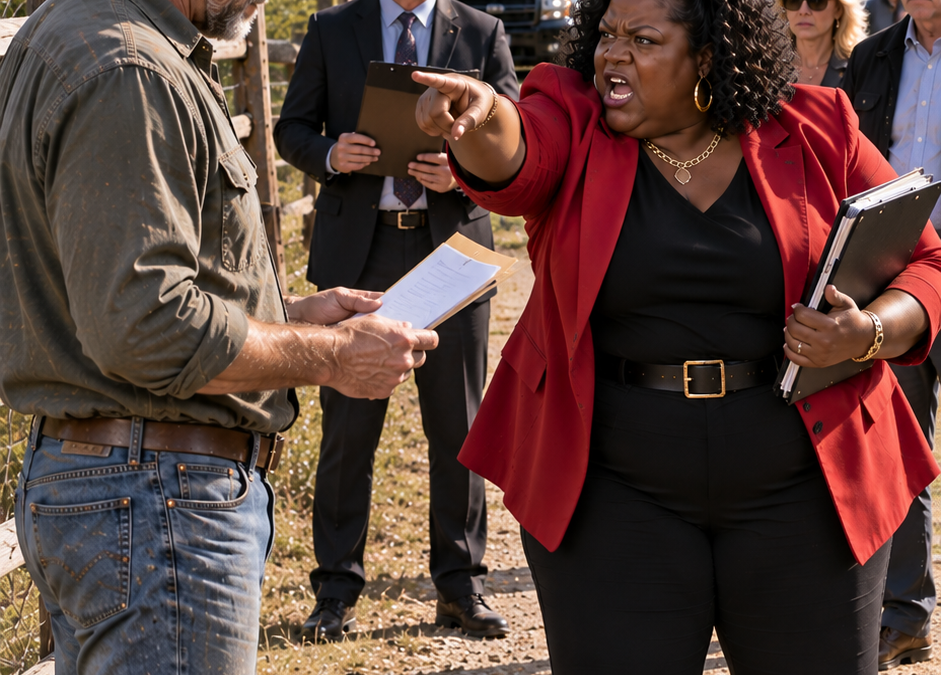
Margaret didn’t stop at my fence.
Didn’t ask permission.
She crossed onto my property and walked until she stood about six feet in front of me.
“You have no idea what you bought into.”
She said it loudly.
Not because I was hard of hearing.
Because she had brought an audience.
The process server held out an envelope.
Margaret folded her arms.
“We’ve already filed. If I were you, I’d get a very good lawyer.”
I took the envelope.
Opened it.
Read the first page.
I didn’t react.
That seemed to bother her more than anger would have.
About forty yards behind Margaret stood the entrance to Milbrook Estates.
Stone pillars.
Brass lettering.
Automated gate arm.
A resident’s SUV rolled toward the county highway while we stood there.
The arm rose.
The SUV passed.
The arm lowered.
Margaret gestured backward without looking.
“That road. That entrance. HOA property. Has been for twenty-nine years.”
She gave me a hard little smile.
“Whatever you think you bought, you bought nothing that touches us.”
I looked at the entrance.
Then at her.
I knew what she wanted.
Confusion.
Maybe panic.
The moment when a person who has just bought 2,500 acres realizes a neighborhood attorney has discovered something the buyer somehow missed.
I gave her nothing.
“The covenants on this acreage go back decades,” she continued. “They’re enforceable whether you knew about them or not.”
I folded the lawsuit.
Tucked it under my arm.
“I understand.”
That was all.
She waited.
I let the silence sit.
Something shifted in her expression.
Not fear.
Not yet.
Just irritation.
Margaret was accustomed to people responding to official-looking paper.
Explaining themselves.
Negotiating.
Apologizing.
I did none of it.
She turned.
The two board members followed.
The process server gave me a professional nod.
Nothing personal.
Then all three vehicles drove away.
I stayed where I was.
The Milbrook Estates gate remained behind them.
Stone pillars.
Brass letters catching the morning light.
The arm opened for another resident.
Twenty-nine years, Margaret had said.
As if time itself were a deed.
I stood there thinking one question.
Who owns the dirt under that road?
I was retired.
But retirement doesn’t erase thirty years of instinct.
Milbrook Estates had been platted in 1996.
Some surveyor had drawn its lines.
Some developer had signed documents.
Someone had decided exactly where the subdivision ended.
And that private road had to sit somewhere.
If the road crossed land outside the subdivision, the developer should have recorded an easement.
No easement, no clean access right.
That much was elementary.
I drove directly to the county recorder’s office.
Didn’t call Margaret.
Didn’t call the HOA attorney.
Didn’t argue.
I pulled the original 1996 Milbrook Estates plat.
Spread it across an examination table.
Then I began tracing.
Slowly.
Boundary by boundary.
I had done the same thing thousands of times.
Fifteen minutes later, I stopped.
Looked at the road.
Looked at the boundary.
Then looked again.
I stayed another half hour just to make sure I wasn’t seeing what I wanted to see.
When you’ve spent your career settling other people’s mistakes, you learn that excitement is dangerous.
So I checked it again.
Then once more.
Margaret Harlo had walked onto my property that morning and told me I didn’t understand what I’d bought.
By filing that lawsuit, she’d given me the first reason I’d had to read every line of my own deed like a hostile survey.
And something in the plat wasn’t right.
I folded the copy.
Placed it beside the lawsuit.
Then drove home.
That night, I called my attorney.
Not because I needed help understanding a boundary.
I called because I wanted to know whether what I suspected had ever been cured legally.
Before I tell you what we found, you should understand what I had bought.
The land had belonged to the Alderman family since 1971.
Gerald Alderman ran cattle on it for decades.
His son later tried hay production.
Then the son died without children.
The estate sat tied up in probate for three years before it finally came to market.
I knew the parcel before I purchased it.
I’d surveyed neighboring properties twice during my county career.
Flat eastern ground.
Rolling pasture westward.
A creek bed near the western edge.
Good cattle land.
Quiet land.
The kind I’d wanted for years.
I had been planning my retirement operation long before I retired.
Barn here.
Handling pens there.
Water lines.
Perimeter fence.
A service road down toward the creek.
I bought the acreage thinking about cattle.
I barely thought about Milbrook Estates.
Ninety-four homes sat along my eastern boundary.
Community pool.
Brick entrance.
Decorative gate.
HOA.
Margaret Harlo had been its president for eleven years.
I knew her reputation before I knew her personally.
Three weeks after closing, I had a survey crew confirm my eastern corners.
Routine work.
Two days later, the first HOA letter arrived.
Margaret informed me that my survey activity was creating a dust nuisance for residents.
Any work within fifty feet of the subdivision, she wrote, needed prior coordination with the board.
There was no statute.
No covenant citation.
No ordinance.
Just HOA letterhead and Margaret’s signature.
I filed it.
Didn’t answer.
A week later came another.
This one complained about a temporary storage container I had placed on my own acreage.
Equipment storage.
Nothing permanent.
Margaret said it was “aesthetically inconsistent” with Milbrook Estates standards and needed to be screened or removed.
My container wasn’t inside Milbrook Estates.
It wasn’t even close.
Again, I filed the letter.
Then came a bill.
Three hundred fifty dollars.
No hearing.
No itemized authority.
No explanation beyond “community compliance.”
I put that one in the same folder.
By then I understood the pattern.
Margaret wasn’t testing whether she had jurisdiction.
She was testing whether I would behave as though she did.
Inside Milbrook Estates, people usually did.
Margaret had moved there in 2004.
After her husband died around 2016, the HOA seemed to become the center of her life.
She had no legal training.
But she had Gerald Finch.
Finch was the HOA’s retained attorney.
Four thousand dollars a month.
Homeowners funded him through their dues whether they understood how often he was being used or not.
Finch wrote intimidating letters.
He wrote them well.
His letters sounded expensive.
They sounded final.
Most people never asked whether the threat behind them was real.
Mrs. Patton did not.
She was seventy-nine.
Widow.
Lived on the north side of Milbrook Estates.
She had her driveway resurfaced in a gravel called Riverstone.
The HOA decided Riverstone did not comply with the approved color palette.
Six-thousand-dollar fine.
She paid.
Didn’t challenge it.
Didn’t know how.
Dale Mercer lived several streets away.
Retired Army.
Property immaculate.
He put small garden flags along his front border.
Seasonal colors.
No slogans.
Margaret called them unauthorized signage.
Finch sent a letter threatening lien and foreclosure action if the flags weren’t removed.
Dale removed them.
But he kept the letter.
He kept every letter.
Six years of them, organized in a box in his garage.
Margaret had learned a dangerous lesson from all of this.
People obeyed.
After eleven years, obedience started feeling like proof that she had been right.
Her claim against my 2,500 acres came from language in the original development documents.
When Cascade Development Group built Milbrook Estates in 1996, the master deed referenced “buffer zone acreage” to the east and south.
Finch’s theory was that certain use restrictions benefiting Milbrook Estates attached to those lands and continued against future owners.
Including me.
Whether that argument had legal merit was one issue.
But there was another.
A much simpler one.
The entrance road.
Ten days after Margaret personally served me, Finch sent a second package.
Heavy law-office envelope.
He was seeking a preliminary injunction.
If granted, I would be prohibited from fencing, grading, building, or materially altering land within three hundred feet of Milbrook Estates while the lawsuit proceeded.
Three hundred feet.
That would freeze roughly six hundred acres on my eastern side.
The best ground.
Flattest.
Closest to the county road.
Exactly where I planned the barn and cattle facilities.
The complaint also demanded $180,000 plus attorney fees.
Then came the part that mattered most.
Finch wanted a permanent restriction recorded against the land.
Not temporary.
Forever.
I could own it.
Pay taxes on it.
Maintain it.
But future use would remain subject to HOA restrictions.
I drank my coffee.
Read it twice.
Then called Ray Caldwell.
No relation.
Just coincidence.
Ray had spent eighteen years as a county judge before going into private practice.
I’d known him two decades.
He read documents the way surgeons look at scans.
Quietly.
Completely.
I drove to his office.
He read the lawsuit.
The injunction request.
The earlier HOA letters.
Then looked at me.
“They’re serious.”
“Do they have a case?”
“Finch isn’t inventing the covenant theory from nothing.”
That got my attention.
“It’s not airtight,” Ray continued. “But it’s arguable enough that you don’t ignore it.”
“Could they freeze the land?”
“Possibly.”
He tapped the injunction.
“Depends on the judge. Depends on what Finch convinces the court the covenant language means.”
Then he tapped the damages request.
“This number is theater.”
“One hundred eighty thousand?”
“Mostly.”
“And the injunction?”
“Not theater.”
He wanted every closing document.
Title commitment.
Deed.
Title policy.
Prior plats.
Everything.
I told him I had already pulled the 1996 Milbrook plat.
“I found something.”
Ray looked up.
“What?”
“I want to confirm it before I say.”
That earned a nod.
“Bring me the deed.”
I went back to the recorder’s office that afternoon.
This time, I pulled two sets of documents.
The 1996 subdivision plat.
And the original Alderman parcel description.
I laid them side by side.
Then traced the entrance road.
The road came off the county highway and ran westward into Milbrook Estates.
Two lanes.
Stone pillars.
Gate.
The only ingress and egress for all ninety-four homes.
Something didn’t close.
The western boundary of the road corridor appeared to cross beyond the recorded subdivision line.
Into the Alderman parcel.
My parcel.
I checked the bearings.
Distances.
Reference points.
Then checked again.
I needed the complete metes-and-bounds description from my closing deed to be certain.
But I knew enough to feel the hair rise along my arms.
The road had either been built in the wrong place—
or somebody had built it intentionally on private land and forgotten to record the right to use it.
That evening, while I was studying photographs of the plat at home, Margaret sent a mass email to Milbrook residents.
I learned about it later.
Subject:
LEGAL UPDATE — PROTECTING OUR COMMUNITY
She referred to me as an “outside developer.”
I wasn’t developing houses.
I wanted cattle.
A barn.
Fence.
But “retired surveyor planning a modest cattle operation” doesn’t scare homeowners.
Outside developer does.
Margaret said the lawsuit was progressing well.
She used the phrase:
Victory in progress.
People asked what exactly I planned to build.
Margaret answered vaguely.
Finch has it under control.
People asked what the covenant really said.
Finch has it under control.
People asked what happened if the HOA lost.
Finch has it under control.
That night, Ray called around nine.
His voice was flat.
Careful.
“Come in tomorrow morning.”
“Something wrong?”
“Bring your deed.”
Pause.
“I found something Margaret Harlo isn’t going to like.”
PART2
Ray had my deed spread on the table when I arrived.
Beside it was his own certified copy of the Milbrook Estates plat.
Yellow legal pad.
Three notes.
Coffee that smelled like it had been sitting since sunrise.
He didn’t bother with small talk.
“Sit.”
I did.
He put his finger on the legal description in my deed.
Then traced the corresponding boundary on the subdivision plat.
“Tell me what you see.”
It took me less than a minute.
The entire entrance corridor—
both lanes—
the pillars—
the gate—
the paved approach—
sat inside the metes-and-bounds description of my 2,500-acre parcel.
Not touching it.
Not partially overlapping it.
Inside.
I straightened.
“No easement?”
Ray shook his head.
“I checked three indexes.”
“Nothing?”
“Nothing.”
“Not 1996?”
“No.”
“Any later correction?”
“No.”
“Utility access?”
“Different instruments. Nothing covering the road.”
I looked at the deed again.
Ray leaned back.
“Plain English?”
“Go ahead.”
“The only entrance to Milbrook Estates sits on your land.”
I nodded.
“And there is no recorded easement giving the HOA or homeowners a permanent right to use it.”
That was the sentence.
For twenty-nine years, ninety-four households had driven across private land with no recorded access easement.
Maybe Gerald Alderman knew.
Maybe he didn’t.
Maybe Cascade’s developer believed paperwork had been filed.
Maybe some closing attorney assumed somebody else handled it.
The reason barely mattered.
The record was the record.
I asked:
“What do we do?”
Ray reached for his coffee.
Discovered it was empty.
Put the cup back down.
“Nothing.”
I thought I’d misheard.
“Nothing?”
“Not yet.”
“Ray, they’re suing me.”
“Exactly.”
He leaned forward.
“They filed suit. That lawsuit forced you to examine your title. You discovered their entrance problem while defending yourself.”
“So we tell Finch.”
“No.”
“Why?”
“Because we don’t need it yet.”
He tapped the covenant complaint.
“We fight their restriction argument on its own merits.”
“And the road?”
“We hold it.”
He saw my expression.
“This isn’t revenge. Don’t make it revenge.”
“I wasn’t.”
“Good. Because ninety-four homeowners aren’t Margaret Harlo.”
That mattered.
He continued.
“The moment we disclose the road, Finch goes into emergency mode. New theories. Implied easement. Necessity. Prescription. Estoppel. Whatever he can build.”
“And if we wait?”
“He keeps committing to the facts he’s already chosen.”
That was Ray.
Never dramatic.
Just patient.
Margaret had sued first.
She had framed me as the threat.
All we had done was read the documents.
I hadn’t gone searching for leverage against her neighborhood.
She had forced me to check what she should have checked before walking onto my land.
I drove past the entrance that afternoon.
The arm opened.
A minivan came out.
Then closed.
Same gate.
Same pillars.
Same road.
Nothing physically changed because I now understood the deed.
That’s something people often misunderstand about ownership disputes.
Land doesn’t react when somebody discovers the paperwork was wrong.
Grass doesn’t move.
Asphalt doesn’t care.
Only people panic.
A few days later, I visited Mrs. Patton.
She invited me in.
Tea.
Neat little kitchen.
She showed me the $6,000 Riverstone gravel fine.
“I’m not fighting them,” she said.
“I’m not asking you to.”
“I’m too old for letters.”
“I understand.”
She looked at me carefully.
“If I were ever asked what happened, I’d tell the truth.”
“That’s all I’d ever ask.”
Then I visited Dale Mercer.
He already knew I’d been sued.
He brought me to his garage.
Opened the box.
Six years of letters.
Dates.
Notices.
Fines.
Threats.
Organized.
“I’ll testify.”
“Not yet.”
He nodded.
No questions.
That evening, I read Milbrook’s recorded CC&Rs.
The entrance appeared once.
Description:
PRIVATE DRIVE SERVING MILBROOK ESTATES.
No recorded easement reference.
No statement that the HOA owned the underlying land.
No mechanism explaining legal access.
Twenty-nine years of assumption reduced to one line.
I also pulled county tax records.
Since my purchase, the county had assessed the full deeded parcel to me.
Including the entrance-road corridor.
I paid those taxes.
The folder got thicker.
Then Finch escalated.
Expanded complaint.
Seventeen pages.
His revised argument said the buffer restrictions were perpetual.
Permanent.
Any future purchaser.
Any future use.
My eastern six hundred acres could become land I technically owned but never fully controlled.
I read it at the kitchen table.
Then reached the next document.
Finch’s sworn declaration.
Signed under penalty of perjury.
Supporting the injunction.
One paragraph stopped me.
I read it once.
Then again.
Then a third time.
The private drive serving Milbrook Estates has been HOA-controlled common property in continuous and exclusive use by subdivision residents since the development’s platting in 1996.
HOA-controlled common property.
Finch had sworn that as fact.
I called Ray.
He answered:
“I’ve got it.”
“He signed it.”
“Yes.”
“You see the paragraph?”
“I circled it.”
That declaration mattered because every county record said the opposite.
My deed.
Tax assessments.
Subdivision plat.
Recorder’s easement index.
Milbrook’s own CC&Rs.
Finch had submitted a factual assertion to the court without checking title to the road.
Now the contradiction existed inside the case itself.
Ray said:
“We mark it as an exhibit.”
“Use it now?”
“No.”
“When?”
“When the question matters.”
Around the same time, Finch offered settlement.
The HOA would drop the $180,000 damages demand if I accepted their land-use restrictions permanently.
In other words:
Give them the authority they were suing to obtain, and they would stop suing me for refusing to give it.
I rejected it.
Then Margaret held a community meeting.
Dale attended.
Ninety-four homeowners were invited.
Projector at the front.
Slide:
PROTECTING OUR COMMUNITY
Margaret told residents Milbrook was winning.
The outside developer was being stopped.
Finch was confident.
The covenants were strong.
People applauded.
Dale told me later it wasn’t happy applause.
More like nervous agreement.
Nobody wants to be the homeowner visibly doubting an HOA president who has threatened people for garden flags.
One person asked:
“What exactly does Caldwell plan to build?”
Margaret said the threat was broader than any single building.
Another asked:
“What happens if the court says those restrictions don’t apply?”
“Finch has it under control.”
“What does the deed say?”
“Finch has it under control.”
Dale wrote down every answer.
Then added the agenda to his garage box.
I thought about those residents.
They weren’t my enemy.
They had bought homes.
Paid dues.
Expected the board to understand the legal structure of their neighborhood.
Most people don’t examine subdivision plats before making breakfast.
They trust that the road leading to their driveway has been legally sorted out.
Why wouldn’t they?
Margaret had turned that trust into personal power.
I decided then that if we won, I would not close the road.
Ray had not even suggested doing it.
But I needed to decide for myself.
Ninety-four families weren’t going to lose access because one woman had sued me.
Finch sent his preliminary hearing exhibits.
Covenants.
Developer marketing materials.
Consultant opinions.
CC&Rs.
Nothing about the road.
Not once.
They still hadn’t checked.
Then came mediation.
Fourteenth floor downtown.
Expensive carpet.
Recycled air.
Six chairs around a table.
Howard Voss, retired circuit judge, served as mediator.
Finch arrived first.
Rolling briefcase.
Three-inch binder.
Tabs in different colors.
Associate with another binder.
Margaret sat behind him.
Ray and I brought one manila folder.
That probably gave Finch the wrong impression.
Good.
Voss explained the rules.
Confidential.
Nonbinding unless an agreement was signed.
Finch started.
Forty minutes.
And he was good.
I don’t say that sarcastically.
He knew the covenant argument.
He cited precedent.
Developer intent.
Land-use consultant.
Historical treatment.
He could make ambiguous language sound inevitable.
Margaret watched the mediator closely.
Looking for signs.
Voss gave none.
Then Ray spoke.
He challenged the buffer language.
Description versus restriction.
No formally recorded deed restriction in my chain of title.
Arms-length probate sale.
Clean title policy.
No actual notice of any purported permanent limitation.
Two cases.
No performance.
Then he opened our folder.
“I’d like to address one additional issue.”
He pulled out Milbrook’s CC&Rs.
Turned to the road section.
“The association’s own governing documents describe the entrance as a private drive serving Milbrook Estates.”
Finch watched.
Ray continued.
“There is no recorded easement referenced.”
Finch replied immediately.
“The easement is implied by the plat.”
“Possibly an argument,” Ray said. “But not a recorded easement.”
Then he looked at Voss.
“I would ask Mr. Finch to identify the instrument number granting Milbrook Estates a recorded easement over the entrance-road corridor.”
Finch didn’t answer directly.
“The plat clearly establishes intended access.”
“That was not the question.”
Voss looked at Finch.
“Is there a recorded easement?”
Half second.
Maybe less.
“We believe the plat itself is sufficient.”
The mediator wrote.
“For purposes of today’s discussion, I’ll note that the existence of a formally recorded easement is disputed.”
Margaret leaned toward Finch.
Whispered.
His shoulders shifted.
That was the first crack.
Not collapse.
Just the first moment I knew Finch hadn’t known.
He moved quickly into settlement.
The HOA would reduce damages from $180,000 to $60,000.
I would permanently accept their interpretation of the buffer restrictions.
And I would submit future development plans for “advisory review” by the HOA.
Advisory.
On my land.
Ray read the proposal.
Then looked at me.
“No.”
Finch set down his pen.
“Mr. Caldwell, your client is going to regret taking this to a judge.”
Ray didn’t react.
Finch continued.
“There are aspects of this property situation he has clearly not thought through.”
I nearly smiled.
Ray said:
“We’ll see the judge in three weeks.”
Mediation ended.
Outside, Finch held the door for Margaret.
She laughed at something he said.
Real laugh.
Relaxed.
They walked toward the parking garage.
Still comfortable.
Still certain.
I wanted them comfortable.
The hearing took place three weeks later.
Judge Nora Whiting.
Twenty-three years on the civil bench.
Small courtroom.
Maybe sixty seats.
Every seat filled.
Margaret had organized homeowner attendance.
Community support.
People took off work.
Eight rows.
Finch at plaintiff’s table.
Margaret directly behind him.
Ray and I entered with our single folder.
Judge Whiting took the bench.
No ceremony.
Finch went first.
Same argument as mediation.
Better, actually.
He had refined it.
Forty minutes.
1996 language.
Developer intent.
Case law.
Consultant letter.
Permanent covenant burden.
He presented it like the case was already complete.
Judge Whiting asked two questions.
Finch answered cleanly.
Then sat.
Ray stood.
He addressed the covenant.
Ambiguous language.
No recorded deed restriction.
Clean title.
Lack of notice.
Legal difference between development planning language and enforceable burden.
Judge Whiting wrote notes.
Then Ray stopped.
Looked down at our table.
“Your Honor, before we conclude, I need to raise a matter that arose directly from the plaintiff’s decision to bring this lawsuit.”
He set three documents on the table.
One at a time.
The clerk marked them.
Exhibit A.
My complete title deed.
Exhibit B.
1996 Milbrook Estates plat.
Exhibit C.
Finch’s sworn declaration.
Ray picked up my deed.
“Page three.”
He read the metes-and-bounds description.
Bearing.
Distance.
Coordinate.
Monument.
Turn.
Distance.
Dry language.
Perfect language.
Then he laid the subdivision plat beside it.
“Your Honor, I would ask the court to compare the defendant’s title boundary to the location of the private entrance road shown on the Milbrook Estates plat.”
Judge Whiting leaned forward.
Read.
Compared.
Ray waited.
Then he picked up Finch’s sworn declaration.
He read the sentence aloud.
The private drive serving Milbrook Estates has been HOA-controlled common property in continuous and exclusive use by subdivision residents since the development’s platting in 1996.
Ray set the declaration next to my deed.
“These documents cannot both be true.”
Silence.
Not courtroom silence.
Something heavier.
Judge Whiting put down her pen.
Picked up the deed.
Then the plat.
Read both.
Finally:
“Mr. Finch.”
Finch stood.
“When did Milbrook Estates record an easement over this entrance corridor?”
His hand moved toward his portfolio.
Stopped.
“Your Honor, may I confer with my client?”
“Take your time.”
He turned.
Margaret leaned over the railing behind him.
They whispered.
I watched her expression change.
Not anger.
Calculation.
The look a person gets when reality suddenly becomes expensive.
Thirty seconds.
Maybe forty-five.
Finch faced the judge.
“Your Honor, we may require additional time to locate that instrument.”
Ray stood immediately.
“There is no instrument.”
Whiting looked toward him.
“We searched the county recorder’s index under the developer, HOA, Alderman ownership chain, road description, and subdivision filings.”
He paused.
“No access easement was recorded in 1996.”
Another pause.
“None has been recorded in the twenty-nine years since.”
The judge looked back at Finch.
“If that’s correct, counsel, your client appears to have used a roadway located on another owner’s titled property for twenty-nine years without a recorded legal access instrument.”
A murmur rolled through the gallery.
People turned toward each other.
Someone whispered:
“What does that mean?”
Margaret made a sound behind Finch.
Not a word.
Judge Whiting spoke again.
“And this lawsuit appears to be the event that caused the current property owner to examine that title relationship closely.”
Then came the word.
Calmly.
Almost academically.
“Trespass.”
The courtroom moved.
One man in the third row stood.
“Your Honor, are you saying our road—”
Whiting raised one hand.
“Sir, please sit.”
He sat.
Finch requested recess.
Fifteen minutes.
The hallway filled instantly.
Homeowners formed small circles.
Phones came out.
People started asking one another questions they should have been able to ask their HOA years ago.
Dale Mercer stood against a wall.
Arms crossed.
Watching.
Margaret reached Ray before three minutes had passed.
No clipboard now.
No audience voice.
No speech.
Just:
“What does he want?”
Ray opened the folder.
Removed one sheet.
Handed it to her.
Proposed easement agreement.
Permanent recorded access for Milbrook Estates.
My terms:
Withdraw the lawsuit entirely.
Withdraw the injunction.
Withdraw the damages demand.
Pay every dollar of my attorney fees.
Formally acknowledge that the entrance road lies inside my titled property.
Pay a nominal annual easement fee.
The road would remain open permanently under a proper recorded agreement.
Margaret read it.
Twice.
Then looked at Ray.
He said:
“Eight months ago, your client pointed at that gate and told Mr. Caldwell the road had been HOA property for twenty-nine years.”
Pause.
“We’d like that position reconsidered.”
Margaret folded the paper.
Walked away.
She didn’t look at me.
I stood in the hallway thinking about Gerald Alderman.
For fifty years, he’d run cattle beside that subdivision.
Never received a letter.
Never challenged the road.
Probably never knew the legal defect existed.
I thought about Mrs. Patton.
Six thousand dollars over gravel color.
Dale’s flags.
All those homeowners in the hallway who arrived believing their HOA was protecting them.
Page three of one deed had changed the entire case.
Not because the paper was clever.
Because nobody on the other side had bothered to read it.
The courtroom reconvened.
There was no dramatic ruling that afternoon.
There didn’t need to be.
Finch knew what had happened.
Margaret knew.
Judge Whiting knew.
Most importantly, sixty homeowners knew.
Seventy-two hours later, Ray called me.
“Dismissal filed.”
“Everything?”
“Everything.”
The HOA voluntarily withdrew the lawsuit.
The preliminary injunction request.
The $180,000 damages claim.
The permanent covenant restriction.
All of it.
No admission of wrongdoing.
Of course.
They insisted on that sentence.
I didn’t care.
Judge Whiting entered a short order recognizing dismissal.
Two lines mattered.
The covenant claim lacked sufficient legal foundation.
The access and boundary questions raised during litigation required formal resolution by the affected property owners.
Three days later, Ray sent the HOA our formal easement terms.
Thirty days to respond.
They took eleven.
Courier delivered the signed agreement.
All board signatures.
Margaret’s was third.
Small.
Compressed.
As if she’d pressed too hard with the pen.
The agreement created what Cascade Development should have created in 1996.
A real access easement.
Surveyed.
Defined.
Recorded.
Permanent.
Milbrook residents could continue entering and leaving exactly as they always had.
I remained the owner of the underlying road corridor.
The HOA paid my attorney fees.
$24,230.
Every fine and compliance notice Margaret had sent me was voided.
The $350 dust and storage nonsense disappeared.
Then came the annual easement fee.
Four hundred dollars.
Indexed to inflation.
Not four thousand.
Not forty thousand.
Four hundred.
Enough to make the legal relationship visible every year.
A line item in the HOA budget.
A reminder.
Entrance-road easement payment — $400.
I picked that number intentionally.
Margaret had fined Mrs. Patton six thousand dollars over gravel shade.
Four hundred seemed sufficient to document reality without punishing ninety-four innocent families.
The agreement was recorded.
Officially.
For the first time in twenty-nine years, Milbrook Estates had a legal right to use its only entrance.
Because I signed one.
Margaret resigned before the next scheduled board meeting.
Two-sentence letter.
Effective immediately.
She didn’t attend when it was read.
An interim board election followed.
Dale Mercer ran.
Forty-one votes out of fifty-nine.
He looked almost embarrassed by the margin.
The first issue his board handled wasn’t my land.
It was Mrs. Patton.
She submitted a handwritten request to review her six-thousand-dollar Riverstone driveway fine.
Three paragraphs.
Attached original violation notice.
Payment receipt.
Photograph of the driveway.
The new board refunded every dollar.
Unanimous.
Four minutes.
Dale called me afterward.
“Done.”
“How’d she take it?”
“She cried.”
I sat quietly for a moment.
Not because six thousand dollars meant much in the scale of my land purchase.
Because it meant everything to her.
That’s what abuse of small authority does.
The amounts look small from outside.
To the person receiving the letter, they’re not small.
People in Milbrook started contacting me afterward.
Not many.
Most probably didn’t know what to say.
One woman left a handwritten note in my mailbox.
Thank you for not closing the road.
A retired teacher stopped me near the gate.
“I’ve been afraid of that board for six years.”
I didn’t know how to answer.
Then he said:
“I didn’t realize I didn’t have to be.”
That stayed with me.
Because I’d watched people obey lines of authority my entire career.
Survey stakes.
Boundary pins.
Paint marks.
Some lines are real.
Others only work because everyone agrees not to question them.
Margaret had spent eleven years converting silence into legitimacy.
The lawsuit broke that illusion.
Three weeks after recording the easement, I drove past the Milbrook entrance on a Tuesday morning.
No business there.
I just wanted to see it.
Stone pillars.
Brass letters.
Automated arm.
A car approached.
The arm lifted.
Vehicle passed.
Arm lowered.
Nothing looked different.
That was the best part.
Those ninety-four families still had their road.
Children still caught the school bus.
People still drove to work.
Emergency vehicles still had access.
Delivery vans still came and went.
No one lost anything they legitimately depended on.
The only thing that changed was the paperwork.
Now the access right actually existed.
And it existed because the landowner had granted it.
Me.
Eight months earlier, Margaret had stood forty yards from that gate.
Pointed at it.
Said:
“HOA property. Has been for twenty-nine years.”
Now there was a recorded easement in the county office saying exactly what the road was.
Private land.
Access granted to Milbrook Estates.
Different thing.
Very different thing.
I drove on.
The cattle project was moving.
Barn framing nearly complete.
Eastern fence line staked exactly where I’d planned.
Three hundred feet from Milbrook’s boundary.
Inside the same acreage Finch wanted frozen.
No injunction.
No HOA review.
No permanent restriction.
Mine.
The first calves arrived the following spring.
I remember standing near the new barn as they moved through the handling lane.
Wind out of the east.
Milbrook’s rooftops visible beyond the fence.
For months, the lawsuit had made those houses feel like a threat.
Now they were just houses again.
That’s how I wanted it.
I never hated the people living there.
They didn’t build the bad plat.
They didn’t forget the easement.
Most didn’t elect Margaret because they wanted somebody terrorizing widows over driveway gravel.
They elected nobody else because few people wanted the job.
Then power accumulated around the only person willing to keep taking it.
That happens more often than people think.
One evening, Dale drove over.
He brought the box.
Six years of correspondence.
Set it on my tailgate.
“What do I do with this now?”
“Keep it.”
“I thought you’d want it.”
“I don’t need it.”
He looked toward the barn.
“You think she’s done?”
“Margaret?”
He nodded.
“Doesn’t matter.”
He looked surprised.
“The system changed.”
“Systems change back.”
“Then keep the box.”
He smiled.
“That’s why I kept it in the first place.”
We stood there a while.
He finally said:
“You knew about the road the whole time?”
“After she sued me.”
“Why didn’t you tell anyone?”
“Because I didn’t need ninety-four families panicking before there was a solution.”
He nodded.
Then:
“I’d have told everybody.”
“I know.”
He laughed.
That’s why Ray had been the lawyer.
And I had been the surveyor.
You learn patience in boundary work.
A surveyor who rushes eventually creates someone else’s lawsuit.
You verify.
Then verify again.
When Margaret came onto my land, she had certainty.
I had doubt.
Doubt was more useful.
Certainty told Margaret:
This road has always been ours.
Doubt told me:
Check the plat.
Certainty told Finch:
The HOA controls the private drive.
Doubt told Ray:
Search every index.
Certainty filed a sworn declaration.
Doubt found page three.
I thought about that often afterward.
People assume winning a land dispute requires aggression.
Sometimes it requires the opposite.
Stand still.
Read.
Let the other person finish creating records.
Margaret created plenty.
Her first dust letter.
The storage violation.
The fine.
The lawsuit.
The expanded complaint.
The injunction request.
Finch’s sworn declaration.
The mass email.
The community meeting.
Every document pushed them deeper into a position they had never verified.
Meanwhile, the deed stayed exactly where it had always been.
Nothing they wrote could move the boundary.
Months after settlement, I went back to the recorder’s office.
The clerk who had helped me recognized me.
“Milbrook road?”
“That’s the one.”
She smiled.
“Heard about that.”
“I need the recorded easement.”
She pulled it.
Fresh instrument number.
My signature.
HOA signatures.
Survey exhibit.
Legal description of the corridor.
I stood at the same examination table where I’d first spread the 1996 plat.
Twenty-nine years between the two documents.
The original mistake.
Then the correction.
That’s the satisfying part of land records.
People make mistakes.
Records can fix them.
Not erase what happened.
But prevent repetition.
I bought certified copies.
One for Ray.
One for my files.
One stayed in the barn office.
Not because I expected another fight.
Because I’d learned something from Dale.
Documents matter most before you need them.
Mrs. Patton eventually invited me over again.
Same tea.
Same kitchen.
Her driveway still Riverstone.
She seemed amused by that now.
“They sent the refund.”
“I heard.”
“Six thousand dollars.”
“Good.”
She shook her head.
“I should have fought it.”
“Maybe.”
“I was scared.”
I didn’t correct her.
Fear is expensive.
People who know that can make a business out of it.
She looked toward the window.
“Margaret never apologized.”
“Did you expect her to?”
“No.”
Then she smiled.
“But the check cleared.”
That was enough.
I visited Ray around the same time.
He had framed nothing.
Saved no newspaper clipping.
He had simply closed the file.
I asked him:
“When did you know we’d won?”
“Mediation.”
“When Finch didn’t know the easement?”
“No.”
“When?”
“When Margaret asked what you wanted.”
I thought about it.
“That fast?”
“People don’t ask for terms when they still think they’re dictating them.”
He poured more coffee.
“Before that, they thought they were negotiating your land.”
“After?”
“They realized they were negotiating their road.”
That was the entire story in one sentence.
Margaret sued me because she believed my 2,500 acres were burdened for the benefit of her neighborhood.
The lawsuit forced us to examine title.
Title showed that the neighborhood’s only entrance was burdening my land instead.
Not metaphorically.
Literally.
Their road.
Their pillars.
Their gate.
Their daily access.
Inside my deed.
If Margaret had never sued me, I might not have discovered it for years.
Maybe ever.
I wasn’t planning to block access.
Gerald Alderman hadn’t cared.
I might have followed his example.
But Margaret couldn’t tolerate land near Milbrook existing outside her authority.
So she reached.
Too far.
And found the one document capable of forcing her board to acknowledge exactly where its authority ended.
Years spent surveying taught me that most property disputes begin with one of three sentences.
“I’ve always used it.”
“Everybody knows it’s mine.”
“That’s where the line has always been.”
Those sentences feel persuasive because human beings love habit.
Land records do not.
A hundred years of habit can still be wrong if the legal right was never created.
Sometimes long use creates legal issues of its own.
Prescription.
Necessity.
Implied rights.
Lawyers can fight those questions.
But the first question remains simple.
What does the deed say?
Margaret skipped that one.
Finch skipped it too.
The residents never had reason to ask.
I did.
Because they sued me.
The barn finished that summer.
Red metal roof.
Wide center aisle.
Handling pens on the south end.
I placed it exactly where I had imagined before Margaret’s first letter arrived.
Some evenings, I stand in the doorway and look east.
I can just see the Milbrook entrance through a break in the trees.
The gate arm rises.
Lowers.
Rises.
Lowers.
People coming home.
Sometimes I think about what would have happened if I’d reacted emotionally when Margaret served me.
Suppose I’d threatened to close the road immediately.
Suppose I’d put up barricades.
Suppose I’d gone online telling ninety-four families they were trespassing.
Finch would have gone to court asking for emergency access.
Residents would have hated me.
Margaret would have looked like their protector.
The title issue would still exist, but the human issue would be uglier.
Instead, we gave them permanent access.
On paper.
Properly.
For four hundred dollars a year.
The same people who arrived in court to support Margaret left knowing I had no intention of trapping them.
That distinction mattered.
Landownership comes with power.
How you use it tells people more than the deed does.
Margaret used every scrap of authority she thought she possessed.
I tried not to.
One afternoon, a delivery driver stopped at the barn.
He was new.
Couldn’t find the cattle supply drop.
He pointed east.
“GPS brought me through that gated neighborhood first.”
“Wrong road.”
He laughed.
“Fancy entrance.”
“It’s on my land.”
He looked at me.
“Seriously?”
“Seriously.”
“That’s a story.”
“Not anymore.”
He waited.
I pointed toward the unloading area.
“Feed goes there.”
That’s how I know the whole thing is truly over.
The fact that once felt enormous is now mostly trivia.
My road.
Their gate.
Recorded easement.
Correct paperwork.
Life moved on.
Margaret’s resignation wasn’t the end of Milbrook Estates.
The neighborhood didn’t collapse.
Their pool still opened every summer.
The clubhouse still hosted birthday parties.
People still complained about dues.
Dale told me board meetings became shorter after he took office.
Less enforcement.
More maintenance.
Someone proposed repainting the entrance pillars.
The board asked who owned them before approving anything.
Dale called me.
“You’re kidding.”
“No.”
“They’re asking permission?”
“Yes.”
“Tell them I don’t care what color they are.”
“You want that in writing?”
I laughed.
“Actually, yes.”
He laughed too.
Then sent me a one-page request.
I signed.
That was how it should have worked all along.
Not complicated.
Not humiliating.
Not threatening.
Ask.
Check.
Record.
Move on.
The annual $400 easement payment arrives every January.
Usually by check.
One year the treasurer forgot.
Dale called.
“Don’t sue us.”
“You’re thirty-six hours late.”
“Have mercy.”
“I’ll consider it.”
The check arrived the next day.
We both knew the amount was symbolic.
The real value was the line item.
It forced every new board member to see the relationship.
They don’t own the road.
They have a permanent recorded right to use it.
That difference fits in one sentence.
But it took a lawsuit, a courtroom, three lawyers, a retired judge, and a terrified HOA president to get it written down.
The cattle don’t care.
That’s another thing I like about them.
They don’t know what an easement is.
Don’t care about Margaret.
Don’t care that Finch once demanded $180,000.
They care about water.
Fence.
Feed.
Shade.
Real things.
After months of legal paper, real things were a relief.
One cold morning, I was repairing a section of fence near the eastern boundary when a school bus came through Milbrook’s gate.
Yellow lights.
Children visible through the windows.
It turned toward the county road.
For a moment, I thought about the fact that every tire of that bus sat on my deeded land.
Then I thought about why easements exist.
So ownership and use don’t have to fight every morning.
That’s the whole point.
Good property law isn’t about keeping people out.
It’s about making rights clear enough that nobody needs to fight.
Cascade Development failed that in 1996.
Margaret made it worse by pretending the uncertainty didn’t exist.
We fixed it.
That’s all.
People occasionally ask whether I enjoyed watching Margaret realize the gate was on my land.
The honest answer?
For about ten seconds.
I’m human.
She had walked onto my property with a process server and told me to hire a very good lawyer.
Eight months later, outside the courtroom, she asked mine:
“What does he want?”
There was satisfaction in that.
I won’t pretend otherwise.
But satisfaction fades.
What lasts is the record.
My land remains mine.
Milbrook has access.
Their residents aren’t trapped.
My barn stands.
My fence stands.
Mrs. Patton got her money back.
Dale’s garden flags returned.
And somewhere in the county recorder’s office sits an easement that should have existed before the first Milbrook house was sold.
That feels better than revenge.
One evening near the end of my first full cattle season, I walked the eastern boundary again.
Same route I’d been walking when Margaret arrived with the process server.
Thermos this time too.
Old habit.
The sun hit the brass Milbrook lettering through the trees.
Gate arm lifted.
A car came out.
Then another went in.
I stopped near the same spot where Margaret had stood.
I could almost hear her voice.
That road, that entrance—HOA property. Has been for twenty-nine years.
She hadn’t been lying in the way people normally mean it.
She believed it.
That may have been the most dangerous part.
A deliberate liar sometimes checks facts because they know facts can hurt them.
A person certain they’re right often doesn’t.
Margaret never checked.
Finch didn’t either.
Twenty-nine years of habit had become evidence in their minds.
My career had taught me the opposite lesson.
The longer something has gone unquestioned, the more carefully you should verify it once money or title is on the line.
I finished my coffee.
Drove another survey stake.
Not because the boundary needed marking.
Because I like visible lines.
Then I stood there looking over the acreage.
Two thousand five hundred acres.
Mine.
Not because I said so.
Not because a board voted.
Not because people had used it a certain way for twenty-nine years.
Because the title said so.
Because the boundaries closed.
Because the county record supported them.
Because when the question finally reached a courtroom, the paper survived scrutiny.
Margaret had tried to use a lawsuit to tell me what I couldn’t do with my own land.
Instead, that lawsuit forced everyone to discover what her neighborhood couldn’t legally do without mine.
Drive home.
And once we all understood that, the solution was surprisingly simple.
They dropped the lawsuit.
I granted the easement.
Everybody kept what they actually needed.
That’s how the story ended.
Not with a locked gate.
Not with ninety-four families stranded.
Not with me proving I could hurt people just because I had leverage.
With one corrected record.
One barn.
A herd of cattle.
And the quiet satisfaction of knowing that the next person who points at that entrance and says, “That’s ours,” can be shown exactly where the truth is filed.








