𝗣𝗔𝗥𝗧 𝟮 HOA Sold Carbon Credits From My Ranch—Then the Registry Asked for the One Signature They Never Had
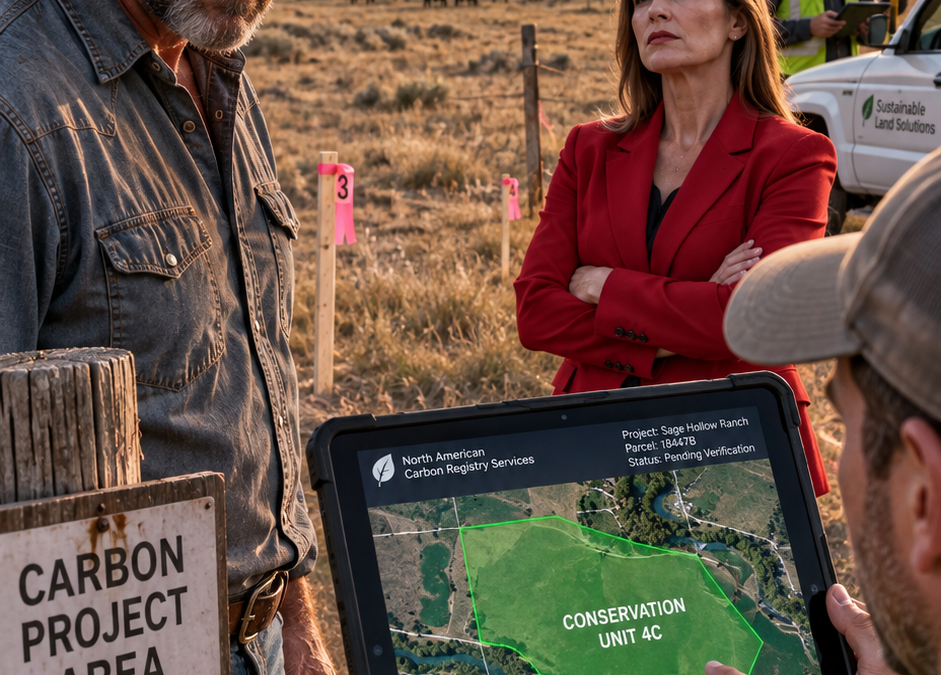
𝗣𝗔𝗥𝗧 𝟮
By 1:30 that afternoon, the contractors were gone.
Vanessa left last.
She stood beside her SUV, one hand on the door.
“Do not remove those stakes.”
I leaned against the gate.
“Tell your contractors not to come back without permission.”
“You’re making this unnecessarily expensive.”
“Funny. I was about to say the same thing.”
Her eyes narrowed.
Then she drove away.
The ranch went quiet.
But the silence felt different now.
Sage Hollow had been in my family’s operation for twenty-seven years.
My father and I bought the original acreage together when I was still in my twenties.
Over time, we expanded.
Bought adjacent pasture.
Repaired irrigation.
Rebuilt fences.
Moved cattle.
Planted windbreaks.
Then twelve years earlier, I bought out Dad’s remaining interest and transferred the ranch into Mercer Land and Cattle LLC.
The paperwork was clean.
Deed.
Tax records.
Title policy.
Recorded survey.
No ambiguity.
High Plains Community Association sat east of us across County Road 6.
It had started as a modest reservoir subdivision.
Then more houses appeared along the ridge.
Then decorative stone gates.
Then landscaped medians.
Then homeowners who moved from cities and discovered that owning three acres made them experts on agriculture.
The HOA boundary stopped at the county road.
My ranch began beyond it.
I knew that.
Still, I didn’t trust memory when recorded documents existed.
So I walked into the small office beside the machine shed and opened my land file.
First document:
Current deed.
Owner: Mercer Land and Cattle LLC.
Second:
County tax record.
Same parcel.
Same owner.
Third:
Recorded subdivision plat for High Plains.
I traced its western boundary.
The line stopped east of County Road 6.
Sage Hollow sat outside it.
No shared tract.
No common-area designation.
No HOA ownership interest.
No notation placing my acreage under association control.
I called the county assessor.
Asked for the current parcel ownership record.
Then the parcel map.
Ten minutes later, both arrived by email.
I printed them.
Identical to what I already had.
That answered the first question.
Vanessa had not been standing on HOA property.
She had been standing on mine.
The second question was harder.
How had my land become part of a commercial carbon project?
I opened the High Plains HOA website.
Across the homepage was a banner:
HIGH PLAINS COMMUNITY CONSERVATION INITIATIVE
Below it sat a photograph of native grasslands and copy about habitat protection, stewardship, climate responsibility, and conservation revenue supporting neighborhood improvements.
No mention of Sage Hollow.
I searched board minutes.
One spring meeting included a single line:
Board authorizes expansion of conservation acreage adjacent to the western boundary for inclusion in regional carbon program.
Adjacent to the western boundary.
That could mean my ranch.
It could also mean county drainage land.
State land.
Another private parcel.
Anything.
No parcel numbers.
No legal descriptions.
Nothing identifying Sage Hollow.
Another meeting referenced “eligible conservation lands.”
Again, vague.
I saved both pages.
Then pulled my title file.
No HOA covenant.
No conservation easement.
No management agreement.
No recorded declaration binding my ranch to High Plains.
By late afternoon, my desk looked like a surveyor had been murdered on it.
Maps.
Deeds.
Minutes.
Tax records.
Printed screenshots.
But the problem was becoming simpler.
The HOA had a boundary.
I had a boundary.
They were not the same.
Maybe Greenline had made a mapping mistake.
Maybe a contractor used the wrong GIS layer.
Maybe the registry matched the wrong parcel.
I wasn’t ready to accuse anybody of fraud.
That word gets thrown around far too easily.
But the registry had my parcel number.
The contractors had monitoring instructions.
Vanessa had been standing beside them like she owned the grass beneath their boots.
So I wrote one question across the top of a legal pad:
WHAT DOCUMENT GIVES HIGH PLAINS AUTHORITY OVER PARCEL 18447B?
Then I underlined it twice.
The next morning, the project developer called before I finished feeding yearlings.
“Mr. Mercer, this is Laura Bennett with Greenline Carbon Partners.”
“Morning.”
“I understand there was an access issue yesterday.”
“Ownership issue.”
A small pause.
“We want to avoid disruption to the verification schedule.”
“Then tell me why your people were on my ranch.”
“I’m looking at the participation schedule.”
I leaned against the feed room wall.
“Sage Hollow is included in Conservation Unit 4C.”
“Included by who?”
“The project sponsor.”
“Which is?”
“High Plains Community Association.”
There it was.
Not a contractor error.
Not random GIS drift.
The HOA had sponsored my acreage.
“High Plains doesn’t own Sage Hollow.”
Laura’s tone became more careful.
“I understand your concern.”
“It’s not a concern.”
I watched dust drift through sunlight coming beneath the barn door.
“It’s ownership.”
She didn’t argue.
Good sign.
“I can place a temporary note on the field file and send you the project materials we’re currently authorized to release.”
“Send everything connected to my parcel.”
“I may not be able to release third-party information.”
“Then redact whatever you need to redact.”
Twenty minutes later, the email arrived.
Three attachments.
Project verification notice.
Participation schedule.
Map.
I opened the schedule first.
Several conservation units appeared.
Each had acreage.
Habitat type.
Sponsor.
Management contact.
Unit 4C was identified as mixed grassland and riparian habitat.
The acreage was large enough to include a significant part of Sage Hollow.
Sponsor: High Plains Community Association.
Land Management Contact: Vanessa Cole.
I read that line twice.
Not landowner.
Not owner representative.
Management contact.
Interesting.
I opened the monitoring notice.
It described upcoming documentation requirements.
Tree cover.
Vegetation condition.
Grazing intensity.
Soil disturbance.
Land-use changes.
Then one section made me sit down.
Participating acreage was expected to maintain management consistency.
Significant grazing changes, grading, clearing, timber removal, or development were supposed to be coordinated with the sponsor before work occurred.
I owned a cattle ranch.
Grazing wasn’t an unusual event.
It was Wednesday.
I called Laura.
“Are you telling me I need Vanessa Cole’s permission to move cows?”
“No.”
“That document says management changes have to be coordinated with the sponsor.”
“Yes, but—”
“She’s the sponsor.”
“Greenline doesn’t determine your underlying property rights.”
“Then what exactly does your project think it controls?”
She hesitated.
“We were provided documentation indicating the acreage was eligible for participation under the sponsor’s program.”
“Eligibility isn’t authority.”
“I understand.”
“What documentation?”
“I’ll have to ask our enrollment and legal teams what can be released.”
That answer told me something.
Greenline had a process.
But the woman responsible for compliance couldn’t immediately point to the document connecting the HOA to my ownership.
By nine that morning, I had two problems.
First, somebody had enrolled my ranch in a carbon program.
Second, a private company now believed ordinary ranch activity could affect contractual commitments connected to my land.
That bothered me more than the stakes.
Stakes can be pulled.
Paper can follow you for years.
I had planned to move thirty-seven cow-calf pairs into the west pasture.
The grass was ready.
It was part of my normal rotation.
The pasture also sat directly inside Conservation Unit 4C.
For ten minutes, I stood beside the gate.
The cattle didn’t know they were climate assets.
The cottonwoods didn’t know.
The grass didn’t know.
Only humans can look at a pasture that has been grazed for generations and suddenly decide it belongs inside a spreadsheet.
I opened the gate.
Moved the cattle.
Then wrote the time in my ranch log.
Routine rotational grazing. No project authorization acknowledged.
At 11:07, Vanessa called.
No greeting.
“I understand you moved cattle into the conservation area.”
I looked toward the herd.
“How do you know?”
“The project has monitoring responsibilities.”
“Are you monitoring my ranch?”
“You were told not to interfere.”
“I was told not to remove stakes.”
“You’re deliberately creating a compliance issue.”
“I’m feeding cattle.”
“That acreage is subject to management standards.”
I paused.
“Whose?”
“The conservation program.”
“Approved by?”
“The board.”
“Your board approved management standards for my ranch?”
“The project includes adjacent lands that provide ecological benefits to the whole community.”
“That wasn’t my question.”
She exhaled sharply.
“You’re turning a conservation initiative into a property dispute because you oppose the program.”
“It became a property dispute when people entered my gate.”
“They were authorized.”
“By me?”
“By the sponsor.”
“You.”
“Yes.”
“Who authorized you?”
Silence.
Then she changed direction.
“If you cause the project to lose verified acreage, you could expose the association to substantial financial harm.”
That was new.
Money.
Up until then, Vanessa had hidden behind words like conservation.
Habitat.
Regional stewardship.
Now we had reached the reason people become honest.
“How much?”
“That’s association business.”
“Apparently part of that business depends on my grass.”
She didn’t answer.
“Do not make any changes to Unit 4C until this is resolved.”
“I’ll manage my ranch exactly as I managed it before you drew a green shape on a map.”
I ended the call.
An automated Greenline email arrived an hour later.
UPCOMING MONITORING WINDOW—UNIT 4C
Seven-day field period.
Fixed-point photography.
Ground-cover sampling.
Tree measurement.
Management consistency review.
Site questions directed to:
Vanessa Cole, Project Sponsor Contact.
I followed the portal link.
Most sections required sponsor credentials.
But the public summary showed Unit 4C as active.
Monitoring underway.
Estimated climate benefit listed.
Verification status pending.
This wasn’t a sketch.
This wasn’t a board proposal.
People had built operations around it.
Field crews.
Schedules.
Data collection.
Contracts.
And my land sat in the middle.
I took screenshots.
Then added another entry to my ranch file:
No access permission granted. No management agreement signed. No landowner participation agreement executed by Mercer Land and Cattle LLC.
I chose every word carefully.
I did not write:
Fraud.
Theft.
Forgery.
Illegal.
Not yet.
Those are conclusions.
I had facts.
Facts were stronger.
That afternoon, I drove the entire marked area.
Fourteen stakes.
Three near the creek cottonwoods.
Four in open grassland.
Two near the stock waterline.
Several along an interior fence.
Then, at the southwest corner, I found something worse.
A small metal tag had been wired to one of my fence posts.
Project code.
Site number.
Permanent Monitoring Point.
Permanent.
I stood looking at it.
Nobody had asked permission to install a permanent anything on my fence.
I called the field contractor.
“Did your company put a tag on my southwest fence?”
“Yes, sir. Baseline monitoring marker.”
“Who authorized attachment to the fence?”
“We’re operating under sponsor access approval.”
“Does that approval contain my name?”
Pause.
“I don’t handle land files.”
“Then who does?”
He gave me Greenline’s field manager.
Before hanging up, I asked one more question.
“Were you told High Plains owned my land?”
“No, sir.”
That surprised me.
“What were you told?”
“That the sponsor controlled access and management coordination for Unit 4C.”
Control.
That word stayed with me.
The HOA didn’t need to tell contractors it owned Sage Hollow.
It only needed everyone to believe it controlled the parts that mattered.
By evening, I stopped trying to understand the project from the outside.
I needed the enrollment file.
The next morning, I emailed Laura.
I asked for five things.
Project boundary map.
Acreage schedule.
Sponsor certification.
Title support.
And every landowner participation document tied to parcel 18447B.
No accusation.
No threats.
Just documents.
At 10:34, Laura called.
“I can provide the sponsor package and project map.”
“What about landowner authorization?”
“Some records require compliance review before release.”
“Fine.”
“There’s also a title support file.”
“What does that show?”
“It references county records.”
“Does it match them?”
Silence.
That answer told me more than a speech would have.
“I’d prefer you review the file directly,” she said.
Forty minutes later, nine attachments landed in my inbox.
I printed all nine.
The project map contained more detail than the field version.
The HOA subdivision appeared in gray.
Open-space parcels appeared in blue.
A broad conservation zone stretched west in pale green.
Unit 4C sat inside that zone.
So did Sage Hollow.
At the bottom:
Boundary adapted from High Plains Area Conservation Plan, Revision 3.
I searched for the source.
Not on the HOA website.
Not in recent county planning files.
Eventually I found it in a regional archive.
Eight years old.
High Plains Area Conservation Plan.
Wildlife movement.
Grassland priority zones.
Water quality.
Riparian corridors.
Long-term land stewardship goals.
The map used broad landscape polygons.
One crossed my ranch.
But the legend did not say:
HOA-owned land.
It said:
Priority Conservation Landscape.
That was a major distinction.
A planning map identifies places.
It doesn’t transfer ownership.
I put the old map beside the carbon map.
Shapes almost identical.
There was the origin.
Someone had taken a conservation planning layer and turned it into project geometry.
That still didn’t explain how the geometry became enrolled acreage.
The next document did.
SPONSOR CERTIFICATION OF CONSERVATION CONTROL
Sponsor:
High Plains Community Association.
Signed:
Vanessa Cole, President.
The certification stated that the sponsor had authority to coordinate access, implement conservation measures, and maintain management consistency across participating lands.
Broad language.
Very broad.
The form didn’t list individual parcels.
Instead, it incorporated an attached schedule.
I flipped the page.
Unit 4C.
Parcel 18447B.
My ranch.
In the ownership field, someone had written:
Private conservation acreage—sponsor coordinated.
I read it three times.
Sponsor coordinated.
Not HOA owned.
Not deeded conservation land.
Private.
That meant somebody knew it wasn’t theirs.
I called Daniel Cho.
Daniel was a property records consultant I’d used during an old boundary cleanup.
He wasn’t an attorney.
That was why I wanted him first.
I didn’t need somebody telling me what the law meant.
I needed somebody telling me what the documents actually said.
He arrived after lunch.
We covered the desk.
Current deed.
County parcel map.
HOA plat.
Conservation plan.
Carbon project map.
Sponsor certification.
Daniel started with the boring questions.
“Owner?”
“Mercer Land and Cattle LLC.”
“Recorded HOA easement?”
“None.”
“Conservation easement?”
“None.”
“Declaration binding parcel to High Plains?”
“None.”
“Management agreement?”
“None.”
He studied the maps.
“These two are obviously related.”
“Planning layer?”
“Yes.”
He pointed to the old map.
“This says your land is environmentally important.”
Then the carbon map.
“This says someone included it in a project.”
Then the deed.
“This says you own it.”
I nodded.
“What’s missing?”
He took my legal pad and drew three boxes.
PLANNING AREA → PROJECT AREA → PRIVATE PROPERTY AUTHORITY
He circled the last arrow.
“This.”
“How did somebody get from ‘important landscape’ to ‘we can monitor his pasture’?”
“Exactly.”
I called Laura again.
This time, I asked for the Greenline intake checklist used when privately owned land enters a project.
She was quiet.
Then:
“I can send the standard form.”
“I want the completed one for Unit 4C.”
“We have an enrollment packet.”
“That wasn’t my question.”
Another pause.
“Yes, there’s an intake checklist.”
“Send the section tied to my parcel.”
“I need compliance approval.”
“Get it.”
Daniel smiled after I hung up.
“You’re enjoying this.”
“No.”
“You are.”
“I enjoy gaps.”
“Former auditor?”
“Rancher with hobbies.”
An hour later, three pages arrived.
The checklist had boxes.
Sponsor map.
Checked.
Acreage schedule.
Checked.
Management contact.
Checked.
Baseline condition.
Checked.
Title support.
Checked.
Then:
Landowner Participation Document.
No check.
Beside it:
See Sponsor Certification—Consolidated Enrollment.
I leaned back.
Daniel read it.
“Ask for the underlying owner document.”
I did.
Laura answered twenty-three minutes later.
We are locating underlying participation records associated with Unit 4C and will respond after compliance review.
That sentence changed the case.
Before then, every document moved confidently in one direction.
Planning map.
Project polygon.
Participation schedule.
Sponsor certification.
Monitoring.
Field access.
Everything looked official.
Until one empty checkbox asked a very simple question.
Where was the owner’s signature?
Daniel cautioned me.
“Not being in this packet doesn’t prove it doesn’t exist.”
“I know.”
“Could be separate.”
“I know.”
“Could be a representative agreement.”
“I know.”
He pointed at the checklist.
“But now you know exactly what matters.”
So I built a timeline.
Eight years earlier:
Regional conservation plan created.
Last spring:
HOA approves expansion of conservation acreage.
Five months later:
Vanessa signs sponsor certification.
Two weeks after that:
Unit 4C added to project schedule.
Then baseline work.
Then monitoring points.
Then contractors at Sage Hollow.
Every step had a date.
But the one step that should have connected Mercer Land and Cattle LLC to the project was blank.
Late that afternoon, Laura called.
“We located a consolidated enrollment reference tied to Unit 4C.”
“Does it contain my signature?”
“I can’t answer yet.”
“Does it contain a signature from Mercer Land and Cattle LLC?”
“The file is under review.”
“That’s not complicated.”
“I understand.”
“Is there a landowner authorization?”
“Our compliance manager will contact you tomorrow.”
After hanging up, I looked again at Vanessa’s certification.
Blue ink.
Confident signature.
Above it, language about participating acreage.
Behind it, my parcel.
The project had apparently treated those things as enough.
Maybe they were.
Maybe they weren’t.
But finally I knew the question that would decide everything.
Could an HOA sponsor certification substitute for authorization from a private landowner who never signed anything?
The answer arrived at 8:17 the next morning.
Laura was on the line.
So was a man named Andrew Mills.
“Mr. Mercer, I’m Greenline’s compliance manager.”
“Morning.”
“We completed our preliminary review of Unit 4C.”
I sat at the kitchen table.
My deed lay open beside the checklist.
“We need to clarify the enrollment basis for your parcel.”
I looked at the empty checkbox.
“Because you don’t have my participation agreement.”
“We located the consolidated sponsor package.”
“That wasn’t what I said.”
“No.”
Andrew paused.
Then, to his credit, he answered directly.
“We have not located a separate landowner participation agreement executed by Mercer Land and Cattle LLC.”
I didn’t say anything.
There it was.
Not forgery.
Not theft.
Not proof of criminal conduct.
A missing authorization.
And that was enough to change everything.
Andrew continued.
“Our standard procedure requires privately owned acreage to have documented participation authority. That can be a direct landowner agreement, valid representative authority, or another legal basis accepted during enrollment.”
“Did Vanessa have authority to sign for my company?”
“We have not located evidence of that.”
“What does her sponsor certification do?”
“It establishes sponsor coordination responsibilities.”
“Does sponsor coordination equal landowner authority?”
“No.”
The answer came immediately.
I wrote it down.
“No?”
“No. They are separate concepts.”
That sentence was the whole dispute.
The old regional plan could say my land mattered environmentally.
Fine.
The HOA could approve a conservation project.
Fine.
Vanessa could sign documents for the HOA.
Fine.
Greenline could create Unit 4C.
Fine.
None of those things automatically allowed Vanessa to commit land owned by Mercer Land and Cattle LLC.
I called Daniel.
He arrived before noon.
I repeated Andrew’s explanation.
Daniel put three documents side by side.
Conservation plan.
Sponsor certification.
Deed.
“This identifies an area.”
He tapped the first.
“This documents what the HOA claims it can coordinate.”
Second.
“This identifies the owner.”
Third.
Then he pointed toward the missing participation form.
“And this is the bridge.”
There was no bridge.
Greenline later emailed me a blank copy of its standard landowner participation and project authorization agreement.
Seven pages.
Legal owner.
Parcel number.
Project term.
Monitoring rights.
Management obligations.
Reporting obligations.
Access provisions.
Signature.
Landowner or authorized representative.
I searched the blank template anyway.
My name?
No.
My company?
No.
Vanessa?
No.
It was simply the form Greenline normally expected.
I printed it.
Then placed it beside Vanessa’s sponsor certification.
Two stacks.
Left stack:
Everything the HOA had signed.
Right stack:
Everything the landowner had signed.
The left stack was thick.
The right stack was empty.
Vanessa called that afternoon.
Her tone was different.
Controlled.
Measured.
“I understand Greenline is asking questions.”
“They’re answering mine.”
“You’re creating unnecessary risk for the association.”
“I asked for the document that lets you commit my ranch.”
“The board approved the conservation program.”
“I know.”
“The regional plan includes your acreage.”
“I know.”
“You’ve benefited from preserved open space around this community for years.”
I almost laughed.
“That doesn’t give you my signature.”
She went quiet.
“You’re oversimplifying a sophisticated regional program.”
“Then simplify it for me.”
“What?”
“Send me the document where Mercer Land and Cattle LLC authorized High Plains to act for us.”
“These projects use consolidated enrollment.”
“Greenline says private acreage still requires participation authority.”
Her voice hardened.
“You are jeopardizing contracted carbon credits.”
There it was.
Not future credits.
Contracted credits.
“How many?”
“I’m not discussing commercial terms with you.”
“Then don’t.”
I leaned back.
“Just show me the authority.”
She hung up.
I wrote down the time.
Then emailed Laura and Andrew:
If no landowner agreement or representative authority exists for parcel 18447B, what is the status of carbon credits relying on that acreage?
Andrew responded twenty minutes later.
We are evaluating that issue now.
That was when the power shifted.
Until then, I had been proving my land belonged to me.
Now Greenline had to prove whether its credits could legally and procedurally rely on land whose owner had never joined.
Andrew called before lunch the next day.
“We’ve placed Unit 4C under administrative hold.”
I stepped away from the hydraulic chute.
“Plain English.”
“No additional verification activity will occur on the disputed acreage while we review ownership and participation records.”
“Field crew?”
“Suspended.”
“Monitoring?”
“Suspended.”
“Credits?”
“We’re reviewing any issuance or delivery batches that relied on Unit 4C.”
“Send that in writing.”
Twelve minutes later, I had it.
I printed the notice.
Pinned it above the office desk.
Not as decoration.
As evidence.
Vanessa called twice that afternoon.
I ignored the first call.
Answered the second.
“You contacted Greenline again.”
“They contacted me.”
“You caused a compliance freeze.”
“No. I asked who authorized the use of my land.”
“You understand this affects every homeowner.”
“I understand your project apparently depends on acreage nobody asked me about.”
“The conservation program funds reserve improvements.”
“Then the board should have excellent records.”
“You could cost this community a substantial amount of money.”
I looked at the hold notice.
“Greenline made the decision.”
“You triggered it.”
“By answering a question about whether I signed?”
Silence.
“If the project suffers damages because of your interference—”
“Stop.”
My voice stayed calm.
“I haven’t removed a stake.”
Pause.
“I haven’t damaged equipment.”
Pause.
“I haven’t entered HOA property.”
Pause.
“I haven’t contacted a buyer.”
Pause.
“I told the registry the truth when they asked whether I signed.”
She said nothing.
“If telling the truth breaks your project, that’s not my engineering problem.”
She hung up.
Two days later, Greenline sent a revised map.
Sage Hollow was outlined in yellow.
OWNERSHIP REVIEW.
Monitoring points inactive.
The rest of the project remained green.
Good.
I didn’t want to destroy a legitimate conservation program.
I wanted my ranch removed from any part that lacked my authorization.
Greenline sent a formal request to High Plains:
Provide landowner participation agreement.
Representative authorization.
Conservation easement.
Management agreement.
Or other documentation supporting inclusion of parcel 18447B.
I was copied.
Vanessa responded forty-three minutes later.
Sponsor certification.
Old conservation plan.
Board resolution.
Nothing from me.
Andrew replied:
Please provide underlying landowner authorization or representative authority specific to parcel 18447B.
No answer that day.
The next morning, Vanessa sent four paragraphs.
She argued that High Plains had historically coordinated conservation around the reservoir.
That regional planning encouraged cross-boundary management.
That Greenline had accepted consolidated enrollment.
That adjacent landowners benefited from the program.
Still no signature.
By Friday, pressure had moved beyond Greenline.
The carbon credit buyer was notified that part of the project was under review.
Nobody canceled the contract.
Nobody declared disaster.
They simply paused acceptance of additional volume tied to Unit 4C pending clarification.
That was enough.
Buyer pressure went to developer.
Developer pressure went to sponsor.
Sponsor pressure went straight to Vanessa.
At the next HOA meeting, three directors asked why privately owned ranch acreage had been enrolled without a parcel-specific authorization.
I wasn’t there.
One director called me afterward.
“Mr. Mercer, could you send me your deed?”
“Absolutely.”
“And Greenline’s hold notice?”
“Yes.”
He sounded uncomfortable.
“We were told all participating land had been cleared.”
“By who?”
Pause.
“Vanessa.”
I wrote that down.
I did not gloat.
A board can be negligent without every member being dishonest.
I wanted the record clean.
The following Monday, Greenline issued an interim boundary revision.
Parcel 18447B was excluded from Unit 4C unless valid landowner authorization could be demonstrated.
No field access.
No monitoring.
No land-management reporting.
No project obligations imposed on Sage Hollow.
The metal monitoring tag remained on my fence.
I called Laura.
“When does that come off?”
“Contractor will schedule removal.”
“Good.”
“What about the stakes?”
“Those can be removed once the field closure is documented.”
I smiled.
“I’ve been waiting.”
But one question still bothered me.
If credits had already been issued or sold based partly on my acreage, who was paying to correct that?
I wasn’t asking because I wanted money.
I wanted to know whether Vanessa had transformed an unauthorized assumption into an actual financial liability.
Three weeks later, Greenline sent the final correction notice.
Parcel 18447B removed from Unit 4C.
Reason:
Landowner authorization not established.
Simple.
Clinical.
Beautiful.
No dramatic accusation.
No moral lecture.
Just a record corrected.
Two days later, the contractor returned.
This time he called before entering.
That’s how civilization works.
“Mr. Mercer, we’re scheduled to remove the permanent monitoring tag.”
“Come to the main gate.”
He did.
I met him.
Walked with him.
He removed the tag from my fence.
Photographed the post.
Then pulled the remaining baseline markers.
No Vanessa.
No argument.
No red blazer.
Before leaving, he held up the metal tag.
“Want it?”
I considered it.
“No.”
“You sure?”
“I have enough paperwork.”
He laughed.
The credit side was more complicated.
Greenline recalculated the next delivery.
Credits associated with the disputed acreage were removed or replaced according to the project’s internal accounting and contracts.
The sponsor was required to cover project correction costs assigned to its enrollment error.
Any replacement obligations were handled between High Plains, Greenline, and the buyer.
Nobody sent me a check.
I didn’t ask for one.
My objective had never been to monetize the mistake.
I already had a business.
Cattle.
Land.
Hay.
The occasional year where fertilizer prices made me question all my life decisions.
What I wanted was simple.
My acreage out of their system.
The HOA board held a special meeting the following week.
This one I attended.
I sat in the back.
Vanessa sat at the front beside six board members.
No red blazer this time.
Gray.
Appropriate.
The treasurer opened with a summary of the carbon correction.
He did not use the word disaster.
He used phrases accountants prefer.
“Enrollment discrepancy.”
“Boundary revision.”
“Replacement obligation.”
“Unbudgeted administrative cost.”
Different words.
Same pain.
Then a director named Samuel Price spoke.
“Before we discuss future participation, I want one thing clarified.”
Vanessa looked at him.
He held up the Greenline correction notice.
“How did parcel 18447B get included without owner authorization?”
Vanessa adjusted her microphone.
“The parcel was part of the approved conservation landscape.”
“That wasn’t my question.”
I almost smiled.
Apparently my phrasing had spread.
Samuel continued.
“Who determined the HOA had authority to enroll Mercer Land and Cattle LLC property?”
“The project used consolidated enrollment.”
“Who made that decision?”
“Greenline accepted the sponsor package.”
The treasurer leaned forward.
“Greenline says the sponsor package did not establish landowner authority.”
Vanessa’s jaw tightened.
“The process at the time was evolving.”
Samuel held up the county record.
“The owner didn’t evolve.”
A few people laughed.
Vanessa didn’t.
Another director spoke.
“Did you ever speak to Mr. Mercer before adding his parcel?”
“I had discussions with regional stakeholders.”
“That means no?”
“The board authorized expansion.”
“Did the board know parcel 18447B was privately owned by Mercer Land and Cattle LLC?”
Silence.
I watched faces around the table change.
There it was.
The same thing the registry had discovered.
The board had approved vague conservation acreage.
Vanessa had treated vague authority like specific permission.
One director opened an old project map.
“This planning document doesn’t show ownership.”
“It identifies conservation priority.”
“That’s not ownership.”
“The program was designed to function regionally.”
“That’s not ownership either.”
The treasurer finally asked the simplest question.
“Where is Mr. Mercer’s signature?”
Vanessa stared at him.
Nobody spoke.
The question hung in the room.
It was almost unfair how powerful an empty signature line could become.
Vanessa turned toward me.
“You understand, Mr. Mercer, that this project provided benefits to the entire region, including your property.”
I stayed seated.
“I understand you never asked me.”
“We weren’t trying to take your land.”
“I didn’t say you were.”
“You have repeatedly characterized the project as unauthorized.”
“Greenline characterized my parcel as landowner authorization not established.”
I held up their notice.
“Their words.”
She looked away.
Samuel proposed a resolution.
Any future conservation, environmental, carbon, mitigation, habitat, or revenue project involving land outside recorded HOA ownership would require parcel-specific documentation.
Proof of ownership.
Proof of authority.
Executed participation agreement.
Written access permission.
No planning map could substitute.
No board resolution could substitute.
No sponsor certification could substitute.
The resolution passed unanimously.
Including Vanessa.
That was satisfying.
Then came the second motion.
Oversight of the carbon project would be transferred from the HOA president to a three-member conservation committee.
One board member asked whether that was necessary.
Samuel answered:
“Yes.”
No speech.
No accusation.
Just yes.
Motion passed.
Vanessa voted against that one.
Didn’t matter.
Afterward, she approached me near the door.
For a few seconds, neither of us spoke.
Finally:
“You’ve made this much harder than it needed to be.”
I looked at her.
“I answered the registry’s question.”
“You know what I mean.”
“I do.”
“High Plains was trying to protect land that benefits everybody.”
“You can protect your land.”
“Environmental systems don’t stop at property lines.”
“Neither do cattle.”
Her expression hardened.
“That’s exactly the attitude these programs are designed to overcome.”
I smiled.
“No. These programs are designed to operate through agreements.”
She said nothing.
“If you wanted my ranch involved, Vanessa, you could’ve called me.”
“You would have said no.”
“Maybe.”
“There.”
She almost smiled.
“You admit it.”
“That doesn’t help you.”
Her smile disappeared.
“Why?”
“Because having a good reason to avoid asking doesn’t create permission.”
She stared at me for a second.
Then walked away.
That was our last real conversation.
She remained HOA president until the end of the quarter.
Technically.
But the carbon project no longer reported directly through her.
Board members started asking for underlying records instead of summaries.
The treasurer demanded project accounting.
Meeting minutes became more detailed.
The phrase “parcel-specific authorization” appeared so often that somebody joked it should go on the community Christmas cards.
Vanessa stopped calling.
Her final email to me was four sentences.
High Plains disagreed with certain interpretations of the original enrollment process.
The association accepted Greenline’s revised boundary.
No future project access to Sage Hollow would occur without authorization from Mercer Land and Cattle LLC.
I printed it.
Filed it.
Closed the folder.
For about twelve minutes.
Then the auditor in me decided the folder needed an index.
Some conditions cannot be cured.
By October, life at Sage Hollow looked exactly as it had before Conservation Unit 4C appeared.
The cows grazed.
The creek ran low.
Cottonwoods turned gold.
Coyotes complained from the western hills after dark.
I fixed the leaking stock valve that had been waiting through the entire carbon fight.
It took forty minutes.
Cost seventy-three dollars.
No board approval required.
One cold morning, I rode out to the west pasture.
The places where the stakes had stood were barely visible.
Thirty-seven cow-calf pairs grazed below the ridge.
Same herd Vanessa had once claimed was creating a compliance problem.
I opened the next gate.
They drifted through.
Nobody called.
Nobody emailed.
Nobody asked for a vegetation report.
Nobody told me the grazing rotation required sponsor coordination.
Nothing happened.
That was the part people misunderstand about ownership.
Properly respected, it is boring.
Quiet.
You decide when the cattle move.
You decide whether to repair a fence.
You decide who enters the gate.
You decide what contracts to sign.
Most ownership is not a dramatic declaration.
It’s a thousand ordinary decisions nobody else has the right to make for you.
The trouble begins when somebody discovers there might be money in those decisions.
I wasn’t opposed to carbon markets.
I wasn’t opposed to conservation.
If Greenline had called me six months earlier and said:
Mr. Mercer, we’d like to discuss enrolling part of Sage Hollow.
I would have listened.
Maybe the numbers made sense.
Maybe they didn’t.
Maybe the grazing restrictions were manageable.
Maybe I would have negotiated different terms.
Maybe I would have refused.
That decision belonged to me.
That’s what Vanessa never understood.
She believed the environmental virtue of the project improved her authority.
It didn’t.
A worthy goal doesn’t eliminate consent.
The HOA could vote unanimously to save every blade of grass in Colorado.
That still wouldn’t give them my signature.
Months later, Andrew from Greenline called one final time.
Not because of a dispute.
He wanted feedback on a revised enrollment process.
“We’ve added direct ownership validation earlier in intake.”
“Good.”
“And private parcels now get a separate authorization check before sponsor enrollment is accepted.”
“Better.”
“We’ve also changed field instructions so crews receive parcel-level access notes.”
“Very good.”
He laughed.
“You know, you could sound slightly pleased.”
“I am pleased.”
“You don’t sound like it.”
“I’m a cattle rancher. Enthusiasm scares livestock.”
He laughed again.
Then became serious.
“For what it’s worth, you handled this better than most people would have.”
“I answered questions.”
“You also didn’t accuse us of stealing your ranch on social media.”
“I didn’t know what happened.”
“That doesn’t stop everyone.”
“No.”
I looked out my office window toward the west pasture.
“But if you’re wrong too early, people stop listening when you’re right later.”
That had been one of Dad’s rules.
He used to say:
Don’t outrun your proof.
I’d spent the entire dispute following that advice.
When I first saw the stakes, I didn’t know whether Vanessa had committed fraud.
So I didn’t say she had.
When I saw the carbon map, I didn’t know whether Greenline had made a mistake.
So I asked.
When the sponsor certification appeared, I didn’t know whether it legally covered private acreage.
So I kept looking.
Every question narrowed the problem.
Until the registry asked the one question nobody in the project had apparently asked early enough:
Where is the landowner’s signature?
There wasn’t one.
That was enough.
No shouting required.
No courtroom.
No sheriff.
No dramatic arrest.
Just a missing signature.
Sometimes people expect satisfying endings to involve sirens.
Mine involved a corrected spreadsheet.
I found that much more appropriate.
The financial consequences for High Plains became clearer during the annual meeting.
The treasurer presented a conservation account report.
Correction costs.
Consulting expenses.
Mapping revisions.
Credit replacement adjustments.
Additional compliance work.
Not catastrophic.
But substantial enough to be embarrassing.
One homeowner asked whether residents would receive a special assessment.
“No,” the treasurer said. “The costs will be absorbed from the conservation program account and future project revenue.”
Then somebody asked whether any money from the disputed acreage had gone into the general HOA budget.
The treasurer answered carefully.
“Some prior project revenue was calculated using unit-level performance that included acreage later removed during verification.”
Another homeowner raised his hand.
“So we were making money off Mr. Mercer’s ranch?”
The room shifted.
The treasurer didn’t like the wording.
“Revenue wasn’t allocated parcel by parcel in that way.”
The homeowner persisted.
“Was his land part of the project when money came in?”
“Yes.”
“Did he sign?”
“No.”
There it was again.
That brutal little question.
Vanessa sat two seats away.
She stared down at the table.
The homeowner looked at her.
“So why didn’t we ask him?”
Vanessa reached for the microphone.
“The original process relied on regional sponsor authority and—”
A woman near the aisle interrupted.
“That’s not an answer.”
Normally, Vanessa would have shut that down immediately.
This time the board chair said:
“Let her finish.”
The woman shook her head.
“We’ve heard the regional explanation for six months. I’m asking why nobody knocked on his door.”
Vanessa took a breath.
“The process was administered through consolidated sponsorship.”
The woman looked toward me.
“Mr. Mercer, did anybody ask you?”
“No.”
“Did anybody pay you?”
“No.”
“Did anybody give you a copy of the management conditions before those contractors arrived?”
“No.”
The woman looked back at Vanessa.
“Then we should probably stop pretending this was complicated.”
That hurt her more than anger would have.
Complexity had been Vanessa’s shield.
She used long phrases.
Regional coordination.
Conservation stewardship.
Sponsor authority.
Aggregated enrollment.
Project integrity.
All of it sounded impressive.
Then somebody reduced the issue to:
Did you ask the owner?
No.
Vanessa did not run for president again.
She didn’t dramatically resign.
She simply announced that after “several demanding years of service,” she wanted to devote more time to family and professional commitments.
Nobody booed.
Nobody applauded.
The board elected Samuel Price.
His first meeting lasted fifty-two minutes.
He opened by saying:
“If your proposal involves property we don’t own, step one is asking the person who does.”
That became the unofficial High Plains doctrine.
Samuel called me afterward.
“Would you consider joining the conservation committee?”
“No.”
“I expected that.”
“Then why ask?”
“Because Vanessa never did.”
I laughed.
“Fair.”
I agreed to attend one meeting as a guest.
That meeting was different from anything under Vanessa.
Maps had property lines.
Ownership status was listed separately.
Private land was marked:
NOT INCLUDED WITHOUT EXECUTED AGREEMENT.
Imagine that.
People had invented consent.
Civilization advanced.
A consultant presented options for habitat work on actual HOA-owned open space.
Native grasses.
Creek stabilization.
Reduced mowing.
Wildlife corridors.
No need to trespass onto Sage Hollow.
No need to pretend my cows were corporate conservation assets.
The HOA still earned some carbon revenue from land it legitimately controlled.
The sky didn’t fall.
The environmental program survived.
It simply became smaller.
More accurate.
Less profitable.
And legal authority stopped exactly where ownership stopped.
Vanessa had insisted for months that removing Sage Hollow would threaten the entire initiative.
It didn’t.
Turns out the project was capable of surviving without several hundred acres that never belonged there.
Another miracle.
The following spring, Laura visited the ranch.
This time she called first.
I met her at the main gate.
She had never been to Sage Hollow in person.
She looked across the grass.
“It’s bigger than the satellite map makes it look.”
“Most land is.”
We walked toward the creek.
She pointed to the cottonwoods.
“That was one of the higher-value riparian areas.”
“I know.”
“You ever consider enrolling voluntarily?”
I looked at her.
She smiled.
“I’m asking.”
That made me laugh.
“Already an improvement.”
She handed me a packet.
Completely voluntary.
Parcel-specific.
Owner signature line.
Clear grazing provisions.
Actual compensation structure.
Monitoring access.
Termination language.
Everything Vanessa should have brought me at the beginning.
“Do I have to answer today?”
“No.”
“Tomorrow?”
“No.”
“Next month?”
“No.”
“Then I’ll read it.”
I did.
Every page.
Twice.
Old habits.
In the end, I enrolled eighty-six acres near the creek.
Not the whole ranch.
Not Unit 4C.
My own agreement.
My own boundaries.
My own grazing terms.
My own signature.
The irony wasn’t lost on anybody.
Samuel called after the agreement became public.
“So after all that, you joined a carbon project?”
“Part of one.”
“Vanessa is going to explode.”
“That sounds like a Vanessa management issue.”
He laughed.
“Why’d you do it?”
“Because this one asked.”
That was the difference.
People sometimes confuse resistance with opposition.
I hadn’t spent months fighting carbon conservation.
I fought the assumption that somebody else could volunteer my property.
The voluntary agreement preserved cottonwood habitat I already intended to protect.
It paid enough to cover fencing improvements.
It allowed seasonal grazing.
It did not give the HOA any role.
Greenline dealt directly with Mercer Land and Cattle LLC.
Every monitoring visit required notice.
Every access gate was identified.
Every obligation was written.
And at the bottom of page seven sat my name.
Ethan Mercer.
I signed it myself.
When the registry later called to verify participation, I almost laughed.
“Mr. Mercer, did you execute the authorization for parcel 18447B conservation subunit R-2?”
“Yes.”
“Are you authorized to sign for Mercer Land and Cattle LLC?”
“Yes.”
“Did you review the participation terms?”
“Yes.”
“Did anyone pressure or compel you to enroll?”
“No.”
“Thank you.”
The whole verification took ninety seconds.
Ninety seconds.
That was all it would have taken the first time.
One call.
One question.
One signature.
Instead, Vanessa had spent months constructing an elaborate tower of authority around an empty space.
That empty space was me.
Years later, people in High Plains still referred to the incident as “the carbon ranch mess.”
I preferred “the signature problem.”
Less dramatic.
More accurate.
The ranch continued.
Calves were born.
Bulls broke fences.
Hay equipment failed exactly when the weather forecast said rain.
Cottonwoods aged.
Sage Creek rose in spring and fell again by late summer.
The carbon agreement on eighty-six acres became just another file in my office.
Legitimate.
Signed.
Boring.
The way contracts should be.
Sometimes I still find one of the old numbered stake holes in the pasture.
Most are gone.
Grass filled them.
Cattle walked over them.
Weather erased them.
The permanent monitoring tag Vanessa’s project had once wired to my fence sits somewhere in a contractor’s warehouse.
I don’t miss it.
I kept only one artifact from that entire mess.
The first participation schedule Greenline sent me.
Unit 4C.
Parcel 18447B.
Sponsor:
High Plains Community Association.
Land Management Contact:
Vanessa Cole.
I framed one page.
Not because I was angry.
Because directly beneath that schedule in my office cabinet sits the document that defeated it.
My deed.
People like Vanessa love complicated systems because complicated systems create opportunities to sound authoritative.
They rely on everyone else feeling too intimidated to ask the simplest questions.
Who owns this?
Who signed?
Who authorized access?
Where is the agreement?
What document gives you that power?
The more expensive the project, the more people assume somebody else already checked.
The registry assumed the developer had reviewed the sponsor package.
The developer assumed the sponsor had participation authority.
The field crew assumed access had been cleared.
The board assumed Vanessa had handled enrollment.
Vanessa assumed a conservation map gave her enough leverage to keep everybody moving forward.
Every assumption passed the problem down the chain.
Until somebody called the landowner.
Me.
“Mr. Mercer, did you sign?”
“No.”
One word.
That was all it took to stop hundreds of acres of project activity.
Not because I possessed some secret legal weapon.
Because authorization either exists or it doesn’t.
Vanessa had believed legitimacy came from layers.
Planning maps.
Board resolutions.
Sponsor certifications.
Carbon schedules.
Monitoring contracts.
Professional language.
But adding more paper on top of missing permission doesn’t create permission.
It only makes the file heavier.
One autumn evening, I sat on the porch after moving cattle out of the lower pasture.
The cottonwoods had gone yellow.
The first snow was visible high on the ridge.
Samuel drove past on County Road 6 and waved.
No HOA vehicles turned into my gate.
No contractors appeared unannounced.
Nobody had marked my pasture without permission in years.
That quiet felt earned.
I thought back to the morning Vanessa stood in my field wearing that red blazer.
She had looked completely certain.
Certain the project was valid.
Certain the board had authority.
Certain the contractors belonged there.
Certain I was the inconvenience.
Then the registry called.
And asked for something she couldn’t produce.
My signature.
That’s what ultimately defeated her.
Not hostility.
Not politics.
Not some dramatic war against conservation.
A blank line.
The HOA had tried to sell carbon credits from a ranch it did not own.
In the end, the most valuable thing they didn’t have wasn’t carbon.
It wasn’t acreage.
It wasn’t a map.
It wasn’t even control.
It was permission.
And unlike carbon credits, permission cannot be generated from thin air.
Have you finished reading the story and want to read it again?
HOA Sold Carbon Credits From My Ranch—Then the Registry Asked for the One Signature They Never Had
They put my ranch into a carbon program without asking me.
Then somebody finally checked the paperwork.
That was when Vanessa stopped smiling.
The woman on the phone identified herself as a project intake specialist with North American Carbon Registry Services, a private registry administrator I had never spoken to in my life.
“Mr. Mercer, we’re reviewing landowner authorization associated with parcel 18447B,” she said. “Before we proceed, I need to confirm whether you signed the participation schedule for Sage Hollow Ranch.”
I kept my eyes on Vanessa Cole.
She stood twenty yards away near my south fence in a red blazer that looked absurd against six hundred acres of dry Colorado grass.
Two contractors were behind her driving bright survey stakes into my pasture.
One held a tablet.
The other had a GPS receiver mounted on a pole.
Vanessa’s expression was the same one she always wore when explaining something she believed had already been decided on my behalf.
I answered the woman.
“No.”
A pause.
“No, you didn’t sign it?”
“No. I didn’t authorize anybody to sign it either.”
For the first time all morning, Vanessa’s face changed.
Barely.
But enough.
One contractor stopped hammering.
The man with the tablet looked toward Vanessa.
The registry specialist continued.
“Can you confirm the legal owner of parcel 18447B?”
“Mercer Land and Cattle LLC.”
“And your relationship to that entity?”
“I’m the managing member.”
Another pause.
Keys clicked on the other end.
“Thank you. I’m flagging the parcel for ownership review. Please don’t remove project markers until our compliance team finishes its initial assessment.”
Project markers.
That phrase bothered me.
They sounded temporary.
Nothing else about what was happening felt temporary.
Six numbered stakes already crossed my lower pasture.
I knew exactly where my property boundaries were. I had personally replaced two corner monuments after a flood in 2018 and paid for a recorded boundary survey three years later.
Those stakes weren’t marking property lines.
They angled inward.
Toward the cottonwoods above Sage Creek.
I ended the call and walked toward the contractor holding the tablet.
“What exactly are you verifying?”
He hesitated.
Vanessa stepped toward us.
“Those are internal project materials.”
I ignored her.
The contractor finally turned the screen.
A satellite image covered the display.
I recognized my ranch immediately.
The north barn.
Cattle lane.
Creek bend.
West pasture.
Machine shed.
Over the image sat a translucent green polygon.
CONSERVATION UNIT 4C.
The shape covered hundreds of acres of Sage Hollow.
My land.
In the corner was the same parcel number the registry had just read to me.
18447B.
Vanessa moved between us.
“That map is part of the High Plains conservation initiative.”
I looked at her.
“I’m looking at my parcel number.”
“You’re looking at a regional conservation area.”
“No.”
I pointed toward the screen.
“I’m looking at land I own.”
Her jaw tightened.
I asked the contractor who had hired him.
“Greenline Carbon Partners out of Denver.”
“What are you collecting?”
“Baseline vegetation. Tree cover. GPS reference points. Grazing conditions. Soil disturbance. Photos before the next verification cycle.”
“Were you told the HOA owns this land?”
He glanced at Vanessa.
“We were told the project sponsor had cleared access.”
Vanessa immediately said, “Which we did.”
I turned to her.
“You cleared access to my ranch?”
“The association has conservation coordination authority in this corridor.”
“Show me.”
She crossed her arms.
“You’re interfering with a registered environmental project.”
I took out my phone.
Photographed every stake.
Photographed the contractor’s screen with his permission.
Copied the project code.
Copied the developer name.
Then I opened the interior cattle gate.
Thirty-seven cow-calf pairs were standing in the lane waiting to move into the lower pasture.
Vanessa pointed toward them.
“Do not move those cattle.”
I stared at her.
“Excuse me?”
“That acreage is under active monitoring.”
I looked toward my cows.
Then toward my pasture.
Then back at Vanessa.
“They’re going through.”
“Mr. Mercer—”
I opened the gate.
The herd moved past us.
Hooves thudded against the dirt.
Vanessa stepped aside to avoid getting covered in dust.
That was the first satisfying moment of the entire dispute.
It would not be the last.
PART2
By 1:30 that afternoon, the contractors were gone.
Vanessa left last.
She stood beside her SUV, one hand on the door.
“Do not remove those stakes.”
I leaned against the gate.
“Tell your contractors not to come back without permission.”
“You’re making this unnecessarily expensive.”
“Funny. I was about to say the same thing.”
Her eyes narrowed.
Then she drove away.
The ranch went quiet.
But the silence felt different now.
Sage Hollow had been in my family’s operation for twenty-seven years.
My father and I bought the original acreage together when I was still in my twenties.
Over time, we expanded.
Bought adjacent pasture.
Repaired irrigation.
Rebuilt fences.
Moved cattle.
Planted windbreaks.
Then twelve years earlier, I bought out Dad’s remaining interest and transferred the ranch into Mercer Land and Cattle LLC.
The paperwork was clean.
Deed.
Tax records.
Title policy.
Recorded survey.
No ambiguity.
High Plains Community Association sat east of us across County Road 6.
It had started as a modest reservoir subdivision.
Then more houses appeared along the ridge.
Then decorative stone gates.
Then landscaped medians.
Then homeowners who moved from cities and discovered that owning three acres made them experts on agriculture.
The HOA boundary stopped at the county road.
My ranch began beyond it.
I knew that.
Still, I didn’t trust memory when recorded documents existed.
So I walked into the small office beside the machine shed and opened my land file.
First document:
Current deed.
Owner: Mercer Land and Cattle LLC.
Second:
County tax record.
Same parcel.
Same owner.
Third:
Recorded subdivision plat for High Plains.
I traced its western boundary.
The line stopped east of County Road 6.
Sage Hollow sat outside it.
No shared tract.
No common-area designation.
No HOA ownership interest.
No notation placing my acreage under association control.
I called the county assessor.
Asked for the current parcel ownership record.
Then the parcel map.
Ten minutes later, both arrived by email.
I printed them.
Identical to what I already had.
That answered the first question.
Vanessa had not been standing on HOA property.
She had been standing on mine.
The second question was harder.
How had my land become part of a commercial carbon project?
I opened the High Plains HOA website.
Across the homepage was a banner:
HIGH PLAINS COMMUNITY CONSERVATION INITIATIVE
Below it sat a photograph of native grasslands and copy about habitat protection, stewardship, climate responsibility, and conservation revenue supporting neighborhood improvements.
No mention of Sage Hollow.
I searched board minutes.
One spring meeting included a single line:
Board authorizes expansion of conservation acreage adjacent to the western boundary for inclusion in regional carbon program.
Adjacent to the western boundary.
That could mean my ranch.
It could also mean county drainage land.
State land.
Another private parcel.
Anything.
No parcel numbers.
No legal descriptions.
Nothing identifying Sage Hollow.
Another meeting referenced “eligible conservation lands.”
Again, vague.
I saved both pages.
Then pulled my title file.
No HOA covenant.
No conservation easement.
No management agreement.
No recorded declaration binding my ranch to High Plains.
By late afternoon, my desk looked like a surveyor had been murdered on it.
Maps.
Deeds.
Minutes.
Tax records.
Printed screenshots.
But the problem was becoming simpler.
The HOA had a boundary.
I had a boundary.
They were not the same.
Maybe Greenline had made a mapping mistake.
Maybe a contractor used the wrong GIS layer.
Maybe the registry matched the wrong parcel.
I wasn’t ready to accuse anybody of fraud.
That word gets thrown around far too easily.
But the registry had my parcel number.
The contractors had monitoring instructions.
Vanessa had been standing beside them like she owned the grass beneath their boots.
So I wrote one question across the top of a legal pad:
WHAT DOCUMENT GIVES HIGH PLAINS AUTHORITY OVER PARCEL 18447B?
Then I underlined it twice.
The next morning, the project developer called before I finished feeding yearlings.
“Mr. Mercer, this is Laura Bennett with Greenline Carbon Partners.”
“Morning.”
“I understand there was an access issue yesterday.”
“Ownership issue.”
A small pause.
“We want to avoid disruption to the verification schedule.”
“Then tell me why your people were on my ranch.”
“I’m looking at the participation schedule.”
I leaned against the feed room wall.
“Sage Hollow is included in Conservation Unit 4C.”
“Included by who?”
“The project sponsor.”
“Which is?”
“High Plains Community Association.”
There it was.
Not a contractor error.
Not random GIS drift.
The HOA had sponsored my acreage.
“High Plains doesn’t own Sage Hollow.”
Laura’s tone became more careful.
“I understand your concern.”
“It’s not a concern.”
I watched dust drift through sunlight coming beneath the barn door.
“It’s ownership.”
She didn’t argue.
Good sign.
“I can place a temporary note on the field file and send you the project materials we’re currently authorized to release.”
“Send everything connected to my parcel.”
“I may not be able to release third-party information.”
“Then redact whatever you need to redact.”
Twenty minutes later, the email arrived.
Three attachments.
Project verification notice.
Participation schedule.
Map.
I opened the schedule first.
Several conservation units appeared.
Each had acreage.
Habitat type.
Sponsor.
Management contact.
Unit 4C was identified as mixed grassland and riparian habitat.
The acreage was large enough to include a significant part of Sage Hollow.
Sponsor: High Plains Community Association.
Land Management Contact: Vanessa Cole.
I read that line twice.
Not landowner.
Not owner representative.
Management contact.
Interesting.
I opened the monitoring notice.
It described upcoming documentation requirements.
Tree cover.
Vegetation condition.
Grazing intensity.
Soil disturbance.
Land-use changes.
Then one section made me sit down.
Participating acreage was expected to maintain management consistency.
Significant grazing changes, grading, clearing, timber removal, or development were supposed to be coordinated with the sponsor before work occurred.
I owned a cattle ranch.
Grazing wasn’t an unusual event.
It was Wednesday.
I called Laura.
“Are you telling me I need Vanessa Cole’s permission to move cows?”
“No.”
“That document says management changes have to be coordinated with the sponsor.”
“Yes, but—”
“She’s the sponsor.”
“Greenline doesn’t determine your underlying property rights.”
“Then what exactly does your project think it controls?”
She hesitated.
“We were provided documentation indicating the acreage was eligible for participation under the sponsor’s program.”
“Eligibility isn’t authority.”
“I understand.”
“What documentation?”
“I’ll have to ask our enrollment and legal teams what can be released.”
That answer told me something.
Greenline had a process.
But the woman responsible for compliance couldn’t immediately point to the document connecting the HOA to my ownership.
By nine that morning, I had two problems.
First, somebody had enrolled my ranch in a carbon program.
Second, a private company now believed ordinary ranch activity could affect contractual commitments connected to my land.
That bothered me more than the stakes.
Stakes can be pulled.
Paper can follow you for years.
I had planned to move thirty-seven cow-calf pairs into the west pasture.
The grass was ready.
It was part of my normal rotation.
The pasture also sat directly inside Conservation Unit 4C.
For ten minutes, I stood beside the gate.
The cattle didn’t know they were climate assets.
The cottonwoods didn’t know.
The grass didn’t know.
Only humans can look at a pasture that has been grazed for generations and suddenly decide it belongs inside a spreadsheet.
I opened the gate.
Moved the cattle.
Then wrote the time in my ranch log.
Routine rotational grazing. No project authorization acknowledged.
At 11:07, Vanessa called.
No greeting.
“I understand you moved cattle into the conservation area.”
I looked toward the herd.
“How do you know?”
“The project has monitoring responsibilities.”
“Are you monitoring my ranch?”
“You were told not to interfere.”
“I was told not to remove stakes.”
“You’re deliberately creating a compliance issue.”
“I’m feeding cattle.”
“That acreage is subject to management standards.”
I paused.
“Whose?”
“The conservation program.”
“Approved by?”
“The board.”
“Your board approved management standards for my ranch?”
“The project includes adjacent lands that provide ecological benefits to the whole community.”
“That wasn’t my question.”
She exhaled sharply.
“You’re turning a conservation initiative into a property dispute because you oppose the program.”
“It became a property dispute when people entered my gate.”
“They were authorized.”
“By me?”
“By the sponsor.”
“You.”
“Yes.”
“Who authorized you?”
Silence.
Then she changed direction.
“If you cause the project to lose verified acreage, you could expose the association to substantial financial harm.”
That was new.
Money.
Up until then, Vanessa had hidden behind words like conservation.
Habitat.
Regional stewardship.
Now we had reached the reason people become honest.
“How much?”
“That’s association business.”
“Apparently part of that business depends on my grass.”
She didn’t answer.
“Do not make any changes to Unit 4C until this is resolved.”
“I’ll manage my ranch exactly as I managed it before you drew a green shape on a map.”
I ended the call.
An automated Greenline email arrived an hour later.
UPCOMING MONITORING WINDOW—UNIT 4C
Seven-day field period.
Fixed-point photography.
Ground-cover sampling.
Tree measurement.
Management consistency review.
Site questions directed to:
Vanessa Cole, Project Sponsor Contact.
I followed the portal link.
Most sections required sponsor credentials.
But the public summary showed Unit 4C as active.
Monitoring underway.
Estimated climate benefit listed.
Verification status pending.
This wasn’t a sketch.
This wasn’t a board proposal.
People had built operations around it.
Field crews.
Schedules.
Data collection.
Contracts.
And my land sat in the middle.
I took screenshots.
Then added another entry to my ranch file:
No access permission granted. No management agreement signed. No landowner participation agreement executed by Mercer Land and Cattle LLC.
I chose every word carefully.
I did not write:
Fraud.
Theft.
Forgery.
Illegal.
Not yet.
Those are conclusions.
I had facts.
Facts were stronger.
That afternoon, I drove the entire marked area.
Fourteen stakes.
Three near the creek cottonwoods.
Four in open grassland.
Two near the stock waterline.
Several along an interior fence.
Then, at the southwest corner, I found something worse.
A small metal tag had been wired to one of my fence posts.
Project code.
Site number.
Permanent Monitoring Point.
Permanent.
I stood looking at it.
Nobody had asked permission to install a permanent anything on my fence.
I called the field contractor.
“Did your company put a tag on my southwest fence?”
“Yes, sir. Baseline monitoring marker.”
“Who authorized attachment to the fence?”
“We’re operating under sponsor access approval.”
“Does that approval contain my name?”
Pause.
“I don’t handle land files.”
“Then who does?”
He gave me Greenline’s field manager.
Before hanging up, I asked one more question.
“Were you told High Plains owned my land?”
“No, sir.”
That surprised me.
“What were you told?”
“That the sponsor controlled access and management coordination for Unit 4C.”
Control.
That word stayed with me.
The HOA didn’t need to tell contractors it owned Sage Hollow.
It only needed everyone to believe it controlled the parts that mattered.
By evening, I stopped trying to understand the project from the outside.
I needed the enrollment file.
The next morning, I emailed Laura.
I asked for five things.
Project boundary map.
Acreage schedule.
Sponsor certification.
Title support.
And every landowner participation document tied to parcel 18447B.
No accusation.
No threats.
Just documents.
At 10:34, Laura called.
“I can provide the sponsor package and project map.”
“What about landowner authorization?”
“Some records require compliance review before release.”
“Fine.”
“There’s also a title support file.”
“What does that show?”
“It references county records.”
“Does it match them?”
Silence.
That answer told me more than a speech would have.
“I’d prefer you review the file directly,” she said.
Forty minutes later, nine attachments landed in my inbox.
I printed all nine.
The project map contained more detail than the field version.
The HOA subdivision appeared in gray.
Open-space parcels appeared in blue.
A broad conservation zone stretched west in pale green.
Unit 4C sat inside that zone.
So did Sage Hollow.
At the bottom:
Boundary adapted from High Plains Area Conservation Plan, Revision 3.
I searched for the source.
Not on the HOA website.
Not in recent county planning files.
Eventually I found it in a regional archive.
Eight years old.
High Plains Area Conservation Plan.
Wildlife movement.
Grassland priority zones.
Water quality.
Riparian corridors.
Long-term land stewardship goals.
The map used broad landscape polygons.
One crossed my ranch.
But the legend did not say:
HOA-owned land.
It said:
Priority Conservation Landscape.
That was a major distinction.
A planning map identifies places.
It doesn’t transfer ownership.
I put the old map beside the carbon map.
Shapes almost identical.
There was the origin.
Someone had taken a conservation planning layer and turned it into project geometry.
That still didn’t explain how the geometry became enrolled acreage.
The next document did.
SPONSOR CERTIFICATION OF CONSERVATION CONTROL
Sponsor:
High Plains Community Association.
Signed:
Vanessa Cole, President.
The certification stated that the sponsor had authority to coordinate access, implement conservation measures, and maintain management consistency across participating lands.
Broad language.
Very broad.
The form didn’t list individual parcels.
Instead, it incorporated an attached schedule.
I flipped the page.
Unit 4C.
Parcel 18447B.
My ranch.
In the ownership field, someone had written:
Private conservation acreage—sponsor coordinated.
I read it three times.
Sponsor coordinated.
Not HOA owned.
Not deeded conservation land.
Private.
That meant somebody knew it wasn’t theirs.
I called Daniel Cho.
Daniel was a property records consultant I’d used during an old boundary cleanup.
He wasn’t an attorney.
That was why I wanted him first.
I didn’t need somebody telling me what the law meant.
I needed somebody telling me what the documents actually said.
He arrived after lunch.
We covered the desk.
Current deed.
County parcel map.
HOA plat.
Conservation plan.
Carbon project map.
Sponsor certification.
Daniel started with the boring questions.
“Owner?”
“Mercer Land and Cattle LLC.”
“Recorded HOA easement?”
“None.”
“Conservation easement?”
“None.”
“Declaration binding parcel to High Plains?”
“None.”
“Management agreement?”
“None.”
He studied the maps.
“These two are obviously related.”
“Planning layer?”
“Yes.”
He pointed to the old map.
“This says your land is environmentally important.”
Then the carbon map.
“This says someone included it in a project.”
Then the deed.
“This says you own it.”
I nodded.
“What’s missing?”
He took my legal pad and drew three boxes.
PLANNING AREA → PROJECT AREA → PRIVATE PROPERTY AUTHORITY
He circled the last arrow.
“This.”
“How did somebody get from ‘important landscape’ to ‘we can monitor his pasture’?”
“Exactly.”
I called Laura again.
This time, I asked for the Greenline intake checklist used when privately owned land enters a project.
She was quiet.
Then:
“I can send the standard form.”
“I want the completed one for Unit 4C.”
“We have an enrollment packet.”
“That wasn’t my question.”
Another pause.
“Yes, there’s an intake checklist.”
“Send the section tied to my parcel.”
“I need compliance approval.”
“Get it.”
Daniel smiled after I hung up.
“You’re enjoying this.”
“No.”
“You are.”
“I enjoy gaps.”
“Former auditor?”
“Rancher with hobbies.”
An hour later, three pages arrived.
The checklist had boxes.
Sponsor map.
Checked.
Acreage schedule.
Checked.
Management contact.
Checked.
Baseline condition.
Checked.
Title support.
Checked.
Then:
Landowner Participation Document.
No check.
Beside it:
See Sponsor Certification—Consolidated Enrollment.
I leaned back.
Daniel read it.
“Ask for the underlying owner document.”
I did.
Laura answered twenty-three minutes later.
We are locating underlying participation records associated with Unit 4C and will respond after compliance review.
That sentence changed the case.
Before then, every document moved confidently in one direction.
Planning map.
Project polygon.
Participation schedule.
Sponsor certification.
Monitoring.
Field access.
Everything looked official.
Until one empty checkbox asked a very simple question.
Where was the owner’s signature?
Daniel cautioned me.
“Not being in this packet doesn’t prove it doesn’t exist.”
“I know.”
“Could be separate.”
“I know.”
“Could be a representative agreement.”
“I know.”
He pointed at the checklist.
“But now you know exactly what matters.”
So I built a timeline.
Eight years earlier:
Regional conservation plan created.
Last spring:
HOA approves expansion of conservation acreage.
Five months later:
Vanessa signs sponsor certification.
Two weeks after that:
Unit 4C added to project schedule.
Then baseline work.
Then monitoring points.
Then contractors at Sage Hollow.
Every step had a date.
But the one step that should have connected Mercer Land and Cattle LLC to the project was blank.
Late that afternoon, Laura called.
“We located a consolidated enrollment reference tied to Unit 4C.”
“Does it contain my signature?”
“I can’t answer yet.”
“Does it contain a signature from Mercer Land and Cattle LLC?”
“The file is under review.”
“That’s not complicated.”
“I understand.”
“Is there a landowner authorization?”
“Our compliance manager will contact you tomorrow.”
After hanging up, I looked again at Vanessa’s certification.
Blue ink.
Confident signature.
Above it, language about participating acreage.
Behind it, my parcel.
The project had apparently treated those things as enough.
Maybe they were.
Maybe they weren’t.
But finally I knew the question that would decide everything.
Could an HOA sponsor certification substitute for authorization from a private landowner who never signed anything?
The answer arrived at 8:17 the next morning.
Laura was on the line.
So was a man named Andrew Mills.
“Mr. Mercer, I’m Greenline’s compliance manager.”
“Morning.”
“We completed our preliminary review of Unit 4C.”
I sat at the kitchen table.
My deed lay open beside the checklist.
“We need to clarify the enrollment basis for your parcel.”
I looked at the empty checkbox.
“Because you don’t have my participation agreement.”
“We located the consolidated sponsor package.”
“That wasn’t what I said.”
“No.”
Andrew paused.
Then, to his credit, he answered directly.
“We have not located a separate landowner participation agreement executed by Mercer Land and Cattle LLC.”
I didn’t say anything.
There it was.
Not forgery.
Not theft.
Not proof of criminal conduct.
A missing authorization.
And that was enough to change everything.
Andrew continued.
“Our standard procedure requires privately owned acreage to have documented participation authority. That can be a direct landowner agreement, valid representative authority, or another legal basis accepted during enrollment.”
“Did Vanessa have authority to sign for my company?”
“We have not located evidence of that.”
“What does her sponsor certification do?”
“It establishes sponsor coordination responsibilities.”
“Does sponsor coordination equal landowner authority?”
“No.”
The answer came immediately.
I wrote it down.
“No?”
“No. They are separate concepts.”
That sentence was the whole dispute.
The old regional plan could say my land mattered environmentally.
Fine.
The HOA could approve a conservation project.
Fine.
Vanessa could sign documents for the HOA.
Fine.
Greenline could create Unit 4C.
Fine.
None of those things automatically allowed Vanessa to commit land owned by Mercer Land and Cattle LLC.
I called Daniel.
He arrived before noon.
I repeated Andrew’s explanation.
Daniel put three documents side by side.
Conservation plan.
Sponsor certification.
Deed.
“This identifies an area.”
He tapped the first.
“This documents what the HOA claims it can coordinate.”
Second.
“This identifies the owner.”
Third.
Then he pointed toward the missing participation form.
“And this is the bridge.”
There was no bridge.
Greenline later emailed me a blank copy of its standard landowner participation and project authorization agreement.
Seven pages.
Legal owner.
Parcel number.
Project term.
Monitoring rights.
Management obligations.
Reporting obligations.
Access provisions.
Signature.
Landowner or authorized representative.
I searched the blank template anyway.
My name?
No.
My company?
No.
Vanessa?
No.
It was simply the form Greenline normally expected.
I printed it.
Then placed it beside Vanessa’s sponsor certification.
Two stacks.
Left stack:
Everything the HOA had signed.
Right stack:
Everything the landowner had signed.
The left stack was thick.
The right stack was empty.
Vanessa called that afternoon.
Her tone was different.
Controlled.
Measured.
“I understand Greenline is asking questions.”
“They’re answering mine.”
“You’re creating unnecessary risk for the association.”
“I asked for the document that lets you commit my ranch.”
“The board approved the conservation program.”
“I know.”
“The regional plan includes your acreage.”
“I know.”
“You’ve benefited from preserved open space around this community for years.”
I almost laughed.
“That doesn’t give you my signature.”
She went quiet.
“You’re oversimplifying a sophisticated regional program.”
“Then simplify it for me.”
“What?”
“Send me the document where Mercer Land and Cattle LLC authorized High Plains to act for us.”
“These projects use consolidated enrollment.”
“Greenline says private acreage still requires participation authority.”
Her voice hardened.
“You are jeopardizing contracted carbon credits.”
There it was.
Not future credits.
Contracted credits.
“How many?”
“I’m not discussing commercial terms with you.”
“Then don’t.”
I leaned back.
“Just show me the authority.”
She hung up.
I wrote down the time.
Then emailed Laura and Andrew:
If no landowner agreement or representative authority exists for parcel 18447B, what is the status of carbon credits relying on that acreage?
Andrew responded twenty minutes later.
We are evaluating that issue now.
That was when the power shifted.
Until then, I had been proving my land belonged to me.
Now Greenline had to prove whether its credits could legally and procedurally rely on land whose owner had never joined.
Andrew called before lunch the next day.
“We’ve placed Unit 4C under administrative hold.”
I stepped away from the hydraulic chute.
“Plain English.”
“No additional verification activity will occur on the disputed acreage while we review ownership and participation records.”
“Field crew?”
“Suspended.”
“Monitoring?”
“Suspended.”
“Credits?”
“We’re reviewing any issuance or delivery batches that relied on Unit 4C.”
“Send that in writing.”
Twelve minutes later, I had it.
I printed the notice.
Pinned it above the office desk.
Not as decoration.
As evidence.
Vanessa called twice that afternoon.
I ignored the first call.
Answered the second.
“You contacted Greenline again.”
“They contacted me.”
“You caused a compliance freeze.”
“No. I asked who authorized the use of my land.”
“You understand this affects every homeowner.”
“I understand your project apparently depends on acreage nobody asked me about.”
“The conservation program funds reserve improvements.”
“Then the board should have excellent records.”
“You could cost this community a substantial amount of money.”
I looked at the hold notice.
“Greenline made the decision.”
“You triggered it.”
“By answering a question about whether I signed?”
Silence.
“If the project suffers damages because of your interference—”
“Stop.”
My voice stayed calm.
“I haven’t removed a stake.”
Pause.
“I haven’t damaged equipment.”
Pause.
“I haven’t entered HOA property.”
Pause.
“I haven’t contacted a buyer.”
Pause.
“I told the registry the truth when they asked whether I signed.”
She said nothing.
“If telling the truth breaks your project, that’s not my engineering problem.”
She hung up.
Two days later, Greenline sent a revised map.
Sage Hollow was outlined in yellow.
OWNERSHIP REVIEW.
Monitoring points inactive.
The rest of the project remained green.
Good.
I didn’t want to destroy a legitimate conservation program.
I wanted my ranch removed from any part that lacked my authorization.
Greenline sent a formal request to High Plains:
Provide landowner participation agreement.
Representative authorization.
Conservation easement.
Management agreement.
Or other documentation supporting inclusion of parcel 18447B.
I was copied.
Vanessa responded forty-three minutes later.
Sponsor certification.
Old conservation plan.
Board resolution.
Nothing from me.
Andrew replied:
Please provide underlying landowner authorization or representative authority specific to parcel 18447B.
No answer that day.
The next morning, Vanessa sent four paragraphs.
She argued that High Plains had historically coordinated conservation around the reservoir.
That regional planning encouraged cross-boundary management.
That Greenline had accepted consolidated enrollment.
That adjacent landowners benefited from the program.
Still no signature.
By Friday, pressure had moved beyond Greenline.
The carbon credit buyer was notified that part of the project was under review.
Nobody canceled the contract.
Nobody declared disaster.
They simply paused acceptance of additional volume tied to Unit 4C pending clarification.
That was enough.
Buyer pressure went to developer.
Developer pressure went to sponsor.
Sponsor pressure went straight to Vanessa.
At the next HOA meeting, three directors asked why privately owned ranch acreage had been enrolled without a parcel-specific authorization.
I wasn’t there.
One director called me afterward.
“Mr. Mercer, could you send me your deed?”
“Absolutely.”
“And Greenline’s hold notice?”
“Yes.”
He sounded uncomfortable.
“We were told all participating land had been cleared.”
“By who?”
Pause.
“Vanessa.”
I wrote that down.
I did not gloat.
A board can be negligent without every member being dishonest.
I wanted the record clean.
The following Monday, Greenline issued an interim boundary revision.
Parcel 18447B was excluded from Unit 4C unless valid landowner authorization could be demonstrated.
No field access.
No monitoring.
No land-management reporting.
No project obligations imposed on Sage Hollow.
The metal monitoring tag remained on my fence.
I called Laura.
“When does that come off?”
“Contractor will schedule removal.”
“Good.”
“What about the stakes?”
“Those can be removed once the field closure is documented.”
I smiled.
“I’ve been waiting.”
But one question still bothered me.
If credits had already been issued or sold based partly on my acreage, who was paying to correct that?
I wasn’t asking because I wanted money.
I wanted to know whether Vanessa had transformed an unauthorized assumption into an actual financial liability.
Three weeks later, Greenline sent the final correction notice.
Parcel 18447B removed from Unit 4C.
Reason:
Landowner authorization not established.
Simple.
Clinical.
Beautiful.
No dramatic accusation.
No moral lecture.
Just a record corrected.
Two days later, the contractor returned.
This time he called before entering.
That’s how civilization works.
“Mr. Mercer, we’re scheduled to remove the permanent monitoring tag.”
“Come to the main gate.”
He did.
I met him.
Walked with him.
He removed the tag from my fence.
Photographed the post.
Then pulled the remaining baseline markers.
No Vanessa.
No argument.
No red blazer.
Before leaving, he held up the metal tag.
“Want it?”
I considered it.
“No.”
“You sure?”
“I have enough paperwork.”
He laughed.
The credit side was more complicated.
Greenline recalculated the next delivery.
Credits associated with the disputed acreage were removed or replaced according to the project’s internal accounting and contracts.
The sponsor was required to cover project correction costs assigned to its enrollment error.
Any replacement obligations were handled between High Plains, Greenline, and the buyer.
Nobody sent me a check.
I didn’t ask for one.
My objective had never been to monetize the mistake.
I already had a business.
Cattle.
Land.
Hay.
The occasional year where fertilizer prices made me question all my life decisions.
What I wanted was simple.
My acreage out of their system.
The HOA board held a special meeting the following week.
This one I attended.
I sat in the back.
Vanessa sat at the front beside six board members.
No red blazer this time.
Gray.
Appropriate.
The treasurer opened with a summary of the carbon correction.
He did not use the word disaster.
He used phrases accountants prefer.
“Enrollment discrepancy.”
“Boundary revision.”
“Replacement obligation.”
“Unbudgeted administrative cost.”
Different words.
Same pain.
Then a director named Samuel Price spoke.
“Before we discuss future participation, I want one thing clarified.”
Vanessa looked at him.
He held up the Greenline correction notice.
“How did parcel 18447B get included without owner authorization?”
Vanessa adjusted her microphone.
“The parcel was part of the approved conservation landscape.”
“That wasn’t my question.”
I almost smiled.
Apparently my phrasing had spread.
Samuel continued.
“Who determined the HOA had authority to enroll Mercer Land and Cattle LLC property?”
“The project used consolidated enrollment.”
“Who made that decision?”
“Greenline accepted the sponsor package.”
The treasurer leaned forward.
“Greenline says the sponsor package did not establish landowner authority.”
Vanessa’s jaw tightened.
“The process at the time was evolving.”
Samuel held up the county record.
“The owner didn’t evolve.”
A few people laughed.
Vanessa didn’t.
Another director spoke.
“Did you ever speak to Mr. Mercer before adding his parcel?”
“I had discussions with regional stakeholders.”
“That means no?”
“The board authorized expansion.”
“Did the board know parcel 18447B was privately owned by Mercer Land and Cattle LLC?”
Silence.
I watched faces around the table change.
There it was.
The same thing the registry had discovered.
The board had approved vague conservation acreage.
Vanessa had treated vague authority like specific permission.
One director opened an old project map.
“This planning document doesn’t show ownership.”
“It identifies conservation priority.”
“That’s not ownership.”
“The program was designed to function regionally.”
“That’s not ownership either.”
The treasurer finally asked the simplest question.
“Where is Mr. Mercer’s signature?”
Vanessa stared at him.
Nobody spoke.
The question hung in the room.
It was almost unfair how powerful an empty signature line could become.
Vanessa turned toward me.
“You understand, Mr. Mercer, that this project provided benefits to the entire region, including your property.”
I stayed seated.
“I understand you never asked me.”
“We weren’t trying to take your land.”
“I didn’t say you were.”
“You have repeatedly characterized the project as unauthorized.”
“Greenline characterized my parcel as landowner authorization not established.”
I held up their notice.
“Their words.”
She looked away.
Samuel proposed a resolution.
Any future conservation, environmental, carbon, mitigation, habitat, or revenue project involving land outside recorded HOA ownership would require parcel-specific documentation.
Proof of ownership.
Proof of authority.
Executed participation agreement.
Written access permission.
No planning map could substitute.
No board resolution could substitute.
No sponsor certification could substitute.
The resolution passed unanimously.
Including Vanessa.
That was satisfying.
Then came the second motion.
Oversight of the carbon project would be transferred from the HOA president to a three-member conservation committee.
One board member asked whether that was necessary.
Samuel answered:
“Yes.”
No speech.
No accusation.
Just yes.
Motion passed.
Vanessa voted against that one.
Didn’t matter.
Afterward, she approached me near the door.
For a few seconds, neither of us spoke.
Finally:
“You’ve made this much harder than it needed to be.”
I looked at her.
“I answered the registry’s question.”
“You know what I mean.”
“I do.”
“High Plains was trying to protect land that benefits everybody.”
“You can protect your land.”
“Environmental systems don’t stop at property lines.”
“Neither do cattle.”
Her expression hardened.
“That’s exactly the attitude these programs are designed to overcome.”
I smiled.
“No. These programs are designed to operate through agreements.”
She said nothing.
“If you wanted my ranch involved, Vanessa, you could’ve called me.”
“You would have said no.”
“Maybe.”
“There.”
She almost smiled.
“You admit it.”
“That doesn’t help you.”
Her smile disappeared.
“Why?”
“Because having a good reason to avoid asking doesn’t create permission.”
She stared at me for a second.
Then walked away.
That was our last real conversation.
She remained HOA president until the end of the quarter.
Technically.
But the carbon project no longer reported directly through her.
Board members started asking for underlying records instead of summaries.
The treasurer demanded project accounting.
Meeting minutes became more detailed.
The phrase “parcel-specific authorization” appeared so often that somebody joked it should go on the community Christmas cards.
Vanessa stopped calling.
Her final email to me was four sentences.
High Plains disagreed with certain interpretations of the original enrollment process.
The association accepted Greenline’s revised boundary.
No future project access to Sage Hollow would occur without authorization from Mercer Land and Cattle LLC.
I printed it.
Filed it.
Closed the folder.
For about twelve minutes.
Then the auditor in me decided the folder needed an index.
Some conditions cannot be cured.
By October, life at Sage Hollow looked exactly as it had before Conservation Unit 4C appeared.
The cows grazed.
The creek ran low.
Cottonwoods turned gold.
Coyotes complained from the western hills after dark.
I fixed the leaking stock valve that had been waiting through the entire carbon fight.
It took forty minutes.
Cost seventy-three dollars.
No board approval required.
One cold morning, I rode out to the west pasture.
The places where the stakes had stood were barely visible.
Thirty-seven cow-calf pairs grazed below the ridge.
Same herd Vanessa had once claimed was creating a compliance problem.
I opened the next gate.
They drifted through.
Nobody called.
Nobody emailed.
Nobody asked for a vegetation report.
Nobody told me the grazing rotation required sponsor coordination.
Nothing happened.
That was the part people misunderstand about ownership.
Properly respected, it is boring.
Quiet.
You decide when the cattle move.
You decide whether to repair a fence.
You decide who enters the gate.
You decide what contracts to sign.
Most ownership is not a dramatic declaration.
It’s a thousand ordinary decisions nobody else has the right to make for you.
The trouble begins when somebody discovers there might be money in those decisions.
I wasn’t opposed to carbon markets.
I wasn’t opposed to conservation.
If Greenline had called me six months earlier and said:
Mr. Mercer, we’d like to discuss enrolling part of Sage Hollow.
I would have listened.
Maybe the numbers made sense.
Maybe they didn’t.
Maybe the grazing restrictions were manageable.
Maybe I would have negotiated different terms.
Maybe I would have refused.
That decision belonged to me.
That’s what Vanessa never understood.
She believed the environmental virtue of the project improved her authority.
It didn’t.
A worthy goal doesn’t eliminate consent.
The HOA could vote unanimously to save every blade of grass in Colorado.
That still wouldn’t give them my signature.
Months later, Andrew from Greenline called one final time.
Not because of a dispute.
He wanted feedback on a revised enrollment process.
“We’ve added direct ownership validation earlier in intake.”
“Good.”
“And private parcels now get a separate authorization check before sponsor enrollment is accepted.”
“Better.”
“We’ve also changed field instructions so crews receive parcel-level access notes.”
“Very good.”
He laughed.
“You know, you could sound slightly pleased.”
“I am pleased.”
“You don’t sound like it.”
“I’m a cattle rancher. Enthusiasm scares livestock.”
He laughed again.
Then became serious.
“For what it’s worth, you handled this better than most people would have.”
“I answered questions.”
“You also didn’t accuse us of stealing your ranch on social media.”
“I didn’t know what happened.”
“That doesn’t stop everyone.”
“No.”
I looked out my office window toward the west pasture.
“But if you’re wrong too early, people stop listening when you’re right later.”
That had been one of Dad’s rules.
He used to say:
Don’t outrun your proof.
I’d spent the entire dispute following that advice.
When I first saw the stakes, I didn’t know whether Vanessa had committed fraud.
So I didn’t say she had.
When I saw the carbon map, I didn’t know whether Greenline had made a mistake.
So I asked.
When the sponsor certification appeared, I didn’t know whether it legally covered private acreage.
So I kept looking.
Every question narrowed the problem.
Until the registry asked the one question nobody in the project had apparently asked early enough:
Where is the landowner’s signature?
There wasn’t one.
That was enough.
No shouting required.
No courtroom.
No sheriff.
No dramatic arrest.
Just a missing signature.
Sometimes people expect satisfying endings to involve sirens.
Mine involved a corrected spreadsheet.
I found that much more appropriate.
The financial consequences for High Plains became clearer during the annual meeting.
The treasurer presented a conservation account report.
Correction costs.
Consulting expenses.
Mapping revisions.
Credit replacement adjustments.
Additional compliance work.
Not catastrophic.
But substantial enough to be embarrassing.
One homeowner asked whether residents would receive a special assessment.
“No,” the treasurer said. “The costs will be absorbed from the conservation program account and future project revenue.”
Then somebody asked whether any money from the disputed acreage had gone into the general HOA budget.
The treasurer answered carefully.
“Some prior project revenue was calculated using unit-level performance that included acreage later removed during verification.”
Another homeowner raised his hand.
“So we were making money off Mr. Mercer’s ranch?”
The room shifted.
The treasurer didn’t like the wording.
“Revenue wasn’t allocated parcel by parcel in that way.”
The homeowner persisted.
“Was his land part of the project when money came in?”
“Yes.”
“Did he sign?”
“No.”
There it was again.
That brutal little question.
Vanessa sat two seats away.
She stared down at the table.
The homeowner looked at her.
“So why didn’t we ask him?”
Vanessa reached for the microphone.
“The original process relied on regional sponsor authority and—”
A woman near the aisle interrupted.
“That’s not an answer.”
Normally, Vanessa would have shut that down immediately.
This time the board chair said:
“Let her finish.”
The woman shook her head.
“We’ve heard the regional explanation for six months. I’m asking why nobody knocked on his door.”
Vanessa took a breath.
“The process was administered through consolidated sponsorship.”
The woman looked toward me.
“Mr. Mercer, did anybody ask you?”
“No.”
“Did anybody pay you?”
“No.”
“Did anybody give you a copy of the management conditions before those contractors arrived?”
“No.”
The woman looked back at Vanessa.
“Then we should probably stop pretending this was complicated.”
That hurt her more than anger would have.
Complexity had been Vanessa’s shield.
She used long phrases.
Regional coordination.
Conservation stewardship.
Sponsor authority.
Aggregated enrollment.
Project integrity.
All of it sounded impressive.
Then somebody reduced the issue to:
Did you ask the owner?
No.
Vanessa did not run for president again.
She didn’t dramatically resign.
She simply announced that after “several demanding years of service,” she wanted to devote more time to family and professional commitments.
Nobody booed.
Nobody applauded.
The board elected Samuel Price.
His first meeting lasted fifty-two minutes.
He opened by saying:
“If your proposal involves property we don’t own, step one is asking the person who does.”
That became the unofficial High Plains doctrine.
Samuel called me afterward.
“Would you consider joining the conservation committee?”
“No.”
“I expected that.”
“Then why ask?”
“Because Vanessa never did.”
I laughed.
“Fair.”
I agreed to attend one meeting as a guest.
That meeting was different from anything under Vanessa.
Maps had property lines.
Ownership status was listed separately.
Private land was marked:
NOT INCLUDED WITHOUT EXECUTED AGREEMENT.
Imagine that.
People had invented consent.
Civilization advanced.
A consultant presented options for habitat work on actual HOA-owned open space.
Native grasses.
Creek stabilization.
Reduced mowing.
Wildlife corridors.
No need to trespass onto Sage Hollow.
No need to pretend my cows were corporate conservation assets.
The HOA still earned some carbon revenue from land it legitimately controlled.
The sky didn’t fall.
The environmental program survived.
It simply became smaller.
More accurate.
Less profitable.
And legal authority stopped exactly where ownership stopped.
Vanessa had insisted for months that removing Sage Hollow would threaten the entire initiative.
It didn’t.
Turns out the project was capable of surviving without several hundred acres that never belonged there.
Another miracle.
The following spring, Laura visited the ranch.
This time she called first.
I met her at the main gate.
She had never been to Sage Hollow in person.
She looked across the grass.
“It’s bigger than the satellite map makes it look.”
“Most land is.”
We walked toward the creek.
She pointed to the cottonwoods.
“That was one of the higher-value riparian areas.”
“I know.”
“You ever consider enrolling voluntarily?”
I looked at her.
She smiled.
“I’m asking.”
That made me laugh.
“Already an improvement.”
She handed me a packet.
Completely voluntary.
Parcel-specific.
Owner signature line.
Clear grazing provisions.
Actual compensation structure.
Monitoring access.
Termination language.
Everything Vanessa should have brought me at the beginning.
“Do I have to answer today?”
“No.”
“Tomorrow?”
“No.”
“Next month?”
“No.”
“Then I’ll read it.”
I did.
Every page.
Twice.
Old habits.
In the end, I enrolled eighty-six acres near the creek.
Not the whole ranch.
Not Unit 4C.
My own agreement.
My own boundaries.
My own grazing terms.
My own signature.
The irony wasn’t lost on anybody.
Samuel called after the agreement became public.
“So after all that, you joined a carbon project?”
“Part of one.”
“Vanessa is going to explode.”
“That sounds like a Vanessa management issue.”
He laughed.
“Why’d you do it?”
“Because this one asked.”
That was the difference.
People sometimes confuse resistance with opposition.
I hadn’t spent months fighting carbon conservation.
I fought the assumption that somebody else could volunteer my property.
The voluntary agreement preserved cottonwood habitat I already intended to protect.
It paid enough to cover fencing improvements.
It allowed seasonal grazing.
It did not give the HOA any role.
Greenline dealt directly with Mercer Land and Cattle LLC.
Every monitoring visit required notice.
Every access gate was identified.
Every obligation was written.
And at the bottom of page seven sat my name.
Ethan Mercer.
I signed it myself.
When the registry later called to verify participation, I almost laughed.
“Mr. Mercer, did you execute the authorization for parcel 18447B conservation subunit R-2?”
“Yes.”
“Are you authorized to sign for Mercer Land and Cattle LLC?”
“Yes.”
“Did you review the participation terms?”
“Yes.”
“Did anyone pressure or compel you to enroll?”
“No.”
“Thank you.”
The whole verification took ninety seconds.
Ninety seconds.
That was all it would have taken the first time.
One call.
One question.
One signature.
Instead, Vanessa had spent months constructing an elaborate tower of authority around an empty space.
That empty space was me.
Years later, people in High Plains still referred to the incident as “the carbon ranch mess.”
I preferred “the signature problem.”
Less dramatic.
More accurate.
The ranch continued.
Calves were born.
Bulls broke fences.
Hay equipment failed exactly when the weather forecast said rain.
Cottonwoods aged.
Sage Creek rose in spring and fell again by late summer.
The carbon agreement on eighty-six acres became just another file in my office.
Legitimate.
Signed.
Boring.
The way contracts should be.
Sometimes I still find one of the old numbered stake holes in the pasture.
Most are gone.
Grass filled them.
Cattle walked over them.
Weather erased them.
The permanent monitoring tag Vanessa’s project had once wired to my fence sits somewhere in a contractor’s warehouse.
I don’t miss it.
I kept only one artifact from that entire mess.
The first participation schedule Greenline sent me.
Unit 4C.
Parcel 18447B.
Sponsor:
High Plains Community Association.
Land Management Contact:
Vanessa Cole.
I framed one page.
Not because I was angry.
Because directly beneath that schedule in my office cabinet sits the document that defeated it.
My deed.
People like Vanessa love complicated systems because complicated systems create opportunities to sound authoritative.
They rely on everyone else feeling too intimidated to ask the simplest questions.
Who owns this?
Who signed?
Who authorized access?
Where is the agreement?
What document gives you that power?
The more expensive the project, the more people assume somebody else already checked.
The registry assumed the developer had reviewed the sponsor package.
The developer assumed the sponsor had participation authority.
The field crew assumed access had been cleared.
The board assumed Vanessa had handled enrollment.
Vanessa assumed a conservation map gave her enough leverage to keep everybody moving forward.
Every assumption passed the problem down the chain.
Until somebody called the landowner.
Me.
“Mr. Mercer, did you sign?”
“No.”
One word.
That was all it took to stop hundreds of acres of project activity.
Not because I possessed some secret legal weapon.
Because authorization either exists or it doesn’t.
Vanessa had believed legitimacy came from layers.
Planning maps.
Board resolutions.
Sponsor certifications.
Carbon schedules.
Monitoring contracts.
Professional language.
But adding more paper on top of missing permission doesn’t create permission.
It only makes the file heavier.
One autumn evening, I sat on the porch after moving cattle out of the lower pasture.
The cottonwoods had gone yellow.
The first snow was visible high on the ridge.
Samuel drove past on County Road 6 and waved.
No HOA vehicles turned into my gate.
No contractors appeared unannounced.
Nobody had marked my pasture without permission in years.
That quiet felt earned.
I thought back to the morning Vanessa stood in my field wearing that red blazer.
She had looked completely certain.
Certain the project was valid.
Certain the board had authority.
Certain the contractors belonged there.
Certain I was the inconvenience.
Then the registry called.
And asked for something she couldn’t produce.
My signature.
That’s what ultimately defeated her.
Not hostility.
Not politics.
Not some dramatic war against conservation.
A blank line.
The HOA had tried to sell carbon credits from a ranch it did not own.
In the end, the most valuable thing they didn’t have wasn’t carbon.
It wasn’t acreage.
It wasn’t a map.
It wasn’t even control.
It was permission.
And unlike carbon credits, permission cannot be generated from thin air.








