𝗣𝗔𝗥𝗧 𝟮 HOA Silenced the Tornado Siren—Everyone Slept Better Until the Sky Turned Green
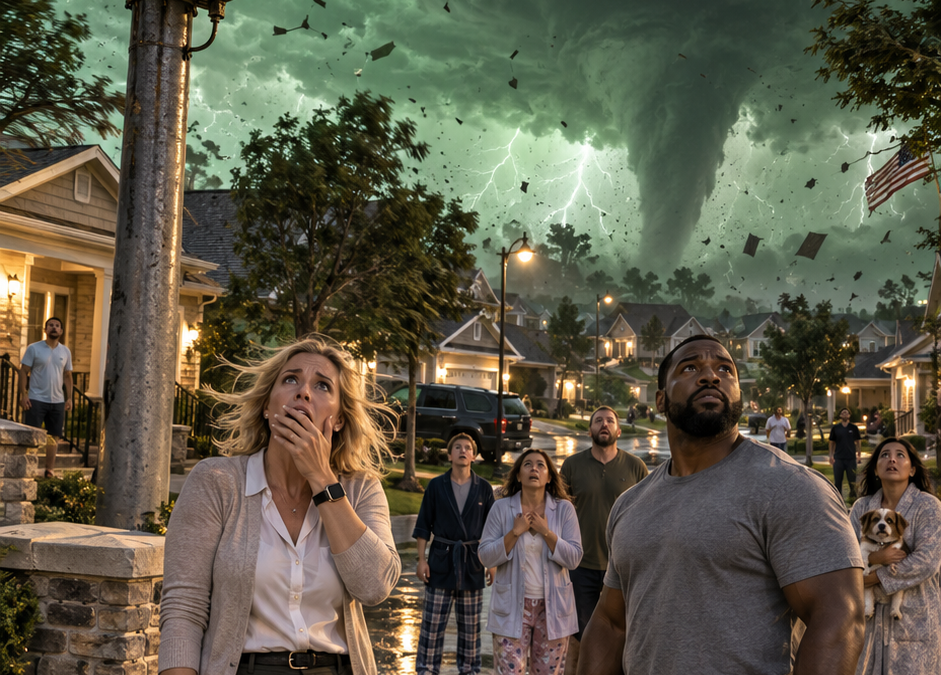
𝗣𝗔𝗥𝗧 𝟮
My name is Garrett Stone.
I was twenty-eight years old when I bought the five-acre parcel at the bottom of Whispering Oaks Basin, and despite what Cybil later told half the county, I was not a survivalist waiting for civilization to collapse.
I was a radar engineer.
There’s a difference.
I had spent five years working in severe-weather research, including field support for low-level Doppler projects and damage surveys across Oklahoma and Kansas.
My job was essentially to study the things people call freak weather after scientists spend decades explaining that they are not freak weather at all.
Tornadoes.
Downbursts.
Mesocyclones.
Boundary interactions.
Debris signatures.
Storm-scale radar failure.
And one fact became very clear to me early in my career.
The atmosphere does not care how expensive your neighborhood is.
It does not care whether you have imported tile.
It does not care whether your HOA has won an award for landscaping.
It does not care if your home cost six hundred thousand dollars or six million.
Physics collects equally.
That was what made Gilded Pines Estates so fascinating.
The development sat on a limestone ridge directly above Whispering Oaks Basin.
The brochures described the location as commanding.
Panoramic.
Elevated.
Resort-like.
I would have used a different word.
Exposed.
One hundred twenty large modern Craftsman houses ran along terraces cut into the ridge.
They had tall glass walls facing southwest to capture sunsets.
Lightweight roof systems.
Decorative timber.
Vinyl shake cladding designed to look like cedar without the inconvenience of actually being cedar.
The homes were beautiful.
They were also built almost perfectly to receive severe weather from the direction violent spring storms usually arrived.
The development’s biggest problem, however, was invisible.
Terrain.
The nearest major Doppler radar site scanned the basin from far enough away that its beam passed thousands of feet above our valley floor.
Strong storms aloft showed beautifully.
Rapidly developing circulation near the surface?
Not always.
The crescent-shaped limestone ridge surrounding Whispering Oaks created a low-level coverage gap.
Most days, that meant nothing.
On the wrong night, it meant everything.
County emergency planners knew that.
Which was why an old civil-defense siren had remained on the basin floor long after subdivisions replaced the farms around it.
The Thunderbolt looked like something designed during the Cold War by engineers who believed subtlety was morally suspicious.
Its horn sat high on a steel lattice tower.
When the blower engaged and the rotor opened, it produced a dual-tone scream that could be heard for miles.
Every Saturday at noon, the county tested it.
The first time I heard it after buying the property, I grinned.
Cybil Crane nearly declared war.
She arrived at my gate in a white golf cart three weeks after I moved in.
Silver hair.
Designer sunglasses.
Silk scarf.
Gold-colored clipboard.
I had never seen anyone hold office supplies with such menace.
“You’re Garrett Stone?”
“Yes.”
“I’m Cybil Crane, president of Gilded Pines.”
“I know.”
Her mouth tightened slightly.
Apparently she preferred introductions that ended with applause.
She looked past me toward my cabin.
The concrete dome was halfway through construction then.
Buffalo grass surrounded it.
Gravel driveway.
Weather equipment.
No manicured hedges.
To Cybil, I might as well have parked an oil rig beside Versailles.
“Your parcel is becoming a concern.”
“My parcel?”
“The appearance.”
I looked around.
“Looks like grass.”
“Native grass.”
“Yes. That’s generally where grass starts.”
She ignored that.
Then pointed at the siren tower.
“And that.”
“The tornado siren?”
“That mechanical screamer.”
“It’s county infrastructure.”
“It disrupts residents.”
“It tests once a week for roughly a minute.”
“Do you know what happens when that thing goes off during Saturday brunch at the clubhouse?”
I considered the question seriously.
“People know the siren works?”
She stared at me.
“Dogs panic.”
“Dogs will survive.”
“Children cry.”
“Children also survive.”
“Glassware rattles.”
“Cybil, are we discussing disaster preparedness or wine glasses?”
That was our relationship from that moment forward.
She hated me.
I found her administratively fascinating.
Cybil ran Gilded Pines like a private corporation whose primary product was obedience.
Trash cans had thirty-minute return windows after pickup.
Mailbox colors came from an approved palette.
Basketball hoops required architectural review.
Residents could receive fines for leaving bicycles visible from the street.
The HOA published a newsletter called The Pine Needle, which included a section identifying addresses with unresolved aesthetic violations.
Public shaming with clip art.
Very efficient.
My property sat outside HOA jurisdiction.
That irritated Cybil more than anything else.
She couldn’t fine me.
Couldn’t regulate my driveway.
Couldn’t tell me to mow native grass to suburban height.
Couldn’t require my cabin to match Gilded Pines’ earth-tone palette.
And she absolutely could not control the siren because it operated under a county easement.
So naturally, controlling the siren became her obsession.
She petitioned the county to remove it.
Denied.
She asked emergency management to replace it with text-message alerts.
Denied.
She requested reduced weekly test volume.
Technically impossible without compromising performance.
Denied.
Each rejection offended her more than the last.
One afternoon she returned to my fence.
“You seem to enjoy this.”
“Enjoy what?”
“Being difficult.”
“I haven’t done anything.”
“That siren sits on your land.”
“Under a county easement.”
“You could support relocation.”
“To where?”
“The industrial corridor.”
“Four miles east.”
“Yes.”
“That wouldn’t warn this basin.”
“People have phones.”
I folded my arms.
“Phones lose power.”
“We have backup generators.”
“Cell towers fail.”
“We have satellite-enabled weather apps.”
“Not everyone does.”
She exhaled.
“Garrett, it is 2026. We do not need a relic from 1965 screaming like nuclear war has started every Saturday.”
“You know why the siren is here?”
“To disturb property values?”
“The radar coverage gap.”
“I’ve heard your theory.”
“It isn’t a theory.”
“That’s your opinion.”
“No, Cybil. Whether you like the siren is opinion. Electromagnetic beam geometry is arithmetic.”
That did not improve the conversation.
She turned toward the tower.
“If the county won’t remove it, we’ll find another solution.”
That sentence stayed with me.
Not because I feared she could legally do anything.
Because Cybil had spent years learning that rules were mostly obstacles for people less persistent than she was.
I decided to put my warning in writing.
I produced a formal engineering memorandum.
Twenty pages.
Terrain maps.
Radar-beam elevation.
Storm climatology.
Acoustic coverage.
Cellular dependency.
Power-loss scenarios.
I explained that the siren was the valley’s only independently powered ground-level warning system capable of reaching residents during simultaneous grid and communication failure.
I specifically warned:
Do not obstruct, wrap, alter, dampen, redirect, enclose, or otherwise modify the siren horn assembly.
Then I sent copies certified mail to the HOA board, county emergency management, and Cybil personally.
Two days later, she burned hers.
I know because she filmed it.
The video went onto the private Gilded Pines community page.
A resident forwarded it to me.
Cybil stood beside the clubhouse fire pit holding my report.
“Our neighbor Garrett has produced another catastrophic fantasy,” she said into the camera.
People around her laughed.
She flipped through several pages.
Apparently the section with actual maps did not impress her.
“He believes our phones will fail, the power will fail, the weather service will fail, and apparently civilization itself will collapse unless we listen to his antique siren.”
More laughter.
Then she held the pages over the flame.
“Gilded Pines believes in modern solutions.”
The report caught fire.
“Not doomsday theater.”
She dropped it into the pit.
Residents posted applause emojis.
I downloaded the video.
Saved the metadata.
Backed it up twice.
I wasn’t angry.
People mistake documentation for passivity.
It isn’t.
Sometimes writing things down is the most aggressive thing you can do.
Because arguments disappear.
Records stay.
On October 12, the contractors arrived.
Flatbed truck.
Ladders.
Copper-colored panels.
Acoustic insulation.
I walked toward the siren with a camera already recording.
Cybil stood beside the road wearing a white linen blazer.
“Morning.”
“Garrett.”
“What are they doing?”
“Aesthetic improvement.”
“To county emergency equipment?”
“To the visual nuisance beside our property.”
One contractor raised an insulated panel toward the horn.
I stepped closer to my property marker but did not touch them.
“You have county authorization?”
“We have board authorization.”
“That wasn’t the question.”
Her smile sharpened.
“Our counsel has reviewed our easement rights.”
“You don’t have an easement over that siren.”
“The work is being performed from the HOA side.”
“You’re physically attaching material to county equipment.”
“Our engineers determined the device remains functional.”
“Your soundproofing contractor is not an emergency-warning engineer.”
“He understands sound.”
“So do pillows. That doesn’t mean I wrap one around a smoke detector.”
One of the workers tried not to laugh.
Cybil noticed.
He stopped immediately.
I pointed toward the camera.
“For the record: I am telling you that obstructing that horn will reduce its effective warning radius. I am also telling you this is emergency infrastructure operating under a county civil-defense easement.”
She looked directly at the lens.
“And for the record, Mr. Stone, Gilded Pines has a right to protect its residents from excessive noise. If you interfere with our contractor, we will pursue trespass and property-damage claims.”
“You understand I’m not interfering.”
“You’re harassing workers.”
“I’m standing on my own land.”
“Same behavior.”
I almost admired the efficiency.
Then I said:
“Check your HOA insurance policy before they tighten those bolts.”
Her expression flickered.
“Excuse me?”
“Public-safety infrastructure exclusions.”
“I’m sure our insurer will be fascinated by your amateur legal interpretation.”
“I’m not giving legal advice.”
I nodded toward the horn.
“I’m giving you engineering advice.”
“Have a wonderful afternoon, Garrett.”
She turned away.
The crew finished the installation.
The shroud looked expensive.
Copper-colored outer panels enclosed the siren’s directional horn assembly while dense acoustic insulation blocked most sound propagation toward Gilded Pines.
The following Saturday at noon, the county ran the weekly test.
The siren activated.
Instead of a valley-filling scream, we heard a dull mechanical buzz.
Residents celebrated.
Cybil’s newsletter called it:
THE BEGINNING OF A QUIETER GILDED PINES.
One homeowner posted:
Best Saturday morning in years.
Another:
Technology finally defeats outdated noise pollution.
I saved those too.
Not because I wanted revenge.
Because I had learned something during years of storm analysis.
After disaster, memory becomes very flexible.
People remember warning signs differently.
People remember what they knew differently.
People remember who said what differently.
Documents do not.
Winter passed.
Nothing happened.
That was the dangerous part.
Cybil became more certain she had been right because nature failed to punish her immediately.
Humans are excellent at confusing delayed consequences with nonexistent consequences.
Every Saturday, the siren wheezed.
Every Saturday, Gilded Pines slept through noon.
Eventually the silence became normal.
Meanwhile, I watched something else happening beneath the ridge.
Water.
My property included the base of the eastern slope below the Gilded Pines clubhouse.
The HOA had recently built a large cedar clubhouse and saltwater pool near the bluff.
To support the expansion, contractors installed a massive concrete retaining wall.
The wall itself was impressive.
The drainage behind it was not.
Historic geological maps from my grandfather, who had surveyed the basin decades earlier, showed expansive clay running beneath the ridge.
When saturated, that clay lost strength dramatically.
Water needed somewhere to go.
Older drainage channels had once carried groundwater laterally toward the basin.
Construction disrupted them.
Then the retaining wall restricted the remaining flow.
I installed monitoring wells and pore-pressure sensors on my side of the boundary.
Month after month, readings climbed.
Not catastrophic.
Yet.
But wrong.
I sent another engineering notice.
This one concerned drainage and slope stability.
Cybil did not burn it publicly.
Progress.
She simply ignored it.
The HOA’s contractor continued landscaping.
Then I learned they planned to remove several mature trees near the clubhouse slope.
Roots were one of the few things still helping stabilize the upper soil layer.
I notified the insurer.
Not dramatically.
I sent data.
Maps.
Sensor logs.
Construction photographs.
My prior siren documentation.
Then I wrote one paragraph:
These conditions may represent material undisclosed risk affecting emergency warning, slope stability, electrical infrastructure, and common-property exposure.
That got attention.
The insurer assigned Douglas Kaine, a senior forensic risk investigator, to conduct an independent audit.
The audit was scheduled for May.
Cybil didn’t know exactly what I had sent.
But she knew something was happening.
She appeared at my gate one afternoon in April.
“Are you communicating with our insurer?”
“Yes.”
Her jaw tightened.
“About association property?”
“About conditions affecting my property and the county siren.”
“You have no standing to interfere with our insurance relationship.”
“I sent them measurements.”
“You sent them accusations.”
“I sent numbers.”
“Same thing when you choose which numbers to send.”
I smiled.
“Interesting philosophy.”
“You’ve wanted Gilded Pines punished since the day you arrived.”
“No.”
“You despise everything this community represents.”
“What does it represent?”
“Investment. Order. Standards.”
“That sounds like a brochure.”
“You think you’re smarter than everyone here because you built a bunker and stare at clouds.”
“It’s a radar dish.”
“I don’t care.”
“I know.”
That ended the useful part of the conversation.
She pointed toward the siren.
“This construction harassment needs to stop.”
“What construction?”
“Your sensor installations. Your cameras. Your communications with our insurer.”
“They’re all on my property.”
“You are creating a hostile environment.”
“You muffled an emergency siren.”
“And everyone sleeps better.”
That sentence would later appear in almost every lawsuit, board hearing, insurance review, and newspaper story connected to what happened.
Everyone sleeps better.
She said it proudly.
Then the atmosphere started changing.
Late April became unusually warm.
Moisture surged north from the Gulf.
A strong western trough approached.
Instability increased.
Meteorologists began talking about a potentially significant severe-weather setup.
By May 3, the Storm Prediction Center had elevated the region into a particularly dangerous tornado environment.
I spent that afternoon calibrating my radar.
My phone showed three messages from neighbors in Gilded Pines asking whether I thought the forecast was exaggerated.
That surprised me.
Six months earlier, they had laughed.
Now somebody had apparently remembered I studied storms for a living.
I responded the same way to all three.
Have your shelter ready. Keep shoes nearby. Keep a battery radio. Do not rely on cellular service alone.
At 9:30 p.m., storms formed west of the basin.
At 11:00, the first line weakened north of us.
People relaxed.
Bad mistake.
Around midnight, a separate cell began developing on an outflow boundary southwest of Whispering Oaks.
Regional radar showed heavy rain.
My low-level radar showed increasing rotation.
At 1:47 a.m., I called county emergency management.
“Garrett Stone. Whispering Oaks.”
The dispatcher transferred me.
I gave coordinates.
Velocity couplet.
Estimated movement.
The duty officer knew my equipment.
“We’re monitoring it.”
“You’re overshooting the lowest circulation.”
“We don’t have confirmation.”
“You won’t until it’s almost here.”
“We need visual confirmation or stronger radar indication.”
“I understand.”
That was procedure.
Procedure is sometimes slow because false alarms matter too.
I went outside.
No rain yet.
Lightning flashed behind the southwestern ridge.
At 2:03, the wind became warm.
At 2:08, pressure began dropping violently.
At 2:12, the wind stopped.
Then the sky turned green.
I radioed emergency management again.
“Circulation has tightened. Strong low-level couplet. Possible tornado entering the basin.”
This time, the response was immediate.
“We’re activating local warning.”
Then lightning hit the ridge.
The cell tower died.
Seconds later, power failed across Gilded Pines.
The Thunderbolt activated.
And whispered.
That sound made me physically sick.
I had tested the acoustic loss.
I knew what the insulation had done.
Knowing it mathematically and hearing it during an actual tornado were two different things.
I grabbed the VHF radio.
“County, basin siren is mechanically active but acoustically obstructed. Repeat, warning output is compromised.”
“Can you remove the obstruction?”
“Not safely in current conditions.”
Lightning was striking around the tower.
Winds were already increasing.
I would have been killed trying.
I switched frequencies.
My emergency radio setup could reach several licensed operators inside the development.
“Gilded Pines, tornado emergency. Wake everyone. Shelter immediately.”
Static.
Then a voice.
“Garrett?”
“Yes. Who is this?”
“Tom Alvarez, number 37.”
“Tom, get everyone you can into shelter. Large tornado approaching from southwest. Do not go outside unless necessary.”
“How long?”
“Minutes.”
That word changed his voice.
He started calling neighbors.
I called others.
A retired firefighter.
An amateur radio operator.
One family I knew had a basement.
Another had a reinforced interior safe room installed privately after moving from Moore.
Word moved house to house.
Not fast enough.
But it moved.
Then the tornado arrived.
People compare tornadoes to freight trains because language runs out quickly.
This one didn’t sound like a train to me.
It sounded industrial.
Metal tearing.
Glass detonating.
Pressure shifting through structures.
The earth itself carrying low-frequency vibration.
I sealed the blast door of my dome.
My radar dish automatically stowed seconds before wind speeds became too high for operation.
The cabin lights flickered onto battery backup.
Then the world outside disappeared.
The first major gust hit.
My entire structure vibrated.
Not moved.
Vibrated.
Debris struck the dome.
Wood.
Roofing.
Something metal.
Then larger impacts.
I sat beside the radio and kept transmitting shelter instructions until static swallowed most replies.
Above me, Gilded Pines took the storm directly.
The southwest-facing glass walls failed first.
Wind-driven debris shattered windows across dozens of houses.
Once openings formed, pressure and wind entered the structures.
Roof systems began peeling away.
Garage doors collapsed.
Cars rolled.
Decorative timber became missiles.
The clubhouse survived the first wind impact.
The ground beneath it did not.
Heavy rain had saturated the ridge.
The retaining system was already under elevated groundwater pressure.
Then intense rainfall, vibration, wind load, and structural damage combined.
A section of slope failed.
The clubhouse shifted.
The pool deck fractured.
Thousands of gallons of water spilled across the unstable ground.
Part of the retaining wall rotated outward.
The electrical equipment near the slope tore loose.
A bright arc lit the night.
Then everything went black again.
I remember thinking:
Cybil wanted silence.
She finally had it.
The tornado passed in less than two minutes.
The aftermath lasted for years.
When pressure stabilized enough for me to open the door, rain was still falling.
I stepped outside.
My pasture was covered in debris.
Shingles.
Insulation.
Pieces of fencing.
A patio chair sat upside down beside my radar gantry.
The siren tower still stood.
Its copper-colored acoustic panels were mangled but still attached.
That image would become the symbol of the entire disaster.
A warning system that had tried to scream through something deliberately built to silence it.
I heard voices from the ridge.
People calling names.
Dogs barking.
Car alarms.
I grabbed my medical kit, helmet, flashlight, and radio.
Then I headed uphill.
Revenge disappeared instantly.
That’s another thing people misunderstand about conflict.
You can despise what somebody did and still help them when the consequence arrives.
A house near the lower terrace had partially collapsed.
We pulled an elderly man from an interior bathroom.
A teenage girl had cuts from broken glass.
Another family emerged from a reinforced closet they had entered only because Tom Alvarez pounded on their door minutes before impact.
At one point I found Cybil.
She was barefoot.
Her white nightshirt was soaked.
Blood ran down one forearm from a superficial cut.
She stood beside what had been a neighbor’s garage staring toward the destroyed clubhouse.
For once, she had no clipboard.
No speech.
No administrative language.
Just shock.
She looked at me.
“The siren.”
I said nothing.
“I didn’t hear it.”
“No.”
Her face changed.
Not because she suddenly understood tornado science.
Because she understood evidence.
She knew exactly why she hadn’t heard it.
By sunrise, rescue crews had reached most of the development.
Miraculously, nobody died.
Several residents were hospitalized.
Many homes were badly damaged.
More than seventy had significant roof, window, or structural failure.
The clubhouse complex was devastated by the combination of wind and slope movement.
The electrical system was ruined.
Roads were blocked.
Gilded Pines no longer looked like a luxury development.
It looked like debris had been poured down a hill.
At 8:17 a.m., black SUVs arrived.
Douglas Kaine stepped from the first.
Insurance investigator.
Two engineers accompanied him.
County emergency officials arrived shortly afterward.
Douglas walked directly to the siren.
He photographed everything.
The horn.
The shroud.
The bolts.
The insulation.
The damaged tower.
Then he came to me.
“Do you have the activation log?”
“Yes.”
“Acoustic recording?”
“Yes.”
“Your original warning correspondence?”
“Yes.”
“Video of installation?”
“Yes.”
“Video where Mrs. Crane destroyed your written warning?”
“Yes.”
He stared at me for a second.
“You kept everything.”
“I work with weather.”
“What does that have to do with recordkeeping?”
“After storms, everybody remembers the forecast differently.”
He almost smiled.
“Fair enough.”
I handed him a drive.
He listened to the boundary microphone recording.
The siren motor could clearly be heard running.
The expected warning output could not.
Douglas removed his headphones.
“That’s extraordinary.”
“Not really.”
He looked at me.
“It was predictable.”
That distinction mattered.
By noon, the county had formally documented unauthorized modification of emergency-warning infrastructure.
The insurance investigation widened.
Not only into the siren.
Into slope construction.
Drainage.
Retaining-wall engineering.
Board authorization.
Contractor selection.
Cybil’s communications.
My reports.
The insurer did not instantly erase every homeowner’s coverage the way rumors later claimed.
Insurance does not work like a cartoon trapdoor.
Individual policies, master policies, exclusions, causation, and mortgage requirements all had to be reviewed separately.
What did happen was bad enough.
The HOA’s master carrier issued a reservation-of-rights notice and froze several categories of association loss pending investigation.
The clubhouse and common-infrastructure claims became contested immediately.
The carrier cited potential policy exclusions involving intentional alteration of public-safety systems and undisclosed known structural risks.
Residents panicked.
Banks began requesting proof of continuing property coverage.
Homeowners discovered something Cybil had spent years making them forget:
The HOA was not the same thing as their neighborhood.
It was an organization run by people.
People could make catastrophic decisions.
And homeowners could be forced to live with the consequences.
The emergency board meeting happened three days later.
They held it in a high school gym because the clubhouse no longer existed.
Nearly every resident came.
Some still had bandages.
Some had lost roofs.
Some had water-damaged belongings stacked in rented storage units.
Cybil entered through a side door with an attorney.
Nobody applauded.
Six months earlier, people had cheered when she silenced the siren.
Memory was changing very quickly now.
The vice president called the meeting to order.
Cybil tried to speak first.
“We are dealing with an unprecedented natural disaster—”
A man in the second row shouted:
“The siren worked.”
She froze.
Another voice:
“We didn’t hear it because you covered it.”
Her attorney whispered something.
Cybil continued.
“The siren modification was approved as a reasonable noise-mitigation measure based on professional recommendations.”
I stood.
Her eyes found me immediately.
I had brought one binder.
Not three inches thick this time.
I didn’t need everything.
Only the important pieces.
“May I respond?”
The vice president nodded.
Cybil’s attorney objected.
“This is not a litigation forum.”
“No,” I said. “It’s an HOA meeting.”
That earned the first bitter laugh of the evening.
I walked to the front.
“Six months ago, I sent the board an engineering warning explaining exactly what would happen if the siren horn was obstructed.”
I held up the certified receipt.
“Received September nineteenth.”
Then I displayed a still image from Cybil’s livestream.
Her holding the report over the fire pit.
A sound moved through the gym.
Not surprise.
Recognition.
Many of them had watched it live.
I played ten seconds.
Cybil’s recorded voice filled the gym.
Everyone will sleep better now.
Then I stopped the video.
Nobody moved.
I opened another file.
“This is my acoustic test after the shroud was installed.”
I explained the reduced warning range.
“This is the county activation record from the night of the tornado.”
The siren had received the signal.
It had mechanically operated.
Then I played the audio.
Motor.
Blower.
Weak hum.
Someone near the back began crying.
I hated that.
Not because it weakened my argument.
Because for the first time, the technical failure became human.
These people had been asleep.
Their children had been asleep.
A warning system designed specifically for that moment had been working sixty feet away and they couldn’t hear it.
Cybil stood.
“You knew the system was compromised.”
“Yes.”
“And you left it that way.”
There it was.
Her strategy.
Spread the responsibility.
I nodded.
“I notified the county.”
“You could have physically removed the panels.”
“Your attorney threatened me with litigation if I touched them.”
I held up her letter.
That landed badly.
Her attorney stared at the floor.
I continued.
“The equipment belonged to the county under an easement. I had no authority to dismantle someone else’s modification while the dispute was under review.”
Then the county emergency-management director stood.
“We also sent the association a formal notice.”
That was new even to me.
He held up paperwork.
“October seventeenth.”
Cybil turned.
“I never saw that.”
The board secretary slowly raised her hand.
“I forwarded it to you.”
The gym went silent.
Cybil’s face changed.
The secretary continued.
“And you told me legal was handling it.”
Cybil’s attorney whispered:
“I was never sent that.”
Beautiful.
Not funny.
But beautifully clear.
The HOA vice president asked the question everyone needed answered.
“Who authorized the contractor?”
Cybil said:
“The board.”
Three board members immediately objected.
“No.”
“We authorized a noise study.”
“Not physical modification.”
“I never approved attaching anything.”
Cybil looked around.
Her authority was collapsing in real time.
That was when Douglas Kaine spoke.
He had been sitting quietly along the wall.
“May I clarify the insurance position?”
Every head turned.
He introduced himself.
Then he spoke carefully.
“The carrier is investigating whether the association knowingly altered an emergency-warning system after receiving technical notice that the alteration would materially reduce performance.”
He looked toward Cybil.
“We are also investigating engineering disclosures related to the retaining system and slope drainage.”
That caused a second wave of noise.
The vice president asked:
“What disclosures?”
Douglas nodded toward me.
“Mr. Stone submitted monitoring information several weeks before the storm.”
Now people were looking at me differently.
Not kindly.
Not angrily.
Just trying to understand how much had happened while they were discussing landscaping standards.
I explained the groundwater-pressure trend.
The lost drainage paths.
The tree-removal plan.
The retaining wall.
I was careful.
“The tornado caused extraordinary loading. I cannot tell you the slope would have failed that night without the storm.”
Douglas nodded.
Good.
“But the drainage condition was a known vulnerability, and I documented it.”
A woman stood.
“My house lost its roof. Are you saying the HOA knew the hill was unstable too?”
“I’m saying I notified the HOA and insurer of increasing subsurface water pressure near common infrastructure.”
She looked at Cybil.
“Did you know?”
Cybil’s silence lasted too long.
That was the moment she lost the room completely.
The recall motion came twenty minutes later.
Someone moved to remove Cybil as president immediately pending investigation.
Another resident seconded.
Her attorney tried to argue procedure.
The secretary opened the bylaws.
Turns out Cybil had spent years writing very effective removal procedures for everyone else.
Nobody appreciated the irony more than I did.
The vote was overwhelming.
Cybil Crane was removed as president of Gilded Pines Estates.
The woman who had spent years publishing residents’ names for mailbox violations left a high school gym through a side door while nearly one hundred homeowners watched in silence.
No applause.
No shouting.
That was worse.
Within weeks, investigators documented that the siren modification had been performed without county authorization.
The acoustic contractor surrendered its permits on several unrelated projects after regulators reviewed its work.
The HOA board opened its internal records.
Invoices showed Cybil had directed payment for the siren shroud from a discretionary beautification account after the board had approved only an acoustic consultation.
That became a problem.
A serious one.
Insurance lawyers became involved.
County attorneys became involved.
Homeowners hired their own counsel.
The slope failure generated separate engineering claims involving the developer, retaining-wall contractor, and HOA maintenance decisions.
Nothing resolved overnight.
Real consequences rarely do.
But Cybil lost the one thing she had always treated as permanent.
Control.
The homeowners dismantled her compliance system.
The public-shaming section disappeared from The Pine Needle.
Fines required documented review.
Board contracts above a certain amount required multiple signatures.
Emergency infrastructure could no longer be altered by HOA vote.
That last rule made me laugh.
Mostly because HOA rules had finally discovered the revolutionary concept that homeowners associations should not redesign tornado sirens.
The county removed the acoustic shroud.
Two months after the storm, the Thunderbolt was tested again.
Saturday.
Noon.
I stood beside my fence.
So did about thirty residents from Gilded Pines.
Some brought children.
Some wore hearing protection.
The emergency director gave the signal.
The siren spun.
Then it screamed.
Full power.
Dual tone.
Mechanical.
Hideous.
Magnificent.
The sound rolled through Whispering Oaks Basin and climbed the ridge.
Windows rattled.
Dogs barked.
One toddler cried.
Nobody complained.
Tom Alvarez stood beside me with his arms folded.
“Still think it’s beautiful?”
“Absolutely.”
He shook his head.
“You’re weird.”
“Radar engineer.”
“Same thing.”
Fair enough.
A few months later, the reconstruction started.
Some homeowners rebuilt.
Others sold damaged properties.
The clubhouse was relocated farther from the unstable slope after an independent geotechnical review.
The retaining wall was replaced.
Drainage systems went in.
Actual ones.
Gravel.
Perforated pipe.
Relief outlets.
Remarkably, water behaves better when engineers give it somewhere to go.
Gilded Pines looked different afterward.
Less perfect.
More honest.
For the first time, residents could see open stormwater infrastructure that Cybil would once have considered aesthetically offensive.
Nobody covered it with copper panels.
One evening, almost a year after the tornado, a car stopped at my gate.
Cybil stepped out.
No golf cart.
No clipboard.
No silk scarf.
She looked older.
I stayed on my side of the fence.
“What can I do for you?”
She looked toward the siren.
“They’re testing it tomorrow?”
“Noon.”
“I know.”
Silence.
Then:
“You enjoyed this.”
I knew exactly what she meant.
Her removal.
The investigation.
Her humiliation.
I shook my head.
“No.”
“I don’t believe you.”
“I enjoyed being right about the engineering.”
“That sounds like the same thing.”
“It isn’t.”
She laughed bitterly.
“You spent months documenting me.”
“Yes.”
“You contacted our insurer.”
“Yes.”
“You installed sensors beside our retaining wall.”
“On my property.”
“You built a file.”
“Yes.”
“You were waiting.”
“For you to stop.”
“That isn’t true.”
I studied her.
“I warned you before the shroud went up.”
She said nothing.
“I warned you about drainage.”
Nothing.
“The county warned you.”
Her jaw tightened.
“You wanted me to fail.”
“No.”
I pointed toward the ridge.
“I wanted you to understand you could fail.”
That landed.
Cybil looked away.
“You think that’s different?”
“It’s everything.”
The breeze moved through the grass.
The siren stood behind us.
“You know what I hated about that thing?” she asked.
“The noise.”
“No.”
That surprised me.
“What?”
“I couldn’t control it.”
There it was.
No engineering language.
No aesthetics.
No property-value argument.
Just truth.
“It belonged to the county. It sat on your land. And every Saturday it reminded everyone that there was something inside Gilded Pines I couldn’t regulate.”
“That’s an expensive reason to muffle a tornado siren.”
She gave a tired smile.
“Yes.”
Then she looked at my dome.
“I thought you built all this because you were afraid.”
“Partly.”
“Of tornadoes?”
“Of pretending systems can’t fail.”
She nodded slowly.
Then she left.
The next day at noon, the siren tested.
Full volume.
I was making coffee when it started.
The sound shook a spoon against the countertop.
I smiled.
Not because Cybil lost.
Not because residents had suffered.
Not because a tornado had proven me right.
There is nothing satisfying about walking through destroyed houses looking for injured people.
What satisfied me was simpler.
The warning system worked again.
That was enough.
People sometimes ask whether I really “set a trap” for the HOA.
The answer is yes and no.
I documented Cybil because I knew her arrogance would eventually create liability.
I warned the insurer because ignoring measurable risk would have been irresponsible.
I monitored the slope because water pressure does not care whether the HOA believes in geotechnical engineering.
But I didn’t create the tornado.
I didn’t cause the retaining wall to fail.
I didn’t silence the siren.
Cybil did that herself.
That is the strange thing about people who confuse authority with expertise.
You rarely need to defeat them directly.
You give them facts.
You give them warnings.
You give them opportunities to reconsider.
Then, if they are arrogant enough, they spend extraordinary amounts of energy documenting their own refusal.
Cybil burned my warning on video.
She signed the contractor invoice.
She threatened me in writing for objecting.
She told 120 households they would sleep better because she had silenced the “Cold War screamer.”
Six months later, when the cell tower failed and the lights went out and a tornado formed below the radar beam, the old siren did exactly what engineers had designed it to do.
It activated.
The only thing wrong with it was the shell Cybil had ordered bolted around its throat.
After the rebuilding, the new HOA board installed a small plaque near the emergency shelter entrance.
Nothing dramatic.
Just evacuation instructions.
Battery-radio frequencies.
Shelter locations.
And one sentence:
DO NOT RELY ON A SINGLE WARNING SYSTEM.
I approved.
The siren remained.
So did my radar.
So did the weather radios.
So did the phone alerts.
Redundancy.
That is how safety works.
Not by trusting one perfect system.
By assuming every system can fail.
The developers had trusted cellular alerts.
Cybil trusted aesthetics.
Residents trusted Cybil.
Cybil trusted insurance.
Everyone had placed too much faith in one layer.
Then one storm peeled those layers away.
Lightning killed cellular service.
Power failed.
Regional radar overshot the circulation.
The HOA had muffled the mechanical warning.
For several minutes, all the expensive technology in Gilded Pines became less useful than a steel siren designed sixty years earlier.
That irony never stopped bothering Cybil.
I suspect that was why she came back to speak with me.
The weekly test continues to this day.
Every Saturday at noon.
The Thunderbolt winds up slowly.
The compressor engages.
Then the valley fills with that enormous mechanical howl.
New residents complain occasionally.
They ask why nobody replaces it with something quieter.
The board sends them a one-page explanation.
Nobody argues after reading the last paragraph.
I still live in the dome.
My X-band radar still spins during severe weather.
My sensors still monitor the ridge.
The rebuilt Gilded Pines clubhouse sits farther back from the bluff now, anchored on foundations designed by engineers who were allowed to use the word “no.”
Their new windows are impact-rated.
Roof connections were upgraded.
Drainage is visible.
Expensive lessons usually produce excellent construction standards.
On spring nights, when the air gets heavy and the western sky starts flashing, I still step onto the porch with coffee.
Sometimes I look toward Gilded Pines.
Then toward the siren.
The copper shroud is gone.
You can still see scratches on the horn housing where its brackets were bolted.
The county offered to repaint everything after the storm.
I asked them not to.
Scars are useful.
They remind people that failure has a history.
And whenever someone mentions Cybil Crane and asks me what finally defeated her, I tell them the truth.
It wasn’t me.
It wasn’t the insurer.
It wasn’t the recall vote.
It wasn’t even the tornado.
Cybil defeated herself the afternoon she decided that quiet was more important than warning.
She stood beside my fence, watched workers bolt insulation around an emergency siren, and told me with absolute confidence:
“Everyone will sleep much better now.”
She was right.
They did.
Right up until 2:12 in the morning, when the wind stopped, the phones went dead, and the sky turned green.
Then, for the first time, everybody in Gilded Pines understood exactly how expensive silence could be.
Have you finished reading the story and want to read it again?
HOA Silenced the Tornado Siren—Everyone Slept Better Until the Sky Turned Green
They silenced the only tornado siren in the valley.
For six months, everyone thanked them for the peace.
Then, at 2:12 in the morning, the sky turned green.
The wind stopped first.
Not slowed.
Stopped.
One second the buffalo grass around my cabin was bending gently beneath warm May air, and the next every blade stood perfectly still beneath a sky the color of bruised emerald glass.
Anyone who has lived long enough in the southern Great Plains knows that kind of silence.
It isn’t peaceful.
It’s the atmosphere holding its breath.
I stood on the porch of my reinforced concrete dome with a ceramic mug warming one hand and my weather tablet glowing in the other.
Barometric pressure was collapsing.
Fast.
The digital trace had already crossed 945 millibars and was still falling.
My private X-band radar dish rotated behind the cabin, feeding low-level scans onto the screen every few seconds.
At 2:12 a.m., a tight hook appeared inside Whispering Oaks Basin.
I stared at it.
Then zoomed in.
Rotation.
Strong.
Rapidly tightening.
The nearest National Weather Service radar beam passed several thousand feet over our basin because of the surrounding limestone ridges.
That meant the circulation developing almost at ground level below Gilded Pines Estates barely existed on the regional radar picture.
On mine, it looked like a loaded gun.
Then lightning struck the cell tower.
Blue-white light filled the northern ridge.
The tower vanished behind sparks.
Every house above me went dark.
No cellular service.
No Wi-Fi.
No smartphone weather alerts.
No cheerful little push notification telling people to take shelter.
But that was why the county still maintained an old mechanical tornado siren on my property.
Fifty feet from my northern fence stood a Federal Signal Thunderbolt 1003 mounted on a steel tower under a civil-defense easement that predated the Gilded Pines development by half a century.
Ugly?
Absolutely.
Loud?
Painfully.
Obsolete?
Only if electricity, cellular towers, satellites, and human judgment had somehow become incapable of failing at the same time.
At 2:14, emergency management transmitted the activation signal.
The siren motor engaged.
I watched the horn begin rotating.
Its supercharger spun at full speed.
Five horsepower worth of mechanical warning system came alive.
And almost nothing came out.
A weak, suffocated hum drifted across my pasture.
It sounded like somebody had trapped an angry insect inside a refrigerator.
Up on Gilded Pines Ridge, 120 families remained asleep.
Six months earlier, HOA president Cybil Crane had paid contractors to wrap the siren horn in an insulated decorative acoustic shroud because residents complained the weekly noon test disturbed brunch.
I had warned her exactly what would happen.
In writing.
On video.
With engineering data.
Cybil had burned my report beside the clubhouse pool while residents reacted with laughing emojis.
Then she told everyone they could finally sleep better.
Now they were.
That was the problem.
I looked back at the radar.
The circulation had become violent.
A rain-wrapped wedge was moving directly through the basin.
I opened a folder on my tablet and transmitted a preassembled emergency evidence packet to the HOA’s insurer, the county emergency director, and the independent risk investigator already assigned to review the development.
Video of Cybil’s contractors covering the siren.
My certified warning letter.
Acoustic measurements showing the warning radius had been reduced to almost nothing.
Current radar.
Barometric logs.
Timestamped audio of the siren trying and failing to warn the neighborhood.
Then I closed the tablet.
I wasn’t smiling.
Whatever I thought of Cybil Crane, there were children sleeping up there.
People who had trusted her.
People who had laughed at me because she had assured them technology made the old siren unnecessary.
I grabbed my radio.
Then I started calling whoever I could reach.
Because I had spent six months documenting Cybil’s arrogance.
But I had not spent six months hoping anyone would die for it.
PART2
My name is Garrett Stone.
I was twenty-eight years old when I bought the five-acre parcel at the bottom of Whispering Oaks Basin, and despite what Cybil later told half the county, I was not a survivalist waiting for civilization to collapse.
I was a radar engineer.
There’s a difference.
I had spent five years working in severe-weather research, including field support for low-level Doppler projects and damage surveys across Oklahoma and Kansas.
My job was essentially to study the things people call freak weather after scientists spend decades explaining that they are not freak weather at all.
Tornadoes.
Downbursts.
Mesocyclones.
Boundary interactions.
Debris signatures.
Storm-scale radar failure.
And one fact became very clear to me early in my career.
The atmosphere does not care how expensive your neighborhood is.
It does not care whether you have imported tile.
It does not care whether your HOA has won an award for landscaping.
It does not care if your home cost six hundred thousand dollars or six million.
Physics collects equally.
That was what made Gilded Pines Estates so fascinating.
The development sat on a limestone ridge directly above Whispering Oaks Basin.
The brochures described the location as commanding.
Panoramic.
Elevated.
Resort-like.
I would have used a different word.
Exposed.
One hundred twenty large modern Craftsman houses ran along terraces cut into the ridge.
They had tall glass walls facing southwest to capture sunsets.
Lightweight roof systems.
Decorative timber.
Vinyl shake cladding designed to look like cedar without the inconvenience of actually being cedar.
The homes were beautiful.
They were also built almost perfectly to receive severe weather from the direction violent spring storms usually arrived.
The development’s biggest problem, however, was invisible.
Terrain.
The nearest major Doppler radar site scanned the basin from far enough away that its beam passed thousands of feet above our valley floor.
Strong storms aloft showed beautifully.
Rapidly developing circulation near the surface?
Not always.
The crescent-shaped limestone ridge surrounding Whispering Oaks created a low-level coverage gap.
Most days, that meant nothing.
On the wrong night, it meant everything.
County emergency planners knew that.
Which was why an old civil-defense siren had remained on the basin floor long after subdivisions replaced the farms around it.
The Thunderbolt looked like something designed during the Cold War by engineers who believed subtlety was morally suspicious.
Its horn sat high on a steel lattice tower.
When the blower engaged and the rotor opened, it produced a dual-tone scream that could be heard for miles.
Every Saturday at noon, the county tested it.
The first time I heard it after buying the property, I grinned.
Cybil Crane nearly declared war.
She arrived at my gate in a white golf cart three weeks after I moved in.
Silver hair.
Designer sunglasses.
Silk scarf.
Gold-colored clipboard.
I had never seen anyone hold office supplies with such menace.
“You’re Garrett Stone?”
“Yes.”
“I’m Cybil Crane, president of Gilded Pines.”
“I know.”
Her mouth tightened slightly.
Apparently she preferred introductions that ended with applause.
She looked past me toward my cabin.
The concrete dome was halfway through construction then.
Buffalo grass surrounded it.
Gravel driveway.
Weather equipment.
No manicured hedges.
To Cybil, I might as well have parked an oil rig beside Versailles.
“Your parcel is becoming a concern.”
“My parcel?”
“The appearance.”
I looked around.
“Looks like grass.”
“Native grass.”
“Yes. That’s generally where grass starts.”
She ignored that.
Then pointed at the siren tower.
“And that.”
“The tornado siren?”
“That mechanical screamer.”
“It’s county infrastructure.”
“It disrupts residents.”
“It tests once a week for roughly a minute.”
“Do you know what happens when that thing goes off during Saturday brunch at the clubhouse?”
I considered the question seriously.
“People know the siren works?”
She stared at me.
“Dogs panic.”
“Dogs will survive.”
“Children cry.”
“Children also survive.”
“Glassware rattles.”
“Cybil, are we discussing disaster preparedness or wine glasses?”
That was our relationship from that moment forward.
She hated me.
I found her administratively fascinating.
Cybil ran Gilded Pines like a private corporation whose primary product was obedience.
Trash cans had thirty-minute return windows after pickup.
Mailbox colors came from an approved palette.
Basketball hoops required architectural review.
Residents could receive fines for leaving bicycles visible from the street.
The HOA published a newsletter called The Pine Needle, which included a section identifying addresses with unresolved aesthetic violations.
Public shaming with clip art.
Very efficient.
My property sat outside HOA jurisdiction.
That irritated Cybil more than anything else.
She couldn’t fine me.
Couldn’t regulate my driveway.
Couldn’t tell me to mow native grass to suburban height.
Couldn’t require my cabin to match Gilded Pines’ earth-tone palette.
And she absolutely could not control the siren because it operated under a county easement.
So naturally, controlling the siren became her obsession.
She petitioned the county to remove it.
Denied.
She asked emergency management to replace it with text-message alerts.
Denied.
She requested reduced weekly test volume.
Technically impossible without compromising performance.
Denied.
Each rejection offended her more than the last.
One afternoon she returned to my fence.
“You seem to enjoy this.”
“Enjoy what?”
“Being difficult.”
“I haven’t done anything.”
“That siren sits on your land.”
“Under a county easement.”
“You could support relocation.”
“To where?”
“The industrial corridor.”
“Four miles east.”
“Yes.”
“That wouldn’t warn this basin.”
“People have phones.”
I folded my arms.
“Phones lose power.”
“We have backup generators.”
“Cell towers fail.”
“We have satellite-enabled weather apps.”
“Not everyone does.”
She exhaled.
“Garrett, it is 2026. We do not need a relic from 1965 screaming like nuclear war has started every Saturday.”
“You know why the siren is here?”
“To disturb property values?”
“The radar coverage gap.”
“I’ve heard your theory.”
“It isn’t a theory.”
“That’s your opinion.”
“No, Cybil. Whether you like the siren is opinion. Electromagnetic beam geometry is arithmetic.”
That did not improve the conversation.
She turned toward the tower.
“If the county won’t remove it, we’ll find another solution.”
That sentence stayed with me.
Not because I feared she could legally do anything.
Because Cybil had spent years learning that rules were mostly obstacles for people less persistent than she was.
I decided to put my warning in writing.
I produced a formal engineering memorandum.
Twenty pages.
Terrain maps.
Radar-beam elevation.
Storm climatology.
Acoustic coverage.
Cellular dependency.
Power-loss scenarios.
I explained that the siren was the valley’s only independently powered ground-level warning system capable of reaching residents during simultaneous grid and communication failure.
I specifically warned:
Do not obstruct, wrap, alter, dampen, redirect, enclose, or otherwise modify the siren horn assembly.
Then I sent copies certified mail to the HOA board, county emergency management, and Cybil personally.
Two days later, she burned hers.
I know because she filmed it.
The video went onto the private Gilded Pines community page.
A resident forwarded it to me.
Cybil stood beside the clubhouse fire pit holding my report.
“Our neighbor Garrett has produced another catastrophic fantasy,” she said into the camera.
People around her laughed.
She flipped through several pages.
Apparently the section with actual maps did not impress her.
“He believes our phones will fail, the power will fail, the weather service will fail, and apparently civilization itself will collapse unless we listen to his antique siren.”
More laughter.
Then she held the pages over the flame.
“Gilded Pines believes in modern solutions.”
The report caught fire.
“Not doomsday theater.”
She dropped it into the pit.
Residents posted applause emojis.
I downloaded the video.
Saved the metadata.
Backed it up twice.
I wasn’t angry.
People mistake documentation for passivity.
It isn’t.
Sometimes writing things down is the most aggressive thing you can do.
Because arguments disappear.
Records stay.
On October 12, the contractors arrived.
Flatbed truck.
Ladders.
Copper-colored panels.
Acoustic insulation.
I walked toward the siren with a camera already recording.
Cybil stood beside the road wearing a white linen blazer.
“Morning.”
“Garrett.”
“What are they doing?”
“Aesthetic improvement.”
“To county emergency equipment?”
“To the visual nuisance beside our property.”
One contractor raised an insulated panel toward the horn.
I stepped closer to my property marker but did not touch them.
“You have county authorization?”
“We have board authorization.”
“That wasn’t the question.”
Her smile sharpened.
“Our counsel has reviewed our easement rights.”
“You don’t have an easement over that siren.”
“The work is being performed from the HOA side.”
“You’re physically attaching material to county equipment.”
“Our engineers determined the device remains functional.”
“Your soundproofing contractor is not an emergency-warning engineer.”
“He understands sound.”
“So do pillows. That doesn’t mean I wrap one around a smoke detector.”
One of the workers tried not to laugh.
Cybil noticed.
He stopped immediately.
I pointed toward the camera.
“For the record: I am telling you that obstructing that horn will reduce its effective warning radius. I am also telling you this is emergency infrastructure operating under a county civil-defense easement.”
She looked directly at the lens.
“And for the record, Mr. Stone, Gilded Pines has a right to protect its residents from excessive noise. If you interfere with our contractor, we will pursue trespass and property-damage claims.”
“You understand I’m not interfering.”
“You’re harassing workers.”
“I’m standing on my own land.”
“Same behavior.”
I almost admired the efficiency.
Then I said:
“Check your HOA insurance policy before they tighten those bolts.”
Her expression flickered.
“Excuse me?”
“Public-safety infrastructure exclusions.”
“I’m sure our insurer will be fascinated by your amateur legal interpretation.”
“I’m not giving legal advice.”
I nodded toward the horn.
“I’m giving you engineering advice.”
“Have a wonderful afternoon, Garrett.”
She turned away.
The crew finished the installation.
The shroud looked expensive.
Copper-colored outer panels enclosed the siren’s directional horn assembly while dense acoustic insulation blocked most sound propagation toward Gilded Pines.
The following Saturday at noon, the county ran the weekly test.
The siren activated.
Instead of a valley-filling scream, we heard a dull mechanical buzz.
Residents celebrated.
Cybil’s newsletter called it:
THE BEGINNING OF A QUIETER GILDED PINES.
One homeowner posted:
Best Saturday morning in years.
Another:
Technology finally defeats outdated noise pollution.
I saved those too.
Not because I wanted revenge.
Because I had learned something during years of storm analysis.
After disaster, memory becomes very flexible.
People remember warning signs differently.
People remember what they knew differently.
People remember who said what differently.
Documents do not.
Winter passed.
Nothing happened.
That was the dangerous part.
Cybil became more certain she had been right because nature failed to punish her immediately.
Humans are excellent at confusing delayed consequences with nonexistent consequences.
Every Saturday, the siren wheezed.
Every Saturday, Gilded Pines slept through noon.
Eventually the silence became normal.
Meanwhile, I watched something else happening beneath the ridge.
Water.
My property included the base of the eastern slope below the Gilded Pines clubhouse.
The HOA had recently built a large cedar clubhouse and saltwater pool near the bluff.
To support the expansion, contractors installed a massive concrete retaining wall.
The wall itself was impressive.
The drainage behind it was not.
Historic geological maps from my grandfather, who had surveyed the basin decades earlier, showed expansive clay running beneath the ridge.
When saturated, that clay lost strength dramatically.
Water needed somewhere to go.
Older drainage channels had once carried groundwater laterally toward the basin.
Construction disrupted them.
Then the retaining wall restricted the remaining flow.
I installed monitoring wells and pore-pressure sensors on my side of the boundary.
Month after month, readings climbed.
Not catastrophic.
Yet.
But wrong.
I sent another engineering notice.
This one concerned drainage and slope stability.
Cybil did not burn it publicly.
Progress.
She simply ignored it.
The HOA’s contractor continued landscaping.
Then I learned they planned to remove several mature trees near the clubhouse slope.
Roots were one of the few things still helping stabilize the upper soil layer.
I notified the insurer.
Not dramatically.
I sent data.
Maps.
Sensor logs.
Construction photographs.
My prior siren documentation.
Then I wrote one paragraph:
These conditions may represent material undisclosed risk affecting emergency warning, slope stability, electrical infrastructure, and common-property exposure.
That got attention.
The insurer assigned Douglas Kaine, a senior forensic risk investigator, to conduct an independent audit.
The audit was scheduled for May.
Cybil didn’t know exactly what I had sent.
But she knew something was happening.
She appeared at my gate one afternoon in April.
“Are you communicating with our insurer?”
“Yes.”
Her jaw tightened.
“About association property?”
“About conditions affecting my property and the county siren.”
“You have no standing to interfere with our insurance relationship.”
“I sent them measurements.”
“You sent them accusations.”
“I sent numbers.”
“Same thing when you choose which numbers to send.”
I smiled.
“Interesting philosophy.”
“You’ve wanted Gilded Pines punished since the day you arrived.”
“No.”
“You despise everything this community represents.”
“What does it represent?”
“Investment. Order. Standards.”
“That sounds like a brochure.”
“You think you’re smarter than everyone here because you built a bunker and stare at clouds.”
“It’s a radar dish.”
“I don’t care.”
“I know.”
That ended the useful part of the conversation.
She pointed toward the siren.
“This construction harassment needs to stop.”
“What construction?”
“Your sensor installations. Your cameras. Your communications with our insurer.”
“They’re all on my property.”
“You are creating a hostile environment.”
“You muffled an emergency siren.”
“And everyone sleeps better.”
That sentence would later appear in almost every lawsuit, board hearing, insurance review, and newspaper story connected to what happened.
Everyone sleeps better.
She said it proudly.
Then the atmosphere started changing.
Late April became unusually warm.
Moisture surged north from the Gulf.
A strong western trough approached.
Instability increased.
Meteorologists began talking about a potentially significant severe-weather setup.
By May 3, the Storm Prediction Center had elevated the region into a particularly dangerous tornado environment.
I spent that afternoon calibrating my radar.
My phone showed three messages from neighbors in Gilded Pines asking whether I thought the forecast was exaggerated.
That surprised me.
Six months earlier, they had laughed.
Now somebody had apparently remembered I studied storms for a living.
I responded the same way to all three.
Have your shelter ready. Keep shoes nearby. Keep a battery radio. Do not rely on cellular service alone.
At 9:30 p.m., storms formed west of the basin.
At 11:00, the first line weakened north of us.
People relaxed.
Bad mistake.
Around midnight, a separate cell began developing on an outflow boundary southwest of Whispering Oaks.
Regional radar showed heavy rain.
My low-level radar showed increasing rotation.
At 1:47 a.m., I called county emergency management.
“Garrett Stone. Whispering Oaks.”
The dispatcher transferred me.
I gave coordinates.
Velocity couplet.
Estimated movement.
The duty officer knew my equipment.
“We’re monitoring it.”
“You’re overshooting the lowest circulation.”
“We don’t have confirmation.”
“You won’t until it’s almost here.”
“We need visual confirmation or stronger radar indication.”
“I understand.”
That was procedure.
Procedure is sometimes slow because false alarms matter too.
I went outside.
No rain yet.
Lightning flashed behind the southwestern ridge.
At 2:03, the wind became warm.
At 2:08, pressure began dropping violently.
At 2:12, the wind stopped.
Then the sky turned green.
I radioed emergency management again.
“Circulation has tightened. Strong low-level couplet. Possible tornado entering the basin.”
This time, the response was immediate.
“We’re activating local warning.”
Then lightning hit the ridge.
The cell tower died.
Seconds later, power failed across Gilded Pines.
The Thunderbolt activated.
And whispered.
That sound made me physically sick.
I had tested the acoustic loss.
I knew what the insulation had done.
Knowing it mathematically and hearing it during an actual tornado were two different things.
I grabbed the VHF radio.
“County, basin siren is mechanically active but acoustically obstructed. Repeat, warning output is compromised.”
“Can you remove the obstruction?”
“Not safely in current conditions.”
Lightning was striking around the tower.
Winds were already increasing.
I would have been killed trying.
I switched frequencies.
My emergency radio setup could reach several licensed operators inside the development.
“Gilded Pines, tornado emergency. Wake everyone. Shelter immediately.”
Static.
Then a voice.
“Garrett?”
“Yes. Who is this?”
“Tom Alvarez, number 37.”
“Tom, get everyone you can into shelter. Large tornado approaching from southwest. Do not go outside unless necessary.”
“How long?”
“Minutes.”
That word changed his voice.
He started calling neighbors.
I called others.
A retired firefighter.
An amateur radio operator.
One family I knew had a basement.
Another had a reinforced interior safe room installed privately after moving from Moore.
Word moved house to house.
Not fast enough.
But it moved.
Then the tornado arrived.
People compare tornadoes to freight trains because language runs out quickly.
This one didn’t sound like a train to me.
It sounded industrial.
Metal tearing.
Glass detonating.
Pressure shifting through structures.
The earth itself carrying low-frequency vibration.
I sealed the blast door of my dome.
My radar dish automatically stowed seconds before wind speeds became too high for operation.
The cabin lights flickered onto battery backup.
Then the world outside disappeared.
The first major gust hit.
My entire structure vibrated.
Not moved.
Vibrated.
Debris struck the dome.
Wood.
Roofing.
Something metal.
Then larger impacts.
I sat beside the radio and kept transmitting shelter instructions until static swallowed most replies.
Above me, Gilded Pines took the storm directly.
The southwest-facing glass walls failed first.
Wind-driven debris shattered windows across dozens of houses.
Once openings formed, pressure and wind entered the structures.
Roof systems began peeling away.
Garage doors collapsed.
Cars rolled.
Decorative timber became missiles.
The clubhouse survived the first wind impact.
The ground beneath it did not.
Heavy rain had saturated the ridge.
The retaining system was already under elevated groundwater pressure.
Then intense rainfall, vibration, wind load, and structural damage combined.
A section of slope failed.
The clubhouse shifted.
The pool deck fractured.
Thousands of gallons of water spilled across the unstable ground.
Part of the retaining wall rotated outward.
The electrical equipment near the slope tore loose.
A bright arc lit the night.
Then everything went black again.
I remember thinking:
Cybil wanted silence.
She finally had it.
The tornado passed in less than two minutes.
The aftermath lasted for years.
When pressure stabilized enough for me to open the door, rain was still falling.
I stepped outside.
My pasture was covered in debris.
Shingles.
Insulation.
Pieces of fencing.
A patio chair sat upside down beside my radar gantry.
The siren tower still stood.
Its copper-colored acoustic panels were mangled but still attached.
That image would become the symbol of the entire disaster.
A warning system that had tried to scream through something deliberately built to silence it.
I heard voices from the ridge.
People calling names.
Dogs barking.
Car alarms.
I grabbed my medical kit, helmet, flashlight, and radio.
Then I headed uphill.
Revenge disappeared instantly.
That’s another thing people misunderstand about conflict.
You can despise what somebody did and still help them when the consequence arrives.
A house near the lower terrace had partially collapsed.
We pulled an elderly man from an interior bathroom.
A teenage girl had cuts from broken glass.
Another family emerged from a reinforced closet they had entered only because Tom Alvarez pounded on their door minutes before impact.
At one point I found Cybil.
She was barefoot.
Her white nightshirt was soaked.
Blood ran down one forearm from a superficial cut.
She stood beside what had been a neighbor’s garage staring toward the destroyed clubhouse.
For once, she had no clipboard.
No speech.
No administrative language.
Just shock.
She looked at me.
“The siren.”
I said nothing.
“I didn’t hear it.”
“No.”
Her face changed.
Not because she suddenly understood tornado science.
Because she understood evidence.
She knew exactly why she hadn’t heard it.
By sunrise, rescue crews had reached most of the development.
Miraculously, nobody died.
Several residents were hospitalized.
Many homes were badly damaged.
More than seventy had significant roof, window, or structural failure.
The clubhouse complex was devastated by the combination of wind and slope movement.
The electrical system was ruined.
Roads were blocked.
Gilded Pines no longer looked like a luxury development.
It looked like debris had been poured down a hill.
At 8:17 a.m., black SUVs arrived.
Douglas Kaine stepped from the first.
Insurance investigator.
Two engineers accompanied him.
County emergency officials arrived shortly afterward.
Douglas walked directly to the siren.
He photographed everything.
The horn.
The shroud.
The bolts.
The insulation.
The damaged tower.
Then he came to me.
“Do you have the activation log?”
“Yes.”
“Acoustic recording?”
“Yes.”
“Your original warning correspondence?”
“Yes.”
“Video of installation?”
“Yes.”
“Video where Mrs. Crane destroyed your written warning?”
“Yes.”
He stared at me for a second.
“You kept everything.”
“I work with weather.”
“What does that have to do with recordkeeping?”
“After storms, everybody remembers the forecast differently.”
He almost smiled.
“Fair enough.”
I handed him a drive.
He listened to the boundary microphone recording.
The siren motor could clearly be heard running.
The expected warning output could not.
Douglas removed his headphones.
“That’s extraordinary.”
“Not really.”
He looked at me.
“It was predictable.”
That distinction mattered.
By noon, the county had formally documented unauthorized modification of emergency-warning infrastructure.
The insurance investigation widened.
Not only into the siren.
Into slope construction.
Drainage.
Retaining-wall engineering.
Board authorization.
Contractor selection.
Cybil’s communications.
My reports.
The insurer did not instantly erase every homeowner’s coverage the way rumors later claimed.
Insurance does not work like a cartoon trapdoor.
Individual policies, master policies, exclusions, causation, and mortgage requirements all had to be reviewed separately.
What did happen was bad enough.
The HOA’s master carrier issued a reservation-of-rights notice and froze several categories of association loss pending investigation.
The clubhouse and common-infrastructure claims became contested immediately.
The carrier cited potential policy exclusions involving intentional alteration of public-safety systems and undisclosed known structural risks.
Residents panicked.
Banks began requesting proof of continuing property coverage.
Homeowners discovered something Cybil had spent years making them forget:
The HOA was not the same thing as their neighborhood.
It was an organization run by people.
People could make catastrophic decisions.
And homeowners could be forced to live with the consequences.
The emergency board meeting happened three days later.
They held it in a high school gym because the clubhouse no longer existed.
Nearly every resident came.
Some still had bandages.
Some had lost roofs.
Some had water-damaged belongings stacked in rented storage units.
Cybil entered through a side door with an attorney.
Nobody applauded.
Six months earlier, people had cheered when she silenced the siren.
Memory was changing very quickly now.
The vice president called the meeting to order.
Cybil tried to speak first.
“We are dealing with an unprecedented natural disaster—”
A man in the second row shouted:
“The siren worked.”
She froze.
Another voice:
“We didn’t hear it because you covered it.”
Her attorney whispered something.
Cybil continued.
“The siren modification was approved as a reasonable noise-mitigation measure based on professional recommendations.”
I stood.
Her eyes found me immediately.
I had brought one binder.
Not three inches thick this time.
I didn’t need everything.
Only the important pieces.
“May I respond?”
The vice president nodded.
Cybil’s attorney objected.
“This is not a litigation forum.”
“No,” I said. “It’s an HOA meeting.”
That earned the first bitter laugh of the evening.
I walked to the front.
“Six months ago, I sent the board an engineering warning explaining exactly what would happen if the siren horn was obstructed.”
I held up the certified receipt.
“Received September nineteenth.”
Then I displayed a still image from Cybil’s livestream.
Her holding the report over the fire pit.
A sound moved through the gym.
Not surprise.
Recognition.
Many of them had watched it live.
I played ten seconds.
Cybil’s recorded voice filled the gym.
Everyone will sleep better now.
Then I stopped the video.
Nobody moved.
I opened another file.
“This is my acoustic test after the shroud was installed.”
I explained the reduced warning range.
“This is the county activation record from the night of the tornado.”
The siren had received the signal.
It had mechanically operated.
Then I played the audio.
Motor.
Blower.
Weak hum.
Someone near the back began crying.
I hated that.
Not because it weakened my argument.
Because for the first time, the technical failure became human.
These people had been asleep.
Their children had been asleep.
A warning system designed specifically for that moment had been working sixty feet away and they couldn’t hear it.
Cybil stood.
“You knew the system was compromised.”
“Yes.”
“And you left it that way.”
There it was.
Her strategy.
Spread the responsibility.
I nodded.
“I notified the county.”
“You could have physically removed the panels.”
“Your attorney threatened me with litigation if I touched them.”
I held up her letter.
That landed badly.
Her attorney stared at the floor.
I continued.
“The equipment belonged to the county under an easement. I had no authority to dismantle someone else’s modification while the dispute was under review.”
Then the county emergency-management director stood.
“We also sent the association a formal notice.”
That was new even to me.
He held up paperwork.
“October seventeenth.”
Cybil turned.
“I never saw that.”
The board secretary slowly raised her hand.
“I forwarded it to you.”
The gym went silent.
Cybil’s face changed.
The secretary continued.
“And you told me legal was handling it.”
Cybil’s attorney whispered:
“I was never sent that.”
Beautiful.
Not funny.
But beautifully clear.
The HOA vice president asked the question everyone needed answered.
“Who authorized the contractor?”
Cybil said:
“The board.”
Three board members immediately objected.
“No.”
“We authorized a noise study.”
“Not physical modification.”
“I never approved attaching anything.”
Cybil looked around.
Her authority was collapsing in real time.
That was when Douglas Kaine spoke.
He had been sitting quietly along the wall.
“May I clarify the insurance position?”
Every head turned.
He introduced himself.
Then he spoke carefully.
“The carrier is investigating whether the association knowingly altered an emergency-warning system after receiving technical notice that the alteration would materially reduce performance.”
He looked toward Cybil.
“We are also investigating engineering disclosures related to the retaining system and slope drainage.”
That caused a second wave of noise.
The vice president asked:
“What disclosures?”
Douglas nodded toward me.
“Mr. Stone submitted monitoring information several weeks before the storm.”
Now people were looking at me differently.
Not kindly.
Not angrily.
Just trying to understand how much had happened while they were discussing landscaping standards.
I explained the groundwater-pressure trend.
The lost drainage paths.
The tree-removal plan.
The retaining wall.
I was careful.
“The tornado caused extraordinary loading. I cannot tell you the slope would have failed that night without the storm.”
Douglas nodded.
Good.
“But the drainage condition was a known vulnerability, and I documented it.”
A woman stood.
“My house lost its roof. Are you saying the HOA knew the hill was unstable too?”
“I’m saying I notified the HOA and insurer of increasing subsurface water pressure near common infrastructure.”
She looked at Cybil.
“Did you know?”
Cybil’s silence lasted too long.
That was the moment she lost the room completely.
The recall motion came twenty minutes later.
Someone moved to remove Cybil as president immediately pending investigation.
Another resident seconded.
Her attorney tried to argue procedure.
The secretary opened the bylaws.
Turns out Cybil had spent years writing very effective removal procedures for everyone else.
Nobody appreciated the irony more than I did.
The vote was overwhelming.
Cybil Crane was removed as president of Gilded Pines Estates.
The woman who had spent years publishing residents’ names for mailbox violations left a high school gym through a side door while nearly one hundred homeowners watched in silence.
No applause.
No shouting.
That was worse.
Within weeks, investigators documented that the siren modification had been performed without county authorization.
The acoustic contractor surrendered its permits on several unrelated projects after regulators reviewed its work.
The HOA board opened its internal records.
Invoices showed Cybil had directed payment for the siren shroud from a discretionary beautification account after the board had approved only an acoustic consultation.
That became a problem.
A serious one.
Insurance lawyers became involved.
County attorneys became involved.
Homeowners hired their own counsel.
The slope failure generated separate engineering claims involving the developer, retaining-wall contractor, and HOA maintenance decisions.
Nothing resolved overnight.
Real consequences rarely do.
But Cybil lost the one thing she had always treated as permanent.
Control.
The homeowners dismantled her compliance system.
The public-shaming section disappeared from The Pine Needle.
Fines required documented review.
Board contracts above a certain amount required multiple signatures.
Emergency infrastructure could no longer be altered by HOA vote.
That last rule made me laugh.
Mostly because HOA rules had finally discovered the revolutionary concept that homeowners associations should not redesign tornado sirens.
The county removed the acoustic shroud.
Two months after the storm, the Thunderbolt was tested again.
Saturday.
Noon.
I stood beside my fence.
So did about thirty residents from Gilded Pines.
Some brought children.
Some wore hearing protection.
The emergency director gave the signal.
The siren spun.
Then it screamed.
Full power.
Dual tone.
Mechanical.
Hideous.
Magnificent.
The sound rolled through Whispering Oaks Basin and climbed the ridge.
Windows rattled.
Dogs barked.
One toddler cried.
Nobody complained.
Tom Alvarez stood beside me with his arms folded.
“Still think it’s beautiful?”
“Absolutely.”
He shook his head.
“You’re weird.”
“Radar engineer.”
“Same thing.”
Fair enough.
A few months later, the reconstruction started.
Some homeowners rebuilt.
Others sold damaged properties.
The clubhouse was relocated farther from the unstable slope after an independent geotechnical review.
The retaining wall was replaced.
Drainage systems went in.
Actual ones.
Gravel.
Perforated pipe.
Relief outlets.
Remarkably, water behaves better when engineers give it somewhere to go.
Gilded Pines looked different afterward.
Less perfect.
More honest.
For the first time, residents could see open stormwater infrastructure that Cybil would once have considered aesthetically offensive.
Nobody covered it with copper panels.
One evening, almost a year after the tornado, a car stopped at my gate.
Cybil stepped out.
No golf cart.
No clipboard.
No silk scarf.
She looked older.
I stayed on my side of the fence.
“What can I do for you?”
She looked toward the siren.
“They’re testing it tomorrow?”
“Noon.”
“I know.”
Silence.
Then:
“You enjoyed this.”
I knew exactly what she meant.
Her removal.
The investigation.
Her humiliation.
I shook my head.
“No.”
“I don’t believe you.”
“I enjoyed being right about the engineering.”
“That sounds like the same thing.”
“It isn’t.”
She laughed bitterly.
“You spent months documenting me.”
“Yes.”
“You contacted our insurer.”
“Yes.”
“You installed sensors beside our retaining wall.”
“On my property.”
“You built a file.”
“Yes.”
“You were waiting.”
“For you to stop.”
“That isn’t true.”
I studied her.
“I warned you before the shroud went up.”
She said nothing.
“I warned you about drainage.”
Nothing.
“The county warned you.”
Her jaw tightened.
“You wanted me to fail.”
“No.”
I pointed toward the ridge.
“I wanted you to understand you could fail.”
That landed.
Cybil looked away.
“You think that’s different?”
“It’s everything.”
The breeze moved through the grass.
The siren stood behind us.
“You know what I hated about that thing?” she asked.
“The noise.”
“No.”
That surprised me.
“What?”
“I couldn’t control it.”
There it was.
No engineering language.
No aesthetics.
No property-value argument.
Just truth.
“It belonged to the county. It sat on your land. And every Saturday it reminded everyone that there was something inside Gilded Pines I couldn’t regulate.”
“That’s an expensive reason to muffle a tornado siren.”
She gave a tired smile.
“Yes.”
Then she looked at my dome.
“I thought you built all this because you were afraid.”
“Partly.”
“Of tornadoes?”
“Of pretending systems can’t fail.”
She nodded slowly.
Then she left.
The next day at noon, the siren tested.
Full volume.
I was making coffee when it started.
The sound shook a spoon against the countertop.
I smiled.
Not because Cybil lost.
Not because residents had suffered.
Not because a tornado had proven me right.
There is nothing satisfying about walking through destroyed houses looking for injured people.
What satisfied me was simpler.
The warning system worked again.
That was enough.
People sometimes ask whether I really “set a trap” for the HOA.
The answer is yes and no.
I documented Cybil because I knew her arrogance would eventually create liability.
I warned the insurer because ignoring measurable risk would have been irresponsible.
I monitored the slope because water pressure does not care whether the HOA believes in geotechnical engineering.
But I didn’t create the tornado.
I didn’t cause the retaining wall to fail.
I didn’t silence the siren.
Cybil did that herself.
That is the strange thing about people who confuse authority with expertise.
You rarely need to defeat them directly.
You give them facts.
You give them warnings.
You give them opportunities to reconsider.
Then, if they are arrogant enough, they spend extraordinary amounts of energy documenting their own refusal.
Cybil burned my warning on video.
She signed the contractor invoice.
She threatened me in writing for objecting.
She told 120 households they would sleep better because she had silenced the “Cold War screamer.”
Six months later, when the cell tower failed and the lights went out and a tornado formed below the radar beam, the old siren did exactly what engineers had designed it to do.
It activated.
The only thing wrong with it was the shell Cybil had ordered bolted around its throat.
After the rebuilding, the new HOA board installed a small plaque near the emergency shelter entrance.
Nothing dramatic.
Just evacuation instructions.
Battery-radio frequencies.
Shelter locations.
And one sentence:
DO NOT RELY ON A SINGLE WARNING SYSTEM.
I approved.
The siren remained.
So did my radar.
So did the weather radios.
So did the phone alerts.
Redundancy.
That is how safety works.
Not by trusting one perfect system.
By assuming every system can fail.
The developers had trusted cellular alerts.
Cybil trusted aesthetics.
Residents trusted Cybil.
Cybil trusted insurance.
Everyone had placed too much faith in one layer.
Then one storm peeled those layers away.
Lightning killed cellular service.
Power failed.
Regional radar overshot the circulation.
The HOA had muffled the mechanical warning.
For several minutes, all the expensive technology in Gilded Pines became less useful than a steel siren designed sixty years earlier.
That irony never stopped bothering Cybil.
I suspect that was why she came back to speak with me.
The weekly test continues to this day.
Every Saturday at noon.
The Thunderbolt winds up slowly.
The compressor engages.
Then the valley fills with that enormous mechanical howl.
New residents complain occasionally.
They ask why nobody replaces it with something quieter.
The board sends them a one-page explanation.
Nobody argues after reading the last paragraph.
I still live in the dome.
My X-band radar still spins during severe weather.
My sensors still monitor the ridge.
The rebuilt Gilded Pines clubhouse sits farther back from the bluff now, anchored on foundations designed by engineers who were allowed to use the word “no.”
Their new windows are impact-rated.
Roof connections were upgraded.
Drainage is visible.
Expensive lessons usually produce excellent construction standards.
On spring nights, when the air gets heavy and the western sky starts flashing, I still step onto the porch with coffee.
Sometimes I look toward Gilded Pines.
Then toward the siren.
The copper shroud is gone.
You can still see scratches on the horn housing where its brackets were bolted.
The county offered to repaint everything after the storm.
I asked them not to.
Scars are useful.
They remind people that failure has a history.
And whenever someone mentions Cybil Crane and asks me what finally defeated her, I tell them the truth.
It wasn’t me.
It wasn’t the insurer.
It wasn’t the recall vote.
It wasn’t even the tornado.
Cybil defeated herself the afternoon she decided that quiet was more important than warning.
She stood beside my fence, watched workers bolt insulation around an emergency siren, and told me with absolute confidence:
“Everyone will sleep much better now.”
She was right.
They did.
Right up until 2:12 in the morning, when the wind stopped, the phones went dead, and the sky turned green.
Then, for the first time, everybody in Gilded Pines understood exactly how expensive silence could be.








