𝗣𝗔𝗥𝗧 𝟮 HOA Sent Heavy Machines Onto My Land—Then the Swamp Swallowed $250,000 of Equipment
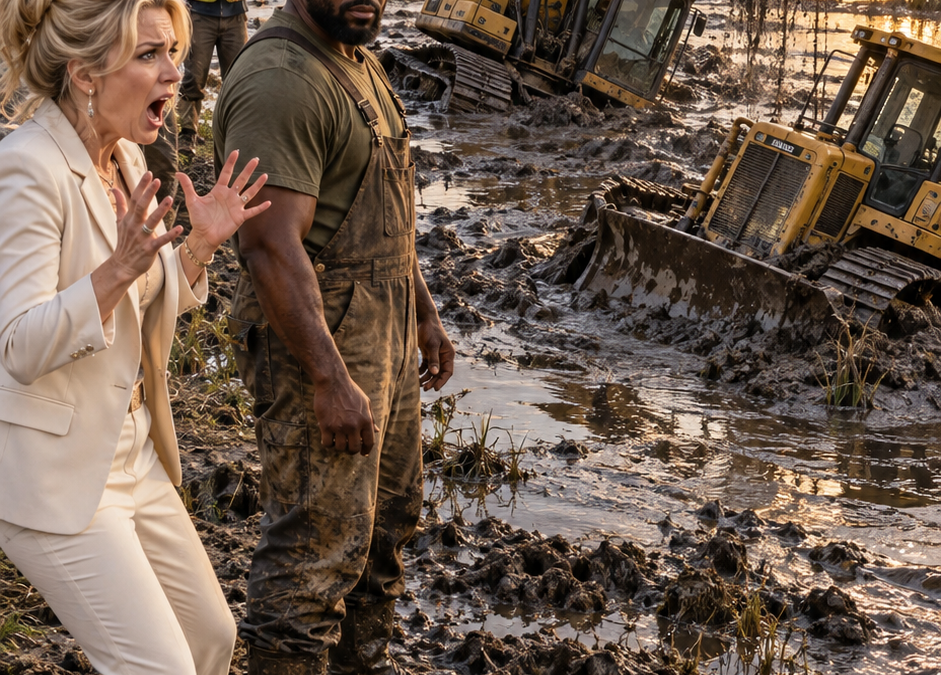
PART2
My name is Silas Thorne.
I was sixty-two when Evergreen Crest decided my family’s land would look better if part of it belonged to them.
I had retired three years earlier after spending thirty-five years as a geotechnical engineer with the state highway division.
My career had involved soil boring logs, slope failures, bridge foundations, retaining systems, landslides, liquefaction analysis, and enough meetings with planners who believed colored lines on presentation slides could negotiate with geology to cure me permanently of optimism.
When I retired, I went home.
Home was one hundred acres in western Oregon that my grandfather, Elijah Thorne, bought after returning from the war in 1948.
He had cleared the upper fields.
Built the barn.
Raised cattle.
Planted alder breaks.
Repaired drainage channels by hand.
He never called himself an environmentalist.
He would have hated the word.
He simply understood that some land wanted to be pasture, some wanted to be forest, and some land wanted everyone to leave it alone.
Blackwood Fen belonged in the last category.
Thirty acres of my lower property sat over an ancient glacial wetland.
From a distance, it looked deceptively ordinary.
Bright green sedges.
Cattails.
Patches of soft pasture grass.
A few shallow pools.
The kind of land a realtor might call “seasonally damp.”
That phrase would have made my grandfather laugh until he coughed.
Beneath the green surface sat deep organic peat mixed with silty clay and groundwater.
In several zones, the soil was thixotropic.
That is an engineering word for a phenomenon that becomes very memorable the first time thirty thousand pounds of machinery discovers it.
Undisturbed, the soil can seem surprisingly stable.
Its particles, organic fibers, roots, and clay form a delicate internal structure capable of carrying modest loads.
Shake it.
Vibrate it.
Overload it.
That structure collapses.
Pore water takes over.
Shear strength disappears.
Solid-looking earth becomes something much closer to soup.
Grandpa called it the bottomless blue clay.
He didn’t need a graduate degree.
He had watched one tractor disappear to the hood there in 1957.
Afterward he drove cedar stakes around the dangerous areas and told my father:
“If you need something from that meadow, walk.”
I kept the rule.
Then Evergreen Crest appeared.
The subdivision rose along the ridge north of my land during the final years before I retired.
Eighty-five large homes.
White siding.
Gray roofs.
Three-car garages.
Decorative stone entry columns.
Every yard looked as though it had been vacuumed.
I didn’t mind the houses.
People need somewhere to live.
I didn’t mind their pools.
Their golf carts.
Their lawn-service trucks.
I didn’t even mind their endless community emails complaining that my cattle occasionally produced smells inconsistent with “premium residential living.”
Cows are notorious for ignoring branding strategy.
What I minded was the assumption that because Evergreen Crest could see my property, it had acquired a vote in what happened there.
That assumption became much worse after Genevieve Croft became HOA president.
Genevieve was fifty-six, spent twenty years in luxury residential real estate, and possessed the kind of polished confidence normally associated with people who have never been forced to reconsider a sentence halfway through saying it.
She drove a silver Mercedes SUV that somehow remained spotless despite living in Oregon.
She carried a black leather clipboard to every interaction.
I never discovered why.
Maybe authority required accessories.
Our first serious dispute involved my barn.
She wanted me to paint it “Evergreen Crest Heritage White.”
I declined.
Her second involved cattle fencing.
She wanted dark powder-coated aluminum because my cedar posts were “visually rustic.”
I told her that was generally the idea.
Her third involved my lower wetland.
That one stopped being funny.
It began on a Saturday afternoon.
I was rebuilding the carburetor on my grandfather’s old Ford 8N tractor beneath the equipment shed.
I heard the Mercedes before I saw it.
Too much throttle on gravel.
Genevieve stopped beside my pasture gate.
She got out wearing white trail shoes, black designer leggings, and a gray outdoor vest so clean I suspected it had never encountered outdoors.
“Silas Thorne.”
I kept working.
“Still me.”
“We need to discuss the lower basin.”
“That sounds ominous.”
She marched toward me.
“We’ve approved the summer beautification master plan.”
“Congratulations.”
“The HOA will be reclaiming the low area adjacent to our southern boundary.”
My wrench stopped.
“Reclaiming?”
“Yes.”
“From whom?”
She pointed toward Blackwood Fen.
“That area.”
“My wetland.”
“The unused basin.”
“It’s wetland.”
“We’re developing a passive recreational amenity.”
“On my property?”
“We’re calling it Croft’s Oasis.”
I looked at her.
“Of course you are.”
She ignored that.
“Walking trail. Three cedar gazebos. Wildlife-viewing deck. Native landscape areas.”
“It already has native landscape.”
“Yes, but organized.”
There it was.
Nature’s oldest deficiency.
Insufficient management meetings.
I wiped my hands on a rag.
“Genevieve, everything south of that fence is mine.”
“Not exactly.”
She opened the clipboard.
I knew then I was about to hear the kind of legal interpretation that begins with confidence and ends with invoices.
“Our title consultant found a 1982 county drainage easement covering the basin.”
“I know the document.”
“Good. Then you know the surrounding development has utility-access rights for drainage improvement.”
“No.”
Her smile tightened.
“Our attorneys disagree.”
“The 1982 agreement was between my father and Westland Timber.”
“It is recorded as a county drainage easement.”
“It was a temporary access agreement connected to their timber operation.”
“It remains in county records.”
“It expired.”
She tilted her head.
“That’s your interpretation.”
“No. That’s the termination filed in 1991.”
She paused.
Only briefly.
Then recovered.
“Our legal review says otherwise.”
“Your legal review is wrong.”
“We are moving forward Monday.”
That got my full attention.
“With what?”
“Western Horizon Excavation.”
She looked toward the fen.
“They’ll clear brush, grade the basin, and establish drainage before trail construction.”
I stared at her for several seconds.
“Tell me you haven’t signed that contract.”
“I certainly have.”
“Genevieve, forget ownership for a second.”
“I won’t.”
“Humor me.”
She folded her arms.
“That meadow cannot support heavy machinery.”
She looked toward the bright green grass.
“It looks perfectly solid.”
“Grass is not a geotechnical report.”
“Our contractor has modern equipment.”
“So did the Titanic.”
She frowned.
“That comparison doesn’t even make sense.”
“It will Monday.”
I pointed toward the wetland.
“See those sedges?”
“The weeds?”
“Sedges.”
“All right.”
“They grow there because the water table is at or near the surface.”
“So?”
“That surface crust sits over peat and liquefiable silty clay.”
“A little mud.”
“No.”
I stepped closer.
“This matters. Heavy vibration can cause that soil structure to collapse. A tractor might cross the first fifty yards and look fine. Then it will reach the old channel and drop.”
She laughed.
Actually laughed.
“Silas, Western Horizon works on commercial sites.”
“I designed highway foundations.”
“Thirty years ago.”
“Last project was three years ago.”
“Technology changes.”
“Soil did not download an update.”
Her smile disappeared.
“We are not asking permission.”
“Yes, you are.”
“No.”
“You are standing on my property discussing entering more of my property.”
“The easement—”
“Expired.”
“Our counsel says active.”
“And I am telling you the machines will sink.”
“Our contractors are professionals.”
“So am I.”
She looked me up and down.
Apparently retired engineers in grease-stained shirts lose professional status.
“We’ll see Monday.”
She turned.
I called after her.
“One more thing.”
She stopped.
“If they cut that lock, I will document it as trespass.”
She looked back.
“File whatever complaint makes you feel better.”
Then she drove away.
I stood watching the Mercedes climb the ridge.
I could have called my attorney.
I did call him, actually.
My attorney was my cousin Daniel, who specialized in property disputes and had the unfortunate habit of becoming cheerful when people did obviously stupid things on record.
I explained the situation.
His first answer was predictable.
“I can file for temporary relief Monday morning.”
“They’re starting at seven-thirty.”
“Then I’ll file at eight.”
“They’ll already be inside.”
“Call the sheriff.”
“I intend to.”
“Silas.”
“Yes?”
“You sound suspiciously calm.”
“I’m standing beside Blackwood Fen.”
Long silence.
“Oh no.”
“Oh yes.”
“Do not encourage them.”
“I’m not encouraging anyone.”
“Do not alter the land.”
“I haven’t.”
“Do not create hazards.”
“I don’t need to.”
“Silas.”
“The ground has been waiting three thousand years. It doesn’t need my help.”
Daniel sighed.
“I dislike how much you’re enjoying this.”
“I haven’t enjoyed anything yet.”
That was true.
Mostly.
Sunday, I prepared.
Not the wetland.
My records.
Warranty deed.
1991 easement termination.
County plats.
2012 wetland-conservation enrollment.
State habitat maps.
Environmental-protection documents.
Photographs of the fence and lock.
I installed two trail cameras facing the gate.
Checked my house camera.
Charged the Sony camcorder.
Then I walked the fen.
Rain had been falling intermittently for three days.
The upper crust felt springy beneath my boots.
I stayed on familiar hummocks.
Near the buried glacial channel, water stood less than six inches below the surface.
I pushed a soil probe down.
It slid nearly without resistance.
“Perfect,” I muttered.
Then immediately corrected myself.
“Terrible.”
Bear, my German Shepherd, watched me.
“You know what I mean.”
Monday arrived gray and wet.
At 7:26, diesel engines came down the subdivision road.
Genevieve’s Mercedes first.
Naturally.
Then a flatbed carrying a Caterpillar D6.
Behind it, a John Deere 8R.
A crew truck.
And two contractor pickups.
Western Horizon had not come cheaply.
I stood on my porch.
Coffee.
Camcorder.
Bear beside me.
The vehicles stopped at the gate.
A foreman got out.
Looked at the chain.
Looked toward my house.
Genevieve walked over.
I could not hear everything from that distance.
I didn’t need to.
She pointed at the lock.
The foreman hesitated.
She pointed again.
One worker retrieved bolt cutters.
Metal snapped.
I zoomed in.
Perfect.
They opened my gate.
Genevieve looked toward the house.
Even from a hundred yards away, the smug satisfaction was visible.
I lifted my coffee mug.
She did not appreciate the gesture.
The John Deere entered first.
Its young operator seemed happy enough.
He drove across the initial grass.
Ten yards.
Twenty.
Thirty.
Nothing.
Genevieve looked toward me again.
Forty.
Fifty.
The tractor’s wide tires spread the load well.
If you didn’t know the subsurface map, you might think I had exaggerated.
Then it reached the old glacial channel.
The left rear tire dropped six inches.
The operator stopped.
Bad choice.
Momentum is useful in weak ground.
He tried to move forward.
The tire spun.
Worse choice.
Then he increased throttle.
Worst choice.
Mud sprayed twenty feet.
The tractor sank.
I could almost hear my grandfather.
Never spin a wheel in blue clay.
The operator engaged the differential lock.
Both rear tires began turning.
The surface crust disappeared beneath them.
Black peat rolled upward.
Water appeared.
Within seconds, the axle was nearly at ground level.
The tractor leaned.
Then stopped moving entirely.
Genevieve ran toward it.
Her shoes lasted approximately eight seconds.
The white fabric turned black.
That was perhaps the first measurable loss of the morning.
“What are you doing?” she shouted.
The operator opened his cab door.
“It’s soft!”
“It’s mud!”
“Yes!”
“Drive out!”
“I’m trying!”
“Use four-wheel drive!”
“It is in four-wheel drive!”
She looked genuinely offended by this information.
The foreman walked toward her.
“We should stop.”
“Absolutely not.”
“We need recovery boards or mats.”
“We’re not waiting.”
He looked toward the tractor.
“If we bring the dozer in, we may lose that too.”
Genevieve pointed at the Caterpillar.
“That machine has tracks.”
“Yes.”
“It’s designed for mud.”
“It’s designed for bearing surfaces that support track pressure.”
She stared.
He tried again.
“Ground still has to hold it.”
“I’m paying five thousand dollars a day for that dozer.”
The foreman’s expression said this information had not improved the soil.
She continued.
“Get the tractor out.”
Hank Mercer climbed down from the D6.
I recognized him.
We had served together on a county road advisory committee years earlier.
He walked to the pasture edge.
Stared toward the Deere.
Then toward me.
I kept filming.
He shouted:
“Silas! That old channel still runs under there?”
“Yes.”
Hank nodded slowly.
Then looked at Genevieve.
“I wouldn’t put the dozer in.”
She snapped:
“I did not hire you to ask the farmer’s permission.”
“He’s a geotechnical engineer.”
“He’s retired.”
Hank stared at her.
I could almost see him deciding how much he needed this job.
Apparently enough.
“Your call.”
“Good.”
“But if she sinks, she sinks on your call.”
“Noted.”
I zoomed in on Genevieve.
“Fine.”
Hank returned to the dozer.
The D6 entered slowly.
For the first hundred feet, its tracks performed beautifully.
Wide footprint.
Low speed.
Minimal turning.
Hank knew what he was doing.
He stopped twenty yards short of the tractor.
That was smart.
A worker dragged out the tow cable.
They attached the Deere to the bulldozer.
Hank leaned from his cab.
“Everyone clear!”
Genevieve moved back.
The line tightened.
Hank reversed gently.
The John Deere shifted.
Maybe an inch.
Then another.
For one moment, Genevieve smiled.
Then the ground under the D6 rippled.
Not metaphorically.
I saw an actual wave move through the saturated turf beside the track.
The engine vibration had begun collapsing the soil structure.
Hank saw it too.
He stopped.
Genevieve shouted:
“Don’t stop!”
Hank pointed downward.
“Ground’s moving!”
“Keep pulling!”
“I’m telling you—”
“Pull!”
Hank tried once more.
The D6 sank six inches.
Then another six.
The tracks started churning black water.
Hank immediately released throttle.
Too late.
Fifteen tons of iron settled onto its belly.
Now both machines were trapped.
Genevieve ran toward the dozer.
“No!”
Hank climbed out.
“I told you.”
“You stopped pulling!”
“Because I enjoy living.”
“We need the tractor out!”
“We need mats, low-ground-pressure recovery equipment, and probably an excavator operating from stable ground.”
“We have a bulldozer.”
“We have a bulldozer stuck in a bog.”
She glared at him.
I almost felt bad.
Almost.
Then she called for the recovery truck.
Two hours later, the largest vehicle of the day arrived.
Kenworth tri-axle heavy wrecker.
Rotating recovery boom.
Massive outriggers.
Two heavy winches.
The kind of truck designed to pull overturned tractor-trailers out of ravines.
The driver introduced himself as Buck Harlan.
Buck took one look at the pasture and laughed.
Not at me.
Not at Genevieve.
At the machines.
“Who drove those in there?”
Genevieve stepped forward.
“We don’t have time for commentary.”
Buck looked at her.
“That means you.”
“Can you recover them?”
“Maybe.”
“How much?”
“Emergency heavy recovery, minimum twelve thousand to mobilize.”
“Fine.”
“That’s before extraction.”
“Fine.”
“If I need mats, additional.”
“Fine.”
“If the machine is flooded—”
“Whatever it costs!”
Buck looked at Hank.
Hank shrugged.
Buck walked toward the edge.
Tested the soil with a steel bar.
Then looked at me.
“You own this?”
“Yes.”
“Road too?”
“Shoulder on this side.”
“Subgrade?”
“Old compacted gravel over clay.”
He frowned.
“How deep?”
“Depends where you set your outriggers.”
That got his attention.
Genevieve interrupted.
“Can we stop discussing geology?”
Buck looked at her.
“Lady, geology is currently holding two of your machines hostage.”
I liked Buck.
He kept the Kenworth on the gravel road.
That was smart.
Then he extended the boom.
Lowered his outriggers.
One landed closer to the road edge than I liked.
I walked over.
“Buck.”
He looked down.
“That shoulder sits over soft fill.”
“How soft?”
“Under high concentrated load?”
“Yes.”
“Soft enough I wouldn’t put that outrigger there.”
Genevieve threw her hands up.
“Oh, for God’s sake!”
Buck ignored her.
He repositioned slightly.
Better.
Not perfect.
But better.
They attached the line to the D6.
Buck tightened it.
The cable rose.
Mud suction is a remarkable force.
A buried machine does not weigh only what the manufacturer says it weighs.
You also have to overcome suction across every buried surface.
The winch load climbed.
The D6 moved perhaps four inches.
Buck increased pressure.
The Kenworth’s right outrigger pressed deeper.
Gravel cracked.
I saw the shoulder deform.
“Buck!”
He looked.
The pad dropped.
Maybe eight inches.
He hit the emergency release immediately.
Smart man.
The cable slackened.
The Kenworth rocked.
Nothing catastrophic.
But enough.
Buck climbed down.
“We’re done.”
Genevieve marched toward him.
“What do you mean done?”
“This needs engineered recovery.”
“You are engineered recovery!”
“No. I’m a tow operator with a truck that costs more than your Mercedes.”
She flinched.
“I need steel mats from the road all the way to the D6, probably a tracked low-ground-pressure excavator staged from the north, and environmental supervision if this really is wetland.”
Her eyes snapped toward me.
“It is not wetland.”
I raised my hand.
“It is.”
“You stay out of this.”
Buck looked between us.
“You two having a property dispute?”
“Yes,” she said.
“No,” I said.
He frowned.
I clarified.
“She is.”
That was when the sheriff arrived.
Not because Genevieve called him.
Daniel did.
My attorney had filed the trespass complaint once the trail camera uploaded footage of the cut lock.
Sheriff Marcus Miller stepped from his SUV.
Behind him came county surveyor David Evans.
Genevieve hurried toward them.
Finally.
Authority she expected to work in her direction.
“Sheriff, thank God.”
Marcus looked toward the bog.
Then toward me.
“Afternoon, Silas.”
“Marcus.”
Genevieve stopped.
She did not like familiarity between institutions and farmers.
“This man intentionally allowed our machines to become trapped.”
Marcus looked at me.
“Did you dig holes?”
“No.”
“Alter drainage?”
“No.”
“Remove support material?”
“No.”
I pointed toward the video camera.
“I’ve been standing mostly right there.”
Marcus nodded.
Genevieve said:
“He knew!”
“I warned you.”
“That makes you liable!”
David Evans actually laughed.
He covered it with a cough.
Marcus turned toward him.
“David?”
The surveyor unfolded a plat map on the hood of his truck.
“Mrs. Croft, you’re claiming authority through the 1982 drainage easement?”
“Yes.”
“It terminated in 1991.”
Her face changed.
“Our counsel reviewed it.”
“They reviewed the wrong index.”
“Impossible.”
“No.”
David pointed.
“The original Westland Timber agreement had a termination trigger tied to reconstruction of Highway 12 drainage infrastructure. That work was completed in 1991.”
He produced another document.
“Release filed September third of that year.”
Genevieve stared.
“But the tax map still shows an easement.”
“Tax maps are not deed records.”
“Our title company—”
“Should refund whatever you paid them.”
I almost coughed coffee through my nose.
David continued.
“The Evergreen Crest boundary terminates here.”
He pointed toward the survey stakes.
“The road shoulder and entire lower fen belong to Mr. Thorne.”
Genevieve looked at me.
Then the cut chain.
Then the machines.
Marcus took over.
“So.”
He spoke slowly.
“Your crew cut his lock.”
Genevieve said nothing.
“Entered his property.”
Nothing.
“After being told not to.”
“He obstructed community development.”
Marcus raised an eyebrow.
“That was not my question.”
“Our attorney said—”
Marcus pointed toward the muddy machines.
“You need a better attorney.”
I allowed myself one small smile.
Then David said:
“There’s more.”
Genevieve looked physically offended by the idea.
I handed Marcus my conservation paperwork.
“In 2012, I enrolled thirty acres of Blackwood Fen in the state protected-wetland program.”
Marcus read the first page.
Then handed it to David.
David whistled.
Genevieve said:
“What now?”
Marcus looked toward the mud.
“Now your trespass may also be an environmental violation.”
The rain intensified.
Perfect timing.
I had already notified the Oregon Department of Environmental Quality after the D6 hydraulic line began leaking.
At 4:45, their vehicle arrived.
Inspector Elena Vance stepped out in a yellow rain jacket.
She did not introduce herself to Genevieve first.
She went directly to the water.
That alone told me the afternoon had shifted into a different kind of problem.
Elena collected samples from the tractor ruts.
Then near the bulldozer.
Then from runoff below the damaged road shoulder.
She held one vial toward the light.
Petroleum sheen separated clearly on top.
“Active hydraulic release.”
Genevieve stepped closer.
“Our contractor is handling it.”
Elena looked around.
“With what containment?”
Silence.
“Absorbent boom?”
None.
“Spill pads?”
None.
“Vacuum recovery?”
None.
“Our machines just became stuck.”
Elena nodded.
“And fluids are entering a protected wetland.”
“It was an accident.”
“Accidents still require response.”
Genevieve looked toward me.
“He called you before giving us time to fix it.”
Elena followed her gaze.
“He called us because state law requires prompt reporting.”
That did not improve Genevieve’s afternoon.
Elena opened the wetland database on her tablet.
“Blackwood Fen. Category One protected glacial wetland. Habitat records include Oregon spotted frog and sensitive waterfowl.”
Genevieve said:
“We had no idea.”
“The boundary is publicly mapped.”
“Our legal counsel—”
Elena stopped her.
“I’m not evaluating your attorney.”
Thank God.
Everyone else already had.
“I’m evaluating environmental damage.”
She walked toward the Deere rut.
“This disturbance is significant.”
“How significant?”
“Depends on soil impact, fluid release, and removal method.”
Genevieve glanced toward the machines.
“We’re getting them out now.”
“No.”
“What?”
“I’m issuing a stop-work order.”
Genevieve stared.
“You cannot leave the machines in there.”
“I did not say leave them indefinitely.”
“You just said stop.”
“I said you may not improvise another recovery attempt.”
Buck nodded appreciatively.
Elena continued.
“You need a state-approved recovery plan designed to prevent additional wetland damage.”
Genevieve’s face was becoming pale.
“How long?”
“If your contractor submits a competent plan immediately, probably tomorrow.”
“And fines?”
Elena looked at her tablet.
“We’ll calculate penalties after inspection.”
“Give me a number.”
“Preliminary categories include unauthorized wetland disturbance, petroleum discharge, and failure to maintain spill controls.”
Genevieve swallowed.
“What kind of number?”
“Tens of thousands.”
Silence.
Even the rain seemed quieter.
Genevieve’s clipboard slipped from her hand.
It landed face-down in mud.
Nobody moved to retrieve it.
I looked at Bear, who had joined me beside the fence.
“Rough Monday.”
He sneezed.
The recovery took four days.
Not because the swamp refused to release the machines forever.
Because once professionals took control, they stopped treating horsepower as a substitute for planning.
Steel access mats were placed from the road.
Low-ground-pressure tracked equipment approached from carefully selected points.
Absorbent booms surrounded the contaminated ruts.
Fluids were pumped from the disabled machines before major extraction.
Rigging engineers calculated pull angles.
Environmental monitors watched every movement.
The John Deere came out first.
It emerged covered in black peat to the windows.
Its engine had taken water.
Axles and electronics needed rebuilding.
The D6 required a heavier pull.
When it finally reached the steel mats, a cheer went up from the recovery crew.
Not Genevieve.
She had stopped visiting the site after the second day.
Western Horizon sent an invoice to the HOA.
Eighty-five thousand dollars for emergency recovery, equipment stabilization, environmental controls, and support.
Then DEQ issued preliminary penalties.
Then my restoration estimate arrived.
Then Daniel sent the HOA our settlement demand.
By Thursday evening, Evergreen Crest residents finally discovered what Croft’s Oasis was going to cost them.
The HOA meeting was held in their community gym.
Daniel suggested I stay home.
I laughed.
“You think I’m missing this?”
“I think you enjoy suffering more than I realized.”
“I spent thirty-five years in state engineering meetings.”
“Fair point.”
Every seat was filled.
Eighty-five homeowners.
Standing room along the walls.
Genevieve sat at the center of the board table.
No sunglasses.
No clipboard.
Interesting.
The treasurer, Arthur Pendleton, opened the meeting.
His hands shook.
“Before we begin—”
A man shouted:
“How much?”
Arthur blinked.
“We’ll get to—”
“How much did she cost us?”
Someone else:
“Was it trespassing?”
The room erupted.
Arthur tapped the microphone.
Feedback screamed.
That somehow made everything worse.
Finally, he put a slide on the projector.
LOWER BASIN PROJECT — EMERGENCY FINANCIAL IMPACT
I almost admired the euphemism.
Trespass had become a lower-basin project.
Arthur cleared his throat.
“Recovery costs for contractor equipment currently total approximately eighty-five thousand dollars.”
People shouted.
He raised his voice.
“Please.”
Another slide.
“Environmental remediation and monitoring are estimated at ninety thousand, including state penalties and spill mitigation.”
More shouting.
Then:
“Mr. Thorne’s counsel has submitted a settlement demand.”
A woman turned toward me.
“How much?”
Daniel answered from beside me.
“Forty thousand for ecological restoration, fifty thousand for trespass and property damage, reimbursement of legal expenses, and permanent boundary fencing.”
A man yelled:
“Why are we paying for his fence?”
I stood.
“Because your contractors cut mine.”
That quieted him.
Arthur returned to the screen.
“The fence estimate is twenty-five thousand.”
A resident shouted:
“So we’re already over two hundred fifty thousand?”
“Approximately.”
“And the reserve fund?”
Arthur swallowed.
“Twelve thousand.”
The gym exploded.
I had witnessed slope failures quieter than that room.
One young father stood.
“I moved here six months ago. Why am I paying for this?”
Genevieve finally spoke.
“The board acted based on legal advice.”
A woman near the front shouted:
“Which lawyer?”
Genevieve paused.
“Our association counsel.”
Arthur looked uncomfortable.
Then the board secretary leaned toward her microphone.
“For the record, association counsel advised that the easement required title verification before physical entry.”
Everything stopped.
Genevieve turned.
“That is not how I understood the email.”
The secretary had come prepared.
She held up a printed page.
“It says, quote, ‘Do not commence work until current easement status and ownership boundary are confirmed.’”
Somewhere in the back, someone said:
“Oh, you have got to be kidding me.”
Genevieve’s face hardened.
“The project had already been delayed.”
A homeowner stood.
“So you ignored your own lawyer?”
“We had a title-company opinion.”
Daniel spoke quietly beside me.
“Ask for it.”
I raised my hand.
Arthur saw me.
“Mr. Thorne.”
“Could the board display the title opinion?”
Genevieve said immediately:
“That document is privileged.”
Daniel stood.
“A title-company report provided as the factual basis for entry onto my client’s land is not magically an attorney-client communication because Mrs. Croft prefers not to read it aloud.”
A few residents laughed.
Genevieve glared.
Arthur looked toward the property manager.
“Do we have it?”
He nodded.
“It’s in the project packet.”
They displayed it.
Three pages.
The important sentence sat halfway down page two.
Easement status appears on historical mapping; current validity has not been independently verified.
The room went very quiet.
I almost admired the wording.
Legal uncertainty compressed into one sentence.
Genevieve had apparently read it as:
Bring bulldozer.
A woman near the front asked:
“You knew it wasn’t verified?”
Genevieve snapped:
“I knew it appeared on official records.”
“Historical records.”
“The distinction was not explained to me.”
Arthur stared at her.
“The sentence literally says current validity has not been verified.”
That was when she lost him.
You could see it.
Not dramatically.
Just a tired man realizing loyalty was becoming expensive.
Genevieve leaned toward the microphone.
“Everyone needs to understand the purpose of this project. Croft’s Oasis would have increased home values. It would have transformed an unused mosquito basin into beautiful common recreational space.”
I heard myself laugh.
Not loudly.
Enough.
She looked at me.
“You find this funny?”
“I find ‘unused mosquito basin’ creative.”
“You left that land abandoned.”
“It is protected habitat.”
“It is mud.”
“Yes.”
I nodded.
“That was the part I emphasized.”
Several people laughed.
Genevieve’s voice sharpened.
“You intentionally stood by while contractors entered a dangerous area.”
“I told you it was dangerous.”
“You should have stopped them.”
“I told you not to enter.”
“You could have physically blocked the equipment!”
“With what? My body?”
Silence.
“You cut a locked gate.”
I looked around the room.
“You were warned about ownership.”
I counted on my fingers.
“You were warned about the expired easement.”
Another finger.
“You were warned the ground could not support heavy equipment.”
Another.
“You were warned I would document trespass.”
I lowered my hand.
“What exactly was left for me to say?”
Nobody answered.
Genevieve did.
“You wanted this.”
I considered that.
“No.”
“Liar.”
“I wanted you to leave.”
“You enjoyed watching those machines sink.”
Now that was harder.
I smiled slightly.
“I enjoyed being believed eventually.”
The room reacted to that one.
Not laughter exactly.
Understanding.
Because plenty of them had probably experienced Genevieve’s particular version of leadership.
Being told no with confidence.
Being corrected in public.
Being fined.
Being treated as inconvenient until documentation became impossible to ignore.
A retired teacher stood.
“Genevieve fined me eleven hundred dollars last year because my rain garden was ‘standing water.’”
Genevieve closed her eyes.
The woman continued.
“But you tried to build a park in a protected wetland?”
Another resident stood.
“You fined me for having a trailer visible from the road.”
Another.
“You threatened a lien over my fence stain.”
Another.
“My son’s basketball hoop.”
Arthur tried to regain order.
It was gone.
Years of grievances were now pouring out.
Apparently Blackwood Fen had not been the only thing under pressure.
Then someone shouted:
“Special assessment.”
The room quieted.
Arthur looked sick.
“Yes.”
“How much?”
He changed the slide.
PROPOSED EMERGENCY ASSESSMENT: $3,500 PER HOUSEHOLD
The explosion returned.
Three thousand five hundred dollars.
Due within thirty days.
To pay for a park nobody had voted to build on land the HOA didn’t own.
One man slammed both hands against the back of a chair.
“I have twins starting college!”
A woman yelled:
“Take it out of Genevieve’s house!”
Another:
“Recall the board!”
Then the chant began.
“RESIGN.”
At first, five people.
Then fifteen.
Then almost the entire room.
“RESIGN.”
Genevieve stood.
Her mouth opened.
The microphone was still on.
Nobody cared.
“RESIGN.”
She looked toward the other board members.
Not one stepped in.
“RESIGN.”
She collected her handbag.
No clipboard.
Interesting again.
Then she walked out the side door.
For a woman who had spent years entering rooms expecting everyone else to yield, there was something deeply satisfying about watching the room refuse.
I stayed for another thirty minutes.
The remaining board voted to suspend the beautification project permanently.
They accepted mediation with me.
They hired independent counsel.
Then they scheduled a recall vote.
Daniel leaned over.
“Ready to go?”
“Almost.”
“What are you waiting for?”
Arthur was still speaking.
“Permanent six-foot boundary fencing funded by the HOA…”
I stood.
“Now.”
The settlement happened quickly after that.
The HOA accepted responsibility for restoration costs without admitting every allegation Daniel wanted them to admit.
Lawyers enjoy admissions.
I enjoy repaired land.
We received enough to restore the wetland, rebuild my gate, cover ecological monitoring, and compensate for physical damage.
The association paid for a commercial-grade fence along the entire shared boundary.
Six feet tall.
Galvanized.
Set exactly one inch inside their side of the surveyed property line.
That detail was mine.
Petty?
Maybe.
Precise?
Absolutely.
The crew installing it arrived with survey coordinates and hand tools.
Their foreman, Robert Miller, walked to my porch before touching anything.
“Morning, Mr. Thorne.”
“Morning.”
He held up the plat.
“We verified every corner.”
“Good start.”
“No machinery crossing the wetland.”
“Excellent.”
“We’ll stage from the road.”
“You may be my favorite contractor this month.”
He laughed.
“Low bar?”
“Extremely.”
They installed the fence over ten days.
Meanwhile, Dr. Sarah Jenkins, a wetland biologist, helped me assess the damage.
The machinery had created deep ruts.
Peat was compressed.
Some root mats had been destroyed.
Hydraulic oil contamination required excavation.
But wetlands, when given time and peace, can be stubbornly resilient.
Sedges returned first.
Tiny green shoots pushed from damaged hummocks.
We replanted slough sedge, tufted hairgrass, and native rushes.
We stabilized exposed peat.
Then, one afternoon, Sarah pointed toward a shallow recovery pool.
“Oregon spotted frog.”
I crouched.
A small green-brown frog sat on moss beside clear water.
“Already?”
“They didn’t get the eviction notice.”
I smiled.
Bear sniffed in its direction.
“Leave him.”
Bear looked insulted.
The environmental penalties against Evergreen Crest were substantial.
Not quite the apocalyptic daily fine rumors circulating online claimed, but more than enough to make every future board member extremely interested in wetland maps.
The contractor’s insurer handled some equipment losses.
The HOA handled other liabilities.
Western Horizon pursued reimbursement for instructions it argued had exceeded the scope of the verified work site.
Everyone sued everyone for a while.
That is how civilization processes mud.
Genevieve lost the recall vote overwhelmingly.
The final count was not close enough to be interesting.
She resigned from the board before the paperwork was finalized.
Her house went on the market six weeks later.
The silver Mercedes disappeared first.
Then a moving truck arrived.
Then a red real-estate sign.
For Sale.
The asking price dropped twice.
I did not take pleasure in that.
All right.
That is not entirely true.
I took a little pleasure.
I am retired, not holy.
The phrase Croft’s Oasis became a county joke.
At the feed store, Marcus Bell asked me one morning:
“How’s the oasis?”
“Growing frogs.”
“Gazebos in yet?”
“Waiting on the swamp’s architectural review.”
He nearly spilled his coffee.
The local paper published a photograph of the buried John Deere before recovery.
The caption read:
LAND DISPUTE BOGS DOWN EVERGREEN CREST PROJECT
Journalists should be ashamed of themselves.
I bought three copies.
One is framed in my study.
The strangest part came months later.
Genevieve returned.
It was early spring.
Blackwood Fen had recovered enough that the deepest machine ruts had filled with water and native vegetation.
I was repairing the gate when a car stopped on the road.
Not the Mercedes.
A rental sedan.
Genevieve stepped out.
No clipboard.
No designer vest.
She walked toward the new fence.
She stayed on her side.
Progress.
“Silas.”
“Genevieve.”
She looked across the wetland.
“It looks the same.”
“No.”
“From here it does.”
“It’s healing.”
She stared at the fence.
“You really made them put it one inch inside our boundary.”
“Yes.”
“Why?”
“So nobody develops a philosophical disagreement about whose fence it is.”
She almost smiled.
Almost.
Then looked toward the low meadow.
“I still think the park would have been beautiful.”
“Probably.”
That surprised her.
“You do?”
“Gazebos are beautiful.”
“Then why—”
“Because beauty does not create ownership.”
She looked away.
“I made a mistake.”
I waited.
That sentence deserved room.
She continued.
“The title company told us there was an easement.”
“They told you it might still exist.”
“The board wanted the project.”
“The board was told you had verified the land.”
Her jaw tightened.
“You think I lied.”
“I think you turned uncertainty into certainty because certainty was more convenient.”
She looked at me.
“That’s a very engineer answer.”
“Retired engineer.”
“I don’t understand why you didn’t stop us.”
There it was again.
The same accusation.
“You knew what would happen.”
“I knew what could happen.”
“You filmed it.”
“Yes.”
“You could have called every contractor beforehand.”
“I spoke to Genevieve Croft beforehand.”
“That’s not the same.”
“You were the client.”
She shook her head.
“You always have an answer.”
“No.”
I leaned on the gate.
“I just finally learned not to confuse somebody rejecting an answer with me failing to give one.”
That silenced her.
After a moment, she said:
“You embarrassed me.”
“No.”
“Come on.”
“I documented you.”
“That’s the same thing.”
“It only feels the same when the behavior is embarrassing.”
She looked toward the wetland again.
“I spent years telling people this land was wasted.”
“I know.”
“I thought you kept it this way because you were sentimental.”
“I am sentimental.”
“And stubborn.”
“Very.”
“But you really knew those machines would sink.”
“I knew they had a high probability of losing bearing support.”
She laughed unexpectedly.
“Even now you can’t just say yes.”
“Yes.”
She laughed again.
Then stopped.
“I lost my house over this.”
I looked at her.
“No.”
Her eyes hardened.
“You think that’s funny?”
“No.”
“Then what?”
“You lost your board position.”
Silence.
“You chose to sell your house.”
“That assessment—”
“Was painful.”
“Legal bills.”
“Also painful.”
“You started those.”
“No.”
I shook my head.
“You cut my lock.”
She looked away.
There it was.
The beginning.
Not the machine sinking.
Not DEQ.
Not the meeting.
The lock.
People prefer consequences without beginnings.
It makes them feel victimized by the ending.
She stood there another minute.
Then said:
“I should have checked.”
“Yes.”
The answer came out before my old habit could soften it.
She nodded.
“I suppose that’s all there is.”
“Mostly.”
She walked back toward the rental car.
I called:
“Genevieve.”
She turned.
“If you ever buy land with cattails growing in the middle of it—”
She waited.
“Don’t bring a bulldozer.”
That time, she really did smile.
“Goodbye, Silas.”
“Goodbye.”
Years have passed.
Blackwood Fen is quiet again.
The heavy machine ruts became shallow seasonal pools.
Dragonflies hover over them during summer.
Red-winged blackbirds nest in the reeds.
The Oregon spotted frogs returned.
The new fence has weathered enough that it no longer looks new.
Evergreen Crest is still there on the ridge.
Different board.
Different president.
Much more cautious capital-improvement committee.
Their current HOA handbook includes an entire section requiring independent title verification, environmental review, and written landowner consent before any project crosses an external boundary.
I have a copy.
Page forty-three is particularly beautiful.
Sometimes new residents walk the subdivision trail and see me checking fence posts or moving cattle.
They wave.
A few know the story.
One young couple asked me whether the swamp really swallowed three machines.
“Two.”
“What about the crane truck?”
“Almost.”
“Did the machines disappear completely?”
“No.”
“That’s disappointing.”
I stared at him.
He laughed.
“I mean for the story.”
“For the invoice, partially submerged was enough.”
The John Deere survived.
After an engine rebuild.
The D6 needed substantial hydraulic and undercarriage work.
Buck’s recovery truck escaped with damaged outrigger components and a profound new respect for road shoulders.
Hank retired two years later.
He still stops by occasionally.
One afternoon we sat on my porch drinking coffee.
He looked toward the fen.
“You know what I hate?”
“What?”
“I knew better.”
“You said no.”
“Then I drove in anyway.”
“Genevieve was paying you.”
“Still my hands on the controls.”
That was an engineer’s answer too.
Responsibility travels down chains, but it does not disappear.
“You got out safely.”
“Barely.”
“The machine got repaired.”
“Eventually.”
“Learn anything?”
He took a drink.
“Never argue soil mechanics with a man holding a camcorder.”
“Good lesson.”
He shook his head.
“No. Real lesson?”
I waited.
“Machines make people feel powerful.”
He looked at the fen.
“But weight is just weight.”
Exactly.
That was what Genevieve never understood.
She believed modern equipment defeated old limitations.
Bigger tractor.
Wider tires.
Tracked bulldozer.
Rotator wrecker.
Every time the earth refused her, she answered with more machinery.
More power.
More weight.
The swamp answered the same way each time.
Come closer.
There is something humbling about geology.
HOA rules work because people agree to follow them.
Contracts work because courts enforce them.
Property lines work because records and law recognize them.
But bearing capacity?
Pore pressure?
Shear strength?
Those do not require agreement.
You can insult them.
Ignore them.
Sue them.
Hold a board meeting about them.
They remain what they are.
Blackwood Fen had existed long before my grandfather bought the farm.
Long before Highway 12.
Long before Evergreen Crest.
Long before anyone invented homeowner associations or leather clipboards.
It did not care about Genevieve’s beautification plan.
It did not care about my engineering degree either.
The only advantage I had was listening.
That is the part people misunderstand when they hear the story.
They think I beat Genevieve.
I didn’t.
I knew my boundary.
I knew my documents.
I knew the wetland designation.
I warned her.
Then I stepped aside.
The county survey beat her legal theory.
DEQ beat her environmental ignorance.
Her own attorney’s email beat her claim that nobody had warned her to verify the easement.
Her homeowners beat her presidency.
And the swamp?
The swamp simply behaved exactly the way it had behaved for thousands of years.
That morning when the John Deere finally died in black water, Genevieve screamed at me:
“You did this!”
I remember looking at those massive tires disappearing beneath the surface.
The same tires she had trusted because they were marketed as high flotation.
I remember Hank’s Caterpillar settling into the mud behind it.
I remember the towing cable snapping.
I remember that absurd black leather clipboard lying face-down in a puddle.
And I remember realizing how wrong she was.
I had done almost nothing.
She had cut the lock.
She had ignored the deed.
She had ignored the expired easement.
She had ignored the wetland map.
She had ignored my warning.
She had ordered the first machine forward.
Then the second.
Then the recovery truck.
Every expensive decision belonged to her.
All I had done was leave my land exactly where it had always been.
Some people think power is the ability to force the world to move.
Heavy machines.
Lawyers.
Board votes.
Money.
Titles.
But the older I get, the more I think power is often the opposite.
Knowing when not to move.
Knowing where the line is.
Knowing what the ground beneath your boots can actually carry.
And being patient enough to let someone who refuses to listen discover the answer for themselves.
Every evening, fog still settles over Blackwood Fen.
It hangs between the Douglas firs.
Water gathers beneath the sedges.
Frogs call from the old machine ruts.
The land looks soft because it is soft.
Nobody from Evergreen Crest calls it wasted anymore.
Nobody mentions Croft’s Oasis.
And nobody has cut my gate lock since.
Sometimes, when the rain has been heavy and the wetland is especially full, I take Bear’s successor—a younger shepherd named Moss—down to the fence.
We stay on the high ground.
Always.
I point toward the faint depression where the John Deere once disappeared.
Moss stares at it as if I expect him to understand.
Maybe he does.
Dogs are better at reading landscapes than HOAs.
Then I look up toward Evergreen Crest.
Clean roofs.
Perfect lawns.
New board.
New rules.
And a very expensive fence they paid to install between their certainty and my land.
The steel posts catch the sunset.
Behind them, Blackwood Fen settles into evening silence.
Patient.
Heavy.
Remembering.
Genevieve once believed a line on a subdivision plan gave her power over that ground.
She brought a tractor to prove it.
Then a bulldozer.
Then a recovery crane.
The swamp kept all three just long enough to make its point.
And by the time it finally gave the machines back, the HOA had lost hundreds of thousands of dollars, Genevieve had lost her presidency, and every homeowner on that ridge had learned the one rule my grandfather tried to teach me seventy years earlier.
You don’t conquer wet ground.
You respect it.
Because if you don’t, sooner or later, it starts collecting what you owe.
Have you finished reading the story and want to read it again?
HOA Sent Heavy Machines Onto My Land—Then the Swamp Swallowed $250,000 of Equipment
They cut my lock and drove onto my land.
I warned them the ground wasn’t solid.
Then the swamp started eating their machines.
The first sound was not the bulldozer.
It was the cable.
A two-inch braided steel recovery line stretched between a half-submerged John Deere tractor and a Caterpillar D6 bulldozer, humming under so much tension it sounded almost musical.
I had spent thirty-five years around heavy equipment.
When steel starts singing, smart people move.
Genevieve Croft was not having a smart morning.
“Keep pulling!” she screamed into a cheap handheld radio from the gravel road fifty yards away. “We are not losing this equipment because of a little mud!”
The bulldozer operator, Hank Mercer, looked through the rain-streaked windshield toward her.
Even from where I stood, I could see his expression.
He knew.
Everyone who had spent enough time around Oregon wetlands knew.
The ground beneath him was no longer behaving like ground.
It trembled beneath the Caterpillar’s tracks like dark gelatin.
Every vibration from the diesel engine was breaking down the fragile internal structure of the saturated soil beneath Blackwood Fen.
The John Deere was already buried past its axles.
Its enormous flotation tires had vanished into black peat and blue-gray clay.
The operator had tried everything.
Four-wheel drive.
Differential lock.
More throttle.
Then even more throttle, because apparently when a twenty-thousand-pound tractor is sinking into a bog, the human mind occasionally decides what the situation really needs is enthusiasm.
The tires had spun themselves into liquid mud.
Now the tractor sat crooked, its rear end several feet below the pasture surface.
Black water lapped against the cab steps.
Hank eased the bulldozer backward.
The cable tightened.
The tractor moved perhaps two inches.
Genevieve shouted triumphantly.
“There! Keep going!”
I leaned against a weathered fence post with a thermos of coffee in one hand and my old Sony camcorder in the other.
I did not yell.
I did not interfere.
I simply made sure the red recording light remained on.
Then the cable snapped.
The sound cracked across Blackwood Valley like a rifle.
The severed steel line whipped backward with terrifying speed and slammed into the bulldozer’s front grille.
Hank ducked.
Safety glass shattered.
The John Deere lurched backward into the bog and sank another two feet.
Its engine coughed.
Gurgled.
Then died.
For a few seconds, the entire meadow became quiet.
Rain.
Idling diesel.
A few startled crows.
Genevieve stared at the machines.
Then she looked at me.
Even fifty yards away, I could see the accusation forming.
“You did this!”
I lifted my coffee.
“No.”
“You sabotaged the ground!”
That was a new one.
I had been accused of trespass disputes, obstruction, refusing “community improvement,” and once—memorably—of harboring “aggressively rural vegetation.”
But sabotaging geology was ambitious even for an HOA president.
I looked toward the sinking equipment.
“I warned you not to cross the fence.”
“Get those machines out!”
I took another sip.
“Genevieve, those machines belong to your contractor.”
“This is your property!”
“Exactly.”
She stared at me.
I nodded toward the bog.
“And at the moment, the swamp seems to have stronger possession than either of us.”
To understand how roughly a quarter-million dollars of industrial machinery ended up disappearing into my lower pasture, you have to understand Blackwood Fen.
And to understand Blackwood Fen, you have to understand one simple rule my grandfather taught me before I was old enough to drive a tractor.
You do not bully wet ground.
You ask permission.
PART2
My name is Silas Thorne.
I was sixty-two when Evergreen Crest decided my family’s land would look better if part of it belonged to them.
I had retired three years earlier after spending thirty-five years as a geotechnical engineer with the state highway division.
My career had involved soil boring logs, slope failures, bridge foundations, retaining systems, landslides, liquefaction analysis, and enough meetings with planners who believed colored lines on presentation slides could negotiate with geology to cure me permanently of optimism.
When I retired, I went home.
Home was one hundred acres in western Oregon that my grandfather, Elijah Thorne, bought after returning from the war in 1948.
He had cleared the upper fields.
Built the barn.
Raised cattle.
Planted alder breaks.
Repaired drainage channels by hand.
He never called himself an environmentalist.
He would have hated the word.
He simply understood that some land wanted to be pasture, some wanted to be forest, and some land wanted everyone to leave it alone.
Blackwood Fen belonged in the last category.
Thirty acres of my lower property sat over an ancient glacial wetland.
From a distance, it looked deceptively ordinary.
Bright green sedges.
Cattails.
Patches of soft pasture grass.
A few shallow pools.
The kind of land a realtor might call “seasonally damp.”
That phrase would have made my grandfather laugh until he coughed.
Beneath the green surface sat deep organic peat mixed with silty clay and groundwater.
In several zones, the soil was thixotropic.
That is an engineering word for a phenomenon that becomes very memorable the first time thirty thousand pounds of machinery discovers it.
Undisturbed, the soil can seem surprisingly stable.
Its particles, organic fibers, roots, and clay form a delicate internal structure capable of carrying modest loads.
Shake it.
Vibrate it.
Overload it.
That structure collapses.
Pore water takes over.
Shear strength disappears.
Solid-looking earth becomes something much closer to soup.
Grandpa called it the bottomless blue clay.
He didn’t need a graduate degree.
He had watched one tractor disappear to the hood there in 1957.
Afterward he drove cedar stakes around the dangerous areas and told my father:
“If you need something from that meadow, walk.”
I kept the rule.
Then Evergreen Crest appeared.
The subdivision rose along the ridge north of my land during the final years before I retired.
Eighty-five large homes.
White siding.
Gray roofs.
Three-car garages.
Decorative stone entry columns.
Every yard looked as though it had been vacuumed.
I didn’t mind the houses.
People need somewhere to live.
I didn’t mind their pools.
Their golf carts.
Their lawn-service trucks.
I didn’t even mind their endless community emails complaining that my cattle occasionally produced smells inconsistent with “premium residential living.”
Cows are notorious for ignoring branding strategy.
What I minded was the assumption that because Evergreen Crest could see my property, it had acquired a vote in what happened there.
That assumption became much worse after Genevieve Croft became HOA president.
Genevieve was fifty-six, spent twenty years in luxury residential real estate, and possessed the kind of polished confidence normally associated with people who have never been forced to reconsider a sentence halfway through saying it.
She drove a silver Mercedes SUV that somehow remained spotless despite living in Oregon.
She carried a black leather clipboard to every interaction.
I never discovered why.
Maybe authority required accessories.
Our first serious dispute involved my barn.
She wanted me to paint it “Evergreen Crest Heritage White.”
I declined.
Her second involved cattle fencing.
She wanted dark powder-coated aluminum because my cedar posts were “visually rustic.”
I told her that was generally the idea.
Her third involved my lower wetland.
That one stopped being funny.
It began on a Saturday afternoon.
I was rebuilding the carburetor on my grandfather’s old Ford 8N tractor beneath the equipment shed.
I heard the Mercedes before I saw it.
Too much throttle on gravel.
Genevieve stopped beside my pasture gate.
She got out wearing white trail shoes, black designer leggings, and a gray outdoor vest so clean I suspected it had never encountered outdoors.
“Silas Thorne.”
I kept working.
“Still me.”
“We need to discuss the lower basin.”
“That sounds ominous.”
She marched toward me.
“We’ve approved the summer beautification master plan.”
“Congratulations.”
“The HOA will be reclaiming the low area adjacent to our southern boundary.”
My wrench stopped.
“Reclaiming?”
“Yes.”
“From whom?”
She pointed toward Blackwood Fen.
“That area.”
“My wetland.”
“The unused basin.”
“It’s wetland.”
“We’re developing a passive recreational amenity.”
“On my property?”
“We’re calling it Croft’s Oasis.”
I looked at her.
“Of course you are.”
She ignored that.
“Walking trail. Three cedar gazebos. Wildlife-viewing deck. Native landscape areas.”
“It already has native landscape.”
“Yes, but organized.”
There it was.
Nature’s oldest deficiency.
Insufficient management meetings.
I wiped my hands on a rag.
“Genevieve, everything south of that fence is mine.”
“Not exactly.”
She opened the clipboard.
I knew then I was about to hear the kind of legal interpretation that begins with confidence and ends with invoices.
“Our title consultant found a 1982 county drainage easement covering the basin.”
“I know the document.”
“Good. Then you know the surrounding development has utility-access rights for drainage improvement.”
“No.”
Her smile tightened.
“Our attorneys disagree.”
“The 1982 agreement was between my father and Westland Timber.”
“It is recorded as a county drainage easement.”
“It was a temporary access agreement connected to their timber operation.”
“It remains in county records.”
“It expired.”
She tilted her head.
“That’s your interpretation.”
“No. That’s the termination filed in 1991.”
She paused.
Only briefly.
Then recovered.
“Our legal review says otherwise.”
“Your legal review is wrong.”
“We are moving forward Monday.”
That got my full attention.
“With what?”
“Western Horizon Excavation.”
She looked toward the fen.
“They’ll clear brush, grade the basin, and establish drainage before trail construction.”
I stared at her for several seconds.
“Tell me you haven’t signed that contract.”
“I certainly have.”
“Genevieve, forget ownership for a second.”
“I won’t.”
“Humor me.”
She folded her arms.
“That meadow cannot support heavy machinery.”
She looked toward the bright green grass.
“It looks perfectly solid.”
“Grass is not a geotechnical report.”
“Our contractor has modern equipment.”
“So did the Titanic.”
She frowned.
“That comparison doesn’t even make sense.”
“It will Monday.”
I pointed toward the wetland.
“See those sedges?”
“The weeds?”
“Sedges.”
“All right.”
“They grow there because the water table is at or near the surface.”
“So?”
“That surface crust sits over peat and liquefiable silty clay.”
“A little mud.”
“No.”
I stepped closer.
“This matters. Heavy vibration can cause that soil structure to collapse. A tractor might cross the first fifty yards and look fine. Then it will reach the old channel and drop.”
She laughed.
Actually laughed.
“Silas, Western Horizon works on commercial sites.”
“I designed highway foundations.”
“Thirty years ago.”
“Last project was three years ago.”
“Technology changes.”
“Soil did not download an update.”
Her smile disappeared.
“We are not asking permission.”
“Yes, you are.”
“No.”
“You are standing on my property discussing entering more of my property.”
“The easement—”
“Expired.”
“Our counsel says active.”
“And I am telling you the machines will sink.”
“Our contractors are professionals.”
“So am I.”
She looked me up and down.
Apparently retired engineers in grease-stained shirts lose professional status.
“We’ll see Monday.”
She turned.
I called after her.
“One more thing.”
She stopped.
“If they cut that lock, I will document it as trespass.”
She looked back.
“File whatever complaint makes you feel better.”
Then she drove away.
I stood watching the Mercedes climb the ridge.
I could have called my attorney.
I did call him, actually.
My attorney was my cousin Daniel, who specialized in property disputes and had the unfortunate habit of becoming cheerful when people did obviously stupid things on record.
I explained the situation.
His first answer was predictable.
“I can file for temporary relief Monday morning.”
“They’re starting at seven-thirty.”
“Then I’ll file at eight.”
“They’ll already be inside.”
“Call the sheriff.”
“I intend to.”
“Silas.”
“Yes?”
“You sound suspiciously calm.”
“I’m standing beside Blackwood Fen.”
Long silence.
“Oh no.”
“Oh yes.”
“Do not encourage them.”
“I’m not encouraging anyone.”
“Do not alter the land.”
“I haven’t.”
“Do not create hazards.”
“I don’t need to.”
“Silas.”
“The ground has been waiting three thousand years. It doesn’t need my help.”
Daniel sighed.
“I dislike how much you’re enjoying this.”
“I haven’t enjoyed anything yet.”
That was true.
Mostly.
Sunday, I prepared.
Not the wetland.
My records.
Warranty deed.
1991 easement termination.
County plats.
2012 wetland-conservation enrollment.
State habitat maps.
Environmental-protection documents.
Photographs of the fence and lock.
I installed two trail cameras facing the gate.
Checked my house camera.
Charged the Sony camcorder.
Then I walked the fen.
Rain had been falling intermittently for three days.
The upper crust felt springy beneath my boots.
I stayed on familiar hummocks.
Near the buried glacial channel, water stood less than six inches below the surface.
I pushed a soil probe down.
It slid nearly without resistance.
“Perfect,” I muttered.
Then immediately corrected myself.
“Terrible.”
Bear, my German Shepherd, watched me.
“You know what I mean.”
Monday arrived gray and wet.
At 7:26, diesel engines came down the subdivision road.
Genevieve’s Mercedes first.
Naturally.
Then a flatbed carrying a Caterpillar D6.
Behind it, a John Deere 8R.
A crew truck.
And two contractor pickups.
Western Horizon had not come cheaply.
I stood on my porch.
Coffee.
Camcorder.
Bear beside me.
The vehicles stopped at the gate.
A foreman got out.
Looked at the chain.
Looked toward my house.
Genevieve walked over.
I could not hear everything from that distance.
I didn’t need to.
She pointed at the lock.
The foreman hesitated.
She pointed again.
One worker retrieved bolt cutters.
Metal snapped.
I zoomed in.
Perfect.
They opened my gate.
Genevieve looked toward the house.
Even from a hundred yards away, the smug satisfaction was visible.
I lifted my coffee mug.
She did not appreciate the gesture.
The John Deere entered first.
Its young operator seemed happy enough.
He drove across the initial grass.
Ten yards.
Twenty.
Thirty.
Nothing.
Genevieve looked toward me again.
Forty.
Fifty.
The tractor’s wide tires spread the load well.
If you didn’t know the subsurface map, you might think I had exaggerated.
Then it reached the old glacial channel.
The left rear tire dropped six inches.
The operator stopped.
Bad choice.
Momentum is useful in weak ground.
He tried to move forward.
The tire spun.
Worse choice.
Then he increased throttle.
Worst choice.
Mud sprayed twenty feet.
The tractor sank.
I could almost hear my grandfather.
Never spin a wheel in blue clay.
The operator engaged the differential lock.
Both rear tires began turning.
The surface crust disappeared beneath them.
Black peat rolled upward.
Water appeared.
Within seconds, the axle was nearly at ground level.
The tractor leaned.
Then stopped moving entirely.
Genevieve ran toward it.
Her shoes lasted approximately eight seconds.
The white fabric turned black.
That was perhaps the first measurable loss of the morning.
“What are you doing?” she shouted.
The operator opened his cab door.
“It’s soft!”
“It’s mud!”
“Yes!”
“Drive out!”
“I’m trying!”
“Use four-wheel drive!”
“It is in four-wheel drive!”
She looked genuinely offended by this information.
The foreman walked toward her.
“We should stop.”
“Absolutely not.”
“We need recovery boards or mats.”
“We’re not waiting.”
He looked toward the tractor.
“If we bring the dozer in, we may lose that too.”
Genevieve pointed at the Caterpillar.
“That machine has tracks.”
“Yes.”
“It’s designed for mud.”
“It’s designed for bearing surfaces that support track pressure.”
She stared.
He tried again.
“Ground still has to hold it.”
“I’m paying five thousand dollars a day for that dozer.”
The foreman’s expression said this information had not improved the soil.
She continued.
“Get the tractor out.”
Hank Mercer climbed down from the D6.
I recognized him.
We had served together on a county road advisory committee years earlier.
He walked to the pasture edge.
Stared toward the Deere.
Then toward me.
I kept filming.
He shouted:
“Silas! That old channel still runs under there?”
“Yes.”
Hank nodded slowly.
Then looked at Genevieve.
“I wouldn’t put the dozer in.”
She snapped:
“I did not hire you to ask the farmer’s permission.”
“He’s a geotechnical engineer.”
“He’s retired.”
Hank stared at her.
I could almost see him deciding how much he needed this job.
Apparently enough.
“Your call.”
“Good.”
“But if she sinks, she sinks on your call.”
“Noted.”
I zoomed in on Genevieve.
“Fine.”
Hank returned to the dozer.
The D6 entered slowly.
For the first hundred feet, its tracks performed beautifully.
Wide footprint.
Low speed.
Minimal turning.
Hank knew what he was doing.
He stopped twenty yards short of the tractor.
That was smart.
A worker dragged out the tow cable.
They attached the Deere to the bulldozer.
Hank leaned from his cab.
“Everyone clear!”
Genevieve moved back.
The line tightened.
Hank reversed gently.
The John Deere shifted.
Maybe an inch.
Then another.
For one moment, Genevieve smiled.
Then the ground under the D6 rippled.
Not metaphorically.
I saw an actual wave move through the saturated turf beside the track.
The engine vibration had begun collapsing the soil structure.
Hank saw it too.
He stopped.
Genevieve shouted:
“Don’t stop!”
Hank pointed downward.
“Ground’s moving!”
“Keep pulling!”
“I’m telling you—”
“Pull!”
Hank tried once more.
The D6 sank six inches.
Then another six.
The tracks started churning black water.
Hank immediately released throttle.
Too late.
Fifteen tons of iron settled onto its belly.
Now both machines were trapped.
Genevieve ran toward the dozer.
“No!”
Hank climbed out.
“I told you.”
“You stopped pulling!”
“Because I enjoy living.”
“We need the tractor out!”
“We need mats, low-ground-pressure recovery equipment, and probably an excavator operating from stable ground.”
“We have a bulldozer.”
“We have a bulldozer stuck in a bog.”
She glared at him.
I almost felt bad.
Almost.
Then she called for the recovery truck.
Two hours later, the largest vehicle of the day arrived.
Kenworth tri-axle heavy wrecker.
Rotating recovery boom.
Massive outriggers.
Two heavy winches.
The kind of truck designed to pull overturned tractor-trailers out of ravines.
The driver introduced himself as Buck Harlan.
Buck took one look at the pasture and laughed.
Not at me.
Not at Genevieve.
At the machines.
“Who drove those in there?”
Genevieve stepped forward.
“We don’t have time for commentary.”
Buck looked at her.
“That means you.”
“Can you recover them?”
“Maybe.”
“How much?”
“Emergency heavy recovery, minimum twelve thousand to mobilize.”
“Fine.”
“That’s before extraction.”
“Fine.”
“If I need mats, additional.”
“Fine.”
“If the machine is flooded—”
“Whatever it costs!”
Buck looked at Hank.
Hank shrugged.
Buck walked toward the edge.
Tested the soil with a steel bar.
Then looked at me.
“You own this?”
“Yes.”
“Road too?”
“Shoulder on this side.”
“Subgrade?”
“Old compacted gravel over clay.”
He frowned.
“How deep?”
“Depends where you set your outriggers.”
That got his attention.
Genevieve interrupted.
“Can we stop discussing geology?”
Buck looked at her.
“Lady, geology is currently holding two of your machines hostage.”
I liked Buck.
He kept the Kenworth on the gravel road.
That was smart.
Then he extended the boom.
Lowered his outriggers.
One landed closer to the road edge than I liked.
I walked over.
“Buck.”
He looked down.
“That shoulder sits over soft fill.”
“How soft?”
“Under high concentrated load?”
“Yes.”
“Soft enough I wouldn’t put that outrigger there.”
Genevieve threw her hands up.
“Oh, for God’s sake!”
Buck ignored her.
He repositioned slightly.
Better.
Not perfect.
But better.
They attached the line to the D6.
Buck tightened it.
The cable rose.
Mud suction is a remarkable force.
A buried machine does not weigh only what the manufacturer says it weighs.
You also have to overcome suction across every buried surface.
The winch load climbed.
The D6 moved perhaps four inches.
Buck increased pressure.
The Kenworth’s right outrigger pressed deeper.
Gravel cracked.
I saw the shoulder deform.
“Buck!”
He looked.
The pad dropped.
Maybe eight inches.
He hit the emergency release immediately.
Smart man.
The cable slackened.
The Kenworth rocked.
Nothing catastrophic.
But enough.
Buck climbed down.
“We’re done.”
Genevieve marched toward him.
“What do you mean done?”
“This needs engineered recovery.”
“You are engineered recovery!”
“No. I’m a tow operator with a truck that costs more than your Mercedes.”
She flinched.
“I need steel mats from the road all the way to the D6, probably a tracked low-ground-pressure excavator staged from the north, and environmental supervision if this really is wetland.”
Her eyes snapped toward me.
“It is not wetland.”
I raised my hand.
“It is.”
“You stay out of this.”
Buck looked between us.
“You two having a property dispute?”
“Yes,” she said.
“No,” I said.
He frowned.
I clarified.
“She is.”
That was when the sheriff arrived.
Not because Genevieve called him.
Daniel did.
My attorney had filed the trespass complaint once the trail camera uploaded footage of the cut lock.
Sheriff Marcus Miller stepped from his SUV.
Behind him came county surveyor David Evans.
Genevieve hurried toward them.
Finally.
Authority she expected to work in her direction.
“Sheriff, thank God.”
Marcus looked toward the bog.
Then toward me.
“Afternoon, Silas.”
“Marcus.”
Genevieve stopped.
She did not like familiarity between institutions and farmers.
“This man intentionally allowed our machines to become trapped.”
Marcus looked at me.
“Did you dig holes?”
“No.”
“Alter drainage?”
“No.”
“Remove support material?”
“No.”
I pointed toward the video camera.
“I’ve been standing mostly right there.”
Marcus nodded.
Genevieve said:
“He knew!”
“I warned you.”
“That makes you liable!”
David Evans actually laughed.
He covered it with a cough.
Marcus turned toward him.
“David?”
The surveyor unfolded a plat map on the hood of his truck.
“Mrs. Croft, you’re claiming authority through the 1982 drainage easement?”
“Yes.”
“It terminated in 1991.”
Her face changed.
“Our counsel reviewed it.”
“They reviewed the wrong index.”
“Impossible.”
“No.”
David pointed.
“The original Westland Timber agreement had a termination trigger tied to reconstruction of Highway 12 drainage infrastructure. That work was completed in 1991.”
He produced another document.
“Release filed September third of that year.”
Genevieve stared.
“But the tax map still shows an easement.”
“Tax maps are not deed records.”
“Our title company—”
“Should refund whatever you paid them.”
I almost coughed coffee through my nose.
David continued.
“The Evergreen Crest boundary terminates here.”
He pointed toward the survey stakes.
“The road shoulder and entire lower fen belong to Mr. Thorne.”
Genevieve looked at me.
Then the cut chain.
Then the machines.
Marcus took over.
“So.”
He spoke slowly.
“Your crew cut his lock.”
Genevieve said nothing.
“Entered his property.”
Nothing.
“After being told not to.”
“He obstructed community development.”
Marcus raised an eyebrow.
“That was not my question.”
“Our attorney said—”
Marcus pointed toward the muddy machines.
“You need a better attorney.”
I allowed myself one small smile.
Then David said:
“There’s more.”
Genevieve looked physically offended by the idea.
I handed Marcus my conservation paperwork.
“In 2012, I enrolled thirty acres of Blackwood Fen in the state protected-wetland program.”
Marcus read the first page.
Then handed it to David.
David whistled.
Genevieve said:
“What now?”
Marcus looked toward the mud.
“Now your trespass may also be an environmental violation.”
The rain intensified.
Perfect timing.
I had already notified the Oregon Department of Environmental Quality after the D6 hydraulic line began leaking.
At 4:45, their vehicle arrived.
Inspector Elena Vance stepped out in a yellow rain jacket.
She did not introduce herself to Genevieve first.
She went directly to the water.
That alone told me the afternoon had shifted into a different kind of problem.
Elena collected samples from the tractor ruts.
Then near the bulldozer.
Then from runoff below the damaged road shoulder.
She held one vial toward the light.
Petroleum sheen separated clearly on top.
“Active hydraulic release.”
Genevieve stepped closer.
“Our contractor is handling it.”
Elena looked around.
“With what containment?”
Silence.
“Absorbent boom?”
None.
“Spill pads?”
None.
“Vacuum recovery?”
None.
“Our machines just became stuck.”
Elena nodded.
“And fluids are entering a protected wetland.”
“It was an accident.”
“Accidents still require response.”
Genevieve looked toward me.
“He called you before giving us time to fix it.”
Elena followed her gaze.
“He called us because state law requires prompt reporting.”
That did not improve Genevieve’s afternoon.
Elena opened the wetland database on her tablet.
“Blackwood Fen. Category One protected glacial wetland. Habitat records include Oregon spotted frog and sensitive waterfowl.”
Genevieve said:
“We had no idea.”
“The boundary is publicly mapped.”
“Our legal counsel—”
Elena stopped her.
“I’m not evaluating your attorney.”
Thank God.
Everyone else already had.
“I’m evaluating environmental damage.”
She walked toward the Deere rut.
“This disturbance is significant.”
“How significant?”
“Depends on soil impact, fluid release, and removal method.”
Genevieve glanced toward the machines.
“We’re getting them out now.”
“No.”
“What?”
“I’m issuing a stop-work order.”
Genevieve stared.
“You cannot leave the machines in there.”
“I did not say leave them indefinitely.”
“You just said stop.”
“I said you may not improvise another recovery attempt.”
Buck nodded appreciatively.
Elena continued.
“You need a state-approved recovery plan designed to prevent additional wetland damage.”
Genevieve’s face was becoming pale.
“How long?”
“If your contractor submits a competent plan immediately, probably tomorrow.”
“And fines?”
Elena looked at her tablet.
“We’ll calculate penalties after inspection.”
“Give me a number.”
“Preliminary categories include unauthorized wetland disturbance, petroleum discharge, and failure to maintain spill controls.”
Genevieve swallowed.
“What kind of number?”
“Tens of thousands.”
Silence.
Even the rain seemed quieter.
Genevieve’s clipboard slipped from her hand.
It landed face-down in mud.
Nobody moved to retrieve it.
I looked at Bear, who had joined me beside the fence.
“Rough Monday.”
He sneezed.
The recovery took four days.
Not because the swamp refused to release the machines forever.
Because once professionals took control, they stopped treating horsepower as a substitute for planning.
Steel access mats were placed from the road.
Low-ground-pressure tracked equipment approached from carefully selected points.
Absorbent booms surrounded the contaminated ruts.
Fluids were pumped from the disabled machines before major extraction.
Rigging engineers calculated pull angles.
Environmental monitors watched every movement.
The John Deere came out first.
It emerged covered in black peat to the windows.
Its engine had taken water.
Axles and electronics needed rebuilding.
The D6 required a heavier pull.
When it finally reached the steel mats, a cheer went up from the recovery crew.
Not Genevieve.
She had stopped visiting the site after the second day.
Western Horizon sent an invoice to the HOA.
Eighty-five thousand dollars for emergency recovery, equipment stabilization, environmental controls, and support.
Then DEQ issued preliminary penalties.
Then my restoration estimate arrived.
Then Daniel sent the HOA our settlement demand.
By Thursday evening, Evergreen Crest residents finally discovered what Croft’s Oasis was going to cost them.
The HOA meeting was held in their community gym.
Daniel suggested I stay home.
I laughed.
“You think I’m missing this?”
“I think you enjoy suffering more than I realized.”
“I spent thirty-five years in state engineering meetings.”
“Fair point.”
Every seat was filled.
Eighty-five homeowners.
Standing room along the walls.
Genevieve sat at the center of the board table.
No sunglasses.
No clipboard.
Interesting.
The treasurer, Arthur Pendleton, opened the meeting.
His hands shook.
“Before we begin—”
A man shouted:
“How much?”
Arthur blinked.
“We’ll get to—”
“How much did she cost us?”
Someone else:
“Was it trespassing?”
The room erupted.
Arthur tapped the microphone.
Feedback screamed.
That somehow made everything worse.
Finally, he put a slide on the projector.
LOWER BASIN PROJECT — EMERGENCY FINANCIAL IMPACT
I almost admired the euphemism.
Trespass had become a lower-basin project.
Arthur cleared his throat.
“Recovery costs for contractor equipment currently total approximately eighty-five thousand dollars.”
People shouted.
He raised his voice.
“Please.”
Another slide.
“Environmental remediation and monitoring are estimated at ninety thousand, including state penalties and spill mitigation.”
More shouting.
Then:
“Mr. Thorne’s counsel has submitted a settlement demand.”
A woman turned toward me.
“How much?”
Daniel answered from beside me.
“Forty thousand for ecological restoration, fifty thousand for trespass and property damage, reimbursement of legal expenses, and permanent boundary fencing.”
A man yelled:
“Why are we paying for his fence?”
I stood.
“Because your contractors cut mine.”
That quieted him.
Arthur returned to the screen.
“The fence estimate is twenty-five thousand.”
A resident shouted:
“So we’re already over two hundred fifty thousand?”
“Approximately.”
“And the reserve fund?”
Arthur swallowed.
“Twelve thousand.”
The gym exploded.
I had witnessed slope failures quieter than that room.
One young father stood.
“I moved here six months ago. Why am I paying for this?”
Genevieve finally spoke.
“The board acted based on legal advice.”
A woman near the front shouted:
“Which lawyer?”
Genevieve paused.
“Our association counsel.”
Arthur looked uncomfortable.
Then the board secretary leaned toward her microphone.
“For the record, association counsel advised that the easement required title verification before physical entry.”
Everything stopped.
Genevieve turned.
“That is not how I understood the email.”
The secretary had come prepared.
She held up a printed page.
“It says, quote, ‘Do not commence work until current easement status and ownership boundary are confirmed.’”
Somewhere in the back, someone said:
“Oh, you have got to be kidding me.”
Genevieve’s face hardened.
“The project had already been delayed.”
A homeowner stood.
“So you ignored your own lawyer?”
“We had a title-company opinion.”
Daniel spoke quietly beside me.
“Ask for it.”
I raised my hand.
Arthur saw me.
“Mr. Thorne.”
“Could the board display the title opinion?”
Genevieve said immediately:
“That document is privileged.”
Daniel stood.
“A title-company report provided as the factual basis for entry onto my client’s land is not magically an attorney-client communication because Mrs. Croft prefers not to read it aloud.”
A few residents laughed.
Genevieve glared.
Arthur looked toward the property manager.
“Do we have it?”
He nodded.
“It’s in the project packet.”
They displayed it.
Three pages.
The important sentence sat halfway down page two.
Easement status appears on historical mapping; current validity has not been independently verified.
The room went very quiet.
I almost admired the wording.
Legal uncertainty compressed into one sentence.
Genevieve had apparently read it as:
Bring bulldozer.
A woman near the front asked:
“You knew it wasn’t verified?”
Genevieve snapped:
“I knew it appeared on official records.”
“Historical records.”
“The distinction was not explained to me.”
Arthur stared at her.
“The sentence literally says current validity has not been verified.”
That was when she lost him.
You could see it.
Not dramatically.
Just a tired man realizing loyalty was becoming expensive.
Genevieve leaned toward the microphone.
“Everyone needs to understand the purpose of this project. Croft’s Oasis would have increased home values. It would have transformed an unused mosquito basin into beautiful common recreational space.”
I heard myself laugh.
Not loudly.
Enough.
She looked at me.
“You find this funny?”
“I find ‘unused mosquito basin’ creative.”
“You left that land abandoned.”
“It is protected habitat.”
“It is mud.”
“Yes.”
I nodded.
“That was the part I emphasized.”
Several people laughed.
Genevieve’s voice sharpened.
“You intentionally stood by while contractors entered a dangerous area.”
“I told you it was dangerous.”
“You should have stopped them.”
“I told you not to enter.”
“You could have physically blocked the equipment!”
“With what? My body?”
Silence.
“You cut a locked gate.”
I looked around the room.
“You were warned about ownership.”
I counted on my fingers.
“You were warned about the expired easement.”
Another finger.
“You were warned the ground could not support heavy equipment.”
Another.
“You were warned I would document trespass.”
I lowered my hand.
“What exactly was left for me to say?”
Nobody answered.
Genevieve did.
“You wanted this.”
I considered that.
“No.”
“Liar.”
“I wanted you to leave.”
“You enjoyed watching those machines sink.”
Now that was harder.
I smiled slightly.
“I enjoyed being believed eventually.”
The room reacted to that one.
Not laughter exactly.
Understanding.
Because plenty of them had probably experienced Genevieve’s particular version of leadership.
Being told no with confidence.
Being corrected in public.
Being fined.
Being treated as inconvenient until documentation became impossible to ignore.
A retired teacher stood.
“Genevieve fined me eleven hundred dollars last year because my rain garden was ‘standing water.’”
Genevieve closed her eyes.
The woman continued.
“But you tried to build a park in a protected wetland?”
Another resident stood.
“You fined me for having a trailer visible from the road.”
Another.
“You threatened a lien over my fence stain.”
Another.
“My son’s basketball hoop.”
Arthur tried to regain order.
It was gone.
Years of grievances were now pouring out.
Apparently Blackwood Fen had not been the only thing under pressure.
Then someone shouted:
“Special assessment.”
The room quieted.
Arthur looked sick.
“Yes.”
“How much?”
He changed the slide.
PROPOSED EMERGENCY ASSESSMENT: $3,500 PER HOUSEHOLD
The explosion returned.
Three thousand five hundred dollars.
Due within thirty days.
To pay for a park nobody had voted to build on land the HOA didn’t own.
One man slammed both hands against the back of a chair.
“I have twins starting college!”
A woman yelled:
“Take it out of Genevieve’s house!”
Another:
“Recall the board!”
Then the chant began.
“RESIGN.”
At first, five people.
Then fifteen.
Then almost the entire room.
“RESIGN.”
Genevieve stood.
Her mouth opened.
The microphone was still on.
Nobody cared.
“RESIGN.”
She looked toward the other board members.
Not one stepped in.
“RESIGN.”
She collected her handbag.
No clipboard.
Interesting again.
Then she walked out the side door.
For a woman who had spent years entering rooms expecting everyone else to yield, there was something deeply satisfying about watching the room refuse.
I stayed for another thirty minutes.
The remaining board voted to suspend the beautification project permanently.
They accepted mediation with me.
They hired independent counsel.
Then they scheduled a recall vote.
Daniel leaned over.
“Ready to go?”
“Almost.”
“What are you waiting for?”
Arthur was still speaking.
“Permanent six-foot boundary fencing funded by the HOA…”
I stood.
“Now.”
The settlement happened quickly after that.
The HOA accepted responsibility for restoration costs without admitting every allegation Daniel wanted them to admit.
Lawyers enjoy admissions.
I enjoy repaired land.
We received enough to restore the wetland, rebuild my gate, cover ecological monitoring, and compensate for physical damage.
The association paid for a commercial-grade fence along the entire shared boundary.
Six feet tall.
Galvanized.
Set exactly one inch inside their side of the surveyed property line.
That detail was mine.
Petty?
Maybe.
Precise?
Absolutely.
The crew installing it arrived with survey coordinates and hand tools.
Their foreman, Robert Miller, walked to my porch before touching anything.
“Morning, Mr. Thorne.”
“Morning.”
He held up the plat.
“We verified every corner.”
“Good start.”
“No machinery crossing the wetland.”
“Excellent.”
“We’ll stage from the road.”
“You may be my favorite contractor this month.”
He laughed.
“Low bar?”
“Extremely.”
They installed the fence over ten days.
Meanwhile, Dr. Sarah Jenkins, a wetland biologist, helped me assess the damage.
The machinery had created deep ruts.
Peat was compressed.
Some root mats had been destroyed.
Hydraulic oil contamination required excavation.
But wetlands, when given time and peace, can be stubbornly resilient.
Sedges returned first.
Tiny green shoots pushed from damaged hummocks.
We replanted slough sedge, tufted hairgrass, and native rushes.
We stabilized exposed peat.
Then, one afternoon, Sarah pointed toward a shallow recovery pool.
“Oregon spotted frog.”
I crouched.
A small green-brown frog sat on moss beside clear water.
“Already?”
“They didn’t get the eviction notice.”
I smiled.
Bear sniffed in its direction.
“Leave him.”
Bear looked insulted.
The environmental penalties against Evergreen Crest were substantial.
Not quite the apocalyptic daily fine rumors circulating online claimed, but more than enough to make every future board member extremely interested in wetland maps.
The contractor’s insurer handled some equipment losses.
The HOA handled other liabilities.
Western Horizon pursued reimbursement for instructions it argued had exceeded the scope of the verified work site.
Everyone sued everyone for a while.
That is how civilization processes mud.
Genevieve lost the recall vote overwhelmingly.
The final count was not close enough to be interesting.
She resigned from the board before the paperwork was finalized.
Her house went on the market six weeks later.
The silver Mercedes disappeared first.
Then a moving truck arrived.
Then a red real-estate sign.
For Sale.
The asking price dropped twice.
I did not take pleasure in that.
All right.
That is not entirely true.
I took a little pleasure.
I am retired, not holy.
The phrase Croft’s Oasis became a county joke.
At the feed store, Marcus Bell asked me one morning:
“How’s the oasis?”
“Growing frogs.”
“Gazebos in yet?”
“Waiting on the swamp’s architectural review.”
He nearly spilled his coffee.
The local paper published a photograph of the buried John Deere before recovery.
The caption read:
LAND DISPUTE BOGS DOWN EVERGREEN CREST PROJECT
Journalists should be ashamed of themselves.
I bought three copies.
One is framed in my study.
The strangest part came months later.
Genevieve returned.
It was early spring.
Blackwood Fen had recovered enough that the deepest machine ruts had filled with water and native vegetation.
I was repairing the gate when a car stopped on the road.
Not the Mercedes.
A rental sedan.
Genevieve stepped out.
No clipboard.
No designer vest.
She walked toward the new fence.
She stayed on her side.
Progress.
“Silas.”
“Genevieve.”
She looked across the wetland.
“It looks the same.”
“No.”
“From here it does.”
“It’s healing.”
She stared at the fence.
“You really made them put it one inch inside our boundary.”
“Yes.”
“Why?”
“So nobody develops a philosophical disagreement about whose fence it is.”
She almost smiled.
Almost.
Then looked toward the low meadow.
“I still think the park would have been beautiful.”
“Probably.”
That surprised her.
“You do?”
“Gazebos are beautiful.”
“Then why—”
“Because beauty does not create ownership.”
She looked away.
“I made a mistake.”
I waited.
That sentence deserved room.
She continued.
“The title company told us there was an easement.”
“They told you it might still exist.”
“The board wanted the project.”
“The board was told you had verified the land.”
Her jaw tightened.
“You think I lied.”
“I think you turned uncertainty into certainty because certainty was more convenient.”
She looked at me.
“That’s a very engineer answer.”
“Retired engineer.”
“I don’t understand why you didn’t stop us.”
There it was again.
The same accusation.
“You knew what would happen.”
“I knew what could happen.”
“You filmed it.”
“Yes.”
“You could have called every contractor beforehand.”
“I spoke to Genevieve Croft beforehand.”
“That’s not the same.”
“You were the client.”
She shook her head.
“You always have an answer.”
“No.”
I leaned on the gate.
“I just finally learned not to confuse somebody rejecting an answer with me failing to give one.”
That silenced her.
After a moment, she said:
“You embarrassed me.”
“No.”
“Come on.”
“I documented you.”
“That’s the same thing.”
“It only feels the same when the behavior is embarrassing.”
She looked toward the wetland again.
“I spent years telling people this land was wasted.”
“I know.”
“I thought you kept it this way because you were sentimental.”
“I am sentimental.”
“And stubborn.”
“Very.”
“But you really knew those machines would sink.”
“I knew they had a high probability of losing bearing support.”
She laughed unexpectedly.
“Even now you can’t just say yes.”
“Yes.”
She laughed again.
Then stopped.
“I lost my house over this.”
I looked at her.
“No.”
Her eyes hardened.
“You think that’s funny?”
“No.”
“Then what?”
“You lost your board position.”
Silence.
“You chose to sell your house.”
“That assessment—”
“Was painful.”
“Legal bills.”
“Also painful.”
“You started those.”
“No.”
I shook my head.
“You cut my lock.”
She looked away.
There it was.
The beginning.
Not the machine sinking.
Not DEQ.
Not the meeting.
The lock.
People prefer consequences without beginnings.
It makes them feel victimized by the ending.
She stood there another minute.
Then said:
“I should have checked.”
“Yes.”
The answer came out before my old habit could soften it.
She nodded.
“I suppose that’s all there is.”
“Mostly.”
She walked back toward the rental car.
I called:
“Genevieve.”
She turned.
“If you ever buy land with cattails growing in the middle of it—”
She waited.
“Don’t bring a bulldozer.”
That time, she really did smile.
“Goodbye, Silas.”
“Goodbye.”
Years have passed.
Blackwood Fen is quiet again.
The heavy machine ruts became shallow seasonal pools.
Dragonflies hover over them during summer.
Red-winged blackbirds nest in the reeds.
The Oregon spotted frogs returned.
The new fence has weathered enough that it no longer looks new.
Evergreen Crest is still there on the ridge.
Different board.
Different president.
Much more cautious capital-improvement committee.
Their current HOA handbook includes an entire section requiring independent title verification, environmental review, and written landowner consent before any project crosses an external boundary.
I have a copy.
Page forty-three is particularly beautiful.
Sometimes new residents walk the subdivision trail and see me checking fence posts or moving cattle.
They wave.
A few know the story.
One young couple asked me whether the swamp really swallowed three machines.
“Two.”
“What about the crane truck?”
“Almost.”
“Did the machines disappear completely?”
“No.”
“That’s disappointing.”
I stared at him.
He laughed.
“I mean for the story.”
“For the invoice, partially submerged was enough.”
The John Deere survived.
After an engine rebuild.
The D6 needed substantial hydraulic and undercarriage work.
Buck’s recovery truck escaped with damaged outrigger components and a profound new respect for road shoulders.
Hank retired two years later.
He still stops by occasionally.
One afternoon we sat on my porch drinking coffee.
He looked toward the fen.
“You know what I hate?”
“What?”
“I knew better.”
“You said no.”
“Then I drove in anyway.”
“Genevieve was paying you.”
“Still my hands on the controls.”
That was an engineer’s answer too.
Responsibility travels down chains, but it does not disappear.
“You got out safely.”
“Barely.”
“The machine got repaired.”
“Eventually.”
“Learn anything?”
He took a drink.
“Never argue soil mechanics with a man holding a camcorder.”
“Good lesson.”
He shook his head.
“No. Real lesson?”
I waited.
“Machines make people feel powerful.”
He looked at the fen.
“But weight is just weight.”
Exactly.
That was what Genevieve never understood.
She believed modern equipment defeated old limitations.
Bigger tractor.
Wider tires.
Tracked bulldozer.
Rotator wrecker.
Every time the earth refused her, she answered with more machinery.
More power.
More weight.
The swamp answered the same way each time.
Come closer.
There is something humbling about geology.
HOA rules work because people agree to follow them.
Contracts work because courts enforce them.
Property lines work because records and law recognize them.
But bearing capacity?
Pore pressure?
Shear strength?
Those do not require agreement.
You can insult them.
Ignore them.
Sue them.
Hold a board meeting about them.
They remain what they are.
Blackwood Fen had existed long before my grandfather bought the farm.
Long before Highway 12.
Long before Evergreen Crest.
Long before anyone invented homeowner associations or leather clipboards.
It did not care about Genevieve’s beautification plan.
It did not care about my engineering degree either.
The only advantage I had was listening.
That is the part people misunderstand when they hear the story.
They think I beat Genevieve.
I didn’t.
I knew my boundary.
I knew my documents.
I knew the wetland designation.
I warned her.
Then I stepped aside.
The county survey beat her legal theory.
DEQ beat her environmental ignorance.
Her own attorney’s email beat her claim that nobody had warned her to verify the easement.
Her homeowners beat her presidency.
And the swamp?
The swamp simply behaved exactly the way it had behaved for thousands of years.
That morning when the John Deere finally died in black water, Genevieve screamed at me:
“You did this!”
I remember looking at those massive tires disappearing beneath the surface.
The same tires she had trusted because they were marketed as high flotation.
I remember Hank’s Caterpillar settling into the mud behind it.
I remember the towing cable snapping.
I remember that absurd black leather clipboard lying face-down in a puddle.
And I remember realizing how wrong she was.
I had done almost nothing.
She had cut the lock.
She had ignored the deed.
She had ignored the expired easement.
She had ignored the wetland map.
She had ignored my warning.
She had ordered the first machine forward.
Then the second.
Then the recovery truck.
Every expensive decision belonged to her.
All I had done was leave my land exactly where it had always been.
Some people think power is the ability to force the world to move.
Heavy machines.
Lawyers.
Board votes.
Money.
Titles.
But the older I get, the more I think power is often the opposite.
Knowing when not to move.
Knowing where the line is.
Knowing what the ground beneath your boots can actually carry.
And being patient enough to let someone who refuses to listen discover the answer for themselves.
Every evening, fog still settles over Blackwood Fen.
It hangs between the Douglas firs.
Water gathers beneath the sedges.
Frogs call from the old machine ruts.
The land looks soft because it is soft.
Nobody from Evergreen Crest calls it wasted anymore.
Nobody mentions Croft’s Oasis.
And nobody has cut my gate lock since.
Sometimes, when the rain has been heavy and the wetland is especially full, I take Bear’s successor—a younger shepherd named Moss—down to the fence.
We stay on the high ground.
Always.
I point toward the faint depression where the John Deere once disappeared.
Moss stares at it as if I expect him to understand.
Maybe he does.
Dogs are better at reading landscapes than HOAs.
Then I look up toward Evergreen Crest.
Clean roofs.
Perfect lawns.
New board.
New rules.
And a very expensive fence they paid to install between their certainty and my land.
The steel posts catch the sunset.
Behind them, Blackwood Fen settles into evening silence.
Patient.
Heavy.
Remembering.
Genevieve once believed a line on a subdivision plan gave her power over that ground.
She brought a tractor to prove it.
Then a bulldozer.
Then a recovery crane.
The swamp kept all three just long enough to make its point.
And by the time it finally gave the machines back, the HOA had lost hundreds of thousands of dollars, Genevieve had lost her presidency, and every homeowner on that ridge had learned the one rule my grandfather tried to teach me seventy years earlier.
You don’t conquer wet ground.
You respect it.
Because if you don’t, sooner or later, it starts collecting what you owe.








