𝗣𝗔𝗥𝗧 𝟮 HOA Sent Armed Guards to Seize My Farm—Then My Wife, the State Police Chief, Landed in the Pasture
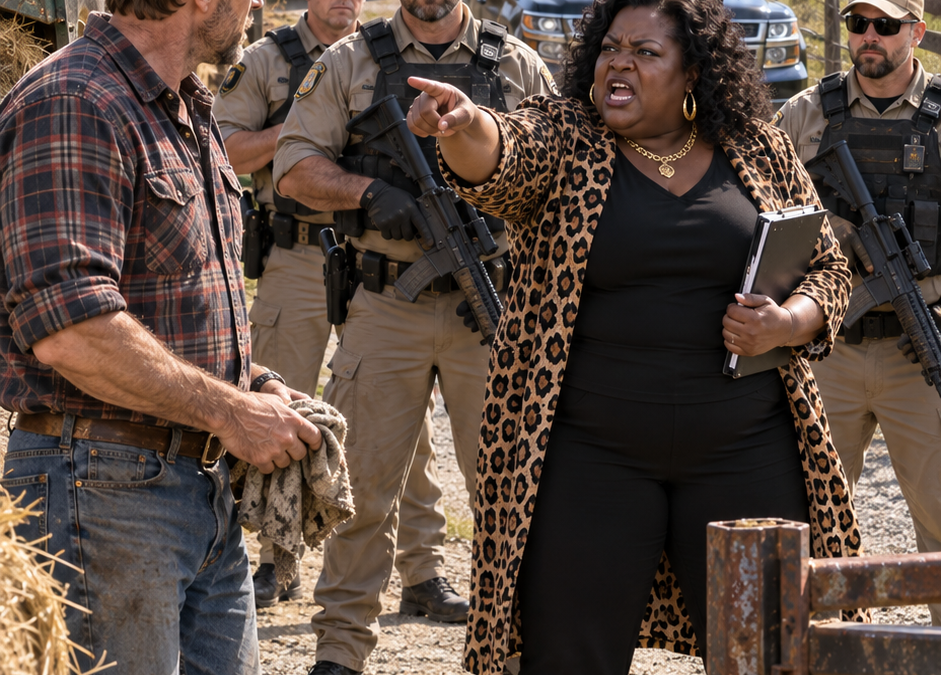
𝗣𝗔𝗥𝗧 𝟮
There was no hesitation in her answer.
That was the point.
Whatever power Adrienne had elsewhere, she would not use it here.
Not because she didn’t care.
Because she understood exactly what Dana wanted.
One phone call from the colonel of the highway patrol to the wrong person and this stopped being a property dispute.
It became a story about a state official using power to protect her husband’s farm.
Dana was waiting for that story.
We wouldn’t give it to her.
While we stood there, the skid steer came off the flatbed.
The operator drove to the frontage fence.
Then he started pulling T-posts.
One.
Two.
Three.
Forty feet of woven wire dropped into the grass.
My cattle were less than a hundred yards away.
Beyond the ditch was Highway 99.
I ran for the truck.
Pulled it sideways across the opening.
Then shook a bucket of range cubes out the window until the herd moved toward me instead of toward the road.
It took the county deputies about twenty minutes to arrive.
Wrong agency entirely from Adrienne.
She ran highway patrol.
This was a county sheriff’s matter.
She had no jurisdiction there.
The deputies understood that immediately.
Dana apparently didn’t.
She reached them first.
Paper already in her hands.
“I have a recorded trustee’s deed,” she said. “And a board resolution authorizing possession.”
The older deputy read it.
Then read it again.
He looked toward me.
“You got paperwork?”
I handed him my grandfather’s deed and my own.
My hands were shaking.
I hated that.
I was fifty-one years old, standing in my own driveway, and my hands shook like I was seventeen and getting pulled over for the first time.
The deputy looked at Dana.
“Ma’am, do you have a writ of possession?”
“I have a deed.”
“That’s not what I asked.”
She started explaining the foreclosure.
He let her get about four sentences into it.
Then he raised one hand.
“Nobody is removing anybody today. You take this to a judge.”
Dana stared at him.
Then he turned toward Adrienne.
“And you are?”
“My name is Adrienne Vance.”
He waited.
She said nothing else.
“Your relationship to Mr. Kimbro?”
“I’m his wife.”
“And your role here?”
“Witness. That’s all.”
He wrote it down exactly that way.
SPOUSE OF PROPERTY OWNER PRESENT ON SCENE. PROVIDED NO DIRECTION TO PARTIES.
Then he assigned the report a case number.
That case number ended up being more valuable than anything I said that morning.
Because from that day forward, there was an independent record.
Dana stopped beside me on her way back to the Tahoe.
“You’ll get billed for the fence too.”
Then she left.
The trucks cleared out over the next half hour.
But the lowboy was already gone.
On the back of it were my Kubota and a round baler that did not even belong to me.
The baler belonged to Dale Puit, an equipment dealer and farmer outside Lebanon.
I had told Dana.
I had told the man loading it.
Twice.
“Dale owns that machine.”
Dana’s answer had been simple.
“If Mr. Puit has a problem, he can call the association.”
So I called Dale.
“They took your baler.”
A pause.
“They what?”
“It was at my place. They loaded it.”
“I’ve got two hundred acres down and rain Thursday.”
“I know.”
He exhaled.
“Wes, I’m not mad at you.”
Somehow that made it worse.
PART2
I spent the rest of that afternoon repairing enough fence to keep the cattle contained overnight.
Then I sat at my kitchen table with every property document I owned spread in front of me.
Stonewater Ridge had been built around my farm starting in 2018.
Bellwood Land Group bought surrounding ground and developed houses on three sides of me.
When they recorded their subdivision plat, my forty-six acres appeared in the middle of the drawing.
Shaded gray.
Labeled FUTURE DEVELOPMENT AREA.
That phrase looked impressive on paper.
But a developer’s hope is not a deed.
Nobody had bought my farm.
Nobody had annexed it.
Nobody had ever asked me to join the association.
The problem started with Coldstream, Stonewater Ridge’s management company.
They apparently built their HOA assessment roll from the subdivision plat instead of checking actual deed records.
January 2019, some computer started charging me ninety-five dollars a month in HOA dues.
On land that was never part of the HOA.
I wrote them in March 2020.
Certified mail.
My deed attached.
My letter was one paragraph.
My property is not part of Stonewater Ridge.
I am not a member of your association.
Please correct your records.
They sent a form response.
I assumed the mistake was finished.
For the next five years, I threw most of their mail away unopened.
That part belonged to me.
I own it.
Same white envelopes.
Same management company.
Same weight and look as notices about pool hours, neighborhood meetings, and landscaping rules that had nothing to do with me.
Somewhere in those stacks was a lien notice.
Somewhere was a foreclosure notice.
Somewhere was a sale notice.
I never opened them.
Adrienne turned over the copy of my 2020 letter.
The certified-mail return card was still stapled behind it.
Signed.
Dated.
“You told them in writing.”
“Six years ago.”
“And attached the deed.”
“Yes.”
She nodded.
“It’s still a document.”
Monday morning, I drove to the Register of Deeds.
Used the public terminal myself.
Typed in the parcel.
And there it was.
A substitute trustee’s deed recorded in June.
GRANTEE:
STONEWATER RIDGE HOMEOWNERS ASSOCIATION, INC.
I stared at the screen until the words stopped looking like English.
Then I sat in my truck outside the courthouse.
The deed in my glove box said I owned the farm.
The courthouse computer said Stonewater Ridge did.
Legally, that difference mattered more than truth.
I called my lender.
Rick had handled my farm credit since 2013.
I explained everything.
He listened without interrupting.
“Wes, I believe you.”
“Good.”
“The title company doesn’t.”
By Tuesday afternoon, my operating line was frozen.
Not canceled.
Frozen pending clarification of title.
Sounds temporary.
On a farm, temporary can ruin you.
I had a fuel and fertilizer draw scheduled Thursday.
Gone.
“What do you need from me?” I asked Rick.
“Clean title.”
“I have clean title in my truck.”
“I need it clean in the courthouse.”
A bank lends against the public record.
Until a judge said otherwise, the public record said Stonewater Ridge owned my farm.
Wednesday morning, I drove to Shelbyville and climbed a flight of stairs above a hardware store.
That was where I met Nan Proser.
She was around sixty.
Reading glasses on a chain.
No wasted motion.
She went through my documents for twenty minutes without saying a word.
Then she leaned back.
“Three things.”
I waited.
“First, this is months. Not days.”
I closed my eyes.
“How many months?”
“If you ask me during spring court calendars, I tell you to stop asking.”
“Great.”
“Second, your 2011 title insurance probably won’t help.”
“I paid for title insurance.”
“You paid for insurance against defects existing when the policy issued.”
“Somebody stole my farm on paper.”
“Last year.”
I stared at her.
“So the insurance insures everything except the problem?”
“It insured 1961 through 2011. That’s useful. It’s simply not this problem.”
Then she took off her glasses.
“Third, you stop talking to Dana Whitlock.”
“I can manage that.”
“No. You misunderstand. Not one word. Not at the gas station. Not at the post office. Not if she’s standing on your mailbox.”
“Fine.”
“And Adrienne doesn’t touch this.”
“My wife called 911.”
“As a citizen?”
“Yes.”
“Good. That’s the last thing she does.”
Nan leaned toward me.
“If your wife calls a colleague and asks for a favor, this stops being a property dispute. It becomes a story about a state police colonel using government power against suburban homeowners.”
“She wouldn’t do that.”
“I don’t care what she would do. I care what they can make it look like she did.”
Retainer:
Six thousand dollars.
I wrote the check from a personal account that wasn’t designed to lose six thousand dollars before lunch.
Meanwhile, the baler Dana had removed created a separate problem.
Dale’s equipment dealer discovered their leased machine was sitting in a fenced storage yard in Smyrna.
They sent a demand letter to Meridian Field Services, the contractor Stonewater Ridge had hired.
Meridian refused to release it.
Their client had authorized the seizure.
Their client had not authorized release.
So the dealer’s insurance company opened a conversion claim.
Dale kept getting billed for a baler he could not use.
Then Stonewater Ridge made the takeover official.
Association counsel sent me a notice to vacate within thirty days.
Someone zip-tied two NO TRESPASSING—ASSOCIATION PROPERTY signs to my gate.
Dana posted online that Stonewater Ridge had “recovered association property.”
Nan looked at the notice.
“She’s building a record.”
“What kind?”
“Thirty days from now, she doesn’t want you described as a farmer defending property. She wants you described as a holdover occupant who received written notice and refused to leave.”
“That’s not what happened.”
“Paper doesn’t care.”
That phrase became a kind of law in my head.
Paper doesn’t care.
I cut the plastic ties off the signs.
Stacked them face down in the barn.
Then the first hay buyer called.
We had shaken hands in June on three hundred round bales.
“I’m going another direction.”
“We had a deal.”
“Wes, I’ve heard the farm is in foreclosure.”
“It isn’t.”
“There’s a lawsuit.”
“Yes.”
“Same thing to me.”
Sixteen thousand dollars vanished in a two-minute conversation.
He wasn’t evil.
He had cattle to feed through winter.
He needed certainty.
Dana didn’t have to beat me in court to damage me.
She just had to make doing business with me look risky.
I spent Saturday rebuilding fence because driving posts gave me something physical to hate.
Ninety-four degrees.
Ground like concrete.
Clang.
Clang.
Clang.
Adrienne came out around six carrying two bottles of water.
She watched me work.
“You’re rebuilding a fence on land that, according to the courthouse, isn’t yours.”
“Cattle don’t know about lawsuits.”
She almost smiled.
Ten days later, a process server taped papers to my front door.
DETAINER ACTION.
STONEWATER RIDGE HOMEOWNERS ASSOCIATION, INC.
v.
WESLEY KIMBRO.
They wanted possession.
This time, instead of four guards, they were asking a judge.
The first hearing lasted eleven minutes.
Their lawyer said they held a recorded deed.
I had received a notice to leave.
I remained on the property.
Nan stood.
“Your Honor, possession cannot be determined in General Sessions while there is a bona fide title dispute. Ownership belongs in Chancery.”
The judge read both deeds.
Asked three questions.
Continued the case.
Walking into the hallway, I almost laughed from relief.
Nan caught my expression.
“Don’t.”
“We stopped them.”
“No. We delayed them.”
“That’s something.”
“To Dana, it means you’re stalling.”
She adjusted the file under her arm.
“Watch what she does next.”
Five days later, I found out.
It was 4:30 Monday morning.
We finally had a clean weather window.
Five dry days.
Rain Saturday night.
In August hay season, five dry days can decide your year.
I had twenty-eight acres of my own ready to bale.
Plus custom work for four neighbors.
About 380 acres total.
I’d done their hay since 2013.
I pulled toward the equipment lot at 4:45.
Two guards were sitting at the gate.
Different men.
Same tan uniforms.
One had a folding chair planted in the gravel.
“Morning, sir.”
“I need my equipment.”
“I’ve got instructions. Nothing leaves this lot.”
“It’s my equipment.”
“I understand.”
The man wasn’t rude.
That almost made the situation more ridiculous.
He was some guy earning maybe eighteen or twenty dollars an hour sitting in the dark beside my baler because somebody’s office had assigned him there.
“Can I see the order?”
He held the clipboard up in my flashlight beam.
Didn’t hand it to me.
Bottom line.
Blue ink.
D. WHITLOCK.
I photographed it.
The guard let me.
So there I stood at five in the morning.
My tractor.
My rake.
My baler.
All visible.
All unusable.
And I had five dry days.
What I didn’t do was cut the chain.
I didn’t drive through the guards.
I didn’t yell.
Nan had explained Dana’s strategy too many times.
One farmer driving a tractor toward an armed guard and suddenly every television station has the picture they need.
Instead, at six, I started calling farmers.
“Ray, I’m not going to make your hay this week.”
Silence.
“You’re kidding.”
“I wish.”
“Wes, it’s already cut.”
That one hurt.
His grass was lying down because I had told him I would come.
The fourth farmer didn’t even want an explanation.
“I don’t need the story. I need hay.”
Then he hung up.
I spent a day and a half trying to borrow a baler.
Every dealer within seventy miles had every decent machine either working or broken.
One dealer had a demonstration unit but wanted a deposit I couldn’t put down because my credit line was frozen.
Normally I’d call Dale.
We traded equipment every summer.
Except Dale’s baler was sitting behind a fence in Smyrna because Dana had hauled it off my farm.
By Wednesday, things got worse.
A survey crew showed up.
Three men in reflective vests.
GPS pole.
Pink ribbons.
They walked straight into my standing orchard grass.
“Who sent you?”
“Bellwood.”
“For what?”
“Phase Four.”
They started staking future lot corners across my twenty-eight acres.
I looked at the crew chief.
“That is hay.”
He looked down.
“Yes, sir.”
“I’m cutting it this week.”
“We’re just setting points.”
By evening, more than forty ribbons ran across my best field.
Rows.
Corners.
Future streets.
Future lots.
Looked like somebody had marked a cemetery.
I photographed everything.
Later, driving the county road, I saw Dana on the new cul-de-sac with two women.
All three were pointing across my field toward the stakes.
I wanted to stop.
I didn’t.
Nan would have murdered me herself.
Thursday and Friday, I managed to bale one small section with old equipment I could reach.
Sixty bales.
Saturday night at 10:40, rain started.
By sunrise, we had an inch and a quarter.
Everything I’d failed to bale was mulch.
Ray’s ground.
Mine.
Other customers.
About nine hundred bales between crop and custom work.
A little under twenty thousand dollars.
Provable.
Because I had five years of invoices.
The financial loss was bad.
Walking into Ray Bickers’s shop to apologize was worse.
“It’s not your fault,” he said.
“My job is to show up.”
“Yeah,” he said quietly. “It is.”
Two of those customers never called me again.
Dana still had not won her title case.
Still didn’t have a writ.
Still hadn’t proven she owned one blade of my grass.
She had simply made me unreliable.
Then came the heatwave.
One morning at five, I flipped the barn lights.
Nothing.
I flipped the switch again.
Still nothing.
I went to the meter.
Dead.
Breaker was fine.
Power wasn’t reaching the property.
At 7:31, I called the electric co-op.
“Sir, that account was closed on the fourteenth.”
“By who?”
“I show a service transfer.”
“Transfer to who?”
“I’m not authorized to discuss an account you’re not listed on.”
“That is my house.”
“I’m sorry, sir.”
“Put my name back on it.”
“We would need documentation showing ownership.”
Same wall.
Again.
Someone had emailed the co-op the recorded trustee’s deed.
The deed said Stonewater Ridge owned the parcel.
A clerk had processed an ordinary transfer.
The utility hadn’t done anything malicious.
They saw recorded ownership.
They acted.
That routine transaction nearly killed my cattle.
Thirty-eight Angus crosses.
Tennessee August.
No creek in the front pasture.
Water came from a well.
The well ran on an electric pump.
By nine, the tanks were four inches down.
Temperature already above ninety.
So I started hauling water.
Three-hundred-gallon poly tank in the F-350.
Municipal fill station eleven miles away.
Fill.
Drive.
Gravity feed.
Repeat.
Three trips a day.
Seven hours.
Hot vinyl.
Warm pond smell.
Diesel.
By Thursday, I had a bruise across my hip from leaning over the tailgate to reach the valve.
I called the co-op repeatedly.
A supervisor finally explained the problem with genuine sympathy.
Until the court corrected the recorded ownership, they couldn’t simply put utilities back in the name of somebody the public record didn’t recognize as owner.
Nan was working on emergency relief.
Courts don’t move at the speed cattle drink.
Friday morning, I found a first-calf heifer under the north fence.
Her neck was stretched flat against the ground.
Anybody who knows cattle knows that posture.
A cow sleeping comfortably doesn’t lie like that.
I ran toward her.
She barely moved.
I called Dr. Sonia Bott.
Large-animal veterinarian out of Eagleville.
She’d worked my herd for nine years.
She arrived in forty minutes.
Checked gums.
Pinched skin.
Watched the skin stay tented.
“How long has she been without water?”
“She hasn’t. I’ve been hauling.”
“How long has the pump been down?”
“Since Tuesday.”
Sonia didn’t argue.
She pulled IV bags from her truck.
I held the line over my head because there wasn’t anything else to hang it from.
We stood in that pasture more than an hour.
The heifer finally got up around one.
Walked away looking offended.
That’s when I knew she’d probably live.
Ten days later she lost the calf.
Sonia wrote it in the medical record.
Heat.
Stress.
Dehydration.
She charged me $240.
At the time, that invoice just felt like one more number.
Months later, that plain veterinary record mattered because Sonia hadn’t written it for a lawsuit.
She wrote what she saw because that’s what doctors do.
Then Saturday night got almost absurd.
I was unloading water at 8:15.
Headlights on.
Hose running.
Twenty minutes later, a county cruiser came up the lane.
Young deputy.
“Sir, we received a trespassing complaint.”
I looked at the tank.
Then at my cattle.
Then at him.
“Who called?”
“I can’t tell you that.”
I already knew.
The guard had seen me drive onto property his work order said belonged to Stonewater Ridge.
So at 8:40 on a Saturday night, I stood beside a running hose explaining why I had the right to water my own cows.
The deputy read my deed.
Read Stonewater Ridge’s trustee deed.
Made a phone call.
Read both again.
“These your cattle?”
“Every one.”
“And the HOA isn’t claiming ownership of the cattle?”
“They’re claiming the dirt the cattle are standing on.”
He looked across the pasture.
“I’m not removing anybody tonight.”
Then he said something I remembered.
“This is the second sheriff’s report I’ve seen involving this property.”
He nodded toward his cruiser.
“That builds.”
At the time, I didn’t understand how important that was.
By winter, we had a stack of reports.
Separate deputies.
Separate dates.
Separate incidents.
People with no reason to help me or hurt Dana.
Paper.
The next Monday, I confronted one of the guards.
“You called the sheriff because I was watering cattle. One of them lost a calf.”
He looked at the ground.
For about four hours, saying it made me feel better.
Then word got back to Dana.
Now she had a story about an angry farmer confronting contracted security.
And she had another weapon.
Adrienne.
On Tuesday, my wife got a call at work.
Wednesday after dinner she told me.
“A complaint was filed.”
“Against you?”
“Yes.”
“By Dana?”
Adrienne gave me a look.
Who else?
Dana had filed a sworn professional standards complaint against Colonel Adrienne Vance.
She accused my wife of using her official position to summon a state aircraft to a private dispute.
Of intimidating licensed security personnel.
Of influencing the county sheriff’s response.
Attached was eleven seconds of video.
Helicopter.
State seal.
Adrienne stepping into my field.
“That’s not what happened.”
“I know.”
“The helicopter was already in the air.”
“I know.”
“You were riding to a scheduled assignment.”
“I know that too.”
She flattened her hand on the table.
“It’s going to take weeks to prove.”
Her rank protected her exactly zero.
In fact, it made things worse.
Within four days, she was moved to administrative duties pending review.
She had to hire her own attorney.
Department counsel represented the department.
Not her.
Nine thousand dollars.
We already had six thousand in Nan’s retainer.
My credit line was frozen.
I’d lost twenty thousand in hay.
We put Adrienne’s legal fees on a home equity line.
Then the television station called.
Dana had sent the complaint packet to Nashville media.
Thursday night, they ran a ninety-second segment.
I watched standing up because I couldn’t sit still.
They played the helicopter video twice.
Once normal.
Once slow.
The narrator said a state police aircraft had landed on disputed property during a conflict over unpaid homeowners association dues.
Then said the woman stepping from the helicopter commanded the state highway patrol.
Every word was technically true.
And the story was completely wrong.
That’s a dangerous kind of lie.
The kind built entirely from accurate pieces.
The station called me for comment.
I called Nan.
“Absolutely not.”
“They’re making me look like a deadbeat.”
“They’re implying it.”
“So I should just say nothing?”
“If you go on television, you’re a man in active litigation making statements that can become exhibits.”
I stared at the reporter’s number for twenty minutes.
Didn’t call.
Within a week, two more customers stopped answering me.
Someone spray-painted a four-letter word on my mailbox.
I covered it with black paint Sunday morning.
Didn’t tell Adrienne for a month.
Then my daughter Callie came through the kitchen door crying.
Callie was sixteen.
Not a crier.
She had been working all year with a steer named Rooster for the county fair.
Eleven hundred pounds.
Biggest idiot on four legs.
She loved him.
His feed, halter, grooming gear, and clippers were inside the equipment lot.
“The guard won’t let me in.”
“Why?”
“He said I’m not on the list.”
“What list?”
“He won’t tell me.”
There was no list.
There was a man sitting in a folding chair under somebody’s work order while my daughter couldn’t get feed for her steer.
I drove down.
“Is my daughter named on your order?”
The guard read it.
Looked at Callie.
Then moved his chair.
“Go get what you need.”
She carried the feed out.
He sat down again.
That’s the thing about nearly every guard Dana hired.
Most weren’t villains.
They were men following paperwork.
And bad paperwork in the hands of ordinary people can do extraordinary damage.
That night, after Callie went upstairs, I finally said what I had been thinking.
“Let’s sell.”
Adrienne looked up from the stove.
“Sell what?”
“The forty-six acres.”
Her face changed.
“All of it?”
“Let Bellwood have it. Let Dana have whatever she wants. We take the money and leave.”
“You don’t mean that.”
“I mean it enough to say it.”
She turned off the burner.
Stood with her back toward me.
“No.”
I waited.
Then she turned.
“But I don’t know, Wes.”
That was the lowest point.
Not the guards.
Not the lawsuit.
Not the dead calf.
My wife saying she wasn’t sure whether fighting for the farm was worth what it was doing to us.
Discovery later showed Dana was fighting a clock.
Bellwood had an option related to Phase Four.
If my forty-six acres could be brought into the development package, their plan became much more valuable.
The television story bought Dana a verbal extension.
September 30 became October 15.
Two more weeks.
She took that as proof her strategy worked.
Nan filed for a temporary injunction in Chancery Court.
The hearing was set three weeks away.
Dana didn’t have three weeks.
Then she made the mistake that eventually destroyed her case.
I was thirty miles away buying hay.
Two hundred twelve round bales.
Fifty-five dollars each.
Eleven thousand six hundred dollars for grass I should have grown myself.
My phone rang.
Callie.
She was at school.
“Dad, there’s a video.”
“What video?”
“You need to come home.”
It was streaming live on the Stonewater Ridge community page.
Dana was filming.
By the time I got back, the east wall of my grandfather’s barn was gone.
That barn was built in 1948.
Post-and-beam.
Hand-hewn header.
My grandfather had milked forty cows there until 1971.
I calved heifers in the east end every February because it blocked the wind.
A track hoe sat in the center of it.
Bucket raised.
I drove through the gate too fast.
Got out.
Walked straight in front of the machine.
The operator saw me.
Shut it down.
Best decision anybody made that entire day.
He climbed out.
Maybe forty.
Hard hat.
Sunglasses.
He looked at the cattle.
Then at me.
“Man, I was told this was a bank job.”
“Who told you?”
He pointed.
Dana stood sixty feet away recording.
“She the bank?”
“No.”
He took off his hard hat.
Put it back on.
“There’s cows here.”
“There have been cows here since 1961.”
Dana walked over.
Phone still raised.
“Get off my property.”
I looked directly at the phone.
“Keep talking. You’re recording.”
Something in her changed.
The demolition stopped.
Not because she cared what I said.
Because the equipment operator wouldn’t restart.
They left within an hour.
What remained was destruction.
East wall gone.
Roof section down.
Fencing ripped out.
Loft flooring broken in the driveway.
Three hundred bales of winter hay buried beneath lumber.
But they didn’t remove equipment this time.
Meridian had learned something from Dale’s baler.
A machine seized in a title fight creates lawyers, insurance claims, and serial numbers.
So this time, Dana wasn’t taking possession.
She was just destroying improvements.
I called Nan from the barnyard.
Her first words:
“Don’t move anything.”
Then:
“Photograph everything.”
I called the farm insurer.
Then spent two hours walking the site with a camera.
Last thing I photographed was the old milkhouse slab.
Poured in 1948.
In one corner, my grandfather had scratched his initials into wet concrete with a nail.
JRK.
The four was crooked.
Always looked like a triangle.
Mud from the demolition tracks covered it.
They hadn’t cracked it.
I swept the mud away.
Took the picture.
Then I sat on that slab.
I won’t describe that part much.
Some grief deserves privacy.
Near sunset, I chained the old header beam and pulled it free from the debris with my tractor.
Eighteen feet of hand-hewn white oak.
Adze marks still visible.
Broke a chain hook doing it.
Dana’s video stayed online nine hours.
Nan downloaded it before anyone could delete it.
About six minutes into the recording, somebody commented asking whether the sheriff was present.
Dana answered aloud.
“No, we don’t need the sheriff. It’s our parcel. It’s my call.”
Her voice.
Her account.
Her timestamp.
More than two hundred residents saw it.
Discovery found even more.
Meridian used a client portal.
Every job produced geotagged photos and status forms.
For the barn job, someone checked:
VACANT / ABANDONED.
Cattle were standing in four of their own photographs.
Then Nan got an email Dana had sent Meridian’s scheduler.
One line.
WE DON’T HAVE 90 DAYS. JUST TAKE IT.
My trail cameras had been running since somebody siphoned fuel from my tank years earlier.
They recorded the demolition equipment entering.
They recorded it leaving.
My insurer eventually paid the barn claim under vandalism.
Less the deductible.
But insurers don’t just swallow losses.
They subrogate.
Suddenly a second law firm—with much more money than I had—started pushing against Stonewater Ridge.
Bellwood’s risk department noticed too.
Not because they cared about me.
Because Dana had turned their Phase Four development into potential litigation.
Then Nan called at 7:15 one Friday morning.
“Subpoenas.”
The injunction hearing came the last Tuesday in October.
Forty minutes.
Nan put three photographs in front of the chancellor.
Then Dana’s eleven-minute demolition video.
Stonewater Ridge had changed lawyers by then.
Their new Nashville counsel had clearly spent several sleepless days learning the file.
He said his client relied on the recorded deed.
Then voluntarily agreed no further activity would occur until trial.
He agreed because the video left him no choice.
The chancellor ordered the association to cease all activity on the property.
Return removed equipment.
Preserve evidence.
Nobody declared me owner that day.
Nobody ruled Dana committed fraud.
Nobody erased the trustee’s deed.
The bleeding simply stopped.
That was enough.
For the first time since August, I slept.
The Kubota came back first.
Scratch down the hood.
Dead battery.
Dale’s baler took another eleven days.
By then, his hay season was over.
He came to pick it up himself.
“You owe me a hood.”
“I’ll repaint the whole machine.”
“You’ll repaint the hood.”
“I can do the whole thing.”
“The hood, Wes.”
We argued over that hood for a month.
That’s how I knew we were okay.
After the injunction, Dana went quiet.
No community posts.
No new signs.
No security expansion.
No surprise contractors.
She told residents the ruling was procedural.
Technically, she was right.
Then somebody apparently convinced her to stop talking.
What followed was four months of the least dramatic work imaginable.
And that boring work won the case.
Folders.
Depositions.
Land records.
Invoices.
Returned envelopes.
Old deeds.
Management-company notes.
Surveys.
I bought a spiral notebook from Dollar General for a dollar and fifty cents.
Wrote down every date.
Every call.
Every expense.
The chain of title was straightforward.
My grandfather’s deed.
Boundary work dating to 1978.
My deed recorded in 2011.
Unbroken ownership.
Then the Stonewater Ridge declaration.
That document created the HOA.
And inside it was an annexation clause.
Bellwood could add land it owned.
Or land whose owner gave recorded written consent.
Nan hired a Nashville title lawyer named Hollis Grant.
Grant searched every recorded instrument touching my parcel from 2018 onward.
Nothing.
No annexation consent.
No signature.
No deed.
No amendment bringing my land into the HOA.
I met him once.
He had the emotional energy of a tax return.
“There is no consent.”
“So?”
“No consent, no membership.”
Nan nodded.
“No membership, no dues.”
I finished it.
“No dues, no lien.”
Grant looked at me.
“Correct.”
“So we win.”
Nan cut in.
“No celebrating.”
I sighed.
“What now?”
“They’re going to argue implied consent.”
“How?”
“You used the subdivision road.”
That part was true.
When Bellwood built Phase Two, they realigned access.
My main drive connected to a paved stub Stonewater Ridge maintained.
Snowplowed.
Lighted.
I had used it for six years.
Never objected.
Their argument would be that I accepted association services.
Behaved like a member.
Therefore consent could be implied.
“Is that real?”
Nan nodded.
“Real enough to take seriously.”
Then discovery turned up my 2020 letter.
Coldstream produced a scanned copy.
Deed attached.
And handwritten across the top:
NON-MEMBER? ASK BOARD.
Nobody had asked the board.
For six years.
Next came the foreclosure file.
Four envelopes.
All returned.
All marked undeliverable.
All mailed to a lot number inside Stonewater Ridge.
A lot that did not exist.
My correct mailing address had been in county property records since 2011.
Nobody checked.
Then Meridian’s work orders.
Dana’s signatures.
Photos marked VACANT while cattle stood in frame.
Then the utility transfer.
Then Sonia’s veterinary record.
Then the flight log from Adrienne’s professional standards case.
The flight log mattered because it showed the helicopter had taken off at 6:55 that morning on a scheduled corridor survey.
It was already airborne twenty miles west of my farm.
The landing was recorded as a pilot decision.
Reason:
FLATTEST AVAILABLE GROUND.
Adrienne happened to be aboard.
It wasn’t dispatched to rescue me.
Her case.
Her evidence.
But paper doesn’t care whose case it belongs to.
We also paid for a new boundary survey.
Two thousand eight hundred dollars.
Two days of survey crews confirming the old lines.
The gray shading on Bellwood’s subdivision drawing crossed into land nobody had conveyed.
The surveyor refused to interpret that legally.
“I set corners. I don’t practice law.”
Smart man.
Stonewater Ridge filed its formal answer in December.
Their attorney, Merrick, scared me more than Dana ever had.
Because he was good.
He didn’t build his argument on lies.
He built it from true facts.
The subdivision plat was publicly recorded.
It showed my acreage inside the proposed development boundary.
Coldstream relied on it.
The HOA relied on Coldstream.
The substitute trustee conducted foreclosure based on information supplied by professionals.
Notice had been mailed.
I admitted I threw years of HOA mail away.
Then he leaned heavily on the paved access road.
Six years of maintenance.
Lighting.
Snow removal.
My uninterrupted use.
No payments.
No complaints.
A man who takes the benefits of an association for years, he argued, may demonstrate membership by conduct.
Then he used Adrienne.
Not as proof the HOA owned the farm.
As atmosphere.
Volunteer HOA president versus a farmer married to the commander of the highway patrol.
State helicopter in the field.
Security guards confronted.
County deputies responding.
He didn’t have to say abuse of power.
He only had to make the judge remember the picture.
I looked at Nan after reading their filing.
“How bad?”
“On the recorded-consent clause, we’re strong.”
“And everything else?”
“We’re going to trial.”
Depositions ran through winter.
Mine was terrible.
Merrick asked about the paved road four different ways.
Finally I snapped:
“I didn’t know there was a toll.”
Nan’s pen stopped moving.
Afterward, she waited until we were alone.
“You argued.”
“He kept baiting me.”
“Yes.”
“That was the point?”
“That is literally his job.”
She pointed at me.
“Next time somebody asks whether you threw away the mail, say yes.”
“That’s it?”
“That’s it.”
Coldstream’s corporate representative was better for us.
She had no emotional stake.
Nan asked:
“Where did the assessment roll originate?”
“The recorded plat.”
“Did Coldstream independently verify ownership at the Register of Deeds?”
“No.”
“Did your office receive Mr. Kimbro’s March 2020 certified letter?”
“Yes.”
“Was his deed attached?”
“Yes.”
“Was the board notified?”
“I have no record.”
Nan moved on.
The substitute trustee was worse for the association.
Four foreclosure notices.
All returned.
Nan placed them in front of him.
“Where did you obtain this mailing address?”
“The association.”
“Did you check county property-tax records?”
“That’s not our practice.”
Four envelopes.
Four failures.
Nobody stopped the sale.
Then came the emails between Dana and Bellwood.
That changed everything.
Dana’s real estate brokerage held the listing arrangement related to the Phase Four assemblage.
If my forty-six acres became part of the deal, Dana could make money.
That wasn’t automatically illegal.
Real estate agents serve on HOA boards every day.
The problem was disclosure.
She had never told her own board.
No minutes mentioned the arrangement.
No conflict disclosure.
No recusal.
Suddenly she wasn’t merely a volunteer president relying on professionals.
She had a financial interest.
And every aggressive decision she made could be reread through that fact.
Then there was the email.
WE DON’T HAVE 90 DAYS. JUST TAKE IT.
By February, Adrienne’s professional standards review closed.
Finding:
Unfounded.
Two paragraphs on department letterhead.
No apology.
No repayment of the nine thousand dollars.
No return of eleven weeks spent under investigation.
Adrienne read it at the kitchen table.
Folded it.
Put it in a drawer beside the utility bills.
“That’s it?” I asked.
“That’s it.”
The insurance carrier tried to settle in April.
Dana refused to resolve her personal exposure.
She wanted trial.
Nan told me.
“She’s going to testify.”
“Is that good?”
Nan gave me a look.
“It’s a decision.”
Trial started May 14.
Chancery Court.
Bench trial.
No jury.
Eighteen people in the gallery.
About half were Stonewater Ridge residents.
No television cameras.
No drama.
The chancellor was in his sixties.
Said good morning.
Then spent ten minutes reading paperwork while everyone waited.
Two days.
The HVAC was probably the loudest thing in the room.
I wore the suit from my mother’s funeral.
Fit worse than I remembered.
The surveyor testified first.
Boundary corners.
Historic pins.
Recorded lines.
Eleven minutes.
Merrick asked three questions and released him.
Nobody argues much with coordinates.
Then Hollis Grant testified.
He walked the chancellor through the HOA declaration.
Paragraph by paragraph.
Then the annexation clause.
“Did you locate recorded written consent from Mr. Kimbro?”
“No.”
“Any predecessor in title?”
“There is no relevant predecessor after 2011. Mr. Kimbro owned the parcel.”
Merrick cross-examined.
He did not challenge Grant’s research.
He argued doctrine.
Six years using HOA-maintained access.
Lighting.
Road maintenance.
No objection.
Conduct consistent with membership.
Implied consent.
Grant waited until he finished.
Then answered.
“The declaration does not merely require consent.”
Pause.
“It requires recorded written consent.”
Merrick watched him.
Grant continued.
“The parties chose that standard when the declaration was drafted. A court does not need to substitute a lesser one.”
Merrick nodded.
Sat down.
Then Coldstream’s representative testified.
She read the handwritten note from my 2020 letter.
NON-MEMBER? ASK BOARD.
“Was the board asked?”
“I have no record that it was.”
Then Nan handed up the four foreclosure envelopes.
One.
Two.
Three.
Four.
All undeliverable.
All mailed to an address that did not exist.
Next to them went my property tax record showing my correct address.
Unchanged for years.
That issue alone put the foreclosure in serious trouble.
Then came the seized baler.
Bill of lading.
Serial number.
Proof it belonged to Dale.
Proof Dana’s crew removed it after being told it wasn’t mine.
Then the demolition video.
All eleven minutes.
No edited clip.
No summary.
The entire thing played in the courtroom.
At about six minutes, Dana’s own voice:
“No, we don’t need the sheriff for this. It’s our parcel. It’s my call.”
The video ended.
Nan put Meridian’s photo packet on the screen.
VACANT / ABANDONED.
Then photograph four.
Seven cattle visible in the background.
Nobody said anything.
A chair creaked behind me.
Then Nan introduced the flight log.
She was careful.
“My wife’s conduct is not at issue here,” I remember her saying. “This document is offered only to compare the timeline with a sworn statement.”
The log showed the aircraft airborne at 6:55 on other business.
Dana’s professional complaint said no fencing had been removed before Colonel Vance arrived.
Then Nan displayed a trail-camera still.
Timestamp.
Skid steer pulling T-posts eighteen minutes before the helicopter landed.
The chancellor wrote something.
Didn’t look up.
I testified after lunch.
Merrick started simply.
“You discarded HOA correspondence for approximately six years.”
“Yes.”
He waited.
I stayed quiet.
Four months of Nan telling me not to explain finally paid off.
He moved on.
I described hauling water.
Eleven miles each way.
Three runs a day.
Heat.
The heifer under the fence.
Holding an IV bag over my head in a pasture.
Losing the calf ten days later.
I didn’t give a speech about what Dana had done.
I didn’t need to.
Sonia’s medical record was already there.
Adrienne testified for six minutes.
Nan never asked about her rank.
Merrick did.
“Did you call 911?”
“Yes.”
“Did you identify yourself?”
“As Mr. Kimbro’s wife.”
“Did you give instructions to responding deputies?”
“No.”
“Did you take law-enforcement action?”
“No.”
“What did you do?”
“I recused myself in writing that morning.”
Then Dana took the stand.
She was good.
Calm.
Professional.
She described herself as a volunteer board president relying on a licensed management company, recorded plat, substitute trustee, and attorneys.
She insisted she had never made legal judgments independently.
“I’m not a lawyer.”
Then Nan asked about Phase Four.
“Your brokerage held an agreement connected to that assemblage?”
“Yes.”
“You could receive compensation if the transaction closed?”
“Potentially.”
“Is that arrangement disclosed anywhere in Stonewater Ridge board minutes?”
“I don’t believe minutes capture every discussion.”
“Is it disclosed in any board minutes?”
Pause.
“No.”
“Did you disclose it to the board treasurer?”
“I don’t recall the conversation.”
Something changed in the room.
Dana didn’t get angry.
That would have been easier for her.
She became careful.
Very careful.
And when a witness suddenly begins choosing every word, everyone notices.
At the end of the second day, the chancellor delivered findings from the bench.
About twenty minutes.
He was polite.
He said the management company’s original mistake played a major role.
He said Dana appeared to have believed, at least initially, that she was acting in the association’s interest.
Then he reached the annexation clause.
The Stonewater Ridge declaration required recorded written consent.
None existed.
I wrote every finding in my cheap spiral notebook because my hands needed something to do.
Annexation void.
No HOA membership.
No assessments owed.
Lien void.
Foreclosure sale void.
Trustee’s deed set aside.
Title quieted in Wesley Kimbro.
I stopped writing for a second.
Then the damages.
Barn.
Fence.
Lost custom hay income.
Lost crop.
Water hauling.
Veterinary expenses.
Equipment interference.
Every figure supported by receipts, invoices, photographs, records.
Low six figures.
Then the chancellor addressed the demolition.
Dana had acted outside the board’s authority when she ordered destruction of the barn.
Punitive damages would be considered separately.
There was no gavel.
Nobody applauded.
Nobody got handcuffed.
The judge thanked counsel and adjourned for lunch.
Nan grabbed my elbow before I reached the door.
“Don’t smile in here.”
“I’m not.”
I wasn’t.
I went to my truck.
Sat behind the wheel for twenty minutes.
Could not turn the key.
The formal order took eleven days.
Stonewater Ridge had thirty days to appeal.
The insurance carrier chose settlement instead.
Because the court found Dana acted outside board authority on the demolition, a substantial piece of her exposure belonged to her personally.
The first thing I did after title was corrected was rebuild the front fence.
Forty feet.
Two proper corner braces.
New gate from the co-op in Eagleville.
I bought chain from a spool.
Cut it to length myself with bolt cutters in the parking lot.
The following week, Rick sent me a letter.
Two sentences.
Title corrected.
Operating line restored.
Fourteen years doing business with that bank.
Two sentences.
About right.
Stonewater Ridge’s insurance covered much of the association’s liability.
But the HOA still had deductibles, uncovered costs, and legal fees.
They levied a special assessment.
About twenty-two hundred dollars per household.
That’s when the neighborhood truly turned on Dana.
Not when they saw my barn destroyed.
Not when cattle were standing in a photograph marked vacant.
Not when somebody shut off my well during August.
Twenty-two hundred dollars.
Money has a way of clarifying governance.
Dana lost a recall vote in July.
Resigned the same week.
She settled her personal liability through a payment arrangement.
A separate complaint went to the real estate licensing board over the undisclosed financial arrangement.
She accepted a suspension.
She wasn’t destroyed.
She didn’t end up homeless.
She moved to Williamson County.
Kept selling houses afterward.
Somebody told me at the feed store about a year later.
I expected satisfaction.
Nothing happened.
I just bought mineral.
The security company received a state licensing sanction for participating in what the final order described as an unlawful lockout.
Meridian changed its policies.
No more possession jobs without a writ or sworn owner authorization.
Their operations manager testified about the change later.
He almost sounded proud.
Bellwood abandoned Phase Four.
The forty-six acres remained hay ground.
The district attorney reviewed the whole mess for months and declined criminal prosecution.
Civil remedies had resolved the title issue.
Various parties had relied, at different points, on a facially valid recorded deed.
I was furious about that for maybe a week.
Then I stopped.
Adrienne went back to her regular job.
The eleven weeks under review didn’t come back.
Neither did our nine thousand dollars in attorney fees.
Something did change in her.
Now she recuses herself early.
In writing.
Over situations nobody else would even question.
People at work tease her about it.
She doesn’t care.
We paid off the home equity line fourteen months later.
The barn went back up over winter.
Forty by eighty.
Post-frame.
Metal roof.
Sliding doors.
Not romantic.
Not historic.
My grandfather would have called it cheap and practical.
He would have been right.
But two things from the old barn survived.
The first was the eighteen-foot white-oak header I pulled from the wreckage.
Hand-hewn.
Adze marks still visible.
The builder asked where I wanted it.
“Across the main opening.”
He looked at me.
“It won’t be structural.”
“I know.”
He mounted it anyway.
The second thing was the milkhouse slab.
We designed around it.
Never poured over it.
The old concrete now sits inside the new barn footprint.
And in one corner:
JRK
1948
Still crooked.
Still there.
That chain Dana’s crew cut off my gate?
I didn’t frame it.
Didn’t mount it with a plaque.
It hangs on a nail next to baling twine and fence pliers.
I’ve cut pieces off it twice when I needed chain.
Callie took Rooster to the county fair the next August.
Fourth in class.
She was furious.
Spent the entire drive home explaining what the judge had gotten wrong.
I didn’t interrupt once.
There is almost nothing better in life than hearing your sixteen-year-old daughter furious over something as ordinary as where her steer placed at the county fair.
Because ordinary had become a luxury.
One week later, a helicopter crossed over the farm.
High.
Heading west.
Some survey company, I think.
I looked up for maybe one second.
Then went back to what I was doing.
Late August.
Dark around nine.
Thirty-eight cows plus calves spread across the front pasture.
Gate closed.
Fence straight.
The lights in my barn belonged to my electric account.
The title at the courthouse had my name on it.
The hay under my boots belonged to nobody’s future development phase.
Adrienne sat on the tailgate in a ball cap.
Two beers beside her.
She handed me one.
We watched trucks move along Highway 99.
For a while, neither of us spoke.
Then I looked toward the front gate.
Same place where those box trucks had rolled in.
Same place where Dana Whitlock had stood with four armed men and told me I had ten minutes to leave land my family had held since 1961.
I remembered how powerless I had felt.
Not because she had actually owned the farm.
She never did.
But because she possessed paperwork that ordinary institutions believed.
The guards believed it.
The utility believed it.
The bank believed it.
The trustee believed it.
Customers believed the rumors that grew from it.
For months, I kept thinking truth should move faster than that.
That if something belongs to you, a deed ought to be enough.
That if somebody makes a mistake, showing them the right document should fix it.
That’s not how it worked.
Truth moved at the speed of certified mail.
Court calendars.
Subpoenas.
Depositions.
Returned envelopes.
Veterinary records.
Photographs.
Surveys.
A handwritten note somebody forgot about for six years.
A flight log from an entirely different investigation.
A security work order photographed at five in the morning.
A camera aimed at a pasture gate.
It wasn’t one dramatic document that saved the farm.
It was a pile of boring ones.
Adrienne took a drink.
“You thinking about it?”
“What?”
She nodded toward the gate.
“All of it.”
I looked across the pasture.
“No.”
That wasn’t completely true.
But it was becoming true.
The farm sounded normal again.
Cattle tearing grass.
Cicadas.
Highway tires beyond the ditch.
The occasional metal tap from the new gate when the wind moved it.
My grandfather probably heard most of those same sounds.
My father did too.
There are people who think land is valuable because of what can be developed on it.
Dana saw forty-six acres and imagined lots.
Roads.
Commissions.
Phase Four.
I saw the slab where my grandfather scratched his initials into wet concrete.
I saw the field where Callie learned to drive a tractor.
I saw the place a sick heifer stood back up after an hour on fluids.
I saw invoices that barely covered diesel and hay that sometimes got rained on anyway.
None of that makes sense on a development spreadsheet.
Maybe that’s why people like Dana never understood why I wouldn’t simply give up.
They thought I was protecting dirt.
I wasn’t.
I was protecting continuity.
A place where one generation leaves something imperfect to the next and says, quietly, take care of this.
Dana arrived with armed guards because she thought a recorded piece of paper had ended that history.
My wife arrived in a state helicopter, and for a while everyone assumed that was the dramatic part.
It wasn’t.
Adrienne didn’t save the farm with her badge.
She didn’t make one official phone call on my behalf.
She couldn’t.
The thing that saved us was that she refused to become what Dana needed her to be.
An abuse-of-power story.
And I eventually learned the same lesson.
I didn’t save the farm by driving through a security gate.
I didn’t save it by punching anybody.
I didn’t save it by shouting louder than Dana.
I saved it by keeping receipts.
By taking pictures.
By opening the mail I should have opened years earlier.
By letting people put their own decisions into writing.
By waiting long enough for the record to become heavier than the story they were telling.
That first morning, Dana had trucks.
Armed guards.
Contractors.
A trustee’s deed.
A subdivision behind her.
And, for a few hours, she looked like the most powerful person on my farm.
But power based on bad paperwork has one weakness.
Eventually somebody reads the paperwork.
And when the judge finally did, forty-six acres that had belonged to my family since 1961 still belonged to us.
The gate stayed closed that evening because I had cattle in the front pasture.
Not because somebody else told me I needed permission to open it.
That difference was enough.
Adrienne touched her beer bottle against mine.
No toast.
No speech.
Nothing dramatic.
We just sat there.
And listened to our farm being ours again.








