𝗣𝗔𝗥𝗧 𝟮 HOA SENT 14 GUARDS TO EVICT US FROM MY RANCH—THEN THREE BLACK FEDERAL SUVs ROLLED THROUGH THE GATE
𝗣𝗔𝗥𝗧 𝟮
The road Cynthia wanted was not impressive.
That was the strange part.
It was dirt.
Two ruts through grass.
Fence on one side.
Cottonwoods farther down.
Nothing about it looked valuable.
But on a development map, it was everything.
Black Ridge Phase Two was planned for the valley behind our northern acreage.
More than three hundred homes.
Clubhouse expansion.
Commercial frontage.
A second gated entrance.
Without access across our road, construction traffic had no practical route.
No route meant no phase two.
No phase two meant a development plan worth tens of millions of dollars stayed trapped on paper.
The developer behind it was a man named Silas Brandt.
At first, that name meant nothing to me.
Cynthia changed that.
After we refused the access agreement, Black Ridge started sending fines.
The first was almost funny.
HOA MEMBERSHIP DUES — DELINQUENT
I mailed it back.
Across the top I wrote:
PROPERTY NOT SUBJECT TO BLACK RIDGE HOA.
Then came a fence violation.
Our fence was older than Black Ridge.
Then landscaping.
Apparently cattle pasture did not meet community aesthetic standards.
Then agricultural vehicle restrictions.
Then livestock-enclosure penalties.
Brooke kept every one.
Within a few weeks, the total exceeded $86,000.
Cynthia’s signature appeared at the bottom of every notice.
I mailed each one back.
Same message.
NOT SUBJECT TO BLACK RIDGE HOA.
One morning, I found survey stakes in the north pasture.
Not near the boundary.
Six hundred feet inside our land.
I pulled them.
The next morning, they were back.
Brooke installed more cameras.
Two nights later, we caught a survey crew entering through the north gate.
Cynthia was with them.
The audio wasn’t perfect, but one sentence came through clearly.
Cynthia told the surveyor:
“Once the bank releases the second phase, Hollister won’t be able to stop anything.”
Brooke replayed it.
Then again.
She looked at me.
“Why is the bank involved in our road?”
“Development loan?”
“Maybe.”
Our attorney received the footage.
He asked for copies of everything.
A few days later, a woman called.
“Mr. Hollister?”
“Yes.”
“My name is Colleen Maddox.”
She identified herself as a federal special agent.
My first thought was that someone had stolen our identity.
It was not that.
She wasn’t calling about fence stakes.
Or HOA dues.
Or livestock rules.
She was calling about Silas Brandt.
“Do you know him?”
“No.”
“Has anyone connected to Black Ridge asked you to sign property documents?”
“Yes.”
“Any annexation documents?”
“Yes.”
“Any easement requests?”
“Yes.”
“Any documents with signatures you believe are fraudulent?”
Brooke was sitting across the kitchen table.
I put the call on speaker.
Brooke said:
“Yes.”
There was a pause.
“Can you preserve everything?”
Brooke almost laughed.
“You called the right house.”
We met with Agent Maddox two days later.
She explained only what she could.
Silas Brandt was already under investigation.
Bank fraud.
Shell companies.
False land representations.
Questionable transfers.
Electronic records.
Development financing.
The forged annexation tied to our ranch might connect several pieces investigators had not been able to connect before.
I remember sitting there thinking:
All of this over a dirt road.
Colleen corrected that idea gently.
“It isn’t about the road.”
“What is it about?”
“What the road unlocks.”
That made sense.
The road unlocked phase two.
Phase two unlocked financing.
Financing unlocked millions.
Our refusal blocked the entire chain.
Brooke handed over copies.
Not originals.
She insisted on keeping originals at home.
Good decision.
From then on, we were asked not to tell Cynthia anything about the investigation.
No hint.
No threat.
No dramatic “federal agents are watching you” moment.
Just silence.
I agreed.
That silence became difficult.
Because Cynthia escalated.
More fines.
More letters.
More threatening language.
Then came:
FINAL EVICTION NOTICE — 72 HOURS
Brooke opened it at breakfast.
She laughed.
Then stopped.
“Wade.”
“What?”
She handed it over.
Bold red heading.
HOA seal.
A supposed judicial reference.
And at the bottom:
MARROW PROTECTIVE SERVICES
I read it.
“Private security?”
“Looks like it.”
“Eviction requires a court.”
“Yes.”
“Sheriff.”
“Yes.”
“Judge.”
“Yes.”
“Do you see any of those?”
“No.”
Brooke spent that night researching Marrow Protective Services.
Private company.
Licensed in security work.
Not law enforcement.
No court authority.
No eviction authority.
Yet Cynthia talked about them as though they were a tactical branch of municipal government.
At the next HOA meeting, we learned she had announced Hollister Ranch was now “a controlled community asset.”
One resident objected.
Cynthia cut his microphone.
Another asked why fourteen armed guards were necessary.
She claimed Brooke and I had “a documented history of resistance.”
I found that almost flattering.
Apparently returning fake fines by mail now counted as insurgency.
Meanwhile, Agent Maddox called.
“Friday morning. Eight.”
“For what?”
“We need you and Mrs. Hollister downtown.”
Assistant United States Attorney Graham Voss wanted to prepare us for formal testimony.
The threats from Black Ridge had become concerning enough that investigators did not want us driving ourselves.
A federal team would collect us at the ranch.
Three vehicles.
Eight o’clock.
I did not tell anyone.
Brooke did not tell anyone.
Our attorney knew.
Federal personnel knew.
That was it.
At least, that was what we believed.
Friday morning began at 5:40.
I woke to engines.
Not one.
Many.
Brooke sat up.
“What is that?”
I checked the gate camera.
Headlights.
One SUV.
Then another.
Then another.
Gray vehicles.
Dark vehicles.
A line.
Brooke stood beside me.
She counted softly.
“Eight.”
More entered.
“Ten.”
More.
“Twelve.”
Then:
“Fourteen.”
Behind them came a white SUV.
Cynthia.
I called the sheriff’s office.
“Private security vehicles are trespassing on Hollister Ridge Ranch.”
“Any weapons visible?”
“Some.”
“We’ll send someone.”
I turned on every camera.
Gate.
Barn.
House.
Driveway.
Workshop.
Brooke put her phone in record mode.
I did the same.
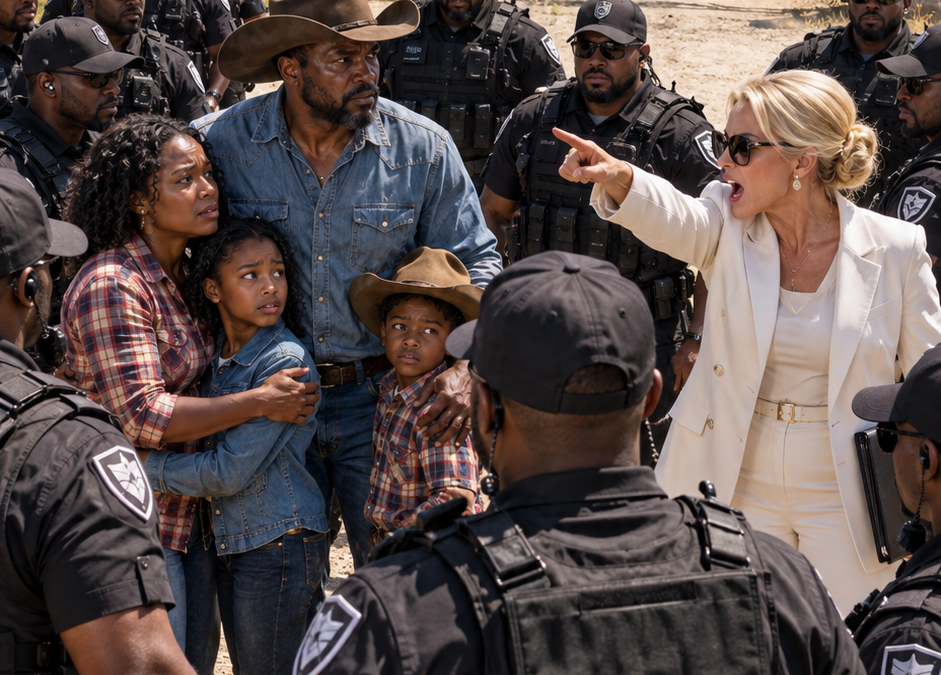
The guards got out.
Dark uniforms.
Vests.
Radios.
Several carried bolt cutters.
Cynthia approached holding a stack of papers.
“Wade.”
“Cynthia.”
“As of six this morning, you and Brooke no longer have lawful possession of this property.”
Brooke stepped forward.
“Which court?”
Cynthia ignored her.
“This order authorizes removal before noon.”
I held out my hand.
“Give it to me.”
She did.
I read the first page.
No valid case number.
No real judge signature.
County name misspelled.
Seal looked scanned.
I gave it to Brooke.
She looked at it for maybe five seconds.
“Fake.”
Cynthia’s face tightened.
“This was prepared through counsel.”
“Whose counsel?” Brooke asked.
“Black Ridge.”
“Where is the judge’s signature?”
“Administrative authority applies.”
I almost laughed.
“Where’s the sheriff?”
“We don’t need the sheriff.”
That sentence told me everything.
A legitimate eviction is not a neighborhood volunteer project.
I looked at the man leading the security team.
“Name?”
“Travis Marrow.”
“You own the company?”
“Yes.”
“This is private property.”
“We have legal paperwork.”
“No, you have paper.”
Cynthia stepped between us.
“Proceed.”
I looked at Travis.
“Do not.”
He hesitated.
That mattered later.
He was not completely comfortable.
Cynthia leaned toward him.
“You’re being paid to execute the order.”
He turned toward his men.
“Move.”
Four guards walked toward the house.
Two moved toward the barn.
Others blocked the driveway.
At the side gate, one man positioned bolt cutters around my padlock.
I shouted:
“Do not cut that.”
He looked at Travis.
Travis looked at Cynthia.
Cynthia nodded.
Snap.
The chain fell.
Brooke raised her phone.
“This is being recorded.”
Cynthia pointed.
“Take that.”
One guard said:
“No.”
Everyone looked at him.
He shook his head.
“We don’t seize phones.”
Cynthia snapped:
“You were hired to handle resistance.”
“That wasn’t in the order.”
Travis stepped closer to the guard.
Then motioned to two others.
“Move them away from the house.”
Two men took my arms.
Not violently at first.
Firmly.
They walked me backward toward my truck.
“Take your hands off me.”
No response.
“I do not consent.”
They kept going.
Across the yard, Brooke was restrained by the wrists.
She shouted:
“Wade!”
Cynthia walked toward her.
Brooke was carrying a canvas document bag.
Cynthia grabbed it.
Brooke pulled back.
“Do not touch that.”
Cynthia yanked harder.
The bag came free.
She opened it.
Inside were files.
Copies.
Tabs.
Labels.
One folder sat on top.
UNITED STATES ATTORNEY
EVIDENCE COPY
Cynthia froze.
For half a second, everything changed in her face.
Confidence disappeared.
Not anger.
Fear.
I watched her.
“If I were you, I’d put that down.”
She looked at me.
Then at the folder.
Then back at me.
“What is this?”
“You should put it down.”
She snapped the bag shut.
“Travis.”
He turned.
“Load these files into my vehicle.”
Brooke shouted:
“Those are not yours!”
Cynthia ignored her.
Two guards started carrying boxes from the porch.
That was when I saw dust beyond the gate.
Three vehicles.
Black.
Approaching fast.
Not racing.
Controlled.
Straight.
Brooke saw them too.
Her whole body changed.
“Wade.”
“I see them.”
The guards turned.
Cynthia looked toward the road.
For one absurd second, she smiled.
I think she believed more help had arrived.
Maybe someone from Silas Brandt.
Maybe attorneys.
Maybe another security team.
She adjusted her blazer.
The SUVs passed through the damaged gate.
No sirens.
No flashing lights.
Just three black vehicles in tight formation.
They stopped in the yard.
Doors opened.
People stepped out.
Dark tactical jackets.
Federal credentials.
Special Agent Colleen Maddox came first.
Her eyes moved across the scene once.
Me against the truck.
Brooke restrained.
Cut gate.
Security guards.
Boxes in Cynthia’s SUV.
Then she called:
“Mr. Hollister?”
“Right here.”
She checked her watch.
“We’re here to pick you and your wife up.”
Nobody spoke.
I looked at Cynthia.
Her smile was gone.
She stepped forward.
“They’re being evicted.”
Colleen turned.
“By whom?”
“The Black Ridge Homeowners Association.”
“Which court issued the order?”
Cynthia held out her pages.
One agent took them.
He scanned the first page.
Then the second.
Looked up.
“This isn’t a court order.”
Travis Marrow’s face changed.
He turned toward his men.
“Release them.”
The guards let go immediately.
Cynthia shouted:
“No!”
Travis looked at her.
“What?”
“Nobody leaves until possession is complete.”
Colleen faced her.
“Do not issue any more instructions.”
“You have no authority over HOA property.”
Colleen glanced around.
“This is HOA property?”
“Yes.”
I said:
“No.”
Brooke said:
“Absolutely not.”
Colleen looked toward me.
“Do you own this ranch?”
“Yes.”
“Documents?”
“Inside.”
Brooke pointed at Cynthia’s SUV.
“And apparently in her trunk now.”
That changed the air.
Colleen turned.
“What?”
Cynthia stepped sideways.
“Those are HOA records.”
“No,” Brooke said. “Those were taken from me.”
An agent walked toward the SUV.
Cynthia moved in front of him.
“You cannot search my vehicle.”
Colleen held up one hand.
“Did your people remove documents from the Hollisters’ house?”
Cynthia answered quickly.
“No.”
A guard near the porch looked at her.
Then away.
Brooke said:
“It’s on camera.”
Cynthia snapped:
“She is lying.”
I pointed toward the yard cameras.
“Four angles.”
Travis Marrow took two steps away from Cynthia.
That was when I realized his loyalty was already cracking.
Colleen looked toward the boxes.
“Do any of those contain materials intended for a federal prosecutor?”
Brooke said:
“Yes.”
Cynthia said:
“I didn’t know.”
I laughed once.
“You read the label.”
She glared.
“I did not.”
“You froze for five seconds.”
“Wade.”
“I told you to put it down.”
Colleen raised her voice slightly.
“Everyone stop.”
The yard went silent.
She radioed for support.
Then:
“All security personnel step away from vehicles.”
Several guards obeyed immediately.
One asked:
“Are we detained?”
“For now, remain where you are while we determine what happened.”
Important difference.
The federal team did not assume all fourteen men were criminals.
They separated them.
Checked identities.
Collected statements.
Asked who gave orders.
Requested body-camera footage.
Photographed the cut lock.
Secured copies of the fake eviction notice.
Preserved ranch video.
Then they took Travis aside.
He looked at Cynthia once.
She stared back at him.
He turned away.
Twenty minutes later, he was talking.
Cynthia had told them the sheriff had approved the operation.
False.
She told them the ranch had already legally transferred to the HOA.
False.
She said a valid court order existed but had not yet appeared in the county system.
False.
She said they had authority to seize assets necessary to complete possession.
False.
One guard produced his briefing instructions.
Another produced messages.
One showed a body-camera clip from before they left their staging area.
Cynthia’s voice:
“Wade Hollister does not leave with any documents.”
That was the line that changed everything.
The operation had never been only about land.
It was about evidence.
Cynthia pulled out her phone.
“I need to call Silas.”
Colleen looked at her.
“Silas Brandt?”
Cynthia realized too late she had said the name.
“Yes.”
“Put it on speaker.”
“I don’t have to.”
“No. You don’t.”
Colleen paused.
“But if you’re calling someone potentially connected to this incident, I advise you not to destroy or conceal evidence.”
Cynthia hesitated.
Then called.
Speaker.
Silas answered.
“What?”
Cynthia’s voice shook.
“Federal agents are here.”
Silence.
“How many?”
“Several.”
“Why?”
“They came for the Hollisters.”
Long pause.
Then Silas said:
“Burn the annexation packet.”
Nobody moved.
Nobody breathed.
Four words.
That was all.
Colleen looked at another agent.
He was already writing.
Cynthia stared at her phone.
Silas continued.
“Cynthia?”
She ended the call.
Colleen said quietly:
“Thank you.”
Cynthia looked sick.
The three SUVs had originally come only to collect Brooke and me.
Now agents were standing in a ranch yard containing:
Fourteen private guards.
A forged eviction document.
A broken gate.
Seized files.
Potential federal evidence in an HOA president’s vehicle.
And a speakerphone instruction to destroy records.
The morning had changed.
Colleen arranged additional support.
She still did not handcuff Cynthia.
That confused her.
I could see it.
She seemed to interpret the lack of immediate arrest as a sign things might still be salvageable.
People like Cynthia often mistake procedure for mercy.
Brooke and I were eventually guided toward one of the SUVs.
She was shaking.
Not dramatically.
Just enough that I noticed when she buckled her seat belt.
I took her hand.
“You okay?”
“No.”
“Me neither.”
She looked back toward the house.
“They took the files.”
“They have them now.”
“What if originals are gone?”
“They aren’t.”
Her head turned.
“What?”
“You hid them?”
“You hid them.”
She almost laughed.
Right.
Brooke had kept originals in a fire safe bolted beneath the office floor.
The boxes Cynthia seized were evidence copies.
That did not make the seizure less serious.
It made it more ridiculous.
The SUV pulled away.
Through the rear window, I watched agents opening the trunk of Cynthia’s white vehicle.
Three boxes.
One canvas bag.
All taken from our home.
Brooke watched too.
“What happens now?”
“I don’t know.”
Agent Maddox sat in front.
She turned slightly.
“Now everything you saved matters.”
The drive downtown was quiet.
At one point, we passed the entrance to Black Ridge.
Stone pillars.
Perfect landscaping.
Large metal lettering.
I looked at it and thought about how Cynthia had spent months pretending those gates somehow expanded her authority nineteen hundred acres farther west.
Brooke finally asked:
“Did she know we were going to meet you today?”
Colleen looked back.
“We’re going to find out.”
That question became important.
Because Cynthia’s timing was too precise.
Five-forty arrival.
Forced removal before noon.
Document seizure.
An order that we not leave carrying papers.
And Silas’s immediate instruction to burn the annexation packet.
At the federal prosecutor’s office, Assistant United States Attorney Graham Voss met us.
He was calm.
Direct.
No dramatic speech.
He reviewed what had happened.
Then said:
“This morning wasn’t only an attempt to take your ranch.”
I looked at him.
“What was it?”
“An attempt to stop you from walking into this building.”
That sentence landed harder than anything Cynthia had said.
Brooke sat back.
“So they knew.”
“We believe someone knew enough.”
Investigators worked through the evidence quickly.
The basic structure emerged.
Silas Brandt had spent years building toward Black Ridge Phase Two.
The project required several things he did not legally have.
Access road.
Water rights.
Certain land interests.
And proof for lenders that those interests had been secured.
Cynthia helped create that proof.
Fake HOA minutes.
False consent documents.
Fraudulent annexation.
Manufactured easement papers.
The signature of a dead man.
Those records were then used in financing materials.
Development money flowed based on representations that were not true.
Our ranch was a problem because Brooke had compared dates.
That was it.
A dead man’s signature.
One impossible date.
One woman careful enough to notice.
From that point forward, Cynthia’s conduct made more sense.
Fines.
Pressure.
Survey stakes.
Threat letters.
Eviction.
Fourteen guards.
Take the documents.
Stop the meeting.
It wasn’t escalating randomly.
It was narrowing toward the evidence.
The security body-camera footage became devastating.
Before the convoy left that morning, Cynthia said:
“Nothing leaves the property with the Hollisters.”
A guard asked:
“Vehicles too?”
She answered:
“Especially documents.”
Another message surfaced:
FRIDAY HAS TO HAPPEN BEFORE THE FEDERAL PICKUP.
The sender used a secondary account.
Investigators traced it.
The originating system connected to Silas Brandt’s company.
That solved part of the leak question.
Not everything.
But enough.
Someone connected to Brandt knew federal pickup was scheduled.
The investigation expanded toward how that information had been obtained.
Cynthia’s attorney tried to get ahead of the story.
Publicly, the HOA called it a civil property dispute.
They claimed Cynthia did not know about a federal investigation.
They said the document seizure was accidental.
They said no one ordered physical restraint.
Then the evidence started arriving.
Body cameras.
Our cameras.
Messages.
Emails.
Fake eviction order.
Speakerphone call.
Phone-location records showing Cynthia at Silas’s office the night before.
A younger guard named Dean Kesler produced a group text from Cynthia:
NOBODY LEAVES WITH DOCUMENTS.
Travis Marrow began cooperating.
He had his own problems.
He had led an operation based on papers he should have verified.
He had brought armed private security onto land without a valid court order.
He had failed to check with the sheriff.
But he could also see clearly that Cynthia had lied to him.
People become very helpful once they realize the person above them is preparing to call them an independent actor.
Cynthia’s defense shifted.
Travis exceeded instructions.
Then Silas misled her.
Silas’s position shifted too.
Cynthia had acted alone.
Then the HOA was responsible.
Then the documents were old drafts.
Then financing staff made mistakes.
Their alliance lasted right up until loyalty became expensive.
The county completed its own title review.
Result:
Not one acre of Hollister Ridge Ranch belonged to Black Ridge.
No valid annexation.
No valid HOA authority.
No permanent easement.
No lawful eviction basis.
Everything Cynthia had claimed from the beginning collapsed.
The bank financing Phase Two was notified.
The next disbursement froze.
Construction stopped.
Machines sat idle.
Billboards remained.
BLACK RIDGE PHASE TWO
COMING SOON
For months, those signs advertised something that no longer had financing.
Brooke called them the most expensive fiction in the county.
Then Agent Maddox called me.
“Wade.”
“Yeah?”
“Warrants were issued.”
“For Cynthia?”
“And others.”
The same black SUVs returned a few mornings later.
They did not turn toward our ranch.
They went through Black Ridge’s main gate.
Federal teams moved on multiple locations.
HOA administrative office.
Silas Brandt’s headquarters.
Off-site records storage.
Development finance office.
Cynthia was reportedly in the clubhouse holding an emergency resident meeting when agents entered.
Colleen walked in.
No shouting.
No spectacle.
She said Cynthia’s full name.
That was enough.
By then, the investigation involved potential conspiracy, fraud tied to financing, falsified property records, obstruction, evidence interference, and conduct involving cooperating witnesses.
The exact charges would be determined through the legal process.
But one thing was finished immediately.
Cynthia’s power in Black Ridge.
The HOA board suspended her.
Then removed her.
Residents started asking where dues had gone.
Security payments.
Legal expenses.
Development-related costs.
Consulting.
Record preparation.
Everything came under review.
Some residents claimed they always distrusted her.
I didn’t believe most of them.
People are remarkably good at remembering skepticism after the person they trusted gets arrested.
Brooke and I stayed out of it.
We had ranch work.
The north fence needed repair.
Gate chain replaced.
One trough had been neglected during the worst weeks.
Cattle do not care about federal investigations.
They still expect water.
That helped.
Normal work made everything feel real again.
Months passed.
Phase Two died.
The financing was never revived under the original plan.
Fraudulent easements were stripped from records.
County officials formally confirmed our title and boundaries.
The northern road remained ours.
No development traffic.
No HOA control.
No construction convoy.
We reached a civil resolution covering damage connected to the ranch invasion.
Gate.
Lock.
Lost work.
Legal costs.
Property damage.
Related losses.
Money mattered.
But the road mattered more.
Silas had wanted it because it unlocked millions.
I wanted it because my father had driven cattle down it.
Different priorities.
Cynthia’s situation worsened.
She lost the presidency.
Then the social protection that came with it.
Former allies stopped calling.
Residents sued.
Financial claims grew.
Her relationship with Silas became openly hostile.
He offered her no protection.
She offered him none.
Each produced documents blaming the other.
Watching two people dismantle their own conspiracy while trying to save themselves was almost efficient.
The fourteen guards did not all share the same fate.
That mattered to me.
Some had been lied to.
Some believed the paperwork was legitimate.
Some refused questionable orders.
One refused to seize Brooke’s phone.
Those distinctions mattered.
Cooperators who had been misled were treated differently from people who knowingly participated in unlawful conduct.
Travis Marrow faced his own licensing and civil consequences for leading the operation without verifying what Cynthia put in front of him.
He later sent a letter through his attorney.
Not exactly an apology.
But close enough.
He acknowledged that he should never have entered the ranch without independent verification.
Brooke read it.
“What do you think?”
“Frame it?”
She smiled.
“No.”
We threw it in the legal file.
Life gradually became quiet.
One afternoon, I replaced the gate lock myself.
Same gate.
Same post.
Same dirt road.
Brooke brought out the old wooden ranch sign.
HOLLISTER RIDGE RANCH
PRIVATE PROPERTY
The corner had cracked.
We repaired it.
She held it while I tightened the bolts.
Then she asked:
“Do you think Cynthia really believed fourteen guards could take this place?”
I considered it.
“No.”
“What then?”
“I think she believed nobody was watching.”
Brooke looked toward the camera above the gate.
Small.
Black.
Almost invisible.
The same camera that recorded the convoy.
The bolt cutters.
The fake eviction.
The guards.
The boxes.
Everything.
She smiled.
“That was a bad assumption.”
“Very.”
I replaced the final padlock.
Pulled it once.
Secure.
Beyond us, Black Ridge rooftops rose above the trees.
Still there.
Still expensive.
Still gated.
But different.
No security patrols came near us.
No survey stakes appeared.
No letters arrived.
No fines.
No fake dues.
No “controlled asset” nonsense.
Just silence.
The dirt road remained empty.
That was the outcome I wanted.
People loved telling the story about the three black SUVs.
I understood why.
It was visual.
Fourteen guards.
Then three federal vehicles.
Cynthia smiling.
Then realizing who had arrived.
Great story.
But those SUVs were not what saved our ranch.
The deed did.
The county records did.
Brooke’s files did.
The cameras did.
The impossible signature did.
The email did.
The body-camera footage did.
And Cynthia’s own arrogance did more than almost anything else.
She kept creating evidence.
Every threat.
Every fine.
Every fabricated document.
Every written instruction.
Every recorded order.
Even the speakerphone call.
She never understood when to stop.
That was her defining flaw.
Not confidence.
Continuation.
At every point, there was an exit.
She could have accepted the original no.
She could have checked the deed.
She could have stopped the fines.
She could have abandoned the fake annexation.
She could have refused Silas’s scheme.
She could have told the security company not to go.
She could have left the gate intact.
She could have told the guards to release us.
She could have put Brooke’s bag down.
She could have avoided calling Silas.
Every time the situation offered her a way out, Cynthia chose the door marked WORSE.
Then acted surprised when it opened.
A year later, I drove the north road at sunrise.
No construction signs.
No survey stakes.
No development equipment.
Just cattle near the fence.
Dust behind my truck.
The valley looked exactly the way it had before Cynthia arrived at our porch with her map.
Brooke was waiting at the house.
Coffee.
Ledger open.
Normal morning.
I sat across from her.
“You know what still bothers me?”
“What?”
“She misspelled the county on the eviction order.”
Brooke started laughing.
“That’s what bothers you?”
“Fourteen guards.”
“Yes.”
“Fake seal.”
“Yes.”
“Forged judge section.”
“Yes.”
“And nobody proofread the county name.”
She shook her head.
“You’re impossible.”
“I’m observant.”
“You married observant.”
“True.”
That was how we finally learned to talk about it.
Not with fear.
With distance.
The ranch survived.
The scheme didn’t.
The road survived.
The development didn’t.
The truth survived.
The paperwork Cynthia created did too, unfortunately for her.
Sometimes I still think about the moment those SUVs appeared.
Cynthia standing in my yard.
Fourteen guards behind her.
My wife restrained.
Files in her hands.
She had spent months making herself look powerful.
HOA president.
Security team.
Threat letters.
Development money.
Lawyers.
Maps.
Fines.
That morning, she believed numbers proved authority.
Fourteen guards.
Fourteen uniforms.
Fourteen radios.
Fourteen people following instructions.
Then three vehicles arrived.
And the difference was not the number.
It was legitimacy.
The federal team had actual authority for what they were doing.
Cynthia had paper she printed.
That distinction destroyed her.
Not instantly.
Real consequences rarely arrive that neatly.
They came through warrants.
Records.
Financial reviews.
Court proceedings.
Resident lawsuits.
Frozen funding.
Lost position.
Collapsed alliances.
The slow dismantling of everything she had built on false documents.
That was more satisfying than any dramatic roadside arrest could have been.
She wanted our ranch.
She lost her office.
Silas wanted our road.
He lost his development.
Black Ridge wanted Phase Two.
It never happened.
We wanted one thing.
To be left alone on land that was already ours.
Eventually, we got it.
The final time I saw Cynthia was months later.
Courthouse hallway.
She was with counsel.
I was with Brooke.
Cynthia stopped.
Looked at us.
No clipboard.
No guards.
No HOA badge.
Nothing behind her.
“You destroyed Black Ridge.”
I shook my head.
“No.”
“You stopped hundreds of homes from being built.”
“No.”
“You ruined everything.”
Brooke answered before I could.
“You forged a dead man’s signature.”
Cynthia’s face hardened.
Brooke continued.
“And then you sent fourteen guards to steal the proof.”
Silence.
I looked at Cynthia.
“You had three months to stop.”
She said nothing.
I thought about the morning at the ranch.
Her fake order.
Her confidence.
The guards.
Then the SUVs.
I said:
“You thought nobody was watching.”
Her eyes shifted.
That was enough.
Brooke and I walked away.
Hollister Ridge Ranch still stands exactly where it always did.
Nineteen hundred acres.
Old fences.
Cattle.
Timber.
Northern dirt road.
No HOA jurisdiction.
No development easement.
No Black Ridge gate.
The only sign at our entrance says exactly what it said before Cynthia ever appeared.
PRIVATE PROPERTY
Nothing dramatic.
Nothing clever.
It doesn’t need to be.
Because unlike Cynthia’s paperwork, every word on that sign is true.
She came with fourteen guards because she believed force could replace ownership.
She came with fake eviction papers because she believed appearance could replace law.
She came for our files because she believed destroying evidence could replace the facts.
Then three black federal SUVs rolled through our gate.
And within minutes, Cynthia learned the lesson she had avoided for months.
Authority is not how many people follow your orders.
It is whether those orders were ever lawful in the first place.
Have you finished reading the story and want to read it again?
HOA SENT 14 GUARDS TO EVICT US FROM MY RANCH—THEN THREE BLACK FEDERAL SUVs ROLLED THROUGH THE GATE
Fourteen guards came to take my ranch.
Their eviction papers were fake.
Then three black federal SUVs rolled through my gate.
My name is Wade Hollister.
My wife, Brooke, and I own Hollister Ridge Ranch, nearly nineteen hundred acres of grazing land, timber, water rights, old fence lines, and more history than the luxury subdivision next door could ever fit into one of its glossy brochures.
The ranch had been there long before Black Ridge Estates.
Our cattle had walked those hills before there was a guarded entrance, before anyone installed decorative stone pillars, before some marketing company decided the valley needed phrases like exclusive living and private mountain lifestyle printed on signs along the highway.
For years, that didn’t matter.
We kept to ourselves.
Black Ridge kept to itself.
Then Cynthia Ror became HOA president.
Cynthia arrived at our front door one afternoon wearing a tailored blazer and carrying a folder.
She introduced herself with the kind of smile people use when they already expect the answer to be yes.
“I’d like to discuss community access.”
I looked past her toward the road.
“What community?”
“Black Ridge.”
“What does that have to do with me?”
She opened the folder.
Inside was a map.
A new subdivision phase had been sketched into the valley behind our northern pasture.
Hundreds of future homes.
A new entrance.
And a road.
My road.
A dirt access lane running along the northern edge of our ranch.
I traced the line with one finger.
“This crosses Hollister property.”
“It would provide substantial benefit to the area.”
“That isn’t what I said.”
She kept smiling.
“We need a community access agreement.”
“No.”
That stopped her.
The smile disappeared.
“You haven’t heard the terms.”
“I don’t need the terms.”
“Mr. Hollister—”
“The road isn’t for sale.”
Her expression hardened.
“This development is moving forward.”
“Then move it somewhere else.”
“You cannot stand in the way of progress forever.”
I looked at her.
“I can stand on my own land indefinitely.”
Then I closed the door.
A week later, the HOA mailed us a letter claiming part of the ranch had already been annexed into Black Ridge years earlier.
Brooke read it twice.
Then went straight to the county records.
She was better with paperwork than anyone I had ever met.
She ran the ranch books, tracked livestock purchases, kept tax records, handled leases, maintained insurance files, and had a habit of saving every document anyone ever sent us.
An hour later, she walked into the kitchen holding a copy of the alleged annexation agreement.
“Wade.”
“What?”
“This signature is impossible.”
I looked.
The name belonged to the man who owned the ranch before my father bought the final northern section.
“What do you mean?”
Brooke tapped the notarized date.
“He died two years before this was supposedly signed.”
That changed everything.
This wasn’t an HOA confusing a boundary.
Someone had created a document.
A dead man’s signature.
A fake annexation.
And somehow, that document was being used to claim access to land worth tens of millions of dollars to a developer.
Brooke closed the folder.
“We stop talking to Cynthia.”
“What do we do instead?”
“Save everything.”
So we did.
Deeds.
Surveys.
Tax records.
HOA letters.
Emails.
Camera footage.
Fake fines.
Threats.
Every page.
Every envelope.
Every date.
At the time, I thought we were protecting ourselves from an aggressive homeowners association.
I didn’t know yet that our ranch had become part of something much larger.
And I had absolutely no idea that three months later, fourteen private guards would come through our gate before sunrise with bolt cutters and fake eviction papers—
on the exact morning federal agents were already scheduled to pick us up.
PART2
The road Cynthia wanted was not impressive.
That was the strange part.
It was dirt.
Two ruts through grass.
Fence on one side.
Cottonwoods farther down.
Nothing about it looked valuable.
But on a development map, it was everything.
Black Ridge Phase Two was planned for the valley behind our northern acreage.
More than three hundred homes.
Clubhouse expansion.
Commercial frontage.
A second gated entrance.
Without access across our road, construction traffic had no practical route.
No route meant no phase two.
No phase two meant a development plan worth tens of millions of dollars stayed trapped on paper.
The developer behind it was a man named Silas Brandt.
At first, that name meant nothing to me.
Cynthia changed that.
After we refused the access agreement, Black Ridge started sending fines.
The first was almost funny.
HOA MEMBERSHIP DUES — DELINQUENT
I mailed it back.
Across the top I wrote:
PROPERTY NOT SUBJECT TO BLACK RIDGE HOA.
Then came a fence violation.
Our fence was older than Black Ridge.
Then landscaping.
Apparently cattle pasture did not meet community aesthetic standards.
Then agricultural vehicle restrictions.
Then livestock-enclosure penalties.
Brooke kept every one.
Within a few weeks, the total exceeded $86,000.
Cynthia’s signature appeared at the bottom of every notice.
I mailed each one back.
Same message.
NOT SUBJECT TO BLACK RIDGE HOA.
One morning, I found survey stakes in the north pasture.
Not near the boundary.
Six hundred feet inside our land.
I pulled them.
The next morning, they were back.
Brooke installed more cameras.
Two nights later, we caught a survey crew entering through the north gate.
Cynthia was with them.
The audio wasn’t perfect, but one sentence came through clearly.
Cynthia told the surveyor:
“Once the bank releases the second phase, Hollister won’t be able to stop anything.”
Brooke replayed it.
Then again.
She looked at me.
“Why is the bank involved in our road?”
“Development loan?”
“Maybe.”
Our attorney received the footage.
He asked for copies of everything.
A few days later, a woman called.
“Mr. Hollister?”
“Yes.”
“My name is Colleen Maddox.”
She identified herself as a federal special agent.
My first thought was that someone had stolen our identity.
It was not that.
She wasn’t calling about fence stakes.
Or HOA dues.
Or livestock rules.
She was calling about Silas Brandt.
“Do you know him?”
“No.”
“Has anyone connected to Black Ridge asked you to sign property documents?”
“Yes.”
“Any annexation documents?”
“Yes.”
“Any easement requests?”
“Yes.”
“Any documents with signatures you believe are fraudulent?”
Brooke was sitting across the kitchen table.
I put the call on speaker.
Brooke said:
“Yes.”
There was a pause.
“Can you preserve everything?”
Brooke almost laughed.
“You called the right house.”
We met with Agent Maddox two days later.
She explained only what she could.
Silas Brandt was already under investigation.
Bank fraud.
Shell companies.
False land representations.
Questionable transfers.
Electronic records.
Development financing.
The forged annexation tied to our ranch might connect several pieces investigators had not been able to connect before.
I remember sitting there thinking:
All of this over a dirt road.
Colleen corrected that idea gently.
“It isn’t about the road.”
“What is it about?”
“What the road unlocks.”
That made sense.
The road unlocked phase two.
Phase two unlocked financing.
Financing unlocked millions.
Our refusal blocked the entire chain.
Brooke handed over copies.
Not originals.
She insisted on keeping originals at home.
Good decision.
From then on, we were asked not to tell Cynthia anything about the investigation.
No hint.
No threat.
No dramatic “federal agents are watching you” moment.
Just silence.
I agreed.
That silence became difficult.
Because Cynthia escalated.
More fines.
More letters.
More threatening language.
Then came:
FINAL EVICTION NOTICE — 72 HOURS
Brooke opened it at breakfast.
She laughed.
Then stopped.
“Wade.”
“What?”
She handed it over.
Bold red heading.
HOA seal.
A supposed judicial reference.
And at the bottom:
MARROW PROTECTIVE SERVICES
I read it.
“Private security?”
“Looks like it.”
“Eviction requires a court.”
“Yes.”
“Sheriff.”
“Yes.”
“Judge.”
“Yes.”
“Do you see any of those?”
“No.”
Brooke spent that night researching Marrow Protective Services.
Private company.
Licensed in security work.
Not law enforcement.
No court authority.
No eviction authority.
Yet Cynthia talked about them as though they were a tactical branch of municipal government.
At the next HOA meeting, we learned she had announced Hollister Ranch was now “a controlled community asset.”
One resident objected.
Cynthia cut his microphone.
Another asked why fourteen armed guards were necessary.
She claimed Brooke and I had “a documented history of resistance.”
I found that almost flattering.
Apparently returning fake fines by mail now counted as insurgency.
Meanwhile, Agent Maddox called.
“Friday morning. Eight.”
“For what?”
“We need you and Mrs. Hollister downtown.”
Assistant United States Attorney Graham Voss wanted to prepare us for formal testimony.
The threats from Black Ridge had become concerning enough that investigators did not want us driving ourselves.
A federal team would collect us at the ranch.
Three vehicles.
Eight o’clock.
I did not tell anyone.
Brooke did not tell anyone.
Our attorney knew.
Federal personnel knew.
That was it.
At least, that was what we believed.
Friday morning began at 5:40.
I woke to engines.
Not one.
Many.
Brooke sat up.
“What is that?”
I checked the gate camera.
Headlights.
One SUV.
Then another.
Then another.
Gray vehicles.
Dark vehicles.
A line.
Brooke stood beside me.
She counted softly.
“Eight.”
More entered.
“Ten.”
More.
“Twelve.”
Then:
“Fourteen.”
Behind them came a white SUV.
Cynthia.
I called the sheriff’s office.
“Private security vehicles are trespassing on Hollister Ridge Ranch.”
“Any weapons visible?”
“Some.”
“We’ll send someone.”
I turned on every camera.
Gate.
Barn.
House.
Driveway.
Workshop.
Brooke put her phone in record mode.
I did the same.
The guards got out.
Dark uniforms.
Vests.
Radios.
Several carried bolt cutters.
Cynthia approached holding a stack of papers.
“Wade.”
“Cynthia.”
“As of six this morning, you and Brooke no longer have lawful possession of this property.”
Brooke stepped forward.
“Which court?”
Cynthia ignored her.
“This order authorizes removal before noon.”
I held out my hand.
“Give it to me.”
She did.
I read the first page.
No valid case number.
No real judge signature.
County name misspelled.
Seal looked scanned.
I gave it to Brooke.
She looked at it for maybe five seconds.
“Fake.”
Cynthia’s face tightened.
“This was prepared through counsel.”
“Whose counsel?” Brooke asked.
“Black Ridge.”
“Where is the judge’s signature?”
“Administrative authority applies.”
I almost laughed.
“Where’s the sheriff?”
“We don’t need the sheriff.”
That sentence told me everything.
A legitimate eviction is not a neighborhood volunteer project.
I looked at the man leading the security team.
“Name?”
“Travis Marrow.”
“You own the company?”
“Yes.”
“This is private property.”
“We have legal paperwork.”
“No, you have paper.”
Cynthia stepped between us.
“Proceed.”
I looked at Travis.
“Do not.”
He hesitated.
That mattered later.
He was not completely comfortable.
Cynthia leaned toward him.
“You’re being paid to execute the order.”
He turned toward his men.
“Move.”
Four guards walked toward the house.
Two moved toward the barn.
Others blocked the driveway.
At the side gate, one man positioned bolt cutters around my padlock.
I shouted:
“Do not cut that.”
He looked at Travis.
Travis looked at Cynthia.
Cynthia nodded.
Snap.
The chain fell.
Brooke raised her phone.
“This is being recorded.”
Cynthia pointed.
“Take that.”
One guard said:
“No.”
Everyone looked at him.
He shook his head.
“We don’t seize phones.”
Cynthia snapped:
“You were hired to handle resistance.”
“That wasn’t in the order.”
Travis stepped closer to the guard.
Then motioned to two others.
“Move them away from the house.”
Two men took my arms.
Not violently at first.
Firmly.
They walked me backward toward my truck.
“Take your hands off me.”
No response.
“I do not consent.”
They kept going.
Across the yard, Brooke was restrained by the wrists.
She shouted:
“Wade!”
Cynthia walked toward her.
Brooke was carrying a canvas document bag.
Cynthia grabbed it.
Brooke pulled back.
“Do not touch that.”
Cynthia yanked harder.
The bag came free.
She opened it.
Inside were files.
Copies.
Tabs.
Labels.
One folder sat on top.
UNITED STATES ATTORNEY
EVIDENCE COPY
Cynthia froze.
For half a second, everything changed in her face.
Confidence disappeared.
Not anger.
Fear.
I watched her.
“If I were you, I’d put that down.”
She looked at me.
Then at the folder.
Then back at me.
“What is this?”
“You should put it down.”
She snapped the bag shut.
“Travis.”
He turned.
“Load these files into my vehicle.”
Brooke shouted:
“Those are not yours!”
Cynthia ignored her.
Two guards started carrying boxes from the porch.
That was when I saw dust beyond the gate.
Three vehicles.
Black.
Approaching fast.
Not racing.
Controlled.
Straight.
Brooke saw them too.
Her whole body changed.
“Wade.”
“I see them.”
The guards turned.
Cynthia looked toward the road.
For one absurd second, she smiled.
I think she believed more help had arrived.
Maybe someone from Silas Brandt.
Maybe attorneys.
Maybe another security team.
She adjusted her blazer.
The SUVs passed through the damaged gate.
No sirens.
No flashing lights.
Just three black vehicles in tight formation.
They stopped in the yard.
Doors opened.
People stepped out.
Dark tactical jackets.
Federal credentials.
Special Agent Colleen Maddox came first.
Her eyes moved across the scene once.
Me against the truck.
Brooke restrained.
Cut gate.
Security guards.
Boxes in Cynthia’s SUV.
Then she called:
“Mr. Hollister?”
“Right here.”
She checked her watch.
“We’re here to pick you and your wife up.”
Nobody spoke.
I looked at Cynthia.
Her smile was gone.
She stepped forward.
“They’re being evicted.”
Colleen turned.
“By whom?”
“The Black Ridge Homeowners Association.”
“Which court issued the order?”
Cynthia held out her pages.
One agent took them.
He scanned the first page.
Then the second.
Looked up.
“This isn’t a court order.”
Travis Marrow’s face changed.
He turned toward his men.
“Release them.”
The guards let go immediately.
Cynthia shouted:
“No!”
Travis looked at her.
“What?”
“Nobody leaves until possession is complete.”
Colleen faced her.
“Do not issue any more instructions.”
“You have no authority over HOA property.”
Colleen glanced around.
“This is HOA property?”
“Yes.”
I said:
“No.”
Brooke said:
“Absolutely not.”
Colleen looked toward me.
“Do you own this ranch?”
“Yes.”
“Documents?”
“Inside.”
Brooke pointed at Cynthia’s SUV.
“And apparently in her trunk now.”
That changed the air.
Colleen turned.
“What?”
Cynthia stepped sideways.
“Those are HOA records.”
“No,” Brooke said. “Those were taken from me.”
An agent walked toward the SUV.
Cynthia moved in front of him.
“You cannot search my vehicle.”
Colleen held up one hand.
“Did your people remove documents from the Hollisters’ house?”
Cynthia answered quickly.
“No.”
A guard near the porch looked at her.
Then away.
Brooke said:
“It’s on camera.”
Cynthia snapped:
“She is lying.”
I pointed toward the yard cameras.
“Four angles.”
Travis Marrow took two steps away from Cynthia.
That was when I realized his loyalty was already cracking.
Colleen looked toward the boxes.
“Do any of those contain materials intended for a federal prosecutor?”
Brooke said:
“Yes.”
Cynthia said:
“I didn’t know.”
I laughed once.
“You read the label.”
She glared.
“I did not.”
“You froze for five seconds.”
“Wade.”
“I told you to put it down.”
Colleen raised her voice slightly.
“Everyone stop.”
The yard went silent.
She radioed for support.
Then:
“All security personnel step away from vehicles.”
Several guards obeyed immediately.
One asked:
“Are we detained?”
“For now, remain where you are while we determine what happened.”
Important difference.
The federal team did not assume all fourteen men were criminals.
They separated them.
Checked identities.
Collected statements.
Asked who gave orders.
Requested body-camera footage.
Photographed the cut lock.
Secured copies of the fake eviction notice.
Preserved ranch video.
Then they took Travis aside.
He looked at Cynthia once.
She stared back at him.
He turned away.
Twenty minutes later, he was talking.
Cynthia had told them the sheriff had approved the operation.
False.
She told them the ranch had already legally transferred to the HOA.
False.
She said a valid court order existed but had not yet appeared in the county system.
False.
She said they had authority to seize assets necessary to complete possession.
False.
One guard produced his briefing instructions.
Another produced messages.
One showed a body-camera clip from before they left their staging area.
Cynthia’s voice:
“Wade Hollister does not leave with any documents.”
That was the line that changed everything.
The operation had never been only about land.
It was about evidence.
Cynthia pulled out her phone.
“I need to call Silas.”
Colleen looked at her.
“Silas Brandt?”
Cynthia realized too late she had said the name.
“Yes.”
“Put it on speaker.”
“I don’t have to.”
“No. You don’t.”
Colleen paused.
“But if you’re calling someone potentially connected to this incident, I advise you not to destroy or conceal evidence.”
Cynthia hesitated.
Then called.
Speaker.
Silas answered.
“What?”
Cynthia’s voice shook.
“Federal agents are here.”
Silence.
“How many?”
“Several.”
“Why?”
“They came for the Hollisters.”
Long pause.
Then Silas said:
“Burn the annexation packet.”
Nobody moved.
Nobody breathed.
Four words.
That was all.
Colleen looked at another agent.
He was already writing.
Cynthia stared at her phone.
Silas continued.
“Cynthia?”
She ended the call.
Colleen said quietly:
“Thank you.”
Cynthia looked sick.
The three SUVs had originally come only to collect Brooke and me.
Now agents were standing in a ranch yard containing:
Fourteen private guards.
A forged eviction document.
A broken gate.
Seized files.
Potential federal evidence in an HOA president’s vehicle.
And a speakerphone instruction to destroy records.
The morning had changed.
Colleen arranged additional support.
She still did not handcuff Cynthia.
That confused her.
I could see it.
She seemed to interpret the lack of immediate arrest as a sign things might still be salvageable.
People like Cynthia often mistake procedure for mercy.
Brooke and I were eventually guided toward one of the SUVs.
She was shaking.
Not dramatically.
Just enough that I noticed when she buckled her seat belt.
I took her hand.
“You okay?”
“No.”
“Me neither.”
She looked back toward the house.
“They took the files.”
“They have them now.”
“What if originals are gone?”
“They aren’t.”
Her head turned.
“What?”
“You hid them?”
“You hid them.”
She almost laughed.
Right.
Brooke had kept originals in a fire safe bolted beneath the office floor.
The boxes Cynthia seized were evidence copies.
That did not make the seizure less serious.
It made it more ridiculous.
The SUV pulled away.
Through the rear window, I watched agents opening the trunk of Cynthia’s white vehicle.
Three boxes.
One canvas bag.
All taken from our home.
Brooke watched too.
“What happens now?”
“I don’t know.”
Agent Maddox sat in front.
She turned slightly.
“Now everything you saved matters.”
The drive downtown was quiet.
At one point, we passed the entrance to Black Ridge.
Stone pillars.
Perfect landscaping.
Large metal lettering.
I looked at it and thought about how Cynthia had spent months pretending those gates somehow expanded her authority nineteen hundred acres farther west.
Brooke finally asked:
“Did she know we were going to meet you today?”
Colleen looked back.
“We’re going to find out.”
That question became important.
Because Cynthia’s timing was too precise.
Five-forty arrival.
Forced removal before noon.
Document seizure.
An order that we not leave carrying papers.
And Silas’s immediate instruction to burn the annexation packet.
At the federal prosecutor’s office, Assistant United States Attorney Graham Voss met us.
He was calm.
Direct.
No dramatic speech.
He reviewed what had happened.
Then said:
“This morning wasn’t only an attempt to take your ranch.”
I looked at him.
“What was it?”
“An attempt to stop you from walking into this building.”
That sentence landed harder than anything Cynthia had said.
Brooke sat back.
“So they knew.”
“We believe someone knew enough.”
Investigators worked through the evidence quickly.
The basic structure emerged.
Silas Brandt had spent years building toward Black Ridge Phase Two.
The project required several things he did not legally have.
Access road.
Water rights.
Certain land interests.
And proof for lenders that those interests had been secured.
Cynthia helped create that proof.
Fake HOA minutes.
False consent documents.
Fraudulent annexation.
Manufactured easement papers.
The signature of a dead man.
Those records were then used in financing materials.
Development money flowed based on representations that were not true.
Our ranch was a problem because Brooke had compared dates.
That was it.
A dead man’s signature.
One impossible date.
One woman careful enough to notice.
From that point forward, Cynthia’s conduct made more sense.
Fines.
Pressure.
Survey stakes.
Threat letters.
Eviction.
Fourteen guards.
Take the documents.
Stop the meeting.
It wasn’t escalating randomly.
It was narrowing toward the evidence.
The security body-camera footage became devastating.
Before the convoy left that morning, Cynthia said:
“Nothing leaves the property with the Hollisters.”
A guard asked:
“Vehicles too?”
She answered:
“Especially documents.”
Another message surfaced:
FRIDAY HAS TO HAPPEN BEFORE THE FEDERAL PICKUP.
The sender used a secondary account.
Investigators traced it.
The originating system connected to Silas Brandt’s company.
That solved part of the leak question.
Not everything.
But enough.
Someone connected to Brandt knew federal pickup was scheduled.
The investigation expanded toward how that information had been obtained.
Cynthia’s attorney tried to get ahead of the story.
Publicly, the HOA called it a civil property dispute.
They claimed Cynthia did not know about a federal investigation.
They said the document seizure was accidental.
They said no one ordered physical restraint.
Then the evidence started arriving.
Body cameras.
Our cameras.
Messages.
Emails.
Fake eviction order.
Speakerphone call.
Phone-location records showing Cynthia at Silas’s office the night before.
A younger guard named Dean Kesler produced a group text from Cynthia:
NOBODY LEAVES WITH DOCUMENTS.
Travis Marrow began cooperating.
He had his own problems.
He had led an operation based on papers he should have verified.
He had brought armed private security onto land without a valid court order.
He had failed to check with the sheriff.
But he could also see clearly that Cynthia had lied to him.
People become very helpful once they realize the person above them is preparing to call them an independent actor.
Cynthia’s defense shifted.
Travis exceeded instructions.
Then Silas misled her.
Silas’s position shifted too.
Cynthia had acted alone.
Then the HOA was responsible.
Then the documents were old drafts.
Then financing staff made mistakes.
Their alliance lasted right up until loyalty became expensive.
The county completed its own title review.
Result:
Not one acre of Hollister Ridge Ranch belonged to Black Ridge.
No valid annexation.
No valid HOA authority.
No permanent easement.
No lawful eviction basis.
Everything Cynthia had claimed from the beginning collapsed.
The bank financing Phase Two was notified.
The next disbursement froze.
Construction stopped.
Machines sat idle.
Billboards remained.
BLACK RIDGE PHASE TWO
COMING SOON
For months, those signs advertised something that no longer had financing.
Brooke called them the most expensive fiction in the county.
Then Agent Maddox called me.
“Wade.”
“Yeah?”
“Warrants were issued.”
“For Cynthia?”
“And others.”
The same black SUVs returned a few mornings later.
They did not turn toward our ranch.
They went through Black Ridge’s main gate.
Federal teams moved on multiple locations.
HOA administrative office.
Silas Brandt’s headquarters.
Off-site records storage.
Development finance office.
Cynthia was reportedly in the clubhouse holding an emergency resident meeting when agents entered.
Colleen walked in.
No shouting.
No spectacle.
She said Cynthia’s full name.
That was enough.
By then, the investigation involved potential conspiracy, fraud tied to financing, falsified property records, obstruction, evidence interference, and conduct involving cooperating witnesses.
The exact charges would be determined through the legal process.
But one thing was finished immediately.
Cynthia’s power in Black Ridge.
The HOA board suspended her.
Then removed her.
Residents started asking where dues had gone.
Security payments.
Legal expenses.
Development-related costs.
Consulting.
Record preparation.
Everything came under review.
Some residents claimed they always distrusted her.
I didn’t believe most of them.
People are remarkably good at remembering skepticism after the person they trusted gets arrested.
Brooke and I stayed out of it.
We had ranch work.
The north fence needed repair.
Gate chain replaced.
One trough had been neglected during the worst weeks.
Cattle do not care about federal investigations.
They still expect water.
That helped.
Normal work made everything feel real again.
Months passed.
Phase Two died.
The financing was never revived under the original plan.
Fraudulent easements were stripped from records.
County officials formally confirmed our title and boundaries.
The northern road remained ours.
No development traffic.
No HOA control.
No construction convoy.
We reached a civil resolution covering damage connected to the ranch invasion.
Gate.
Lock.
Lost work.
Legal costs.
Property damage.
Related losses.
Money mattered.
But the road mattered more.
Silas had wanted it because it unlocked millions.
I wanted it because my father had driven cattle down it.
Different priorities.
Cynthia’s situation worsened.
She lost the presidency.
Then the social protection that came with it.
Former allies stopped calling.
Residents sued.
Financial claims grew.
Her relationship with Silas became openly hostile.
He offered her no protection.
She offered him none.
Each produced documents blaming the other.
Watching two people dismantle their own conspiracy while trying to save themselves was almost efficient.
The fourteen guards did not all share the same fate.
That mattered to me.
Some had been lied to.
Some believed the paperwork was legitimate.
Some refused questionable orders.
One refused to seize Brooke’s phone.
Those distinctions mattered.
Cooperators who had been misled were treated differently from people who knowingly participated in unlawful conduct.
Travis Marrow faced his own licensing and civil consequences for leading the operation without verifying what Cynthia put in front of him.
He later sent a letter through his attorney.
Not exactly an apology.
But close enough.
He acknowledged that he should never have entered the ranch without independent verification.
Brooke read it.
“What do you think?”
“Frame it?”
She smiled.
“No.”
We threw it in the legal file.
Life gradually became quiet.
One afternoon, I replaced the gate lock myself.
Same gate.
Same post.
Same dirt road.
Brooke brought out the old wooden ranch sign.
HOLLISTER RIDGE RANCH
PRIVATE PROPERTY
The corner had cracked.
We repaired it.
She held it while I tightened the bolts.
Then she asked:
“Do you think Cynthia really believed fourteen guards could take this place?”
I considered it.
“No.”
“What then?”
“I think she believed nobody was watching.”
Brooke looked toward the camera above the gate.
Small.
Black.
Almost invisible.
The same camera that recorded the convoy.
The bolt cutters.
The fake eviction.
The guards.
The boxes.
Everything.
She smiled.
“That was a bad assumption.”
“Very.”
I replaced the final padlock.
Pulled it once.
Secure.
Beyond us, Black Ridge rooftops rose above the trees.
Still there.
Still expensive.
Still gated.
But different.
No security patrols came near us.
No survey stakes appeared.
No letters arrived.
No fines.
No fake dues.
No “controlled asset” nonsense.
Just silence.
The dirt road remained empty.
That was the outcome I wanted.
People loved telling the story about the three black SUVs.
I understood why.
It was visual.
Fourteen guards.
Then three federal vehicles.
Cynthia smiling.
Then realizing who had arrived.
Great story.
But those SUVs were not what saved our ranch.
The deed did.
The county records did.
Brooke’s files did.
The cameras did.
The impossible signature did.
The email did.
The body-camera footage did.
And Cynthia’s own arrogance did more than almost anything else.
She kept creating evidence.
Every threat.
Every fine.
Every fabricated document.
Every written instruction.
Every recorded order.
Even the speakerphone call.
She never understood when to stop.
That was her defining flaw.
Not confidence.
Continuation.
At every point, there was an exit.
She could have accepted the original no.
She could have checked the deed.
She could have stopped the fines.
She could have abandoned the fake annexation.
She could have refused Silas’s scheme.
She could have told the security company not to go.
She could have left the gate intact.
She could have told the guards to release us.
She could have put Brooke’s bag down.
She could have avoided calling Silas.
Every time the situation offered her a way out, Cynthia chose the door marked WORSE.
Then acted surprised when it opened.
A year later, I drove the north road at sunrise.
No construction signs.
No survey stakes.
No development equipment.
Just cattle near the fence.
Dust behind my truck.
The valley looked exactly the way it had before Cynthia arrived at our porch with her map.
Brooke was waiting at the house.
Coffee.
Ledger open.
Normal morning.
I sat across from her.
“You know what still bothers me?”
“What?”
“She misspelled the county on the eviction order.”
Brooke started laughing.
“That’s what bothers you?”
“Fourteen guards.”
“Yes.”
“Fake seal.”
“Yes.”
“Forged judge section.”
“Yes.”
“And nobody proofread the county name.”
She shook her head.
“You’re impossible.”
“I’m observant.”
“You married observant.”
“True.”
That was how we finally learned to talk about it.
Not with fear.
With distance.
The ranch survived.
The scheme didn’t.
The road survived.
The development didn’t.
The truth survived.
The paperwork Cynthia created did too, unfortunately for her.
Sometimes I still think about the moment those SUVs appeared.
Cynthia standing in my yard.
Fourteen guards behind her.
My wife restrained.
Files in her hands.
She had spent months making herself look powerful.
HOA president.
Security team.
Threat letters.
Development money.
Lawyers.
Maps.
Fines.
That morning, she believed numbers proved authority.
Fourteen guards.
Fourteen uniforms.
Fourteen radios.
Fourteen people following instructions.
Then three vehicles arrived.
And the difference was not the number.
It was legitimacy.
The federal team had actual authority for what they were doing.
Cynthia had paper she printed.
That distinction destroyed her.
Not instantly.
Real consequences rarely arrive that neatly.
They came through warrants.
Records.
Financial reviews.
Court proceedings.
Resident lawsuits.
Frozen funding.
Lost position.
Collapsed alliances.
The slow dismantling of everything she had built on false documents.
That was more satisfying than any dramatic roadside arrest could have been.
She wanted our ranch.
She lost her office.
Silas wanted our road.
He lost his development.
Black Ridge wanted Phase Two.
It never happened.
We wanted one thing.
To be left alone on land that was already ours.
Eventually, we got it.
The final time I saw Cynthia was months later.
Courthouse hallway.
She was with counsel.
I was with Brooke.
Cynthia stopped.
Looked at us.
No clipboard.
No guards.
No HOA badge.
Nothing behind her.
“You destroyed Black Ridge.”
I shook my head.
“No.”
“You stopped hundreds of homes from being built.”
“No.”
“You ruined everything.”
Brooke answered before I could.
“You forged a dead man’s signature.”
Cynthia’s face hardened.
Brooke continued.
“And then you sent fourteen guards to steal the proof.”
Silence.
I looked at Cynthia.
“You had three months to stop.”
She said nothing.
I thought about the morning at the ranch.
Her fake order.
Her confidence.
The guards.
Then the SUVs.
I said:
“You thought nobody was watching.”
Her eyes shifted.
That was enough.
Brooke and I walked away.
Hollister Ridge Ranch still stands exactly where it always did.
Nineteen hundred acres.
Old fences.
Cattle.
Timber.
Northern dirt road.
No HOA jurisdiction.
No development easement.
No Black Ridge gate.
The only sign at our entrance says exactly what it said before Cynthia ever appeared.
PRIVATE PROPERTY
Nothing dramatic.
Nothing clever.
It doesn’t need to be.
Because unlike Cynthia’s paperwork, every word on that sign is true.
She came with fourteen guards because she believed force could replace ownership.
She came with fake eviction papers because she believed appearance could replace law.
She came for our files because she believed destroying evidence could replace the facts.
Then three black federal SUVs rolled through our gate.
And within minutes, Cynthia learned the lesson she had avoided for months.
Authority is not how many people follow your orders.
It is whether those orders were ever lawful in the first place.








