𝗣𝗔𝗥𝗧 𝟮 HOA Scheduled a Burn on My Pasture—Then I Found the Missing Authorization in Their Permit
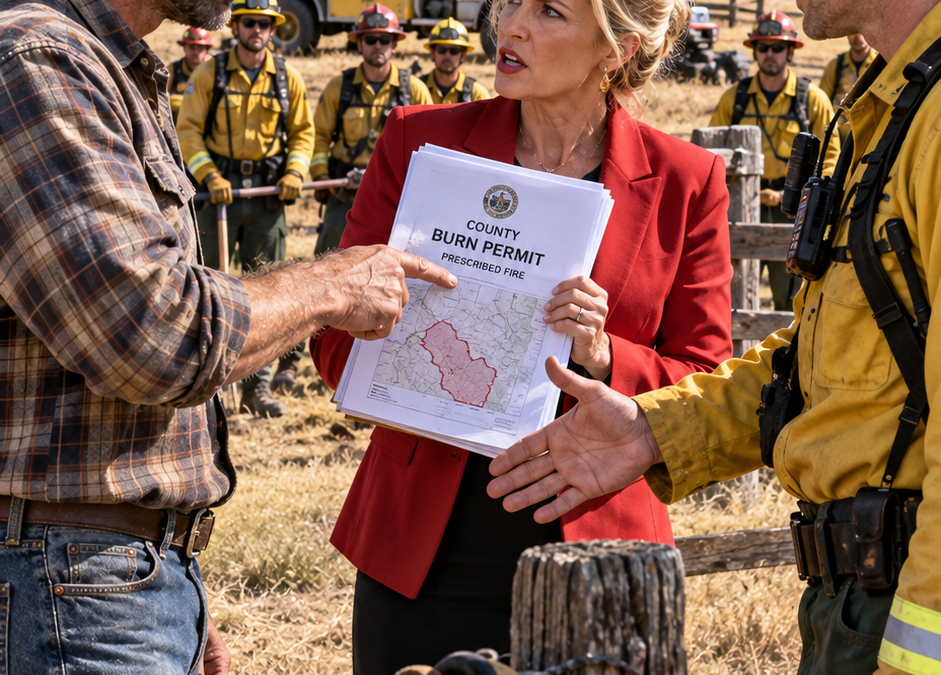
𝗣𝗔𝗥𝗧 𝟮
Travis nodded politely.
“I’m still calling.”
That was the first sensible sentence anyone had spoken since I arrived.
He walked toward the water tender.
I took out my phone.
Lydia immediately noticed.
“What are you doing?”
“Making a record.”
I photographed the gate.
The water tender.
Every vehicle.
The red flags.
The permit cover.
The map.
The stacked tools.
The unopened drip torches.
The crew positions.
The condition of the grass before anybody touched it.
“You’re making this more complicated than necessary.”
“No.”
I took another photo.
“I’m making it harder for anyone to remember it differently later.”
She stared at me.
I smiled.
The ranch had been in my family long enough for me to know exactly how land disputes evolve.
Day one, everybody is certain what happened.
Day thirty, everybody remembers a slightly different version.
Day ninety, somebody’s lawyer discovers language like misunderstanding, assumption, customary practice, implied cooperation, and administrative oversight.
Photographs have no imagination.
That makes them useful.
Travis returned several minutes later.
“We’re holding ignition while the office confirms site authorization.”
Lydia’s face tightened.
“The permit is active.”
“I didn’t say it wasn’t.”
“You have the work order.”
“I know.”
“Then perform it.”
Travis glanced at me.
“My company is not lighting private land while the owner is standing here disputing access unless somebody above my pay grade confirms why we’re allowed to.”
I almost liked him immediately.
Lydia did not.
“Every delay increases association costs,” she said to me. “If this crew has to remobilize, the board will document those expenses.”
“Document everything.”
“I intend to.”
“Excellent. We finally agree on something.”
She looked as though she had briefly considered setting me on fire herself.
The operation did not proceed that morning.
Nobody ruled in my favor.
Nobody declared Lydia wrong.
Nobody revoked the county permit.
The crew simply kept the drip torches capped.
At that moment, that was enough.
I drove back toward the ranch house with photographs on my phone and one question repeating in my head.
If Sierra Hollow truly had the authority Lydia claimed, why couldn’t she show me the page that mattered most?
The next morning, I went back to the west fence.
Not for paperwork.
For perspective.
There are places on a ranch you stop noticing because you have seen them too many times.
The west pasture was like that.
Forty acres of dry summer grass.
A stock tank.
Fence wire patched in several places.
Dust beaten into trails where cattle moved between water and shade.
Nobody would photograph it for a real-estate brochure.
That was precisely why it mattered.
Land does not have to look impressive to be useful.
I rotated cattle through that pasture late each summer.
It bought time.
It let the lower ground rest.
It kept me from feeding hay earlier than I needed to.
Every acre had a job.
I stood beside the fence and looked across into Sierra Hollow.
The contrast would have been funny if the morning before hadn’t annoyed me so much.
Synthetic turf.
Trimmed shrubs.
Stone monuments.
Matching wildfire-awareness signs.
Irrigation clicking through common landscaping while my side of the fence looked like exactly what it was.
Working land.
Their side was designed to look controlled.
Mine was designed to work.
I pulled out my phone and searched old email.
SIERRA HOLLOW.
Hundreds of messages.
Road notices.
Property-line questions.
Dust complaints.
One memorable email in which a resident wanted me to prevent cattle from “creating an agricultural visual impact.”
I still treasure that phrase.
Then I searched:
FUEL REDUCTION.
One message appeared from three years earlier.
TEMPORARY ACCESS REQUEST — SIERRA HOLLOW FUEL REDUCTION.
I remembered the project immediately.
The HOA had hired a brush-removal contractor near its north service lane.
To reach one corner efficiently, the crew needed to cross a strip of my land.
And Sierra Hollow had done something revolutionary.
They asked.
The old email described dates.
Equipment.
A marked access corridor.
Then one sentence:
The association is requesting permission to enter a limited portion of the property.
I scrolled down.
My response was still there.
Permission granted subject to four conditions:
Stay within the marked corridor.
Keep gates closed.
No work before 7:00 a.m.
Repair any fence damage.
That had been it.
No shouting.
No lawyers.
No crimson blazer at my gate explaining that county paperwork had abolished private ownership overnight.
They asked.
I agreed.
The job got done.
My phone buzzed.
Lydia.
Email.
She described the previous day as my “obstruction of a scheduled wildfire mitigation operation.”
Apparently standing on your own land and asking who authorized fire crews to enter it had now become obstruction.
The board intended to remobilize within the week.
Any additional contractor charges would be documented and, in her words, “attributed accordingly.”
I read the email twice.
Then opened the one from three years earlier.
Same HOA.
Same boundary.
Same basic kind of work.
Completely different attitude.
Three years ago:
May we enter?
Now:
We are entering.
Three years ago:
Here are the dates and conditions.
Now:
You were notified.
Three years ago:
Permission.
Now:
Permit.
That was the moment the dispute changed in my head.
Wildfire prevention had never been the problem.
I took wildfire risk seriously.
I maintained access.
Cleared dead growth.
Watched wind.
Watched humidity.
Watched lightning.
A rancher who ignores wildfire risk in dry country eventually becomes a rancher explaining to an insurance adjuster why he ignored wildfire risk.
I had cooperated before.
What I had never done was give Sierra Hollow permanent rights over my pasture.
And now I had documentary proof that Sierra Hollow itself had once understood that distinction.
Four days later, they came back.
This time they did not wait at the gate.
I was repairing a float valve on the south side when I saw smoke.
Thin gray ribbon.
West ridge.
At first I assumed the HOA was burning on its own common ground.
Then the wind shifted.
The smoke drifted across my pasture.
I dropped the wrench.
Got in the truck.
And drove north.
Two contractor pickups were already inside my fence.
The same water tender sat near the gate.
A skid steer was cutting a control line through my grass.
Crew members walked the perimeter with hand tools.
And beside the tender stood Lydia Crane.
Crimson blazer.
Again.
If the apocalypse ever comes, I am reasonably confident Lydia will attend in business casual.
I stopped outside the active area.
“What are you doing?”
She turned.
Not surprised.
“The access issue was resolved.”
“By whom?”
“The board confirmed the contractor can proceed.”
A black strip marked the edge of the treatment area.
Not large yet.
A short test burn.
Flames only a few inches high.
Controlled.
A firefighter stood with a charged hose.
Everything safe.
Everything deliberate.
That was what made me angrier.
This was not some confused crew taking a wrong turn.
Somebody had decided, after I explicitly objected, that my objection did not matter.
I walked toward the nearest firefighter with both hands visible.
“I’m not touching equipment. I need the supervisor.”
Travis came over.
He recognized me immediately.
“Mason.”
“Travis.”
His face told me he had hoped our next meeting would never happen.
“We were told the site-control question was resolved.”
“By whom?”
He rubbed the back of his neck.
“We received remobilization instructions yesterday.”
“From the county?”
He hesitated.
That answered me before he spoke.
“From the client file.”
“The HOA.”
“Yes.”
Lydia stepped closer.
“The association confirmed access.”
“With what document?”
“The permit.”
I looked at Travis.
“Did the county tell your company my authorization had been verified?”
He did not say yes.
He did not say anything.
Good man.
Sometimes not lying is the best help a stranger can give you.
I took out my phone and started recording.
The skid steer stopped.
One firefighter kept the drip torch upright.
Another watched the black line.
My cattle stood at the far end of the field in a tighter bunch than normal.
I called Eli, my ranch hand.
“Bring the stock trailer.”
“What happened?”
“They started the burn.”
“I’m coming.”
Then I called county fire dispatch.
I chose my words carefully.
“This is not an uncontrolled wildfire.”
The dispatcher paused.
“All right.”
“A permitted prescribed burn has begun on private property. Ownership authorization for the treatment area is disputed. The contractor previously paused for the same reason.”
“Is anyone injured?”
“No.”
“Any structures threatened?”
“No.”
“Is the fire contained?”
“Yes.”
“Are you requesting suppression?”
“No. I’m requesting an officer verify whether the operation should continue while the land-control issue is unresolved.”
That distinction mattered.
I did not want sirens.
I did not want ten engines arriving because I had exaggerated a dispute into an emergency.
I wanted documentation.
Lydia walked toward me.
“You called dispatch?”
“Yes.”
“You are escalating this.”
I pointed at the black grass.
“No. That is escalation.”
“This is professional wildfire mitigation.”
“I can see that.”
“Then stop interfering.”
“I haven’t touched your equipment.”
“You’re delaying the project.”
“I’m asking who gave you permission to burn my pasture.”
“You were notified.”
“Again, Lydia, notification is not permission.”
That sentence irritated her more every time I said it.
Probably because repetition had not made it less true.
County Fire Operations Officer Daniel Ruiz arrived in a white utility truck.
He did exactly what competent professionals usually do.
He ignored the drama.
Asked Travis for the operational plan.
Weather readings.
Permit.
Work order.
Asked me for deed information.
Parcel map.
Identification.
Then stood near the hood of his truck reading.
Lydia hovered beside him.
“The permit is active.”
Ruiz nodded.
“I see that.”
She gave me a tiny triumphant look.
Then Ruiz turned toward Travis.
“Pause additional ignition.”
Lydia’s victory lasted approximately three seconds.
“On what basis?”
Ruiz looked at her.
“The owner is disputing authorization to treat this parcel, and your contractor says the issue was already raised during a previous mobilization.”
“That doesn’t revoke the permit.”
“I didn’t say it did.”
“The treatment unit is approved.”
“I’m not adjudicating ownership.”
He pointed toward the burned strip.
“Secure what has already been ignited. No expansion until applicant site control is verified.”
The crew moved immediately.
No argument.
No performance.
Hose line checked.
Black edge wetted.
Equipment shut down.
That was the difference between actual operational authority and Lydia’s version of authority.
Professionals know exactly what their authority covers.
People like Lydia tend to assume theirs covers whatever they need that morning.
Eli arrived.
We spent forty minutes moving cattle.
Not catastrophic.
Just expensive in the boring way ranch problems are expensive.
Fuel.
Labor.
Lost grazing.
Delayed work.
Stress on animals.
Things that never make dramatic photographs but still cost money.
Once the burn was secure, I walked the control line.
Photographed scorched fence posts.
Measured the disturbed area.
Photographed burned forage.
Cattle tracks.
Equipment placement.
Travis approached with a clipboard.
“I want you to understand something.”
“I’m listening.”
“We were hired to perform a treatment unit. Our client represented the site as cleared.”
“Who is the client?”
“Sierra Hollow HOA.”
“Do you have that in writing?”
He hesitated.
Then glanced toward Lydia.
“I can show you the mobilization work order. I can’t give you our full contract.”
“Fine.”
He flipped through several pages.
One line caught my eye.
HOA COOPERATIVE TREATMENT UNIT.
I read it twice.
My pasture had somehow become cooperative.
That was fascinating, considering nobody had asked me to cooperate.
“Who supplied that description?”
“Client file.”
“May I photograph this line?”
Travis nodded.
I did.
Lydia saw me.
Her heels moved remarkably fast on uneven ground.
“You are not entitled to contractor documents.”
Travis closed the clipboard.
“He photographed the site description.”
“That is internal.”
“It describes my property.”
“Exactly.”
I looked at her.
“Thank you for making my point.”
Ruiz stepped between us before Lydia discovered another creative interpretation of county authority.
“The operation is paused. That’s all being decided today.”
By late afternoon, the crew left.
The blackened strip did not.
Neither did the control line.
Neither did the scorched posts.
I went home and opened a notebook.
DAMAGE LOG.
Extra labor.
Stock trailer fuel.
Lost grazing access.
Burned forage.
Fence material.
Time.
Then one separate entry:
Contractor work order identifies West Pasture as HOA cooperative treatment unit.
I underlined cooperative.
Somebody had inserted that concept before the crew reached my gate.
The phrase did not invent itself.
The next morning, the equipment remained staged near the county turnout.
Not on my property.
Close enough to return quickly.
At 9:12, Lydia sent another email.
Sierra Hollow was seeking “immediate county confirmation” so operations could resume.
She intended to preserve the existing treatment schedule.
Translation:
They had not given up.
Neither had I.
I called the county fire prevention office.
“I want the complete permit file.”
“What portion?”
“All of it.”
Application.
Attachments.
Maps.
Revisions.
Correspondence.
Owner participation documents.
Applicant certifications.
Everything.
Then I called Rachel Moreno.
Rachel was my attorney.
Not because I normally wandered around retaining lawyers for pasture arguments.
Rachel had handled a water-access agreement for me several years earlier and had the rare ability to explain legal risk without turning every sentence into a threat.
“They started burning.”
A pause.
“The county stopped it?”
“Paused expansion.”
“Good.”
“The equipment is still staged nearby.”
“What do you have?”
“Permit photos. Contractor work order. Burn map. Old access email.”
“Get the complete county application.”
“I requested it.”
“And Mason?”
“Yes?”
“Stop arguing about what the permit means until we have the permit file.”
I looked through the kitchen window toward the distant road.
“That may be difficult.”
“Do it anyway.”
Rachel’s caution frequently irritated me.
That was one reason I trusted her.
At 3:47 that afternoon, the county emailed me a download link.
Seventy-three pages.
I opened the file.
Search.
My last name.
Three hits.
Parcel number.
More hits.
The west pasture was definitely inside the treatment unit.
Then I opened the map.
There it was.
Sierra Hollow common slope.
Eastern boundary.
And the shaded polygon continuing straight into my pasture.
I called Rachel.
“My property is definitely on the approved map.”
“We knew that.”
“Still unpleasant to look at.”
“Keep reading.”
I found a section titled LAND CONTROL.
Applicant certification.
Then an OWNER PARTICIPATION attachment.
Sierra Hollow HOA.
Two private homeowners.
Utility parcel.
Another tract.
I scanned the list again.
My name was not there.
Neither was my parcel number.
“My pasture is on the map.”
“I heard you.”
“My name is not on the owner authorization list.”
A pause.
Rachel said, “Print both.”
I did.
I circled my parcel on the treatment map.
Then circled the place where my authorization should have appeared.
Rachel asked me to read the applicant certification.
I found it.
The applicant certified that required site-control rights or landowner permissions for proposed treatment areas had been obtained or would be in place before operations.
I sat back.
“That’s it.”
“No.”
“It says they needed permission.”
“It says the applicant certified required rights or permissions would exist.”
“That sounds remarkably like it.”
“It is evidence. It is not yet the entire answer.”
“You lawyers are exhausting.”
“You hired one voluntarily.”
I kept reading.
Staffing.
Weather parameters.
Smoke.
Water.
Operational contingencies.
Then the revision history.
Map Version 1.
Map Version 2.
Map Version 3.
I opened Version 1.
The treatment polygon stopped at the HOA boundary.
Exactly.
At.
The.
Fence.
I opened the approved map again.
The polygon crossed onto my ranch.
I printed both pages.
Put them side by side.
My kitchen suddenly became very quiet.
“Rachel.”
“What?”
“Original map stops at my fence.”
Silence.
“Approved map doesn’t.”
“Send them.”
I photographed both maps together before emailing them.
That picture was more useful than twenty paragraphs of argument.
Same project.
Same boundary.
Before.
After.
Someone had expanded the treatment unit across my property line.
I searched the HOA board documents I already had.
Three weeks before the revised map appeared, Sierra Hollow had discussed an insurance inspection.
The neighborhood needed measurable wildfire mitigation.
Their common slope was steep.
Mechanical treatment expensive.
Equipment access difficult.
Then I found a planning worksheet.
Scenario A:
HOA-controlled acreage.
Scenario B:
Larger treatment footprint.
Faster acreage target.
Beside Scenario B:
ADJACENT COOPERATIVE ACREAGE.
I stared at those words.
Then opened my photograph from Travis’s clipboard.
HOA COOPERATIVE TREATMENT UNIT.
I placed both on my screen.
Cooperative.
Cooperative.
I had never agreed to cooperate.
Rachel was still on the call.
“Listen.”
I read both phrases.
She was silent.
Then:
“Photograph those together too.”
I did.
Different documents.
Same assumption.
Somewhere between the first treatment map and the contractor work order, my pasture had stopped being neighboring private property.
On paper, it had become cooperative acreage.
Without the minor inconvenience of my cooperation.
I called Sierra Hollow’s property manager.
Denise Harper answered.
“Do you have a signed access agreement from me for the West Pasture?”
A pause.
“I’d have to review the project file.”
“The crew already burned part of the property.”
“The association is operating under a county-approved mitigation permit.”
“That wasn’t my question.”
Another pause.
“Our counsel can respond.”
“Please have counsel send whatever document gives you access.”
The call ended.
No answer.
Rachel reviewed my deed.
Title report.
Recorded easements.
Nothing.
“No obvious recorded right for Sierra Hollow to perform this work,” she said.
“So the permit is invalid.”
“No.”
I sighed.
“Of course that answer was too easy.”
“The permit may be completely valid for what the county actually approved.”
“They approved my pasture.”
“They approved a technical burn plan that includes your pasture.”
“What’s the difference?”
“A large one.”
She explained it carefully.
A prescribed-burn permit regulated the burn.
Weather.
Staffing.
Ignition.
Smoke.
Water.
Safety.
Operational conditions.
It did not automatically create a property right.
“A burn permit isn’t a deed,” she said.
I looked at the shaded map.
“So Lydia is right that the county approved the burn.”
“Yes.”
“And wrong that county approval itself gives the HOA authority over my land.”
“That appears to be the issue.”
Finally.
There it was.
The clean distinction Lydia had been avoiding since the first morning.
Permit authority.
Property authority.
Different questions.
Every time I asked the second, she answered the first.
Rachel kept going.
“The county can determine whether the operation complies with its permit process. It may also require the applicant to support its certification that it has appropriate site control.”
“And ownership?”
“Private property rights are separate. The county fire office is not your title court.”
“I’m beginning to miss the simple version where Lydia was just obnoxious.”
“She can still be obnoxious. That isn’t legally incompatible with complexity.”
Rachel prepared three letters.
The first went to Sierra Hollow.
Parcel identified.
Permit number.
First mobilization.
Second mobilization.
Burned area.
Contractor work-order language.
Then one request:
Produce every deed, easement, license, access agreement, owner authorization, recorded right, or other instrument the HOA believed allowed it to enter and burn my pasture.
The second went to the county.
Treatment map.
Owner list.
Deed.
Title report.
Old access request.
Contractor work order.
Photos.
Revision history.
Rachel asked the county to review whether its permit file supported the land-control assumptions applied to the west pasture.
The third went to the contractor.
Ownership disputed.
No additional entry authorized by landowner.
Preserve records.
Work orders.
Emails.
Maps.
Mobilization instructions.
No theatrical language.
No accusations.
Just paperwork asking the same question Lydia had avoided repeatedly.
What gave Sierra Hollow the right to use my land?
The contractor acknowledged receipt that afternoon.
The county did too.
Sierra Hollow responded through Lydia.
The association acted pursuant to a county-approved wildfire mitigation permit and rejects any characterization of its actions as unauthorized.
I forwarded it to Rachel.
Her reply came almost immediately.
She still answered the permit question.
That sentence made me laugh.
Not because anything was funny.
Because by then, the pattern had become absurd.
I could have asked Lydia whether she had borrowed my tractor without permission and she probably would have replied that the county had approved wildfire mitigation.
Two days later, the county called Rachel.
One question.
Had I signed any separate agreement connected to the project?
No.
Had I authorized Sierra Hollow?
No.
Contractor?
No.
Wildfire program?
No.
Rachel supplied the prior access email too.
That one became important for a simple reason.
Sierra Hollow could not easily pretend it had always believed county wildfire approval automatically let it cross my boundary.
Three years earlier, the same association had asked me for permission.
They knew the difference.
The county scheduled a formal permit review.
I attended with Rachel.
Daniel Ruiz joined from field operations.
Permit specialist Carla Mendes ran the meeting.
Sierra Hollow sent Denise Harper.
Its attorney.
Lydia.
No contractors.
No cattle.
No fence-line shouting.
Fluorescent conference room.
Bottled water.
PowerPoint screen.
Almost disappointing.
Carla began calmly.
“We are reviewing whether the approved treatment unit is supported by the documentation required for this permit file. We are not adjudicating ownership.”
That distinction again.
The useful one.
She opened the approved treatment map.
Highlighted my west pasture.
Then the applicant certification.
“The applicant certified that required site-control rights or owner permissions would be in place before treatment.”
Next page.
Owner participation attachment.
She looked at Denise.
“Please provide the supporting site-control document for this parcel.”
Denise opened a binder.
Treatment map.
Permit.
Wildfire plan.
Contractor scope.
Carla waited.
“Where is the land-control document?”
Sierra Hollow’s attorney spoke.
“The association relied on the county-approved treatment map.”
Carla’s face did not change.
“That is the treatment map.”
“Yes.”
“It is not an access agreement.”
Lydia leaned forward.
“The county approved this unit.”
Carla nodded.
“Yes.”
“And issued the permit.”
“Yes.”
“Then the work was authorized.”
Carla finally looked directly at her.
“The county authorized a prescribed-burn operation subject to the permit terms and applicant certifications.”
Lydia opened her mouth.
Carla continued.
“We are asking you to support one of those certifications.”
Silence.
Rachel leaned slightly toward the table.
“Does Sierra Hollow have a signed agreement from Mason?”
Nobody produced one.
“An easement?”
Nothing.
“License?”
Nothing.
“Recorded vegetation-management right?”
The HOA attorney finally said:
“I’m not prepared to represent that such an instrument exists.”
That was lawyer language for:
No one in this room has one.
Carla turned to Daniel Ruiz.
He summarized the field history.
First mobilization paused after ownership authorization was disputed.
Second mobilization occurred after contractor was told site control had been resolved.
Ignition began.
County paused expansion.
Carla wrote several notes.
Then she gave her conclusion.
Not dramatic.
No accusations.
No finding that Lydia committed fraud.
No speeches.
“The disputed west pasture acreage may not receive additional prescribed-fire treatment under the current permit documentation unless the applicant supplies valid site-control support or revises the treatment unit to remove that acreage.”
Lydia immediately spoke.
“So the permit is being revoked?”
“No.”
“Then—”
“The rest of the permit remains subject to normal conditions. The disputed parcel is suspended from treatment until documentation is corrected.”
That was better than a speech.
Because it was precise.
By late afternoon, the county issued the written directive.
Two options.
Show valid authorization.
Or remove my pasture.
Sierra Hollow chose Option Two.
Three days later, a revised treatment map arrived.
The shaded polygon reached my fence.
And stopped.
Exactly where Version 1 had stopped months earlier.
It was amazing how visible a property line became once somebody had to prove a right to cross it.
The contractor confirmed it would not return without updated documentation.
Travis called me personally.
“We received the revised unit.”
“I saw it.”
“Your pasture is out.”
“Good.”
“For what it’s worth, I’m sorry the second mobilization happened.”
“You stopped the first one.”
“Should’ve pushed harder before the second.”
“You relied on the client.”
“Yes.”
“That’s why we keep paper.”
He laughed once.
“You sound like my insurance carrier.”
“I’m probably less expensive.”
The permit dispute was over.
The damage was not.
I walked the pasture that evening.
Black strip.
Scorched fence posts.
Disturbed control line.
Lost forage.
Sierra Hollow’s new map could not unburn grass.
It could not reimburse labor.
Could not restore the cattle rotation I had disrupted.
Could not pay Rachel.
There was also a larger question.
How had the land become “cooperative acreage” in the first place?
Sierra Hollow began an internal review.
I learned that from the board minutes.
Wildfire mitigation remained necessary.
Their insurance concerns were real.
Their common slope needed treatment.
The problem was that without my forty acres, they now had to do more work on difficult ground.
Mechanical thinning.
Narrower prescribed units.
Higher cost.
Longer schedule.
I did not enjoy that because wildfire safety getting more expensive benefits nobody.
But private property becomes meaningless if inconvenience allows somebody else to redraw it.
At the next Sierra Hollow board meeting, their attorney reportedly said almost exactly what Rachel had told me.
County permit approval and property-access authority were separate issues.
Imagine that.
A week earlier, Lydia had treated those two concepts as identical.
Now her own lawyer was explaining the difference in a public meeting.
The board approved a revised mitigation program entirely on HOA-controlled land.
Then came a second agenda item.
Project oversight.
Lydia was removed from direct control of the wildfire mitigation program.
Not removed from the board.
Not arrested.
Not marched out.
Nothing theatrical.
The board simply decided that future project coordination would run through a committee, the property manager, and counsel.
Some people would find that unsatisfying.
I didn’t.
Lydia’s entire power during the dispute came from presenting her interpretation as final.
The county had rejected that assumption.
The contractor no longer relied on her assurance.
Now her own board had taken the project out of her hands.
That was plenty.
Sierra Hollow eventually agreed to meet about damages.
Rachel and I arrived carrying one old file box.
Across the table, the HOA representatives had matching binders.
Glossy tabs.
Color maps.
Professional reports.
Our box contained ranch life.
Fence receipts.
Seed estimates.
Fuel records.
Labor logs.
Cattle movement.
Photographs.
Professional bills.
Dirt on the bottom.
Rachel placed one summary on the table.
“Physical restoration.”
Fence.
Reseeding.
Control-line repair.
Lost pasture use.
Cattle relocation.
Then professional expenses tied directly to the dispute.
The HOA attorney reviewed the numbers.
Lydia sat beside him.
Crimson blazer.
Again.
I began to suspect she owned only one conflict outfit.
The attorney moved to future procedures.
Rachel had drafted a simple requirement:
Before any HOA contractor enters property the association does not own or control, written authorization must be confirmed in the project file.
Parcel ownership verified separately.
Access document attached.
Project manager sign-off.
Board confirmation for cross-boundary work.
Emergency response carved out separately.
Lydia finally spoke.
“This level of review could delay wildfire mitigation.”
Rachel looked at her.
“This was not an emergency response.”
Silence.
One of the board members turned a page.
“We can distinguish planned mitigation from emergency action.”
Another nodded.
That was the moment I knew Lydia had lost.
Not because anyone embarrassed her.
Because her own side had stopped automatically adopting her interpretation.
Authority disappears quietly sometimes.
Nobody announces it.
People simply stop asking one person what everything means.
The board chair signed the procedure.
Then another member signed.
Then another.
Pen scratching on paper.
That was all.
Sierra Hollow withdrew every threatened obstruction charge and standby-cost demand.
They agreed to pay negotiated restoration costs supported by my records.
The contractor participated in the portion attributable to its fieldwork.
Nobody wrote:
WE WERE WRONG.
Nobody wrote:
LYDIA CRANE OVERSTEPPED HER AUTHORITY.
I did not need that sentence.
I had something better.
A revised map ending at my fence.
A county directive.
A contractor stand-down.
Restoration money.
And a written rule requiring permission next time.
Lydia remained seated while everyone packed up.
She looked at the revised map.
Then at me.
No apology.
I did not ask.
People sometimes become obsessed with apologies because they want the other side to validate what happened.
I had seventy-three pages, photographs, two treatment maps, county correspondence, invoices, and a signed procedure.
I was sufficiently validated.
A few weeks later, we reseeded the burned strip.
Replaced the damaged fence posts.
Smoothed the control line.
Rain came late.
For a while, the west pasture looked wounded.
Black underneath.
Bare patches.
Then green returned.
First thin.
Then stronger.
By the next grazing season, cattle were back.
Across the fence, Sierra Hollow finished its mitigation too.
Mechanical crews worked the steep common slope.
A smaller burn stayed entirely inside association property.
No contractor crossed my gate.
No red flags appeared in my pasture.
No blazer arrived to explain why a map mattered more than my deed.
The work cost Sierra Hollow more.
Took longer.
And still got done safely.
That mattered.
Because I never wanted this story to end with:
HOA loses, wildfire prevention defeated.
That would have been stupid.
The real conclusion was better.
Wildfire safety and property rights had never been enemies.
Lydia had simply treated one as permission to ignore the other.
One morning, I stood at the same fence where I had found the old access email months earlier.
My cattle grazed behind me.
On the Sierra Hollow side, a mechanical crew cut brush inside the revised boundary.
The operator stopped at the fence.
Turned.
Worked the other direction.
That simple turn meant more to me than Lydia’s apology ever could have.
The line existed again.
Later that afternoon, Denise Harper called.
“We’re updating project templates.”
“All right.”
“Written adjoining-owner authorization will be required before any cross-boundary work.”
“That sounds familiar.”
She gave a small laugh.
“Yes.”
“Good.”
“There’s also a board requirement that county approval and land-access approval be listed separately.”
That one pleased me.
Not because it had my name on it.
Because it solved the exact problem.
A permit answers:
May this type of burn be conducted under these conditions?
Property authorization answers:
May you conduct it here?
Different documents.
Different authority.
Different questions.
It was ridiculous that the distinction had required burned grass and lawyers to become obvious.
But obvious things have a strange habit of becoming complicated once enough confident people insist otherwise.
I kept the original permit packet.
Not as a trophy.
It sits in the office with ranch records.
Beside it are the two treatment maps.
Version 1.
Fence intact.
Final approved version.
Polygon across my land.
Then the corrected version.
Fence respected again.
Three sheets of paper telling the whole story without commentary.
Sometimes Eli looks at them when he comes into the office.
“You ever figure out who actually expanded the map?”
“No.”
“You think Lydia did?”
“I think somebody associated with the project caused it to be expanded.”
“That is the most lawyer answer I’ve ever heard from a rancher.”
“I spent too much time with Rachel.”
The truth was, I never got a clean document saying:
LYDIA CRANE ORDERED MAP EXPANSION.
I was not going to invent one just because it made a better villain.
What I knew was enough.
Insurance pressure existed.
The HOA wanted more treatment acreage.
The early map stopped at my fence.
The revised map crossed it.
Planning papers referred to adjacent cooperative acreage.
The contractor was told the area was cooperative.
Nobody produced my authorization.
Lydia repeatedly insisted county approval settled the issue.
Then the county reviewed the file and required my acreage removed.
That sequence needed no decoration.
Months later, Sierra Hollow held its annual wildfire preparedness meeting.
They invited surrounding landowners.
Including me.
I almost declined.
Then attended for one reason.
I wanted to see whether they had actually learned anything.
Denise opened the meeting.
The presentation included evacuation routes.
Defensible space.
Brush treatment.
Water access.
Then a slide titled:
LAND ACCESS AND AUTHORIZATION.
I nearly laughed.
The slide stated:
County or agency permits do not replace required landowner permission, easement rights, or property access agreements.
I looked around.
No one appeared to understand why I found that sentence so amusing.
Lydia sat near the end of the board table.
No crimson blazer this time.
Gray.
Progress.
She did not speak during that section.
Afterward, one resident approached me.
“I heard you stopped the wildfire project.”
“No.”
He looked confused.
“Wasn’t that the whole dispute?”
“No. I stopped them from burning my pasture without permission.”
“But the project had to be redesigned.”
“Yes.”
“So it delayed mitigation.”
“It did.”
He looked toward the presentation.
“Was it worth it?”
I considered the question.
Then pointed toward the map.
“You own a house over there?”
“Yes.”
“If the county approves a fire-safety plan tomorrow that includes bulldozing your backyard for an access lane, would you want someone to check whether you agreed before the bulldozer arrived?”
He thought about it.
“Yes.”
“That’s the whole story.”
He nodded.
Fair enough.
That evening, I drove home with the windows down.
The west pasture glowed gold in the late light.
Nothing manicured about it.
No synthetic turf.
No stone entry monument.
Just grass.
Cattle.
Fence.
The kind of landscape people sometimes mistake for empty because nobody spent money making it decorative.
But nothing on a ranch is empty.
A pasture stores feed.
Rest.
Time.
Options.
And property rights are the same way.
You do not notice them much when everyone respects them.
They look passive.
Invisible.
Almost unnecessary.
Until someone crosses the line.
Then suddenly the line is everything.
I remembered Lydia standing beside the water tender the first morning.
“The county approved it.”
She had said it with absolute certainty.
As though those four words ended every question.
For several days, I almost wondered whether they did.
That is how authority works when people are not familiar with its limits.
A uniform.
A permit.
A government stamp.
A contractor.
A project map.
All those things feel official enough that most people assume the difficult questions have already been answered.
But paperwork can answer one question while leaving another untouched.
The burn permit was real.
That mattered.
The wildfire danger was real.
That mattered too.
Sierra Hollow’s insurance concerns were real.
Its mitigation obligations were real.
None of those facts turned my fence into decoration.
None made a permit into an easement.
None changed notification into consent.
The most useful thing Rachel ever told me was the simplest.
Separate the authorities.
County authority.
HOA authority.
Contractor authority.
Owner authority.
Once we did that, Lydia’s entire argument shrank.
She had spent weeks saying:
The county approved it.
Fine.
Approved what?
A burn plan.
Under what safety conditions?
Those listed in the permit.
Did that permit convey my land?
No.
Did it grant the HOA an easement?
No.
Did it contain my owner authorization?
No.
Did the county later require the disputed acreage removed when the site-control documentation could not be produced?
Yes.
That was the case.
Everything else was volume.
By the following summer, the black strip was impossible to see unless you knew exactly where to look.
The scorched posts were gone.
Grass had filled back in.
Cattle moved across the west pasture like nothing had happened.
Nature is irritatingly unimpressed by legal disputes.
One morning, I found Eli leaning against the fence watching Sierra Hollow’s landscapers.
“You know what I like most?”
“What?”
“They stop at the line now.”
I looked over.
A mowing crew turned exactly at the boundary.
“No big deal.”
“That’s why it is.”
He nodded.
Then grinned.
“Think Lydia knows?”
“Oh, Lydia knows.”
“How?”
“Because somewhere in that HOA office there is now a procedure with approximately six signatures explaining how to ask permission.”
He laughed.
“Could’ve just called.”
“Yes.”
“That would’ve been cheaper.”
“Considerably.”
“Faster too.”
“Also yes.”
He shook his head.
“People are strange.”
“That is the foundation of most legal work.”
Years later, whenever someone asks me what happened with the prescribed burn, they usually want a dramatic answer.
They expect me to say I exposed a fake permit.
I didn’t.
The permit was genuine.
They expect me to say the county admitted wrongdoing.
It didn’t.
The county reviewed its own process and corrected the disputed treatment unit.
They expect Lydia to have been arrested.
She wasn’t.
They expect me to have sued Sierra Hollow into bankruptcy.
I didn’t.
The truth is less theatrical.
And better.
An HOA president believed a government-approved project map gave her more power than it actually did.
She treated a private pasture as cooperative acreage without being able to show the owner’s agreement.
When I challenged it, she answered a property question with a permit.
When that failed, the crew returned after being told the access issue had been resolved.
Fire touched my land.
Then paperwork caught up.
The county required the HOA to support its site-control claim.
It couldn’t produce my authorization.
My pasture came out of the treatment plan.
The project moved back inside the HOA’s boundary.
The damaged ground was restored.
My costs were resolved.
And Lydia lost control of the program she had insisted was beyond challenge.
That ending suited me.
Because I never needed Lydia humiliated.
I needed her unable to do it again.
There is a difference.
Humiliation lasts an afternoon.
Procedure lasts.
One evening near the end of summer, I sat on the tailgate of my truck while the cattle moved toward the stock tank.
Across the fence, Sierra Hollow’s wildfire signs caught the fading light.
Their landscaping still looked absurdly green.
Mine still looked dusty.
Both properties were safer than they had been the year before.
That felt like a victory worth having.
I opened my phone and found the old email from three years before.
TEMPORARY ACCESS REQUEST.
The sentence still made me smile.
The association is requesting permission to enter a limited portion of the property.
Twenty-two lines of email.
That was all it had taken.
Ask.
Define the work.
Agree on conditions.
Do the job.
Somewhere along the way, Lydia decided asking was inefficient.
And that single decision created months of conflict, burned pasture, attorney fees, county review, revised maps, contractor delays, restoration costs, and an entirely new HOA procedure.
All to avoid writing the one sentence the association already knew how to write:
May we enter your property?
That was the part I found most satisfying.
Not that Lydia lost project authority.
Not even that the HOA paid.
It was knowing the final solution looked almost exactly like the system they had ignored.
Verify ownership.
Ask permission.
Put it in writing.
Then proceed.
The fence never moved.
The county never needed to seize anything.
Wildfire prevention never stopped.
The world did not collapse because the HOA had to acknowledge I owned the ground on the other side of its landscaping.
The next morning, I repaired one loose strand of barbed wire along the west boundary.
Pulled it tight.
Stapled it to the post.
Then stepped back.
Sierra Hollow sat beyond it.
My pasture stretched behind me.
One fence.
Two properties.
A line Lydia had once treated as inconvenient.
A line the first project map had respected.
A line the revised map eventually respected again.
I rested my hand on the post.
Permits matter.
So do maps.
So do agencies.
So do wildfire crews doing difficult work under dangerous conditions.
But none of those things become more legitimate when someone exaggerates what they authorize.
The crew needed permission to cross my gate.
The HOA knew that.
I knew that.
Eventually, the county file made everyone else confront it too.
Lydia had walked into my pasture believing the largest stamp in the packet would end the argument.
Instead, she learned what I had suspected from the first morning.
The most important page in that permit was not the treatment map.
It was the missing one.
The one that should have contained my authorization.
And when nobody could produce it, all the shouting, red flags, county stamps, contractor work orders, and board notices in the world could not move my property line a single inch.
Have you finished reading the story and want to read it again?
HOA Scheduled a Burn on My Pasture—Then I Found the Missing Authorization in Their Permit
They brought fire crews onto my ranch before they bothered to ask whether they were allowed to be there.
The HOA president kept waving a county permit like it was a deed.
Then I found the one page she desperately needed—and my name wasn’t on it.
By the time I reached the west pasture, Lydia Crane was already shouting.
“You were notified, Mason. The burn goes forward today.”
Behind her, a wildfire contractor had staged enough equipment to turn forty acres of dry summer grass black before lunch.
A water tender sat just inside my gate.
Drip torches were still capped, fortunately.
A coil of hose lay beside the truck.
Pulaskis and other hand tools had been stacked near the fence.
Red boundary flags disappeared through my pasture in a line I knew perfectly well I had never approved.
One firefighter stood beside a handheld weather meter.
Another was checking the gate clearance.
Everything looked organized.
Professional.
Safe, probably.
And completely unauthorized.
Lydia stood in the middle of it wearing a crimson blazer.
I have never understood why some HOA officials dress for property disputes as though they might be called directly from a fence line into a cable-news interview, but Lydia had committed fully to the role.
Pressed slacks.
Gold watch.
Heels in ranch dust.
A leather folder under one arm.
And the particular facial expression of someone who believed volume was a substitute for ownership.
I parked my truck outside the work zone.
“Show me the permit.”
She immediately pulled a packet from her folder.
“There.”
She slapped it against her palm.
“The county approved the mitigation unit. Your pasture is clearly shown on the treatment map.”
I took the packet.
The permit number was real.
The fire agency logo was real.
The contractor was named.
Weather restrictions were listed.
Crew requirements.
Water supply.
Smoke-management conditions.
Emergency contacts.
And on page two, a shaded treatment polygon crossed the Sierra Hollow property line and spread roughly forty acres into my west pasture.
The red boundary on the paper matched the flags they had planted in my grass.
I read the first page again.
Then the second.
Then the attachments Lydia had brought.
She gave an irritated sigh.
“We are not delaying this operation because you suddenly decided you don’t understand the permit.”
I looked up.
“I understand it.”
“Good.”
“I just don’t see my authorization.”
She stopped.
Only for half a second.
But she stopped.
I turned toward the crew supervisor.
He was a broad-shouldered man in a yellow fire-resistant shirt with TRAVIS BELL stitched over one pocket.
“Did I authorize you to enter this property?”
Travis looked at Lydia.
Then at me.
Then at the permit.
Lydia answered for him.
“The county authorized the burn.”
“That wasn’t my question.”
Her jaw tightened.
I held the packet up.
“The county can authorize somebody to conduct a prescribed burn under whatever safety conditions its law requires. I’m asking who gave this HOA permission to use my land.”
“You were notified.”
“Notification isn’t permission.”
“This property is part of the approved treatment unit.”
“Then show me the landowner authorization for this parcel.”
For the first time that morning, Lydia Crane had absolutely nothing to say.
And I knew enough about people like Lydia to understand that silence was far more interesting than whatever she would say next.
PART2
Travis held out his hand.
“Can I see the packet?”
Lydia did not give it to him.
That interested me too.
“You’re the contractor,” she said. “You already have the work order.”
Travis’s expression changed.
Not dramatically.
Just enough.
He had arrived expecting to supervise fire.
Now he was beginning to suspect he might be standing in the middle of somebody else’s property dispute while holding ignition equipment.
“I’m going to call the office,” he said.
Lydia crossed her arms.
“This has already been reviewed.”
Travis nodded politely.
“I’m still calling.”
That was the first sensible sentence anyone had spoken since I arrived.
He walked toward the water tender.
I took out my phone.
Lydia immediately noticed.
“What are you doing?”
“Making a record.”
I photographed the gate.
The water tender.
Every vehicle.
The red flags.
The permit cover.
The map.
The stacked tools.
The unopened drip torches.
The crew positions.
The condition of the grass before anybody touched it.
“You’re making this more complicated than necessary.”
“No.”
I took another photo.
“I’m making it harder for anyone to remember it differently later.”
She stared at me.
I smiled.
The ranch had been in my family long enough for me to know exactly how land disputes evolve.
Day one, everybody is certain what happened.
Day thirty, everybody remembers a slightly different version.
Day ninety, somebody’s lawyer discovers language like misunderstanding, assumption, customary practice, implied cooperation, and administrative oversight.
Photographs have no imagination.
That makes them useful.
Travis returned several minutes later.
“We’re holding ignition while the office confirms site authorization.”
Lydia’s face tightened.
“The permit is active.”
“I didn’t say it wasn’t.”
“You have the work order.”
“I know.”
“Then perform it.”
Travis glanced at me.
“My company is not lighting private land while the owner is standing here disputing access unless somebody above my pay grade confirms why we’re allowed to.”
I almost liked him immediately.
Lydia did not.
“Every delay increases association costs,” she said to me. “If this crew has to remobilize, the board will document those expenses.”
“Document everything.”
“I intend to.”
“Excellent. We finally agree on something.”
She looked as though she had briefly considered setting me on fire herself.
The operation did not proceed that morning.
Nobody ruled in my favor.
Nobody declared Lydia wrong.
Nobody revoked the county permit.
The crew simply kept the drip torches capped.
At that moment, that was enough.
I drove back toward the ranch house with photographs on my phone and one question repeating in my head.
If Sierra Hollow truly had the authority Lydia claimed, why couldn’t she show me the page that mattered most?
The next morning, I went back to the west fence.
Not for paperwork.
For perspective.
There are places on a ranch you stop noticing because you have seen them too many times.
The west pasture was like that.
Forty acres of dry summer grass.
A stock tank.
Fence wire patched in several places.
Dust beaten into trails where cattle moved between water and shade.
Nobody would photograph it for a real-estate brochure.
That was precisely why it mattered.
Land does not have to look impressive to be useful.
I rotated cattle through that pasture late each summer.
It bought time.
It let the lower ground rest.
It kept me from feeding hay earlier than I needed to.
Every acre had a job.
I stood beside the fence and looked across into Sierra Hollow.
The contrast would have been funny if the morning before hadn’t annoyed me so much.
Synthetic turf.
Trimmed shrubs.
Stone monuments.
Matching wildfire-awareness signs.
Irrigation clicking through common landscaping while my side of the fence looked like exactly what it was.
Working land.
Their side was designed to look controlled.
Mine was designed to work.
I pulled out my phone and searched old email.
SIERRA HOLLOW.
Hundreds of messages.
Road notices.
Property-line questions.
Dust complaints.
One memorable email in which a resident wanted me to prevent cattle from “creating an agricultural visual impact.”
I still treasure that phrase.
Then I searched:
FUEL REDUCTION.
One message appeared from three years earlier.
TEMPORARY ACCESS REQUEST — SIERRA HOLLOW FUEL REDUCTION.
I remembered the project immediately.
The HOA had hired a brush-removal contractor near its north service lane.
To reach one corner efficiently, the crew needed to cross a strip of my land.
And Sierra Hollow had done something revolutionary.
They asked.
The old email described dates.
Equipment.
A marked access corridor.
Then one sentence:
The association is requesting permission to enter a limited portion of the property.
I scrolled down.
My response was still there.
Permission granted subject to four conditions:
Stay within the marked corridor.
Keep gates closed.
No work before 7:00 a.m.
Repair any fence damage.
That had been it.
No shouting.
No lawyers.
No crimson blazer at my gate explaining that county paperwork had abolished private ownership overnight.
They asked.
I agreed.
The job got done.
My phone buzzed.
Lydia.
Email.
She described the previous day as my “obstruction of a scheduled wildfire mitigation operation.”
Apparently standing on your own land and asking who authorized fire crews to enter it had now become obstruction.
The board intended to remobilize within the week.
Any additional contractor charges would be documented and, in her words, “attributed accordingly.”
I read the email twice.
Then opened the one from three years earlier.
Same HOA.
Same boundary.
Same basic kind of work.
Completely different attitude.
Three years ago:
May we enter?
Now:
We are entering.
Three years ago:
Here are the dates and conditions.
Now:
You were notified.
Three years ago:
Permission.
Now:
Permit.
That was the moment the dispute changed in my head.
Wildfire prevention had never been the problem.
I took wildfire risk seriously.
I maintained access.
Cleared dead growth.
Watched wind.
Watched humidity.
Watched lightning.
A rancher who ignores wildfire risk in dry country eventually becomes a rancher explaining to an insurance adjuster why he ignored wildfire risk.
I had cooperated before.
What I had never done was give Sierra Hollow permanent rights over my pasture.
And now I had documentary proof that Sierra Hollow itself had once understood that distinction.
Four days later, they came back.
This time they did not wait at the gate.
I was repairing a float valve on the south side when I saw smoke.
Thin gray ribbon.
West ridge.
At first I assumed the HOA was burning on its own common ground.
Then the wind shifted.
The smoke drifted across my pasture.
I dropped the wrench.
Got in the truck.
And drove north.
Two contractor pickups were already inside my fence.
The same water tender sat near the gate.
A skid steer was cutting a control line through my grass.
Crew members walked the perimeter with hand tools.
And beside the tender stood Lydia Crane.
Crimson blazer.
Again.
If the apocalypse ever comes, I am reasonably confident Lydia will attend in business casual.
I stopped outside the active area.
“What are you doing?”
She turned.
Not surprised.
“The access issue was resolved.”
“By whom?”
“The board confirmed the contractor can proceed.”
A black strip marked the edge of the treatment area.
Not large yet.
A short test burn.
Flames only a few inches high.
Controlled.
A firefighter stood with a charged hose.
Everything safe.
Everything deliberate.
That was what made me angrier.
This was not some confused crew taking a wrong turn.
Somebody had decided, after I explicitly objected, that my objection did not matter.
I walked toward the nearest firefighter with both hands visible.
“I’m not touching equipment. I need the supervisor.”
Travis came over.
He recognized me immediately.
“Mason.”
“Travis.”
His face told me he had hoped our next meeting would never happen.
“We were told the site-control question was resolved.”
“By whom?”
He rubbed the back of his neck.
“We received remobilization instructions yesterday.”
“From the county?”
He hesitated.
That answered me before he spoke.
“From the client file.”
“The HOA.”
“Yes.”
Lydia stepped closer.
“The association confirmed access.”
“With what document?”
“The permit.”
I looked at Travis.
“Did the county tell your company my authorization had been verified?”
He did not say yes.
He did not say anything.
Good man.
Sometimes not lying is the best help a stranger can give you.
I took out my phone and started recording.
The skid steer stopped.
One firefighter kept the drip torch upright.
Another watched the black line.
My cattle stood at the far end of the field in a tighter bunch than normal.
I called Eli, my ranch hand.
“Bring the stock trailer.”
“What happened?”
“They started the burn.”
“I’m coming.”
Then I called county fire dispatch.
I chose my words carefully.
“This is not an uncontrolled wildfire.”
The dispatcher paused.
“All right.”
“A permitted prescribed burn has begun on private property. Ownership authorization for the treatment area is disputed. The contractor previously paused for the same reason.”
“Is anyone injured?”
“No.”
“Any structures threatened?”
“No.”
“Is the fire contained?”
“Yes.”
“Are you requesting suppression?”
“No. I’m requesting an officer verify whether the operation should continue while the land-control issue is unresolved.”
That distinction mattered.
I did not want sirens.
I did not want ten engines arriving because I had exaggerated a dispute into an emergency.
I wanted documentation.
Lydia walked toward me.
“You called dispatch?”
“Yes.”
“You are escalating this.”
I pointed at the black grass.
“No. That is escalation.”
“This is professional wildfire mitigation.”
“I can see that.”
“Then stop interfering.”
“I haven’t touched your equipment.”
“You’re delaying the project.”
“I’m asking who gave you permission to burn my pasture.”
“You were notified.”
“Again, Lydia, notification is not permission.”
That sentence irritated her more every time I said it.
Probably because repetition had not made it less true.
County Fire Operations Officer Daniel Ruiz arrived in a white utility truck.
He did exactly what competent professionals usually do.
He ignored the drama.
Asked Travis for the operational plan.
Weather readings.
Permit.
Work order.
Asked me for deed information.
Parcel map.
Identification.
Then stood near the hood of his truck reading.
Lydia hovered beside him.
“The permit is active.”
Ruiz nodded.
“I see that.”
She gave me a tiny triumphant look.
Then Ruiz turned toward Travis.
“Pause additional ignition.”
Lydia’s victory lasted approximately three seconds.
“On what basis?”
Ruiz looked at her.
“The owner is disputing authorization to treat this parcel, and your contractor says the issue was already raised during a previous mobilization.”
“That doesn’t revoke the permit.”
“I didn’t say it did.”
“The treatment unit is approved.”
“I’m not adjudicating ownership.”
He pointed toward the burned strip.
“Secure what has already been ignited. No expansion until applicant site control is verified.”
The crew moved immediately.
No argument.
No performance.
Hose line checked.
Black edge wetted.
Equipment shut down.
That was the difference between actual operational authority and Lydia’s version of authority.
Professionals know exactly what their authority covers.
People like Lydia tend to assume theirs covers whatever they need that morning.
Eli arrived.
We spent forty minutes moving cattle.
Not catastrophic.
Just expensive in the boring way ranch problems are expensive.
Fuel.
Labor.
Lost grazing.
Delayed work.
Stress on animals.
Things that never make dramatic photographs but still cost money.
Once the burn was secure, I walked the control line.
Photographed scorched fence posts.
Measured the disturbed area.
Photographed burned forage.
Cattle tracks.
Equipment placement.
Travis approached with a clipboard.
“I want you to understand something.”
“I’m listening.”
“We were hired to perform a treatment unit. Our client represented the site as cleared.”
“Who is the client?”
“Sierra Hollow HOA.”
“Do you have that in writing?”
He hesitated.
Then glanced toward Lydia.
“I can show you the mobilization work order. I can’t give you our full contract.”
“Fine.”
He flipped through several pages.
One line caught my eye.
HOA COOPERATIVE TREATMENT UNIT.
I read it twice.
My pasture had somehow become cooperative.
That was fascinating, considering nobody had asked me to cooperate.
“Who supplied that description?”
“Client file.”
“May I photograph this line?”
Travis nodded.
I did.
Lydia saw me.
Her heels moved remarkably fast on uneven ground.
“You are not entitled to contractor documents.”
Travis closed the clipboard.
“He photographed the site description.”
“That is internal.”
“It describes my property.”
“Exactly.”
I looked at her.
“Thank you for making my point.”
Ruiz stepped between us before Lydia discovered another creative interpretation of county authority.
“The operation is paused. That’s all being decided today.”
By late afternoon, the crew left.
The blackened strip did not.
Neither did the control line.
Neither did the scorched posts.
I went home and opened a notebook.
DAMAGE LOG.
Extra labor.
Stock trailer fuel.
Lost grazing access.
Burned forage.
Fence material.
Time.
Then one separate entry:
Contractor work order identifies West Pasture as HOA cooperative treatment unit.
I underlined cooperative.
Somebody had inserted that concept before the crew reached my gate.
The phrase did not invent itself.
The next morning, the equipment remained staged near the county turnout.
Not on my property.
Close enough to return quickly.
At 9:12, Lydia sent another email.
Sierra Hollow was seeking “immediate county confirmation” so operations could resume.
She intended to preserve the existing treatment schedule.
Translation:
They had not given up.
Neither had I.
I called the county fire prevention office.
“I want the complete permit file.”
“What portion?”
“All of it.”
Application.
Attachments.
Maps.
Revisions.
Correspondence.
Owner participation documents.
Applicant certifications.
Everything.
Then I called Rachel Moreno.
Rachel was my attorney.
Not because I normally wandered around retaining lawyers for pasture arguments.
Rachel had handled a water-access agreement for me several years earlier and had the rare ability to explain legal risk without turning every sentence into a threat.
“They started burning.”
A pause.
“The county stopped it?”
“Paused expansion.”
“Good.”
“The equipment is still staged nearby.”
“What do you have?”
“Permit photos. Contractor work order. Burn map. Old access email.”
“Get the complete county application.”
“I requested it.”
“And Mason?”
“Yes?”
“Stop arguing about what the permit means until we have the permit file.”
I looked through the kitchen window toward the distant road.
“That may be difficult.”
“Do it anyway.”
Rachel’s caution frequently irritated me.
That was one reason I trusted her.
At 3:47 that afternoon, the county emailed me a download link.
Seventy-three pages.
I opened the file.
Search.
My last name.
Three hits.
Parcel number.
More hits.
The west pasture was definitely inside the treatment unit.
Then I opened the map.
There it was.
Sierra Hollow common slope.
Eastern boundary.
And the shaded polygon continuing straight into my pasture.
I called Rachel.
“My property is definitely on the approved map.”
“We knew that.”
“Still unpleasant to look at.”
“Keep reading.”
I found a section titled LAND CONTROL.
Applicant certification.
Then an OWNER PARTICIPATION attachment.
Sierra Hollow HOA.
Two private homeowners.
Utility parcel.
Another tract.
I scanned the list again.
My name was not there.
Neither was my parcel number.
“My pasture is on the map.”
“I heard you.”
“My name is not on the owner authorization list.”
A pause.
Rachel said, “Print both.”
I did.
I circled my parcel on the treatment map.
Then circled the place where my authorization should have appeared.
Rachel asked me to read the applicant certification.
I found it.
The applicant certified that required site-control rights or landowner permissions for proposed treatment areas had been obtained or would be in place before operations.
I sat back.
“That’s it.”
“No.”
“It says they needed permission.”
“It says the applicant certified required rights or permissions would exist.”
“That sounds remarkably like it.”
“It is evidence. It is not yet the entire answer.”
“You lawyers are exhausting.”
“You hired one voluntarily.”
I kept reading.
Staffing.
Weather parameters.
Smoke.
Water.
Operational contingencies.
Then the revision history.
Map Version 1.
Map Version 2.
Map Version 3.
I opened Version 1.
The treatment polygon stopped at the HOA boundary.
Exactly.
At.
The.
Fence.
I opened the approved map again.
The polygon crossed onto my ranch.
I printed both pages.
Put them side by side.
My kitchen suddenly became very quiet.
“Rachel.”
“What?”
“Original map stops at my fence.”
Silence.
“Approved map doesn’t.”
“Send them.”
I photographed both maps together before emailing them.
That picture was more useful than twenty paragraphs of argument.
Same project.
Same boundary.
Before.
After.
Someone had expanded the treatment unit across my property line.
I searched the HOA board documents I already had.
Three weeks before the revised map appeared, Sierra Hollow had discussed an insurance inspection.
The neighborhood needed measurable wildfire mitigation.
Their common slope was steep.
Mechanical treatment expensive.
Equipment access difficult.
Then I found a planning worksheet.
Scenario A:
HOA-controlled acreage.
Scenario B:
Larger treatment footprint.
Faster acreage target.
Beside Scenario B:
ADJACENT COOPERATIVE ACREAGE.
I stared at those words.
Then opened my photograph from Travis’s clipboard.
HOA COOPERATIVE TREATMENT UNIT.
I placed both on my screen.
Cooperative.
Cooperative.
I had never agreed to cooperate.
Rachel was still on the call.
“Listen.”
I read both phrases.
She was silent.
Then:
“Photograph those together too.”
I did.
Different documents.
Same assumption.
Somewhere between the first treatment map and the contractor work order, my pasture had stopped being neighboring private property.
On paper, it had become cooperative acreage.
Without the minor inconvenience of my cooperation.
I called Sierra Hollow’s property manager.
Denise Harper answered.
“Do you have a signed access agreement from me for the West Pasture?”
A pause.
“I’d have to review the project file.”
“The crew already burned part of the property.”
“The association is operating under a county-approved mitigation permit.”
“That wasn’t my question.”
Another pause.
“Our counsel can respond.”
“Please have counsel send whatever document gives you access.”
The call ended.
No answer.
Rachel reviewed my deed.
Title report.
Recorded easements.
Nothing.
“No obvious recorded right for Sierra Hollow to perform this work,” she said.
“So the permit is invalid.”
“No.”
I sighed.
“Of course that answer was too easy.”
“The permit may be completely valid for what the county actually approved.”
“They approved my pasture.”
“They approved a technical burn plan that includes your pasture.”
“What’s the difference?”
“A large one.”
She explained it carefully.
A prescribed-burn permit regulated the burn.
Weather.
Staffing.
Ignition.
Smoke.
Water.
Safety.
Operational conditions.
It did not automatically create a property right.
“A burn permit isn’t a deed,” she said.
I looked at the shaded map.
“So Lydia is right that the county approved the burn.”
“Yes.”
“And wrong that county approval itself gives the HOA authority over my land.”
“That appears to be the issue.”
Finally.
There it was.
The clean distinction Lydia had been avoiding since the first morning.
Permit authority.
Property authority.
Different questions.
Every time I asked the second, she answered the first.
Rachel kept going.
“The county can determine whether the operation complies with its permit process. It may also require the applicant to support its certification that it has appropriate site control.”
“And ownership?”
“Private property rights are separate. The county fire office is not your title court.”
“I’m beginning to miss the simple version where Lydia was just obnoxious.”
“She can still be obnoxious. That isn’t legally incompatible with complexity.”
Rachel prepared three letters.
The first went to Sierra Hollow.
Parcel identified.
Permit number.
First mobilization.
Second mobilization.
Burned area.
Contractor work-order language.
Then one request:
Produce every deed, easement, license, access agreement, owner authorization, recorded right, or other instrument the HOA believed allowed it to enter and burn my pasture.
The second went to the county.
Treatment map.
Owner list.
Deed.
Title report.
Old access request.
Contractor work order.
Photos.
Revision history.
Rachel asked the county to review whether its permit file supported the land-control assumptions applied to the west pasture.
The third went to the contractor.
Ownership disputed.
No additional entry authorized by landowner.
Preserve records.
Work orders.
Emails.
Maps.
Mobilization instructions.
No theatrical language.
No accusations.
Just paperwork asking the same question Lydia had avoided repeatedly.
What gave Sierra Hollow the right to use my land?
The contractor acknowledged receipt that afternoon.
The county did too.
Sierra Hollow responded through Lydia.
The association acted pursuant to a county-approved wildfire mitigation permit and rejects any characterization of its actions as unauthorized.
I forwarded it to Rachel.
Her reply came almost immediately.
She still answered the permit question.
That sentence made me laugh.
Not because anything was funny.
Because by then, the pattern had become absurd.
I could have asked Lydia whether she had borrowed my tractor without permission and she probably would have replied that the county had approved wildfire mitigation.
Two days later, the county called Rachel.
One question.
Had I signed any separate agreement connected to the project?
No.
Had I authorized Sierra Hollow?
No.
Contractor?
No.
Wildfire program?
No.
Rachel supplied the prior access email too.
That one became important for a simple reason.
Sierra Hollow could not easily pretend it had always believed county wildfire approval automatically let it cross my boundary.
Three years earlier, the same association had asked me for permission.
They knew the difference.
The county scheduled a formal permit review.
I attended with Rachel.
Daniel Ruiz joined from field operations.
Permit specialist Carla Mendes ran the meeting.
Sierra Hollow sent Denise Harper.
Its attorney.
Lydia.
No contractors.
No cattle.
No fence-line shouting.
Fluorescent conference room.
Bottled water.
PowerPoint screen.
Almost disappointing.
Carla began calmly.
“We are reviewing whether the approved treatment unit is supported by the documentation required for this permit file. We are not adjudicating ownership.”
That distinction again.
The useful one.
She opened the approved treatment map.
Highlighted my west pasture.
Then the applicant certification.
“The applicant certified that required site-control rights or owner permissions would be in place before treatment.”
Next page.
Owner participation attachment.
She looked at Denise.
“Please provide the supporting site-control document for this parcel.”
Denise opened a binder.
Treatment map.
Permit.
Wildfire plan.
Contractor scope.
Carla waited.
“Where is the land-control document?”
Sierra Hollow’s attorney spoke.
“The association relied on the county-approved treatment map.”
Carla’s face did not change.
“That is the treatment map.”
“Yes.”
“It is not an access agreement.”
Lydia leaned forward.
“The county approved this unit.”
Carla nodded.
“Yes.”
“And issued the permit.”
“Yes.”
“Then the work was authorized.”
Carla finally looked directly at her.
“The county authorized a prescribed-burn operation subject to the permit terms and applicant certifications.”
Lydia opened her mouth.
Carla continued.
“We are asking you to support one of those certifications.”
Silence.
Rachel leaned slightly toward the table.
“Does Sierra Hollow have a signed agreement from Mason?”
Nobody produced one.
“An easement?”
Nothing.
“License?”
Nothing.
“Recorded vegetation-management right?”
The HOA attorney finally said:
“I’m not prepared to represent that such an instrument exists.”
That was lawyer language for:
No one in this room has one.
Carla turned to Daniel Ruiz.
He summarized the field history.
First mobilization paused after ownership authorization was disputed.
Second mobilization occurred after contractor was told site control had been resolved.
Ignition began.
County paused expansion.
Carla wrote several notes.
Then she gave her conclusion.
Not dramatic.
No accusations.
No finding that Lydia committed fraud.
No speeches.
“The disputed west pasture acreage may not receive additional prescribed-fire treatment under the current permit documentation unless the applicant supplies valid site-control support or revises the treatment unit to remove that acreage.”
Lydia immediately spoke.
“So the permit is being revoked?”
“No.”
“Then—”
“The rest of the permit remains subject to normal conditions. The disputed parcel is suspended from treatment until documentation is corrected.”
That was better than a speech.
Because it was precise.
By late afternoon, the county issued the written directive.
Two options.
Show valid authorization.
Or remove my pasture.
Sierra Hollow chose Option Two.
Three days later, a revised treatment map arrived.
The shaded polygon reached my fence.
And stopped.
Exactly where Version 1 had stopped months earlier.
It was amazing how visible a property line became once somebody had to prove a right to cross it.
The contractor confirmed it would not return without updated documentation.
Travis called me personally.
“We received the revised unit.”
“I saw it.”
“Your pasture is out.”
“Good.”
“For what it’s worth, I’m sorry the second mobilization happened.”
“You stopped the first one.”
“Should’ve pushed harder before the second.”
“You relied on the client.”
“Yes.”
“That’s why we keep paper.”
He laughed once.
“You sound like my insurance carrier.”
“I’m probably less expensive.”
The permit dispute was over.
The damage was not.
I walked the pasture that evening.
Black strip.
Scorched fence posts.
Disturbed control line.
Lost forage.
Sierra Hollow’s new map could not unburn grass.
It could not reimburse labor.
Could not restore the cattle rotation I had disrupted.
Could not pay Rachel.
There was also a larger question.
How had the land become “cooperative acreage” in the first place?
Sierra Hollow began an internal review.
I learned that from the board minutes.
Wildfire mitigation remained necessary.
Their insurance concerns were real.
Their common slope needed treatment.
The problem was that without my forty acres, they now had to do more work on difficult ground.
Mechanical thinning.
Narrower prescribed units.
Higher cost.
Longer schedule.
I did not enjoy that because wildfire safety getting more expensive benefits nobody.
But private property becomes meaningless if inconvenience allows somebody else to redraw it.
At the next Sierra Hollow board meeting, their attorney reportedly said almost exactly what Rachel had told me.
County permit approval and property-access authority were separate issues.
Imagine that.
A week earlier, Lydia had treated those two concepts as identical.
Now her own lawyer was explaining the difference in a public meeting.
The board approved a revised mitigation program entirely on HOA-controlled land.
Then came a second agenda item.
Project oversight.
Lydia was removed from direct control of the wildfire mitigation program.
Not removed from the board.
Not arrested.
Not marched out.
Nothing theatrical.
The board simply decided that future project coordination would run through a committee, the property manager, and counsel.
Some people would find that unsatisfying.
I didn’t.
Lydia’s entire power during the dispute came from presenting her interpretation as final.
The county had rejected that assumption.
The contractor no longer relied on her assurance.
Now her own board had taken the project out of her hands.
That was plenty.
Sierra Hollow eventually agreed to meet about damages.
Rachel and I arrived carrying one old file box.
Across the table, the HOA representatives had matching binders.
Glossy tabs.
Color maps.
Professional reports.
Our box contained ranch life.
Fence receipts.
Seed estimates.
Fuel records.
Labor logs.
Cattle movement.
Photographs.
Professional bills.
Dirt on the bottom.
Rachel placed one summary on the table.
“Physical restoration.”
Fence.
Reseeding.
Control-line repair.
Lost pasture use.
Cattle relocation.
Then professional expenses tied directly to the dispute.
The HOA attorney reviewed the numbers.
Lydia sat beside him.
Crimson blazer.
Again.
I began to suspect she owned only one conflict outfit.
The attorney moved to future procedures.
Rachel had drafted a simple requirement:
Before any HOA contractor enters property the association does not own or control, written authorization must be confirmed in the project file.
Parcel ownership verified separately.
Access document attached.
Project manager sign-off.
Board confirmation for cross-boundary work.
Emergency response carved out separately.
Lydia finally spoke.
“This level of review could delay wildfire mitigation.”
Rachel looked at her.
“This was not an emergency response.”
Silence.
One of the board members turned a page.
“We can distinguish planned mitigation from emergency action.”
Another nodded.
That was the moment I knew Lydia had lost.
Not because anyone embarrassed her.
Because her own side had stopped automatically adopting her interpretation.
Authority disappears quietly sometimes.
Nobody announces it.
People simply stop asking one person what everything means.
The board chair signed the procedure.
Then another member signed.
Then another.
Pen scratching on paper.
That was all.
Sierra Hollow withdrew every threatened obstruction charge and standby-cost demand.
They agreed to pay negotiated restoration costs supported by my records.
The contractor participated in the portion attributable to its fieldwork.
Nobody wrote:
WE WERE WRONG.
Nobody wrote:
LYDIA CRANE OVERSTEPPED HER AUTHORITY.
I did not need that sentence.
I had something better.
A revised map ending at my fence.
A county directive.
A contractor stand-down.
Restoration money.
And a written rule requiring permission next time.
Lydia remained seated while everyone packed up.
She looked at the revised map.
Then at me.
No apology.
I did not ask.
People sometimes become obsessed with apologies because they want the other side to validate what happened.
I had seventy-three pages, photographs, two treatment maps, county correspondence, invoices, and a signed procedure.
I was sufficiently validated.
A few weeks later, we reseeded the burned strip.
Replaced the damaged fence posts.
Smoothed the control line.
Rain came late.
For a while, the west pasture looked wounded.
Black underneath.
Bare patches.
Then green returned.
First thin.
Then stronger.
By the next grazing season, cattle were back.
Across the fence, Sierra Hollow finished its mitigation too.
Mechanical crews worked the steep common slope.
A smaller burn stayed entirely inside association property.
No contractor crossed my gate.
No red flags appeared in my pasture.
No blazer arrived to explain why a map mattered more than my deed.
The work cost Sierra Hollow more.
Took longer.
And still got done safely.
That mattered.
Because I never wanted this story to end with:
HOA loses, wildfire prevention defeated.
That would have been stupid.
The real conclusion was better.
Wildfire safety and property rights had never been enemies.
Lydia had simply treated one as permission to ignore the other.
One morning, I stood at the same fence where I had found the old access email months earlier.
My cattle grazed behind me.
On the Sierra Hollow side, a mechanical crew cut brush inside the revised boundary.
The operator stopped at the fence.
Turned.
Worked the other direction.
That simple turn meant more to me than Lydia’s apology ever could have.
The line existed again.
Later that afternoon, Denise Harper called.
“We’re updating project templates.”
“All right.”
“Written adjoining-owner authorization will be required before any cross-boundary work.”
“That sounds familiar.”
She gave a small laugh.
“Yes.”
“Good.”
“There’s also a board requirement that county approval and land-access approval be listed separately.”
That one pleased me.
Not because it had my name on it.
Because it solved the exact problem.
A permit answers:
May this type of burn be conducted under these conditions?
Property authorization answers:
May you conduct it here?
Different documents.
Different authority.
Different questions.
It was ridiculous that the distinction had required burned grass and lawyers to become obvious.
But obvious things have a strange habit of becoming complicated once enough confident people insist otherwise.
I kept the original permit packet.
Not as a trophy.
It sits in the office with ranch records.
Beside it are the two treatment maps.
Version 1.
Fence intact.
Final approved version.
Polygon across my land.
Then the corrected version.
Fence respected again.
Three sheets of paper telling the whole story without commentary.
Sometimes Eli looks at them when he comes into the office.
“You ever figure out who actually expanded the map?”
“No.”
“You think Lydia did?”
“I think somebody associated with the project caused it to be expanded.”
“That is the most lawyer answer I’ve ever heard from a rancher.”
“I spent too much time with Rachel.”
The truth was, I never got a clean document saying:
LYDIA CRANE ORDERED MAP EXPANSION.
I was not going to invent one just because it made a better villain.
What I knew was enough.
Insurance pressure existed.
The HOA wanted more treatment acreage.
The early map stopped at my fence.
The revised map crossed it.
Planning papers referred to adjacent cooperative acreage.
The contractor was told the area was cooperative.
Nobody produced my authorization.
Lydia repeatedly insisted county approval settled the issue.
Then the county reviewed the file and required my acreage removed.
That sequence needed no decoration.
Months later, Sierra Hollow held its annual wildfire preparedness meeting.
They invited surrounding landowners.
Including me.
I almost declined.
Then attended for one reason.
I wanted to see whether they had actually learned anything.
Denise opened the meeting.
The presentation included evacuation routes.
Defensible space.
Brush treatment.
Water access.
Then a slide titled:
LAND ACCESS AND AUTHORIZATION.
I nearly laughed.
The slide stated:
County or agency permits do not replace required landowner permission, easement rights, or property access agreements.
I looked around.
No one appeared to understand why I found that sentence so amusing.
Lydia sat near the end of the board table.
No crimson blazer this time.
Gray.
Progress.
She did not speak during that section.
Afterward, one resident approached me.
“I heard you stopped the wildfire project.”
“No.”
He looked confused.
“Wasn’t that the whole dispute?”
“No. I stopped them from burning my pasture without permission.”
“But the project had to be redesigned.”
“Yes.”
“So it delayed mitigation.”
“It did.”
He looked toward the presentation.
“Was it worth it?”
I considered the question.
Then pointed toward the map.
“You own a house over there?”
“Yes.”
“If the county approves a fire-safety plan tomorrow that includes bulldozing your backyard for an access lane, would you want someone to check whether you agreed before the bulldozer arrived?”
He thought about it.
“Yes.”
“That’s the whole story.”
He nodded.
Fair enough.
That evening, I drove home with the windows down.
The west pasture glowed gold in the late light.
Nothing manicured about it.
No synthetic turf.
No stone entry monument.
Just grass.
Cattle.
Fence.
The kind of landscape people sometimes mistake for empty because nobody spent money making it decorative.
But nothing on a ranch is empty.
A pasture stores feed.
Rest.
Time.
Options.
And property rights are the same way.
You do not notice them much when everyone respects them.
They look passive.
Invisible.
Almost unnecessary.
Until someone crosses the line.
Then suddenly the line is everything.
I remembered Lydia standing beside the water tender the first morning.
“The county approved it.”
She had said it with absolute certainty.
As though those four words ended every question.
For several days, I almost wondered whether they did.
That is how authority works when people are not familiar with its limits.
A uniform.
A permit.
A government stamp.
A contractor.
A project map.
All those things feel official enough that most people assume the difficult questions have already been answered.
But paperwork can answer one question while leaving another untouched.
The burn permit was real.
That mattered.
The wildfire danger was real.
That mattered too.
Sierra Hollow’s insurance concerns were real.
Its mitigation obligations were real.
None of those facts turned my fence into decoration.
None made a permit into an easement.
None changed notification into consent.
The most useful thing Rachel ever told me was the simplest.
Separate the authorities.
County authority.
HOA authority.
Contractor authority.
Owner authority.
Once we did that, Lydia’s entire argument shrank.
She had spent weeks saying:
The county approved it.
Fine.
Approved what?
A burn plan.
Under what safety conditions?
Those listed in the permit.
Did that permit convey my land?
No.
Did it grant the HOA an easement?
No.
Did it contain my owner authorization?
No.
Did the county later require the disputed acreage removed when the site-control documentation could not be produced?
Yes.
That was the case.
Everything else was volume.
By the following summer, the black strip was impossible to see unless you knew exactly where to look.
The scorched posts were gone.
Grass had filled back in.
Cattle moved across the west pasture like nothing had happened.
Nature is irritatingly unimpressed by legal disputes.
One morning, I found Eli leaning against the fence watching Sierra Hollow’s landscapers.
“You know what I like most?”
“What?”
“They stop at the line now.”
I looked over.
A mowing crew turned exactly at the boundary.
“No big deal.”
“That’s why it is.”
He nodded.
Then grinned.
“Think Lydia knows?”
“Oh, Lydia knows.”
“How?”
“Because somewhere in that HOA office there is now a procedure with approximately six signatures explaining how to ask permission.”
He laughed.
“Could’ve just called.”
“Yes.”
“That would’ve been cheaper.”
“Considerably.”
“Faster too.”
“Also yes.”
He shook his head.
“People are strange.”
“That is the foundation of most legal work.”
Years later, whenever someone asks me what happened with the prescribed burn, they usually want a dramatic answer.
They expect me to say I exposed a fake permit.
I didn’t.
The permit was genuine.
They expect me to say the county admitted wrongdoing.
It didn’t.
The county reviewed its own process and corrected the disputed treatment unit.
They expect Lydia to have been arrested.
She wasn’t.
They expect me to have sued Sierra Hollow into bankruptcy.
I didn’t.
The truth is less theatrical.
And better.
An HOA president believed a government-approved project map gave her more power than it actually did.
She treated a private pasture as cooperative acreage without being able to show the owner’s agreement.
When I challenged it, she answered a property question with a permit.
When that failed, the crew returned after being told the access issue had been resolved.
Fire touched my land.
Then paperwork caught up.
The county required the HOA to support its site-control claim.
It couldn’t produce my authorization.
My pasture came out of the treatment plan.
The project moved back inside the HOA’s boundary.
The damaged ground was restored.
My costs were resolved.
And Lydia lost control of the program she had insisted was beyond challenge.
That ending suited me.
Because I never needed Lydia humiliated.
I needed her unable to do it again.
There is a difference.
Humiliation lasts an afternoon.
Procedure lasts.
One evening near the end of summer, I sat on the tailgate of my truck while the cattle moved toward the stock tank.
Across the fence, Sierra Hollow’s wildfire signs caught the fading light.
Their landscaping still looked absurdly green.
Mine still looked dusty.
Both properties were safer than they had been the year before.
That felt like a victory worth having.
I opened my phone and found the old email from three years before.
TEMPORARY ACCESS REQUEST.
The sentence still made me smile.
The association is requesting permission to enter a limited portion of the property.
Twenty-two lines of email.
That was all it had taken.
Ask.
Define the work.
Agree on conditions.
Do the job.
Somewhere along the way, Lydia decided asking was inefficient.
And that single decision created months of conflict, burned pasture, attorney fees, county review, revised maps, contractor delays, restoration costs, and an entirely new HOA procedure.
All to avoid writing the one sentence the association already knew how to write:
May we enter your property?
That was the part I found most satisfying.
Not that Lydia lost project authority.
Not even that the HOA paid.
It was knowing the final solution looked almost exactly like the system they had ignored.
Verify ownership.
Ask permission.
Put it in writing.
Then proceed.
The fence never moved.
The county never needed to seize anything.
Wildfire prevention never stopped.
The world did not collapse because the HOA had to acknowledge I owned the ground on the other side of its landscaping.
The next morning, I repaired one loose strand of barbed wire along the west boundary.
Pulled it tight.
Stapled it to the post.
Then stepped back.
Sierra Hollow sat beyond it.
My pasture stretched behind me.
One fence.
Two properties.
A line Lydia had once treated as inconvenient.
A line the first project map had respected.
A line the revised map eventually respected again.
I rested my hand on the post.
Permits matter.
So do maps.
So do agencies.
So do wildfire crews doing difficult work under dangerous conditions.
But none of those things become more legitimate when someone exaggerates what they authorize.
The crew needed permission to cross my gate.
The HOA knew that.
I knew that.
Eventually, the county file made everyone else confront it too.
Lydia had walked into my pasture believing the largest stamp in the packet would end the argument.
Instead, she learned what I had suspected from the first morning.
The most important page in that permit was not the treatment map.
It was the missing one.
The one that should have contained my authorization.
And when nobody could produce it, all the shouting, red flags, county stamps, contractor work orders, and board notices in the world could not move my property line a single inch.








