𝗙𝗨𝗟𝗟 𝗦𝗧𝗢𝗥𝗬 HOA Reported My Private Airstrip to the FAA—They Didn’t Know I Had Every Permit for All 5,900 Acres
𝗣𝗔𝗥𝗧 𝟮
I knew where spring runoff widened it.
Where trout collected beneath the undercut bank.
Where my grandfather would stand with a survey map folded beneath one arm and explain that a fence and a legal boundary were not necessarily the same thing.
“You don’t own to the fence because somebody built a fence,” he once told me.
“You own to the description.”
I was probably eleven.
I asked what the difference was.
He pointed toward a cedar post.
“That post can move.”
Then toward the folded survey.
“That takes more work.”
At eleven, I barely understood him.
At fifty-three, I understood exactly.
I left Montana for college.
Then for engineering work.
Three states over fifteen years.
But the land remained the fixed point.
When my father’s health declined, I returned.
Not reluctantly.
I had always known I would.
By the time I took full ownership in 2013, I had already been flying for sixteen years.
I earned my private pilot certificate in 1997.
Instrument rating in 2001.
Commercial certificate in 2009.
Flying started as something I loved separately from the ranch.
Eventually, the two belonged together.
The western grassland section had a natural grade that almost looked designed for a runway.
Long.
Gradual rise.
Good drainage.
Few obstructions.
Stable soil.
I had been thinking about building a private strip there for years.
But thinking and building are different things.
Aviation punishes casual assumptions.
So does land ownership.
I approached the runway the same way Harlan approached property.
Measure first.
Document second.
Act third.
I hired an aviation consultant named Roy Bertram.
Roy had spent two decades working with the FAA before entering private consulting.
The first time we walked the proposed alignment, he carried a notebook, a handheld GPS, and enough skepticism for both of us.
“You want thirty-two hundred feet?”
“Yes.”
“Private use only?”
“Yes.”
“What aircraft?”
“Mostly a Cessna 182. Possibly similar general aviation traffic by permission.”
“No public operation?”
“No.”
He looked down the proposed centerline.
“Drainage?”
“Natural fall southwest.”
“Wind data?”
“In the truck.”
He gave me a look.
“You’ve been planning this awhile.”
“Years.”
“Good.”
That was as close to praise as Roy usually came.
We did it properly.
Notice of proposed construction.
Aeronautical study.
Airspace review.
State registration.
County building permit for the hangar.
Environmental evaluation.
Geotechnical review.
Drainage.
Approach considerations.
Roy checked everything.
Twice.
The completed runway measured 3,200 feet long and sixty feet wide.
Compacted crushed limestone.
Drainage swales on both sides.
The hangar sat far enough from operational surfaces to satisfy the applicable requirements.
The FAA issued its determination of no hazard to air navigation.
The Montana Aeronautics Division registered the field as private use.
The county approved the hangar.
Environmental review found no wetland impact within the assessed area.
Roy signed his final report.
I filed everything.
And then I flew.
For years, nothing about it was controversial.
There were no commercial operations.
No flight school.
No constant traffic.
Some weeks the runway saw no activity at all.
Other weeks I might make two or three local flights.
Occasionally another pilot landed by invitation.
That was it.
Then Ridgeline Ranch Estates appeared beside my western boundary.
In 2017, Cascade Ridge Properties purchased roughly 340 acres neighboring mine.
The parcel had once been connected to Fenwick land but had been sold away decades earlier.
Cascade Ridge divided it into forty-seven rural residential lots ranging from roughly five to twelve acres.
They marketed the development as ranch-style estate living.
Large lots.
Open views.
Equestrian amenities.
Community center.
Country atmosphere without the operational burden of actually owning thousands of acres.
I had no objection.
Their land.
Their development.
Their business.
The main access road ran about 1.4 miles along my western boundary.
Construction noise came and went.
Survey stakes appeared.
Road crews worked.
Houses rose.
Nothing crossed my line.
That was all I cared about.
I did send Cascade Ridge one letter.
Not a complaint.
A clarification.
Their development sat near an existing private-use airstrip.
I did not want sales material implying residents would have aviation access.
So I notified their project manager that the strip was private, preexisting, and not a community amenity.
He acknowledged the letter politely.
No dispute.
No drama.
Then control of the development transferred from Cascade Ridge to the homeowners.
That was when Constance Merrill became president.
Constance had moved from suburban Phoenix to a twelve-acre lot in Ridgeline Ranch Estates.
I later learned she had previously been heavily involved with another HOA.
She liked procedure.
She liked standards.
More specifically, she liked applying standards.
The first letter from her arrived in August 2019.
It was addressed vaguely to “Property Owner, Adjacent Parcel Western Boundary.”
That alone told me how much homework they had done.
It cited Section 4.7 of the Ridgeline Ranch Estates covenants, conditions, and restrictions.
Noise-generating activities.
Community enjoyment.
It requested that I voluntarily limit flight activity to specified hours.
I read it twice.
Then I retrieved the Ridgeline Ranch Estates CC&Rs online.
Section 4.7 existed.
It governed lots inside Ridgeline Ranch Estates.
I did not own a lot inside Ridgeline Ranch Estates.
I was not a member.
I had never signed their declarations.
My property had never been included in their plat.
The letter was legally irrelevant.
So I created a folder.
RIDGELINE RANCH ESTATES HOA.
I put the letter inside.
And did nothing.
Six weeks later, the second arrived by certified mail.
This time they added a county ordinance.
Morrow County Ordinance 18-44.
The letter suggested the ordinance supported restrictions on my operations.
I pulled the ordinance that night.
It concerned commercial construction noise during specified hours.
Then I reached subsection D.
Private-use airports lawfully registered with the Montana Aeronautics Division were expressly exempted.
I laughed.
Not loudly.
Just once.
The HOA had cited an ordinance that specifically excluded my operation.
I printed it.
Highlighted subsection D.
Added it to the folder.
Still no response.
Then came Constance herself.
Fourteen days.
Community standards.
FAA report.
The threat changed the equation, but not because I feared the FAA.
I wanted to see what happened if she did exactly what she promised.
That evening, after verifying my permits, I called Patricia Voss.
Patricia practiced property and aviation law in Billings.
She had assisted during the airstrip permitting.
If Roy Bertram understood how federal aviation agencies thought, Patricia understood how agencies and property law intersected.
I described the letters.
Then Constance’s visit.
When I finished, Patricia was silent.
“What?” I asked.
“Let her file.”
“You’re serious?”
“Completely.”
“What happens?”
“The FAA pulls the record.”
“And?”
“And they find what you just described.”
I leaned back.
“All the permits.”
“All the permits.”
“What if they inspect?”
“Then they inspect a legal airstrip.”
I smiled.
Patricia continued.
“Right now you have your records telling the HOA they’re wrong. If she files the complaint, eventually you may have a federal agency telling them they’re wrong.”
“That’s better?”
“Much.”
I wrote it down.
Let her file.
Patricia added, “The complaint itself may become useful later.”
“How?”
“Because she’s converting informal overreach into documented overreach.”
That sounded exactly like something my grandfather would have appreciated.
So I waited.
Constance filed the FAA complaint in November.
I learned through Gerald Fitch.
Gerald owned land north of mine.
Retired surveyor.
Thirty years working Morrow County.
If you gave Gerald a parcel number, he could often tell you which family had argued about it twenty years earlier.
His son-in-law sat on the Ridgeline Ranch Estates board.
Not closely aligned with Constance.
Just a homeowner who had agreed to serve and discovered too late that board service involved listening to arguments about fences, paint, road maintenance, and apparently private airports on neighboring land.
Gerald found me at the feed store.
“Your friends filed with the FAA.”
I looked at him.
“My friends?”
“Ridgeline.”
“When?”
“Couple weeks ago.”
“What are they alleging?”
He pushed his hands into his coat pockets.
“Noise. Operational irregularities. Possible unpermitted airport construction.”
I repeated the last phrase.
“Unpermitted airport construction?”
“That’s what I heard.”
I nodded.
Gerald studied me.
“You don’t seem worried.”
“I’m trying to decide which permit they think doesn’t exist.”
He smiled.
“How many do you have?”
“All of them.”
“That’ll complicate the story.”
I went home.
Spread the airstrip file across the kitchen table.
FAA determination.
State registration.
Roy’s inspection.
County permit.
Environmental review.
Annual reports.
Everything aligned.
I didn’t need to send any of it.
The agencies already had what they needed.
That was the beauty of proper records.
They existed before the conflict.
They did not need to be invented in response to it.
Two months later, in January 2020, an FAA envelope arrived.
I placed it on the kitchen table.
Made coffee.
Sat down.
Then opened it.
Four paragraphs.
The first identified the complaint and reference number.
The second explained that the FAA had reviewed the airport’s status, relevant aeronautical study, registration information, and operational history.
Then came the third paragraph.
No evidence of unpermitted construction.
No evidence of operational irregularities.
No basis for regulatory action.
The complaint would be closed.
No further action was required of me.
I read it three times.
Not because I was surprised.
Because exact language matters.
I called Patricia.
“They closed it.”
“Read me the operative paragraph.”
I did.
When I finished, she said, “Good.”
“That’s all?”
“What do you want, applause?”
“Maybe.”
She laughed.
“Make copies. Keep the original.”
“Already planning to.”
“And Everett?”
“Yeah?”
“Now you have what we wanted.”
A federal determination in writing.
I put the original in a protective sleeve.
Labeled it with the case number.
Filed it inside the fireproof box.
A couple weeks later, Gerald called.
The HOA board had received a copy of the closure.
Constance apparently described it as procedural.
According to her, the FAA had not investigated deeply enough.
That fascinated me.
When a federal agency agreed with her threat, presumably it would have been authoritative.
When it disagreed, suddenly it was insufficiently thorough.
But not everyone on the board accepted that explanation.
One board member, Ray Alcott, had begun asking questions.
Ray was a retired civil engineer.
He had moved into Ridgeline Ranch Estates because he wanted space for a workshop.
At the meeting, he reportedly asked one simple question.
“Do our covenants apply to Callaway’s property?”
Constance answered that his airstrip affected community enjoyment.
Ray repeated:
“That wasn’t my question.”
Then he asked whether anyone had reviewed the subdivision plat.
Apparently nobody answered clearly.
A few days later, Ray visited Gerald and spent nearly two hours studying county survey maps.
Gerald told me that at the feed store.
“What was he looking for?”
“Your boundary.”
“And?”
“He found it.”
“Where it has always been?”
Gerald nodded.
“Remarkable thing about survey lines.”
I smiled.
“They don’t move much.”
“Not without somebody noticing.”
When I told Patricia, she said, “Constance will try something else.”
“How sure are you?”
“Very.”
“Why?”
“Because she has framed this as a governance problem. People who do that rarely stop when the first tool fails. They choose another tool.”
“What should I do?”
“Nothing.”
Again.
“Nothing?”
“Keep records.”
So I did.
I downloaded the Ridgeline Ranch Estates CC&Rs.
Forty-seven pages.
Read every one.
Three sections could plausibly be used rhetorically against neighboring activity.
Every one was limited to property within the recorded development.
I tabbed them.
Printed the document.
Added it to the folder.
Spring came.
Snowmelt filled the creek.
Mallards returned to the lower pond.
The runway came through winter without significant heaving.
I filed my annual operational report.
The state acknowledged it.
Life continued.
Then in May, the HOA sent its next letter.
This one had a lawyer’s signature.
Three pages.
More formal.
Section 4.7 again.
Then Section 9.2 concerning activities materially diminishing property values.
Section 12.1 addressing nuisances.
Montana nuisance law.
The letter claimed the HOA possessed standing to pursue a nuisance action against neighboring property whose activities interfered with residents’ enjoyment.
That was smarter than the previous letters.
Not necessarily correct.
But smarter.
I called Patricia.
She listened while I read it.
When I finished, she said, “They finally found the right category of law.”
“That sounds bad.”
“It means nuisance claims can sometimes cross property boundaries.”
“And here?”
“Different problem.”
“What problem?”
“You’re operating a legally registered airport under federal aviation regulation.”
She explained that aviation presents a substantial federal regulatory framework.
Local nuisance theories do not automatically disappear, but local entities cannot simply use private covenants or generalized complaints to control federally regulated aviation activity.
More importantly, she said, the HOA still faced a threshold problem.
Authority.
“They’re mixing two things,” Patricia told me. “One is their private covenant authority. The other is general nuisance law. They are not the same.”
“So what do we answer?”
“First, we make them confront their own jurisdiction.”
She instructed me to obtain the original recorded subdivision plat and declaration.
Not an online summary.
Certified copies.
Boundary descriptions.
The actual recorded instrument.
So the next morning I drove to the Morrow County recorder’s office.
The building had the same smell nearly every county records office seems to acquire after enough decades.
Old paper.
Dust.
Dry heat.
The clerk was Doris.
She knew the development.
“I recorded that plat,” she said.
“Ridgeline Ranch Estates?”
“2017.”
“I need a certified copy.”
“All of it?”
“All of it.”
She pulled the instrument.
Large-format pages.
Survey lines.
Lot descriptions.
Road easements.
Common areas.
Dense legal language.
I sat at a public research table.
Started reading.
Article 1.
Definitions.
Article 2.
Applicability.
Then I found it.
Section 2.1.
The covenants, conditions, restrictions, and obligations applied to all lots within Ridgeline Ranch Estates as recorded in Plat Book 14, Pages 112 through 118, and to their owners, heirs, successors, and assigns.
I read it again.
Then I looked at the plat boundary.
My land lay outside it.
Every acre.
The HOA had drawn a legal circle around itself when it was created.
Constance was now pretending that circle extended across my fence because she disliked what happened beyond it.
It did not.
I photographed the provision.
Doris prepared the certified copy.
When she handed it over, the pages were still warm.
“Find what you needed?”
“Yes.”
“Good.”
That was all.
No dramatic revelation.
No courtroom.
Just paper.
I mailed Patricia the certified copy.
She called two days later.
“This is clean.”
“How clean?”
“No ambiguity.”
She read Section 2.1 back to me.
“Their covenants apply to lots inside the plat. You’re outside the plat.”
“So we answer now?”
“Yes.”
Patricia drafted four pages.
No anger.
No insults.
No accusations about Constance’s motives.
Just law and documents.
Article 2, Section 2.1.
Certified subdivision plat.
FAA closure notice with case number.
State aviation registration.
Federal aviation authority.
Existing permitted use.
Then one sentence that mattered most:
Ridgeline Ranch Estates had no contractual or covenant authority over the Callaway property because the property was not, and had never been, subject to the recorded Ridgeline Ranch Estates declaration.
Patricia also challenged the nuisance theory and reserved all rights.
But her final paragraph was the one I liked best.
She asked the HOA’s attorney to confirm whether he had reviewed the recorded plat declaration before advising the association to pursue the claim.
I called her.
“You’re trying to make him answer that.”
“Yes.”
“What if he says he did?”
“Then he knowingly proceeded despite the limitation.”
“And if he says he didn’t?”
“Then he advised the claim without reviewing the governing instrument.”
I smiled.
“You enjoy this.”
“I enjoy documentation.”
My grandfather would have liked Patricia.
The response went by certified mail.
Both tracking receipts went into my folder.
Three weeks passed.
Then the HOA attorney responded.
The tone had changed.
No more declarations that the association possessed authority.
Instead:
The association was reviewing the matter.
The board was considering the supplied documentation.
Counsel reserved all positions.
No immediate action would be taken.
He did not answer Patricia’s question about whether he had previously reviewed the plat.
Patricia called.
“He read it now.”
“How do you know?”
“Because lawyers sound different after they discover their client’s founding document is against them.”
“What happens next?”
“He advises the board to stop.”
“And if Constance refuses?”
“The board decides whether it wants to pay to fight its own documents.”
We waited.
Gerald brought the answer in July.
Same feed store.
Same truck.
Different weather.
Hot enough that the gravel shimmered.
“Board voted.”
“On what?”
“Dropping it.”
I leaned against his tailgate.
“How?”
“Four to one.”
“Let me guess.”
“Constance was the one.”
I nodded.
Gerald explained.
The HOA lawyer had presented the legal situation privately to the board.
He discussed the explicit jurisdictional boundary.
The FAA closure.
The federal aviation issues.
He recommended discontinuing the claim.
Constance argued that the board had a responsibility to protect property values and quality of life.
Ray Alcott asked whether protecting homeowners included spending homeowner dues litigating a case their own attorney recommended abandoning.
Apparently the room became very quiet after that.
The vote followed.
Four to one.
Withdraw.
No further claims against my airstrip on behalf of the HOA.
The written confirmation arrived in August.
Ridgeline Ranch Estates letterhead.
A short statement.
The association would discontinue its action regarding my private-use airport and would make no further claims based on its CC&Rs concerning the operation.
At the bottom:
Constance Merrill
President
I stared at her signature.
There was something perfectly fitting about it.
The same woman who had stood at my gate and threatened escalation now signed the document confirming the association had no further case.
I sent Patricia a copy.
She pursued recovery of legal expenses.
After several exchanges, the HOA’s insurer agreed to settle for $11,400.
That covered Patricia’s fees with a modest amount remaining.
The agreement was signed.
Notarized.
Recorded.
I put that in the folder too.
Then I closed it.
The whole matter had taken nearly a year.
And during that year, almost nothing physical changed.
The runway remained where it had been.
The fence remained where it had been.
My deed did not gain an acre.
The HOA did not lose one.
The legal boundary on the ground had never moved.
Only people’s understanding of it had.
That September, I walked the western fence line.
Cold morning.
Frost silver in the lower grass.
The cedar posts Dad had set decades earlier still stood solid.
He had been meticulous about posts.
Dig deep.
Set straight.
Pack correctly.
Do the work once.
As I walked, I thought about how similar that was to recordkeeping.
The effort is mostly invisible until pressure arrives.
Then you discover whether the foundation was correct.
I stopped at the southwest corner and looked across the ranch.
The runway formed a pale line across the grass.
Hangar roof shining in early light.
Creek bottom dark with cottonwoods.
Timber climbing north toward the ridge.
Somewhere beyond my western boundary sat forty-seven residential lots governed by documents their owners had every right to enforce among themselves.
That last part mattered.
I never came away believing HOAs had no legitimate authority.
Ridgeline Ranch Estates absolutely had authority.
Inside Ridgeline Ranch Estates.
They could enforce lawful provisions against members who had agreed to those provisions.
What they could not do was transform proximity into jurisdiction.
My grandfather used to say a fence was useful only if you knew why it was where it was.
Authority works the same way.
A title does not create unlimited power.
A board vote does not erase property boundaries.
An attorney’s signature does not automatically make an argument correct.
An official-looking letter can still be wrong.
That was probably the biggest lesson in the entire experience.
Constance’s first letter looked official.
It had a logo.
Sections.
Deadlines.
Her signature.
The FAA threat sounded serious.
Then the lawyer’s letter looked even more official.
Statutes.
Legal theories.
Multiple pages.
Professional language.
Someone unfamiliar with property records might have panicked.
They might have assumed that because the letter cited something real, the conclusion must also be real.
But law rarely works that way.
A statute can exist and still not apply.
A covenant can be enforceable and still not bind you.
An agency can have authority and still find no violation.
The question is never simply:
Does this document sound official?
The question is:
What gives the sender authority over me?
In my case, the answer was simple.
Nothing in the HOA’s governing documents.
And the agencies that did have authority had already approved the operation.
That was why I never needed to shout at Constance.
Shouting would not change the plat.
Anger would not strengthen the permit.
Calling her names would not alter the FAA determination.
The documents were already enough.
Harlan Callaway understood that in 1951.
He probably would have disliked the phrase “documentary evidence.”
He would have called it “the paper.”
Keep the paper.
He said that constantly.
Receipts.
Surveys.
Deeds.
Agreements.
“People remember what favors them,” he once told my father. “Paper remembers what happened.”
That became family doctrine.
When Harlan died in 1989, we found boxes of records.
Some unnecessary.
Some duplicated.
Tax receipts.
Old boundary correspondence.
Survey notes.
Cancelled checks.
Dad laughed at how much there was.
Then he kept all of it.
So did I.
Because somewhere between generations, we realized Harlan wasn’t hoarding paper.
He was preserving memory that did not depend on human honesty.
That September morning, I reached the hangar.
Opened the doors.
My Cessna 182 sat inside.
The same airplane Constance had indirectly threatened.
I pulled it into the light.
Preflight became automatic after enough years.
Oil.
Fuel.
Control surfaces.
Tires.
Pitot.
Lights.
Nothing dramatic.
Just verification.
That habit is one of the things I love most about aviation.
Pilots do not perform preflight inspections because they expect the airplane to fail every morning.
They do it because confidence should follow checking, not replace it.
Property ownership deserves the same discipline.
Know the deed.
Know the survey.
Know the easements.
Know the permits.
Know what you signed.
Know what you did not sign.
Because when a dispute arrives, memory is weak evidence.
Paper is better.
I climbed into the aircraft.
Started the engine.
Taxied toward the runway.
At the threshold, I held the brakes and completed the run-up.
Gauges good.
Controls free.
Wind light from the southwest.
I lined up.
For one second, before applying full power, I looked down the runway.
Three thousand two hundred feet.
Sixty feet wide.
Permitted.
Registered.
Inspected.
Mine.
I advanced the throttle.
The 182 accelerated.
Gravel blurred beneath me.
The controls came alive.
Then the wheels lifted.
The ranch opened below.
From altitude, property disputes look strangely small.
Fence lines become thin marks.
Houses become shapes.
Roads become threads.
You can see Ridgeline Ranch Estates from the air easily.
Forty-seven lots arranged along its road network.
Beyond them, my western grassland.
Runway.
Creek.
Timber.
Different parcels.
Different owners.
Different legal worlds sitting side by side.
That is what the paperwork had always shown.
Nothing more complicated than that.
I climbed farther.
The morning was clear enough to see the ridges west of the valley.
I thought about Constance.
Not angrily.
By then, anger would have felt pointless.
She had believed the HOA should control something outside its boundary because that thing affected people inside the community.
She had then sought increasingly serious mechanisms to make that belief enforceable.
FAA complaint.
Nuisance theory.
Attorney.
Each step felt more powerful than the last.
But each still ran into the same basic problem.
She was trying to create authority after the fact.
You cannot do that with land.
Not easily.
Land operates on history.
Recorded history.
Who owned what.
What was conveyed.
What was reserved.
What was permitted.
What was agreed.
The airstrip existed lawfully before Ridgeline Ranch Estates had an elected HOA board.
My parcel existed before the subdivision.
My title chain reached back decades before Constance moved to Montana.
None of that made me special.
It simply made the timeline clear.
And timelines matter.
A person cannot buy next to an existing lawful use, join a private association governing a different parcel, then assume the association’s rules automatically extend across the boundary because the existing use is inconvenient.
At least not because a board says so.
The record has to support it.
Ours did not.
I flew for about forty minutes.
Nothing ambitious.
A loop over the northern section.
Creek valley.
Western ridge.
Then back.
On final approach, the runway looked exactly as it had for years.
There was something comforting about that.
I landed.
Taxied back.
Shut down.
The sudden silence after an aircraft engine stops is always deeper than the silence before it starts.
I sat for a moment.
Then climbed out.
The air smelled like dry grass.
A few weeks later, Ray Alcott called me.
It was the first time we had spoken directly.
“Everett Callaway?”
“Yes.”
“Ray Alcott. Ridgeline Ranch.”
“I know who you are.”
A pause.
“I hope that’s not bad.”
“Depends what you want.”
He laughed.
“Fair.”
He asked if he could stop by.
I agreed.
The next afternoon, he arrived in an old pickup.
Not polished.
Mud on the tires.
That alone made a better first impression than Constance’s SUV had.
We sat on the porch.
Ray looked toward the airstrip.
“That’s it?”
“What were you expecting?”
“I don’t know.”
He shrugged.
“More activity.”
“Most days it’s just limestone.”
Ray smiled.
He had brought copies of several board documents.
Not because I needed them.
Because he wanted to apologize.
“I should have asked earlier.”
“Asked what?”
“Whether we actually had authority.”
I shook my head.
“You eventually did.”
“After money was already spent.”
“Not my money.”
He winced.
“Exactly.”
I poured coffee.
Ray looked out across the property.
“You know what bothered me?”
“What?”
“The assumption.”
I waited.
“We started with ‘How do we stop the airstrip?’”
He looked at me.
“Nobody started with ‘Do we have the right to?’”
That was probably the most accurate summary of the entire conflict.
I nodded.
“Order matters.”
“Engineering rule.”
“Legal one too.”
Ray laughed.
We talked for nearly an hour.
He told me several residents had never cared about the runway.
A few actually enjoyed seeing an occasional aircraft.
Others did dislike the noise.
I told him I understood.
Noise complaints were not inherently unreasonable.
If my operations were violating a legitimate regulation, I would have corrected them.
The issue was never whether neighbors could dislike what I did.
They could.
The issue was whether dislike created legal authority.
It did not.
Ray eventually stood.
“Constance isn’t happy.”
“I assumed.”
“She may not run again.”
“That’s between you folks.”
He nodded.
“I figured you’d say that.”
He started toward his truck.
Then stopped.
“For what it’s worth, I’m sorry.”
I believed him.
“Accepted.”
And that was it.
No enemies.
No victory speech.
No need to humiliate anyone.
A boundary had been tested.
The record resolved it.
Years later, the folder still sits in my fireproof box.
HOA letters.
Certified mail receipts.
County ordinance.
FAA closure.
Certified plat.
Patricia’s response.
Attorney correspondence.
Board withdrawal.
Settlement agreement.
Behind them rests the certified copy of Harlan’s original deed.
The actual laminated version is too fragile now to handle much.
Amber.
Clouded.
Almost unreadable.
But I keep it anyway.
Not because it is legally necessary.
Because it reminds me where the habit began.
A thirty-one-year-old man home from Korea sitting at a kitchen table in 1951, trying to protect a piece of paper from weather.
He could not have imagined the FAA complaint.
HOAs.
Online filing portals.
Federal aviation regulation.
Email.
Digital county records.
But he understood the basic problem.
People come and go.
Authority changes hands.
Memories change.
Paper survives if you protect it.
One afternoon not long after the dispute ended, I carried the old laminated deed outside.
Held it in the sunlight.
Most of the text was obscured.
But I could still make out Harlan’s name.
That was enough.
I thought about how many times ownership had been challenged informally through the decades.
Grazing questions.
Access questions.
Survey disagreements.
Water use.
Fence placement.
Now aviation.
Different subject.
Same underlying question.
What does the record say?
The answer had protected three generations.
That is why Constance’s clipboard never frightened me.
She had confidence.
I had documents.
Those are not equal things.
Confidence can be manufactured in five minutes.
A proper title chain takes decades.
That doesn’t mean you ignore a threat.
Quite the opposite.
You take it seriously enough to check everything.
That first evening after she left, I opened every file because arrogance is just as dangerous as panic.
I believed I was right.
Belief was not sufficient.
I verified.
That mattered too.
If one filing had expired, I wanted to know.
If one permit contained a condition I had forgotten, I wanted to know.
If the annual reports showed an omission, I wanted to find it before someone else did.
Never confuse confidence in your position with permission to stop checking.
That is another lesson aviation teaches well.
Today the runway still operates.
Private use.
Same basic dimensions.
Same land.
Same requirements.
I still file what needs filing.
Still inspect what needs inspecting.
Still keep copies.
Ridgeline Ranch Estates still exists beside me.
People have sold.
New families have arrived.
Ray remained on the board for several years.
Constance eventually stepped away.
Nothing dramatic followed.
No war between neighbors.
No lasting feud.
Sometimes an airplane takes off and somebody in Ridgeline probably hears it.
Then the sound fades.
Life continues.
That is how the matter should have been from the beginning.
Recently, I walked the western fence again.
I do that more often as I get older.
Maybe because my father did.
Maybe because Harlan did before him.
Maybe because land encourages repetition.
You walk the same boundary and notice different things depending on what life has taught you since the last time.
The cedar posts are older.
So am I.
The creek has shifted slightly inside its natural channel.
Cottonwoods have fallen.
New ones are growing.
Some things change.
The legal line does not.
I reached the corner nearest Ridgeline Ranch Estates and stopped.
From there, I could see part of their access road.
A vehicle passed.
Probably somebody going home from work.
No idea who.
No need to know.
Their road.
Their homes.
Their association.
My grass.
My fence.
My runway.
Simple.
The sun was dropping behind the western ridge.
Light stretched across the limestone strip.
For a moment, I imagined my grandfather standing beside me.
He would have asked one question.
“Got the paper?”
I would have said yes.
That would have satisfied him.
Because in the end, that was what resolved everything.
Not anger.
Not intimidation.
Not who spoke loudest.
The FAA reviewed the airstrip because Constance asked them to.
They found it compliant.
The county record defined the HOA boundary.
The certified plat excluded my land.
The HOA lawyer eventually read what had always been there.
The board voted accordingly.
The insurer paid the legal costs.
And the property itself never moved an inch.
That is the quiet power of a good record.
It does not need to win an argument.
It only needs to remain true long enough for everyone else to finish talking.
I turned away from the fence and walked toward the hangar.
The Cessna sat inside.
Evening light reflected from the windshield.
I ran my hand along the cowling.
Then looked back across the 5,900 acres my family had assembled over three generations.
The same land Constance once believed could be brought under HOA “community standards” with a fourteen-day notice.
I almost smiled.
Not because she lost.
Because the land had never been playing her game.
Neither was I.
She brought a clipboard.
I had the deed.
She cited covenants.
I had the plat.
She threatened the FAA.
I had the permits.
And when she finally reported me, the very agency she expected to shut me down gave me something more valuable instead:
A federal record confirming there was nothing to shut down.
That letter remains in the fireproof box.
Right beside everything that came before it.
Exactly where my grandfather would have told me to put it.
Because he was right about one thing above all others.
When someone claims authority over your land, you don’t need the loudest voice.
You need the record.
Have you finished reading the story and want to read it again?
HOA Reported My Private Airstrip to the FAA—They Didn’t Know I Had Every Permit for All 5,900 Acres
The HOA president stood at the end of my gravel drive and gave me fourteen days to bring my private airstrip into “community compliance,” warning that if I refused, she would report me to the Federal Aviation Administration.
I let her finish without mentioning that the runway, hangar, taxiway, and every one of the 5,900 acres beneath her shoes belonged entirely to me—and that the FAA, the state aviation division, the county, and every other agency with actual authority had already approved exactly what she was threatening to report.
What she could not have known was that I had spent my entire life learning one lesson from my grandfather: when somebody claims authority over your land, don’t argue at the fence—let them put their mistake in writing.
My name is Everett Callaway.
I was fifty-three when Constance Merrill came to my property with that clipboard, and I had been a licensed pilot for twenty-six years.
I had also owned the land she was standing on for eleven.
That distinction mattered far more than anything written on her HOA letterhead.
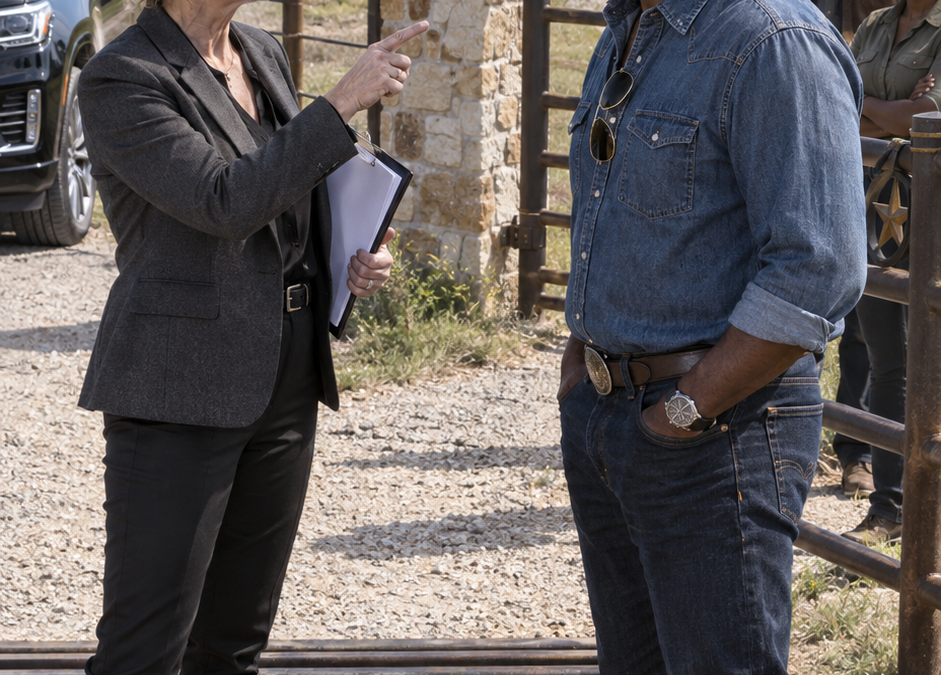
Constance stood just beyond the cattle guard at the entrance to my western drive, wearing a charcoal blazer and polished boots that looked as though they had never touched mud deeper than a suburban flower bed.
She held the clipboard with both hands.
Her posture told me she had delivered this speech before.
Maybe not to me.
Maybe not about an airstrip.
But definitely to people she expected to obey.
“Your operation is in violation of community standards,” she said. “You have fourteen days to bring the airstrip into compliance, or the association will be forced to escalate. That may include a formal report to the Federal Aviation Administration.”
I looked past her.
Beyond my fence, the grass moved in long waves beneath an October wind.
Farther west sat Ridgeline Ranch Estates, the subdivision whose HOA Constance chaired.
From where we stood, I could see only the upper roofs of a few houses above the rolling grassland.
My runway lay behind me.
Three thousand two hundred feet of compacted crushed limestone, sixty feet wide, aligned roughly southwest to northeast.
Completely legal.
Completely permitted.
Completely outside her authority.
But I said none of that.
Instead, I asked, “Is that everything?”
The question seemed to surprise her.
She glanced down at the clipboard.
“For now.”
I nodded.
“I’ll review what you’ve provided.”
Her expression tightened slightly.
I think she expected resistance.
Maybe anger.
Maybe an argument about property rights.
Instead, I thanked her for coming.
She stood there another second as if waiting for the confrontation she had rehearsed.
When none came, she returned to her SUV.
The vehicle was spotless.
Even the tires were clean.
She backed onto the road and drove toward Ridgeline Ranch Estates.
I watched until she disappeared.
Then I went inside.
Not because I was worried.
Because my grandfather had trained worry out of me whenever paper could replace it.
My office sat at the rear of the house.
Against one wall was a heavy fireproof document box.
Inside it were the things that mattered.
The deeds.
Survey records.
Parcel acquisitions.
FAA correspondence.
State aviation registrations.
Environmental reviews.
Hangar permits.
Annual operational reports.
Inspection records.
Everything.
I opened the box.
One document at a time, I checked.
FAA aeronautical study determination.
Present.
Determination of no hazard.
Present.
State private-use airport registration.
Current.
Part 77 filing acknowledgement.
Present.
County hangar permit.
Present.
Environmental clearance.
Present.
Final inspection report signed by Roy Bertram.
Present.
Nothing had changed.
Nothing was missing.
The airstrip had been legal yesterday.
It was legal while Constance threatened me.
It would still be legal tomorrow.
I sat down and looked at the documents.
That was when I thought of my grandfather.
Harlan Callaway.
The first man in our family to understand that land remembers nothing unless somebody records it.
In 1951, Harlan came back from Korea at thirty-one years old with a surveyor’s eye, a distrust of verbal agreements, and enough money saved from two years of railroad grading work to buy eight hundred acres in Morrow County, Montana.
He paid cash.
The county recorder issued the deed.
Then Harlan did something everybody in the family laughed about for years.
He laminated it himself.
Not professionally.
He bought a kit from a hardware store, spread the deed on the kitchen table, and sealed it because, according to him, “Paper doesn’t survive Montana unless you make it.”
The lamination eventually turned amber.
The original became difficult to read.
But the principle survived.
Keep the record.
Harlan added land whenever adjacent parcels became available.
Four hundred acres from the Fenwick family in 1957.
A twelve-hundred-acre timber section in 1963 after a logging company stripped much of it and moved on.
Three hundred acres of creek bottom that had been locked in probate since the 1940s before finally clearing in 1971.
By the time he passed the property to my father, Dale, the Callaway holdings exceeded 2,900 acres.
Dad continued buying.
Mostly grassland.
Mostly when cattle prices were poor and neighboring owners wanted out.
He never bought recklessly.
Every parcel had to connect.
Every boundary had to be surveyed.
Every easement had to be understood before money changed hands.
By the time the property eventually passed to me, we held approximately 5,900 acres.
Grassland.
Timber.
Creek bottom.
Hay meadow.
Rock.
Water.
Wind.
And silence.
I grew up on the home section.
As a boy, I knew the creek before I knew most roads.
I knew where spring runoff widened it.
Where trout collected beneath the undercut bank.
Where my grandfather would stand with a survey map folded beneath one arm and explain that a fence and a legal boundary were not necessarily the same thing.
“You don’t own to the fence because somebody built a fence,” he once told me.
“You own to the description.”
I was probably eleven.
I asked what the difference was.
He pointed toward a cedar post.
“That post can move.”
Then toward the folded survey.
“That takes more work.”
At eleven, I barely understood him.
At fifty-three, I understood exactly.
I left Montana for college.
Then for engineering work.
Three states over fifteen years.
But the land remained the fixed point.
When my father’s health declined, I returned.
Not reluctantly.
I had always known I would.
By the time I took full ownership in 2013, I had already been flying for sixteen years.
I earned my private pilot certificate in 1997.
Instrument rating in 2001.
Commercial certificate in 2009.
Flying started as something I loved separately from the ranch.
Eventually, the two belonged together.
The western grassland section had a natural grade that almost looked designed for a runway.
Long.
Gradual rise.
Good drainage.
Few obstructions.
Stable soil.
I had been thinking about building a private strip there for years.
But thinking and building are different things.
Aviation punishes casual assumptions.
So does land ownership.
I approached the runway the same way Harlan approached property.
Measure first.
Document second.
Act third.
I hired an aviation consultant named Roy Bertram.
Roy had spent two decades working with the FAA before entering private consulting.
The first time we walked the proposed alignment, he carried a notebook, a handheld GPS, and enough skepticism for both of us.
“You want thirty-two hundred feet?”
“Yes.”
“Private use only?”
“Yes.”
“What aircraft?”
“Mostly a Cessna 182. Possibly similar general aviation traffic by permission.”
“No public operation?”
“No.”
He looked down the proposed centerline.
“Drainage?”
“Natural fall southwest.”
“Wind data?”
“In the truck.”
He gave me a look.
“You’ve been planning this awhile.”
“Years.”
“Good.”
That was as close to praise as Roy usually came.
We did it properly.
Notice of proposed construction.
Aeronautical study.
Airspace review.
State registration.
County building permit for the hangar.
Environmental evaluation.
Geotechnical review.
Drainage.
Approach considerations.
Roy checked everything.
Twice.
The completed runway measured 3,200 feet long and sixty feet wide.
Compacted crushed limestone.
Drainage swales on both sides.
The hangar sat far enough from operational surfaces to satisfy the applicable requirements.
The FAA issued its determination of no hazard to air navigation.
The Montana Aeronautics Division registered the field as private use.
The county approved the hangar.
Environmental review found no wetland impact within the assessed area.
Roy signed his final report.
I filed everything.
And then I flew.
For years, nothing about it was controversial.
There were no commercial operations.
No flight school.
No constant traffic.
Some weeks the runway saw no activity at all.
Other weeks I might make two or three local flights.
Occasionally another pilot landed by invitation.
That was it.
Then Ridgeline Ranch Estates appeared beside my western boundary.
In 2017, Cascade Ridge Properties purchased roughly 340 acres neighboring mine.
The parcel had once been connected to Fenwick land but had been sold away decades earlier.
Cascade Ridge divided it into forty-seven rural residential lots ranging from roughly five to twelve acres.
They marketed the development as ranch-style estate living.
Large lots.
Open views.
Equestrian amenities.
Community center.
Country atmosphere without the operational burden of actually owning thousands of acres.
I had no objection.
Their land.
Their development.
Their business.
The main access road ran about 1.4 miles along my western boundary.
Construction noise came and went.
Survey stakes appeared.
Road crews worked.
Houses rose.
Nothing crossed my line.
That was all I cared about.
I did send Cascade Ridge one letter.
Not a complaint.
A clarification.
Their development sat near an existing private-use airstrip.
I did not want sales material implying residents would have aviation access.
So I notified their project manager that the strip was private, preexisting, and not a community amenity.
He acknowledged the letter politely.
No dispute.
No drama.
Then control of the development transferred from Cascade Ridge to the homeowners.
That was when Constance Merrill became president.
Constance had moved from suburban Phoenix to a twelve-acre lot in Ridgeline Ranch Estates.
I later learned she had previously been heavily involved with another HOA.
She liked procedure.
She liked standards.
More specifically, she liked applying standards.
The first letter from her arrived in August 2019.
It was addressed vaguely to “Property Owner, Adjacent Parcel Western Boundary.”
That alone told me how much homework they had done.
It cited Section 4.7 of the Ridgeline Ranch Estates covenants, conditions, and restrictions.
Noise-generating activities.
Community enjoyment.
It requested that I voluntarily limit flight activity to specified hours.
I read it twice.
Then I retrieved the Ridgeline Ranch Estates CC&Rs online.
Section 4.7 existed.
It governed lots inside Ridgeline Ranch Estates.
I did not own a lot inside Ridgeline Ranch Estates.
I was not a member.
I had never signed their declarations.
My property had never been included in their plat.
The letter was legally irrelevant.
So I created a folder.
RIDGELINE RANCH ESTATES HOA.
I put the letter inside.
And did nothing.
Six weeks later, the second arrived by certified mail.
This time they added a county ordinance.
Morrow County Ordinance 18-44.
The letter suggested the ordinance supported restrictions on my operations.
I pulled the ordinance that night.
It concerned commercial construction noise during specified hours.
Then I reached subsection D.
Private-use airports lawfully registered with the Montana Aeronautics Division were expressly exempted.
I laughed.
Not loudly.
Just once.
The HOA had cited an ordinance that specifically excluded my operation.
I printed it.
Highlighted subsection D.
Added it to the folder.
Still no response.
Then came Constance herself.
Fourteen days.
Community standards.
FAA report.
The threat changed the equation, but not because I feared the FAA.
I wanted to see what happened if she did exactly what she promised.
That evening, after verifying my permits, I called Patricia Voss.
Patricia practiced property and aviation law in Billings.
She had assisted during the airstrip permitting.
If Roy Bertram understood how federal aviation agencies thought, Patricia understood how agencies and property law intersected.
I described the letters.
Then Constance’s visit.
When I finished, Patricia was silent.
“What?” I asked.
“Let her file.”
“You’re serious?”
“Completely.”
“What happens?”
“The FAA pulls the record.”
“And?”
“And they find what you just described.”
I leaned back.
“All the permits.”
“All the permits.”
“What if they inspect?”
“Then they inspect a legal airstrip.”
I smiled.
Patricia continued.
“Right now you have your records telling the HOA they’re wrong. If she files the complaint, eventually you may have a federal agency telling them they’re wrong.”
“That’s better?”
“Much.”
I wrote it down.
Let her file.
Patricia added, “The complaint itself may become useful later.”
“How?”
“Because she’s converting informal overreach into documented overreach.”
That sounded exactly like something my grandfather would have appreciated.
So I waited.
Constance filed the FAA complaint in November.
I learned through Gerald Fitch.
Gerald owned land north of mine.
Retired surveyor.
Thirty years working Morrow County.
If you gave Gerald a parcel number, he could often tell you which family had argued about it twenty years earlier.
His son-in-law sat on the Ridgeline Ranch Estates board.
Not closely aligned with Constance.
Just a homeowner who had agreed to serve and discovered too late that board service involved listening to arguments about fences, paint, road maintenance, and apparently private airports on neighboring land.
Gerald found me at the feed store.
“Your friends filed with the FAA.”
I looked at him.
“My friends?”
“Ridgeline.”
“When?”
“Couple weeks ago.”
“What are they alleging?”
He pushed his hands into his coat pockets.
“Noise. Operational irregularities. Possible unpermitted airport construction.”
I repeated the last phrase.
“Unpermitted airport construction?”
“That’s what I heard.”
I nodded.
Gerald studied me.
“You don’t seem worried.”
“I’m trying to decide which permit they think doesn’t exist.”
He smiled.
“How many do you have?”
“All of them.”
“That’ll complicate the story.”
I went home.
Spread the airstrip file across the kitchen table.
FAA determination.
State registration.
Roy’s inspection.
County permit.
Environmental review.
Annual reports.
Everything aligned.
I didn’t need to send any of it.
The agencies already had what they needed.
That was the beauty of proper records.
They existed before the conflict.
They did not need to be invented in response to it.
Two months later, in January 2020, an FAA envelope arrived.
I placed it on the kitchen table.
Made coffee.
Sat down.
Then opened it.
Four paragraphs.
The first identified the complaint and reference number.
The second explained that the FAA had reviewed the airport’s status, relevant aeronautical study, registration information, and operational history.
Then came the third paragraph.
No evidence of unpermitted construction.
No evidence of operational irregularities.
No basis for regulatory action.
The complaint would be closed.
No further action was required of me.
I read it three times.
Not because I was surprised.
Because exact language matters.
I called Patricia.
“They closed it.”
“Read me the operative paragraph.”
I did.
When I finished, she said, “Good.”
“That’s all?”
“What do you want, applause?”
“Maybe.”
She laughed.
“Make copies. Keep the original.”
“Already planning to.”
“And Everett?”
“Yeah?”
“Now you have what we wanted.”
A federal determination in writing.
I put the original in a protective sleeve.
Labeled it with the case number.
Filed it inside the fireproof box.
A couple weeks later, Gerald called.
The HOA board had received a copy of the closure.
Constance apparently described it as procedural.
According to her, the FAA had not investigated deeply enough.
That fascinated me.
When a federal agency agreed with her threat, presumably it would have been authoritative.
When it disagreed, suddenly it was insufficiently thorough.
But not everyone on the board accepted that explanation.
One board member, Ray Alcott, had begun asking questions.
Ray was a retired civil engineer.
He had moved into Ridgeline Ranch Estates because he wanted space for a workshop.
At the meeting, he reportedly asked one simple question.
“Do our covenants apply to Callaway’s property?”
Constance answered that his airstrip affected community enjoyment.
Ray repeated:
“That wasn’t my question.”
Then he asked whether anyone had reviewed the subdivision plat.
Apparently nobody answered clearly.
A few days later, Ray visited Gerald and spent nearly two hours studying county survey maps.
Gerald told me that at the feed store.
“What was he looking for?”
“Your boundary.”
“And?”
“He found it.”
“Where it has always been?”
Gerald nodded.
“Remarkable thing about survey lines.”
I smiled.
“They don’t move much.”
“Not without somebody noticing.”
When I told Patricia, she said, “Constance will try something else.”
“How sure are you?”
“Very.”
“Why?”
“Because she has framed this as a governance problem. People who do that rarely stop when the first tool fails. They choose another tool.”
“What should I do?”
“Nothing.”
Again.
“Nothing?”
“Keep records.”
So I did.
I downloaded the Ridgeline Ranch Estates CC&Rs.
Forty-seven pages.
Read every one.
Three sections could plausibly be used rhetorically against neighboring activity.
Every one was limited to property within the recorded development.
I tabbed them.
Printed the document.
Added it to the folder.
Spring came.
Snowmelt filled the creek.
Mallards returned to the lower pond.
The runway came through winter without significant heaving.
I filed my annual operational report.
The state acknowledged it.
Life continued.
Then in May, the HOA sent its next letter.
This one had a lawyer’s signature.
Three pages.
More formal.
Section 4.7 again.
Then Section 9.2 concerning activities materially diminishing property values.
Section 12.1 addressing nuisances.
Montana nuisance law.
The letter claimed the HOA possessed standing to pursue a nuisance action against neighboring property whose activities interfered with residents’ enjoyment.
That was smarter than the previous letters.
Not necessarily correct.
But smarter.
I called Patricia.
She listened while I read it.
When I finished, she said, “They finally found the right category of law.”
“That sounds bad.”
“It means nuisance claims can sometimes cross property boundaries.”
“And here?”
“Different problem.”
“What problem?”
“You’re operating a legally registered airport under federal aviation regulation.”
She explained that aviation presents a substantial federal regulatory framework.
Local nuisance theories do not automatically disappear, but local entities cannot simply use private covenants or generalized complaints to control federally regulated aviation activity.
More importantly, she said, the HOA still faced a threshold problem.
Authority.
“They’re mixing two things,” Patricia told me. “One is their private covenant authority. The other is general nuisance law. They are not the same.”
“So what do we answer?”
“First, we make them confront their own jurisdiction.”
She instructed me to obtain the original recorded subdivision plat and declaration.
Not an online summary.
Certified copies.
Boundary descriptions.
The actual recorded instrument.
So the next morning I drove to the Morrow County recorder’s office.
The building had the same smell nearly every county records office seems to acquire after enough decades.
Old paper.
Dust.
Dry heat.
The clerk was Doris.
She knew the development.
“I recorded that plat,” she said.
“Ridgeline Ranch Estates?”
“2017.”
“I need a certified copy.”
“All of it?”
“All of it.”
She pulled the instrument.
Large-format pages.
Survey lines.
Lot descriptions.
Road easements.
Common areas.
Dense legal language.
I sat at a public research table.
Started reading.
Article 1.
Definitions.
Article 2.
Applicability.
Then I found it.
Section 2.1.
The covenants, conditions, restrictions, and obligations applied to all lots within Ridgeline Ranch Estates as recorded in Plat Book 14, Pages 112 through 118, and to their owners, heirs, successors, and assigns.
I read it again.
Then I looked at the plat boundary.
My land lay outside it.
Every acre.
The HOA had drawn a legal circle around itself when it was created.
Constance was now pretending that circle extended across my fence because she disliked what happened beyond it.
It did not.
I photographed the provision.
Doris prepared the certified copy.
When she handed it over, the pages were still warm.
“Find what you needed?”
“Yes.”
“Good.”
That was all.
No dramatic revelation.
No courtroom.
Just paper.
I mailed Patricia the certified copy.
She called two days later.
“This is clean.”
“How clean?”
“No ambiguity.”
She read Section 2.1 back to me.
“Their covenants apply to lots inside the plat. You’re outside the plat.”
“So we answer now?”
“Yes.”
Patricia drafted four pages.
No anger.
No insults.
No accusations about Constance’s motives.
Just law and documents.
Article 2, Section 2.1.
Certified subdivision plat.
FAA closure notice with case number.
State aviation registration.
Federal aviation authority.
Existing permitted use.
Then one sentence that mattered most:
Ridgeline Ranch Estates had no contractual or covenant authority over the Callaway property because the property was not, and had never been, subject to the recorded Ridgeline Ranch Estates declaration.
Patricia also challenged the nuisance theory and reserved all rights.
But her final paragraph was the one I liked best.
She asked the HOA’s attorney to confirm whether he had reviewed the recorded plat declaration before advising the association to pursue the claim.
I called her.
“You’re trying to make him answer that.”
“Yes.”
“What if he says he did?”
“Then he knowingly proceeded despite the limitation.”
“And if he says he didn’t?”
“Then he advised the claim without reviewing the governing instrument.”
I smiled.
“You enjoy this.”
“I enjoy documentation.”
My grandfather would have liked Patricia.
The response went by certified mail.
Both tracking receipts went into my folder.
Three weeks passed.
Then the HOA attorney responded.
The tone had changed.
No more declarations that the association possessed authority.
Instead:
The association was reviewing the matter.
The board was considering the supplied documentation.
Counsel reserved all positions.
No immediate action would be taken.
He did not answer Patricia’s question about whether he had previously reviewed the plat.
Patricia called.
“He read it now.”
“How do you know?”
“Because lawyers sound different after they discover their client’s founding document is against them.”
“What happens next?”
“He advises the board to stop.”
“And if Constance refuses?”
“The board decides whether it wants to pay to fight its own documents.”
We waited.
Gerald brought the answer in July.
Same feed store.
Same truck.
Different weather.
Hot enough that the gravel shimmered.
“Board voted.”
“On what?”
“Dropping it.”
I leaned against his tailgate.
“How?”
“Four to one.”
“Let me guess.”
“Constance was the one.”
I nodded.
Gerald explained.
The HOA lawyer had presented the legal situation privately to the board.
He discussed the explicit jurisdictional boundary.
The FAA closure.
The federal aviation issues.
He recommended discontinuing the claim.
Constance argued that the board had a responsibility to protect property values and quality of life.
Ray Alcott asked whether protecting homeowners included spending homeowner dues litigating a case their own attorney recommended abandoning.
Apparently the room became very quiet after that.
The vote followed.
Four to one.
Withdraw.
No further claims against my airstrip on behalf of the HOA.
The written confirmation arrived in August.
Ridgeline Ranch Estates letterhead.
A short statement.
The association would discontinue its action regarding my private-use airport and would make no further claims based on its CC&Rs concerning the operation.
At the bottom:
Constance Merrill
President
I stared at her signature.
There was something perfectly fitting about it.
The same woman who had stood at my gate and threatened escalation now signed the document confirming the association had no further case.
I sent Patricia a copy.
She pursued recovery of legal expenses.
After several exchanges, the HOA’s insurer agreed to settle for $11,400.
That covered Patricia’s fees with a modest amount remaining.
The agreement was signed.
Notarized.
Recorded.
I put that in the folder too.
Then I closed it.
The whole matter had taken nearly a year.
And during that year, almost nothing physical changed.
The runway remained where it had been.
The fence remained where it had been.
My deed did not gain an acre.
The HOA did not lose one.
The legal boundary on the ground had never moved.
Only people’s understanding of it had.
That September, I walked the western fence line.
Cold morning.
Frost silver in the lower grass.
The cedar posts Dad had set decades earlier still stood solid.
He had been meticulous about posts.
Dig deep.
Set straight.
Pack correctly.
Do the work once.
As I walked, I thought about how similar that was to recordkeeping.
The effort is mostly invisible until pressure arrives.
Then you discover whether the foundation was correct.
I stopped at the southwest corner and looked across the ranch.
The runway formed a pale line across the grass.
Hangar roof shining in early light.
Creek bottom dark with cottonwoods.
Timber climbing north toward the ridge.
Somewhere beyond my western boundary sat forty-seven residential lots governed by documents their owners had every right to enforce among themselves.
That last part mattered.
I never came away believing HOAs had no legitimate authority.
Ridgeline Ranch Estates absolutely had authority.
Inside Ridgeline Ranch Estates.
They could enforce lawful provisions against members who had agreed to those provisions.
What they could not do was transform proximity into jurisdiction.
My grandfather used to say a fence was useful only if you knew why it was where it was.
Authority works the same way.
A title does not create unlimited power.
A board vote does not erase property boundaries.
An attorney’s signature does not automatically make an argument correct.
An official-looking letter can still be wrong.
That was probably the biggest lesson in the entire experience.
Constance’s first letter looked official.
It had a logo.
Sections.
Deadlines.
Her signature.
The FAA threat sounded serious.
Then the lawyer’s letter looked even more official.
Statutes.
Legal theories.
Multiple pages.
Professional language.
Someone unfamiliar with property records might have panicked.
They might have assumed that because the letter cited something real, the conclusion must also be real.
But law rarely works that way.
A statute can exist and still not apply.
A covenant can be enforceable and still not bind you.
An agency can have authority and still find no violation.
The question is never simply:
Does this document sound official?
The question is:
What gives the sender authority over me?
In my case, the answer was simple.
Nothing in the HOA’s governing documents.
And the agencies that did have authority had already approved the operation.
That was why I never needed to shout at Constance.
Shouting would not change the plat.
Anger would not strengthen the permit.
Calling her names would not alter the FAA determination.
The documents were already enough.
Harlan Callaway understood that in 1951.
He probably would have disliked the phrase “documentary evidence.”
He would have called it “the paper.”
Keep the paper.
He said that constantly.
Receipts.
Surveys.
Deeds.
Agreements.
“People remember what favors them,” he once told my father. “Paper remembers what happened.”
That became family doctrine.
When Harlan died in 1989, we found boxes of records.
Some unnecessary.
Some duplicated.
Tax receipts.
Old boundary correspondence.
Survey notes.
Cancelled checks.
Dad laughed at how much there was.
Then he kept all of it.
So did I.
Because somewhere between generations, we realized Harlan wasn’t hoarding paper.
He was preserving memory that did not depend on human honesty.
That September morning, I reached the hangar.
Opened the doors.
My Cessna 182 sat inside.
The same airplane Constance had indirectly threatened.
I pulled it into the light.
Preflight became automatic after enough years.
Oil.
Fuel.
Control surfaces.
Tires.
Pitot.
Lights.
Nothing dramatic.
Just verification.
That habit is one of the things I love most about aviation.
Pilots do not perform preflight inspections because they expect the airplane to fail every morning.
They do it because confidence should follow checking, not replace it.
Property ownership deserves the same discipline.
Know the deed.
Know the survey.
Know the easements.
Know the permits.
Know what you signed.
Know what you did not sign.
Because when a dispute arrives, memory is weak evidence.
Paper is better.
I climbed into the aircraft.
Started the engine.
Taxied toward the runway.
At the threshold, I held the brakes and completed the run-up.
Gauges good.
Controls free.
Wind light from the southwest.
I lined up.
For one second, before applying full power, I looked down the runway.
Three thousand two hundred feet.
Sixty feet wide.
Permitted.
Registered.
Inspected.
Mine.
I advanced the throttle.
The 182 accelerated.
Gravel blurred beneath me.
The controls came alive.
Then the wheels lifted.
The ranch opened below.
From altitude, property disputes look strangely small.
Fence lines become thin marks.
Houses become shapes.
Roads become threads.
You can see Ridgeline Ranch Estates from the air easily.
Forty-seven lots arranged along its road network.
Beyond them, my western grassland.
Runway.
Creek.
Timber.
Different parcels.
Different owners.
Different legal worlds sitting side by side.
That is what the paperwork had always shown.
Nothing more complicated than that.
I climbed farther.
The morning was clear enough to see the ridges west of the valley.
I thought about Constance.
Not angrily.
By then, anger would have felt pointless.
She had believed the HOA should control something outside its boundary because that thing affected people inside the community.
She had then sought increasingly serious mechanisms to make that belief enforceable.
FAA complaint.
Nuisance theory.
Attorney.
Each step felt more powerful than the last.
But each still ran into the same basic problem.
She was trying to create authority after the fact.
You cannot do that with land.
Not easily.
Land operates on history.
Recorded history.
Who owned what.
What was conveyed.
What was reserved.
What was permitted.
What was agreed.
The airstrip existed lawfully before Ridgeline Ranch Estates had an elected HOA board.
My parcel existed before the subdivision.
My title chain reached back decades before Constance moved to Montana.
None of that made me special.
It simply made the timeline clear.
And timelines matter.
A person cannot buy next to an existing lawful use, join a private association governing a different parcel, then assume the association’s rules automatically extend across the boundary because the existing use is inconvenient.
At least not because a board says so.
The record has to support it.
Ours did not.
I flew for about forty minutes.
Nothing ambitious.
A loop over the northern section.
Creek valley.
Western ridge.
Then back.
On final approach, the runway looked exactly as it had for years.
There was something comforting about that.
I landed.
Taxied back.
Shut down.
The sudden silence after an aircraft engine stops is always deeper than the silence before it starts.
I sat for a moment.
Then climbed out.
The air smelled like dry grass.
A few weeks later, Ray Alcott called me.
It was the first time we had spoken directly.
“Everett Callaway?”
“Yes.”
“Ray Alcott. Ridgeline Ranch.”
“I know who you are.”
A pause.
“I hope that’s not bad.”
“Depends what you want.”
He laughed.
“Fair.”
He asked if he could stop by.
I agreed.
The next afternoon, he arrived in an old pickup.
Not polished.
Mud on the tires.
That alone made a better first impression than Constance’s SUV had.
We sat on the porch.
Ray looked toward the airstrip.
“That’s it?”
“What were you expecting?”
“I don’t know.”
He shrugged.
“More activity.”
“Most days it’s just limestone.”
Ray smiled.
He had brought copies of several board documents.
Not because I needed them.
Because he wanted to apologize.
“I should have asked earlier.”
“Asked what?”
“Whether we actually had authority.”
I shook my head.
“You eventually did.”
“After money was already spent.”
“Not my money.”
He winced.
“Exactly.”
I poured coffee.
Ray looked out across the property.
“You know what bothered me?”
“What?”
“The assumption.”
I waited.
“We started with ‘How do we stop the airstrip?’”
He looked at me.
“Nobody started with ‘Do we have the right to?’”
That was probably the most accurate summary of the entire conflict.
I nodded.
“Order matters.”
“Engineering rule.”
“Legal one too.”
Ray laughed.
We talked for nearly an hour.
He told me several residents had never cared about the runway.
A few actually enjoyed seeing an occasional aircraft.
Others did dislike the noise.
I told him I understood.
Noise complaints were not inherently unreasonable.
If my operations were violating a legitimate regulation, I would have corrected them.
The issue was never whether neighbors could dislike what I did.
They could.
The issue was whether dislike created legal authority.
It did not.
Ray eventually stood.
“Constance isn’t happy.”
“I assumed.”
“She may not run again.”
“That’s between you folks.”
He nodded.
“I figured you’d say that.”
He started toward his truck.
Then stopped.
“For what it’s worth, I’m sorry.”
I believed him.
“Accepted.”
And that was it.
No enemies.
No victory speech.
No need to humiliate anyone.
A boundary had been tested.
The record resolved it.
Years later, the folder still sits in my fireproof box.
HOA letters.
Certified mail receipts.
County ordinance.
FAA closure.
Certified plat.
Patricia’s response.
Attorney correspondence.
Board withdrawal.
Settlement agreement.
Behind them rests the certified copy of Harlan’s original deed.
The actual laminated version is too fragile now to handle much.
Amber.
Clouded.
Almost unreadable.
But I keep it anyway.
Not because it is legally necessary.
Because it reminds me where the habit began.
A thirty-one-year-old man home from Korea sitting at a kitchen table in 1951, trying to protect a piece of paper from weather.
He could not have imagined the FAA complaint.
HOAs.
Online filing portals.
Federal aviation regulation.
Email.
Digital county records.
But he understood the basic problem.
People come and go.
Authority changes hands.
Memories change.
Paper survives if you protect it.
One afternoon not long after the dispute ended, I carried the old laminated deed outside.
Held it in the sunlight.
Most of the text was obscured.
But I could still make out Harlan’s name.
That was enough.
I thought about how many times ownership had been challenged informally through the decades.
Grazing questions.
Access questions.
Survey disagreements.
Water use.
Fence placement.
Now aviation.
Different subject.
Same underlying question.
What does the record say?
The answer had protected three generations.
That is why Constance’s clipboard never frightened me.
She had confidence.
I had documents.
Those are not equal things.
Confidence can be manufactured in five minutes.
A proper title chain takes decades.
That doesn’t mean you ignore a threat.
Quite the opposite.
You take it seriously enough to check everything.
That first evening after she left, I opened every file because arrogance is just as dangerous as panic.
I believed I was right.
Belief was not sufficient.
I verified.
That mattered too.
If one filing had expired, I wanted to know.
If one permit contained a condition I had forgotten, I wanted to know.
If the annual reports showed an omission, I wanted to find it before someone else did.
Never confuse confidence in your position with permission to stop checking.
That is another lesson aviation teaches well.
Today the runway still operates.
Private use.
Same basic dimensions.
Same land.
Same requirements.
I still file what needs filing.
Still inspect what needs inspecting.
Still keep copies.
Ridgeline Ranch Estates still exists beside me.
People have sold.
New families have arrived.
Ray remained on the board for several years.
Constance eventually stepped away.
Nothing dramatic followed.
No war between neighbors.
No lasting feud.
Sometimes an airplane takes off and somebody in Ridgeline probably hears it.
Then the sound fades.
Life continues.
That is how the matter should have been from the beginning.
Recently, I walked the western fence again.
I do that more often as I get older.
Maybe because my father did.
Maybe because Harlan did before him.
Maybe because land encourages repetition.
You walk the same boundary and notice different things depending on what life has taught you since the last time.
The cedar posts are older.
So am I.
The creek has shifted slightly inside its natural channel.
Cottonwoods have fallen.
New ones are growing.
Some things change.
The legal line does not.
I reached the corner nearest Ridgeline Ranch Estates and stopped.
From there, I could see part of their access road.
A vehicle passed.
Probably somebody going home from work.
No idea who.
No need to know.
Their road.
Their homes.
Their association.
My grass.
My fence.
My runway.
Simple.
The sun was dropping behind the western ridge.
Light stretched across the limestone strip.
For a moment, I imagined my grandfather standing beside me.
He would have asked one question.
“Got the paper?”
I would have said yes.
That would have satisfied him.
Because in the end, that was what resolved everything.
Not anger.
Not intimidation.
Not who spoke loudest.
The FAA reviewed the airstrip because Constance asked them to.
They found it compliant.
The county record defined the HOA boundary.
The certified plat excluded my land.
The HOA lawyer eventually read what had always been there.
The board voted accordingly.
The insurer paid the legal costs.
And the property itself never moved an inch.
That is the quiet power of a good record.
It does not need to win an argument.
It only needs to remain true long enough for everyone else to finish talking.
I turned away from the fence and walked toward the hangar.
The Cessna sat inside.
Evening light reflected from the windshield.
I ran my hand along the cowling.
Then looked back across the 5,900 acres my family had assembled over three generations.
The same land Constance once believed could be brought under HOA “community standards” with a fourteen-day notice.
I almost smiled.
Not because she lost.
Because the land had never been playing her game.
Neither was I.
She brought a clipboard.
I had the deed.
She cited covenants.
I had the plat.
She threatened the FAA.
I had the permits.
And when she finally reported me, the very agency she expected to shut me down gave me something more valuable instead:
A federal record confirming there was nothing to shut down.
That letter remains in the fireproof box.
Right beside everything that came before it.
Exactly where my grandfather would have told me to put it.
Because he was right about one thing above all others.
When someone claims authority over your land, you don’t need the loudest voice.
You need the record.








