𝗣𝗔𝗥𝗧 𝟮 HOA Put an Armed Guard Shack on My Private Driveway—So I Flattened It With My Bulldozer and Took Back Every Inch
𝗣𝗔𝗥𝗧 𝟮
Vanessa handed me a printed registration packet.
I took it because curiosity occasionally makes a man participate in his own humiliation.
The first page required my name, address, driver’s license number, license plate, emergency contact information, and vehicle description.
The second required me to list regular visitors.
The third described contractor access.
The fourth explained that the gate automatically closed between ten at night and six in the morning.
The fifth informed me that commercial vehicles could be restricted at the discretion of the association.
I read the packet twice.
Then I folded it carefully.
“Let me make sure I understand this.”
Vanessa crossed her arms.
“I think the instructions are very straightforward.”
“I need to register with your HOA so I can drive from the county road to my own house.”
“Yes.”
“Across my property.”
“This road serves Cedar Ridge.”
“That still sounds like my property.”
“You’re focusing on ownership when the issue is community function.”
I stared at her.
There are sentences so ridiculous that responding to them feels like rewarding bad behavior.
“This road has never been part of Cedar Ridge.”
“We have long-standing access rights.”
“No, you don’t.”
“Our attorney disagrees.”
“Then your attorney should probably buy a map.”
The guard beside us coughed into his fist.
Vanessa’s eyes narrowed.
“I would advise you not to make this unnecessarily hostile.”
I almost laughed.
She had built a checkpoint on my driveway before sunrise and was warning me about hostility.
“I’m going to say this once,” I told her. “My property is outside your subdivision. My house is outside your subdivision. My workshop is outside your subdivision. My driveway is outside your subdivision. You do not own this road.”
“It serves our community.”
“You keep saying that like repetition changes the deed.”
She extended her hand toward the packet.
“Complete the registration before using the gate again.”
I handed the papers back.
“No.”
Vanessa’s expression remained irritatingly calm.
“Then you may experience delays.”
“I’m going home.”
I turned toward my truck.
The guard looked at Vanessa.
She gave him a small nod.
The barrier rose.
I drove through.
But as I passed the shack, I understood something very clearly.
A misunderstanding ends when both people see the evidence.
An attempted takeover continues after one side sees the evidence and decides it does not matter.
So I did not go home angry.
I went home organized.
My office was built into one end of the workshop.
I walked inside, locked the door, pulled the fireproof file box from beneath my desk, and placed three documents across the workbench.
My deed.
The original county parcel map.
And a survey my father had commissioned thirty years earlier.
Parcel 47B.
Thirty-eight acres.
The driveway ran directly through the center of it.
A red line marked the route.
Beside it were the words PRIVATE DRIVE.
No easement.
No right-of-way.
No community access agreement.
Nothing involving Cedar Ridge or the developer who had built it.
I stood at the window looking toward the distant white roof of the guard shack.
For the first time that morning, I felt genuinely angry.
Not because someone had inconvenienced me.
I had spent my life around broken equipment.
Inconvenience was almost a business partner.
What bothered me was the confidence.
Vanessa had not asked.
She had not negotiated.
She had not even attempted to invent a polite reason for what she was doing.
She had simply arrived with hired guards and assumed that control, once physically established, would eventually become authority.
I had seen people make similar mistakes with machinery.
They ignored the warning light because the engine was still running.
Then they ignored the noise because the machine was still moving.
Then they ignored the smoke.
Eventually something expensive came apart.
I decided I would give Vanessa every opportunity to stop before that happened.
That evening, I spread the survey across my kitchen table.
My first instinct had been simple.
Start the dozer.
Push the shack into the ditch.
Go eat dinner.
It would have taken less than ten minutes.
It also would have been exactly what Vanessa wanted.
If I destroyed the checkpoint immediately, she could tell Cedar Ridge that some unstable mechanic had attacked their security project before anybody understood the facts.
So I made coffee.
Sat down.
And started documenting.
The next morning, I parked near the workshop with a clear view of the road.
By seven thirty, Cedar Ridge residents were already using my driveway.
That surprised me.
My road had always dead-ended at my property.
At least it had until somebody cut an opening through the eastern subdivision fence.
I drove down there and found that approximately twenty feet of my old boundary fence had been removed.
The new opening connected one of Cedar Ridge’s internal streets directly to my driveway.
Cars were flowing through steadily.
Some drivers waved at the guards.
Others held cards against a scanner.
One woman in a silver SUV stopped long enough to purchase temporary access.
That was when I noticed the laminated price sheet attached to the shack.
VISITOR ACCESS — $15
CONTRACTOR ACCESS — $30
COMMERCIAL DELIVERY — $50
I read it three times.
Vanessa was charging people money to cross my land.
I stood there holding my phone and actually laughed.
It was not a happy laugh.
It was the laugh a person makes when absurdity becomes so complete that anger temporarily loses the competition.
I filmed everything.
The shack.
The barrier arm.
The vehicles.
The cut fence.
The price sheet.
The guards accepting payments.
The location in relation to my survey stakes.
Then I went looking for Vanessa.
The Cedar Ridge clubhouse was the kind of building designed to convince suburban residents that quarterly association dues had transformed them into members of a country club.
Stone veneer.
White columns.
Artificial pond.
A conference room overlooking tennis courts that appeared to spend most of their time being admired rather than used.
I walked inside carrying my survey tube.
A board meeting was already underway.
Vanessa sat at the head of the table.
Six board members turned toward me.
She did not.
“Mr. Mercer,” she said. “This is a closed working session.”
“Then this should be quick.”
I unrolled my survey directly across the table.
“This is parcel 47B.”
A man near the far end leaned forward.
I later learned his name was Bryce Halford, the vice president.
Vanessa barely looked at the map.
“We’re already familiar with your claim.”
“It isn’t a claim.”
I tapped the survey.
“It’s the boundary.”
Vanessa opened a leather folder and removed a photocopied document.
“Then perhaps you should familiarize yourself with ours.”
She pushed it toward me.
ROAD ACCESS AGREEMENT.
According to the heading, it had been executed almost twenty years earlier between the original owner of parcel 47B and the developer of Cedar Ridge.
It supposedly granted permanent access rights across the driveway.
I began reading.
It took less than a minute before the first problem jumped off the page.
The legal description referenced parcel 47D.
My land was 47B.
I kept reading.
The name listed as the property owner was Leonard Grayson.
I knew that name.
Grayson had owned land farther south.
He had never owned my father’s parcel.
“What year was this supposedly signed?”
Vanessa tapped the date.
I looked at Bryce.
“Who owned parcel 47B that year?”
He hesitated.
“I don’t know.”
“My father.”
Vanessa leaned back.
“The association attorney has verified the document.”
“Wonderful. Give me a copy.”
“No.”
I looked at her.
“You just showed it to me.”
“You’ve seen what you need to see.”
“If it’s legitimate, why won’t you give me a copy?”
“The association has no obligation to provide internal records to a nonresident.”
“This is supposedly a document granting your association rights across my property.”
Vanessa smiled faintly.
“We consider this roadway under shared community control.”
Bryce looked from her to me.
“Vanessa, I’ve never seen that agreement.”
She ignored him.
I rolled my survey back into the tube.
“Fine.”
She seemed almost pleased.
“Good.”
I looked directly at her.
“If that document is legitimate, a courthouse can confirm it in five minutes.”
Her expression hardened.
“We have no reason to ask your permission.”
“You won’t be asking mine.”
I picked up my survey.
“You’ll be explaining it to a judge.”
The following morning, Vanessa escalated.
Two steel posts had appeared beside the checkpoint.
Mounted on top were license plate recognition cameras.
A new sign stood beside the barrier.
NO HEAVY EQUIPMENT WITHOUT HOA AUTHORIZATION.
I stopped beside it on my way to the workshop.
I read the words slowly.
My business repaired heavy equipment.
Dozers.
Excavators.
Loaders.
Graders.
Farm tractors.
The entire reason I maintained that road was so commercial trucks could reach my shop.
Vanessa had effectively installed a sign saying:
GRANT MERCER MAY NO LONGER OPERATE GRANT MERCER’S BUSINESS ON GRANT MERCER’S LAND WITHOUT VANESSA WHITMORE’S PERMISSION.
By noon, the stupidity had become expensive.
A flatbed arrived carrying a customer’s excavator.
The driver called me.
“Grant, I’ve got a problem.”
“What kind?”
“Security won’t let me through.”
I drove down.
Landon, the guard I had met the first morning, stood beside the barrier looking deeply uncomfortable.
“Commercial equipment needs authorization now,” he said.
“Who authorized the restriction?”
He looked toward the shack.
“The HOA.”
“The HOA doesn’t own the road.”
“I understand what you’re saying.”
“No, Landon. You understand what Vanessa is saying. I’m asking you to look at the ground.”
He sighed.
“I don’t have discretion here.”
The truck had nowhere to turn.
The driver had to reverse almost a mile.
The customer eventually sent the excavator to another shop.
I lost several thousand dollars in work.
That afternoon, Vanessa emailed me.
The message was beautifully formatted.
People attempting extortion apparently appreciate fonts.
Cedar Ridge would permit my continued commercial use of what she now called the “Cedar Ridge Access Point” for a monthly infrastructure contribution of $1,500.
I printed the email.
Placed it into a new manila folder.
Then wrote across the tab:
CEDAR RIDGE ENCROACHMENT.
That folder would eventually become thick enough to injure somebody.
I stopped communicating with Vanessa casually.
From that point forward, every conversation was documented.
Every sign photographed.
Every vehicle recorded.
Every email printed.
Every receipt saved.
I also hired Wade Hollister.
Wade was sixty-eight, sunburned year-round, and had probably forgotten more about county boundaries than most attorneys ever learned.
He had surveyed the area decades earlier.
When I explained the situation, he stared at me for several seconds.
“They built a what?”
“A guard shack.”
“On your driveway?”
“Yes.”
“And they’re charging tolls?”
“Yes.”
Wade scratched his chin.
“Well.”
He looked toward his truck.
“I suppose I should bring extra stakes.”
He spent nearly an entire day locating the original monuments.
Some were buried under grass.
One was beneath several inches of gravel.
Another sat near the cut section of fence.
By late afternoon, Wade had enough data to plot the boundary.
We stood beside his equipment while he checked the measurements again.
Then again.
Finally, he handed me a preliminary sketch.
The guard shack sat twenty-seven feet inside my property.
The barrier arm sat thirty-one feet inside.
Both cameras were on my land.
The new fence opening cut directly through my boundary fence.
I asked the obvious question.
“Could this be accidental?”
Wade looked at me.
Then at the shack.
Then back at me.
“Grant, somebody poured a foundation.”
“So?”
“Contractors don’t usually pour concrete security pads by throwing a dart at a parcel map.”
He drove large orange stakes along the true property line.
Vanessa arrived before he had finished packing.
She stepped out of her sedan with Landon and another guard.
“What are these?”
Wade answered.
“Survey markers.”
“Remove them.”
“No.”
She looked at Landon.
“Pull them.”
I stepped between him and the nearest stake.
“Don’t.”
Landon froze.
Wade spoke calmly.
“These markers correspond with recorded boundary monuments. I would strongly recommend nobody remove or tamper with them.”
Vanessa folded her arms.
“We’ll hire our own surveyor.”
“Please do,” I said.
“You think this is funny?”
“No.”
I looked toward the guard shack.
“I think this is expensive.”
That afternoon, I delivered a formal notice of encroachment.
It gave Cedar Ridge seventy-two hours to remove:
The guard shack.
The barrier arm.
The security cameras.
The steel posts.
The subdivision fence connection.
And every other unauthorized installation on parcel 47B.
They were also required to restore the original fence and road surface.
I personally handed the notice to Vanessa.
She read the first page.
“You have no authority to issue this.”
“I’m the landowner.”
“We dispute that.”
“No. You dispute whether ownership matters.”
I pointed to the deadline.
“Seventy-two hours.”
Vanessa smiled.
“I wouldn’t make threats you aren’t prepared to defend.”
I smiled back.
“That’s excellent advice.”
The next morning, I discovered her answer.
She had not removed the guard shack.
She had upgraded it.
Fresh concrete had been poured beneath the structure.
A backup generator sat behind it.
The lightweight barrier arm had been replaced by a heavier steel model.
Two additional guards had joined Landon.
And farther down the road were concrete bollards waiting to be installed.
Vanessa was trying to turn temporary trespass into permanent infrastructure faster than I could stop her.
That was when I drove to the county land records office.
Mara Keaton worked behind the public records counter.
She wore reading glasses low on her nose and possessed the special patience of somebody who spent her life explaining legal documents to people who wished those documents said something else.
I handed her the parcel numbers.
“I need everything.”
She raised an eyebrow.
“Everything?”
“Everything.”
Two hours later, we had a table covered in deeds, subdivision plats, easements, development applications, and historical filings.
There was no access easement across my property.
None.
No right-of-way.
No agreement.
No recorded license.
Nothing.
Then Mara found something better.
Twenty years earlier, Cedar Ridge’s original developer had filed a written request to purchase a strip of my driveway.
The owner at the time—my father—had refused.
Mara looked at me over her glasses.
“This is significant.”
“Because they knew they didn’t own access.”
“Exactly.”
Then I showed her Vanessa’s road agreement.
Mara examined the recording number.
Her expression changed.
“This number isn’t right.”
“How do you know?”
“The sequence.”
She typed it into the system.
A document appeared.
Drainage easement.
Different parcel.
Almost three miles away.
I stared at the screen.
“So that recording number has nothing to do with my driveway.”
“Nothing.”
“Could somebody have made a clerical error?”
She looked again at Vanessa’s document.
“Mr. Mercer, somebody used a real recording number from a completely unrelated filing.”
I felt the situation change in that moment.
Trespass was one thing.
A fabricated land document was another.
Vanessa responded to my notice by claiming Cedar Ridge held prescriptive access rights.
It was a fascinating argument considering the checkpoint had existed for less time than some leftovers in my refrigerator.
Prescriptive rights generally require years of qualifying use.
Vanessa apparently believed she could speed up history through enthusiasm.
She began logging every car.
The cameras ran around the clock.
More signs appeared.
CEDAR RIDGE ACCESS.
AUTHORIZED USERS ONLY.
COMMUNITY SECURITY ZONE.
She was building a visual record of control.
Then she locked me out.
It happened around eleven at night.
I had delivered a repaired loader to a customer and returned in my service truck.
The barrier would not rise.
I called Landon.
“Open the gate.”
“I can’t.”
“My house is on the other side.”
“I know.”
“Then open it.”
“There’s a new policy.”
“What policy?”
“Commercial vehicles need authorization before eight.”
“Landon.”
I stared through the windshield at the shack.
“I own the road.”
He sighed.
“I don’t have override authority.”
I parked my truck on the shoulder of the county road.
Then I walked half a mile home in darkness.
The next morning, Vanessa mailed me a $500 violation notice for attempted unauthorized entry.
I sat at my desk reading it.
Then I started laughing.
That was the moment my patience expired.
Not emotionally.
Administratively.
I issued one final notice.
Friday.
8:00 a.m.
If the structures remained after that deadline, I would remove them myself.
Vanessa reacted by sending a communitywide email accusing me of threatening Cedar Ridge’s “vital security infrastructure.”
Residents began appearing.
One man drove onto my property and shouted through his window.
“You can’t tear down our gate!”
I held out Wade’s survey.
“It isn’t your gate.”
“Yes, it is!”
“Then show me where your property starts.”
He looked at the paper.
His volume decreased.
Another resident arrived.
Then another.
I gave each of them copies.
Most had no idea the road was private.
That was when Vanessa’s narrative began cracking.
Bryce Halford started asking questions too.
He discovered that the Cedar Ridge board had never formally approved the checkpoint.
Vanessa claimed she had emergency authority.
Then Bryce asked how much she had spent.
She refused to answer.
Thursday evening, a truck arrived carrying concrete traffic bollards.
Vanessa supervised the unloading personally.
I walked down.
“Tomorrow morning.”
She turned.
“What?”
“Eight o’clock.”
Her expression sharpened.
“You touch association property and I will have you arrested.”
“Then make sure nobody is standing near it at eight.”
She laughed.
It was the laugh of someone who believed machinery was metaphorical.
I walked back to my shop.
Then I checked my bulldozer.
Hydraulic fluid.
Fuel.
Tracks.
Blade.
Pins.
Lights.
Camera mount.
Everything.
I was not preparing for a tantrum.
I was preparing for a job.
By 7:45 Friday morning, Vanessa was waiting at the checkpoint.
Landon stood nearby with two guards.
Bryce and another board member had arrived.
Several residents watched from farther back.
Vanessa already had her phone raised.
She expected me to arrive in a pickup and argue.
At 7:58, I started the dozer.
The diesel engine rolled through the morning air.
I eased the machine out of the equipment yard.
Then down the center of my road.
Vanessa’s expression changed when she saw me.
Not much.
Just enough.
I stopped well short of the checkpoint.
Wade stood off to one side as an independent witness.
My camera was running.
I climbed partly out of the cab.
“Everybody clear the road.”
Vanessa shouted back.
“You do not have permission to touch anything here!”
I held up the final notice.
“You had seventy-two hours.”
Landon immediately moved his guards away.
I called to him.
“Is anybody inside the shack?”
He looked through the window.
Then opened the door and checked.
“Empty.”
“You’re confirming that?”
“Yes.”
Vanessa stepped in front of the barrier.
I waited.
I did not move the machine.
“Get clear, Vanessa.”
“You’re committing a crime!”
“Then you should probably stand somewhere safer while you record it.”
She remained there another twenty seconds.
Maybe thirty.
Eventually even she realized that standing in front of a bulldozer for dramatic effect was not a legal strategy.
She moved.
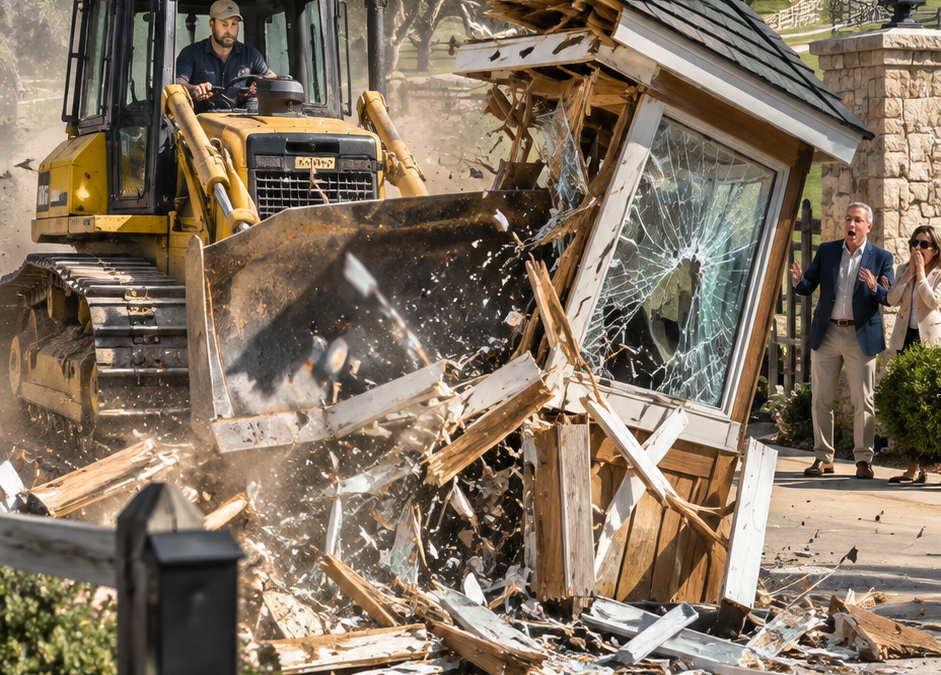
I lowered the blade.
The first contact was almost gentle.
Steel touched the base of the barrier post.
I increased pressure.
The post bent.
Vanessa screamed something I could not hear over the engine.
Another controlled push folded the mounting assembly sideways.
The barrier arm crashed onto the gravel.
I backed up.
Repositioned.
Then moved toward the guard shack.
The blade contacted one lower corner.
The prefab structure shuddered.
I pushed.
The entire building slid several inches across its concrete pad.
Wood cracked.
One wall buckled.
The roof sagged.
Another push folded the front corner inward.
A security camera dropped onto the gravel and shattered.
The RESIDENT ACCESS ONLY sign disappeared beneath the blade.
Vanessa was yelling into her phone like a war correspondent covering the fall of civilization.
I kept working.
Within minutes, the shack was no longer a shack.
It was a pile of panels, twisted trim, insulation, and cheap framing.
Then I moved the concrete bollards aside.
I pushed the broken barrier assembly out of the travel lane.
I regraded the disturbed gravel.
I widened the roadway back to its original dimensions.
When I finished, I raised the blade.
Shut down the engine.
And climbed out.
Dust drifted across the road.
For the first time in days, I could see straight from my workshop toward the county highway without a piece of Cedar Ridge infrastructure blocking the view.
Vanessa rushed toward me.
“You destroyed sixty thousand dollars of association property!”
I looked toward Wade’s orange stakes.
“No.”
I pointed.
“I removed unauthorized structures from my property.”
“You are going to pay for every dollar!”
“Send the invoice.”
Sirens sounded in the distance.
Two county patrol vehicles turned onto the road.
Vanessa smiled.
Actually smiled.
She clearly believed this was the part where authority finally arrived on her side.
She hurried toward the deputies.
“That man destroyed HOA property!” she said before either had fully exited the vehicle. “He threatened security personnel, operated heavy equipment recklessly, and demolished critical neighborhood infrastructure!”
One deputy looked at the debris.
Then at the bulldozer.
Then at me.
“Mr. Mercer?”
“Yes.”
“Your side?”
I handed him my folder.
He opened it.
Deed.
Survey.
Encroachment notice.
Photographs.
Emails.
Video stills.
County records.
Mara’s confirmation regarding the nonexistent easement.
The commercial-use demand.
The $500 unauthorized-entry fine.
The officer read silently.
Vanessa attempted to interrupt.
He held up a hand.
“Ma’am, I’m reviewing the documents.”
I almost admired his courage.
Eventually Vanessa produced her road agreement.
The deputy compared it to Mara’s written verification.
His forehead tightened.
“This recording number doesn’t match.”
“It absolutely does,” Vanessa said.
He called the county office.
Mara confirmed the number belonged to a drainage easement several miles away.
The deputy looked at Vanessa differently after that.
No one was arrested.
The officers correctly concluded that the underlying property dispute was primarily civil.
But copies of the questionable agreement were forwarded for review by the county fraud investigators.
That was the first time I saw Vanessa truly lose composure.
Then Landon made things worse.
He approached Bryce while the deputies were still present.
“I need to clarify something.”
Vanessa turned sharply.
“Landon, this is not the time.”
He ignored her.
“Our contract says this property belongs to Cedar Ridge.”
Bryce frowned.
“What?”
Landon retrieved a binder from his vehicle.
He opened the security agreement.
“Location is described as association-controlled property.”
I looked at him.
“You were never told this was my private driveway?”
“No.”
Vanessa snapped.
“He’s a contractor. His interpretation is irrelevant.”
Bryce kept reading.
Then his face changed.
“What is this amount?”
Landon hesitated.
“Three-year service contract.”
“How much?”
“One hundred sixty-eight thousand dollars.”
Bryce looked at Vanessa.
“You signed a hundred-and-sixty-eight-thousand-dollar contract?”
She said nothing.
“Without a board vote?”
Still nothing.
Several board members began making phone calls.
Wade, meanwhile, was examining the exposed concrete pad where the shack had stood.
He called me over.
“Grant.”
I walked across.
He pointed to a dark damp line under the road shoulder.
Water.
We dug enough gravel away to expose the problem.
During construction, whoever had installed the checkpoint had damaged one of my underground drainage pipes.
The pipe was cracked.
Water had been leaking beneath the road.
If it continued, the gravel base could wash out and eventually collapse.
The repair estimate later came back in the tens of thousands.
Vanessa had not just trespassed.
She had damaged the road she was claiming to control.
When I showed her the broken pipe, she barely looked.
“You still owe Cedar Ridge sixty thousand dollars.”
I wiped dirt from my hands.
“Send it to my lawyer.”
That seemed to irritate her more than shouting would have.
Bryce called an emergency board meeting.
Vanessa tried to delay it.
He overruled her.
For the first time, Cedar Ridge’s financial records were opened in front of the full board.
That was when the real reason for everything emerged.
Six months earlier, Cedar Ridge had entered negotiations to sell an undeveloped parcel behind the subdivision.
Purchase price:
$4.8 million.
The buyer intended commercial development.
There was one problem.
The parcel lacked suitable road access for construction traffic.
The official Cedar Ridge entrance was narrow, indirect, and poorly positioned for heavy vehicles.
There was one obvious alternative.
My driveway.
I sat in the clubhouse listening while Bryce explained it.
Suddenly every insane decision Vanessa had made became logical.
Not legal.
Not ethical.
But logical.
She needed my road.
Without it, the commercial buyer might walk.
So instead of negotiating with me, Vanessa had tried to manufacture the appearance that Cedar Ridge already controlled the route.
Guard shack.
Security contract.
Access cards.
Tolls.
Cameras.
Traffic logs.
Signs.
Restrictions.
She was not simply trying to steal convenience.
She was manufacturing history.
If enough documentation showed Cedar Ridge managing the road, perhaps she imagined the association could eventually argue the access had existed all along.
Bryce produced additional invoices.
One stood out.
$24,700 paid to a consulting firm nobody remembered approving.
Mara later examined the digital copy of the supposed twenty-year-old access agreement.
Its file metadata indicated it had been created less than three months earlier.
Three months.
Not twenty years.
When Bryce confronted Vanessa during another board session, the room became painfully quiet.
“Did you create this agreement?”
“No.”
“Who did?”
“I told you. A consultant located it.”
“What consultant?”
She named the same company that had received the $24,700.
Bryce looked at the records.
“That company was formed four months ago.”
Vanessa’s jaw tightened.
“That does not invalidate its research.”
“No,” I said from the far end of the room. “The fake recording number does a pretty good job of that.”
She turned toward me.
“You’re enjoying this.”
“Actually, I preferred Monday morning before you built a toll booth in my driveway.”
Bryce later gave me a copy of an internal email.
One sentence mattered more than everything else.
Once the checkpoint is fully operational, Mercer will have no practical alternative but to accept the proposed access arrangement.
There it was.
No misunderstanding.
No good-faith belief.
No accidental boundary error.
Pressure.
That sentence proved Vanessa knew I opposed Cedar Ridge’s use of the road.
She intended to make refusal so inconvenient that I would eventually surrender.
That changed the scope of my lawsuit.
Originally, I had only wanted Cedar Ridge gone.
Now I wanted everything documented.
My attorney filed claims seeking compensation for:
Damage to the drainage system.
Road restoration.
Lost workshop income.
Survey costs.
Legal expenses where recoverable.
And reimbursement of every dollar collected from drivers using my land as a private toll road.
More importantly, we requested a permanent injunction declaring that Cedar Ridge possessed no access rights across parcel 47B.
That threatened Vanessa’s $4.8 million transaction directly.
She reacted exactly the way people often react when desperation meets authority.
She doubled down.
One Sunday morning, I found a convoy of construction vehicles parked near my driveway.
The drivers had been told Cedar Ridge access was “disputed but operational.”
I parked my pickup across the entrance.
One contractor climbed down.
“Mr. Mercer?”
“Yes.”
“We were told this was an authorized construction route.”
“You were told wrong.”
Vanessa arrived twenty minutes later.
She stepped from her sedan already angry.
“You cannot block this project.”
“I’m blocking my driveway.”
“This involves millions of dollars.”
“Then somebody should have checked the deed.”
“You’re holding an entire development hostage over a few feet of dirt.”
I pointed behind me.
“It’s half a mile.”
“You know what I mean.”
“I know exactly what you mean. You think the value of your deal changes the ownership of my property.”
Her face hardened.
“If necessary, Cedar Ridge will pursue eminent domain.”
That one almost made my attorney laugh when I told him later.
“Vanessa,” I said, “you’re the president of a homeowners association.”
“Yes.”
“You are not a government.”
“We have legal options.”
“Then use the real ones.”
The construction crews began leaving.
The buyer’s attorneys soon appeared.
They had never been told that the advertised access route crossed privately owned land.
That revelation froze the commercial deal almost immediately.
The buyer’s deposit was placed under review.
Their attorneys accused Cedar Ridge of misrepresenting material facts.
Vanessa attempted to blame Bryce.
Unfortunately for her, Bryce had already preserved the relevant emails.
Then the board discovered another number.
$86,000.
That was how much Vanessa had transferred from Cedar Ridge’s reserve account to cover checkpoint construction, security expenses, consulting payments, and related costs without proper authorization.
Her financial signing authority was suspended.
She still refused to resign.
Instead, she began telling residents that I was trying to destroy Cedar Ridge.
I said nothing publicly.
I had learned something useful during the dispute.
The louder Vanessa became, the less I needed to speak.
Documents have a particular advantage over arrogant people.
Documents never get nervous.
Our emergency hearing was scheduled before County Judge Rebecca Sloan.
By the morning of the hearing, the courtroom gallery was packed with Cedar Ridge residents.
Some had once confronted me on my driveway.
Now they avoided eye contact.
Others nodded quietly.
I sat beside my attorney with a folder thick enough to qualify as construction material.
Vanessa sat across from us with Cedar Ridge’s counsel.
The association’s attorney had an uncomfortable job.
He had to protect Cedar Ridge while simultaneously distancing Cedar Ridge from Vanessa.
Judge Sloan entered.
Everyone stood.
Once preliminary matters were handled, she asked the simplest question of the entire dispute.
“Who owns the driveway?”
My attorney submitted the deed.
Wade’s survey.
County tax records.
Historical parcel maps.
Every document said the same thing.
Grant Mercer.
Parcel 47B.
Judge Sloan looked toward Cedar Ridge’s attorney.
“Does the association dispute title?”
He hesitated.
“Not title in the conventional sense, Your Honor. The association asserts access rights.”
“Through what recorded instrument?”
He produced Vanessa’s road agreement.
Mara testified next.
She explained the recording number.
Wrong document.
Wrong property.
Wrong location.
She explained the supposed signatory.
Wrong owner.
Then the digital creation date.
Wrong century, practically.
Judge Sloan looked toward Vanessa.
“Where did this document originate?”
Vanessa remained composed.
“An outside consultant located it during a historical records review.”
“Name the consultant.”
She did.
The judge reviewed the company information.
“How old is this business?”
Cedar Ridge’s attorney looked down.
Mara answered.
“Approximately four months at the time of the payment.”
The courtroom became silent.
Judge Sloan removed her glasses.
“I want to be clear. This court is not making any criminal determination concerning the creation or use of this document. Those issues may be addressed elsewhere.”
Vanessa shifted slightly.
“But for purposes of determining whether Cedar Ridge holds a valid recorded easement across parcel 47B, the court finds no credible evidence that such an easement exists.”
I felt something release in my chest.
Not excitement.
Relief.
The kind that comes when reality finally reaches the person with authority to enforce it.
Judge Sloan continued.
Cedar Ridge was permanently prohibited from placing barriers, security structures, cameras, guards, access-control equipment, or other obstructions on my road.
The illegal fence connection had to be sealed.
My boundary fence had to be restored.
The association was responsible for interim drainage repairs pending final determination of damages.
And most importantly:
Cedar Ridge had no easement.
No road rights.
No authority.
Nothing.
Vanessa’s attorney made one final argument.
He requested compensation for the destroyed guard shack.
Judge Sloan looked at him.
“Where was the structure located?”
He hesitated.
“On parcel 47B.”
“Mr. Mercer’s property.”
“Yes.”
“Was the association notified that the structure was unauthorized?”
“Yes.”
“Was an independent survey provided?”
“Yes.”
“Was the association given an opportunity to remove it?”
“Yes.”
“How long?”
“Seventy-two hours.”
“Was the area occupied at the time of removal?”
My attorney submitted the video.
“No, Your Honor.”
“Did Mr. Mercer verify that before operating the machinery?”
“Yes.”
Judge Sloan looked down at the documents again.
“The emergency claim for compensation related to removal of the checkpoint is denied.”
I glanced toward Vanessa.
For the first time since this started, she had no response.
She left the courtroom without speaking to me.
The consequences came quickly afterward.
An independent audit confirmed the unauthorized use of $86,000 from Cedar Ridge’s reserve fund.
The association’s insurance carrier warned that intentional misconduct involving fabricated documents might not be covered.
A special board meeting was scheduled.
I did not attend.
I had spent enough evenings at the Cedar Ridge clubhouse to last several lifetimes.
Bryce called me afterward.
“She’s out.”
“Removed?”
“Vote passed.”
“How close?”
“Not close.”
I leaned back in my chair.
“You okay?”
He sighed.
“I should have asked questions sooner.”
“That probably applies to a lot of people.”
“We gave one person too much authority.”
“That definitely applies to a lot of people.”
My civil case eventually settled.
Cedar Ridge agreed to pay for the drainage repairs.
Restore the damaged road surface.
Replace the section of boundary fence.
Compensate me for lost business.
Reimburse Wade’s survey fees.
Pay a substantial portion of my legal costs.
And refund every toll illegally collected at the checkpoint.
The separate investigation concerning the fabricated agreement and consulting payments continued through the appropriate authorities.
I stayed out of it.
Vanessa’s problems were no longer my project.
My project was my road.
The $4.8 million commercial sale collapsed.
Once the buyer learned Cedar Ridge had no guaranteed access through my property, they withdrew.
That was the deal Vanessa had risked everything to protect.
And in the end, her attempt to force access did not save the transaction.
It destroyed it.
A month later, I hired a crew to help rebuild the damaged section of driveway properly.
We excavated the failed drainage pipe.
Installed a new one.
Rebuilt the gravel base.
Compacted fresh stone.
Removed the last concrete fragments from Vanessa’s checkpoint.
Repaired the fence.
Then I stood where the guard shack had once been.
Nothing remained.
No security booth.
No camera pole.
No barrier arm.
No sign demanding resident identification.
Just gravel.
I installed one simple marker beside the driveway.
PRIVATE DRIVE
NO HOA ACCESS
No threats.
No fine schedule.
No laminated rules.
No $15 visitor fee.
Just six words.
Wade stopped by after the work was finished.
He stood beside me looking down the restored road.
“You planning to put up your own gate?”
“I think I might.”
He smiled.
“Make sure you know where the property line is.”
I looked at him.
“That sounds important.”
A few days later, I used the same bulldozer to haul two steel posts into position.
We installed them well inside my boundary.
I added a proper gate.
My gate.
On my land.
Controlled by me.
No Cedar Ridge logo.
No access cards issued by Vanessa.
No private security company.
No community curfew.
If someone needed access, they called me.
Exactly the way it had worked before Cedar Ridge decided a subdivision president could apparently annex neighboring land through office supplies and confidence.
The first morning after the gate was finished, I climbed into my bulldozer before sunrise.
I had a grading job to do near the highway.
The diesel engine turned over.
I drove from the workshop toward the road.
As I reached the place where Vanessa’s checkpoint had once stood, I slowed slightly.
For several days, that spot had represented everything irritating about the dispute.
The arrogance.
The threats.
The fake paperwork.
The guards.
The fees.
Being told I needed permission to reach my own house.
Now there was nothing there except fresh gravel glowing pale in the morning light.
Nobody stepped forward.
Nobody demanded identification.
Nobody asked where I was going.
Nobody lowered a barrier.
I drove straight through.
Looking back, people liked to describe the whole thing as the story about the time I bulldozed an HOA guard shack.
That was certainly the entertaining part.
But it was never really about a shack.
The shack was just lumber, metal, glass, and a little concrete.
It was about the idea behind it.
Vanessa believed physical control could eventually become legal control.
She believed that if she placed enough signs on my land, hired enough guards, collected enough tolls, and generated enough paperwork, everyone would eventually accept her version of reality simply because challenging it was inconvenient.
For a few days, she almost succeeded.
Residents accepted the gate.
Security accepted the contract.
Contractors paid the tolls.
Board members assumed somebody else had verified the documents.
And Vanessa mistook all that compliance for ownership.
That was her real mistake.
People can be intimidated.
Paperwork can be fabricated.
Boards can be manipulated.
Neighbors can be confused.
But a property line does not care who speaks more confidently.
The survey monuments beneath the grass did not move when Vanessa became HOA president.
My deed did not rewrite itself because Cedar Ridge found my road convenient.
The county records did not suddenly create an easement because a $4.8 million transaction needed one.
Vanessa eventually lost the presidency she had used to push the scheme.
The commercial deal she was protecting disappeared.
The association had to pay for the damage.
The fake access agreement became evidence instead of leverage.
And the security checkpoint she once believed would force me into surrender ended up becoming the most visible proof of how far she had been willing to go.
In the end, I never took anything from Cedar Ridge.
I did not seize their clubhouse.
I did not demand part of their land.
I did not interfere with their internal roads.
I did not tell them what color their houses could be, how tall their grass should grow, or which decorative wreaths were approved for autumn.
I wanted one thing.
My land left alone.
And after months of documents, surveys, lawyers, hearings, repairs, and one extremely satisfying morning behind the controls of a bulldozer, that was exactly what I got.
Vanessa Whitmore had tried to turn my driveway into Cedar Ridge property by building a guard shack on it.
Instead, she built the case that removed her from power.
And every morning after that, when I drove down that half-mile stretch of gravel without asking anybody’s permission, the open road reminded me of something simple.
Ownership does not become less real because someone important-looking decides to ignore it.
Sometimes all it takes to prove that is a deed.
Sometimes it takes a judge.
And every once in a while, after the paperwork is signed, the warnings are delivered, the area is cleared, and seventy-two hours have expired, it also takes a bulldozer.
Have you finished reading the story and want to read it again?
HOA Put an Armed Guard Shack on My Private Driveway—So I Flattened It With My Bulldozer and Took Back Every Inch
At six o’clock on a Monday morning, I came home from a parts run and discovered that the homeowners association next door had planted an armed security checkpoint in the middle of my private driveway and was demanding identification before allowing me to reach my own house.
The HOA president smiled while standing on land my family had owned for decades and explained that, from now on, I would need her permission to drive the half-mile road connecting my workshop to the county highway.
I could have argued with her until sunset, but three days later, when she locked me out completely, I decided there were situations where a deed, a survey, and seventy-two hours of patience were more useful than words—and situations where a bulldozer made the final point considerably clearer.
My name is Grant Mercer.
I owned thirty-eight acres on the eastern edge of Cedar Ridge Estates, although saying I lived “next to” Cedar Ridge gave the subdivision more importance in my life than it deserved.
My property had been there first.
My road had been there first.
The steel survey monuments marking the boundaries had been hammered into the earth long before the first Cedar Ridge resident ever worried about whether somebody’s mailbox was the wrong shade of beige.
My father had bought most of the land decades earlier, and I had eventually built my own house and heavy-equipment repair shop there.
The driveway was not decorative.
It was half a mile of compacted gravel wide enough to accommodate lowboys, excavators, graders, dump trucks, and whatever broken machine somebody was paying me to bring home and repair.
For eleven years, nobody had questioned who owned it.
Then Vanessa Whitmore discovered imagination.
I came around the final bend that Monday morning pulling a trailer loaded with hydraulic fittings and replacement parts when I saw something white and red sitting approximately two hundred feet from my gate.
I actually took my foot off the accelerator because my brain needed a second to catch up with my eyes.
There was a prefabricated guard shack beside the road.
A mechanical barrier arm stretched across the driveway.
Two uniformed security guards stood beside it.
And somebody had installed a professionally printed sign that read:
CEDAR RIDGE HOA
RESIDENT ACCESS ONLY
I stopped my truck.
Then I looked behind me.
Then forward again.
There is a particular kind of confusion a man experiences when something is so absurd that his mind temporarily assumes he must be standing in the wrong place.
Unfortunately, I knew exactly where I was.
One of the guards walked toward my window.
“Morning, sir. Cedar Ridge access card?”
I stared at him.
“My what?”
“Resident access credentials.”
I opened the door and stepped down.
“This is my driveway.”
The guard blinked.
He looked young enough to still believe laminated credentials were stronger than property law.
“I’m just working the contract, sir.”
“What contract?”
Before he could answer, a black sedan rolled up from the direction of the subdivision.
Vanessa Whitmore stepped out wearing a dark blazer, immaculate shoes, and the expression of somebody arriving to unveil a statue of herself.
I knew who she was.
Everybody along that side of the county knew Vanessa.
President of the Cedar Ridge Estates Homeowners Association.
A woman who had apparently spent enough time enforcing architectural guidelines that she had begun to confuse neighborhood bylaws with federal sovereignty.
She approached me smiling.
“Mr. Mercer.”
“Vanessa.”
“I assume security explained the new access protocol.”
I looked at the shack.
Then the barrier.
Then back at her.
“You built this on my road.”
Her smile never moved.
“Cedar Ridge has implemented an emergency security improvement.”
“That wasn’t my question.”
She opened a folder.
“This roadway now functions as a secondary controlled entrance into the community.”
I pointed toward my workshop in the distance.
“This roadway functions as my driveway.”
Vanessa tilted her head.
“Not exclusively anymore.”
That was the moment I understood this was not a construction mistake.
She knew.
She knew exactly where she was standing.
And she had decided ownership was apparently a negotiable concept.
What Vanessa did not yet understand was that I repaired bulldozers for a living.
And patience, unlike HOA authority, actually becomes more dangerous when you give it time.
PART2
Vanessa handed me a printed registration packet.
I took it because curiosity occasionally makes a man participate in his own humiliation.
The first page required my name, address, driver’s license number, license plate, emergency contact information, and vehicle description.
The second required me to list regular visitors.
The third described contractor access.
The fourth explained that the gate automatically closed between ten at night and six in the morning.
The fifth informed me that commercial vehicles could be restricted at the discretion of the association.
I read the packet twice.
Then I folded it carefully.
“Let me make sure I understand this.”
Vanessa crossed her arms.
“I think the instructions are very straightforward.”
“I need to register with your HOA so I can drive from the county road to my own house.”
“Yes.”
“Across my property.”
“This road serves Cedar Ridge.”
“That still sounds like my property.”
“You’re focusing on ownership when the issue is community function.”
I stared at her.
There are sentences so ridiculous that responding to them feels like rewarding bad behavior.
“This road has never been part of Cedar Ridge.”
“We have long-standing access rights.”
“No, you don’t.”
“Our attorney disagrees.”
“Then your attorney should probably buy a map.”
The guard beside us coughed into his fist.
Vanessa’s eyes narrowed.
“I would advise you not to make this unnecessarily hostile.”
I almost laughed.
She had built a checkpoint on my driveway before sunrise and was warning me about hostility.
“I’m going to say this once,” I told her. “My property is outside your subdivision. My house is outside your subdivision. My workshop is outside your subdivision. My driveway is outside your subdivision. You do not own this road.”
“It serves our community.”
“You keep saying that like repetition changes the deed.”
She extended her hand toward the packet.
“Complete the registration before using the gate again.”
I handed the papers back.
“No.”
Vanessa’s expression remained irritatingly calm.
“Then you may experience delays.”
“I’m going home.”
I turned toward my truck.
The guard looked at Vanessa.
She gave him a small nod.
The barrier rose.
I drove through.
But as I passed the shack, I understood something very clearly.
A misunderstanding ends when both people see the evidence.
An attempted takeover continues after one side sees the evidence and decides it does not matter.
So I did not go home angry.
I went home organized.
My office was built into one end of the workshop.
I walked inside, locked the door, pulled the fireproof file box from beneath my desk, and placed three documents across the workbench.
My deed.
The original county parcel map.
And a survey my father had commissioned thirty years earlier.
Parcel 47B.
Thirty-eight acres.
The driveway ran directly through the center of it.
A red line marked the route.
Beside it were the words PRIVATE DRIVE.
No easement.
No right-of-way.
No community access agreement.
Nothing involving Cedar Ridge or the developer who had built it.
I stood at the window looking toward the distant white roof of the guard shack.
For the first time that morning, I felt genuinely angry.
Not because someone had inconvenienced me.
I had spent my life around broken equipment.
Inconvenience was almost a business partner.
What bothered me was the confidence.
Vanessa had not asked.
She had not negotiated.
She had not even attempted to invent a polite reason for what she was doing.
She had simply arrived with hired guards and assumed that control, once physically established, would eventually become authority.
I had seen people make similar mistakes with machinery.
They ignored the warning light because the engine was still running.
Then they ignored the noise because the machine was still moving.
Then they ignored the smoke.
Eventually something expensive came apart.
I decided I would give Vanessa every opportunity to stop before that happened.
That evening, I spread the survey across my kitchen table.
My first instinct had been simple.
Start the dozer.
Push the shack into the ditch.
Go eat dinner.
It would have taken less than ten minutes.
It also would have been exactly what Vanessa wanted.
If I destroyed the checkpoint immediately, she could tell Cedar Ridge that some unstable mechanic had attacked their security project before anybody understood the facts.
So I made coffee.
Sat down.
And started documenting.
The next morning, I parked near the workshop with a clear view of the road.
By seven thirty, Cedar Ridge residents were already using my driveway.
That surprised me.
My road had always dead-ended at my property.
At least it had until somebody cut an opening through the eastern subdivision fence.
I drove down there and found that approximately twenty feet of my old boundary fence had been removed.
The new opening connected one of Cedar Ridge’s internal streets directly to my driveway.
Cars were flowing through steadily.
Some drivers waved at the guards.
Others held cards against a scanner.
One woman in a silver SUV stopped long enough to purchase temporary access.
That was when I noticed the laminated price sheet attached to the shack.
VISITOR ACCESS — $15
CONTRACTOR ACCESS — $30
COMMERCIAL DELIVERY — $50
I read it three times.
Vanessa was charging people money to cross my land.
I stood there holding my phone and actually laughed.
It was not a happy laugh.
It was the laugh a person makes when absurdity becomes so complete that anger temporarily loses the competition.
I filmed everything.
The shack.
The barrier arm.
The vehicles.
The cut fence.
The price sheet.
The guards accepting payments.
The location in relation to my survey stakes.
Then I went looking for Vanessa.
The Cedar Ridge clubhouse was the kind of building designed to convince suburban residents that quarterly association dues had transformed them into members of a country club.
Stone veneer.
White columns.
Artificial pond.
A conference room overlooking tennis courts that appeared to spend most of their time being admired rather than used.
I walked inside carrying my survey tube.
A board meeting was already underway.
Vanessa sat at the head of the table.
Six board members turned toward me.
She did not.
“Mr. Mercer,” she said. “This is a closed working session.”
“Then this should be quick.”
I unrolled my survey directly across the table.
“This is parcel 47B.”
A man near the far end leaned forward.
I later learned his name was Bryce Halford, the vice president.
Vanessa barely looked at the map.
“We’re already familiar with your claim.”
“It isn’t a claim.”
I tapped the survey.
“It’s the boundary.”
Vanessa opened a leather folder and removed a photocopied document.
“Then perhaps you should familiarize yourself with ours.”
She pushed it toward me.
ROAD ACCESS AGREEMENT.
According to the heading, it had been executed almost twenty years earlier between the original owner of parcel 47B and the developer of Cedar Ridge.
It supposedly granted permanent access rights across the driveway.
I began reading.
It took less than a minute before the first problem jumped off the page.
The legal description referenced parcel 47D.
My land was 47B.
I kept reading.
The name listed as the property owner was Leonard Grayson.
I knew that name.
Grayson had owned land farther south.
He had never owned my father’s parcel.
“What year was this supposedly signed?”
Vanessa tapped the date.
I looked at Bryce.
“Who owned parcel 47B that year?”
He hesitated.
“I don’t know.”
“My father.”
Vanessa leaned back.
“The association attorney has verified the document.”
“Wonderful. Give me a copy.”
“No.”
I looked at her.
“You just showed it to me.”
“You’ve seen what you need to see.”
“If it’s legitimate, why won’t you give me a copy?”
“The association has no obligation to provide internal records to a nonresident.”
“This is supposedly a document granting your association rights across my property.”
Vanessa smiled faintly.
“We consider this roadway under shared community control.”
Bryce looked from her to me.
“Vanessa, I’ve never seen that agreement.”
She ignored him.
I rolled my survey back into the tube.
“Fine.”
She seemed almost pleased.
“Good.”
I looked directly at her.
“If that document is legitimate, a courthouse can confirm it in five minutes.”
Her expression hardened.
“We have no reason to ask your permission.”
“You won’t be asking mine.”
I picked up my survey.
“You’ll be explaining it to a judge.”
The following morning, Vanessa escalated.
Two steel posts had appeared beside the checkpoint.
Mounted on top were license plate recognition cameras.
A new sign stood beside the barrier.
NO HEAVY EQUIPMENT WITHOUT HOA AUTHORIZATION.
I stopped beside it on my way to the workshop.
I read the words slowly.
My business repaired heavy equipment.
Dozers.
Excavators.
Loaders.
Graders.
Farm tractors.
The entire reason I maintained that road was so commercial trucks could reach my shop.
Vanessa had effectively installed a sign saying:
GRANT MERCER MAY NO LONGER OPERATE GRANT MERCER’S BUSINESS ON GRANT MERCER’S LAND WITHOUT VANESSA WHITMORE’S PERMISSION.
By noon, the stupidity had become expensive.
A flatbed arrived carrying a customer’s excavator.
The driver called me.
“Grant, I’ve got a problem.”
“What kind?”
“Security won’t let me through.”
I drove down.
Landon, the guard I had met the first morning, stood beside the barrier looking deeply uncomfortable.
“Commercial equipment needs authorization now,” he said.
“Who authorized the restriction?”
He looked toward the shack.
“The HOA.”
“The HOA doesn’t own the road.”
“I understand what you’re saying.”
“No, Landon. You understand what Vanessa is saying. I’m asking you to look at the ground.”
He sighed.
“I don’t have discretion here.”
The truck had nowhere to turn.
The driver had to reverse almost a mile.
The customer eventually sent the excavator to another shop.
I lost several thousand dollars in work.
That afternoon, Vanessa emailed me.
The message was beautifully formatted.
People attempting extortion apparently appreciate fonts.
Cedar Ridge would permit my continued commercial use of what she now called the “Cedar Ridge Access Point” for a monthly infrastructure contribution of $1,500.
I printed the email.
Placed it into a new manila folder.
Then wrote across the tab:
CEDAR RIDGE ENCROACHMENT.
That folder would eventually become thick enough to injure somebody.
I stopped communicating with Vanessa casually.
From that point forward, every conversation was documented.
Every sign photographed.
Every vehicle recorded.
Every email printed.
Every receipt saved.
I also hired Wade Hollister.
Wade was sixty-eight, sunburned year-round, and had probably forgotten more about county boundaries than most attorneys ever learned.
He had surveyed the area decades earlier.
When I explained the situation, he stared at me for several seconds.
“They built a what?”
“A guard shack.”
“On your driveway?”
“Yes.”
“And they’re charging tolls?”
“Yes.”
Wade scratched his chin.
“Well.”
He looked toward his truck.
“I suppose I should bring extra stakes.”
He spent nearly an entire day locating the original monuments.
Some were buried under grass.
One was beneath several inches of gravel.
Another sat near the cut section of fence.
By late afternoon, Wade had enough data to plot the boundary.
We stood beside his equipment while he checked the measurements again.
Then again.
Finally, he handed me a preliminary sketch.
The guard shack sat twenty-seven feet inside my property.
The barrier arm sat thirty-one feet inside.
Both cameras were on my land.
The new fence opening cut directly through my boundary fence.
I asked the obvious question.
“Could this be accidental?”
Wade looked at me.
Then at the shack.
Then back at me.
“Grant, somebody poured a foundation.”
“So?”
“Contractors don’t usually pour concrete security pads by throwing a dart at a parcel map.”
He drove large orange stakes along the true property line.
Vanessa arrived before he had finished packing.
She stepped out of her sedan with Landon and another guard.
“What are these?”
Wade answered.
“Survey markers.”
“Remove them.”
“No.”
She looked at Landon.
“Pull them.”
I stepped between him and the nearest stake.
“Don’t.”
Landon froze.
Wade spoke calmly.
“These markers correspond with recorded boundary monuments. I would strongly recommend nobody remove or tamper with them.”
Vanessa folded her arms.
“We’ll hire our own surveyor.”
“Please do,” I said.
“You think this is funny?”
“No.”
I looked toward the guard shack.
“I think this is expensive.”
That afternoon, I delivered a formal notice of encroachment.
It gave Cedar Ridge seventy-two hours to remove:
The guard shack.
The barrier arm.
The security cameras.
The steel posts.
The subdivision fence connection.
And every other unauthorized installation on parcel 47B.
They were also required to restore the original fence and road surface.
I personally handed the notice to Vanessa.
She read the first page.
“You have no authority to issue this.”
“I’m the landowner.”
“We dispute that.”
“No. You dispute whether ownership matters.”
I pointed to the deadline.
“Seventy-two hours.”
Vanessa smiled.
“I wouldn’t make threats you aren’t prepared to defend.”
I smiled back.
“That’s excellent advice.”
The next morning, I discovered her answer.
She had not removed the guard shack.
She had upgraded it.
Fresh concrete had been poured beneath the structure.
A backup generator sat behind it.
The lightweight barrier arm had been replaced by a heavier steel model.
Two additional guards had joined Landon.
And farther down the road were concrete bollards waiting to be installed.
Vanessa was trying to turn temporary trespass into permanent infrastructure faster than I could stop her.
That was when I drove to the county land records office.
Mara Keaton worked behind the public records counter.
She wore reading glasses low on her nose and possessed the special patience of somebody who spent her life explaining legal documents to people who wished those documents said something else.
I handed her the parcel numbers.
“I need everything.”
She raised an eyebrow.
“Everything?”
“Everything.”
Two hours later, we had a table covered in deeds, subdivision plats, easements, development applications, and historical filings.
There was no access easement across my property.
None.
No right-of-way.
No agreement.
No recorded license.
Nothing.
Then Mara found something better.
Twenty years earlier, Cedar Ridge’s original developer had filed a written request to purchase a strip of my driveway.
The owner at the time—my father—had refused.
Mara looked at me over her glasses.
“This is significant.”
“Because they knew they didn’t own access.”
“Exactly.”
Then I showed her Vanessa’s road agreement.
Mara examined the recording number.
Her expression changed.
“This number isn’t right.”
“How do you know?”
“The sequence.”
She typed it into the system.
A document appeared.
Drainage easement.
Different parcel.
Almost three miles away.
I stared at the screen.
“So that recording number has nothing to do with my driveway.”
“Nothing.”
“Could somebody have made a clerical error?”
She looked again at Vanessa’s document.
“Mr. Mercer, somebody used a real recording number from a completely unrelated filing.”
I felt the situation change in that moment.
Trespass was one thing.
A fabricated land document was another.
Vanessa responded to my notice by claiming Cedar Ridge held prescriptive access rights.
It was a fascinating argument considering the checkpoint had existed for less time than some leftovers in my refrigerator.
Prescriptive rights generally require years of qualifying use.
Vanessa apparently believed she could speed up history through enthusiasm.
She began logging every car.
The cameras ran around the clock.
More signs appeared.
CEDAR RIDGE ACCESS.
AUTHORIZED USERS ONLY.
COMMUNITY SECURITY ZONE.
She was building a visual record of control.
Then she locked me out.
It happened around eleven at night.
I had delivered a repaired loader to a customer and returned in my service truck.
The barrier would not rise.
I called Landon.
“Open the gate.”
“I can’t.”
“My house is on the other side.”
“I know.”
“Then open it.”
“There’s a new policy.”
“What policy?”
“Commercial vehicles need authorization before eight.”
“Landon.”
I stared through the windshield at the shack.
“I own the road.”
He sighed.
“I don’t have override authority.”
I parked my truck on the shoulder of the county road.
Then I walked half a mile home in darkness.
The next morning, Vanessa mailed me a $500 violation notice for attempted unauthorized entry.
I sat at my desk reading it.
Then I started laughing.
That was the moment my patience expired.
Not emotionally.
Administratively.
I issued one final notice.
Friday.
8:00 a.m.
If the structures remained after that deadline, I would remove them myself.
Vanessa reacted by sending a communitywide email accusing me of threatening Cedar Ridge’s “vital security infrastructure.”
Residents began appearing.
One man drove onto my property and shouted through his window.
“You can’t tear down our gate!”
I held out Wade’s survey.
“It isn’t your gate.”
“Yes, it is!”
“Then show me where your property starts.”
He looked at the paper.
His volume decreased.
Another resident arrived.
Then another.
I gave each of them copies.
Most had no idea the road was private.
That was when Vanessa’s narrative began cracking.
Bryce Halford started asking questions too.
He discovered that the Cedar Ridge board had never formally approved the checkpoint.
Vanessa claimed she had emergency authority.
Then Bryce asked how much she had spent.
She refused to answer.
Thursday evening, a truck arrived carrying concrete traffic bollards.
Vanessa supervised the unloading personally.
I walked down.
“Tomorrow morning.”
She turned.
“What?”
“Eight o’clock.”
Her expression sharpened.
“You touch association property and I will have you arrested.”
“Then make sure nobody is standing near it at eight.”
She laughed.
It was the laugh of someone who believed machinery was metaphorical.
I walked back to my shop.
Then I checked my bulldozer.
Hydraulic fluid.
Fuel.
Tracks.
Blade.
Pins.
Lights.
Camera mount.
Everything.
I was not preparing for a tantrum.
I was preparing for a job.
By 7:45 Friday morning, Vanessa was waiting at the checkpoint.
Landon stood nearby with two guards.
Bryce and another board member had arrived.
Several residents watched from farther back.
Vanessa already had her phone raised.
She expected me to arrive in a pickup and argue.
At 7:58, I started the dozer.
The diesel engine rolled through the morning air.
I eased the machine out of the equipment yard.
Then down the center of my road.
Vanessa’s expression changed when she saw me.
Not much.
Just enough.
I stopped well short of the checkpoint.
Wade stood off to one side as an independent witness.
My camera was running.
I climbed partly out of the cab.
“Everybody clear the road.”
Vanessa shouted back.
“You do not have permission to touch anything here!”
I held up the final notice.
“You had seventy-two hours.”
Landon immediately moved his guards away.
I called to him.
“Is anybody inside the shack?”
He looked through the window.
Then opened the door and checked.
“Empty.”
“You’re confirming that?”
“Yes.”
Vanessa stepped in front of the barrier.
I waited.
I did not move the machine.
“Get clear, Vanessa.”
“You’re committing a crime!”
“Then you should probably stand somewhere safer while you record it.”
She remained there another twenty seconds.
Maybe thirty.
Eventually even she realized that standing in front of a bulldozer for dramatic effect was not a legal strategy.
She moved.
I lowered the blade.
The first contact was almost gentle.
Steel touched the base of the barrier post.
I increased pressure.
The post bent.
Vanessa screamed something I could not hear over the engine.
Another controlled push folded the mounting assembly sideways.
The barrier arm crashed onto the gravel.
I backed up.
Repositioned.
Then moved toward the guard shack.
The blade contacted one lower corner.
The prefab structure shuddered.
I pushed.
The entire building slid several inches across its concrete pad.
Wood cracked.
One wall buckled.
The roof sagged.
Another push folded the front corner inward.
A security camera dropped onto the gravel and shattered.
The RESIDENT ACCESS ONLY sign disappeared beneath the blade.
Vanessa was yelling into her phone like a war correspondent covering the fall of civilization.
I kept working.
Within minutes, the shack was no longer a shack.
It was a pile of panels, twisted trim, insulation, and cheap framing.
Then I moved the concrete bollards aside.
I pushed the broken barrier assembly out of the travel lane.
I regraded the disturbed gravel.
I widened the roadway back to its original dimensions.
When I finished, I raised the blade.
Shut down the engine.
And climbed out.
Dust drifted across the road.
For the first time in days, I could see straight from my workshop toward the county highway without a piece of Cedar Ridge infrastructure blocking the view.
Vanessa rushed toward me.
“You destroyed sixty thousand dollars of association property!”
I looked toward Wade’s orange stakes.
“No.”
I pointed.
“I removed unauthorized structures from my property.”
“You are going to pay for every dollar!”
“Send the invoice.”
Sirens sounded in the distance.
Two county patrol vehicles turned onto the road.
Vanessa smiled.
Actually smiled.
She clearly believed this was the part where authority finally arrived on her side.
She hurried toward the deputies.
“That man destroyed HOA property!” she said before either had fully exited the vehicle. “He threatened security personnel, operated heavy equipment recklessly, and demolished critical neighborhood infrastructure!”
One deputy looked at the debris.
Then at the bulldozer.
Then at me.
“Mr. Mercer?”
“Yes.”
“Your side?”
I handed him my folder.
He opened it.
Deed.
Survey.
Encroachment notice.
Photographs.
Emails.
Video stills.
County records.
Mara’s confirmation regarding the nonexistent easement.
The commercial-use demand.
The $500 unauthorized-entry fine.
The officer read silently.
Vanessa attempted to interrupt.
He held up a hand.
“Ma’am, I’m reviewing the documents.”
I almost admired his courage.
Eventually Vanessa produced her road agreement.
The deputy compared it to Mara’s written verification.
His forehead tightened.
“This recording number doesn’t match.”
“It absolutely does,” Vanessa said.
He called the county office.
Mara confirmed the number belonged to a drainage easement several miles away.
The deputy looked at Vanessa differently after that.
No one was arrested.
The officers correctly concluded that the underlying property dispute was primarily civil.
But copies of the questionable agreement were forwarded for review by the county fraud investigators.
That was the first time I saw Vanessa truly lose composure.
Then Landon made things worse.
He approached Bryce while the deputies were still present.
“I need to clarify something.”
Vanessa turned sharply.
“Landon, this is not the time.”
He ignored her.
“Our contract says this property belongs to Cedar Ridge.”
Bryce frowned.
“What?”
Landon retrieved a binder from his vehicle.
He opened the security agreement.
“Location is described as association-controlled property.”
I looked at him.
“You were never told this was my private driveway?”
“No.”
Vanessa snapped.
“He’s a contractor. His interpretation is irrelevant.”
Bryce kept reading.
Then his face changed.
“What is this amount?”
Landon hesitated.
“Three-year service contract.”
“How much?”
“One hundred sixty-eight thousand dollars.”
Bryce looked at Vanessa.
“You signed a hundred-and-sixty-eight-thousand-dollar contract?”
She said nothing.
“Without a board vote?”
Still nothing.
Several board members began making phone calls.
Wade, meanwhile, was examining the exposed concrete pad where the shack had stood.
He called me over.
“Grant.”
I walked across.
He pointed to a dark damp line under the road shoulder.
Water.
We dug enough gravel away to expose the problem.
During construction, whoever had installed the checkpoint had damaged one of my underground drainage pipes.
The pipe was cracked.
Water had been leaking beneath the road.
If it continued, the gravel base could wash out and eventually collapse.
The repair estimate later came back in the tens of thousands.
Vanessa had not just trespassed.
She had damaged the road she was claiming to control.
When I showed her the broken pipe, she barely looked.
“You still owe Cedar Ridge sixty thousand dollars.”
I wiped dirt from my hands.
“Send it to my lawyer.”
That seemed to irritate her more than shouting would have.
Bryce called an emergency board meeting.
Vanessa tried to delay it.
He overruled her.
For the first time, Cedar Ridge’s financial records were opened in front of the full board.
That was when the real reason for everything emerged.
Six months earlier, Cedar Ridge had entered negotiations to sell an undeveloped parcel behind the subdivision.
Purchase price:
$4.8 million.
The buyer intended commercial development.
There was one problem.
The parcel lacked suitable road access for construction traffic.
The official Cedar Ridge entrance was narrow, indirect, and poorly positioned for heavy vehicles.
There was one obvious alternative.
My driveway.
I sat in the clubhouse listening while Bryce explained it.
Suddenly every insane decision Vanessa had made became logical.
Not legal.
Not ethical.
But logical.
She needed my road.
Without it, the commercial buyer might walk.
So instead of negotiating with me, Vanessa had tried to manufacture the appearance that Cedar Ridge already controlled the route.
Guard shack.
Security contract.
Access cards.
Tolls.
Cameras.
Traffic logs.
Signs.
Restrictions.
She was not simply trying to steal convenience.
She was manufacturing history.
If enough documentation showed Cedar Ridge managing the road, perhaps she imagined the association could eventually argue the access had existed all along.
Bryce produced additional invoices.
One stood out.
$24,700 paid to a consulting firm nobody remembered approving.
Mara later examined the digital copy of the supposed twenty-year-old access agreement.
Its file metadata indicated it had been created less than three months earlier.
Three months.
Not twenty years.
When Bryce confronted Vanessa during another board session, the room became painfully quiet.
“Did you create this agreement?”
“No.”
“Who did?”
“I told you. A consultant located it.”
“What consultant?”
She named the same company that had received the $24,700.
Bryce looked at the records.
“That company was formed four months ago.”
Vanessa’s jaw tightened.
“That does not invalidate its research.”
“No,” I said from the far end of the room. “The fake recording number does a pretty good job of that.”
She turned toward me.
“You’re enjoying this.”
“Actually, I preferred Monday morning before you built a toll booth in my driveway.”
Bryce later gave me a copy of an internal email.
One sentence mattered more than everything else.
Once the checkpoint is fully operational, Mercer will have no practical alternative but to accept the proposed access arrangement.
There it was.
No misunderstanding.
No good-faith belief.
No accidental boundary error.
Pressure.
That sentence proved Vanessa knew I opposed Cedar Ridge’s use of the road.
She intended to make refusal so inconvenient that I would eventually surrender.
That changed the scope of my lawsuit.
Originally, I had only wanted Cedar Ridge gone.
Now I wanted everything documented.
My attorney filed claims seeking compensation for:
Damage to the drainage system.
Road restoration.
Lost workshop income.
Survey costs.
Legal expenses where recoverable.
And reimbursement of every dollar collected from drivers using my land as a private toll road.
More importantly, we requested a permanent injunction declaring that Cedar Ridge possessed no access rights across parcel 47B.
That threatened Vanessa’s $4.8 million transaction directly.
She reacted exactly the way people often react when desperation meets authority.
She doubled down.
One Sunday morning, I found a convoy of construction vehicles parked near my driveway.
The drivers had been told Cedar Ridge access was “disputed but operational.”
I parked my pickup across the entrance.
One contractor climbed down.
“Mr. Mercer?”
“Yes.”
“We were told this was an authorized construction route.”
“You were told wrong.”
Vanessa arrived twenty minutes later.
She stepped from her sedan already angry.
“You cannot block this project.”
“I’m blocking my driveway.”
“This involves millions of dollars.”
“Then somebody should have checked the deed.”
“You’re holding an entire development hostage over a few feet of dirt.”
I pointed behind me.
“It’s half a mile.”
“You know what I mean.”
“I know exactly what you mean. You think the value of your deal changes the ownership of my property.”
Her face hardened.
“If necessary, Cedar Ridge will pursue eminent domain.”
That one almost made my attorney laugh when I told him later.
“Vanessa,” I said, “you’re the president of a homeowners association.”
“Yes.”
“You are not a government.”
“We have legal options.”
“Then use the real ones.”
The construction crews began leaving.
The buyer’s attorneys soon appeared.
They had never been told that the advertised access route crossed privately owned land.
That revelation froze the commercial deal almost immediately.
The buyer’s deposit was placed under review.
Their attorneys accused Cedar Ridge of misrepresenting material facts.
Vanessa attempted to blame Bryce.
Unfortunately for her, Bryce had already preserved the relevant emails.
Then the board discovered another number.
$86,000.
That was how much Vanessa had transferred from Cedar Ridge’s reserve account to cover checkpoint construction, security expenses, consulting payments, and related costs without proper authorization.
Her financial signing authority was suspended.
She still refused to resign.
Instead, she began telling residents that I was trying to destroy Cedar Ridge.
I said nothing publicly.
I had learned something useful during the dispute.
The louder Vanessa became, the less I needed to speak.
Documents have a particular advantage over arrogant people.
Documents never get nervous.
Our emergency hearing was scheduled before County Judge Rebecca Sloan.
By the morning of the hearing, the courtroom gallery was packed with Cedar Ridge residents.
Some had once confronted me on my driveway.
Now they avoided eye contact.
Others nodded quietly.
I sat beside my attorney with a folder thick enough to qualify as construction material.
Vanessa sat across from us with Cedar Ridge’s counsel.
The association’s attorney had an uncomfortable job.
He had to protect Cedar Ridge while simultaneously distancing Cedar Ridge from Vanessa.
Judge Sloan entered.
Everyone stood.
Once preliminary matters were handled, she asked the simplest question of the entire dispute.
“Who owns the driveway?”
My attorney submitted the deed.
Wade’s survey.
County tax records.
Historical parcel maps.
Every document said the same thing.
Grant Mercer.
Parcel 47B.
Judge Sloan looked toward Cedar Ridge’s attorney.
“Does the association dispute title?”
He hesitated.
“Not title in the conventional sense, Your Honor. The association asserts access rights.”
“Through what recorded instrument?”
He produced Vanessa’s road agreement.
Mara testified next.
She explained the recording number.
Wrong document.
Wrong property.
Wrong location.
She explained the supposed signatory.
Wrong owner.
Then the digital creation date.
Wrong century, practically.
Judge Sloan looked toward Vanessa.
“Where did this document originate?”
Vanessa remained composed.
“An outside consultant located it during a historical records review.”
“Name the consultant.”
She did.
The judge reviewed the company information.
“How old is this business?”
Cedar Ridge’s attorney looked down.
Mara answered.
“Approximately four months at the time of the payment.”
The courtroom became silent.
Judge Sloan removed her glasses.
“I want to be clear. This court is not making any criminal determination concerning the creation or use of this document. Those issues may be addressed elsewhere.”
Vanessa shifted slightly.
“But for purposes of determining whether Cedar Ridge holds a valid recorded easement across parcel 47B, the court finds no credible evidence that such an easement exists.”
I felt something release in my chest.
Not excitement.
Relief.
The kind that comes when reality finally reaches the person with authority to enforce it.
Judge Sloan continued.
Cedar Ridge was permanently prohibited from placing barriers, security structures, cameras, guards, access-control equipment, or other obstructions on my road.
The illegal fence connection had to be sealed.
My boundary fence had to be restored.
The association was responsible for interim drainage repairs pending final determination of damages.
And most importantly:
Cedar Ridge had no easement.
No road rights.
No authority.
Nothing.
Vanessa’s attorney made one final argument.
He requested compensation for the destroyed guard shack.
Judge Sloan looked at him.
“Where was the structure located?”
He hesitated.
“On parcel 47B.”
“Mr. Mercer’s property.”
“Yes.”
“Was the association notified that the structure was unauthorized?”
“Yes.”
“Was an independent survey provided?”
“Yes.”
“Was the association given an opportunity to remove it?”
“Yes.”
“How long?”
“Seventy-two hours.”
“Was the area occupied at the time of removal?”
My attorney submitted the video.
“No, Your Honor.”
“Did Mr. Mercer verify that before operating the machinery?”
“Yes.”
Judge Sloan looked down at the documents again.
“The emergency claim for compensation related to removal of the checkpoint is denied.”
I glanced toward Vanessa.
For the first time since this started, she had no response.
She left the courtroom without speaking to me.
The consequences came quickly afterward.
An independent audit confirmed the unauthorized use of $86,000 from Cedar Ridge’s reserve fund.
The association’s insurance carrier warned that intentional misconduct involving fabricated documents might not be covered.
A special board meeting was scheduled.
I did not attend.
I had spent enough evenings at the Cedar Ridge clubhouse to last several lifetimes.
Bryce called me afterward.
“She’s out.”
“Removed?”
“Vote passed.”
“How close?”
“Not close.”
I leaned back in my chair.
“You okay?”
He sighed.
“I should have asked questions sooner.”
“That probably applies to a lot of people.”
“We gave one person too much authority.”
“That definitely applies to a lot of people.”
My civil case eventually settled.
Cedar Ridge agreed to pay for the drainage repairs.
Restore the damaged road surface.
Replace the section of boundary fence.
Compensate me for lost business.
Reimburse Wade’s survey fees.
Pay a substantial portion of my legal costs.
And refund every toll illegally collected at the checkpoint.
The separate investigation concerning the fabricated agreement and consulting payments continued through the appropriate authorities.
I stayed out of it.
Vanessa’s problems were no longer my project.
My project was my road.
The $4.8 million commercial sale collapsed.
Once the buyer learned Cedar Ridge had no guaranteed access through my property, they withdrew.
That was the deal Vanessa had risked everything to protect.
And in the end, her attempt to force access did not save the transaction.
It destroyed it.
A month later, I hired a crew to help rebuild the damaged section of driveway properly.
We excavated the failed drainage pipe.
Installed a new one.
Rebuilt the gravel base.
Compacted fresh stone.
Removed the last concrete fragments from Vanessa’s checkpoint.
Repaired the fence.
Then I stood where the guard shack had once been.
Nothing remained.
No security booth.
No camera pole.
No barrier arm.
No sign demanding resident identification.
Just gravel.
I installed one simple marker beside the driveway.
PRIVATE DRIVE
NO HOA ACCESS
No threats.
No fine schedule.
No laminated rules.
No $15 visitor fee.
Just six words.
Wade stopped by after the work was finished.
He stood beside me looking down the restored road.
“You planning to put up your own gate?”
“I think I might.”
He smiled.
“Make sure you know where the property line is.”
I looked at him.
“That sounds important.”
A few days later, I used the same bulldozer to haul two steel posts into position.
We installed them well inside my boundary.
I added a proper gate.
My gate.
On my land.
Controlled by me.
No Cedar Ridge logo.
No access cards issued by Vanessa.
No private security company.
No community curfew.
If someone needed access, they called me.
Exactly the way it had worked before Cedar Ridge decided a subdivision president could apparently annex neighboring land through office supplies and confidence.
The first morning after the gate was finished, I climbed into my bulldozer before sunrise.
I had a grading job to do near the highway.
The diesel engine turned over.
I drove from the workshop toward the road.
As I reached the place where Vanessa’s checkpoint had once stood, I slowed slightly.
For several days, that spot had represented everything irritating about the dispute.
The arrogance.
The threats.
The fake paperwork.
The guards.
The fees.
Being told I needed permission to reach my own house.
Now there was nothing there except fresh gravel glowing pale in the morning light.
Nobody stepped forward.
Nobody demanded identification.
Nobody asked where I was going.
Nobody lowered a barrier.
I drove straight through.
Looking back, people liked to describe the whole thing as the story about the time I bulldozed an HOA guard shack.
That was certainly the entertaining part.
But it was never really about a shack.
The shack was just lumber, metal, glass, and a little concrete.
It was about the idea behind it.
Vanessa believed physical control could eventually become legal control.
She believed that if she placed enough signs on my land, hired enough guards, collected enough tolls, and generated enough paperwork, everyone would eventually accept her version of reality simply because challenging it was inconvenient.
For a few days, she almost succeeded.
Residents accepted the gate.
Security accepted the contract.
Contractors paid the tolls.
Board members assumed somebody else had verified the documents.
And Vanessa mistook all that compliance for ownership.
That was her real mistake.
People can be intimidated.
Paperwork can be fabricated.
Boards can be manipulated.
Neighbors can be confused.
But a property line does not care who speaks more confidently.
The survey monuments beneath the grass did not move when Vanessa became HOA president.
My deed did not rewrite itself because Cedar Ridge found my road convenient.
The county records did not suddenly create an easement because a $4.8 million transaction needed one.
Vanessa eventually lost the presidency she had used to push the scheme.
The commercial deal she was protecting disappeared.
The association had to pay for the damage.
The fake access agreement became evidence instead of leverage.
And the security checkpoint she once believed would force me into surrender ended up becoming the most visible proof of how far she had been willing to go.
In the end, I never took anything from Cedar Ridge.
I did not seize their clubhouse.
I did not demand part of their land.
I did not interfere with their internal roads.
I did not tell them what color their houses could be, how tall their grass should grow, or which decorative wreaths were approved for autumn.
I wanted one thing.
My land left alone.
And after months of documents, surveys, lawyers, hearings, repairs, and one extremely satisfying morning behind the controls of a bulldozer, that was exactly what I got.
Vanessa Whitmore had tried to turn my driveway into Cedar Ridge property by building a guard shack on it.
Instead, she built the case that removed her from power.
And every morning after that, when I drove down that half-mile stretch of gravel without asking anybody’s permission, the open road reminded me of something simple.
Ownership does not become less real because someone important-looking decides to ignore it.
Sometimes all it takes to prove that is a deed.
Sometimes it takes a judge.
And every once in a while, after the paperwork is signed, the warnings are delivered, the area is cleared, and seventy-two hours have expired, it also takes a bulldozer.








