𝗣𝗔𝗥𝗧 𝟮 HOA President Smashed My Mailbox With Her SUV—Then Tried to Make Me Pay for Her Damage
𝗣𝗔𝗥𝗧 𝟮
That was praise from Edmund Alderman.
He died in 1994.
The property passed to my mother.
When she died in 2011, title came to me in fee simple under Instrument No. 2011-047832.
That same year, I commissioned a survey.
Pins were set.
The plat was recorded.
The western boundary followed County Road 14.
The northern edge touched the Harland Creek easement.
The eastern boundary ran along the old rail corridor.
The southern line cut straight through a stand of white oak.
Clear title.
No restrictive covenant in favor of Clearwater Pines.
No HOA declaration.
No easement granting them regulatory authority.
Nothing.
And I knew exactly where the mailbox sat.
Inside my property.
I had installed it twelve years earlier.
Edmund helped me select the cedar post before he became too weak to work much.
The tree came from our northern timber stand.
Straight grain.
Dense heartwood.
We cut it oversized.
I set it in concrete.
The post stood well away from the travel lane and, according to every survey I possessed, outside the county road right-of-way.
Nobody complained for twelve years.
Then Clearwater Pines decided it was dangerous.
Clearwater Pines had not existed when my grandfather bought the land.
It appeared in 2003 after Garrison Properties purchased the old Whitfield farm south of us.
One hundred ten acres.
Seventy-four residential lots.
A clubhouse.
Retention pond.
Gated entrance.
Decorative brick columns.
Bronze sign.
The sort of development designed to look as though it had always belonged there despite having been built six months earlier.
I had no objection to any of it.
The Whitfield property was not mine.
What other people did with their land was their business.
The development’s northern boundary was supposed to meet the southern edge of my parcel.
Supposed to.
That word would eventually matter.
The Clearwater Pines HOA was formed as part of the subdivision.
It had recorded covenants.
It regulated the seventy-four lots inside the development.
Again, none of that bothered me.
My property was not one of those lots.
The entrance to Clearwater Pines sat about two hundred feet south of my driveway.
I could see its brick columns from County Road 14.
For nearly twenty years, that was the extent of my relationship with the subdivision.
Then Ranata Holloway became HOA president.
Ranata treated the position with the seriousness of a governor.
She had served for three years.
She carried a laminated version of Clearwater Pines’ standards in a leather portfolio.
According to my neighbor Walt Greer, she referred to the CC&Rs during meetings as “the law.”
They were not the law.
They were private covenants governing property subject to them.
That distinction is simple.
But repeated authority has a way of becoming theatrical authority, and theatrical authority can be surprisingly effective if nobody asks for the underlying instrument.
My first notice arrived six weeks before Ranata destroyed the mailbox.
Certified mail.
White envelope.
Clearwater Pines pine-tree logo.
The letter claimed that my property, as a parcel “adjacent to the northern boundary,” was subject to certain Clearwater Pines community standards.
It cited three supposed violations.
Section 4.2: mailbox placement.
Section 7.1: fencing aesthetics.
Section 9.4: sightline maintenance.
It was signed by Ranata Holloway and Douglas Fitch, the HOA compliance coordinator.
I read the letter twice.
What interested me was not what it contained.
It was what it did not contain.
No deed reference.
No recorded easement.
No declaration tying my parcel to theirs.
No annexation.
No boundary agreement.
No statute.
Nothing explaining how an HOA created in 2003 had acquired regulatory authority over land my family had owned continuously since 1947.
The letter simply assumed the authority existed.
I placed it in a manila folder.
CLEARWATER PINES CORRESPONDENCE.
Then I started another.
CLEARWATER PINES PROPERTY RECORDS.
I walked outside and photographed the mailbox.
Four angles.
Road view.
Drive view.
Distance from pavement.
Concrete footing.
Post.
Mailbox.
I wrote down the time and date.
At that point I did not know why.
Something about the letter made me think I should.
Then I called Walt.
Walt Greer had farmed east of me for forty years.
He had a memory for county land history that was usually more useful than the internet.
“Ranata’s been sending letters everywhere,” he said.
“You get one?”
“Wanted me to trim my hedge.”
“Are you in Clearwater Pines?”
“No.”
“What did you do?”
“Threw it away.”
I smiled.
“Probably satisfying.”
“Very.”
“I kept mine.”
“I figured you would.”
Walt knew me.
Three weeks later, the second letter arrived.
Another certified envelope.
Another deadline.
This time Clearwater Pines assessed fines.
$250 for mailbox placement.
$150 for fencing aesthetics.
Total: $400.
The HOA also claimed it had referred the sightline issue to the county road department.
That caught my attention.
County authority was different from HOA authority.
If the road department believed my mailbox violated the right-of-way, I wanted to know.
I called them.
A technician eventually pulled the road maps.
There was no active violation.
No inspection.
No citation.
No order.
Someone from Clearwater Pines had apparently made an inquiry.
Nothing more.
I wrote that down too.
Then Ranata drove into the post.
The collision occurred on a Tuesday morning in early October.
Later, once the dispute became formal, her insurance company described it as a low-speed impact at approximately nine miles per hour.
I had not measured her speed.
I only knew that she turned across the gravel apron too sharply.
There was no oncoming vehicle.
No obstruction.
No ice.
No rain.
No reason to be anywhere near the post.
She struck it because she drove into it.
Yet within minutes, the story became something else.
The post was unsafe.
The placement was noncompliant.
My property had caused damage to her SUV.
Her insurance carrier would be contacted.
I was expected to fix the “hazard.”
Before leaving, Ranata handed me another compliance notice.
Fourteen days.
Move the mailbox.
Correct the fence.
Clear the sightline.
I took it.
She climbed into the Escalade.
The damaged mirror swung slightly as she drove away.
I returned to the house.
Then I opened the fireproof box.
My deed.
2011 survey.
Tax records.
Original family documents.
I spread the relevant papers across my kitchen table.
Then I pulled the official Clearwater Pines records from the county database.
Their CC&Rs.
Subdivision plat.
Garrison acquisition deed.
Something bothered me.
Not simply whether their rules reached me.
The geometry itself.
I put my survey beside their plat.
The southern boundary of my property and the northern boundary of their development should have aligned.
They did not appear to.
The difference was small on paper.
But it was there.
I wrote three phrases on a legal pad.
PLAT COMPARISON.
RECORDED CC&Rs.
BASIS OF JURISDICTION.
Then I wrote the name Catherine Puit.
Catherine practiced land law in the county seat.
Her office was above a hardware store.
The staircase smelled like machine oil and fresh-cut lumber.
I found that reassuring.
Her walls were covered with surveys.
Not decorative maps.
Working surveys.
Large-format plats pinned directly to drywall.
Boundary sketches.
Aerial overlays.
Drainage easements.
Catherine had practiced property law for twenty-two years.
She read documents without speaking.
I brought her everything.
The original deed.
My 2011 deed.
Survey.
HOA notices.
Photographs before and after the collision.
Compliance notice.
Clearwater Pines CC&Rs.
Garrison subdivision plat.
The deed by which Garrison acquired the Whitfield property.
I placed them chronologically.
Catherine started with 1947.
Then moved forward.
Eventually she put my survey next to the Clearwater Pines plat.
She looked at one.
Then the other.
Back again.
Her finger traced the southern line of my parcel.
Then the northern line of theirs.
She stopped.
“These don’t match.”
“That was my impression.”
She pulled a magnifier from her drawer.
The Clearwater Pines plat referenced a 1998 boundary survey of the Whitfield farm.
But that survey, as cited on the development plat, did not reference the Alderman deed.
Catherine leaned back.
“How far do you think the discrepancy is?”
“I couldn’t tell from the scale.”
“I’m getting about twenty feet.”
“Enough to matter.”
“On land, six inches can matter.”
She continued examining the plat.
Then she asked:
“Did you or your mother ever sign a boundary-line agreement with Whitfield or Garrison?”
“No.”
“Grant them an easement?”
“No.”
“Sell any southern strip?”
“No.”
“Receive notice of a boundary adjustment?”
“Never.”
Catherine wrote something.
She asked me to leave the documents.
“I need the complete Whitfield chain.”
“All right.”
“And the 1998 survey.”
“Fine.”
“And I want the county surveyor’s monument records.”
“What are you thinking?”
She looked back at the two maps.
“That somebody started from the wrong point.”
Nine days later, I received her report.
Eleven pages.
Single-spaced.
Attachments.
The answer was worse for Clearwater Pines than either of us expected.
The 1998 survey had used a monument near County Road 14 as the northern control point for the Whitfield tract.
The problem was the monument.
It was not a property corner.
County survey records showed it had been installed in 1961 during a road-widening project.
It marked the road right-of-way.
The 1998 surveyor had treated it as a boundary monument.
That single mistake moved the Whitfield northern boundary approximately twenty-three feet north.
Then the mistake propagated.
1998 survey.
Garrison acquisition.
2003 subdivision plat.
Clearwater Pines CC&Rs.
Individual lot descriptions.
Every later document inherited the error because nobody went back to the Alderman chain and reconciled the adjacent title.
The result was extraordinary.
A strip approximately twenty-three feet wide and eight hundred forty feet long appeared on the Clearwater Pines plat even though nobody in the Alderman family had ever conveyed it.
Roughly 19,320 square feet.
Almost half an acre.
Still mine.
My mailbox sat in that disputed strip.
So did part of the gravel apron.
Ranata had driven onto land belonging to me.
Destroyed my property.
Then cited me under HOA rules that applied only because her subdivision plat mistakenly included ground the subdivision had never acquired.
I read Catherine’s conclusion twice.
Clearwater Pines had no legal authority to enforce community standards on the Alderman parcel.
The fines lacked legal foundation.
No recorded instrument transferred title to the disputed strip.
No covenant attached.
The survey error did not extinguish my ownership.
I called Catherine.
“What happens now?”
“We notify them.”
“And the mailbox damage?”
“Preserve everything.”
“Her insurer thinks I’m responsible.”
“Has anyone sued?”
“Not yet.”
“Then don’t use their language. Right now they have a claim. We answer it with evidence.”
That distinction mattered.
Ranata had threatened liability.
Her insurer later sent a demand letter seeking reimbursement for damage to the Escalade.
The repair estimate was $6,870.
The letter described my mailbox as an improperly placed fixed obstruction within the Clearwater Pines controlled roadway approach.
Catherine almost smiled when she read that.
“Controlled roadway approach.”
“Sounds official.”
“So does ‘dragon sanctuary’ if you put it on letterhead.”
That was as close as Catherine came to sarcasm.
She replied with three documents.
My deed.
The 2011 survey.
Her preliminary boundary analysis.
Then she asked the insurer to identify the recorded instrument establishing Clearwater Pines ownership or control over the collision location.
They did not answer immediately.
Catherine’s formal demand to the HOA went out the same week.
Certified mail.
Return receipt.
Addressed to Ranata.
Douglas Fitch.
Each board member individually.
Copies to the county surveyor and county recorder.
The letter demanded four things.
Immediate withdrawal of all citations.
Cancellation of all fines.
Written acknowledgment that the Alderman parcel was outside HOA jurisdiction.
Initiation of a formal process to correct the plat.
It also demanded that the HOA and Ranata preserve all records relating to the collision, enforcement actions, boundary information, and communication with insurers.
Catherine told me:
“I want them to understand that this is no longer about a mailbox.”
They received the letter on Thursday.
No response for ten days.
On the eleventh, Catherine sent another.
On the fourteenth, Clearwater Pines retained Gerald Spence.
Gerald practiced real-estate litigation.
He requested a meeting.
Catherine agreed.
I did not attend.
My presence would have added nothing.
The records were going.
Gerald arrived with the HOA declaration.
Subdivision plat.
A letter from the development’s original title insurer.
His initial position was that the Clearwater Pines line had been recorded and relied upon for roughly two decades, creating some form of established boundary through acquiescence.
Catherine answered with the Alderman deed chain.
The 2011 survey.
The county surveyor’s analysis of the incorrect monument.
And controlling case law explaining that a survey error does not transfer title to an adjoining owner when there was no agreement, notice, conveyance, or lawful adverse claim sufficient to extinguish record ownership.
Then she produced something Gerald had not expected.
A letter from the title insurer’s underwriting department.
Catherine had contacted them during her research.
The underwriting review acknowledged that the 1998 survey had not been properly cross-checked against the Alderman title chain.
The company did not concede liability in the letter.
Insurance companies rarely volunteer that.
But it also did not defend the twenty-three-foot encroachment.
Gerald read the county surveyor’s analysis.
Then the title-company letter.
He sat quietly.
Finally he asked:
“What does your client want?”
Catherine already had the answer.
“Withdraw every citation.”
Gerald wrote.
“Vacate every fine.”
He wrote.
“Written acknowledgment that Instrument No. 2011-047832 is not subject to Clearwater Pines covenants.”
Another note.
“Correct the plat.”
Another.
“Reimburse legal expenses incurred because of your client’s unsupported enforcement.”
He looked up.
“And the vehicle?”
Catherine folded her hands.
“Ms. Holloway drove into Mr. Alderman’s mailbox while on his property.”
“Our position is that the post contributed to the damage.”
“Then show me the document giving your client ownership or right-of-way control over where the post stood.”
Gerald did not answer.
Catherine continued.
“And once we’re discussing property damage, Mr. Alderman’s mailbox was destroyed.”
Gerald wrote something else.
The Escalade claim became much quieter after that meeting.
The insurer eventually withdrew its demand against me.
I submitted my own documentation for the mailbox damage.
I did not ask for anything extravagant.
Replacement post.
Concrete.
Reinstallation.
Repair of my mother’s cast-iron mailbox.
I could have bought a new one.
I did not want a new one.
That mailbox belonged there.
The bigger problem was the boundary.
Once the county was formally notified, Clearwater Pines could no longer treat it as a private argument between an HOA president and one stubborn neighbor.
The county surveyor opened a review.
The original Whitfield survey was compared against historic deed descriptions.
The road-widening records were examined.
The 1961 monument designation was confirmed.
The error was real.
Some of Clearwater Pines’ northern lots contained legal descriptions based in part on the faulty plat.
Their owners had purchased in good faith.
None of them had created the mistake.
I felt no pleasure in that.
These were families who had paid for houses believing their title documents were accurate.
My dispute was never with them.
But a bad survey does not become a good survey because innocent people later rely on it.
The county had to correct the record.
Ranata, meanwhile, had another problem.
She had personally turned a boundary dispute into a collision claim.
The incident became difficult to explain once everyone understood that she had driven onto the very strip of land her HOA had been wrongly asserting authority over.
Walt found that hilarious.
He stopped by one afternoon while I was temporarily using a basic metal rural mailbox mounted on a utility post.
He looked at it.
“Ugly.”
“Temporary.”
“Ranata approve it?”
I looked at him.
He smiled.
“I’d send her a letter.”
“Don’t tempt me.”
That was the only joke I allowed myself.
The formal Clearwater Pines board meeting occurred the first Monday in December.
Catherine attended.
I did not.
Five directors sat on the board.
By then Gerald Spence had circulated a legal memorandum explaining the boundary problem and the risks of continuing enforcement.
Several title insurers were also reviewing the matter.
The northern lot owners had learned their deed descriptions might require correction.
According to Catherine, the atmosphere in the clubhouse was different from the one Ranata usually controlled.
No speeches.
No confidence.
Mostly questions.
How had the error happened?
Who had reviewed the plat?
Would correcting it reduce lot size?
Would mortgages need endorsements?
Who would pay surveying costs?
Could the HOA really have been fining someone outside its jurisdiction?
Then came the vote.
Four to one.
The board accepted Catherine’s proposed resolution.
Ranata cast the only no vote.
She did not make a speech.
She did not defend the mailbox citation.
She did not repeat her safety argument.
The board resolution stated:
The parcel described under Instrument No. 2011-047832 was not subject to the Clearwater Pines Declaration of Covenants, Conditions and Restrictions.
The HOA had no authority to enforce community standards against it.
All citations were withdrawn.
All $400 in fines were vacated.
The association would initiate correction of the northern boundary plat.
My documented legal fees—$4,260—would be reimbursed.
The resolution also acknowledged the pending property-damage dispute.
Within weeks, the vehicle claim disappeared entirely.
Ranata’s insurer sent written confirmation that it would not pursue me.
That document went straight into my folder.
I did not celebrate.
The plat still had to be fixed.
That process lasted into spring.
Survey crews appeared along the southern edge of my land.
For the first time since 1998, people measured the line using the correct historic control points.
New pins were set.
Affected descriptions were revised.
Title companies issued whatever corrective documentation was necessary for the relevant Clearwater Pines owners.
Finally, a corrected plat was recorded.
The twenty-three-by-eight-hundred-forty-foot strip disappeared from Clearwater Pines.
Not physically.
It had never physically gone anywhere.
It disappeared from the wrong column of the record.
The land returned, on paper, to the place it had always remained in fact.
The Alderman parcel.
That spring, I walked the corrected line.
Eight hundred forty feet.
I carried a copy of the new plat.
At each pin, I stopped.
Pressed my boot into the cold ground beside it.
Looked north.
Then south toward Clearwater Pines.
Twenty-three feet did not look like much.
That was almost the unsettling part.
You could cross it in a few steps.
Yet that narrow strip had been enough for an HOA to believe it could regulate my fence, my roadside vegetation, my mailbox, and eventually hold me responsible when its president drove her SUV into a post standing on my own ground.
Small errors can carry large authority when nobody checks them.
The county line correction was completed in April.
A week later, I rebuilt the mailbox.
I went into the northern timber stand myself.
I chose cedar from the same area Edmund once said would outlast everything he built.
I cut a straight post.
Planed it.
Sanded it.
Treated the buried section.
The fresh wood smelled sharp and clean.
There are smells that do not change across a lifetime.
Cedar is one of them.
I dug at the same location.
The broken concrete footing had been removed.
I poured new concrete.
Set the post plumb.
Checked it twice.
Then a third time because Edmund would have.
After it cured, I repaired my mother’s cast-iron mailbox.
The impact had bent the mounting plate and warped the door slightly.
I straightened what I could.
A metalworker in town repaired the hinge.
There was still a shallow scar along one side.
I left it.
Not everything needs to be restored until no evidence remains.
I bolted the mailbox onto the new cedar.
Then I stood in County Road 14 and looked at it.
Not in the roadway.
Not in Clearwater Pines.
Not violating anything.
Just a mailbox on private land.
Walt drove by while I was finishing.
He slowed his truck.
Rolled down the window.
“Looks dangerous.”
I stared at him.
He laughed all the way down the road.
Ranata Holloway remained HOA president through the end of that term.
She did not contact me again.
Douglas Fitch sent the formal letter confirming that my fines had been removed from the HOA’s system.
I filed it.
Gerald Spence’s office mailed the reimbursement check for $4,260.
I deposited it.
The title company handled much of the correction work with the affected owners.
No one lost a house.
No one had to move a fence by twenty-three feet overnight.
Correcting records is often less dramatic than people imagine.
It is paperwork.
Surveying.
Signatures.
Amended descriptions.
Endorsements.
Time.
But the quietness of the process should not be confused with insignificance.
The corrected record protects everyone.
Including the Clearwater Pines owners.
A bad boundary is not only a problem for the person losing land.
It is also a problem for the person who believes they own land they never acquired.
That became the part of the story I thought about most.
Not Ranata’s Escalade.
Not even the absurdity of being handed a violation notice while my mailbox lay in a ditch because the woman issuing the notice had just destroyed it.
What stayed with me was the 1998 monument.
One concrete post.
Installed during a road project.
Misidentified as a property corner.
Then trusted.
Year after year.
Document after document.
Nobody had intended for that concrete marker to become a twenty-year legal error.
But once the first survey incorporated it, everything downstream inherited the mistake.
That is how records work.
Accuracy compounds.
So does error.
My grandfather understood the first half of that.
He kept receipts because he knew memory was weak.
People die.
Conversations disappear.
Handshakes become stories told by children who were not present.
Paper lasts longer.
But paper is only useful if someone checks whether the paper is right.
The original Clearwater Pines plat was recorded.
That did not make the underlying monument magically correct.
The HOA declaration was recorded.
That did not allow its covenants to reach property the developer had never acquired.
Ranata had a laminated copy.
Lamination did not improve it.
And saying “community standards” while standing next to a damaged Cadillac did not turn my mailbox into her liability shield.
One afternoon, several months after the plat correction, I received a call from a Clearwater Pines homeowner named Brian Mercer.
His lot was near the northern boundary.
I had never met him.
“Mr. Alderman?”
“Yes.”
“I wanted to ask you something about the boundary case.”
“All right.”
“My title company sent corrected documents.”
“I expected some of them would.”
He hesitated.
“Were you trying to take land from the subdivision?”
That question told me what some residents had been told.
“No.”
“So what happened?”
“The subdivision plat included land my family never sold.”
Silence.
“How?”
“Survey error.”
“Twenty-three feet?”
“Approximately.”
“And your family always had the older deed?”
“Since 1947.”
Another pause.
“Then why did our HOA say you were trying to move the boundary?”
I looked out toward the pond.
“That is probably a question for your HOA.”
He sighed.
“Yeah.”
Before hanging up, he said something I appreciated.
“For what it’s worth, I looked at the corrected survey. I get it now.”
“That is worth something.”
A month later, Brian stopped by.
He brought no lawyer.
No clipboard.
Just himself.
We walked the southern line.
I showed him one of the new pins.
He stood on the Clearwater Pines side.
I stood on mine.
Twenty-three feet farther south than the old plat had shown.
He shook his head.
“All this over that much ground.”
“No.”
He looked at me.
“All this over who owned it.”
He nodded.
That was the distinction.
If somebody takes one foot of your land without authority, the issue is not the acreage.
It is title.
If an institution can expand jurisdiction merely because the error seems small, then every boundary becomes negotiable according to convenience.
That is not how property works.
My grandfather would have understood that immediately.
Edmund did not have Catherine’s legal education.
He did not know the language of modern HOA declarations.
But he knew that if you bought sixty-eight acres, you needed proof of sixty-eight acres.
He knew you checked the receipt.
He knew you checked the line.
He knew you did not surrender something simply because somebody with a better car spoke more confidently than you.
Near the end of that summer, I found one of his old notebooks.
Cloth cover.
Brown with age.
Several pages were filled with railroad work.
Mileage.
Pay.
Names.
Then I reached a page from 1947.
It contained the amount he paid toward the land.
Beneath it, in pencil:
Check south line against Whitfield.
I sat there for a long time.
Seventy-seven years before Ranata Holloway drove into my mailbox, my grandfather had written himself a reminder to check the exact line that eventually became disputed.
I showed the page to Catherine.
She smiled.
“Your grandfather would’ve been a difficult client.”
“He would’ve liked you.”
“I’m not sure that’s a compliment.”
“It is.”
I made a copy.
The original went back into the notebook.
The copy went into the Clearwater Pines file.
That file eventually became almost three inches thick.
Letters.
Certified receipts.
Photographs.
Insurance correspondence.
County road maps.
My deed.
1947 deed.
2011 survey.
1998 Whitfield survey.
County monument records.
Catherine’s report.
Title-company correspondence.
HOA resolution.
Corrected plat.
Reimbursement check copy.
Withdrawal of vehicle-damage claim.
Everything in sequence.
At the front, I placed the photograph I took six weeks before the collision.
My original mailbox.
Standing upright.
Straight.
Undamaged.
Exactly where it had been for twelve years.
Behind it, I placed the photograph from the morning Ranata hit it.
Post in ditch.
Escalade beside the drive.
Mirror hanging loose.
There are moments when photographs do more than preserve an image.
They preserve absurdity.
You look at those two pictures and understand almost the whole story.
Before.
After.
Then a compliance notice blaming the thing that got hit.
I never filed a personal lawsuit against Ranata.
I did not need to.
The insurance dispute ended.
My mailbox was restored.
The HOA reimbursed my legal expenses.
The plat was corrected.
Their fines disappeared.
The disputed land remained mine.
More litigation would have cost time to prove things already established.
Catherine agreed.
“Winning doesn’t always mean filing one more case.”
I remembered that.
Because it is tempting, after somebody pushes too far, to want a punishment proportional to your frustration.
But property disputes become expensive very quickly.
The goal is not to maximize drama.
The goal is to restore the record.
Once that happened, I was finished.
The following fall, almost exactly one year after the collision, I was on the porch drinking coffee when a vehicle slowed at the head of the drive.
For half a second, I thought it might be Ranata.
It wasn’t.
County road maintenance.
The driver stopped.
He looked at the new mailbox.
Then waved.
I waved back.
He continued.
The cedar post stood in the morning light.
No complaint.
No citation.
No Escalade.
Just a mailbox.
Behind it, the pond carried the reflection of the northern timber.
A great blue heron stood at the edge.
Edmund called them patience birds.
They wait.
Completely still.
Then, when the moment is right, they move once.
Precisely.
I understood why he liked them.
The entire Clearwater Pines dispute had required the same thing.
I could have argued with the first letter.
I could have confronted Ranata after the second.
I could have shouted beside her damaged Escalade while my mailbox was lying in the ditch.
None of those things would have changed the boundary.
Instead, I photographed.
Filed.
Pulled deeds.
Compared plats.
Hired Catherine.
Found the old survey.
Found the wrong monument.
Then let the record do what my grandfather always said a record would do.
Speak for itself.
Ranata Holloway’s biggest mistake was not driving into the mailbox.
People have accidents.
Her biggest mistake was believing the accident proved her authority.
It did not.
The damaged SUV did not convert my property into Clearwater Pines property.
Her insurance letter did not move a boundary.
The HOA’s fines did not create a covenant.
The 2003 plat did not erase the 1947 deed.
And twenty years of an incorrect survey did not transform a road marker into a property corner.
Reality remained reality under every layer of paperwork placed over it.
That is what I remember whenever I pass the mailbox now.
The scar on the cast iron is still visible.
A shallow indentation near the lower edge.
Some people might replace it.
I won’t.
My mother bought that mailbox.
My grandfather helped select the first post.
I installed the replacement myself.
It belongs where it stands.
More importantly, now everybody knows exactly where that is.
The corrected survey is recorded.
The new pins are in the ground.
The title descriptions match.
Clearwater Pines ends where Clearwater Pines legally ends.
The Alderman parcel begins where it always began.
No ambiguity.
No performance.
No laminated rules.
Just the record.
And somewhere in the filing cabinet in my back bedroom is a certified HOA resolution acknowledging in black and white what should have been obvious before any of this started:
They never had authority over my land.
Not when they sent the first letter.
Not when they fined me.
Not when Ranata drove onto my property.
Not when she hit my mailbox.
And certainly not when she tried to make me responsible for the damage to the SUV she had driven into it.
My grandfather once told me that a man who keeps a record of what is true does not have to spend much time arguing about it.
At fifty-three, standing beside a new cedar post set into the same ground his deed had protected since 1947, I finally understood exactly what he meant.
The loudest person in a property dispute may have the clipboard.
They may have the letterhead.
They may even have a lawyer and twenty years of recorded paperwork behind them.
But none of that matters if the first line was drawn in the wrong place.
Because sooner or later, somebody will go back to the beginning.
And when they do, the truth will still be there.
Patient as a heron.
Waiting beside the water.
Have you finished reading the story and want to read it again?
HOA President Smashed My Mailbox With Her SUV—Then Tried to Make Me Pay for Her Damage
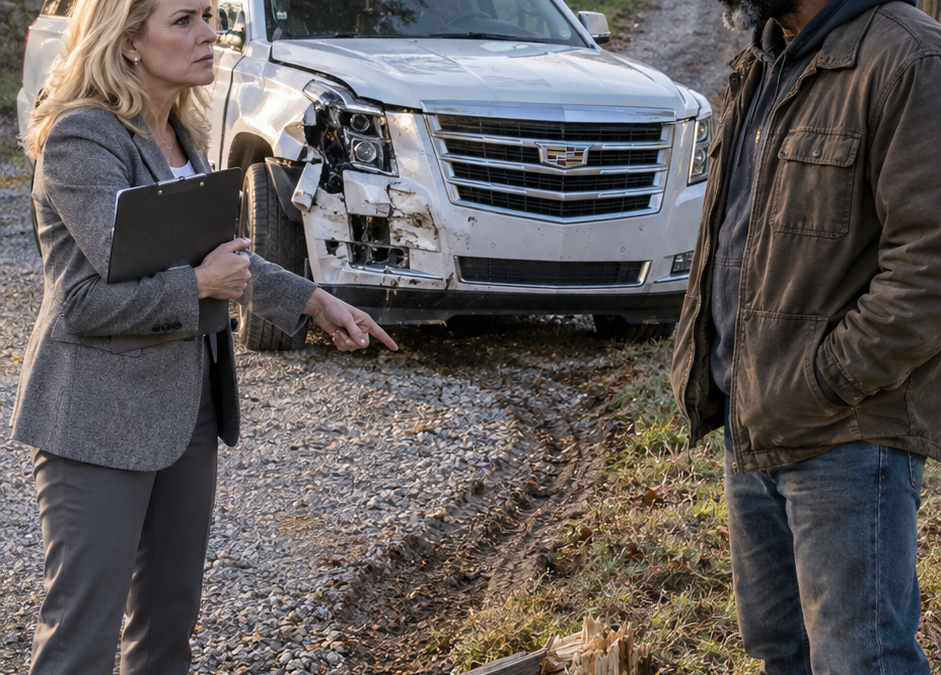
The president of Clearwater Pines HOA drove her Cadillac Escalade into my cedar mailbox post, snapped it off at ground level, damaged her own SUV, and then stepped out holding a clipboard to inform me that I was responsible because my mailbox had supposedly been placed illegally.
She demanded that I move what was left of it within fourteen days, threatened a formal complaint, and began building an insurance claim around the idea that her collision proved my property was a safety hazard—even though the post had stood there for twelve years without a single incident.
What she did not know was that the ground beneath her tires was hiding a twenty-three-foot mistake buried in a survey from 1998, and once my attorney found it, the question stopped being whether I owed her for a damaged Cadillac and became how much land her entire subdivision had been claiming without ever owning it.
My name is Nathan Alderman.
I was fifty-three years old when Ranata Holloway destroyed my mailbox.
The morning was cold enough that I could see a faint haze above the pond behind the house, though the first light had already reached the hardwoods along the northern edge of my property.
I was drinking coffee on the porch when I heard tires crunch too quickly across the gravel apron at the head of my drive.
Then came the sound.
Wood splitting.
Metal folding.
Glass rattling.
A dull impact followed by silence.
I set the coffee down.
At the end of the driveway, a white Cadillac Escalade sat crooked near County Road 14.
Its right front quarter panel had a deep crease.
The passenger-side mirror hung by its wiring.
And my mailbox was lying in the ditch.
The post had not merely tipped.
It had broken.
Twelve years earlier, I had set that cedar post myself in concrete deep enough to survive wind, snowplows, teenagers with baseball bats, and every other hazard a rural mailbox might reasonably encounter.
Apparently, it had not been designed for Ranata Holloway.
She backed the Escalade several feet.
Stopped.
Looked at the damage from inside.
Then opened the door.
She was wearing a gray blazer.
Pressed slacks.
Low boots that immediately picked up dust from my drive.
Under one arm she carried a clipboard.
In one hand she still held her keys.
I walked down from the porch.
Ranata did not begin with an apology.
She looked at the post.
Then at her SUV.
Then at me.
“You need to move that mailbox.”
I stopped.
“What?”
“It is not in compliance with community standards, and frankly, it is a safety hazard.”
She pulled a document from the clipboard.
“You have fourteen days to correct the placement, or Clearwater Pines will file a formal complaint.”
I looked past her.
The cast-iron mailbox my mother bought at an estate auction in 1988 lay door-open in the grass.
My cedar post was beside it.
Then I looked at the crushed quarter panel of her Escalade.
“You drove into it.”
“The placement contributed to the collision.”
“Did the mailbox move into the road?”
Her mouth tightened.
“That isn’t the issue.”
It was exactly the issue.
But I did not argue.
I took the notice.
“Thank you for letting me know.”
She stared at me for a second as though she could not determine whether I was mocking her.
I wasn’t.
I had simply learned something from my grandfather.
When somebody makes a confident claim about land, the most useful thing you can do is stop talking and find the deed.
So I went inside.
The Alderman property had been in my family since 1947.
Locals still called it the Alderman parcel, though no county map used that name.
Sixty-eight acres.
A spring-fed pond.
Hardwood timber.
An old farmhouse.
A gravel drive connecting to County Road 14.
My grandfather Edmund Alderman purchased the first tract after spending eleven years working rail lines out of Knoxville.
He came from people who knew what it meant to lose land.
That history mattered to him.
So when he finally bought property of his own, he documented everything.
The original deed.
Payment receipts.
Survey notes.
Tax records.
Correspondence.
Anything involving ownership went into either the courthouse record or a metal box at home.
Edmund was thirty-one when he bought the land.
He built the farmhouse in 1949.
My mother was born in the back bedroom five years later.
I was born in that same room in 1971.
By then, there was a perfectly good hospital less than thirty minutes away.
My mother simply preferred stubbornness.
It runs in the family.
The pond was where I learned to fish.
The timber line was where Edmund taught me red oak from white oak before I understood why anybody cared.
And the driveway where my broken mailbox now lay was where he taught me to back a trailer.
He would stand beside the road with his arms folded while I corrected the truck again and again.
He rarely told me what I had done wrong.
He made me figure it out.
When I finally backed straight down the drive, he nodded once.
That was praise from Edmund Alderman.
He died in 1994.
The property passed to my mother.
When she died in 2011, title came to me in fee simple under Instrument No. 2011-047832.
That same year, I commissioned a survey.
Pins were set.
The plat was recorded.
The western boundary followed County Road 14.
The northern edge touched the Harland Creek easement.
The eastern boundary ran along the old rail corridor.
The southern line cut straight through a stand of white oak.
Clear title.
No restrictive covenant in favor of Clearwater Pines.
No HOA declaration.
No easement granting them regulatory authority.
Nothing.
And I knew exactly where the mailbox sat.
Inside my property.
I had installed it twelve years earlier.
Edmund helped me select the cedar post before he became too weak to work much.
The tree came from our northern timber stand.
Straight grain.
Dense heartwood.
We cut it oversized.
I set it in concrete.
The post stood well away from the travel lane and, according to every survey I possessed, outside the county road right-of-way.
Nobody complained for twelve years.
Then Clearwater Pines decided it was dangerous.
Clearwater Pines had not existed when my grandfather bought the land.
It appeared in 2003 after Garrison Properties purchased the old Whitfield farm south of us.
One hundred ten acres.
Seventy-four residential lots.
A clubhouse.
Retention pond.
Gated entrance.
Decorative brick columns.
Bronze sign.
The sort of development designed to look as though it had always belonged there despite having been built six months earlier.
I had no objection to any of it.
The Whitfield property was not mine.
What other people did with their land was their business.
The development’s northern boundary was supposed to meet the southern edge of my parcel.
Supposed to.
That word would eventually matter.
The Clearwater Pines HOA was formed as part of the subdivision.
It had recorded covenants.
It regulated the seventy-four lots inside the development.
Again, none of that bothered me.
My property was not one of those lots.
The entrance to Clearwater Pines sat about two hundred feet south of my driveway.
I could see its brick columns from County Road 14.
For nearly twenty years, that was the extent of my relationship with the subdivision.
Then Ranata Holloway became HOA president.
Ranata treated the position with the seriousness of a governor.
She had served for three years.
She carried a laminated version of Clearwater Pines’ standards in a leather portfolio.
According to my neighbor Walt Greer, she referred to the CC&Rs during meetings as “the law.”
They were not the law.
They were private covenants governing property subject to them.
That distinction is simple.
But repeated authority has a way of becoming theatrical authority, and theatrical authority can be surprisingly effective if nobody asks for the underlying instrument.
My first notice arrived six weeks before Ranata destroyed the mailbox.
Certified mail.
White envelope.
Clearwater Pines pine-tree logo.
The letter claimed that my property, as a parcel “adjacent to the northern boundary,” was subject to certain Clearwater Pines community standards.
It cited three supposed violations.
Section 4.2: mailbox placement.
Section 7.1: fencing aesthetics.
Section 9.4: sightline maintenance.
It was signed by Ranata Holloway and Douglas Fitch, the HOA compliance coordinator.
I read the letter twice.
What interested me was not what it contained.
It was what it did not contain.
No deed reference.
No recorded easement.
No declaration tying my parcel to theirs.
No annexation.
No boundary agreement.
No statute.
Nothing explaining how an HOA created in 2003 had acquired regulatory authority over land my family had owned continuously since 1947.
The letter simply assumed the authority existed.
I placed it in a manila folder.
CLEARWATER PINES CORRESPONDENCE.
Then I started another.
CLEARWATER PINES PROPERTY RECORDS.
I walked outside and photographed the mailbox.
Four angles.
Road view.
Drive view.
Distance from pavement.
Concrete footing.
Post.
Mailbox.
I wrote down the time and date.
At that point I did not know why.
Something about the letter made me think I should.
Then I called Walt.
Walt Greer had farmed east of me for forty years.
He had a memory for county land history that was usually more useful than the internet.
“Ranata’s been sending letters everywhere,” he said.
“You get one?”
“Wanted me to trim my hedge.”
“Are you in Clearwater Pines?”
“No.”
“What did you do?”
“Threw it away.”
I smiled.
“Probably satisfying.”
“Very.”
“I kept mine.”
“I figured you would.”
Walt knew me.
Three weeks later, the second letter arrived.
Another certified envelope.
Another deadline.
This time Clearwater Pines assessed fines.
$250 for mailbox placement.
$150 for fencing aesthetics.
Total: $400.
The HOA also claimed it had referred the sightline issue to the county road department.
That caught my attention.
County authority was different from HOA authority.
If the road department believed my mailbox violated the right-of-way, I wanted to know.
I called them.
A technician eventually pulled the road maps.
There was no active violation.
No inspection.
No citation.
No order.
Someone from Clearwater Pines had apparently made an inquiry.
Nothing more.
I wrote that down too.
Then Ranata drove into the post.
The collision occurred on a Tuesday morning in early October.
Later, once the dispute became formal, her insurance company described it as a low-speed impact at approximately nine miles per hour.
I had not measured her speed.
I only knew that she turned across the gravel apron too sharply.
There was no oncoming vehicle.
No obstruction.
No ice.
No rain.
No reason to be anywhere near the post.
She struck it because she drove into it.
Yet within minutes, the story became something else.
The post was unsafe.
The placement was noncompliant.
My property had caused damage to her SUV.
Her insurance carrier would be contacted.
I was expected to fix the “hazard.”
Before leaving, Ranata handed me another compliance notice.
Fourteen days.
Move the mailbox.
Correct the fence.
Clear the sightline.
I took it.
She climbed into the Escalade.
The damaged mirror swung slightly as she drove away.
I returned to the house.
Then I opened the fireproof box.
My deed.
2011 survey.
Tax records.
Original family documents.
I spread the relevant papers across my kitchen table.
Then I pulled the official Clearwater Pines records from the county database.
Their CC&Rs.
Subdivision plat.
Garrison acquisition deed.
Something bothered me.
Not simply whether their rules reached me.
The geometry itself.
I put my survey beside their plat.
The southern boundary of my property and the northern boundary of their development should have aligned.
They did not appear to.
The difference was small on paper.
But it was there.
I wrote three phrases on a legal pad.
PLAT COMPARISON.
RECORDED CC&Rs.
BASIS OF JURISDICTION.
Then I wrote the name Catherine Puit.
Catherine practiced land law in the county seat.
Her office was above a hardware store.
The staircase smelled like machine oil and fresh-cut lumber.
I found that reassuring.
Her walls were covered with surveys.
Not decorative maps.
Working surveys.
Large-format plats pinned directly to drywall.
Boundary sketches.
Aerial overlays.
Drainage easements.
Catherine had practiced property law for twenty-two years.
She read documents without speaking.
I brought her everything.
The original deed.
My 2011 deed.
Survey.
HOA notices.
Photographs before and after the collision.
Compliance notice.
Clearwater Pines CC&Rs.
Garrison subdivision plat.
The deed by which Garrison acquired the Whitfield property.
I placed them chronologically.
Catherine started with 1947.
Then moved forward.
Eventually she put my survey next to the Clearwater Pines plat.
She looked at one.
Then the other.
Back again.
Her finger traced the southern line of my parcel.
Then the northern line of theirs.
She stopped.
“These don’t match.”
“That was my impression.”
She pulled a magnifier from her drawer.
The Clearwater Pines plat referenced a 1998 boundary survey of the Whitfield farm.
But that survey, as cited on the development plat, did not reference the Alderman deed.
Catherine leaned back.
“How far do you think the discrepancy is?”
“I couldn’t tell from the scale.”
“I’m getting about twenty feet.”
“Enough to matter.”
“On land, six inches can matter.”
She continued examining the plat.
Then she asked:
“Did you or your mother ever sign a boundary-line agreement with Whitfield or Garrison?”
“No.”
“Grant them an easement?”
“No.”
“Sell any southern strip?”
“No.”
“Receive notice of a boundary adjustment?”
“Never.”
Catherine wrote something.
She asked me to leave the documents.
“I need the complete Whitfield chain.”
“All right.”
“And the 1998 survey.”
“Fine.”
“And I want the county surveyor’s monument records.”
“What are you thinking?”
She looked back at the two maps.
“That somebody started from the wrong point.”
Nine days later, I received her report.
Eleven pages.
Single-spaced.
Attachments.
The answer was worse for Clearwater Pines than either of us expected.
The 1998 survey had used a monument near County Road 14 as the northern control point for the Whitfield tract.
The problem was the monument.
It was not a property corner.
County survey records showed it had been installed in 1961 during a road-widening project.
It marked the road right-of-way.
The 1998 surveyor had treated it as a boundary monument.
That single mistake moved the Whitfield northern boundary approximately twenty-three feet north.
Then the mistake propagated.
1998 survey.
Garrison acquisition.
2003 subdivision plat.
Clearwater Pines CC&Rs.
Individual lot descriptions.
Every later document inherited the error because nobody went back to the Alderman chain and reconciled the adjacent title.
The result was extraordinary.
A strip approximately twenty-three feet wide and eight hundred forty feet long appeared on the Clearwater Pines plat even though nobody in the Alderman family had ever conveyed it.
Roughly 19,320 square feet.
Almost half an acre.
Still mine.
My mailbox sat in that disputed strip.
So did part of the gravel apron.
Ranata had driven onto land belonging to me.
Destroyed my property.
Then cited me under HOA rules that applied only because her subdivision plat mistakenly included ground the subdivision had never acquired.
I read Catherine’s conclusion twice.
Clearwater Pines had no legal authority to enforce community standards on the Alderman parcel.
The fines lacked legal foundation.
No recorded instrument transferred title to the disputed strip.
No covenant attached.
The survey error did not extinguish my ownership.
I called Catherine.
“What happens now?”
“We notify them.”
“And the mailbox damage?”
“Preserve everything.”
“Her insurer thinks I’m responsible.”
“Has anyone sued?”
“Not yet.”
“Then don’t use their language. Right now they have a claim. We answer it with evidence.”
That distinction mattered.
Ranata had threatened liability.
Her insurer later sent a demand letter seeking reimbursement for damage to the Escalade.
The repair estimate was $6,870.
The letter described my mailbox as an improperly placed fixed obstruction within the Clearwater Pines controlled roadway approach.
Catherine almost smiled when she read that.
“Controlled roadway approach.”
“Sounds official.”
“So does ‘dragon sanctuary’ if you put it on letterhead.”
That was as close as Catherine came to sarcasm.
She replied with three documents.
My deed.
The 2011 survey.
Her preliminary boundary analysis.
Then she asked the insurer to identify the recorded instrument establishing Clearwater Pines ownership or control over the collision location.
They did not answer immediately.
Catherine’s formal demand to the HOA went out the same week.
Certified mail.
Return receipt.
Addressed to Ranata.
Douglas Fitch.
Each board member individually.
Copies to the county surveyor and county recorder.
The letter demanded four things.
Immediate withdrawal of all citations.
Cancellation of all fines.
Written acknowledgment that the Alderman parcel was outside HOA jurisdiction.
Initiation of a formal process to correct the plat.
It also demanded that the HOA and Ranata preserve all records relating to the collision, enforcement actions, boundary information, and communication with insurers.
Catherine told me:
“I want them to understand that this is no longer about a mailbox.”
They received the letter on Thursday.
No response for ten days.
On the eleventh, Catherine sent another.
On the fourteenth, Clearwater Pines retained Gerald Spence.
Gerald practiced real-estate litigation.
He requested a meeting.
Catherine agreed.
I did not attend.
My presence would have added nothing.
The records were going.
Gerald arrived with the HOA declaration.
Subdivision plat.
A letter from the development’s original title insurer.
His initial position was that the Clearwater Pines line had been recorded and relied upon for roughly two decades, creating some form of established boundary through acquiescence.
Catherine answered with the Alderman deed chain.
The 2011 survey.
The county surveyor’s analysis of the incorrect monument.
And controlling case law explaining that a survey error does not transfer title to an adjoining owner when there was no agreement, notice, conveyance, or lawful adverse claim sufficient to extinguish record ownership.
Then she produced something Gerald had not expected.
A letter from the title insurer’s underwriting department.
Catherine had contacted them during her research.
The underwriting review acknowledged that the 1998 survey had not been properly cross-checked against the Alderman title chain.
The company did not concede liability in the letter.
Insurance companies rarely volunteer that.
But it also did not defend the twenty-three-foot encroachment.
Gerald read the county surveyor’s analysis.
Then the title-company letter.
He sat quietly.
Finally he asked:
“What does your client want?”
Catherine already had the answer.
“Withdraw every citation.”
Gerald wrote.
“Vacate every fine.”
He wrote.
“Written acknowledgment that Instrument No. 2011-047832 is not subject to Clearwater Pines covenants.”
Another note.
“Correct the plat.”
Another.
“Reimburse legal expenses incurred because of your client’s unsupported enforcement.”
He looked up.
“And the vehicle?”
Catherine folded her hands.
“Ms. Holloway drove into Mr. Alderman’s mailbox while on his property.”
“Our position is that the post contributed to the damage.”
“Then show me the document giving your client ownership or right-of-way control over where the post stood.”
Gerald did not answer.
Catherine continued.
“And once we’re discussing property damage, Mr. Alderman’s mailbox was destroyed.”
Gerald wrote something else.
The Escalade claim became much quieter after that meeting.
The insurer eventually withdrew its demand against me.
I submitted my own documentation for the mailbox damage.
I did not ask for anything extravagant.
Replacement post.
Concrete.
Reinstallation.
Repair of my mother’s cast-iron mailbox.
I could have bought a new one.
I did not want a new one.
That mailbox belonged there.
The bigger problem was the boundary.
Once the county was formally notified, Clearwater Pines could no longer treat it as a private argument between an HOA president and one stubborn neighbor.
The county surveyor opened a review.
The original Whitfield survey was compared against historic deed descriptions.
The road-widening records were examined.
The 1961 monument designation was confirmed.
The error was real.
Some of Clearwater Pines’ northern lots contained legal descriptions based in part on the faulty plat.
Their owners had purchased in good faith.
None of them had created the mistake.
I felt no pleasure in that.
These were families who had paid for houses believing their title documents were accurate.
My dispute was never with them.
But a bad survey does not become a good survey because innocent people later rely on it.
The county had to correct the record.
Ranata, meanwhile, had another problem.
She had personally turned a boundary dispute into a collision claim.
The incident became difficult to explain once everyone understood that she had driven onto the very strip of land her HOA had been wrongly asserting authority over.
Walt found that hilarious.
He stopped by one afternoon while I was temporarily using a basic metal rural mailbox mounted on a utility post.
He looked at it.
“Ugly.”
“Temporary.”
“Ranata approve it?”
I looked at him.
He smiled.
“I’d send her a letter.”
“Don’t tempt me.”
That was the only joke I allowed myself.
The formal Clearwater Pines board meeting occurred the first Monday in December.
Catherine attended.
I did not.
Five directors sat on the board.
By then Gerald Spence had circulated a legal memorandum explaining the boundary problem and the risks of continuing enforcement.
Several title insurers were also reviewing the matter.
The northern lot owners had learned their deed descriptions might require correction.
According to Catherine, the atmosphere in the clubhouse was different from the one Ranata usually controlled.
No speeches.
No confidence.
Mostly questions.
How had the error happened?
Who had reviewed the plat?
Would correcting it reduce lot size?
Would mortgages need endorsements?
Who would pay surveying costs?
Could the HOA really have been fining someone outside its jurisdiction?
Then came the vote.
Four to one.
The board accepted Catherine’s proposed resolution.
Ranata cast the only no vote.
She did not make a speech.
She did not defend the mailbox citation.
She did not repeat her safety argument.
The board resolution stated:
The parcel described under Instrument No. 2011-047832 was not subject to the Clearwater Pines Declaration of Covenants, Conditions and Restrictions.
The HOA had no authority to enforce community standards against it.
All citations were withdrawn.
All $400 in fines were vacated.
The association would initiate correction of the northern boundary plat.
My documented legal fees—$4,260—would be reimbursed.
The resolution also acknowledged the pending property-damage dispute.
Within weeks, the vehicle claim disappeared entirely.
Ranata’s insurer sent written confirmation that it would not pursue me.
That document went straight into my folder.
I did not celebrate.
The plat still had to be fixed.
That process lasted into spring.
Survey crews appeared along the southern edge of my land.
For the first time since 1998, people measured the line using the correct historic control points.
New pins were set.
Affected descriptions were revised.
Title companies issued whatever corrective documentation was necessary for the relevant Clearwater Pines owners.
Finally, a corrected plat was recorded.
The twenty-three-by-eight-hundred-forty-foot strip disappeared from Clearwater Pines.
Not physically.
It had never physically gone anywhere.
It disappeared from the wrong column of the record.
The land returned, on paper, to the place it had always remained in fact.
The Alderman parcel.
That spring, I walked the corrected line.
Eight hundred forty feet.
I carried a copy of the new plat.
At each pin, I stopped.
Pressed my boot into the cold ground beside it.
Looked north.
Then south toward Clearwater Pines.
Twenty-three feet did not look like much.
That was almost the unsettling part.
You could cross it in a few steps.
Yet that narrow strip had been enough for an HOA to believe it could regulate my fence, my roadside vegetation, my mailbox, and eventually hold me responsible when its president drove her SUV into a post standing on my own ground.
Small errors can carry large authority when nobody checks them.
The county line correction was completed in April.
A week later, I rebuilt the mailbox.
I went into the northern timber stand myself.
I chose cedar from the same area Edmund once said would outlast everything he built.
I cut a straight post.
Planed it.
Sanded it.
Treated the buried section.
The fresh wood smelled sharp and clean.
There are smells that do not change across a lifetime.
Cedar is one of them.
I dug at the same location.
The broken concrete footing had been removed.
I poured new concrete.
Set the post plumb.
Checked it twice.
Then a third time because Edmund would have.
After it cured, I repaired my mother’s cast-iron mailbox.
The impact had bent the mounting plate and warped the door slightly.
I straightened what I could.
A metalworker in town repaired the hinge.
There was still a shallow scar along one side.
I left it.
Not everything needs to be restored until no evidence remains.
I bolted the mailbox onto the new cedar.
Then I stood in County Road 14 and looked at it.
Not in the roadway.
Not in Clearwater Pines.
Not violating anything.
Just a mailbox on private land.
Walt drove by while I was finishing.
He slowed his truck.
Rolled down the window.
“Looks dangerous.”
I stared at him.
He laughed all the way down the road.
Ranata Holloway remained HOA president through the end of that term.
She did not contact me again.
Douglas Fitch sent the formal letter confirming that my fines had been removed from the HOA’s system.
I filed it.
Gerald Spence’s office mailed the reimbursement check for $4,260.
I deposited it.
The title company handled much of the correction work with the affected owners.
No one lost a house.
No one had to move a fence by twenty-three feet overnight.
Correcting records is often less dramatic than people imagine.
It is paperwork.
Surveying.
Signatures.
Amended descriptions.
Endorsements.
Time.
But the quietness of the process should not be confused with insignificance.
The corrected record protects everyone.
Including the Clearwater Pines owners.
A bad boundary is not only a problem for the person losing land.
It is also a problem for the person who believes they own land they never acquired.
That became the part of the story I thought about most.
Not Ranata’s Escalade.
Not even the absurdity of being handed a violation notice while my mailbox lay in a ditch because the woman issuing the notice had just destroyed it.
What stayed with me was the 1998 monument.
One concrete post.
Installed during a road project.
Misidentified as a property corner.
Then trusted.
Year after year.
Document after document.
Nobody had intended for that concrete marker to become a twenty-year legal error.
But once the first survey incorporated it, everything downstream inherited the mistake.
That is how records work.
Accuracy compounds.
So does error.
My grandfather understood the first half of that.
He kept receipts because he knew memory was weak.
People die.
Conversations disappear.
Handshakes become stories told by children who were not present.
Paper lasts longer.
But paper is only useful if someone checks whether the paper is right.
The original Clearwater Pines plat was recorded.
That did not make the underlying monument magically correct.
The HOA declaration was recorded.
That did not allow its covenants to reach property the developer had never acquired.
Ranata had a laminated copy.
Lamination did not improve it.
And saying “community standards” while standing next to a damaged Cadillac did not turn my mailbox into her liability shield.
One afternoon, several months after the plat correction, I received a call from a Clearwater Pines homeowner named Brian Mercer.
His lot was near the northern boundary.
I had never met him.
“Mr. Alderman?”
“Yes.”
“I wanted to ask you something about the boundary case.”
“All right.”
“My title company sent corrected documents.”
“I expected some of them would.”
He hesitated.
“Were you trying to take land from the subdivision?”
That question told me what some residents had been told.
“No.”
“So what happened?”
“The subdivision plat included land my family never sold.”
Silence.
“How?”
“Survey error.”
“Twenty-three feet?”
“Approximately.”
“And your family always had the older deed?”
“Since 1947.”
Another pause.
“Then why did our HOA say you were trying to move the boundary?”
I looked out toward the pond.
“That is probably a question for your HOA.”
He sighed.
“Yeah.”
Before hanging up, he said something I appreciated.
“For what it’s worth, I looked at the corrected survey. I get it now.”
“That is worth something.”
A month later, Brian stopped by.
He brought no lawyer.
No clipboard.
Just himself.
We walked the southern line.
I showed him one of the new pins.
He stood on the Clearwater Pines side.
I stood on mine.
Twenty-three feet farther south than the old plat had shown.
He shook his head.
“All this over that much ground.”
“No.”
He looked at me.
“All this over who owned it.”
He nodded.
That was the distinction.
If somebody takes one foot of your land without authority, the issue is not the acreage.
It is title.
If an institution can expand jurisdiction merely because the error seems small, then every boundary becomes negotiable according to convenience.
That is not how property works.
My grandfather would have understood that immediately.
Edmund did not have Catherine’s legal education.
He did not know the language of modern HOA declarations.
But he knew that if you bought sixty-eight acres, you needed proof of sixty-eight acres.
He knew you checked the receipt.
He knew you checked the line.
He knew you did not surrender something simply because somebody with a better car spoke more confidently than you.
Near the end of that summer, I found one of his old notebooks.
Cloth cover.
Brown with age.
Several pages were filled with railroad work.
Mileage.
Pay.
Names.
Then I reached a page from 1947.
It contained the amount he paid toward the land.
Beneath it, in pencil:
Check south line against Whitfield.
I sat there for a long time.
Seventy-seven years before Ranata Holloway drove into my mailbox, my grandfather had written himself a reminder to check the exact line that eventually became disputed.
I showed the page to Catherine.
She smiled.
“Your grandfather would’ve been a difficult client.”
“He would’ve liked you.”
“I’m not sure that’s a compliment.”
“It is.”
I made a copy.
The original went back into the notebook.
The copy went into the Clearwater Pines file.
That file eventually became almost three inches thick.
Letters.
Certified receipts.
Photographs.
Insurance correspondence.
County road maps.
My deed.
1947 deed.
2011 survey.
1998 Whitfield survey.
County monument records.
Catherine’s report.
Title-company correspondence.
HOA resolution.
Corrected plat.
Reimbursement check copy.
Withdrawal of vehicle-damage claim.
Everything in sequence.
At the front, I placed the photograph I took six weeks before the collision.
My original mailbox.
Standing upright.
Straight.
Undamaged.
Exactly where it had been for twelve years.
Behind it, I placed the photograph from the morning Ranata hit it.
Post in ditch.
Escalade beside the drive.
Mirror hanging loose.
There are moments when photographs do more than preserve an image.
They preserve absurdity.
You look at those two pictures and understand almost the whole story.
Before.
After.
Then a compliance notice blaming the thing that got hit.
I never filed a personal lawsuit against Ranata.
I did not need to.
The insurance dispute ended.
My mailbox was restored.
The HOA reimbursed my legal expenses.
The plat was corrected.
Their fines disappeared.
The disputed land remained mine.
More litigation would have cost time to prove things already established.
Catherine agreed.
“Winning doesn’t always mean filing one more case.”
I remembered that.
Because it is tempting, after somebody pushes too far, to want a punishment proportional to your frustration.
But property disputes become expensive very quickly.
The goal is not to maximize drama.
The goal is to restore the record.
Once that happened, I was finished.
The following fall, almost exactly one year after the collision, I was on the porch drinking coffee when a vehicle slowed at the head of the drive.
For half a second, I thought it might be Ranata.
It wasn’t.
County road maintenance.
The driver stopped.
He looked at the new mailbox.
Then waved.
I waved back.
He continued.
The cedar post stood in the morning light.
No complaint.
No citation.
No Escalade.
Just a mailbox.
Behind it, the pond carried the reflection of the northern timber.
A great blue heron stood at the edge.
Edmund called them patience birds.
They wait.
Completely still.
Then, when the moment is right, they move once.
Precisely.
I understood why he liked them.
The entire Clearwater Pines dispute had required the same thing.
I could have argued with the first letter.
I could have confronted Ranata after the second.
I could have shouted beside her damaged Escalade while my mailbox was lying in the ditch.
None of those things would have changed the boundary.
Instead, I photographed.
Filed.
Pulled deeds.
Compared plats.
Hired Catherine.
Found the old survey.
Found the wrong monument.
Then let the record do what my grandfather always said a record would do.
Speak for itself.
Ranata Holloway’s biggest mistake was not driving into the mailbox.
People have accidents.
Her biggest mistake was believing the accident proved her authority.
It did not.
The damaged SUV did not convert my property into Clearwater Pines property.
Her insurance letter did not move a boundary.
The HOA’s fines did not create a covenant.
The 2003 plat did not erase the 1947 deed.
And twenty years of an incorrect survey did not transform a road marker into a property corner.
Reality remained reality under every layer of paperwork placed over it.
That is what I remember whenever I pass the mailbox now.
The scar on the cast iron is still visible.
A shallow indentation near the lower edge.
Some people might replace it.
I won’t.
My mother bought that mailbox.
My grandfather helped select the first post.
I installed the replacement myself.
It belongs where it stands.
More importantly, now everybody knows exactly where that is.
The corrected survey is recorded.
The new pins are in the ground.
The title descriptions match.
Clearwater Pines ends where Clearwater Pines legally ends.
The Alderman parcel begins where it always began.
No ambiguity.
No performance.
No laminated rules.
Just the record.
And somewhere in the filing cabinet in my back bedroom is a certified HOA resolution acknowledging in black and white what should have been obvious before any of this started:
They never had authority over my land.
Not when they sent the first letter.
Not when they fined me.
Not when Ranata drove onto my property.
Not when she hit my mailbox.
And certainly not when she tried to make me responsible for the damage to the SUV she had driven into it.
My grandfather once told me that a man who keeps a record of what is true does not have to spend much time arguing about it.
At fifty-three, standing beside a new cedar post set into the same ground his deed had protected since 1947, I finally understood exactly what he meant.
The loudest person in a property dispute may have the clipboard.
They may have the letterhead.
They may even have a lawyer and twenty years of recorded paperwork behind them.
But none of that matters if the first line was drawn in the wrong place.
Because sooner or later, somebody will go back to the beginning.
And when they do, the truth will still be there.
Patient as a heron.
Waiting beside the water.








