𝗣𝗔𝗥𝗧 𝟮 HOA President Parked on Our Ranch 11 Times—Then Grandpa Quietly Reached for the Tow Strap
𝗣𝗔𝗥𝗧 𝟮
That was the first warning.
I noted it and continued my work.
Over the next six weeks, Karen returned six times.
Morning.
Afternoon.
Weekdays.
Once on a Sunday.
The routine barely changed.
She entered through the loose section of the eastern fence, drove along the ranch road, parked, got out, photographed whatever interested her, and left when confronted.
Each time, I told her the land was private.
Each time, she acted as if she were tolerating an eccentric request from a difficult neighbor.
After the fourth incident, I bought two heavy orange no-trespassing signs.
Grandpa helped me bolt them to the fence posts flanking the gap. The raised black lettering could be read from thirty yards away.
I photographed both signs immediately after installation.
The image files recorded the date, time, and location.
At that stage, I believed clear signs would end the problem.
Forty-eight hours later, someone sent me a screenshot from the Mercer Hills community page.
Karen had written:
“The old ranch family beside us is trying to block community access to the green space along the eastern trail. Does anyone know who to contact at the county?”
Green space.
Eastern trail.
Community access.
With three phrases, she converted a cattle road into a public amenity and our family into unreasonable caretakers refusing to share it.
Her post reached roughly six hundred group members.
I searched her earlier posts.
There were three.
One included a photograph taken from inside our fence.
The caption read:
“Morning walk through the green space.”
Another showed our stock pond in the distance.
Both were geotagged.
Karen had documented her own trespassing and published the evidence because it had never occurred to her that entering our ranch might genuinely be unlawful.
I saved every post.
Then I installed a trail camera at the gap.
Three more visits followed after the signs went up.
The camera captured her plate every time.
Date.
Time.
Direction of travel.
Clear images.
The eighth time she returned, Grandpa met her.
He did not raise his voice.
He rarely needed to.
“This property belongs to my family,” he said. “The signs are posted. If you bring that vehicle back, we will remove it.”
Karen looked at him with the expression people sometimes used when speaking to someone elderly enough that they assumed age had made him irrelevant.
“You don’t understand how communities work anymore.”
Grandpa held her gaze.
Then he turned and walked back to the barn.
He had spent most of his life fixing things that could injure a man if handled carelessly. He did not confuse arguing with solving.
That evening, he opened the fireproof safe in the study.
He removed the original deed, the folded plat, and eight decades of tax records.
He placed everything on the kitchen table.
“I haven’t needed these in years,” he said.
“You still don’t.”
He ran one finger along the eastern boundary on the plat.
“Might.”
The ninth visit was worse.
Karen parked directly in front of the equipment gate.
Her bumper nearly touched the chain-link panels, blocking the only opening wide enough for our tractor and veterinary vehicles.
She left the SUV and walked two hundred yards into the property to take photographs near the tree line.
Dr. Callahan was due at nine that morning to examine a heifer favoring her left front leg.
He arrived at 8:50 and stopped behind Karen’s vehicle.
“That belong to your new neighbors?” he asked.
“Unfortunately.”
We waited forty minutes.
The heifer remained in the south pen, shifting weight away from the injured leg.
I photographed the blocked gate from three angles. Karen’s plate appeared clearly in every image.
Dr. Callahan recorded the delay in his professional visit log.
When Karen finally returned, she seemed surprised to find us waiting.
“I was looking around.”
“You blocked a working gate during a veterinary appointment.”
“I didn’t block anything important.”
Dr. Callahan looked at the gate.
Then at her SUV.
He wisely chose silence.
“You have entered this ranch nine times without permission,” I said. “The signs are posted. Grandpa warned you. I have warned you. This stops now.”
Karen crossed her arms.
“I’ve looked into this.”
“That would be a pleasant change.”
Her chin lifted.
“There are laws concerning adverse possession and public access. People have been using this road for years. You can’t suddenly fence everyone out.”
“This road has belonged to my family since 1941.”
“You should speak with an attorney before threatening people.”
Adverse possession and prescriptive easements were real legal concepts.
They were also more complicated than watching half a video online and deciding repeated trespassing eventually transformed itself into ownership.
Such claims required particular elements: duration, openness, continuity, and use without the owner’s effective permission or objection.
The moment an owner clearly objected, posted signs, documented notice, and ordered the use to stop, the claimant’s story became much harder.
I did not give Karen a property-law lesson beside the injured heifer.
“I’m sending formal notice today,” I said. “Any vehicle left on this ranch afterward will be removed at the owner’s expense.”
I took one final photograph.
Then I opened the gate as far as her bumper allowed and guided Dr. Callahan through.
Karen drove away while he examined the heifer.
That afternoon, I sent a certified letter.
Private property.
No trespassing.
No public right-of-way.
Any unauthorized vehicle discovered on the ranch after receipt of the notice would be removed without further warning.
One page.
Signed.
Mailed before two.
Three days later, Karen accepted delivery.
Her signature appeared on the return receipt.
I placed it in the folder.
Hank Oglesby ran cattle north of Mercer Hills.
He pulled into the post-office lot as I was leaving after mailing the notice.
He lowered his truck window.
“Same woman?”
“Same woman.”
“She came through my fence last month. Her and two others.”
“Do you have proof?”
“Photographs.”
“I may need a statement.”
“You’ll get one.”
Two days after Karen signed for the notice, her husband appeared at the end of our driveway.
He stayed on the county side of the fence and shouted about harassment.
According to him, Mercer Hills residents possessed a moral right to enjoy the land surrounding their neighborhood.
Apparently, our decades of ownership had acquired a community-obligation clause nobody bothered to mention when we paid property taxes.
I photographed him from the porch.
He remained outside the gate.
That was the first sensible choice anyone in Karen’s family had made.
Two days later, an attorney’s letter arrived.
The law firm specialized in HOA and residential-property disputes.
The language sounded confident.
Mercer Hills intended to claim that the eastern ranch road had become a prescriptive easement through open and continuous public use.
In ordinary language, Karen wanted her repeated trespassing converted into a permanent legal right for two hundred households.
I read the letter twice.
Then I made coffee.
Panic would not change the deed.
Documents might.
Grandpa retrieved the original from the safe.
The paper carried my great-grandfather’s name on the first page.
The eastern road appeared inside our boundary, described as a private ranch access route.
No public dedication.
No easement.
No shared right-of-way.
I printed all eleven camera images.
Each showed Karen’s vehicle entering through the posted gap.
Each carried a timestamp.
Several occurred after direct verbal objections.
The latest occurred after she signed for the certified notice.
I stacked the images chronologically.
Then I called Hank.
His records included three separate incidents involving Mercer Hills residents. One person had cut a fence post to widen an opening.
He sent photographs and prepared a written statement.
Karen’s own social-media page provided more.
Eleven posts mentioned the eastern road or supposed green space.
Four photographs had been taken inside our fence.
Two retained coordinates showing Karen approximately sixty yards within our property.
Several posts came after the no-trespassing signs appeared.
Two came after certified notice.
She had thought she was manufacturing community expectation.
She had actually created a confession file with dates, locations, photographs, and six hundred potential witnesses.
I called Patricia Oaks.
She had spent more than twenty years handling ranch titles and boundary disputes.
After hearing the summary, she asked three questions.
“Are the signs clearly visible?”
“Yes.”
“Do you have proof of notice?”
“Her signature.”
“Any easement on the deed or plat?”
“None.”
“Bring everything.”
Patricia examined the folder in her office.
She moved carefully, writing notes in the margins of a yellow pad.
“The prescriptive claim is weak,” she said. “Your objections break the continuity they need. The camera files make that difficult to dispute.”
“What about removing a vehicle?”
She found the applicable state provision.
Under the law, an owner of posted private land could remove an unauthorized vehicle when notice had been given, provided the removal did not involve unnecessary conduct beyond recovering possession of the property.
“The signs and certified notice matter,” she said.
“They have both.”
“If she returns, call me before doing anything complicated.”
Grandpa did not consider attaching a tow strap complicated.
Before we reached that morning, however, Karen escalated again.
The county planning office sent an official notice.
Her attorney had requested a formal determination that our eastern ranch road constituted a public right-of-way.
The county was required to investigate and schedule a hearing.
If Mercer Hills won, the consequences would extend far beyond Karen’s SUV.
Two hundred households.
Guests.
Delivery vehicles.
Contractors.
Children.
Anyone residents invited could travel through an active cattle pasture, past equipment gates, and beside a stock pond.
We might lose the right to lock our own road.
One injury near livestock or water could expose the ranch to devastating liability.
I placed the county notice beside Grandpa’s coffee.
He read every paragraph.
When he finished, he looked at the paper.
“She wants our road.”
“Yes.”
He folded the notice once.
“Then we prove it isn’t hers.”
That evening, we walked the eastern fence.
Grandpa pointed to the place where his father built the first gate using timber milled from trees cleared off the south pasture.
He showed me where the cattle guard went in during the winter of 1978.
Farther north, he touched a weathered post.
“I reset every one along this line when I was nineteen.”
“Why?”
“My father injured his knee. Fence still needed doing.”
At the gap, he looked at Karen’s tire marks.
“It’s all in the deed,” he said. “Every inch.”
Until then, I had viewed the conflict as a matter of stopping one woman.
The county filing changed that.
A recorded easement could outlive Karen, Grandpa, and me.
We needed more than a temporary victory.
We needed a permanent record declaring exactly where the public road ended and our ranch began.
Patricia reviewed the evidence for ninety minutes the next morning.
She verified the camera clocks, installation photographs, certified-mail dates, deed description, and geotags.
“Hank willing to testify?”
“Yes.”
“Dr. Callahan?”
“He documented the blocked gate.”
She studied the social-media posts.
“These coordinates are remarkably helpful.”
“She provided them herself.”
“People are often generous that way.”
Patricia prepared our formal response and requested an expedited review.
The county hearing was scheduled three weeks away.
Then Karen returned.
That was the eleventh visit.
She drove past the signs and parked near the cattle pen as though the county filing had already made the ranch communal.
I told her she was trespassing.
She repeated her argument about the missing gate.
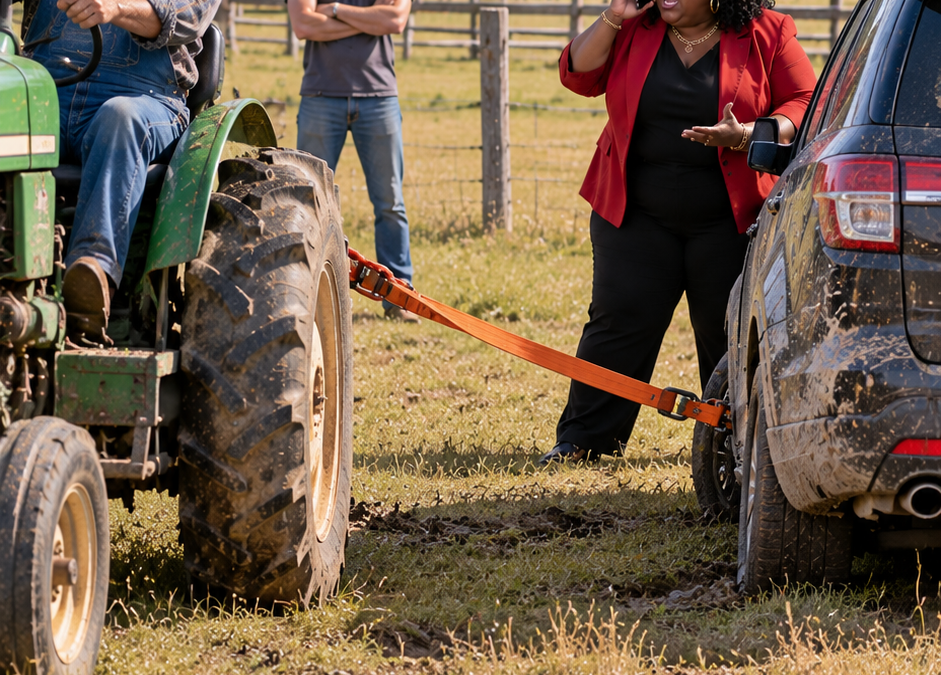
Then Grandpa appeared with the recovery strap.
He secured it carefully while Karen called the police.
The strap tightened.
Her SUV began moving backward.
Karen followed beside it for several yards, shouting into the phone.
“Stop that tractor!”
Grandpa did not turn around.
“Do something!” she yelled at me.
“You were warned.”
“This is destruction of private property!”
“You parked private property on a private ranch.”
The SUV rolled along the grass behind the tractor.
Grandpa kept the speed low.
No one was inside the vehicle.
The wheels followed the equipment track toward the stock pond.
Karen stopped following when the ground became muddy.
The tractor continued over the low rise.
I walked behind at a distance, carrying the folder.
At the pond, Grandpa turned along the upper bank and backed the SUV toward the shallow edge.
The rear wheels entered first.
Mud swallowed the tires.
Water rose slowly around the lower bumper.
Grandpa pulled until the vehicle sat clear of the working road and equipment area, its rear end settled in the pond shallows and its front wheels resting near the bank.
Then he stopped the tractor.
He climbed down and removed the strap.
Karen reached the rise several minutes later.
For once, she had nothing prepared.
Her mouth opened.
No words came.
Grandpa coiled the strap over one arm.
“You said you’d have it removed,” I told him.
“It’s removed.”
He walked back toward the equipment shed.
Karen stared at the pond.
Then she returned to her phone call with renewed volume.
The SUV remained there fourteen hours.
The rear bumper sank below the waterline as the soft bank settled beneath it.
Karen hired a towing service.
The first truck could not recover the vehicle safely. A second arrived with additional winching equipment.
By evening, they had pulled the SUV from the pond.
The total recovery bill was $2,800.
Three days later, we entered the county planning hearing.
The room held twelve chairs around a rectangular table.
Fluorescent lights washed every face pale.
Patricia sat to my left.
Grandpa occupied the back row wearing the same canvas shirt and work boots he wore most days.
Karen arrived with her attorney, Garrett Sloan, and three Mercer Hills residents.
Garrett brought aerial maps highlighted in yellow, a tablet displaying community posts, and neatly organized packets.
The residents appeared sincere.
They believed the ranch road was public because Karen had told them it was.
That did not make them dishonest.
It made them useful to someone who benefited from their ignorance.
County reviewer Michael Dawson opened the hearing.
Garrett presented first.
He described years of community use.
Residents walking the road.
Vehicles stopping along it.
A route functioning in practice as shared access.
The witnesses confirmed they had walked near the eastern fence, parked briefly, and taken their children onto the land.
None had ever checked the county plat.
None had asked our permission.
Karen spoke last.
She straightened her jacket and looked directly at Dawson.
“This family is using the county’s passive tolerance of misplaced fencing to seize land the community has enjoyed for years.”
Grandpa stared at the wall behind her.
“They posted signs after the fact,” she continued. “They made threats. Then they deliberately destroyed my vehicle as an act of intimidation.”
Garrett introduced an emergency addendum seeking $14,000 for vehicle damage and legal expenses.
He requested a temporary hold on enforcement while the county reviewed both claims.
Dawson took notes.
When Garrett finished, Dawson turned toward us.
“I’ll hear the property owner’s response.”
“Of course,” I said. “But I want to be certain Mrs. Holloway has finished.”
Karen looked at me with the same patient expression she had worn at the gate.
“Yes.”
“Thank you.”
Patricia began.
She did not rush.
She explained that we would address ownership, access history, notice, and vehicle removal separately.
Before she reached the first exhibit, Dawson raised one hand.
“I want the original deed and the county-recorded plat.”
Garrett offered his aerial maps.
“I’ll begin with the landowner’s recorded documents,” Dawson said.
Karen leaned toward Garrett.
He whispered something.
Then she settled back with a faint smile.
She believed the deed was a formality.
Patricia opened the folder.
The original deed lay at the center of the table.
Four cream-colored pages.
Hand-typed.
Dated 1941.
Dawson read the first page.
Then the second.
The room changed gradually.
Nothing dramatic happened.
No one gasped.
Certainty simply began leaving one side of the table.
Patricia placed the certified plat beside the deed.
“The property description and plat correspond exactly,” she said. “The eastern ranch road lies entirely within the family parcel. It was never dedicated as a public road, and no easement appears anywhere in the abstract.”
Dawson compared the documents.
Then he looked at Garrett’s highlighted aerial map.
The yellow route sat unmistakably inside our boundary.
Garrett picked up his copy.
He studied it.
Then placed it face down.
Patricia presented the camera log.
Eleven still images.
The same SUV.
The same license plate.
Date after date.
Time after time.
“Every entry occurred after the signs were posted,” Patricia said. “Six happened after direct warnings. Four followed certified written notice.”
Dawson moved slowly through the photographs.
Patricia placed the return receipt beside them.
Karen’s signature appeared at the bottom.
“She received formal notice,” Patricia said. “She returned to the ranch repeatedly after signing.”
Karen looked toward Garrett.
He kept his eyes on his papers.
“A prescriptive claim requires use continuing without effective objection,” Patricia said. “This record establishes repeated, active opposition.”
The three residents behind Karen stopped taking notes.
One stared at the floor.
Patricia laid out the social-media screenshots.
Karen inside our fence.
Coordinates visible.
Captions describing private ranchland as community green space.
“These geotags place Mrs. Holloway approximately sixty yards inside the recorded boundary.”
Garrett started to speak.
“The photographs don’t necessarily—”
He stopped.
There was nowhere useful to take the sentence.
“She documented her own entry,” Patricia continued. “Two photographs were posted after the certified notice. That is not proof of lawful community access. It is timestamped evidence of trespass.”
Hank’s statement followed.
Then Dr. Callahan’s visit log.
The blocked equipment gate.
Forty-minute delay.
Karen’s SUV positioned across the only opening wide enough for his vehicle.
Dawson set the papers beside the deed.
Then he turned toward the vehicle issue.
Karen straightened.
This was the part she believed would restore control.
Grandpa stood.
He did not walk to the table.
He did not give a speech.
“She was told,” he said. “The land was posted. I removed the vehicle with my equipment.”
Then he sat down.
Patricia cited the state statute addressing removal of unauthorized vehicles from posted private property.
Dawson already had the code.
He read the section twice.
“The vehicle-removal claim is a separate civil issue between the parties and the insurer,” he said. “It does not alter the title or right-of-way question.”
“But he put my SUV in a pond,” Karen said.
“That may be addressed through the appropriate civil or insurance process. It does not create an easement.”
Karen looked at Garrett.
Garrett studied the statute.
Dawson closed the evidence folder.
“I find no factual or legal basis for recognizing a prescriptive easement.”
The words settled across the room.
“The property has remained under continuous documented private ownership. The boundary is unambiguous. The owners repeatedly and actively objected to unauthorized use.”
He looked toward Karen’s witnesses.
“Use of private land based on mistaken information from a third party does not convert that land into a public right-of-way.”
One of the residents lowered her head.
Dawson continued.
“The written determination will be filed with the recorder within five business days.”
Garrett began stacking his materials.
Karen remained still.
She stared at the original deed.
Her attorney had brought maps, community posts, witnesses, and a yellow marker.
Our family had brought four pages from 1941.
The deed had never needed better language.
Someone had only needed to read it.
Patricia called four days later.
“It’s in the record.”
That was all she said.
The county determination declared that no public or prescriptive easement existed over our eastern ranch road.
It confirmed the road as private property and documented our continuous objection to unauthorized use.
The decision was signed, dated, and permanently filed.
I printed a copy.
Then I placed it beside the original deed.
The folder had begun as a shield.
Now it had become part of the property’s history.
Karen’s insurer handled part of the vehicle recovery claim according to its terms. Her deductible, legal costs, and any consequences to her rates remained her business.
Her demand for $14,000 never became part of the county’s property determination.
Patricia later sent a letter to the Mercer Hills board.
It documented how Karen used the community page to encourage residents onto neighboring ranches and how the association’s failure to clarify boundaries contributed to repeated trespass.
The letter outlined our legal expenses.
Two weeks later, the HOA offered to reimburse those costs in exchange for our agreement not to pursue further claims against the association.
Patricia recommended accepting.
We did.
The community page went quiet.
Karen deleted her posts one by one.
The photographs disappeared.
The captions vanished.
The leaf emojis went with them.
It did not matter.
Our copies retained the dates, coordinates, and original text.
Mercer Hills sent a formal notice to all two hundred households.
Adjacent parcels were privately owned ranchland.
No recreational access existed beyond the development boundary.
Entering without permission constituted trespass.
The letter did not identify Karen.
It did not need to.
Hank repaired his fence.
Two other ranchers reinforced theirs.
No meetings.
No coordinated announcement.
People who work land often respond to trouble in the same quiet way.
New posts.
Tight wire.
Clear signs.
Repairs meant to outlast arguments.
Grandpa ordered a steel gate before the hearing.
He never doubted how the county would read the deed.
The frame arrived three weeks later.
Heavy-gauge steel.
Concrete-set posts.
A padlock nearly the size of my fist.
Grandpa and I installed it on a Saturday.
We checked the swing repeatedly until the gate seated cleanly against the latch.
The orange no-trespassing signs remained on the posts.
They had never failed.
Karen had simply chosen not to read them.
That evening, Grandpa sat on the porch overlooking the north pasture.
The grass had turned gold in the late light.
The stock pond lay beyond the rise, its surface smooth enough to reflect the sky.
I stood beside him.
For several minutes, neither of us spoke.
Then he nodded toward the water.
“Your great-grandfather dug that with a borrowed loader and three Saturdays he couldn’t spare.”
“I remember the story.”
“He wanted cattle to have water through summer.”
Grandpa rested both hands on the arms of his chair.
“Nobody’s putting a car in it again.”
That was the only comment he ever made about Karen’s SUV.
The trail camera remained active.
The county determination stayed in the fireproof safe beside the deed.
The recovery strap returned to its hook inside the equipment shed, coiled and waiting for the next tractor or trailer that genuinely needed pulling from the mud.
Months passed.
The grass returned where tires had cut the eastern road.
Cattle moved through the pasture without vehicles appearing behind them.
Dr. Callahan came and went through the gate without delay.
The three residents who had testified for Karen never returned.
One sent a letter apologizing for walking on the ranch. She explained that she had believed the HOA’s description of the road.
I wrote back.
I thanked her for the apology and told her the matter was closed.
There was no sense punishing someone forever for believing the wrong person once.
Karen was different.
She had been warned in person.
Warned by signs.
Warned by certified mail.
Warned by photographs, deeds, and the plain discomfort of neighbors who questioned her.
She kept returning because she believed repetition could replace permission.
The county record now said otherwise.
One evening the following spring, I walked along the eastern fence with Grandpa.
The new gate stood square between its concrete posts.
Beyond it, Mercer Hills glowed with porch lights and streetlamps.
Children shouted near the pool.
A lawn mower moved somewhere behind the houses.
Ordinary sounds.
The subdivision had not disappeared.
Neither had the ranch.
They simply existed beside each other with the boundary finally understood.
Grandpa tested the padlock.
“Good gate,” he said.
“It ought to be for what it cost.”
He grunted.
“That’s how you know it’s good.”
We turned toward the house.
Behind us, the pond lay still.
The eastern road was empty.
Some disputes end with apologies.
Some end with court orders.
Ours ended with a deed in the county record, a steel gate across the opening, and an orange tow strap hanging quietly in the equipment shed.
For our family, that was clear enough.
Have you finished reading the story and want to read it again?
HOA President Parked on Our Ranch 11 Times—Then Grandpa Quietly Reached for the Tow Strap
She ignored every warning.
She parked on our ranch again.
Then Grandpa walked out carrying the orange tow strap.
I heard Karen’s SUV before I saw it.
Tires crushed the dry pasture grass with a dragging sound too heavy to belong there. She entered through the same gap in the eastern fence and followed the tracks left by her previous ten visits.
Two orange signs stood on either side of that opening.
PRIVATE PROPERTY.
NO TRESPASSING.
She drove between them without slowing.
I stood in the barn doorway and counted under my breath.
Eleven.
Karen stopped thirty feet from the cattle pen, turned off the engine, and climbed out wearing sunglasses. She held her phone in one hand and looked across our ranch as though she had arrived early at a public park and was deciding where to spread a blanket.
When she noticed me, she waved.
Not nervously.
Not apologetically.
She gave me the casual wave of a neighbor passing a mailbox.
“Don’t worry,” she called. “I’m not bothering anything.”
“You’re trespassing.”
Her smile thinned.
“It’s not as though you’re using this part.”
“This is a working pasture.”
“There isn’t even a proper gate here. If you wanted people to stay out, you should have built a real fence.”
She said it patiently, like she had explained the matter several times and was disappointed by my continuing inability to understand.
“You’ve been told to stay off this land,” I said. “You signed for the notice.”
Karen pushed her sunglasses higher.
“You might want to be careful with accusations. The county is reviewing whether this road belongs to the community.”
“The county is reviewing a claim you filed. That doesn’t make the claim true.”
Her mouth tightened.
Then a metal buckle struck steel behind her.
Grandpa had come out of the equipment shed carrying the heavy orange recovery strap we used to pull machinery from mud.
He was eighty-seven years old and moved more slowly than he once had, but there was nothing uncertain in his steps.
He walked to the rear of Karen’s SUV, crouched, and threaded the strap through the axle mount.
Karen turned.
“What are you doing?”
Grandpa tightened the loop.
“Don’t touch my car.”
He stood and looked at her.
One quiet glance.
No anger.
No argument.
Just acknowledgment that she had spoken and that nothing she said had changed the task in front of him.
Then he walked toward the tractor.
“I’m calling the police!” Karen shouted.
Grandpa climbed into the seat.
I remained beside the barn.
“Go ahead,” I said.
She was already dialing when the tractor started.
The orange strap stretched across the grass. The last of the slack disappeared with a sharp crack, and Karen’s SUV shifted backward.
Her voice rose as she described harassment, threats, and property damage to the dispatcher.
Grandpa kept moving.
Beyond the low rise, a hundred and forty yards away, lay the stock pond my great-grandfather had dug in 1941.
Grandpa knew every grade, fence post, and soft patch between us and that water.
Karen did not.
She believed our family had spent months bluffing.
Grandpa had never been much of a bluffer.
PART2
My great-grandfather bought the ranch in 1941.
Three hundred and forty acres in the eastern part of the county, back when the nearest paved road was eleven miles away and nobody bought land that remote unless they intended to work it.
The original deed consisted of four hand-typed pages.
The paper had softened at the folds, but the property description remained as clear as the day it was recorded.
The northern ridge.
The creek boundary.
The eastern access road.
Every marker, distance, and turn.
My family had paid taxes on that same ground for more than eighty years.
Grandpa was nine when his father dug the stock pond.
They borrowed a loader and spent three consecutive Saturdays shaping the basin. The first time water reached a stable level, Grandpa stood beside his father and watched it reflect the sky.
He told me that story often enough that I could see the day despite having been born decades later.
Four generations had used that pond.
Cattle drank there through dry summers.
We pulled stuck equipment from its muddy edge after storms. Children learned to skip stones there. My father taught me how to read animal tracks along its bank.
Nothing about it was decorative.
Nothing on the ranch was.
The north pasture carried roughly forty head during the warmer months. The eastern access road moved tractors, feed trailers, veterinary trucks, and equipment between the north and south acreage.
It was narrow and unpaved.
In dry weather, it threw dust.
After rain, it softened near the pond.
It was a working road serving a working ranch, and it sat entirely within the boundary described in our deed.
Then Mercer Hills arrived.
Fourteen months before Grandpa hitched the strap to Karen’s SUV, a developer broke ground on the adjoining parcel.
We had once leased that land for seasonal grazing. When the owner sold, two hundred houses replaced the pasture.
The development had cul-de-sacs, landscaped entrances, a swimming pool, and a homeowners association eager to ensure no mailbox displayed more individuality than the bylaws permitted.
Suddenly, we had hundreds of neighbors.
Most were fine.
They waved from the road. Some brought children to see the cattle. Several asked permission before walking near the fence.
Karen Holloway did none of those things.
The first time I found her on our property, I was checking the eastern fence.
Her white SUV sat on the ranch road with its engine off. She leaned against the driver’s door, holding her phone toward the rooflines rising inside Mercer Hills.
“This is private property,” I said.
She looked mildly surprised.
“I only needed somewhere to stop.”
“Then use the county road.”
“I’m not hurting anything.”
“I need you to move.”
She got back into her vehicle with the irritated cooperation of someone who had decided my request was unreasonable but not yet worth arguing over.
As she drove away, she lowered the window.
“It’s not like this road goes anywhere important.”
That was the first warning.
I noted it and continued my work.
Over the next six weeks, Karen returned six times.
Morning.
Afternoon.
Weekdays.
Once on a Sunday.
The routine barely changed.
She entered through the loose section of the eastern fence, drove along the ranch road, parked, got out, photographed whatever interested her, and left when confronted.
Each time, I told her the land was private.
Each time, she acted as if she were tolerating an eccentric request from a difficult neighbor.
After the fourth incident, I bought two heavy orange no-trespassing signs.
Grandpa helped me bolt them to the fence posts flanking the gap. The raised black lettering could be read from thirty yards away.
I photographed both signs immediately after installation.
The image files recorded the date, time, and location.
At that stage, I believed clear signs would end the problem.
Forty-eight hours later, someone sent me a screenshot from the Mercer Hills community page.
Karen had written:
“The old ranch family beside us is trying to block community access to the green space along the eastern trail. Does anyone know who to contact at the county?”
Green space.
Eastern trail.
Community access.
With three phrases, she converted a cattle road into a public amenity and our family into unreasonable caretakers refusing to share it.
Her post reached roughly six hundred group members.
I searched her earlier posts.
There were three.
One included a photograph taken from inside our fence.
The caption read:
“Morning walk through the green space.”
Another showed our stock pond in the distance.
Both were geotagged.
Karen had documented her own trespassing and published the evidence because it had never occurred to her that entering our ranch might genuinely be unlawful.
I saved every post.
Then I installed a trail camera at the gap.
Three more visits followed after the signs went up.
The camera captured her plate every time.
Date.
Time.
Direction of travel.
Clear images.
The eighth time she returned, Grandpa met her.
He did not raise his voice.
He rarely needed to.
“This property belongs to my family,” he said. “The signs are posted. If you bring that vehicle back, we will remove it.”
Karen looked at him with the expression people sometimes used when speaking to someone elderly enough that they assumed age had made him irrelevant.
“You don’t understand how communities work anymore.”
Grandpa held her gaze.
Then he turned and walked back to the barn.
He had spent most of his life fixing things that could injure a man if handled carelessly. He did not confuse arguing with solving.
That evening, he opened the fireproof safe in the study.
He removed the original deed, the folded plat, and eight decades of tax records.
He placed everything on the kitchen table.
“I haven’t needed these in years,” he said.
“You still don’t.”
He ran one finger along the eastern boundary on the plat.
“Might.”
The ninth visit was worse.
Karen parked directly in front of the equipment gate.
Her bumper nearly touched the chain-link panels, blocking the only opening wide enough for our tractor and veterinary vehicles.
She left the SUV and walked two hundred yards into the property to take photographs near the tree line.
Dr. Callahan was due at nine that morning to examine a heifer favoring her left front leg.
He arrived at 8:50 and stopped behind Karen’s vehicle.
“That belong to your new neighbors?” he asked.
“Unfortunately.”
We waited forty minutes.
The heifer remained in the south pen, shifting weight away from the injured leg.
I photographed the blocked gate from three angles. Karen’s plate appeared clearly in every image.
Dr. Callahan recorded the delay in his professional visit log.
When Karen finally returned, she seemed surprised to find us waiting.
“I was looking around.”
“You blocked a working gate during a veterinary appointment.”
“I didn’t block anything important.”
Dr. Callahan looked at the gate.
Then at her SUV.
He wisely chose silence.
“You have entered this ranch nine times without permission,” I said. “The signs are posted. Grandpa warned you. I have warned you. This stops now.”
Karen crossed her arms.
“I’ve looked into this.”
“That would be a pleasant change.”
Her chin lifted.
“There are laws concerning adverse possession and public access. People have been using this road for years. You can’t suddenly fence everyone out.”
“This road has belonged to my family since 1941.”
“You should speak with an attorney before threatening people.”
Adverse possession and prescriptive easements were real legal concepts.
They were also more complicated than watching half a video online and deciding repeated trespassing eventually transformed itself into ownership.
Such claims required particular elements: duration, openness, continuity, and use without the owner’s effective permission or objection.
The moment an owner clearly objected, posted signs, documented notice, and ordered the use to stop, the claimant’s story became much harder.
I did not give Karen a property-law lesson beside the injured heifer.
“I’m sending formal notice today,” I said. “Any vehicle left on this ranch afterward will be removed at the owner’s expense.”
I took one final photograph.
Then I opened the gate as far as her bumper allowed and guided Dr. Callahan through.
Karen drove away while he examined the heifer.
That afternoon, I sent a certified letter.
Private property.
No trespassing.
No public right-of-way.
Any unauthorized vehicle discovered on the ranch after receipt of the notice would be removed without further warning.
One page.
Signed.
Mailed before two.
Three days later, Karen accepted delivery.
Her signature appeared on the return receipt.
I placed it in the folder.
Hank Oglesby ran cattle north of Mercer Hills.
He pulled into the post-office lot as I was leaving after mailing the notice.
He lowered his truck window.
“Same woman?”
“Same woman.”
“She came through my fence last month. Her and two others.”
“Do you have proof?”
“Photographs.”
“I may need a statement.”
“You’ll get one.”
Two days after Karen signed for the notice, her husband appeared at the end of our driveway.
He stayed on the county side of the fence and shouted about harassment.
According to him, Mercer Hills residents possessed a moral right to enjoy the land surrounding their neighborhood.
Apparently, our decades of ownership had acquired a community-obligation clause nobody bothered to mention when we paid property taxes.
I photographed him from the porch.
He remained outside the gate.
That was the first sensible choice anyone in Karen’s family had made.
Two days later, an attorney’s letter arrived.
The law firm specialized in HOA and residential-property disputes.
The language sounded confident.
Mercer Hills intended to claim that the eastern ranch road had become a prescriptive easement through open and continuous public use.
In ordinary language, Karen wanted her repeated trespassing converted into a permanent legal right for two hundred households.
I read the letter twice.
Then I made coffee.
Panic would not change the deed.
Documents might.
Grandpa retrieved the original from the safe.
The paper carried my great-grandfather’s name on the first page.
The eastern road appeared inside our boundary, described as a private ranch access route.
No public dedication.
No easement.
No shared right-of-way.
I printed all eleven camera images.
Each showed Karen’s vehicle entering through the posted gap.
Each carried a timestamp.
Several occurred after direct verbal objections.
The latest occurred after she signed for the certified notice.
I stacked the images chronologically.
Then I called Hank.
His records included three separate incidents involving Mercer Hills residents. One person had cut a fence post to widen an opening.
He sent photographs and prepared a written statement.
Karen’s own social-media page provided more.
Eleven posts mentioned the eastern road or supposed green space.
Four photographs had been taken inside our fence.
Two retained coordinates showing Karen approximately sixty yards within our property.
Several posts came after the no-trespassing signs appeared.
Two came after certified notice.
She had thought she was manufacturing community expectation.
She had actually created a confession file with dates, locations, photographs, and six hundred potential witnesses.
I called Patricia Oaks.
She had spent more than twenty years handling ranch titles and boundary disputes.
After hearing the summary, she asked three questions.
“Are the signs clearly visible?”
“Yes.”
“Do you have proof of notice?”
“Her signature.”
“Any easement on the deed or plat?”
“None.”
“Bring everything.”
Patricia examined the folder in her office.
She moved carefully, writing notes in the margins of a yellow pad.
“The prescriptive claim is weak,” she said. “Your objections break the continuity they need. The camera files make that difficult to dispute.”
“What about removing a vehicle?”
She found the applicable state provision.
Under the law, an owner of posted private land could remove an unauthorized vehicle when notice had been given, provided the removal did not involve unnecessary conduct beyond recovering possession of the property.
“The signs and certified notice matter,” she said.
“They have both.”
“If she returns, call me before doing anything complicated.”
Grandpa did not consider attaching a tow strap complicated.
Before we reached that morning, however, Karen escalated again.
The county planning office sent an official notice.
Her attorney had requested a formal determination that our eastern ranch road constituted a public right-of-way.
The county was required to investigate and schedule a hearing.
If Mercer Hills won, the consequences would extend far beyond Karen’s SUV.
Two hundred households.
Guests.
Delivery vehicles.
Contractors.
Children.
Anyone residents invited could travel through an active cattle pasture, past equipment gates, and beside a stock pond.
We might lose the right to lock our own road.
One injury near livestock or water could expose the ranch to devastating liability.
I placed the county notice beside Grandpa’s coffee.
He read every paragraph.
When he finished, he looked at the paper.
“She wants our road.”
“Yes.”
He folded the notice once.
“Then we prove it isn’t hers.”
That evening, we walked the eastern fence.
Grandpa pointed to the place where his father built the first gate using timber milled from trees cleared off the south pasture.
He showed me where the cattle guard went in during the winter of 1978.
Farther north, he touched a weathered post.
“I reset every one along this line when I was nineteen.”
“Why?”
“My father injured his knee. Fence still needed doing.”
At the gap, he looked at Karen’s tire marks.
“It’s all in the deed,” he said. “Every inch.”
Until then, I had viewed the conflict as a matter of stopping one woman.
The county filing changed that.
A recorded easement could outlive Karen, Grandpa, and me.
We needed more than a temporary victory.
We needed a permanent record declaring exactly where the public road ended and our ranch began.
Patricia reviewed the evidence for ninety minutes the next morning.
She verified the camera clocks, installation photographs, certified-mail dates, deed description, and geotags.
“Hank willing to testify?”
“Yes.”
“Dr. Callahan?”
“He documented the blocked gate.”
She studied the social-media posts.
“These coordinates are remarkably helpful.”
“She provided them herself.”
“People are often generous that way.”
Patricia prepared our formal response and requested an expedited review.
The county hearing was scheduled three weeks away.
Then Karen returned.
That was the eleventh visit.
She drove past the signs and parked near the cattle pen as though the county filing had already made the ranch communal.
I told her she was trespassing.
She repeated her argument about the missing gate.
Then Grandpa appeared with the recovery strap.
He secured it carefully while Karen called the police.
The strap tightened.
Her SUV began moving backward.
Karen followed beside it for several yards, shouting into the phone.
“Stop that tractor!”
Grandpa did not turn around.
“Do something!” she yelled at me.
“You were warned.”
“This is destruction of private property!”
“You parked private property on a private ranch.”
The SUV rolled along the grass behind the tractor.
Grandpa kept the speed low.
No one was inside the vehicle.
The wheels followed the equipment track toward the stock pond.
Karen stopped following when the ground became muddy.
The tractor continued over the low rise.
I walked behind at a distance, carrying the folder.
At the pond, Grandpa turned along the upper bank and backed the SUV toward the shallow edge.
The rear wheels entered first.
Mud swallowed the tires.
Water rose slowly around the lower bumper.
Grandpa pulled until the vehicle sat clear of the working road and equipment area, its rear end settled in the pond shallows and its front wheels resting near the bank.
Then he stopped the tractor.
He climbed down and removed the strap.
Karen reached the rise several minutes later.
For once, she had nothing prepared.
Her mouth opened.
No words came.
Grandpa coiled the strap over one arm.
“You said you’d have it removed,” I told him.
“It’s removed.”
He walked back toward the equipment shed.
Karen stared at the pond.
Then she returned to her phone call with renewed volume.
The SUV remained there fourteen hours.
The rear bumper sank below the waterline as the soft bank settled beneath it.
Karen hired a towing service.
The first truck could not recover the vehicle safely. A second arrived with additional winching equipment.
By evening, they had pulled the SUV from the pond.
The total recovery bill was $2,800.
Three days later, we entered the county planning hearing.
The room held twelve chairs around a rectangular table.
Fluorescent lights washed every face pale.
Patricia sat to my left.
Grandpa occupied the back row wearing the same canvas shirt and work boots he wore most days.
Karen arrived with her attorney, Garrett Sloan, and three Mercer Hills residents.
Garrett brought aerial maps highlighted in yellow, a tablet displaying community posts, and neatly organized packets.
The residents appeared sincere.
They believed the ranch road was public because Karen had told them it was.
That did not make them dishonest.
It made them useful to someone who benefited from their ignorance.
County reviewer Michael Dawson opened the hearing.
Garrett presented first.
He described years of community use.
Residents walking the road.
Vehicles stopping along it.
A route functioning in practice as shared access.
The witnesses confirmed they had walked near the eastern fence, parked briefly, and taken their children onto the land.
None had ever checked the county plat.
None had asked our permission.
Karen spoke last.
She straightened her jacket and looked directly at Dawson.
“This family is using the county’s passive tolerance of misplaced fencing to seize land the community has enjoyed for years.”
Grandpa stared at the wall behind her.
“They posted signs after the fact,” she continued. “They made threats. Then they deliberately destroyed my vehicle as an act of intimidation.”
Garrett introduced an emergency addendum seeking $14,000 for vehicle damage and legal expenses.
He requested a temporary hold on enforcement while the county reviewed both claims.
Dawson took notes.
When Garrett finished, Dawson turned toward us.
“I’ll hear the property owner’s response.”
“Of course,” I said. “But I want to be certain Mrs. Holloway has finished.”
Karen looked at me with the same patient expression she had worn at the gate.
“Yes.”
“Thank you.”
Patricia began.
She did not rush.
She explained that we would address ownership, access history, notice, and vehicle removal separately.
Before she reached the first exhibit, Dawson raised one hand.
“I want the original deed and the county-recorded plat.”
Garrett offered his aerial maps.
“I’ll begin with the landowner’s recorded documents,” Dawson said.
Karen leaned toward Garrett.
He whispered something.
Then she settled back with a faint smile.
She believed the deed was a formality.
Patricia opened the folder.
The original deed lay at the center of the table.
Four cream-colored pages.
Hand-typed.
Dated 1941.
Dawson read the first page.
Then the second.
The room changed gradually.
Nothing dramatic happened.
No one gasped.
Certainty simply began leaving one side of the table.
Patricia placed the certified plat beside the deed.
“The property description and plat correspond exactly,” she said. “The eastern ranch road lies entirely within the family parcel. It was never dedicated as a public road, and no easement appears anywhere in the abstract.”
Dawson compared the documents.
Then he looked at Garrett’s highlighted aerial map.
The yellow route sat unmistakably inside our boundary.
Garrett picked up his copy.
He studied it.
Then placed it face down.
Patricia presented the camera log.
Eleven still images.
The same SUV.
The same license plate.
Date after date.
Time after time.
“Every entry occurred after the signs were posted,” Patricia said. “Six happened after direct warnings. Four followed certified written notice.”
Dawson moved slowly through the photographs.
Patricia placed the return receipt beside them.
Karen’s signature appeared at the bottom.
“She received formal notice,” Patricia said. “She returned to the ranch repeatedly after signing.”
Karen looked toward Garrett.
He kept his eyes on his papers.
“A prescriptive claim requires use continuing without effective objection,” Patricia said. “This record establishes repeated, active opposition.”
The three residents behind Karen stopped taking notes.
One stared at the floor.
Patricia laid out the social-media screenshots.
Karen inside our fence.
Coordinates visible.
Captions describing private ranchland as community green space.
“These geotags place Mrs. Holloway approximately sixty yards inside the recorded boundary.”
Garrett started to speak.
“The photographs don’t necessarily—”
He stopped.
There was nowhere useful to take the sentence.
“She documented her own entry,” Patricia continued. “Two photographs were posted after the certified notice. That is not proof of lawful community access. It is timestamped evidence of trespass.”
Hank’s statement followed.
Then Dr. Callahan’s visit log.
The blocked equipment gate.
Forty-minute delay.
Karen’s SUV positioned across the only opening wide enough for his vehicle.
Dawson set the papers beside the deed.
Then he turned toward the vehicle issue.
Karen straightened.
This was the part she believed would restore control.
Grandpa stood.
He did not walk to the table.
He did not give a speech.
“She was told,” he said. “The land was posted. I removed the vehicle with my equipment.”
Then he sat down.
Patricia cited the state statute addressing removal of unauthorized vehicles from posted private property.
Dawson already had the code.
He read the section twice.
“The vehicle-removal claim is a separate civil issue between the parties and the insurer,” he said. “It does not alter the title or right-of-way question.”
“But he put my SUV in a pond,” Karen said.
“That may be addressed through the appropriate civil or insurance process. It does not create an easement.”
Karen looked at Garrett.
Garrett studied the statute.
Dawson closed the evidence folder.
“I find no factual or legal basis for recognizing a prescriptive easement.”
The words settled across the room.
“The property has remained under continuous documented private ownership. The boundary is unambiguous. The owners repeatedly and actively objected to unauthorized use.”
He looked toward Karen’s witnesses.
“Use of private land based on mistaken information from a third party does not convert that land into a public right-of-way.”
One of the residents lowered her head.
Dawson continued.
“The written determination will be filed with the recorder within five business days.”
Garrett began stacking his materials.
Karen remained still.
She stared at the original deed.
Her attorney had brought maps, community posts, witnesses, and a yellow marker.
Our family had brought four pages from 1941.
The deed had never needed better language.
Someone had only needed to read it.
Patricia called four days later.
“It’s in the record.”
That was all she said.
The county determination declared that no public or prescriptive easement existed over our eastern ranch road.
It confirmed the road as private property and documented our continuous objection to unauthorized use.
The decision was signed, dated, and permanently filed.
I printed a copy.
Then I placed it beside the original deed.
The folder had begun as a shield.
Now it had become part of the property’s history.
Karen’s insurer handled part of the vehicle recovery claim according to its terms. Her deductible, legal costs, and any consequences to her rates remained her business.
Her demand for $14,000 never became part of the county’s property determination.
Patricia later sent a letter to the Mercer Hills board.
It documented how Karen used the community page to encourage residents onto neighboring ranches and how the association’s failure to clarify boundaries contributed to repeated trespass.
The letter outlined our legal expenses.
Two weeks later, the HOA offered to reimburse those costs in exchange for our agreement not to pursue further claims against the association.
Patricia recommended accepting.
We did.
The community page went quiet.
Karen deleted her posts one by one.
The photographs disappeared.
The captions vanished.
The leaf emojis went with them.
It did not matter.
Our copies retained the dates, coordinates, and original text.
Mercer Hills sent a formal notice to all two hundred households.
Adjacent parcels were privately owned ranchland.
No recreational access existed beyond the development boundary.
Entering without permission constituted trespass.
The letter did not identify Karen.
It did not need to.
Hank repaired his fence.
Two other ranchers reinforced theirs.
No meetings.
No coordinated announcement.
People who work land often respond to trouble in the same quiet way.
New posts.
Tight wire.
Clear signs.
Repairs meant to outlast arguments.
Grandpa ordered a steel gate before the hearing.
He never doubted how the county would read the deed.
The frame arrived three weeks later.
Heavy-gauge steel.
Concrete-set posts.
A padlock nearly the size of my fist.
Grandpa and I installed it on a Saturday.
We checked the swing repeatedly until the gate seated cleanly against the latch.
The orange no-trespassing signs remained on the posts.
They had never failed.
Karen had simply chosen not to read them.
That evening, Grandpa sat on the porch overlooking the north pasture.
The grass had turned gold in the late light.
The stock pond lay beyond the rise, its surface smooth enough to reflect the sky.
I stood beside him.
For several minutes, neither of us spoke.
Then he nodded toward the water.
“Your great-grandfather dug that with a borrowed loader and three Saturdays he couldn’t spare.”
“I remember the story.”
“He wanted cattle to have water through summer.”
Grandpa rested both hands on the arms of his chair.
“Nobody’s putting a car in it again.”
That was the only comment he ever made about Karen’s SUV.
The trail camera remained active.
The county determination stayed in the fireproof safe beside the deed.
The recovery strap returned to its hook inside the equipment shed, coiled and waiting for the next tractor or trailer that genuinely needed pulling from the mud.
Months passed.
The grass returned where tires had cut the eastern road.
Cattle moved through the pasture without vehicles appearing behind them.
Dr. Callahan came and went through the gate without delay.
The three residents who had testified for Karen never returned.
One sent a letter apologizing for walking on the ranch. She explained that she had believed the HOA’s description of the road.
I wrote back.
I thanked her for the apology and told her the matter was closed.
There was no sense punishing someone forever for believing the wrong person once.
Karen was different.
She had been warned in person.
Warned by signs.
Warned by certified mail.
Warned by photographs, deeds, and the plain discomfort of neighbors who questioned her.
She kept returning because she believed repetition could replace permission.
The county record now said otherwise.
One evening the following spring, I walked along the eastern fence with Grandpa.
The new gate stood square between its concrete posts.
Beyond it, Mercer Hills glowed with porch lights and streetlamps.
Children shouted near the pool.
A lawn mower moved somewhere behind the houses.
Ordinary sounds.
The subdivision had not disappeared.
Neither had the ranch.
They simply existed beside each other with the boundary finally understood.
Grandpa tested the padlock.
“Good gate,” he said.
“It ought to be for what it cost.”
He grunted.
“That’s how you know it’s good.”
We turned toward the house.
Behind us, the pond lay still.
The eastern road was empty.
Some disputes end with apologies.
Some end with court orders.
Ours ended with a deed in the county record, a steel gate across the opening, and an orange tow strap hanging quietly in the equipment shed.
For our family, that was clear enough.








