HOA President Had My Father Handcuffed on His Own Land — Then the FBI Surrounded Her House Before Sunrise
𝗣𝗔𝗥𝗧 𝟮
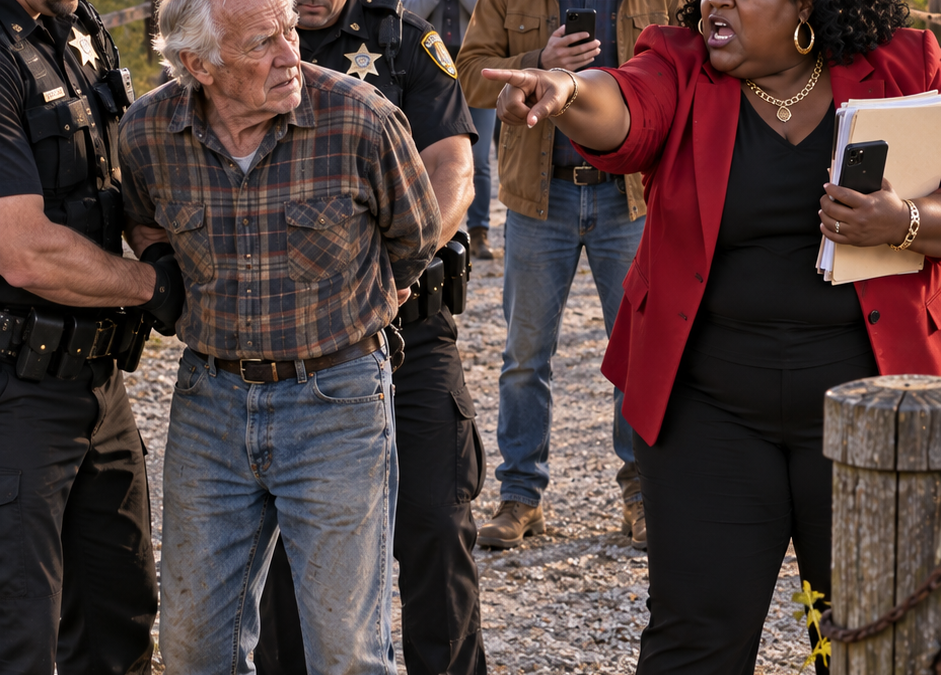
The steel closed around one wrist.
Then the other.
Two clicks.
My father made a sound I had never heard from him before.
Not a shout.
Not exactly pain.
Something between a breath and a groan.
The phone dropped onto the gravel.
The camera pointed at the sky.
For several seconds I heard nothing but breathing and footsteps.
Then Karen’s voice came close to the microphone.
“Somebody kill that call.”
A pause.
“And clear this driveway before ten. I have someone coming to inspect the property.”
Then the screen went black.
I was three hours away.
I put the phone down.
Picked up my keys.
And drove.
Three hours on I-58 gives you time to do arithmetic you do not want to do.
My parents bought that land in 1962.
Three-point-two acres.
Farmhouse.
Machine shed.
Gravel driveway.
Pear trees.
My mother planted those trees the year I was born.
For decades, there was nothing around them but open fields.
Then, in 1998, a developer bought the surrounding acreage.
One hundred ninety houses.
Loop roads.
Gate.
Clubhouse.
A subdivision called Barrow Glenn Estates.
They built right up to my father’s fence.
Then they stopped.
Because they had to.
His parcel was older.
Separate.
Never conveyed.
Never annexed.
My parents never joined the HOA.
My mother died in 2011.
My father stayed.
He kept the house almost exactly as she left it.
Same curtains.
Same cast-iron skillet beside the stove.
Same pear trees pruned every February.
That should have been the whole legal story.
Three-point-two acres surrounded by a subdivision but not part of it.
Instead, by noon, my father was sitting in county lockup.
They kept him six hours.
When he finally walked through the doors of the Ketaridge County detention center, he was still wearing his work jacket.
He carried his arms slightly away from his body.
The skin around both wrists was raw.
Red rings.
One had started bleeding.
I stared at them.
“Nobody loosened those?”
He shrugged.
“They were busy.”
“Dad.”
“I’m fine.”
“You’re not fine.”
“They charged me.”
“With what?”
“Criminal trespass.”
He tried to smile.
Didn’t manage it.
“And resisting.”
“Resisting what?”
He looked toward the parking lot.
“Apparently being arrested.”
That was all he said.
I got him into my truck.
Halfway home he leaned his head against the passenger window.
Then, without looking at me:
“Don’t tell your sister.”
I almost laughed.
Not because anything was funny.
Because that was my father.
Humiliated, wrists cut, criminal charges hanging over him, and his first concern was avoiding worrying his daughter.
The house smelled like it always had.
Coffee.
Machine oil.
Dust from the shed.
I made him sit while I cleaned his wrists.
He kept telling me to stop fussing.
Finally I asked:
“How long has this been happening?”
“What?”
“Karen. The HOA. All of it.”
He looked toward the kitchen drawers.
“Couple years.”
“What do you mean, couple years?”
“Third drawer.”
I opened it.
It stopped halfway.
Something inside blocked it.
I pulled harder.
Stacks of paper.
Rubber-banded.
Some opened.
Some still sealed.
Violation notices.
Dozens.
UNAPPROVED STRUCTURE — MACHINE SHED.
UNAPPROVED VEGETATION — FRUIT TREES.
UNAPPROVED SURFACE — GRAVEL DRIVE.
IMPROPER VEHICLE STORAGE.
Each carried daily fines.
I looked at him.
“Dad.”
“They don’t have authority.”
“That isn’t what I asked.”
“I’m not in their association.”
He said it quietly.
Like something he had repeated to himself many times.
“I never joined. You don’t answer letters from somebody with no business writing you.”
I kept digging.
The notices got newer toward the back.
$150 per day.
Then a summary.
TOTAL ASSESSED:
$18,400.
Under that sat heavier paper.
County recording stamp.
NOTICE OF LIEN.
Barrow Glenn Estates Homeowners Association against Arles Fairbanks.
$31,200.
I read the legal description.
It was my father’s parcel.
Then one sentence near the bottom stopped me.
Records reflect subject parcel has been member property since 2019.
I read it three times.
My father had owned that property since 1962.
Somewhere, somehow, county records now claimed he joined an association fifty-seven years later.
“Dad.”
“What?”
“Did you sign anything in 2019?”
“No.”
“Anything from Barrow Glenn?”
“No.”
“Think.”
“I don’t need to think.”
His voice hardened.
“I never signed anything those people gave me.”
That evening, I walked the fence line.
Two neighbors found reasons to come outside.
Neither approached directly at first.
One carried a trash bag he did not need to carry.
The other checked a mailbox already empty.
Eventually they drifted toward me.
I learned about Karen Trumbull in fragments.
Three terms as HOA president.
A board of three people who almost always followed her lead.
Beulah Cranfield.
Chester Ainsworth.
Prudence Hallagan.
A private patrol company called Iron Veil Security.
Two pickup trucks circulating the neighborhood at night with amber light bars.
“She has a system,” one neighbor said.
“What system?”
He looked down the street.
“You get on Karen’s list, you stay there.”
The second neighbor hesitated.
“There was a man here this morning.”
“What man?”
“After they took your dad.”
“Doing what?”
“Taking pictures.”
“Of the house?”
“And the shed. Driveway too.”
“Who was he?”
“Never seen him.”
“What did he drive?”
“Gray SUV. Clipboard.”
I stored that away.
At nine that night, Karen called me.
Not from the HOA office.
Her personal cell.
Her voice sounded nothing like the woman I had heard through my father’s phone.
Now she was gentle.
Concerned.
Almost maternal.
“Porter, I’m so glad you’re here.”
I said nothing.
“I’ve been worried about your father for quite some time.”
“You had him arrested.”
“I hated what happened this morning.”
“You ordered it.”
A carefully placed breath.
“He’s confused.”
“No.”
“He forgets things.”
“No.”
“He wanders into common areas and then becomes confrontational with people who are trying to help him.”
“My father was standing in his driveway.”
“Porter, I understand how difficult this is for family.”
There are people who can make cruelty sound like compassion if you let them speak long enough.
Karen was one of them.
“That property has become too much for him,” she continued.
“He’s managed it since 1962.”
“And now it’s a burden.”
Then she arrived at the point.
“The association would consider purchasing the parcel.”
I leaned back in the kitchen chair.
“Would it?”
“Fair market value. Quick close. We resolve the assessments and the lien. No more hearings. No more enforcement. Your father can move somewhere appropriate.”
“Appropriate?”
“Somewhere with help.”
There it was.
A three-point-two-acre parcel.
A vulnerable older owner.
A lien.
An arrest.
And a buyer waiting.
“Karen.”
“Yes?”
“Before we talk about money, explain how the HOA has authority over Dad’s property.”
“It’s recorded.”
“What is?”
“Your father executed a joinder in 2019.”
I stopped.
“A what?”
“Joinder and annexation agreement.”
“He didn’t.”
“Porter.”
That soft sympathetic voice disappeared slightly.
“It’s recorded with the county. That isn’t really debatable.”
Then she wished my father a good evening.
Hung up.
Dad had been standing in the kitchen doorway.
He had heard enough.
“Signed what?”
“She says you joined the HOA in 2019.”
His right hand was shaking.
It always shook more at night.
“Porter.”
“I know.”
“I never signed anything.”
“I know.”
“Ask me tomorrow.”
“What?”
“Ask me tomorrow. Ask me every day.”
He gripped the doorframe.
“I will tell you the same thing.”
I believed him.
That was not the problem.
The problem was my job.
For twenty-two years, I had worked federal financial investigations.
At that time, I supervised a squad three hours north.
For four months, our team had been examining an investment fund purchasing HOA liens across the state.
Thousands of liens.
Bought cheaply.
The fund waited for homeowners to default badly enough for foreclosure leverage to become profitable.
I knew that case almost line by line.
What I had never done was carefully read every association selling liens into it.
Why would I?
There were thousands.
The Ketaridge County Recorder opened at 8:30 the next morning.
I arrived at 8:25.
The clerk pulled the 1998 plat book.
Heavy linen binding.
Smelled like paper, dust, and basement.
He turned the subdivision page toward me.
Barrow Glenn Estates.
One hundred ninety lots.
Loop road.
Common areas.
And in the center:
A rectangular parcel enclosed by a heavy line.
Inside were three words.
NOT A PART.
My father’s land.
The original developer had excluded it explicitly.
I requested the declaration.
Exhibit A listed every property governed by the HOA.
Lots 1 through 190.
That was all.
My father’s land wasn’t lot 191.
It wasn’t an appendix.
It wasn’t accidentally omitted.
It simply did not belong.
I ordered certified copies.
Twelve dollars.
The clerk slid them into a manila envelope.
Then said:
“You’re the second person this month asking about that parcel.”
I looked up.
“Who was the first?”
“Can’t tell you.”
“Attorney?”
“Didn’t say.”
“How’d he pay?”
“Cash.”
The man with the clipboard.
Maybe.
I filed it next to everything else.
The HOA board met Tuesday evening.
Forty-something residents showed up.
Folding chairs.
Old coffee urn.
Projector humming overhead.
Karen sat at the front table between Cranfield, Ainsworth, and Hallagan.
Open forum came thirty minutes in.
I stood.
“My name is Porter Fairbanks. Arles Fairbanks is my father.”
Karen watched me.
I carried the certified documents forward.
“This is the subdivision plat recorded in 1998.”
I laid it down.
“My father’s parcel is marked NOT A PART.”
Second page.
“This is the founding declaration. Exhibit A contains lots one through one hundred ninety. His parcel is not included.”
I looked around the room.
“He has never belonged to this association.”
Karen did not look at either document.
Instead, she reached into a folder.
Pulled out one sheet.
Held it up so the room could see the county stamp.
“Joinder and annexation agreement.”
My stomach tightened.
She read the document number aloud.
“2019-00004188.”
Then:
“Executed by Arles Fairbanks. Notarized. Recorded March 12, 2019.”
Blue ink signature.
My father’s name.
Raised notary seal.
Karen tilted the page slightly under the fluorescent lights.
“Paper beats memory, Mr. Fairbanks.”
I stared at the signature.
She smiled.
“This is recorded. Your opinion is not.”
Somebody clapped.
Then several others.
The sound spread through the room.
Not everyone joined.
Enough did.
I stood at the front with the original subdivision plat proving my father had never been included.
And Karen held one later document claiming he voluntarily joined.
Legally, hers controlled until someone invalidated it.
An older man stood near the back.
Delbert Yansy.
Gray hair.
Flat-top cut.
Hands in his coat pockets.
“Karen.”
She looked toward him.
“Mr. Yansy?”
“Arles never joined.”
“This isn’t the time.”
“I’ve known him nineteen years.”
“Thank you.”
“I’m not finished.”
“You are.”
No anger.
No shouting.
Karen looked at the secretary taking minutes.
“Please note Mr. Yansy disrupted open forum.”
Delbert slowly sat.
That was the moment I understood how the neighborhood worked.
Everyone had a mailbox Karen could reach.
I told Dad the meeting had not gone well.
He nodded once.
“It never does.”
Then went to bed.
At six the next morning, Iron Veil’s patrol truck drove the loop twice.
At seven, an HOA maintenance vehicle backed into my father’s driveway.
I walked outside holding coffee.
Two men in polo shirts were wrapping a chain around the cedar post.
“What are you doing?”
The older man handed me a work order.
REMOVAL OF UNAPPROVED SIGNAGE FROM COMMON AREA.
Then:
REMOVAL OF UNAPPROVED VEGETATION ENCROACHING SETBACK.
Signed by Karen the night before.
A chainsaw started behind the shed.
My body went cold.
There were eleven pear trees.
My mother had planted them the spring I was born.
Dad pruned them every February after she died.
By the time I reached the row, four were already down.
Fresh stumps.
White wood.
Sap bleeding into gravel.
My father came out wearing an undershirt.
He saw the trees.
Then he walked toward the man holding the saw.
No hesitation.
No fear.
I got both arms around him from behind.
“Let go of me.”
“No.”
“Porter.”
“No.”
“Those are your mother’s trees.”
“I know.”
“Let go.”
“No.”
He fought me.
Four seconds.
Maybe five.
A seventy-four-year-old man with ruined hands.
Then the strength went out of him.
He stopped.
Stood there in my arms breathing hard.
And watched strangers cut down his wife’s trees.
I hated myself for holding him.
But if he touched anyone, Karen would have had exactly what she needed.
Second arrest.
Violent elderly resident.
Escalating behavior.
She was building a file.
I was finally learning how.
The maintenance crew finished.
They pulled the cedar post from the ground.
FAIRBANKS — 1962 disappeared into the truck bed.
At 8:40 they drove away.
That afternoon, certified mail arrived.
Addressed to me, care of my father’s house.
That told me Karen knew I was staying there.
The letter stated that because of the $31,200 lien and lack of payment arrangement, foreclosure proceedings would begin.
I sat at the kitchen table a long time.
Then remembered something.
My father had sold his half of a repair business in 2011.
A large contract.
Eight pages.
His signature at the bottom.
Blue ink.
I found the file in the machine shed.
Laid the 2011 signature beside the alleged 2019 joinder.
Then moved a desk lamp close.
Something bothered me.
I put one sheet over the other.
Held them against the light.
People do not sign exactly the same way twice.
The pressure changes.
Angles shift.
Letter spacing moves.
But these signatures were identical.
Not similar.
Identical.
The A leaned at the exact same degree.
The double L merged at the same height.
Most important, the 2011 signature contained a tiny broken downstroke in the F where his pen had skipped across rough paper.
The 2019 version had the same skip.
Same place.
Same length.
That could not happen naturally.
I sat back.
My ears started ringing.
“Dad.”
He came in carrying a dish towel.
“Sit down.”
“Why?”
“Sign your name.”
I handed him blank paper.
He didn’t ask questions.
Placed his left hand flat to stabilize his right.
Then wrote.
It took eleven seconds.
The A was square.
The Ls separate.
The whole signature sloped downward.
The final letters dissolved into tremor.
He stared at it.
Then the 2019 document.
“That’s not mine.”
“No.”
“I can’t write like that anymore.”
He opened and closed his right hand.
“Haven’t been able to since around 2016.”
I knew.
I had completed Medicare paperwork for him.
That signature had not been written in 2019.
It had been reproduced.
Mechanical.
Printed.
Stamped.
Something.
Which meant somewhere there might be a physical device that created it.
That thought would stay with me for weeks.
Who made it?
Where was it?
I researched the notary.
Cecile Hartnett.
Public commission records showed she worked for Pilgrim Trust Abstract.
The management company handling Barrow Glenn’s billing and books.
She wasn’t some random bank notary.
She was inside the same administrative system.
That didn’t prove fraud.
But it meant the only witness supposedly confirming my father’s signature was financially connected to the HOA.
Then I stopped treating his parcel as unique.
I pulled every annexation recorded by Barrow Glenn since 2015.
Four total.
My father’s.
And three others.
All had originally been excluded from the 1998 subdivision.
A widow named Winona Stackhouse.
A half-acre strip with a wellhouse.
Another pasture parcel.
All annexed between March 2019 and August 2020.
All holdouts.
That changed the shape of the problem.
Then I made the discovery I still hate remembering.
I opened my federal case file.
The investment fund buying HOA liens.
Scrolled to the schedule of associations selling liens.
Barrow Glenn Estates HOA.
Twenty-two lien assignments since 2019.
I read it once.
Then again.
Then twice more.
My father’s neighborhood had been inside my investigation for months.
I had simply never noticed.
Not because I was careless.
Because it had been one line among thousands.
That realization was colder than fear.
The fraud touching my father was not necessarily about my father.
He might simply be one target inside a mechanism.
County commercial filings gave me the next piece.
Barrow Glenn Estates HOA had entered an option agreement with Haven Ridge Property Group.
$2.4 million.
Payment contingent upon delivering a contiguous clear-title assemblage.
Included:
The north quarter of the subdivision.
And every previously excluded parcel inside the loop.
Closing deadline:
September 30.
I looked at the calendar on Dad’s refrigerator.
Then remembered Karen’s voice through the phone.
Clear the driveway before ten. I have somebody coming to look at the property.
The man with the clipboard had not been curious.
He had been inspecting the acquisition.
Karen scheduled my father’s arrest and the site visit in the same morning.
By midnight, I had four things on the table.
Forged joinder.
Connected notary.
Pattern of annexed holdouts.
$2.4 million development option.
I knew what that looked like.
A case.
Then the worse realization followed.
I couldn’t investigate it.
My father was the victim.
I supervised the squad responsible for the broader financial investigation.
Anything I did now could poison the case.
Defense attorneys would not need to prove I had fabricated anything.
They only needed to show a federal agent using government access to investigate people threatening his father’s home.
So at two in the morning, I called my ASAC.
Hugh Salinger answered after four rings.
“Hugh, I need to report a conflict.”
Silence.
“What kind?”
“Personal victim overlap with the lien case.”
“How close?”
“My father.”
Another silence.
“I need it documented tonight.”
“You accessed anything restricted?”
“Nothing outside the existing case systems. But I made the connection while dealing with his property dispute.”
“Stop.”
“I have.”
“Come in tomorrow.”
Karen’s lawyer moved faster than our internal process.
Six days later, Gideon Akroyd filed a fourteen-page complaint with my agency’s Office of Professional Responsibility.
Copied to the U.S. Attorney.
The sheriff.
And the Barrow Glenn newsletter.
The allegation:
A supervisory federal agent had abused government databases to intimidate a volunteer HOA board on behalf of his father.
The dangerous part?
Most underlying facts were accurate.
I had run queries.
I had attended the HOA meeting.
I had presented records.
The meaning she assigned to those facts was false.
But facts wrapped in a dishonest story are often harder to fight than pure lies.
Karen printed the complaint in the community newsletter.
Front page.
My name in bold.
Within days, the neighborhood story flipped.
Dad was no longer the old man handcuffed in his own driveway.
I was the federal bully.
Karen became the volunteer board president standing up to government intimidation.
Delbert Yansy called me.
He spoke for four minutes without quite apologizing.
I told him I understood.
I did.
Fear makes people retreat into whichever story seems least dangerous.
An internal investigator named Ren Callister interviewed me for five hours.
She was professional.
Fair.
Thorough.
That was exactly why it hurt.
Everything I had done could be made to resemble what Karen accused me of doing.
At the end, I was placed on administrative suspension pending review.
I surrendered my credentials.
Service weapon.
Signed a property receipt.
Twenty-two years.
Ninety seconds.
Hugh walked me into the hallway.
“You are walled off.”
“Understood.”
“No access, no discussion, no requests, no back-channel updates involving Barrow Glenn, Trumbull, or your father’s parcel.”
“I understand.”
“Civil-rights side involving the arrest goes to Doyle Winterborn.”
I knew Winterborn.
Three floors above me.
Now I was prohibited from discussing the case with him.
The work I was best at had become the one thing I legally could not do for my father.
That week, we went to county court.
The HOA pushed lien enforcement.
Akroyd argued for eleven minutes.
He never tried to prove the joinder was authentic.
Instead, he argued something narrower.
It was recorded.
Facially valid.
A summary lien proceeding was not the correct forum to declare a recorded instrument fraudulent based on a son’s handwriting comparison.
Legally, he was right.
That made it worse.
The judge told us to file a quiet-title action.
Estimated timeline:
Eight to fourteen months.
Then denied our request to stay enforcement.
Akroyd stood again.
“The foreclosure sale has already been advertised.”
The judge looked up.
“When?”
“Twenty-one days, Your Honor. Ten a.m.”
My father’s land.
Farmhouse.
Machine shed.
Seven remaining pear trees.
Scheduled for courthouse auction in three weeks.
Dad said nothing on the drive home.
Two days later, the county attorney added obstruction to his charges.
Deputy Gus Threadgill filed a supplemental report describing Dad as combative.
My father was ordered to report every Tuesday at nine.
Seventy-four years old.
Signing a check-in sheet in a courthouse hallway beside people on DUI probation.
The hardest change was smaller.
He stopped going to the pear trees.
At first, he visited the stumps every afternoon.
Then one day he didn’t.
After that he sat in the machine shed.
Radio off.
I brought him coffee on Sunday.
He turned the cup slowly in both hands.
“You know, maybe I’d have signed.”
“What?”
“If she asked straight in 2019.”
“You didn’t.”
“I know.”
He stared at the floor.
“But maybe if I’d been tired, maybe I would’ve.”
“Dad.”
“I just wish it was that.”
“Why?”
He looked at me.
“Easier to be a fool than to be robbed.”
That sentence fixed something in me.
I could not be an investigator in his case.
Fine.
But I could be a witness.
I had been on the phone when he was arrested.
I had personally seen public records.
Dad could testify he never signed.
None of that required my badge.
So I wrote an affidavit.
Twenty-six pages.
Everything I had personally observed.
Everything obtained from public counters.
Certified subdivision plat.
Declaration.
Signature comparison.
Haven Ridge option agreement.
Lien schedule only insofar as I had already encountered it through my work before the conflict existed.
I drove to the U.S. Attorney’s Office.
An Assistant U.S. Attorney named Imogen Blackwood met with me.
Winterborn sat beside her.
I placed the affidavit on the desk.
Then said:
“I am not asking to investigate this.”
Blackwood looked at me.
“Good.”
“I am asking to be treated as a witness.”
She read.
Slowly.
When she reached the lien schedule, she stopped.
“This fund is your squad’s existing case?”
“Yes.”
“When was that investigation opened?”
“February.”
“Before your father’s arrest?”
“Four months before.”
Winterborn leaned forward.
That mattered.
Karen’s complaint claimed I invented a federal investigation to pressure her.
But our federal case predated my personal dispute.
Blackwood closed the binder.
“I need your father Monday at nine.”
Then she looked directly at me.
“And after today, you do not call me.”
“Understood.”
“I call you.”
I drove home calculating days.
Sixteen until the foreclosure sale.
Grand-jury subpoenas went out.
I learned because my father received a witness letter just like any other citizen.
Pilgrim Trust was served.
Iron Veil Security was served.
Five-year records.
Pilgrim Trust produced eleven boxes.
Management companies rarely destroy themselves defending one HOA client.
Winterborn interviewed Dad.
I sat against the wall as family.
Silent.
One document appeared.
November 2018.
Legal advisory from Barrow Glenn’s outside counsel to the board.
Four months before the alleged joinder.
The advice was simple:
Excluded parcels could only be annexed if each owner voluntarily executed and recorded a joinder.
The association had no power to compel annexation.
Upper-right corner:
KT 11/26/18.
Karen Trumbull’s initials.
She had been told in writing that my father’s voluntary signature was required.
Then four months later, a document appeared carrying his signature.
That was no longer an innocent misunderstanding of HOA authority.
Karen had received instructions.
Cecile Hartnett came in the next week with a lawyer.
She signed a cooperation agreement.
Nineteen years a notary.
Eleven at Pilgrim Trust.
She admitted Karen repeatedly brought documents with signatures already on them and requested notarization without the supposed signers present.
“Did you ever meet Arles Fairbanks?”
“No.”
“Why notarize his document?”
Long pause.
“Karen represented the association.”
“That’s not what I asked.”
Another pause.
“I liked my job.”
The first crack.
Then Iron Veil produced records.
The morning Dad was arrested, there had been no ordinary sheriff’s dispatch.
Deputy Gus Threadgill was working an off-duty detail.
Employer:
Barrow Glenn Estates HOA.
$90 an hour.
Four-hour minimum.
The call reaching him at 7:52 a.m. came directly from Karen’s cell phone.
He had not responded to a neutral public complaint.
He had been working for the woman who ordered him to place my father in handcuffs.
The case was no longer merely fraudulent property paperwork.
It was starting to become something else.
Nine days before the foreclosure sale, internal affairs finished reviewing me.
Callister’s conclusion split the matters.
I would remain permanently walled off from the civil-rights investigation concerning Dad’s arrest.
No contact.
No access.
No questions.
But the broader financial case involving lien assignments had been opened before the personal conflict existed.
It remained with my squad.
Hugh handed my credentials back in the parking garage.
“Financial case only.”
“Yes.”
“You ask one question about your father’s arrest and I’ll take these back.”
“I won’t.”
He held them one second longer.
“Work your case, Porter.”
“I will.”
Then he released them.
At that moment, I still thought the financial investigation and Dad’s case were separate.
They were not.
Karen called a special HOA meeting seven days before the foreclosure.
Ninety residents showed.
She stood beneath the same grinding projector fan.
She told everyone Barrow Glenn was under attack by a federal agent pursuing a personal grudge.
Then proposed retroactive ratification of every board action from 2018 forward.
Every fine.
Every lien.
Every annexation.
Every enforcement decision.
Cranfield seconded.
Ainsworth and Hallagan supported.
Voice vote passed.
Delbert told me later:
“She made everybody sign the check.”
He was right.
Until then, other board members could have claimed Karen acted alone.
After the ratification, they had publicly adopted her conduct.
Then Karen moved the records.
Nineteen boxes.
From the clubhouse into her garage.
She announced they were being secured at the president’s residence because of litigation.
I did not go near that house.
Did not photograph it.
Did not drive past it.
I worked only the financial case.
And the financial case found what we needed.
I was reconciling 2019 HOA operating expenses.
One charge:
January 22, 2019.
$41.
MERIDIAN STAMP & ENGRAVING.
Forty-one dollars.
Nothing.
Except the date.
Six weeks before the joinder.
Meridian made plaques.
Address stamps.
Name plates.
And custom pre-inked signature stamps from supplied samples.
Blackwood subpoenaed the company.
The next morning.
Small businesses keep surprising amounts of history.
Meridian still had the order.
January 22.
One custom signature stamp.
Paid with the Barrow Glenn operating card.
Shipped February 4.
Not to the clubhouse.
To a residence on Catillian Court.
Karen’s house.
The shop had archived the artwork.
A scanned signature.
Investigators compared it with the 2011 contract.
Source match.
My father’s signature from the business-sale document.
Publicly downloadable county record.
Four dollars online.
Someone had taken my father’s genuine signature from 2011, sent it to a stamp manufacturer, and ordered a device capable of recreating it.
Cost:
Forty-one dollars.
Suddenly the question I had asked at the kitchen table had an answer.
Made with what?
A pre-inked signature stamp.
One question remained.
Where was it now?
A stamp is not digital.
You cannot delete it.
It is physical.
Deck-of-cards size.
If Karen kept it, it had probably been somewhere in her home for six years.
And now she had moved nineteen boxes of HOA records into that same home.
Blackwood went to a magistrate.
Judge Everline Prather signed the search warrant at 9:04 p.m.
Items sought included:
The Arles Fairbanks signature stamp.
Barrow Glenn HOA records removed from the clubhouse.
Electronic devices containing relevant communications.
The foreclosure sale was scheduled for ten the following morning.
Search execution:
Six a.m.
We staged at 5:40 in a gravel lot behind a Baptist church half a mile from Barrow Glenn.
Six vehicles.
Fourteen personnel.
Two evidence technicians.
Photographer.
Analyst.
Agents in raid jackets standing around the open tailgate of the lead SUV.
I read the operations briefing under flashlight.
Address.
Occupants.
House layout from public assessor diagrams.
Garage priority because the nineteen boxes had recently been moved.
Knock and announce.
No known firearms.
Then I said the part I needed said aloud.
“The complaining witness in one underlying fraud is my father.”
Everyone looked at me.
“I am participating solely under the authorized financial investigation. Agent Doss logs every item. I do not handle evidence recovered from the residence. If anyone has concerns about that conflict, I step to the second vehicle.”
Silence.
Doss clicked her pen.
“Copy.”
At 5:58, we entered Barrow Glenn.
No sirens.
No emergency lights.
Just six vehicles rolling through the gate.
Headlights.
Quiet engines.
At 6:01, we reached Catillian Court.
The convoy broke apart.
One car continued to the end of the cul-de-sac.
Another blocked the entrance.
A third angled across Karen’s garage apron.
Agents moved along both sides of the house.
Within ninety seconds, fourteen federal agents surrounded the property.
FBI lettering bright across their backs.
Porch lights came on.
Then neighbors started waking.
One house.
Three.
Seven.
Kitchen windows.
Bedroom windows.
A man in a bathrobe stepped outside holding his phone.
Some of those people had watched my father get handcuffed.
They were watching again.
Karen’s porch light came on.
The front door opened four inches.
Chain still attached.
She wore a quilted robe.
Hair flattened on one side.
She looked out at the federal vehicles.
And the first thing she said was:
“This is a private community.”
I almost could not believe it.
Not:
What happened?
Not:
Is someone hurt?
Instead:
“Those vehicles are not authorized to stage on this street.”
An agent answered.
“Ma’am, open the door.”
“You need board authorization.”
“Ma’am.”
“I am the board.”
“Remove the chain.”
She did.
Then stepped onto the porch in slippers.
Started speaking again.
Then saw me.
I stood at the bottom of the steps holding a copy of the warrant.
Her eyes locked on mine.
Two seconds.
Maybe less.
But in that moment, I watched nine months of certainty collide with one possibility she had never seriously considered.
That someone else’s paper could outrank hers.
“Karen Trumbull.”
She didn’t answer.
“I have a federal search warrant signed by Judge Everline Prather authorizing a search of this residence.”
Her chin lifted.
“Your father signed that agreement.”
Louder now.
For the neighbors.
For the audience.
“It was witnessed. Notarized. Recorded.”
Agents moved past her.
“You cannot invade my home because you don’t like a county document.”
I said:
“Cecile Hartnett testified eleven days ago.”
Karen’s face stayed still.
“She admitted notarizing signatures she did not witness at your request.”
One hand left the porch rail.
Closed over her robe.
“That’s her word.”
“Yes.”
Agents entered the house.
Karen tried to follow.
Then turned back to me.
“I never touched your father.”
I said nothing.
“A sheriff’s deputy made that arrest.”
Nothing.
“That was his decision.”
Nothing.
“I reported trespassing. That’s all.”
Agent Doss came around the side of the house carrying a clear evidence container.
“Ma’am, is this your phone?”
Karen stared.
“The device is listed on the warrant.”
“You are not taking—”
“It is listed on the warrant.”
Karen let go of it.
Twelve days later, forensic review found a text thread between her and Threadgill.
7:52 a.m.
The morning Dad was arrested.
Here now.
Bring cuffs.
Make it look official.
Neighbors are watching.
But at six that morning, we did not know that yet.
All I knew was Karen stood on her porch with empty hands.
Seven minutes into the search, an agent appeared at the front door.
He held a clear evidence bag.
Inside was a small black object.
Curved handle.
Plastic housing.
About the size of a deck of cards.
“SSA Fairbanks.”
I looked.
“Recovered master bedroom. Second desk drawer beneath a checkbook.”
I did not touch it.
Agent Doss carried it to the hood of the third vehicle.
She placed a blank sheet of printer paper on the hood.
Removed the stamp from the evidence bag according to procedure.
Held it above the paper.
Pressed.
A small sound.
Thump.
She lifted it.
My father’s name appeared.
ARLES FAIRBANKS.
Crisp.
Black.
The A leaning at the angle he had used in 2011.
The double L merged.
The tiny break in the downstroke of the F.
Even the accidental imperfection from the old document had been reproduced.
I looked toward Karen.
She had gone very still.
The street had too.
Fourteen federal personnel.
Neighbors in robes and jackets.
Sprinklers clicked on somewhere down the block.
Karen stared at the paper.
“That’s not—”
She stopped.
There was no believable ending to that sentence.
Then the garage door opened.
Nineteen boxes.
Stacked three high.
Several still carrying U-Haul labels.
Association correspondence.
Minutes.
Legal advice.
Holdout parcel files.
The original 2018 counsel letter telling the board excluded parcels could only be annexed voluntarily.
Karen’s initials still in the upper corner.
Files involving Winona Stackhouse.
Other holdout landowners.
People who had never known what paperwork supposedly existed in their names.
Karen’s husband came outside wearing a jacket over pajamas.
He stood on the lawn.
Did not approach her.
I watched Karen descend her own front steps between two agents.
Past the mailbox.
Past the porch column.
Past neighbors who had received years of her violation notices.
She looked at me once.
I said nothing.
Anything I could have said would have made that moment smaller.
At 6:31, I checked my watch.
The foreclosure sale was three and a half hours away.
At 9:40, a trustee representative stood on the courthouse steps.
Read through the auction list.
Reached my father’s address.
Then announced:
“Sale withdrawn at request of the United States Attorney.”
Eleven words.
That was all.
Someone holding an auction paddle lowered it.
Looked at his phone.
My father’s home stopped being something for sale.
Eleven weeks later, the quiet-title case became simple.
Document 2019-00004188 was declared forged.
Void.
The $31,200 lien was struck.
The $18,400 assessments were invalidated.
The court restored the parcel to exactly what the 1998 plat said.
Three-point-two acres.
NOT A PART.
The criminal charges against Dad collapsed after prosecutors reviewed the recovered communications.
Trespass dismissed.
Resisting dismissed.
Obstruction dismissed.
Record expunged.
He stopped reporting every Tuesday morning.
The raw marks from the cuffs had faded months earlier.
Other things took longer.
Karen Trumbull was indicted on eleven counts.
The charges included fraud-related offenses, aggravated identity theft, forged recorded instruments, and federal civil-rights allegations connected to using an off-duty deputy to create an official-looking arrest.
The board removed her.
Unanimously.
I found the unanimity interesting.
Six weeks later, Cranfield, Ainsworth, and Hallagan were gone too.
Their retroactive ratification vote had made distancing themselves much harder.
Deputy Gus Threadgill surrendered his law-enforcement certification rather than continue through the disciplinary process.
Iron Veil lost contracts in three counties.
Haven Ridge Property Group canceled its development option.
The $2.4 million never came.
Not to Karen.
Not to Barrow Glenn.
Not to anyone.
The association still had legal bills.
Residents still paid them.
Winona Stackhouse got her parcel corrected.
So did the owners of the other excluded properties.
Karen’s Catillian Court house went on the market the following spring.
A real-estate sign appeared in the yard.
Nobody on that street needed an explanation.
In April, Delbert Yansy called Dad.
“You home Saturday?”
“Why?”
“Just be home.”
Four men arrived.
Post-hole digger.
Gravel.
A new cedar post.
Delbert had cut and planed it himself.
Two of the men had been standing along the road the morning Dad was arrested.
They did not apologize.
Dad did not ask them to.
They set the new post in the original hole.
Leveled it.
Packed gravel around the base.
Then handed Dad his old chisel.
His hands were worse.
It took almost the entire afternoon.
FAIRBANKS.
The letters were uneven.
One side deeper than the other.
The S drifted.
Dad stepped back.
“Crooked.”
Delbert examined it.
“Looks fine.”
Dad looked at me.
“First one was crooked too.”
Then we planted four new pear trees.
Same row.
Same spacing.
Small trees.
Thin trunks.
Dad tamped the final one himself.
Slowly.
His shovel scraping the dirt.
He said:
“I won’t see these bear.”
I looked at him.
“No.”
He pushed soil around the roots.
“That’s all right.”
He paused.
“Your mother didn’t see the first ones bear either.”
That stopped me.
He kept working.
In June, Dad decided to put the parcel into both our names.
I argued against it.
For a month.
Lost.
We signed the transfer at the kitchen table.
Same table where I had once held two signatures toward a lamp and realized somebody had stolen his name.
Dad flattened his left hand against the wood.
Used it to steady the right.
Then signed.
Eleven seconds.
Square A.
Separate Ls.
Whole signature drifting downhill.
The final letters trembling.
He stared at it.
“Ugly.”
I looked at the page.
“No.”
“It is.”
“It’s yours.”
He looked at me.
Then capped the pen.
Set it down.
We went outside.
Sat on the front step.
Water moved slowly along the irrigation line toward the new pear trees.
The machine shed stood where it had always stood.
The gravel driveway was still gravel.
The new cedar post leaned maybe a quarter inch toward the road.
My father noticed.
Of course he did.
“You see that?”
“What?”
“The post.”
“What about it?”
“Leaning.”
“Looks straight to me.”
“You’ve always had bad eyes.”
For the first time in months, he laughed.
A real laugh.
His hands still shook.
Nothing had fixed that.
The government could invalidate a forged document.
A judge could erase a lien.
A prosecutor could dismiss charges.
Agents could recover a stamp.
But nobody could give him back the morning he stood in his own driveway with steel around his wrists while six neighbors watched.
Nobody could put the old pear trees back.
Nobody could make him seventy-three again.
That is the part people sometimes misunderstand when they talk about winning.
Winning does not reverse time.
It just stops the person hurting you from writing the ending.
Dad sat beside me until the sun dropped behind the machine shed.
Then he nodded toward the new trees.
“Your mother would’ve complained about those.”
“Why?”
“Too close together.”
“You picked the spacing.”
“She would’ve complained anyway.”
I smiled.
“Probably.”
He leaned back against the step.
For sixty-three years, people had tried to tell him what that property was worth.
Developers.
Assessors.
The HOA.
Karen.
Haven Ridge.
Investors buying liens.
Men holding auction paddles on courthouse steps.
To them, three-point-two acres in the middle of one hundred ninety houses was an obstruction.
A holdout.
A development opportunity.
A parcel.
To my father, it was simpler.
It was where my mother planted trees.
Where he built a machine shed.
Where he cut his name into cedar when he was twenty-six.
Where his children learned which floorboard near the pantry squeaked.
Where his wife died.
Where he intended to remain until somebody carried him out for the right reason.
Karen thought paperwork could change that.
She thought if she could put his name on one document, put a lien on another, and put handcuffs on him in front of enough witnesses, eventually reality would surrender.
For a while, it almost did.
That was what frightened me most.
Not that the scheme was brilliant.
It wasn’t.
A forty-one-dollar signature stamp.
A cooperative notary.
A board nobody challenged.
A deputy willing to take off-duty money.
Neighbors who preferred silence.
That was enough to get dangerously close to taking a man’s home.
The thing that stopped it wasn’t one dramatic move.
It was small records.
A plat marked NOT A PART.
An old signature.
A forty-one-dollar expense.
A shipping address.
A legal letter.
A notary log.
A patrol invoice.
A text message.
And finally a little black stamp sitting under a checkbook in the second drawer of a bedroom desk.
People like Karen depend on everyone else treating paperwork as boring.
They count on people throwing away envelopes.
Ignoring minutes.
Not reading legal descriptions.
Forgetting dates.
Assuming a seal means something is true.
She was right about one thing she said at that first meeting.
Paper does beat memory.
But only when the paper is real.
My father stood slowly.
His knees had stiffened.
I offered my hand.
He ignored it.
Pushed himself up using the railing.
Then walked toward the house.
Halfway there, he turned.
“Porter.”
“Yeah?”
“You coming in?”
“In a minute.”
He nodded.
The new cedar post stood at the end of the drive.
FAIRBANKS.
Crooked letters cut by an old man with shaking hands.
No stamp.
No printed reproduction.
No copied signature.
No one else’s idea of how his name should look.
Just his.
And that was exactly how it was supposed to be.
Have you finished reading the story and want to read it again?
HOA President Had My Father Handcuffed on His Own Land — Then the FBI Surrounded Her House Before Sunrise
My seventy-four-year-old father called me because he couldn’t figure out the camera on his phone.
By the time the call ended, he was in handcuffs on land he had owned since 1962.
Three weeks later, I stood outside the HOA president’s house before sunrise while six federal vehicles quietly closed every way out.
My name is Porter Fairbanks.
The morning this started, my father wasn’t trying to gather evidence.
He wasn’t expecting a confrontation.
He had simply called because the camera icon on his phone had moved again.
His hands had been bad since around 2016.
Arthritis, nerve damage, a tremor that got worse when he was tired.
He could rebuild a carburetor by feel, but a touchscreen made him furious.
“Turn it sideways,” I told him.
“It is sideways.”
“I mean the phone.”
“The phone is sideways.”
I could hear gravel under his boots.
Then the picture stabilized.
For a moment I saw the property exactly as I remembered it from childhood.
The machine shed.
The old farmhouse.
The row of pear trees my mother had planted the spring I was born.
The cedar post at the end of the driveway.
My father had carved FAIRBANKS — 1962 into that post with a chisel when he was twenty-six.
Then I heard car doors.
Several.
Dad turned.
The phone shook.
A woman’s voice carried across the gravel.
“Arles, off the common area. Now.”
I knew the voice.
Karen Trumbull.
President of the Barrow Glenn Estates homeowners association.
Dad turned the phone enough that I caught part of her.
White blouse.
Dark jacket.
Clipboard in one hand.
Behind her stood a sheriff’s deputy.
My father pointed toward the cedar post.
“This is my driveway.”
Karen didn’t even look at it.
“Not according to association records.”
“My name is cut into the damn post.”
“Your name doesn’t determine ownership.”
“My deed does.”
Karen’s answer was flat.
Almost bored.
“You don’t own anything independently inside Barrow Glenn anymore. You occupy property subject to the association.”
My father laughed once.
Not because it was funny.
Because the statement was so absurd he didn’t know what else to do.
“I bought this land thirty-six years before Barrow Glenn existed.”
“The board has ruled.”
“The board can rule on the moon for all I care.”
Karen turned toward the deputy.
“He’s confused.”
My father’s voice sharpened.
“Don’t do that.”
She ignored him.
“He has become increasingly belligerent. He wanders onto common areas. He refuses compliance instructions.”
“Karen.”
“And now he’s trespassing.”
Dad stepped forward.
“On my own driveway?”
Karen snapped her fingers once toward the deputy.
I still remember that sound.
Small.
Sharp.
The way somebody calls a dog to heel.
“Cuff him.”
The deputy hesitated.
“Ma’am—”
“In front of the house.”
My father stared at her.
Karen continued.
“His neighbors need to see what happens when somebody decides association rules don’t apply to them.”
“Dad,” I said into the phone.
He looked down.
“Porter?”
“Don’t touch anyone.”
“I’m not touching anybody.”
“Keep your hands where they can see them.”
The deputy moved toward him.
My father’s right hand shook badly.
“Sir, turn around.”
“My hands don’t go behind me very well.”
“Turn around.”
“I’m telling you, my hands—”
“Dad, don’t resist.”
“I’m not resisting.”
The steel closed around one wrist.
Then the other.
Two clicks.
My father made a sound I had never heard from him before.
Not a shout.
Not exactly pain.
Something between a breath and a groan.
The phone dropped onto the gravel.
The camera pointed at the sky.
For several seconds I heard nothing but breathing and footsteps.
Then Karen’s voice came close to the microphone.
“Somebody kill that call.”
A pause.
“And clear this driveway before ten. I have someone coming to inspect the property.”
Then the screen went black.
I was three hours away.
I put the phone down.
Picked up my keys.
And drove.
Three hours on I-58 gives you time to do arithmetic you do not want to do.
My parents bought that land in 1962.
Three-point-two acres.
Farmhouse.
Machine shed.
Gravel driveway.
Pear trees.
My mother planted those trees the year I was born.
For decades, there was nothing around them but open fields.
Then, in 1998, a developer bought the surrounding acreage.
One hundred ninety houses.
Loop roads.
Gate.
Clubhouse.
A subdivision called Barrow Glenn Estates.
They built right up to my father’s fence.
Then they stopped.
Because they had to.
His parcel was older.
Separate.
Never conveyed.
Never annexed.
My parents never joined the HOA.
My mother died in 2011.
My father stayed.
He kept the house almost exactly as she left it.
Same curtains.
Same cast-iron skillet beside the stove.
Same pear trees pruned every February.
That should have been the whole legal story.
Three-point-two acres surrounded by a subdivision but not part of it.
Instead, by noon, my father was sitting in county lockup.
They kept him six hours.
When he finally walked through the doors of the Ketaridge County detention center, he was still wearing his work jacket.
He carried his arms slightly away from his body.
The skin around both wrists was raw.
Red rings.
One had started bleeding.
I stared at them.
“Nobody loosened those?”
He shrugged.
“They were busy.”
“Dad.”
“I’m fine.”
“You’re not fine.”
“They charged me.”
“With what?”
“Criminal trespass.”
He tried to smile.
Didn’t manage it.
“And resisting.”
“Resisting what?”
He looked toward the parking lot.
“Apparently being arrested.”
That was all he said.
I got him into my truck.
Halfway home he leaned his head against the passenger window.
Then, without looking at me:
“Don’t tell your sister.”
I almost laughed.
Not because anything was funny.
Because that was my father.
Humiliated, wrists cut, criminal charges hanging over him, and his first concern was avoiding worrying his daughter.
The house smelled like it always had.
Coffee.
Machine oil.
Dust from the shed.
I made him sit while I cleaned his wrists.
He kept telling me to stop fussing.
Finally I asked:
“How long has this been happening?”
“What?”
“Karen. The HOA. All of it.”
He looked toward the kitchen drawers.
“Couple years.”
“What do you mean, couple years?”
“Third drawer.”
I opened it.
It stopped halfway.
Something inside blocked it.
I pulled harder.
Stacks of paper.
Rubber-banded.
Some opened.
Some still sealed.
Violation notices.
Dozens.
UNAPPROVED STRUCTURE — MACHINE SHED.
UNAPPROVED VEGETATION — FRUIT TREES.
UNAPPROVED SURFACE — GRAVEL DRIVE.
IMPROPER VEHICLE STORAGE.
Each carried daily fines.
I looked at him.
“Dad.”
“They don’t have authority.”
“That isn’t what I asked.”
“I’m not in their association.”
He said it quietly.
Like something he had repeated to himself many times.
“I never joined. You don’t answer letters from somebody with no business writing you.”
I kept digging.
The notices got newer toward the back.
$150 per day.
Then a summary.
TOTAL ASSESSED:
$18,400.
Under that sat heavier paper.
County recording stamp.
NOTICE OF LIEN.
Barrow Glenn Estates Homeowners Association against Arles Fairbanks.
$31,200.
I read the legal description.
It was my father’s parcel.
Then one sentence near the bottom stopped me.
Records reflect subject parcel has been member property since 2019.
I read it three times.
My father had owned that property since 1962.
Somewhere, somehow, county records now claimed he joined an association fifty-seven years later.
“Dad.”
“What?”
“Did you sign anything in 2019?”
“No.”
“Anything from Barrow Glenn?”
“No.”
“Think.”
“I don’t need to think.”
His voice hardened.
“I never signed anything those people gave me.”
That evening, I walked the fence line.
Two neighbors found reasons to come outside.
Neither approached directly at first.
One carried a trash bag he did not need to carry.
The other checked a mailbox already empty.
Eventually they drifted toward me.
I learned about Karen Trumbull in fragments.
Three terms as HOA president.
A board of three people who almost always followed her lead.
Beulah Cranfield.
Chester Ainsworth.
Prudence Hallagan.
A private patrol company called Iron Veil Security.
Two pickup trucks circulating the neighborhood at night with amber light bars.
“She has a system,” one neighbor said.
“What system?”
He looked down the street.
“You get on Karen’s list, you stay there.”
The second neighbor hesitated.
“There was a man here this morning.”
“What man?”
“After they took your dad.”
“Doing what?”
“Taking pictures.”
“Of the house?”
“And the shed. Driveway too.”
“Who was he?”
“Never seen him.”
“What did he drive?”
“Gray SUV. Clipboard.”
I stored that away.
At nine that night, Karen called me.
Not from the HOA office.
Her personal cell.
Her voice sounded nothing like the woman I had heard through my father’s phone.
Now she was gentle.
Concerned.
Almost maternal.
“Porter, I’m so glad you’re here.”
I said nothing.
“I’ve been worried about your father for quite some time.”
“You had him arrested.”
“I hated what happened this morning.”
“You ordered it.”
A carefully placed breath.
“He’s confused.”
“No.”
“He forgets things.”
“No.”
“He wanders into common areas and then becomes confrontational with people who are trying to help him.”
“My father was standing in his driveway.”
“Porter, I understand how difficult this is for family.”
There are people who can make cruelty sound like compassion if you let them speak long enough.
Karen was one of them.
“That property has become too much for him,” she continued.
“He’s managed it since 1962.”
“And now it’s a burden.”
Then she arrived at the point.
“The association would consider purchasing the parcel.”
I leaned back in the kitchen chair.
“Would it?”
“Fair market value. Quick close. We resolve the assessments and the lien. No more hearings. No more enforcement. Your father can move somewhere appropriate.”
“Appropriate?”
“Somewhere with help.”
There it was.
A three-point-two-acre parcel.
A vulnerable older owner.
A lien.
An arrest.
And a buyer waiting.
“Karen.”
“Yes?”
“Before we talk about money, explain how the HOA has authority over Dad’s property.”
“It’s recorded.”
“What is?”
“Your father executed a joinder in 2019.”
I stopped.
“A what?”
“Joinder and annexation agreement.”
“He didn’t.”
“Porter.”
That soft sympathetic voice disappeared slightly.
“It’s recorded with the county. That isn’t really debatable.”
Then she wished my father a good evening.
Hung up.
Dad had been standing in the kitchen doorway.
He had heard enough.
“Signed what?”
“She says you joined the HOA in 2019.”
His right hand was shaking.
It always shook more at night.
“Porter.”
“I know.”
“I never signed anything.”
“I know.”
“Ask me tomorrow.”
“What?”
“Ask me tomorrow. Ask me every day.”
He gripped the doorframe.
“I will tell you the same thing.”
I believed him.
That was not the problem.
The problem was my job.
For twenty-two years, I had worked federal financial investigations.
At that time, I supervised a squad three hours north.
For four months, our team had been examining an investment fund purchasing HOA liens across the state.
Thousands of liens.
Bought cheaply.
The fund waited for homeowners to default badly enough for foreclosure leverage to become profitable.
I knew that case almost line by line.
What I had never done was carefully read every association selling liens into it.
Why would I?
There were thousands.
The Ketaridge County Recorder opened at 8:30 the next morning.
I arrived at 8:25.
The clerk pulled the 1998 plat book.
Heavy linen binding.
Smelled like paper, dust, and basement.
He turned the subdivision page toward me.
Barrow Glenn Estates.
One hundred ninety lots.
Loop road.
Common areas.
And in the center:
A rectangular parcel enclosed by a heavy line.
Inside were three words.
NOT A PART.
My father’s land.
The original developer had excluded it explicitly.
I requested the declaration.
Exhibit A listed every property governed by the HOA.
Lots 1 through 190.
That was all.
My father’s land wasn’t lot 191.
It wasn’t an appendix.
It wasn’t accidentally omitted.
It simply did not belong.
I ordered certified copies.
Twelve dollars.
The clerk slid them into a manila envelope.
Then said:
“You’re the second person this month asking about that parcel.”
I looked up.
“Who was the first?”
“Can’t tell you.”
“Attorney?”
“Didn’t say.”
“How’d he pay?”
“Cash.”
The man with the clipboard.
Maybe.
I filed it next to everything else.
The HOA board met Tuesday evening.
Forty-something residents showed up.
Folding chairs.
Old coffee urn.
Projector humming overhead.
Karen sat at the front table between Cranfield, Ainsworth, and Hallagan.
Open forum came thirty minutes in.
I stood.
“My name is Porter Fairbanks. Arles Fairbanks is my father.”
Karen watched me.
I carried the certified documents forward.
“This is the subdivision plat recorded in 1998.”
I laid it down.
“My father’s parcel is marked NOT A PART.”
Second page.
“This is the founding declaration. Exhibit A contains lots one through one hundred ninety. His parcel is not included.”
I looked around the room.
“He has never belonged to this association.”
Karen did not look at either document.
Instead, she reached into a folder.
Pulled out one sheet.
Held it up so the room could see the county stamp.
“Joinder and annexation agreement.”
My stomach tightened.
She read the document number aloud.
“2019-00004188.”
Then:
“Executed by Arles Fairbanks. Notarized. Recorded March 12, 2019.”
Blue ink signature.
My father’s name.
Raised notary seal.
Karen tilted the page slightly under the fluorescent lights.
“Paper beats memory, Mr. Fairbanks.”
I stared at the signature.
She smiled.
“This is recorded. Your opinion is not.”
Somebody clapped.
Then several others.
The sound spread through the room.
Not everyone joined.
Enough did.
I stood at the front with the original subdivision plat proving my father had never been included.
And Karen held one later document claiming he voluntarily joined.
Legally, hers controlled until someone invalidated it.
An older man stood near the back.
Delbert Yansy.
Gray hair.
Flat-top cut.
Hands in his coat pockets.
“Karen.”
She looked toward him.
“Mr. Yansy?”
“Arles never joined.”
“This isn’t the time.”
“I’ve known him nineteen years.”
“Thank you.”
“I’m not finished.”
“You are.”
No anger.
No shouting.
Karen looked at the secretary taking minutes.
“Please note Mr. Yansy disrupted open forum.”
Delbert slowly sat.
That was the moment I understood how the neighborhood worked.
Everyone had a mailbox Karen could reach.
I told Dad the meeting had not gone well.
He nodded once.
“It never does.”
Then went to bed.
At six the next morning, Iron Veil’s patrol truck drove the loop twice.
At seven, an HOA maintenance vehicle backed into my father’s driveway.
I walked outside holding coffee.
Two men in polo shirts were wrapping a chain around the cedar post.
“What are you doing?”
The older man handed me a work order.
REMOVAL OF UNAPPROVED SIGNAGE FROM COMMON AREA.
Then:
REMOVAL OF UNAPPROVED VEGETATION ENCROACHING SETBACK.
Signed by Karen the night before.
A chainsaw started behind the shed.
My body went cold.
There were eleven pear trees.
My mother had planted them the spring I was born.
Dad pruned them every February after she died.
By the time I reached the row, four were already down.
Fresh stumps.
White wood.
Sap bleeding into gravel.
My father came out wearing an undershirt.
He saw the trees.
Then he walked toward the man holding the saw.
No hesitation.
No fear.
I got both arms around him from behind.
“Let go of me.”
“No.”
“Porter.”
“No.”
“Those are your mother’s trees.”
“I know.”
“Let go.”
“No.”
He fought me.
Four seconds.
Maybe five.
A seventy-four-year-old man with ruined hands.
Then the strength went out of him.
He stopped.
Stood there in my arms breathing hard.
And watched strangers cut down his wife’s trees.
I hated myself for holding him.
But if he touched anyone, Karen would have had exactly what she needed.
Second arrest.
Violent elderly resident.
Escalating behavior.
She was building a file.
I was finally learning how.
The maintenance crew finished.
They pulled the cedar post from the ground.
FAIRBANKS — 1962 disappeared into the truck bed.
At 8:40 they drove away.
That afternoon, certified mail arrived.
Addressed to me, care of my father’s house.
That told me Karen knew I was staying there.
The letter stated that because of the $31,200 lien and lack of payment arrangement, foreclosure proceedings would begin.
I sat at the kitchen table a long time.
Then remembered something.
My father had sold his half of a repair business in 2011.
A large contract.
Eight pages.
His signature at the bottom.
Blue ink.
I found the file in the machine shed.
Laid the 2011 signature beside the alleged 2019 joinder.
Then moved a desk lamp close.
Something bothered me.
I put one sheet over the other.
Held them against the light.
People do not sign exactly the same way twice.
The pressure changes.
Angles shift.
Letter spacing moves.
But these signatures were identical.
Not similar.
Identical.
The A leaned at the exact same degree.
The double L merged at the same height.
Most important, the 2011 signature contained a tiny broken downstroke in the F where his pen had skipped across rough paper.
The 2019 version had the same skip.
Same place.
Same length.
That could not happen naturally.
I sat back.
My ears started ringing.
“Dad.”
He came in carrying a dish towel.
“Sit down.”
“Why?”
“Sign your name.”
I handed him blank paper.
He didn’t ask questions.
Placed his left hand flat to stabilize his right.
Then wrote.
It took eleven seconds.
The A was square.
The Ls separate.
The whole signature sloped downward.
The final letters dissolved into tremor.
He stared at it.
Then the 2019 document.
“That’s not mine.”
“No.”
“I can’t write like that anymore.”
He opened and closed his right hand.
“Haven’t been able to since around 2016.”
I knew.
I had completed Medicare paperwork for him.
That signature had not been written in 2019.
It had been reproduced.
Mechanical.
Printed.
Stamped.
Something.
Which meant somewhere there might be a physical device that created it.
That thought would stay with me for weeks.
Who made it?
Where was it?
I researched the notary.
Cecile Hartnett.
Public commission records showed she worked for Pilgrim Trust Abstract.
The management company handling Barrow Glenn’s billing and books.
She wasn’t some random bank notary.
She was inside the same administrative system.
That didn’t prove fraud.
But it meant the only witness supposedly confirming my father’s signature was financially connected to the HOA.
Then I stopped treating his parcel as unique.
I pulled every annexation recorded by Barrow Glenn since 2015.
Four total.
My father’s.
And three others.
All had originally been excluded from the 1998 subdivision.
A widow named Winona Stackhouse.
A half-acre strip with a wellhouse.
Another pasture parcel.
All annexed between March 2019 and August 2020.
All holdouts.
That changed the shape of the problem.
Then I made the discovery I still hate remembering.
I opened my federal case file.
The investment fund buying HOA liens.
Scrolled to the schedule of associations selling liens.
Barrow Glenn Estates HOA.
Twenty-two lien assignments since 2019.
I read it once.
Then again.
Then twice more.
My father’s neighborhood had been inside my investigation for months.
I had simply never noticed.
Not because I was careless.
Because it had been one line among thousands.
That realization was colder than fear.
The fraud touching my father was not necessarily about my father.
He might simply be one target inside a mechanism.
County commercial filings gave me the next piece.
Barrow Glenn Estates HOA had entered an option agreement with Haven Ridge Property Group.
$2.4 million.
Payment contingent upon delivering a contiguous clear-title assemblage.
Included:
The north quarter of the subdivision.
And every previously excluded parcel inside the loop.
Closing deadline:
September 30.
I looked at the calendar on Dad’s refrigerator.
Then remembered Karen’s voice through the phone.
Clear the driveway before ten. I have somebody coming to look at the property.
The man with the clipboard had not been curious.
He had been inspecting the acquisition.
Karen scheduled my father’s arrest and the site visit in the same morning.
By midnight, I had four things on the table.
Forged joinder.
Connected notary.
Pattern of annexed holdouts.
$2.4 million development option.
I knew what that looked like.
A case.
Then the worse realization followed.
I couldn’t investigate it.
My father was the victim.
I supervised the squad responsible for the broader financial investigation.
Anything I did now could poison the case.
Defense attorneys would not need to prove I had fabricated anything.
They only needed to show a federal agent using government access to investigate people threatening his father’s home.
So at two in the morning, I called my ASAC.
Hugh Salinger answered after four rings.
“Hugh, I need to report a conflict.”
Silence.
“What kind?”
“Personal victim overlap with the lien case.”
“How close?”
“My father.”
Another silence.
“I need it documented tonight.”
“You accessed anything restricted?”
“Nothing outside the existing case systems. But I made the connection while dealing with his property dispute.”
“Stop.”
“I have.”
“Come in tomorrow.”
Karen’s lawyer moved faster than our internal process.
Six days later, Gideon Akroyd filed a fourteen-page complaint with my agency’s Office of Professional Responsibility.
Copied to the U.S. Attorney.
The sheriff.
And the Barrow Glenn newsletter.
The allegation:
A supervisory federal agent had abused government databases to intimidate a volunteer HOA board on behalf of his father.
The dangerous part?
Most underlying facts were accurate.
I had run queries.
I had attended the HOA meeting.
I had presented records.
The meaning she assigned to those facts was false.
But facts wrapped in a dishonest story are often harder to fight than pure lies.
Karen printed the complaint in the community newsletter.
Front page.
My name in bold.
Within days, the neighborhood story flipped.
Dad was no longer the old man handcuffed in his own driveway.
I was the federal bully.
Karen became the volunteer board president standing up to government intimidation.
Delbert Yansy called me.
He spoke for four minutes without quite apologizing.
I told him I understood.
I did.
Fear makes people retreat into whichever story seems least dangerous.
An internal investigator named Ren Callister interviewed me for five hours.
She was professional.
Fair.
Thorough.
That was exactly why it hurt.
Everything I had done could be made to resemble what Karen accused me of doing.
At the end, I was placed on administrative suspension pending review.
I surrendered my credentials.
Service weapon.
Signed a property receipt.
Twenty-two years.
Ninety seconds.
Hugh walked me into the hallway.
“You are walled off.”
“Understood.”
“No access, no discussion, no requests, no back-channel updates involving Barrow Glenn, Trumbull, or your father’s parcel.”
“I understand.”
“Civil-rights side involving the arrest goes to Doyle Winterborn.”
I knew Winterborn.
Three floors above me.
Now I was prohibited from discussing the case with him.
The work I was best at had become the one thing I legally could not do for my father.
That week, we went to county court.
The HOA pushed lien enforcement.
Akroyd argued for eleven minutes.
He never tried to prove the joinder was authentic.
Instead, he argued something narrower.
It was recorded.
Facially valid.
A summary lien proceeding was not the correct forum to declare a recorded instrument fraudulent based on a son’s handwriting comparison.
Legally, he was right.
That made it worse.
The judge told us to file a quiet-title action.
Estimated timeline:
Eight to fourteen months.
Then denied our request to stay enforcement.
Akroyd stood again.
“The foreclosure sale has already been advertised.”
The judge looked up.
“When?”
“Twenty-one days, Your Honor. Ten a.m.”
My father’s land.
Farmhouse.
Machine shed.
Seven remaining pear trees.
Scheduled for courthouse auction in three weeks.
Dad said nothing on the drive home.
Two days later, the county attorney added obstruction to his charges.
Deputy Gus Threadgill filed a supplemental report describing Dad as combative.
My father was ordered to report every Tuesday at nine.
Seventy-four years old.
Signing a check-in sheet in a courthouse hallway beside people on DUI probation.
The hardest change was smaller.
He stopped going to the pear trees.
At first, he visited the stumps every afternoon.
Then one day he didn’t.
After that he sat in the machine shed.
Radio off.
I brought him coffee on Sunday.
He turned the cup slowly in both hands.
“You know, maybe I’d have signed.”
“What?”
“If she asked straight in 2019.”
“You didn’t.”
“I know.”
He stared at the floor.
“But maybe if I’d been tired, maybe I would’ve.”
“Dad.”
“I just wish it was that.”
“Why?”
He looked at me.
“Easier to be a fool than to be robbed.”
That sentence fixed something in me.
I could not be an investigator in his case.
Fine.
But I could be a witness.
I had been on the phone when he was arrested.
I had personally seen public records.
Dad could testify he never signed.
None of that required my badge.
So I wrote an affidavit.
Twenty-six pages.
Everything I had personally observed.
Everything obtained from public counters.
Certified subdivision plat.
Declaration.
Signature comparison.
Haven Ridge option agreement.
Lien schedule only insofar as I had already encountered it through my work before the conflict existed.
I drove to the U.S. Attorney’s Office.
An Assistant U.S. Attorney named Imogen Blackwood met with me.
Winterborn sat beside her.
I placed the affidavit on the desk.
Then said:
“I am not asking to investigate this.”
Blackwood looked at me.
“Good.”
“I am asking to be treated as a witness.”
She read.
Slowly.
When she reached the lien schedule, she stopped.
“This fund is your squad’s existing case?”
“Yes.”
“When was that investigation opened?”
“February.”
“Before your father’s arrest?”
“Four months before.”
Winterborn leaned forward.
That mattered.
Karen’s complaint claimed I invented a federal investigation to pressure her.
But our federal case predated my personal dispute.
Blackwood closed the binder.
“I need your father Monday at nine.”
Then she looked directly at me.
“And after today, you do not call me.”
“Understood.”
“I call you.”
I drove home calculating days.
Sixteen until the foreclosure sale.
Grand-jury subpoenas went out.
I learned because my father received a witness letter just like any other citizen.
Pilgrim Trust was served.
Iron Veil Security was served.
Five-year records.
Pilgrim Trust produced eleven boxes.
Management companies rarely destroy themselves defending one HOA client.
Winterborn interviewed Dad.
I sat against the wall as family.
Silent.
One document appeared.
November 2018.
Legal advisory from Barrow Glenn’s outside counsel to the board.
Four months before the alleged joinder.
The advice was simple:
Excluded parcels could only be annexed if each owner voluntarily executed and recorded a joinder.
The association had no power to compel annexation.
Upper-right corner:
KT 11/26/18.
Karen Trumbull’s initials.
She had been told in writing that my father’s voluntary signature was required.
Then four months later, a document appeared carrying his signature.
That was no longer an innocent misunderstanding of HOA authority.
Karen had received instructions.
Cecile Hartnett came in the next week with a lawyer.
She signed a cooperation agreement.
Nineteen years a notary.
Eleven at Pilgrim Trust.
She admitted Karen repeatedly brought documents with signatures already on them and requested notarization without the supposed signers present.
“Did you ever meet Arles Fairbanks?”
“No.”
“Why notarize his document?”
Long pause.
“Karen represented the association.”
“That’s not what I asked.”
Another pause.
“I liked my job.”
The first crack.
Then Iron Veil produced records.
The morning Dad was arrested, there had been no ordinary sheriff’s dispatch.
Deputy Gus Threadgill was working an off-duty detail.
Employer:
Barrow Glenn Estates HOA.
$90 an hour.
Four-hour minimum.
The call reaching him at 7:52 a.m. came directly from Karen’s cell phone.
He had not responded to a neutral public complaint.
He had been working for the woman who ordered him to place my father in handcuffs.
The case was no longer merely fraudulent property paperwork.
It was starting to become something else.
Nine days before the foreclosure sale, internal affairs finished reviewing me.
Callister’s conclusion split the matters.
I would remain permanently walled off from the civil-rights investigation concerning Dad’s arrest.
No contact.
No access.
No questions.
But the broader financial case involving lien assignments had been opened before the personal conflict existed.
It remained with my squad.
Hugh handed my credentials back in the parking garage.
“Financial case only.”
“Yes.”
“You ask one question about your father’s arrest and I’ll take these back.”
“I won’t.”
He held them one second longer.
“Work your case, Porter.”
“I will.”
Then he released them.
At that moment, I still thought the financial investigation and Dad’s case were separate.
They were not.
Karen called a special HOA meeting seven days before the foreclosure.
Ninety residents showed.
She stood beneath the same grinding projector fan.
She told everyone Barrow Glenn was under attack by a federal agent pursuing a personal grudge.
Then proposed retroactive ratification of every board action from 2018 forward.
Every fine.
Every lien.
Every annexation.
Every enforcement decision.
Cranfield seconded.
Ainsworth and Hallagan supported.
Voice vote passed.
Delbert told me later:
“She made everybody sign the check.”
He was right.
Until then, other board members could have claimed Karen acted alone.
After the ratification, they had publicly adopted her conduct.
Then Karen moved the records.
Nineteen boxes.
From the clubhouse into her garage.
She announced they were being secured at the president’s residence because of litigation.
I did not go near that house.
Did not photograph it.
Did not drive past it.
I worked only the financial case.
And the financial case found what we needed.
I was reconciling 2019 HOA operating expenses.
One charge:
January 22, 2019.
$41.
MERIDIAN STAMP & ENGRAVING.
Forty-one dollars.
Nothing.
Except the date.
Six weeks before the joinder.
Meridian made plaques.
Address stamps.
Name plates.
And custom pre-inked signature stamps from supplied samples.
Blackwood subpoenaed the company.
The next morning.
Small businesses keep surprising amounts of history.
Meridian still had the order.
January 22.
One custom signature stamp.
Paid with the Barrow Glenn operating card.
Shipped February 4.
Not to the clubhouse.
To a residence on Catillian Court.
Karen’s house.
The shop had archived the artwork.
A scanned signature.
Investigators compared it with the 2011 contract.
Source match.
My father’s signature from the business-sale document.
Publicly downloadable county record.
Four dollars online.
Someone had taken my father’s genuine signature from 2011, sent it to a stamp manufacturer, and ordered a device capable of recreating it.
Cost:
Forty-one dollars.
Suddenly the question I had asked at the kitchen table had an answer.
Made with what?
A pre-inked signature stamp.
One question remained.
Where was it now?
A stamp is not digital.
You cannot delete it.
It is physical.
Deck-of-cards size.
If Karen kept it, it had probably been somewhere in her home for six years.
And now she had moved nineteen boxes of HOA records into that same home.
Blackwood went to a magistrate.
Judge Everline Prather signed the search warrant at 9:04 p.m.
Items sought included:
The Arles Fairbanks signature stamp.
Barrow Glenn HOA records removed from the clubhouse.
Electronic devices containing relevant communications.
The foreclosure sale was scheduled for ten the following morning.
Search execution:
Six a.m.
We staged at 5:40 in a gravel lot behind a Baptist church half a mile from Barrow Glenn.
Six vehicles.
Fourteen personnel.
Two evidence technicians.
Photographer.
Analyst.
Agents in raid jackets standing around the open tailgate of the lead SUV.
I read the operations briefing under flashlight.
Address.
Occupants.
House layout from public assessor diagrams.
Garage priority because the nineteen boxes had recently been moved.
Knock and announce.
No known firearms.
Then I said the part I needed said aloud.
“The complaining witness in one underlying fraud is my father.”
Everyone looked at me.
“I am participating solely under the authorized financial investigation. Agent Doss logs every item. I do not handle evidence recovered from the residence. If anyone has concerns about that conflict, I step to the second vehicle.”
Silence.
Doss clicked her pen.
“Copy.”
At 5:58, we entered Barrow Glenn.
No sirens.
No emergency lights.
Just six vehicles rolling through the gate.
Headlights.
Quiet engines.
At 6:01, we reached Catillian Court.
The convoy broke apart.
One car continued to the end of the cul-de-sac.
Another blocked the entrance.
A third angled across Karen’s garage apron.
Agents moved along both sides of the house.
Within ninety seconds, fourteen federal agents surrounded the property.
FBI lettering bright across their backs.
Porch lights came on.
Then neighbors started waking.
One house.
Three.
Seven.
Kitchen windows.
Bedroom windows.
A man in a bathrobe stepped outside holding his phone.
Some of those people had watched my father get handcuffed.
They were watching again.
Karen’s porch light came on.
The front door opened four inches.
Chain still attached.
She wore a quilted robe.
Hair flattened on one side.
She looked out at the federal vehicles.
And the first thing she said was:
“This is a private community.”
I almost could not believe it.
Not:
What happened?
Not:
Is someone hurt?
Instead:
“Those vehicles are not authorized to stage on this street.”
An agent answered.
“Ma’am, open the door.”
“You need board authorization.”
“Ma’am.”
“I am the board.”
“Remove the chain.”
She did.
Then stepped onto the porch in slippers.
Started speaking again.
Then saw me.
I stood at the bottom of the steps holding a copy of the warrant.
Her eyes locked on mine.
Two seconds.
Maybe less.
But in that moment, I watched nine months of certainty collide with one possibility she had never seriously considered.
That someone else’s paper could outrank hers.
“Karen Trumbull.”
She didn’t answer.
“I have a federal search warrant signed by Judge Everline Prather authorizing a search of this residence.”
Her chin lifted.
“Your father signed that agreement.”
Louder now.
For the neighbors.
For the audience.
“It was witnessed. Notarized. Recorded.”
Agents moved past her.
“You cannot invade my home because you don’t like a county document.”
I said:
“Cecile Hartnett testified eleven days ago.”
Karen’s face stayed still.
“She admitted notarizing signatures she did not witness at your request.”
One hand left the porch rail.
Closed over her robe.
“That’s her word.”
“Yes.”
Agents entered the house.
Karen tried to follow.
Then turned back to me.
“I never touched your father.”
I said nothing.
“A sheriff’s deputy made that arrest.”
Nothing.
“That was his decision.”
Nothing.
“I reported trespassing. That’s all.”
Agent Doss came around the side of the house carrying a clear evidence container.
“Ma’am, is this your phone?”
Karen stared.
“The device is listed on the warrant.”
“You are not taking—”
“It is listed on the warrant.”
Karen let go of it.
Twelve days later, forensic review found a text thread between her and Threadgill.
7:52 a.m.
The morning Dad was arrested.
Here now.
Bring cuffs.
Make it look official.
Neighbors are watching.
But at six that morning, we did not know that yet.
All I knew was Karen stood on her porch with empty hands.
Seven minutes into the search, an agent appeared at the front door.
He held a clear evidence bag.
Inside was a small black object.
Curved handle.
Plastic housing.
About the size of a deck of cards.
“SSA Fairbanks.”
I looked.
“Recovered master bedroom. Second desk drawer beneath a checkbook.”
I did not touch it.
Agent Doss carried it to the hood of the third vehicle.
She placed a blank sheet of printer paper on the hood.
Removed the stamp from the evidence bag according to procedure.
Held it above the paper.
Pressed.
A small sound.
Thump.
She lifted it.
My father’s name appeared.
ARLES FAIRBANKS.
Crisp.
Black.
The A leaning at the angle he had used in 2011.
The double L merged.
The tiny break in the downstroke of the F.
Even the accidental imperfection from the old document had been reproduced.
I looked toward Karen.
She had gone very still.
The street had too.
Fourteen federal personnel.
Neighbors in robes and jackets.
Sprinklers clicked on somewhere down the block.
Karen stared at the paper.
“That’s not—”
She stopped.
There was no believable ending to that sentence.
Then the garage door opened.
Nineteen boxes.
Stacked three high.
Several still carrying U-Haul labels.
Association correspondence.
Minutes.
Legal advice.
Holdout parcel files.
The original 2018 counsel letter telling the board excluded parcels could only be annexed voluntarily.
Karen’s initials still in the upper corner.
Files involving Winona Stackhouse.
Other holdout landowners.
People who had never known what paperwork supposedly existed in their names.
Karen’s husband came outside wearing a jacket over pajamas.
He stood on the lawn.
Did not approach her.
I watched Karen descend her own front steps between two agents.
Past the mailbox.
Past the porch column.
Past neighbors who had received years of her violation notices.
She looked at me once.
I said nothing.
Anything I could have said would have made that moment smaller.
At 6:31, I checked my watch.
The foreclosure sale was three and a half hours away.
At 9:40, a trustee representative stood on the courthouse steps.
Read through the auction list.
Reached my father’s address.
Then announced:
“Sale withdrawn at request of the United States Attorney.”
Eleven words.
That was all.
Someone holding an auction paddle lowered it.
Looked at his phone.
My father’s home stopped being something for sale.
Eleven weeks later, the quiet-title case became simple.
Document 2019-00004188 was declared forged.
Void.
The $31,200 lien was struck.
The $18,400 assessments were invalidated.
The court restored the parcel to exactly what the 1998 plat said.
Three-point-two acres.
NOT A PART.
The criminal charges against Dad collapsed after prosecutors reviewed the recovered communications.
Trespass dismissed.
Resisting dismissed.
Obstruction dismissed.
Record expunged.
He stopped reporting every Tuesday morning.
The raw marks from the cuffs had faded months earlier.
Other things took longer.
Karen Trumbull was indicted on eleven counts.
The charges included fraud-related offenses, aggravated identity theft, forged recorded instruments, and federal civil-rights allegations connected to using an off-duty deputy to create an official-looking arrest.
The board removed her.
Unanimously.
I found the unanimity interesting.
Six weeks later, Cranfield, Ainsworth, and Hallagan were gone too.
Their retroactive ratification vote had made distancing themselves much harder.
Deputy Gus Threadgill surrendered his law-enforcement certification rather than continue through the disciplinary process.
Iron Veil lost contracts in three counties.
Haven Ridge Property Group canceled its development option.
The $2.4 million never came.
Not to Karen.
Not to Barrow Glenn.
Not to anyone.
The association still had legal bills.
Residents still paid them.
Winona Stackhouse got her parcel corrected.
So did the owners of the other excluded properties.
Karen’s Catillian Court house went on the market the following spring.
A real-estate sign appeared in the yard.
Nobody on that street needed an explanation.
In April, Delbert Yansy called Dad.
“You home Saturday?”
“Why?”
“Just be home.”
Four men arrived.
Post-hole digger.
Gravel.
A new cedar post.
Delbert had cut and planed it himself.
Two of the men had been standing along the road the morning Dad was arrested.
They did not apologize.
Dad did not ask them to.
They set the new post in the original hole.
Leveled it.
Packed gravel around the base.
Then handed Dad his old chisel.
His hands were worse.
It took almost the entire afternoon.
FAIRBANKS.
The letters were uneven.
One side deeper than the other.
The S drifted.
Dad stepped back.
“Crooked.”
Delbert examined it.
“Looks fine.”
Dad looked at me.
“First one was crooked too.”
Then we planted four new pear trees.
Same row.
Same spacing.
Small trees.
Thin trunks.
Dad tamped the final one himself.
Slowly.
His shovel scraping the dirt.
He said:
“I won’t see these bear.”
I looked at him.
“No.”
He pushed soil around the roots.
“That’s all right.”
He paused.
“Your mother didn’t see the first ones bear either.”
That stopped me.
He kept working.
In June, Dad decided to put the parcel into both our names.
I argued against it.
For a month.
Lost.
We signed the transfer at the kitchen table.
Same table where I had once held two signatures toward a lamp and realized somebody had stolen his name.
Dad flattened his left hand against the wood.
Used it to steady the right.
Then signed.
Eleven seconds.
Square A.
Separate Ls.
Whole signature drifting downhill.
The final letters trembling.
He stared at it.
“Ugly.”
I looked at the page.
“No.”
“It is.”
“It’s yours.”
He looked at me.
Then capped the pen.
Set it down.
We went outside.
Sat on the front step.
Water moved slowly along the irrigation line toward the new pear trees.
The machine shed stood where it had always stood.
The gravel driveway was still gravel.
The new cedar post leaned maybe a quarter inch toward the road.
My father noticed.
Of course he did.
“You see that?”
“What?”
“The post.”
“What about it?”
“Leaning.”
“Looks straight to me.”
“You’ve always had bad eyes.”
For the first time in months, he laughed.
A real laugh.
His hands still shook.
Nothing had fixed that.
The government could invalidate a forged document.
A judge could erase a lien.
A prosecutor could dismiss charges.
Agents could recover a stamp.
But nobody could give him back the morning he stood in his own driveway with steel around his wrists while six neighbors watched.
Nobody could put the old pear trees back.
Nobody could make him seventy-three again.
That is the part people sometimes misunderstand when they talk about winning.
Winning does not reverse time.
It just stops the person hurting you from writing the ending.
Dad sat beside me until the sun dropped behind the machine shed.
Then he nodded toward the new trees.
“Your mother would’ve complained about those.”
“Why?”
“Too close together.”
“You picked the spacing.”
“She would’ve complained anyway.”
I smiled.
“Probably.”
He leaned back against the step.
For sixty-three years, people had tried to tell him what that property was worth.
Developers.
Assessors.
The HOA.
Karen.
Haven Ridge.
Investors buying liens.
Men holding auction paddles on courthouse steps.
To them, three-point-two acres in the middle of one hundred ninety houses was an obstruction.
A holdout.
A development opportunity.
A parcel.
To my father, it was simpler.
It was where my mother planted trees.
Where he built a machine shed.
Where he cut his name into cedar when he was twenty-six.
Where his children learned which floorboard near the pantry squeaked.
Where his wife died.
Where he intended to remain until somebody carried him out for the right reason.
Karen thought paperwork could change that.
She thought if she could put his name on one document, put a lien on another, and put handcuffs on him in front of enough witnesses, eventually reality would surrender.
For a while, it almost did.
That was what frightened me most.
Not that the scheme was brilliant.
It wasn’t.
A forty-one-dollar signature stamp.
A cooperative notary.
A board nobody challenged.
A deputy willing to take off-duty money.
Neighbors who preferred silence.
That was enough to get dangerously close to taking a man’s home.
The thing that stopped it wasn’t one dramatic move.
It was small records.
A plat marked NOT A PART.
An old signature.
A forty-one-dollar expense.
A shipping address.
A legal letter.
A notary log.
A patrol invoice.
A text message.
And finally a little black stamp sitting under a checkbook in the second drawer of a bedroom desk.
People like Karen depend on everyone else treating paperwork as boring.
They count on people throwing away envelopes.
Ignoring minutes.
Not reading legal descriptions.
Forgetting dates.
Assuming a seal means something is true.
She was right about one thing she said at that first meeting.
Paper does beat memory.
But only when the paper is real.
My father stood slowly.
His knees had stiffened.
I offered my hand.
He ignored it.
Pushed himself up using the railing.
Then walked toward the house.
Halfway there, he turned.
“Porter.”
“Yeah?”
“You coming in?”
“In a minute.”
He nodded.
The new cedar post stood at the end of the drive.
FAIRBANKS.
Crooked letters cut by an old man with shaking hands.
No stamp.
No printed reproduction.
No copied signature.
No one else’s idea of how his name should look.
Just his.
And that was exactly how it was supposed to be.








