𝗙𝗨𝗟𝗟 𝗦𝗧𝗢𝗥𝗬 HOA Paved a Private Jet Runway Across My Farm—They Had No Idea I Worked for the FAA
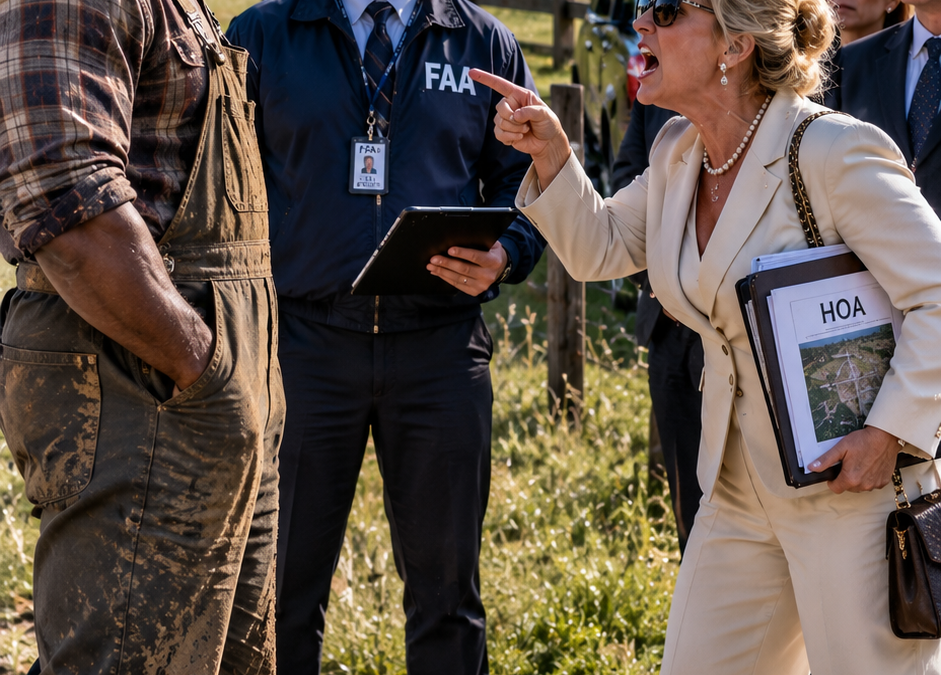
𝗙𝗨𝗟𝗟 𝗦𝗧𝗢𝗥𝗬
My name is Victor Vance.
I was forty-three when Skyline Estates decided I was just a farmer.
They weren’t entirely wrong.
I am a farmer.
The Vance farm had been in my family since 1948, when my grandfather returned from military service with more optimism than money and bought the first eighty acres on installments.
He planted sweet corn.
Then alfalfa.
Then feed corn.
My father expanded the place.
By the time I inherited management of the operation, we held a little over three hundred acres of bottomland and rolling pasture.
Farming was never a hobby.
It was the center of the family.
But it wasn’t my only career.
I had started flying before I could legally rent a car.
Crop dusters first.
Then military training.
Then fast jets.
After active duty, I joined the Naval Reserve and built a civilian career in aviation safety and airspace compliance.
By the time Victoria Sinclair paved my field, I worked for the Federal Aviation Administration in regional airspace and airport-safety review.
My job involved proposed runways.
Obstruction evaluations.
Airport notifications.
Airspace studies.
Agricultural aviation conflicts.
Approach and departure surfaces.
The sort of paperwork developers find boring right up until it stops a multimillion-dollar project.
I didn’t advertise that job around town.
Why would I?
At home I wore work boots.
Drove an old pickup.
Flew a restored Grumman Ag-Cat when the crops needed treatment.
Fixed tractors.
Helped Grandpa with irrigation.
If somebody asked what I did, I usually said:
“Farm and aviation.”
Most people heard farmer.
Victoria heard disposable.
That mistake began long before I returned from deployment.
Skyline Estates had started as a luxury subdivision on former wet pasture south of the farm.
Then somebody discovered fly-in communities.
Suddenly the developers weren’t selling houses.
They were selling what the brochures called:
PRIVATE AVIATION LIFESTYLE OWNERSHIP.
Hangars attached to villas.
Taxi lanes behind houses.
Concierge fueling.
Private club facilities.
Residents who could supposedly walk from breakfast to a Citation jet without ever touching ordinary civilization.
There was just one problem.
They did not own enough land for a safe runway.
My south field was flat.
Long.
Convenient.
And not for sale.
That should have ended the discussion.
Instead, Skyline treated my refusal as the opening bid.
The first offer was generous.
The second was ridiculous.
The third came with a developer who sat at my kitchen table and explained that agricultural land had “limited future utility.”
Grandpa was sitting beside me.
He was seventy-eight at the time.
He listened quietly.
Then asked:
“You ever eaten corn?”
The developer blinked.
“Yes.”
“Then the land has utility.”
Meeting over.
When I left on reserve deployment eighteen months later, the dispute was unresolved.
My grandfather remained on the farm.
So did my hired manager, Hank Lewis.
I left written instructions.
No land sales.
No new easements.
No boundary adjustments.
No construction access.
Apparently Skyline solved this by pretending those instructions did not exist.
Victoria’s explanation came the afternoon I returned.
She had been waiting for me to react to the twelve-thousand-dollar notice.
Instead, I unfolded it calmly.
“Amendment Fourteen,” I read.
“Yes.”
“Runway Visual Enclosure Zone.”
“Yes.”
“Who adopted this?”
“The Skyline board.”
“And I’m bound by it because?”
“Your property falls inside the aviation compatibility area.”
“Is my farm part of Skyline Estates?”
“Not formally.”
“Do I pay HOA dues?”
“No.”
“Did I sign your covenants?”
“No, but—”
“Then your Amendment Fourteen is a decorative piece of paper.”
Her face tightened.
“You are within our operational flight corridor.”
“That’s fascinating.”
“It means your machinery presents a safety issue.”
“My machinery was here first.”
“The neighborhood has changed.”
“The deed hasn’t.”
“Victor.”
She used my first name the way kindergarten teachers address difficult children.
“Sometimes progress requires compromise.”
“You paved my cornfield.”
“Our survey shows the runway improvements are inside a county development corridor.”
“Which survey?”
“Skyline’s.”
“Who prepared it?”
“Our engineering consultant.”
“Name?”
She smiled.
“You’ll receive everything through counsel.”
That answer told me more than a name would have.
I unfolded another page.
“My Ag-Cat was impounded Wednesday?”
“Yes.”
“Five hundred dollars per day storage?”
“Correct.”
“You called county dispatch to remove it?”
“Our security director did.”
“And which towing company responded?”
She hesitated.
“I don’t concern myself with vendor details.”
“I do.”
She smiled again.
“Perhaps that’s why you’re still running a farm.”
There are insults that sting.
Then there are insults so perfectly constructed that they become gifts.
Victoria had just given me one.
She thought land, machinery, and agriculture represented failure.
Something people did until they became wealthy enough not to.
I folded the notice and put it in my pocket.
“I’ll take care of the airplane.”
“You’ll need to pay your HOA balance first.”
“No.”
“The towing yard will not release it otherwise.”
I looked toward the road where her golf cart had entered my pasture.
“Victoria, would you mind backing your cart six feet?”
She frowned.
“Why?”
“Because the drainage easement ends three feet behind your rear tires.”
Her eyes narrowed.
“This again?”
“Yes.”
“I think we’re done here.”
She shifted into reverse.
Before leaving, she smiled over one shoulder.
“Stick to cornfields, Victor. Aviation is for people who can afford it.”
I watched her drive away.
Then touched the radio button clipped beneath my collar.
“Hank.”
Static.
Then a familiar voice.
“You still standing?”
“Barely.”
Hank Lewis managed Vance & Sons Heavy Recovery.
Our family had started towing farm trucks in the seventies.
By the time I was grown, we operated rotators, heavy wreckers, lowboys, aviation dollies, and specialized recovery gear for everything from overturned semis to light aircraft.
The county contract had been ours for eleven years.
Hank chuckled.
“She really told you aviation is for rich people?”
“Close enough.”
“I nearly swallowed my chewing gum.”
“Where’s the Ag-Cat?”
“Bay Three.”
“Damage?”
“None.”
“Who authorized the tow?”
“Skyline security called dispatch. Reported abandoned aircraft inside a newly designated private flight-safety zone.”
“And dispatch sent us.”
“Only outfit in the county with aviation transport certification.”
I looked toward the asphalt.
“You invoice them?”
“Not yet.”
“Do it.”
“How much?”
“Normal corporate rate.”
He paused.
“You’re no fun.”
“Emergency specialized aviation move. After-hours labor. Secure wing support. Hazard control. Daily storage.”
Silence.
Then Hank laughed.
“There you are.”
“Send the invoice to Skyline.”
“What about your own plane?”
“Leave it exactly where it is.”
“For how long?”
“Until Victoria asks where her tow bill came from.”
That happened the next morning.
At 8:12, my phone rang.
“Victor.”
“Morning.”
“What is this invoice?”
I poured coffee.
“What invoice?”
“Twenty-eight thousand four hundred dollars.”
“Oh. The airplane.”
“You cannot bill us for towing your own aircraft!”
“I didn’t.”
She went silent.
“Vance & Sons billed the party that ordered the tow.”
“That company belongs to you!”
“My family.”
“This is absurd.”
“The county awarded us the contract through competitive procurement.”
“You’re charging storage.”
“You demanded impoundment.”
“It was your plane!”
“I know. Makes inventory easy.”
“Release it and cancel this invoice.”
“You authorized the tow?”
“Skyline did.”
“Then Skyline owns the invoice.”
She inhaled sharply.
“You’re playing games.”
“No. I’m invoicing.”
“You think this is funny?”
“A little.”
She hung up.
By Thursday, I had my Ag-Cat back.
Technically, Skyline’s lawyers demanded Vance & Sons release it because they claimed the original tow lacked legal basis.
Perfect.
They put that position in writing.
That became Exhibit One in my property case.
I flew the next morning.
The Ag-Cat was old, loud, and magnificent.
Radial engine.
Yellow wings.
Agricultural spray system.
No luxury leather.
No champagne compartment.
Just honest machinery.
I stayed entirely inside the farm’s legal agricultural operating area.
At low altitude, the new villas seemed even more absurd.
Swimming pools.
Stone patios.
Hangar doors.
Residents drinking coffee beside a runway that crossed land they did not own.
I finished the fertilizer pass.
Landed on my grass strip.
By the time I shut down, three Skyline security vehicles were waiting near the south pasture.
Grandpa stood beside the barn.
“You make friends?”
“Apparently.”
He spat tobacco juice into the grass.
“They’ve been cutting through the lower field while you were gone.”
“Security?”
“Every week.”
“Why?”
“Inspection.”
“Of what?”
“Us.”
I stared.
“They drove across our pasture?”
“Twice they knocked down fence posts.”
“Why didn’t you call me?”
“You were flying jets. Figured I could handle people in golf carts.”
I smiled.
“What did you do?”
He pointed south.
New fence posts.
Except they weren’t fence posts.
They were lengths of old railroad rail driven vertically six feet into the clay.
Painted white at the top.
Four feet apart.
I stared.
“Grandpa.”
“What?”
“That might stop a tank.”
“Then it’ll probably stop a Jeep.”
Right on cue, one of Skyline’s black security SUVs accelerated along the dirt lane.
Grandpa smiled.
“That’s Dylan.”
“You know him?”
“He enjoys driving through fences.”
The SUV approached.
Too fast.
The young security driver leaned from his window.
“Move the equipment! This is an emergency aviation clearance corridor!”
He apparently expected Grandpa’s old wooden rails.
Instead he found sixty-pound-per-yard carbon steel.
The front bumper hit first.
Then the crumple zone performed exactly the way its engineers intended.
The hood folded.
Airbags detonated.
Radiator fluid sprayed across the grass.
The vehicle stopped instantly.
The rail barely moved.
I closed my eyes.
“Grandpa.”
“What?”
“That was a seventy-thousand-dollar SUV.”
“It was.”
“You knew he would hit it.”
“I painted it white.”
I looked at him.
He shrugged.
“Very visible.”
We walked toward the wreck.
The driver was shaken but conscious.
I tapped the window.
“You hurt?”
He shook his head.
“Good.”
I pointed toward the steel post.
“That fence is on private property.”
He groaned.
“You did this.”
“No.”
Apparently that phrase was popular around Skyline.
Grandpa leaned toward the windshield.
“Son, if a stationary object beats your moving vehicle, blaming the stationary object is rarely your strongest argument.”
I called an ambulance anyway.
Then Vance & Sons.
Hank arrived with a rollback.
He inspected the Jeep.
Then the post.
“Post wins.”
“Apparently.”
“Hookup?”
“Three hundred.”
“Emergency cleanup?”
“Add it.”
Hank looked at Grandpa.
“Rail fence?”
Grandpa smiled.
“Educational infrastructure.”
Within an hour Victoria arrived.
She stared at the Jeep.
Then at me.
Then Grandpa.
“You deliberately created a dangerous barrier.”
Grandpa pointed to the white paint.
“Visible barrier.”
“Security vehicles require access.”
“To my field?”
“For aviation safety.”
“What federal authority gave you that?”
She looked at me.
“The Skyline board.”
I smiled.
“That isn’t federal authority.”
“Enough.”
She turned toward the recovering Jeep.
“This entire farm is becoming a safety nuisance.”
“Interesting choice of phrase.”
“Our grand opening is Saturday.”
“Congratulations.”
“A Citation will make the inaugural flight.”
I stopped smiling.
“What kind?”
“Why does that matter?”
“Because your runway is not operationally approved.”
Her eyes hardened.
“It absolutely is.”
“FAA determination?”
“State authorization.”
“FAA Form 7480 notification?”
She blinked.
“Obstruction evaluation?”
Silence.
“Airspace study number?”
Her expression changed.
Slightly.
But enough.
“Our aviation lawyers handled all approvals.”
“Then they’ll have the numbers.”
“Victor, you are a crop duster.”
There it was.
I nodded.
“Saturday should be interesting.”
She left.
Grandpa looked at me.
“You know something.”
“Several things.”
“You going to tell me?”
“After I make some calls.”
I spent Thursday afternoon doing what Victoria should have done before pouring fifteen million dollars of asphalt.
Checking federal records.
I had access through normal FAA channels, but I kept myself out of the decision-making chain because the dispute involved my property.
I notified my supervisor.
Disclosed the conflict.
Sent the coordinates.
Survey.
Property maps.
My existing agricultural-operation records.
Then I asked one question:
“Does Skyline have an approved airport study at these coordinates?”
The answer came back quickly.
No completed determination.
They had submitted preliminary notices through a consultant.
The proposed runway dimensions had changed afterward.
Its final location had shifted west.
Onto my land.
Worse, the approach geometry conflicted with my long-established agricultural aviation operation and existing structures.
I forwarded the issue for formal review.
No tricks.
No secret authority.
No magical power to close an airport because I disliked Victoria.
Federal aviation regulations are boring compared with revenge fantasies.
They are also much more effective.
Friday afternoon brought rain.
Heavy plains rain.
I was inside the hangar working on the Ag-Cat when the doors opened.
Victoria marched in with three private security guards and a county assistant code officer named Ben Harper.
Victoria looked soaked and furious.
“This ends now.”
I set down my wrench.
“What ends?”
“This illegal aviation operation.”
Ben raised one hand.
“Mr. Vance, I want to be clear. I’m here only to inspect the structural complaint.”
Victoria turned toward him.
“We discussed this.”
“Yes, ma’am.”
“You have an emergency condemnation request.”
“I have a request.”
She glared.
One security guard stepped farther into the hangar.
His hand rested too close to his sidearm.
I pointed at the floor.
“Everyone stop.”
Victoria laughed.
“You don’t control county inspection.”
“No. But I control access to my private hangar absent lawful authority.”
Ben immediately nodded.
“He’s correct.”
Victoria stared at him.
“You told me—”
“I told you I would inspect the complaint if the owner consented or if we had an administrative warrant.”
“Then issue one.”
“I cannot issue warrants.”
Her face flushed.
I walked to the support post beside the hangar door.
Pulled down the inspection certificate.
“State agricultural inspection. September.”
Ben studied it.
Then the fuel permit.
Then the structural certificate.
“This facility is current.”
Victoria snapped:
“You haven’t checked the aircraft.”
“That isn’t county code jurisdiction.”
“The runway makes it a public hazard.”
Ben shook his head.
“FAA matter.”
Victoria turned toward me.
“You planned this.”
“Planned what?”
“This whole resistance campaign.”
“I came home Monday.”
“You’re obstructing fifteen million dollars of investment!”
“You paved my corn.”
“You have been offered compensation.”
“Ten cents on the dollar.”
“That land has no development value without our project.”
“Then why did you need it?”
She stopped.
Good question.
Then the guard moved again.
His hand went onto the grip of his pistol.
That was the moment things stopped being funny.
A voice came from the hangar entrance.
“Take your hand off the weapon.”
Sheriff Sarah Vance walked in.
My wife.
Sarah had spent twelve years in military police and county investigations before running for sheriff.
She had been sworn into the elected office that morning after the previous sheriff retired at the end of his term.
Victoria stared.
“You’re his wife.”
Sarah nodded.
“And because I’m his wife, I’m not adjudicating the property dispute.”
She looked at the security guard.
“But I am absolutely handling an armed private-security officer putting his hand on a firearm during an unlawful entry dispute.”
The guard lifted both hands.
Smart.
Sarah continued.
“Leave the hangar.”
Victoria stepped forward.
“We have board authority.”
Sarah looked at her.
“Your board governs your subdivision.”
“This is part of our aviation safety corridor.”
“Show me the recorded interest.”
Victoria opened her mouth.
Nothing came out.
Sarah pointed toward the door.
“Everyone outside.”
The security team complied.
Ben followed.
Victoria stayed.
“This is corruption.”
Sarah’s expression did not change.
“No. Corruption would be me resolving my husband’s civil case for him.”
She pointed outside.
“I’m removing armed private security from property where the owner has revoked consent. The deed question goes to court.”
Victoria looked toward me.
“Tomorrow, when our runway opens in front of investors from all over the country, this farm becomes the last ugly obstacle standing in the way of progress.”
I picked up my wrench.
“You’re still planning to operate tomorrow?”
“Absolutely.”
“Even without a final federal airspace determination?”
For the first time, uncertainty broke through.
“You don’t know what approvals we have.”
“You’re right.”
I smiled slightly.
“See you tomorrow.”
Skyline’s grand opening began at ten Saturday morning.
The storm had moved east.
Blue sky.
Clean air.
White pavilion.
Champagne.
A brass quartet.
Investors.
Buyers.
Local officials.
A two-million-dollar Citation positioned near the threshold for the ceremonial first flight.
I watched from my side of the fence.
Not in uniform.
No dramatic helicopter entrance.
No gold-striped fantasy costume.
Jeans.
FAA identification clipped to my belt because I was there as the property owner, not the official making the determination.
The actual FAA compliance team arrived in two federal vehicles.
Regional airport and airspace specialists.
An aviation safety inspector.
County representatives.
A surveyor.
Victoria noticed them before the speeches began.
She came marching toward the boundary.
“What are they doing here?”
“Ask them.”
“You called the FAA.”
“Yes.”
Her face brightened strangely.
“Good.”
That surprised me.
“Our counsel will finally put an end to your interference.”
I nodded.
“I hope somebody ends it.”
At ten-fifteen, she took the stage.
“Welcome to Skyline Estates Aviation Club.”
Applause.
“Today represents the future of luxury living.”
More applause.
I noticed an FAA inspector speaking quietly with the Citation pilot.
The pilot’s expression changed.
Victoria continued.
“A place where home and sky become one.”
The Citation engines started.
Then shut down thirty seconds later.
The crowd murmured.
Victoria looked toward the airplane.
The pilot climbed out.
An FAA official walked toward the stage.
“Mrs. Sinclair?”
She lowered the microphone.
“Yes?”
“I’m Daniel Kerr, FAA airport safety and airspace review.”
Her smile returned.
“Wonderful. I’m sure Victor has filled your office with complaints.”
“We’re here because of the runway.”
“Exactly.”
He handed her a written notice.
“Skyline does not have a completed federal airspace determination supporting operation of this runway in its current constructed location and configuration.”
She stared at him.
“That’s impossible.”
“Our consultant handled this.”
“The proposal reviewed by the FAA was materially different from what was built.”
“What difference?”
Daniel opened the survey.
“The runway centerline shifted approximately three hundred feet west.”
Her eyes flicked toward me.
“That adjustment was necessary.”
“It moved portions onto property Skyline does not own.”
“That is disputed.”
“Ownership is a separate civil matter.”
He continued.
“The change also altered your protected approach surfaces and relationship to existing agricultural aviation operations.”
Victoria looked at the investors.
Then back at Daniel.
“But we have state approval.”
“State approval does not replace federal notice and airspace review.”
“Our aircraft has a flight plan.”
“A flight plan does not certify an airport.”
The crowd had become completely silent.
Victoria’s husband approached.
“What exactly are you saying?”
Daniel answered calmly.
“The FAA is directing that this runway not be used for the planned operation until the safety and airspace issues are resolved.”
“For how long?”
“I cannot give you a timeline today.”
Victoria laughed.
It sounded brittle.
“This is Victor.”
Daniel looked at her.
“Mr. Vance disclosed his property interest and recused himself from agency review.”
She turned toward me.
“You work for them?”
There it was.
Finally.
I nodded.
“Regional airspace and aviation safety.”
“You said you were a farmer.”
“I am.”
“You’re an FAA official?”
“Employee.”
“And a Navy pilot?”
“Reserve.”
“And you let me talk to you like—”
I smiled.
“Like a farmer?”
Her face went red.
One investor behind her quietly lowered his champagne glass.
I stepped closer to the fence.
“Victoria, the problem was never that you thought I was poor.”
She stared.
“The problem was that you thought poor people’s deeds mattered less.”
Her husband took the notice from her.
“How serious is this?”
Daniel answered.
“Very.”
“What happens to the runway?”
“That depends on surveys, ownership resolution, airport geometry, agricultural operations, obstruction analysis, and whether a compliant configuration is possible.”
One of the investors asked:
“Were the fly-in lots sold as having operational runway access?”
Nobody answered.
That question mattered.
A lot.
The grand opening ended without a flight.
No dramatic federal raid.
No helicopter landing.
No jet circling the valley.
Just paperwork.
Silence.
A multimillion-dollar Citation sitting motionless beside a runway that nobody could legally use as advertised.
I found that considerably more satisfying.
Monday morning brought lawyers.
Skyline’s attorneys.
My property attorney.
The developer’s lender.
Investors.
Insurance representatives.
Surveyors.
Everybody suddenly became fascinated by property boundaries.
Funny how that happens once asphalt becomes collateral.
The independent survey was devastating.
A significant portion of the western runway pavement crossed my deeded parcel.
The construction crews had also removed trees and drainage features from my farm without authorization.
Skyline argued adverse interpretations.
We produced historical monuments.
Prior surveys.
Agricultural tax maps.
Recorded deeds.
Grandpa’s maintenance records.
Aerial photographs.
There was no serious ambiguity left.
They had built part of their runway on my land.
Victoria came to the farm three days later.
Alone.
No golf cart.
No security.
No visor.
She stood beside the old fence.
“Five million.”
I was checking irrigation.
“What?”
“For the affected acreage.”
“No.”
“Ten.”
“No.”
“Victor, be rational.”
“I am.”
“You could retire.”
“I like working.”
“Your children could have security.”
“They have land.”
“You’re doing this out of spite.”
“No.”
She looked toward the runway.
“The bank is threatening to suspend our construction facility.”
“That sounds complicated.”
“Investors are demanding rescission.”
“Also complicated.”
“You caused this.”
I shut off the irrigation valve.
“You built it.”
“You contacted the FAA.”
“You built an airport without completing the FAA process.”
“You could have quietly sold us the land.”
“You could have quietly not paved it.”
Her mouth tightened.
“Fine.”
She turned.
Then stopped.
“What do you want?”
“My farm restored.”
“That runway cost fifteen million dollars.”
“My cornfield wasn’t for sale.”
“It’s asphalt now.”
“For the moment.”
She stared.
“You wouldn’t.”
“Wouldn’t what?”
“Destroy it.”
“It’s on my land.”
“Our lenders will sue you.”
“My lawyer will enjoy the exercise.”
Her shoulders dropped slightly.
For the first time since we met, she looked tired instead of powerful.
“We thought you’d sell.”
That was the closest thing to honesty I had heard from her.
“Why?”
“Everybody sells eventually.”
I looked toward Grandpa’s barn.
“No.”
“People like you always say that until the number gets high enough.”
“People like me?”
She realized too late.
“Farmers.”
I smiled.
“There it is again.”
She left.
The civil case moved quickly because Skyline had bigger problems than me.
Buyer contracts marketed the project as an operational fly-in community.
Several lots had been sold at aviation premiums.
Lenders had underwritten the development partly on runway access.
The runway now faced federal safety review and a property-title dispute.
Investors started asking what the developer knew before taking deposits.
Then internal emails surfaced.
One was from Victoria to the development manager six months before construction.
Vance is deployed. Grandpa won’t fight this. Get the western section paved before he returns and we can negotiate from finished-condition value.
That sentence ended the moral argument.
Another email:
Once the runway exists, no judge will order fifteen million in infrastructure removed over corn.
Grandpa read that one.
Then looked at me.
“She underestimated corn.”
“She did.”
He nodded.
“Common mistake.”
The towing records became useful too.
Skyline had ordered my Ag-Cat removed specifically because its presence interfered with construction.
Their own written request identified the aircraft as being on “future runway property.”
My deed said otherwise.
The more documents they produced, the worse the story became.
Then came Victoria’s biggest problem.
The marketing contracts.
Prospective residents had paid premiums for guaranteed private-airfield access.
Some sales materials described the runway as “fully approved.”
It wasn’t.
Federal investigators did not arrest Victoria because she irritated me.
Real law does not work that way.
But state investigators and civil attorneys began reviewing whether buyers had been misled.
The developer’s insurers reserved rights.
Lenders froze additional draws.
The board turned on her.
At the emergency HOA meeting, Victoria sat beneath a projection of the site plan.
Hundreds of residents packed the clubhouse.
I attended because several property questions involved me.
The treasurer went through the numbers.
Runway shutdown.
Pending survey claim.
Investor demands.
Potential repurchase exposure.
Legal costs.
Then the developer’s counsel displayed Victoria’s email.
GET THE WESTERN SECTION PAVED BEFORE HE RETURNS.
The room changed.
Victoria stood.
“That email is being taken out of context.”
A resident shouted:
“What context makes that better?”
She tried again.
“We genuinely believed the easement allowed—”
My attorney raised a hand.
“There is no runway easement.”
Victoria snapped:
“You don’t live here.”
He smiled.
“Neither does the runway, apparently.”
That got a laugh.
A very large one.
Victoria’s husband stared at the table.
The board secretary asked:
“Did you authorize construction knowing Victor had rejected every purchase offer?”
Victoria said nothing.
“Did you?”
“We had legal advice.”
The association attorney interrupted.
“Our firm advised that construction should not proceed across disputed acreage without written landowner consent.”
Silence.
Victoria turned slowly.
“You advised that the likelihood of removal was low.”
“Low is not consent.”
There it was.
The same mistake again.
Probably.
Likely.
Influence.
Money.
Finished-condition leverage.
Everything except ownership.
A recall motion came from the floor.
Victoria objected.
Nobody cared.
The vote removed her as HOA president that night.
Skyline Estates did not disappear.
The houses remained.
The residents remained.
But the Aviation Club concept collapsed.
The runway could not remain in its intended configuration.
Eventually the developer, lenders, insurers, and I reached a settlement.
I did not sell the farm.
I granted no permanent runway rights.
Skyline paid for restoration of my acreage, replacement of the windbreak, drainage repair, loss of crops, attorney fees, and significant additional damages tied to the unauthorized construction.
The section of pavement crossing my farm had to come out.
Vance & Sons won the demolition and heavy-recovery subcontract through a competitive bid.
That part amused Grandpa more than anything.
The morning removal started, Victoria came to watch.
I almost wished she hadn’t.
Not because I felt sorry for her.
Because she looked like somebody who had finally understood that confidence does not create facts.
A hydraulic breaker hammered the asphalt.
Black pavement fractured.
Excavators loaded pieces into trucks.
Below it, compacted subgrade emerged.
Then, eventually, soil.
Victoria stood behind the boundary.
“You really needed to do this?”
“Yes.”
“Couldn’t you have left the pavement and farm around it?”
“Could you have left the corn and built around it?”
She looked away.
Fair.
Grandpa stood beside me with both hands on his cane.
He watched a large slab of runway asphalt break apart.
“Ugly stuff.”
“You liked it when you were younger.”
“I liked roads where roads belonged.”
Another slab cracked.
He smiled.
“Good sound.”
We restored the field over the following year.
Compaction had damaged the soil badly.
We deep-ripped.
Added organic matter.
Corrected drainage.
Rebuilt irrigation.
Replanted the windbreak.
The first corn crop was disappointing.
The second was better.
By year three, the field was producing normally again.
Skyline kept part of the pavement on property it actually owned.
Without a compliant aviation configuration, it became an access road and emergency staging area.
Expensive parking lot.
Locals renamed it Sinclair Boulevard.
Not officially.
Nobody is that cruel.
Officially, it became South Service Road.
Victoria sold her home.
Her husband withdrew from the development partnership.
Several investors settled their claims.
The HOA rewrote its rules to prohibit any future attempt to regulate agricultural land outside its recorded boundaries.
That clause is beautiful.
I keep a copy.
The Ag-Cat returned to its hangar.
The old John Deere returned to work.
Its paint is still faded.
It still leaks slightly from a hydraulic fitting Grandpa refuses to replace because, according to him:
“It only leaks when it has fluid in it.”
I have explained the flaw in this reasoning.
Repeatedly.
He remains unconvinced.
One morning the following spring, I flew the Ag-Cat over the south field.
Not low over Skyline.
Not to annoy anyone.
Just my normal agricultural pattern.
From the cockpit, the restored acreage looked small.
Straight corn rows.
Dark soil.
Young windbreak trees.
Beside it sat the remnant of Skyline’s magnificent aviation dream.
Pavement.
Hangars converted into garages.
No Citation jets.
No runway centerline crossing my farm.
No white pavilion.
I thought about Victoria’s first words.
Stick to cornfields, Victor. Aviation is for people who can afford it.
She had misunderstood both halves.
Farming is expensive.
Aviation is expensive.
But ignorance is more expensive than either one.
Especially when you combine it with fifteen million dollars of asphalt.
I remained with the FAA for several more years.
I never used my position to punish Skyline.
I didn’t need to.
That mattered to me.
Once the property conflict emerged, other officials handled the formal determinations.
The federal process did exactly what it was supposed to do.
Review the facts.
Look at the constructed runway.
Compare it with the submitted proposal.
Evaluate safety.
Require compliance.
Boring.
Methodical.
Devastating to people who had built first and assumed paperwork would surrender later.
Grandpa liked that part.
“Government finally did something useful?”
“Careful.”
“I’m old. I can say what I want.”
“You have always said what you want.”
“Practice.”
The fence stayed too.
Railroad-steel posts.
White tops.
After the Jeep incident, Skyline security stopped using my pasture as a shortcut.
Funny how quickly people discover respect for boundaries once the boundary wins a collision.
Sarah remained sheriff.
And despite local gossip, she never handled my civil claims.
She was very careful about that.
Her deputies handled trespass complaints through normal procedures.
Property issues went to attorneys.
Aviation went to FAA staff who were not me.
We kept the lines clean.
That made Victoria’s accusations of conspiracy fall apart quickly.
Years later, a young Skyline resident came to the farm.
His parents had bought after the runway scandal.
He was sixteen.
Loved airplanes.
He stood outside the Ag-Cat hangar staring at the old radial engine.
“That thing still flies?”
“It flew before you were born.”
“Is it hard?”
“Yes.”
“Can you teach me?”
“Your parents know you’re here?”
“My dad dropped me off.”
I looked toward the road.
His father waved from a pickup.
Not a golf cart.
Progress.
I spent twenty minutes showing the boy the controls.
He asked smart questions.
Lift.
Stalls.
Prop pitch.
Agricultural turns.
Engine management.
Then he asked:
“Were you really the FAA guy who shut down Skyline Airport?”
“No.”
His face fell.
“That’s what everybody says.”
“I worked for the FAA.”
“But you shut it down.”
“The FAA reviewed it.”
“Because you called them.”
“Because somebody built a runway.”
He thought about that.
“So the story is exaggerated?”
“Most good stories are.”
“Did the HOA really tow your plane?”
“Yes.”
“Was it really your towing company?”
“Yes.”
His eyes lit up.
“That’s awesome.”
“That part is exactly as funny as people say.”
He laughed.
Then looked toward the restored field.
“My dad says that used to be asphalt.”
“It did.”
“Why didn’t you just take the money?”
Good question.
A generation younger than me.
No history tied to the land.
No reason to understand automatically.
So I walked him outside.
I picked up a handful of soil.
Dark.
Loose.
Alive with roots.
“My grandfather bought this before any of those houses existed.”
“So?”
“So some things have value because selling them would end what gives them value.”
He frowned.
“Like what?”
“Family land.”
He still looked uncertain.
“That sounds sentimental.”
“It is.”
“Isn’t that bad business?”
“Sometimes.”
I let the soil fall through my fingers.
“Not every decision is business.”
He nodded slowly.
I don’t know whether he understood.
Maybe you have to inherit something before you understand why price and value are different words.
Skyline’s developers had known price.
Victoria had known price exceptionally well.
Price per acre.
Price per villa.
Price per aviation lot.
Runway cost.
Monthly dues.
Premium upgrade packages.
But she never understood value outside a spreadsheet.
Grandpa did.
My father did.
I did.
And eventually the court documents did too.
The farm remains a farm.
Corn.
Alfalfa.
Cattle.
One loud agricultural airplane.
A towing yard farther east.
An old man named Victor who occasionally wears an FAA badge but looks far more comfortable with dirt under his fingernails.
Sometimes pilots flying through the region still call asking about Skyline Airport.
I tell them the truth.
“There is no Skyline Airport.”
“What happened?”
“Poor planning.”
“How poor?”
“About fifteen million dollars poor.”
Then I give them the nearest real airport.
Much safer.
Fully reviewed.
Actually owned by the people operating it.
A revolutionary idea.
Victoria once believed the world could be divided into people who mattered and people who didn’t.
Developers and farmers.
Investors and neighbors.
Private jets and crop dusters.
She thought money determined which side of the line you stood on.
But aviation taught me something long before Skyline arrived.
The sky does not care who paid more for the airplane.
A Citation and an Ag-Cat both stall when they run out of lift.
A billionaire and a farmer both answer to gravity.
And federal safety standards do not become optional because your clubhouse serves expensive champagne.
The same is true of land.
A survey monument does not become less accurate because the person on one side wears muddy boots.
A deed does not become negotiable because somebody on the other side has better lawyers.
And a cornfield does not become available merely because a developer has already printed brochures showing a runway where the corn used to be.
That was Victoria’s mistake from the beginning.
She saw a farmer and assumed simplicity.
She saw old machinery and assumed poverty.
She saw agricultural land and assumed weakness.
She thought I had a tractor.
She never asked about the towing company.
She thought I flew an old crop duster.
She never asked why I knew federal airspace forms by number.
She thought eighteen months away meant abandonment.
She never understood I had spent those eighteen months flying military aircraft while my civilian career waited for me back home.
Most of all, she thought asphalt created ownership.
It doesn’t.
After the runway pavement was removed, Grandpa took one broken piece and carried it to the barn.
About twelve inches square.
Heavy.
Black.
I found him writing on it with white paint.
“What are you doing?”
“Making you an office decoration.”
He turned it around.
On the asphalt he had painted:
FAA CLEARANCE: $0
SURVEY: $2,400
IGNORING BOTH: $15,000,000
I stared.
“Copyright lawyers from a credit-card company may be calling.”
“Let them.”
I put it on my FAA office shelf anyway.
It stayed there until I retired.
Now it hangs in the farm workshop.
Under it is Victoria’s original violation notice.
Twelve thousand dollars.
My “unauthorized agricultural waste.”
My “visual pollution.”
My “hazardous aircraft.”
Sometimes I read it when the bureaucracy in my own life starts irritating me.
Perspective helps.
The southern field is green again.
The pine windbreak is growing.
The Ag-Cat still leaves the grass runway every planting season.
When I climb through a turn, I can see Skyline Estates below.
The homes survived the scandal.
Residents eventually elected a quieter board.
They stopped sending security vehicles through the farm.
Some even buy our corn.
One resident apologized to Grandpa for the old fence damage.
Grandpa charged him two ears of corn.
“Restitution,” he called it.
The boy who visited my hangar eventually earned his private pilot certificate.
His first solo was from a legitimate municipal airport twenty miles east.
He called me afterward.
“Victor?”
“Yes?”
“I flew alone.”
“How’d it feel?”
“Terrifying.”
“Good.”
“Good?”
“Means you’re paying attention.”
He laughed.
Then said:
“My dad told me the whole Skyline story again.”
“Dangerous.”
“I think I get it now.”
“What?”
“Why you didn’t sell.”
I looked out across the field.
“Yeah?”
“You already had what they were trying to sell everybody.”
That stopped me.
“What’s that?”
He said:
“Freedom to use your own land.”
Smart kid.
Maybe smarter than the entire original Skyline board.
So that is how the greatest aviation development in our valley became an expensive service road.
Not because a farmer hated airplanes.
I love airplanes.
Not because I wanted rich people punished for owning jets.
I don’t care what anyone flies.
It failed because the people building it decided that money could replace permission.
Victoria Sinclair thought she could tow my airplane, fine my tractor, pave my crops, and then pressure me into selling after the fact.
She expected the old farmer to become intimidated by the runway, the lawyers, the security vehicles, and the millions already spent.
Instead, she eventually learned that the man standing beside that old tractor had spent his career studying exactly the rules she had failed to follow.
By the end, Victoria lost the HOA presidency.
Skyline lost its aviation project.
The developer paid to restore my farm.
The runway section across my land came out piece by piece.
And the Vance family kept every acre we had owned before she ever arrived.
Grandpa still tells the story differently.
Whenever somebody asks what happened, he spits into the grass, points toward the south field, and says:
“Lady tried to build an airport in the corn.”
They usually ask:
“What stopped her?”
Grandpa smiles.
“The farmer knew airplanes.”
That’s close enough.
Have you finished reading the story and want to read it again?
HOA Paved a Private Jet Runway Across My Farm—They Had No Idea I Worked for the FAA
They paved a runway straight across my farm.
Then they fined me for interfering with their “aviation community.”
What they never bothered to ask was what I did when I wasn’t growing corn.
I smelled the asphalt before I saw it.
That was the first thing wrong.
After eighteen months away with my Naval Reserve squadron, I expected the Vance farm to smell the way it had since childhood.
Dry corn husks.
Warm dirt.
Diesel.
Alfalfa.
The machine oil Grandpa rubbed into every piece of equipment he owned whether it needed it or not.
Instead, the afternoon wind carried the sharp petroleum smell of freshly laid blacktop.
My Ford F-250 rolled slowly down the gravel drive while heat shimmered above the high plains.
I killed the engine beside the barn.
For a few seconds, everything looked normal.
The weathered red siding.
Grandpa’s old John Deere beneath the equipment shed.
Corn bending under a hot western wind.
Then I rounded the barn.
And stopped.
Fifteen acres of my family’s best bottomland corn were gone.
Not harvested.
Not damaged.
Gone.
In their place stretched a broad strip of fresh black asphalt running almost directly through the center of the southern field.
Runway markings had already been painted.
New drainage had been cut.
Several mature pines along the old windbreak had been removed.
Beyond the strip, glass-fronted hangars and expensive new villas rose behind the gates of Skyline Estates.
I stood there with my deployment bag still over one shoulder and tried to understand how anybody could pour millions of dollars of pavement onto somebody else’s deeded land and still have enough confidence left to stripe the centerline.
Then I heard a golf cart.
A white electric cart came humming across my south pasture as though it had every legal right in the world to be there.
Victoria Sinclair sat behind the wheel.
HOA president.
Late fifties.
White tennis outfit.
Silver hair arranged into something the plains wind apparently feared disturbing.
Gold watch.
Gold sunglasses.
And the expression of a woman who had spent years discovering that most people surrendered when confronted with enough paperwork.
She stopped directly beside my drainage ditch.
“Well,” she said. “The prodigal farmer returns.”
I looked at her cart.
“You’re on my land.”
She laughed.
Not nervously.
Dismissively.
“Oh, Victor. Let’s not begin with petty boundary arguments.”
I turned toward the runway.
“Fifteen acres of my cornfield have become asphalt.”
“We prefer to call it the Skyline Estates Aviation Club.”
“You built an airport.”
“A private fly-in community.”
“On my farm.”
“Adjacent to your farm.”
I looked at her.
Then back at the centerline that crossed a survey monument my grandfather had installed before Victoria’s development existed.
“That runway is nearly three hundred feet inside my recorded property.”
Her smile tightened.
“Our title consultants disagree.”
“Good for them.”
She reached into her tennis bag and handed me a thick notice.
Apparently, while I had been serving overseas, Skyline had classified my tractor, crop duster, hangar, and portions of the farm itself as hazards inside their new “runway visual enclosure zone.”
The fine totaled twelve thousand dollars.
Then I reached the paragraph about my airplane.
“You towed my Ag-Cat?”
Victoria smiled.
“We impounded it.”
“Who moved it?”
“A county-authorized heavy recovery contractor.”
I stared at her.
She mistook my silence for anger.
It wasn’t.
I was trying not to smile.
My family owned the county’s contracted heavy-recovery company.
Which meant Skyline Estates had apparently hired my own employees to tow my own airplane into my own impound yard.
Victoria leaned closer.
“Perhaps you should simply accept reality, Victor. Skyline has investors, attorneys, commissioners, and fifteen million dollars in aviation infrastructure.”
Then she looked toward my corn.
“You have a tractor.”
I folded the violation notice.
“Victoria?”
“Yes?”
“You really should have checked who you were building an airport next to.”
PART2
My name is Victor Vance.
I was forty-three when Skyline Estates decided I was just a farmer.
They weren’t entirely wrong.
I am a farmer.
The Vance farm had been in my family since 1948, when my grandfather returned from military service with more optimism than money and bought the first eighty acres on installments.
He planted sweet corn.
Then alfalfa.
Then feed corn.
My father expanded the place.
By the time I inherited management of the operation, we held a little over three hundred acres of bottomland and rolling pasture.
Farming was never a hobby.
It was the center of the family.
But it wasn’t my only career.
I had started flying before I could legally rent a car.
Crop dusters first.
Then military training.
Then fast jets.
After active duty, I joined the Naval Reserve and built a civilian career in aviation safety and airspace compliance.
By the time Victoria Sinclair paved my field, I worked for the Federal Aviation Administration in regional airspace and airport-safety review.
My job involved proposed runways.
Obstruction evaluations.
Airport notifications.
Airspace studies.
Agricultural aviation conflicts.
Approach and departure surfaces.
The sort of paperwork developers find boring right up until it stops a multimillion-dollar project.
I didn’t advertise that job around town.
Why would I?
At home I wore work boots.
Drove an old pickup.
Flew a restored Grumman Ag-Cat when the crops needed treatment.
Fixed tractors.
Helped Grandpa with irrigation.
If somebody asked what I did, I usually said:
“Farm and aviation.”
Most people heard farmer.
Victoria heard disposable.
That mistake began long before I returned from deployment.
Skyline Estates had started as a luxury subdivision on former wet pasture south of the farm.
Then somebody discovered fly-in communities.
Suddenly the developers weren’t selling houses.
They were selling what the brochures called:
PRIVATE AVIATION LIFESTYLE OWNERSHIP.
Hangars attached to villas.
Taxi lanes behind houses.
Concierge fueling.
Private club facilities.
Residents who could supposedly walk from breakfast to a Citation jet without ever touching ordinary civilization.
There was just one problem.
They did not own enough land for a safe runway.
My south field was flat.
Long.
Convenient.
And not for sale.
That should have ended the discussion.
Instead, Skyline treated my refusal as the opening bid.
The first offer was generous.
The second was ridiculous.
The third came with a developer who sat at my kitchen table and explained that agricultural land had “limited future utility.”
Grandpa was sitting beside me.
He was seventy-eight at the time.
He listened quietly.
Then asked:
“You ever eaten corn?”
The developer blinked.
“Yes.”
“Then the land has utility.”
Meeting over.
When I left on reserve deployment eighteen months later, the dispute was unresolved.
My grandfather remained on the farm.
So did my hired manager, Hank Lewis.
I left written instructions.
No land sales.
No new easements.
No boundary adjustments.
No construction access.
Apparently Skyline solved this by pretending those instructions did not exist.
Victoria’s explanation came the afternoon I returned.
She had been waiting for me to react to the twelve-thousand-dollar notice.
Instead, I unfolded it calmly.
“Amendment Fourteen,” I read.
“Yes.”
“Runway Visual Enclosure Zone.”
“Yes.”
“Who adopted this?”
“The Skyline board.”
“And I’m bound by it because?”
“Your property falls inside the aviation compatibility area.”
“Is my farm part of Skyline Estates?”
“Not formally.”
“Do I pay HOA dues?”
“No.”
“Did I sign your covenants?”
“No, but—”
“Then your Amendment Fourteen is a decorative piece of paper.”
Her face tightened.
“You are within our operational flight corridor.”
“That’s fascinating.”
“It means your machinery presents a safety issue.”
“My machinery was here first.”
“The neighborhood has changed.”
“The deed hasn’t.”
“Victor.”
She used my first name the way kindergarten teachers address difficult children.
“Sometimes progress requires compromise.”
“You paved my cornfield.”
“Our survey shows the runway improvements are inside a county development corridor.”
“Which survey?”
“Skyline’s.”
“Who prepared it?”
“Our engineering consultant.”
“Name?”
She smiled.
“You’ll receive everything through counsel.”
That answer told me more than a name would have.
I unfolded another page.
“My Ag-Cat was impounded Wednesday?”
“Yes.”
“Five hundred dollars per day storage?”
“Correct.”
“You called county dispatch to remove it?”
“Our security director did.”
“And which towing company responded?”
She hesitated.
“I don’t concern myself with vendor details.”
“I do.”
She smiled again.
“Perhaps that’s why you’re still running a farm.”
There are insults that sting.
Then there are insults so perfectly constructed that they become gifts.
Victoria had just given me one.
She thought land, machinery, and agriculture represented failure.
Something people did until they became wealthy enough not to.
I folded the notice and put it in my pocket.
“I’ll take care of the airplane.”
“You’ll need to pay your HOA balance first.”
“No.”
“The towing yard will not release it otherwise.”
I looked toward the road where her golf cart had entered my pasture.
“Victoria, would you mind backing your cart six feet?”
She frowned.
“Why?”
“Because the drainage easement ends three feet behind your rear tires.”
Her eyes narrowed.
“This again?”
“Yes.”
“I think we’re done here.”
She shifted into reverse.
Before leaving, she smiled over one shoulder.
“Stick to cornfields, Victor. Aviation is for people who can afford it.”
I watched her drive away.
Then touched the radio button clipped beneath my collar.
“Hank.”
Static.
Then a familiar voice.
“You still standing?”
“Barely.”
Hank Lewis managed Vance & Sons Heavy Recovery.
Our family had started towing farm trucks in the seventies.
By the time I was grown, we operated rotators, heavy wreckers, lowboys, aviation dollies, and specialized recovery gear for everything from overturned semis to light aircraft.
The county contract had been ours for eleven years.
Hank chuckled.
“She really told you aviation is for rich people?”
“Close enough.”
“I nearly swallowed my chewing gum.”
“Where’s the Ag-Cat?”
“Bay Three.”
“Damage?”
“None.”
“Who authorized the tow?”
“Skyline security called dispatch. Reported abandoned aircraft inside a newly designated private flight-safety zone.”
“And dispatch sent us.”
“Only outfit in the county with aviation transport certification.”
I looked toward the asphalt.
“You invoice them?”
“Not yet.”
“Do it.”
“How much?”
“Normal corporate rate.”
He paused.
“You’re no fun.”
“Emergency specialized aviation move. After-hours labor. Secure wing support. Hazard control. Daily storage.”
Silence.
Then Hank laughed.
“There you are.”
“Send the invoice to Skyline.”
“What about your own plane?”
“Leave it exactly where it is.”
“For how long?”
“Until Victoria asks where her tow bill came from.”
That happened the next morning.
At 8:12, my phone rang.
“Victor.”
“Morning.”
“What is this invoice?”
I poured coffee.
“What invoice?”
“Twenty-eight thousand four hundred dollars.”
“Oh. The airplane.”
“You cannot bill us for towing your own aircraft!”
“I didn’t.”
She went silent.
“Vance & Sons billed the party that ordered the tow.”
“That company belongs to you!”
“My family.”
“This is absurd.”
“The county awarded us the contract through competitive procurement.”
“You’re charging storage.”
“You demanded impoundment.”
“It was your plane!”
“I know. Makes inventory easy.”
“Release it and cancel this invoice.”
“You authorized the tow?”
“Skyline did.”
“Then Skyline owns the invoice.”
She inhaled sharply.
“You’re playing games.”
“No. I’m invoicing.”
“You think this is funny?”
“A little.”
She hung up.
By Thursday, I had my Ag-Cat back.
Technically, Skyline’s lawyers demanded Vance & Sons release it because they claimed the original tow lacked legal basis.
Perfect.
They put that position in writing.
That became Exhibit One in my property case.
I flew the next morning.
The Ag-Cat was old, loud, and magnificent.
Radial engine.
Yellow wings.
Agricultural spray system.
No luxury leather.
No champagne compartment.
Just honest machinery.
I stayed entirely inside the farm’s legal agricultural operating area.
At low altitude, the new villas seemed even more absurd.
Swimming pools.
Stone patios.
Hangar doors.
Residents drinking coffee beside a runway that crossed land they did not own.
I finished the fertilizer pass.
Landed on my grass strip.
By the time I shut down, three Skyline security vehicles were waiting near the south pasture.
Grandpa stood beside the barn.
“You make friends?”
“Apparently.”
He spat tobacco juice into the grass.
“They’ve been cutting through the lower field while you were gone.”
“Security?”
“Every week.”
“Why?”
“Inspection.”
“Of what?”
“Us.”
I stared.
“They drove across our pasture?”
“Twice they knocked down fence posts.”
“Why didn’t you call me?”
“You were flying jets. Figured I could handle people in golf carts.”
I smiled.
“What did you do?”
He pointed south.
New fence posts.
Except they weren’t fence posts.
They were lengths of old railroad rail driven vertically six feet into the clay.
Painted white at the top.
Four feet apart.
I stared.
“Grandpa.”
“What?”
“That might stop a tank.”
“Then it’ll probably stop a Jeep.”
Right on cue, one of Skyline’s black security SUVs accelerated along the dirt lane.
Grandpa smiled.
“That’s Dylan.”
“You know him?”
“He enjoys driving through fences.”
The SUV approached.
Too fast.
The young security driver leaned from his window.
“Move the equipment! This is an emergency aviation clearance corridor!”
He apparently expected Grandpa’s old wooden rails.
Instead he found sixty-pound-per-yard carbon steel.
The front bumper hit first.
Then the crumple zone performed exactly the way its engineers intended.
The hood folded.
Airbags detonated.
Radiator fluid sprayed across the grass.
The vehicle stopped instantly.
The rail barely moved.
I closed my eyes.
“Grandpa.”
“What?”
“That was a seventy-thousand-dollar SUV.”
“It was.”
“You knew he would hit it.”
“I painted it white.”
I looked at him.
He shrugged.
“Very visible.”
We walked toward the wreck.
The driver was shaken but conscious.
I tapped the window.
“You hurt?”
He shook his head.
“Good.”
I pointed toward the steel post.
“That fence is on private property.”
He groaned.
“You did this.”
“No.”
Apparently that phrase was popular around Skyline.
Grandpa leaned toward the windshield.
“Son, if a stationary object beats your moving vehicle, blaming the stationary object is rarely your strongest argument.”
I called an ambulance anyway.
Then Vance & Sons.
Hank arrived with a rollback.
He inspected the Jeep.
Then the post.
“Post wins.”
“Apparently.”
“Hookup?”
“Three hundred.”
“Emergency cleanup?”
“Add it.”
Hank looked at Grandpa.
“Rail fence?”
Grandpa smiled.
“Educational infrastructure.”
Within an hour Victoria arrived.
She stared at the Jeep.
Then at me.
Then Grandpa.
“You deliberately created a dangerous barrier.”
Grandpa pointed to the white paint.
“Visible barrier.”
“Security vehicles require access.”
“To my field?”
“For aviation safety.”
“What federal authority gave you that?”
She looked at me.
“The Skyline board.”
I smiled.
“That isn’t federal authority.”
“Enough.”
She turned toward the recovering Jeep.
“This entire farm is becoming a safety nuisance.”
“Interesting choice of phrase.”
“Our grand opening is Saturday.”
“Congratulations.”
“A Citation will make the inaugural flight.”
I stopped smiling.
“What kind?”
“Why does that matter?”
“Because your runway is not operationally approved.”
Her eyes hardened.
“It absolutely is.”
“FAA determination?”
“State authorization.”
“FAA Form 7480 notification?”
She blinked.
“Obstruction evaluation?”
Silence.
“Airspace study number?”
Her expression changed.
Slightly.
But enough.
“Our aviation lawyers handled all approvals.”
“Then they’ll have the numbers.”
“Victor, you are a crop duster.”
There it was.
I nodded.
“Saturday should be interesting.”
She left.
Grandpa looked at me.
“You know something.”
“Several things.”
“You going to tell me?”
“After I make some calls.”
I spent Thursday afternoon doing what Victoria should have done before pouring fifteen million dollars of asphalt.
Checking federal records.
I had access through normal FAA channels, but I kept myself out of the decision-making chain because the dispute involved my property.
I notified my supervisor.
Disclosed the conflict.
Sent the coordinates.
Survey.
Property maps.
My existing agricultural-operation records.
Then I asked one question:
“Does Skyline have an approved airport study at these coordinates?”
The answer came back quickly.
No completed determination.
They had submitted preliminary notices through a consultant.
The proposed runway dimensions had changed afterward.
Its final location had shifted west.
Onto my land.
Worse, the approach geometry conflicted with my long-established agricultural aviation operation and existing structures.
I forwarded the issue for formal review.
No tricks.
No secret authority.
No magical power to close an airport because I disliked Victoria.
Federal aviation regulations are boring compared with revenge fantasies.
They are also much more effective.
Friday afternoon brought rain.
Heavy plains rain.
I was inside the hangar working on the Ag-Cat when the doors opened.
Victoria marched in with three private security guards and a county assistant code officer named Ben Harper.
Victoria looked soaked and furious.
“This ends now.”
I set down my wrench.
“What ends?”
“This illegal aviation operation.”
Ben raised one hand.
“Mr. Vance, I want to be clear. I’m here only to inspect the structural complaint.”
Victoria turned toward him.
“We discussed this.”
“Yes, ma’am.”
“You have an emergency condemnation request.”
“I have a request.”
She glared.
One security guard stepped farther into the hangar.
His hand rested too close to his sidearm.
I pointed at the floor.
“Everyone stop.”
Victoria laughed.
“You don’t control county inspection.”
“No. But I control access to my private hangar absent lawful authority.”
Ben immediately nodded.
“He’s correct.”
Victoria stared at him.
“You told me—”
“I told you I would inspect the complaint if the owner consented or if we had an administrative warrant.”
“Then issue one.”
“I cannot issue warrants.”
Her face flushed.
I walked to the support post beside the hangar door.
Pulled down the inspection certificate.
“State agricultural inspection. September.”
Ben studied it.
Then the fuel permit.
Then the structural certificate.
“This facility is current.”
Victoria snapped:
“You haven’t checked the aircraft.”
“That isn’t county code jurisdiction.”
“The runway makes it a public hazard.”
Ben shook his head.
“FAA matter.”
Victoria turned toward me.
“You planned this.”
“Planned what?”
“This whole resistance campaign.”
“I came home Monday.”
“You’re obstructing fifteen million dollars of investment!”
“You paved my corn.”
“You have been offered compensation.”
“Ten cents on the dollar.”
“That land has no development value without our project.”
“Then why did you need it?”
She stopped.
Good question.
Then the guard moved again.
His hand went onto the grip of his pistol.
That was the moment things stopped being funny.
A voice came from the hangar entrance.
“Take your hand off the weapon.”
Sheriff Sarah Vance walked in.
My wife.
Sarah had spent twelve years in military police and county investigations before running for sheriff.
She had been sworn into the elected office that morning after the previous sheriff retired at the end of his term.
Victoria stared.
“You’re his wife.”
Sarah nodded.
“And because I’m his wife, I’m not adjudicating the property dispute.”
She looked at the security guard.
“But I am absolutely handling an armed private-security officer putting his hand on a firearm during an unlawful entry dispute.”
The guard lifted both hands.
Smart.
Sarah continued.
“Leave the hangar.”
Victoria stepped forward.
“We have board authority.”
Sarah looked at her.
“Your board governs your subdivision.”
“This is part of our aviation safety corridor.”
“Show me the recorded interest.”
Victoria opened her mouth.
Nothing came out.
Sarah pointed toward the door.
“Everyone outside.”
The security team complied.
Ben followed.
Victoria stayed.
“This is corruption.”
Sarah’s expression did not change.
“No. Corruption would be me resolving my husband’s civil case for him.”
She pointed outside.
“I’m removing armed private security from property where the owner has revoked consent. The deed question goes to court.”
Victoria looked toward me.
“Tomorrow, when our runway opens in front of investors from all over the country, this farm becomes the last ugly obstacle standing in the way of progress.”
I picked up my wrench.
“You’re still planning to operate tomorrow?”
“Absolutely.”
“Even without a final federal airspace determination?”
For the first time, uncertainty broke through.
“You don’t know what approvals we have.”
“You’re right.”
I smiled slightly.
“See you tomorrow.”
Skyline’s grand opening began at ten Saturday morning.
The storm had moved east.
Blue sky.
Clean air.
White pavilion.
Champagne.
A brass quartet.
Investors.
Buyers.
Local officials.
A two-million-dollar Citation positioned near the threshold for the ceremonial first flight.
I watched from my side of the fence.
Not in uniform.
No dramatic helicopter entrance.
No gold-striped fantasy costume.
Jeans.
FAA identification clipped to my belt because I was there as the property owner, not the official making the determination.
The actual FAA compliance team arrived in two federal vehicles.
Regional airport and airspace specialists.
An aviation safety inspector.
County representatives.
A surveyor.
Victoria noticed them before the speeches began.
She came marching toward the boundary.
“What are they doing here?”
“Ask them.”
“You called the FAA.”
“Yes.”
Her face brightened strangely.
“Good.”
That surprised me.
“Our counsel will finally put an end to your interference.”
I nodded.
“I hope somebody ends it.”
At ten-fifteen, she took the stage.
“Welcome to Skyline Estates Aviation Club.”
Applause.
“Today represents the future of luxury living.”
More applause.
I noticed an FAA inspector speaking quietly with the Citation pilot.
The pilot’s expression changed.
Victoria continued.
“A place where home and sky become one.”
The Citation engines started.
Then shut down thirty seconds later.
The crowd murmured.
Victoria looked toward the airplane.
The pilot climbed out.
An FAA official walked toward the stage.
“Mrs. Sinclair?”
She lowered the microphone.
“Yes?”
“I’m Daniel Kerr, FAA airport safety and airspace review.”
Her smile returned.
“Wonderful. I’m sure Victor has filled your office with complaints.”
“We’re here because of the runway.”
“Exactly.”
He handed her a written notice.
“Skyline does not have a completed federal airspace determination supporting operation of this runway in its current constructed location and configuration.”
She stared at him.
“That’s impossible.”
“Our consultant handled this.”
“The proposal reviewed by the FAA was materially different from what was built.”
“What difference?”
Daniel opened the survey.
“The runway centerline shifted approximately three hundred feet west.”
Her eyes flicked toward me.
“That adjustment was necessary.”
“It moved portions onto property Skyline does not own.”
“That is disputed.”
“Ownership is a separate civil matter.”
He continued.
“The change also altered your protected approach surfaces and relationship to existing agricultural aviation operations.”
Victoria looked at the investors.
Then back at Daniel.
“But we have state approval.”
“State approval does not replace federal notice and airspace review.”
“Our aircraft has a flight plan.”
“A flight plan does not certify an airport.”
The crowd had become completely silent.
Victoria’s husband approached.
“What exactly are you saying?”
Daniel answered calmly.
“The FAA is directing that this runway not be used for the planned operation until the safety and airspace issues are resolved.”
“For how long?”
“I cannot give you a timeline today.”
Victoria laughed.
It sounded brittle.
“This is Victor.”
Daniel looked at her.
“Mr. Vance disclosed his property interest and recused himself from agency review.”
She turned toward me.
“You work for them?”
There it was.
Finally.
I nodded.
“Regional airspace and aviation safety.”
“You said you were a farmer.”
“I am.”
“You’re an FAA official?”
“Employee.”
“And a Navy pilot?”
“Reserve.”
“And you let me talk to you like—”
I smiled.
“Like a farmer?”
Her face went red.
One investor behind her quietly lowered his champagne glass.
I stepped closer to the fence.
“Victoria, the problem was never that you thought I was poor.”
She stared.
“The problem was that you thought poor people’s deeds mattered less.”
Her husband took the notice from her.
“How serious is this?”
Daniel answered.
“Very.”
“What happens to the runway?”
“That depends on surveys, ownership resolution, airport geometry, agricultural operations, obstruction analysis, and whether a compliant configuration is possible.”
One of the investors asked:
“Were the fly-in lots sold as having operational runway access?”
Nobody answered.
That question mattered.
A lot.
The grand opening ended without a flight.
No dramatic federal raid.
No helicopter landing.
No jet circling the valley.
Just paperwork.
Silence.
A multimillion-dollar Citation sitting motionless beside a runway that nobody could legally use as advertised.
I found that considerably more satisfying.
Monday morning brought lawyers.
Skyline’s attorneys.
My property attorney.
The developer’s lender.
Investors.
Insurance representatives.
Surveyors.
Everybody suddenly became fascinated by property boundaries.
Funny how that happens once asphalt becomes collateral.
The independent survey was devastating.
A significant portion of the western runway pavement crossed my deeded parcel.
The construction crews had also removed trees and drainage features from my farm without authorization.
Skyline argued adverse interpretations.
We produced historical monuments.
Prior surveys.
Agricultural tax maps.
Recorded deeds.
Grandpa’s maintenance records.
Aerial photographs.
There was no serious ambiguity left.
They had built part of their runway on my land.
Victoria came to the farm three days later.
Alone.
No golf cart.
No security.
No visor.
She stood beside the old fence.
“Five million.”
I was checking irrigation.
“What?”
“For the affected acreage.”
“No.”
“Ten.”
“No.”
“Victor, be rational.”
“I am.”
“You could retire.”
“I like working.”
“Your children could have security.”
“They have land.”
“You’re doing this out of spite.”
“No.”
She looked toward the runway.
“The bank is threatening to suspend our construction facility.”
“That sounds complicated.”
“Investors are demanding rescission.”
“Also complicated.”
“You caused this.”
I shut off the irrigation valve.
“You built it.”
“You contacted the FAA.”
“You built an airport without completing the FAA process.”
“You could have quietly sold us the land.”
“You could have quietly not paved it.”
Her mouth tightened.
“Fine.”
She turned.
Then stopped.
“What do you want?”
“My farm restored.”
“That runway cost fifteen million dollars.”
“My cornfield wasn’t for sale.”
“It’s asphalt now.”
“For the moment.”
She stared.
“You wouldn’t.”
“Wouldn’t what?”
“Destroy it.”
“It’s on my land.”
“Our lenders will sue you.”
“My lawyer will enjoy the exercise.”
Her shoulders dropped slightly.
For the first time since we met, she looked tired instead of powerful.
“We thought you’d sell.”
That was the closest thing to honesty I had heard from her.
“Why?”
“Everybody sells eventually.”
I looked toward Grandpa’s barn.
“No.”
“People like you always say that until the number gets high enough.”
“People like me?”
She realized too late.
“Farmers.”
I smiled.
“There it is again.”
She left.
The civil case moved quickly because Skyline had bigger problems than me.
Buyer contracts marketed the project as an operational fly-in community.
Several lots had been sold at aviation premiums.
Lenders had underwritten the development partly on runway access.
The runway now faced federal safety review and a property-title dispute.
Investors started asking what the developer knew before taking deposits.
Then internal emails surfaced.
One was from Victoria to the development manager six months before construction.
Vance is deployed. Grandpa won’t fight this. Get the western section paved before he returns and we can negotiate from finished-condition value.
That sentence ended the moral argument.
Another email:
Once the runway exists, no judge will order fifteen million in infrastructure removed over corn.
Grandpa read that one.
Then looked at me.
“She underestimated corn.”
“She did.”
He nodded.
“Common mistake.”
The towing records became useful too.
Skyline had ordered my Ag-Cat removed specifically because its presence interfered with construction.
Their own written request identified the aircraft as being on “future runway property.”
My deed said otherwise.
The more documents they produced, the worse the story became.
Then came Victoria’s biggest problem.
The marketing contracts.
Prospective residents had paid premiums for guaranteed private-airfield access.
Some sales materials described the runway as “fully approved.”
It wasn’t.
Federal investigators did not arrest Victoria because she irritated me.
Real law does not work that way.
But state investigators and civil attorneys began reviewing whether buyers had been misled.
The developer’s insurers reserved rights.
Lenders froze additional draws.
The board turned on her.
At the emergency HOA meeting, Victoria sat beneath a projection of the site plan.
Hundreds of residents packed the clubhouse.
I attended because several property questions involved me.
The treasurer went through the numbers.
Runway shutdown.
Pending survey claim.
Investor demands.
Potential repurchase exposure.
Legal costs.
Then the developer’s counsel displayed Victoria’s email.
GET THE WESTERN SECTION PAVED BEFORE HE RETURNS.
The room changed.
Victoria stood.
“That email is being taken out of context.”
A resident shouted:
“What context makes that better?”
She tried again.
“We genuinely believed the easement allowed—”
My attorney raised a hand.
“There is no runway easement.”
Victoria snapped:
“You don’t live here.”
He smiled.
“Neither does the runway, apparently.”
That got a laugh.
A very large one.
Victoria’s husband stared at the table.
The board secretary asked:
“Did you authorize construction knowing Victor had rejected every purchase offer?”
Victoria said nothing.
“Did you?”
“We had legal advice.”
The association attorney interrupted.
“Our firm advised that construction should not proceed across disputed acreage without written landowner consent.”
Silence.
Victoria turned slowly.
“You advised that the likelihood of removal was low.”
“Low is not consent.”
There it was.
The same mistake again.
Probably.
Likely.
Influence.
Money.
Finished-condition leverage.
Everything except ownership.
A recall motion came from the floor.
Victoria objected.
Nobody cared.
The vote removed her as HOA president that night.
Skyline Estates did not disappear.
The houses remained.
The residents remained.
But the Aviation Club concept collapsed.
The runway could not remain in its intended configuration.
Eventually the developer, lenders, insurers, and I reached a settlement.
I did not sell the farm.
I granted no permanent runway rights.
Skyline paid for restoration of my acreage, replacement of the windbreak, drainage repair, loss of crops, attorney fees, and significant additional damages tied to the unauthorized construction.
The section of pavement crossing my farm had to come out.
Vance & Sons won the demolition and heavy-recovery subcontract through a competitive bid.
That part amused Grandpa more than anything.
The morning removal started, Victoria came to watch.
I almost wished she hadn’t.
Not because I felt sorry for her.
Because she looked like somebody who had finally understood that confidence does not create facts.
A hydraulic breaker hammered the asphalt.
Black pavement fractured.
Excavators loaded pieces into trucks.
Below it, compacted subgrade emerged.
Then, eventually, soil.
Victoria stood behind the boundary.
“You really needed to do this?”
“Yes.”
“Couldn’t you have left the pavement and farm around it?”
“Could you have left the corn and built around it?”
She looked away.
Fair.
Grandpa stood beside me with both hands on his cane.
He watched a large slab of runway asphalt break apart.
“Ugly stuff.”
“You liked it when you were younger.”
“I liked roads where roads belonged.”
Another slab cracked.
He smiled.
“Good sound.”
We restored the field over the following year.
Compaction had damaged the soil badly.
We deep-ripped.
Added organic matter.
Corrected drainage.
Rebuilt irrigation.
Replanted the windbreak.
The first corn crop was disappointing.
The second was better.
By year three, the field was producing normally again.
Skyline kept part of the pavement on property it actually owned.
Without a compliant aviation configuration, it became an access road and emergency staging area.
Expensive parking lot.
Locals renamed it Sinclair Boulevard.
Not officially.
Nobody is that cruel.
Officially, it became South Service Road.
Victoria sold her home.
Her husband withdrew from the development partnership.
Several investors settled their claims.
The HOA rewrote its rules to prohibit any future attempt to regulate agricultural land outside its recorded boundaries.
That clause is beautiful.
I keep a copy.
The Ag-Cat returned to its hangar.
The old John Deere returned to work.
Its paint is still faded.
It still leaks slightly from a hydraulic fitting Grandpa refuses to replace because, according to him:
“It only leaks when it has fluid in it.”
I have explained the flaw in this reasoning.
Repeatedly.
He remains unconvinced.
One morning the following spring, I flew the Ag-Cat over the south field.
Not low over Skyline.
Not to annoy anyone.
Just my normal agricultural pattern.
From the cockpit, the restored acreage looked small.
Straight corn rows.
Dark soil.
Young windbreak trees.
Beside it sat the remnant of Skyline’s magnificent aviation dream.
Pavement.
Hangars converted into garages.
No Citation jets.
No runway centerline crossing my farm.
No white pavilion.
I thought about Victoria’s first words.
Stick to cornfields, Victor. Aviation is for people who can afford it.
She had misunderstood both halves.
Farming is expensive.
Aviation is expensive.
But ignorance is more expensive than either one.
Especially when you combine it with fifteen million dollars of asphalt.
I remained with the FAA for several more years.
I never used my position to punish Skyline.
I didn’t need to.
That mattered to me.
Once the property conflict emerged, other officials handled the formal determinations.
The federal process did exactly what it was supposed to do.
Review the facts.
Look at the constructed runway.
Compare it with the submitted proposal.
Evaluate safety.
Require compliance.
Boring.
Methodical.
Devastating to people who had built first and assumed paperwork would surrender later.
Grandpa liked that part.
“Government finally did something useful?”
“Careful.”
“I’m old. I can say what I want.”
“You have always said what you want.”
“Practice.”
The fence stayed too.
Railroad-steel posts.
White tops.
After the Jeep incident, Skyline security stopped using my pasture as a shortcut.
Funny how quickly people discover respect for boundaries once the boundary wins a collision.
Sarah remained sheriff.
And despite local gossip, she never handled my civil claims.
She was very careful about that.
Her deputies handled trespass complaints through normal procedures.
Property issues went to attorneys.
Aviation went to FAA staff who were not me.
We kept the lines clean.
That made Victoria’s accusations of conspiracy fall apart quickly.
Years later, a young Skyline resident came to the farm.
His parents had bought after the runway scandal.
He was sixteen.
Loved airplanes.
He stood outside the Ag-Cat hangar staring at the old radial engine.
“That thing still flies?”
“It flew before you were born.”
“Is it hard?”
“Yes.”
“Can you teach me?”
“Your parents know you’re here?”
“My dad dropped me off.”
I looked toward the road.
His father waved from a pickup.
Not a golf cart.
Progress.
I spent twenty minutes showing the boy the controls.
He asked smart questions.
Lift.
Stalls.
Prop pitch.
Agricultural turns.
Engine management.
Then he asked:
“Were you really the FAA guy who shut down Skyline Airport?”
“No.”
His face fell.
“That’s what everybody says.”
“I worked for the FAA.”
“But you shut it down.”
“The FAA reviewed it.”
“Because you called them.”
“Because somebody built a runway.”
He thought about that.
“So the story is exaggerated?”
“Most good stories are.”
“Did the HOA really tow your plane?”
“Yes.”
“Was it really your towing company?”
“Yes.”
His eyes lit up.
“That’s awesome.”
“That part is exactly as funny as people say.”
He laughed.
Then looked toward the restored field.
“My dad says that used to be asphalt.”
“It did.”
“Why didn’t you just take the money?”
Good question.
A generation younger than me.
No history tied to the land.
No reason to understand automatically.
So I walked him outside.
I picked up a handful of soil.
Dark.
Loose.
Alive with roots.
“My grandfather bought this before any of those houses existed.”
“So?”
“So some things have value because selling them would end what gives them value.”
He frowned.
“Like what?”
“Family land.”
He still looked uncertain.
“That sounds sentimental.”
“It is.”
“Isn’t that bad business?”
“Sometimes.”
I let the soil fall through my fingers.
“Not every decision is business.”
He nodded slowly.
I don’t know whether he understood.
Maybe you have to inherit something before you understand why price and value are different words.
Skyline’s developers had known price.
Victoria had known price exceptionally well.
Price per acre.
Price per villa.
Price per aviation lot.
Runway cost.
Monthly dues.
Premium upgrade packages.
But she never understood value outside a spreadsheet.
Grandpa did.
My father did.
I did.
And eventually the court documents did too.
The farm remains a farm.
Corn.
Alfalfa.
Cattle.
One loud agricultural airplane.
A towing yard farther east.
An old man named Victor who occasionally wears an FAA badge but looks far more comfortable with dirt under his fingernails.
Sometimes pilots flying through the region still call asking about Skyline Airport.
I tell them the truth.
“There is no Skyline Airport.”
“What happened?”
“Poor planning.”
“How poor?”
“About fifteen million dollars poor.”
Then I give them the nearest real airport.
Much safer.
Fully reviewed.
Actually owned by the people operating it.
A revolutionary idea.
Victoria once believed the world could be divided into people who mattered and people who didn’t.
Developers and farmers.
Investors and neighbors.
Private jets and crop dusters.
She thought money determined which side of the line you stood on.
But aviation taught me something long before Skyline arrived.
The sky does not care who paid more for the airplane.
A Citation and an Ag-Cat both stall when they run out of lift.
A billionaire and a farmer both answer to gravity.
And federal safety standards do not become optional because your clubhouse serves expensive champagne.
The same is true of land.
A survey monument does not become less accurate because the person on one side wears muddy boots.
A deed does not become negotiable because somebody on the other side has better lawyers.
And a cornfield does not become available merely because a developer has already printed brochures showing a runway where the corn used to be.
That was Victoria’s mistake from the beginning.
She saw a farmer and assumed simplicity.
She saw old machinery and assumed poverty.
She saw agricultural land and assumed weakness.
She thought I had a tractor.
She never asked about the towing company.
She thought I flew an old crop duster.
She never asked why I knew federal airspace forms by number.
She thought eighteen months away meant abandonment.
She never understood I had spent those eighteen months flying military aircraft while my civilian career waited for me back home.
Most of all, she thought asphalt created ownership.
It doesn’t.
After the runway pavement was removed, Grandpa took one broken piece and carried it to the barn.
About twelve inches square.
Heavy.
Black.
I found him writing on it with white paint.
“What are you doing?”
“Making you an office decoration.”
He turned it around.
On the asphalt he had painted:
FAA CLEARANCE: $0
SURVEY: $2,400
IGNORING BOTH: $15,000,000
I stared.
“Copyright lawyers from a credit-card company may be calling.”
“Let them.”
I put it on my FAA office shelf anyway.
It stayed there until I retired.
Now it hangs in the farm workshop.
Under it is Victoria’s original violation notice.
Twelve thousand dollars.
My “unauthorized agricultural waste.”
My “visual pollution.”
My “hazardous aircraft.”
Sometimes I read it when the bureaucracy in my own life starts irritating me.
Perspective helps.
The southern field is green again.
The pine windbreak is growing.
The Ag-Cat still leaves the grass runway every planting season.
When I climb through a turn, I can see Skyline Estates below.
The homes survived the scandal.
Residents eventually elected a quieter board.
They stopped sending security vehicles through the farm.
Some even buy our corn.
One resident apologized to Grandpa for the old fence damage.
Grandpa charged him two ears of corn.
“Restitution,” he called it.
The boy who visited my hangar eventually earned his private pilot certificate.
His first solo was from a legitimate municipal airport twenty miles east.
He called me afterward.
“Victor?”
“Yes?”
“I flew alone.”
“How’d it feel?”
“Terrifying.”
“Good.”
“Good?”
“Means you’re paying attention.”
He laughed.
Then said:
“My dad told me the whole Skyline story again.”
“Dangerous.”
“I think I get it now.”
“What?”
“Why you didn’t sell.”
I looked out across the field.
“Yeah?”
“You already had what they were trying to sell everybody.”
That stopped me.
“What’s that?”
He said:
“Freedom to use your own land.”
Smart kid.
Maybe smarter than the entire original Skyline board.
So that is how the greatest aviation development in our valley became an expensive service road.
Not because a farmer hated airplanes.
I love airplanes.
Not because I wanted rich people punished for owning jets.
I don’t care what anyone flies.
It failed because the people building it decided that money could replace permission.
Victoria Sinclair thought she could tow my airplane, fine my tractor, pave my crops, and then pressure me into selling after the fact.
She expected the old farmer to become intimidated by the runway, the lawyers, the security vehicles, and the millions already spent.
Instead, she eventually learned that the man standing beside that old tractor had spent his career studying exactly the rules she had failed to follow.
By the end, Victoria lost the HOA presidency.
Skyline lost its aviation project.
The developer paid to restore my farm.
The runway section across my land came out piece by piece.
And the Vance family kept every acre we had owned before she ever arrived.
Grandpa still tells the story differently.
Whenever somebody asks what happened, he spits into the grass, points toward the south field, and says:
“Lady tried to build an airport in the corn.”
They usually ask:
“What stopped her?”
Grandpa smiles.
“The farmer knew airplanes.”
That’s close enough.








