𝗙𝗨𝗟𝗟 𝗦𝗧𝗢𝗥𝗬 HOA Padlocked My Family Barn and Filled It With Their Property—So I Put Everything Inside Up for Auction
𝗣𝗔𝗥𝗧 𝟮
But because strangers had entered a place that had belonged to my family for generations, rearranged our possessions, drilled into oak my grandfather had milled himself, and behaved as though the absence of immediate resistance was the same thing as permission.
I took more photographs.
Then I went home.
I opened the second drawer of my desk.
The manila folder was exactly where it had always been.
I carried it to the kitchen table.
The deed identified the parcel clearly.
Book 47, page 312.
Transferred to Daniel James Cutter on March 14, 2003.
The survey showed the western boundary running parallel to the Ridgerest Commons fence.
The barn sat well inside my property.
There was no easement through it.
No shared ownership.
No access agreement.
No lease.
Nothing.
I took out a yellow legal pad.
I wrote:
RENATA VOSS.
Underneath it:
TRESPASS.
Then I closed the pad.
There was no reason to rush.
The lock was already there.
Their property was already inside.
Every additional day only created more evidence.
Four days later, a certified letter arrived.
The envelope carried the Ridgerest Commons logo and the slogan:
BUILDING COMMUNITY TOGETHER.
I almost admired the irony.
The letter was signed by the board president, Gerald Fitch.
According to Gerald, the board had voted during a special session to designate my barn as a “temporary community storage facility.”
He referred to something called a “neighborhood resource utilization provision.”
No statute was cited.
No easement.
No lease.
No deed.
No contract.
No recorded covenant.
Nothing explaining how a private association could vote itself the right to occupy property belonging to a nonmember.
The second paragraph was even better.
It said my failure to cooperate could result in a “community disruption fee” of $250 per month.
Then it warned that the association reserved the right to seek injunctive relief if I interfered with the storage arrangement.
I read that paragraph three times.
They had entered my property.
Installed their own lock.
Filled my barn with their equipment.
And were threatening to fine me if I interfered with them doing it.
I photographed the letter.
Then I called Warren Albright.
Warren had handled the property transfer after my father died.
He was sixty-seven and had practiced property law in the county for nearly four decades.
His office sat above an old hardware store in the county seat.
When I described what had happened, he was silent for several seconds.
“They put a lock on your barn?”
“Yes.”
“Their lock?”
“Yes.”
“And their equipment is inside?”
“Yes.”
“And now they’re threatening to fine you for interfering?”
“That’s what the letter says.”
Another pause.
Then Warren said, “Daniel, that’s trespass.”
“I thought you might say that.”
“It may also support a conversion claim. And if they’re occupying the structure for storage, we need to determine how long they’ve been using it.”
He told me not to remove the lock.
Not yet.
He told me not to move their equipment.
And he told me not to communicate directly with Renata or Gerald.
“Photograph everything,” he said. “Keep dates. Keep envelopes. Keep delivery records.”
“I already started.”
“I figured you had.”
Then Warren said something that became the guiding principle for everything that followed.
“Let the paper do the work.”
I liked that.
My grandfather would have liked it too.
Eight days later, Warren mailed a certified letter to Gerald Fitch and the HOA’s registered agent.
Four pages.
No insults.
No threats.
Just facts.
He identified my property using the recorded deed.
Attached the survey.
Explained that Ridgerest Commons had no easement, lease, license, covenant, or other recorded interest allowing it to enter the parcel or use the barn.
He demanded that the lock and all HOA property be removed within fourteen days.
Then he introduced a number that changed the discussion.
Four hundred twenty dollars per month.
That was Warren’s initial estimate of the fair rental value for comparable agricultural storage space.
The HOA, he wrote, was occupying space without permission and therefore accruing a claim for unpaid use.
Renata replied eleven days later.
Her letter did not address the deed.
It did not challenge the survey.
It did not identify any easement.
Instead, she said the board continued to support its “community resource designation” and would be willing to discuss a formal arrangement going forward.
I read that sentence twice.
“They want me to approve it after they already did it,” I told Warren.
“Yes.”
Renata also offered what she called a “nominal storage fee.”
Warren gave a dry laugh when I read him that part.
“They’ve moved from saying they owe you nothing to arguing about the amount.”
“Which means?”
“Which means they understand more than they’re admitting.”
That was when I hired Hugh Prader.
Hugh was a licensed land surveyor who had worked in the region for more than thirty years.
He had done the 2004 survey after my father’s death.
One October morning, he arrived with an assistant and enough equipment to make the pasture look briefly like a scientific field station.
I watched them work along the western boundary.
Cedar branches moved in a cold breeze.
Black walnut leaves lay flattened against the earth.
The barn stood behind us, still locked with the HOA’s padlock.
When Hugh finished, he came to the house and spread his notes across the kitchen table.
“The old survey was right,” he said.
“How right?”
He tapped the paper.
“Your western boundary is exactly where it was shown in 1949.”
He traced the line with one finger.
“The Ridgerest fence is twelve feet west of it.”
“And the barn?”
“Ninety-three feet, four inches inside your property.”
I leaned back.
“So there’s no overlap.”
“None.”
“No ambiguity?”
“None.”
Then Hugh slid another page across the table.
“There’s something else.”
It was a copy of the original Ridgerest Commons plat.
Hugh pointed to a notation in the legal description.
The subdivision’s eastern boundary had been drawn with explicit reference to the existing Cutter agricultural tract.
More importantly, the document stated that no easement, access right, or community interest was claimed or implied in that adjacent property.
I read it twice.
Then once more.
The subdivision’s own founding plat acknowledged that my property was separate.
Not accidentally separate.
Explicitly separate.
Hugh looked at me.
“Whoever designed that subdivision knew exactly where your land was.”
Apparently the board did not.
Or they had chosen not to know.
Either way, the result was the same.
Eight days later, Hugh delivered his certified survey.
I added it to the file.
By then the manila folder was too small.
I replaced it with an accordion file.
On the front, in black marker, I wrote:
RIDGEREST COMMONS — BARN PARCEL.
The file grew steadily.
Photographs.
Letters.
Surveys.
Certified mail receipts.
Copies of recorded plats.
Dates.
Names.
Everything in order.
When Warren reviewed Hugh’s report, he called me.
“That plat language matters,” he said.
“Because they acknowledged the boundary?”
“More than that. Their own founding instrument says no right in your parcel was claimed or implied. That makes it difficult for anyone associated with the HOA to pretend this boundary appeared yesterday.”
Warren recommended filing a quiet title action.
There was no legitimate title dispute, but a court judgment would create a permanent record confirming ownership and extinguishing any suggestion that Ridgerest Commons possessed an interest in the barn parcel.
I agreed.
Then I did something Warren had not asked me to do.
I went to the county clerk’s office myself.
I wanted to read the HOA’s governing documents.
If Ridgerest Commons claimed some internal authority allowed them to seize private storage space, I wanted to see the language.
Their covenants ran forty-one pages.
I read them from the beginning.
Article 7 dealt with common property and community facilities.
The association’s authority applied to land deeded to the HOA or held in common ownership by members.
That was it.
Nothing gave the board authority over neighboring private land.
Nothing allowed it to identify an “underutilized structure” on property outside the subdivision and designate it as a community asset.
The power Renata had claimed did not exist.
I sat under the fluorescent lights of the clerk’s office staring at Article 7.
That was one of the strangest moments in the entire dispute.
I did not feel victorious.
I felt calm.
My grandfather had died years earlier, but suddenly I could picture him standing beside the table.
Elias had believed paperwork mattered because memory faded and people changed.
A deed did not care how confident someone sounded.
A survey did not care how many people voted.
A boundary did not move because a board believed moving it would be convenient.
I photographed the relevant pages and called Warren the next morning.
“They don’t have it,” I said.
“Don’t have what?”
“The authority Renata cited. Article 7 only applies to association property.”
Silence.
Then:
“Send me every page.”
Warren’s second letter was sharper.
He quoted the HOA’s own covenants back to them.
He attached Hugh’s survey.
He cited the original Ridgerest plat.
And he revised the claimed storage value to $450 per month based on comparable arrangements he had located in county records.
The letter stated plainly that Ridgerest Commons was occupying private property without authorization and accruing a debt for every month of continued use.
This time, Warren sent a copy not only to Gerald Fitch but also to the HOA’s attorney of record.
Philip Darden.
That changed everything.
Philip practiced in Nashville.
He called Warren within days of receiving the letter.
I was not part of the conversation, but Warren summarized it afterward.
Philip had reviewed the deed.
He had reviewed the surveys.
He had read the plat notation.
He had read Article 7.
“And?” I asked.
Warren chuckled.
“He has very little to say about ownership.”
That was lawyer language for:
They knew they were in trouble.
Philip asked whether the dispute could be settled without litigation.
Warren said yes.
Three things would need to happen.
Remove the lock.
Remove the property.
Pay for the unauthorized storage.
The board scheduled a meeting for the second Wednesday in November.
Warren attended for me.
I stayed home.
There was no reason to sit in a room while people debated whether recorded documents meant what they plainly said.
Warren brought the file in a three-inch binder.
The meeting began with Gerald Fitch reading a prepared statement.
According to Warren, Gerald described the board’s actions as “community-minded” and “forward-looking.”
He said the HOA had identified an “underutilized structure adjacent to the subdivision.”
Adjacent.
That word mattered.
They were no longer calling the barn part of Ridgerest Commons.
Philip had clearly corrected them.
Gerald explained that the board had believed using the barn would benefit residents.
What he did not explain was why benefiting residents entitled them to enter someone else’s property.
When Gerald finished, Warren opened the binder.
He read the deed.
Then the survey.
Then Hugh’s measurements.
Then the subdivision plat acknowledging the Cutter agricultural tract.
Then the sentence stating no easement, access right, or community interest was claimed.
Finally, he read Article 7 of the HOA’s own covenants.
No editorializing.
No raised voice.
When he finished, he closed the binder.
“My client is willing to resolve this without further court intervention,” Warren said.
Gerald leaned forward.
“What would that require?”
“Immediate removal of the lock. Removal of all association property within seven days. Payment of unpaid storage charges calculated at four hundred fifty dollars per month.”
Gerald looked toward Philip.
Philip apparently said nothing.
Gerald tried another approach.
“What if the association issued a formal apology?”
“An apology would be appropriate,” Warren replied. “It would not satisfy the financial obligation.”
Gerald’s jaw tightened.
“We did not intend to rent the building.”
“You intended to use it.”
“We believed it was available.”
“You were informed it was not.”
“We were acting in good faith.”
Warren looked at the binder.
“Good faith does not change the deed.”
According to Warren, that was when Renata finally spoke.
“This association cannot be expected to pay thousands of dollars simply because Mr. Cutter chose not to cooperate with a community initiative.”
Warren turned toward her.
“Ms. Voss, Mr. Cutter did not refuse to cooperate with an initiative. Your association entered property it did not own.”
“It was vacant.”
“No.”
“Underutilized.”
“That is not a property interest.”
“The board voted.”
“That is not a property interest either.”
Philip Darden intervened before Renata could continue.
The board voted that evening.
Four to one.
Remove the lock.
Remove the equipment.
The single dissenting vote came from Renata.
When Warren told me that, I laughed for the first time since the dispute began.
Not because it was funny.
Because even with her own attorney sitting in the room, even after hearing the deed, survey, plat, and covenants read aloud, she still believed confidence could substitute for jurisdiction.
The lock came off the following Saturday.
Two men arrived in a pickup truck.
They removed the hasp.
When they finished, eight screw holes remained in the oak.
I photographed those too.
The HOA’s belongings came out over the next three days.
Tables.
Chairs.
Totes.
Traffic cones.
Generator.
Pressure washer.
When the final van left, I walked inside.
The barn was mine again.
At least physically.
I pushed the tractor back to its normal position.
Straightened the trailer.
Swept the floor.
The smell of plastic slowly faded.
But one issue remained.
The rent.
Philip tried to negotiate.
First forty percent.
Then sixty.
His argument was always the same.
The board had misunderstood.
They had acted in good faith.
They had not intended to create a landlord-tenant relationship.
Warren’s answer was also always the same.
They had used someone else’s building.
The value of that use could be calculated.
At some point, I became interested in another question.
“What happens when someone stores property on land, doesn’t pay what they owe, and leaves the owner with the bill?” I asked Warren.
He was quiet.
“That depends on the legal relationship and the applicable statutory procedure.”
I had been reading.
I told him I wanted to explore the remedies available for abandoned property and unpaid storage.
Warren did not immediately agree.
That was one thing I respected about him.
He never confused an emotionally satisfying idea with a legally sound one.
He reviewed the statutes.
He reviewed the history.
He considered the theory we had already asserted regarding unauthorized occupation and storage.
Then he drafted another notice.
The HOA received fourteen days to satisfy the outstanding amount or enter a written agreement.
Philip responded with another partial offer.
Sixty percent.
And one condition.
We had to abandon the theory that their stored property could be used to satisfy the debt.
I told Warren no.
He filed the quiet title action.
He also recorded the appropriate lien notice connected to the unpaid storage claim and served the association through its registered agent.
For the first time, the dispute was no longer just sitting inside my accordion file.
It was attached to their public record.
Then I called Harland Valley Estate Sales.
The auctioneer was Roy Sethwick.
Roy had run farm and estate auctions for more than twenty years.
He was short, compact, and spoke with the kind of calm voice that somehow carried across an entire field without ever sounding loud.
I explained the history.
He read the notices Warren had prepared.
Then he looked toward the barn.
“So these people locked your building,” he said.
“Yes.”
“Put their things inside.”
“Yes.”
“Then told you to move your stuff out.”
“Yes.”
Roy stared at me.
“I’ve sold property for some strange reasons.”
“I imagine you have.”
“This one is new.”
He smiled slightly.
“But paperwork looks clean.”
A sale date was set.
The required notice was published in the county newspaper.
The auction listing identified the property.
Folding tables.
Metal chairs.
Rolling utility cart.
Storage tubs.
Traffic cones.
Generator.
Pressure washer.
The stated unpaid amount was $3,150.
The HOA was notified that it could stop the sale by paying the amount due before the auction date.
They did not.
After the second notice ran, Philip sent Warren a letter calling the auction procedurally improper and threatening to seek an emergency injunction.
Warren replied that same day.
He cited the notice.
The lien.
The documentation.
The opportunities to pay.
Then he invited Philip to file whatever motion he believed appropriate.
No motion came.
That silence told me more than another ten-page letter would have.
The auction took place on a cold Saturday morning in late November.
The sky was nearly white.
The gravel in front of the barn had hardened overnight, and every breath hung briefly in the air.
Roy arrived early.
He set up a small table and podium near the barn doors.
About thirty people came.
Farmers.
Dealers.
Neighbors.
People who had seen the newspaper notice and were curious.
A reporter stood near the fence with a notebook.
Neither Gerald nor Renata appeared.
Philip sent a junior attorney from his firm.
The young man stood at the back of the crowd wearing a dark coat, hands in his pockets, saying nothing.
At nine o’clock, Roy began.
He explained that the items were being sold pursuant to a documented storage dispute and lien process.
Then he started calling lots.
The folding tables went first.
A man who operated a church hall bought them.
The metal chairs followed.
Then the utility cart.
Two bidders wanted it badly enough that Roy let them chase each other for several rounds before one finally stopped.
The Ridgerest Commons storage tubs drew laughter when Roy announced the lot.
A woman who owned a landscaping company bought them.
“Logo doesn’t bother me,” she said.
The traffic cones went to a contractor.
Then Roy moved to the generator.
That drew the most attention.
It was nearly new.
A man in a canvas jacket checked the pull cord, fuel cap, outlets, and frame.
Roy started calling.
“One fifty.”
A hand went up.
“Two.”
Another bidder.
“Two fifty.”
The man in the canvas jacket nodded.
“Three.”
“Three twenty-five.”
“Three fifty.”
“Three seventy-five.”
The other bidder hesitated.
Roy looked across the crowd.
“Four hundred?”
The canvas jacket nodded.
Another bidder called, “Four ten.”
Roy turned.
“Four twenty?”
Silence.
“Four hundred ten dollars once.”
He paused.
“Twice.”
The young attorney from Philip’s firm scribbled something into his notebook.
“Sold.”
The gavel came down.
The generator belonged to someone else.
I expected to feel something then.
Vindication.
Satisfaction.
Maybe even pleasure.
I did not.
I simply watched the buyer write a check.
This was not revenge anymore.
It was accounting.
The pressure washer sold next.
Then the final small items.
When everything was finished, the junior attorney closed his notebook, walked to his car, and drove away without speaking to me.
Roy totaled the sales.
$3,420 gross.
After his commission and publication expenses, the amount available against the lien was $3,040.
That left $110 unpaid.
One hundred ten dollars.
After months of letters, surveys, meetings, locks, notices, lawyers, and an auction, Ridgerest Commons still owed me one hundred ten dollars.
Warren laughed when I told him.
“Should we let that go?” he asked.
“No.”
He paused.
Then said, “I didn’t think so.”
The quiet title case went before Judge Harlon Boone.
I attended that hearing.
For the first time in the entire dispute, I sat across a courtroom from the organization that had started it.
Gerald Fitch was there.
Renata was not.
Philip Darden represented the HOA.
Warren sat beside me with the same binder he had taken to the board meeting.
The case was remarkably short.
That is something people often misunderstand about property disputes.
The arguments can feel enormous when they are happening.
But once everything is reduced to documents, many questions become very small.
Judge Boone looked at Philip.
“Does the association possess any recorded instrument authorizing use of the Cutter barn parcel?”
Philip stood.
“No, Your Honor.”
“Any easement?”
“No.”
“License?”
“No.”
“Lease?”
“No.”
“Recorded covenant?”
“No.”
Judge Boone removed his glasses.
“Then what was the basis for entering the property?”
Philip paused.
“The board believed the structure had been treated as a community resource.”
“Believed by whom?”
“The board.”
The judge looked down at the file.
“Belief is not an instrument.”
No one spoke.
Judge Boone continued.
“The plaintiff’s title is documented. The survey is documented. The subdivision’s own plat acknowledges the parcel as separate property and expressly disclaims an interest.”
Philip nodded.
“Yes, Your Honor.”
The remaining questions concerned money and fees.
Judge Boone awarded the outstanding rental balance.
He awarded Warren’s recoverable attorney’s fees under the applicable provisions Warren had pleaded.
Most importantly, he issued a permanent injunction preventing Ridgerest Commons from claiming access to or use of my parcel without a valid recorded instrument executed by the property owner.
In plain English:
They were never to do it again.
The association paid the judgment within thirty days.
The quiet title judgment was recorded in December.
The same county record system that held my grandfather’s ownership history now held a modern court order confirming exactly what Elias’s survey had already said generations earlier.
The land was ours.
The barn was ours.
The line had never moved.
Gerald Fitch did not run for another term as board president the following spring.
Renata Voss’s compliance-director position was eliminated at the association’s annual meeting in March.
I learned that from Warren.
I did not celebrate.
I did not attend their meeting.
I did not send anyone a letter.
By then, I had no interest in Ridgerest Commons beyond making sure they stayed on their side of the property line.
The only unfinished business was the door.
Eight holes remained where their hasp had been screwed into my grandfather’s oak frame.
One cold afternoon, I went into the workshop and found a scrap of seasoned oak.
I cut plugs.
Fitted them.
Glued them into the holes.
Sanded the surface flush.
Then I sealed the wood.
When I finished, I stepped back.
Unless someone knew where to look, they would never notice the repair.
That mattered to me.
Not because I wanted to erase what had happened.
Because the barn deserved to look like itself again.
A few weeks later, after the first hard frost of December, I walked out there early in the morning.
The gravel was frozen beneath my boots.
The cedar trees along the western fence remained green.
Everything else had gone brown and quiet.
I unlocked the side door with my key.
My key.
The tractor sat where it belonged.
The trailer was square against the wall.
My tools were exactly where I had left them.
The barn smelled like oil, old wood, dust, and hay.
Morning light entered through the high south window, cutting a pale rectangle across the floorboards Elias had laid in 1951.
I walked to the main entrance and looked up.
E.C.
R.C.
My grandfather’s initials.
My grandmother’s initials.
Seventy-three years earlier, Elias Cutter had built that barn because he needed somewhere to protect what belonged to his family.
He could never have imagined an HOA.
He probably would have laughed at the idea that a neighborhood board could vote to claim a building sitting ninety-three feet inside someone else’s land.
But he would have understood the solution immediately.
Find the deed.
Find the survey.
Read the record.
Then be patient.
That was what the entire dispute had taught me.
Authority can look impressive.
It can arrive in a clean SUV.
It can carry a clipboard.
It can use official letterhead.
It can hold meetings, pass resolutions, create policies, threaten fees, and speak in language designed to make resistance sound unreasonable.
None of those things create ownership.
The first question is always simpler.
What does the record say?
In my case, the record said the same thing in 1949, 1997, 2003, 2004, and finally in a courtroom decades later.
The Cutter property ended where the recorded line said it ended.
The subdivision began where its recorded line said it began.
And the barn belonged to me.
The HOA had tried to convert confidence into ownership.
Instead, their own equipment paid nearly all the rent they had refused to acknowledge.
A judge ordered the remaining balance paid.
And a permanent judgment ensured that no future board could repeat the same mistake without first confronting a record that was now even stronger than before.
I stood beneath the carved lintel for another moment.
Then I closed the barn doors.
The repaired oak met cleanly in the middle.
I slipped my lock through the original hardware.
It clicked shut.
My lock.
My barn.
My land.
Beyond the fence, Ridgerest Commons sat quiet in the cold morning.
The cedar branches moved slightly in the wind.
And ninety-three feet and four inches inside my property line, Elias Cutter’s barn was still standing exactly where he had built it.
Have you finished reading the story and want to read it again?
HOA Padlocked My Family Barn and Filled It With Their Property—So I Put Everything Inside Up for Auction
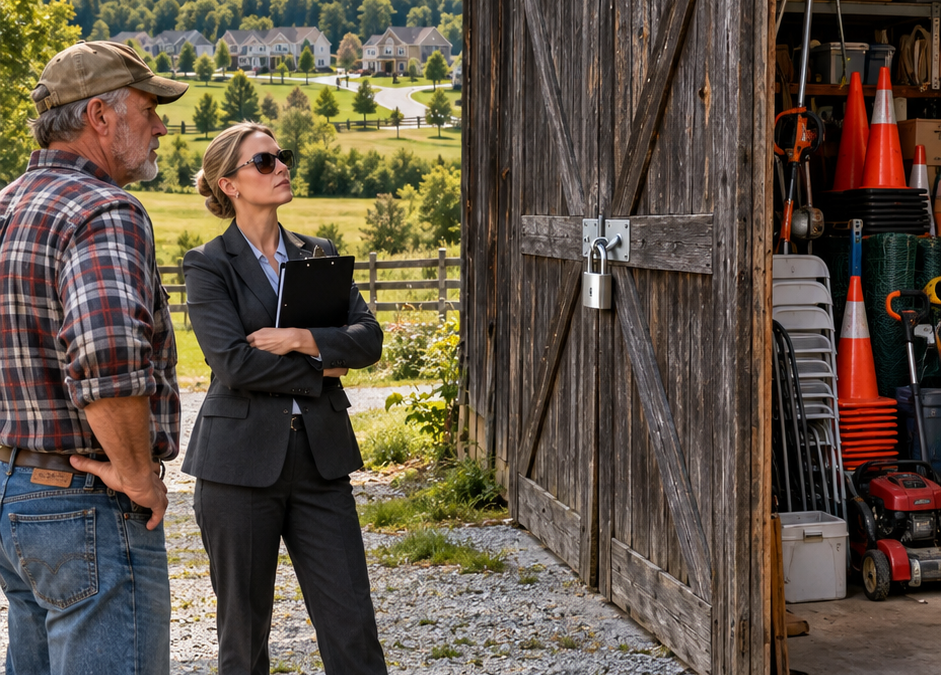
The woman standing in my driveway told me, with complete confidence, that my barn had been designated for HOA storage and that I had until the end of the month to remove my own belongings from it.
Behind her, the barn my grandfather had built by hand in 1951 was secured with a heavy padlock I had never purchased, while inside sat thousands of dollars’ worth of HOA equipment nobody had asked permission to store there.
What happened after I pulled one old deed from my desk drawer turned that padlock into the most expensive storage decision the board had ever made.
My name is Daniel Cutter, and I was sixty-one years old when Ridgerest Commons decided my family barn belonged to them.
The woman’s name was Renata Voss.
I did not know that yet.
At that moment she was simply a stranger in a charcoal blazer standing on the warm gravel of my driveway with a clipboard tucked against her chest as though it were a badge.
“Your barn is being used for community storage,” she said. “The board authorized it. You’ll need to clear your personal items out by the end of the month.”
I looked past her toward the barn.
It stood near the western edge of my property, seventy years of weather darkening the oak siding almost black in places. My grandfather, Elias Cutter, had raised that structure in 1951 using timber cut from his own land. He had carved the year into the lintel above the main doors beside his initials and my grandmother Ruth’s.
E.C.
R.C.
1951.
Those marks were still there.
So were the original hand-forged hinges.
What was new was the padlock.
A thick combination lock hung from a shiny metal hasp someone had screwed into the door frame.
Not my lock.
Not my hasp.
Not my screws.
Renata followed my gaze.
“The association needed secure space,” she explained. “This structure was identified as underutilized.”
I turned back to her.
“Underutilized by whom?”
She blinked once.
“The board.”
That answer told me nearly everything I needed to know.
She believed the issue was whether the barn was being used efficiently.
I knew the issue was who owned it.
The difference between those two questions would eventually cost Ridgerest Commons far more than anyone standing in my driveway that afternoon understood.
I did not argue with her.
I did not raise my voice.
I said, “Thank you for stopping by. I’ll look into it.”
She seemed almost disappointed by my response.
Then she walked back to a spotless white SUV, placed her clipboard on the passenger seat, and drove toward the subdivision behind my land.
I waited until the vehicle disappeared.
Then I walked to the barn.
That was where the real story began.
I had lived on the Cutter property for most of my life and continuously for the previous twenty-two years.
Forty-three acres in the hill country of Central Tennessee.
Nothing extravagant.
Pasture.
Cedar.
Black walnut.
A seasonal creek called Gentry Branch.
An old house.
An older barn.
And boundaries that had been surveyed, recorded, inherited, transferred, and respected longer than Ridgerest Commons had existed.
My grandfather Elias acquired the first twenty acres in 1948.
He paid eight hundred dollars to a cattleman named Fowler, who was seventy years old and ready to stop fighting weather, fences, and livestock.
Elias acquired the remaining acreage over the next four years through timber-clearing arrangements with the county.
He was not wealthy.
He did not have a lawyer.
He had a surveyor, a notary, strong hands, and a nearly religious respect for recorded boundaries.
“The land doesn’t care what a man says,” he used to tell my father. “It cares what the line says.”
My father repeated that to me so often when I was young that I could hear Elias’s voice through him.
The barn went up in 1951.
Twelve-by-twelve oak timbers.
Mortise-and-tenon joints.
Wooden pegs.
Heavy plank doors.
It survived ice storms, droughts, windstorms, wet springs, and more than seven decades of Tennessee summers.
My father, James Cutter, used it for hay and equipment.
By the time farming became less central to our income, it became a general storage building.
My tractor lived there.
So did a small utility trailer, post-hole diggers, chainsaws, fencing tools, a generator, and an old chest freezer that had belonged to my mother.
When my father died in 2003, the property transferred to me.
The paperwork was uncomplicated.
The deed was recorded.
The title was clean.
I had an updated survey completed the following year.
And because I inherited more than land from the men before me, I kept every important document.
The original deed.
The transfer deed.
The 1949 survey.
The 2004 survey.
Tax records.
Maintenance receipts.
Everything sat in a manila folder in the second drawer of the desk in my home office.
I knew exactly where it was.
Ridgerest Commons had been built along my western boundary decades after my family established the farm.
The subdivision was platted in 1997.
Its HOA was incorporated in 1998.
For twenty-five years, we had lived beside each other without any serious trouble.
They controlled paint colors, fences, lawns, mailboxes, landscaping, and whatever else their covenants allowed inside their development.
I did not care.
Their residents were free to organize their neighborhood however they wished.
My land, however, was not part of their neighborhood.
Never had been.
I was not an HOA member.
I had never signed their covenants.
My parcel had never been annexed into their subdivision.
The boundary between us was old, surveyed, and recorded.
In 2009, the association sent me a polite letter asking whether I would sell them four acres near the subdivision so they could build some kind of recreational area.
I declined.
They accepted my answer.
For fifteen years after that, nothing happened.
Then Renata Voss arrived with her clipboard and informed me that the same land they had once asked to buy was apparently now theirs to use.
That evening, I inspected the barn carefully.
The new hasp had been installed with three-inch screws driven directly into my grandfather’s door frame.
Four marks scarred the wood where the drill had slipped.
I photographed everything.
The lock.
The screws.
The hasp.
The gouges.
The door.
Then I went around to the side entrance.
That door still had my lock.
I opened it and stepped inside.
The first thing I noticed was that my tractor had been moved.
Someone had pushed it against the far wall.
My utility trailer had been shoved sideways into a corner.
Then I saw why.
The center aisle was filled with property that did not belong to me.
Folding tables.
Metal chairs.
Orange traffic cones.
A rolling utility cart.
Stacks of large plastic tubs bearing the blue Ridgerest Commons logo.
A pressure washer.
A gas-powered generator.
There were enough items to make it obvious this had not been a temporary accident.
Someone had planned it.
Someone had organized it.
Someone had decided my barn was available.
I stood there for several minutes.
The smell bothered me more than I expected.
For my entire life, that barn had smelled like old oak, grease, dry hay, dust, gasoline, and machinery.
Now there was plastic in the air.
Packaging foam.
New rubber.
Synthetic fabric.
Someone else’s things.
That was the moment the intrusion became personal.
Not because the equipment was valuable.
Not because the barn had been physically damaged beyond repair.
But because strangers had entered a place that had belonged to my family for generations, rearranged our possessions, drilled into oak my grandfather had milled himself, and behaved as though the absence of immediate resistance was the same thing as permission.
I took more photographs.
Then I went home.
I opened the second drawer of my desk.
The manila folder was exactly where it had always been.
I carried it to the kitchen table.
The deed identified the parcel clearly.
Book 47, page 312.
Transferred to Daniel James Cutter on March 14, 2003.
The survey showed the western boundary running parallel to the Ridgerest Commons fence.
The barn sat well inside my property.
There was no easement through it.
No shared ownership.
No access agreement.
No lease.
Nothing.
I took out a yellow legal pad.
I wrote:
RENATA VOSS.
Underneath it:
TRESPASS.
Then I closed the pad.
There was no reason to rush.
The lock was already there.
Their property was already inside.
Every additional day only created more evidence.
Four days later, a certified letter arrived.
The envelope carried the Ridgerest Commons logo and the slogan:
BUILDING COMMUNITY TOGETHER.
I almost admired the irony.
The letter was signed by the board president, Gerald Fitch.
According to Gerald, the board had voted during a special session to designate my barn as a “temporary community storage facility.”
He referred to something called a “neighborhood resource utilization provision.”
No statute was cited.
No easement.
No lease.
No deed.
No contract.
No recorded covenant.
Nothing explaining how a private association could vote itself the right to occupy property belonging to a nonmember.
The second paragraph was even better.
It said my failure to cooperate could result in a “community disruption fee” of $250 per month.
Then it warned that the association reserved the right to seek injunctive relief if I interfered with the storage arrangement.
I read that paragraph three times.
They had entered my property.
Installed their own lock.
Filled my barn with their equipment.
And were threatening to fine me if I interfered with them doing it.
I photographed the letter.
Then I called Warren Albright.
Warren had handled the property transfer after my father died.
He was sixty-seven and had practiced property law in the county for nearly four decades.
His office sat above an old hardware store in the county seat.
When I described what had happened, he was silent for several seconds.
“They put a lock on your barn?”
“Yes.”
“Their lock?”
“Yes.”
“And their equipment is inside?”
“Yes.”
“And now they’re threatening to fine you for interfering?”
“That’s what the letter says.”
Another pause.
Then Warren said, “Daniel, that’s trespass.”
“I thought you might say that.”
“It may also support a conversion claim. And if they’re occupying the structure for storage, we need to determine how long they’ve been using it.”
He told me not to remove the lock.
Not yet.
He told me not to move their equipment.
And he told me not to communicate directly with Renata or Gerald.
“Photograph everything,” he said. “Keep dates. Keep envelopes. Keep delivery records.”
“I already started.”
“I figured you had.”
Then Warren said something that became the guiding principle for everything that followed.
“Let the paper do the work.”
I liked that.
My grandfather would have liked it too.
Eight days later, Warren mailed a certified letter to Gerald Fitch and the HOA’s registered agent.
Four pages.
No insults.
No threats.
Just facts.
He identified my property using the recorded deed.
Attached the survey.
Explained that Ridgerest Commons had no easement, lease, license, covenant, or other recorded interest allowing it to enter the parcel or use the barn.
He demanded that the lock and all HOA property be removed within fourteen days.
Then he introduced a number that changed the discussion.
Four hundred twenty dollars per month.
That was Warren’s initial estimate of the fair rental value for comparable agricultural storage space.
The HOA, he wrote, was occupying space without permission and therefore accruing a claim for unpaid use.
Renata replied eleven days later.
Her letter did not address the deed.
It did not challenge the survey.
It did not identify any easement.
Instead, she said the board continued to support its “community resource designation” and would be willing to discuss a formal arrangement going forward.
I read that sentence twice.
“They want me to approve it after they already did it,” I told Warren.
“Yes.”
Renata also offered what she called a “nominal storage fee.”
Warren gave a dry laugh when I read him that part.
“They’ve moved from saying they owe you nothing to arguing about the amount.”
“Which means?”
“Which means they understand more than they’re admitting.”
That was when I hired Hugh Prader.
Hugh was a licensed land surveyor who had worked in the region for more than thirty years.
He had done the 2004 survey after my father’s death.
One October morning, he arrived with an assistant and enough equipment to make the pasture look briefly like a scientific field station.
I watched them work along the western boundary.
Cedar branches moved in a cold breeze.
Black walnut leaves lay flattened against the earth.
The barn stood behind us, still locked with the HOA’s padlock.
When Hugh finished, he came to the house and spread his notes across the kitchen table.
“The old survey was right,” he said.
“How right?”
He tapped the paper.
“Your western boundary is exactly where it was shown in 1949.”
He traced the line with one finger.
“The Ridgerest fence is twelve feet west of it.”
“And the barn?”
“Ninety-three feet, four inches inside your property.”
I leaned back.
“So there’s no overlap.”
“None.”
“No ambiguity?”
“None.”
Then Hugh slid another page across the table.
“There’s something else.”
It was a copy of the original Ridgerest Commons plat.
Hugh pointed to a notation in the legal description.
The subdivision’s eastern boundary had been drawn with explicit reference to the existing Cutter agricultural tract.
More importantly, the document stated that no easement, access right, or community interest was claimed or implied in that adjacent property.
I read it twice.
Then once more.
The subdivision’s own founding plat acknowledged that my property was separate.
Not accidentally separate.
Explicitly separate.
Hugh looked at me.
“Whoever designed that subdivision knew exactly where your land was.”
Apparently the board did not.
Or they had chosen not to know.
Either way, the result was the same.
Eight days later, Hugh delivered his certified survey.
I added it to the file.
By then the manila folder was too small.
I replaced it with an accordion file.
On the front, in black marker, I wrote:
RIDGEREST COMMONS — BARN PARCEL.
The file grew steadily.
Photographs.
Letters.
Surveys.
Certified mail receipts.
Copies of recorded plats.
Dates.
Names.
Everything in order.
When Warren reviewed Hugh’s report, he called me.
“That plat language matters,” he said.
“Because they acknowledged the boundary?”
“More than that. Their own founding instrument says no right in your parcel was claimed or implied. That makes it difficult for anyone associated with the HOA to pretend this boundary appeared yesterday.”
Warren recommended filing a quiet title action.
There was no legitimate title dispute, but a court judgment would create a permanent record confirming ownership and extinguishing any suggestion that Ridgerest Commons possessed an interest in the barn parcel.
I agreed.
Then I did something Warren had not asked me to do.
I went to the county clerk’s office myself.
I wanted to read the HOA’s governing documents.
If Ridgerest Commons claimed some internal authority allowed them to seize private storage space, I wanted to see the language.
Their covenants ran forty-one pages.
I read them from the beginning.
Article 7 dealt with common property and community facilities.
The association’s authority applied to land deeded to the HOA or held in common ownership by members.
That was it.
Nothing gave the board authority over neighboring private land.
Nothing allowed it to identify an “underutilized structure” on property outside the subdivision and designate it as a community asset.
The power Renata had claimed did not exist.
I sat under the fluorescent lights of the clerk’s office staring at Article 7.
That was one of the strangest moments in the entire dispute.
I did not feel victorious.
I felt calm.
My grandfather had died years earlier, but suddenly I could picture him standing beside the table.
Elias had believed paperwork mattered because memory faded and people changed.
A deed did not care how confident someone sounded.
A survey did not care how many people voted.
A boundary did not move because a board believed moving it would be convenient.
I photographed the relevant pages and called Warren the next morning.
“They don’t have it,” I said.
“Don’t have what?”
“The authority Renata cited. Article 7 only applies to association property.”
Silence.
Then:
“Send me every page.”
Warren’s second letter was sharper.
He quoted the HOA’s own covenants back to them.
He attached Hugh’s survey.
He cited the original Ridgerest plat.
And he revised the claimed storage value to $450 per month based on comparable arrangements he had located in county records.
The letter stated plainly that Ridgerest Commons was occupying private property without authorization and accruing a debt for every month of continued use.
This time, Warren sent a copy not only to Gerald Fitch but also to the HOA’s attorney of record.
Philip Darden.
That changed everything.
Philip practiced in Nashville.
He called Warren within days of receiving the letter.
I was not part of the conversation, but Warren summarized it afterward.
Philip had reviewed the deed.
He had reviewed the surveys.
He had read the plat notation.
He had read Article 7.
“And?” I asked.
Warren chuckled.
“He has very little to say about ownership.”
That was lawyer language for:
They knew they were in trouble.
Philip asked whether the dispute could be settled without litigation.
Warren said yes.
Three things would need to happen.
Remove the lock.
Remove the property.
Pay for the unauthorized storage.
The board scheduled a meeting for the second Wednesday in November.
Warren attended for me.
I stayed home.
There was no reason to sit in a room while people debated whether recorded documents meant what they plainly said.
Warren brought the file in a three-inch binder.
The meeting began with Gerald Fitch reading a prepared statement.
According to Warren, Gerald described the board’s actions as “community-minded” and “forward-looking.”
He said the HOA had identified an “underutilized structure adjacent to the subdivision.”
Adjacent.
That word mattered.
They were no longer calling the barn part of Ridgerest Commons.
Philip had clearly corrected them.
Gerald explained that the board had believed using the barn would benefit residents.
What he did not explain was why benefiting residents entitled them to enter someone else’s property.
When Gerald finished, Warren opened the binder.
He read the deed.
Then the survey.
Then Hugh’s measurements.
Then the subdivision plat acknowledging the Cutter agricultural tract.
Then the sentence stating no easement, access right, or community interest was claimed.
Finally, he read Article 7 of the HOA’s own covenants.
No editorializing.
No raised voice.
When he finished, he closed the binder.
“My client is willing to resolve this without further court intervention,” Warren said.
Gerald leaned forward.
“What would that require?”
“Immediate removal of the lock. Removal of all association property within seven days. Payment of unpaid storage charges calculated at four hundred fifty dollars per month.”
Gerald looked toward Philip.
Philip apparently said nothing.
Gerald tried another approach.
“What if the association issued a formal apology?”
“An apology would be appropriate,” Warren replied. “It would not satisfy the financial obligation.”
Gerald’s jaw tightened.
“We did not intend to rent the building.”
“You intended to use it.”
“We believed it was available.”
“You were informed it was not.”
“We were acting in good faith.”
Warren looked at the binder.
“Good faith does not change the deed.”
According to Warren, that was when Renata finally spoke.
“This association cannot be expected to pay thousands of dollars simply because Mr. Cutter chose not to cooperate with a community initiative.”
Warren turned toward her.
“Ms. Voss, Mr. Cutter did not refuse to cooperate with an initiative. Your association entered property it did not own.”
“It was vacant.”
“No.”
“Underutilized.”
“That is not a property interest.”
“The board voted.”
“That is not a property interest either.”
Philip Darden intervened before Renata could continue.
The board voted that evening.
Four to one.
Remove the lock.
Remove the equipment.
The single dissenting vote came from Renata.
When Warren told me that, I laughed for the first time since the dispute began.
Not because it was funny.
Because even with her own attorney sitting in the room, even after hearing the deed, survey, plat, and covenants read aloud, she still believed confidence could substitute for jurisdiction.
The lock came off the following Saturday.
Two men arrived in a pickup truck.
They removed the hasp.
When they finished, eight screw holes remained in the oak.
I photographed those too.
The HOA’s belongings came out over the next three days.
Tables.
Chairs.
Totes.
Traffic cones.
Generator.
Pressure washer.
When the final van left, I walked inside.
The barn was mine again.
At least physically.
I pushed the tractor back to its normal position.
Straightened the trailer.
Swept the floor.
The smell of plastic slowly faded.
But one issue remained.
The rent.
Philip tried to negotiate.
First forty percent.
Then sixty.
His argument was always the same.
The board had misunderstood.
They had acted in good faith.
They had not intended to create a landlord-tenant relationship.
Warren’s answer was also always the same.
They had used someone else’s building.
The value of that use could be calculated.
At some point, I became interested in another question.
“What happens when someone stores property on land, doesn’t pay what they owe, and leaves the owner with the bill?” I asked Warren.
He was quiet.
“That depends on the legal relationship and the applicable statutory procedure.”
I had been reading.
I told him I wanted to explore the remedies available for abandoned property and unpaid storage.
Warren did not immediately agree.
That was one thing I respected about him.
He never confused an emotionally satisfying idea with a legally sound one.
He reviewed the statutes.
He reviewed the history.
He considered the theory we had already asserted regarding unauthorized occupation and storage.
Then he drafted another notice.
The HOA received fourteen days to satisfy the outstanding amount or enter a written agreement.
Philip responded with another partial offer.
Sixty percent.
And one condition.
We had to abandon the theory that their stored property could be used to satisfy the debt.
I told Warren no.
He filed the quiet title action.
He also recorded the appropriate lien notice connected to the unpaid storage claim and served the association through its registered agent.
For the first time, the dispute was no longer just sitting inside my accordion file.
It was attached to their public record.
Then I called Harland Valley Estate Sales.
The auctioneer was Roy Sethwick.
Roy had run farm and estate auctions for more than twenty years.
He was short, compact, and spoke with the kind of calm voice that somehow carried across an entire field without ever sounding loud.
I explained the history.
He read the notices Warren had prepared.
Then he looked toward the barn.
“So these people locked your building,” he said.
“Yes.”
“Put their things inside.”
“Yes.”
“Then told you to move your stuff out.”
“Yes.”
Roy stared at me.
“I’ve sold property for some strange reasons.”
“I imagine you have.”
“This one is new.”
He smiled slightly.
“But paperwork looks clean.”
A sale date was set.
The required notice was published in the county newspaper.
The auction listing identified the property.
Folding tables.
Metal chairs.
Rolling utility cart.
Storage tubs.
Traffic cones.
Generator.
Pressure washer.
The stated unpaid amount was $3,150.
The HOA was notified that it could stop the sale by paying the amount due before the auction date.
They did not.
After the second notice ran, Philip sent Warren a letter calling the auction procedurally improper and threatening to seek an emergency injunction.
Warren replied that same day.
He cited the notice.
The lien.
The documentation.
The opportunities to pay.
Then he invited Philip to file whatever motion he believed appropriate.
No motion came.
That silence told me more than another ten-page letter would have.
The auction took place on a cold Saturday morning in late November.
The sky was nearly white.
The gravel in front of the barn had hardened overnight, and every breath hung briefly in the air.
Roy arrived early.
He set up a small table and podium near the barn doors.
About thirty people came.
Farmers.
Dealers.
Neighbors.
People who had seen the newspaper notice and were curious.
A reporter stood near the fence with a notebook.
Neither Gerald nor Renata appeared.
Philip sent a junior attorney from his firm.
The young man stood at the back of the crowd wearing a dark coat, hands in his pockets, saying nothing.
At nine o’clock, Roy began.
He explained that the items were being sold pursuant to a documented storage dispute and lien process.
Then he started calling lots.
The folding tables went first.
A man who operated a church hall bought them.
The metal chairs followed.
Then the utility cart.
Two bidders wanted it badly enough that Roy let them chase each other for several rounds before one finally stopped.
The Ridgerest Commons storage tubs drew laughter when Roy announced the lot.
A woman who owned a landscaping company bought them.
“Logo doesn’t bother me,” she said.
The traffic cones went to a contractor.
Then Roy moved to the generator.
That drew the most attention.
It was nearly new.
A man in a canvas jacket checked the pull cord, fuel cap, outlets, and frame.
Roy started calling.
“One fifty.”
A hand went up.
“Two.”
Another bidder.
“Two fifty.”
The man in the canvas jacket nodded.
“Three.”
“Three twenty-five.”
“Three fifty.”
“Three seventy-five.”
The other bidder hesitated.
Roy looked across the crowd.
“Four hundred?”
The canvas jacket nodded.
Another bidder called, “Four ten.”
Roy turned.
“Four twenty?”
Silence.
“Four hundred ten dollars once.”
He paused.
“Twice.”
The young attorney from Philip’s firm scribbled something into his notebook.
“Sold.”
The gavel came down.
The generator belonged to someone else.
I expected to feel something then.
Vindication.
Satisfaction.
Maybe even pleasure.
I did not.
I simply watched the buyer write a check.
This was not revenge anymore.
It was accounting.
The pressure washer sold next.
Then the final small items.
When everything was finished, the junior attorney closed his notebook, walked to his car, and drove away without speaking to me.
Roy totaled the sales.
$3,420 gross.
After his commission and publication expenses, the amount available against the lien was $3,040.
That left $110 unpaid.
One hundred ten dollars.
After months of letters, surveys, meetings, locks, notices, lawyers, and an auction, Ridgerest Commons still owed me one hundred ten dollars.
Warren laughed when I told him.
“Should we let that go?” he asked.
“No.”
He paused.
Then said, “I didn’t think so.”
The quiet title case went before Judge Harlon Boone.
I attended that hearing.
For the first time in the entire dispute, I sat across a courtroom from the organization that had started it.
Gerald Fitch was there.
Renata was not.
Philip Darden represented the HOA.
Warren sat beside me with the same binder he had taken to the board meeting.
The case was remarkably short.
That is something people often misunderstand about property disputes.
The arguments can feel enormous when they are happening.
But once everything is reduced to documents, many questions become very small.
Judge Boone looked at Philip.
“Does the association possess any recorded instrument authorizing use of the Cutter barn parcel?”
Philip stood.
“No, Your Honor.”
“Any easement?”
“No.”
“License?”
“No.”
“Lease?”
“No.”
“Recorded covenant?”
“No.”
Judge Boone removed his glasses.
“Then what was the basis for entering the property?”
Philip paused.
“The board believed the structure had been treated as a community resource.”
“Believed by whom?”
“The board.”
The judge looked down at the file.
“Belief is not an instrument.”
No one spoke.
Judge Boone continued.
“The plaintiff’s title is documented. The survey is documented. The subdivision’s own plat acknowledges the parcel as separate property and expressly disclaims an interest.”
Philip nodded.
“Yes, Your Honor.”
The remaining questions concerned money and fees.
Judge Boone awarded the outstanding rental balance.
He awarded Warren’s recoverable attorney’s fees under the applicable provisions Warren had pleaded.
Most importantly, he issued a permanent injunction preventing Ridgerest Commons from claiming access to or use of my parcel without a valid recorded instrument executed by the property owner.
In plain English:
They were never to do it again.
The association paid the judgment within thirty days.
The quiet title judgment was recorded in December.
The same county record system that held my grandfather’s ownership history now held a modern court order confirming exactly what Elias’s survey had already said generations earlier.
The land was ours.
The barn was ours.
The line had never moved.
Gerald Fitch did not run for another term as board president the following spring.
Renata Voss’s compliance-director position was eliminated at the association’s annual meeting in March.
I learned that from Warren.
I did not celebrate.
I did not attend their meeting.
I did not send anyone a letter.
By then, I had no interest in Ridgerest Commons beyond making sure they stayed on their side of the property line.
The only unfinished business was the door.
Eight holes remained where their hasp had been screwed into my grandfather’s oak frame.
One cold afternoon, I went into the workshop and found a scrap of seasoned oak.
I cut plugs.
Fitted them.
Glued them into the holes.
Sanded the surface flush.
Then I sealed the wood.
When I finished, I stepped back.
Unless someone knew where to look, they would never notice the repair.
That mattered to me.
Not because I wanted to erase what had happened.
Because the barn deserved to look like itself again.
A few weeks later, after the first hard frost of December, I walked out there early in the morning.
The gravel was frozen beneath my boots.
The cedar trees along the western fence remained green.
Everything else had gone brown and quiet.
I unlocked the side door with my key.
My key.
The tractor sat where it belonged.
The trailer was square against the wall.
My tools were exactly where I had left them.
The barn smelled like oil, old wood, dust, and hay.
Morning light entered through the high south window, cutting a pale rectangle across the floorboards Elias had laid in 1951.
I walked to the main entrance and looked up.
E.C.
R.C.
My grandfather’s initials.
My grandmother’s initials.
Seventy-three years earlier, Elias Cutter had built that barn because he needed somewhere to protect what belonged to his family.
He could never have imagined an HOA.
He probably would have laughed at the idea that a neighborhood board could vote to claim a building sitting ninety-three feet inside someone else’s land.
But he would have understood the solution immediately.
Find the deed.
Find the survey.
Read the record.
Then be patient.
That was what the entire dispute had taught me.
Authority can look impressive.
It can arrive in a clean SUV.
It can carry a clipboard.
It can use official letterhead.
It can hold meetings, pass resolutions, create policies, threaten fees, and speak in language designed to make resistance sound unreasonable.
None of those things create ownership.
The first question is always simpler.
What does the record say?
In my case, the record said the same thing in 1949, 1997, 2003, 2004, and finally in a courtroom decades later.
The Cutter property ended where the recorded line said it ended.
The subdivision began where its recorded line said it began.
And the barn belonged to me.
The HOA had tried to convert confidence into ownership.
Instead, their own equipment paid nearly all the rent they had refused to acknowledge.
A judge ordered the remaining balance paid.
And a permanent judgment ensured that no future board could repeat the same mistake without first confronting a record that was now even stronger than before.
I stood beneath the carved lintel for another moment.
Then I closed the barn doors.
The repaired oak met cleanly in the middle.
I slipped my lock through the original hardware.
It clicked shut.
My lock.
My barn.
My land.
Beyond the fence, Ridgerest Commons sat quiet in the cold morning.
The cedar branches moved slightly in the wind.
And ninety-three feet and four inches inside my property line, Elias Cutter’s barn was still standing exactly where he had built it.








