𝗙𝗨𝗟𝗟 𝗦𝗧𝗢𝗥𝗬 HOA Ordered My Wheelchair Ramp Torn Out—Then Their Own Lawyer Opened the Old File
𝗣𝗔𝗥𝗧 𝟮
I knew exactly where my copy was.
Second drawer.
House documents.
Architectural approvals.
When using the front steps became unsafe for me, I had not simply hired someone and built whatever I wanted.
I had followed the process.
Every tedious step.
Application.
Photos.
Measurements.
Contractor drawing.
Railing details.
Street-facing elevation.
The first design came back with comments.
The HOA wanted the rail color matched to the porch trim.
They wanted the lower section shifted slightly inward so it did not interfere visually with the sidewalk landscaping.
I remember reading that second request and thinking that apparently my ability to enter my home safely had to coexist peacefully with decorative shrubs.
Fine.
We changed it.
The contractor revised the plan.
I resubmitted.
Three weeks later, written approval arrived.
I found the letter behind the original invoice.
Management company logo.
My name.
My address.
Application number.
APPROVED — REVISED EXTERIOR MODIFICATION
Simple.
Clear.
My contractor then pulled the city permit.
Built the ramp according to the approved drawing.
City inspector came out afterward.
Checked the work.
Closed the permit.
For the next year and a half, nothing happened.
Landscapers worked around it.
Neighbors used the sidewalk beside it.
The management company performed a routine exterior inspection months after construction and photographed the front of my house.
No violation.
No warning.
No question.
The ramp was simply part of the property.
Then the board changed.
Vanessa became president.
Within weeks, I received a notice identifying the ramp as an:
UNAPPROVED EXTERIOR STRUCTURE
I assumed somebody had missed the old file.
Easy mistake.
Associations change management companies.
Board members change.
Records get separated.
So I scanned the approval letter and uploaded it to the portal.
The response did not say the letter was fake.
It did not say I had misunderstood it.
The message said:
Matter referred to board for review.
Twelve days later, the language changed.
Now the ramp was not “never approved.”
Now it “failed to comply with current architectural standards.”
That bothered me.
Those are different claims.
I sent a message.
Please identify the architectural standard that changed and the provision under which a previously approved and completed modification becomes noncompliant after adoption of a later policy.
No answer.
Vanessa eventually replied personally.
Prior boards cannot permanently bind the association to exterior modifications that conflict with current community standards.
I read it several times.
Maybe she was right about some situations.
I genuinely didn’t know.
HOAs adopt new standards all the time.
Rules change.
Buildings age.
Safety conditions change.
Nothing in property law is as simple as people on the internet like to pretend.
But my ramp had not appeared overnight.
The HOA had reviewed the design.
Requested revisions.
Approved those revisions.
Allowed construction.
Then eighteen months later, a new president decided that entire history no longer mattered.
I wanted to know why.
So I asked narrowly.
If the association believes the approval is no longer valid, please identify the governing process by which the approval was revoked or superseded after construction.
Vanessa responded in under an hour.
The board’s position is final.
That was when I stopped arguing.
And started filing.
I created folders.
Notices.
Emails.
Approvals.
Permit records.
Photos.
Contractor records.
I saved screenshots of the portal.
Downloaded messages as PDFs.
Wrote dates on a legal pad.
It felt excessive.
Then again, the HOA had already described the same ramp three different ways.
Unapproved.
Approved but outdated.
Unapproved again.
Memory becomes unreliable when people change wording every week.
Documents don’t.
The next morning, I photographed the damaged rail.
The missing section changed how I used the ramp.
I could still get inside.
Carefully.
But there was now an unfinished edge where support had been removed.
I had to position my chair differently approaching the porch.
Slow down.
Stay away from one side.
That was when the dispute stopped feeling like a cosmetic argument.
They had already made the entrance less safe.
Not with a letter.
Physically.
Another notice arrived before I repaired it.
Certified mail and portal upload.
Seventy-two hours.
Remove the remainder.
Daily fines to follow.
Attached was a street photograph with a red rectangle around the ramp.
Label:
UNAPPROVED EXTERIOR MODIFICATION
I stared at that phrase.
Again.
I uploaded the approval letter.
Again.
Then the original application.
The revised drawing.
The contractor invoice.
City permit.
Inspection closure.
One sentence:
Please confirm these documents have been reviewed before any additional enforcement action is taken.
The portal showed my message opened within thirty minutes.
No answer.
Next morning:
$250 enforcement assessment.
I called the management company.
Rachel Kim answered.
I had spoken to her before about a landscaping charge.
She pulled up my account.
“I see the $250.”
“What is it based on?”
“Architectural enforcement.”
“Do you see the approval letter attached to the property file?”
Typing.
“One moment.”
More typing.
“Yes. I see several documents.”
“Can you tell whether the board reviewed them?”
The keyboard stopped.
“I don’t have enough information on this screen to say that.”
That was a careful answer.
I respected it.
“Can you make a note that I asked?”
“Yes.”
I wrote down her name.
Time.
Summary.
That became routine.
Every call:
Date.
Person.
Statement.
Every message:
Saved.
Every notice:
PDF.
Because the differences were small.
The first notice said no approval existed.
The second implied an approval existed but current standards controlled.
The third returned to calling the ramp unapproved.
In conversation, that could sound like sloppy phrasing.
In a chronological file, it looked different.
Two days later, daily fines started.
Small first.
Then increasing.
That was the pressure mechanism.
Make time expensive.
At the end of the week, I received a hearing notice.
Fifteen minutes.
Video conference.
I organized my documents chronologically.
Original application.
HOA revision request.
Revised plan.
Written approval.
Permit.
Final inspection.
Finished-ramp photographs.
New violations.
Demolition work order.
Late that night, another document appeared in the portal.
A board resolution adopted two months earlier.
It addressed exterior architectural consistency.
Sheds.
Visible equipment.
Porch additions.
Decorative structures.
Unapproved modifications.
One paragraph allowed enforcement against exterior structures conflicting with current standards.
I read the whole thing.
Then again.
I could not find language saying every previously approved modification automatically became invalid when the policy changed.
Maybe there was authority elsewhere.
But not in that resolution.
The hearing started at seven the following evening.
Vanessa appeared first.
Deep red blazer.
Four directors joined.
Rachel appeared with her microphone muted.
Vanessa introduced the matter.
“Continued failure to correct an exterior architectural violation.”
I waited.
Then said:
“I understand that’s the board’s position. What I’m asking is why an approved ramp is being treated as unauthorized.”
“The board has reviewed the matter.”
I held my approval letter toward the camera.
“Did the board review this specific letter?”
Vanessa looked toward another window.
“The board reviewed the records it considered relevant.”
That answer made one director lean forward.
His name was Steven.
“When was that issued?”
“Eighteen months ago.”
He looked down at his packet.
“Was the ramp built before our new architectural resolution?”
“Yes.”
Vanessa interrupted.
“The age of the modification is not controlling.”
Another director, Clare, spoke.
“Rachel, does management have the original application?”
Rachel opened something.
“Yes.”
“The approval too?”
A pause.
“Yes.”
The directors looked at each other.
That mattered.
Maybe not legally.
But procedurally.
At least two of them appeared to be learning about those documents during the hearing.
I asked the question at the top of my notes.
“What process did the board use to determine the written approval no longer protected the ramp?”
Vanessa held up the current resolution.
“The association has authority to enforce current standards.”
“Did the board issue any written analysis explaining how the previous approval was evaluated under those standards?”
“This is not a courtroom.”
“I know.”
“The board will conduct its hearing according to association procedures.”
I stopped pushing.
I had already learned what I needed.
The old file existed.
Management had it.
At least some directors did not appear fully familiar with it.
Vanessa continued.
She said the HOA had issued repeated notices and attempted “voluntary resolution” before hiring a contractor.
I wrote that phrase down.
Nobody had asked me to voluntarily remove the ramp.
Nobody had scheduled removal with me.
Nobody had asked whether I consented to contractor entry.
I learned the contractor was coming when I saw a demolition saw outside.
After Vanessa finished, the board entered closed session.
Twenty-one minutes.
Then everyone returned.
Violation sustained.
Daily fines continued.
Ten days to submit a compliance plan.
The written decision arrived two days later.
Along with minutes.
Materials listed as considered:
Current architectural standards.
Violation photos.
Enforcement notices.
Board resolution.
Not listed:
My original application.
Approval letter.
Revised drawing.
Permit.
Inspection closure.
That omission wasn’t absolute proof nobody had seen them.
Minutes can be summaries.
Closed-session documentation can be incomplete.
But it was a discrepancy.
Rachel had confirmed during the hearing that the old documents existed.
Yet the written decision said almost nothing about them.
Another fine appeared the next morning.
That was when I stopped asking Vanessa to explain herself.
I wanted the record.
All of it.
I sent a formal document request.
Original architectural file.
Approval history.
Board records concerning the ramp.
Management correspondence.
Contractor instructions.
Invoices.
Photos.
Materials used to authorize removal.
Anything relating to enforcement.
Six business days passed.
Fines continued.
Then Rachel called.
“It’s taking longer because some historical documents were transferred from our prior management company.”
“Transferred where?”
“Legacy archive.”
“Our current board can access that?”
“Management can access the archive.”
“Did the board?”
“I can’t tell you what individual directors requested.”
Important distinction.
The active enforcement file might not have contained the historical file.
That didn’t excuse anything yet.
But it gave me a possible explanation.
The first production arrived.
Current rules.
Current notices.
Photos.
Hearing materials.
Board resolution.
Demolition work order.
No old application.
No approval.
I emailed Rachel.
She replied:
Historical property file is being retrieved separately.
That changed how I organized everything.
I built a timeline.
Application.
Requested revisions.
Revised plan.
Approval.
Permit.
Construction.
Inspection.
Eighteen quiet months.
Board change.
New resolution.
Violation.
Fines.
Hearing.
Contractor.
That timeline didn’t prove the board lacked power.
It proved the ramp had history.
History the active file did not appear to reflect.
A few days later, Rachel contacted me.
“We found the archived property folder.”
The email arrived.
I opened the attachments.
Application.
Original drawing.
HOA requested changes.
Revised drawing.
Approval letter.
All familiar.
Then something new.
Old board meeting minutes.
My address appeared under architectural review.
Revised accessibility ramp design approved.
Vote:
Four in favor.
None opposed.
I stared at it.
Until then, I’d assumed the management company might have approved the project administratively.
No.
The board itself had voted.
Next document.
Internal note from the former management company.
It referred to the modification as connected to:
HOMEOWNER ACCESS NEEDS
and instructed that the materials be retained with:
PROPERTY ACCOMMODATION RECORDS
That phrase had never appeared in Vanessa’s notices.
I kept reading.
Old board email chain.
Railing color.
Landscaping.
Ramp route.
One director asked whether a temporary design should be considered.
Property manager replied that the request required careful review and said the question had been forwarded for legal guidance.
Then the chain skipped.
Next available email:
Board had received guidance and would proceed with revised design.
Something was missing.
I emailed Rachel.
“Was correspondence withheld?”
She checked.
Called later.
“Some legal communications are retained separately and can’t simply be produced to you.”
“I understand.”
I wasn’t asking for privileged advice.
“Can you confirm the material exists in the association’s historical file?”
“As far as I can see, yes.”
That was enough.
The association’s own archived record showed:
It understood why the ramp mattered.
It modified the design.
Its board voted.
It retained the file with accommodation-related records.
Then years later, a different board opened an enforcement case as though the structure were an unauthorized porch decoration.
Rachel sent two more documents.
First:
The routing sheet created when Vanessa reported the ramp.
Supporting materials:
Current architectural standards.
Current property photos.
No old approval.
No old board vote.
No legacy file.
Second:
Contractor intake record.
Association contact:
Vanessa Cole.
Job description:
REMOVE UNAUTHORIZED EXTERIOR INSTALLATION FOLLOWING OWNER NOTICE
Again:
No old approval.
No accommodation file.
No mention of prior board action.
Marcus had seen the weakness immediately.
The work order told him what the HOA wanted.
It did not explain why he had authority to physically alter my home over my objection.
I asked Rachel:
“When the contractor job was prepared, does the system show anyone accessing the archived property file first?”
She said she’d check.
Later:
Matter forwarded for internal review.
I immediately sent a preservation request.
Current file.
Archived file.
Contractor communications.
Board emails.
Work orders.
Notes.
Everything in existing form.
I did not accuse Vanessa of hiding anything.
The records supported a simpler possibility.
Enforcement began in one system.
Important history sat in another.
Whether that was careless or intentional was not something I could prove.
Then Daniel Mercer contacted me.
Outside counsel for the association.
His email was short.
He had been asked to review the dispute.
He requested any documents I possessed that might not appear in the current management file.
I sent:
Approval letter.
Permit record.
Inspection closure.
Photos.
Violation notices.
Hearing decision.
Meeting minutes.
Demolition video.
Old board vote.
I did not editorialize.
Let the chronology speak.
Less than an hour later, Daniel emailed the directors and management.
He requested the complete archived file.
Original application.
Board vote.
Correspondence concerning the nature of the request.
Privileged legal materials for his review.
Vanessa was copied.
Then silence.
Late that afternoon, Rachel forwarded another message.
Daniel had instructed management to:
SUSPEND FURTHER ENFORCEMENT PENDING COUNSEL REVIEW.
I read it twice.
Fines still showed in the portal.
Ramp still damaged.
But the machine had stopped.
Again.
First Marcus stopped the saw.
Now the association’s lawyer stopped the enforcement process.
Two days passed.
No notice.
No new fine.
No message from Vanessa.
Thursday afternoon, Daniel called.
“I’ve reviewed the active file and historical archive.”
His tone was measured.
“There are problems with how this matter progressed.”
He did not tell me privileged advice from the old board.
I didn’t ask.
He walked through facts.
“Your original application was filed eighteen months before the current resolution?”
“Yes.”
“Revised at management’s request?”
“Yes.”
“Board-approved?”
“According to the minutes you now have, yes.”
“Built materially according to the approved plan?”
“Yes.”
“City permit?”
“Yes.”
“Final inspection?”
“Passed.”
Then he explained.
The old board had not treated the ramp like a random exterior addition.
The records showed management and directors understood it related to my ability to access the home safely.
They reviewed it.
Required changes.
Obtained guidance.
Approved the revised version.
He was careful.
“That does not mean an association can never revisit an old modification.”
“I understand.”
“And an approval does not eliminate every future power in the governing documents.”
“Understood.”
“The problem is the process here.”
There it was.
The active violation file began with current photos and current standards.
The old approval history was not integrated.
So the process started with one assumption:
Unauthorized structure.
That assumption then became the foundation for every next step.
Notice.
Second notice.
Fine.
Hearing.
Daily fines.
Contractor.
By the time I produced the approval documents again, the board was already enforcing.
During the hearing, management confirmed those records existed.
Yet the written decision did not clearly explain why the prior approval was ineffective.
Daniel continued.
“I do not see a clear written analysis in the current record explaining why the earlier approval no longer controlled, what authority justified disregarding it, or why physical removal was appropriate after the historical documents were brought forward.”
I leaned back.
For weeks, Vanessa kept saying:
Current standards.
Board authority.
Final decision.
Daniel reduced everything to a much simpler sentence.
“The process matters.”
Exactly.
Maybe the HOA had legitimate enforcement powers.
Maybe some approved structures could eventually become subject to later requirements.
Maybe future circumstances could justify review.
But authority did not erase history.
And a new rule didn’t automatically make an old file disappear.
Then he asked about the demolition crew.
“Did anyone tell you contractors would arrive that morning?”
“No.”
“Did you consent to removal?”
“No.”
“Did you sign a right-of-entry document?”
“No.”
“Did anyone show you specific authority allowing physical removal over your objection?”
“No.”
He asked me to preserve the original video and photos.
“The contractor issue is distinct from a notice or fine.”
“I figured.”
“A work order identifies what the client wants done. It doesn’t, by itself, resolve the legal authority for entering private property and altering an attached structure.”
Marcus had figured that out in thirty seconds.
The board took several weeks.
I asked Daniel one thing.
“What was in the old legal correspondence?”
“I can’t disclose privileged advice.”
“Fair.”
He paused.
“What I can confirm is that the association understood the nature of your request before approving the project.”
That was enough.
The old board knew.
This wasn’t a forgotten barbecue screen.
They understood why the ramp existed.
Considered the design.
Modified it.
Approved it.
Then stored the record accordingly.
Daniel said he had recommended:
Immediate enforcement suspension.
No new fines.
Reversal review of existing charges.
No further contractor work.
Board review of how the historical approval should be treated.
Damage to be addressed separately.
The written confirmation arrived after the call.
I printed it.
Placed it beside Vanessa’s seventy-two-hour demand.
One document said:
Remove it.
The other said:
Stop.
Same association.
Different amount of research.
The next morning, no new fine appeared.
Then the city building department gave me another piece of independent confirmation.
I requested certified permit history.
Issued permit.
Inspection.
Closure.
The city didn’t decide HOA rights.
I didn’t ask it to.
It simply confirmed the ramp was lawfully permitted under city requirements at the time.
I sent the record to Daniel.
A few days later, the HOA hired an accessibility consultant.
Lena Ortiz.
She came to my house with measuring equipment, a digital level, tablet, and camera.
She did not ask me who was right.
She asked:
“Show me how you normally enter the house.”
Good question.
I demonstrated.
Then she examined the damaged rail.
Measured the ramp.
Photographed exposed hardware.
Checked support points.
Reviewed the old drawing.
Watched my demolition video from beginning to end.
“Has anyone repaired this section?”
“No.”
Her report stayed within her expertise.
She did not declare the HOA guilty of anything.
She documented physical condition.
The removed rail reduced support along part of the access route.
She recommended restoring the damaged section and avoiding additional removal while the dispute remained unresolved.
Then the insurance carrier became involved.
The HOA’s insurer requested:
Work order.
Contractor invoice.
Board records.
Photos.
Video.
Restoration estimate.
Communication suddenly became very formal.
Rachel handled routine matters.
Daniel handled disputes.
Vanessa disappeared.
No calls.
No messages.
No threats.
Marcus called me days later.
His company had been asked for a statement.
He told me their intake packet described the job as removing a noncompliant exterior structure after homeowner notice.
“Did it say I consented?”
“No.”
“Did it mention an old approval?”
“No.”
“Board vote?”
“No.”
“Accommodation records?”
“No.”
He sighed.
“When we got there, I assumed your HOA had handled its side.”
“Understandable.”
“Once you objected, I looked at the work order and realized it didn’t answer enough.”
“That’s why you stopped.”
“Yes.”
That mattered.
Not because Marcus was taking my side.
Because his records independently matched mine.
One participant confirmed permits.
One documented physical damage.
One confirmed job instructions.
Management confirmed split files.
Lawyer halted enforcement.
The story no longer depended on Vanessa’s version or mine.
The facts had started supporting themselves.
Monday night, the board held a special meeting.
I wasn’t invited to the closed session.
Didn’t need to be.
Later, Rachel sent a formal notice.
The prior enforcement decision was suspended.
Accumulated fines would be reversed.
The association would obtain a restoration estimate.
Future communication through management or counsel.
I opened the portal the next morning.
Balance:
$0.
Below it:
Fine.
Reversal.
Fine.
Reversal.
Fine.
Reversal.
For weeks, the growing balance had been the first thing I saw.
It was how disagreement became pressure.
Now the numbers were retreating line by line.
I sat staring longer than I expected.
That afternoon, a contractor came to inspect the railing.
Different company.
Different purpose.
He carried the original approved drawing.
Not Vanessa’s violation photograph.
He measured.
Compared the damaged section to the plan.
“Do you want it restored exactly to this configuration?”
“Yes.”
He made a note.
“That’s what I’ll quote.”
A few weeks earlier, a crew arrived to remove the ramp.
Now a crew was pricing the cost of putting it back.
That was when the shift felt real.
The estimate included:
Replacement rail.
Mounting hardware.
Porch-post repair.
Paint.
Finish work.
Final inspection.
The HOA approved it.
No attempt to split the bill.
No request that I accept a cheaper fix.
The restoration crew arrived the following week.
Before touching anything, the supervisor reviewed the drawing with me.
“This section?”
“Yes.”
“Same hardware style?”
“Yes.”
“Same rail height?”
“Correct.”
He worked carefully.
Removed damaged fasteners.
Repaired the porch post.
Installed new brackets.
Replaced the rail.
Repainted the affected area.
By late afternoon, the ramp looked almost exactly as it had before Vanessa sent the demolition crew.
Almost.
I still knew where the holes had been.
You remember damage even after paint covers it.
Lena returned after repairs.
Checked the restored section.
Confirmed support had been reinstated.
Management then issued a formal correction to my account.
The violation was closed.
Fines reversed.
Contractor damage restored.
Historical approval attached to the current property record so future board members would not have to search a legacy archive to find it.
That last part mattered more than I expected.
The file itself had been fixed.
No longer:
Current enforcement in one place.
Approval history somewhere else.
One record.
One chronology.
One property.
Daniel recommended additional changes to board procedure.
I learned about them later through the new policy notice.
Before enforcement involving an existing exterior modification:
Management had to check historical architectural records.
Prior approvals had to be identified.
If an approval existed, counsel review was required before physical-removal action.
Any contractor work touching an occupied residence required written confirmation of authority and access procedures.
That was Marcus’s question turned into policy:
Where’s the authorization?
Vanessa remained president for another few months.
But she stopped contacting me.
At the next annual meeting, several residents asked about enforcement procedures.
Not my ramp specifically.
The process.
How old approvals were stored.
How board resolutions interacted with prior decisions.
Whether contractors could ever be sent without owner coordination.
One director proposed a formal records-reconciliation project.
Passed.
Another proposed that archived architectural approvals be migrated into the current system.
Passed.
Vanessa looked tired throughout the meeting.
She did not run again the following year.
I never asked whether the ramp dispute caused that.
It probably wasn’t the only reason.
Board politics rarely has one cause.
And I wasn’t interested in turning her departure into some victory parade.
The victory was already outside my front door.
The ramp remained.
Approved.
Repaired.
Usable.
The first morning after restoration, I rolled down it slowly.
Habit.
At the repaired section, I paused.
The new handrail was solid beneath my palm.
Same angle.
Same height.
Same route the old board had approved.
I reached the sidewalk and turned around.
For weeks, Vanessa had talked about architectural consistency.
From the street, the ramp looked exactly the way the HOA had required it to look eighteen months earlier.
Matching rail color.
Shifted lower section.
Landscaping preserved.
Every visual detail they had asked for.
That irony would have been funny if the process hadn’t damaged something I depended on.
A neighbor named Ben crossed the street while I was looking at it.
“They fixed it.”
“They did.”
“HOA paid?”
“Yes.”
He nodded.
“Good.”
Then:
“Why did they go after it in the first place?”
I thought about the answer.
There were several.
New board.
New standards.
Bad file separation.
Assumptions.
Escalation.
A president too confident in a partial record.
I finally said:
“They started with the newest paperwork and forgot the older paperwork existed.”
Ben laughed.
“That’s it?”
“That’s enough.”
And it was.
People expect institutional mistakes to begin with dramatic corruption.
Often they begin with a bad assumption nobody checks.
Vanessa saw a ramp that did not match the current board’s preferences.
Someone opened an enforcement case.
The active file contained current photos.
Current standards.
Current board resolution.
The old approval stayed in the archive.
Then the case developed momentum.
Notice generates notice.
Notice generates fine.
Fine generates hearing.
Hearing generates contractor.
At every stage, the previous step makes the next one feel more legitimate.
By the time Marcus arrived with a demolition saw, everyone involved could point backward and say:
“Look how much process has already happened.”
That’s why his question mattered.
Where’s the homeowner authorization?
He stopped looking backward.
He asked what allowed the next physical act.
Nobody had answered that.
The most important thing Daniel did wasn’t declare me right.
He reconstructed the chronology.
That’s what changed everything.
Not one magical document.
Not one legal phrase.
A sequence.
Application.
Revision.
Approval.
Construction.
Permit.
Inspection.
New board.
New standard.
Violation file.
Old approval ignored.
Fines.
Hearing.
Contractor.
Once you see the sequence, the problem becomes obvious.
The association had not begun by deciding what an old approval meant under new rules.
It had begun by treating the approval like it wasn’t there.
Then continued even after it knew it existed.
That was harder to defend.
I kept copies of everything.
The first notice.
The approval.
The old board minutes.
The work order.
The video.
The contractor’s pause.
Daniel’s suspension letter.
Fine reversals.
Restoration report.
Not because I expected another fight.
Because records had saved the ramp once.
I intended to make sure nobody had to rediscover the same history again.
A few months later, Rachel called.
“We’ve completed the legacy-file migration.”
“For my property?”
“For the whole community.”
I smiled.
“So other homeowners’ old approvals are being linked too?”
“Yes.”
That was bigger than my ramp.
Old sheds.
Decks.
Windows.
Fences.
Solar panels.
Accessibility modifications.
Whatever earlier boards had approved.
Future directors could still review things where legally appropriate.
But at least they would be reviewing actual history.
Not pretending the first page in a modern portal was the first page of reality.
“Thank you,” I said.
Rachel paused.
“I should probably thank you.”
“For being fined?”
“For finding a problem in our records system.”
“I would’ve preferred a survey.”
She laughed.
Fair.
Lena’s report ended up helping with one additional change.
The board adopted a procedure requiring accessibility-related modifications to receive separate review before removal enforcement.
Not automatic approval.
Not immunity from every standard.
Just a requirement that the association identify the functional issue before treating the structure like decorative clutter.
Again:
Boring.
Procedural.
Useful.
That’s how real reform usually looks.
No dramatic music.
Just an extra checkbox that prevents the next person from waking up to a demolition crew.
The contractor Marcus stopped by months later.
He had another job nearby and knocked on my door.
I rolled out.
He looked at the repaired rail.
“Looks better.”
“Looks like it did before you arrived.”
He winced.
“Fair.”
“I’m not blaming you.”
“I know.”
He leaned against his truck.
“My company changed our intake process after that job.”
“How?”
“If a client wants us to remove something permanently attached to an occupied residence and the owner is expected to object, office wants documentation before dispatch.”
I raised an eyebrow.
“My ramp became training material?”
“Basically.”
“Do I get royalties?”
“No.”
“Disappointing.”
He laughed.
Then became serious.
“I should’ve asked sooner.”
“You asked before cutting the ramp apart.”
“After we’d already removed part of the rail.”
“Still better than not asking.”
He nodded.
That was something I had learned throughout the whole dispute.
People often judge themselves by whether they caught the mistake at the beginning.
That’s unrealistic.
Most mistakes become visible halfway through.
The important part is whether you stop.
Marcus stopped.
Rachel looked deeper.
Daniel halted enforcement.
The board reversed fines.
Those things mattered.
Vanessa’s mistake was different.
Every time a new fact appeared, she treated it like an obstacle instead of information.
Approval letter?
Current standards.
Old application?
Board authority.
Management records?
Final decision.
Contractor concern?
Work order.
The position never changed.
Only the explanation.
That’s dangerous in any institution.
If the conclusion can never change, evidence becomes decoration.
The last time I saw Vanessa was at the community mailbox area.
Months after she left the presidency.
She nodded toward my house.
“Ramp still there.”
“Yes.”
She gave a thin smile.
“I suppose you’re pleased.”
I thought about it.
“Pleased isn’t the word.”
“What is?”
“Relieved.”
She looked surprised.
“You think I wanted a fight?”
“You fought hard enough.”
“I fought because I needed to get into my house safely.”
She crossed her arms.
“We were trying to apply consistent standards.”
“I know.”
“People act like I personally wanted your ramp gone.”
“You sent the contractor.”
“The board authorized enforcement.”
There it was again.
The board.
I didn’t argue.
Instead, I said:
“The old board approved it.”
She looked away.
“They shouldn’t have.”
“Maybe. But once they did, the next board had to deal with that fact.”
No answer.
“You could’ve opened the old file first.”
She looked back at me.
“Management should have provided it.”
“Probably.”
That was the closest she ever came to admitting anything had gone wrong.
Maybe that was enough.
I didn’t need an apology to use the ramp.
I needed the process corrected.
She left.
I rolled home.
The red suit was gone.
The clipboard was gone.
The ramp remained.
A year later, the wood needed fresh sealant.
I hired the same contractor who originally built it.
He came by with the old drawing.
“I heard about the HOA mess.”
“Everyone did.”
He inspected the repaired section.
“They did decent work restoring it.”
“They should have. They had the blueprint.”
He laughed.
We resealed the surface.
Touched up the rails.
Replaced one worn anti-slip strip.
Ordinary maintenance.
It felt good.
There is a difference between choosing to work on something you own and watching strangers arrive to remove it.
That difference is control.
For a while, the HOA had taken that feeling away from me.
Every portal alert made me wonder what they would do next.
Every truck slowing near the curb caught my attention.
Every envelope felt heavier than it was.
People underestimate what administrative pressure does.
The money matters.
The legal language matters.
But the worst part is uncertainty.
What will they send tomorrow?
Will someone come back?
Will the ramp still be there next week?
Will I have to fight simply to enter my own front door?
When the fines disappeared, that uncertainty began to disappear too.
When the rail was restored, it disappeared a little more.
When the historical approval became permanently linked to the property file, I finally stopped checking the portal every morning.
That was when I knew the dispute was really over.
Not when the board voted.
When I stopped expecting another notice.
I still keep the white envelope Vanessa left on the railing that first morning.
Three-day deadline.
Remove the rest.
The paper has a crease from where I folded it.
Beside it sits Daniel’s later letter.
No further enforcement.
Fines suspended.
Historical review required.
Same HOA.
Same house.
Same ramp.
Different amount of information.
If you put those two letters next to each other, the entire story is there.
One was certainty without investigation.
The other was caution after investigation.
Institutions get dangerous when they prefer the first.
I don’t know whether Vanessa ever understood that.
Maybe she still believes she was right about the architectural standard.
She may even have an argument about aesthetics.
That was never the decisive issue.
The decisive issue was process.
The ramp had history.
The HOA had created that history.
They couldn’t pretend it didn’t exist simply because a new board preferred a different answer.
And they definitely could not send contractors to my home, start removing an attached access structure, and only afterward begin asking what authority supported the job.
The order matters.
First authority.
Then action.
Not action first and paperwork after somebody objects.
That principle isn’t dramatic.
It should be obvious.
Apparently it needed a demolition saw to become memorable.
Today, when I roll down the ramp, I still pass the porch post where those original brackets were pulled out.
The paint covers the marks.
You wouldn’t notice unless you knew where to look.
I know.
I always will.
Not because I want to stay angry.
Because scars are useful records too.
The ramp works.
The rail is solid.
The city permit remains closed.
The HOA approval remains attached to the file.
The fines are gone.
And if some future board ever opens my property record and wonders why the ramp is there, they will not have to guess.
They will see the application.
The requested changes.
The revised design.
The four-to-zero board vote.
The approval letter.
The permit.
The inspection.
The entire history.
Exactly where it should have been before Vanessa ever sent Marcus to my porch.
She thought the file was about whether my ramp matched her standards.
In the end, the file was about whether her board had bothered to read its own history.
Their lawyer finally did.
And once he did, nobody came back with a demolition saw.
Have you finished reading the story and want to read it again?
HOA Ordered My Wheelchair Ramp Torn Out—Then Their Own Lawyer Opened the Old File
They sent a demolition crew to remove the only safe entrance to my home.
The HOA president insisted the ramp had never been properly approved.
Then their own lawyer opened an old file nobody on the new board had bothered to read.
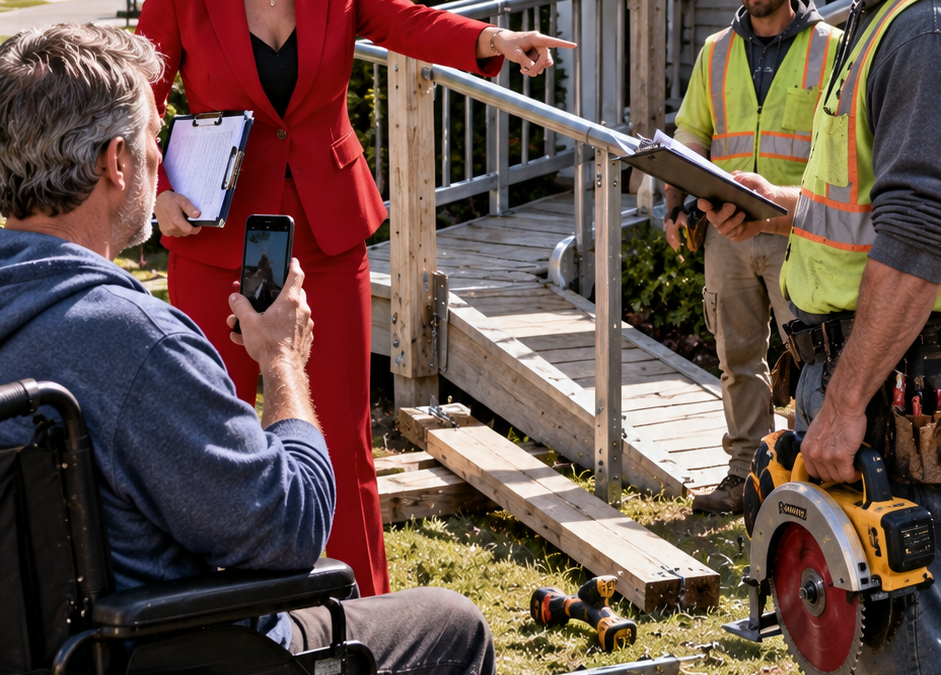
I was sitting ten feet from my front porch when the contractor lifted the demolition saw.
The sound hadn’t started yet.
That almost made it worse.
The saw hung in Marcus’s hands while his coworker stood near the bottom of my wheelchair ramp with an impact driver, waiting for instructions.
Part of the handrail was already lying in my grass.
Two brackets had been pulled from the porch post, leaving pale rectangles in the paint where the metal had sat for the last eighteen months.
And between me and the contractors stood Vanessa Cole.
President of the HOA.
Bright red suit.
Clipboard.
Angry enough that she seemed personally offended by the existence of treated lumber.
“You ignored three notices,” she said.
I raised my phone and kept recording.
“I responded to every one.”
“You did not correct the violation.”
“The ramp was approved.”
“We’ve been through this.”
“Yes. Mostly because you keep saying that sentence instead of explaining why the approval suddenly doesn’t count.”
Her jaw tightened.
Behind her, Marcus looked down at his paperwork again.
That was when the entire morning changed.
He lowered the saw.
“Ms. Cole?”
Vanessa turned.
“What?”
“Where’s the homeowner authorization?”
For the first time since she arrived, she looked confused.
“You don’t need his authorization.”
Marcus unfolded the work order.
“The association approved the removal.”
He traced one line with his finger.
“This tells me what you hired us to remove.”
“Exactly.”
“I’m asking what gives us permission to detach it from his house if he’s objecting.”
Vanessa moved closer.
“The board handled that.”
Marcus looked toward me.
Then the damaged railing.
Then back at her.
“Did your office inspect this before the work order was issued?”
“The structure violates community standards.”
“That’s not what I asked.”
That phrase landed harder than it should have.
Maybe because I’d spent weeks asking versions of the same question.
Vanessa had an answer for everything except the exact thing being asked.
Marcus folded the work order against his clipboard.
“I need my office to verify authorization before we continue.”
His coworker immediately lowered the impact driver.
Vanessa stared at him.
“You have a contract.”
“Yes.”
“Then do the work.”
“I’m not tearing an attached structure off a private residence while the owner is objecting unless my office confirms we’re covered.”
I almost laughed.
Not because anything about the situation was funny.
Because after weeks of letters, fines, threats, and board language, the first person to stop the machine was a contractor who simply didn’t want his company’s name attached to something his paperwork didn’t explain.
Vanessa pulled out her phone and walked toward the curb.
I couldn’t hear whoever answered.
I heard her.
“Board authority.”
“Yes, he is refusing access.”
“No, the contractor is refusing to continue.”
“No, the work order was issued correctly.”
While she argued, I recorded everything.
The missing rail.
The exposed mounting holes.
The tools in the grass.
The contractor’s truck.
The section of ramp still attached to my porch.
The timestamp on my phone.
I wanted the condition preserved before anyone later described that morning as a misunderstanding.
Vanessa returned.
“The work is being paused.”
Marcus shook his head.
“Our office is stopping the job until we verify.”
Small distinction.
Important one.
For the first time, Vanessa was no longer deciding what happened next.
She turned toward me.
“The violation still stands.”
I didn’t answer.
At that moment, I honestly didn’t know whether the board had some power I was overlooking.
I wasn’t a lawyer.
I didn’t pretend to understand every limit of HOA authority.
What I did understand was simpler.
A crew had arrived at my home with instructions to physically dismantle an access structure attached to my house.
When the contractor asked for the document showing he had authority to proceed over my objection, Vanessa could not hand him one.
Marcus and his coworker packed their tools.
Vanessa stayed near the curb until their truck disappeared.
Then she walked back to my porch.
She placed a white envelope on the remaining section of handrail.
“Your deadline hasn’t changed.”
She left.
Inside the envelope was another violation notice.
Three days.
Remove the rest of the ramp myself.
Or face additional enforcement.
I sat there for several minutes with the envelope in my lap.
Then I went inside and opened the filing cabinet beside my desk.
Because eighteen months earlier, before a single board member called my ramp a violation, the HOA had already looked at it.
Measured it.
Changed it.
Approved it.
And somewhere inside their own records was the file that was about to become much more important than Vanessa’s red suit.
PART2
I knew exactly where my copy was.
Second drawer.
House documents.
Architectural approvals.
When using the front steps became unsafe for me, I had not simply hired someone and built whatever I wanted.
I had followed the process.
Every tedious step.
Application.
Photos.
Measurements.
Contractor drawing.
Railing details.
Street-facing elevation.
The first design came back with comments.
The HOA wanted the rail color matched to the porch trim.
They wanted the lower section shifted slightly inward so it did not interfere visually with the sidewalk landscaping.
I remember reading that second request and thinking that apparently my ability to enter my home safely had to coexist peacefully with decorative shrubs.
Fine.
We changed it.
The contractor revised the plan.
I resubmitted.
Three weeks later, written approval arrived.
I found the letter behind the original invoice.
Management company logo.
My name.
My address.
Application number.
APPROVED — REVISED EXTERIOR MODIFICATION
Simple.
Clear.
My contractor then pulled the city permit.
Built the ramp according to the approved drawing.
City inspector came out afterward.
Checked the work.
Closed the permit.
For the next year and a half, nothing happened.
Landscapers worked around it.
Neighbors used the sidewalk beside it.
The management company performed a routine exterior inspection months after construction and photographed the front of my house.
No violation.
No warning.
No question.
The ramp was simply part of the property.
Then the board changed.
Vanessa became president.
Within weeks, I received a notice identifying the ramp as an:
UNAPPROVED EXTERIOR STRUCTURE
I assumed somebody had missed the old file.
Easy mistake.
Associations change management companies.
Board members change.
Records get separated.
So I scanned the approval letter and uploaded it to the portal.
The response did not say the letter was fake.
It did not say I had misunderstood it.
The message said:
Matter referred to board for review.
Twelve days later, the language changed.
Now the ramp was not “never approved.”
Now it “failed to comply with current architectural standards.”
That bothered me.
Those are different claims.
I sent a message.
Please identify the architectural standard that changed and the provision under which a previously approved and completed modification becomes noncompliant after adoption of a later policy.
No answer.
Vanessa eventually replied personally.
Prior boards cannot permanently bind the association to exterior modifications that conflict with current community standards.
I read it several times.
Maybe she was right about some situations.
I genuinely didn’t know.
HOAs adopt new standards all the time.
Rules change.
Buildings age.
Safety conditions change.
Nothing in property law is as simple as people on the internet like to pretend.
But my ramp had not appeared overnight.
The HOA had reviewed the design.
Requested revisions.
Approved those revisions.
Allowed construction.
Then eighteen months later, a new president decided that entire history no longer mattered.
I wanted to know why.
So I asked narrowly.
If the association believes the approval is no longer valid, please identify the governing process by which the approval was revoked or superseded after construction.
Vanessa responded in under an hour.
The board’s position is final.
That was when I stopped arguing.
And started filing.
I created folders.
Notices.
Emails.
Approvals.
Permit records.
Photos.
Contractor records.
I saved screenshots of the portal.
Downloaded messages as PDFs.
Wrote dates on a legal pad.
It felt excessive.
Then again, the HOA had already described the same ramp three different ways.
Unapproved.
Approved but outdated.
Unapproved again.
Memory becomes unreliable when people change wording every week.
Documents don’t.
The next morning, I photographed the damaged rail.
The missing section changed how I used the ramp.
I could still get inside.
Carefully.
But there was now an unfinished edge where support had been removed.
I had to position my chair differently approaching the porch.
Slow down.
Stay away from one side.
That was when the dispute stopped feeling like a cosmetic argument.
They had already made the entrance less safe.
Not with a letter.
Physically.
Another notice arrived before I repaired it.
Certified mail and portal upload.
Seventy-two hours.
Remove the remainder.
Daily fines to follow.
Attached was a street photograph with a red rectangle around the ramp.
Label:
UNAPPROVED EXTERIOR MODIFICATION
I stared at that phrase.
Again.
I uploaded the approval letter.
Again.
Then the original application.
The revised drawing.
The contractor invoice.
City permit.
Inspection closure.
One sentence:
Please confirm these documents have been reviewed before any additional enforcement action is taken.
The portal showed my message opened within thirty minutes.
No answer.
Next morning:
$250 enforcement assessment.
I called the management company.
Rachel Kim answered.
I had spoken to her before about a landscaping charge.
She pulled up my account.
“I see the $250.”
“What is it based on?”
“Architectural enforcement.”
“Do you see the approval letter attached to the property file?”
Typing.
“One moment.”
More typing.
“Yes. I see several documents.”
“Can you tell whether the board reviewed them?”
The keyboard stopped.
“I don’t have enough information on this screen to say that.”
That was a careful answer.
I respected it.
“Can you make a note that I asked?”
“Yes.”
I wrote down her name.
Time.
Summary.
That became routine.
Every call:
Date.
Person.
Statement.
Every message:
Saved.
Every notice:
PDF.
Because the differences were small.
The first notice said no approval existed.
The second implied an approval existed but current standards controlled.
The third returned to calling the ramp unapproved.
In conversation, that could sound like sloppy phrasing.
In a chronological file, it looked different.
Two days later, daily fines started.
Small first.
Then increasing.
That was the pressure mechanism.
Make time expensive.
At the end of the week, I received a hearing notice.
Fifteen minutes.
Video conference.
I organized my documents chronologically.
Original application.
HOA revision request.
Revised plan.
Written approval.
Permit.
Final inspection.
Finished-ramp photographs.
New violations.
Demolition work order.
Late that night, another document appeared in the portal.
A board resolution adopted two months earlier.
It addressed exterior architectural consistency.
Sheds.
Visible equipment.
Porch additions.
Decorative structures.
Unapproved modifications.
One paragraph allowed enforcement against exterior structures conflicting with current standards.
I read the whole thing.
Then again.
I could not find language saying every previously approved modification automatically became invalid when the policy changed.
Maybe there was authority elsewhere.
But not in that resolution.
The hearing started at seven the following evening.
Vanessa appeared first.
Deep red blazer.
Four directors joined.
Rachel appeared with her microphone muted.
Vanessa introduced the matter.
“Continued failure to correct an exterior architectural violation.”
I waited.
Then said:
“I understand that’s the board’s position. What I’m asking is why an approved ramp is being treated as unauthorized.”
“The board has reviewed the matter.”
I held my approval letter toward the camera.
“Did the board review this specific letter?”
Vanessa looked toward another window.
“The board reviewed the records it considered relevant.”
That answer made one director lean forward.
His name was Steven.
“When was that issued?”
“Eighteen months ago.”
He looked down at his packet.
“Was the ramp built before our new architectural resolution?”
“Yes.”
Vanessa interrupted.
“The age of the modification is not controlling.”
Another director, Clare, spoke.
“Rachel, does management have the original application?”
Rachel opened something.
“Yes.”
“The approval too?”
A pause.
“Yes.”
The directors looked at each other.
That mattered.
Maybe not legally.
But procedurally.
At least two of them appeared to be learning about those documents during the hearing.
I asked the question at the top of my notes.
“What process did the board use to determine the written approval no longer protected the ramp?”
Vanessa held up the current resolution.
“The association has authority to enforce current standards.”
“Did the board issue any written analysis explaining how the previous approval was evaluated under those standards?”
“This is not a courtroom.”
“I know.”
“The board will conduct its hearing according to association procedures.”
I stopped pushing.
I had already learned what I needed.
The old file existed.
Management had it.
At least some directors did not appear fully familiar with it.
Vanessa continued.
She said the HOA had issued repeated notices and attempted “voluntary resolution” before hiring a contractor.
I wrote that phrase down.
Nobody had asked me to voluntarily remove the ramp.
Nobody had scheduled removal with me.
Nobody had asked whether I consented to contractor entry.
I learned the contractor was coming when I saw a demolition saw outside.
After Vanessa finished, the board entered closed session.
Twenty-one minutes.
Then everyone returned.
Violation sustained.
Daily fines continued.
Ten days to submit a compliance plan.
The written decision arrived two days later.
Along with minutes.
Materials listed as considered:
Current architectural standards.
Violation photos.
Enforcement notices.
Board resolution.
Not listed:
My original application.
Approval letter.
Revised drawing.
Permit.
Inspection closure.
That omission wasn’t absolute proof nobody had seen them.
Minutes can be summaries.
Closed-session documentation can be incomplete.
But it was a discrepancy.
Rachel had confirmed during the hearing that the old documents existed.
Yet the written decision said almost nothing about them.
Another fine appeared the next morning.
That was when I stopped asking Vanessa to explain herself.
I wanted the record.
All of it.
I sent a formal document request.
Original architectural file.
Approval history.
Board records concerning the ramp.
Management correspondence.
Contractor instructions.
Invoices.
Photos.
Materials used to authorize removal.
Anything relating to enforcement.
Six business days passed.
Fines continued.
Then Rachel called.
“It’s taking longer because some historical documents were transferred from our prior management company.”
“Transferred where?”
“Legacy archive.”
“Our current board can access that?”
“Management can access the archive.”
“Did the board?”
“I can’t tell you what individual directors requested.”
Important distinction.
The active enforcement file might not have contained the historical file.
That didn’t excuse anything yet.
But it gave me a possible explanation.
The first production arrived.
Current rules.
Current notices.
Photos.
Hearing materials.
Board resolution.
Demolition work order.
No old application.
No approval.
I emailed Rachel.
She replied:
Historical property file is being retrieved separately.
That changed how I organized everything.
I built a timeline.
Application.
Requested revisions.
Revised plan.
Approval.
Permit.
Construction.
Inspection.
Eighteen quiet months.
Board change.
New resolution.
Violation.
Fines.
Hearing.
Contractor.
That timeline didn’t prove the board lacked power.
It proved the ramp had history.
History the active file did not appear to reflect.
A few days later, Rachel contacted me.
“We found the archived property folder.”
The email arrived.
I opened the attachments.
Application.
Original drawing.
HOA requested changes.
Revised drawing.
Approval letter.
All familiar.
Then something new.
Old board meeting minutes.
My address appeared under architectural review.
Revised accessibility ramp design approved.
Vote:
Four in favor.
None opposed.
I stared at it.
Until then, I’d assumed the management company might have approved the project administratively.
No.
The board itself had voted.
Next document.
Internal note from the former management company.
It referred to the modification as connected to:
HOMEOWNER ACCESS NEEDS
and instructed that the materials be retained with:
PROPERTY ACCOMMODATION RECORDS
That phrase had never appeared in Vanessa’s notices.
I kept reading.
Old board email chain.
Railing color.
Landscaping.
Ramp route.
One director asked whether a temporary design should be considered.
Property manager replied that the request required careful review and said the question had been forwarded for legal guidance.
Then the chain skipped.
Next available email:
Board had received guidance and would proceed with revised design.
Something was missing.
I emailed Rachel.
“Was correspondence withheld?”
She checked.
Called later.
“Some legal communications are retained separately and can’t simply be produced to you.”
“I understand.”
I wasn’t asking for privileged advice.
“Can you confirm the material exists in the association’s historical file?”
“As far as I can see, yes.”
That was enough.
The association’s own archived record showed:
It understood why the ramp mattered.
It modified the design.
Its board voted.
It retained the file with accommodation-related records.
Then years later, a different board opened an enforcement case as though the structure were an unauthorized porch decoration.
Rachel sent two more documents.
First:
The routing sheet created when Vanessa reported the ramp.
Supporting materials:
Current architectural standards.
Current property photos.
No old approval.
No old board vote.
No legacy file.
Second:
Contractor intake record.
Association contact:
Vanessa Cole.
Job description:
REMOVE UNAUTHORIZED EXTERIOR INSTALLATION FOLLOWING OWNER NOTICE
Again:
No old approval.
No accommodation file.
No mention of prior board action.
Marcus had seen the weakness immediately.
The work order told him what the HOA wanted.
It did not explain why he had authority to physically alter my home over my objection.
I asked Rachel:
“When the contractor job was prepared, does the system show anyone accessing the archived property file first?”
She said she’d check.
Later:
Matter forwarded for internal review.
I immediately sent a preservation request.
Current file.
Archived file.
Contractor communications.
Board emails.
Work orders.
Notes.
Everything in existing form.
I did not accuse Vanessa of hiding anything.
The records supported a simpler possibility.
Enforcement began in one system.
Important history sat in another.
Whether that was careless or intentional was not something I could prove.
Then Daniel Mercer contacted me.
Outside counsel for the association.
His email was short.
He had been asked to review the dispute.
He requested any documents I possessed that might not appear in the current management file.
I sent:
Approval letter.
Permit record.
Inspection closure.
Photos.
Violation notices.
Hearing decision.
Meeting minutes.
Demolition video.
Old board vote.
I did not editorialize.
Let the chronology speak.
Less than an hour later, Daniel emailed the directors and management.
He requested the complete archived file.
Original application.
Board vote.
Correspondence concerning the nature of the request.
Privileged legal materials for his review.
Vanessa was copied.
Then silence.
Late that afternoon, Rachel forwarded another message.
Daniel had instructed management to:
SUSPEND FURTHER ENFORCEMENT PENDING COUNSEL REVIEW.
I read it twice.
Fines still showed in the portal.
Ramp still damaged.
But the machine had stopped.
Again.
First Marcus stopped the saw.
Now the association’s lawyer stopped the enforcement process.
Two days passed.
No notice.
No new fine.
No message from Vanessa.
Thursday afternoon, Daniel called.
“I’ve reviewed the active file and historical archive.”
His tone was measured.
“There are problems with how this matter progressed.”
He did not tell me privileged advice from the old board.
I didn’t ask.
He walked through facts.
“Your original application was filed eighteen months before the current resolution?”
“Yes.”
“Revised at management’s request?”
“Yes.”
“Board-approved?”
“According to the minutes you now have, yes.”
“Built materially according to the approved plan?”
“Yes.”
“City permit?”
“Yes.”
“Final inspection?”
“Passed.”
Then he explained.
The old board had not treated the ramp like a random exterior addition.
The records showed management and directors understood it related to my ability to access the home safely.
They reviewed it.
Required changes.
Obtained guidance.
Approved the revised version.
He was careful.
“That does not mean an association can never revisit an old modification.”
“I understand.”
“And an approval does not eliminate every future power in the governing documents.”
“Understood.”
“The problem is the process here.”
There it was.
The active violation file began with current photos and current standards.
The old approval history was not integrated.
So the process started with one assumption:
Unauthorized structure.
That assumption then became the foundation for every next step.
Notice.
Second notice.
Fine.
Hearing.
Daily fines.
Contractor.
By the time I produced the approval documents again, the board was already enforcing.
During the hearing, management confirmed those records existed.
Yet the written decision did not clearly explain why the prior approval was ineffective.
Daniel continued.
“I do not see a clear written analysis in the current record explaining why the earlier approval no longer controlled, what authority justified disregarding it, or why physical removal was appropriate after the historical documents were brought forward.”
I leaned back.
For weeks, Vanessa kept saying:
Current standards.
Board authority.
Final decision.
Daniel reduced everything to a much simpler sentence.
“The process matters.”
Exactly.
Maybe the HOA had legitimate enforcement powers.
Maybe some approved structures could eventually become subject to later requirements.
Maybe future circumstances could justify review.
But authority did not erase history.
And a new rule didn’t automatically make an old file disappear.
Then he asked about the demolition crew.
“Did anyone tell you contractors would arrive that morning?”
“No.”
“Did you consent to removal?”
“No.”
“Did you sign a right-of-entry document?”
“No.”
“Did anyone show you specific authority allowing physical removal over your objection?”
“No.”
He asked me to preserve the original video and photos.
“The contractor issue is distinct from a notice or fine.”
“I figured.”
“A work order identifies what the client wants done. It doesn’t, by itself, resolve the legal authority for entering private property and altering an attached structure.”
Marcus had figured that out in thirty seconds.
The board took several weeks.
I asked Daniel one thing.
“What was in the old legal correspondence?”
“I can’t disclose privileged advice.”
“Fair.”
He paused.
“What I can confirm is that the association understood the nature of your request before approving the project.”
That was enough.
The old board knew.
This wasn’t a forgotten barbecue screen.
They understood why the ramp existed.
Considered the design.
Modified it.
Approved it.
Then stored the record accordingly.
Daniel said he had recommended:
Immediate enforcement suspension.
No new fines.
Reversal review of existing charges.
No further contractor work.
Board review of how the historical approval should be treated.
Damage to be addressed separately.
The written confirmation arrived after the call.
I printed it.
Placed it beside Vanessa’s seventy-two-hour demand.
One document said:
Remove it.
The other said:
Stop.
Same association.
Different amount of research.
The next morning, no new fine appeared.
Then the city building department gave me another piece of independent confirmation.
I requested certified permit history.
Issued permit.
Inspection.
Closure.
The city didn’t decide HOA rights.
I didn’t ask it to.
It simply confirmed the ramp was lawfully permitted under city requirements at the time.
I sent the record to Daniel.
A few days later, the HOA hired an accessibility consultant.
Lena Ortiz.
She came to my house with measuring equipment, a digital level, tablet, and camera.
She did not ask me who was right.
She asked:
“Show me how you normally enter the house.”
Good question.
I demonstrated.
Then she examined the damaged rail.
Measured the ramp.
Photographed exposed hardware.
Checked support points.
Reviewed the old drawing.
Watched my demolition video from beginning to end.
“Has anyone repaired this section?”
“No.”
Her report stayed within her expertise.
She did not declare the HOA guilty of anything.
She documented physical condition.
The removed rail reduced support along part of the access route.
She recommended restoring the damaged section and avoiding additional removal while the dispute remained unresolved.
Then the insurance carrier became involved.
The HOA’s insurer requested:
Work order.
Contractor invoice.
Board records.
Photos.
Video.
Restoration estimate.
Communication suddenly became very formal.
Rachel handled routine matters.
Daniel handled disputes.
Vanessa disappeared.
No calls.
No messages.
No threats.
Marcus called me days later.
His company had been asked for a statement.
He told me their intake packet described the job as removing a noncompliant exterior structure after homeowner notice.
“Did it say I consented?”
“No.”
“Did it mention an old approval?”
“No.”
“Board vote?”
“No.”
“Accommodation records?”
“No.”
He sighed.
“When we got there, I assumed your HOA had handled its side.”
“Understandable.”
“Once you objected, I looked at the work order and realized it didn’t answer enough.”
“That’s why you stopped.”
“Yes.”
That mattered.
Not because Marcus was taking my side.
Because his records independently matched mine.
One participant confirmed permits.
One documented physical damage.
One confirmed job instructions.
Management confirmed split files.
Lawyer halted enforcement.
The story no longer depended on Vanessa’s version or mine.
The facts had started supporting themselves.
Monday night, the board held a special meeting.
I wasn’t invited to the closed session.
Didn’t need to be.
Later, Rachel sent a formal notice.
The prior enforcement decision was suspended.
Accumulated fines would be reversed.
The association would obtain a restoration estimate.
Future communication through management or counsel.
I opened the portal the next morning.
Balance:
$0.
Below it:
Fine.
Reversal.
Fine.
Reversal.
Fine.
Reversal.
For weeks, the growing balance had been the first thing I saw.
It was how disagreement became pressure.
Now the numbers were retreating line by line.
I sat staring longer than I expected.
That afternoon, a contractor came to inspect the railing.
Different company.
Different purpose.
He carried the original approved drawing.
Not Vanessa’s violation photograph.
He measured.
Compared the damaged section to the plan.
“Do you want it restored exactly to this configuration?”
“Yes.”
He made a note.
“That’s what I’ll quote.”
A few weeks earlier, a crew arrived to remove the ramp.
Now a crew was pricing the cost of putting it back.
That was when the shift felt real.
The estimate included:
Replacement rail.
Mounting hardware.
Porch-post repair.
Paint.
Finish work.
Final inspection.
The HOA approved it.
No attempt to split the bill.
No request that I accept a cheaper fix.
The restoration crew arrived the following week.
Before touching anything, the supervisor reviewed the drawing with me.
“This section?”
“Yes.”
“Same hardware style?”
“Yes.”
“Same rail height?”
“Correct.”
He worked carefully.
Removed damaged fasteners.
Repaired the porch post.
Installed new brackets.
Replaced the rail.
Repainted the affected area.
By late afternoon, the ramp looked almost exactly as it had before Vanessa sent the demolition crew.
Almost.
I still knew where the holes had been.
You remember damage even after paint covers it.
Lena returned after repairs.
Checked the restored section.
Confirmed support had been reinstated.
Management then issued a formal correction to my account.
The violation was closed.
Fines reversed.
Contractor damage restored.
Historical approval attached to the current property record so future board members would not have to search a legacy archive to find it.
That last part mattered more than I expected.
The file itself had been fixed.
No longer:
Current enforcement in one place.
Approval history somewhere else.
One record.
One chronology.
One property.
Daniel recommended additional changes to board procedure.
I learned about them later through the new policy notice.
Before enforcement involving an existing exterior modification:
Management had to check historical architectural records.
Prior approvals had to be identified.
If an approval existed, counsel review was required before physical-removal action.
Any contractor work touching an occupied residence required written confirmation of authority and access procedures.
That was Marcus’s question turned into policy:
Where’s the authorization?
Vanessa remained president for another few months.
But she stopped contacting me.
At the next annual meeting, several residents asked about enforcement procedures.
Not my ramp specifically.
The process.
How old approvals were stored.
How board resolutions interacted with prior decisions.
Whether contractors could ever be sent without owner coordination.
One director proposed a formal records-reconciliation project.
Passed.
Another proposed that archived architectural approvals be migrated into the current system.
Passed.
Vanessa looked tired throughout the meeting.
She did not run again the following year.
I never asked whether the ramp dispute caused that.
It probably wasn’t the only reason.
Board politics rarely has one cause.
And I wasn’t interested in turning her departure into some victory parade.
The victory was already outside my front door.
The ramp remained.
Approved.
Repaired.
Usable.
The first morning after restoration, I rolled down it slowly.
Habit.
At the repaired section, I paused.
The new handrail was solid beneath my palm.
Same angle.
Same height.
Same route the old board had approved.
I reached the sidewalk and turned around.
For weeks, Vanessa had talked about architectural consistency.
From the street, the ramp looked exactly the way the HOA had required it to look eighteen months earlier.
Matching rail color.
Shifted lower section.
Landscaping preserved.
Every visual detail they had asked for.
That irony would have been funny if the process hadn’t damaged something I depended on.
A neighbor named Ben crossed the street while I was looking at it.
“They fixed it.”
“They did.”
“HOA paid?”
“Yes.”
He nodded.
“Good.”
Then:
“Why did they go after it in the first place?”
I thought about the answer.
There were several.
New board.
New standards.
Bad file separation.
Assumptions.
Escalation.
A president too confident in a partial record.
I finally said:
“They started with the newest paperwork and forgot the older paperwork existed.”
Ben laughed.
“That’s it?”
“That’s enough.”
And it was.
People expect institutional mistakes to begin with dramatic corruption.
Often they begin with a bad assumption nobody checks.
Vanessa saw a ramp that did not match the current board’s preferences.
Someone opened an enforcement case.
The active file contained current photos.
Current standards.
Current board resolution.
The old approval stayed in the archive.
Then the case developed momentum.
Notice generates notice.
Notice generates fine.
Fine generates hearing.
Hearing generates contractor.
At every stage, the previous step makes the next one feel more legitimate.
By the time Marcus arrived with a demolition saw, everyone involved could point backward and say:
“Look how much process has already happened.”
That’s why his question mattered.
Where’s the homeowner authorization?
He stopped looking backward.
He asked what allowed the next physical act.
Nobody had answered that.
The most important thing Daniel did wasn’t declare me right.
He reconstructed the chronology.
That’s what changed everything.
Not one magical document.
Not one legal phrase.
A sequence.
Application.
Revision.
Approval.
Construction.
Permit.
Inspection.
New board.
New standard.
Violation file.
Old approval ignored.
Fines.
Hearing.
Contractor.
Once you see the sequence, the problem becomes obvious.
The association had not begun by deciding what an old approval meant under new rules.
It had begun by treating the approval like it wasn’t there.
Then continued even after it knew it existed.
That was harder to defend.
I kept copies of everything.
The first notice.
The approval.
The old board minutes.
The work order.
The video.
The contractor’s pause.
Daniel’s suspension letter.
Fine reversals.
Restoration report.
Not because I expected another fight.
Because records had saved the ramp once.
I intended to make sure nobody had to rediscover the same history again.
A few months later, Rachel called.
“We’ve completed the legacy-file migration.”
“For my property?”
“For the whole community.”
I smiled.
“So other homeowners’ old approvals are being linked too?”
“Yes.”
That was bigger than my ramp.
Old sheds.
Decks.
Windows.
Fences.
Solar panels.
Accessibility modifications.
Whatever earlier boards had approved.
Future directors could still review things where legally appropriate.
But at least they would be reviewing actual history.
Not pretending the first page in a modern portal was the first page of reality.
“Thank you,” I said.
Rachel paused.
“I should probably thank you.”
“For being fined?”
“For finding a problem in our records system.”
“I would’ve preferred a survey.”
She laughed.
Fair.
Lena’s report ended up helping with one additional change.
The board adopted a procedure requiring accessibility-related modifications to receive separate review before removal enforcement.
Not automatic approval.
Not immunity from every standard.
Just a requirement that the association identify the functional issue before treating the structure like decorative clutter.
Again:
Boring.
Procedural.
Useful.
That’s how real reform usually looks.
No dramatic music.
Just an extra checkbox that prevents the next person from waking up to a demolition crew.
The contractor Marcus stopped by months later.
He had another job nearby and knocked on my door.
I rolled out.
He looked at the repaired rail.
“Looks better.”
“Looks like it did before you arrived.”
He winced.
“Fair.”
“I’m not blaming you.”
“I know.”
He leaned against his truck.
“My company changed our intake process after that job.”
“How?”
“If a client wants us to remove something permanently attached to an occupied residence and the owner is expected to object, office wants documentation before dispatch.”
I raised an eyebrow.
“My ramp became training material?”
“Basically.”
“Do I get royalties?”
“No.”
“Disappointing.”
He laughed.
Then became serious.
“I should’ve asked sooner.”
“You asked before cutting the ramp apart.”
“After we’d already removed part of the rail.”
“Still better than not asking.”
He nodded.
That was something I had learned throughout the whole dispute.
People often judge themselves by whether they caught the mistake at the beginning.
That’s unrealistic.
Most mistakes become visible halfway through.
The important part is whether you stop.
Marcus stopped.
Rachel looked deeper.
Daniel halted enforcement.
The board reversed fines.
Those things mattered.
Vanessa’s mistake was different.
Every time a new fact appeared, she treated it like an obstacle instead of information.
Approval letter?
Current standards.
Old application?
Board authority.
Management records?
Final decision.
Contractor concern?
Work order.
The position never changed.
Only the explanation.
That’s dangerous in any institution.
If the conclusion can never change, evidence becomes decoration.
The last time I saw Vanessa was at the community mailbox area.
Months after she left the presidency.
She nodded toward my house.
“Ramp still there.”
“Yes.”
She gave a thin smile.
“I suppose you’re pleased.”
I thought about it.
“Pleased isn’t the word.”
“What is?”
“Relieved.”
She looked surprised.
“You think I wanted a fight?”
“You fought hard enough.”
“I fought because I needed to get into my house safely.”
She crossed her arms.
“We were trying to apply consistent standards.”
“I know.”
“People act like I personally wanted your ramp gone.”
“You sent the contractor.”
“The board authorized enforcement.”
There it was again.
The board.
I didn’t argue.
Instead, I said:
“The old board approved it.”
She looked away.
“They shouldn’t have.”
“Maybe. But once they did, the next board had to deal with that fact.”
No answer.
“You could’ve opened the old file first.”
She looked back at me.
“Management should have provided it.”
“Probably.”
That was the closest she ever came to admitting anything had gone wrong.
Maybe that was enough.
I didn’t need an apology to use the ramp.
I needed the process corrected.
She left.
I rolled home.
The red suit was gone.
The clipboard was gone.
The ramp remained.
A year later, the wood needed fresh sealant.
I hired the same contractor who originally built it.
He came by with the old drawing.
“I heard about the HOA mess.”
“Everyone did.”
He inspected the repaired section.
“They did decent work restoring it.”
“They should have. They had the blueprint.”
He laughed.
We resealed the surface.
Touched up the rails.
Replaced one worn anti-slip strip.
Ordinary maintenance.
It felt good.
There is a difference between choosing to work on something you own and watching strangers arrive to remove it.
That difference is control.
For a while, the HOA had taken that feeling away from me.
Every portal alert made me wonder what they would do next.
Every truck slowing near the curb caught my attention.
Every envelope felt heavier than it was.
People underestimate what administrative pressure does.
The money matters.
The legal language matters.
But the worst part is uncertainty.
What will they send tomorrow?
Will someone come back?
Will the ramp still be there next week?
Will I have to fight simply to enter my own front door?
When the fines disappeared, that uncertainty began to disappear too.
When the rail was restored, it disappeared a little more.
When the historical approval became permanently linked to the property file, I finally stopped checking the portal every morning.
That was when I knew the dispute was really over.
Not when the board voted.
When I stopped expecting another notice.
I still keep the white envelope Vanessa left on the railing that first morning.
Three-day deadline.
Remove the rest.
The paper has a crease from where I folded it.
Beside it sits Daniel’s later letter.
No further enforcement.
Fines suspended.
Historical review required.
Same HOA.
Same house.
Same ramp.
Different amount of information.
If you put those two letters next to each other, the entire story is there.
One was certainty without investigation.
The other was caution after investigation.
Institutions get dangerous when they prefer the first.
I don’t know whether Vanessa ever understood that.
Maybe she still believes she was right about the architectural standard.
She may even have an argument about aesthetics.
That was never the decisive issue.
The decisive issue was process.
The ramp had history.
The HOA had created that history.
They couldn’t pretend it didn’t exist simply because a new board preferred a different answer.
And they definitely could not send contractors to my home, start removing an attached access structure, and only afterward begin asking what authority supported the job.
The order matters.
First authority.
Then action.
Not action first and paperwork after somebody objects.
That principle isn’t dramatic.
It should be obvious.
Apparently it needed a demolition saw to become memorable.
Today, when I roll down the ramp, I still pass the porch post where those original brackets were pulled out.
The paint covers the marks.
You wouldn’t notice unless you knew where to look.
I know.
I always will.
Not because I want to stay angry.
Because scars are useful records too.
The ramp works.
The rail is solid.
The city permit remains closed.
The HOA approval remains attached to the file.
The fines are gone.
And if some future board ever opens my property record and wonders why the ramp is there, they will not have to guess.
They will see the application.
The requested changes.
The revised design.
The four-to-zero board vote.
The approval letter.
The permit.
The inspection.
The entire history.
Exactly where it should have been before Vanessa ever sent Marcus to my porch.
She thought the file was about whether my ramp matched her standards.
In the end, the file was about whether her board had bothered to read its own history.
Their lawyer finally did.
And once he did, nobody came back with a demolition saw.








