𝗙𝗨𝗟𝗟 𝗦𝗧𝗢𝗥𝗬 HOA Ordered My Wheelchair Ramp Removed—Then Their Own Lawyer Opened the Archived File
𝗣𝗔𝗥𝗧 𝟮
After that, my contractor obtained the local permit.
Built the ramp according to the revised drawing.
A city inspector came out after completion.
Checked the installation.
Closed the permit.
For the next year and a half, the ramp was simply part of my house.
Landscapers worked around it.
Neighbors passed it.
Delivery drivers used it.
The management company even performed a routine exterior inspection months later and photographed the front of the property.
No violation.
No complaint.
No warning.
Then the board changed.
Vanessa Cole became president.
Within weeks, I got my first notice.
UNAPPROVED EXTERIOR STRUCTURE.
I assumed somebody had missed the old file.
It happens.
Boards change.
Management systems change.
Records get stored in the wrong place.
I scanned the approval letter and uploaded it to the portal.
The HOA didn’t say it was fake.
Didn’t say I’d misunderstood it.
The response was:
MATTER REFERRED TO BOARD FOR REVIEW.
Twelve days later, a second notice arrived.
Different wording.
Now the ramp wasn’t “never approved.”
Now it supposedly “failed to comply with current architectural standards.”
That bothered me.
Those were two different claims.
So I asked a simple question.
Which standard had changed?
And did the board believe a rule adopted later automatically canceled an approval issued before that rule existed?
Nobody answered directly.
Vanessa eventually sent me a short portal message.
PRIOR BOARDS CANNOT PERMANENTLY BIND THE ASSOCIATION TO MODIFICATIONS THAT CONFLICT WITH CURRENT COMMUNITY STANDARDS.
I read it several times.
Maybe there were circumstances where that was true.
I genuinely didn’t know.
Associations revise rules.
Safety codes change.
Conditions change.
Nothing involving property governance is as simple as angry people on the internet make it sound.
But I knew how this particular ramp had come into existence.
I asked.
They reviewed.
They required changes.
I made the changes.
They approved it.
I built it.
The city inspected it.
Then eighteen months later, a new president acted as if the whole history had become inconvenient background noise.
So I sent one narrow question.
If the association believes the prior written approval is no longer valid, please identify the governing process through which that approval was revoked or superseded after construction.
Vanessa answered in less than an hour.
THE BOARD’S POSITION IS FINAL.
That was when I stopped trying to persuade her.
And started preserving everything.
I created digital folders.
Notices.
Emails.
Approvals.
Permit records.
Photos.
Contractor documents.
Portal screenshots.
Then a paper binder.
Dates.
Names.
Phone calls.
It felt excessive.
Until I realized the HOA had already described the same ramp three different ways.
Never approved.
Approved but obsolete.
Unapproved again.
People can make those differences sound trivial in conversation.
On paper, they become harder to ignore.
The next morning, I photographed the damage the demolition crew had already done.
The missing rail had changed how I used the entrance.
I could still get through.
Carefully.
But I had to approach one section more slowly and keep my chair farther from the unfinished edge.
That was when the dispute stopped feeling like an argument about appearance.
Someone had physically reduced the safety of an access route the association itself had once approved.
And the current board seemed determined to finish the job without explaining what happened to the original approval.
Another notice arrived by certified mail.
Seventy-two hours.
Remove the remaining ramp.
Daily fines afterward.
Attached was a photo taken from the street.
Someone had drawn a red rectangle around the entire structure.
Label:
UNAPPROVED EXTERIOR MODIFICATION
I uploaded the approval letter.
Again.
The original application.
The revised drawing.
Contractor invoice.
Permit record.
Then added one sentence.
Please confirm these documents have been reviewed before further enforcement action is taken.
The portal showed my message opened within thirty minutes.
No response.
The following morning, a $250 enforcement charge appeared on my account.
I called management.
Rachel Kim answered.
I’d spoken with her once before about a landscaping invoice.
She pulled up the account.
“I see the charge.”
“What is it based on?”
“It is coded as an architectural enforcement assessment.”
“Do you see the approval letter I uploaded?”
Keyboard clicking.
“One moment.”
More clicking.
“Yes. There are several documents attached to your property file.”
“Can you tell whether the board reviewed them?”
The typing stopped.
“I can’t see enough from this screen to tell you that.”
That was a careful answer.
I respected it.
“Can you make a note that I asked?”
“Yes.”
I wrote down the time.
Her name.
What she said.
That became part of my routine.
Every phone call.
Every email.
Every notice.
Documented.
I wasn’t preparing for a dramatic courtroom battle.
I was trying to prevent the HOA’s changing explanations from blending together.
The first notice said the ramp had never been approved.
Vanessa’s later message suggested the approval existed but no longer controlled.
The new violation notice had returned to calling it unapproved.
Those differences were small enough to disappear in memory.
Not in a timeline.
Two days later, daily fines started.
Not huge at first.
Then growing.
The strategy was obvious.
Make time expensive.
At the end of the week, I received notice of a hearing.
Fifteen minutes.
Video conference.
I spent the evening before organizing everything chronologically.
Application.
HOA requested revisions.
Revised drawing.
Approval.
Permit.
Inspection closure.
Photos of completed ramp.
Violation notices.
Demolition work order.
Late that night, another document appeared in the portal.
A board resolution adopted two months earlier.
Architectural consistency.
Sheds.
Visible equipment.
Porch additions.
Decorative structures.
Unapproved changes.
One paragraph said the board could enforce current architectural standards against conflicting exterior structures.
I read it carefully.
Then again.
Nothing I found said every prior approval automatically disappeared the moment a later board adopted different preferences.
Maybe another document gave them that authority.
But this one didn’t.
The hearing started at seven the next evening.
Vanessa appeared first.
Deep red blazer this time.
Four directors joined.
Rachel appeared with her microphone muted.
Vanessa opened.
“This hearing concerns the homeowner’s continued failure to correct an exterior architectural violation.”
I waited until she finished.
“I understand that’s the board’s position. What I’m asking is why an approved ramp is being treated as unauthorized.”
“The board has reviewed the matter.”
I held the approval letter close to my camera.
“Did the board review this specific letter?”
Vanessa shifted her eyes toward another screen.
“The board reviewed the records it considered relevant.”
One director leaned forward.
Steven.
“When was that issued?”
“Eighteen months ago.”
He looked down at his packet.
“Was the ramp built before the resolution we adopted this summer?”
“Yes.”
Vanessa cut in.
“The age of the modification is not the controlling issue.”
Another director, Clare, spoke.
“Rachel, does management have the original architectural application?”
Rachel opened something on her screen.
“Yes.”
“The approval?”
Scrolling.
“Yes.”
The directors looked at one another.
That was the first moment I realized at least some of them might be learning the history during the hearing.
I asked the question I’d written at the top of my notes.
“What process did the board use to determine that the written approval no longer protected the ramp?”
Vanessa held up the new resolution.
“The association has authority to enforce current standards.”
I let her finish.
Then:
“Did the board produce any written decision explaining how the older approval was evaluated under those standards?”
“This is not a courtroom.”
“I know.”
“The board will conduct this hearing according to its procedures.”
I stopped.
Something had already changed.
The board now knew there was an old application.
An old approval.
An actual record.
And at least two directors seemed less familiar with those documents than I would have expected from people deciding whether my ramp should be demolished.
Vanessa continued.
She said the HOA had issued repeated notices and attempted “voluntary resolution” before hiring the contractor.
I wrote that phrase down.
Voluntary resolution.
Nobody had ever asked me to schedule removal.
Nobody asked whether I consented to a crew entering my property.
The first time I knew anyone was coming was when I saw Marcus standing outside with a demolition saw.
After Vanessa finished, the board entered closed session.
Twenty-one minutes.
Then everyone came back.
Violation sustained.
Daily fines continued.
Ten days to submit a compliance plan.
The written decision arrived two days later with the meeting minutes.
Materials listed as considered:
Current architectural guidelines.
Violation photographs.
Prior enforcement notices.
Board resolution.
Missing from the list:
My original application.
Approval letter.
Revised drawing.
Permit.
Inspection closure.
That omission didn’t prove every director had never seen them.
Minutes are summaries.
Closed sessions are complicated.
I knew better than to treat one list as magic proof.
But the discrepancy was obvious.
Rachel had confirmed those documents existed.
The board enforced anyway.
And its written decision barely mentioned how the earlier approval had been evaluated.
Another daily fine appeared the next morning.
That was when I stopped debating Vanessa.
I wanted the association’s record.
Not her interpretation of it.
I sent a formal request for:
Original architectural file.
Approval history.
Board records concerning the ramp.
Management correspondence.
Contractor instructions.
Invoices.
Photos.
Materials used to authorize physical removal.
Anything tied to the enforcement process.
For several days, nothing happened except the fines.
On the sixth business day, Rachel called.
“The request is taking longer because part of the property history was transferred from the previous management company.”
“Transferred where?”
“A legacy archive.”
“Our current management can access it?”
“Yes.”
“The board?”
“The records are available to management. I can’t tell you which individual directors requested them.”
That distinction mattered.
For the first time, I considered something less dramatic than deliberate concealment.
Maybe the current board had been working from a newer enforcement file while the older history sat somewhere else.
That wouldn’t automatically excuse anything.
But it could explain how bad decisions started.
Two days later, the first document batch arrived.
Current rules.
Current photos.
Enforcement notices.
Hearing materials.
New board resolution.
Demolition work order.
No original application.
No approval.
I emailed Rachel.
She replied:
Historical documents are being retrieved separately from the legacy archive.
Once I knew that, I stopped treating the case as one stack.
I built a timeline.
Application.
Requested revisions.
Revised plan.
Approval.
Permit.
Construction.
Inspection.
Eighteen months.
Board change.
New architectural resolution.
Violation.
Fines.
Hearing.
Contractor.
The sequence didn’t prove the new board had no authority.
It proved the ramp had a documented life long before Vanessa’s enforcement campaign began.
Then Rachel contacted me again.
“We found the archived property file.”
The email arrived.
I opened the attachments in order.
Application.
Original drawing.
Management’s requested changes.
Revised drawing.
Approval letter.
All familiar.
Then I found something I’d never seen.
Minutes from the prior board.
My address listed under architectural review.
A motion approving the revised ramp design.
Four directors in favor.
None opposed.
I stared at the screen.
Until that moment, I’d assumed management may have issued the approval administratively after some informal review.
No.
The old board itself had voted.
Then the next document.
Internal management note.
The modification related to the homeowner’s access needs.
Materials should be stored with the property’s accommodation records.
Those words had never appeared in any of Vanessa’s violation notices.
I kept reading.
Old email chain.
Railing color.
Landscaping.
Ramp route.
One director asked whether a temporary design should be considered.
The property manager replied that the request deserved careful treatment and forwarded the issue for legal review.
Then the chain jumped.
Next available email:
The board had received guidance and decided to move forward with the revised design.
Something was missing.
I emailed Rachel.
“Was correspondence withheld?”
She checked.
Later she called.
“Some materials are legal communications and can’t simply be released.”
“I understand.”
I wasn’t asking for privileged advice.
“Can you confirm those materials remain in the association’s historical record?”
“As far as I can see, yes.”
Good enough.
I didn’t need to know what the old lawyer had told them.
I needed to know the old board had considered the nature of the request before approving it.
Rachel sent two more documents.
First:
The intake sheet created when Vanessa reported the ramp as a violation.
Supporting material:
Current photos.
Current architectural rules.
Nothing from the legacy archive.
Second:
Contractor intake record.
Association contact:
Vanessa Cole.
Job:
Removal of unauthorized exterior installation following owner notice.
No mention of:
Prior approval.
Prior board vote.
Accommodation record.
Permit.
Inspection.
Marcus had spotted the problem immediately.
The work order told him what the client wanted.
It didn’t answer whether the client had authority to physically alter an attached structure while I objected.
I asked Rachel one last factual question.
“When the demolition job was prepared, does the management system show anyone accessing the archived property file first?”
She said she’d check.
Later that day, she sent one sentence.
Matter forwarded for internal review.
I replied with a preservation request.
Current file.
Historical file.
Board communications.
Contractor instructions.
Work orders.
Emails.
Notes.
I didn’t accuse Vanessa of hiding documents.
At that point, the evidence supported a simpler explanation.
One process had started in the current system.
The important history sat in an older system.
Whether that separation was careless, intentional, or simply bad administration was not something I could prove from my desk.
Then someone I hadn’t contacted entered the dispute.
Daniel Mercer.
Attorney for the association.
He emailed me and said he’d been asked to review the matter.
He requested any documents I possessed that might not appear in management’s active file.
I sent:
Approval letter.
Permit record.
Inspection closure.
Photos.
Violation notices.
Hearing decision.
Meeting minutes.
Demolition video.
Old board approval.
No speech.
No accusations.
Just documents.
Less than an hour later, Daniel emailed management and the directors.
He requested the complete archived file.
Original application.
Board vote.
Communications concerning the nature of the request.
Privileged legal material for his review.
Vanessa was copied.
Nobody responded publicly.
Just before five, Rachel forwarded another message into the thread.
Daniel had instructed the association to suspend further enforcement pending review.
I sat at my desk staring at the sentence.
The fines were still there.
The ramp was still damaged.
But the machinery had stopped again.
First Marcus stopped the saw.
Now the HOA’s own lawyer stopped the enforcement system.
For two days, Vanessa disappeared.
No notice.
No warning.
No contractor.
The portal balance remained.
But the daily additions stopped.
Thursday afternoon, Daniel called.
“I’ve reviewed the active file and the historical archive.”
His voice was measured.
“There are problems with how this matter progressed.”
He was careful not to reveal privileged communications.
I didn’t ask him to.
Instead, he reconstructed the history.
Original application.
Requested revisions.
Board approval.
Construction.
Permit.
Inspection.
Then he asked:
“Did the completed ramp materially differ from the approved drawing?”
“No.”
“Was it inspected?”
“Yes.”
“Permit closed?”
“Yes.”
Then he explained why the old file mattered.
The prior board had not treated the ramp like a casual decorative structure.
Management and directors knew the request related to safe access to the home.
They reviewed the design.
Required changes.
Sought guidance.
Approved the revised version.
Daniel was careful.
“That history does not mean an association can never revisit a property issue.”
“I understand.”
“Nor does one approval remove every future enforcement power.”
“Understood.”
“The problem is the path the current board took.”
The active violation file started with current photos and new standards.
The historical approval wasn’t incorporated.
So the first assumption entered the system:
Unauthorized structure.
Then everything built on top of that.
First notice.
Second notice.
Fine.
Daily fines.
Hearing.
Contractor.
The issue, Daniel explained, wasn’t that one old letter magically decided every possible legal question.
The issue was that the HOA had escalated against a previously approved access-related modification without first reconciling the current position with its own historical record.
The hearing made that harder to defend.
By then, I had already resubmitted the old approval.
Rachel had confirmed during the hearing that the documents existed.
Yet the written decision still treated the matter primarily as a current architectural violation.
Daniel said:
“I don’t see a clear written analysis explaining why the prior approval was ineffective, what authority justified disregarding it, or why removal was considered appropriate after the board knew the old documents existed.”
I leaned back.
Vanessa had spent weeks talking about final decisions and current standards.
Daniel reduced the entire problem to one sentence.
“The process matters.”
Exactly.
An HOA can have rules.
It can enforce valid restrictions.
It can conduct hearings.
It can impose fines where authorized.
It may even have circumstances where an older approval can be revisited.
But authority does not make history irrelevant.
And a new policy does not automatically erase the conditions under which an earlier board approved completed work.
Then Daniel asked about the demolition crew.
“Did anyone notify you contractors were coming that morning?”
“No.”
“Did you consent to removal?”
“No.”
“Did you sign a right-of-entry form?”
“No.”
“Did anyone provide written authority for physical removal over your objection?”
“No.”
He asked me to preserve the original video.
The photos.
Everything.
“The contractor issue is distinct from a violation notice.”
“I figured.”
“A work order describes what the association wants done. It doesn’t, by itself, establish the authority to enter private property and alter an attached structure.”
Marcus had understood that while standing in my front yard.
Vanessa apparently hadn’t.
Before we ended the call, I asked:
“What was in the old legal material?”
“I can’t disclose privileged advice.”
“Fair.”
He paused.
“What I can tell you is that the historical record shows the association understood the nature of your request before it approved the project.”
That was enough.
The old board hadn’t casually approved some random structure and forgotten about it.
They understood why the ramp existed.
They changed the design.
They approved it.
They stored the file accordingly.
Daniel told me he’d recommended:
Immediate enforcement suspension.
No new fines.
Board review of existing charges.
No further contractor work.
Preservation of all records.
Repair issue addressed separately.
The written confirmation arrived afterward.
I printed it.
Then placed it beside Vanessa’s seventy-two-hour demand.
One letter said:
Remove it.
The other said:
Stop.
Same association.
Same house.
Same ramp.
Different amount of homework.
The following morning, there was no new charge.
Then I went to the city building department.
I wanted one record from someone with no involvement in the HOA dispute.
Certified permit history.
The city file showed:
Permit issued.
Inspection performed.
Permit closed.
The building department didn’t take a position on my HOA documents.
That wasn’t its job.
It confirmed one narrow fact.
The ramp had gone through the local permitting process when it was built.
I sent the certified copy to Daniel.
A few days later, an accessibility consultant came to my house.
Lena Ortiz.
Measuring tape.
Digital level.
Tablet.
Camera.
She didn’t ask:
“Who is right?”
She asked:
“Show me how you normally enter and exit.”
Much better question.
I demonstrated.
Then she inspected the section where the rail had been removed.
Measured the ramp.
Photographed the mounting points.
Checked remaining support.
Reviewed the approved drawing.
Watched the contractor video once.
Beginning to end.
“Has this damaged section been repaired?”
“No.”
Her report stayed within her expertise.
She didn’t announce that the HOA broke a law.
Didn’t decide liability.
She documented physical condition.
The removed railing had reduced support along part of the access route.
She recommended restoring it and avoiding additional removal during review.
Then the HOA’s insurer got involved.
The carrier requested:
Contractor invoice.
Work order.
Board records.
Photos.
Video.
Restoration estimate.
Communication became noticeably more formal.
Rachel handled routine messages.
Daniel handled disputed issues.
Vanessa stopped contacting me entirely.
Marcus called a few days later.
His company had been asked to document what happened.
We compared the sequence.
His office had received a job described as removal of a noncompliant exterior installation.
The paperwork named Vanessa as association contact.
It said the homeowner had received notice.
It did not say:
I consented.
The ramp had prior approval.
An old board had voted.
Accommodation-related records existed.
“When we arrived,” Marcus said, “I assumed the association had handled whatever authority was required.”
“Understandable.”
“Once you objected, I looked at the work order again.”
“And?”
“It didn’t answer enough.”
“That’s why you stopped.”
“Yes.”
His statement matched my video.
By then, every outside participant was confirming a different piece.
City:
Permit existed.
Lena:
Ramp had been physically compromised.
Contractor:
Work order didn’t show homeowner consent or historical approval.
Management:
Old records had been stored separately.
HOA counsel:
Enforcement process had not properly reconciled the current case with the historical record.
No one needed to stand up and announce:
THE HOMEOWNER IS RIGHT ABOUT EVERYTHING.
The HOA’s original narrative was becoming harder to maintain because the facts no longer depended on Vanessa or me describing them.
The special board meeting happened on a Monday.
I wasn’t invited to the executive session.
Didn’t need to be.
Later that evening, Rachel emailed formal notice.
The prior enforcement decision was suspended.
Accumulated fines would be reversed.
The association would obtain a restoration estimate.
Future communication would go through management or counsel.
I opened the portal the next morning.
Balance:
$0.
Below it:
$250 fine.
Reversal.
Daily fine.
Reversal.
Another fine.
Reversal.
Line after line.
For weeks, that balance had been the first thing I saw every morning.
It was how the board turned disagreement into pressure.
Now the numbers were retreating.
One entry at a time.
I stared longer than I expected.
That afternoon, a restoration contractor came to inspect the damage.
He carried the original approved drawing.
Not the violation photo.
Not Vanessa’s markup.
The approved drawing.
He measured.
Compared the damaged rail with the plan.
Photographed the porch post.
Then asked:
“Do you want this restored exactly to the approved configuration?”
“Yes.”
He made a note.
“That’s what I’ll price.”
Only a few weeks earlier, contractors had arrived to remove the ramp.
Now another contractor had been sent to estimate the cost of putting it back.
That was when the shift became tangible.
The estimate arrived four days later.
Replacement railing.
Repair of mounting points.
Trim repainting.
Hardware.
Final inspection.
The HOA approved the expense.
No cost-sharing proposal.
No request that I compromise on the repair.
A different crew arrived the following week.
Before touching anything, the supervisor reviewed the plan with me.
“This is the section?”
“Yes.”
“Original rail height?”
“Yes.”
“Same bracket locations?”
“As shown.”
“Same finish?”
“Yes.”
Then they worked.
Slowly.
Carefully.
Which felt almost surreal after watching the first crew arrive with demolition tools.
They removed the damaged hardware.
Repaired the porch post.
Reset the mounting points.
Installed the replacement rail.
Painted the affected area.
By late afternoon, the ramp looked almost exactly the way it had before Vanessa sent Marcus to my house.
Almost.
I still knew where the original brackets had been pulled.
Paint hides damage better than memory does.
Lena came back after restoration.
Checked the rail.
Tested stability.
Confirmed the support had been restored.
Then Rachel sent another notice.
ARCHITECTURAL ENFORCEMENT MATTER CLOSED.
The historical approval would be linked into the current property file.
Not left in a legacy archive.
Not separated from the active record.
Linked.
That meant the next board would not have to discover the same history by accident.
That mattered more than I expected.
The file itself had been repaired.
The board also adopted new procedures.
I learned about them through a policy update.
Before enforcement involving an existing exterior modification, management had to review historical architectural records.
If a prior approval existed, it had to be identified.
If a project involved access-related modifications, additional review was required before physical-removal enforcement.
Any contractor sent to alter an occupied residence needed documented authority and entry procedures.
Marcus’s question had become policy.
Where’s the authorization?
Vanessa remained president for a few months.
But she never contacted me directly again.
At the next annual meeting, homeowners asked questions about recordkeeping.
Not just my ramp.
Old approvals.
Legacy files.
Board transitions.
How prior decisions were tracked.
One director proposed migrating all archived architectural approvals into the active management system.
Passed.
Another proposed requiring legal review before a board authorized physical removal of a previously approved attached structure.
Passed.
Vanessa sat through the discussion without saying much.
She didn’t run again at the next election.
I never asked why.
Maybe the ramp mattered.
Maybe it didn’t.
Board politics rarely has one clean cause.
And I wasn’t interested in turning her departure into a trophy.
My trophy was outside my front door.
The ramp.
Still there.
Repaired.
Approved.
Usable.
The first morning after the restoration was complete, I rolled down it slowly.
Habit.
At the repaired section, I stopped.
Put my hand against the railing.
Solid.
Same height.
Same angle.
Same route the old board approved.
I reached the sidewalk.
Then turned around.
From the street, the ramp looked exactly the way the HOA had once required it to look.
Railing matched the porch trim.
Lower section shifted away from landscaping.
Every visual concession they’d requested.
The irony would have been funny if the process hadn’t interfered with something I relied on every day.
My neighbor Ben came across the street.
“They fixed it.”
“They did.”
“HOA paid?”
“Yes.”
He nodded.
“Good.”
Then:
“Why did they go after it in the first place?”
I thought about the answer.
New board.
New standards.
Legacy archive.
Incomplete enforcement file.
Assumption.
Escalation.
Too much confidence.
I finally said:
“They started with the newest paperwork and forgot the older paperwork existed.”
Ben frowned.
“That’s all?”
“That’s enough.”
And it was.
People assume institutions fail because somebody sits in a dark room planning something terrible.
Sometimes.
More often, failure begins with a bad assumption nobody bothers to check.
Vanessa saw a ramp that didn’t fit her understanding of current standards.
A violation case opened.
The active file contained photos.
New rules.
A new board resolution.
The old approval sat in a different archive.
Then the case developed momentum.
Notice produces notice.
Notice produces fine.
Fine produces hearing.
Hearing produces contractor.
At every stage, the previous step makes the next one feel more legitimate.
By the time Marcus stood on my lawn with a saw, everyone involved could point backward and say:
Look how much process has already happened.
That’s why his question mattered.
Where’s the homeowner authorization?
He stopped looking backward.
He asked what justified the next physical step.
Nobody had answered that.
Daniel did something similar.
He didn’t start by asking whether Vanessa disliked the ramp.
He rebuilt the chronology.
Application.
Revision.
Approval.
Permit.
Inspection.
Quiet eighteen months.
New board.
New standard.
Violation.
Old approval missing from active file.
Fine.
Hearing.
Contractor.
Once the sequence was visible, the process problem became obvious.
The HOA had not first determined what an old approval meant under new standards.
It had first treated the old approval like it didn’t matter.
Then continued even after learning it existed.
That was harder to defend.
I kept everything.
First violation.
Approval letter.
Old board minutes.
Demolition work order.
Video.
Daniel’s suspension.
Fine reversals.
Restoration report.
Not because I expected another fight.
Because records had saved the ramp once.
I wanted the next person to find them immediately.
A few months later, Rachel called.
“We completed the legacy migration.”
“For my property?”
“For the community.”
“So old approvals are being linked into active records?”
“Yes.”
That was bigger than one ramp.
Decks.
Windows.
Sheds.
Fences.
Solar systems.
Accessibility modifications.
Whatever earlier boards had reviewed.
Future directors could still evaluate issues where legally appropriate.
But at least they’d be evaluating actual history.
Not pretending the first page visible in a modern portal was the first page of reality.
“Thank you,” I said.
Rachel paused.
“I should probably thank you.”
“For the fines?”
She laughed.
“For finding a problem in the system.”
“I would’ve preferred finding a coupon.”
“Fair.”
Lena’s report contributed to another change.
Accessibility-related structures would receive separate review before physical-removal enforcement.
Not automatic immunity.
Not unlimited approval.
Just a requirement that the board identify what the structure actually did before treating it like decorative clutter.
Boring procedure.
Useful procedure.
That’s what reform usually looks like.
Not dramatic speeches.
Checklists.
Records.
One extra step preventing somebody else from waking up to contractors at the door.
Marcus stopped by months later.
He was working nearby and recognized the house.
I rolled onto the porch.
He looked at the repaired rail.
“Looks good.”
“Looks like it did before you arrived.”
He winced.
“Fair.”
“I’m not blaming you.”
“I know.”
He leaned against the truck.
“My company changed our intake procedure after that.”
“How?”
“If someone wants us to remove something permanently attached to an occupied home and the owner is expected to object, the office wants documentation before dispatch.”
“My ramp became training material?”
“Pretty much.”
“Do I get royalties?”
“No.”
“Disappointing.”
He laughed.
Then grew serious.
“I should’ve asked before we removed the first section.”
“You asked before you removed the rest.”
“Still.”
“Most mistakes become obvious halfway through.”
He looked at the ramp.
“Yeah.”
“Stopping still matters.”
That became one of the things I respected most about the entire situation.
People like perfect stories.
Someone sees a mistake instantly.
Does the right thing instantly.
No harm.
Real life is messier.
Marcus stopped after damage had begun.
Rachel dug deeper once the file discrepancy became obvious.
Daniel stopped enforcement after reviewing the archive.
The board reversed fines after the process failed.
The important question isn’t always:
Why didn’t you know sooner?
Sometimes it’s:
What did you do once you knew?
Vanessa’s problem was different.
Every new fact became something to push past.
Approval letter?
Current standards.
Original application?
Board authority.
Historical file?
Final decision.
Contractor concern?
Existing work order.
The conclusion stayed fixed.
Only the explanation changed.
That’s dangerous.
If the conclusion can never change, evidence isn’t evidence anymore.
It’s decoration.
The last time I spoke with Vanessa was at the community mailbox area months after she left the presidency.
She noticed me first.
“Ramp still there.”
“Yes.”
“I suppose you’re pleased.”
I thought about that.
“Pleased isn’t the word.”
“What is?”
“Relieved.”
She looked surprised.
“You think I wanted a fight?”
“You fought hard enough.”
“We were trying to enforce consistent standards.”
“I know.”
“People act like I personally had some issue with your ramp.”
“You authorized the contractor.”
“The board authorized enforcement.”
There it was again.
The board.
I didn’t argue.
Instead:
“The old board approved the ramp.”
She looked away.
“They shouldn’t have.”
“Maybe.”
She looked back.
“But once they did, the next board had to deal with that fact.”
Silence.
“You could have opened the old file first.”
“Management should’ve provided it.”
“Probably.”
That was the closest she came to acknowledging anything.
Maybe that was enough.
I didn’t need an apology to use the ramp.
I needed the ramp.
I rolled home.
A year later, the wood needed sealing.
Normal maintenance.
I called the contractor who originally built it.
He came by with the old drawing.
“I heard you had some HOA trouble.”
“That’s one description.”
He inspected the repaired section.
“They restored it pretty well.”
“They had the blueprint.”
He laughed.
We resealed the surface.
Touched up the rail.
Replaced one worn anti-slip strip.
Ordinary work.
That felt good.
There is a huge difference between choosing to maintain something and watching strangers arrive to destroy it.
That difference is control.
For weeks, the HOA took that feeling away from me.
Every portal alert made me wonder what came next.
Every truck slowing near the curb caught my attention.
Every envelope felt heavier than the paper inside.
People underestimate administrative pressure.
Yes, the money matters.
Yes, threats matter.
But uncertainty can be worse.
Will another crew come?
Will another fine appear?
Will they try something while I’m not home?
Will I have to fight simply to enter my own house?
When the fines vanished, that anxiety started fading.
When the rail was restored, it faded more.
When the old approval became permanently linked to my current file, I finally stopped checking the portal every morning.
That was when I knew it was over.
Not when the board voted.
When I stopped expecting another notice.
I kept Vanessa’s white envelope.
The three-day demand.
It’s folded inside my file.
Beside it is Daniel’s suspension letter.
One says:
Remove it.
The other says:
No further action pending historical review.
Same association.
Same structure.
Same governing documents.
The difference was information.
If you place those letters side by side, the entire story becomes visible.
One was certainty before investigation.
The other was caution after investigation.
Institutions become dangerous when they prefer the first.
Maybe Vanessa still believes the ramp conflicted with what she thought the neighborhood should look like.
Maybe she believes the old board made a bad choice.
That’s possible.
But those were never the questions that decided what happened.
The decisive question was process.
The ramp had history.
The HOA had created that history.
It couldn’t pretend the history disappeared because a new board preferred a different answer.
And it certainly couldn’t send contractors to begin dismantling an attached access route and only afterward start asking what authority supported the job.
Order matters.
First:
Review.
Then:
Authority.
Then:
Action.
Not action first.
Paperwork after someone objects.
It shouldn’t take a demolition saw to make that principle memorable.
But apparently it did.
Today, when I roll down the ramp, I still pass the porch post where the first brackets were pulled.
Paint covers the marks.
Nobody else would notice.
I do.
I probably always will.
Not because I enjoy being angry.
Because scars are records too.
The ramp works.
The rail is solid.
The city permit remains closed.
The HOA approval is attached to the active file.
The fines are gone.
And if some future board member ever opens my property record and asks why the ramp exists, they won’t have to guess.
They’ll see everything.
The application.
The requested changes.
The revised design.
The four-to-zero vote.
The approval.
The permit.
The inspection.
The contractor record.
The dispute.
The restoration.
Exactly where that history should have been before Vanessa ever sent Marcus to my door.
She thought the file was about whether my ramp matched her standards.
In the end, the file was about whether her board had bothered to read its own records.
Their lawyer finally did.
And after he did, nobody ever came back with a demolition saw.
Have you finished reading the story and want to read it again?
HOA Ordered My Wheelchair Ramp Removed—Then Their Own Lawyer Opened the Archived File
They sent a demolition crew to tear out the only safe entrance to my home.
The HOA president insisted the ramp had never been properly authorized.
Then their own lawyer opened an old file the new board had apparently never bothered to read.
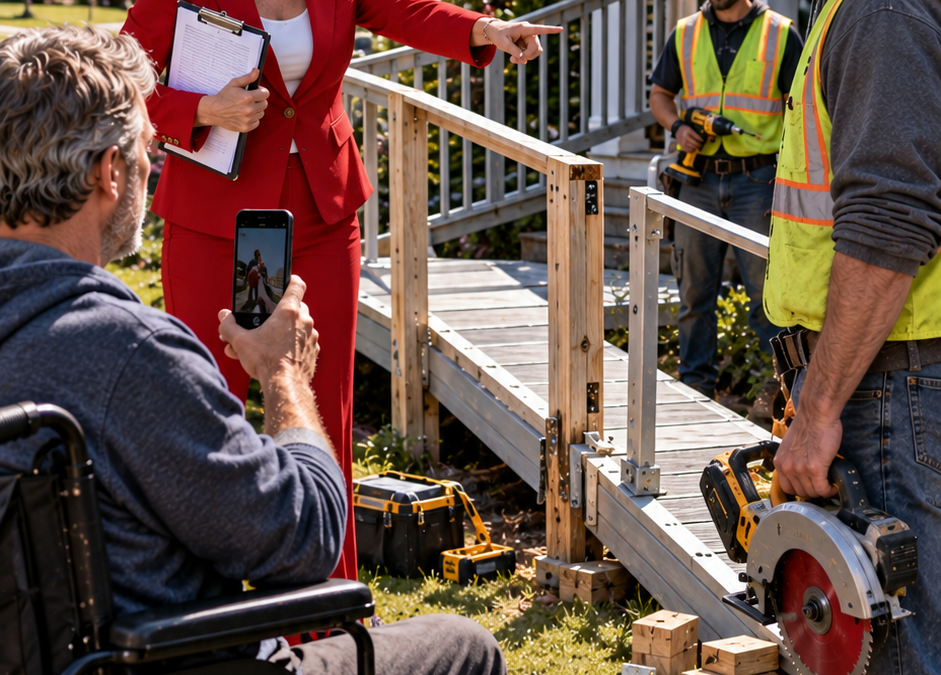
I was sitting about ten feet from my porch when Marcus raised the demolition saw.
He didn’t start it.
Not yet.
The blade hovered beside the lower rail of my wheelchair ramp while his coworker stood near the porch with an impact driver, waiting for someone to tell him what came next.
Part of the handrail was already lying in the grass.
Two brackets had been pulled from the porch post, exposing pale rectangles where the paint underneath had never seen sunlight.
And standing between me and the men dismantling the safest way into my own house was Vanessa Cole, president of the HOA.
Bright red suit.
White blouse.
Clipboard.
Expression tight enough to suggest my ramp had personally insulted her family.
“You were given three notices,” she said.
I held my phone up and kept recording.
“I answered all three.”
“You failed to correct the violation.”
“The ramp was approved.”
“We’ve been through this.”
“That’s the problem. You keep saying that without explaining why the approval suddenly stopped existing.”
Her eyes narrowed.
Behind her, Marcus lowered the saw slightly and looked at the paperwork clipped to his board.
That turned out to matter more than anything Vanessa said.
“Ms. Cole?”
She turned sharply.
“What?”
“Where’s the homeowner authorization?”
For the first time that morning, Vanessa looked caught off guard.
“You don’t need his authorization.”
Marcus unfolded the work order.
“The association approved the removal.”
He tapped the page.
“This says what you want us to remove.”
“Exactly.”
“It doesn’t tell me what gives us permission to detach it from the house while he’s sitting there telling us not to.”
Vanessa took one step toward him.
“The board has already handled that.”
Marcus looked at me.
Then at the damaged railing.
Then back at Vanessa.
“Did your office inspect this before scheduling the job?”
“The structure violates community standards.”
“That’s not what I asked.”
I almost laughed.
Not because the situation was funny.
It wasn’t.
But I’d been asking versions of that same question for weeks, and Vanessa had developed an impressive talent for answering everything except the thing actually being asked.
Marcus folded the work order against his clipboard.
“I need my office to verify authorization before we do anything else.”
His coworker immediately lowered the impact driver.
Vanessa stared at him.
“You have a contract.”
“Yes.”
“Then fulfill it.”
“I’m not tearing an attached structure off a private residence when the homeowner is objecting unless my office confirms we’re covered.”
That was the first moment anyone involved in the HOA’s enforcement campaign treated my house like it was actually mine.
Vanessa pulled out her phone and walked toward the curb.
I couldn’t hear the other person.
I heard enough of her.
“Board authority.”
“Yes, he is refusing.”
“No, the contractor is refusing.”
“The work order was properly issued.”
While she argued, I slowly recorded the damage.
Missing rail.
Exposed mounting holes.
Loose hardware.
Tools on the grass.
Contractor truck.
Timestamp.
I wanted everything preserved exactly as it looked before anyone had time to rewrite the morning in an email.
Vanessa returned.
“The work is being paused.”
Marcus shook his head.
“Our office is stopping the job until we verify.”
Tiny difference.
Important difference.
For the first time, Vanessa was no longer deciding what happened next.
She looked at me.
“The violation still stands.”
I didn’t argue.
At that moment, I didn’t know whether her interpretation of the rules was completely wrong, partly wrong, or legally complicated enough to give ten attorneys ten different opinions.
I wasn’t a lawyer.
I wasn’t pretending to be one.
But I understood what had just happened.
The HOA had sent strangers to my front door with tools and instructions to dismantle a structure attached to my home.
When the contractor asked what authority allowed him to continue over my objection, the answer wasn’t in his paperwork.
Marcus and his coworker packed up.
Vanessa stayed at the curb until their truck disappeared.
Then she walked back to the porch and placed a white envelope on what remained of the railing.
“Your deadline hasn’t changed.”
She left before I opened it.
Inside was another violation notice.
Three days.
Remove the rest of the ramp myself.
Or face escalating enforcement.
I sat there with the letter in my lap, staring at the section of rail Marcus had been smart enough not to cut.
Then I went inside and opened the filing cabinet beside my desk.
Because eighteen months earlier, before Vanessa ever called my ramp an unauthorized structure, the association had already reviewed it.
Measured it.
Changed it.
Approved it.
And somewhere inside the HOA’s own records was a file that was about to become far more important than Vanessa’s red suit.
PART2
I knew exactly where my copy was.
Second drawer.
House documents.
Architectural modifications.
When the front steps became unsafe for me, I hadn’t hired the first carpenter I could find and started building whatever I wanted.
I followed the process.
Every ridiculous detail of it.
Application form.
Photos of the porch.
Measurements.
Contractor drawing.
Railing style.
Material list.
Street-facing elevation.
Side view.
Color sample.
The management company didn’t approve the first version.
They sent it back.
Two requested changes.
First, they wanted the railing painted to match the porch trim.
Second, they wanted the lower run shifted slightly inward so the structure would not interfere visually with the sidewalk landscaping.
I remember reading that second request and thinking that apparently my ability to enter my house safely had to coexist respectfully with ornamental shrubs.
Fine.
We changed it.
My contractor revised the drawing.
I resubmitted.
Three weeks later, the approval arrived.
I pulled it from the file now.
Management company logo across the top.
My address.
Application number.
Date.
And one sentence simple enough that I’d never imagined I’d need to defend it later.
THE REVISED EXTERIOR MODIFICATION IS APPROVED.
After that, my contractor obtained the local permit.
Built the ramp according to the revised drawing.
A city inspector came out after completion.
Checked the installation.
Closed the permit.
For the next year and a half, the ramp was simply part of my house.
Landscapers worked around it.
Neighbors passed it.
Delivery drivers used it.
The management company even performed a routine exterior inspection months later and photographed the front of the property.
No violation.
No complaint.
No warning.
Then the board changed.
Vanessa Cole became president.
Within weeks, I got my first notice.
UNAPPROVED EXTERIOR STRUCTURE.
I assumed somebody had missed the old file.
It happens.
Boards change.
Management systems change.
Records get stored in the wrong place.
I scanned the approval letter and uploaded it to the portal.
The HOA didn’t say it was fake.
Didn’t say I’d misunderstood it.
The response was:
MATTER REFERRED TO BOARD FOR REVIEW.
Twelve days later, a second notice arrived.
Different wording.
Now the ramp wasn’t “never approved.”
Now it supposedly “failed to comply with current architectural standards.”
That bothered me.
Those were two different claims.
So I asked a simple question.
Which standard had changed?
And did the board believe a rule adopted later automatically canceled an approval issued before that rule existed?
Nobody answered directly.
Vanessa eventually sent me a short portal message.
PRIOR BOARDS CANNOT PERMANENTLY BIND THE ASSOCIATION TO MODIFICATIONS THAT CONFLICT WITH CURRENT COMMUNITY STANDARDS.
I read it several times.
Maybe there were circumstances where that was true.
I genuinely didn’t know.
Associations revise rules.
Safety codes change.
Conditions change.
Nothing involving property governance is as simple as angry people on the internet make it sound.
But I knew how this particular ramp had come into existence.
I asked.
They reviewed.
They required changes.
I made the changes.
They approved it.
I built it.
The city inspected it.
Then eighteen months later, a new president acted as if the whole history had become inconvenient background noise.
So I sent one narrow question.
If the association believes the prior written approval is no longer valid, please identify the governing process through which that approval was revoked or superseded after construction.
Vanessa answered in less than an hour.
THE BOARD’S POSITION IS FINAL.
That was when I stopped trying to persuade her.
And started preserving everything.
I created digital folders.
Notices.
Emails.
Approvals.
Permit records.
Photos.
Contractor documents.
Portal screenshots.
Then a paper binder.
Dates.
Names.
Phone calls.
It felt excessive.
Until I realized the HOA had already described the same ramp three different ways.
Never approved.
Approved but obsolete.
Unapproved again.
People can make those differences sound trivial in conversation.
On paper, they become harder to ignore.
The next morning, I photographed the damage the demolition crew had already done.
The missing rail had changed how I used the entrance.
I could still get through.
Carefully.
But I had to approach one section more slowly and keep my chair farther from the unfinished edge.
That was when the dispute stopped feeling like an argument about appearance.
Someone had physically reduced the safety of an access route the association itself had once approved.
And the current board seemed determined to finish the job without explaining what happened to the original approval.
Another notice arrived by certified mail.
Seventy-two hours.
Remove the remaining ramp.
Daily fines afterward.
Attached was a photo taken from the street.
Someone had drawn a red rectangle around the entire structure.
Label:
UNAPPROVED EXTERIOR MODIFICATION
I uploaded the approval letter.
Again.
The original application.
The revised drawing.
Contractor invoice.
Permit record.
Then added one sentence.
Please confirm these documents have been reviewed before further enforcement action is taken.
The portal showed my message opened within thirty minutes.
No response.
The following morning, a $250 enforcement charge appeared on my account.
I called management.
Rachel Kim answered.
I’d spoken with her once before about a landscaping invoice.
She pulled up the account.
“I see the charge.”
“What is it based on?”
“It is coded as an architectural enforcement assessment.”
“Do you see the approval letter I uploaded?”
Keyboard clicking.
“One moment.”
More clicking.
“Yes. There are several documents attached to your property file.”
“Can you tell whether the board reviewed them?”
The typing stopped.
“I can’t see enough from this screen to tell you that.”
That was a careful answer.
I respected it.
“Can you make a note that I asked?”
“Yes.”
I wrote down the time.
Her name.
What she said.
That became part of my routine.
Every phone call.
Every email.
Every notice.
Documented.
I wasn’t preparing for a dramatic courtroom battle.
I was trying to prevent the HOA’s changing explanations from blending together.
The first notice said the ramp had never been approved.
Vanessa’s later message suggested the approval existed but no longer controlled.
The new violation notice had returned to calling it unapproved.
Those differences were small enough to disappear in memory.
Not in a timeline.
Two days later, daily fines started.
Not huge at first.
Then growing.
The strategy was obvious.
Make time expensive.
At the end of the week, I received notice of a hearing.
Fifteen minutes.
Video conference.
I spent the evening before organizing everything chronologically.
Application.
HOA requested revisions.
Revised drawing.
Approval.
Permit.
Inspection closure.
Photos of completed ramp.
Violation notices.
Demolition work order.
Late that night, another document appeared in the portal.
A board resolution adopted two months earlier.
Architectural consistency.
Sheds.
Visible equipment.
Porch additions.
Decorative structures.
Unapproved changes.
One paragraph said the board could enforce current architectural standards against conflicting exterior structures.
I read it carefully.
Then again.
Nothing I found said every prior approval automatically disappeared the moment a later board adopted different preferences.
Maybe another document gave them that authority.
But this one didn’t.
The hearing started at seven the next evening.
Vanessa appeared first.
Deep red blazer this time.
Four directors joined.
Rachel appeared with her microphone muted.
Vanessa opened.
“This hearing concerns the homeowner’s continued failure to correct an exterior architectural violation.”
I waited until she finished.
“I understand that’s the board’s position. What I’m asking is why an approved ramp is being treated as unauthorized.”
“The board has reviewed the matter.”
I held the approval letter close to my camera.
“Did the board review this specific letter?”
Vanessa shifted her eyes toward another screen.
“The board reviewed the records it considered relevant.”
One director leaned forward.
Steven.
“When was that issued?”
“Eighteen months ago.”
He looked down at his packet.
“Was the ramp built before the resolution we adopted this summer?”
“Yes.”
Vanessa cut in.
“The age of the modification is not the controlling issue.”
Another director, Clare, spoke.
“Rachel, does management have the original architectural application?”
Rachel opened something on her screen.
“Yes.”
“The approval?”
Scrolling.
“Yes.”
The directors looked at one another.
That was the first moment I realized at least some of them might be learning the history during the hearing.
I asked the question I’d written at the top of my notes.
“What process did the board use to determine that the written approval no longer protected the ramp?”
Vanessa held up the new resolution.
“The association has authority to enforce current standards.”
I let her finish.
Then:
“Did the board produce any written decision explaining how the older approval was evaluated under those standards?”
“This is not a courtroom.”
“I know.”
“The board will conduct this hearing according to its procedures.”
I stopped.
Something had already changed.
The board now knew there was an old application.
An old approval.
An actual record.
And at least two directors seemed less familiar with those documents than I would have expected from people deciding whether my ramp should be demolished.
Vanessa continued.
She said the HOA had issued repeated notices and attempted “voluntary resolution” before hiring the contractor.
I wrote that phrase down.
Voluntary resolution.
Nobody had ever asked me to schedule removal.
Nobody asked whether I consented to a crew entering my property.
The first time I knew anyone was coming was when I saw Marcus standing outside with a demolition saw.
After Vanessa finished, the board entered closed session.
Twenty-one minutes.
Then everyone came back.
Violation sustained.
Daily fines continued.
Ten days to submit a compliance plan.
The written decision arrived two days later with the meeting minutes.
Materials listed as considered:
Current architectural guidelines.
Violation photographs.
Prior enforcement notices.
Board resolution.
Missing from the list:
My original application.
Approval letter.
Revised drawing.
Permit.
Inspection closure.
That omission didn’t prove every director had never seen them.
Minutes are summaries.
Closed sessions are complicated.
I knew better than to treat one list as magic proof.
But the discrepancy was obvious.
Rachel had confirmed those documents existed.
The board enforced anyway.
And its written decision barely mentioned how the earlier approval had been evaluated.
Another daily fine appeared the next morning.
That was when I stopped debating Vanessa.
I wanted the association’s record.
Not her interpretation of it.
I sent a formal request for:
Original architectural file.
Approval history.
Board records concerning the ramp.
Management correspondence.
Contractor instructions.
Invoices.
Photos.
Materials used to authorize physical removal.
Anything tied to the enforcement process.
For several days, nothing happened except the fines.
On the sixth business day, Rachel called.
“The request is taking longer because part of the property history was transferred from the previous management company.”
“Transferred where?”
“A legacy archive.”
“Our current management can access it?”
“Yes.”
“The board?”
“The records are available to management. I can’t tell you which individual directors requested them.”
That distinction mattered.
For the first time, I considered something less dramatic than deliberate concealment.
Maybe the current board had been working from a newer enforcement file while the older history sat somewhere else.
That wouldn’t automatically excuse anything.
But it could explain how bad decisions started.
Two days later, the first document batch arrived.
Current rules.
Current photos.
Enforcement notices.
Hearing materials.
New board resolution.
Demolition work order.
No original application.
No approval.
I emailed Rachel.
She replied:
Historical documents are being retrieved separately from the legacy archive.
Once I knew that, I stopped treating the case as one stack.
I built a timeline.
Application.
Requested revisions.
Revised plan.
Approval.
Permit.
Construction.
Inspection.
Eighteen months.
Board change.
New architectural resolution.
Violation.
Fines.
Hearing.
Contractor.
The sequence didn’t prove the new board had no authority.
It proved the ramp had a documented life long before Vanessa’s enforcement campaign began.
Then Rachel contacted me again.
“We found the archived property file.”
The email arrived.
I opened the attachments in order.
Application.
Original drawing.
Management’s requested changes.
Revised drawing.
Approval letter.
All familiar.
Then I found something I’d never seen.
Minutes from the prior board.
My address listed under architectural review.
A motion approving the revised ramp design.
Four directors in favor.
None opposed.
I stared at the screen.
Until that moment, I’d assumed management may have issued the approval administratively after some informal review.
No.
The old board itself had voted.
Then the next document.
Internal management note.
The modification related to the homeowner’s access needs.
Materials should be stored with the property’s accommodation records.
Those words had never appeared in any of Vanessa’s violation notices.
I kept reading.
Old email chain.
Railing color.
Landscaping.
Ramp route.
One director asked whether a temporary design should be considered.
The property manager replied that the request deserved careful treatment and forwarded the issue for legal review.
Then the chain jumped.
Next available email:
The board had received guidance and decided to move forward with the revised design.
Something was missing.
I emailed Rachel.
“Was correspondence withheld?”
She checked.
Later she called.
“Some materials are legal communications and can’t simply be released.”
“I understand.”
I wasn’t asking for privileged advice.
“Can you confirm those materials remain in the association’s historical record?”
“As far as I can see, yes.”
Good enough.
I didn’t need to know what the old lawyer had told them.
I needed to know the old board had considered the nature of the request before approving it.
Rachel sent two more documents.
First:
The intake sheet created when Vanessa reported the ramp as a violation.
Supporting material:
Current photos.
Current architectural rules.
Nothing from the legacy archive.
Second:
Contractor intake record.
Association contact:
Vanessa Cole.
Job:
Removal of unauthorized exterior installation following owner notice.
No mention of:
Prior approval.
Prior board vote.
Accommodation record.
Permit.
Inspection.
Marcus had spotted the problem immediately.
The work order told him what the client wanted.
It didn’t answer whether the client had authority to physically alter an attached structure while I objected.
I asked Rachel one last factual question.
“When the demolition job was prepared, does the management system show anyone accessing the archived property file first?”
She said she’d check.
Later that day, she sent one sentence.
Matter forwarded for internal review.
I replied with a preservation request.
Current file.
Historical file.
Board communications.
Contractor instructions.
Work orders.
Emails.
Notes.
I didn’t accuse Vanessa of hiding documents.
At that point, the evidence supported a simpler explanation.
One process had started in the current system.
The important history sat in an older system.
Whether that separation was careless, intentional, or simply bad administration was not something I could prove from my desk.
Then someone I hadn’t contacted entered the dispute.
Daniel Mercer.
Attorney for the association.
He emailed me and said he’d been asked to review the matter.
He requested any documents I possessed that might not appear in management’s active file.
I sent:
Approval letter.
Permit record.
Inspection closure.
Photos.
Violation notices.
Hearing decision.
Meeting minutes.
Demolition video.
Old board approval.
No speech.
No accusations.
Just documents.
Less than an hour later, Daniel emailed management and the directors.
He requested the complete archived file.
Original application.
Board vote.
Communications concerning the nature of the request.
Privileged legal material for his review.
Vanessa was copied.
Nobody responded publicly.
Just before five, Rachel forwarded another message into the thread.
Daniel had instructed the association to suspend further enforcement pending review.
I sat at my desk staring at the sentence.
The fines were still there.
The ramp was still damaged.
But the machinery had stopped again.
First Marcus stopped the saw.
Now the HOA’s own lawyer stopped the enforcement system.
For two days, Vanessa disappeared.
No notice.
No warning.
No contractor.
The portal balance remained.
But the daily additions stopped.
Thursday afternoon, Daniel called.
“I’ve reviewed the active file and the historical archive.”
His voice was measured.
“There are problems with how this matter progressed.”
He was careful not to reveal privileged communications.
I didn’t ask him to.
Instead, he reconstructed the history.
Original application.
Requested revisions.
Board approval.
Construction.
Permit.
Inspection.
Then he asked:
“Did the completed ramp materially differ from the approved drawing?”
“No.”
“Was it inspected?”
“Yes.”
“Permit closed?”
“Yes.”
Then he explained why the old file mattered.
The prior board had not treated the ramp like a casual decorative structure.
Management and directors knew the request related to safe access to the home.
They reviewed the design.
Required changes.
Sought guidance.
Approved the revised version.
Daniel was careful.
“That history does not mean an association can never revisit a property issue.”
“I understand.”
“Nor does one approval remove every future enforcement power.”
“Understood.”
“The problem is the path the current board took.”
The active violation file started with current photos and new standards.
The historical approval wasn’t incorporated.
So the first assumption entered the system:
Unauthorized structure.
Then everything built on top of that.
First notice.
Second notice.
Fine.
Daily fines.
Hearing.
Contractor.
The issue, Daniel explained, wasn’t that one old letter magically decided every possible legal question.
The issue was that the HOA had escalated against a previously approved access-related modification without first reconciling the current position with its own historical record.
The hearing made that harder to defend.
By then, I had already resubmitted the old approval.
Rachel had confirmed during the hearing that the documents existed.
Yet the written decision still treated the matter primarily as a current architectural violation.
Daniel said:
“I don’t see a clear written analysis explaining why the prior approval was ineffective, what authority justified disregarding it, or why removal was considered appropriate after the board knew the old documents existed.”
I leaned back.
Vanessa had spent weeks talking about final decisions and current standards.
Daniel reduced the entire problem to one sentence.
“The process matters.”
Exactly.
An HOA can have rules.
It can enforce valid restrictions.
It can conduct hearings.
It can impose fines where authorized.
It may even have circumstances where an older approval can be revisited.
But authority does not make history irrelevant.
And a new policy does not automatically erase the conditions under which an earlier board approved completed work.
Then Daniel asked about the demolition crew.
“Did anyone notify you contractors were coming that morning?”
“No.”
“Did you consent to removal?”
“No.”
“Did you sign a right-of-entry form?”
“No.”
“Did anyone provide written authority for physical removal over your objection?”
“No.”
He asked me to preserve the original video.
The photos.
Everything.
“The contractor issue is distinct from a violation notice.”
“I figured.”
“A work order describes what the association wants done. It doesn’t, by itself, establish the authority to enter private property and alter an attached structure.”
Marcus had understood that while standing in my front yard.
Vanessa apparently hadn’t.
Before we ended the call, I asked:
“What was in the old legal material?”
“I can’t disclose privileged advice.”
“Fair.”
He paused.
“What I can tell you is that the historical record shows the association understood the nature of your request before it approved the project.”
That was enough.
The old board hadn’t casually approved some random structure and forgotten about it.
They understood why the ramp existed.
They changed the design.
They approved it.
They stored the file accordingly.
Daniel told me he’d recommended:
Immediate enforcement suspension.
No new fines.
Board review of existing charges.
No further contractor work.
Preservation of all records.
Repair issue addressed separately.
The written confirmation arrived afterward.
I printed it.
Then placed it beside Vanessa’s seventy-two-hour demand.
One letter said:
Remove it.
The other said:
Stop.
Same association.
Same house.
Same ramp.
Different amount of homework.
The following morning, there was no new charge.
Then I went to the city building department.
I wanted one record from someone with no involvement in the HOA dispute.
Certified permit history.
The city file showed:
Permit issued.
Inspection performed.
Permit closed.
The building department didn’t take a position on my HOA documents.
That wasn’t its job.
It confirmed one narrow fact.
The ramp had gone through the local permitting process when it was built.
I sent the certified copy to Daniel.
A few days later, an accessibility consultant came to my house.
Lena Ortiz.
Measuring tape.
Digital level.
Tablet.
Camera.
She didn’t ask:
“Who is right?”
She asked:
“Show me how you normally enter and exit.”
Much better question.
I demonstrated.
Then she inspected the section where the rail had been removed.
Measured the ramp.
Photographed the mounting points.
Checked remaining support.
Reviewed the approved drawing.
Watched the contractor video once.
Beginning to end.
“Has this damaged section been repaired?”
“No.”
Her report stayed within her expertise.
She didn’t announce that the HOA broke a law.
Didn’t decide liability.
She documented physical condition.
The removed railing had reduced support along part of the access route.
She recommended restoring it and avoiding additional removal during review.
Then the HOA’s insurer got involved.
The carrier requested:
Contractor invoice.
Work order.
Board records.
Photos.
Video.
Restoration estimate.
Communication became noticeably more formal.
Rachel handled routine messages.
Daniel handled disputed issues.
Vanessa stopped contacting me entirely.
Marcus called a few days later.
His company had been asked to document what happened.
We compared the sequence.
His office had received a job described as removal of a noncompliant exterior installation.
The paperwork named Vanessa as association contact.
It said the homeowner had received notice.
It did not say:
I consented.
The ramp had prior approval.
An old board had voted.
Accommodation-related records existed.
“When we arrived,” Marcus said, “I assumed the association had handled whatever authority was required.”
“Understandable.”
“Once you objected, I looked at the work order again.”
“And?”
“It didn’t answer enough.”
“That’s why you stopped.”
“Yes.”
His statement matched my video.
By then, every outside participant was confirming a different piece.
City:
Permit existed.
Lena:
Ramp had been physically compromised.
Contractor:
Work order didn’t show homeowner consent or historical approval.
Management:
Old records had been stored separately.
HOA counsel:
Enforcement process had not properly reconciled the current case with the historical record.
No one needed to stand up and announce:
THE HOMEOWNER IS RIGHT ABOUT EVERYTHING.
The HOA’s original narrative was becoming harder to maintain because the facts no longer depended on Vanessa or me describing them.
The special board meeting happened on a Monday.
I wasn’t invited to the executive session.
Didn’t need to be.
Later that evening, Rachel emailed formal notice.
The prior enforcement decision was suspended.
Accumulated fines would be reversed.
The association would obtain a restoration estimate.
Future communication would go through management or counsel.
I opened the portal the next morning.
Balance:
$0.
Below it:
$250 fine.
Reversal.
Daily fine.
Reversal.
Another fine.
Reversal.
Line after line.
For weeks, that balance had been the first thing I saw every morning.
It was how the board turned disagreement into pressure.
Now the numbers were retreating.
One entry at a time.
I stared longer than I expected.
That afternoon, a restoration contractor came to inspect the damage.
He carried the original approved drawing.
Not the violation photo.
Not Vanessa’s markup.
The approved drawing.
He measured.
Compared the damaged rail with the plan.
Photographed the porch post.
Then asked:
“Do you want this restored exactly to the approved configuration?”
“Yes.”
He made a note.
“That’s what I’ll price.”
Only a few weeks earlier, contractors had arrived to remove the ramp.
Now another contractor had been sent to estimate the cost of putting it back.
That was when the shift became tangible.
The estimate arrived four days later.
Replacement railing.
Repair of mounting points.
Trim repainting.
Hardware.
Final inspection.
The HOA approved the expense.
No cost-sharing proposal.
No request that I compromise on the repair.
A different crew arrived the following week.
Before touching anything, the supervisor reviewed the plan with me.
“This is the section?”
“Yes.”
“Original rail height?”
“Yes.”
“Same bracket locations?”
“As shown.”
“Same finish?”
“Yes.”
Then they worked.
Slowly.
Carefully.
Which felt almost surreal after watching the first crew arrive with demolition tools.
They removed the damaged hardware.
Repaired the porch post.
Reset the mounting points.
Installed the replacement rail.
Painted the affected area.
By late afternoon, the ramp looked almost exactly the way it had before Vanessa sent Marcus to my house.
Almost.
I still knew where the original brackets had been pulled.
Paint hides damage better than memory does.
Lena came back after restoration.
Checked the rail.
Tested stability.
Confirmed the support had been restored.
Then Rachel sent another notice.
ARCHITECTURAL ENFORCEMENT MATTER CLOSED.
The historical approval would be linked into the current property file.
Not left in a legacy archive.
Not separated from the active record.
Linked.
That meant the next board would not have to discover the same history by accident.
That mattered more than I expected.
The file itself had been repaired.
The board also adopted new procedures.
I learned about them through a policy update.
Before enforcement involving an existing exterior modification, management had to review historical architectural records.
If a prior approval existed, it had to be identified.
If a project involved access-related modifications, additional review was required before physical-removal enforcement.
Any contractor sent to alter an occupied residence needed documented authority and entry procedures.
Marcus’s question had become policy.
Where’s the authorization?
Vanessa remained president for a few months.
But she never contacted me directly again.
At the next annual meeting, homeowners asked questions about recordkeeping.
Not just my ramp.
Old approvals.
Legacy files.
Board transitions.
How prior decisions were tracked.
One director proposed migrating all archived architectural approvals into the active management system.
Passed.
Another proposed requiring legal review before a board authorized physical removal of a previously approved attached structure.
Passed.
Vanessa sat through the discussion without saying much.
She didn’t run again at the next election.
I never asked why.
Maybe the ramp mattered.
Maybe it didn’t.
Board politics rarely has one clean cause.
And I wasn’t interested in turning her departure into a trophy.
My trophy was outside my front door.
The ramp.
Still there.
Repaired.
Approved.
Usable.
The first morning after the restoration was complete, I rolled down it slowly.
Habit.
At the repaired section, I stopped.
Put my hand against the railing.
Solid.
Same height.
Same angle.
Same route the old board approved.
I reached the sidewalk.
Then turned around.
From the street, the ramp looked exactly the way the HOA had once required it to look.
Railing matched the porch trim.
Lower section shifted away from landscaping.
Every visual concession they’d requested.
The irony would have been funny if the process hadn’t interfered with something I relied on every day.
My neighbor Ben came across the street.
“They fixed it.”
“They did.”
“HOA paid?”
“Yes.”
He nodded.
“Good.”
Then:
“Why did they go after it in the first place?”
I thought about the answer.
New board.
New standards.
Legacy archive.
Incomplete enforcement file.
Assumption.
Escalation.
Too much confidence.
I finally said:
“They started with the newest paperwork and forgot the older paperwork existed.”
Ben frowned.
“That’s all?”
“That’s enough.”
And it was.
People assume institutions fail because somebody sits in a dark room planning something terrible.
Sometimes.
More often, failure begins with a bad assumption nobody bothers to check.
Vanessa saw a ramp that didn’t fit her understanding of current standards.
A violation case opened.
The active file contained photos.
New rules.
A new board resolution.
The old approval sat in a different archive.
Then the case developed momentum.
Notice produces notice.
Notice produces fine.
Fine produces hearing.
Hearing produces contractor.
At every stage, the previous step makes the next one feel more legitimate.
By the time Marcus stood on my lawn with a saw, everyone involved could point backward and say:
Look how much process has already happened.
That’s why his question mattered.
Where’s the homeowner authorization?
He stopped looking backward.
He asked what justified the next physical step.
Nobody had answered that.
Daniel did something similar.
He didn’t start by asking whether Vanessa disliked the ramp.
He rebuilt the chronology.
Application.
Revision.
Approval.
Permit.
Inspection.
Quiet eighteen months.
New board.
New standard.
Violation.
Old approval missing from active file.
Fine.
Hearing.
Contractor.
Once the sequence was visible, the process problem became obvious.
The HOA had not first determined what an old approval meant under new standards.
It had first treated the old approval like it didn’t matter.
Then continued even after learning it existed.
That was harder to defend.
I kept everything.
First violation.
Approval letter.
Old board minutes.
Demolition work order.
Video.
Daniel’s suspension.
Fine reversals.
Restoration report.
Not because I expected another fight.
Because records had saved the ramp once.
I wanted the next person to find them immediately.
A few months later, Rachel called.
“We completed the legacy migration.”
“For my property?”
“For the community.”
“So old approvals are being linked into active records?”
“Yes.”
That was bigger than one ramp.
Decks.
Windows.
Sheds.
Fences.
Solar systems.
Accessibility modifications.
Whatever earlier boards had reviewed.
Future directors could still evaluate issues where legally appropriate.
But at least they’d be evaluating actual history.
Not pretending the first page visible in a modern portal was the first page of reality.
“Thank you,” I said.
Rachel paused.
“I should probably thank you.”
“For the fines?”
She laughed.
“For finding a problem in the system.”
“I would’ve preferred finding a coupon.”
“Fair.”
Lena’s report contributed to another change.
Accessibility-related structures would receive separate review before physical-removal enforcement.
Not automatic immunity.
Not unlimited approval.
Just a requirement that the board identify what the structure actually did before treating it like decorative clutter.
Boring procedure.
Useful procedure.
That’s what reform usually looks like.
Not dramatic speeches.
Checklists.
Records.
One extra step preventing somebody else from waking up to contractors at the door.
Marcus stopped by months later.
He was working nearby and recognized the house.
I rolled onto the porch.
He looked at the repaired rail.
“Looks good.”
“Looks like it did before you arrived.”
He winced.
“Fair.”
“I’m not blaming you.”
“I know.”
He leaned against the truck.
“My company changed our intake procedure after that.”
“How?”
“If someone wants us to remove something permanently attached to an occupied home and the owner is expected to object, the office wants documentation before dispatch.”
“My ramp became training material?”
“Pretty much.”
“Do I get royalties?”
“No.”
“Disappointing.”
He laughed.
Then grew serious.
“I should’ve asked before we removed the first section.”
“You asked before you removed the rest.”
“Still.”
“Most mistakes become obvious halfway through.”
He looked at the ramp.
“Yeah.”
“Stopping still matters.”
That became one of the things I respected most about the entire situation.
People like perfect stories.
Someone sees a mistake instantly.
Does the right thing instantly.
No harm.
Real life is messier.
Marcus stopped after damage had begun.
Rachel dug deeper once the file discrepancy became obvious.
Daniel stopped enforcement after reviewing the archive.
The board reversed fines after the process failed.
The important question isn’t always:
Why didn’t you know sooner?
Sometimes it’s:
What did you do once you knew?
Vanessa’s problem was different.
Every new fact became something to push past.
Approval letter?
Current standards.
Original application?
Board authority.
Historical file?
Final decision.
Contractor concern?
Existing work order.
The conclusion stayed fixed.
Only the explanation changed.
That’s dangerous.
If the conclusion can never change, evidence isn’t evidence anymore.
It’s decoration.
The last time I spoke with Vanessa was at the community mailbox area months after she left the presidency.
She noticed me first.
“Ramp still there.”
“Yes.”
“I suppose you’re pleased.”
I thought about that.
“Pleased isn’t the word.”
“What is?”
“Relieved.”
She looked surprised.
“You think I wanted a fight?”
“You fought hard enough.”
“We were trying to enforce consistent standards.”
“I know.”
“People act like I personally had some issue with your ramp.”
“You authorized the contractor.”
“The board authorized enforcement.”
There it was again.
The board.
I didn’t argue.
Instead:
“The old board approved the ramp.”
She looked away.
“They shouldn’t have.”
“Maybe.”
She looked back.
“But once they did, the next board had to deal with that fact.”
Silence.
“You could have opened the old file first.”
“Management should’ve provided it.”
“Probably.”
That was the closest she came to acknowledging anything.
Maybe that was enough.
I didn’t need an apology to use the ramp.
I needed the ramp.
I rolled home.
A year later, the wood needed sealing.
Normal maintenance.
I called the contractor who originally built it.
He came by with the old drawing.
“I heard you had some HOA trouble.”
“That’s one description.”
He inspected the repaired section.
“They restored it pretty well.”
“They had the blueprint.”
He laughed.
We resealed the surface.
Touched up the rail.
Replaced one worn anti-slip strip.
Ordinary work.
That felt good.
There is a huge difference between choosing to maintain something and watching strangers arrive to destroy it.
That difference is control.
For weeks, the HOA took that feeling away from me.
Every portal alert made me wonder what came next.
Every truck slowing near the curb caught my attention.
Every envelope felt heavier than the paper inside.
People underestimate administrative pressure.
Yes, the money matters.
Yes, threats matter.
But uncertainty can be worse.
Will another crew come?
Will another fine appear?
Will they try something while I’m not home?
Will I have to fight simply to enter my own house?
When the fines vanished, that anxiety started fading.
When the rail was restored, it faded more.
When the old approval became permanently linked to my current file, I finally stopped checking the portal every morning.
That was when I knew it was over.
Not when the board voted.
When I stopped expecting another notice.
I kept Vanessa’s white envelope.
The three-day demand.
It’s folded inside my file.
Beside it is Daniel’s suspension letter.
One says:
Remove it.
The other says:
No further action pending historical review.
Same association.
Same structure.
Same governing documents.
The difference was information.
If you place those letters side by side, the entire story becomes visible.
One was certainty before investigation.
The other was caution after investigation.
Institutions become dangerous when they prefer the first.
Maybe Vanessa still believes the ramp conflicted with what she thought the neighborhood should look like.
Maybe she believes the old board made a bad choice.
That’s possible.
But those were never the questions that decided what happened.
The decisive question was process.
The ramp had history.
The HOA had created that history.
It couldn’t pretend the history disappeared because a new board preferred a different answer.
And it certainly couldn’t send contractors to begin dismantling an attached access route and only afterward start asking what authority supported the job.
Order matters.
First:
Review.
Then:
Authority.
Then:
Action.
Not action first.
Paperwork after someone objects.
It shouldn’t take a demolition saw to make that principle memorable.
But apparently it did.
Today, when I roll down the ramp, I still pass the porch post where the first brackets were pulled.
Paint covers the marks.
Nobody else would notice.
I do.
I probably always will.
Not because I enjoy being angry.
Because scars are records too.
The ramp works.
The rail is solid.
The city permit remains closed.
The HOA approval is attached to the active file.
The fines are gone.
And if some future board member ever opens my property record and asks why the ramp exists, they won’t have to guess.
They’ll see everything.
The application.
The requested changes.
The revised design.
The four-to-zero vote.
The approval.
The permit.
The inspection.
The contractor record.
The dispute.
The restoration.
Exactly where that history should have been before Vanessa ever sent Marcus to my door.
She thought the file was about whether my ramp matched her standards.
In the end, the file was about whether her board had bothered to read its own records.
Their lawyer finally did.
And after he did, nobody ever came back with a demolition saw.








