𝗣𝗔𝗥𝗧 𝟮 HOA Ordered My Flood-Control Dam Removed — Then the Mountain Sent Them the Water They Asked For
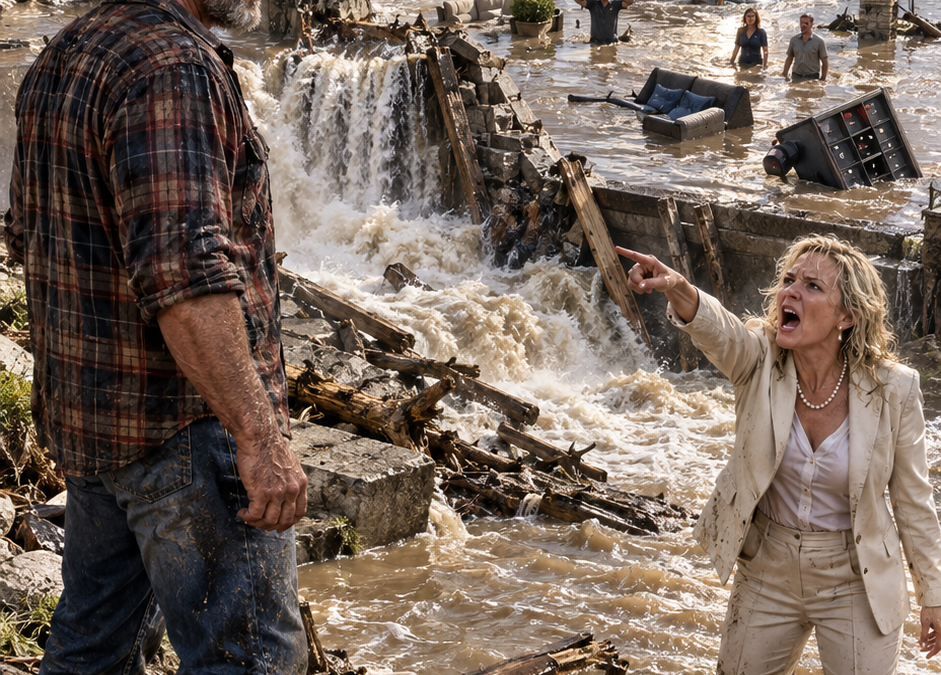
PART2
Victoria Sterling had spent most of her working life selling luxury real estate.
That explained a lot.
She understood views.
Curb appeal.
Price-per-square-foot.
Buyer psychology.
Prestige.
She understood how a photograph of a mountain at sunset could add six figures to the asking price of a house.
What she did not understand was the mountain.
To her, Mount Sentinel was a backdrop.
A static object.
Something buyers would admire through glass.
To me, it was a drainage basin.
A five-hundred-acre granite funnel angled directly toward the valley.
Those are two very different ways of looking at the same piece of geography.
Victoria arrived with two HOA compliance officers in orange vests.
One took photographs.
The other wrote notes.
I was drinking chamomile tea on the porch.
Victoria pointed at the berm.
“Arthur, we need to address this.”
“Good morning to you too.”
“This earthwork.”
“It has a name.”
“I’m sure it does.”
“Bio-retention berm.”
She made a face.
“It is a mound of weeds and mud.”
“No.”
“It blocks the mountain view from Phase Three.”
“That part is true.”
“And it violates our visual-harmony standards.”
“That part is irrelevant.”
Her eyebrows rose.
“I beg your pardon?”
“I’m not in your HOA.”
“Our standards apply to adjacent conditions that materially affect the appearance and drainage of Whispering Pines.”
“No, they don’t.”
“Our counsel disagrees.”
“Your counsel is welcome to maintain any opinion he can afford.”
One compliance officer coughed to hide a laugh.
Victoria heard it.
Her eyes sharpened.
She pulled a document from her clipboard.
“Fine.”
She held it toward me.
“Formal notice.”
I took it.
The HOA seal was printed in red.
Very official-looking.
Very expensive stationery.
The number near the bottom was more interesting.
$75,000.
I looked up.
“You’re fining me seventy-five thousand dollars?”
“For maintaining an unapproved earth structure that interferes with natural drainage and scenic value.”
I nearly laughed at the phrase interferes with natural drainage.
The berm was the only reason their natural drainage had not introduced itself to their living rooms.
Victoria continued.
“You have fourteen days to remove it.”
“And if I don’t?”
“We will seek a lien.”
“Against property outside your HOA?”
“We will pursue all remedies available through county enforcement.”
She smiled.
“And if necessary, we will obtain authority to remove the structure ourselves and bill you.”
Behind her, one of the compliance officers photographed the vetiver grass.
I set down my tea.
“Victoria.”
“Yes?”
“Do you know what that berm does?”
“It blocks our view.”
“It holds back mountain runoff.”
“We have drainage.”
“You have culverts.”
“Engineered culverts.”
“Too small.”
She gave a little laugh.
“Arthur, I appreciate that you used to work with the government.”
“Army Corps of Engineers.”
“Yes. Very impressive.”
It did not sound impressive when she said it.
“But Whispering Pines was designed by licensed professionals.”
“So was the Titanic.”
Her expression hardened.
I walked toward the boundary.
“Mount Sentinel sheds water almost immediately during heavy rainfall.”
I pointed uphill.
“Granite surface. Minimal infiltration.”
Then downhill.
“Before your development, this whole lower valley was marsh.”
“That was years ago.”
“Water has a longer memory than your development.”
Her mouth tightened.
I continued.
“When you filled the marsh, you removed storage capacity.”
“We installed drainage.”
“Your drainage assumes moderate suburban runoff.”
“It passed inspection.”
“It will work beautifully in moderate rain.”
She crossed her arms.
“And in heavy rain?”
“The berm saves you.”
“That pile of dirt?”
“That pile of dirt has been saving you for five years.”
Victoria shook her head.
“Our infrastructure cost millions.”
“Price does not change pipe diameter.”
“Our engineers know what they’re doing.”
“Then invite one here.”
“I don’t need to.”
“You should.”
“Remove it.”
I looked west.
Clouds were developing offshore.
Nothing immediate.
But the seasonal pattern was changing.
Atmospheric-river forecasts had already begun appearing in long-range models.
I turned back.
“One professional warning.”
Victoria sighed theatrically.
“If that berm comes out, high-volume runoff from the mountain will resume its historical path.”
“I understand your position.”
“No.”
I pointed directly toward the tenth hole.
“That is the historical path.”
She looked.
Golf green.
White bunkers.
Stone-lined ornamental creek.
Three Phase Three mansions beyond.
“You will flood the golf course.”
Her smile became condescending.
“And then?”
“The water will move through Phase Three.”
“Our stormwater network will carry it.”
“No.”
“You cannot know that.”
“I calculated it.”
“Years ago?”
“Repeatedly.”
She tapped her clipboard.
“Then your numbers disagree with ours.”
“Gravity gets the deciding vote.”
Her eyes narrowed.
“Remove it, Arthur.”
“If I do, you assume the risk.”
“We already assume the risk of maintaining our community.”
“No.”
I pointed toward her notice.
“You are ordering me to remove a functioning flood-control feature after receiving a technical warning.”
Her smile returned.
“You’re trying to frighten me.”
“I’m trying to document you.”
That finally made her pause.
“Document what?”
“That you were warned.”
She looked down at the paper.
Then back at me.
“Remove the berm.”
“All right.”
She blinked.
That answer was not what she expected.
“All right?”
“You want the natural historic grade restored?”
“Yes.”
“You want the earthwork removed?”
“Yes.”
“You want the original flow path reopened?”
“Yes.”
“And you’ll put that in writing?”
Her confidence returned instantly.
“It already is.”
I folded the notice.
“Good.”
Victoria smiled.
“I knew you’d eventually become reasonable.”
I watched her walk back toward her SUV.
Reasonable.
That was one word for it.
I called Thomas Vance that afternoon.
Thomas and I had worked together years earlier.
Military engineer turned environmental and land-use attorney.
The kind of man who read contracts the way demolition experts read structural cracks.
He arrived before dark.
I laid out the HOA notice.
He read the $75,000 fine.
Then looked at me.
“They actually put ‘restore natural historic drainage’ in writing?”
“Yes.”
He read it again.
“Arthur.”
“Yes?”
“I may frame this.”
“I was thinking the same thing.”
We spread maps across my kitchen table.
Historic contours.
Old wetlands.
Whispering Pines Phase Three plans.
Stormwater diagrams.
My berm drawings.
Thomas listened while I explained the hydrology.
Five hundred acres above.
Near-impermeable granite.
Steep runoff convergence.
Compacted downstream soils.
Undersized culverts.
The berm’s detention volume.
The forecast.
Thomas studied the contours.
“How bad?”
“With the berm?”
“Yes.”
“A serious storm creates temporary storage here.”
I pointed.
“Controlled release through the spillway.”
“Without it?”
“The mountain gets its original route back.”
“How fast?”
“Depends on rainfall intensity.”
“Worst case.”
I sat back.
“Phase Three becomes a lake.”
Thomas was quiet.
Then he asked:
“Did you send them a written engineering report?”
“Three years ago.”
“Receipt?”
“Yes.”
“Any response?”
“Victoria called it alarmist.”
Thomas smiled.
“Excellent.”
“Not the word I’d use.”
“Legally, Arthur, this is excellent.”
He pulled out a legal pad.
“If they are going to force removal, they need to own the consequences.”
Over six hours, we drafted the agreement.
Not a protest.
Not an injunction.
Compliance.
That was the elegance of it.
The document stated that under direct written demand from Whispering Pines HOA, and under threat of a $75,000 penalty and legal action, I agreed to remove the berm and return the boundary to its documented historic grade.
Then came the important section.
The HOA acknowledged that I had warned them in writing that removal would restore the natural runoff path toward Whispering Pines.
They acknowledged receipt of my engineering report.
They acknowledged the downstream parcels most exposed.
They accepted responsibility for consequences arising from their demanded modification.
Thomas read the clause aloud.
I nodded.
“Make it plainer.”
“It’s already plain.”
“Victoria doesn’t read engineering language.”
“She also doesn’t read legal language.”
“Exactly.”
He rewrote the acknowledgment in direct English before adding the formal language beneath it.
THE HOA ACKNOWLEDGES THAT REMOVAL OF THE BERM MAY MATERIALLY INCREASE DOWNSTREAM STORMWATER VOLUME, VELOCITY, SEDIMENT LOAD, AND FLOOD RISK.
Even Victoria could understand that.
We attached my hydrology report.
Historic storm data.
Contour maps.
Photographs.
Then we took it to the HOA.
Victoria’s office looked exactly like I expected.
Glass walls.
Marble reception desk.
Architectural model under a dome.
Flat-screen displays showing happy fictional families walking across eternally dry golf-course lawns.
Thomas and I arrived in muddy boots.
The receptionist looked down at them.
I almost apologized.
Almost.
Victoria received us in her office.
“Arthur.”
She smiled.
“Have you come to pay?”
“No.”
“Then I hope you brought a demolition schedule.”
Thomas placed the agreement on her desk.
“My client has decided to comply.”
Victoria looked delighted.
I had spent enough time around generals to recognize victory intoxication.
It causes intelligent people to stop reading.
She skimmed the first page.
“You’ll remove it within seven days?”
“Yes.”
“At your expense?”
“Yes.”
“And the seventy-five-thousand-dollar fine is dismissed?”
“Once compliance is complete.”
She reached for her pen.
Thomas put two fingers on the document.
“One moment.”
Her smile weakened.
“What?”
“The HOA must acknowledge the technical risk.”
She waved one hand.
“Our engineers are comfortable.”
“Then signing should present no problem.”
“What exactly am I accepting?”
“That Mr. Pendleton warned you.”
“He has certainly done that.”
“That removal could increase downstream flood exposure.”
She laughed.
“We have stormwater infrastructure.”
“Then the clause should concern you even less.”
She scanned the page.
Thomas waited.
I said nothing.
That was important.
Silence makes arrogant people rush to fill it.
Victoria picked up her gold pen.
“This is standard lawyer language.”
Thomas said:
“It is a liability acknowledgment.”
“Fine.”
She signed.
Thomas notarized it.
Before leaving, he asked:
“Would you like counsel to review your signature?”
“I do not need permission from a lawyer to sign an HOA compliance agreement.”
Thomas closed his briefcase.
“No, ma’am.”
Outside, he looked west.
The clouds were heavier.
His phone buzzed.
Weather alert.
He read it.
“Arthur.”
“What?”
“The atmospheric river has strengthened.”
“How much?”
“Forecast office is using phrases they normally avoid.”
“Such as?”
“Potentially historic.”
I looked down toward Whispering Pines.
Sprinklers were running on the golf course.
“Move your equipment uphill,” Thomas said.
“I already planned to.”
The next morning, I started the excavator.
A Caterpillar diesel at dawn has a way of making an administrative decision feel physical.
The berm had taken me three months to construct.
Removing it hurt.
That surprised me.
Vetiver roots had woven through the clay into dense vertical mats.
Every bucket bite tore apart something alive and functional.
It felt like dismantling a bridge because somebody disliked its color.
Victoria came to watch.
Of course she did.
She sat beside the tenth-hole path in a white lawn chair wearing a cashmere scarf.
Espresso in one hand.
Clipboard in the other.
Two board members stood nearby.
When my bucket tore out the first large section of berm, one of them clapped.
I remember that.
Clapped.
I kept working.
Slow.
Exact.
The agreement required restoration to historic grade.
That is precisely what I gave them.
I used the old topographic data.
Laser level.
Survey stakes.
I did not leave extra earth.
Did not build a hidden lip.
Did not retain an emergency mound.
Not because I wanted the flood.
Because Victoria had threatened my farm for altering the natural grade.
So I restored the natural grade.
Perfectly.
As I worked, she called across the boundary.
“Looks better already!”
I ignored her.
“You should have trusted us from the beginning!”
Bucket down.
Clay up.
Swing.
Dump.
“Property values are about consistency, Arthur!”
Swing.
Dump.
“People pay millions for these views!”
That part was true.
By Saturday afternoon, the berm was gone.
The mountain view was magnificent.
Unfortunately, so was the drainage path.
Where the berm had stood, the land now sloped naturally over exposed granite toward the golf course.
I parked the excavator.
Victoria approached.
“Beautiful.”
I wiped hydraulic grime from my hands.
“Finished.”
She looked uphill.
“See how open it feels?”
“Yes.”
“Our brokers are coming tomorrow.”
I looked west.
The sky was almost black.
“Maybe reschedule.”
She laughed.
“Because of rain?”
“Yes.”
“This community was built for all-season living.”
“So was Noah’s ark.”
She frowned.
“You always need the last word.”
“No.”
I pointed toward the clouds.
“The mountain usually gets it.”
That evening, I moved the excavator.
Tractors.
Trucks.
Fuel.
Distilling equipment.
Everything important went to the upper barns.
Then I checked the weather radio.
Flood warning.
Extreme rainfall.
Rapid runoff.
Historic floodplain.
Evacuation urged for vulnerable low-lying areas.
I called the county emergency office.
Gave them my runoff estimate.
Explained that the berm had been removed.
Sent the current maps.
Unlike Victoria, they listened.
Emergency alerts went out.
Some Whispering Pines residents evacuated before the worst rainfall arrived.
That mattered.
Whatever I thought of Victoria, I had no interest in anyone dying to prove me right.
At midnight, the rain stopped sounding like rain.
It became continuous noise.
A wall.
Mount Sentinel disappeared.
Water poured off the granite face.
Within minutes, every shallow channel on my land was full.
I stood under the porch roof wearing a raincoat and watched through a spotlight.
Where the berm had once created a temporary pool, the runoff now crossed my lower property almost uninterrupted.
Then it reached the restored slope.
Accelerated.
And disappeared toward Whispering Pines.
The mountain had been handed back its old road.
At 1:30 a.m., I checked flow estimates.
Bad.
At 2:00, emergency radio reported flooding near the tenth fairway.
At 2:12, the first drainage culvert clogged.
At 2:20, the golf-course service road disappeared.
At 2:35, the tenth hole became brown water.
The expensive imported bunker sand lasted perhaps ten minutes.
I watched through binoculars when lightning illuminated the valley.
The golf course had ceased being a golf course.
It was a floodplain again.
The eleventh hole followed.
Then the water reached Phase Three.
The new houses had been designed around the view.
Large glass walls.
Deep basements.
Landscaped terraces.
Beautiful.
And profoundly vulnerable to moving water.
The first basement filled before 3:00.
Retaining walls failed.
Landscape stone became debris.
Garage doors bent inward.
One large window cracked under water pressure and disappeared behind a surge of mud.
Emergency crews were already moving residents.
Sirens echoed through the storm.
I stayed by the radio.
Reported what I could see.
At 3:15, my landline rang.
I answered.
“Arthur!”
Victoria.
“Good morning.”
“Do something!”
Her voice was nearly unrecognizable.
“What is happening?”
“The whole lower section is flooding!”
“Yes.”
“The water is coming off your property!”
“Correct.”
“Stop it!”
“With what?”
“The berm!”
I looked toward the dark slope.
“The berm is gone.”
“Build it back!”
“In this storm?”
“Anything!”
“You ordered it removed.”
“I didn’t know this would happen!”
“I told you.”
“Our engineers said—”
“I told you.”
“The tenth hole is gone!”
“I know.”
“Phase Three is underwater!”
“I know.”
“You have to stop the water!”
“Victoria.”
“Please.”
That word sounded strange from her.
“We will pay you.”
“This is not about money.”
“One million dollars.”
“No.”
“Two million!”
“You cannot rebuild a one-hundred-fifty-meter retention system during a flash flood.”
Her voice broke.
“My house has mud in it.”
“I’m sorry.”
“My cars are underwater.”
“I’m sorry.”
“Then help us!”
“I am helping.”
“How?”
“I gave emergency management the watershed model before midnight. Search-and-rescue crews are already positioned.”
Silence.
Then she whispered:
“You knew.”
“I knew flooding was possible.”
“You wanted this.”
“No.”
“You set us up.”
“No.”
“You signed that paper knowing this storm was coming.”
“I signed the paper because you threatened my farm.”
Her breathing was loud.
“You could have fought us.”
“Yes.”
“You could have gotten an injunction.”
“Probably.”
“Then why didn’t you?”
I looked through the window.
Because that was the question, wasn’t it?
“Because you were certain.”
“What?”
“You had the notice.”
“The board.”
“The fine.”
“The lawyers.”
“The developer.”
“The view.”
“You had every opportunity to stop.”
“You chose not to.”
She began crying.
“Arthur, people are losing everything.”
My voice softened.
“I know.”
That part was not funny.
It never was.
“Get to higher ground.”
“What?”
“Leave the property if emergency crews tell you to leave.”
“But—”
“Property can be replaced.”
I paused.
“People cannot.”
Then I hung up.
By sunrise, the storm moved inland.
The valley looked ruined.
The tenth and eleventh holes were buried under silt.
Phase Three was coated in mud.
Vehicles sat at strange angles where water had moved them.
Landscaping had vanished.
Pools were filled with brown water.
Roads were blocked by debris.
Twelve new luxury homes had suffered severe damage.
County estimates eventually placed total losses above twelve million dollars.
Nobody died.
That mattered more than everything else.
A handful of people suffered minor injuries.
Emergency crews had evacuated the most exposed homes early enough.
That was the only part of the disaster I considered a victory.
Everything after that was paperwork.
And paperwork was where Victoria’s real flood began.
Insurance adjusters arrived.
Then engineers.
Then attorneys.
Then more engineers.
Everybody asked the same question.
Why had the runoff-control berm been removed?
Whispering Pines initially described the storm as unprecedented.
Act of God.
Natural disaster.
Then the insurers found my report.
Exhibit A.
Victoria’s signature beneath the acknowledgment.
The written HOA demand.
The $75,000 threat.
The statement requiring restoration of “natural historical drainage.”
The agreement.
Suddenly, the story changed.
Homeowners received denial notices and reservation-of-rights letters while carriers investigated whether the HOA had deliberately increased a known flood risk.
Phase Three residents were furious.
Several had purchased homes partly because the HOA had marketed its drainage infrastructure as state of the art.
Then they discovered their own president had ordered the removal of a functioning upstream detention structure because it obstructed their mountain view.
One homeowner came to my farm.
His name was Michael Reese.
His basement was destroyed.
He looked exhausted.
“Did you really warn them?”
“Yes.”
“Can I see it?”
I gave him a copy.
He read silently.
Then looked at me.
“She signed this?”
“Yes.”
“She knew the water came through our lots?”
“She acknowledged the historic flow path.”
He sat on my porch step.
“My wife asked about flood risk before we bought.”
I said nothing.
“The sales agent told us the drainage system had eliminated it.”
I still said nothing.
“What would you have done?”
“If?”
“If you were building down there.”
“Not built.”
He laughed bitterly.
“Anything else?”
“Restore part of the wetland.”
He nodded.
“That’s what the county engineer told us yesterday.”
Within forty-eight hours, Phase Three owners retained counsel.
The lawsuit named Whispering Pines HOA.
Several board members.
Victoria personally.
The developer.
Engineering consultants.
Claims multiplied.
Negligence.
Failure to disclose.
Breach of fiduciary duty.
Misrepresentation.
The signed compliance agreement became central evidence in every dispute.
Victoria resigned.
Not voluntarily, from what I heard.
The board accepted her resignation during an emergency meeting attended by nearly every homeowner.
Her real-estate company removed her from active marketing duties.
Phase Three sales stopped.
The remaining unsold houses became nearly impossible to move until the flood-control question was resolved.
Bethany Morris, who ran the local nursery, saw Victoria several weeks later.
“She looks different.”
“How?”
“No clipboard.”
I smiled.
“That’ll do it.”
Two weeks after the flood, four members of the new emergency HOA board walked up my driveway.
No compliance officers.
No gold pens.
No threats.
Their new president was Evelyn Vance, a retired school principal in her late sixties.
She looked at the herb fields.
Then at me.
“Mr. Pendleton.”
“Arthur is fine.”
“Arthur.”
She took a breath.
“We owe you an apology.”
“Yes.”
Thomas, standing beside me, coughed.
I gave him a look.
Evelyn continued.
“We were wrong.”
“Yes.”
“We allowed the previous board to confuse aesthetic preferences with engineering judgment.”
“Yes.”
“We thought our drainage system was enough.”
“Yes.”
Thomas finally said:
“Arthur, perhaps let the woman finish.”
“Fair.”
Evelyn almost smiled.
“We need your help.”
I poured tea.
We sat on the porch.
She explained the obvious.
Winter had barely begun.
Another major storm could arrive.
Whispering Pines remained exposed.
The old berm was gone.
The wetlands below were partially reclaiming themselves, but without deliberate reconstruction the next storm could repeat the damage.
“We have reviewed your credentials,” Evelyn said.
I looked at Thomas.
He looked away, amused.
“Apparently,” she continued, “we should have done that before.”
“That would have saved time.”
“And money.”
“Considerably.”
She folded her hands.
“What will it take?”
Thomas placed a document on the table.
Not a revenge contract.
A reconstruction framework.
First:
Every fine, notice, and enforcement claim against my farm would be dismissed permanently.
Second:
My property would be formally excluded from HOA authority.
No aesthetic jurisdiction.
No landscaping standards.
No adjacent-property theories.
No future attempt to extend covenants across my deed line.
Third:
Whispering Pines would fund reconstruction of the flood-control system.
Not the old berm.
Something better.
A reinforced retention weir.
Stone-faced.
Controlled outlet.
Emergency spillway.
Integrated with restored wetlands below.
Designed to safely manage an extreme storm.
Fourth:
The destroyed tenth and eleventh holes, along with the lowest Phase Three drainage parcels, would no longer be treated as luxury recreational ground.
They would become flood-storage and wetland space.
Evelyn read everything.
“This means we lose two golf holes.”
“You already lost them.”
Thomas smiled into his tea.
She continued.
“And some Phase Three lots cannot be rebuilt as originally planned.”
“Correct.”
“And you receive final technical review over major earthwork affecting the watershed?”
“Engineering review.”
“Not HOA control.”
“No.”
She nodded.
“I understand the distinction now.”
Good answer.
We spent the next month revising designs.
County engineers joined.
Environmental specialists.
Insurance consultants.
Hydrologists.
People who understood that a watershed is a connected system rather than a collection of individually landscaped parcels.
The new structure went in the following spring.
Reinforced core.
Compacted clay shoulders.
Stone facing.
Vetiver along the flanks.
Large emergency spillway.
Flow-monitoring equipment.
We also reopened portions of the valley to natural wetland function.
That was more important than the concrete.
Water needs room.
Give it room, and it becomes manageable.
Deny it room, and eventually it takes room.
The tenth hole became marsh.
The eleventh became seasonal flood storage.
Golfers complained.
Frogs did not.
Mallards arrived first.
Then herons.
Then reeds.
Sedges.
Dragonflies.
The valley began looking less expensive.
And more alive.
The next major storm came eighteen months later.
Not as large as the one that destroyed Phase Three.
Large enough to test us.
I stood beside the new control structure in a rain jacket.
The water rose.
The upper basin filled.
The wetland expanded.
The spillway engaged.
Sensors recorded flow.
Downstream culverts remained within capacity.
Whispering Pines stayed dry.
Evelyn called the next morning.
“Arthur?”
“Yes?”
“Everything worked.”
“That’s generally why we build things.”
She laughed.
A genuine laugh.
“I suppose this is where you say you told us so.”
“No.”
“Really?”
“You listened this time.”
There was no reason to punish people for learning.
Victoria, however, had a longer road.
Her lawsuits dragged on.
She sold her home.
Her real-estate career never recovered.
The developer blamed the HOA.
The HOA blamed the developer.
The insurers blamed everybody.
Attorneys billed all of them.
Physics remained neutral.
I saw Victoria once about a year later.
County planning hearing.
She sat alone near the back.
No pastel polo.
No gold clipboard.
When the hearing ended, we crossed paths outside.
“Arthur.”
“Victoria.”
She looked older.
“The wetland looks terrible.”
I almost laughed.
“You’re consistent.”
“I mean messy.”
“Yes.”
“Standing water.”
“Yes.”
“Reeds everywhere.”
“Yes.”
“Mosquitoes.”
“Not many. Too many dragonflies.”
She looked toward the valley.
“I still think the old golf course looked better.”
“And I still think houses look better dry.”
She almost smiled.
Almost.
Then she said:
“Do you hate me?”
“No.”
That surprised her.
“You should.”
“Too much work.”
“What do you feel?”
I thought about it.
“Respect for consequences.”
She looked away.
“I lost everything.”
“No.”
Her eyes returned to mine.
“You’re alive.”
She did not answer.
I walked away.
That exchange stayed with me.
It would be easy to tell this as a revenge story.
Woman orders engineer to remove dam.
Engineer complies.
Flood destroys HOA.
Woman loses everything.
Satisfying.
Clean.
But water is rarely clean.
The homeowners who lost photographs did not deserve that.
The families evacuated at three in the morning did not deserve it.
The maintenance crews who spent weeks shoveling mud did not deserve it.
That is why I called emergency management before the storm.
Why I sent the runoff model.
Why I cooperated with rescue crews.
I did not want destruction.
I wanted responsibility.
Victoria wanted the berm removed badly enough to threaten my land.
I required her to acknowledge what that meant.
Then she signed.
People sometimes ask why I didn’t simply refuse.
Because refusal had become its own risk.
She had threatened litigation.
Foreclosure theories.
County enforcement.
Unauthorized equipment on my property.
A prolonged fight could have taken months.
And Victoria’s board believed the structure itself was harmful.
So I did the one thing engineers do when a client insists on overriding technical advice.
I documented the warning.
Obtained written acknowledgment.
Then complied exactly.
That is not revenge.
That is traceability.
Every profession has some version of it.
Pilots have checklists.
Doctors have informed consent.
Engineers have design assumptions.
Lawyers have signatures.
When somebody insists on ignoring expertise, the record becomes the last barrier between a bad decision and a rewritten story.
Victoria could say later:
We never knew.
Except she signed:
We know.
She could say:
Arthur acted on his own.
Except the notice said:
Remove it.
She could say:
The flood was unforeseeable.
Except my report included fifty years of storm history.
She could say:
The berm was unnecessary.
Except five dry winters followed by one disastrous winter without it told a very different story.
The mountain did not punish Whispering Pines.
The mountain behaved normally.
That was the uncomfortable part.
The flood was not nature becoming abnormal.
It was nature returning to the path humans had blocked, filled, paved, landscaped, and forgotten.
Whispering Pines had been built on the assumption that old water could be erased by new construction.
It cannot.
The wetland is still there now.
Expanded.
Protected.
School groups visit in spring.
Biology students test water.
Migratory birds stop during their seasonal routes.
A wooden observation platform sits near the old eleventh tee.
The irony is not lost on me.
Whispering Pines once threatened to take my farm because my flood-control berm disturbed its view.
Now the HOA’s most celebrated amenity is a wetland created by the flood that happened after they forced me to remove it.
They even printed brochures.
I received one.
WHISPERING PINES WATERSHED SANCTUARY
I called Evelyn immediately.
“You printed a brochure.”
She laughed.
“We’re still an HOA.”
“Fair.”
At least the brochure did not claim the frogs were architecturally approved.
My farm is still above the valley.
Lavender in summer.
Rosemary.
Peppermint.
The copper still still runs during harvest.
Sometimes, when steam fills the barn and the scent of lavender hangs in the rafters, I think about how different that life is from the one I lived in uniform.
Then a storm approaches.
The barometer falls.
Birds quiet.
Wind shifts.
And the old engineer comes back.
I walk the weir.
Check the spillway.
Inspect the vetiver.
Read the gauges.
Water gathers behind the structure exactly as designed.
Then releases slowly.
Below me, the restored marsh rises a few inches.
Frogs relocate.
Birds move toward higher reeds.
Whispering Pines remains dry.
That is what good engineering looks like most of the time.
Nothing dramatic happens.
Nobody applauds a flood that does not occur.
Nobody photographs a culvert that stays within capacity.
Nobody gives awards to a retaining structure because a basement remained boringly empty.
Success is invisible.
That is why Victoria thought the old berm did nothing.
Five years of dry golf-course fairways looked like evidence that the HOA’s drainage worked.
In reality, the berm had been working so well they forgot it existed.
People are very good at resenting protective systems precisely because successful protective systems prevent them from seeing the danger.
Then they remove them.
And suddenly everybody understands.
Thomas still jokes about the agreement.
“The most expensive scenic-view contract in county history.”
I correct him.
“It was free.”
“The signature cost them twelve million dollars.”
“The signature cost nothing.”
“You engineers have no poetry.”
“We have units.”
He shakes his head.
That is why we remain friends.
The $75,000 fine disappeared, obviously.
So did every other notice.
My property now has a permanent recorded exclusion from HOA enforcement.
The language is almost comically broad.
No architectural control.
No landscape authority.
No view protection.
No aesthetic-impact enforcement.
No stormwater directive.
No earthwork restriction originating from Whispering Pines.
I framed that one.
It hangs beside my original military engineering certificate.
Not because I am proud of winning.
Because I am proud of the boundary being clear.
No more ambiguity.
No more gold clipboards marching up my driveway.
Once a year, the emergency board invites me to a watershed meeting.
I go.
We discuss rainfall trends.
Sediment.
Vegetation.
Drainage maintenance.
Actual issues.
No one mentions paint color.
One year, a new resident asked:
“Could we trim the reeds to improve the lake view?”
The entire board turned toward me.
I said:
“No.”
He asked:
“Why?”
Evelyn answered before I could.
“Because we enjoy having houses.”
Progress.
On quiet autumn mornings, I stand on my porch with tea.
Mist sits over the marsh.
Mount Sentinel rises behind it.
Water moves through the weir in a low silver sheet.
Where the tenth green once sat, cattails bend in the wind.
Where golfers once complained about bunker sand, herons hunt frogs.
Somewhere under the reeds are old drainage pipes that once represented millions of dollars of confidence.
They are mostly irrelevant now.
The wetland does the heavy work.
Nature is often cheaper than arrogance.
I still have Victoria’s original violation notice.
UNAPPROVED NON-CONFORMING EARTH STRUCTURE.
FINE: $75,000.
REQUIRED ACTION: REMOVE BERM AND RESTORE NATURAL HISTORIC WATER FLOW.
Sometimes I read that last line.
Then I look at the marsh.
Whispering Pines got exactly what it ordered.
The natural historic flow returned.
It crossed the golf course.
Entered Phase Three.
Filled basements.
Destroyed views.
Collapsed sales.
Generated lawsuits.
And eventually rebuilt the entire valley around the one fact Victoria had refused to understand.
Water remembers where it belongs.
Victoria thought she was ordering an old veteran to remove an ugly pile of dirt.
What she actually removed was the only thing standing between her subdivision and five hundred acres of gravity.
I warned her.
Thomas warned her.
The maps warned her.
The weather forecast warned her.
She signed anyway.
Then the mountain signed underneath her name in twelve million dollars’ worth of mud.
That was the end of the old Whispering Pines.
The new one learned.
The wetlands returned.
The flood-control system was rebuilt.
My farm remained mine.
And every storm since has delivered the same quiet reminder down the spillway:
You can fine a man.
You can threaten his property.
You can rewrite your bylaws.
But when you order the dam gone, you do not get to negotiate with the water that comes after it.
Have you finished reading the story and want to read it again?
HOA Ordered My Flood-Control Dam Removed — Then the Mountain Sent Them the Water They Asked For
They ordered me to tear down the only thing holding the mountain back.
I warned them exactly what would happen.
Then the rain arrived.
My name is Arthur Pendleton, and before I retired, I spent three decades working with water for the United States Army Corps of Engineers.
Not decorative fountains.
Not backyard ponds.
Water when it has weight behind it.
Water when a river rises twelve feet overnight and starts testing every calculation somebody made twenty years earlier.
Water when saturated soil loses shear strength and a hillside begins moving.
Water when a concrete wall starts humming because the pressure on the other side has become greater than what some engineer promised on paper.
I learned something early in that career.
Water does not negotiate.
It does not care how expensive the houses are downstream.
It does not read HOA bylaws.
It does not respect marketing brochures, landscaping committees, architectural renderings, or the confidence of people who have mistaken a controlled environment for actual control.
Water follows gravity.
That is the whole contract.
When I retired, I wanted quiet.
My family owned one hundred twenty acres at the head of Mist Bay Valley, pressed against the granite slopes of Mount Sentinel.
The property had been in our family since the nineteenth century.
High woodland.
Herb fields.
Wetlands.
Old barns.
Cold springs.
I grew lavender, rosemary, peppermint, and lemon verbena.
I distilled essential oils in a copper still behind the main barn and sold the entire crop to herbalists and soap makers before harvest most years.
After decades of flood-control work, it was exactly the life I wanted.
Slow.
Useful.
Quiet.
Then Whispering Pines Estates arrived below me.
The developers drained the old marshes at the bottom of the valley, filled them, compacted them, installed miles of expensive drainage pipe, planted acres of chemically perfect turf, and built an eighteen-hole golf course surrounded by large stucco homes with deep basements and floor-to-ceiling glass.
They marketed the mountain as scenery.
That was their first mistake.
Mount Sentinel was not scenery.
It was a five-hundred-acre hydraulic catchment made mostly of hard, nearly impermeable granite.
When heavy Pacific storms hit that face, very little water soaked in.
It ran.
Fast.
Historically, that runoff had slowed in the wetlands below.
The marshes spread the water.
Stored it.
Released it gradually.
Whispering Pines had built its golf course where the valley used to absorb the mountain.
I studied their drainage plans when Phase One went in.
Then Phase Two.
Then Phase Three.
The pipes were too small for a serious atmospheric-river event.
The grading was too optimistic.
The golf-course subsoil had been compacted so heavily that during saturation it would absorb almost nothing.
So five years before this story began, I built a bio-retention berm along my lower boundary.
It wasn’t pretty in the suburban sense.
No decorative stone cap.
No fountain.
No landscape lighting.
Just compacted local clay, deep-rooted vetiver grass, and a controlled spillway.
One hundred fifty meters long.
Designed to temporarily hold roughly two million gallons of storm runoff.
For five winters, it quietly protected Whispering Pines.
Nobody thanked me.
Most of them didn’t even know it existed.
Then Victoria Sterling became HOA president.
And one Tuesday morning, she walked up my gravel drive, pointed a gold clipboard at the berm, and announced:
“Remove that damn thing by Friday.”
I looked past her toward Mount Sentinel.
Far to the west, the sky was already darkening.
Then I looked back at Victoria.
“Are you absolutely certain that’s what you want?”
She smiled.
“Yes.”
That was the moment I knew the mountain was about to teach Whispering Pines a lesson no HOA committee could appeal.
PART2
Victoria Sterling had spent most of her working life selling luxury real estate.
That explained a lot.
She understood views.
Curb appeal.
Price-per-square-foot.
Buyer psychology.
Prestige.
She understood how a photograph of a mountain at sunset could add six figures to the asking price of a house.
What she did not understand was the mountain.
To her, Mount Sentinel was a backdrop.
A static object.
Something buyers would admire through glass.
To me, it was a drainage basin.
A five-hundred-acre granite funnel angled directly toward the valley.
Those are two very different ways of looking at the same piece of geography.
Victoria arrived with two HOA compliance officers in orange vests.
One took photographs.
The other wrote notes.
I was drinking chamomile tea on the porch.
Victoria pointed at the berm.
“Arthur, we need to address this.”
“Good morning to you too.”
“This earthwork.”
“It has a name.”
“I’m sure it does.”
“Bio-retention berm.”
She made a face.
“It is a mound of weeds and mud.”
“No.”
“It blocks the mountain view from Phase Three.”
“That part is true.”
“And it violates our visual-harmony standards.”
“That part is irrelevant.”
Her eyebrows rose.
“I beg your pardon?”
“I’m not in your HOA.”
“Our standards apply to adjacent conditions that materially affect the appearance and drainage of Whispering Pines.”
“No, they don’t.”
“Our counsel disagrees.”
“Your counsel is welcome to maintain any opinion he can afford.”
One compliance officer coughed to hide a laugh.
Victoria heard it.
Her eyes sharpened.
She pulled a document from her clipboard.
“Fine.”
She held it toward me.
“Formal notice.”
I took it.
The HOA seal was printed in red.
Very official-looking.
Very expensive stationery.
The number near the bottom was more interesting.
$75,000.
I looked up.
“You’re fining me seventy-five thousand dollars?”
“For maintaining an unapproved earth structure that interferes with natural drainage and scenic value.”
I nearly laughed at the phrase interferes with natural drainage.
The berm was the only reason their natural drainage had not introduced itself to their living rooms.
Victoria continued.
“You have fourteen days to remove it.”
“And if I don’t?”
“We will seek a lien.”
“Against property outside your HOA?”
“We will pursue all remedies available through county enforcement.”
She smiled.
“And if necessary, we will obtain authority to remove the structure ourselves and bill you.”
Behind her, one of the compliance officers photographed the vetiver grass.
I set down my tea.
“Victoria.”
“Yes?”
“Do you know what that berm does?”
“It blocks our view.”
“It holds back mountain runoff.”
“We have drainage.”
“You have culverts.”
“Engineered culverts.”
“Too small.”
She gave a little laugh.
“Arthur, I appreciate that you used to work with the government.”
“Army Corps of Engineers.”
“Yes. Very impressive.”
It did not sound impressive when she said it.
“But Whispering Pines was designed by licensed professionals.”
“So was the Titanic.”
Her expression hardened.
I walked toward the boundary.
“Mount Sentinel sheds water almost immediately during heavy rainfall.”
I pointed uphill.
“Granite surface. Minimal infiltration.”
Then downhill.
“Before your development, this whole lower valley was marsh.”
“That was years ago.”
“Water has a longer memory than your development.”
Her mouth tightened.
I continued.
“When you filled the marsh, you removed storage capacity.”
“We installed drainage.”
“Your drainage assumes moderate suburban runoff.”
“It passed inspection.”
“It will work beautifully in moderate rain.”
She crossed her arms.
“And in heavy rain?”
“The berm saves you.”
“That pile of dirt?”
“That pile of dirt has been saving you for five years.”
Victoria shook her head.
“Our infrastructure cost millions.”
“Price does not change pipe diameter.”
“Our engineers know what they’re doing.”
“Then invite one here.”
“I don’t need to.”
“You should.”
“Remove it.”
I looked west.
Clouds were developing offshore.
Nothing immediate.
But the seasonal pattern was changing.
Atmospheric-river forecasts had already begun appearing in long-range models.
I turned back.
“One professional warning.”
Victoria sighed theatrically.
“If that berm comes out, high-volume runoff from the mountain will resume its historical path.”
“I understand your position.”
“No.”
I pointed directly toward the tenth hole.
“That is the historical path.”
She looked.
Golf green.
White bunkers.
Stone-lined ornamental creek.
Three Phase Three mansions beyond.
“You will flood the golf course.”
Her smile became condescending.
“And then?”
“The water will move through Phase Three.”
“Our stormwater network will carry it.”
“No.”
“You cannot know that.”
“I calculated it.”
“Years ago?”
“Repeatedly.”
She tapped her clipboard.
“Then your numbers disagree with ours.”
“Gravity gets the deciding vote.”
Her eyes narrowed.
“Remove it, Arthur.”
“If I do, you assume the risk.”
“We already assume the risk of maintaining our community.”
“No.”
I pointed toward her notice.
“You are ordering me to remove a functioning flood-control feature after receiving a technical warning.”
Her smile returned.
“You’re trying to frighten me.”
“I’m trying to document you.”
That finally made her pause.
“Document what?”
“That you were warned.”
She looked down at the paper.
Then back at me.
“Remove the berm.”
“All right.”
She blinked.
That answer was not what she expected.
“All right?”
“You want the natural historic grade restored?”
“Yes.”
“You want the earthwork removed?”
“Yes.”
“You want the original flow path reopened?”
“Yes.”
“And you’ll put that in writing?”
Her confidence returned instantly.
“It already is.”
I folded the notice.
“Good.”
Victoria smiled.
“I knew you’d eventually become reasonable.”
I watched her walk back toward her SUV.
Reasonable.
That was one word for it.
I called Thomas Vance that afternoon.
Thomas and I had worked together years earlier.
Military engineer turned environmental and land-use attorney.
The kind of man who read contracts the way demolition experts read structural cracks.
He arrived before dark.
I laid out the HOA notice.
He read the $75,000 fine.
Then looked at me.
“They actually put ‘restore natural historic drainage’ in writing?”
“Yes.”
He read it again.
“Arthur.”
“Yes?”
“I may frame this.”
“I was thinking the same thing.”
We spread maps across my kitchen table.
Historic contours.
Old wetlands.
Whispering Pines Phase Three plans.
Stormwater diagrams.
My berm drawings.
Thomas listened while I explained the hydrology.
Five hundred acres above.
Near-impermeable granite.
Steep runoff convergence.
Compacted downstream soils.
Undersized culverts.
The berm’s detention volume.
The forecast.
Thomas studied the contours.
“How bad?”
“With the berm?”
“Yes.”
“A serious storm creates temporary storage here.”
I pointed.
“Controlled release through the spillway.”
“Without it?”
“The mountain gets its original route back.”
“How fast?”
“Depends on rainfall intensity.”
“Worst case.”
I sat back.
“Phase Three becomes a lake.”
Thomas was quiet.
Then he asked:
“Did you send them a written engineering report?”
“Three years ago.”
“Receipt?”
“Yes.”
“Any response?”
“Victoria called it alarmist.”
Thomas smiled.
“Excellent.”
“Not the word I’d use.”
“Legally, Arthur, this is excellent.”
He pulled out a legal pad.
“If they are going to force removal, they need to own the consequences.”
Over six hours, we drafted the agreement.
Not a protest.
Not an injunction.
Compliance.
That was the elegance of it.
The document stated that under direct written demand from Whispering Pines HOA, and under threat of a $75,000 penalty and legal action, I agreed to remove the berm and return the boundary to its documented historic grade.
Then came the important section.
The HOA acknowledged that I had warned them in writing that removal would restore the natural runoff path toward Whispering Pines.
They acknowledged receipt of my engineering report.
They acknowledged the downstream parcels most exposed.
They accepted responsibility for consequences arising from their demanded modification.
Thomas read the clause aloud.
I nodded.
“Make it plainer.”
“It’s already plain.”
“Victoria doesn’t read engineering language.”
“She also doesn’t read legal language.”
“Exactly.”
He rewrote the acknowledgment in direct English before adding the formal language beneath it.
THE HOA ACKNOWLEDGES THAT REMOVAL OF THE BERM MAY MATERIALLY INCREASE DOWNSTREAM STORMWATER VOLUME, VELOCITY, SEDIMENT LOAD, AND FLOOD RISK.
Even Victoria could understand that.
We attached my hydrology report.
Historic storm data.
Contour maps.
Photographs.
Then we took it to the HOA.
Victoria’s office looked exactly like I expected.
Glass walls.
Marble reception desk.
Architectural model under a dome.
Flat-screen displays showing happy fictional families walking across eternally dry golf-course lawns.
Thomas and I arrived in muddy boots.
The receptionist looked down at them.
I almost apologized.
Almost.
Victoria received us in her office.
“Arthur.”
She smiled.
“Have you come to pay?”
“No.”
“Then I hope you brought a demolition schedule.”
Thomas placed the agreement on her desk.
“My client has decided to comply.”
Victoria looked delighted.
I had spent enough time around generals to recognize victory intoxication.
It causes intelligent people to stop reading.
She skimmed the first page.
“You’ll remove it within seven days?”
“Yes.”
“At your expense?”
“Yes.”
“And the seventy-five-thousand-dollar fine is dismissed?”
“Once compliance is complete.”
She reached for her pen.
Thomas put two fingers on the document.
“One moment.”
Her smile weakened.
“What?”
“The HOA must acknowledge the technical risk.”
She waved one hand.
“Our engineers are comfortable.”
“Then signing should present no problem.”
“What exactly am I accepting?”
“That Mr. Pendleton warned you.”
“He has certainly done that.”
“That removal could increase downstream flood exposure.”
She laughed.
“We have stormwater infrastructure.”
“Then the clause should concern you even less.”
She scanned the page.
Thomas waited.
I said nothing.
That was important.
Silence makes arrogant people rush to fill it.
Victoria picked up her gold pen.
“This is standard lawyer language.”
Thomas said:
“It is a liability acknowledgment.”
“Fine.”
She signed.
Thomas notarized it.
Before leaving, he asked:
“Would you like counsel to review your signature?”
“I do not need permission from a lawyer to sign an HOA compliance agreement.”
Thomas closed his briefcase.
“No, ma’am.”
Outside, he looked west.
The clouds were heavier.
His phone buzzed.
Weather alert.
He read it.
“Arthur.”
“What?”
“The atmospheric river has strengthened.”
“How much?”
“Forecast office is using phrases they normally avoid.”
“Such as?”
“Potentially historic.”
I looked down toward Whispering Pines.
Sprinklers were running on the golf course.
“Move your equipment uphill,” Thomas said.
“I already planned to.”
The next morning, I started the excavator.
A Caterpillar diesel at dawn has a way of making an administrative decision feel physical.
The berm had taken me three months to construct.
Removing it hurt.
That surprised me.
Vetiver roots had woven through the clay into dense vertical mats.
Every bucket bite tore apart something alive and functional.
It felt like dismantling a bridge because somebody disliked its color.
Victoria came to watch.
Of course she did.
She sat beside the tenth-hole path in a white lawn chair wearing a cashmere scarf.
Espresso in one hand.
Clipboard in the other.
Two board members stood nearby.
When my bucket tore out the first large section of berm, one of them clapped.
I remember that.
Clapped.
I kept working.
Slow.
Exact.
The agreement required restoration to historic grade.
That is precisely what I gave them.
I used the old topographic data.
Laser level.
Survey stakes.
I did not leave extra earth.
Did not build a hidden lip.
Did not retain an emergency mound.
Not because I wanted the flood.
Because Victoria had threatened my farm for altering the natural grade.
So I restored the natural grade.
Perfectly.
As I worked, she called across the boundary.
“Looks better already!”
I ignored her.
“You should have trusted us from the beginning!”
Bucket down.
Clay up.
Swing.
Dump.
“Property values are about consistency, Arthur!”
Swing.
Dump.
“People pay millions for these views!”
That part was true.
By Saturday afternoon, the berm was gone.
The mountain view was magnificent.
Unfortunately, so was the drainage path.
Where the berm had stood, the land now sloped naturally over exposed granite toward the golf course.
I parked the excavator.
Victoria approached.
“Beautiful.”
I wiped hydraulic grime from my hands.
“Finished.”
She looked uphill.
“See how open it feels?”
“Yes.”
“Our brokers are coming tomorrow.”
I looked west.
The sky was almost black.
“Maybe reschedule.”
She laughed.
“Because of rain?”
“Yes.”
“This community was built for all-season living.”
“So was Noah’s ark.”
She frowned.
“You always need the last word.”
“No.”
I pointed toward the clouds.
“The mountain usually gets it.”
That evening, I moved the excavator.
Tractors.
Trucks.
Fuel.
Distilling equipment.
Everything important went to the upper barns.
Then I checked the weather radio.
Flood warning.
Extreme rainfall.
Rapid runoff.
Historic floodplain.
Evacuation urged for vulnerable low-lying areas.
I called the county emergency office.
Gave them my runoff estimate.
Explained that the berm had been removed.
Sent the current maps.
Unlike Victoria, they listened.
Emergency alerts went out.
Some Whispering Pines residents evacuated before the worst rainfall arrived.
That mattered.
Whatever I thought of Victoria, I had no interest in anyone dying to prove me right.
At midnight, the rain stopped sounding like rain.
It became continuous noise.
A wall.
Mount Sentinel disappeared.
Water poured off the granite face.
Within minutes, every shallow channel on my land was full.
I stood under the porch roof wearing a raincoat and watched through a spotlight.
Where the berm had once created a temporary pool, the runoff now crossed my lower property almost uninterrupted.
Then it reached the restored slope.
Accelerated.
And disappeared toward Whispering Pines.
The mountain had been handed back its old road.
At 1:30 a.m., I checked flow estimates.
Bad.
At 2:00, emergency radio reported flooding near the tenth fairway.
At 2:12, the first drainage culvert clogged.
At 2:20, the golf-course service road disappeared.
At 2:35, the tenth hole became brown water.
The expensive imported bunker sand lasted perhaps ten minutes.
I watched through binoculars when lightning illuminated the valley.
The golf course had ceased being a golf course.
It was a floodplain again.
The eleventh hole followed.
Then the water reached Phase Three.
The new houses had been designed around the view.
Large glass walls.
Deep basements.
Landscaped terraces.
Beautiful.
And profoundly vulnerable to moving water.
The first basement filled before 3:00.
Retaining walls failed.
Landscape stone became debris.
Garage doors bent inward.
One large window cracked under water pressure and disappeared behind a surge of mud.
Emergency crews were already moving residents.
Sirens echoed through the storm.
I stayed by the radio.
Reported what I could see.
At 3:15, my landline rang.
I answered.
“Arthur!”
Victoria.
“Good morning.”
“Do something!”
Her voice was nearly unrecognizable.
“What is happening?”
“The whole lower section is flooding!”
“Yes.”
“The water is coming off your property!”
“Correct.”
“Stop it!”
“With what?”
“The berm!”
I looked toward the dark slope.
“The berm is gone.”
“Build it back!”
“In this storm?”
“Anything!”
“You ordered it removed.”
“I didn’t know this would happen!”
“I told you.”
“Our engineers said—”
“I told you.”
“The tenth hole is gone!”
“I know.”
“Phase Three is underwater!”
“I know.”
“You have to stop the water!”
“Victoria.”
“Please.”
That word sounded strange from her.
“We will pay you.”
“This is not about money.”
“One million dollars.”
“No.”
“Two million!”
“You cannot rebuild a one-hundred-fifty-meter retention system during a flash flood.”
Her voice broke.
“My house has mud in it.”
“I’m sorry.”
“My cars are underwater.”
“I’m sorry.”
“Then help us!”
“I am helping.”
“How?”
“I gave emergency management the watershed model before midnight. Search-and-rescue crews are already positioned.”
Silence.
Then she whispered:
“You knew.”
“I knew flooding was possible.”
“You wanted this.”
“No.”
“You set us up.”
“No.”
“You signed that paper knowing this storm was coming.”
“I signed the paper because you threatened my farm.”
Her breathing was loud.
“You could have fought us.”
“Yes.”
“You could have gotten an injunction.”
“Probably.”
“Then why didn’t you?”
I looked through the window.
Because that was the question, wasn’t it?
“Because you were certain.”
“What?”
“You had the notice.”
“The board.”
“The fine.”
“The lawyers.”
“The developer.”
“The view.”
“You had every opportunity to stop.”
“You chose not to.”
She began crying.
“Arthur, people are losing everything.”
My voice softened.
“I know.”
That part was not funny.
It never was.
“Get to higher ground.”
“What?”
“Leave the property if emergency crews tell you to leave.”
“But—”
“Property can be replaced.”
I paused.
“People cannot.”
Then I hung up.
By sunrise, the storm moved inland.
The valley looked ruined.
The tenth and eleventh holes were buried under silt.
Phase Three was coated in mud.
Vehicles sat at strange angles where water had moved them.
Landscaping had vanished.
Pools were filled with brown water.
Roads were blocked by debris.
Twelve new luxury homes had suffered severe damage.
County estimates eventually placed total losses above twelve million dollars.
Nobody died.
That mattered more than everything else.
A handful of people suffered minor injuries.
Emergency crews had evacuated the most exposed homes early enough.
That was the only part of the disaster I considered a victory.
Everything after that was paperwork.
And paperwork was where Victoria’s real flood began.
Insurance adjusters arrived.
Then engineers.
Then attorneys.
Then more engineers.
Everybody asked the same question.
Why had the runoff-control berm been removed?
Whispering Pines initially described the storm as unprecedented.
Act of God.
Natural disaster.
Then the insurers found my report.
Exhibit A.
Victoria’s signature beneath the acknowledgment.
The written HOA demand.
The $75,000 threat.
The statement requiring restoration of “natural historical drainage.”
The agreement.
Suddenly, the story changed.
Homeowners received denial notices and reservation-of-rights letters while carriers investigated whether the HOA had deliberately increased a known flood risk.
Phase Three residents were furious.
Several had purchased homes partly because the HOA had marketed its drainage infrastructure as state of the art.
Then they discovered their own president had ordered the removal of a functioning upstream detention structure because it obstructed their mountain view.
One homeowner came to my farm.
His name was Michael Reese.
His basement was destroyed.
He looked exhausted.
“Did you really warn them?”
“Yes.”
“Can I see it?”
I gave him a copy.
He read silently.
Then looked at me.
“She signed this?”
“Yes.”
“She knew the water came through our lots?”
“She acknowledged the historic flow path.”
He sat on my porch step.
“My wife asked about flood risk before we bought.”
I said nothing.
“The sales agent told us the drainage system had eliminated it.”
I still said nothing.
“What would you have done?”
“If?”
“If you were building down there.”
“Not built.”
He laughed bitterly.
“Anything else?”
“Restore part of the wetland.”
He nodded.
“That’s what the county engineer told us yesterday.”
Within forty-eight hours, Phase Three owners retained counsel.
The lawsuit named Whispering Pines HOA.
Several board members.
Victoria personally.
The developer.
Engineering consultants.
Claims multiplied.
Negligence.
Failure to disclose.
Breach of fiduciary duty.
Misrepresentation.
The signed compliance agreement became central evidence in every dispute.
Victoria resigned.
Not voluntarily, from what I heard.
The board accepted her resignation during an emergency meeting attended by nearly every homeowner.
Her real-estate company removed her from active marketing duties.
Phase Three sales stopped.
The remaining unsold houses became nearly impossible to move until the flood-control question was resolved.
Bethany Morris, who ran the local nursery, saw Victoria several weeks later.
“She looks different.”
“How?”
“No clipboard.”
I smiled.
“That’ll do it.”
Two weeks after the flood, four members of the new emergency HOA board walked up my driveway.
No compliance officers.
No gold pens.
No threats.
Their new president was Evelyn Vance, a retired school principal in her late sixties.
She looked at the herb fields.
Then at me.
“Mr. Pendleton.”
“Arthur is fine.”
“Arthur.”
She took a breath.
“We owe you an apology.”
“Yes.”
Thomas, standing beside me, coughed.
I gave him a look.
Evelyn continued.
“We were wrong.”
“Yes.”
“We allowed the previous board to confuse aesthetic preferences with engineering judgment.”
“Yes.”
“We thought our drainage system was enough.”
“Yes.”
Thomas finally said:
“Arthur, perhaps let the woman finish.”
“Fair.”
Evelyn almost smiled.
“We need your help.”
I poured tea.
We sat on the porch.
She explained the obvious.
Winter had barely begun.
Another major storm could arrive.
Whispering Pines remained exposed.
The old berm was gone.
The wetlands below were partially reclaiming themselves, but without deliberate reconstruction the next storm could repeat the damage.
“We have reviewed your credentials,” Evelyn said.
I looked at Thomas.
He looked away, amused.
“Apparently,” she continued, “we should have done that before.”
“That would have saved time.”
“And money.”
“Considerably.”
She folded her hands.
“What will it take?”
Thomas placed a document on the table.
Not a revenge contract.
A reconstruction framework.
First:
Every fine, notice, and enforcement claim against my farm would be dismissed permanently.
Second:
My property would be formally excluded from HOA authority.
No aesthetic jurisdiction.
No landscaping standards.
No adjacent-property theories.
No future attempt to extend covenants across my deed line.
Third:
Whispering Pines would fund reconstruction of the flood-control system.
Not the old berm.
Something better.
A reinforced retention weir.
Stone-faced.
Controlled outlet.
Emergency spillway.
Integrated with restored wetlands below.
Designed to safely manage an extreme storm.
Fourth:
The destroyed tenth and eleventh holes, along with the lowest Phase Three drainage parcels, would no longer be treated as luxury recreational ground.
They would become flood-storage and wetland space.
Evelyn read everything.
“This means we lose two golf holes.”
“You already lost them.”
Thomas smiled into his tea.
She continued.
“And some Phase Three lots cannot be rebuilt as originally planned.”
“Correct.”
“And you receive final technical review over major earthwork affecting the watershed?”
“Engineering review.”
“Not HOA control.”
“No.”
She nodded.
“I understand the distinction now.”
Good answer.
We spent the next month revising designs.
County engineers joined.
Environmental specialists.
Insurance consultants.
Hydrologists.
People who understood that a watershed is a connected system rather than a collection of individually landscaped parcels.
The new structure went in the following spring.
Reinforced core.
Compacted clay shoulders.
Stone facing.
Vetiver along the flanks.
Large emergency spillway.
Flow-monitoring equipment.
We also reopened portions of the valley to natural wetland function.
That was more important than the concrete.
Water needs room.
Give it room, and it becomes manageable.
Deny it room, and eventually it takes room.
The tenth hole became marsh.
The eleventh became seasonal flood storage.
Golfers complained.
Frogs did not.
Mallards arrived first.
Then herons.
Then reeds.
Sedges.
Dragonflies.
The valley began looking less expensive.
And more alive.
The next major storm came eighteen months later.
Not as large as the one that destroyed Phase Three.
Large enough to test us.
I stood beside the new control structure in a rain jacket.
The water rose.
The upper basin filled.
The wetland expanded.
The spillway engaged.
Sensors recorded flow.
Downstream culverts remained within capacity.
Whispering Pines stayed dry.
Evelyn called the next morning.
“Arthur?”
“Yes?”
“Everything worked.”
“That’s generally why we build things.”
She laughed.
A genuine laugh.
“I suppose this is where you say you told us so.”
“No.”
“Really?”
“You listened this time.”
There was no reason to punish people for learning.
Victoria, however, had a longer road.
Her lawsuits dragged on.
She sold her home.
Her real-estate career never recovered.
The developer blamed the HOA.
The HOA blamed the developer.
The insurers blamed everybody.
Attorneys billed all of them.
Physics remained neutral.
I saw Victoria once about a year later.
County planning hearing.
She sat alone near the back.
No pastel polo.
No gold clipboard.
When the hearing ended, we crossed paths outside.
“Arthur.”
“Victoria.”
She looked older.
“The wetland looks terrible.”
I almost laughed.
“You’re consistent.”
“I mean messy.”
“Yes.”
“Standing water.”
“Yes.”
“Reeds everywhere.”
“Yes.”
“Mosquitoes.”
“Not many. Too many dragonflies.”
She looked toward the valley.
“I still think the old golf course looked better.”
“And I still think houses look better dry.”
She almost smiled.
Almost.
Then she said:
“Do you hate me?”
“No.”
That surprised her.
“You should.”
“Too much work.”
“What do you feel?”
I thought about it.
“Respect for consequences.”
She looked away.
“I lost everything.”
“No.”
Her eyes returned to mine.
“You’re alive.”
She did not answer.
I walked away.
That exchange stayed with me.
It would be easy to tell this as a revenge story.
Woman orders engineer to remove dam.
Engineer complies.
Flood destroys HOA.
Woman loses everything.
Satisfying.
Clean.
But water is rarely clean.
The homeowners who lost photographs did not deserve that.
The families evacuated at three in the morning did not deserve it.
The maintenance crews who spent weeks shoveling mud did not deserve it.
That is why I called emergency management before the storm.
Why I sent the runoff model.
Why I cooperated with rescue crews.
I did not want destruction.
I wanted responsibility.
Victoria wanted the berm removed badly enough to threaten my land.
I required her to acknowledge what that meant.
Then she signed.
People sometimes ask why I didn’t simply refuse.
Because refusal had become its own risk.
She had threatened litigation.
Foreclosure theories.
County enforcement.
Unauthorized equipment on my property.
A prolonged fight could have taken months.
And Victoria’s board believed the structure itself was harmful.
So I did the one thing engineers do when a client insists on overriding technical advice.
I documented the warning.
Obtained written acknowledgment.
Then complied exactly.
That is not revenge.
That is traceability.
Every profession has some version of it.
Pilots have checklists.
Doctors have informed consent.
Engineers have design assumptions.
Lawyers have signatures.
When somebody insists on ignoring expertise, the record becomes the last barrier between a bad decision and a rewritten story.
Victoria could say later:
We never knew.
Except she signed:
We know.
She could say:
Arthur acted on his own.
Except the notice said:
Remove it.
She could say:
The flood was unforeseeable.
Except my report included fifty years of storm history.
She could say:
The berm was unnecessary.
Except five dry winters followed by one disastrous winter without it told a very different story.
The mountain did not punish Whispering Pines.
The mountain behaved normally.
That was the uncomfortable part.
The flood was not nature becoming abnormal.
It was nature returning to the path humans had blocked, filled, paved, landscaped, and forgotten.
Whispering Pines had been built on the assumption that old water could be erased by new construction.
It cannot.
The wetland is still there now.
Expanded.
Protected.
School groups visit in spring.
Biology students test water.
Migratory birds stop during their seasonal routes.
A wooden observation platform sits near the old eleventh tee.
The irony is not lost on me.
Whispering Pines once threatened to take my farm because my flood-control berm disturbed its view.
Now the HOA’s most celebrated amenity is a wetland created by the flood that happened after they forced me to remove it.
They even printed brochures.
I received one.
WHISPERING PINES WATERSHED SANCTUARY
I called Evelyn immediately.
“You printed a brochure.”
She laughed.
“We’re still an HOA.”
“Fair.”
At least the brochure did not claim the frogs were architecturally approved.
My farm is still above the valley.
Lavender in summer.
Rosemary.
Peppermint.
The copper still still runs during harvest.
Sometimes, when steam fills the barn and the scent of lavender hangs in the rafters, I think about how different that life is from the one I lived in uniform.
Then a storm approaches.
The barometer falls.
Birds quiet.
Wind shifts.
And the old engineer comes back.
I walk the weir.
Check the spillway.
Inspect the vetiver.
Read the gauges.
Water gathers behind the structure exactly as designed.
Then releases slowly.
Below me, the restored marsh rises a few inches.
Frogs relocate.
Birds move toward higher reeds.
Whispering Pines remains dry.
That is what good engineering looks like most of the time.
Nothing dramatic happens.
Nobody applauds a flood that does not occur.
Nobody photographs a culvert that stays within capacity.
Nobody gives awards to a retaining structure because a basement remained boringly empty.
Success is invisible.
That is why Victoria thought the old berm did nothing.
Five years of dry golf-course fairways looked like evidence that the HOA’s drainage worked.
In reality, the berm had been working so well they forgot it existed.
People are very good at resenting protective systems precisely because successful protective systems prevent them from seeing the danger.
Then they remove them.
And suddenly everybody understands.
Thomas still jokes about the agreement.
“The most expensive scenic-view contract in county history.”
I correct him.
“It was free.”
“The signature cost them twelve million dollars.”
“The signature cost nothing.”
“You engineers have no poetry.”
“We have units.”
He shakes his head.
That is why we remain friends.
The $75,000 fine disappeared, obviously.
So did every other notice.
My property now has a permanent recorded exclusion from HOA enforcement.
The language is almost comically broad.
No architectural control.
No landscape authority.
No view protection.
No aesthetic-impact enforcement.
No stormwater directive.
No earthwork restriction originating from Whispering Pines.
I framed that one.
It hangs beside my original military engineering certificate.
Not because I am proud of winning.
Because I am proud of the boundary being clear.
No more ambiguity.
No more gold clipboards marching up my driveway.
Once a year, the emergency board invites me to a watershed meeting.
I go.
We discuss rainfall trends.
Sediment.
Vegetation.
Drainage maintenance.
Actual issues.
No one mentions paint color.
One year, a new resident asked:
“Could we trim the reeds to improve the lake view?”
The entire board turned toward me.
I said:
“No.”
He asked:
“Why?”
Evelyn answered before I could.
“Because we enjoy having houses.”
Progress.
On quiet autumn mornings, I stand on my porch with tea.
Mist sits over the marsh.
Mount Sentinel rises behind it.
Water moves through the weir in a low silver sheet.
Where the tenth green once sat, cattails bend in the wind.
Where golfers once complained about bunker sand, herons hunt frogs.
Somewhere under the reeds are old drainage pipes that once represented millions of dollars of confidence.
They are mostly irrelevant now.
The wetland does the heavy work.
Nature is often cheaper than arrogance.
I still have Victoria’s original violation notice.
UNAPPROVED NON-CONFORMING EARTH STRUCTURE.
FINE: $75,000.
REQUIRED ACTION: REMOVE BERM AND RESTORE NATURAL HISTORIC WATER FLOW.
Sometimes I read that last line.
Then I look at the marsh.
Whispering Pines got exactly what it ordered.
The natural historic flow returned.
It crossed the golf course.
Entered Phase Three.
Filled basements.
Destroyed views.
Collapsed sales.
Generated lawsuits.
And eventually rebuilt the entire valley around the one fact Victoria had refused to understand.
Water remembers where it belongs.
Victoria thought she was ordering an old veteran to remove an ugly pile of dirt.
What she actually removed was the only thing standing between her subdivision and five hundred acres of gravity.
I warned her.
Thomas warned her.
The maps warned her.
The weather forecast warned her.
She signed anyway.
Then the mountain signed underneath her name in twelve million dollars’ worth of mud.
That was the end of the old Whispering Pines.
The new one learned.
The wetlands returned.
The flood-control system was rebuilt.
My farm remained mine.
And every storm since has delivered the same quiet reminder down the spillway:
You can fine a man.
You can threaten his property.
You can rewrite your bylaws.
But when you order the dam gone, you do not get to negotiate with the water that comes after it.








