𝗣𝗔𝗥𝗧 𝟮 HOA Ordered Me to Remove My Bird Feeders—They Had No Idea What Their Own Rules Let Me Build
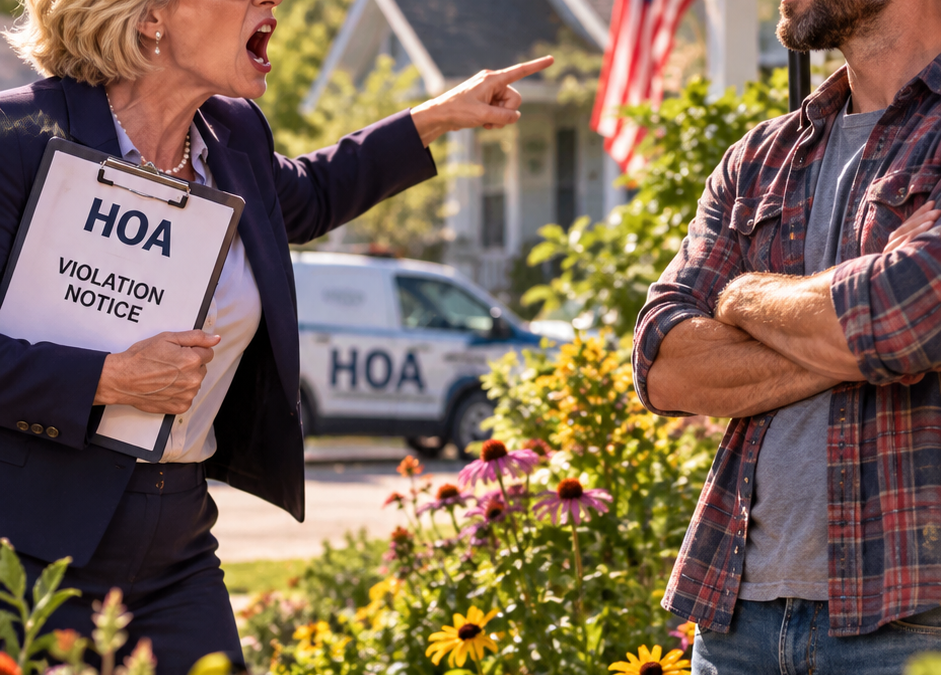
𝗣𝗔𝗥𝗧 𝟮
Two days later, Brenda returned.
She didn’t even bother leaving her golf cart.
She stopped at the curb, stared at my feeders, then slowly looked toward my front window.
I was standing behind the blinds.
She knew I was there.
I knew she knew.
She raised her clipboard.
Made a deliberate check mark.
Then drove away.
Friday afternoon, the second letter arrived by certified mail.
Our mail carrier, Steve, handed me the electronic signature pad with the expression of a man delivering a court summons.
“She’s having a productive week,” he said quietly.
“Brenda?”
He nodded.
“Gave the Hendersons a warning this morning.”
“For what?”
“Their welcome mat.”
“What happened to it?”
“Too blue.”
I stared at him.
Steve shrugged.
“Apparently there are levels of blue now.”
I signed for the envelope.
“Good luck, Arthur.”
Inside was another notice.
The first additional $100 fine had officially been applied.
The language had also changed.
The first letter had been bureaucratic.
This one was designed to frighten me.
The HOA’s law firm had filled it with words like “willful noncompliance,” “procedural enforcement,” “continuing architectural violation,” and my personal favorite, “degradation of community aesthetic harmony.”
It warned that if the growing balance remained unpaid, the association could pursue collection remedies against my property.
I sat at my kitchen table reading the letter.
$800.
Because birds ate sunflower seeds in my yard.
I wasn’t angry yet.
Anger usually arrives fast.
Mine came slowly.
It started as irritation.
Then disbelief.
Then something colder.
I walked into my office, shut the door, turned on both monitors, and downloaded the complete Whispering Pines governing documents.
Three hundred pages.
Nobody voluntarily read three hundred pages of HOA rules unless they were being punished or planning a murder.
I wasn’t planning a murder.
So I started reading.
At 7:30 that evening, I learned that driveway basketball hoops had to be stored behind the garage after use.
At 8:15, I discovered that mulch could be dark brown or black.
Red mulch was forbidden.
At 9:40, I reached the section controlling mailbox post dimensions.
At 10:20, I found a provision banning “whimsical lawn statuary.”
That explained the Great Garden Gnome Purge of 2019.
By midnight, I understood why ordinary homeowners surrendered.
The documents weren’t designed to be understood.
They were designed to be intimidating.
Every clause referenced another clause.
Definitions contradicted examples.
Exceptions were buried six chapters away from the rules they modified.
It was the legal equivalent of hiding a bear trap under beige carpeting.
Unfortunately for Brenda, I made a living untangling complicated systems.
Graphic design wasn’t just choosing fonts and making attractive logos.
My larger corporate projects required managing style systems, brand standards, file structures, accessibility rules, and hundreds of tiny requirements that had to fit together without breaking.
I knew how to find inconsistencies.
So I stopped reading the HOA documents as rules.
I started reading them as code.
Every codebase has bugs.
At 3:42 in the morning, I found Brenda’s.
Section 4.7C defined the wooden feeders as objects placed or suspended on residential property.
Fine.
She had me there.
But Chapter 14 dealt with landscaping and environmental improvements.
Buried beneath language about water conservation was Section 14.2.
I read it once.
Then again.
Then aloud.
“Homeowners are encouraged to maintain healthy native vegetative barriers and natural flora to promote water conservation and enhance local biodiversity.”
Interesting.
I kept reading.
“No HOA architectural approval shall be required for cultivation of indigenous plant species placed directly into residential soil, provided such vegetation does not obstruct utility easements or materially encroach upon neighboring parcels.”
I leaned closer to the monitor.
There it was.
The feeders were regulated.
Native plants weren’t.
Brenda could order me to remove a cedar tray.
But according to her own rules, she couldn’t stop me from planting native food sources directly into my soil.
My exhaustion disappeared.
I opened a notebook.
If wooden feeders were prohibited, what plants naturally fed the same birds?
Elderberry.
American holly.
Beautyberry.
Sunflowers.
Native grasses.
Serviceberry.
What provided water?
A compliant ornamental stream.
What provided cover?
Dense native shrubs.
What provided nesting habitat?
Trees and thickets.
I looked through the window toward my perfectly flat front lawn.
For the first time, I didn’t see grass.
I saw unused square footage.
A slow smile spread across my face.
“Oh, Brenda,” I whispered.
“You should have taken the bird feeders and called it a win.”
The next morning, after sleeping three hours, I began making calls.
I contacted Dr. Mara Vance, an ornithologist at a nearby state university whose work focused on urban bird habitats and migratory corridors.
When I explained the situation, there was silence.
Then she laughed.
Not politely.
She laughed hard enough that I had to move the phone away from my ear.
“I’m sorry,” she finally said. “Your HOA president described cardinals as vermin?”
“Officially.”
“That’s spectacular.”
“I was hoping for something more useful than spectacular.”
“Arthur, your neighborhood sits near a major migratory corridor. Native plantings can provide food, water, shelter, and stopover habitat for multiple species.”
“How many?”
“Potentially dozens depending on the season.”
I looked through my kitchen window.
“How much habitat can I put in one front yard?”
She became quiet.
I could almost hear the academic enthusiasm building on the other end.
“How annoyed are you?”
“Professionally annoyed.”
“Excellent.”
That afternoon, Mara came to my house.
She arrived in an old Subaru covered in university parking stickers and stepped out wearing hiking boots, cargo pants, and a faded field hat.
Brenda watched us from across the street.
Of course she did.
Mara spent nearly two hours walking my property.
She identified areas receiving morning sun.
Checked drainage.
Studied the maple.
Examined the soil.
She pointed toward the center of the lawn.
“If you created a shallow water feature here, planted elderberry along that side, holly near the house, native wildflowers around the edge, you’d have food, water, cover, and nesting opportunities.”
“How quickly?”
“Plants immediately. Birds will follow.”
“What about documentation?”
She smiled.
“Now you’re speaking my language.”
Mara explained that we could document the property as wildlife habitat and maintain detailed records of active nests and species use.
She also warned me not to treat environmental law like magic armor.
“Federal protections are serious,” she said, “but don’t go around telling people your lawn has become sovereign territory.”
“So no diplomatic passport?”
“Unfortunately.”
“Embassy?”
“No.”
“Aircraft carrier?”
“Arthur.”
“Fine.”
She laughed.
“What documentation does give you is evidence. If protected birds establish active nests, anyone deciding to bulldoze vegetation without checking what they’re disturbing would be taking a very stupid risk.”
That was enough for me.
I didn’t need magic.
I needed friction.
Brenda’s power depended on people giving up because resisting her was inconvenient.
I wanted every future step she took against me to become inconvenient.
Very inconvenient.
My next call was to a contractor named Tony Russo.
Everybody called him Big Tony because he was approximately the size of a commercial refrigerator.
Tony specialized in drainage projects, retaining walls, ponds, and large landscape installations.
When I mentioned Whispering Pines, he groaned.
“I worked there once.”
“You sound traumatized.”
“Lady with a visor made my crew replace three stone caps because she said the texture was ‘insufficiently serene.'”
“That was Brenda.”
“I still hate Brenda.”
“I have a project.”
“What kind?”
“I’m replacing my lawn with a native wildlife habitat.”
Silence.
Then:
“How much lawn?”
“Most of it.”
More silence.
“Do I get to bring the excavator?”
“Absolutely.”
“When do we start?”
“Monday.”
Tony lowered his voice.
“What time can we legally make noise?”
I checked the city ordinance.
“Seven.”
“I’ll be there at 7:01.”
Monday morning, at precisely 7:01, Whispering Pines discovered that I had chosen violence.
Ecological violence.
Tony’s F-350 rolled into the cul-de-sac pulling a trailer with a mini excavator.
Behind him came another truck loaded with stone.
Then a flatbed carrying shrubs.
Then another carrying soil, liner material, pipe, pumps, and native plants.
The diesel engines echoed between identical stucco houses.
Blinds opened.
Garage doors lifted.
Neighbors appeared with coffee cups.
At 7:03, Brenda’s front door opened.
She came out so fast I wondered whether she had slept in her visor.
She crossed the street at a speed remarkable for orthopedic shoes.
Tony was unloading the excavator when she arrived.
“What is happening?”
Nobody answered.
The excavator came off the trailer.
“What is happening?”
Tony pointed toward me.
“Homeowner.”
Brenda turned.
“Mr. Miller!”
I stepped off my porch holding coffee and a thick folder.
“Good morning, Brenda.”
“Shut this down.”
“I’m sorry?”
“You heard me. Shut. This. Down.”
Behind her, one of Tony’s workers started the excavator.
The engine roared.
Brenda nearly jumped.
She raised her voice.
“You do not have architectural approval for excavation!”
I opened my folder.
“We’re installing landscaping.”
“You are unloading heavy machinery!”
“For landscaping.”
“That is an excavator!”
“Excellent observation.”
Tony coughed into his fist to hide a laugh.
Brenda pointed toward the lawn.
“What exactly are you building?”
“A water feature.”
“No.”
“Yes.”
“No.”
I took another sip of coffee.
“I’m glad we cleared that up.”
Her face reddened.
“I am ordering you to stop immediately.”
“Under what section?”
That slowed her down.
Brenda was accustomed to residents responding emotionally.
She wasn’t accustomed to residents asking for citations.
“What?”
“Which section prohibits what I’m doing?”
She grabbed her clipboard.
“I don’t need to stand here and educate you on your own governing documents.”
“That’s convenient.”
“I will issue a cease-and-desist.”
“Based on?”
“Unapproved excavation.”
I opened my folder and removed a page.
“Section 9F3.”
Her eyes narrowed.
I read it aloud.
“Front-yard ornamental streams, brooks, and shallow circulating water features are permitted when professionally installed, limited to ten feet in width, lined to prevent uncontrolled seepage, and equipped with circulation sufficient to prevent stagnation.”
I pointed toward the orange marks Tony had painted on the grass.
“Nine feet wide.”
Brenda stared.
Tony lifted one finger.
“Nine exactly.”
I continued.
“Maximum depth eleven inches. Professionally installed. Circulating pump. Liner. No utility easement interference.”
“You didn’t submit this to the architectural committee.”
“The section doesn’t require approval under twelve inches.”
“That is not what it means.”
“It’s exactly what it means.”
“I will call code enforcement.”
“Already did.”
I handed her a copy of the municipal permit.
She stared at it.
“You contacted the city?”
“Friday.”
“You planned this?”
“Very carefully.”
Her clipboard tightened against her chest.
She looked toward Tony.
“Do not touch that lawn.”
Tony looked at me.
I nodded.
He climbed into the excavator.
Brenda’s jaw dropped.
The bucket came down.
The first section of perfect Whispering Pines turf curled upward like a green carpet.
The Hendersons were watching from across the street.
Mr. Henderson whispered something to his wife.
She covered her mouth.
I strongly suspected she was laughing.
Brenda stood frozen as Tony removed the second scoop.
Then the third.
The sound was magnificent.
Not because I hated grass.
I didn’t.
But because every bucket of soil represented something Brenda couldn’t control.
By noon, the rectangular lawn was gone.
In its place was a winding shallow channel.
Tony’s crew laid commercial rubber liner, installed circulation plumbing, and placed weathered fieldstone along the edges.
The stream curved from near my porch toward the maple, crossed the center of the yard, then widened into a shallow basin before circulating back underground.
A small three-tier waterfall went in near the porch.
The pump ran partially from a concealed solar system.
When Tony turned it on for the first time, water spilled across dark stone and flowed through the channel with a soft rushing sound.
Three neighbors applauded.
Brenda did not.
Then came the plants.
We started with elderberry.
Not one.
Not two.
Twelve.
Mature ones.
Tony’s crew planted them in broad natural clusters.
Then American holly.
Beautyberry.
Wax myrtle.
Native grasses.
Butterfly weed.
Black-eyed Susans.
Coneflowers.
Cardinal flower.
Blue flag iris near the damp bank.
The front yard transformed hour by hour.
Whispering Pines had never seen that much biological diversity in one place.
By Wednesday afternoon, my yard no longer looked like every other lawn.
It looked alive.
Butterflies arrived first.
Then bees.
Then birds.
Goldfinches found the seed heads.
Cardinals moved into the thicker shrubs.
Mourning doves drank at the edge of the stream.
A hummingbird discovered the flowers near the porch and defended them with the attitude of a tiny fighter jet pilot.
Mara returned several times to document species activity.
We photographed nests.
Recorded dates.
Mapped vegetation.
I registered the property through a recognized wildlife habitat program and kept the certification paperwork in a waterproof folder.
I also installed modest informational signs identifying the yard as a wildlife habitat and reminding visitors not to disturb active nests or vegetation.
I deliberately kept the language professional.
I wanted documentation.
Not theater.
Tony wanted theater.
“You should put up a sign that says BRENDA-FREE ZONE.”
“Tempting.”
“FEDERAL BIRD EMPIRE.”
“Tony.”
“THE PEOPLE’S REPUBLIC OF FINCHES.”
I laughed.
“We’re trying to look responsible.”
“That’s less fun.”
Friday evening, I sat on my porch watching the water move through the stream.
The transformation was almost shocking.
A week earlier, my yard had been grass.
Now it had depth.
Movement.
Sound.
Color.
Life.
Across the street, Brenda stood behind her front window staring at it.
She thought I couldn’t see her.
I could.
She had binoculars.
That made it even better.
The real confrontation came the following Tuesday.
At 9:17 in the morning, a city inspection truck entered the cul-de-sac.
Behind it came a police SUV.
Behind that came Brenda’s golf cart.
That procession told me everything.
She had called everybody.
The city.
The police.
Possibly God.
Two officers stepped out of the SUV.
The older one was Officer Miller.
No relation.
The younger officer introduced himself as Davis.
A city inspector named Dave climbed out of the second vehicle carrying a tablet and laser measure.
Brenda parked dramatically and marched toward them.
“Officers,” she said, pointing toward my property, “there he is.”
I remained on the porch.
Officer Miller looked at me.
Then the stream.
Then Brenda.
“There who is?”
“The responsible party.”
“For what?”
Brenda looked almost offended that the police had not studied her complaint in advance.
“For this.”
She swept both arms toward my yard.
“He has turned a prestigious residential subdivision into an unregulated wildlife facility.”
Officer Davis looked at the goldfinch perched on my elderberry.
“Wildlife facility?”
“Exactly.”
The goldfinch ate a berry.
Davis glanced at Miller.
Miller sighed.
“What did you report, ma’am?”
“An unauthorized canal, dangerous wildlife attraction, environmental contamination, threatening signage, prohibited vegetation, unlicensed construction, and an ongoing disturbance of the peace.”
I stood.
“Morning.”
Officer Miller approached.
“Arthur Miller?”
“That’s me.”
“We received a complaint.”
“I gathered.”
“Can you explain what’s going on?”
I handed him my folder.
“Professionally installed landscape water feature. City permit. Contractor documentation. Habitat registration. Plant inventory. Nest observations.”
He looked at the thickness of the folder.
“You were expecting us.”
“I was expecting Brenda.”
Behind him, Brenda made a sound somewhere between a cough and an insult.
Dave started measuring.
Nine feet at the widest point.
Eleven inches at the deepest point.
He inspected the liner, pump, drainage, and setback.
Brenda followed him.
“What about groundwater contamination?”
“No contamination.”
“Standing water?”
“It’s circulating.”
“Mosquito breeding?”
“Moving water.”
“Foundation danger?”
“No.”
“What about erosion?”
“Stone stabilization.”
“What about—”
Dave looked at her.
“Mrs. Halloway, please let me inspect.”
She closed her mouth.
For approximately eight seconds.
Then she pointed toward the elderberries.
“Those bushes violate the forty-eight-inch vegetation standard.”
I spoke before Dave could answer.
“They’re native species.”
“I don’t care if they’re from the Garden of Eden.”
“They’re permitted under Chapter 14.”
“You are intentionally misinterpreting the rule.”
I opened the HOA documents.
“Would you like me to read it?”
“No.”
“That’s probably wise.”
Officer Davis coughed again.
Brenda turned toward him.
“Is something funny?”
“No, ma’am.”
“Then act professionally.”
His expression went blank.
Officer Miller lowered the folder.
“Mr. Miller, are there active nests?”
“Three documented this week.”
Mara had marked them.
I pointed from a distance.
“One cardinal nest in the holly. Another in the myrtle. Goldfinches have been using the rear elderberry cluster.”
Brenda waved her hand.
“I don’t care about nests. My landscaping company will remove all of this tomorrow.”
Everything became quiet.
Even Tony, who had stopped by to adjust a pump fitting, looked up.
I said, “I wouldn’t do that.”
Brenda faced me.
“I am HOA president.”
“Congratulations.”
“My board has authority over exterior landscaping.”
“Not unlimited authority.”
She stepped closer.
“Tomorrow morning, my crew will come onto this property, remove those weeds, drain this ridiculous ditch, and restore the approved lawn.”
Officer Miller raised a hand.
“Ma’am.”
She ignored him.
“I will personally supervise.”
“Mrs. Halloway.”
“What?”
Miller’s voice hardened.
“Do not send a private crew onto his property without legal authority.”
“This association has authority.”
“That’s a civil question for your attorney. I’m telling you that sending workers onto someone’s property after the owner has expressly refused permission creates additional problems.”
She pointed toward the shrubs.
“But the birds—”
“Are birds.”
“They are a nuisance!”
Officer Davis looked toward the stream.
His decibel meter was already out.
“The water and bird noise are at forty-two decibels.”
Brenda turned.
“What?”
“Forty-two.”
“They are constantly chirping.”
“Ambient street noise is around forty.”
“I can hear them from my bedroom.”
Miller rubbed his forehead.
“Ma’am, birds making ordinary bird sounds during the daytime are not a police matter.”
She stared at him.
“The waterfall?”
“Below the daytime limit.”
“The vegetation?”
“City inspection.”
“The canal?”
Dave looked up.
“Water feature.”
“The signs?”
“Private property unless they violate municipal sign code.”
Dave checked.
“They don’t.”
Brenda’s face changed.
She had arrived expecting uniforms to validate her authority.
Instead, every agency she had summoned was dismantling her complaint one item at a time.
She wasn’t accustomed to hearing no.
Not from homeowners.
Not from contractors.
Certainly not from government employees.
“This is outrageous,” she said.
Officer Miller handed my folder back.
“From our perspective, there is no criminal issue here.”
“You’re refusing to enforce the law?”
“I’m explaining that no crime has been identified.”
“My HOA rules are law.”
“No, ma’am. They are private covenants.”
Her mouth opened.
Closed.
Opened again.
“Then I will enforce them privately.”
“That’s between you, your attorney, and Mr. Miller.”
I smiled.
“Perfect.”
Brenda turned toward me.
“This is not over.”
“I didn’t think it was.”
She walked back to her golf cart.
Her hands were shaking.
She drove away too fast and clipped one wheel over the edge of the curb.
Tony watched her go.
“That was beautiful.”
“She’ll come back.”
“How do you know?”
“People like Brenda don’t stop when they’re wrong.”
“What do they do?”
“They escalate until someone stronger stops them.”
Three days later, she proved me right.
At 8:06 Friday morning, I received an email from the HOA portal.
EMERGENCY DISCIPLINARY HEARING.
The board would consider a $5,000 special punitive assessment for willful architectural noncompliance.
It would also consider authorization for collection proceedings against my property.
There it was.
The final weapon.
Money.
Brenda couldn’t beat me with code enforcement.
She couldn’t beat me with the police.
So she was going to try to make resistance too expensive.
That strategy worked on most people.
Homeowners rarely fight HOA boards because litigation is brutally expensive.
A board can spend association money.
A resident spends his own.
Brenda understood that imbalance perfectly.
What she didn’t understand was that while she had spent the previous week staring at birds through binoculars, I had been staring at financial statements.
I had asked the HOA for records as soon as the first fine arrived.
Budgets.
Reserve reports.
Vendor invoices.
Reimbursement logs.
Canceled checks.
Minutes.
Contracts.
At first, I had only been looking for procedural mistakes connected to my fines.
Then I noticed something strange.
The landscaping expenses didn’t make sense.
Whispering Pines wasn’t a giant community.
Yet monthly “aesthetic consulting” charges had increased dramatically over the previous eighteen months.
I mentioned it to my roommate, Alex.
Alex was finishing a graduate degree in philosophy and paid his bills doing delivery work, research assistance, and occasional bookkeeping.
His most valuable skill, however, was suspicion.
Alex believed all institutions were guilty until properly footnoted.
I showed him the ledger.
He studied it.
“What’s Pristine Vistas LLC?”
“Landscape consultant.”
“$3,500 every month?”
“Apparently.”
“What do they do?”
“No idea.”
“Let’s find out.”
That sentence changed Brenda’s life.
We searched state corporate records.
Pristine Vistas LLC had one registered agent.
Kyle Halloway.
I stared at the screen.
“That name familiar?”
Alex asked.
“Brenda’s brother.”
Alex leaned back.
“Oh.”
“Exactly.”
We kept digging.
Payments were remarkably consistent.
$3,500.
Month after month.
Sometimes labeled consulting.
Sometimes site review.
Sometimes community beautification analysis.
The descriptions sounded impressive until we tried to find evidence of actual work.
There were no formal reports.
No site plans.
No published recommendations.
No competitive bid records.
Just invoices.
Then we looked at reimbursements.
Brenda had submitted hundreds of dollars for “administrative office equipment.”
Then more.
Then more.
One invoice totaled $1,250.
Alex found the retailer order number.
The items included a curved thirty-two-inch monitor and a premium mechanical keyboard.
“Community clubhouse?” I asked.
We drove past the clubhouse.
The office contained a ten-year-old Dell monitor that looked like it had survived a flood.
Alex stared through the window.
“Not here.”
I remembered seeing photographs of Brenda’s home office on a neighborhood newsletter feature the previous year.
We found the archived issue online.
There, behind Brenda in a picture titled MEET YOUR BOARD PRESIDENT, sat a beautiful curved monitor.
Alex slowly turned toward me.
“No.”
“Yes.”
“She used HOA money for her gaming setup?”
“I doubt Brenda games.”
“Then somehow that’s worse.”
We kept working.
The deeper we went, the uglier it became.
Pristine Vistas wasn’t merely receiving a convenient family contract.
There were indications that other vendor bills had been inflated to include consulting charges.
One contractor finally agreed to speak with me.
I recorded the conversation with his permission.
He told me that during a pool deck renovation, the HOA required an additional $5,000 “project consulting fee” connected to Pristine Vistas.
He had objected.
He had been told the payment was necessary if he wanted future HOA work.
By Wednesday night, my dining room looked like an FBI training exercise.
Printed bank statements covered the table.
Invoices were highlighted.
Corporate records were tabbed.
Copies of checks were organized by date.
Alex built spreadsheets.
I built timelines.
We did not know whether every suspicious expense was criminal.
That wasn’t our job to decide.
But we knew one thing with absolute certainty.
Brenda had a much bigger problem than my elderberries.
The emergency meeting took place Thursday evening.
By 6:30, the Whispering Pines recreation center parking lot was full.
Word had spread.
Apparently nothing motivates suburban political participation like the possibility that someone has been stealing from the landscaping budget.
Nearly eighty residents packed into the room.
The air smelled like stale coffee, lemon cleaner, and suppressed rebellion.
Folding chairs filled every available space.
The Hendersons sat in the second row.
Mr. Peterson was there.
So was Steve the mail carrier, though he claimed he was only attending because his cousin lived in the neighborhood.
At the front stood a long folding table.
Five board members sat behind it.
Brenda occupied the center seat.
She wore a beige blazer.
Of course.
Beside her sat Gary, the treasurer, already sweating.
On the opposite side sat Sterling Wade, the HOA’s corporate attorney.
Sterling wore a suit that probably cost more than my first car.
He had the calm expression of a man accustomed to billing people for conflict.
At exactly seven, Brenda raised a small wooden gavel.
Bang.
“This emergency session of the Whispering Pines Homeowners Association is called to order.”
The microphone squealed.
Half the room winced.
Brenda adjusted it.
“We are gathered tonight to address serious and continuing violations at Lot 4220, owned by Mr. Arthur Miller.”
Several people turned toward me.
I sat in the third row wearing a navy suit.
Alex sat beside me holding a laptop.
On my knees rested a thick black binder.
Brenda continued.
“Mr. Miller has engaged in a deliberate campaign of architectural hostility.”
Architectural hostility.
I almost admired that phrase.
“He has removed approved lawn coverage, installed an unapproved water system, introduced excessive vegetation, attracted wildlife, erected hostile signage, and repeatedly refused to comply with lawful board directives.”
Behind her, a projector displayed a photograph of my yard.
The photo had been taken from across the street with a telephoto lens.
Which meant Brenda had apparently conducted wildlife surveillance.
She continued.
“The board has made repeated attempts to resolve this matter peacefully.”
Mr. Henderson snorted.
Brenda glared in his direction.
“Tonight, we will consider authorization for an immediate $5,000 punitive assessment and further collection remedies.”
She paused.
Then looked directly at me.
“Mr. Miller, you may make a brief statement before the board votes.”
I stood.
“Thank you.”
I picked up the binder.
Walked down the center aisle.
Stopped in front of the table.
Sterling leaned toward his microphone.
“Mr. Miller, please restrict your remarks to the alleged landscaping violations.”
“I’ll get there.”
I placed six copies of my evidence binder on the table.
Thud.
Thud.
Thud.
Thud.
Thud.
Thud.
Brenda stared at them.
“What is this?”
“Context.”
“This is not a budget meeting.”
“It is now.”
Sterling spoke.
“Mr. Miller—”
“Counselor, before this board votes to impose another $5,000 against my home, I think the homeowners whose money funds this association deserve to know something.”
The room became quiet.
I opened my copy.
“Tab A.”
Nobody moved.
I looked at Gary.
“Please.”
His hands trembled slightly as he opened the binder.
Sterling opened his.
The other directors followed.
Brenda did not.
“Over the last eighteen months,” I said, “Whispering Pines homeowners have experienced a twenty-percent increase in association dues.”
Several people murmured.
“We were told those increases were necessary because of higher maintenance costs, pool repairs, gate repairs, insurance, and landscaping.”
I walked slowly along the table.
“During that same period, our association paid approximately $42,000 to a company called Pristine Vistas LLC.”
Now people were listening.
I continued.
“The invoices describe services including aesthetic consulting, landscape analysis, exterior compliance recommendations, and beautification planning.”
Brenda finally opened the binder.
Her eyes moved across the first page.
Then stopped.
“I searched the Florida corporate registry.”
I turned toward the residents.
“Pristine Vistas LLC is registered to Kyle Halloway.”
Silence.
“Kyle Halloway is Brenda Halloway’s brother.”
The room erupted.
“What?”
“Are you serious?”
“Her brother?”
Brenda hit the gavel.
“Order!”
I raised my voice just enough to be heard.
“The checks authorizing those payments contain Brenda’s signature.”
Mr. Peterson stood.
“You paid your own brother?”
Brenda banged the gavel.
“Sit down!”
He didn’t.
“You raised our dues!”
“Mr. Peterson!”
“You fined me fifty dollars over a garden hose!”
Someone shouted from the back.
“Tell them about the pool!”
I nodded.
“Gladly.”
I turned to Tab C.
“Last spring, the HOA hired a contractor for pool deck repairs. I contacted that contractor. With his permission, I recorded our conversation.”
Sterling immediately looked up.
“What did he say?”
I looked directly at him.
“He said he was required to add a $5,000 consulting charge connected to Pristine Vistas as a condition of the project.”
Gary stopped wiping his forehead.
He was now simply staring at Brenda.
She leaned toward her microphone.
“These accusations are defamatory.”
I didn’t respond.
I turned another page.
“Tab D contains reimbursement records.”
I held up a copy.
“One reimbursement, approved for $1,250, was categorized as clubhouse administrative equipment.”
Brenda’s face tightened.
“That is completely legitimate.”
“Good.”
I smiled.
“Then perhaps you can tell us where the equipment is.”
No answer.
“The invoice includes a curved thirty-two-inch computer monitor and a premium mechanical keyboard.”
I looked toward the recreation center office.
“The clubhouse currently uses an old flat-panel monitor that predates half the cars in this parking lot.”
Someone laughed.
“So I checked last year’s Whispering Pines newsletter.”
Alex connected his laptop to the projector.
A photograph appeared.
Brenda sitting at her home desk.
Behind her was the curved monitor.
The room exploded.
People stood.
Voices overlapped.
“You bought that with our money?”
“You’ve got to be kidding me!”
“She stole from us!”
“Sit down!” Brenda screamed.
Bang.
Bang.
Bang.
The gavel head detached from the handle.
It flew across the table.
Hit the floor.
Rolled beneath a folding chair.
For one beautiful second, the entire room became silent.
Then someone laughed.
That was all it took.
The room broke apart.
Laughter.
Shouting.
Applause.
Brenda stood behind the table holding a headless gavel handle.
If I had commissioned an artist to paint a portrait titled Collapse of Petty Authority, I couldn’t have designed a better image.
“ORDER!”
She slammed the wooden handle against the table.
It sounded pathetic.
Sterling wasn’t looking at her.
He was reading.
Quickly.
He turned through bank statements.
Corporate records.
Invoices.
Transcripts.
Reimbursement documents.
He removed his glasses.
Rubbed the bridge of his nose.
Then leaned toward Brenda and whispered.
I couldn’t hear what he said.
I didn’t need to.
I saw the moment everything changed.
Brenda’s face lost color.
Her shoulders lowered.
For the first time since I had known her, she looked uncertain.
I turned toward the room.
“I want to be very clear.”
People quieted.
“I am not standing here tonight claiming that I personally determine whether any crime has occurred. That’s for investigators, accountants, attorneys, and courts.”
Sterling looked at me.
That wording mattered.
“But these records raise serious questions about conflicts of interest, undisclosed related-party payments, reimbursements, and the use of association funds.”
I looked toward the board.
“Those questions should be answered before this board spends another dollar trying to punish me over a native garden.”
Applause broke out.
Brenda pointed at me.
“This is retaliation.”
I almost laughed.
“Retaliation?”
“You’re doing this because I enforced community standards.”
“No, Brenda. I started reading the financial records because you threatened my home over bird feeders.”
The applause became louder.
I waited.
Then lowered my voice.
“You could have left the birds alone.”
That line shut the room up again.
“You could have issued your warning, had your argument, and moved on. Instead, you escalated.”
I tapped the binder.
“Again.”
Tap.
“And again.”
Tap.
“And again.”
Tap.
“You called city inspectors.”
Tap.
“You called police.”
Tap.
“You threatened contractors.”
Tap.
“You threatened fines.”
Tap.
“You threatened my property.”
Tap.
“And every time you escalated, I read another document.”
A man in the back called out, “Read some more!”
Laughter rolled through the room.
Even two board members smiled.
Brenda didn’t.
I continued.
“You spent years teaching this neighborhood that rules matter.”
I looked directly at her.
“So let’s agree.”
Her eyes narrowed.
“Rules matter.”
I gestured toward the financial statements.
“All of them.”
That was the moment she lost the room.
Not because of me.
Because everyone sitting there suddenly remembered every petty citation.
Every warning letter.
Every humiliating confrontation.
Every time Brenda had stood on a driveway with her clipboard telling someone that rules were rules.
Now the same people wanted to know whether Brenda had followed them herself.
Mr. Peterson stood again.
This time he wasn’t shouting.
“I move that we suspend all enforcement action against Mr. Miller until we have an independent financial audit.”
A woman across the aisle raised her hand.
“Second.”
Brenda snapped, “Residents cannot make board motions.”
One of the board members, Linda, spoke quietly.
“But I can.”
She turned toward Mr. Peterson.
“I make that motion.”
Another board member immediately said, “Second.”
Brenda stared at them.
“You can’t be serious.”
Linda looked at her.
“I am extremely serious.”
Sterling leaned toward his microphone.
“I strongly recommend that the board suspend tonight’s enforcement vote.”
Brenda turned on him.
“You work for us.”
“I represent the association.”
“I am the association president.”
“That is not the same thing.”
That sentence landed harder than anything I had said.
The room went silent.
Sterling continued.
“Given the materials presented tonight, proceeding with extraordinary collection action against Mr. Miller would be unwise.”
“Unwise?”
“Yes.”
“I instructed you to prepare the lien documents.”
“I am advising the board not to authorize them.”
Brenda looked toward Gary.
“Say something.”
Gary slowly opened his microphone.
His face was pale.
“I think we need an audit.”
“You approved those payments.”
“I approved records you presented to me.”
Brenda’s voice dropped.
“Careful, Gary.”
He stared at her.
Then something hardened in his expression.
“No.”
One word.
Quiet.
But it changed the room.
“No, Brenda. You be careful.”
People murmured.
Gary opened the binder again.
“I want every payment to Pristine Vistas reviewed.”
Brenda shook her head.
“This is a coup.”
Mr. Henderson called from the audience.
“It’s an HOA meeting.”
Laughter.
Linda raised her hand.
“I move to rescind all outstanding fines against Lot 4220 pending review of enforcement procedures.”
“Second,” another director said.
Brenda slammed the broken gavel handle.
“You cannot do this!”
Sterling calmly said, “They can.”
The vote was four to one.
Brenda was the one.
The $700 fine vanished.
The daily $100 fines vanished.
The proposed $5,000 assessment vanished.
The threat against my property vanished.
The entire campaign collapsed in less than five minutes.
Then Linda made another motion.
“Independent forensic review of association finances covering the previous three fiscal years.”
Second.
Four to one.
Brenda stared down the table.
“This board is destroying itself.”
Nobody answered.
Sterling closed his binder.
“This meeting should adjourn.”
Brenda remained standing.
Nobody waited for her.
Residents began gathering around the table.
Some wanted copies.
Some wanted answers.
Some wanted to know why their dues had increased.
Others started telling stories about citations they had received.
Brenda’s little kingdom dissolved around her in real time.
I stepped away.
Alex joined me near the door.
“How do you feel?”
I looked back.
Brenda was standing alone behind the board table.
Her beige blazer was wrinkled.
Her clipboard lay on the floor.
The broken gavel handle remained in her hand.
“I think the birds won.”
Alex grinned.
“The birds didn’t build the spreadsheet.”
“Team effort.”
One week later, the certified letter arrived.
This one looked different.
No lavender.
No threat.
No bold red VIOLATION.
The new interim board had voted to remove Brenda as president while the financial review proceeded.
She resigned from the board two days later.
The letter formally withdrew every citation connected to my property.
All outstanding assessments were canceled.
All enforcement actions were closed.
The new board also acknowledged that my native landscaping had been installed in accordance with the relevant landscaping provisions and applicable municipal requirements.
The last paragraph apologized for what it called “excessive and inconsistent enforcement practices.”
I read that line three times.
Then I framed the letter.
Not because I was sentimental.
Because sometimes art finds you.
Steve, the mail carrier, saw it hanging inside my entryway the next week.
“Is that the HOA surrender?”
“Officially, it’s a compliance resolution.”
“So yes.”
“Yes.”
He nodded approvingly.
“Beautiful.”
The forensic audit took longer.
I wasn’t directly involved once professionals took over.
That was exactly how I wanted it.
My purpose had never been to conduct a criminal prosecution from my dining room.
I had found records.
I had raised questions.
Now accountants, attorneys, insurers, and county investigators could determine what those records meant.
The preliminary findings were enough to end Brenda’s career in neighborhood government.
Several contracts were terminated.
Payments were reviewed.
New conflict-of-interest rules were adopted.
Board approvals were changed so that no single officer could dominate vendor selection or reimbursements.
The association also created a homeowner records committee.
Alex called that part “the least exciting revolution in human history.”
He wasn’t wrong.
Brenda listed her house three days after resigning.
The FOR SALE sign appeared early Saturday morning.
That created one final controversy because Brenda herself had spent years enforcing rules on the exact dimensions of real estate signage.
Mr. Henderson measured it.
Then he walked over to my porch.
“Two inches too wide.”
“You’re kidding.”
He showed me the tape.
“Should we report her?”
I considered it.
“No.”
He looked disappointed.
“Why not?”
“Let her go.”
He stared across the street.
Then smiled.
“You’re no fun.”
Brenda rarely came outside after that.
Her golf cart disappeared into the garage.
The visor vanished.
The clipboard vanished.
Once, about a week before she moved, I saw her standing near the edge of her driveway.
A cardinal was bathing in my stream.
She looked at it.
Then at me.
For a second, I thought she might say something.
Apologize.
Complain.
Threaten.
Anything.
Instead, she went back inside.
The moving truck arrived on a humid Wednesday morning.
Tony texted me.
IS THE WITCH EVACUATING?
I replied:
BE NICE.
He responded:
NO.
By afternoon, Brenda’s house was empty.
The next family that bought it had two children, a Labrador retriever, and absolutely no interest in measuring mailbox setbacks.
Whispering Pines changed after Brenda left.
Not overnight.
But steadily.
Without her driving around looking for violations, people started relaxing.
The Hendersons put their infamous blue welcome mat back outside.
Nobody died.
Mr. Peterson coiled his garden hose counterclockwise purely out of principle.
Civilization survived.
A family near the entrance painted their garage door a darker color than the old board would have approved.
Several neighbors replaced sections of thirsty lawn with native plants after seeing how well mine performed in the summer heat.
Some did it for birds.
Some did it for water conservation.
At least one admitted he was doing it because Brenda would have hated it.
I respected all three motivations.
The Hendersons brought back their plastic flamingo too.
They didn’t simply put it on the lawn.
That would have been too ordinary.
Mr. Henderson installed a small velvet rope around it like a museum exhibit.
Then he added a tiny brass plaque.
PHOENICOPTERUS PLASTICUS
FORMERLY PROHIBITED
NOW THRIVING
When I saw it, I laughed so hard I had to sit down.
The new board considered asking him to remove the plaque.
Then wisely reconsidered.
The greatest change wasn’t aesthetic.
It was psychological.
People stopped acting afraid.
Under Brenda, everyone had learned to avoid attention.
Don’t plant anything unusual.
Don’t paint anything interesting.
Don’t ask where the money goes.
Don’t challenge a citation.
Don’t become the next target.
Once the residents saw Brenda lose, that fear disappeared.
Board meetings became crowded.
Budget reports were actually read.
Vendor contracts were discussed.
Neighbors asked questions.
Some questions were annoying.
Some were repetitive.
Some lasted much too long.
But that was still better than silence.
The HOA didn’t disappear.
Rules didn’t disappear.
We still had basic standards.
Nobody wanted six abandoned cars on blocks in a front yard.
Nobody wanted midnight construction.
Nobody wanted someone converting a garage into an alligator petting zoo.
Reasonable rules could coexist with reasonable people.
What changed was the assumption that authority should never be questioned.
That was Brenda’s real mistake.
She thought the clipboard gave her power.
It didn’t.
Consent gave her power.
Ignorance gave her power.
Exhaustion gave her power.
The moment people started reading what she was actually doing, everything changed.
As for my yard, it became better than anything I had originally imagined.
By late summer, the elderberries were heavy with dark fruit.
The American holly had thickened.
Butterfly weed glowed orange along the stream.
Coneflowers crowded the sunny bank.
Dragonflies hovered above the water.
Frogs appeared after storms.
Butterflies moved between flowers all afternoon.
And the birds?
They came in numbers.
Cardinals.
Goldfinches.
Wrens.
Chickadees.
Mourning doves.
Downy woodpeckers.
Hummingbirds.
Seasonal visitors Mara helped me identify.
I started keeping a notebook near the porch.
Not because anyone required it.
I genuinely became interested.
That surprised me.
The whole project had begun out of spite.
Useful spite, but spite nonetheless.
Somewhere along the way, I started loving the thing I had built.
Neighbors came over in the evening with beer or coffee.
Kids crouched near the water looking for frogs.
Mara sometimes brought students by to discuss native urban habitat.
Tony occasionally stopped by just to admire his stonework.
He still insisted we should install the FEDERAL BIRD EMPIRE sign.
I still refused.
One Saturday, the new HOA president, Steve Reynolds, wandered over carrying a plate of grilled sausages.
Steve had accepted the position because, in his words, “apparently somebody has to sign the pool invoices.”
He sat beside me on the porch.
A bright red cardinal landed on a flat rock in the stream.
Steve watched it drink.
“You know,” he said, “Brenda probably could have avoided all of this.”
“Absolutely.”
“She could’ve just ignored the feeders.”
“Correct.”
“Or asked you to move them.”
“Yep.”
“Or reduced the fine.”
“Yep.”
“Or stopped after the city said your project was legal.”
“Many opportunities.”
Steve handed me a sausage.
“Instead she declared war on a man with two monitors and insomnia.”
“Fatal tactical error.”
He laughed.
Across the street, Brenda’s old house had children’s bicycles lying near the garage.
One was bright purple.
Under the old regime, they would have received a warning for leaving them visible.
Now nobody cared.
The neighborhood somehow continued functioning.
The sun lowered behind the houses.
The stream reflected orange light.
A group of goldfinches moved through the elderberry branches, yellow feathers flickering between dark leaves.
I thought about the first violation letter.
$700.
Three wooden feeders.
At the time, Brenda had probably imagined the ending clearly.
I would complain.
She would threaten me.
I would pay.
The feeders would come down.
Her authority would become stronger because another homeowner had learned resistance was expensive.
Instead, I took the feeders down.
Technically.
I never put them back.
I didn’t need to.
The birds had something better.
They had berries growing from the ground.
Seeds.
Flowers.
Water.
Shelter.
Nesting cover.
A whole living system built exactly where my sterile patch of regulation-height grass had once sat.
That was the part I found most satisfying.
I hadn’t beaten Brenda by ignoring every rule.
I had beaten her by finally reading them.
She believed regulations were weapons that only worked in one direction.
She had spent years using technical language to intimidate residents who didn’t have the time, money, or patience to argue.
But rules are strange things.
Once written down, they stop belonging to the person who quotes them the loudest.
Anyone can read them.
Anyone can ask questions.
Anyone can compare what a person says against what the documents actually allow.
And sometimes, buried inside three hundred pages of administrative beige, there’s enough room to plant an entire ecosystem.
The cardinal hopped into the shallow water.
He splashed once.
Twice.
Then violently shook water through his feathers.
Steve lifted his beer.
“To nuisance vermin.”
I lifted my coffee.
“To nuisance vermin.”
We tapped our drinks together.
The bird flew into the holly.
Somewhere farther down the street, a child laughed.
The waterfall kept moving.
No golf cart appeared.
No clipboard came around the corner.
No certified envelope waited on my door.
For the first time since I’d moved into Whispering Pines, the neighborhood actually felt like the name advertised.
Quiet.
Green.
Alive.
I leaned back in my chair and looked at the place where my three wooden bird feeders used to hang.
Brenda had ordered me to remove them.
So I did.
She just never thought to ask what I might put in their place.
Have you finished reading the story and want to read it again?
HOA Ordered Me to Remove My Bird Feeders—They Had No Idea What Their Own Rules Let Me Build
Brenda thought three bird feeders were an easy target.
She had no idea I had started reading the fine print.
By the time she understood what she had started, the birds were the least of her problems.
I never intended to turn the front yard of my ordinary Florida house into an ecological act of revenge.
I was a graphic designer, not an environmental revolutionary. I paid my mortgage on time, kept my trash cans out of sight, and spent most mornings drinking coffee while watching goldfinches bounce between the branches of the maple tree outside my kitchen window.
That was about as dangerous as my lifestyle got.
Then Brenda Halloway decided my three cedar bird feeders represented a threat to civilization.
If you had never lived in Whispering Pines, the name might have sounded peaceful.
It wasn’t.
First, there were no pines.
Not one.
There were ornamental palms, carefully trimmed oaks, decorative crepe myrtles, and hundreds of identical lawns maintained with enough fertilizer to make the local frogs reconsider their life choices.
The houses were permitted in three approved colors: Desert Sand, Navajo White, and Subtle Taupe.
Those weren’t suggestions.
Those were the choices.
Whispering Pines had somehow managed to take the entire visible spectrum of light and reduce it to three shades of oatmeal.
Our grass was supposed to remain approximately two and a half inches tall. Three inches apparently represented the first stage of social collapse.
Trash cans could be placed on the curb Monday evening but had to disappear shortly after collection Tuesday afternoon.
A resident once received a violation because his recycling bin remained visible from the street for forty-three minutes longer than permitted.
Another homeowner was warned because the blue flowers in her hanging basket were allegedly “too visually assertive.”
Whispering Pines didn’t have neighborhood guidelines.
It had commandments.
And Brenda was Moses with a retractable tape measure.
She was the HOA president, a retired corporate middle manager who had apparently spent thirty years preparing herself for the moment when she could finally control the height of someone else’s azaleas.
Every morning she drove through the neighborhood in a taupe electric golf cart.
Naturally, even her golf cart was beige.
She wore white orthopedic sneakers, a broad visor, and carried a clipboard against her chest like it contained national security secrets.
Sometimes I saw her measuring mailbox setbacks.
Sometimes she photographed driveways.
Once I watched her spend nearly ten minutes examining a decorative wreath hanging on the Hendersons’ front door.
Apparently autumn leaves were acceptable.
Orange ribbon was not.
My relationship with the Beige Inquisition began on a cool Tuesday morning.
I was sitting at the kitchen island with a cup of dark roast while preparing myself for nine hours of video meetings with a client who wanted his dental adhesive company to appear “more adventurous.”
I still wasn’t entirely sure what adventurous dental adhesive looked like.
Maybe a molar skydiving.
Through the window, I watched Brenda’s golf cart stop in front of my house.
She climbed out.
Clack.
Clack.
Clack.
Her white sneakers crossed my driveway.
She stopped beneath the maple tree where my three bird feeders hung from low branches.
They weren’t elaborate.
Two were cedar platforms.
The third was a simple cylindrical feeder.
They attracted cardinals, chickadees, mourning doves, and a handful of American goldfinches that arrived every morning like tiny yellow customers demanding breakfast.
Brenda pulled out her measuring tape.
I watched her measure one feeder.
Then another.
Then the tree.
Then, for reasons known only to Brenda and whatever dark administrative spirit inhabited her clipboard, the distance between the tree and my walkway.
She frowned.
She wrote something.
Ten minutes later, I found a cream-colored envelope taped to my front door.
Even the envelope smelled like lavender and disapproval.
I opened it.
NOTICE OF VIOLATION.
According to Brenda’s interpretation of Section 4.7C of the Whispering Pines Covenants, Conditions, and Restrictions, my bird feeders constituted “unauthorized detached accessory structures.”
She had also cited Section 3.2A regarding the attraction of “nuisance wildlife and vermin.”
I read that line twice.
Then I looked toward the maple tree.
A male cardinal sat on the top feeder, brilliant red against the green leaves, staring directly at me.
“Apparently you’re vermin,” I told him.
He tilted his head.
I turned back to the letter.
I had forty-eight hours to remove all three feeders.
The HOA had imposed an initial $700 assessment.
After forty-eight hours, another $100 would be added for every day of noncompliance.
At the bottom was Brenda’s signature.
Large.
Curving.
Self-important.
I stared at it for a moment.
Then I folded the notice.
“Don’t worry,” I told the cardinal.
“You’re staying.”
I had no idea then how expensive those words were going to become for Brenda.
PART2
Two days later, Brenda returned.
She didn’t even bother leaving her golf cart.
She stopped at the curb, stared at my feeders, then slowly looked toward my front window.
I was standing behind the blinds.
She knew I was there.
I knew she knew.
She raised her clipboard.
Made a deliberate check mark.
Then drove away.
Friday afternoon, the second letter arrived by certified mail.
Our mail carrier, Steve, handed me the electronic signature pad with the expression of a man delivering a court summons.
“She’s having a productive week,” he said quietly.
“Brenda?”
He nodded.
“Gave the Hendersons a warning this morning.”
“For what?”
“Their welcome mat.”
“What happened to it?”
“Too blue.”
I stared at him.
Steve shrugged.
“Apparently there are levels of blue now.”
I signed for the envelope.
“Good luck, Arthur.”
Inside was another notice.
The first additional $100 fine had officially been applied.
The language had also changed.
The first letter had been bureaucratic.
This one was designed to frighten me.
The HOA’s law firm had filled it with words like “willful noncompliance,” “procedural enforcement,” “continuing architectural violation,” and my personal favorite, “degradation of community aesthetic harmony.”
It warned that if the growing balance remained unpaid, the association could pursue collection remedies against my property.
I sat at my kitchen table reading the letter.
$800.
Because birds ate sunflower seeds in my yard.
I wasn’t angry yet.
Anger usually arrives fast.
Mine came slowly.
It started as irritation.
Then disbelief.
Then something colder.
I walked into my office, shut the door, turned on both monitors, and downloaded the complete Whispering Pines governing documents.
Three hundred pages.
Nobody voluntarily read three hundred pages of HOA rules unless they were being punished or planning a murder.
I wasn’t planning a murder.
So I started reading.
At 7:30 that evening, I learned that driveway basketball hoops had to be stored behind the garage after use.
At 8:15, I discovered that mulch could be dark brown or black.
Red mulch was forbidden.
At 9:40, I reached the section controlling mailbox post dimensions.
At 10:20, I found a provision banning “whimsical lawn statuary.”
That explained the Great Garden Gnome Purge of 2019.
By midnight, I understood why ordinary homeowners surrendered.
The documents weren’t designed to be understood.
They were designed to be intimidating.
Every clause referenced another clause.
Definitions contradicted examples.
Exceptions were buried six chapters away from the rules they modified.
It was the legal equivalent of hiding a bear trap under beige carpeting.
Unfortunately for Brenda, I made a living untangling complicated systems.
Graphic design wasn’t just choosing fonts and making attractive logos.
My larger corporate projects required managing style systems, brand standards, file structures, accessibility rules, and hundreds of tiny requirements that had to fit together without breaking.
I knew how to find inconsistencies.
So I stopped reading the HOA documents as rules.
I started reading them as code.
Every codebase has bugs.
At 3:42 in the morning, I found Brenda’s.
Section 4.7C defined the wooden feeders as objects placed or suspended on residential property.
Fine.
She had me there.
But Chapter 14 dealt with landscaping and environmental improvements.
Buried beneath language about water conservation was Section 14.2.
I read it once.
Then again.
Then aloud.
“Homeowners are encouraged to maintain healthy native vegetative barriers and natural flora to promote water conservation and enhance local biodiversity.”
Interesting.
I kept reading.
“No HOA architectural approval shall be required for cultivation of indigenous plant species placed directly into residential soil, provided such vegetation does not obstruct utility easements or materially encroach upon neighboring parcels.”
I leaned closer to the monitor.
There it was.
The feeders were regulated.
Native plants weren’t.
Brenda could order me to remove a cedar tray.
But according to her own rules, she couldn’t stop me from planting native food sources directly into my soil.
My exhaustion disappeared.
I opened a notebook.
If wooden feeders were prohibited, what plants naturally fed the same birds?
Elderberry.
American holly.
Beautyberry.
Sunflowers.
Native grasses.
Serviceberry.
What provided water?
A compliant ornamental stream.
What provided cover?
Dense native shrubs.
What provided nesting habitat?
Trees and thickets.
I looked through the window toward my perfectly flat front lawn.
For the first time, I didn’t see grass.
I saw unused square footage.
A slow smile spread across my face.
“Oh, Brenda,” I whispered.
“You should have taken the bird feeders and called it a win.”
The next morning, after sleeping three hours, I began making calls.
I contacted Dr. Mara Vance, an ornithologist at a nearby state university whose work focused on urban bird habitats and migratory corridors.
When I explained the situation, there was silence.
Then she laughed.
Not politely.
She laughed hard enough that I had to move the phone away from my ear.
“I’m sorry,” she finally said. “Your HOA president described cardinals as vermin?”
“Officially.”
“That’s spectacular.”
“I was hoping for something more useful than spectacular.”
“Arthur, your neighborhood sits near a major migratory corridor. Native plantings can provide food, water, shelter, and stopover habitat for multiple species.”
“How many?”
“Potentially dozens depending on the season.”
I looked through my kitchen window.
“How much habitat can I put in one front yard?”
She became quiet.
I could almost hear the academic enthusiasm building on the other end.
“How annoyed are you?”
“Professionally annoyed.”
“Excellent.”
That afternoon, Mara came to my house.
She arrived in an old Subaru covered in university parking stickers and stepped out wearing hiking boots, cargo pants, and a faded field hat.
Brenda watched us from across the street.
Of course she did.
Mara spent nearly two hours walking my property.
She identified areas receiving morning sun.
Checked drainage.
Studied the maple.
Examined the soil.
She pointed toward the center of the lawn.
“If you created a shallow water feature here, planted elderberry along that side, holly near the house, native wildflowers around the edge, you’d have food, water, cover, and nesting opportunities.”
“How quickly?”
“Plants immediately. Birds will follow.”
“What about documentation?”
She smiled.
“Now you’re speaking my language.”
Mara explained that we could document the property as wildlife habitat and maintain detailed records of active nests and species use.
She also warned me not to treat environmental law like magic armor.
“Federal protections are serious,” she said, “but don’t go around telling people your lawn has become sovereign territory.”
“So no diplomatic passport?”
“Unfortunately.”
“Embassy?”
“No.”
“Aircraft carrier?”
“Arthur.”
“Fine.”
She laughed.
“What documentation does give you is evidence. If protected birds establish active nests, anyone deciding to bulldoze vegetation without checking what they’re disturbing would be taking a very stupid risk.”
That was enough for me.
I didn’t need magic.
I needed friction.
Brenda’s power depended on people giving up because resisting her was inconvenient.
I wanted every future step she took against me to become inconvenient.
Very inconvenient.
My next call was to a contractor named Tony Russo.
Everybody called him Big Tony because he was approximately the size of a commercial refrigerator.
Tony specialized in drainage projects, retaining walls, ponds, and large landscape installations.
When I mentioned Whispering Pines, he groaned.
“I worked there once.”
“You sound traumatized.”
“Lady with a visor made my crew replace three stone caps because she said the texture was ‘insufficiently serene.'”
“That was Brenda.”
“I still hate Brenda.”
“I have a project.”
“What kind?”
“I’m replacing my lawn with a native wildlife habitat.”
Silence.
Then:
“How much lawn?”
“Most of it.”
More silence.
“Do I get to bring the excavator?”
“Absolutely.”
“When do we start?”
“Monday.”
Tony lowered his voice.
“What time can we legally make noise?”
I checked the city ordinance.
“Seven.”
“I’ll be there at 7:01.”
Monday morning, at precisely 7:01, Whispering Pines discovered that I had chosen violence.
Ecological violence.
Tony’s F-350 rolled into the cul-de-sac pulling a trailer with a mini excavator.
Behind him came another truck loaded with stone.
Then a flatbed carrying shrubs.
Then another carrying soil, liner material, pipe, pumps, and native plants.
The diesel engines echoed between identical stucco houses.
Blinds opened.
Garage doors lifted.
Neighbors appeared with coffee cups.
At 7:03, Brenda’s front door opened.
She came out so fast I wondered whether she had slept in her visor.
She crossed the street at a speed remarkable for orthopedic shoes.
Tony was unloading the excavator when she arrived.
“What is happening?”
Nobody answered.
The excavator came off the trailer.
“What is happening?”
Tony pointed toward me.
“Homeowner.”
Brenda turned.
“Mr. Miller!”
I stepped off my porch holding coffee and a thick folder.
“Good morning, Brenda.”
“Shut this down.”
“I’m sorry?”
“You heard me. Shut. This. Down.”
Behind her, one of Tony’s workers started the excavator.
The engine roared.
Brenda nearly jumped.
She raised her voice.
“You do not have architectural approval for excavation!”
I opened my folder.
“We’re installing landscaping.”
“You are unloading heavy machinery!”
“For landscaping.”
“That is an excavator!”
“Excellent observation.”
Tony coughed into his fist to hide a laugh.
Brenda pointed toward the lawn.
“What exactly are you building?”
“A water feature.”
“No.”
“Yes.”
“No.”
I took another sip of coffee.
“I’m glad we cleared that up.”
Her face reddened.
“I am ordering you to stop immediately.”
“Under what section?”
That slowed her down.
Brenda was accustomed to residents responding emotionally.
She wasn’t accustomed to residents asking for citations.
“What?”
“Which section prohibits what I’m doing?”
She grabbed her clipboard.
“I don’t need to stand here and educate you on your own governing documents.”
“That’s convenient.”
“I will issue a cease-and-desist.”
“Based on?”
“Unapproved excavation.”
I opened my folder and removed a page.
“Section 9F3.”
Her eyes narrowed.
I read it aloud.
“Front-yard ornamental streams, brooks, and shallow circulating water features are permitted when professionally installed, limited to ten feet in width, lined to prevent uncontrolled seepage, and equipped with circulation sufficient to prevent stagnation.”
I pointed toward the orange marks Tony had painted on the grass.
“Nine feet wide.”
Brenda stared.
Tony lifted one finger.
“Nine exactly.”
I continued.
“Maximum depth eleven inches. Professionally installed. Circulating pump. Liner. No utility easement interference.”
“You didn’t submit this to the architectural committee.”
“The section doesn’t require approval under twelve inches.”
“That is not what it means.”
“It’s exactly what it means.”
“I will call code enforcement.”
“Already did.”
I handed her a copy of the municipal permit.
She stared at it.
“You contacted the city?”
“Friday.”
“You planned this?”
“Very carefully.”
Her clipboard tightened against her chest.
She looked toward Tony.
“Do not touch that lawn.”
Tony looked at me.
I nodded.
He climbed into the excavator.
Brenda’s jaw dropped.
The bucket came down.
The first section of perfect Whispering Pines turf curled upward like a green carpet.
The Hendersons were watching from across the street.
Mr. Henderson whispered something to his wife.
She covered her mouth.
I strongly suspected she was laughing.
Brenda stood frozen as Tony removed the second scoop.
Then the third.
The sound was magnificent.
Not because I hated grass.
I didn’t.
But because every bucket of soil represented something Brenda couldn’t control.
By noon, the rectangular lawn was gone.
In its place was a winding shallow channel.
Tony’s crew laid commercial rubber liner, installed circulation plumbing, and placed weathered fieldstone along the edges.
The stream curved from near my porch toward the maple, crossed the center of the yard, then widened into a shallow basin before circulating back underground.
A small three-tier waterfall went in near the porch.
The pump ran partially from a concealed solar system.
When Tony turned it on for the first time, water spilled across dark stone and flowed through the channel with a soft rushing sound.
Three neighbors applauded.
Brenda did not.
Then came the plants.
We started with elderberry.
Not one.
Not two.
Twelve.
Mature ones.
Tony’s crew planted them in broad natural clusters.
Then American holly.
Beautyberry.
Wax myrtle.
Native grasses.
Butterfly weed.
Black-eyed Susans.
Coneflowers.
Cardinal flower.
Blue flag iris near the damp bank.
The front yard transformed hour by hour.
Whispering Pines had never seen that much biological diversity in one place.
By Wednesday afternoon, my yard no longer looked like every other lawn.
It looked alive.
Butterflies arrived first.
Then bees.
Then birds.
Goldfinches found the seed heads.
Cardinals moved into the thicker shrubs.
Mourning doves drank at the edge of the stream.
A hummingbird discovered the flowers near the porch and defended them with the attitude of a tiny fighter jet pilot.
Mara returned several times to document species activity.
We photographed nests.
Recorded dates.
Mapped vegetation.
I registered the property through a recognized wildlife habitat program and kept the certification paperwork in a waterproof folder.
I also installed modest informational signs identifying the yard as a wildlife habitat and reminding visitors not to disturb active nests or vegetation.
I deliberately kept the language professional.
I wanted documentation.
Not theater.
Tony wanted theater.
“You should put up a sign that says BRENDA-FREE ZONE.”
“Tempting.”
“FEDERAL BIRD EMPIRE.”
“Tony.”
“THE PEOPLE’S REPUBLIC OF FINCHES.”
I laughed.
“We’re trying to look responsible.”
“That’s less fun.”
Friday evening, I sat on my porch watching the water move through the stream.
The transformation was almost shocking.
A week earlier, my yard had been grass.
Now it had depth.
Movement.
Sound.
Color.
Life.
Across the street, Brenda stood behind her front window staring at it.
She thought I couldn’t see her.
I could.
She had binoculars.
That made it even better.
The real confrontation came the following Tuesday.
At 9:17 in the morning, a city inspection truck entered the cul-de-sac.
Behind it came a police SUV.
Behind that came Brenda’s golf cart.
That procession told me everything.
She had called everybody.
The city.
The police.
Possibly God.
Two officers stepped out of the SUV.
The older one was Officer Miller.
No relation.
The younger officer introduced himself as Davis.
A city inspector named Dave climbed out of the second vehicle carrying a tablet and laser measure.
Brenda parked dramatically and marched toward them.
“Officers,” she said, pointing toward my property, “there he is.”
I remained on the porch.
Officer Miller looked at me.
Then the stream.
Then Brenda.
“There who is?”
“The responsible party.”
“For what?”
Brenda looked almost offended that the police had not studied her complaint in advance.
“For this.”
She swept both arms toward my yard.
“He has turned a prestigious residential subdivision into an unregulated wildlife facility.”
Officer Davis looked at the goldfinch perched on my elderberry.
“Wildlife facility?”
“Exactly.”
The goldfinch ate a berry.
Davis glanced at Miller.
Miller sighed.
“What did you report, ma’am?”
“An unauthorized canal, dangerous wildlife attraction, environmental contamination, threatening signage, prohibited vegetation, unlicensed construction, and an ongoing disturbance of the peace.”
I stood.
“Morning.”
Officer Miller approached.
“Arthur Miller?”
“That’s me.”
“We received a complaint.”
“I gathered.”
“Can you explain what’s going on?”
I handed him my folder.
“Professionally installed landscape water feature. City permit. Contractor documentation. Habitat registration. Plant inventory. Nest observations.”
He looked at the thickness of the folder.
“You were expecting us.”
“I was expecting Brenda.”
Behind him, Brenda made a sound somewhere between a cough and an insult.
Dave started measuring.
Nine feet at the widest point.
Eleven inches at the deepest point.
He inspected the liner, pump, drainage, and setback.
Brenda followed him.
“What about groundwater contamination?”
“No contamination.”
“Standing water?”
“It’s circulating.”
“Mosquito breeding?”
“Moving water.”
“Foundation danger?”
“No.”
“What about erosion?”
“Stone stabilization.”
“What about—”
Dave looked at her.
“Mrs. Halloway, please let me inspect.”
She closed her mouth.
For approximately eight seconds.
Then she pointed toward the elderberries.
“Those bushes violate the forty-eight-inch vegetation standard.”
I spoke before Dave could answer.
“They’re native species.”
“I don’t care if they’re from the Garden of Eden.”
“They’re permitted under Chapter 14.”
“You are intentionally misinterpreting the rule.”
I opened the HOA documents.
“Would you like me to read it?”
“No.”
“That’s probably wise.”
Officer Davis coughed again.
Brenda turned toward him.
“Is something funny?”
“No, ma’am.”
“Then act professionally.”
His expression went blank.
Officer Miller lowered the folder.
“Mr. Miller, are there active nests?”
“Three documented this week.”
Mara had marked them.
I pointed from a distance.
“One cardinal nest in the holly. Another in the myrtle. Goldfinches have been using the rear elderberry cluster.”
Brenda waved her hand.
“I don’t care about nests. My landscaping company will remove all of this tomorrow.”
Everything became quiet.
Even Tony, who had stopped by to adjust a pump fitting, looked up.
I said, “I wouldn’t do that.”
Brenda faced me.
“I am HOA president.”
“Congratulations.”
“My board has authority over exterior landscaping.”
“Not unlimited authority.”
She stepped closer.
“Tomorrow morning, my crew will come onto this property, remove those weeds, drain this ridiculous ditch, and restore the approved lawn.”
Officer Miller raised a hand.
“Ma’am.”
She ignored him.
“I will personally supervise.”
“Mrs. Halloway.”
“What?”
Miller’s voice hardened.
“Do not send a private crew onto his property without legal authority.”
“This association has authority.”
“That’s a civil question for your attorney. I’m telling you that sending workers onto someone’s property after the owner has expressly refused permission creates additional problems.”
She pointed toward the shrubs.
“But the birds—”
“Are birds.”
“They are a nuisance!”
Officer Davis looked toward the stream.
His decibel meter was already out.
“The water and bird noise are at forty-two decibels.”
Brenda turned.
“What?”
“Forty-two.”
“They are constantly chirping.”
“Ambient street noise is around forty.”
“I can hear them from my bedroom.”
Miller rubbed his forehead.
“Ma’am, birds making ordinary bird sounds during the daytime are not a police matter.”
She stared at him.
“The waterfall?”
“Below the daytime limit.”
“The vegetation?”
“City inspection.”
“The canal?”
Dave looked up.
“Water feature.”
“The signs?”
“Private property unless they violate municipal sign code.”
Dave checked.
“They don’t.”
Brenda’s face changed.
She had arrived expecting uniforms to validate her authority.
Instead, every agency she had summoned was dismantling her complaint one item at a time.
She wasn’t accustomed to hearing no.
Not from homeowners.
Not from contractors.
Certainly not from government employees.
“This is outrageous,” she said.
Officer Miller handed my folder back.
“From our perspective, there is no criminal issue here.”
“You’re refusing to enforce the law?”
“I’m explaining that no crime has been identified.”
“My HOA rules are law.”
“No, ma’am. They are private covenants.”
Her mouth opened.
Closed.
Opened again.
“Then I will enforce them privately.”
“That’s between you, your attorney, and Mr. Miller.”
I smiled.
“Perfect.”
Brenda turned toward me.
“This is not over.”
“I didn’t think it was.”
She walked back to her golf cart.
Her hands were shaking.
She drove away too fast and clipped one wheel over the edge of the curb.
Tony watched her go.
“That was beautiful.”
“She’ll come back.”
“How do you know?”
“People like Brenda don’t stop when they’re wrong.”
“What do they do?”
“They escalate until someone stronger stops them.”
Three days later, she proved me right.
At 8:06 Friday morning, I received an email from the HOA portal.
EMERGENCY DISCIPLINARY HEARING.
The board would consider a $5,000 special punitive assessment for willful architectural noncompliance.
It would also consider authorization for collection proceedings against my property.
There it was.
The final weapon.
Money.
Brenda couldn’t beat me with code enforcement.
She couldn’t beat me with the police.
So she was going to try to make resistance too expensive.
That strategy worked on most people.
Homeowners rarely fight HOA boards because litigation is brutally expensive.
A board can spend association money.
A resident spends his own.
Brenda understood that imbalance perfectly.
What she didn’t understand was that while she had spent the previous week staring at birds through binoculars, I had been staring at financial statements.
I had asked the HOA for records as soon as the first fine arrived.
Budgets.
Reserve reports.
Vendor invoices.
Reimbursement logs.
Canceled checks.
Minutes.
Contracts.
At first, I had only been looking for procedural mistakes connected to my fines.
Then I noticed something strange.
The landscaping expenses didn’t make sense.
Whispering Pines wasn’t a giant community.
Yet monthly “aesthetic consulting” charges had increased dramatically over the previous eighteen months.
I mentioned it to my roommate, Alex.
Alex was finishing a graduate degree in philosophy and paid his bills doing delivery work, research assistance, and occasional bookkeeping.
His most valuable skill, however, was suspicion.
Alex believed all institutions were guilty until properly footnoted.
I showed him the ledger.
He studied it.
“What’s Pristine Vistas LLC?”
“Landscape consultant.”
“$3,500 every month?”
“Apparently.”
“What do they do?”
“No idea.”
“Let’s find out.”
That sentence changed Brenda’s life.
We searched state corporate records.
Pristine Vistas LLC had one registered agent.
Kyle Halloway.
I stared at the screen.
“That name familiar?”
Alex asked.
“Brenda’s brother.”
Alex leaned back.
“Oh.”
“Exactly.”
We kept digging.
Payments were remarkably consistent.
$3,500.
Month after month.
Sometimes labeled consulting.
Sometimes site review.
Sometimes community beautification analysis.
The descriptions sounded impressive until we tried to find evidence of actual work.
There were no formal reports.
No site plans.
No published recommendations.
No competitive bid records.
Just invoices.
Then we looked at reimbursements.
Brenda had submitted hundreds of dollars for “administrative office equipment.”
Then more.
Then more.
One invoice totaled $1,250.
Alex found the retailer order number.
The items included a curved thirty-two-inch monitor and a premium mechanical keyboard.
“Community clubhouse?” I asked.
We drove past the clubhouse.
The office contained a ten-year-old Dell monitor that looked like it had survived a flood.
Alex stared through the window.
“Not here.”
I remembered seeing photographs of Brenda’s home office on a neighborhood newsletter feature the previous year.
We found the archived issue online.
There, behind Brenda in a picture titled MEET YOUR BOARD PRESIDENT, sat a beautiful curved monitor.
Alex slowly turned toward me.
“No.”
“Yes.”
“She used HOA money for her gaming setup?”
“I doubt Brenda games.”
“Then somehow that’s worse.”
We kept working.
The deeper we went, the uglier it became.
Pristine Vistas wasn’t merely receiving a convenient family contract.
There were indications that other vendor bills had been inflated to include consulting charges.
One contractor finally agreed to speak with me.
I recorded the conversation with his permission.
He told me that during a pool deck renovation, the HOA required an additional $5,000 “project consulting fee” connected to Pristine Vistas.
He had objected.
He had been told the payment was necessary if he wanted future HOA work.
By Wednesday night, my dining room looked like an FBI training exercise.
Printed bank statements covered the table.
Invoices were highlighted.
Corporate records were tabbed.
Copies of checks were organized by date.
Alex built spreadsheets.
I built timelines.
We did not know whether every suspicious expense was criminal.
That wasn’t our job to decide.
But we knew one thing with absolute certainty.
Brenda had a much bigger problem than my elderberries.
The emergency meeting took place Thursday evening.
By 6:30, the Whispering Pines recreation center parking lot was full.
Word had spread.
Apparently nothing motivates suburban political participation like the possibility that someone has been stealing from the landscaping budget.
Nearly eighty residents packed into the room.
The air smelled like stale coffee, lemon cleaner, and suppressed rebellion.
Folding chairs filled every available space.
The Hendersons sat in the second row.
Mr. Peterson was there.
So was Steve the mail carrier, though he claimed he was only attending because his cousin lived in the neighborhood.
At the front stood a long folding table.
Five board members sat behind it.
Brenda occupied the center seat.
She wore a beige blazer.
Of course.
Beside her sat Gary, the treasurer, already sweating.
On the opposite side sat Sterling Wade, the HOA’s corporate attorney.
Sterling wore a suit that probably cost more than my first car.
He had the calm expression of a man accustomed to billing people for conflict.
At exactly seven, Brenda raised a small wooden gavel.
Bang.
“This emergency session of the Whispering Pines Homeowners Association is called to order.”
The microphone squealed.
Half the room winced.
Brenda adjusted it.
“We are gathered tonight to address serious and continuing violations at Lot 4220, owned by Mr. Arthur Miller.”
Several people turned toward me.
I sat in the third row wearing a navy suit.
Alex sat beside me holding a laptop.
On my knees rested a thick black binder.
Brenda continued.
“Mr. Miller has engaged in a deliberate campaign of architectural hostility.”
Architectural hostility.
I almost admired that phrase.
“He has removed approved lawn coverage, installed an unapproved water system, introduced excessive vegetation, attracted wildlife, erected hostile signage, and repeatedly refused to comply with lawful board directives.”
Behind her, a projector displayed a photograph of my yard.
The photo had been taken from across the street with a telephoto lens.
Which meant Brenda had apparently conducted wildlife surveillance.
She continued.
“The board has made repeated attempts to resolve this matter peacefully.”
Mr. Henderson snorted.
Brenda glared in his direction.
“Tonight, we will consider authorization for an immediate $5,000 punitive assessment and further collection remedies.”
She paused.
Then looked directly at me.
“Mr. Miller, you may make a brief statement before the board votes.”
I stood.
“Thank you.”
I picked up the binder.
Walked down the center aisle.
Stopped in front of the table.
Sterling leaned toward his microphone.
“Mr. Miller, please restrict your remarks to the alleged landscaping violations.”
“I’ll get there.”
I placed six copies of my evidence binder on the table.
Thud.
Thud.
Thud.
Thud.
Thud.
Thud.
Brenda stared at them.
“What is this?”
“Context.”
“This is not a budget meeting.”
“It is now.”
Sterling spoke.
“Mr. Miller—”
“Counselor, before this board votes to impose another $5,000 against my home, I think the homeowners whose money funds this association deserve to know something.”
The room became quiet.
I opened my copy.
“Tab A.”
Nobody moved.
I looked at Gary.
“Please.”
His hands trembled slightly as he opened the binder.
Sterling opened his.
The other directors followed.
Brenda did not.
“Over the last eighteen months,” I said, “Whispering Pines homeowners have experienced a twenty-percent increase in association dues.”
Several people murmured.
“We were told those increases were necessary because of higher maintenance costs, pool repairs, gate repairs, insurance, and landscaping.”
I walked slowly along the table.
“During that same period, our association paid approximately $42,000 to a company called Pristine Vistas LLC.”
Now people were listening.
I continued.
“The invoices describe services including aesthetic consulting, landscape analysis, exterior compliance recommendations, and beautification planning.”
Brenda finally opened the binder.
Her eyes moved across the first page.
Then stopped.
“I searched the Florida corporate registry.”
I turned toward the residents.
“Pristine Vistas LLC is registered to Kyle Halloway.”
Silence.
“Kyle Halloway is Brenda Halloway’s brother.”
The room erupted.
“What?”
“Are you serious?”
“Her brother?”
Brenda hit the gavel.
“Order!”
I raised my voice just enough to be heard.
“The checks authorizing those payments contain Brenda’s signature.”
Mr. Peterson stood.
“You paid your own brother?”
Brenda banged the gavel.
“Sit down!”
He didn’t.
“You raised our dues!”
“Mr. Peterson!”
“You fined me fifty dollars over a garden hose!”
Someone shouted from the back.
“Tell them about the pool!”
I nodded.
“Gladly.”
I turned to Tab C.
“Last spring, the HOA hired a contractor for pool deck repairs. I contacted that contractor. With his permission, I recorded our conversation.”
Sterling immediately looked up.
“What did he say?”
I looked directly at him.
“He said he was required to add a $5,000 consulting charge connected to Pristine Vistas as a condition of the project.”
Gary stopped wiping his forehead.
He was now simply staring at Brenda.
She leaned toward her microphone.
“These accusations are defamatory.”
I didn’t respond.
I turned another page.
“Tab D contains reimbursement records.”
I held up a copy.
“One reimbursement, approved for $1,250, was categorized as clubhouse administrative equipment.”
Brenda’s face tightened.
“That is completely legitimate.”
“Good.”
I smiled.
“Then perhaps you can tell us where the equipment is.”
No answer.
“The invoice includes a curved thirty-two-inch computer monitor and a premium mechanical keyboard.”
I looked toward the recreation center office.
“The clubhouse currently uses an old flat-panel monitor that predates half the cars in this parking lot.”
Someone laughed.
“So I checked last year’s Whispering Pines newsletter.”
Alex connected his laptop to the projector.
A photograph appeared.
Brenda sitting at her home desk.
Behind her was the curved monitor.
The room exploded.
People stood.
Voices overlapped.
“You bought that with our money?”
“You’ve got to be kidding me!”
“She stole from us!”
“Sit down!” Brenda screamed.
Bang.
Bang.
Bang.
The gavel head detached from the handle.
It flew across the table.
Hit the floor.
Rolled beneath a folding chair.
For one beautiful second, the entire room became silent.
Then someone laughed.
That was all it took.
The room broke apart.
Laughter.
Shouting.
Applause.
Brenda stood behind the table holding a headless gavel handle.
If I had commissioned an artist to paint a portrait titled Collapse of Petty Authority, I couldn’t have designed a better image.
“ORDER!”
She slammed the wooden handle against the table.
It sounded pathetic.
Sterling wasn’t looking at her.
He was reading.
Quickly.
He turned through bank statements.
Corporate records.
Invoices.
Transcripts.
Reimbursement documents.
He removed his glasses.
Rubbed the bridge of his nose.
Then leaned toward Brenda and whispered.
I couldn’t hear what he said.
I didn’t need to.
I saw the moment everything changed.
Brenda’s face lost color.
Her shoulders lowered.
For the first time since I had known her, she looked uncertain.
I turned toward the room.
“I want to be very clear.”
People quieted.
“I am not standing here tonight claiming that I personally determine whether any crime has occurred. That’s for investigators, accountants, attorneys, and courts.”
Sterling looked at me.
That wording mattered.
“But these records raise serious questions about conflicts of interest, undisclosed related-party payments, reimbursements, and the use of association funds.”
I looked toward the board.
“Those questions should be answered before this board spends another dollar trying to punish me over a native garden.”
Applause broke out.
Brenda pointed at me.
“This is retaliation.”
I almost laughed.
“Retaliation?”
“You’re doing this because I enforced community standards.”
“No, Brenda. I started reading the financial records because you threatened my home over bird feeders.”
The applause became louder.
I waited.
Then lowered my voice.
“You could have left the birds alone.”
That line shut the room up again.
“You could have issued your warning, had your argument, and moved on. Instead, you escalated.”
I tapped the binder.
“Again.”
Tap.
“And again.”
Tap.
“And again.”
Tap.
“You called city inspectors.”
Tap.
“You called police.”
Tap.
“You threatened contractors.”
Tap.
“You threatened fines.”
Tap.
“You threatened my property.”
Tap.
“And every time you escalated, I read another document.”
A man in the back called out, “Read some more!”
Laughter rolled through the room.
Even two board members smiled.
Brenda didn’t.
I continued.
“You spent years teaching this neighborhood that rules matter.”
I looked directly at her.
“So let’s agree.”
Her eyes narrowed.
“Rules matter.”
I gestured toward the financial statements.
“All of them.”
That was the moment she lost the room.
Not because of me.
Because everyone sitting there suddenly remembered every petty citation.
Every warning letter.
Every humiliating confrontation.
Every time Brenda had stood on a driveway with her clipboard telling someone that rules were rules.
Now the same people wanted to know whether Brenda had followed them herself.
Mr. Peterson stood again.
This time he wasn’t shouting.
“I move that we suspend all enforcement action against Mr. Miller until we have an independent financial audit.”
A woman across the aisle raised her hand.
“Second.”
Brenda snapped, “Residents cannot make board motions.”
One of the board members, Linda, spoke quietly.
“But I can.”
She turned toward Mr. Peterson.
“I make that motion.”
Another board member immediately said, “Second.”
Brenda stared at them.
“You can’t be serious.”
Linda looked at her.
“I am extremely serious.”
Sterling leaned toward his microphone.
“I strongly recommend that the board suspend tonight’s enforcement vote.”
Brenda turned on him.
“You work for us.”
“I represent the association.”
“I am the association president.”
“That is not the same thing.”
That sentence landed harder than anything I had said.
The room went silent.
Sterling continued.
“Given the materials presented tonight, proceeding with extraordinary collection action against Mr. Miller would be unwise.”
“Unwise?”
“Yes.”
“I instructed you to prepare the lien documents.”
“I am advising the board not to authorize them.”
Brenda looked toward Gary.
“Say something.”
Gary slowly opened his microphone.
His face was pale.
“I think we need an audit.”
“You approved those payments.”
“I approved records you presented to me.”
Brenda’s voice dropped.
“Careful, Gary.”
He stared at her.
Then something hardened in his expression.
“No.”
One word.
Quiet.
But it changed the room.
“No, Brenda. You be careful.”
People murmured.
Gary opened the binder again.
“I want every payment to Pristine Vistas reviewed.”
Brenda shook her head.
“This is a coup.”
Mr. Henderson called from the audience.
“It’s an HOA meeting.”
Laughter.
Linda raised her hand.
“I move to rescind all outstanding fines against Lot 4220 pending review of enforcement procedures.”
“Second,” another director said.
Brenda slammed the broken gavel handle.
“You cannot do this!”
Sterling calmly said, “They can.”
The vote was four to one.
Brenda was the one.
The $700 fine vanished.
The daily $100 fines vanished.
The proposed $5,000 assessment vanished.
The threat against my property vanished.
The entire campaign collapsed in less than five minutes.
Then Linda made another motion.
“Independent forensic review of association finances covering the previous three fiscal years.”
Second.
Four to one.
Brenda stared down the table.
“This board is destroying itself.”
Nobody answered.
Sterling closed his binder.
“This meeting should adjourn.”
Brenda remained standing.
Nobody waited for her.
Residents began gathering around the table.
Some wanted copies.
Some wanted answers.
Some wanted to know why their dues had increased.
Others started telling stories about citations they had received.
Brenda’s little kingdom dissolved around her in real time.
I stepped away.
Alex joined me near the door.
“How do you feel?”
I looked back.
Brenda was standing alone behind the board table.
Her beige blazer was wrinkled.
Her clipboard lay on the floor.
The broken gavel handle remained in her hand.
“I think the birds won.”
Alex grinned.
“The birds didn’t build the spreadsheet.”
“Team effort.”
One week later, the certified letter arrived.
This one looked different.
No lavender.
No threat.
No bold red VIOLATION.
The new interim board had voted to remove Brenda as president while the financial review proceeded.
She resigned from the board two days later.
The letter formally withdrew every citation connected to my property.
All outstanding assessments were canceled.
All enforcement actions were closed.
The new board also acknowledged that my native landscaping had been installed in accordance with the relevant landscaping provisions and applicable municipal requirements.
The last paragraph apologized for what it called “excessive and inconsistent enforcement practices.”
I read that line three times.
Then I framed the letter.
Not because I was sentimental.
Because sometimes art finds you.
Steve, the mail carrier, saw it hanging inside my entryway the next week.
“Is that the HOA surrender?”
“Officially, it’s a compliance resolution.”
“So yes.”
“Yes.”
He nodded approvingly.
“Beautiful.”
The forensic audit took longer.
I wasn’t directly involved once professionals took over.
That was exactly how I wanted it.
My purpose had never been to conduct a criminal prosecution from my dining room.
I had found records.
I had raised questions.
Now accountants, attorneys, insurers, and county investigators could determine what those records meant.
The preliminary findings were enough to end Brenda’s career in neighborhood government.
Several contracts were terminated.
Payments were reviewed.
New conflict-of-interest rules were adopted.
Board approvals were changed so that no single officer could dominate vendor selection or reimbursements.
The association also created a homeowner records committee.
Alex called that part “the least exciting revolution in human history.”
He wasn’t wrong.
Brenda listed her house three days after resigning.
The FOR SALE sign appeared early Saturday morning.
That created one final controversy because Brenda herself had spent years enforcing rules on the exact dimensions of real estate signage.
Mr. Henderson measured it.
Then he walked over to my porch.
“Two inches too wide.”
“You’re kidding.”
He showed me the tape.
“Should we report her?”
I considered it.
“No.”
He looked disappointed.
“Why not?”
“Let her go.”
He stared across the street.
Then smiled.
“You’re no fun.”
Brenda rarely came outside after that.
Her golf cart disappeared into the garage.
The visor vanished.
The clipboard vanished.
Once, about a week before she moved, I saw her standing near the edge of her driveway.
A cardinal was bathing in my stream.
She looked at it.
Then at me.
For a second, I thought she might say something.
Apologize.
Complain.
Threaten.
Anything.
Instead, she went back inside.
The moving truck arrived on a humid Wednesday morning.
Tony texted me.
IS THE WITCH EVACUATING?
I replied:
BE NICE.
He responded:
NO.
By afternoon, Brenda’s house was empty.
The next family that bought it had two children, a Labrador retriever, and absolutely no interest in measuring mailbox setbacks.
Whispering Pines changed after Brenda left.
Not overnight.
But steadily.
Without her driving around looking for violations, people started relaxing.
The Hendersons put their infamous blue welcome mat back outside.
Nobody died.
Mr. Peterson coiled his garden hose counterclockwise purely out of principle.
Civilization survived.
A family near the entrance painted their garage door a darker color than the old board would have approved.
Several neighbors replaced sections of thirsty lawn with native plants after seeing how well mine performed in the summer heat.
Some did it for birds.
Some did it for water conservation.
At least one admitted he was doing it because Brenda would have hated it.
I respected all three motivations.
The Hendersons brought back their plastic flamingo too.
They didn’t simply put it on the lawn.
That would have been too ordinary.
Mr. Henderson installed a small velvet rope around it like a museum exhibit.
Then he added a tiny brass plaque.
PHOENICOPTERUS PLASTICUS
FORMERLY PROHIBITED
NOW THRIVING
When I saw it, I laughed so hard I had to sit down.
The new board considered asking him to remove the plaque.
Then wisely reconsidered.
The greatest change wasn’t aesthetic.
It was psychological.
People stopped acting afraid.
Under Brenda, everyone had learned to avoid attention.
Don’t plant anything unusual.
Don’t paint anything interesting.
Don’t ask where the money goes.
Don’t challenge a citation.
Don’t become the next target.
Once the residents saw Brenda lose, that fear disappeared.
Board meetings became crowded.
Budget reports were actually read.
Vendor contracts were discussed.
Neighbors asked questions.
Some questions were annoying.
Some were repetitive.
Some lasted much too long.
But that was still better than silence.
The HOA didn’t disappear.
Rules didn’t disappear.
We still had basic standards.
Nobody wanted six abandoned cars on blocks in a front yard.
Nobody wanted midnight construction.
Nobody wanted someone converting a garage into an alligator petting zoo.
Reasonable rules could coexist with reasonable people.
What changed was the assumption that authority should never be questioned.
That was Brenda’s real mistake.
She thought the clipboard gave her power.
It didn’t.
Consent gave her power.
Ignorance gave her power.
Exhaustion gave her power.
The moment people started reading what she was actually doing, everything changed.
As for my yard, it became better than anything I had originally imagined.
By late summer, the elderberries were heavy with dark fruit.
The American holly had thickened.
Butterfly weed glowed orange along the stream.
Coneflowers crowded the sunny bank.
Dragonflies hovered above the water.
Frogs appeared after storms.
Butterflies moved between flowers all afternoon.
And the birds?
They came in numbers.
Cardinals.
Goldfinches.
Wrens.
Chickadees.
Mourning doves.
Downy woodpeckers.
Hummingbirds.
Seasonal visitors Mara helped me identify.
I started keeping a notebook near the porch.
Not because anyone required it.
I genuinely became interested.
That surprised me.
The whole project had begun out of spite.
Useful spite, but spite nonetheless.
Somewhere along the way, I started loving the thing I had built.
Neighbors came over in the evening with beer or coffee.
Kids crouched near the water looking for frogs.
Mara sometimes brought students by to discuss native urban habitat.
Tony occasionally stopped by just to admire his stonework.
He still insisted we should install the FEDERAL BIRD EMPIRE sign.
I still refused.
One Saturday, the new HOA president, Steve Reynolds, wandered over carrying a plate of grilled sausages.
Steve had accepted the position because, in his words, “apparently somebody has to sign the pool invoices.”
He sat beside me on the porch.
A bright red cardinal landed on a flat rock in the stream.
Steve watched it drink.
“You know,” he said, “Brenda probably could have avoided all of this.”
“Absolutely.”
“She could’ve just ignored the feeders.”
“Correct.”
“Or asked you to move them.”
“Yep.”
“Or reduced the fine.”
“Yep.”
“Or stopped after the city said your project was legal.”
“Many opportunities.”
Steve handed me a sausage.
“Instead she declared war on a man with two monitors and insomnia.”
“Fatal tactical error.”
He laughed.
Across the street, Brenda’s old house had children’s bicycles lying near the garage.
One was bright purple.
Under the old regime, they would have received a warning for leaving them visible.
Now nobody cared.
The neighborhood somehow continued functioning.
The sun lowered behind the houses.
The stream reflected orange light.
A group of goldfinches moved through the elderberry branches, yellow feathers flickering between dark leaves.
I thought about the first violation letter.
$700.
Three wooden feeders.
At the time, Brenda had probably imagined the ending clearly.
I would complain.
She would threaten me.
I would pay.
The feeders would come down.
Her authority would become stronger because another homeowner had learned resistance was expensive.
Instead, I took the feeders down.
Technically.
I never put them back.
I didn’t need to.
The birds had something better.
They had berries growing from the ground.
Seeds.
Flowers.
Water.
Shelter.
Nesting cover.
A whole living system built exactly where my sterile patch of regulation-height grass had once sat.
That was the part I found most satisfying.
I hadn’t beaten Brenda by ignoring every rule.
I had beaten her by finally reading them.
She believed regulations were weapons that only worked in one direction.
She had spent years using technical language to intimidate residents who didn’t have the time, money, or patience to argue.
But rules are strange things.
Once written down, they stop belonging to the person who quotes them the loudest.
Anyone can read them.
Anyone can ask questions.
Anyone can compare what a person says against what the documents actually allow.
And sometimes, buried inside three hundred pages of administrative beige, there’s enough room to plant an entire ecosystem.
The cardinal hopped into the shallow water.
He splashed once.
Twice.
Then violently shook water through his feathers.
Steve lifted his beer.
“To nuisance vermin.”
I lifted my coffee.
“To nuisance vermin.”
We tapped our drinks together.
The bird flew into the holly.
Somewhere farther down the street, a child laughed.
The waterfall kept moving.
No golf cart appeared.
No clipboard came around the corner.
No certified envelope waited on my door.
For the first time since I’d moved into Whispering Pines, the neighborhood actually felt like the name advertised.
Quiet.
Green.
Alive.
I leaned back in my chair and looked at the place where my three wooden bird feeders used to hang.
Brenda had ordered me to remove them.
So I did.
She just never thought to ask what I might put in their place.








