𝗙𝗨𝗟𝗟 𝗦𝗧𝗢𝗥𝗬 HOA Officers Stormed My Mountain Lodge and Claimed I Pointed a Rifle—Then the Deed Proved They Had No Right to Be There
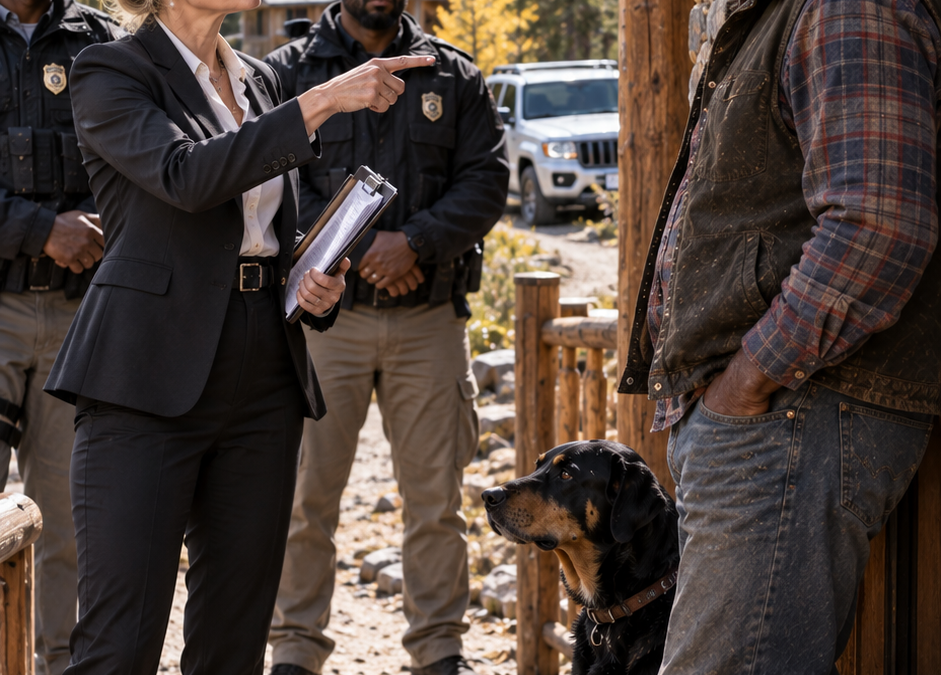
𝗣𝗔𝗥𝗧 𝟮
He was right.
The parcel totaled 412 acres.
Greer Creek formed the northern boundary.
County forest lay to the east.
The western line followed a ridge monumented in 1968, resurveyed in 1991, and monumented again during a neighboring transfer in 2009.
The southern boundary ran near the deeded route toward the county road.
I knew all of it.
I had walked every line.
I had photographed every monument after the 2009 survey.
I knew where old fencing departed from true boundary.
I knew which corner marker disappeared under snow first.
That knowledge was not based on memory alone.
It was in paper.
Survey.
Tax record.
Deed.
Those documents mattered more than my certainty.
Ridgeline Pines had never been part of them.
The first HOA letter arrived in early April.
That was the fence violation.
Section Four, Paragraph Nine.
Structures visible from “community access corridors.”
Fine:
$450.
Then $150 each week after thirty days.
I filed it.
Three weeks later came the second.
This one referred to my road as:
RIDGELINE COMMUNITY ACCESS ROAD.
I read the phrase three times.
No such road legally existed.
Their letter claimed I had failed to maintain the surface according to HOA infrastructure standards.
They included a proposed resurfacing plan.
Cost estimate:
$3,200.
If I refused, they threatened to hire a contractor and bill me.
That letter went into the folder behind the first.
The third arrived with a photograph.
Trailhead parking area.
A simple gravel rectangle my father had graded in 1972 for hunting season.
The HOA called it common property.
That changed my level of attention.
Rules were one thing.
Ownership claims were another.
The letter ordered me to stop parking vehicles on HOA land.
My vehicles.
On my parking area.
On land assessed under my parcel number.
I sat at the kitchen table for a long time.
Not angry.
Interested.
Because every time Diane wrote a new letter, she moved farther away from opinion and closer to making a provably false claim about title.
The first letter said my fence offended their standards.
The second said my road was community infrastructure.
The third said the parking area belonged to them.
A pattern was forming.
I called Pete Aldakoa.
Pete grazed cattle on my lower meadow under a seasonal lease and had lived in the valley nearly thirty years.
When I read him the third letter, he became quiet.
Then:
“Calvin, that road is yours.”
“I know.”
“Your dad built it.”
“I know.”
“They know that?”
“Apparently not.”
“Got your surveys?”
“Yes.”
“You should call Tom.”
He meant Tom Riley.
Property lawyer in Crestfield.
Tom had handled the legal side of my 2009 resurvey.
He was not theatrical.
That was why I trusted him.
He treated documents as if they were machinery.
Understand what each part does before touching anything.
I called the next morning.
“Bring every record,” he said.
So I did.
Homestead patent.
Deed.
1968 survey.
1991 survey.
2009 survey.
Monument report.
County assessment records.
Tax histories.
HOA letters.
Photographs.
Tom spread them across his conference table.
Read for forty minutes.
I drank coffee.
He said nothing.
Finally, he leaned back.
“The HOA has nothing.”
“I know.”
“No, Calvin.”
He tapped the documents.
“I mean legally, nothing. No covenant. No easement. No deed interest. No plat overlap. No annexation.”
“What do we do?”
“Confirm everything independently.”
That answer was exactly what I wanted.
Tom ordered a complete title search back to the federal patent.
Every recorded Ridgeline Pines amendment.
Subdivision plat.
Common-area descriptions.
Access-road records.
County assessor maps.
Planning documents.
Everything.
The documents arrived gradually.
Two weeks later, Tom called.
“Your road is exactly where you said it is.”
“Good.”
“The HOA plat ends at the county road.”
“Also good.”
“No overlap.”
“I assumed.”
“Never assume.”
I smiled.
“That sounds familiar.”
Tom continued.
“The road remains part of your parcel. Trailhead too.”
“So we send a letter?”
“Yes.”
His first response to Ridgeline Pines was only two pages.
That brevity mattered.
He cited my parcel number.
Recording history.
2009 survey.
County assessment.
Then the HOA’s own CC&Rs.
Their jurisdiction:
Forty-three platted lots and designated common areas shown in Plat Book 14, Page 22.
My parcel:
Not included.
He demanded withdrawal of all violations, cancellation of all fines, and written acknowledgment that the access road, trailhead parking area, fence, lodge, and other improvements on my parcel were outside HOA authority.
Thirty days.
Their response came on day twenty-two.
Not from a lawyer.
From the board.
All five members signed.
Three pages.
Not one page addressed Tom’s citations.
No discussion of the deed.
No survey.
No parcel number.
No plat.
Instead, the board argued that residents had used the road for more than fifteen years and that continuous use had transformed it into a “community thoroughfare.”
The phrase they used was:
ESTABLISHED COMMUNITY PRACTICE.
I called Tom.
“What does that mean?”
“Nothing by itself.”
“They’re claiming fifteen years.”
“I know what they’re trying to claim.”
“What?”
“Prescriptive easement.”
He explained.
In general terms, prescriptive easement law requires more than use over time.
The use has to satisfy specific legal elements.
Open.
Continuous for the required period.
And, crucially, adverse or hostile rather than merely permissive.
Ridgeline residents had used the road.
I had known about it.
Hunters sometimes used it.
Hikers.
Residents.
Delivery drivers.
I rarely cared.
I had never blocked ordinary passage.
That was tolerance.
Permission.
Not surrender.
Tom said:
“If you allow someone to cross your land, their use is not automatically hostile just because it lasts a long time.”
“Could they claim they thought it was theirs?”
“They can claim anything.”
“Would that matter?”
“We answer with evidence.”
He sent a second letter.
Four pages.
Prescriptive easement doctrine.
Case law.
Difference between permissive use and hostile use.
Then another important distinction:
Even if Ridgeline Pines somehow established a right to pass over the road, an access easement would not give the HOA authority to regulate the underlying land.
They could drive.
They could not tell me what fence to build.
They could not claim my parking area.
They could not impose HOA standards on the lodge.
Passage and governance were different rights.
Tom’s final paragraph was blunt without being dramatic.
No recorded instrument extended HOA jurisdiction to my parcel.
Continued enforcement could expose the association to claims including slander of title, interference with property rights, and other remedies.
I filed everything.
Then Diane decided to make the dispute public.
Ridgeline Pines placed the access-road issue on the agenda for its June board meeting.
Pete called.
“You going?”
“No.”
“Why?”
“Tom says no.”
“He’s probably right.”
“He usually charges enough to be.”
Pete attended.
The next morning he told me what happened.
Diane spoke for twenty minutes.
Called my road an essential community resource.
Said a neighboring landowner was attempting to interfere with longstanding community rights.
That neighbor was me.
She repeatedly referred to “community agreements.”
Pete said nobody asked to see one.
Then she brought out a map.
Laminated.
Color printed.
The road highlighted yellow.
Large label:
RIDGELINE COMMUNITY ACCESS CORRIDOR.
The label impressed people.
That was the problem.
A label is not a deed.
The board voted four to one authorizing formal legal action.
Three days later, Pete forwarded me the meeting minutes.
I printed them.
Put them in the folder.
By then, the folder was thick enough that I replaced the original manila with a larger file jacket.
That was when Ridgeline Pines finally hired counsel.
The lawyer’s name was Gerald Fitch.
He wrote Tom a technically competent letter advancing a prescriptive-easement theory.
Unlike Diane, Fitch cited real law.
He argued that residents had used the road openly and continuously for more than fifteen years under a claim of right.
Therefore, he argued, their use was not permission.
It was adverse.
I met Tom at his office.
“This is better than their earlier argument,” I said.
“Much.”
“Should I be worried?”
“No.”
“Why?”
Tom slid a document across the table.
“Because I found this.”
One page.
County Planning Department letterhead.
August 14, 2007.
I began reading.
It was addressed to Summit Ridge Development LLC, predecessor to the developer behind Ridgeline Pines.
The developer had asked the county whether the existing road north of the proposed subdivision could be represented as community access.
The county answered in writing.
The road was private.
Located entirely within the Greer parcel.
No public right existed.
No easement had been recorded.
And the developer could not market or represent the road as subdivision access without first securing an easement from the Greer owner.
Final paragraph:
No easement had been requested, negotiated, or granted.
I looked at Tom.
“Where was this?”
“County planning file.”
“For sixteen years?”
“Yes.”
“Public?”
“Yes.”
“So the developer knew.”
“In writing.”
I read it again.
That document changed everything.
The HOA’s prescriptive claim depended partly on the story that residents had openly used the road under a belief that it belonged to their community.
But the developer that created the community had received direct written notice before selling lots that the road was privately owned.
No easement.
No community right.
Nothing.
Whatever buyers had later been told, the official record started with the opposite.
“What now?” I asked.
“Full planning file.”
“Do it.”
Tom requested every document associated with Ridgeline Pines approval.
Applications.
Staff comments.
Maps.
Developer submissions.
Conditions.
Correspondence.
While waiting, he sent Fitch a five-page response.
Exhibit A:
2007 planning letter.
Exhibit B:
County assessor description.
Exhibit C:
HOA subdivision plat.
Exhibit D:
Chain-of-title summary back to the homestead patent.
Everything pointed the same direction.
Private road.
Private parcel.
No recorded easement.
No HOA jurisdiction.
Fitch asked for two more weeks.
Tom agreed.
The two weeks passed.
Then another.
On the twenty-second day, Fitch called Tom.
Ridgeline Pines wanted to negotiate.
They proposed a formal access agreement.
In return, the HOA would release its property claims.
Tom called me.
“What do you think?”
“No.”
“I agree.”
“Why negotiate access after telling me they already own it?”
“Exactly.”
“File.”
So he did.
Quiet title.
District court.
The complaint asked the court to declare Parcel 14-0072A owned in fee simple by me, free of any easement, covenant, or property interest held by Ridgeline Pines.
It also sought relief for the HOA’s written ownership claims concerning the access road and parking area.
Ridgeline Pines answered.
Prescriptive easement again.
Then a new theory:
Implied dedication to public use.
Tom called that one “ambitious.”
“Explain.”
“They’re saying your long tolerance of public use shows you intended to dedicate the road.”
“Did I?”
“No.”
“Could they prove I did?”
“Not while that 2007 letter exists.”
The county had explicitly described the road as private.
The developer had been told no public access existed.
The county had told them a recorded easement was required.
That was contemporaneous evidence against dedication.
The hearing was scheduled for November.
Until then, the road remained open.
I never blocked it.
That point matters.
I did not wake one morning, drag trees across the road, and trap forty-three families inside a subdivision.
I had no quarrel with residents.
Many probably had no idea what their HOA was doing.
My dispute was over ownership and authority.
Not access to groceries.
Then, about three weeks before the hearing, the situation escalated in the stupidest possible way.
It happened on a Saturday morning.
I was at the lodge.
Coffee on.
Fire low.
The old rifle still hanging above the fireplace.
A vehicle came up the road.
Then another.
The first was Diane’s white HOA SUV.
The second carried two men I recognized from Ridgeline meetings.
One board member.
One security contractor.
They parked in my turnaround.
No call.
No appointment.
No permission.
I stepped onto the porch.
Diane walked toward me holding a stack of papers.
“Mr. Greer, we are here to document the condition of the community access corridor and trailhead.”
“No.”
She stopped.
“We have a board authorization.”
“Your board doesn’t authorize entry onto my property.”
“We have an active legal claim.”
“That also does not authorize entry.”
The two men had started walking toward the side of the lodge.
I raised my voice.
“Gentlemen, stop.”
They did.
“Return to your vehicles.”
Diane stepped up onto the porch.
“We are entitled to inspect the disputed area.”
“No, you are not.”
“This is becoming obstruction.”
“No. It’s becoming trespass.”
For the first time, I was angry.
Not out of control.
Not shouting wildly.
But angry.
Months of letters were one thing.
Three people driving onto my land during active litigation and announcing an inspection was another.
Diane looked through the open lodge door.
Her eyes went to the wall.
The rifle.
Then back to me.
Her entire expression changed.
“You have a firearm.”
“I own several.”
“That one is accessible.”
“It’s hanging on my wall.”
The security contractor moved closer.
I looked at him.
“Do not come onto this porch.”
He stopped.
Diane said, “Are you threatening us?”
“No.”
“You are standing near a weapon.”
“I am standing outside my house.”
She looked toward the rifle again.
I understood exactly what was happening.
So I stepped farther away from the doorway.
Then I took out my phone.
“I’m recording now.”
Diane’s face tightened.
“Good.”
I held the phone where all three were visible.
“For the record, I have not touched any firearm. The rifle visible inside the lodge is hanging above the fireplace. You have entered my property without permission after being instructed through counsel that the road and trailhead are disputed private property. I am directing all three of you to leave.”
Silence.
The board member looked at Diane.
Then at the security contractor.
The contractor said quietly:
“We should go.”
Diane turned toward him.
“We were authorized.”
“Not for this.”
That was the moment the title I had originally been given makes sound dramatic.
They dropped everything and ran.
They didn’t literally sprint down the mountain.
But their confidence collapsed very quickly.
The board member lowered the measuring wheel he had been carrying.
The contractor stepped back.
Diane gathered her papers.
Within two minutes, all three were in their vehicles.
They left.
The rifle never moved.
Later that afternoon, Tom called.
“Did something happen?”
“How did you hear already?”
“Fitch called.”
I laughed without humor.
“What did Diane tell him?”
“That you confronted HOA personnel with a rifle.”
I closed my eyes.
“Of course.”
“Calvin.”
“I never touched it.”
“I need every detail.”
I gave him everything.
Arrival.
Names.
Vehicles.
Statements.
Position of the rifle.
My recorded warning.
Departure.
“You recorded it?”
“Most of it.”
“Send me the file.”
I did.
Ten minutes later, Tom called back.
“You’re fine.”
“I know.”
“No, listen. Do not delete this recording. Back it up twice.”
“Already did.”
“Good.”
“What did she claim?”
“That you retrieved a rifle and forced them off the property.”
“She lied.”
“I know.”
“How?”
“Your video starts before anyone leaves.”
He paused.
“And the rifle is visible on the wall behind you the entire time.”
That was almost funny.
Diane had created a claim disproved by the same object she used to construct it.
Tom contacted Fitch immediately.
By Monday morning, Fitch confirmed in writing that Ridgeline Pines would not pursue any firearm-related allegation.
The security contractor apparently provided his own account.
It did not support Diane’s story.
That incident never became the central legal issue.
But it mattered.
Because it showed the judge something about the HOA’s willingness to convert assumptions into facts.
Road becomes community road because we call it that.
Parking area becomes HOA property because we print a map.
Rifle on wall becomes threatening display because the compliance director says so.
Pattern matters.
Tom did not turn the case into a character attack.
He was better than that.
But he preserved everything.
The November hearing took place in a small mountain county courtroom.
Six rows of benches.
Wood paneling.
Fluorescent lights.
Judge Patricia Renn presiding.
Diane sat in the gallery.
She had brought the clipboard.
That detail still makes me smile.
Different blazer.
Same clipboard.
Same laminated community standards.
Tom began with the homestead patent.
Then title.
Surveys.
Tax records.
Parcel description.
Road.
Trailhead.
Everything.
He put the 2007 county planning letter on an enlarged board.
Read the important part aloud.
Private road.
Greer property.
No easement requested.
No easement negotiated.
No easement granted.
Then the HOA plat.
Boundary ending at the county road.
Judge Renn listened.
Fitch presented prescriptive easement.
Forty minutes.
Open use.
Long use.
Homeowners believing they had a right.
The judge asked:
“What evidence establishes hostility rather than permission?”
Fitch cited duration.
Open passage.
Community maintenance on several occasions.
Judge Renn repeated:
“What establishes hostility?”
Silence.
He cited two cases.
Tom distinguished both.
One involved an owner who repeatedly objected yet users continued.
That was hostile.
Another involved physical improvements made openly under a claim of right and over explicit protest.
Again hostile.
My facts were the opposite.
I had tolerated use.
No one asserted legal entitlement until Diane’s letters.
The county planning letter confirmed the developer knew the road was private.
Judge Renn asked about implied dedication.
Fitch argued public use.
Tom stood.
“Intent controls.”
He placed the 2007 letter back before the judge.
“The county told the developer the road was private and could not be marketed as subdivision access absent an easement.”
Judge Renn looked at Fitch.
“Where is evidence Mr. Greer intended to dedicate the road?”
Fitch referred to years of nonexclusion.
The judge shook her head.
“Permission is not dedication.”
That sentence ended most of the case.
She ruled from the bench.
“The chain of title is unbroken.”
My hands rested on the table.
“The county record identifies the disputed access road and trailhead area as lying within Parcel 14-0072A.”
She looked at the planning letter.
“The 2007 communication is unusually clear contemporaneous evidence that the developer knew no public or subdivision easement existed.”
Diane did not move.
“The association has failed to establish hostile use sufficient for a prescriptive easement.”
Another page turned.
“It has likewise failed to establish intent necessary for implied dedication.”
Then:
“Title is quieted in Calvin Elias Greer, free and clear of any claim by Ridgeline Pines Homeowners Association.”
I breathed out.
The judge continued.
“The association’s recorded governing documents are limited to the forty-three platted lots and designated common areas appearing in Plat Book 14, Page 22. Nothing in those documents extends covenant jurisdiction over the Greer parcel.”
Then she looked toward the gallery.
“The court will be direct. Longstanding assumption does not substitute for title.”
No one spoke.
She awarded attorney’s fees under the applicable slander-of-title theory Tom had pleaded.
The amount would later be fixed at $14,200.
Then came one final warning.
“Any future HOA enforcement activity directed at property outside the recorded Ridgeline Pines boundaries, absent an independent lawful basis, may subject the association and responsible individuals to sanctions.”
She looked at the board members.
“You are on notice.”
That was the end.
Not dramatic.
No pounding gavel.
No cheering.
Just a record read correctly.
Outside, Tom and I walked down the courthouse steps.
Cold air.
Thin sunlight.
He handed me a copy of the ruling.
“You planning to close the road?”
“No.”
“Thought so.”
“Why would I?”
“You’ve got every right to control access now.”
“I had that right before.”
He smiled.
“Exactly.”
That was the point.
Winning did not require me to punish forty-three households.
Residents had driven the road because the developer and later the HOA allowed them to believe it was part of the community.
That misunderstanding was not entirely their fault.
So the road stayed open.
But from then on, use continued with the truth sitting in the county file.
Private property.
No HOA governance.
No ownership.
No implied community corridor.
Just permission.
Permission can continue.
It can also be conditioned or revoked.
That distinction is what the HOA had spent months refusing to understand.
The aftermath unfolded slowly.
Fitch withdrew as counsel not long after the ruling.
Three board members declined to continue after January.
Diane resigned as compliance director in February.
The title disappeared with her.
As far as I know, nobody ever recreated the position.
The split-rail fence remains exactly where it was.
I never changed one rail.
The trailhead parking area is still gravel.
I still let neighbors and residents use it reasonably.
Hunters sometimes meet there.
Hikers park.
I have never wanted the mountain sealed away from everyone else.
I only wanted the people using it to understand that access did not turn into ownership through repetition.
The rifle remained above the fireplace too.
For a while, whenever I looked at it, I thought about Diane’s allegation.
The irony bothered me.
A weapon I had not touched almost became more important than a deed she had never read.
That is how disputes become distorted.
People remember dramatic objects.
Rifles.
Uniforms.
Badges.
SUV logos.
Courtrooms.
But the thing that determined everything was a letter sitting unnoticed in a county planning file for sixteen years.
One page.
August 14, 2007.
No easement requested.
No easement negotiated.
No easement granted.
That page did more work than every argument Diane ever made.
I later asked Tom how close the HOA came to winning anything.
“Not close.”
“Even on the road?”
“Not with that record.”
“What if the county letter hadn’t existed?”
He considered.
“The case becomes more expensive.”
“But still?”
“You still had strong title, surveys, tax history, and the difference between permissive and hostile use.”
“So the letter wasn’t everything.”
“No.”
He smiled.
“But it made the truth difficult to decorate.”
That phrase stayed with me.
Difficult to decorate.
Diane had spent months decorating the claim.
Community access corridor.
Aesthetic standards.
Longstanding community practice.
Protected mountain environment.
Access rights.
Implied dedication.
Different labels.
Same missing instrument.
A deed doesn’t care what you call the road.
The next spring, I walked the southern boundary.
Snow had melted from the meadow.
Mud near the lower section.
Mallards had returned to the pond.
The split-rail fence looked exactly as it had the year before.
I ran my hand over one rail.
Weathered.
Cracked slightly near a post.
I replaced that rail later.
Not because Ridgeline Pines ordered me to.
Because it needed replacing.
That difference mattered more than it should have.
I continued toward the county road.
At the subdivision entrance, I could see Ridgeline Pines below.
Forty-three homes.
Roofs among trees.
Families living ordinary lives.
Most of them had never asked to be part of a property dispute.
A woman walking a dog waved.
I waved back.
No feud.
No need.
The court had resolved the boundary.
People could return to being neighbors.
Pete stopped by that afternoon.
He sat on the porch while I made coffee.
He looked through the window at the rifle.
“That the infamous weapon?”
“Apparently.”
“You threatening me now?”
“Only if you complain about the coffee.”
He laughed.
Then he became serious.
“You ever figure out why Coulter pushed it so hard?”
“No.”
“Power?”
“Maybe.”
“Pride?”
“Probably.”
I looked toward the road.
“But I think mostly she never separated use from ownership.”
Pete nodded.
“People drive something long enough, they think it’s theirs.”
“People enforce something long enough, they think the same.”
That was closer to the truth.
Diane had probably begun with a belief that she was protecting the development.
Then each unchallenged act expanded her sense of authority.
Road crew.
Neighboring fence.
My split rail.
Parking area.
At some point, internal HOA rules stopped looking internal to her.
They became universal standards.
That is dangerous in any institution.
Power used repeatedly can begin to feel like power lawfully possessed.
The cure is the boundary document.
Show me where it starts.
Show me where it ends.
Tom once said something similar.
“Every association is powerful inside the agreement that created it.”
“And outside?”
“It’s another private entity.”
Exactly.
The fact that Ridgeline Pines could fine one of its members did not mean it could fine me.
The fact that its residents used my road did not mean its board could rename it.
The fact that Diane had a compliance title did not make me subject to compliance.
Those things sound obvious after judgment.
They did not seem obvious to the people sending me letters.
That is why records matter.
They remove the argument from personality.
Imagine if I had handled the first visit differently.
Suppose I had come off the porch shouting.
Suppose I had grabbed the rifle from the wall.
Suppose I had used it as a prop.
Even without pointing it at anyone.
What would happen then?
The story would become about the rifle.
Not the deed.
Threatening landowner.
Fear.
Police.
Maybe criminal investigation.
Maybe restraining orders.
The title issue would still exist, but buried under something unnecessary.
Instead, when Diane later tried to make the rifle part of the story, the video killed that version before it could grow.
The gun stayed on the wall.
I stayed outside.
They left.
The paper remained the story.
That is the way my father would have wanted it.
He died before the dispute.
Sometimes I wonder what he would have said.
Probably not much.
He would have read Diane’s letter.
Read the deed.
Checked the plat.
Then asked why I was wasting time talking about it.
Elias would have been less diplomatic.
My grandfather possessed many virtues.
Tolerance for nonsense was not one.
Still, both would have understood the conclusion.
Land is held physically by fences, roads, work, taxes, maintenance.
But legally it is held through memory made permanent.
A deed.
Survey.
Patent.
Recorded letter.
That is the architecture beneath ownership.
Without it, every generation would have to fight every boundary again.
The county record prevents that.
If people read it.
That was the failure in Ridgeline Pines.
The developer knew.
The county documented it.
Then years passed.
People moved in.
The original knowledge disappeared.
The road remained.
Use became normal.
Normal became assumed right.
Assumed right became HOA policy.
HOA policy became enforcement.
Then Diane stood on my porch and handed me a deadline.
Fourteen days.
All because nobody had opened one county file.
There is something almost comic about that.
Except real property disputes cost real money.
The HOA eventually paid $14,200 in my legal fees.
That money came from somewhere.
Insurance.
Association accounts.
Ultimately, resources belonging to homeowners.
People who might have preferred that money remain available for roads, snow removal, or actual common-property maintenance.
That is the part boards should remember before converting assumption into litigation.
Authority should be verified before enforced.
Otherwise, members pay for leadership’s confidence.
Ridgeline Pines never sent me another violation.
No fence letter.
No road maintenance bill.
No parking notice.
Nothing.
A few years later, the HOA asked Tom whether I would be willing to document continuing permissive access more formally so future boards would understand the road’s status.
That request was different.
Respectful.
Legally coherent.
I agreed to discuss it.
Eventually we created a simple license agreement.
Not an easement.
Not ownership.
A revocable written license allowing residents to continue normal vehicle passage under defined conditions.
No HOA maintenance authority.
No right to regulate surrounding land.
No trailhead ownership.
No public dedication.
The document was signed.
Recorded as a notice where appropriate.
Future buyers could read it.
That was the correct way to solve the practical problem.
Permission documented as permission.
No mythology required.
The first time I saw the new HOA president after that agreement, he stopped at the foot of my drive.
His name was Mark Ellison.
Mid-fifties.
Retired teacher.
He held no clipboard.
“Mr. Greer?”
“Calvin.”
“Mark.”
We shook hands.
He looked toward the lodge.
“Beautiful place.”
“My grandfather thought so.”
“I wanted to thank you for working with us on the road.”
“I never had a problem with the road.”
“I know.”
He looked embarrassed.
“The board understands that now.”
“That helps.”
He laughed.
“We’ve also put a copy of the license and the court ruling in our permanent governance file.”
“Good.”
“So nobody reinvents history.”
I smiled.
“That’s what files are for.”
He left after ten minutes.
No confrontation.
No threats.
No badge.
That conversation accomplished more neighborly goodwill than every one of Diane’s notices combined.
Because it began with the correct premise.
My land was mine.
Ridgeline Pines was theirs.
Then we discussed what cooperation between those two facts could look like.
That is how boundaries should work.
A boundary is not hostility.
It is clarity.
Clarity makes cooperation safer.
Today I am older.
The mountain feels steeper than it did at forty.
Some mornings my knees remind me why my father eventually moved into the valley.
I haven’t followed him yet.
Maybe someday.
For now, I still wake in the lodge.
Still make coffee before sunrise.
Still walk the meadow.
Still check the road after heavy storms.
Still replace rails when they rot.
The old rifle remains above the fireplace.
Same hooks.
Same wall.
Visitors sometimes ask about it because the story got around.
“Is that the rifle from the HOA case?”
“No.”
They look confused.
“It was a rifle in the HOA case because somebody decided to mention it.”
Then I point toward the office.
“The deed was the thing that mattered.”
That answer usually disappoints them.
People prefer dramatic objects.
But drama is rarely what protects land.
The quiet things do.
Recording stamps.
Survey monuments.
Tax records.
County letters.
All the things nobody notices until someone arrives saying reality is different.
I keep the entire Ridgeline file in the fireproof drawer now.
First violation.
Second.
Third.
Tom’s letters.
Board response.
Meeting minutes.
Fitch correspondence.
2007 county letter.
Planning file.
Quiet-title complaint.
Hearing transcript.
Final order.
Fee award.
License agreement.
And a flash drive containing the porch video from the day Diane claimed I threatened them with a rifle.
I labeled it clearly.
Not because I expect another case.
Because evidence is useful only if the next person can find it.
My niece will probably inherit this place.
She is better with computers than I am.
I have made her sit at the kitchen table and read the documents.
She complained.
I told her I did the same thing when my father made me.
She said:
“What am I supposed to remember from all this?”
I pointed toward the fireproof drawer.
“Where it is.”
“No, seriously.”
“Read before you sign.”
She rolled her eyes.
I smiled.
Then added:
“And if someone tells you they own part of your land, make them show you where.”
That got her attention.
“What if they can’t?”
“Then don’t help them invent it.”
That is probably the cleanest summary of everything.
Diane brought me a conclusion and expected me to provide compliance.
Instead, I asked for the missing foundation.
There wasn’t one.
When she tried a new theory, we checked that too.
Nothing.
Prescriptive easement?
No hostile use.
Implied dedication?
No intent.
HOA covenant authority?
Parcel outside the plat.
Community ownership?
No deed.
Rifle threat?
Video showed the rifle never left the wall.
Every claim eventually met a record.
The record won.
One autumn morning, years after the case, I stood at the same porch railing where Diane had given me the fourteen-day deadline.
Frost again.
Same season.
I could see the road twisting downward through the pines.
A Ridgeline resident’s truck came up.
He was heading toward the trailhead.
Slowed when he saw me.
Window down.
“Morning, Calvin.”
“Morning.”
“Okay if I park up there for a couple hours?”
That question told me everything had changed.
Not because he legally needed to ask every time under our written arrangement.
Because he understood the nature of the place.
“Go ahead.”
“Thanks.”
He drove on.
No problem.
Permission given.
Permission understood.
No one needed a courtroom.
I watched him disappear around the bend.
Then looked at the lodge.
The same porch.
The same wall inside.
Same rifle.
Same deed in the office.
Nothing essential had moved.
Only the story people told themselves about the road had changed.
And that is ultimately why I never describe what happened as defeating the HOA.
That gives them too much importance.
I didn’t defeat Ridgeline Pines.
I corrected a record misunderstanding.
The court confirmed title that already existed.
The HOA stopped enforcing rules where they did not apply.
Residents kept using the road with permission.
Life continued.
That is a better ending than destruction.
People sometimes want a revenge story.
They ask why I didn’t gate the road after winning.
Why I didn’t charge every homeowner.
Why I didn’t sue Diane personally.
Why I didn’t make the HOA suffer more.
Because I did not spend my life holding 412 acres so that one day I could use them to punish people.
Elias held this mountain through the Depression.
Robert held it through bad cattle years.
I hold it now.
The responsibility is continuity.
Not revenge.
That does not mean weakness.
If somebody had ignored the ruling, we would have enforced it.
If another false lien appeared, Tom would have filed immediately.
If people entered the property after being told not to, they would be treated as trespassers.
Boundaries without enforcement are suggestions.
But enforcement should serve the boundary.
Not ego.
That is the distinction Diane never understood.
Her job should have been to enforce actual Ridgeline Pines rules inside actual Ridgeline Pines property.
Instead, she treated compliance as a mission without an edge.
Once an institution forgets its edge, every neighbor becomes subject to whatever it decides next.
The deed put the edge back.
So did Judge Renn.
Her warning still sits in the final order.
Future enforcement beyond Plat Book 14, Page 22, without independent lawful basis, may result in sanctions.
One paragraph.
Enough.
The funniest thing is that Diane had said something true during the first visit.
“You have fourteen days to comply.”
I did comply.
Not with her fence order.
With my father’s instruction.
Read every document.
Check the record.
That took longer than fourteen days.
But it was the only compliance that mattered.
This morning, I woke before six.
Cold air.
Clear sky.
I made coffee.
Stepped onto the porch.
The mountain was quiet.
A little snow remained high on the western ridge.
The split-rail fence followed the meadow.
The access road lay pale through the trees.
Ridgeline Pines sat below, mostly hidden.
I walked inside.
Passed the fireplace.
The rifle was where it always is.
Then I opened the office drawer.
Pulled out the original county planning letter.
August 14, 2007.
I read the last paragraph again.
No easement requested.
No easement negotiated.
No easement granted.
Then I put it back.
Sometimes the most powerful document in a fight is not one created by either side.
It is the paper written years before anyone knew a fight would exist.
That is why it carries weight.
It wasn’t trying to help me.
It wasn’t trying to hurt Ridgeline Pines.
It simply recorded the truth at the time.
Private road.
Greer parcel.
No community right.
Sixteen years later, when confidence had buried that truth beneath maps, meetings, fines, and invented terminology, the paper was still there.
Waiting.
That is the thing I want my niece to understand.
The thing my father understood.
The thing Elias understood when he proved up the homestead almost ninety years ago.
Land remembers through records.
People forget.
Boards change.
Developers disappear.
Names get invented.
Roads acquire nicknames.
Someone prints a map.
Somebody else repeats it.
After enough time, repetition begins to sound like history.
But it is not history until the record supports it.
Ridgeline Pines spent fifteen years calling my road a community resource.
The county had one old letter saying it wasn’t.
When the time came, one old letter mattered more.
So when people hear the shortened version of this story—the version where HOA officers came onto my mountain property, saw a rifle, and suddenly ran—they usually think the weapon ended the confrontation.
It didn’t.
The rifle accomplished nothing.
It stayed on the wall.
The deed mattered.
The surveys mattered.
The county letter mattered.
The video mattered.
The court order mattered.
The discipline not to turn a property dispute into something dangerous mattered.
That is the version worth remembering.
The HOA came up the mountain believing confidence was authority.
They left the case knowing authority has to come from somewhere.
A deed.
A covenant.
An easement.
A statute.
A recorded right.
Something.
They had none of those.
I had all the documents I needed.
And in the end, nobody needed to raise a rifle, a voice, or anything else.
We only needed the right papers read in the right room.
The lodge is still here.
The fence is still here.
The road is still mine.
Residents still use it.
The mountain has gone back to being a mountain instead of evidence.
And every morning when I step onto the porch, I can look down the road and know exactly where the boundary lies.
Not because I won an argument.
Because I checked.
Have you finished reading the story and want to read it again?
HOA Officers Stormed My Mountain Lodge and Claimed I Pointed a Rifle—Then the Deed Proved They Had No Right to Be There
The HOA compliance director came up my private mountain road, stood on the porch my grandfather built in 1949, and ordered me to change a fence on land her association had never owned, governed, or held an easement across.
Months later, when HOA representatives pushed farther onto my property and claimed I had threatened them with the old rifle hanging above my fireplace, I stopped treating their arrogance like a nuisance and started treating every false claim as evidence.
What finally destroyed their case was not the rifle, the shouting, or anything I said—it was a sixteen-year-old county letter proving the developer had known from the beginning that my road was private.
My name is Calvin Greer.
I was sixty-one years old when Diane Coulter first walked onto my porch carrying a clipboard and the confidence of someone who believed a laminated badge could create jurisdiction.
It was early spring.
There was still frost along the north side of the lodge.
The sun had reached the upper pines but not the creek bottom, and the railing beside Diane’s hand was cold enough that a thin white film still clung to the lodgepole pine my grandfather had shaped more than seventy years earlier.
She wore a dark blazer.
Pressed slacks.
Polished boots.
Everything about her looked designed for an office rather than a mountain.
Her white SUV sat in the turnaround behind her with the Ridgeline Pines logo on the front door—a pine tree inside a circle.
She held the clipboard against her chest.
At the top of the paper was the same logo.
Beneath it:
RIDGELINE PINES HOA
COMPLIANCE NOTICE
Then she read the violation to me.
“Your property is in violation of Ridgeline Pines Community Standards, Section Four, Paragraph Nine. You have fourteen days to comply or we will take formal enforcement action.”
She said it without hesitation.
Almost no emotion.
A person who had repeated the words several times before getting out of the vehicle.
I looked at her.
Then at the notice.
Then past her to my road.
My road.
Not theirs.
The gravel track had been built by my father in 1971.
It ran from the county road up the southern edge of our property, crossed a lower meadow, climbed through lodgepole pine, and terminated near the trailhead parking area below the lodge.
My family had maintained it for more than half a century.
We had paid taxes on the land under it every one of those years.
No deed had transferred it.
No recorded easement burdened it.
No subdivision plat claimed it.
But Ridgeline Pines had apparently decided that long use and a homemade label were enough to change ownership.
“What exactly am I violating?” I asked.
Diane looked down.
“The split-rail fence along the southern meadow.”
“What about it?”
“It does not conform to the association’s aesthetic requirements for structures visible from community access corridors.”
I almost asked her which community.
Instead, I let her continue.
“The fence must either be replaced with an approved design or removed.”
“That fence is on my land.”
She looked up from the form.
“The road serves Ridgeline Pines residents.”
“That wasn’t what I said.”
Her mouth tightened.
“We consider the road part of the community access system.”
“Do you?”
“Yes.”
I nodded.
That was all.
The lodge stood forty feet behind me.
Inside my office was a fireproof drawer containing the deed.
Inside another file were surveys from 1968, 1991, and 2009.
Every one described the same property.
Every one placed the access road and trailhead parking area inside my parcel.
I could have walked Diane inside.
Could have spread those documents across the table.
Could have explained exactly how wrong she was.
I didn’t.
My father had taught me something useful before he moved down into the valley.
Read everything.
Sign nothing you haven’t read.
And when somebody makes a claim about land, start with the recorded instrument.
Arguments come later.
So I took the notice.
“I’ll look into it.”
Diane hesitated.
That was not the response she expected.
“Fourteen days, Mr. Greer.”
“I heard you.”
“If we don’t receive confirmation of compliance, the board may assess fines.”
“All right.”
She turned.
Walked back toward the SUV.
Then stopped briefly near the front window.
Mounted above the stone fireplace inside the lodge was an old hunting rifle.
A lever-action my father had put there in 1963.
It had remained in essentially the same place for decades.
Sometimes it was taken down for cleaning.
Rarely for anything else.
Diane looked at it through the glass.
Then at me.
I noticed.
At the time, I didn’t think much of it.
Later, she would tell people I had “displayed a firearm in a threatening manner.”
Eventually, that story grew into a claim that I had pointed it toward HOA representatives.
None of that happened.
The rifle was on the wall.
I never touched it.
That detail became important later.
Diane got into her SUV.
Drove away.
Dust rose behind her tires.
I watched until she reached the bend.
Then I went inside.
The coffee in the pot was still warm.
I poured a cup.
Put the HOA notice on the kitchen table.
And began reading.
The land beneath Ridgeline Pines had not belonged to my family.
That point matters.
I never claimed it did.
The subdivision sat roughly a mile and a half south of the lodge, lower on Greer Mountain.
Forty-three residential lots.
Mostly larger mountain homes.
The land had once been part of the old Harmon ranch before that property was divided and sold beginning around 2005.
Ridgeline Pines incorporated its HOA in 2007.
Its covenants, conditions, and restrictions were recorded that same year.
I had read them when the development was new.
Not because I was worried.
Because they bordered land I owned.
The CC&Rs governed forty-three platted lots and the designated common areas inside Ridgeline Pines.
My property was not listed.
My parcel number did not appear.
My deed was not subjected to their declaration.
No annexation.
No covenant.
Nothing.
My family’s history on Greer Mountain went back much further.
My grandfather, Elias Greer, filed the original homestead claim in 1931.
He spent the next five years proving it up.
Timber work.
Subsistence farming.
Improvements.
Residence.
Whatever the government required, he did.
The patent was issued in 1936.
I still have it.
Framed.
The paper has yellowed.
The ink is faded in places.
But the description remains readable.
Elias built the first cabin in 1934.
Two rooms.
Root cellar.
Stone chimney.
Later, after the war years, he began expanding.
Between 1947 and 1952, he built most of the lodge that still stands today.
He cut lodgepole pine on the mountain.
Milled some himself.
Hauled stone from the creek.
Set beams by hand.
My father, Robert, used to say Elias believed hiring someone was evidence you had failed to learn something.
That philosophy made him difficult.
It also built a lodge that has stood through more than seventy winters.
My father inherited the land in 1978.
He ran cattle in the lower meadow.
Leased timber rights for a few years on the western slope.
Maintained the road.
Maintained the lodge.
Maintained the boundaries.
Then in 2004, his knees finally convinced him that living at 4,200 feet was no longer proof of character.
He moved into a smaller home in the valley and transferred title to me.
Before leaving, he sat across from me at the kitchen table.
The deed between us.
He said:
“Read every document before you sign anything.”
I laughed.
“That all?”
“That’ll save you more trouble than most advice.”
He was right.
The parcel totaled 412 acres.
Greer Creek formed the northern boundary.
County forest lay to the east.
The western line followed a ridge monumented in 1968, resurveyed in 1991, and monumented again during a neighboring transfer in 2009.
The southern boundary ran near the deeded route toward the county road.
I knew all of it.
I had walked every line.
I had photographed every monument after the 2009 survey.
I knew where old fencing departed from true boundary.
I knew which corner marker disappeared under snow first.
That knowledge was not based on memory alone.
It was in paper.
Survey.
Tax record.
Deed.
Those documents mattered more than my certainty.
Ridgeline Pines had never been part of them.
The first HOA letter arrived in early April.
That was the fence violation.
Section Four, Paragraph Nine.
Structures visible from “community access corridors.”
Fine:
$450.
Then $150 each week after thirty days.
I filed it.
Three weeks later came the second.
This one referred to my road as:
RIDGELINE COMMUNITY ACCESS ROAD.
I read the phrase three times.
No such road legally existed.
Their letter claimed I had failed to maintain the surface according to HOA infrastructure standards.
They included a proposed resurfacing plan.
Cost estimate:
$3,200.
If I refused, they threatened to hire a contractor and bill me.
That letter went into the folder behind the first.
The third arrived with a photograph.
Trailhead parking area.
A simple gravel rectangle my father had graded in 1972 for hunting season.
The HOA called it common property.
That changed my level of attention.
Rules were one thing.
Ownership claims were another.
The letter ordered me to stop parking vehicles on HOA land.
My vehicles.
On my parking area.
On land assessed under my parcel number.
I sat at the kitchen table for a long time.
Not angry.
Interested.
Because every time Diane wrote a new letter, she moved farther away from opinion and closer to making a provably false claim about title.
The first letter said my fence offended their standards.
The second said my road was community infrastructure.
The third said the parking area belonged to them.
A pattern was forming.
I called Pete Aldakoa.
Pete grazed cattle on my lower meadow under a seasonal lease and had lived in the valley nearly thirty years.
When I read him the third letter, he became quiet.
Then:
“Calvin, that road is yours.”
“I know.”
“Your dad built it.”
“I know.”
“They know that?”
“Apparently not.”
“Got your surveys?”
“Yes.”
“You should call Tom.”
He meant Tom Riley.
Property lawyer in Crestfield.
Tom had handled the legal side of my 2009 resurvey.
He was not theatrical.
That was why I trusted him.
He treated documents as if they were machinery.
Understand what each part does before touching anything.
I called the next morning.
“Bring every record,” he said.
So I did.
Homestead patent.
Deed.
1968 survey.
1991 survey.
2009 survey.
Monument report.
County assessment records.
Tax histories.
HOA letters.
Photographs.
Tom spread them across his conference table.
Read for forty minutes.
I drank coffee.
He said nothing.
Finally, he leaned back.
“The HOA has nothing.”
“I know.”
“No, Calvin.”
He tapped the documents.
“I mean legally, nothing. No covenant. No easement. No deed interest. No plat overlap. No annexation.”
“What do we do?”
“Confirm everything independently.”
That answer was exactly what I wanted.
Tom ordered a complete title search back to the federal patent.
Every recorded Ridgeline Pines amendment.
Subdivision plat.
Common-area descriptions.
Access-road records.
County assessor maps.
Planning documents.
Everything.
The documents arrived gradually.
Two weeks later, Tom called.
“Your road is exactly where you said it is.”
“Good.”
“The HOA plat ends at the county road.”
“Also good.”
“No overlap.”
“I assumed.”
“Never assume.”
I smiled.
“That sounds familiar.”
Tom continued.
“The road remains part of your parcel. Trailhead too.”
“So we send a letter?”
“Yes.”
His first response to Ridgeline Pines was only two pages.
That brevity mattered.
He cited my parcel number.
Recording history.
2009 survey.
County assessment.
Then the HOA’s own CC&Rs.
Their jurisdiction:
Forty-three platted lots and designated common areas shown in Plat Book 14, Page 22.
My parcel:
Not included.
He demanded withdrawal of all violations, cancellation of all fines, and written acknowledgment that the access road, trailhead parking area, fence, lodge, and other improvements on my parcel were outside HOA authority.
Thirty days.
Their response came on day twenty-two.
Not from a lawyer.
From the board.
All five members signed.
Three pages.
Not one page addressed Tom’s citations.
No discussion of the deed.
No survey.
No parcel number.
No plat.
Instead, the board argued that residents had used the road for more than fifteen years and that continuous use had transformed it into a “community thoroughfare.”
The phrase they used was:
ESTABLISHED COMMUNITY PRACTICE.
I called Tom.
“What does that mean?”
“Nothing by itself.”
“They’re claiming fifteen years.”
“I know what they’re trying to claim.”
“What?”
“Prescriptive easement.”
He explained.
In general terms, prescriptive easement law requires more than use over time.
The use has to satisfy specific legal elements.
Open.
Continuous for the required period.
And, crucially, adverse or hostile rather than merely permissive.
Ridgeline residents had used the road.
I had known about it.
Hunters sometimes used it.
Hikers.
Residents.
Delivery drivers.
I rarely cared.
I had never blocked ordinary passage.
That was tolerance.
Permission.
Not surrender.
Tom said:
“If you allow someone to cross your land, their use is not automatically hostile just because it lasts a long time.”
“Could they claim they thought it was theirs?”
“They can claim anything.”
“Would that matter?”
“We answer with evidence.”
He sent a second letter.
Four pages.
Prescriptive easement doctrine.
Case law.
Difference between permissive use and hostile use.
Then another important distinction:
Even if Ridgeline Pines somehow established a right to pass over the road, an access easement would not give the HOA authority to regulate the underlying land.
They could drive.
They could not tell me what fence to build.
They could not claim my parking area.
They could not impose HOA standards on the lodge.
Passage and governance were different rights.
Tom’s final paragraph was blunt without being dramatic.
No recorded instrument extended HOA jurisdiction to my parcel.
Continued enforcement could expose the association to claims including slander of title, interference with property rights, and other remedies.
I filed everything.
Then Diane decided to make the dispute public.
Ridgeline Pines placed the access-road issue on the agenda for its June board meeting.
Pete called.
“You going?”
“No.”
“Why?”
“Tom says no.”
“He’s probably right.”
“He usually charges enough to be.”
Pete attended.
The next morning he told me what happened.
Diane spoke for twenty minutes.
Called my road an essential community resource.
Said a neighboring landowner was attempting to interfere with longstanding community rights.
That neighbor was me.
She repeatedly referred to “community agreements.”
Pete said nobody asked to see one.
Then she brought out a map.
Laminated.
Color printed.
The road highlighted yellow.
Large label:
RIDGELINE COMMUNITY ACCESS CORRIDOR.
The label impressed people.
That was the problem.
A label is not a deed.
The board voted four to one authorizing formal legal action.
Three days later, Pete forwarded me the meeting minutes.
I printed them.
Put them in the folder.
By then, the folder was thick enough that I replaced the original manila with a larger file jacket.
That was when Ridgeline Pines finally hired counsel.
The lawyer’s name was Gerald Fitch.
He wrote Tom a technically competent letter advancing a prescriptive-easement theory.
Unlike Diane, Fitch cited real law.
He argued that residents had used the road openly and continuously for more than fifteen years under a claim of right.
Therefore, he argued, their use was not permission.
It was adverse.
I met Tom at his office.
“This is better than their earlier argument,” I said.
“Much.”
“Should I be worried?”
“No.”
“Why?”
Tom slid a document across the table.
“Because I found this.”
One page.
County Planning Department letterhead.
August 14, 2007.
I began reading.
It was addressed to Summit Ridge Development LLC, predecessor to the developer behind Ridgeline Pines.
The developer had asked the county whether the existing road north of the proposed subdivision could be represented as community access.
The county answered in writing.
The road was private.
Located entirely within the Greer parcel.
No public right existed.
No easement had been recorded.
And the developer could not market or represent the road as subdivision access without first securing an easement from the Greer owner.
Final paragraph:
No easement had been requested, negotiated, or granted.
I looked at Tom.
“Where was this?”
“County planning file.”
“For sixteen years?”
“Yes.”
“Public?”
“Yes.”
“So the developer knew.”
“In writing.”
I read it again.
That document changed everything.
The HOA’s prescriptive claim depended partly on the story that residents had openly used the road under a belief that it belonged to their community.
But the developer that created the community had received direct written notice before selling lots that the road was privately owned.
No easement.
No community right.
Nothing.
Whatever buyers had later been told, the official record started with the opposite.
“What now?” I asked.
“Full planning file.”
“Do it.”
Tom requested every document associated with Ridgeline Pines approval.
Applications.
Staff comments.
Maps.
Developer submissions.
Conditions.
Correspondence.
While waiting, he sent Fitch a five-page response.
Exhibit A:
2007 planning letter.
Exhibit B:
County assessor description.
Exhibit C:
HOA subdivision plat.
Exhibit D:
Chain-of-title summary back to the homestead patent.
Everything pointed the same direction.
Private road.
Private parcel.
No recorded easement.
No HOA jurisdiction.
Fitch asked for two more weeks.
Tom agreed.
The two weeks passed.
Then another.
On the twenty-second day, Fitch called Tom.
Ridgeline Pines wanted to negotiate.
They proposed a formal access agreement.
In return, the HOA would release its property claims.
Tom called me.
“What do you think?”
“No.”
“I agree.”
“Why negotiate access after telling me they already own it?”
“Exactly.”
“File.”
So he did.
Quiet title.
District court.
The complaint asked the court to declare Parcel 14-0072A owned in fee simple by me, free of any easement, covenant, or property interest held by Ridgeline Pines.
It also sought relief for the HOA’s written ownership claims concerning the access road and parking area.
Ridgeline Pines answered.
Prescriptive easement again.
Then a new theory:
Implied dedication to public use.
Tom called that one “ambitious.”
“Explain.”
“They’re saying your long tolerance of public use shows you intended to dedicate the road.”
“Did I?”
“No.”
“Could they prove I did?”
“Not while that 2007 letter exists.”
The county had explicitly described the road as private.
The developer had been told no public access existed.
The county had told them a recorded easement was required.
That was contemporaneous evidence against dedication.
The hearing was scheduled for November.
Until then, the road remained open.
I never blocked it.
That point matters.
I did not wake one morning, drag trees across the road, and trap forty-three families inside a subdivision.
I had no quarrel with residents.
Many probably had no idea what their HOA was doing.
My dispute was over ownership and authority.
Not access to groceries.
Then, about three weeks before the hearing, the situation escalated in the stupidest possible way.
It happened on a Saturday morning.
I was at the lodge.
Coffee on.
Fire low.
The old rifle still hanging above the fireplace.
A vehicle came up the road.
Then another.
The first was Diane’s white HOA SUV.
The second carried two men I recognized from Ridgeline meetings.
One board member.
One security contractor.
They parked in my turnaround.
No call.
No appointment.
No permission.
I stepped onto the porch.
Diane walked toward me holding a stack of papers.
“Mr. Greer, we are here to document the condition of the community access corridor and trailhead.”
“No.”
She stopped.
“We have a board authorization.”
“Your board doesn’t authorize entry onto my property.”
“We have an active legal claim.”
“That also does not authorize entry.”
The two men had started walking toward the side of the lodge.
I raised my voice.
“Gentlemen, stop.”
They did.
“Return to your vehicles.”
Diane stepped up onto the porch.
“We are entitled to inspect the disputed area.”
“No, you are not.”
“This is becoming obstruction.”
“No. It’s becoming trespass.”
For the first time, I was angry.
Not out of control.
Not shouting wildly.
But angry.
Months of letters were one thing.
Three people driving onto my land during active litigation and announcing an inspection was another.
Diane looked through the open lodge door.
Her eyes went to the wall.
The rifle.
Then back to me.
Her entire expression changed.
“You have a firearm.”
“I own several.”
“That one is accessible.”
“It’s hanging on my wall.”
The security contractor moved closer.
I looked at him.
“Do not come onto this porch.”
He stopped.
Diane said, “Are you threatening us?”
“No.”
“You are standing near a weapon.”
“I am standing outside my house.”
She looked toward the rifle again.
I understood exactly what was happening.
So I stepped farther away from the doorway.
Then I took out my phone.
“I’m recording now.”
Diane’s face tightened.
“Good.”
I held the phone where all three were visible.
“For the record, I have not touched any firearm. The rifle visible inside the lodge is hanging above the fireplace. You have entered my property without permission after being instructed through counsel that the road and trailhead are disputed private property. I am directing all three of you to leave.”
Silence.
The board member looked at Diane.
Then at the security contractor.
The contractor said quietly:
“We should go.”
Diane turned toward him.
“We were authorized.”
“Not for this.”
That was the moment the title I had originally been given makes sound dramatic.
They dropped everything and ran.
They didn’t literally sprint down the mountain.
But their confidence collapsed very quickly.
The board member lowered the measuring wheel he had been carrying.
The contractor stepped back.
Diane gathered her papers.
Within two minutes, all three were in their vehicles.
They left.
The rifle never moved.
Later that afternoon, Tom called.
“Did something happen?”
“How did you hear already?”
“Fitch called.”
I laughed without humor.
“What did Diane tell him?”
“That you confronted HOA personnel with a rifle.”
I closed my eyes.
“Of course.”
“Calvin.”
“I never touched it.”
“I need every detail.”
I gave him everything.
Arrival.
Names.
Vehicles.
Statements.
Position of the rifle.
My recorded warning.
Departure.
“You recorded it?”
“Most of it.”
“Send me the file.”
I did.
Ten minutes later, Tom called back.
“You’re fine.”
“I know.”
“No, listen. Do not delete this recording. Back it up twice.”
“Already did.”
“Good.”
“What did she claim?”
“That you retrieved a rifle and forced them off the property.”
“She lied.”
“I know.”
“How?”
“Your video starts before anyone leaves.”
He paused.
“And the rifle is visible on the wall behind you the entire time.”
That was almost funny.
Diane had created a claim disproved by the same object she used to construct it.
Tom contacted Fitch immediately.
By Monday morning, Fitch confirmed in writing that Ridgeline Pines would not pursue any firearm-related allegation.
The security contractor apparently provided his own account.
It did not support Diane’s story.
That incident never became the central legal issue.
But it mattered.
Because it showed the judge something about the HOA’s willingness to convert assumptions into facts.
Road becomes community road because we call it that.
Parking area becomes HOA property because we print a map.
Rifle on wall becomes threatening display because the compliance director says so.
Pattern matters.
Tom did not turn the case into a character attack.
He was better than that.
But he preserved everything.
The November hearing took place in a small mountain county courtroom.
Six rows of benches.
Wood paneling.
Fluorescent lights.
Judge Patricia Renn presiding.
Diane sat in the gallery.
She had brought the clipboard.
That detail still makes me smile.
Different blazer.
Same clipboard.
Same laminated community standards.
Tom began with the homestead patent.
Then title.
Surveys.
Tax records.
Parcel description.
Road.
Trailhead.
Everything.
He put the 2007 county planning letter on an enlarged board.
Read the important part aloud.
Private road.
Greer property.
No easement requested.
No easement negotiated.
No easement granted.
Then the HOA plat.
Boundary ending at the county road.
Judge Renn listened.
Fitch presented prescriptive easement.
Forty minutes.
Open use.
Long use.
Homeowners believing they had a right.
The judge asked:
“What evidence establishes hostility rather than permission?”
Fitch cited duration.
Open passage.
Community maintenance on several occasions.
Judge Renn repeated:
“What establishes hostility?”
Silence.
He cited two cases.
Tom distinguished both.
One involved an owner who repeatedly objected yet users continued.
That was hostile.
Another involved physical improvements made openly under a claim of right and over explicit protest.
Again hostile.
My facts were the opposite.
I had tolerated use.
No one asserted legal entitlement until Diane’s letters.
The county planning letter confirmed the developer knew the road was private.
Judge Renn asked about implied dedication.
Fitch argued public use.
Tom stood.
“Intent controls.”
He placed the 2007 letter back before the judge.
“The county told the developer the road was private and could not be marketed as subdivision access absent an easement.”
Judge Renn looked at Fitch.
“Where is evidence Mr. Greer intended to dedicate the road?”
Fitch referred to years of nonexclusion.
The judge shook her head.
“Permission is not dedication.”
That sentence ended most of the case.
She ruled from the bench.
“The chain of title is unbroken.”
My hands rested on the table.
“The county record identifies the disputed access road and trailhead area as lying within Parcel 14-0072A.”
She looked at the planning letter.
“The 2007 communication is unusually clear contemporaneous evidence that the developer knew no public or subdivision easement existed.”
Diane did not move.
“The association has failed to establish hostile use sufficient for a prescriptive easement.”
Another page turned.
“It has likewise failed to establish intent necessary for implied dedication.”
Then:
“Title is quieted in Calvin Elias Greer, free and clear of any claim by Ridgeline Pines Homeowners Association.”
I breathed out.
The judge continued.
“The association’s recorded governing documents are limited to the forty-three platted lots and designated common areas appearing in Plat Book 14, Page 22. Nothing in those documents extends covenant jurisdiction over the Greer parcel.”
Then she looked toward the gallery.
“The court will be direct. Longstanding assumption does not substitute for title.”
No one spoke.
She awarded attorney’s fees under the applicable slander-of-title theory Tom had pleaded.
The amount would later be fixed at $14,200.
Then came one final warning.
“Any future HOA enforcement activity directed at property outside the recorded Ridgeline Pines boundaries, absent an independent lawful basis, may subject the association and responsible individuals to sanctions.”
She looked at the board members.
“You are on notice.”
That was the end.
Not dramatic.
No pounding gavel.
No cheering.
Just a record read correctly.
Outside, Tom and I walked down the courthouse steps.
Cold air.
Thin sunlight.
He handed me a copy of the ruling.
“You planning to close the road?”
“No.”
“Thought so.”
“Why would I?”
“You’ve got every right to control access now.”
“I had that right before.”
He smiled.
“Exactly.”
That was the point.
Winning did not require me to punish forty-three households.
Residents had driven the road because the developer and later the HOA allowed them to believe it was part of the community.
That misunderstanding was not entirely their fault.
So the road stayed open.
But from then on, use continued with the truth sitting in the county file.
Private property.
No HOA governance.
No ownership.
No implied community corridor.
Just permission.
Permission can continue.
It can also be conditioned or revoked.
That distinction is what the HOA had spent months refusing to understand.
The aftermath unfolded slowly.
Fitch withdrew as counsel not long after the ruling.
Three board members declined to continue after January.
Diane resigned as compliance director in February.
The title disappeared with her.
As far as I know, nobody ever recreated the position.
The split-rail fence remains exactly where it was.
I never changed one rail.
The trailhead parking area is still gravel.
I still let neighbors and residents use it reasonably.
Hunters sometimes meet there.
Hikers park.
I have never wanted the mountain sealed away from everyone else.
I only wanted the people using it to understand that access did not turn into ownership through repetition.
The rifle remained above the fireplace too.
For a while, whenever I looked at it, I thought about Diane’s allegation.
The irony bothered me.
A weapon I had not touched almost became more important than a deed she had never read.
That is how disputes become distorted.
People remember dramatic objects.
Rifles.
Uniforms.
Badges.
SUV logos.
Courtrooms.
But the thing that determined everything was a letter sitting unnoticed in a county planning file for sixteen years.
One page.
August 14, 2007.
No easement requested.
No easement negotiated.
No easement granted.
That page did more work than every argument Diane ever made.
I later asked Tom how close the HOA came to winning anything.
“Not close.”
“Even on the road?”
“Not with that record.”
“What if the county letter hadn’t existed?”
He considered.
“The case becomes more expensive.”
“But still?”
“You still had strong title, surveys, tax history, and the difference between permissive and hostile use.”
“So the letter wasn’t everything.”
“No.”
He smiled.
“But it made the truth difficult to decorate.”
That phrase stayed with me.
Difficult to decorate.
Diane had spent months decorating the claim.
Community access corridor.
Aesthetic standards.
Longstanding community practice.
Protected mountain environment.
Access rights.
Implied dedication.
Different labels.
Same missing instrument.
A deed doesn’t care what you call the road.
The next spring, I walked the southern boundary.
Snow had melted from the meadow.
Mud near the lower section.
Mallards had returned to the pond.
The split-rail fence looked exactly as it had the year before.
I ran my hand over one rail.
Weathered.
Cracked slightly near a post.
I replaced that rail later.
Not because Ridgeline Pines ordered me to.
Because it needed replacing.
That difference mattered more than it should have.
I continued toward the county road.
At the subdivision entrance, I could see Ridgeline Pines below.
Forty-three homes.
Roofs among trees.
Families living ordinary lives.
Most of them had never asked to be part of a property dispute.
A woman walking a dog waved.
I waved back.
No feud.
No need.
The court had resolved the boundary.
People could return to being neighbors.
Pete stopped by that afternoon.
He sat on the porch while I made coffee.
He looked through the window at the rifle.
“That the infamous weapon?”
“Apparently.”
“You threatening me now?”
“Only if you complain about the coffee.”
He laughed.
Then he became serious.
“You ever figure out why Coulter pushed it so hard?”
“No.”
“Power?”
“Maybe.”
“Pride?”
“Probably.”
I looked toward the road.
“But I think mostly she never separated use from ownership.”
Pete nodded.
“People drive something long enough, they think it’s theirs.”
“People enforce something long enough, they think the same.”
That was closer to the truth.
Diane had probably begun with a belief that she was protecting the development.
Then each unchallenged act expanded her sense of authority.
Road crew.
Neighboring fence.
My split rail.
Parking area.
At some point, internal HOA rules stopped looking internal to her.
They became universal standards.
That is dangerous in any institution.
Power used repeatedly can begin to feel like power lawfully possessed.
The cure is the boundary document.
Show me where it starts.
Show me where it ends.
Tom once said something similar.
“Every association is powerful inside the agreement that created it.”
“And outside?”
“It’s another private entity.”
Exactly.
The fact that Ridgeline Pines could fine one of its members did not mean it could fine me.
The fact that its residents used my road did not mean its board could rename it.
The fact that Diane had a compliance title did not make me subject to compliance.
Those things sound obvious after judgment.
They did not seem obvious to the people sending me letters.
That is why records matter.
They remove the argument from personality.
Imagine if I had handled the first visit differently.
Suppose I had come off the porch shouting.
Suppose I had grabbed the rifle from the wall.
Suppose I had used it as a prop.
Even without pointing it at anyone.
What would happen then?
The story would become about the rifle.
Not the deed.
Threatening landowner.
Fear.
Police.
Maybe criminal investigation.
Maybe restraining orders.
The title issue would still exist, but buried under something unnecessary.
Instead, when Diane later tried to make the rifle part of the story, the video killed that version before it could grow.
The gun stayed on the wall.
I stayed outside.
They left.
The paper remained the story.
That is the way my father would have wanted it.
He died before the dispute.
Sometimes I wonder what he would have said.
Probably not much.
He would have read Diane’s letter.
Read the deed.
Checked the plat.
Then asked why I was wasting time talking about it.
Elias would have been less diplomatic.
My grandfather possessed many virtues.
Tolerance for nonsense was not one.
Still, both would have understood the conclusion.
Land is held physically by fences, roads, work, taxes, maintenance.
But legally it is held through memory made permanent.
A deed.
Survey.
Patent.
Recorded letter.
That is the architecture beneath ownership.
Without it, every generation would have to fight every boundary again.
The county record prevents that.
If people read it.
That was the failure in Ridgeline Pines.
The developer knew.
The county documented it.
Then years passed.
People moved in.
The original knowledge disappeared.
The road remained.
Use became normal.
Normal became assumed right.
Assumed right became HOA policy.
HOA policy became enforcement.
Then Diane stood on my porch and handed me a deadline.
Fourteen days.
All because nobody had opened one county file.
There is something almost comic about that.
Except real property disputes cost real money.
The HOA eventually paid $14,200 in my legal fees.
That money came from somewhere.
Insurance.
Association accounts.
Ultimately, resources belonging to homeowners.
People who might have preferred that money remain available for roads, snow removal, or actual common-property maintenance.
That is the part boards should remember before converting assumption into litigation.
Authority should be verified before enforced.
Otherwise, members pay for leadership’s confidence.
Ridgeline Pines never sent me another violation.
No fence letter.
No road maintenance bill.
No parking notice.
Nothing.
A few years later, the HOA asked Tom whether I would be willing to document continuing permissive access more formally so future boards would understand the road’s status.
That request was different.
Respectful.
Legally coherent.
I agreed to discuss it.
Eventually we created a simple license agreement.
Not an easement.
Not ownership.
A revocable written license allowing residents to continue normal vehicle passage under defined conditions.
No HOA maintenance authority.
No right to regulate surrounding land.
No trailhead ownership.
No public dedication.
The document was signed.
Recorded as a notice where appropriate.
Future buyers could read it.
That was the correct way to solve the practical problem.
Permission documented as permission.
No mythology required.
The first time I saw the new HOA president after that agreement, he stopped at the foot of my drive.
His name was Mark Ellison.
Mid-fifties.
Retired teacher.
He held no clipboard.
“Mr. Greer?”
“Calvin.”
“Mark.”
We shook hands.
He looked toward the lodge.
“Beautiful place.”
“My grandfather thought so.”
“I wanted to thank you for working with us on the road.”
“I never had a problem with the road.”
“I know.”
He looked embarrassed.
“The board understands that now.”
“That helps.”
He laughed.
“We’ve also put a copy of the license and the court ruling in our permanent governance file.”
“Good.”
“So nobody reinvents history.”
I smiled.
“That’s what files are for.”
He left after ten minutes.
No confrontation.
No threats.
No badge.
That conversation accomplished more neighborly goodwill than every one of Diane’s notices combined.
Because it began with the correct premise.
My land was mine.
Ridgeline Pines was theirs.
Then we discussed what cooperation between those two facts could look like.
That is how boundaries should work.
A boundary is not hostility.
It is clarity.
Clarity makes cooperation safer.
Today I am older.
The mountain feels steeper than it did at forty.
Some mornings my knees remind me why my father eventually moved into the valley.
I haven’t followed him yet.
Maybe someday.
For now, I still wake in the lodge.
Still make coffee before sunrise.
Still walk the meadow.
Still check the road after heavy storms.
Still replace rails when they rot.
The old rifle remains above the fireplace.
Same hooks.
Same wall.
Visitors sometimes ask about it because the story got around.
“Is that the rifle from the HOA case?”
“No.”
They look confused.
“It was a rifle in the HOA case because somebody decided to mention it.”
Then I point toward the office.
“The deed was the thing that mattered.”
That answer usually disappoints them.
People prefer dramatic objects.
But drama is rarely what protects land.
The quiet things do.
Recording stamps.
Survey monuments.
Tax records.
County letters.
All the things nobody notices until someone arrives saying reality is different.
I keep the entire Ridgeline file in the fireproof drawer now.
First violation.
Second.
Third.
Tom’s letters.
Board response.
Meeting minutes.
Fitch correspondence.
2007 county letter.
Planning file.
Quiet-title complaint.
Hearing transcript.
Final order.
Fee award.
License agreement.
And a flash drive containing the porch video from the day Diane claimed I threatened them with a rifle.
I labeled it clearly.
Not because I expect another case.
Because evidence is useful only if the next person can find it.
My niece will probably inherit this place.
She is better with computers than I am.
I have made her sit at the kitchen table and read the documents.
She complained.
I told her I did the same thing when my father made me.
She said:
“What am I supposed to remember from all this?”
I pointed toward the fireproof drawer.
“Where it is.”
“No, seriously.”
“Read before you sign.”
She rolled her eyes.
I smiled.
Then added:
“And if someone tells you they own part of your land, make them show you where.”
That got her attention.
“What if they can’t?”
“Then don’t help them invent it.”
That is probably the cleanest summary of everything.
Diane brought me a conclusion and expected me to provide compliance.
Instead, I asked for the missing foundation.
There wasn’t one.
When she tried a new theory, we checked that too.
Nothing.
Prescriptive easement?
No hostile use.
Implied dedication?
No intent.
HOA covenant authority?
Parcel outside the plat.
Community ownership?
No deed.
Rifle threat?
Video showed the rifle never left the wall.
Every claim eventually met a record.
The record won.
One autumn morning, years after the case, I stood at the same porch railing where Diane had given me the fourteen-day deadline.
Frost again.
Same season.
I could see the road twisting downward through the pines.
A Ridgeline resident’s truck came up.
He was heading toward the trailhead.
Slowed when he saw me.
Window down.
“Morning, Calvin.”
“Morning.”
“Okay if I park up there for a couple hours?”
That question told me everything had changed.
Not because he legally needed to ask every time under our written arrangement.
Because he understood the nature of the place.
“Go ahead.”
“Thanks.”
He drove on.
No problem.
Permission given.
Permission understood.
No one needed a courtroom.
I watched him disappear around the bend.
Then looked at the lodge.
The same porch.
The same wall inside.
Same rifle.
Same deed in the office.
Nothing essential had moved.
Only the story people told themselves about the road had changed.
And that is ultimately why I never describe what happened as defeating the HOA.
That gives them too much importance.
I didn’t defeat Ridgeline Pines.
I corrected a record misunderstanding.
The court confirmed title that already existed.
The HOA stopped enforcing rules where they did not apply.
Residents kept using the road with permission.
Life continued.
That is a better ending than destruction.
People sometimes want a revenge story.
They ask why I didn’t gate the road after winning.
Why I didn’t charge every homeowner.
Why I didn’t sue Diane personally.
Why I didn’t make the HOA suffer more.
Because I did not spend my life holding 412 acres so that one day I could use them to punish people.
Elias held this mountain through the Depression.
Robert held it through bad cattle years.
I hold it now.
The responsibility is continuity.
Not revenge.
That does not mean weakness.
If somebody had ignored the ruling, we would have enforced it.
If another false lien appeared, Tom would have filed immediately.
If people entered the property after being told not to, they would be treated as trespassers.
Boundaries without enforcement are suggestions.
But enforcement should serve the boundary.
Not ego.
That is the distinction Diane never understood.
Her job should have been to enforce actual Ridgeline Pines rules inside actual Ridgeline Pines property.
Instead, she treated compliance as a mission without an edge.
Once an institution forgets its edge, every neighbor becomes subject to whatever it decides next.
The deed put the edge back.
So did Judge Renn.
Her warning still sits in the final order.
Future enforcement beyond Plat Book 14, Page 22, without independent lawful basis, may result in sanctions.
One paragraph.
Enough.
The funniest thing is that Diane had said something true during the first visit.
“You have fourteen days to comply.”
I did comply.
Not with her fence order.
With my father’s instruction.
Read every document.
Check the record.
That took longer than fourteen days.
But it was the only compliance that mattered.
This morning, I woke before six.
Cold air.
Clear sky.
I made coffee.
Stepped onto the porch.
The mountain was quiet.
A little snow remained high on the western ridge.
The split-rail fence followed the meadow.
The access road lay pale through the trees.
Ridgeline Pines sat below, mostly hidden.
I walked inside.
Passed the fireplace.
The rifle was where it always is.
Then I opened the office drawer.
Pulled out the original county planning letter.
August 14, 2007.
I read the last paragraph again.
No easement requested.
No easement negotiated.
No easement granted.
Then I put it back.
Sometimes the most powerful document in a fight is not one created by either side.
It is the paper written years before anyone knew a fight would exist.
That is why it carries weight.
It wasn’t trying to help me.
It wasn’t trying to hurt Ridgeline Pines.
It simply recorded the truth at the time.
Private road.
Greer parcel.
No community right.
Sixteen years later, when confidence had buried that truth beneath maps, meetings, fines, and invented terminology, the paper was still there.
Waiting.
That is the thing I want my niece to understand.
The thing my father understood.
The thing Elias understood when he proved up the homestead almost ninety years ago.
Land remembers through records.
People forget.
Boards change.
Developers disappear.
Names get invented.
Roads acquire nicknames.
Someone prints a map.
Somebody else repeats it.
After enough time, repetition begins to sound like history.
But it is not history until the record supports it.
Ridgeline Pines spent fifteen years calling my road a community resource.
The county had one old letter saying it wasn’t.
When the time came, one old letter mattered more.
So when people hear the shortened version of this story—the version where HOA officers came onto my mountain property, saw a rifle, and suddenly ran—they usually think the weapon ended the confrontation.
It didn’t.
The rifle accomplished nothing.
It stayed on the wall.
The deed mattered.
The surveys mattered.
The county letter mattered.
The video mattered.
The court order mattered.
The discipline not to turn a property dispute into something dangerous mattered.
That is the version worth remembering.
The HOA came up the mountain believing confidence was authority.
They left the case knowing authority has to come from somewhere.
A deed.
A covenant.
An easement.
A statute.
A recorded right.
Something.
They had none of those.
I had all the documents I needed.
And in the end, nobody needed to raise a rifle, a voice, or anything else.
We only needed the right papers read in the right room.
The lodge is still here.
The fence is still here.
The road is still mine.
Residents still use it.
The mountain has gone back to being a mountain instead of evidence.
And every morning when I step onto the porch, I can look down the road and know exactly where the boundary lies.
Not because I won an argument.
Because I checked.








