𝗣𝗔𝗥𝗧 𝟮 HOA Moved My Fence 40 Feet to Claim My Well—Then One Permit Number Cost Them Nearly $2 Million
𝗣𝗔𝗥𝗧 𝟮
Canyon Ridge had not existed when my father drilled the well.
In 1987, the land north of us was still mostly open ground.
My father, Walter Keane, ran cattle and grew alfalfa.
The well was designed for exactly that.
Agricultural irrigation.
Livestock support.
Nothing glamorous.
Nothing suburban.
The subdivision came later.
Much later.
The first homes went up nearly twenty years before this dispute.
Then came a second phase.
Then a third.
Streets expanded.
Common landscaping multiplied.
Decorative medians appeared.
The entrance monument grew large enough to suggest Canyon Ridge was guarding a minor European principality instead of three hundred houses.
Their problem was water.
The developer had expected a regional reclaimed-water system to reach the area.
It hadn’t.
My father’s well had excess seasonal capacity.
So in 2006, the developer approached him.
Dad agreed to sell irrigation water.
That was how I remembered it.
Sell water.
Not the land.
Not the well.
Not the pump house.
For years, the arrangement had worked without drama.
Canyon Ridge had a separate branch line.
A meter recorded what they received.
They sent readings.
We invoiced.
They paid.
The original developer eventually transferred control of the subdivision to the HOA.
The HOA continued buying water.
Nobody argued because there was nothing to argue about.
Routine can be dangerous that way.
People stop asking why something works.
They only remember that it does.
After Karen left that morning, I drove back to the ranch office.
Dad’s old metal file cabinet stood against one wall.
He had been obsessive about records.
At the time I thought it was excessive.
Decades later, with an HOA fence surrounding his well, it felt prophetic.
I started with the drilling file.
Permit number.
Same six digits.
Original permit holder:
Walter Keane.
Legal location:
Keane Ranch.
I found the completion report.
Depth.
Casing size.
Static water level.
Pump test.
Then the later county record transferring the permit to me when I took over the ranch.
Current permit holder:
Jonah Keane.
The fence had moved forty feet.
The permit hadn’t.
Then came the electrical records.
The pump had its own service.
Every bill had been paid by the ranch.
Motor replacement.
Keane Ranch.
Pressure-control upgrade.
Keane Ranch.
Casing inspection.
Keane Ranch.
Flow-meter service.
Keane Ranch.
The HOA appeared only in connection with its branch.
That difference was visible not only in the paperwork but in the plumbing.
The well was the source.
The HOA branch was a customer connection.
I kept looking.
Near the bottom of the cabinet sat a brown envelope with Dad’s handwriting across it.
CANYON RIDGE WATER
Inside was the original 2006 agreement.
I put it on the desk.
Read the title.
Then smiled.
METERED IRRIGATION WATER SUPPLY AGREEMENT
Not well transfer.
Not utility conveyance.
Not common-facility dedication.
Water supply.
The agreement identified Keane Ranch as supplier.
The developer as customer.
It established a maximum seasonal quantity.
Metering method.
Rate calculation.
Delivery point.
Responsibility for downstream lines.
Then I reached the clause that changed the whole dispute.
Ownership and operational control of the source well, pump house, electrical system, and production equipment remained with Keane Ranch.
I read it again.
Then a third time.
The next paragraph limited the developer’s rights even further.
No unauthorized modification of the pump.
No increase in production.
No change in operation.
No entry into the pump-house enclosure except under a narrowly defined emergency provision.
That was why the branch meter was outside.
The customer didn’t need to enter my pump house to buy water.
They measured what crossed the delivery point.
Simple.
I leaned back.
The HOA hadn’t inherited a well.
It had inherited a customer account.
There was a difference.
Apparently nobody at Canyon Ridge remembered it.
I went back to the engineering plan I’d photographed.
At the bottom, it referenced an old utility base map revised in 2011.
That sent me into another box.
Eventually I found a reduced copy.
The well appeared.
The line toward Canyon Ridge appeared.
Beside the well:
COMMUNITY IRRIGATION SUPPLY
That phrase was understandable.
The well supplied irrigation water to the community.
But it didn’t say:
COMMUNITY-OWNED WELL.
Somewhere between that 2011 drawing and Karen’s current plan, “community irrigation supply” had transformed into “existing HOA irrigation well.”
One additional word.
HOA.
Amazing how much land one adjective can swallow.
I searched newer documents.
HOA irrigation summaries.
Reserve reports.
Landscape budgets.
Capital plans.
The well kept appearing.
At first as a supply source.
Then as existing infrastructure.
Then as an HOA asset.
One maintenance forecast even included future pump replacement.
Funny.
The HOA had never replaced my pump.
I had.
One engineering memo referred to:
Existing HOA groundwater capacity.
That was when I saw the mistake clearly.
Nobody had necessarily forged an ownership transfer.
They had repeated an assumption.
Somebody found an old map.
Somebody entered the well into an asset schedule.
Someone else relied on the schedule.
A reserve analyst copied it.
An engineer copied that.
A board approved a capital plan based on the engineer.
Karen approved construction based on the capital plan.
By the time somebody physically moved my fence, the same error had been copied enough times to look official.
Ten documents repeating one mistake do not become ten independent facts.
They are still one mistake wearing ten different headers.
I called County Water Resources.
Asked for the complete public well file using the six-digit permit number.
Then ordered current title records for the ranch.
My deed included the pump-house area.
No transfer.
No separate utility parcel.
No common-area deed.
No HOA ownership exception.
Nothing.
Then I noticed something else in Karen’s engineering set.
The fence project was only phase one.
Canyon Ridge planned a major irrigation upgrade.
Additional landscaping zones.
Automated controls.
Higher peak demand.
A future expansion area.
And direct control modifications inside the pump house.
That told me why the fence had suddenly mattered after years of peaceful coexistence.
They weren’t fencing the well because of what it had done.
They were fencing it because of what they wanted it to do.
If Canyon Ridge could classify the well as its own infrastructure, it could design its future landscape system around it.
If the well was actually mine?
Then they had a serious problem.
Their preferred engineering solution depended on an asset they did not control.
Two days later, the county file arrived.
It was larger than expected.
Original permit.
Drilling log.
Completion certificate.
Pump test.
Casing modifications.
Ownership update.
Current permit holder:
Jonah Keane.
Same number on the brass tag.
Authorized use:
Agricultural irrigation and livestock support, subject to the applicable county and state records.
No Canyon Ridge.
No HOA.
No association operator.
Nothing.
I called Marcus Weller.
Marcus handled rural property transactions and water-related agreements.
He was the sort of attorney who could make silence feel like cross-examination.
I spread the documents across his conference table.
He started with the deed.
Then permit.
Then supply agreement.
Then HOA engineering materials.
Twenty minutes passed.
“Three different things,” he finally said.
“What?”
“Land.”
He tapped the deed.
“Permit.”
Tap.
“Contract.”
Tap.
“The HOA is treating all three as one.”
“That’s my reading.”
“Your reading doesn’t matter.”
“Always comforting.”
“The documents do.”
He studied the successor clause in the 2006 agreement.
When the developer transferred relevant common facilities to the HOA, the association inherited the developer’s rights and obligations.
Customer rights.
Customer obligations.
Nothing more.
Marcus looked at me.
“If I buy milk from the same dairy for twenty years, I don’t eventually own the cow.”
“That’s considerably clearer than the contract.”
“I charge more for legal wording.”
Then he found the future-conversion provision.
I had forgotten about it completely.
Dad and the developer had expected Canyon Ridge eventually to secure a permanent non-potable source once regional reclaimed-water service became available.
The ranch well was a bridge.
That clause sent me back through recent utility notices.
A reclaimed-water main had been extended along the highway the previous year.
Not directly to Canyon Ridge.
But close enough that connection had become technically possible.
Expensive.
Very expensive.
Suddenly, Karen’s fence started making more financial sense.
If Canyon Ridge acknowledged my well as a privately owned agricultural source, their long-term choices were limited.
Continue purchasing water under an old agreement with restrictions.
Negotiate a new agreement with me.
Or build the reclaimed-water connection the original developer had always expected.
But if the HOA owned my well?
Then the expensive connection could be avoided.
Modernize the source.
Automate it.
Increase demand.
Treat the groundwater as permanent HOA infrastructure.
The engineering package did exactly that.
Marcus told me to slow down.
“The fence issue and water issue are related, but don’t collapse them.”
“What do you mean?”
“Ownership of the land is one question.”
“Fine.”
“Ownership or control of the well is another.”
“Fine.”
“And whether a proposed change is permitted under water regulation is another.”
“Three problems.”
“Exactly.”
“So I need another professional.”
“Yes.”
That was Lena Ortiz.
Lena was a hydrogeologist who worked with agricultural, municipal, and private water systems.
She came to the ranch carrying equipment instead of opinions.
She inspected the casing.
Pressure tank.
Pump curve.
Branch meter.
Controls.
Delivery records.
Electrical service.
Then she followed the HOA branch downstream.
After almost two hours, she said:
“The physical arrangement is consistent with your contract.”
“Meaning?”
“Your source. Their delivery connection.”
“Good.”
“Don’t celebrate yet.”
Apparently I had hired professionals who enjoyed ruining emotional momentum.
Lena opened the HOA upgrade package.
She studied the projected flow rates.
Control logic.
Landscape demand.
Then frowned.
“This assumes direct HOA control of pumping.”
“That’s what I thought.”
“Their peak demand projection is also above recent purchased volumes.”
“So?”
“So they’re not merely maintaining an old customer relationship. They’re engineering around expanded control.”
“Can they?”
“Not because they moved a fence.”
I laughed.
She didn’t.
“I’m serious, Jonah. Water permits follow their own rules. Ownership of land doesn’t automatically answer every operational question, and changing use or control may require regulatory review.”
“Can Canyon Ridge simply become operator because they call it their well?”
“No.”
Good enough for me.
Marcus kept digging into the HOA records.
Eventually he found something almost comically thin.
An internal asset schedule.
Several years old.
Under irrigation infrastructure:
HOA WELL—HASS
No deed reference.
No permit.
No acquisition date.
No purchase price.
No transfer instrument.
Just one line in a spreadsheet.
That line had apparently metastasized into an entire capital plan.
Marcus placed it beside the permit.
“This is where the assumption hardened.”
I looked at it.
“That?”
“Likely.”
“That’s barely a sentence.”
“Bad records don’t need to be sophisticated.”
We reconstructed the paper trail.
Original developer:
Understood the well was private.
2006 agreement:
Explicit.
2011 utility map:
Well shown as community supply source.
Later cropped map:
Property boundary missing.
Asset spreadsheet:
Well classified as HOA asset.
Reserve report:
Relied on asset spreadsheet.
Engineering database:
Relied on reserve report.
Current capital plan:
Relied on engineering database.
Fence contractor:
Relied on capital plan.
Karen:
Relied on everything downstream.
The farther the documents moved from the original agreement, the more confident they became and the less accurate they were.
That was the irony.
The oldest records were cautious.
The newest were certain.
Marcus sent a formal request asking Canyon Ridge to identify the instrument by which it claimed ownership.
Their response was thick.
Very thick.
Capital schedules.
Maps.
Landscape invoices.
Engineering plans.
Repair records for HOA lines.
Board minutes.
Asset lists.
Not one deed.
Not one permit transfer.
Not one bill of sale.
Not one instrument conveying the pump house.
Not one document transferring production equipment.
Their file proved they had used water from my well for years.
I already knew that.
What it did not prove was that they owned the source.
Karen called after Marcus’s letter arrived.
“You’ve escalated this unnecessarily.”
“You moved my fence.”
“To formalize infrastructure access.”
“To infrastructure you can’t prove you own.”
“We have decades of records.”
“You have decades of customer records.”
Her voice sharpened.
“The HOA has invested heavily in that system.”
“Downstream.”
“That distinction is artificial.”
“Then find the deed.”
Silence.
“Jonah—”
“Find the permit transfer.”
More silence.
“Or a bill of sale.”
Nothing.
“Anything.”
She hung up.
That was the first time she ended a call before I did.
The county response came next.
It confirmed what its files already showed.
I was the current permit holder.
Any material change in operator or permitted use had to follow the appropriate review process.
The county carefully avoided deciding land ownership.
Fine.
It didn’t need to.
My deed did that.
What the county did was eliminate the convenient fantasy that a new fence could turn Canyon Ridge into the permit holder.
The HOA commissioned its own independent review.
That was when I knew the argument was almost finished.
Their consultants started with title.
Pump-house land:
Keane Ranch.
Then historical surveys.
Same conclusion.
Then the 2006 water agreement.
Supplier:
Keane Ranch.
Customer:
Canyon Ridge developer, later HOA successor.
Then the well registry.
Same permit number.
Same location.
Same permit lineage.
Current holder:
Me.
Karen’s new steel fence had absolutely no effect on any of those records.
Their attorney eventually summarized the relationship almost exactly as Marcus had.
The HOA owned its downstream distribution infrastructure.
It had contractual rights to purchase water.
It did not own the source well.
I wish I could say Karen apologized.
She did not.
Instead, she shifted to necessity.
“Regardless of ownership history,” she said during one meeting, “Canyon Ridge has relied on this source for almost two decades.”
That was true.
But reliance and ownership are different things.
The board finally had to price its alternatives.
Option one:
Negotiate a new long-term agreement with me.
I was willing to discuss continued limited supply.
I was not willing to hand the HOA permanent operational control over the ranch well.
That option did not give them the certainty they wanted.
Option two:
Drill their own well.
Possible.
Maybe.
But site limitations, water quality, permitting, treatment, and common-area land made it uncertain.
Option three:
Connect to the regional reclaimed-water network.
That was the expensive one.
The utility district prepared preliminary requirements.
Main extension from the highway.
Directional bore beneath the county road.
Booster station.
Electrical service.
Backflow prevention.
Control system.
Distribution modifications.
Possible balancing storage.
Engineering.
Permits.
Traffic management.
Road restoration.
Contingency.
Temporary supply during construction.
First estimate:
Over one million dollars.
The board demanded alternatives.
Engineers looked.
Then looked again.
A new groundwater source might be cheaper.
Or it might become more expensive after treatment and permitting.
The reclaimed system was predictable.
Expensive, but predictable.
Then more detailed estimates arrived.
$1.3 million.
$1.5 million.
$1.7 million.
Road-bore costs increased.
Controls needed more work.
Pressure-zone modifications grew.
Construction contingency went up.
By the time all phases were included, the capital-planning figure sat just under two million dollars.
Later pricing pushed it close enough that Canyon Ridge’s own documents began referring to:
Approximately $2 million.
That number spread through the neighborhood quickly.
And suddenly everyone cared about six digits stamped onto an old brass plate.
To be clear, nobody owed me two million dollars.
I wasn’t winning some absurd jackpot.
The money was the cost of building infrastructure Canyon Ridge had avoided because its planning system mistakenly treated my private well as an HOA asset.
The permit didn’t cost them $2 million.
Their failure to check it did.
That distinction mattered to me.
Because otherwise the story becomes too simple.
Jonah found magic paperwork.
HOA got punished.
That wasn’t what happened.
Canyon Ridge had a real problem.
It needed reliable long-term irrigation water.
Instead of solving that problem honestly years earlier, the association allowed an old assumption to become embedded in every planning layer.
Then Karen made the worst possible move.
She made the assumption physical.
She moved my fence.
The board created a temporary committee for the water transition.
Major decisions stopped running through Karen alone.
Attorneys reviewed title.
Engineers reviewed source options.
Lena reviewed operational limits.
Meanwhile, the well kept running.
I continued serving my ranch.
And I continued supplying Canyon Ridge the amount it was contractually entitled to receive.
Some neighbors expected me to shut the valve.
I didn’t.
Why punish hundreds of homeowners because their board had made a stupid decision?
Their grass wasn’t my enemy.
My issue was ownership.
Control.
Future use.
Nothing more.
Keeping those things separate protected me too.
It made Karen’s argument harder.
She couldn’t claim I was holding the neighborhood hostage.
I was honoring the contract.
Canyon Ridge was the party trying to change the arrangement.
Then Karen tried a different argument.
She called one afternoon.
“You understand that forcing the association to transition sources could create a substantial financial burden.”
“Forcing?”
“You are refusing to recognize the operational reality.”
“The operational reality is that you buy water.”
“From a source integral to our community.”
“Yes.”
“Which the community has relied on.”
“Yes.”
“Then there is an equitable interest.”
I smiled.
“Did your lawyer tell you to say that?”
Silence.
“Jonah.”
“I’m asking because your lawyer’s written review says you don’t own the well.”
“The board is considering all positions.”
“Good.”
I looked through the ranch-office window toward the pump house.
“Consider this one too. If Canyon Ridge wants to buy something from me, ask.”
“We’ve paid for that infrastructure for years.”
“No. You’ve paid for water.”
“You know what I mean.”
“I know exactly what you mean.”
Pause.
“You wish the invoices said something they don’t.”
She hung up again.
The property settlement came first.
Canyon Ridge agreed to restore the original fence alignment.
The black steel enclosure around the pump house would come out.
Their new access gate would be removed.
Disturbed ground restored.
My professional expenses associated with the encroachment would be reimbursed.
Most importantly, the written agreement stated that Canyon Ridge claimed no ownership in:
The pump house.
Production well.
Source equipment.
Electrical equipment.
Or ranch land surrounding them.
The temporary water arrangement would continue while the reclaimed-water project was built.
But this time every role was defined in painful detail.
Supplier:
Keane Ranch.
Customer:
Canyon Ridge HOA.
Source:
Private ranch well.
Delivery point:
Branch meter.
Maximum quantity:
Defined.
Pump operation:
Ranch controlled.
Term:
Limited.
Expiration:
Linked to completion of Canyon Ridge’s replacement source.
No vague “community asset.”
No “legacy infrastructure.”
No hidden assumptions.
Just words that meant what they said.
The day the HOA fence came down was quieter than I expected.
A contractor arrived at seven.
The gate came off first.
Then black steel sections.
Then posts.
Concrete broke loose from the soil.
I stood near the pump house drinking coffee.
The foreman recognized me.
“Morning.”
“Morning.”
“You want any of these posts?”
“No.”
He grinned.
“Didn’t think so.”
Karen arrived around ten.
Scarlet-red field jacket.
Same one from the first morning.
Perfect.
She stood near the branch meter while an irrigation engineer installed a permanent identification tag.
CANYON RIDGE DELIVERY POINT
The placement told the entire story.
My pump house sat on one side.
Their irrigation line began on the other.
Karen looked at the new tag.
Then at me.
“You seem pleased.”
“I appreciate accurate labels.”
“This could have been handled differently.”
“I agree.”
That surprised her.
“You do?”
“Sure.”
I pointed toward the brass permit tag.
“You could have looked at that before moving my fence.”
Her face tightened.
“I mean with more cooperation.”
“So do I.”
“We had legitimate reasons to believe this was community infrastructure.”
“You had reasons to believe it supplied community infrastructure.”
“That’s exactly the distinction you’ve been exploiting.”
I laughed.
“No, Karen.”
I pointed toward the delivery meter.
“That’s the distinction your developer created.”
She looked away.
“You know homeowners are going to pay for this.”
“I know.”
“And that doesn’t bother you?”
“It does.”
She looked back.
That answer surprised her too.
“I didn’t ask your board to spend two million dollars.”
“No. You’re simply leaving us no alternative.”
I shook my head.
“The alternative was always there.”
“What?”
“The original agreement told you Canyon Ridge was supposed to transition when reclaimed water became available.”
“That was written in 2006.”
“Yes.”
“So?”
“So you delayed an expensive project.”
I looked at the pump house.
“Then somebody decided pretending my well belonged to you was cheaper.”
Her expression hardened.
“That is not what happened.”
“Then show me the transfer.”
She had no answer.
The board approved the reclaimed-water project.
Reserve funds covered part.
Financing covered another portion.
Homeowners received the bad news.
Some were furious.
I didn’t blame them.
Nearly two million dollars is painful.
But at least the final board explanation approached the truth.
Canyon Ridge had historically received irrigation water from a privately owned agricultural source.
Long-term planning had incorrectly treated that source as HOA-owned infrastructure.
The association therefore required a permanent replacement system.
That was accurate enough.
The neighborhood meetings became difficult.
One homeowner asked Karen:
“Did we ever own the well?”
She answered:
“The association had long-standing operational reliance.”
The man repeated:
“Did we own it?”
Another board member finally said:
“No.”
The room went quiet.
That single word probably did more damage to Karen’s authority than anything I said all year.
Another homeowner asked:
“Then why did we move the fence?”
Karen explained access formalization.
Engineering layouts.
Legacy records.
Historical infrastructure.
Eventually a woman in the back interrupted.
“So we moved the fence before confirming the land?”
Nobody answered.
The next question:
“Who approved that?”
This time everyone looked at Karen.
I wasn’t there.
A neighbor sent me the recording.
I listened once.
Then filed it.
The new capital-project policy arrived a month later.
Any project affecting third-party property, utility sources, easements, or recorded rights had to include verified source documents before construction authorization.
Asset schedules had to cite the deed, agreement, bill of sale, easement, permit, or other document supporting ownership.
Engineering drawings could not be treated as title evidence.
Contractors could not relocate property fencing based solely on an internal project layout.
I read that last sentence twice.
Progress often arrives wearing the clothes of obviousness.
Construction began on the reclaimed-water project in early fall.
This time, surveyors came first.
Actual surveyors.
Routes stayed inside property or rights-of-way the project had permission to use.
The directional bore beneath the county road took longer than expected.
The booster station cost more.
There was an underground utility conflict.
Of course there was.
Every capital project eventually discovers geology and reality.
The final forecast remained around the $2 million mark after contingency and transition work.
Some earlier engineering expenses tied to the pump-house upgrade became sunk costs.
Control designs had to be abandoned.
Consultants repeated work.
Schedules slipped.
Every correction added another small amount to the total.
That was what made the outcome satisfying.
There was no punitive judge inventing a giant number.
No cartoon damages award.
The cost came from reality.
The association had planned around an asset it didn’t own.
Reality sent the invoice.
By spring, Canyon Ridge began testing its new system.
Their purchases from the ranch decreased.
For nearly twenty years, I had been accustomed to the branch meter turning during irrigation season.
Now it slowed.
Then slowed again.
Eventually Canyon Ridge’s engineer called.
“We’re ready to transition fully.”
“Thursday?”
“Works for us.”
Thursday morning, Lena joined me.
A Canyon Ridge technician met us at the delivery point.
We recorded the final reading.
Photographed the meter.
Checked the temporary agreement.
Then I closed the valve.
Slowly.
No speech.
No audience.
No revenge.
The branch line went quiet.
For the first time in almost twenty years, the 1987 well served only Keane Ranch.
I stood there with one hand on the valve.
Thinking about Dad.
He had never intended to become the permanent water utility for a subdivision.
He had seen a neighbor with a temporary problem.
He had extra capacity.
He made a deal.
Then twenty years passed.
Temporary relationships have a strange way of becoming permanent assumptions.
People forget the beginning.
They remember only what they’re accustomed to.
Canyon Ridge became accustomed to water.
Then accustomed to the well being nearby.
Then accustomed to seeing it on maps.
Then somebody called it an asset.
Then engineers designed around it.
Then Karen built a fence around it.
That was the moment the misunderstanding crossed from administrative stupidity into my pasture.
The ranch returned to normal faster than the HOA did.
Cattle still required feeding.
A hydraulic hose failed.
The west stock tank developed a leak.
One heifer managed to get her head through a gate that had successfully contained livestock for twelve years.
Cows don’t care about property law.
They’re refreshing that way.
Marcus sent his final invoice.
Lena sent hers.
The HOA reimbursed the agreed professional costs.
I repaired a section of pasture torn up by the fence crew.
Then moved on.
The brass permit plate remained bolted to the well.
I cleaned it once.
Not because it needed cleaning.
Because after everything, I had developed a strange affection for it.
Six digits.
That was it.
No legal language.
No dramatic warning.
Just an identifier.
But those digits connected the physical well to a permanent trail.
Permit.
Completion report.
Owner.
Location.
Authorized use.
Transfer history.
From there came the old supply agreement.
From that came the relationship.
Supplier.
Customer.
That chain broke Canyon Ridge’s assumption.
People love to think big disputes require big evidence.
Sometimes they do.
Sometimes the most important object in the case is a dirty brass tag everybody has walked past for thirty years.
Karen did not survive the next HOA election as president.
There was no recall.
No public humiliation ceremony.
No sheriff.
No dramatic resignation.
She ran.
Someone quieter beat her.
That suited me.
I didn’t need her destroyed.
I needed her unable to repeat the mistake.
The new president, Michael Durant, called me a few weeks after taking office.
“I’d like your opinion on a draft infrastructure-access policy.”
“You understand I’m not a Canyon Ridge member.”
“Very clearly.”
“And don’t plan to become one.”
“Even more clearly.”
“Then why me?”
He paused.
“Because our last access policy cost us nearly two million dollars.”
I laughed.
“Fair.”
I reviewed it.
My suggestion fit on one page.
Before entering third-party land:
Verify ownership.
Verify rights.
Obtain written authorization.
If uncertain, stop.
Apparently the revolutionary governance framework of the twenty-first century was:
Check before taking.
Michael adopted it.
Years passed.
Canyon Ridge’s reclaimed-water system became ordinary.
Sprinklers ran.
Landscaping stayed green.
Nobody cared where the water came from anymore.
That’s usually the fate of expensive infrastructure.
Years of controversy.
Then somebody turns a valve and forgets about it.
My well remained on the ranch.
Same location.
Same gravel.
Same green pump house.
Same permit number.
The restored fence ran where it always had.
One evening after checking cattle, I stopped there.
The sun was dropping behind the western ridge.
Canyon Ridge’s entrance lights had started coming on across the boundary.
Their landscaping sprinklers turned slowly in the distance.
My pump cycled.
A stock tank filled.
Everything was finally serving exactly what it was supposed to serve.
I thought again about the morning Karen moved my fence.
She had been completely certain.
That was what struck me most.
Not angry.
Not nervous.
Certain.
She had an engineering plan.
A capital budget.
An internal asset list.
A board title.
A contractor.
Fresh steel fencing.
From where she stood, authority looked physical.
It looked like posts in concrete.
But ownership doesn’t care how confident you look beside a new fence.
That’s what she never understood.
A fence can move.
Records don’t move with it.
A map can be mislabeled.
A permit doesn’t rewrite itself.
An asset spreadsheet can be wrong.
A contract still says what was actually sold.
Canyon Ridge had purchased water from my family for nearly twenty years.
They had every right to the water we agreed to sell.
They never owned the well.
The difference between those two sentences eventually cost the association close to two million dollars.
Not because I demanded it.
Because once the mistake was corrected, they finally had to build the infrastructure they had postponed.
That is what made the ending so satisfying.
I didn’t take their money.
Reality did.
I reached down and wiped dust from the brass plate.
Six numbers appeared beneath my glove.
The same six numbers I’d photographed before Karen’s contractor could touch anything.
The fence had been moved.
The gate had been moved.
The maps had changed.
The spreadsheets had changed.
The HOA presidency had changed.
But the permit number had stayed exactly where it had been since 1987.
So had the truth behind it.
Karen thought moving a fence forty feet would move ownership with it.
Instead, all she accomplished was putting a nearly $2 million spotlight on the one question nobody at Canyon Ridge had bothered to ask:
Who actually owns the well?
Have you finished reading the story and want to read it again?
HOA Moved My Fence 40 Feet to Claim My Well—Then One Permit Number Cost Them Nearly $2 Million
They moved my fence forty feet while I wasn’t looking.
Then they put my well on their side.
One six-digit permit number destroyed the entire plan.
By the time I reached the north pump house, Canyon Ridge HOA President Karen Vale was standing inside the new fence line in a scarlet-red field jacket while a contractor chained my old gate to a fresh black steel post.
For a few seconds, I simply sat behind the wheel of my truck.
The fence had moved.
Not a few inches.
Not the sort of small discrepancy somebody could blame on an old map or a survey pin hidden under grass.
Nearly forty feet.
My original woven-wire ranch fence still ran north to south exactly where it had for decades, except a long section had now been cut down and rolled beside a contractor trailer. Forty feet closer to my pasture, a new black steel fence had appeared.
Inside it sat the green pump house my father built around our irrigation well in 1987.
I got out.
Karen looked toward me without the slightest hint that anything unusual had happened.
“Morning, Jonah.”
I stared at my gate hanging from her new post.
“Morning.”
“We’re almost finished here.”
“With what?”
“The boundary correction.”
That was Karen.
She could describe removing part of your property as if she were correcting a typo in a newsletter.
I was fifty-seven then, and Keane Ranch had been my life for so long that I knew the place by sound. I could tell which stock tank was running low by the pressure change at the pump. I could hear when a baler bearing was starting to fail. I knew which gate dragged after heavy rain and exactly how far north the cattle liked to bunch before turning toward the hayfield.
And I knew where that fence belonged.
The pump house stood about twenty-five feet inside the original ranch line.
It wasn’t decorative.
No stone veneer.
No landscaping.
No bronze plaque.
Just a low metal-roofed utility building surrounded by gravel, containing an electrical disconnect, pressure tank, valves, flow controls, and the headworks of a deep agricultural well my father had drilled when I was eighteen.
That well irrigated our alfalfa.
It supplied stock tanks.
And for years, it had sold a measured amount of water to Canyon Ridge for landscaping.
That fact would end up explaining almost everything.
At the time, all I knew was that somebody had wrapped an HOA fence around a well my family had owned for nearly forty years.
I didn’t shout.
I took out my phone.
Old fence line.
Photograph.
Cut wire.
Photograph.
Gate hardware.
Photograph.
Fresh steel posts.
Photograph.
Concrete.
Tire tracks.
Orange markings leading toward the pump house.
Then I walked inside.
Karen followed.
“You’re making this more dramatic than it needs to be.”
“I haven’t said anything.”
“That’s usually when you’re most dramatic.”
I ignored her.
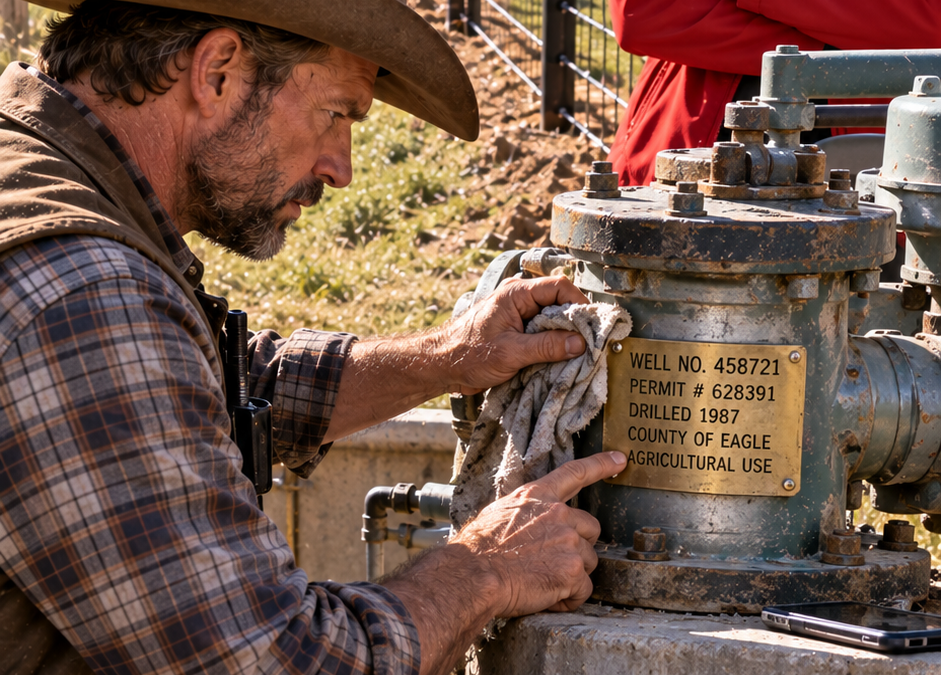
On the steel casing beneath the protective cover was an old brass identification plate darkened by dust and mineral scale.
I wiped it clean with my glove.
Drilling company.
Completion year.
Well depth.
County permit number.
Six digits.
I photographed it carefully.
Karen glanced down.
“What are you doing?”
“Recording the permit.”
“The HOA already has the utility records.”
“Good.”
I took another photo.
“Then this should be easy.”
I photographed the electrical-service identifier next.
Account holder:
Keane Ranch.
Then the faded pump-company maintenance sticker from the previous spring.
Keane Ranch again.
Outside the pump house, the contractor had clipped an engineering plan to a temporary board.
That was where the situation stopped looking accidental.
The drawing labeled the building:
EXISTING HOA IRRIGATION WELL NO. 1
A heavy project line enclosed the pump house inside the new fence.
Another note identified the area as:
HOA CONTROLLED ACCESS ZONE
I stared at it.
This wasn’t a crew guessing wrong.
Somebody had designed the project this way.
Somebody had decided that if they moved the fence far enough, the well became theirs.
I photographed the plan.
Then the title block.
Then the revision date.
Karen folded her arms.
“The association has used that well for almost twenty years.”
“No.”
Her eyebrows rose.
“No?”
“You’ve bought water from it for almost twenty years.”
“That’s semantics.”
I looked back at the brass permit tag.
“No, Karen.”
I slipped my phone into my pocket.
“That might be the most expensive distinction you’ve ever ignored.”
PART2
Canyon Ridge had not existed when my father drilled the well.
In 1987, the land north of us was still mostly open ground.
My father, Walter Keane, ran cattle and grew alfalfa.
The well was designed for exactly that.
Agricultural irrigation.
Livestock support.
Nothing glamorous.
Nothing suburban.
The subdivision came later.
Much later.
The first homes went up nearly twenty years before this dispute.
Then came a second phase.
Then a third.
Streets expanded.
Common landscaping multiplied.
Decorative medians appeared.
The entrance monument grew large enough to suggest Canyon Ridge was guarding a minor European principality instead of three hundred houses.
Their problem was water.
The developer had expected a regional reclaimed-water system to reach the area.
It hadn’t.
My father’s well had excess seasonal capacity.
So in 2006, the developer approached him.
Dad agreed to sell irrigation water.
That was how I remembered it.
Sell water.
Not the land.
Not the well.
Not the pump house.
For years, the arrangement had worked without drama.
Canyon Ridge had a separate branch line.
A meter recorded what they received.
They sent readings.
We invoiced.
They paid.
The original developer eventually transferred control of the subdivision to the HOA.
The HOA continued buying water.
Nobody argued because there was nothing to argue about.
Routine can be dangerous that way.
People stop asking why something works.
They only remember that it does.
After Karen left that morning, I drove back to the ranch office.
Dad’s old metal file cabinet stood against one wall.
He had been obsessive about records.
At the time I thought it was excessive.
Decades later, with an HOA fence surrounding his well, it felt prophetic.
I started with the drilling file.
Permit number.
Same six digits.
Original permit holder:
Walter Keane.
Legal location:
Keane Ranch.
I found the completion report.
Depth.
Casing size.
Static water level.
Pump test.
Then the later county record transferring the permit to me when I took over the ranch.
Current permit holder:
Jonah Keane.
The fence had moved forty feet.
The permit hadn’t.
Then came the electrical records.
The pump had its own service.
Every bill had been paid by the ranch.
Motor replacement.
Keane Ranch.
Pressure-control upgrade.
Keane Ranch.
Casing inspection.
Keane Ranch.
Flow-meter service.
Keane Ranch.
The HOA appeared only in connection with its branch.
That difference was visible not only in the paperwork but in the plumbing.
The well was the source.
The HOA branch was a customer connection.
I kept looking.
Near the bottom of the cabinet sat a brown envelope with Dad’s handwriting across it.
CANYON RIDGE WATER
Inside was the original 2006 agreement.
I put it on the desk.
Read the title.
Then smiled.
METERED IRRIGATION WATER SUPPLY AGREEMENT
Not well transfer.
Not utility conveyance.
Not common-facility dedication.
Water supply.
The agreement identified Keane Ranch as supplier.
The developer as customer.
It established a maximum seasonal quantity.
Metering method.
Rate calculation.
Delivery point.
Responsibility for downstream lines.
Then I reached the clause that changed the whole dispute.
Ownership and operational control of the source well, pump house, electrical system, and production equipment remained with Keane Ranch.
I read it again.
Then a third time.
The next paragraph limited the developer’s rights even further.
No unauthorized modification of the pump.
No increase in production.
No change in operation.
No entry into the pump-house enclosure except under a narrowly defined emergency provision.
That was why the branch meter was outside.
The customer didn’t need to enter my pump house to buy water.
They measured what crossed the delivery point.
Simple.
I leaned back.
The HOA hadn’t inherited a well.
It had inherited a customer account.
There was a difference.
Apparently nobody at Canyon Ridge remembered it.
I went back to the engineering plan I’d photographed.
At the bottom, it referenced an old utility base map revised in 2011.
That sent me into another box.
Eventually I found a reduced copy.
The well appeared.
The line toward Canyon Ridge appeared.
Beside the well:
COMMUNITY IRRIGATION SUPPLY
That phrase was understandable.
The well supplied irrigation water to the community.
But it didn’t say:
COMMUNITY-OWNED WELL.
Somewhere between that 2011 drawing and Karen’s current plan, “community irrigation supply” had transformed into “existing HOA irrigation well.”
One additional word.
HOA.
Amazing how much land one adjective can swallow.
I searched newer documents.
HOA irrigation summaries.
Reserve reports.
Landscape budgets.
Capital plans.
The well kept appearing.
At first as a supply source.
Then as existing infrastructure.
Then as an HOA asset.
One maintenance forecast even included future pump replacement.
Funny.
The HOA had never replaced my pump.
I had.
One engineering memo referred to:
Existing HOA groundwater capacity.
That was when I saw the mistake clearly.
Nobody had necessarily forged an ownership transfer.
They had repeated an assumption.
Somebody found an old map.
Somebody entered the well into an asset schedule.
Someone else relied on the schedule.
A reserve analyst copied it.
An engineer copied that.
A board approved a capital plan based on the engineer.
Karen approved construction based on the capital plan.
By the time somebody physically moved my fence, the same error had been copied enough times to look official.
Ten documents repeating one mistake do not become ten independent facts.
They are still one mistake wearing ten different headers.
I called County Water Resources.
Asked for the complete public well file using the six-digit permit number.
Then ordered current title records for the ranch.
My deed included the pump-house area.
No transfer.
No separate utility parcel.
No common-area deed.
No HOA ownership exception.
Nothing.
Then I noticed something else in Karen’s engineering set.
The fence project was only phase one.
Canyon Ridge planned a major irrigation upgrade.
Additional landscaping zones.
Automated controls.
Higher peak demand.
A future expansion area.
And direct control modifications inside the pump house.
That told me why the fence had suddenly mattered after years of peaceful coexistence.
They weren’t fencing the well because of what it had done.
They were fencing it because of what they wanted it to do.
If Canyon Ridge could classify the well as its own infrastructure, it could design its future landscape system around it.
If the well was actually mine?
Then they had a serious problem.
Their preferred engineering solution depended on an asset they did not control.
Two days later, the county file arrived.
It was larger than expected.
Original permit.
Drilling log.
Completion certificate.
Pump test.
Casing modifications.
Ownership update.
Current permit holder:
Jonah Keane.
Same number on the brass tag.
Authorized use:
Agricultural irrigation and livestock support, subject to the applicable county and state records.
No Canyon Ridge.
No HOA.
No association operator.
Nothing.
I called Marcus Weller.
Marcus handled rural property transactions and water-related agreements.
He was the sort of attorney who could make silence feel like cross-examination.
I spread the documents across his conference table.
He started with the deed.
Then permit.
Then supply agreement.
Then HOA engineering materials.
Twenty minutes passed.
“Three different things,” he finally said.
“What?”
“Land.”
He tapped the deed.
“Permit.”
Tap.
“Contract.”
Tap.
“The HOA is treating all three as one.”
“That’s my reading.”
“Your reading doesn’t matter.”
“Always comforting.”
“The documents do.”
He studied the successor clause in the 2006 agreement.
When the developer transferred relevant common facilities to the HOA, the association inherited the developer’s rights and obligations.
Customer rights.
Customer obligations.
Nothing more.
Marcus looked at me.
“If I buy milk from the same dairy for twenty years, I don’t eventually own the cow.”
“That’s considerably clearer than the contract.”
“I charge more for legal wording.”
Then he found the future-conversion provision.
I had forgotten about it completely.
Dad and the developer had expected Canyon Ridge eventually to secure a permanent non-potable source once regional reclaimed-water service became available.
The ranch well was a bridge.
That clause sent me back through recent utility notices.
A reclaimed-water main had been extended along the highway the previous year.
Not directly to Canyon Ridge.
But close enough that connection had become technically possible.
Expensive.
Very expensive.
Suddenly, Karen’s fence started making more financial sense.
If Canyon Ridge acknowledged my well as a privately owned agricultural source, their long-term choices were limited.
Continue purchasing water under an old agreement with restrictions.
Negotiate a new agreement with me.
Or build the reclaimed-water connection the original developer had always expected.
But if the HOA owned my well?
Then the expensive connection could be avoided.
Modernize the source.
Automate it.
Increase demand.
Treat the groundwater as permanent HOA infrastructure.
The engineering package did exactly that.
Marcus told me to slow down.
“The fence issue and water issue are related, but don’t collapse them.”
“What do you mean?”
“Ownership of the land is one question.”
“Fine.”
“Ownership or control of the well is another.”
“Fine.”
“And whether a proposed change is permitted under water regulation is another.”
“Three problems.”
“Exactly.”
“So I need another professional.”
“Yes.”
That was Lena Ortiz.
Lena was a hydrogeologist who worked with agricultural, municipal, and private water systems.
She came to the ranch carrying equipment instead of opinions.
She inspected the casing.
Pressure tank.
Pump curve.
Branch meter.
Controls.
Delivery records.
Electrical service.
Then she followed the HOA branch downstream.
After almost two hours, she said:
“The physical arrangement is consistent with your contract.”
“Meaning?”
“Your source. Their delivery connection.”
“Good.”
“Don’t celebrate yet.”
Apparently I had hired professionals who enjoyed ruining emotional momentum.
Lena opened the HOA upgrade package.
She studied the projected flow rates.
Control logic.
Landscape demand.
Then frowned.
“This assumes direct HOA control of pumping.”
“That’s what I thought.”
“Their peak demand projection is also above recent purchased volumes.”
“So?”
“So they’re not merely maintaining an old customer relationship. They’re engineering around expanded control.”
“Can they?”
“Not because they moved a fence.”
I laughed.
She didn’t.
“I’m serious, Jonah. Water permits follow their own rules. Ownership of land doesn’t automatically answer every operational question, and changing use or control may require regulatory review.”
“Can Canyon Ridge simply become operator because they call it their well?”
“No.”
Good enough for me.
Marcus kept digging into the HOA records.
Eventually he found something almost comically thin.
An internal asset schedule.
Several years old.
Under irrigation infrastructure:
HOA WELL—HASS
No deed reference.
No permit.
No acquisition date.
No purchase price.
No transfer instrument.
Just one line in a spreadsheet.
That line had apparently metastasized into an entire capital plan.
Marcus placed it beside the permit.
“This is where the assumption hardened.”
I looked at it.
“That?”
“Likely.”
“That’s barely a sentence.”
“Bad records don’t need to be sophisticated.”
We reconstructed the paper trail.
Original developer:
Understood the well was private.
2006 agreement:
Explicit.
2011 utility map:
Well shown as community supply source.
Later cropped map:
Property boundary missing.
Asset spreadsheet:
Well classified as HOA asset.
Reserve report:
Relied on asset spreadsheet.
Engineering database:
Relied on reserve report.
Current capital plan:
Relied on engineering database.
Fence contractor:
Relied on capital plan.
Karen:
Relied on everything downstream.
The farther the documents moved from the original agreement, the more confident they became and the less accurate they were.
That was the irony.
The oldest records were cautious.
The newest were certain.
Marcus sent a formal request asking Canyon Ridge to identify the instrument by which it claimed ownership.
Their response was thick.
Very thick.
Capital schedules.
Maps.
Landscape invoices.
Engineering plans.
Repair records for HOA lines.
Board minutes.
Asset lists.
Not one deed.
Not one permit transfer.
Not one bill of sale.
Not one instrument conveying the pump house.
Not one document transferring production equipment.
Their file proved they had used water from my well for years.
I already knew that.
What it did not prove was that they owned the source.
Karen called after Marcus’s letter arrived.
“You’ve escalated this unnecessarily.”
“You moved my fence.”
“To formalize infrastructure access.”
“To infrastructure you can’t prove you own.”
“We have decades of records.”
“You have decades of customer records.”
Her voice sharpened.
“The HOA has invested heavily in that system.”
“Downstream.”
“That distinction is artificial.”
“Then find the deed.”
Silence.
“Jonah—”
“Find the permit transfer.”
More silence.
“Or a bill of sale.”
Nothing.
“Anything.”
She hung up.
That was the first time she ended a call before I did.
The county response came next.
It confirmed what its files already showed.
I was the current permit holder.
Any material change in operator or permitted use had to follow the appropriate review process.
The county carefully avoided deciding land ownership.
Fine.
It didn’t need to.
My deed did that.
What the county did was eliminate the convenient fantasy that a new fence could turn Canyon Ridge into the permit holder.
The HOA commissioned its own independent review.
That was when I knew the argument was almost finished.
Their consultants started with title.
Pump-house land:
Keane Ranch.
Then historical surveys.
Same conclusion.
Then the 2006 water agreement.
Supplier:
Keane Ranch.
Customer:
Canyon Ridge developer, later HOA successor.
Then the well registry.
Same permit number.
Same location.
Same permit lineage.
Current holder:
Me.
Karen’s new steel fence had absolutely no effect on any of those records.
Their attorney eventually summarized the relationship almost exactly as Marcus had.
The HOA owned its downstream distribution infrastructure.
It had contractual rights to purchase water.
It did not own the source well.
I wish I could say Karen apologized.
She did not.
Instead, she shifted to necessity.
“Regardless of ownership history,” she said during one meeting, “Canyon Ridge has relied on this source for almost two decades.”
That was true.
But reliance and ownership are different things.
The board finally had to price its alternatives.
Option one:
Negotiate a new long-term agreement with me.
I was willing to discuss continued limited supply.
I was not willing to hand the HOA permanent operational control over the ranch well.
That option did not give them the certainty they wanted.
Option two:
Drill their own well.
Possible.
Maybe.
But site limitations, water quality, permitting, treatment, and common-area land made it uncertain.
Option three:
Connect to the regional reclaimed-water network.
That was the expensive one.
The utility district prepared preliminary requirements.
Main extension from the highway.
Directional bore beneath the county road.
Booster station.
Electrical service.
Backflow prevention.
Control system.
Distribution modifications.
Possible balancing storage.
Engineering.
Permits.
Traffic management.
Road restoration.
Contingency.
Temporary supply during construction.
First estimate:
Over one million dollars.
The board demanded alternatives.
Engineers looked.
Then looked again.
A new groundwater source might be cheaper.
Or it might become more expensive after treatment and permitting.
The reclaimed system was predictable.
Expensive, but predictable.
Then more detailed estimates arrived.
$1.3 million.
$1.5 million.
$1.7 million.
Road-bore costs increased.
Controls needed more work.
Pressure-zone modifications grew.
Construction contingency went up.
By the time all phases were included, the capital-planning figure sat just under two million dollars.
Later pricing pushed it close enough that Canyon Ridge’s own documents began referring to:
Approximately $2 million.
That number spread through the neighborhood quickly.
And suddenly everyone cared about six digits stamped onto an old brass plate.
To be clear, nobody owed me two million dollars.
I wasn’t winning some absurd jackpot.
The money was the cost of building infrastructure Canyon Ridge had avoided because its planning system mistakenly treated my private well as an HOA asset.
The permit didn’t cost them $2 million.
Their failure to check it did.
That distinction mattered to me.
Because otherwise the story becomes too simple.
Jonah found magic paperwork.
HOA got punished.
That wasn’t what happened.
Canyon Ridge had a real problem.
It needed reliable long-term irrigation water.
Instead of solving that problem honestly years earlier, the association allowed an old assumption to become embedded in every planning layer.
Then Karen made the worst possible move.
She made the assumption physical.
She moved my fence.
The board created a temporary committee for the water transition.
Major decisions stopped running through Karen alone.
Attorneys reviewed title.
Engineers reviewed source options.
Lena reviewed operational limits.
Meanwhile, the well kept running.
I continued serving my ranch.
And I continued supplying Canyon Ridge the amount it was contractually entitled to receive.
Some neighbors expected me to shut the valve.
I didn’t.
Why punish hundreds of homeowners because their board had made a stupid decision?
Their grass wasn’t my enemy.
My issue was ownership.
Control.
Future use.
Nothing more.
Keeping those things separate protected me too.
It made Karen’s argument harder.
She couldn’t claim I was holding the neighborhood hostage.
I was honoring the contract.
Canyon Ridge was the party trying to change the arrangement.
Then Karen tried a different argument.
She called one afternoon.
“You understand that forcing the association to transition sources could create a substantial financial burden.”
“Forcing?”
“You are refusing to recognize the operational reality.”
“The operational reality is that you buy water.”
“From a source integral to our community.”
“Yes.”
“Which the community has relied on.”
“Yes.”
“Then there is an equitable interest.”
I smiled.
“Did your lawyer tell you to say that?”
Silence.
“Jonah.”
“I’m asking because your lawyer’s written review says you don’t own the well.”
“The board is considering all positions.”
“Good.”
I looked through the ranch-office window toward the pump house.
“Consider this one too. If Canyon Ridge wants to buy something from me, ask.”
“We’ve paid for that infrastructure for years.”
“No. You’ve paid for water.”
“You know what I mean.”
“I know exactly what you mean.”
Pause.
“You wish the invoices said something they don’t.”
She hung up again.
The property settlement came first.
Canyon Ridge agreed to restore the original fence alignment.
The black steel enclosure around the pump house would come out.
Their new access gate would be removed.
Disturbed ground restored.
My professional expenses associated with the encroachment would be reimbursed.
Most importantly, the written agreement stated that Canyon Ridge claimed no ownership in:
The pump house.
Production well.
Source equipment.
Electrical equipment.
Or ranch land surrounding them.
The temporary water arrangement would continue while the reclaimed-water project was built.
But this time every role was defined in painful detail.
Supplier:
Keane Ranch.
Customer:
Canyon Ridge HOA.
Source:
Private ranch well.
Delivery point:
Branch meter.
Maximum quantity:
Defined.
Pump operation:
Ranch controlled.
Term:
Limited.
Expiration:
Linked to completion of Canyon Ridge’s replacement source.
No vague “community asset.”
No “legacy infrastructure.”
No hidden assumptions.
Just words that meant what they said.
The day the HOA fence came down was quieter than I expected.
A contractor arrived at seven.
The gate came off first.
Then black steel sections.
Then posts.
Concrete broke loose from the soil.
I stood near the pump house drinking coffee.
The foreman recognized me.
“Morning.”
“Morning.”
“You want any of these posts?”
“No.”
He grinned.
“Didn’t think so.”
Karen arrived around ten.
Scarlet-red field jacket.
Same one from the first morning.
Perfect.
She stood near the branch meter while an irrigation engineer installed a permanent identification tag.
CANYON RIDGE DELIVERY POINT
The placement told the entire story.
My pump house sat on one side.
Their irrigation line began on the other.
Karen looked at the new tag.
Then at me.
“You seem pleased.”
“I appreciate accurate labels.”
“This could have been handled differently.”
“I agree.”
That surprised her.
“You do?”
“Sure.”
I pointed toward the brass permit tag.
“You could have looked at that before moving my fence.”
Her face tightened.
“I mean with more cooperation.”
“So do I.”
“We had legitimate reasons to believe this was community infrastructure.”
“You had reasons to believe it supplied community infrastructure.”
“That’s exactly the distinction you’ve been exploiting.”
I laughed.
“No, Karen.”
I pointed toward the delivery meter.
“That’s the distinction your developer created.”
She looked away.
“You know homeowners are going to pay for this.”
“I know.”
“And that doesn’t bother you?”
“It does.”
She looked back.
That answer surprised her too.
“I didn’t ask your board to spend two million dollars.”
“No. You’re simply leaving us no alternative.”
I shook my head.
“The alternative was always there.”
“What?”
“The original agreement told you Canyon Ridge was supposed to transition when reclaimed water became available.”
“That was written in 2006.”
“Yes.”
“So?”
“So you delayed an expensive project.”
I looked at the pump house.
“Then somebody decided pretending my well belonged to you was cheaper.”
Her expression hardened.
“That is not what happened.”
“Then show me the transfer.”
She had no answer.
The board approved the reclaimed-water project.
Reserve funds covered part.
Financing covered another portion.
Homeowners received the bad news.
Some were furious.
I didn’t blame them.
Nearly two million dollars is painful.
But at least the final board explanation approached the truth.
Canyon Ridge had historically received irrigation water from a privately owned agricultural source.
Long-term planning had incorrectly treated that source as HOA-owned infrastructure.
The association therefore required a permanent replacement system.
That was accurate enough.
The neighborhood meetings became difficult.
One homeowner asked Karen:
“Did we ever own the well?”
She answered:
“The association had long-standing operational reliance.”
The man repeated:
“Did we own it?”
Another board member finally said:
“No.”
The room went quiet.
That single word probably did more damage to Karen’s authority than anything I said all year.
Another homeowner asked:
“Then why did we move the fence?”
Karen explained access formalization.
Engineering layouts.
Legacy records.
Historical infrastructure.
Eventually a woman in the back interrupted.
“So we moved the fence before confirming the land?”
Nobody answered.
The next question:
“Who approved that?”
This time everyone looked at Karen.
I wasn’t there.
A neighbor sent me the recording.
I listened once.
Then filed it.
The new capital-project policy arrived a month later.
Any project affecting third-party property, utility sources, easements, or recorded rights had to include verified source documents before construction authorization.
Asset schedules had to cite the deed, agreement, bill of sale, easement, permit, or other document supporting ownership.
Engineering drawings could not be treated as title evidence.
Contractors could not relocate property fencing based solely on an internal project layout.
I read that last sentence twice.
Progress often arrives wearing the clothes of obviousness.
Construction began on the reclaimed-water project in early fall.
This time, surveyors came first.
Actual surveyors.
Routes stayed inside property or rights-of-way the project had permission to use.
The directional bore beneath the county road took longer than expected.
The booster station cost more.
There was an underground utility conflict.
Of course there was.
Every capital project eventually discovers geology and reality.
The final forecast remained around the $2 million mark after contingency and transition work.
Some earlier engineering expenses tied to the pump-house upgrade became sunk costs.
Control designs had to be abandoned.
Consultants repeated work.
Schedules slipped.
Every correction added another small amount to the total.
That was what made the outcome satisfying.
There was no punitive judge inventing a giant number.
No cartoon damages award.
The cost came from reality.
The association had planned around an asset it didn’t own.
Reality sent the invoice.
By spring, Canyon Ridge began testing its new system.
Their purchases from the ranch decreased.
For nearly twenty years, I had been accustomed to the branch meter turning during irrigation season.
Now it slowed.
Then slowed again.
Eventually Canyon Ridge’s engineer called.
“We’re ready to transition fully.”
“Thursday?”
“Works for us.”
Thursday morning, Lena joined me.
A Canyon Ridge technician met us at the delivery point.
We recorded the final reading.
Photographed the meter.
Checked the temporary agreement.
Then I closed the valve.
Slowly.
No speech.
No audience.
No revenge.
The branch line went quiet.
For the first time in almost twenty years, the 1987 well served only Keane Ranch.
I stood there with one hand on the valve.
Thinking about Dad.
He had never intended to become the permanent water utility for a subdivision.
He had seen a neighbor with a temporary problem.
He had extra capacity.
He made a deal.
Then twenty years passed.
Temporary relationships have a strange way of becoming permanent assumptions.
People forget the beginning.
They remember only what they’re accustomed to.
Canyon Ridge became accustomed to water.
Then accustomed to the well being nearby.
Then accustomed to seeing it on maps.
Then somebody called it an asset.
Then engineers designed around it.
Then Karen built a fence around it.
That was the moment the misunderstanding crossed from administrative stupidity into my pasture.
The ranch returned to normal faster than the HOA did.
Cattle still required feeding.
A hydraulic hose failed.
The west stock tank developed a leak.
One heifer managed to get her head through a gate that had successfully contained livestock for twelve years.
Cows don’t care about property law.
They’re refreshing that way.
Marcus sent his final invoice.
Lena sent hers.
The HOA reimbursed the agreed professional costs.
I repaired a section of pasture torn up by the fence crew.
Then moved on.
The brass permit plate remained bolted to the well.
I cleaned it once.
Not because it needed cleaning.
Because after everything, I had developed a strange affection for it.
Six digits.
That was it.
No legal language.
No dramatic warning.
Just an identifier.
But those digits connected the physical well to a permanent trail.
Permit.
Completion report.
Owner.
Location.
Authorized use.
Transfer history.
From there came the old supply agreement.
From that came the relationship.
Supplier.
Customer.
That chain broke Canyon Ridge’s assumption.
People love to think big disputes require big evidence.
Sometimes they do.
Sometimes the most important object in the case is a dirty brass tag everybody has walked past for thirty years.
Karen did not survive the next HOA election as president.
There was no recall.
No public humiliation ceremony.
No sheriff.
No dramatic resignation.
She ran.
Someone quieter beat her.
That suited me.
I didn’t need her destroyed.
I needed her unable to repeat the mistake.
The new president, Michael Durant, called me a few weeks after taking office.
“I’d like your opinion on a draft infrastructure-access policy.”
“You understand I’m not a Canyon Ridge member.”
“Very clearly.”
“And don’t plan to become one.”
“Even more clearly.”
“Then why me?”
He paused.
“Because our last access policy cost us nearly two million dollars.”
I laughed.
“Fair.”
I reviewed it.
My suggestion fit on one page.
Before entering third-party land:
Verify ownership.
Verify rights.
Obtain written authorization.
If uncertain, stop.
Apparently the revolutionary governance framework of the twenty-first century was:
Check before taking.
Michael adopted it.
Years passed.
Canyon Ridge’s reclaimed-water system became ordinary.
Sprinklers ran.
Landscaping stayed green.
Nobody cared where the water came from anymore.
That’s usually the fate of expensive infrastructure.
Years of controversy.
Then somebody turns a valve and forgets about it.
My well remained on the ranch.
Same location.
Same gravel.
Same green pump house.
Same permit number.
The restored fence ran where it always had.
One evening after checking cattle, I stopped there.
The sun was dropping behind the western ridge.
Canyon Ridge’s entrance lights had started coming on across the boundary.
Their landscaping sprinklers turned slowly in the distance.
My pump cycled.
A stock tank filled.
Everything was finally serving exactly what it was supposed to serve.
I thought again about the morning Karen moved my fence.
She had been completely certain.
That was what struck me most.
Not angry.
Not nervous.
Certain.
She had an engineering plan.
A capital budget.
An internal asset list.
A board title.
A contractor.
Fresh steel fencing.
From where she stood, authority looked physical.
It looked like posts in concrete.
But ownership doesn’t care how confident you look beside a new fence.
That’s what she never understood.
A fence can move.
Records don’t move with it.
A map can be mislabeled.
A permit doesn’t rewrite itself.
An asset spreadsheet can be wrong.
A contract still says what was actually sold.
Canyon Ridge had purchased water from my family for nearly twenty years.
They had every right to the water we agreed to sell.
They never owned the well.
The difference between those two sentences eventually cost the association close to two million dollars.
Not because I demanded it.
Because once the mistake was corrected, they finally had to build the infrastructure they had postponed.
That is what made the ending so satisfying.
I didn’t take their money.
Reality did.
I reached down and wiped dust from the brass plate.
Six numbers appeared beneath my glove.
The same six numbers I’d photographed before Karen’s contractor could touch anything.
The fence had been moved.
The gate had been moved.
The maps had changed.
The spreadsheets had changed.
The HOA presidency had changed.
But the permit number had stayed exactly where it had been since 1987.
So had the truth behind it.
Karen thought moving a fence forty feet would move ownership with it.
Instead, all she accomplished was putting a nearly $2 million spotlight on the one question nobody at Canyon Ridge had bothered to ask:
Who actually owns the well?








