𝗙𝗨𝗟𝗟 𝗦𝗧𝗢𝗥𝗬 HOA Locked a Security Gate Across My Ranch Road—Then Their Fire Access Plan Proved They Built It in the Wrong Place
𝗣𝗔𝗥𝗧 𝟮
Vanessa recovered quickly.
People who run homeowners associations long enough tend to develop a remarkable ability to treat silence as though it were merely a gap before the next instruction.
“The contractor has the location package,” she said.
“Then I’d like to know what location it identifies.”
“You are not the project manager.”
“No.”
I looked at the steel frame.
“I’m the person whose road you blocked.”
“This road interfaces with Stonebridge property.”
“That is an interesting phrase.”
“It is accurate.”
“So is ‘my ranch road.’”
Vanessa’s jaw tightened.
“You’re being unnecessarily difficult.”
“That’s possible.”
I raised my phone.
“But at least I’m being unnecessarily difficult from the correct side of the gate.”
The installer glanced down.
He was trying not to smile.
Vanessa noticed.
His expression disappeared immediately.
I walked to the western shoulder and photographed the road surface.
Old ranch tire marks.
Wide trailer tracks.
The turnout where feed trucks swung before entering.
Dust pressed into the shoulder from years of equipment.
Everything about the road showed what it had always been.
Working access.
Feed deliveries came through there.
Veterinary trucks.
Stock trailers.
Equipment haulers.
Fuel delivery.
My own pickup several times a day.
The gate would change all of that.
A keypad looks harmless when you imagine residents driving sedans through a subdivision.
It looks less harmless when you imagine a loaded cattle trailer stopping on a curve while somebody leans out the window trying to enter an HOA code he never asked to need.
A remote could fail.
A code could change.
The access list could omit someone.
The power could go out.
An ambulance could arrive.
A hay truck could show up before dawn.
Stonebridge would suddenly control a layer of access between my ranch and the county road.
That was not something I intended to accept because Vanessa owned a nice blazer.
I did not interfere with the crew.
That mattered to me.
The posts were already installed.
The equipment was there.
If the location was wrong, the records needed to prove it.
Shouting would not improve the records.
I photographed the contractor company name.
Project number.
Hardware labels.
Then one last wide shot.
The gate filled the center.
Vanessa stood beyond it.
The site sketch lay open on the folding table.
And farther east, in the background, I could see Stonebridge’s actual service entrance.
That photograph stayed in my mind all evening.
Not because it proved anything.
Because it contained two possible answers in one frame.
The installed gate.
And the entrance that seemed to match the drawing.
The next morning, I returned before the contractor arrived.
Without trucks and people, the geography became clearer.
My ranch road approached from the west, curved gently near a drainage culvert, and joined the county road.
Stonebridge Hills sat east of that point.
Its service entrance also reached toward the county road but curved into the subdivision.
For maybe fifty or sixty yards, depending on where you stood, the two routes looked almost parallel.
Then they separated.
That was probably where the trouble started.
I began taking fixed-reference photographs.
Cedar fence corner.
Drainage culvert.
Utility pole.
Old gravel turnout.
Road curvature.
All things that existed long before Stonebridge bought a security gate.
Back at the ranch office, I searched old photos.
I found one from two years earlier showing a feed truck parked along the lane after blowing a hydraulic hose.
Another showed my stock trailer during a fence repair.
Another had been taken after heavy rain when the road shoulder washed.
None had been taken to prove ownership or access.
Now they documented years of ranch use.
Then I pulled delivery invoices.
Most had written directions.
“NORTH RANCH ENTRANCE.”
“USE WEST ACCESS FROM COUNTY ROAD.”
“WIDE TURN AT CULVERT.”
The road had an operational history independent of Stonebridge.
That did not automatically decide legal rights.
I knew that.
There could be an easement.
Shared access agreement.
Emergency route.
Utility right.
Land carries invisible obligations all the time.
The fastest way to lose a property argument is to assume memory outranks recorded documents.
So I kept two questions separate.
Question one:
Why did the contractor install the gate here?
Question two:
Did Stonebridge have any legal right to control this road?
The first question looked easier.
Around ten that morning, the contractor returned.
This time a supervisor came with them.
Different truck.
Tablet.
Printed folder.
He got out and looked first at the gate.
Then east toward Stonebridge.
Then back at the gate.
That was promising.
Vanessa arrived fifteen minutes later.
Still red blazer.
I began to suspect Stonebridge issued them with the presidency.
She opened a project folder on the contractor truck’s hood.
The supervisor studied a drawing.
Then walked east.
He stood at the Stonebridge service entrance.
Turned around.
Looked back toward the gate across my road.
Then walked back.
Vanessa was talking when he returned.
I could not hear everything.
I did not need to.
The useful part was what did not happen.
Nobody powered the operator.
Nobody entered a code.
Nobody tested the opening sequence.
The gate remained installed but uncommissioned.
Around noon, the supervisor used a measuring wheel.
He measured from the county road to my gate.
Then repeated the measurement at Stonebridge’s service entrance.
One installer followed with the site sketch.
Vanessa stood with her arms folded.
Her posture suggested the contractor’s curiosity was becoming inconvenient.
Good.
I went home and started a file.
GATE INSTALLATION.
Photos.
Dates.
Company.
Project number.
Road-use evidence.
Invoices.
Fixed landmarks.
By late afternoon, I received a call from the contractor supervisor.
“My name’s Aaron Wells.”
“I saw you today.”
“We’re reviewing the field location.”
“I’m glad somebody is.”
“I want to be clear. We’re not making any determination about your property rights.”
“I didn’t ask you to.”
“We installed according to the field package we received.”
“Where does the work order say the gate belongs?”
A pause.
“Stonebridge service and emergency access.”
I leaned back in my chair.
“Does my ranch road appear by name?”
“No.”
“Does the work order identify my property?”
“Not specifically.”
“What happens now?”
“We’re comparing the field packet against the project authorization.”
“Is the gate going live?”
“Not until we resolve the location question.”
That was enough for one day.
The next morning, Aaron emailed me the portion of the contractor file he was allowed to share.
The security project itself was legitimate.
No surprise there.
Stonebridge had ordered:
Steel access gate.
Electric operator.
Keypad.
Protective bollards.
Control cabinet.
Emergency override system.
Equipment specifications matched almost perfectly.
Right gate.
Right hardware.
Potentially wrong location.
The work order described:
HOA-CONTROLLED SERVICE AND EMERGENCY ACCESS POINT NEAR OUTER SUBDIVISION PERIMETER.
My road had never been HOA-controlled.
Stonebridge did not schedule its landscapers through it.
Residents did not use it as an internal road.
The nearby service entrance fit that description much better.
I printed the work order and laid it beside my photographs.
Then the contractor sketch.
Then an aerial image.
The more I looked, the stranger the installation became.
That afternoon, Aaron returned for another review.
Vanessa brought Stonebridge’s own project authorization.
I stayed back.
No reason to turn every document comparison into a hearing.
Aaron walked both routes.
The ranch entrance.
Then the subdivision service entrance.
He compared fence lines.
Shoulder width.
Landscape strip.
Approach direction.
Turning radius.
Several features on the contractor sketch fit the Stonebridge entrance better.
Vanessa argued the wider ranch approach gave better visibility.
I could understand that.
From a security perspective, my entrance was attractive.
Wide.
Direct.
Clear sightline from the county road.
Plenty of turning room.
There was only one inconvenience.
It was mine.
Aaron placed two temporary flags.
One beside the installed gate.
One at the Stonebridge service entrance.
Then photographed them.
The crew left without commissioning anything.
Vanessa left before they did.
The steel still blocked the road physically, though the installer had secured it open enough for me to pass temporarily.
That was not a permanent solution.
But it bought me time.
At the ranch office, I kept returning to one phrase.
SERVICE AND EMERGENCY ACCESS.
If Stonebridge’s development had required a designated emergency entrance, there should be a fire-access drawing.
Fire departments tend to care about things like gate width, turning radius, apparatus clearance, emergency override, and exact location considerably more than HOA security committees care about where a rancher buys feed.
So I requested Stonebridge Hills’ original fire-access approval package.
The document arrived the next day.
That was when the dispute appeared to become simple.
Too simple, as it turned out.
The fire access plan was far more detailed than the contractor’s field sketch.
County road.
Stonebridge service lane.
Required emergency width.
Turning envelope.
Controlled gate location.
Emergency apparatus path.
There was no ambiguity.
The gate symbol sat across Stonebridge’s service entrance.
My ranch road continued west.
Separate.
Distinct.
Untouched.
I oriented the drawing against the terrain.
Landscape strip.
Service-lane curve.
Road angle.
Everything matched.
I called Aaron.
“I found the fire-access plan.”
“Send it.”
Ten minutes later, he called back.
“That’s useful.”
“Useful enough to remove the gate?”
“Useful enough that we’re doing another field review before anybody touches anything.”
The following morning, Aaron came with two installers.
No Vanessa yet.
They started at the Stonebridge service entrance.
Measuring wheel.
Fire plan.
Temporary stake.
Approach geometry.
Then they stepped back toward the county road.
The fit was obvious.
The designated emergency route aligned with the service lane.
The gate symbol aligned with the location Aaron had flagged earlier.
My ranch road did not.
I stood beside my pickup feeling the first real sense of relief since the gate appeared.
Then Vanessa arrived.
She walked directly to the steel gate.
Saw the contractors measuring elsewhere.
And immediately headed toward Aaron’s truck.
He laid the fire plan on the hood.
Vanessa studied it.
Long enough to understand it.
Then she opened her own red project folder.
And that was when the situation became complicated again.
She pulled out a newer document.
Several months after the original fire-access approval, Stonebridge had approved a security retrofit.
The wording did not identify the service entrance as precisely.
Instead, it referred to a “perimeter access control point near the northwest county road approach.”
Aaron checked the date.
Newer than the fire plan.
Vanessa pointed at it.
“This supersedes the original location.”
“Does it?” I asked.
She looked at me.
“It is the later security authorization.”
“That means it is newer. It doesn’t automatically mean it changes the property rights.”
“This was approved by the association.”
“I’m sure the association approves many things.”
“That’s what boards do.”
“Can your board approve a swimming pool in my kitchen?”
She stared.
Aaron coughed into his fist.
I continued.
“I’m asking because I want to understand the limit of the theory.”
Vanessa ignored me and turned back to Aaron.
The security addendum contained a field note.
SHIFT CONTROL POINT OUTWARD TO IMPROVE APPROACH VISIBILITY AND PREVENT BYPASS.
Now the ranch-road location looked less accidental.
Somebody had intentionally wanted the gate farther out.
The contractor may not have wandered onto the wrong road.
The project itself may have been shifted.
That changed everything.
Aaron stopped discussing relocation.
“If the later project formally moved the control point, we need the full change record.”
Vanessa looked pleased.
I did not panic.
A later internal approval did not automatically give Stonebridge ownership of my entrance.
But it meant the fire plan was no longer the final answer.
It became a fixed point in the timeline.
Original emergency route here.
Later security project moves control outward.
Next question:
Who approved that outward move?
And what right did Stonebridge have to put it there?
Vanessa became considerably more confident.
The red blazer regained several horsepower.
She walked the ranch-road gate with Aaron and pointed toward the broad approach.
“Vehicles can bypass the narrow service lane if we don’t control them earlier.”
“Vehicles going to my ranch are supposed to bypass your service lane.”
“That creates a security vulnerability.”
“For you.”
“Yes.”
“That doesn’t make my road yours.”
“We have shared access rights in this corridor.”
That sentence stopped me.
“Show me.”
For once, she did not say the county approved something.
She looked at Stonebridge’s property manager, Denise Harper.
Denise opened an old access file.
Inside was a reference to a recorded agreement dating back to the subdivision’s original development.
Emergency and maintenance access.
Northwest boundary corridor.
I felt the entire argument shift beneath my feet.
This was exactly why I had refused to assume too much from the beginning.
An easement.
Possibly across part of my ranch road.
Vanessa watched my face.
“You see?”
“No.”
I looked at the reference number.
“I see that a document exists.”
“That gives Stonebridge access.”
“Maybe.”
Her eyebrows rose.
“Maybe?”
“Access can mean many things.”
“It is recorded.”
“So is my deed.”
Aaron closed his tablet.
“We’re done for today.”
Vanessa turned.
“Why?”
“Because if there’s a recorded easement, we need the certified document before commissioning or relocation.”
“The project is already installed.”
“And currently disputed.”
He locked the operator cabinet.
“We leave it off.”
For the second time, Stonebridge’s attempt to activate the gate stalled.
This time not because the contractor had clearly chosen the wrong entrance.
Because Vanessa might actually have a legal right near mine.
That evening, I called my attorney, Rachel Moreno.
She listened to everything.
Fire plan.
Security addendum.
Recorded access reference.
Then asked:
“Have you read the easement?”
“Not yet.”
“Then stop having opinions about it.”
“I have one opinion.”
“I’m sure you do.”
“The gate is still irritating.”
“That opinion is legally safe.”
Two days later, the certified agreement arrived.
Old document.
Long legal description.
Survey references.
Bearings.
Distances.
I read it twice before calling Rachel.
Stonebridge did have an easement.
A real one.
Not invented.
Not vague.
Not some HOA memo pretending to be a property right.
The legal description overlapped a narrow strip near the route of my ranch road.
The easement granted Stonebridge non-exclusive rights for three purposes:
Emergency response.
Utility service.
Subdivision maintenance access.
Vanessa had not been relying on nothing.
That mattered.
Rachel came to the ranch the next morning.
We spread the easement across the kitchen table.
She pointed to one phrase.
“Non-exclusive.”
“I noticed.”
“Important.”
“Because I retain use.”
“Yes.”
She moved down.
“Now look at scope.”
Emergency.
Utility.
Maintenance.
“No general security control,” I said.
“Correct.”
“No exclusive access.”
“Correct.”
“No right to decide whether I enter my own ranch.”
“I don’t see one.”
I looked through the window toward the distant gate.
“So can they put the gate there?”
Rachel gave the answer lawyers use when they want their clients to develop patience against their will.
“It depends.”
“I hate that answer.”
“I know.”
“On what?”
“Whether the gate reasonably facilitates their easement without materially interfering with your retained rights.”
“It blocks my road.”
“It would if commissioned as designed.”
“So that seems material.”
“It certainly gives us something to discuss.”
I leaned back.
“The keypad makes my access depend on Stonebridge.”
“Exactly.”
That became the center of the dispute.
Stonebridge had a right to use part of the corridor.
It did not own the corridor.
A non-exclusive easement is not the same thing as possession.
It allows use for specified purposes.
The underlying owner keeps rights too.
The steel frame itself was one issue.
The control system was another.
Once activated, Stonebridge would decide:
Who gets credentials.
When codes change.
Whether remotes work.
Whether access is suspended.
What happens during power failure.
Which vendors are approved.
Which vehicles trigger alarms.
Vanessa’s lawyers could call it security.
From my side of the gate, it looked remarkably like practical control over the entrance to my ranch.
Rachel sent Stonebridge a letter.
Not accusing.
Not threatening.
It acknowledged the easement.
That surprised Vanessa, I later learned.
She had apparently expected us to deny the document entirely.
Instead, Rachel wrote:
Our client recognizes Stonebridge Hills’ recorded non-exclusive access rights for the limited purposes stated in the instrument.
Then:
Those rights do not appear to include exclusive possession or authority to condition the fee owner’s ordinary ranch access upon credentials administered by the HOA.
That sentence became the fight.
Stonebridge scheduled a formal review.
Contractor.
Project manager.
Denise.
HOA counsel.
Vanessa.
Rachel.
Me.
We met at the site.
Vanessa arrived carrying the easement like she had discovered the Magna Carta.
“This document establishes Stonebridge’s right to use the corridor.”
Rachel nodded.
“Yes.”
Vanessa looked almost disappointed.
Then Rachel continued.
“It does not establish a right to control Mason’s use of it.”
“It allows emergency access.”
“Yes.”
“Maintenance access.”
“Yes.”
“Utility access.”
“Yes.”
“So the security gate facilitates those rights.”
Rachel pointed toward the keypad.
“How?”
“It secures the corridor.”
“From whom?”
“Unauthorized vehicles.”
Rachel looked at me.
Then back at Vanessa.
“Is Mason unauthorized?”
“No, but he would have permanent credentials.”
I laughed.
I could not help it.
Vanessa glared.
“What is amusing?”
“You want to give me permission to use my own road.”
“That is not what I said.”
“You said you’d issue me credentials.”
“As an accommodation.”
That made it worse.
Rachel stepped in before I said something expensive.
“Providing credentials does not solve the underlying question.”
The contractor project manager nodded.
That mattered.
He had clearly been thinking the same thing.
“What if the owner’s remote fails?” he asked.
Vanessa turned.
“There would be a manual override.”
“Controlled by whom?”
“Security.”
“What if a feed vendor arrives?”
“They can be issued temporary access.”
I looked at Rachel.
She did not need to say anything.
Vanessa was making our argument for us.
Cattle trailer?
Temporary access.
Veterinarian?
Temporary access.
Fuel delivery?
Temporary access.
Equipment hauler?
Temporary access.
Every ordinary ranch activity would become something Stonebridge could permit.
My road would still technically belong to me.
But daily use would depend on their system.
That was not shared access.
That was hierarchy.
Vanessa tried alternatives.
Gate normally open during daylight.
Closed at night.
Permanent ranch code.
Emergency mechanical release.
Separate remote.
Override key.
Every solution had the same flaw.
Stonebridge would still be operating the control point.
Rachel finally asked the question that ended that part of the discussion.
“Why does the gate need to be here?”
Vanessa pointed toward the county road.
“Visibility. Security. Bypass prevention.”
Rachel held up the fire-access plan.
“You already have a dedicated service and emergency entrance thirty yards east.”
“That entrance is narrower.”
“It is approved.”
“It can be upgraded.”
“Then upgrade it.”
Vanessa’s face tightened.
“That is more expensive.”
And there it was.
Not impossible.
Not unsafe.
More expensive.
The room went quiet.
I looked at the steel gate.
For the first time, the whole project became obvious.
Stonebridge had a legitimate security goal.
It had a legitimate easement.
It had a legitimate emergency-access need.
It also had a nearby entrance it controlled much more directly.
But my wider ranch approach was easier.
Cleaner.
Cheaper.
More convenient.
So the security project had drifted outward until convenience turned into control.
That was what the documents finally exposed.
The fire-access plan showed the original entrance.
The security addendum showed the deliberate shift.
The easement showed Stonebridge’s limited rights.
And the keypad showed how far Vanessa had tried to stretch those rights.
Aaron, the contractor supervisor, asked to speak with his project manager privately.
They walked toward the service entrance.
Measured again.
Discussed bollard placement.
Turning radius.
Operator clearance.
Emergency override.
Then returned.
The project manager looked at Stonebridge’s attorney.
“We can relocate the system to the service entrance.”
Vanessa immediately objected.
“That reduces security.”
“It still controls Stonebridge’s service access.”
“Vehicles approaching the ranch road remain unmonitored.”
I raised a hand.
“That is because vehicles approaching my ranch are not your residents.”
She looked at me.
“They pass adjacent to Stonebridge.”
“So do clouds.”
“Mason.”
“I’m just trying to establish where your jurisdiction ends.”
The HOA attorney closed his binder.
“I think we have enough.”
Vanessa turned toward him.
“We have not agreed to relocation.”
“No.”
He looked at her.
“But the association also does not have a strong basis for conditioning the fee owner’s daily access on an HOA-controlled credential system under this easement language.”
Her face changed.
Small change.
But unmistakable.
For weeks, Vanessa had controlled Stonebridge’s position.
Now Stonebridge’s own attorney had separated himself from her.
That was the moment she started losing the project.
Not when I found the fire plan.
Not when the contractor refused commissioning.
When her lawyer stopped calling her preferred location defensible.
The contractor prepared two scopes.
Scope One:
Remove ranch-road gate installation.
Restore shoulder.
Remove concrete footings.
Repair conduit trench.
Recompact gravel.
Restore turning clearance.
Scope Two:
Reuse gate hardware at Stonebridge service entrance.
New operator foundation.
Keypad relocation.
Emergency fire override.
Updated access geometry.
Vanessa continued arguing for the widest possible security configuration at the Stonebridge entrance.
Fine.
That was her job.
But she stopped arguing that the ranch-road gate had to remain.
That distinction mattered.
Three days later, work began.
I stood near my pickup while the contractor isolated power.
Keypad removed first.
Then control cabinet.
Operator disconnected.
Wiring pulled.
Bollards cut free.
The steel frame remained for another hour.
Then the hinge pins came out.
A small crane lifted the gate.
The entire structure that had appeared across my road like a declaration of authority rose into the air.
Aaron guided it onto the trailer.
I took one photograph.
Only one.
Not because I needed more evidence.
Because some photographs deserve to exist for personal reasons.
Vanessa arrived halfway through removal.
Gray blazer this time.
Apparently the red one had lost jurisdiction.
She stood beside Denise watching the crew.
Neither spoke to me.
I did not speak to them.
There was nothing left to debate.
After the steel left, the real restoration started.
Concrete footings.
Post holes.
Conduit trench.
Compacted shoulder.
The contractor compared everything against the condition photographs I had taken on the first day.
That was why the photographs mattered.
No debate over whether the road had already been damaged.
No debate about original shoulder width.
No debate over where the turnaround gravel had been.
They restored what they had changed.
Stonebridge paid.
Not me.
The contractor moved the equipment thirty yards east.
At the actual Stonebridge service entrance, the gate suddenly made sense.
Keypad aligned naturally with the approach.
Security camera had a clean view.
Emergency lane remained clear.
Residents did not need to use it.
Ranch traffic did not cross it.
The fire-access plan worked.
The security project worked.
And somehow civilization survived without Vanessa controlling my feed deliveries.
A week later, Stonebridge held a board meeting.
I attended because the gate dispute was on the agenda.
Vanessa sat at the front.
Denise beside her.
HOA counsel at one end.
The board reviewed the relocation cost.
Not cheap.
New concrete.
Rewiring.
Restoration.
Labor.
Additional engineering.
Fire-access verification.
Contractor remobilization.
Someone asked how the mistake had happened.
Vanessa spoke first.
“The initial project documents contained overlapping descriptions of the northwest access corridor.”
Technically true.
Beautifully incomplete.
One board member asked:
“Did we verify property rights before choosing the outward location?”
Vanessa paused.
“The association had a recorded easement.”
“That isn’t what I asked.”
I liked him immediately.
Denise answered.
“The later security change relied on the easement corridor but did not obtain a separate legal review regarding installation of HOA-controlled access equipment across the fee owner’s road.”
There it was.
Clean.
Professional.
Painful.
Another board member turned to Vanessa.
“Who approved the outward shift?”
She looked down at the documents.
“The security committee recommended it.”
“You chaired that committee.”
“Yes.”
“And the board relied on your recommendation?”
“With contractor input.”
Aaron was not there to defend himself.
Fortunately, the work order was.
The board member held it up.
“The contractor package seems to have inherited the location from our addendum.”
Vanessa’s voice cooled.
“The location made operational sense.”
“For us.”
“Yes.”
“Not for the ranch.”
Silence.
She did not answer.
The board voted to adopt a new procedure.
Any security project affecting shared or easement corridors required:
Title review.
Current survey overlay.
Fire-access compatibility.
Written legal review of easement scope.
Field verification before drilling.
Notice to underlying landowners.
And no commissioning until all those items were signed off.
It was the kind of procedure people call burdensome right up until they have paid twice to install the same gate.
Then came the final agenda item.
Security project oversight.
Vanessa remained HOA president.
But the board removed unilateral security-project authority from her committee.
Future access-control projects required joint approval from the property manager, counsel, and facilities committee.
No speech.
No public humiliation.
Just a vote.
Five in favor.
One opposed.
Vanessa abstained.
I sat in the back and watched her close the red project folder.
That was satisfying enough.
On the drive home, I stopped at my ranch road.
No gate.
No keypad.
No bollards.
No steel frame.
Just the lane.
Exactly as boring as it had been before.
I had never appreciated boring access so much in my life.
A week later, a feed truck came through.
The driver, Carl, leaned out the window.
“Heard you had a gate here.”
“For a while.”
“What happened?”
“It migrated.”
He looked confused.
“Thirty yards east.”
“Expensive migration?”
“Very.”
He laughed and drove on.
That became the joke around the ranch.
Migratory gate.
Eli painted a tiny steel gate on a scrap board and nailed it inside the equipment shed.
Underneath he wrote:
STONEBRIDGE WILDLIFE — RELOCATED TO NATIVE HABITAT.
I left it there.
The physical problem was solved.
But the fire-access plan stayed on my desk.
I kept returning to it because that document had done something none of the arguments could.
It created a fixed reference.
Before the security retrofit.
Before Vanessa’s committee.
Before contractor confusion.
Before the keypad.
Stonebridge’s official development plan showed its emergency entrance exactly where the relocated gate now stood.
That did not mean plans could never change.
They can.
That was the trap I nearly fell into.
When I first found the fire plan, I wanted it to be the entire answer.
Gate shown there.
Gate installed here.
Therefore obvious mistake.
Life rarely respects such convenient conclusions.
The later addendum was real too.
Stonebridge had deliberately moved the security point outward.
The easement was real.
Stonebridge did possess access rights near my road.
For a few days, the documents seemed to favor Vanessa again.
But that complexity ended up exposing the mistake more clearly.
Because once every document was placed in chronological order, the problem was not mysterious.
Original fire plan:
Stonebridge gate at Stonebridge entrance.
Later security project:
HOA wants control farther outward.
Recorded easement:
Allows Stonebridge certain non-exclusive emergency, maintenance, and utility access.
Vanessa’s solution:
Install HOA-controlled electronic barrier across ranch road.
Problem:
A limited right to use a corridor is not the same as a right to control the landowner’s use of that corridor.
That was it.
Not dramatic.
Not mysterious.
Just one authority stretched farther than the paper supporting it.
I saw Vanessa a few weeks later.
I was filling up at the gas station.
She pulled in on the opposite pump.
For several seconds, neither of us spoke.
Then she looked across.
“You got what you wanted.”
I capped the tank.
“I wanted to reach my ranch without asking your HOA.”
“The security project still went forward.”
“I know.”
“You made it significantly more expensive.”
“No.”
Her expression tightened.
“The gate had to be relocated because of your objection.”
“The gate had to be relocated because you installed it where your easement didn’t give you control.”
“That is your interpretation.”
“It is also where your contractor moved it after your attorney reviewed the documents.”
She stared at me.
I opened my truck door.
Vanessa said:
“The ranch road still falls partly within Stonebridge’s easement.”
“Yes.”
That answer surprised her.
I leaned against the door.
“I’ve never disputed that after reading the document.”
“You acted like Stonebridge had no rights.”
“No. I acted like Stonebridge didn’t have all the rights.”
She said nothing.
“That was the whole problem, Vanessa.”
I got in my truck.
She called after me.
“We were trying to protect the community.”
I looked through the open window.
“I believe you.”
She seemed almost disappointed.
Then I added:
“You just forgot the community ends somewhere.”
I drove away.
That was the closest thing we ever had to a final argument.
The next season brought heavy rain.
The ranch road held.
The contractor’s restoration had been good.
No settling around the old footing locations.
No drainage problem.
Stonebridge’s relocated gate worked too.
I saw maintenance trucks use it.
Emergency vehicles had an override.
Landscapers entered there.
Everything Vanessa originally wanted still existed.
Just on land the HOA actually controlled.
That became the part I found funniest.
All that conflict.
Contractor visits.
Attorney letters.
Fire plans.
Easement research.
Board meetings.
Removal cost.
Restoration.
And after everything was finished, Stonebridge still had its security gate.
Thirty yards away.
Which meant the entire fight had never truly been about whether Stonebridge could protect itself.
It was about whether protecting itself entitled the HOA to control everybody nearby.
The answer was no.
One spring morning, I was hauling cattle toward the north pasture when I came down the ranch road with a loaded trailer.
No stopping.
No keypad.
No remote hanging from the visor.
No access list.
No security guard.
I turned onto the county road and passed Stonebridge’s service entrance.
Their gate was closed.
A maintenance truck rolled up.
Driver entered a code.
Gate opened.
Perfect.
Their entrance.
Their system.
Their rules.
My road.
My access.
My rules.
That simple separation was what had been missing from the beginning.
A few months later, Stonebridge replaced Vanessa as HOA president.
Not because of my gate alone.
There were other board disagreements.
Budget complaints.
Contractor issues.
Normal HOA politics.
I did not attend the election.
I heard about it from Denise.
“Vanessa didn’t run again.”
“That so?”
“Yes.”
“She moving?”
“No.”
“Then I’m sure we’ll continue enjoying each other’s company.”
Denise laughed.
“She still thinks the gate would’ve worked better at your entrance.”
“I’m sure it would have.”
“For Stonebridge.”
“Exactly.”
That distinction followed the whole dispute.
The ranch-road location was objectively better for Stonebridge’s security goal.
Wider approach.
Better visibility.
Earlier control point.
Less bypass risk.
If Stonebridge had owned the road, Vanessa’s decision might have been excellent.
But efficiency does not create ownership.
Convenience does not enlarge an easement.
And an HOA committee cannot vote itself property rights simply because the alternative costs more concrete.
I eventually framed three documents in the ranch office.
Not because I had become sentimental about bureaucracy.
Because together they told the story better than I could.
First:
The original fire-access plan.
Gate symbol at Stonebridge’s service entrance.
Second:
The later security addendum.
Control point shifted outward.
Third:
The recorded easement.
NON-EXCLUSIVE.
LIMITED PURPOSE.
Those three documents were the entire dispute.
A plan.
A change.
A limit.
Whenever someone asks why I took the issue so seriously, I point toward the photographs too.
The steel gate across the lane.
Some people look at it and say:
“You could’ve just taken a remote.”
That always makes me smile.
Yes.
I could have.
I could have accepted a remote.
Accepted a code.
Accepted Stonebridge controlling the operator.
Accepted that my vendors needed temporary access.
Accepted that the HOA could service or replace the system.
Accepted that someday a future board might change procedures.
Accepted that a power failure, equipment fault, policy revision, or overenthusiastic HOA president could stand between a loaded livestock trailer and my own ranch.
I could have accepted all of that.
And perhaps nothing bad would ever have happened.
But property rights do not usually disappear through dramatic seizure.
They erode through convenience.
Just take the remote.
Just use the code.
Just call security.
Just let the HOA administer it.
Just this once.
Just because the gate is already installed.
By the time somebody notices how much control moved, everybody has gotten used to the arrangement.
My grandfather used to say fences are honest because they tell you exactly where the argument is.
Electronic gates are trickier.
The steel might stand in one place.
The control sits somewhere else.
Whoever controls the system controls passage.
That is why the keypad mattered more than the posts.
The posts damaged gravel.
The keypad changed authority.
Stonebridge’s easement let it pass through part of the corridor for certain purposes.
It did not make me a guest at my own ranch entrance.
That was the mistake Vanessa never fully understood.
Or perhaps she understood it perfectly and believed practicality should win.
Either way, the documents did not agree.
One evening, years after the gate dispute, I was sitting on the porch when a Stonebridge resident named Paul stopped by.
I barely knew him.
He had moved into the subdivision after the security project.
He leaned against the porch rail.
“Can I ask you something?”
“Depends.”
“The gate story.”
I sighed.
“You people really need hobbies.”
He laughed.
“I heard Vanessa tried to take your road.”
“That’s the short version and not quite accurate.”
“What’s the accurate version?”
“She tried to install Stonebridge’s access-control system across a corridor where Stonebridge had limited easement rights but not the right to control my access.”
Paul stared.
“That is significantly less exciting.”
“Reality often suffers from legal description.”
“So she wasn’t completely making it up?”
“No.”
“Stonebridge really had an easement?”
“Yes.”
“Then why couldn’t the gate stay?”
“Because having the right to use somebody’s road for limited purposes is not the same as owning the road or controlling everyone else’s passage.”
He nodded slowly.
“Like sharing someone’s driveway doesn’t mean you get to install the lock.”
“Exactly.”
“That sounds obvious.”
“It became obvious after four contractor visits, two attorneys, a fire-access plan, one easement search, and a few thousand dollars of concrete.”
Paul laughed.
“HOAs.”
“People.”
He looked surprised.
“You’re defending them?”
“No.”
I took a drink.
“I’m saying the basic mistake wasn’t uniquely HOA. Somebody had a legitimate limited right and kept stretching it until it became something much larger.”
“That happens a lot.”
“Yes.”
“That’s depressing.”
“Have another beer.”
He did.
The ranch road became invisible again after that.
Which is the highest compliment I can give infrastructure.
Nobody thought about it.
Feed trucks came through.
Cattle trailers left.
Veterinarians arrived.
Delivery drivers got lost occasionally.
Normal life.
Stonebridge’s gate became invisible too.
Exactly where it belonged.
Sometimes, driving past, I saw Vanessa’s old security project operating perfectly.
Steel frame.
Keypad.
Operator.
Bollards.
Same equipment.
Same purpose.
Different location.
That was the final irony.
Nothing about the hardware had ever been wrong.
The gate was not evil.
The contractor was not incompetent.
Even Vanessa’s security goal was not irrational.
The mistake was believing a useful project belonged wherever it worked best for Stonebridge.
The fire-access plan first exposed that mistake.
It showed that Stonebridge already had a specific emergency entrance.
Then the later addendum explained how the project had drifted outward.
Then the easement showed the boundary Vanessa had crossed.
Not a physical boundary.
A legal one.
Stonebridge could use.
Stonebridge could not dominate.
Those are not the same verbs.
And by the end, the HOA paid to learn the difference.
The last time I saw the old installation location being worked on was months later.
County maintenance crews were grading the shoulder.
One worker stopped near the spot where the keypad had once stood.
“You the ranch owner?”
“Yes.”
“Heard there used to be some big gate here.”
“There was.”
“Why’d they remove it?”
“Wrong ecosystem.”
He frowned.
I pointed east.
“Gate migrated.”
He looked toward Stonebridge.
Then laughed.
“You’re the guy.”
“I’m apparently a guy.”
He shook his head and went back to the grader.
I stood there for another minute.
Nothing remained.
No concrete.
No conduit.
No bollards.
Just gravel and dust.
I looked east.
Stonebridge’s gate sat across its own entrance.
Then west.
My road climbed toward the ranch.
No barrier.
If you had arrived that day without knowing the story, you would never guess anything had happened.
That was exactly how I wanted it.
People imagine winning a property dispute means leaving some permanent monument.
A sign.
A court order framed on the wall.
A pile of somebody else’s demolished equipment.
Maybe television cameras.
I wanted the opposite.
I wanted the road to look like it had before Vanessa arrived with a contractor and a folder.
I wanted the mistake erased.
The best evidence that I won was the absence of the thing I had fought.
Years later, I still keep the first photograph on my phone.
Steel gate.
Fresh concrete.
Vanessa in crimson.
Contractor sketch on the folding table.
And in the distance, Stonebridge’s service entrance.
All of it in one frame.
The wrong location.
The right location.
The person defending the first.
The plan eventually pointing toward the second.
When I took that photograph, I had no idea how much paper sat between those two entrances.
Fire plan.
Security addendum.
Easement.
Work order.
Title review.
Board procedure.
I only knew something looked wrong.
That was enough reason to ask.
And asking turned out to matter because Vanessa’s strongest weapon from the beginning was certainty.
The project is approved.
The location is correct.
Stonebridge has rights.
The easement allows access.
The gate improves security.
Every statement contained some truth.
That was why the dispute took work.
The project was approved.
But approval alone did not settle location.
Stonebridge did have rights.
But not exclusive control.
The easement did allow access.
But for limited purposes.
The gate did improve security.
But mostly by controlling a road Stonebridge did not own.
Half-truths are harder to fight than lies because you cannot simply tear them apart.
You have to define their limits.
In the end, that was what the fire-access plan did.
Not by magically deciding the whole case.
It gave us the first clear line.
Stonebridge entrance here.
Ranch road there.
Then every later document had to explain why that line had moved.
The security addendum explained the decision.
The easement defined the maximum authority beneath it.
And once the three were read together, Vanessa’s gate had nowhere left to stand.
That was enough for me.
My ranch did not need Stonebridge’s security.
Stonebridge did not need control of my ranch.
Both could exist.
Both could function.
Both could protect what belonged to them.
All it required was respecting the line between use and ownership.
A line that had been there long before Vanessa’s crimson blazer, long before the keypad, and long before somebody decided a wider approach looked more convenient on a security sketch.
I started the dispute staring at a steel gate across my road.
I ended it driving past that same gate every week.
Thirty yards east.
Across Stonebridge Hills’ actual service entrance.
Where their own fire plan had shown it from the beginning.
And every time I passed it, I remembered the lesson Vanessa had paid an impressive amount of contractor money to learn:
Having permission to cross another man’s road is not the same thing as having permission to lock it.
Have you finished reading the story and want to read it again?
HOA Locked a Security Gate Across My Ranch Road—Then Their Fire Access Plan Proved They Built It in the Wrong Place
They put a steel gate across the only road into my ranch.
The HOA president acted like I needed her permission to reach my own land.
Then one drawing in their own file made everyone stop talking.
I saw the gate before I understood what I was looking at.
I had been coming back from the north pasture in my pickup, moving slowly because the road curved around a cedar fence line before dropping toward the county road, when a strip of dark steel appeared between two posts ahead of me.
At first I assumed Stonebridge Hills was doing more construction.
That would not have surprised me.
For several weeks, contractors had been working around the subdivision’s service entrance near the eastern edge of my ranch. Security cameras had gone up. New lighting had appeared. Utility trucks had come and gone. Stonebridge had apparently decided that a neighborhood protected by stone walls, private landscaping crews, security patrols, cameras, and a decorative fountain roughly the size of a municipal swimming pool remained dangerously exposed to the possibility of somebody driving in without permission.
So I expected construction.
I did not expect the construction to be across my road.
I slowed.
Then stopped.
A heavy steel gate stretched from one newly installed post to another across the full width of the lane I had used for years.
Not beside it.
Across it.
An electric operator had already been mounted.
A keypad pedestal stood near the shoulder where a driver would have to stop, lower a window, enter a code, and wait for the gate to open.
Concrete around the posts was still fresh.
Electrical conduit disappeared into a narrow trench beside the road.
Protective bollards had been installed around the keypad.
This was not temporary equipment.
This was not somebody measuring.
This was a permanent access-control system being built across the primary road to my ranch.
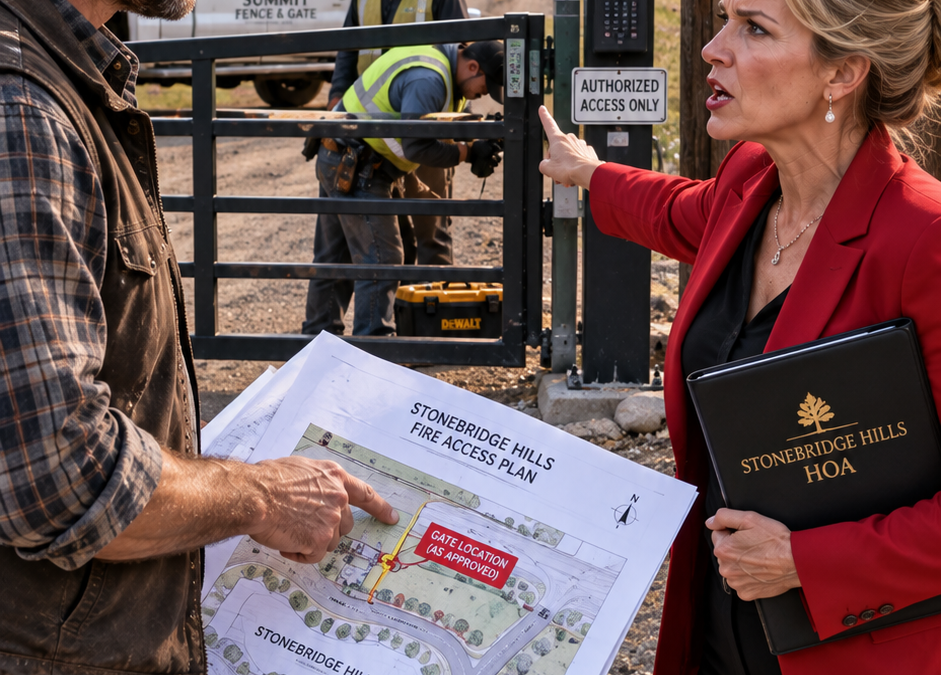
And standing beside the contractor’s utility truck wearing a crimson-red blazer was Vanessa Ror.
Vanessa was president of the Stonebridge Hills HOA.
I knew that because nobody else in the county could stand next to a privately installed security gate with quite the same expression of inherited constitutional authority.
She had one hand resting against a folder.
The other pointed toward the keypad while an installer checked wiring inside the operator cabinet.
Another worker adjusted the hinge assembly.
Nobody looked uncertain.
They were finishing the job.
I parked twenty yards back.
Then I took out my phone.
The first photograph showed the whole gate.
Second photograph: western approach toward my ranch.
Third: eastern approach toward the county road.
Then the posts.
Fresh concrete.
Keypad.
Operator.
Bollards.
Electrical trench.
Contractor truck.
Company name.
Project reference number printed on an equipment case.
I had learned something over the years about land disputes.
People become extremely creative once the concrete dries.
So I prefer photographs before conversations.
Vanessa noticed me.
She watched me photograph the gate.
Then the road.
Then the installer’s folding table.
A laminated site sketch sat on it beside wiring diagrams and hardware boxes.
I did not touch anything.
I zoomed in from where I was standing.
The drawing showed a gate across a short access lane connected to a service road.
Simple.
Not enough detail to settle a property question.
But enough to make me look up.
The orientation felt wrong.
I turned east.
Stonebridge Hills had a service and emergency entrance a short distance away.
My ranch road and that subdivision entrance ran close together near the county road before separating.
From the wrong angle, I could understand how somebody unfamiliar with the site might confuse them.
I looked at the drawing again.
Then the road beneath my boots.
Then the Stonebridge service lane.
That was when a different possibility entered my mind.
Maybe Vanessa had not decided to seize control of my ranch road.
Maybe the contractor had installed the right gate on the wrong road.
Vanessa walked toward me.
“What exactly are you doing?”
“Documenting the installation.”
“This is an HOA security project.”
“I can see that.”
“You do not need to photograph our contractor.”
“I’m photographing a gate across my ranch road.”
Her expression hardened.
“This access point serves Stonebridge Hills.”
“So does the entrance thirty yards east of here.”
“That is not your concern.”
I looked over her shoulder at the installer.
“No. But this gate is.”
She folded her arms.
“The project has been approved.”
“Excellent.”
I pointed toward the contractor’s site sketch.
“Approved where?”
For the first time, Vanessa did not answer immediately.
And that tiny pause interested me far more than the steel gate.
Because if Stonebridge had approved a security gate across my road, I had one kind of problem.
If Stonebridge had approved a gate somewhere else and built it here, Vanessa had a much worse one.
PART2
Vanessa recovered quickly.
People who run homeowners associations long enough tend to develop a remarkable ability to treat silence as though it were merely a gap before the next instruction.
“The contractor has the location package,” she said.
“Then I’d like to know what location it identifies.”
“You are not the project manager.”
“No.”
I looked at the steel frame.
“I’m the person whose road you blocked.”
“This road interfaces with Stonebridge property.”
“That is an interesting phrase.”
“It is accurate.”
“So is ‘my ranch road.’”
Vanessa’s jaw tightened.
“You’re being unnecessarily difficult.”
“That’s possible.”
I raised my phone.
“But at least I’m being unnecessarily difficult from the correct side of the gate.”
The installer glanced down.
He was trying not to smile.
Vanessa noticed.
His expression disappeared immediately.
I walked to the western shoulder and photographed the road surface.
Old ranch tire marks.
Wide trailer tracks.
The turnout where feed trucks swung before entering.
Dust pressed into the shoulder from years of equipment.
Everything about the road showed what it had always been.
Working access.
Feed deliveries came through there.
Veterinary trucks.
Stock trailers.
Equipment haulers.
Fuel delivery.
My own pickup several times a day.
The gate would change all of that.
A keypad looks harmless when you imagine residents driving sedans through a subdivision.
It looks less harmless when you imagine a loaded cattle trailer stopping on a curve while somebody leans out the window trying to enter an HOA code he never asked to need.
A remote could fail.
A code could change.
The access list could omit someone.
The power could go out.
An ambulance could arrive.
A hay truck could show up before dawn.
Stonebridge would suddenly control a layer of access between my ranch and the county road.
That was not something I intended to accept because Vanessa owned a nice blazer.
I did not interfere with the crew.
That mattered to me.
The posts were already installed.
The equipment was there.
If the location was wrong, the records needed to prove it.
Shouting would not improve the records.
I photographed the contractor company name.
Project number.
Hardware labels.
Then one last wide shot.
The gate filled the center.
Vanessa stood beyond it.
The site sketch lay open on the folding table.
And farther east, in the background, I could see Stonebridge’s actual service entrance.
That photograph stayed in my mind all evening.
Not because it proved anything.
Because it contained two possible answers in one frame.
The installed gate.
And the entrance that seemed to match the drawing.
The next morning, I returned before the contractor arrived.
Without trucks and people, the geography became clearer.
My ranch road approached from the west, curved gently near a drainage culvert, and joined the county road.
Stonebridge Hills sat east of that point.
Its service entrance also reached toward the county road but curved into the subdivision.
For maybe fifty or sixty yards, depending on where you stood, the two routes looked almost parallel.
Then they separated.
That was probably where the trouble started.
I began taking fixed-reference photographs.
Cedar fence corner.
Drainage culvert.
Utility pole.
Old gravel turnout.
Road curvature.
All things that existed long before Stonebridge bought a security gate.
Back at the ranch office, I searched old photos.
I found one from two years earlier showing a feed truck parked along the lane after blowing a hydraulic hose.
Another showed my stock trailer during a fence repair.
Another had been taken after heavy rain when the road shoulder washed.
None had been taken to prove ownership or access.
Now they documented years of ranch use.
Then I pulled delivery invoices.
Most had written directions.
“NORTH RANCH ENTRANCE.”
“USE WEST ACCESS FROM COUNTY ROAD.”
“WIDE TURN AT CULVERT.”
The road had an operational history independent of Stonebridge.
That did not automatically decide legal rights.
I knew that.
There could be an easement.
Shared access agreement.
Emergency route.
Utility right.
Land carries invisible obligations all the time.
The fastest way to lose a property argument is to assume memory outranks recorded documents.
So I kept two questions separate.
Question one:
Why did the contractor install the gate here?
Question two:
Did Stonebridge have any legal right to control this road?
The first question looked easier.
Around ten that morning, the contractor returned.
This time a supervisor came with them.
Different truck.
Tablet.
Printed folder.
He got out and looked first at the gate.
Then east toward Stonebridge.
Then back at the gate.
That was promising.
Vanessa arrived fifteen minutes later.
Still red blazer.
I began to suspect Stonebridge issued them with the presidency.
She opened a project folder on the contractor truck’s hood.
The supervisor studied a drawing.
Then walked east.
He stood at the Stonebridge service entrance.
Turned around.
Looked back toward the gate across my road.
Then walked back.
Vanessa was talking when he returned.
I could not hear everything.
I did not need to.
The useful part was what did not happen.
Nobody powered the operator.
Nobody entered a code.
Nobody tested the opening sequence.
The gate remained installed but uncommissioned.
Around noon, the supervisor used a measuring wheel.
He measured from the county road to my gate.
Then repeated the measurement at Stonebridge’s service entrance.
One installer followed with the site sketch.
Vanessa stood with her arms folded.
Her posture suggested the contractor’s curiosity was becoming inconvenient.
Good.
I went home and started a file.
GATE INSTALLATION.
Photos.
Dates.
Company.
Project number.
Road-use evidence.
Invoices.
Fixed landmarks.
By late afternoon, I received a call from the contractor supervisor.
“My name’s Aaron Wells.”
“I saw you today.”
“We’re reviewing the field location.”
“I’m glad somebody is.”
“I want to be clear. We’re not making any determination about your property rights.”
“I didn’t ask you to.”
“We installed according to the field package we received.”
“Where does the work order say the gate belongs?”
A pause.
“Stonebridge service and emergency access.”
I leaned back in my chair.
“Does my ranch road appear by name?”
“No.”
“Does the work order identify my property?”
“Not specifically.”
“What happens now?”
“We’re comparing the field packet against the project authorization.”
“Is the gate going live?”
“Not until we resolve the location question.”
That was enough for one day.
The next morning, Aaron emailed me the portion of the contractor file he was allowed to share.
The security project itself was legitimate.
No surprise there.
Stonebridge had ordered:
Steel access gate.
Electric operator.
Keypad.
Protective bollards.
Control cabinet.
Emergency override system.
Equipment specifications matched almost perfectly.
Right gate.
Right hardware.
Potentially wrong location.
The work order described:
HOA-CONTROLLED SERVICE AND EMERGENCY ACCESS POINT NEAR OUTER SUBDIVISION PERIMETER.
My road had never been HOA-controlled.
Stonebridge did not schedule its landscapers through it.
Residents did not use it as an internal road.
The nearby service entrance fit that description much better.
I printed the work order and laid it beside my photographs.
Then the contractor sketch.
Then an aerial image.
The more I looked, the stranger the installation became.
That afternoon, Aaron returned for another review.
Vanessa brought Stonebridge’s own project authorization.
I stayed back.
No reason to turn every document comparison into a hearing.
Aaron walked both routes.
The ranch entrance.
Then the subdivision service entrance.
He compared fence lines.
Shoulder width.
Landscape strip.
Approach direction.
Turning radius.
Several features on the contractor sketch fit the Stonebridge entrance better.
Vanessa argued the wider ranch approach gave better visibility.
I could understand that.
From a security perspective, my entrance was attractive.
Wide.
Direct.
Clear sightline from the county road.
Plenty of turning room.
There was only one inconvenience.
It was mine.
Aaron placed two temporary flags.
One beside the installed gate.
One at the Stonebridge service entrance.
Then photographed them.
The crew left without commissioning anything.
Vanessa left before they did.
The steel still blocked the road physically, though the installer had secured it open enough for me to pass temporarily.
That was not a permanent solution.
But it bought me time.
At the ranch office, I kept returning to one phrase.
SERVICE AND EMERGENCY ACCESS.
If Stonebridge’s development had required a designated emergency entrance, there should be a fire-access drawing.
Fire departments tend to care about things like gate width, turning radius, apparatus clearance, emergency override, and exact location considerably more than HOA security committees care about where a rancher buys feed.
So I requested Stonebridge Hills’ original fire-access approval package.
The document arrived the next day.
That was when the dispute appeared to become simple.
Too simple, as it turned out.
The fire access plan was far more detailed than the contractor’s field sketch.
County road.
Stonebridge service lane.
Required emergency width.
Turning envelope.
Controlled gate location.
Emergency apparatus path.
There was no ambiguity.
The gate symbol sat across Stonebridge’s service entrance.
My ranch road continued west.
Separate.
Distinct.
Untouched.
I oriented the drawing against the terrain.
Landscape strip.
Service-lane curve.
Road angle.
Everything matched.
I called Aaron.
“I found the fire-access plan.”
“Send it.”
Ten minutes later, he called back.
“That’s useful.”
“Useful enough to remove the gate?”
“Useful enough that we’re doing another field review before anybody touches anything.”
The following morning, Aaron came with two installers.
No Vanessa yet.
They started at the Stonebridge service entrance.
Measuring wheel.
Fire plan.
Temporary stake.
Approach geometry.
Then they stepped back toward the county road.
The fit was obvious.
The designated emergency route aligned with the service lane.
The gate symbol aligned with the location Aaron had flagged earlier.
My ranch road did not.
I stood beside my pickup feeling the first real sense of relief since the gate appeared.
Then Vanessa arrived.
She walked directly to the steel gate.
Saw the contractors measuring elsewhere.
And immediately headed toward Aaron’s truck.
He laid the fire plan on the hood.
Vanessa studied it.
Long enough to understand it.
Then she opened her own red project folder.
And that was when the situation became complicated again.
She pulled out a newer document.
Several months after the original fire-access approval, Stonebridge had approved a security retrofit.
The wording did not identify the service entrance as precisely.
Instead, it referred to a “perimeter access control point near the northwest county road approach.”
Aaron checked the date.
Newer than the fire plan.
Vanessa pointed at it.
“This supersedes the original location.”
“Does it?” I asked.
She looked at me.
“It is the later security authorization.”
“That means it is newer. It doesn’t automatically mean it changes the property rights.”
“This was approved by the association.”
“I’m sure the association approves many things.”
“That’s what boards do.”
“Can your board approve a swimming pool in my kitchen?”
She stared.
Aaron coughed into his fist.
I continued.
“I’m asking because I want to understand the limit of the theory.”
Vanessa ignored me and turned back to Aaron.
The security addendum contained a field note.
SHIFT CONTROL POINT OUTWARD TO IMPROVE APPROACH VISIBILITY AND PREVENT BYPASS.
Now the ranch-road location looked less accidental.
Somebody had intentionally wanted the gate farther out.
The contractor may not have wandered onto the wrong road.
The project itself may have been shifted.
That changed everything.
Aaron stopped discussing relocation.
“If the later project formally moved the control point, we need the full change record.”
Vanessa looked pleased.
I did not panic.
A later internal approval did not automatically give Stonebridge ownership of my entrance.
But it meant the fire plan was no longer the final answer.
It became a fixed point in the timeline.
Original emergency route here.
Later security project moves control outward.
Next question:
Who approved that outward move?
And what right did Stonebridge have to put it there?
Vanessa became considerably more confident.
The red blazer regained several horsepower.
She walked the ranch-road gate with Aaron and pointed toward the broad approach.
“Vehicles can bypass the narrow service lane if we don’t control them earlier.”
“Vehicles going to my ranch are supposed to bypass your service lane.”
“That creates a security vulnerability.”
“For you.”
“Yes.”
“That doesn’t make my road yours.”
“We have shared access rights in this corridor.”
That sentence stopped me.
“Show me.”
For once, she did not say the county approved something.
She looked at Stonebridge’s property manager, Denise Harper.
Denise opened an old access file.
Inside was a reference to a recorded agreement dating back to the subdivision’s original development.
Emergency and maintenance access.
Northwest boundary corridor.
I felt the entire argument shift beneath my feet.
This was exactly why I had refused to assume too much from the beginning.
An easement.
Possibly across part of my ranch road.
Vanessa watched my face.
“You see?”
“No.”
I looked at the reference number.
“I see that a document exists.”
“That gives Stonebridge access.”
“Maybe.”
Her eyebrows rose.
“Maybe?”
“Access can mean many things.”
“It is recorded.”
“So is my deed.”
Aaron closed his tablet.
“We’re done for today.”
Vanessa turned.
“Why?”
“Because if there’s a recorded easement, we need the certified document before commissioning or relocation.”
“The project is already installed.”
“And currently disputed.”
He locked the operator cabinet.
“We leave it off.”
For the second time, Stonebridge’s attempt to activate the gate stalled.
This time not because the contractor had clearly chosen the wrong entrance.
Because Vanessa might actually have a legal right near mine.
That evening, I called my attorney, Rachel Moreno.
She listened to everything.
Fire plan.
Security addendum.
Recorded access reference.
Then asked:
“Have you read the easement?”
“Not yet.”
“Then stop having opinions about it.”
“I have one opinion.”
“I’m sure you do.”
“The gate is still irritating.”
“That opinion is legally safe.”
Two days later, the certified agreement arrived.
Old document.
Long legal description.
Survey references.
Bearings.
Distances.
I read it twice before calling Rachel.
Stonebridge did have an easement.
A real one.
Not invented.
Not vague.
Not some HOA memo pretending to be a property right.
The legal description overlapped a narrow strip near the route of my ranch road.
The easement granted Stonebridge non-exclusive rights for three purposes:
Emergency response.
Utility service.
Subdivision maintenance access.
Vanessa had not been relying on nothing.
That mattered.
Rachel came to the ranch the next morning.
We spread the easement across the kitchen table.
She pointed to one phrase.
“Non-exclusive.”
“I noticed.”
“Important.”
“Because I retain use.”
“Yes.”
She moved down.
“Now look at scope.”
Emergency.
Utility.
Maintenance.
“No general security control,” I said.
“Correct.”
“No exclusive access.”
“Correct.”
“No right to decide whether I enter my own ranch.”
“I don’t see one.”
I looked through the window toward the distant gate.
“So can they put the gate there?”
Rachel gave the answer lawyers use when they want their clients to develop patience against their will.
“It depends.”
“I hate that answer.”
“I know.”
“On what?”
“Whether the gate reasonably facilitates their easement without materially interfering with your retained rights.”
“It blocks my road.”
“It would if commissioned as designed.”
“So that seems material.”
“It certainly gives us something to discuss.”
I leaned back.
“The keypad makes my access depend on Stonebridge.”
“Exactly.”
That became the center of the dispute.
Stonebridge had a right to use part of the corridor.
It did not own the corridor.
A non-exclusive easement is not the same thing as possession.
It allows use for specified purposes.
The underlying owner keeps rights too.
The steel frame itself was one issue.
The control system was another.
Once activated, Stonebridge would decide:
Who gets credentials.
When codes change.
Whether remotes work.
Whether access is suspended.
What happens during power failure.
Which vendors are approved.
Which vehicles trigger alarms.
Vanessa’s lawyers could call it security.
From my side of the gate, it looked remarkably like practical control over the entrance to my ranch.
Rachel sent Stonebridge a letter.
Not accusing.
Not threatening.
It acknowledged the easement.
That surprised Vanessa, I later learned.
She had apparently expected us to deny the document entirely.
Instead, Rachel wrote:
Our client recognizes Stonebridge Hills’ recorded non-exclusive access rights for the limited purposes stated in the instrument.
Then:
Those rights do not appear to include exclusive possession or authority to condition the fee owner’s ordinary ranch access upon credentials administered by the HOA.
That sentence became the fight.
Stonebridge scheduled a formal review.
Contractor.
Project manager.
Denise.
HOA counsel.
Vanessa.
Rachel.
Me.
We met at the site.
Vanessa arrived carrying the easement like she had discovered the Magna Carta.
“This document establishes Stonebridge’s right to use the corridor.”
Rachel nodded.
“Yes.”
Vanessa looked almost disappointed.
Then Rachel continued.
“It does not establish a right to control Mason’s use of it.”
“It allows emergency access.”
“Yes.”
“Maintenance access.”
“Yes.”
“Utility access.”
“Yes.”
“So the security gate facilitates those rights.”
Rachel pointed toward the keypad.
“How?”
“It secures the corridor.”
“From whom?”
“Unauthorized vehicles.”
Rachel looked at me.
Then back at Vanessa.
“Is Mason unauthorized?”
“No, but he would have permanent credentials.”
I laughed.
I could not help it.
Vanessa glared.
“What is amusing?”
“You want to give me permission to use my own road.”
“That is not what I said.”
“You said you’d issue me credentials.”
“As an accommodation.”
That made it worse.
Rachel stepped in before I said something expensive.
“Providing credentials does not solve the underlying question.”
The contractor project manager nodded.
That mattered.
He had clearly been thinking the same thing.
“What if the owner’s remote fails?” he asked.
Vanessa turned.
“There would be a manual override.”
“Controlled by whom?”
“Security.”
“What if a feed vendor arrives?”
“They can be issued temporary access.”
I looked at Rachel.
She did not need to say anything.
Vanessa was making our argument for us.
Cattle trailer?
Temporary access.
Veterinarian?
Temporary access.
Fuel delivery?
Temporary access.
Equipment hauler?
Temporary access.
Every ordinary ranch activity would become something Stonebridge could permit.
My road would still technically belong to me.
But daily use would depend on their system.
That was not shared access.
That was hierarchy.
Vanessa tried alternatives.
Gate normally open during daylight.
Closed at night.
Permanent ranch code.
Emergency mechanical release.
Separate remote.
Override key.
Every solution had the same flaw.
Stonebridge would still be operating the control point.
Rachel finally asked the question that ended that part of the discussion.
“Why does the gate need to be here?”
Vanessa pointed toward the county road.
“Visibility. Security. Bypass prevention.”
Rachel held up the fire-access plan.
“You already have a dedicated service and emergency entrance thirty yards east.”
“That entrance is narrower.”
“It is approved.”
“It can be upgraded.”
“Then upgrade it.”
Vanessa’s face tightened.
“That is more expensive.”
And there it was.
Not impossible.
Not unsafe.
More expensive.
The room went quiet.
I looked at the steel gate.
For the first time, the whole project became obvious.
Stonebridge had a legitimate security goal.
It had a legitimate easement.
It had a legitimate emergency-access need.
It also had a nearby entrance it controlled much more directly.
But my wider ranch approach was easier.
Cleaner.
Cheaper.
More convenient.
So the security project had drifted outward until convenience turned into control.
That was what the documents finally exposed.
The fire-access plan showed the original entrance.
The security addendum showed the deliberate shift.
The easement showed Stonebridge’s limited rights.
And the keypad showed how far Vanessa had tried to stretch those rights.
Aaron, the contractor supervisor, asked to speak with his project manager privately.
They walked toward the service entrance.
Measured again.
Discussed bollard placement.
Turning radius.
Operator clearance.
Emergency override.
Then returned.
The project manager looked at Stonebridge’s attorney.
“We can relocate the system to the service entrance.”
Vanessa immediately objected.
“That reduces security.”
“It still controls Stonebridge’s service access.”
“Vehicles approaching the ranch road remain unmonitored.”
I raised a hand.
“That is because vehicles approaching my ranch are not your residents.”
She looked at me.
“They pass adjacent to Stonebridge.”
“So do clouds.”
“Mason.”
“I’m just trying to establish where your jurisdiction ends.”
The HOA attorney closed his binder.
“I think we have enough.”
Vanessa turned toward him.
“We have not agreed to relocation.”
“No.”
He looked at her.
“But the association also does not have a strong basis for conditioning the fee owner’s daily access on an HOA-controlled credential system under this easement language.”
Her face changed.
Small change.
But unmistakable.
For weeks, Vanessa had controlled Stonebridge’s position.
Now Stonebridge’s own attorney had separated himself from her.
That was the moment she started losing the project.
Not when I found the fire plan.
Not when the contractor refused commissioning.
When her lawyer stopped calling her preferred location defensible.
The contractor prepared two scopes.
Scope One:
Remove ranch-road gate installation.
Restore shoulder.
Remove concrete footings.
Repair conduit trench.
Recompact gravel.
Restore turning clearance.
Scope Two:
Reuse gate hardware at Stonebridge service entrance.
New operator foundation.
Keypad relocation.
Emergency fire override.
Updated access geometry.
Vanessa continued arguing for the widest possible security configuration at the Stonebridge entrance.
Fine.
That was her job.
But she stopped arguing that the ranch-road gate had to remain.
That distinction mattered.
Three days later, work began.
I stood near my pickup while the contractor isolated power.
Keypad removed first.
Then control cabinet.
Operator disconnected.
Wiring pulled.
Bollards cut free.
The steel frame remained for another hour.
Then the hinge pins came out.
A small crane lifted the gate.
The entire structure that had appeared across my road like a declaration of authority rose into the air.
Aaron guided it onto the trailer.
I took one photograph.
Only one.
Not because I needed more evidence.
Because some photographs deserve to exist for personal reasons.
Vanessa arrived halfway through removal.
Gray blazer this time.
Apparently the red one had lost jurisdiction.
She stood beside Denise watching the crew.
Neither spoke to me.
I did not speak to them.
There was nothing left to debate.
After the steel left, the real restoration started.
Concrete footings.
Post holes.
Conduit trench.
Compacted shoulder.
The contractor compared everything against the condition photographs I had taken on the first day.
That was why the photographs mattered.
No debate over whether the road had already been damaged.
No debate about original shoulder width.
No debate over where the turnaround gravel had been.
They restored what they had changed.
Stonebridge paid.
Not me.
The contractor moved the equipment thirty yards east.
At the actual Stonebridge service entrance, the gate suddenly made sense.
Keypad aligned naturally with the approach.
Security camera had a clean view.
Emergency lane remained clear.
Residents did not need to use it.
Ranch traffic did not cross it.
The fire-access plan worked.
The security project worked.
And somehow civilization survived without Vanessa controlling my feed deliveries.
A week later, Stonebridge held a board meeting.
I attended because the gate dispute was on the agenda.
Vanessa sat at the front.
Denise beside her.
HOA counsel at one end.
The board reviewed the relocation cost.
Not cheap.
New concrete.
Rewiring.
Restoration.
Labor.
Additional engineering.
Fire-access verification.
Contractor remobilization.
Someone asked how the mistake had happened.
Vanessa spoke first.
“The initial project documents contained overlapping descriptions of the northwest access corridor.”
Technically true.
Beautifully incomplete.
One board member asked:
“Did we verify property rights before choosing the outward location?”
Vanessa paused.
“The association had a recorded easement.”
“That isn’t what I asked.”
I liked him immediately.
Denise answered.
“The later security change relied on the easement corridor but did not obtain a separate legal review regarding installation of HOA-controlled access equipment across the fee owner’s road.”
There it was.
Clean.
Professional.
Painful.
Another board member turned to Vanessa.
“Who approved the outward shift?”
She looked down at the documents.
“The security committee recommended it.”
“You chaired that committee.”
“Yes.”
“And the board relied on your recommendation?”
“With contractor input.”
Aaron was not there to defend himself.
Fortunately, the work order was.
The board member held it up.
“The contractor package seems to have inherited the location from our addendum.”
Vanessa’s voice cooled.
“The location made operational sense.”
“For us.”
“Yes.”
“Not for the ranch.”
Silence.
She did not answer.
The board voted to adopt a new procedure.
Any security project affecting shared or easement corridors required:
Title review.
Current survey overlay.
Fire-access compatibility.
Written legal review of easement scope.
Field verification before drilling.
Notice to underlying landowners.
And no commissioning until all those items were signed off.
It was the kind of procedure people call burdensome right up until they have paid twice to install the same gate.
Then came the final agenda item.
Security project oversight.
Vanessa remained HOA president.
But the board removed unilateral security-project authority from her committee.
Future access-control projects required joint approval from the property manager, counsel, and facilities committee.
No speech.
No public humiliation.
Just a vote.
Five in favor.
One opposed.
Vanessa abstained.
I sat in the back and watched her close the red project folder.
That was satisfying enough.
On the drive home, I stopped at my ranch road.
No gate.
No keypad.
No bollards.
No steel frame.
Just the lane.
Exactly as boring as it had been before.
I had never appreciated boring access so much in my life.
A week later, a feed truck came through.
The driver, Carl, leaned out the window.
“Heard you had a gate here.”
“For a while.”
“What happened?”
“It migrated.”
He looked confused.
“Thirty yards east.”
“Expensive migration?”
“Very.”
He laughed and drove on.
That became the joke around the ranch.
Migratory gate.
Eli painted a tiny steel gate on a scrap board and nailed it inside the equipment shed.
Underneath he wrote:
STONEBRIDGE WILDLIFE — RELOCATED TO NATIVE HABITAT.
I left it there.
The physical problem was solved.
But the fire-access plan stayed on my desk.
I kept returning to it because that document had done something none of the arguments could.
It created a fixed reference.
Before the security retrofit.
Before Vanessa’s committee.
Before contractor confusion.
Before the keypad.
Stonebridge’s official development plan showed its emergency entrance exactly where the relocated gate now stood.
That did not mean plans could never change.
They can.
That was the trap I nearly fell into.
When I first found the fire plan, I wanted it to be the entire answer.
Gate shown there.
Gate installed here.
Therefore obvious mistake.
Life rarely respects such convenient conclusions.
The later addendum was real too.
Stonebridge had deliberately moved the security point outward.
The easement was real.
Stonebridge did possess access rights near my road.
For a few days, the documents seemed to favor Vanessa again.
But that complexity ended up exposing the mistake more clearly.
Because once every document was placed in chronological order, the problem was not mysterious.
Original fire plan:
Stonebridge gate at Stonebridge entrance.
Later security project:
HOA wants control farther outward.
Recorded easement:
Allows Stonebridge certain non-exclusive emergency, maintenance, and utility access.
Vanessa’s solution:
Install HOA-controlled electronic barrier across ranch road.
Problem:
A limited right to use a corridor is not the same as a right to control the landowner’s use of that corridor.
That was it.
Not dramatic.
Not mysterious.
Just one authority stretched farther than the paper supporting it.
I saw Vanessa a few weeks later.
I was filling up at the gas station.
She pulled in on the opposite pump.
For several seconds, neither of us spoke.
Then she looked across.
“You got what you wanted.”
I capped the tank.
“I wanted to reach my ranch without asking your HOA.”
“The security project still went forward.”
“I know.”
“You made it significantly more expensive.”
“No.”
Her expression tightened.
“The gate had to be relocated because of your objection.”
“The gate had to be relocated because you installed it where your easement didn’t give you control.”
“That is your interpretation.”
“It is also where your contractor moved it after your attorney reviewed the documents.”
She stared at me.
I opened my truck door.
Vanessa said:
“The ranch road still falls partly within Stonebridge’s easement.”
“Yes.”
That answer surprised her.
I leaned against the door.
“I’ve never disputed that after reading the document.”
“You acted like Stonebridge had no rights.”
“No. I acted like Stonebridge didn’t have all the rights.”
She said nothing.
“That was the whole problem, Vanessa.”
I got in my truck.
She called after me.
“We were trying to protect the community.”
I looked through the open window.
“I believe you.”
She seemed almost disappointed.
Then I added:
“You just forgot the community ends somewhere.”
I drove away.
That was the closest thing we ever had to a final argument.
The next season brought heavy rain.
The ranch road held.
The contractor’s restoration had been good.
No settling around the old footing locations.
No drainage problem.
Stonebridge’s relocated gate worked too.
I saw maintenance trucks use it.
Emergency vehicles had an override.
Landscapers entered there.
Everything Vanessa originally wanted still existed.
Just on land the HOA actually controlled.
That became the part I found funniest.
All that conflict.
Contractor visits.
Attorney letters.
Fire plans.
Easement research.
Board meetings.
Removal cost.
Restoration.
And after everything was finished, Stonebridge still had its security gate.
Thirty yards away.
Which meant the entire fight had never truly been about whether Stonebridge could protect itself.
It was about whether protecting itself entitled the HOA to control everybody nearby.
The answer was no.
One spring morning, I was hauling cattle toward the north pasture when I came down the ranch road with a loaded trailer.
No stopping.
No keypad.
No remote hanging from the visor.
No access list.
No security guard.
I turned onto the county road and passed Stonebridge’s service entrance.
Their gate was closed.
A maintenance truck rolled up.
Driver entered a code.
Gate opened.
Perfect.
Their entrance.
Their system.
Their rules.
My road.
My access.
My rules.
That simple separation was what had been missing from the beginning.
A few months later, Stonebridge replaced Vanessa as HOA president.
Not because of my gate alone.
There were other board disagreements.
Budget complaints.
Contractor issues.
Normal HOA politics.
I did not attend the election.
I heard about it from Denise.
“Vanessa didn’t run again.”
“That so?”
“Yes.”
“She moving?”
“No.”
“Then I’m sure we’ll continue enjoying each other’s company.”
Denise laughed.
“She still thinks the gate would’ve worked better at your entrance.”
“I’m sure it would have.”
“For Stonebridge.”
“Exactly.”
That distinction followed the whole dispute.
The ranch-road location was objectively better for Stonebridge’s security goal.
Wider approach.
Better visibility.
Earlier control point.
Less bypass risk.
If Stonebridge had owned the road, Vanessa’s decision might have been excellent.
But efficiency does not create ownership.
Convenience does not enlarge an easement.
And an HOA committee cannot vote itself property rights simply because the alternative costs more concrete.
I eventually framed three documents in the ranch office.
Not because I had become sentimental about bureaucracy.
Because together they told the story better than I could.
First:
The original fire-access plan.
Gate symbol at Stonebridge’s service entrance.
Second:
The later security addendum.
Control point shifted outward.
Third:
The recorded easement.
NON-EXCLUSIVE.
LIMITED PURPOSE.
Those three documents were the entire dispute.
A plan.
A change.
A limit.
Whenever someone asks why I took the issue so seriously, I point toward the photographs too.
The steel gate across the lane.
Some people look at it and say:
“You could’ve just taken a remote.”
That always makes me smile.
Yes.
I could have.
I could have accepted a remote.
Accepted a code.
Accepted Stonebridge controlling the operator.
Accepted that my vendors needed temporary access.
Accepted that the HOA could service or replace the system.
Accepted that someday a future board might change procedures.
Accepted that a power failure, equipment fault, policy revision, or overenthusiastic HOA president could stand between a loaded livestock trailer and my own ranch.
I could have accepted all of that.
And perhaps nothing bad would ever have happened.
But property rights do not usually disappear through dramatic seizure.
They erode through convenience.
Just take the remote.
Just use the code.
Just call security.
Just let the HOA administer it.
Just this once.
Just because the gate is already installed.
By the time somebody notices how much control moved, everybody has gotten used to the arrangement.
My grandfather used to say fences are honest because they tell you exactly where the argument is.
Electronic gates are trickier.
The steel might stand in one place.
The control sits somewhere else.
Whoever controls the system controls passage.
That is why the keypad mattered more than the posts.
The posts damaged gravel.
The keypad changed authority.
Stonebridge’s easement let it pass through part of the corridor for certain purposes.
It did not make me a guest at my own ranch entrance.
That was the mistake Vanessa never fully understood.
Or perhaps she understood it perfectly and believed practicality should win.
Either way, the documents did not agree.
One evening, years after the gate dispute, I was sitting on the porch when a Stonebridge resident named Paul stopped by.
I barely knew him.
He had moved into the subdivision after the security project.
He leaned against the porch rail.
“Can I ask you something?”
“Depends.”
“The gate story.”
I sighed.
“You people really need hobbies.”
He laughed.
“I heard Vanessa tried to take your road.”
“That’s the short version and not quite accurate.”
“What’s the accurate version?”
“She tried to install Stonebridge’s access-control system across a corridor where Stonebridge had limited easement rights but not the right to control my access.”
Paul stared.
“That is significantly less exciting.”
“Reality often suffers from legal description.”
“So she wasn’t completely making it up?”
“No.”
“Stonebridge really had an easement?”
“Yes.”
“Then why couldn’t the gate stay?”
“Because having the right to use somebody’s road for limited purposes is not the same as owning the road or controlling everyone else’s passage.”
He nodded slowly.
“Like sharing someone’s driveway doesn’t mean you get to install the lock.”
“Exactly.”
“That sounds obvious.”
“It became obvious after four contractor visits, two attorneys, a fire-access plan, one easement search, and a few thousand dollars of concrete.”
Paul laughed.
“HOAs.”
“People.”
He looked surprised.
“You’re defending them?”
“No.”
I took a drink.
“I’m saying the basic mistake wasn’t uniquely HOA. Somebody had a legitimate limited right and kept stretching it until it became something much larger.”
“That happens a lot.”
“Yes.”
“That’s depressing.”
“Have another beer.”
He did.
The ranch road became invisible again after that.
Which is the highest compliment I can give infrastructure.
Nobody thought about it.
Feed trucks came through.
Cattle trailers left.
Veterinarians arrived.
Delivery drivers got lost occasionally.
Normal life.
Stonebridge’s gate became invisible too.
Exactly where it belonged.
Sometimes, driving past, I saw Vanessa’s old security project operating perfectly.
Steel frame.
Keypad.
Operator.
Bollards.
Same equipment.
Same purpose.
Different location.
That was the final irony.
Nothing about the hardware had ever been wrong.
The gate was not evil.
The contractor was not incompetent.
Even Vanessa’s security goal was not irrational.
The mistake was believing a useful project belonged wherever it worked best for Stonebridge.
The fire-access plan first exposed that mistake.
It showed that Stonebridge already had a specific emergency entrance.
Then the later addendum explained how the project had drifted outward.
Then the easement showed the boundary Vanessa had crossed.
Not a physical boundary.
A legal one.
Stonebridge could use.
Stonebridge could not dominate.
Those are not the same verbs.
And by the end, the HOA paid to learn the difference.
The last time I saw the old installation location being worked on was months later.
County maintenance crews were grading the shoulder.
One worker stopped near the spot where the keypad had once stood.
“You the ranch owner?”
“Yes.”
“Heard there used to be some big gate here.”
“There was.”
“Why’d they remove it?”
“Wrong ecosystem.”
He frowned.
I pointed east.
“Gate migrated.”
He looked toward Stonebridge.
Then laughed.
“You’re the guy.”
“I’m apparently a guy.”
He shook his head and went back to the grader.
I stood there for another minute.
Nothing remained.
No concrete.
No conduit.
No bollards.
Just gravel and dust.
I looked east.
Stonebridge’s gate sat across its own entrance.
Then west.
My road climbed toward the ranch.
No barrier.
If you had arrived that day without knowing the story, you would never guess anything had happened.
That was exactly how I wanted it.
People imagine winning a property dispute means leaving some permanent monument.
A sign.
A court order framed on the wall.
A pile of somebody else’s demolished equipment.
Maybe television cameras.
I wanted the opposite.
I wanted the road to look like it had before Vanessa arrived with a contractor and a folder.
I wanted the mistake erased.
The best evidence that I won was the absence of the thing I had fought.
Years later, I still keep the first photograph on my phone.
Steel gate.
Fresh concrete.
Vanessa in crimson.
Contractor sketch on the folding table.
And in the distance, Stonebridge’s service entrance.
All of it in one frame.
The wrong location.
The right location.
The person defending the first.
The plan eventually pointing toward the second.
When I took that photograph, I had no idea how much paper sat between those two entrances.
Fire plan.
Security addendum.
Easement.
Work order.
Title review.
Board procedure.
I only knew something looked wrong.
That was enough reason to ask.
And asking turned out to matter because Vanessa’s strongest weapon from the beginning was certainty.
The project is approved.
The location is correct.
Stonebridge has rights.
The easement allows access.
The gate improves security.
Every statement contained some truth.
That was why the dispute took work.
The project was approved.
But approval alone did not settle location.
Stonebridge did have rights.
But not exclusive control.
The easement did allow access.
But for limited purposes.
The gate did improve security.
But mostly by controlling a road Stonebridge did not own.
Half-truths are harder to fight than lies because you cannot simply tear them apart.
You have to define their limits.
In the end, that was what the fire-access plan did.
Not by magically deciding the whole case.
It gave us the first clear line.
Stonebridge entrance here.
Ranch road there.
Then every later document had to explain why that line had moved.
The security addendum explained the decision.
The easement defined the maximum authority beneath it.
And once the three were read together, Vanessa’s gate had nowhere left to stand.
That was enough for me.
My ranch did not need Stonebridge’s security.
Stonebridge did not need control of my ranch.
Both could exist.
Both could function.
Both could protect what belonged to them.
All it required was respecting the line between use and ownership.
A line that had been there long before Vanessa’s crimson blazer, long before the keypad, and long before somebody decided a wider approach looked more convenient on a security sketch.
I started the dispute staring at a steel gate across my road.
I ended it driving past that same gate every week.
Thirty yards east.
Across Stonebridge Hills’ actual service entrance.
Where their own fire plan had shown it from the beginning.
And every time I passed it, I remembered the lesson Vanessa had paid an impressive amount of contractor money to learn:
Having permission to cross another man’s road is not the same thing as having permission to lock it.








