𝗣𝗔𝗥𝗧 𝟮 HOA LANDED 11 PRIVATE JETS ON MY RANCH—THEN THE FAA ASKED WHO AUTHORIZED THEIR RUNWAY
𝗣𝗔𝗥𝗧 𝟮
I drove straight to the Crest Haven Ridge clubhouse.
The parking lot was full.
Luxury SUVs.
Sedans.
Black car-service vehicles.
Inside, the reception room looked like a private investment conference.
Meredith Sloan stood at the front.
President of Crest Haven Ridge.
She wore a tailored cream jacket and was speaking beneath a huge projection screen.
Across it:
CREST HAVEN RIDGE
PRIVATE HOMES
PRIVATE SECURITY
PRIVATE AVIATION
I stopped.
A scale model of the subdivision sat on a table.
Then I noticed something that made my stomach turn.
My ranch was included.
Painted the same color as Crest Haven Ridge.
The strip running across my northern field had even been given a name.
A brass plaque read:
SILVER CREST EXECUTIVE AIRFIELD
Brochures were stacked nearby.
I picked one up.
Luxury homes.
Private aviation access.
Limousine service from runway to residence.
Future hangars.
Priority aircraft scheduling.
VIP ground support.
I walked directly toward Meredith.
She saw me.
Her smile disappeared for maybe half a second.
Then returned.
“Grant.”
“What are you doing?”
Several investors turned toward us.
Meredith lowered her voice.
“This is not the appropriate time.”
“Eleven aircraft are scheduled to use my land.”
“We have access rights.”
“No.”
“Our counsel reviewed the agreement.”
“You forged my signature.”
The room went quieter.
Meredith’s eyes sharpened.
“Do not make accusations you can’t support.”
“I’m looking at a document with my name on it that I never signed.”
“You signed an aviation-access agreement.”
“No.”
“You may not remember every document executed during prior negotiations.”
“I remember giving away permanent aircraft access across my ranch.”
She stiffened.
“This event has already been coordinated.”
“Cancel it.”
“We’re not canceling anything.”
“Ground every incoming aircraft.”
“No.”
“You are operating on my property.”
She stepped closer.
“Crest Haven has invested approximately six hundred forty thousand dollars into improvements.”
That sentence mattered.
“What improvements?”
She gestured vaguely toward the ranch.
“Grading. Lighting. drainage. safety infrastructure.”
“You spent $640,000 modifying land you don’t own?”
Her expression changed.
Only slightly.
But I saw it.
She had just admitted it.
I said:
“Spending money on somebody else’s land doesn’t make it yours.”
Meredith turned toward Wyatt.
“Escort Mr. Hollister outside.”
I laughed once.
“From your clubhouse?”
“From this event.”
“Gladly.”
By the time I reached my truck, a third jet had landed.
A fourth was circling.
I sat behind the wheel.
Did not start the engine.
Watched.
My first instinct was anger.
Drive onto the strip.
Block it.
Park my truck in the middle.
Force every aircraft to stop.
But airplanes are not pickup trucks.
Pilots were operating based on information somebody had given them.
I had no intention of creating a safety problem just to prove ownership.
So I did the opposite.
I documented.
Every tail number.
Every arrival time.
Every vehicle.
Every security guard.
Every passenger group.
Every golf cart taking investors toward the clubhouse.
I stayed well clear of the aircraft.
By midafternoon, eleven private jets had landed.
Eleven.
On my ranch.
One of the pilots eventually walked toward me.
“Ground crew?”
“No.”
He stopped.
“Sorry?”
“My name is Grant Hollister.”
He looked at the ranch.
Then at me.
“I own this property.”
His expression changed immediately.
“You own the airfield?”
“There is no airfield.”
He stared.
“This is Silver Crest Executive.”
“According to whom?”
The pilot introduced himself as Owen Redford.
He pulled out his phone.
His flight briefing described the location as a private executive airstrip available by prior arrangement through Crest Haven Ridge.
Ground handling included.
Future fuel service listed.
Owen scrolled.
“This is what our charter company received.”
“Who sent it?”
“Event coordinator.”
“Did anyone provide proof the field was authorized?”
He looked uncomfortable.
“That’s normally handled before it reaches a flight crew.”
“I never authorized any of this.”
He looked toward the aircraft.
“Then you have a problem.”
“So do you.”
He nodded.
“Fair.”
The passengers on Owen’s jet were considering multi-million-dollar homes inside Crest Haven.
The airstrip was part of the sales pitch.
That told me what Meredith was actually building.
Not an HOA amenity.
A valuation tool.
Homes near supposed private aviation access could be marketed differently.
Priced differently.
Sold differently.
I called my attorney.
Lydia Fairmont.
“I need every recorded document tied to my ranch.”
“What happened?”
“Eleven private jets happened.”
Silence.
“Repeat that.”
“Crest Haven built an airstrip.”
“On your land?”
“Yes.”
“Did you authorize it?”
“No.”
“Do not sign anything.”
“I wasn’t planning to.”
“I’m pulling title now.”
She called back that evening.
“No aviation easement.”
“I know.”
“No lease.”
“I know.”
“No license.”
“Nothing?”
“Nothing.”
I sent her photographs of Wyatt’s document.
She called again twenty minutes later.
“Grant.”
“What?”
“This file is new.”
“How new?”
“Created thirty-seven days ago.”
The document claimed I had signed it more than two years earlier.
I leaned back in my chair.
“So somebody backdated it.”
“Looks that way.”
“And forged the signature.”
“I’m not making that conclusion until we get an examiner, but if you’re telling me you didn’t sign…”
“I didn’t.”
“Then this just became much worse.”
The next morning, I installed two temporary signs.
One at each end of the strip.
PRIVATE PROPERTY
AIRFIELD CLOSED BY LANDOWNER
I was careful.
I did not block the eleven aircraft already there.
Those pilots needed a safe route out.
The signs were intended to stop additional arrivals.
Meredith reacted within an hour.
Wyatt returned with security.
“You need to remove those.”
“No.”
“You’re interfering with HOA aviation operations.”
“There are no HOA aviation operations.”
He pointed toward the aircraft.
“They’re right there.”
“They’re on my land.”
“Meredith says the association has rights.”
“Meredith is wrong.”
His men erected temporary fencing.
On my property.
It cut me off from part of my northern parcel.
That was when I called the sheriff’s office to document the trespass.
Lydia sent formal notice to Crest Haven’s attorney.
Every claimed aviation right was disputed.
No aircraft activity authorized.
No construction authorized.
No occupancy authorized.
No security fence authorized.
Wyatt’s men remained near the strip.
I did not touch the fence.
That was exactly what Meredith wanted.
A dramatic video of an angry rancher ripping down barriers while private jets sat nearby.
I refused to give it to her.
Instead, I called county planning.
Trevor Maddox answered.
I sent him photographs.
Runway markings.
Lights.
Windsock.
Parking apron.
Directional signs.
He called back.
“We didn’t approve this.”
“Any application?”
“No.”
“Any aviation-facility review?”
“No.”
“Any conversion permit?”
“No.”
“Then who authorized construction?”
“That’s what I’d like to know.”
A pilot submitted a report to his dispatch office around the same time.
Conditions on the ground did not match the briefing.
That report traveled.
By the next morning, two federal vehicles came through my gate.
A woman stepped out of the first.
She introduced herself as Rochelle Barrett.
Federal aviation investigator.
Her colleague carried inspection equipment.
There were no sirens.
No spectacle.
Rochelle simply started walking.
Centerline markings.
Edge markers.
Lighting.
Parking apron.
Windsock.
Approach area.
Surface condition.
She photographed everything.
Meredith arrived less than twenty minutes later.
Her attorney, Caleb Vance, came with her.
Meredith spoke first.
“This is private HOA aviation infrastructure.”
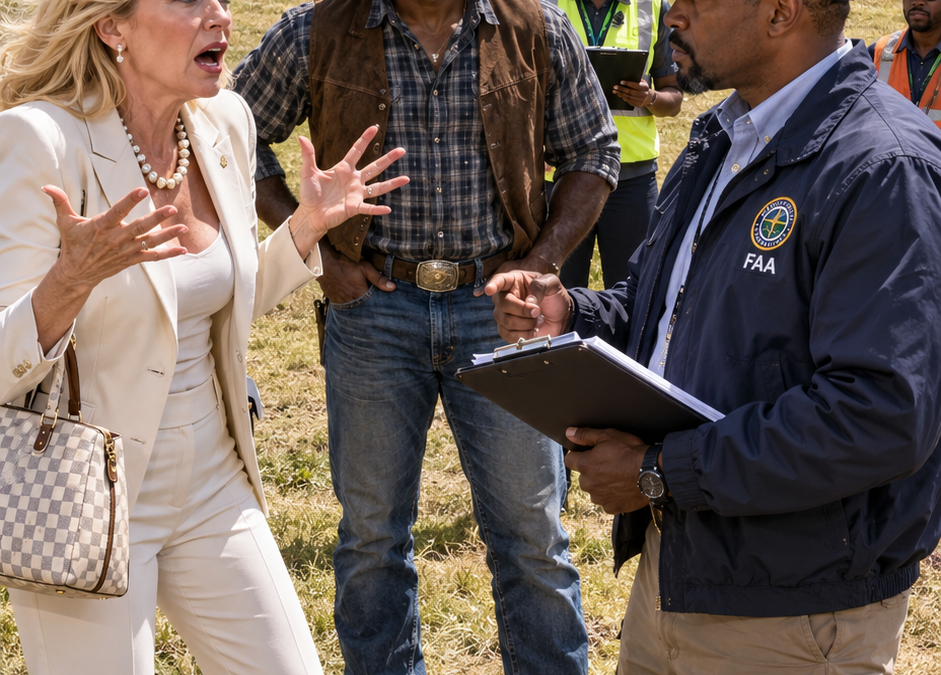
Rochelle looked at her.
“Who authorized it?”
“Our association has legal access rights.”
“Show me.”
Caleb produced the same agreement.
Rochelle read it.
Slowly.
Then Lydia arrived with a certified copy of my deed.
Rochelle compared the descriptions.
Then looked at me.
“Mr. Hollister, did you sign this aviation-access agreement?”
“No.”
One word.
That was enough.
Rochelle turned back toward Meredith.
“Who authorized the strip?”
“Our legal department handled the transaction.”
Caleb immediately said:
“The board supplied the underlying agreement.”
Meredith looked at him.
He kept going.
“My office reviewed what we were given.”
Nobody answered Rochelle’s question.
She did not argue.
“Then I want every record related to establishment, promotion, coordination, and use of this facility.”
Meredith frowned.
“This is fundamentally a civil property disagreement.”
Rochelle answered:
“The property issue may be civil. Aircraft operations are still aircraft operations.”
I handed her my landing log.
Eleven tail numbers.
Eleven timestamps.
Video.
Photographs.
Owen Redford volunteered his flight briefing.
One line inside it changed the mood.
FIELD OPERATED EXCLUSIVELY BY CREST HAVEN RIDGE HOA
Rochelle read it aloud.
Meredith’s expression shifted.
That language mattered because it showed the HOA had actively represented itself as operator of the strip.
The pilots had not simply mistaken an old farm road for an airport.
Somebody planned the event.
Published information.
Scheduled arrivals.
Coordinated ground handling.
And invited investors.
Lydia kept tracing the fake agreement.
It existed nowhere in my title chain.
Only inside Crest Haven’s records.
Metadata showed it had been created recently on a management-office computer.
My legal property description had been copied almost word for word from the public deed.
That was how the document looked so convincing.
The person who created it had not needed access to my private files.
County property records were public.
All they needed was enough patience to copy the description correctly.
Lydia explained it plainly.
“This document was never designed to survive litigation.”
“What was it designed for?”
“To survive five minutes in a conference room.”
She was right.
Show it to security.
Investors.
Pilots.
Contractors.
Anyone eager to believe the deal had already been completed.
Then move quickly.
Crest Haven Treasurer Paige Whitcomb contacted me next.
She sounded nervous.
“We need to talk.”
“About?”
“The six hundred forty thousand dollars.”
I met her with Lydia present.
Paige brought bank records.
Meredith had pushed the board to approve funding under:
NORTH ACCESS IMPROVEMENTS
No airfield.
No runway.
The costs were separated.
Grading.
Drainage.
Lighting.
Transportation infrastructure.
Security.
Landscaping.
Site preparation.
Individually, they looked ordinary.
Together:
$640,000.
“They didn’t tell homeowners they were paying for an airstrip?” I asked.
“No.”
“Did the board know?”
“Not clearly.”
“Did you?”
Paige looked embarrassed.
“I trusted Meredith.”
Then she showed us why the runway mattered so much.
Investors had placed deposits tied to Crest Haven’s expansion.
Marketing packages promised aviation access.
The western luxury lots were being valued partly on that promise.
If the airfield disappeared, projected prices changed.
Potential deals changed.
Expansion financing changed.
Meredith had promised something before she owned the right to provide it.
Then apparently manufactured the paperwork afterward.
Paige opened another file.
“This is worse.”
A master-development plan.
My ranch appeared again.
Not merely the strip.
Dozens of acres were shaded.
FUTURE AVIATION CORRIDOR
Planned taxiway.
Hangar complex.
Connector road.
Expanded aircraft apron.
All across my land.
I stared at it.
“They’re selling future development on my ranch.”
Lydia nodded.
“Looks that way.”
Meredith’s strategy suddenly became obvious.
Spend money first.
Create investor expectations.
Market homes around aviation access.
Build physical improvements.
Then confront me after the economic pressure became enormous.
If I resisted, hundreds of homeowners and buyers could be told that I was destroying their investment.
She was trying to manufacture leverage out of trespass.
I filed for emergency injunctive relief.
County planning issued stop orders covering unauthorized improvements.
Rochelle made clear that no additional aircraft should arrive while the situation remained unresolved.
The eleven jets already on the ground still needed to leave.
I agreed immediately.
The pilots had not created the fraud.
I was not going to trap them in the middle of it.
Rochelle coordinated departures.
Aircraft one taxied out.
Then two.
Then three.
I stood behind the safety line.
Each jet accelerated down the strip.
Lifted.
Disappeared.
With every departure, Crest Haven’s supposed executive aviation weekend looked more absurd.
The eleventh aircraft remained.
Owen Redford wanted to speak with investigators.
His charter company had reviewed the event emails.
He handed over the full chain.
One message had come directly from Meredith.
An event coordinator had asked:
HAS THE LANDOWNER APPROVED FLIGHT OPERATIONS?
Meredith replied:
ACCESS HAS BEEN FULLY SECURED AND PROPERLY RECORDED.
Rochelle read the message twice.
That destroyed any claim that Meredith simply assumed access was valid.
She had been asked specifically whether the landowner approved.
She answered yes.
I had not.
Paige produced private board notes next.
At a closed session, somebody had asked why my signature still had not been received if the airstrip agreement was finished.
According to Paige’s notes, Meredith answered:
WE’LL HANDLE HOLLISTER AFTER THE LAUNCH.
That was the phrase that told me everything.
After the launch.
Meaning she knew I had not signed before the aviation weekend.
Knew the legal rights were not secured.
Knew investors were being shown something unfinished.
And moved forward anyway.
Her confidence had never been certainty.
It had been performance.
Crest Haven’s attorney began distancing himself.
Caleb Vance produced emails showing he had warned Meredith that the HOA could not claim a permanent aviation easement without my signature.
One message read:
WE NEED EXECUTED LANDOWNER AUTHORIZATION BEFORE THIS CAN BE PRESENTED AS A PROPERTY RIGHT.
Meredith responded asking for:
A CLEAN VERSION FOR INVESTOR PRESENTATION.
Caleb claimed he believed she meant cleaner formatting.
Maybe he did.
Maybe he did not.
Investigators could decide.
What mattered to me was that every person who had helped build Meredith’s story was suddenly producing records.
The emergency board meeting happened days later.
Meredith still tried to blame me.
She stood at the front.
“Grant Hollister has deliberately sabotaged a major development opportunity.”
Paige stood.
“No.”
The room went quiet.
She put the financial records on the table.
$640,000.
Categories.
Transfers.
Board approvals.
What members had actually been told.
Then Lydia displayed my certified deed.
Beside it:
The aviation agreement.
Creation date.
False historical date.
Missing recording information.
Forged signature.
Trevor from county planning confirmed no approved runway conversion existed.
Owen presented the flight briefing.
Then Meredith’s email.
ACCESS HAS BEEN FULLY SECURED AND PROPERLY RECORDED.
One longtime board member removed his glasses.
“Meredith, was that true when you wrote it?”
She hesitated.
“We believed it to be.”
“That isn’t what I asked.”
“The association had a good-faith basis—”
“Did Grant sign?”
She looked toward me.
“No.”
“Then why did you say access had been secured?”
No clean answer existed.
Meredith called the document dispute an administrative misunderstanding.
Nobody believed that anymore.
Investigators eventually obtained authority to secure records tied to the suspected forgery and financial misconduct.
Computers.
Emails.
Contracts.
Architectural drawings.
Investor materials.
Accounting records.
Meredith was removed from operational authority while those matters proceeded.
I had no role in directing that process.
That mattered to me.
I wanted my land back.
Not personal revenge.
The civil case was simpler.
Ownership was not seriously debatable.
My deed was valid.
No aviation easement existed.
No lease existed.
No license existed.
Crest Haven had physically modified my property without authorization.
The association became responsible for restoration.
Runway lights came out.
Reflective markers disappeared.
Painted centerline markings were removed.
The scraped aircraft parking area was broken up.
Imported base material was removed where necessary.
Unauthorized signage came down.
The Silver Crest Executive Airfield name disappeared.
Every sales brochure promising private aviation access had to be withdrawn or corrected.
Buyers who had relied on those promises began reviewing their own transactions.
Crest Haven’s problems continued long after the jets were gone.
Paige remained involved with the association during restructuring.
She told me once:
“The hardest part wasn’t learning Meredith lied.”
“What was?”
“Realizing how easy it was for the rest of us not to ask.”
That stayed with me.
Systems rarely collapse because one person lies.
They collapse because everybody else becomes comfortable accepting whatever keeps the machine moving.
Wyatt later spoke with investigators too.
He admitted the signature page had bothered him.
“Why didn’t you say anything?” I asked when we crossed paths months later.
“Wasn’t my job.”
I nodded.
“That phrase caused a lot of this.”
He looked away.
The county adopted stricter review requirements for development amenities advertised using property rights outside the developer’s recorded holdings.
Crest Haven rewrote its own approval procedures.
No external property could appear in investor materials without verified documentation.
No major capital project could be divided into vague categories to avoid transparent board review.
Those changes came too late for Meredith.
But not for whoever came next.
The eleventh jet was the last to leave.
Owen shook my hand beside the strip.
“You ever going to turn this into a real airport?”
I looked across the field.
The old crop-dusting lane.
My cattle fence.
The barn.
“Maybe.”
He smiled.
“Seriously?”
“Probably not.”
He laughed.
Then I added:
“But if I ever do, I’ll start by asking the owner.”
He understood.
“Nobody builds an airport by stealing the ground first.”
“Exactly.”
Owen climbed aboard.
Engines started.
The aircraft taxied.
Accelerated.
Then lifted over the northern pasture.
I watched until it disappeared.
For the first time in days, the ranch became quiet.
A flatbed arrived later carrying restoration equipment.
The irony was difficult to miss.
Crest Haven had spent roughly $640,000 creating an airfield it had no right to build.
Now it was spending more money removing it.
I walked toward the old executive-airfield sign.
Crest Haven’s logo still sat across the top.
I unbolted it.
Turned it around.
Found a marker in my truck.
Then wrote:
PRIVATE PROPERTY
NO HOA ACCESS
I set it beside the fence.
No clever slogan.
No insult.
Just fact.
Weeks later, the last lighting unit disappeared.
Then the parking apron.
The strip returned to something much closer to what it had been before.
Packed earth.
Grass.
Farm tracks.
Nothing about the ranch looked like a luxury aviation development anymore.
That was exactly how I wanted it.
Meredith had believed money could create reality.
Spend enough.
Market enough.
Bring enough investors.
Land enough jets.
And eventually everybody would accept that the runway belonged to Crest Haven because it had become too valuable to undo.
But ownership does not work that way.
Eleven aircraft did not create an easement.
$640,000 did not create an easement.
Investor deposits did not create an easement.
A glossy brochure did not create an easement.
A forged signature certainly did not create one.
The truth had been much simpler than everything Meredith built around it.
I owned the land.
I had never said yes.
Months after the event, I walked the strip at sunset.
The wind moved through the grass.
A few cattle stood near the southern fence.
No jet engines.
No golf carts.
No private security.
No investors.
I stopped where the first aircraft had touched down.
There was almost no sign of it anymore.
I remembered Meredith standing in the clubhouse beneath the words:
PRIVATE AVIATION
I remembered her telling me the HOA had already spent too much money for me to object.
And I remembered Rochelle Barrett arriving with a notebook, walking the strip, looking at the lights, the markings, and the paperwork.
Meredith had spent months creating complicated explanations.
Rochelle reduced the whole thing to one question.
“Who authorized this airstrip?”
That was all it took.
Because every lie surrounding Crest Haven’s aviation weekend depended on nobody asking that question directly.
Once somebody finally did, there was only one honest answer.
Nobody.
Not the county.
Not the landowner.
And certainly not me.
Have you finished reading the story and want to read it again?
The HOA landed eleven private jets on my ranch without permission.
Their president threatened me when I closed the runway.
Then the FAA arrived and asked who had authorized the airstrip.
My name is Grant Hollister.
The first jet touched down at 8:17 on a Friday morning.
I remember the exact time because I was standing beside the eastern fence line of my ranch when the sound reached me.
At first, I thought it was a military aircraft passing low overhead.
Then the engine noise dropped.
Too low.
Too close.
I looked north.
A white business jet was descending toward a long strip of packed earth running across my property.
For several seconds, I simply stood there.
That strip had once been used by a crop-dusting company decades before I bought the ranch.
It had not functioned as an airstrip in years.
I kept the surface relatively smooth because farm trucks and cattle trailers crossed it, but there had been no aviation activity since long before my name appeared on the deed.
Now it looked completely different.
Fresh white markings ran down the center.
Reflective stakes lined both edges.
A new windsock snapped above the fence.
Portable runway lights had been positioned along the strip.
A parking apron had been scraped flat near the northern end.
Directional signs pointed aircraft toward an area beside my barn.
None of it belonged there.
None of it had been installed by me.
The jet touched down.
Dust exploded behind the wheels.
I watched it roll across land I had owned for more than a decade.
Then another sound came through the sky.
A second aircraft.
That was when I climbed into my truck.
By the time I reached the strip, six men wearing matching private-security jackets were already guiding the first aircraft into position.
Their supervisor was Wyatt Dempsey.
I knew him by sight.
Crest Haven Ridge HOA used his company for neighborhood security.
“What is this?”
Wyatt barely looked at me.
“Private aviation weekend.”
“On whose property?”
He finally turned.
“Crest Haven has aviation access.”
“No, it doesn’t.”
He reached into a binder.
Pulled out several pages.
Then handed them to me.
The heading read:
PERMANENT AVIATION ACCESS EASEMENT
My parcel number was correct.
My legal description was correct.
My full name was correct.
Then I reached the signature page.
The signature was not mine.
I looked at Wyatt.
“Who gave you this?”
“Association office.”
“This is forged.”
His expression barely moved.
“You’ll need to discuss that with them.”
A radio on his belt crackled.
“Aircraft two on final.”
I looked toward the sky.
Another jet was descending.
That was when I understood the scale of what had happened.
Someone had not merely trespassed onto my ranch.
Someone had built an aviation operation across it.
And before sunset, eleven private jets would be sitting on land the HOA had never owned.
PART2
I drove straight to the Crest Haven Ridge clubhouse.
The parking lot was full.
Luxury SUVs.
Sedans.
Black car-service vehicles.
Inside, the reception room looked like a private investment conference.
Meredith Sloan stood at the front.
President of Crest Haven Ridge.
She wore a tailored cream jacket and was speaking beneath a huge projection screen.
Across it:
CREST HAVEN RIDGE
PRIVATE HOMES
PRIVATE SECURITY
PRIVATE AVIATION
I stopped.
A scale model of the subdivision sat on a table.
Then I noticed something that made my stomach turn.
My ranch was included.
Painted the same color as Crest Haven Ridge.
The strip running across my northern field had even been given a name.
A brass plaque read:
SILVER CREST EXECUTIVE AIRFIELD
Brochures were stacked nearby.
I picked one up.
Luxury homes.
Private aviation access.
Limousine service from runway to residence.
Future hangars.
Priority aircraft scheduling.
VIP ground support.
I walked directly toward Meredith.
She saw me.
Her smile disappeared for maybe half a second.
Then returned.
“Grant.”
“What are you doing?”
Several investors turned toward us.
Meredith lowered her voice.
“This is not the appropriate time.”
“Eleven aircraft are scheduled to use my land.”
“We have access rights.”
“No.”
“Our counsel reviewed the agreement.”
“You forged my signature.”
The room went quieter.
Meredith’s eyes sharpened.
“Do not make accusations you can’t support.”
“I’m looking at a document with my name on it that I never signed.”
“You signed an aviation-access agreement.”
“No.”
“You may not remember every document executed during prior negotiations.”
“I remember giving away permanent aircraft access across my ranch.”
She stiffened.
“This event has already been coordinated.”
“Cancel it.”
“We’re not canceling anything.”
“Ground every incoming aircraft.”
“No.”
“You are operating on my property.”
She stepped closer.
“Crest Haven has invested approximately six hundred forty thousand dollars into improvements.”
That sentence mattered.
“What improvements?”
She gestured vaguely toward the ranch.
“Grading. Lighting. drainage. safety infrastructure.”
“You spent $640,000 modifying land you don’t own?”
Her expression changed.
Only slightly.
But I saw it.
She had just admitted it.
I said:
“Spending money on somebody else’s land doesn’t make it yours.”
Meredith turned toward Wyatt.
“Escort Mr. Hollister outside.”
I laughed once.
“From your clubhouse?”
“From this event.”
“Gladly.”
By the time I reached my truck, a third jet had landed.
A fourth was circling.
I sat behind the wheel.
Did not start the engine.
Watched.
My first instinct was anger.
Drive onto the strip.
Block it.
Park my truck in the middle.
Force every aircraft to stop.
But airplanes are not pickup trucks.
Pilots were operating based on information somebody had given them.
I had no intention of creating a safety problem just to prove ownership.
So I did the opposite.
I documented.
Every tail number.
Every arrival time.
Every vehicle.
Every security guard.
Every passenger group.
Every golf cart taking investors toward the clubhouse.
I stayed well clear of the aircraft.
By midafternoon, eleven private jets had landed.
Eleven.
On my ranch.
One of the pilots eventually walked toward me.
“Ground crew?”
“No.”
He stopped.
“Sorry?”
“My name is Grant Hollister.”
He looked at the ranch.
Then at me.
“I own this property.”
His expression changed immediately.
“You own the airfield?”
“There is no airfield.”
He stared.
“This is Silver Crest Executive.”
“According to whom?”
The pilot introduced himself as Owen Redford.
He pulled out his phone.
His flight briefing described the location as a private executive airstrip available by prior arrangement through Crest Haven Ridge.
Ground handling included.
Future fuel service listed.
Owen scrolled.
“This is what our charter company received.”
“Who sent it?”
“Event coordinator.”
“Did anyone provide proof the field was authorized?”
He looked uncomfortable.
“That’s normally handled before it reaches a flight crew.”
“I never authorized any of this.”
He looked toward the aircraft.
“Then you have a problem.”
“So do you.”
He nodded.
“Fair.”
The passengers on Owen’s jet were considering multi-million-dollar homes inside Crest Haven.
The airstrip was part of the sales pitch.
That told me what Meredith was actually building.
Not an HOA amenity.
A valuation tool.
Homes near supposed private aviation access could be marketed differently.
Priced differently.
Sold differently.
I called my attorney.
Lydia Fairmont.
“I need every recorded document tied to my ranch.”
“What happened?”
“Eleven private jets happened.”
Silence.
“Repeat that.”
“Crest Haven built an airstrip.”
“On your land?”
“Yes.”
“Did you authorize it?”
“No.”
“Do not sign anything.”
“I wasn’t planning to.”
“I’m pulling title now.”
She called back that evening.
“No aviation easement.”
“I know.”
“No lease.”
“I know.”
“No license.”
“Nothing?”
“Nothing.”
I sent her photographs of Wyatt’s document.
She called again twenty minutes later.
“Grant.”
“What?”
“This file is new.”
“How new?”
“Created thirty-seven days ago.”
The document claimed I had signed it more than two years earlier.
I leaned back in my chair.
“So somebody backdated it.”
“Looks that way.”
“And forged the signature.”
“I’m not making that conclusion until we get an examiner, but if you’re telling me you didn’t sign…”
“I didn’t.”
“Then this just became much worse.”
The next morning, I installed two temporary signs.
One at each end of the strip.
PRIVATE PROPERTY
AIRFIELD CLOSED BY LANDOWNER
I was careful.
I did not block the eleven aircraft already there.
Those pilots needed a safe route out.
The signs were intended to stop additional arrivals.
Meredith reacted within an hour.
Wyatt returned with security.
“You need to remove those.”
“No.”
“You’re interfering with HOA aviation operations.”
“There are no HOA aviation operations.”
He pointed toward the aircraft.
“They’re right there.”
“They’re on my land.”
“Meredith says the association has rights.”
“Meredith is wrong.”
His men erected temporary fencing.
On my property.
It cut me off from part of my northern parcel.
That was when I called the sheriff’s office to document the trespass.
Lydia sent formal notice to Crest Haven’s attorney.
Every claimed aviation right was disputed.
No aircraft activity authorized.
No construction authorized.
No occupancy authorized.
No security fence authorized.
Wyatt’s men remained near the strip.
I did not touch the fence.
That was exactly what Meredith wanted.
A dramatic video of an angry rancher ripping down barriers while private jets sat nearby.
I refused to give it to her.
Instead, I called county planning.
Trevor Maddox answered.
I sent him photographs.
Runway markings.
Lights.
Windsock.
Parking apron.
Directional signs.
He called back.
“We didn’t approve this.”
“Any application?”
“No.”
“Any aviation-facility review?”
“No.”
“Any conversion permit?”
“No.”
“Then who authorized construction?”
“That’s what I’d like to know.”
A pilot submitted a report to his dispatch office around the same time.
Conditions on the ground did not match the briefing.
That report traveled.
By the next morning, two federal vehicles came through my gate.
A woman stepped out of the first.
She introduced herself as Rochelle Barrett.
Federal aviation investigator.
Her colleague carried inspection equipment.
There were no sirens.
No spectacle.
Rochelle simply started walking.
Centerline markings.
Edge markers.
Lighting.
Parking apron.
Windsock.
Approach area.
Surface condition.
She photographed everything.
Meredith arrived less than twenty minutes later.
Her attorney, Caleb Vance, came with her.
Meredith spoke first.
“This is private HOA aviation infrastructure.”
Rochelle looked at her.
“Who authorized it?”
“Our association has legal access rights.”
“Show me.”
Caleb produced the same agreement.
Rochelle read it.
Slowly.
Then Lydia arrived with a certified copy of my deed.
Rochelle compared the descriptions.
Then looked at me.
“Mr. Hollister, did you sign this aviation-access agreement?”
“No.”
One word.
That was enough.
Rochelle turned back toward Meredith.
“Who authorized the strip?”
“Our legal department handled the transaction.”
Caleb immediately said:
“The board supplied the underlying agreement.”
Meredith looked at him.
He kept going.
“My office reviewed what we were given.”
Nobody answered Rochelle’s question.
She did not argue.
“Then I want every record related to establishment, promotion, coordination, and use of this facility.”
Meredith frowned.
“This is fundamentally a civil property disagreement.”
Rochelle answered:
“The property issue may be civil. Aircraft operations are still aircraft operations.”
I handed her my landing log.
Eleven tail numbers.
Eleven timestamps.
Video.
Photographs.
Owen Redford volunteered his flight briefing.
One line inside it changed the mood.
FIELD OPERATED EXCLUSIVELY BY CREST HAVEN RIDGE HOA
Rochelle read it aloud.
Meredith’s expression shifted.
That language mattered because it showed the HOA had actively represented itself as operator of the strip.
The pilots had not simply mistaken an old farm road for an airport.
Somebody planned the event.
Published information.
Scheduled arrivals.
Coordinated ground handling.
And invited investors.
Lydia kept tracing the fake agreement.
It existed nowhere in my title chain.
Only inside Crest Haven’s records.
Metadata showed it had been created recently on a management-office computer.
My legal property description had been copied almost word for word from the public deed.
That was how the document looked so convincing.
The person who created it had not needed access to my private files.
County property records were public.
All they needed was enough patience to copy the description correctly.
Lydia explained it plainly.
“This document was never designed to survive litigation.”
“What was it designed for?”
“To survive five minutes in a conference room.”
She was right.
Show it to security.
Investors.
Pilots.
Contractors.
Anyone eager to believe the deal had already been completed.
Then move quickly.
Crest Haven Treasurer Paige Whitcomb contacted me next.
She sounded nervous.
“We need to talk.”
“About?”
“The six hundred forty thousand dollars.”
I met her with Lydia present.
Paige brought bank records.
Meredith had pushed the board to approve funding under:
NORTH ACCESS IMPROVEMENTS
No airfield.
No runway.
The costs were separated.
Grading.
Drainage.
Lighting.
Transportation infrastructure.
Security.
Landscaping.
Site preparation.
Individually, they looked ordinary.
Together:
$640,000.
“They didn’t tell homeowners they were paying for an airstrip?” I asked.
“No.”
“Did the board know?”
“Not clearly.”
“Did you?”
Paige looked embarrassed.
“I trusted Meredith.”
Then she showed us why the runway mattered so much.
Investors had placed deposits tied to Crest Haven’s expansion.
Marketing packages promised aviation access.
The western luxury lots were being valued partly on that promise.
If the airfield disappeared, projected prices changed.
Potential deals changed.
Expansion financing changed.
Meredith had promised something before she owned the right to provide it.
Then apparently manufactured the paperwork afterward.
Paige opened another file.
“This is worse.”
A master-development plan.
My ranch appeared again.
Not merely the strip.
Dozens of acres were shaded.
FUTURE AVIATION CORRIDOR
Planned taxiway.
Hangar complex.
Connector road.
Expanded aircraft apron.
All across my land.
I stared at it.
“They’re selling future development on my ranch.”
Lydia nodded.
“Looks that way.”
Meredith’s strategy suddenly became obvious.
Spend money first.
Create investor expectations.
Market homes around aviation access.
Build physical improvements.
Then confront me after the economic pressure became enormous.
If I resisted, hundreds of homeowners and buyers could be told that I was destroying their investment.
She was trying to manufacture leverage out of trespass.
I filed for emergency injunctive relief.
County planning issued stop orders covering unauthorized improvements.
Rochelle made clear that no additional aircraft should arrive while the situation remained unresolved.
The eleven jets already on the ground still needed to leave.
I agreed immediately.
The pilots had not created the fraud.
I was not going to trap them in the middle of it.
Rochelle coordinated departures.
Aircraft one taxied out.
Then two.
Then three.
I stood behind the safety line.
Each jet accelerated down the strip.
Lifted.
Disappeared.
With every departure, Crest Haven’s supposed executive aviation weekend looked more absurd.
The eleventh aircraft remained.
Owen Redford wanted to speak with investigators.
His charter company had reviewed the event emails.
He handed over the full chain.
One message had come directly from Meredith.
An event coordinator had asked:
HAS THE LANDOWNER APPROVED FLIGHT OPERATIONS?
Meredith replied:
ACCESS HAS BEEN FULLY SECURED AND PROPERLY RECORDED.
Rochelle read the message twice.
That destroyed any claim that Meredith simply assumed access was valid.
She had been asked specifically whether the landowner approved.
She answered yes.
I had not.
Paige produced private board notes next.
At a closed session, somebody had asked why my signature still had not been received if the airstrip agreement was finished.
According to Paige’s notes, Meredith answered:
WE’LL HANDLE HOLLISTER AFTER THE LAUNCH.
That was the phrase that told me everything.
After the launch.
Meaning she knew I had not signed before the aviation weekend.
Knew the legal rights were not secured.
Knew investors were being shown something unfinished.
And moved forward anyway.
Her confidence had never been certainty.
It had been performance.
Crest Haven’s attorney began distancing himself.
Caleb Vance produced emails showing he had warned Meredith that the HOA could not claim a permanent aviation easement without my signature.
One message read:
WE NEED EXECUTED LANDOWNER AUTHORIZATION BEFORE THIS CAN BE PRESENTED AS A PROPERTY RIGHT.
Meredith responded asking for:
A CLEAN VERSION FOR INVESTOR PRESENTATION.
Caleb claimed he believed she meant cleaner formatting.
Maybe he did.
Maybe he did not.
Investigators could decide.
What mattered to me was that every person who had helped build Meredith’s story was suddenly producing records.
The emergency board meeting happened days later.
Meredith still tried to blame me.
She stood at the front.
“Grant Hollister has deliberately sabotaged a major development opportunity.”
Paige stood.
“No.”
The room went quiet.
She put the financial records on the table.
$640,000.
Categories.
Transfers.
Board approvals.
What members had actually been told.
Then Lydia displayed my certified deed.
Beside it:
The aviation agreement.
Creation date.
False historical date.
Missing recording information.
Forged signature.
Trevor from county planning confirmed no approved runway conversion existed.
Owen presented the flight briefing.
Then Meredith’s email.
ACCESS HAS BEEN FULLY SECURED AND PROPERLY RECORDED.
One longtime board member removed his glasses.
“Meredith, was that true when you wrote it?”
She hesitated.
“We believed it to be.”
“That isn’t what I asked.”
“The association had a good-faith basis—”
“Did Grant sign?”
She looked toward me.
“No.”
“Then why did you say access had been secured?”
No clean answer existed.
Meredith called the document dispute an administrative misunderstanding.
Nobody believed that anymore.
Investigators eventually obtained authority to secure records tied to the suspected forgery and financial misconduct.
Computers.
Emails.
Contracts.
Architectural drawings.
Investor materials.
Accounting records.
Meredith was removed from operational authority while those matters proceeded.
I had no role in directing that process.
That mattered to me.
I wanted my land back.
Not personal revenge.
The civil case was simpler.
Ownership was not seriously debatable.
My deed was valid.
No aviation easement existed.
No lease existed.
No license existed.
Crest Haven had physically modified my property without authorization.
The association became responsible for restoration.
Runway lights came out.
Reflective markers disappeared.
Painted centerline markings were removed.
The scraped aircraft parking area was broken up.
Imported base material was removed where necessary.
Unauthorized signage came down.
The Silver Crest Executive Airfield name disappeared.
Every sales brochure promising private aviation access had to be withdrawn or corrected.
Buyers who had relied on those promises began reviewing their own transactions.
Crest Haven’s problems continued long after the jets were gone.
Paige remained involved with the association during restructuring.
She told me once:
“The hardest part wasn’t learning Meredith lied.”
“What was?”
“Realizing how easy it was for the rest of us not to ask.”
That stayed with me.
Systems rarely collapse because one person lies.
They collapse because everybody else becomes comfortable accepting whatever keeps the machine moving.
Wyatt later spoke with investigators too.
He admitted the signature page had bothered him.
“Why didn’t you say anything?” I asked when we crossed paths months later.
“Wasn’t my job.”
I nodded.
“That phrase caused a lot of this.”
He looked away.
The county adopted stricter review requirements for development amenities advertised using property rights outside the developer’s recorded holdings.
Crest Haven rewrote its own approval procedures.
No external property could appear in investor materials without verified documentation.
No major capital project could be divided into vague categories to avoid transparent board review.
Those changes came too late for Meredith.
But not for whoever came next.
The eleventh jet was the last to leave.
Owen shook my hand beside the strip.
“You ever going to turn this into a real airport?”
I looked across the field.
The old crop-dusting lane.
My cattle fence.
The barn.
“Maybe.”
He smiled.
“Seriously?”
“Probably not.”
He laughed.
Then I added:
“But if I ever do, I’ll start by asking the owner.”
He understood.
“Nobody builds an airport by stealing the ground first.”
“Exactly.”
Owen climbed aboard.
Engines started.
The aircraft taxied.
Accelerated.
Then lifted over the northern pasture.
I watched until it disappeared.
For the first time in days, the ranch became quiet.
A flatbed arrived later carrying restoration equipment.
The irony was difficult to miss.
Crest Haven had spent roughly $640,000 creating an airfield it had no right to build.
Now it was spending more money removing it.
I walked toward the old executive-airfield sign.
Crest Haven’s logo still sat across the top.
I unbolted it.
Turned it around.
Found a marker in my truck.
Then wrote:
PRIVATE PROPERTY
NO HOA ACCESS
I set it beside the fence.
No clever slogan.
No insult.
Just fact.
Weeks later, the last lighting unit disappeared.
Then the parking apron.
The strip returned to something much closer to what it had been before.
Packed earth.
Grass.
Farm tracks.
Nothing about the ranch looked like a luxury aviation development anymore.
That was exactly how I wanted it.
Meredith had believed money could create reality.
Spend enough.
Market enough.
Bring enough investors.
Land enough jets.
And eventually everybody would accept that the runway belonged to Crest Haven because it had become too valuable to undo.
But ownership does not work that way.
Eleven aircraft did not create an easement.
$640,000 did not create an easement.
Investor deposits did not create an easement.
A glossy brochure did not create an easement.
A forged signature certainly did not create one.
The truth had been much simpler than everything Meredith built around it.
I owned the land.
I had never said yes.
Months after the event, I walked the strip at sunset.
The wind moved through the grass.
A few cattle stood near the southern fence.
No jet engines.
No golf carts.
No private security.
No investors.
I stopped where the first aircraft had touched down.
There was almost no sign of it anymore.
I remembered Meredith standing in the clubhouse beneath the words:
PRIVATE AVIATION
I remembered her telling me the HOA had already spent too much money for me to object.
And I remembered Rochelle Barrett arriving with a notebook, walking the strip, looking at the lights, the markings, and the paperwork.
Meredith had spent months creating complicated explanations.
Rochelle reduced the whole thing to one question.
“Who authorized this airstrip?”
That was all it took.
Because every lie surrounding Crest Haven’s aviation weekend depended on nobody asking that question directly.
Once somebody finally did, there was only one honest answer.
Nobody.
Not the county.
Not the landowner.
And certainly not me.








