𝗙𝗨𝗟𝗟 𝗦𝗧𝗢𝗥𝗬 HOA Karen’s Son Ordered Me Out of My Own Pool—Then He Learned I Was the County Sheriff
𝗣𝗔𝗥𝗧 𝟮
The pool water moved in widening circles.
The key marked 14B still hung beside the door.
Everything around me looked exactly as it had ten minutes earlier.
But something had changed.
Not because Karen Aldrich’s son had irritated me.
I had been irritated by better men than him.
What changed was that I finally understood the kind of operation Karen had built inside this neighborhood.
And I also understood something neither Karen nor her son knew yet.
For eleven years, I had served as the sheriff of this county.
I had deliberately told almost nobody in the subdivision.
I wanted to live here as a neighbor.
Not a badge.
Not a title.
Not a man people behaved differently around because they knew what office I occupied.
Dylan had just walked into the backyard of the one homeowner most likely to know exactly where private rules ended and actual law began.
And he had done it carrying his own evidence.
PART2
I bought the house eight months earlier.
Four bedrooms.
Quiet street.
Mature trees.
In-ground pool.
Private backyard.
The listing described the pool as a major selling point.
The deed was more useful.
Deeds usually are.
The language was unambiguous.
The pool was a private residential amenity attached to Lot 14B.
Not part of the community pool system.
Not shared property.
Not under any separate recreational easement.
Mine.
I read that paragraph three times before closing.
Old habit.
When you’ve spent a career dealing with disputes, warrants, affidavits, probable cause statements, property descriptions, contracts, and people who swear something says what it does not actually say, you learn to read slowly.
I moved in on a Thursday.
By Saturday, an HOA welcome packet was waiting in my mailbox.
Glossy folder.
Color tabs.
Photograph of the board.
Karen Aldrich stood in the center.
Blazer.
Perfect posture.
Smile that looked more managerial than friendly.
I attended my first HOA meeting two weeks later.
Mostly curiosity.
I wanted to know what kind of neighborhood I had moved into.
Karen entered as though she were chairing a corporate acquisition.
Printed agendas.
Hole-punched packets.
Violation summary.
She read eleven property addresses aloud in the first ten minutes.
Then moved to maintenance.
Assessments.
Compliance.
I listened.
When homeowner questions opened, I raised my hand.
“My monthly statement includes a community pool maintenance fee.”
Karen looked toward me.
“Correct.”
“I have a private pool.”
“Yes.”
“It’s on my deed. I don’t use the community pool.”
She gave me the patient expression adults sometimes use on children who have interrupted at an inconvenient time.
“All pool-adjacent properties contribute to neighborhood aquatic infrastructure.”
I wrote that down.
Word for word.
Not because it made sense.
Because it didn’t.
All pool-adjacent properties contribute to neighborhood aquatic infrastructure.
That sentence sounded official.
It meant almost nothing.
And sentences like that are often load-bearing walls in organizations built on intimidation.
Nobody else questioned her.
Several people nodded.
I started paying attention.
The board supposedly had five seats.
Karen held the presidency.
Two members voted with her on nearly everything.
The fourth seat had been open for months.
The fifth had been vacant more than a year.
No election had been scheduled to fill either.
Then there was Dylan.
Karen’s son.
No board seat.
No appointment in the governing documents.
No legitimate enforcement title that I could find.
Yet he drove around the subdivision in Karen’s second vehicle, photographed yards, left notices, warned residents, and wore his homemade HOA ENFORCEMENT badge.
Nobody challenged him.
That interested me.
Fear doesn’t always come from knowing what someone can do.
Sometimes it comes from not knowing.
That was Karen’s real system.
Ninety-six homes.
Ninety-six families.
Most weren’t sure where the rules ended.
They weren’t sure which fines were enforceable.
They didn’t know who could lien what.
They didn’t know whether Dylan could actually order them around.
So they complied.
The Pattersons lived three houses away.
Harold and Margaret.
Both in their seventies.
Their crime was a ceramic garden gnome.
Eighteen inches tall.
Hand-painted.
Gift from their daughter.
Karen fined them eight hundred dollars for an “unauthorized decorative installation in a designated visibility zone.”
Harold paid.
Not because he believed the gnome violated anything.
He told me over the fence:
“I can’t afford to find out what happens if I don’t.”
That sentence bothered me more than the fine.
On the east side lived Sandra.
Single mother.
Two children.
Two jobs.
Her driveway developed a hairline crack after a winter freeze.
Normal wear.
Karen’s notice required repair using an HOA-approved contractor.
Sandra called independent contractors first.
Quotes ranged between $350 and $425.
The HOA-approved contractor charged $1,200.
She paid because the notice threatened escalating penalties.
Then there was Roy.
Retired teacher.
He painted his fence a soft beige listed on the HOA’s approved color chart.
Two weeks after the work was complete, Karen changed the chart.
His color disappeared.
The following Monday, Roy received a violation.
He still had the original guidelines.
Dated.
Approved.
Initialed.
I started keeping notes.
Nothing formal at first.
Small notebook.
Date.
Resident.
Fine.
Reason.
What Karen said.
What Dylan did.
I wasn’t conducting an investigation.
Not yet.
I was doing what I’ve always done before deciding whether something is a pattern.
I documented.
I also kept my occupation to myself.
I drove an unmarked vehicle.
No campaign sticker.
No sheriff decal.
No special plate anyone outside law enforcement would recognize.
After eleven years in office and years before that in law enforcement, I wanted one address where I could be a man who occasionally needed to clean leaves out of his pool.
That privacy mattered.
Karen and Dylan behaved around me exactly the way they behaved around everyone else.
That turned out to be useful.
I ordered a certified copy of the HOA’s recorded CC&Rs.
Then I read them.
Every page.
Section 7.4 governed pools.
Not all pools.
The community pool.
Maintenance.
Guest rules.
Shared access.
Operating hours.
Safety standards.
There was nothing extending HOA control to private pools inside individually deeded lots.
Nothing.
Karen had taken a rule governing the central community facility and stretched it into jurisdiction over privately owned pools.
Then she built fines around that interpretation.
Two days after Dylan entered my backyard, Karen knocked on my front door.
10:15 in the morning.
Dylan stood behind her.
Same badge.
Same clipboard.
Karen held out a document.
I took it.
Official-looking formatting.
Reference number.
Bold header.
Fine amount in a box.
$250.
Violation:
HOA POOL SAFETY ORDINANCE 12B
Failure to maintain current pool access authorization.
“You have fourteen days to pay or contest,” Karen said.
Then:
“I’d recommend paying.”
I read the notice from top to bottom.
Slowly.
Karen shifted her weight.
Dylan stood perfectly still.
“What section of the recorded CC&Rs authorizes Ordinance 12B?”
Karen didn’t hesitate.
“All pools are subject to HOA safety oversight.”
“I’ve read the CC&Rs.”
Her eyes narrowed slightly.
“Can you give me the section number?”
“The ordinance speaks for itself.”
“No. An ordinance does not establish its own authority.”
She gave me the look people use when they think specificity is disrespect.
Dylan cut in.
“We’ve already removed three other residents from their pools this month.”
I turned toward him.
“Three?”
“Yes.”
“Private pools?”
“You’re not a special case.”
He thought that helped.
It didn’t.
It meant this was bigger.
I nodded.
“Thank you.”
Karen looked surprised.
“I’ll review it.”
I closed the door.
Then I went to my filing cabinet.
Section 7.4.
Read it again.
Community pool only.
No private-pool jurisdiction.
I photographed the page.
Timestamp.
Saved one copy locally.
One to secure storage.
Then I found meeting minutes.
Ordinance 12B had been created by board amendment.
That meant the next question was whether the amendment itself had been valid.
Before I reached that part, Karen sent an email.
9:14 Tuesday night.
Subject:
FINAL NOTICE — HOA COMPLIANCE ACTION PENDING
The third paragraph threatened a lien against my property if I refused to pay.
Recorded against the deed.
Could affect sale.
Refinance.
Transfer.
That was escalation.
A $250 fine is nuisance money.
A lien threat is different.
Karen had moved from bluffing about pool access to threatening legal encumbrance against property under authority she might not possess.
I printed the email.
Added it to the folder.
Then forwarded it to two people.
No message.
They knew me well enough to understand why I was sending it.
One worked in the county attorney’s office.
The other was a prosecutor I’d worked with for six years.
I still didn’t tell them to do anything.
I wanted documentation first.
The following week, I went door to door.
No uniform.
No badge.
No official introduction.
“I’m your neighbor. I’m looking at HOA compliance practices. If you have documentation you’d be comfortable sharing, I’d like to see it.”
That was all.
The Pattersons let me in.
Margaret checked the street before closing the door.
That told me something.
Fear had become habit.
They showed me the gnome violation.
Eight hundred dollars.
Harold had called Karen asking for the rule.
Karen said the board had broad aesthetic authority.
Then told him he could request a hearing.
Hearing fee:
Fifty dollars.
And, according to Karen, no resident had ever won one.
They paid instead.
Margaret kept everything in a shoebox.
Every notice.
Every year.
Chronological.
I photographed the gnome violation with permission.
Sandra’s documents were more complicated.
Her driveway repair quotes were exactly as she’d said.
Three independent contractors:
$350.
$390.
$425.
The approved contractor:
$1,200.
I photographed the invoice.
Then noticed the billing service.
Wrote it down.
The contractor’s name looked familiar.
I’d seen it in an HOA newsletter sponsor acknowledgment.
Maybe coincidence.
Maybe not.
I circled it in my notes.
Roy had the cleanest paper trail.
Original approved color chart.
Date.
His painter’s invoice.
Date.
Revised HOA color chart.
Date.
Violation notice.
Date.
There was no ambiguity.
His fence had been compliant when painted.
Karen changed the rule afterward.
Then punished him retroactively.
“I didn’t paint my fence wrong,” Roy said.
“She moved the target after I stopped moving.”
I requested one year of board minutes.
Residents were entitled to them.
Karen’s assistant, Pam, sent them within forty-eight hours.
I suspect Pam had long since stopped asking whether Karen wanted things released and simply followed written policy when a request was proper.
I read every page.
Four major amendments had been passed in eleven months.
Pool Ordinance 12B.
Revised color standards.
Noise restriction.
Vehicle rule.
Each amendment had exactly two affirmative votes.
Karen.
One ally.
The governing bylaws required three affirmative votes to amend association rules.
Plain language.
No ambiguity.
Three.
They had two.
Every one of those amendments was procedurally defective.
Including the pool ordinance.
The ordinance Dylan cited when he entered my backyard.
The ordinance Karen used for my fine.
The ordinance supporting the lien threat.
I spread everything across my dining table.
Deed.
Section 7.4.
Ordinance 12B.
Minutes.
Karen’s email.
Patterson gnome fine.
Sandra’s contractor invoice.
Roy’s fence documents.
My notebook.
Fourteen entries now.
I still didn’t act.
Because once you move officially, you need to know exactly what you’re moving on.
Eleven days after Karen handed me the violation, I walked outside at 7:15 in the morning.
My pool gate had been padlocked.
Heavy steel lock.
Orange HOA notice taped at eye level.
PROPERTY UNDER HOA COMPLIANCE REVIEW
ACCESS SUSPENDED
Dylan stood ten feet away on my lawn.
Arms folded.
Waiting.
“HOA has temporarily suspended pool access pending compliance.”
I looked at the lock.
Then him.
Then the notice.
“Okay.”
His expression changed.
He wanted anger.
I went inside.
Called a locksmith.
Then opened my security system.
Pool-gate camera.
Rewound.
6:28 a.m.
Dylan’s car stopped on the street.
He walked along the side of my home.
Opened my private side gate.
Carried tools and a padlock.
Four minutes at the pool gate.
6:32.
Lock secured.
No prior notice.
No board meeting.
No vote.
No court order.
He had simply decided my access to my own pool could be physically restricted.
I saved the footage.
Named the file with date and time.
Backed it up twice.
The locksmith arrived forty minutes later.
Three minutes of work.
Lock off.
I put it in a paper bag.
I’ve spent enough time around evidence rooms to know one rule applies even at home.
Don’t throw away the thing that proves what happened.
Karen called police before noon.
Two officers from a neighboring precinct arrived at 12:47.
Neither knew me personally.
That was useful.
Karen intercepted them near the curb.
I watched from inside.
She had her folder.
Violation notice.
Compliance paperwork.
Dylan’s photos.
She spoke for several minutes.
They listened.
Then came to my door.
I answered.
They explained there had been a complaint involving HOA access and asked whether I would step outside.
“Of course.”
I gave them nothing beyond what they asked for.
One inspected the pool gate.
No padlock by then.
They examined the property.
Talked quietly.
Then wrote the incident as a civil dispute.
No criminal element established at the time of response.
Reasonable based on the narrow information they had.
Karen read the notation.
Then turned toward several neighbors watching nearby.
“See?”
Her voice carried.
“Even the police confirmed HOA authority.”
The officer looked at her.
He hadn’t confirmed anything.
He had written civil dispute.
Those are not remotely the same thing.
Harold Patterson looked toward the ground.
Sandra stood across the street.
I memorized the officer’s badge number.
Not to punish him.
Because the record needed clarification later.
After everyone left, I went back inside.
Opened county code.
Found the provision I’d already had in mind.
Unlawful interference with private residential property access.
A non-owner physically restricting lawful access to private property without legal authority.
Class B misdemeanor under the applicable county code framework.
I read the elements twice.
Then matched them to the security footage.
Entry.
Private property.
Padlock.
No consent.
No court order.
No valid authority.
No notice.
Dylan had put himself squarely inside the problem.
That afternoon, I made the call I’d been waiting to make.
I didn’t call Karen.
The next major HOA notice went to all ninety-six houses.
COMMUNITY SAFETY AND COMPLIANCE FORUM
Attendance strongly encouraged.
Thursday.
7:00 p.m.
Community room.
The subject was enforcement.
I was the enforcement problem.
I arrived twenty minutes early.
Sat toward the back.
Same way I always did.
Sandra entered with her daughter.
Pattersons three rows ahead.
Roy in the middle.
Greg two houses down sat near the front.
People noticed me.
Some nodded.
Others looked away.
Nobody was rude.
They were cautious.
That’s what fear looks like after it becomes culture.
Karen opened at exactly seven.
Board table.
Microphone.
Printed agenda.
Dylan sat at the far right.
Not listed as a board member.
Agenda called him:
Documentation Support
Three-ring binder in front of him.
Karen summarized my “violations.”
Refusal to pay.
Interference with enforcement.
Noncompliance.
Potential lien action.
Every phrase sounded pre-cleared.
Dylan presented photographs from my pool incident.
His photographs.
The ones he had taken while trespassing.
He displayed the violation.
Ordinance 12B.
Then the police incident notation.
The board allies nodded as though “civil dispute” meant law enforcement endorsement.
Karen returned to the podium.
“This is not about one pool.”
She paused.
“This is about whether the rules in this community mean something.”
Then:
“If one resident can simply ignore HOA authority, everything we’ve built here falls apart.”
Several people nodded.
Not all because they agreed.
Some because nodding had become safer than being noticed.
Karen finally looked toward me.
“Mr. Hale, would you like to respond?”
I stood.
Opened the folder.
“Three questions.”
The room got quieter.
“First: Was Pool Safety Ordinance 12B adopted with the vote required by Section 4.7 of the governing bylaws?”
Karen’s expression shifted.
“The ordinance was properly adopted.”
“How many affirmative votes?”
Dwight, her strongest board ally, interrupted.
“This is not a legal proceeding.”
I looked at him.
“No. It’s a question.”
Then back to Karen.
“How many affirmative votes?”
She didn’t answer.
“Second: Is the recorded vote for that amendment contained in the minutes residents are entitled to inspect?”
Karen said:
“Our records are maintained according to HOA policy.”
“Is that a yes?”
“The board operates transparently.”
I nodded.
“Third: Before enforcing Ordinance 12B against privately owned residential pools, did the HOA attorney review whether the recorded CC&Rs permit the board to regulate pools explicitly listed on individual deeds as private amenities?”
Silence.
Not one answer.
I closed the folder.
“Thank you.”
Sat down.
Karen moved immediately to a vote.
Formal lien action against my property.
Pending compliance.
Karen:
Yes.
Dwight:
Yes.
Patrice:
Yes.
Two remaining members:
No.
Three to two.
Ironically, the first vote they’d managed to take with three affirmative votes in a long time.
The room went still.
People looked at me.
I gave them nothing.
Because the vote was never the meeting I was preparing for.
I thanked Karen.
Left.
Outside, the air felt cooler.
Behind me, chairs scraped.
Voices resumed.
I walked home.
One week later, Karen, Dylan, Dwight, Patrice, and the third aligned board member each received certified letters.
County letterhead.
Return receipt.
Invitation to discuss legal issues related to the HOA’s enforcement actions and associated property violations.
Location:
County Sheriff’s Office.
Third floor conference room.
Wednesday.
9:00 a.m.
I signed the letters.
I didn’t put “Sheriff” beside my name in the body.
Didn’t need to.
I later learned Karen told the others it was probably some county mediation procedure.
She brought their HOA attorney.
Garrett.
Community-association law.
Expensive suit.
Expensive briefcase.
They arrived at 8:55.
A uniformed deputy opened the conference-room door.
County seal on the wall.
State flag.
County flag.
Framed commendations.
I was seated at the head of the table.
In uniform.
Badge visible.
Nameplate in front of me.
The deputy county attorney sat to my right.
Her name was Ellen.
She had the file.
Dylan entered first.
Stopped.
Actually stopped mid-step.
One foot inside.
One still in the hallway.
His eyes went to my uniform.
Then badge.
Then nameplate.
Then face.
Back to badge.
I had seen that look many times in my career.
The moment when someone realizes the assumptions they carried into a room were never attached to reality.
He turned toward Karen.
Karen looked at me.
For three full seconds, nobody spoke.
Three seconds in a silent conference room is a very long time.
“Please,” I said.
“Sit.”
They sat.
Garrett opened his briefcase.
Didn’t look at Karen.
The board members arranged themselves along one side.
I introduced myself.
Full name.
County sheriff.
Eleven years in office.
I explained that Ellen from the county attorney’s office had been briefed.
Nobody was detained.
The meeting was informational.
They were free to leave.
Then I opened the manila folder.
“Let’s begin with the pool.”
I slid my deed across.
Lot 14B.
Private residential amenity.
Exclusive to the parcel.
No shared ownership.
No community-pool classification.
“The pool Dylan ordered me to leave is private property.”
I looked toward him.
“That has been true since before Karen was elected.”
Karen inhaled.
“The HOA has always—”
I slid the CC&Rs across.
Section 7.4 tabbed.
“Community pool.”
Garrett leaned forward.
Read.
Then read again.
Third paragraph.
Scope clearly limited to the shared facility.
He made a note.
Underlined something.
Karen read the same page.
Stopped talking.
“The second issue is the padlock.”
Dylan shifted.
I described the footage.
6:28 a.m.
His car.
Side gate.
Tools.
Padlock.
6:32 secured.
No board vote.
No notice.
No court order.
No legal authority.
I didn’t need to play the video.
He knew what he’d done.
I knew.
Ellen knew.
Garrett knew what the facts meant.
“Dylan, physically restricting a homeowner’s access to private residential property without lawful authority implicates county criminal law.”
His voice changed.
“I was following the ordinance.”
Then:
“My mother said—”
I looked at him.
He stopped.
Garrett wrote more.
“The third issue is the ordinance.”
I laid down the meeting minutes.
Four amendments.
Two votes each.
Then the bylaws.
Three affirmative votes required.
“Ordinance 12B was never validly enacted.”
Dwight stared at the tabletop.
Patrice looked toward the county flag.
Karen sat very still.
“Neither were the revised color rule, the noise amendment, or the vehicle restriction.”
I paused.
“Every enforcement action based on those amendments is legally vulnerable.”
Nobody spoke.
“The fourth matter is the lien threat.”
Karen’s 9:14 email went on the table.
Her words.
Her warning.
Her intention to encumber my deed.
“Threatening lien action based on a void rule, applied to property outside the rule’s scope, raises questions beyond ordinary HOA administration.”
I looked around the table.
“The county attorney received this yesterday.”
Karen stood.
I said:
“You’re free to leave.”
She remained standing.
“This meeting is not detention.”
She looked at Garrett.
He looked at his legal pad.
Not at her.
Karen slowly sat down again.
That told me everything.
Garrett finally asked:
“Has your office reached a formal conclusion?”
Ellen answered before I did.
“Review is active.”
Garrett nodded.
“What happens next?”
“That depends significantly on cooperation and corrective action.”
Forty minutes.
That was the entire meeting.
Karen and Dylan left first.
Garrett followed.
He walked separately.
Dwight and Patrice stayed.
Neither looked at the other.
Finally Dwight asked:
“What does cooperation look like?”
Ellen handed him her card.
“Preserve records. Do not destroy anything. Respond accurately.”
Patrice asked whether they were personally liable for the lien vote.
I said:
“That’s a question for your own attorney.”
Then I added:
“In my experience, people who come forward early and tell the truth tend to have very different outcomes from people who don’t.”
She took Ellen’s card with both hands.
When they left, I stayed in the conference room.
County flag moving slightly in the air conditioning.
Sunlight on the civic-center plaza.
Forty minutes.
Karen had spent years building her reputation.
But she built the legal structure underneath it badly.
Two votes instead of three.
Private property treated as common property.
Made-up enforcement authority.
Retaliatory fines.
A son with no formal office acting like a compliance officer.
The operation didn’t collapse because I was sheriff.
That mattered procedurally.
But what destroyed Karen’s authority was simpler.
Documents.
Her own documents.
The county attorney opened a formal review twelve days later.
Certified notices went to Karen, Dylan, board members, and HOA counsel.
Karen withdrew the lien action before it could be formally recorded.
The police incident record was clarified after supervisory review.
The original notation remained what it had actually been:
A civil-dispute response.
Not a finding that the HOA controlled my pool.
Then came the administrative review of the four amendments.
All four were invalidated because the board had not met its own required voting threshold.
Pool Ordinance 12B.
Color rule.
Noise provision.
Vehicle restriction.
Years of enforcement built on decisions that had never been validly adopted.
Dylan’s padlock case proceeded separately.
He ultimately accepted a plea on the unlawful property-access offense.
Community service.
No jail.
That was appropriate.
I had no interest in ruining a young man’s life because he’d confused his mother’s power with his own.
Consequences were enough.
The morning after our sheriff’s-office meeting, Dylan came back to my property before seven.
This time he did not enter the yard.
He removed what remained of the compliance materials at the gate.
Later, the padlock was returned in a plastic bag.
No note.
No apology.
I kept it with the original evidence.
Not because I wanted a trophy.
Records matter.
The financial review took longer.
Once the four amendments were declared invalid, every fine issued under them became contestable.
The remaining board voted to offer refunds rather than force ninety-six homeowners into individual appeals.
The Pattersons received their eight hundred dollars.
Harold brought the check over just to show me.
He held it like he couldn’t quite believe the paper existed.
“Margaret wants to put the gnome back out.”
“She should.”
“You think they’ll fine us?”
“No.”
He smiled.
“Good.”
Sandra got twelve hundred dollars back.
The amount she had paid the approved driveway contractor.
That contractor became its own problem.
An independent audit of the HOA’s operating account found quarterly payments from the contractor to an LLC registered under Karen’s maiden name.
I was not part of the civil investigation that followed.
Didn’t need to be.
Once proper people had the records, the process could work without me.
Roy received his refund.
More importantly, the HOA gave him a written acknowledgment that his fence had complied with the rules at the time it was painted.
He framed that letter.
Not because of the money.
Because for years Karen had made him feel like facts didn’t matter if she could change the rule afterward.
Across the neighborhood, refunds totaled a little over fourteen thousand dollars.
Not millions.
But each payment carried its own story.
Fourteen thousand dollars extracted in increments small enough that most residents had decided fighting cost more than surrender.
Karen resigned on a Tuesday.
Email.
“Personal reasons.”
Sent to Pam.
Not directly to the board.
Pam forwarded it.
By Thursday, Dwight and Patrice resigned too.
The third aligned member followed.
For the first time in three years, Cedarwood held a legitimate board election.
Saturday morning.
Forty-one households represented.
Highest turnout anyone remembered.
Harold Patterson was elected vice president.
Margaret became secretary.
Sandra became treasurer.
Roy joined the nominating committee.
When the last board seat was opened, someone called my name from the back.
Greg, I think.
A few people agreed.
I stood.
“Thank you.”
Then:
“No.”
There were laughs.
I smiled.
“This neighborhood needs neighbors running the HOA.”
Not a sheriff.
Not a prosecutor.
Not somebody bringing county authority into a volunteer organization.
They had better people already in the room.
The neighborhood changed slowly afterward.
That’s the part I remember most.
Not the resignations.
Not the county letters.
Not Dylan’s expression when he saw my badge.
People came outside again.
The Pattersons put the gnome back in the flower bed.
Not hidden.
Right near the walkway.
Eighteen inches of ceramic rebellion.
Sandra planted flowers along her front porch.
Roy repainted his fence.
The original beige.
The color that had been valid before Karen rewrote the rule.
He played music from a speaker while he worked.
People stopped by.
Some helped.
Some just talked.
Someone planted sunflowers on the east side.
Too tall for whatever Karen’s old landscaping rule probably said.
Nobody measured them.
At the new board’s first meeting, Harold opened by saying:
“If someone asks what rule authorizes something, we are going to answer with the actual rule.”
That got applause.
Then he added:
“If we can’t find one, we’re going to assume we don’t have one.”
More applause.
Simple.
Almost embarrassingly simple.
But Karen’s system had survived because nobody demanded that sentence.
My own pool returned to being what it had been before Dylan entered my yard.
A pool.
Nothing symbolic about it.
No legal battleground.
No “aquatic infrastructure.”
Just water behind a house.
I went back to it one Saturday in late October.
Afternoon sun lower than August.
Air cooler.
Same chair.
Same water bottle.
Same brass key by the back door.
Orange tag:
14B.
The pool gate opened normally.
No padlock.
No orange notice.
No young man in khaki shorts carrying a clipboard.
I floated on my back.
For the first time in weeks, I wasn’t thinking about minutes, votes, liens, statutes, contractor invoices, or board records.
I was thinking about nothing.
That was the point.
People imagine stories like this end when somebody powerful gets exposed.
They don’t.
They end when ordinary life becomes ordinary again.
Karen’s biggest mistake wasn’t threatening the sheriff.
She didn’t know who I was.
And I don’t believe homeowners should need to be sheriffs to have their property rights respected.
That would be a terrible lesson.
Her mistake was believing the rules only mattered when they served her.
She believed nobody would read Section 7.4.
Nobody would count the votes.
Nobody would compare an ordinance to the bylaws.
Nobody would question Dylan’s fake authority.
Nobody would save an email.
Nobody would back up a camera.
Nobody would ask:
“Where does it actually say you can do this?”
For years, she was almost right.
Ninety-five households learned to pay first and ask questions never.
Then Dylan opened the wrong gate.
People still occasionally ask what I thought when he said:
“My mother is the HOA president.”
I remember exactly what I thought.
Nothing dramatic.
Just:
That explains a lot.
He believed authority could be inherited socially.
Karen had authority, therefore he had authority.
Karen controlled the board, therefore her rules were law.
A laminated badge made him enforcement.
A clipboard made him official.
A phone camera made him the person creating the record.
He never considered that someone else might be keeping a better record.
That’s the part I have tried to explain to younger deputies over the years too.
Authority is not performance.
A uniform doesn’t make every action lawful.
A badge doesn’t replace jurisdiction.
A title doesn’t replace procedure.
If anything, the more authority people think you possess, the more careful you have to be about its limits.
Karen understood only the first half.
She liked authority.
She hated limits.
That’s why her system broke.
One afternoon after the new board took office, Margaret Patterson knocked on my door.
She had the gnome.
The actual gnome.
Held against her chest.
“I need an opinion.”
“On what?”
“Placement.”
I laughed.
She pointed toward the flower bed.
“Harold says front and center. I think that looks aggressive.”
“It’s a garden gnome.”
“Exactly.”
We walked over.
Harold was waiting.
He had already dug a small hole.
I said:
“You’re asking the sheriff where to legally place a gnome?”
Harold nodded seriously.
“This is official business.”
I looked at the bed.
“Six inches to the left.”
Margaret laughed.
Harold moved it.
“Perfect.”
That gnome stayed.
Nobody measured it.
Nobody photographed it.
Nobody charged anyone eight hundred dollars.
Another day, Roy stopped me near the mailbox.
“Question.”
“What?”
“Fence still beige enough?”
“Don’t start.”
He grinned.
“I want a professional opinion.”
“I’m not a painter.”
“But you are apparently the person people ask about everything now.”
“That’s exactly what I’m trying to avoid.”
He laughed and walked away.
Those conversations mattered more than the conference room reveal.
People weren’t afraid anymore.
Not of being seen talking to me.
Not of being noticed by a board member.
Not of a surprise letter.
The HOA still existed.
There were still dues.
Common landscaping.
Pool maintenance.
Insurance.
Rules.
But the rules were written down.
Votes were counted correctly.
Minutes were available.
Appeals didn’t require paying for the privilege of asking a question.
The board learned something Karen never had.
Good governance is boring.
It should be.
If a neighborhood association regularly makes people afraid, something has gone wrong.
Dylan completed his community service.
I heard through someone else that he moved out of Karen’s house the following year.
I never spoke to him again.
That was fine.
Some people expect stories like this to end with a confrontation.
An apology.
Maybe Dylan returning to my pool gate and saying he’d been wrong.
Real life rarely organizes itself that neatly.
He faced consequences.
The record was corrected.
That was sufficient.
Karen stayed in the neighborhood for several months after resigning.
She stopped attending meetings.
Her house became noticeably quieter.
No parade of homeowners at the door.
No clipboard.
No HOA materials being loaded into her car.
I saw her once at the grocery store.
We were in different aisles.
She noticed me.
I nodded.
She looked away.
I kept shopping.
I didn’t need anything from her.
That may have been the point at which I knew it was truly finished.
When someone has occupied your attention through conflict, freedom isn’t always defeating them.
Sometimes it’s reaching the moment when seeing them doesn’t change your heartbeat.
I kept the orange compliance notice.
Top drawer of my home office.
I kept Karen’s lien email.
I kept the invalid ordinance.
The padlock too.
Not displayed.
Not framed.
Filed.
A record.
My career taught me that memory gets emotional.
Paper stays boring.
Boring is useful.
One year later, the board asked residents to approve an updated version of the pool rules.
For the actual community pool.
The proposal went out thirty days before the vote.
Marked changes.
Legal review attached.
Open question period.
All five board seats occupied.
The amendment passed four to one.
Correct quorum.
Correct notice.
Correct scope.
Harold called me afterward.
“You proud of us?”
“Deeply moved.”
“I can hear the emotion.”
“Try not to abuse your newfound authority.”
He lowered his voice theatrically.
“I already ordered three people out of their private pools.”
I hung up on him.
He called back laughing.
That’s what normal sounds like.
One Saturday, almost exactly a year after Dylan first walked into my backyard, I sat beside the pool again.
Same late-August heat.
Same angle of afternoon sun.
I remembered him opening the gate.
Pointing.
“Out of the pool.”
At the time, he thought the most important fact in that backyard was that his mother ran the HOA.
It wasn’t.
The most important fact wasn’t that I was sheriff either.
It was simpler.
He had crossed onto land that wasn’t his.
He had ordered the lawful owner to leave.
Everything that followed came from refusing to check that basic fact.
The deed was clear.
The CC&Rs were clear.
The vote requirement was clear.
The camera footage was clear.
Karen and Dylan had built an entire enforcement system by assuming nobody would ever place those things next to each other.
I did.
So did the county attorney.
Then the neighborhood finally did too.
I stepped into the pool.
Water warm from the sun.
Floated toward the deep end.
The gate remained closed.
Not locked.
Just closed.
That’s how it should be.
There is a difference between protection and control.
A gate can protect privacy without trapping the person who owns what’s behind it.
A rule can protect a neighborhood without becoming a weapon.
A board can govern without making people afraid.
And authority can exist without constantly proving itself.
Karen never understood that.
Dylan definitely didn’t.
The key was still hanging beside the back door.
Small brass key.
Orange tag.
14B.
The right key for the right lock.
That’s ultimately what the whole situation came down to.
Karen had spent years forcing the wrong key into everything.
Wrong rule.
Wrong vote.
Wrong authority.
Wrong property.
For a while, force made it seem like the key fit.
Then someone finally checked the lock.
And once that happened, the door opened exactly the way it was supposed to.
Have you finished reading the story and want to read it again?
HOA Karen’s Son Ordered Me Out of My Own Pool—Then He Learned I Was the County Sheriff
He walked into my backyard and ordered me out of my own pool.
Then he threatened to have me removed for trespassing.
He had no idea whose gate he had just crossed.
It was a Saturday afternoon in late August, and for the first time all week, nobody needed anything from me.
No calls.
No meetings.
No emergencies.
No stack of reports waiting for a signature.
Just me, twenty minutes into a quiet afternoon, floating in the pool behind the house I had bought eight months earlier.
My water bottle sat on the concrete ledge.
The sun was warm but not oppressive.
Nothing on my calendar until Monday.
Then the side gate opened.
No knock.
No doorbell.
No voice calling from outside.
Just the metallic click of the latch and footsteps coming across my pool deck.
I turned.
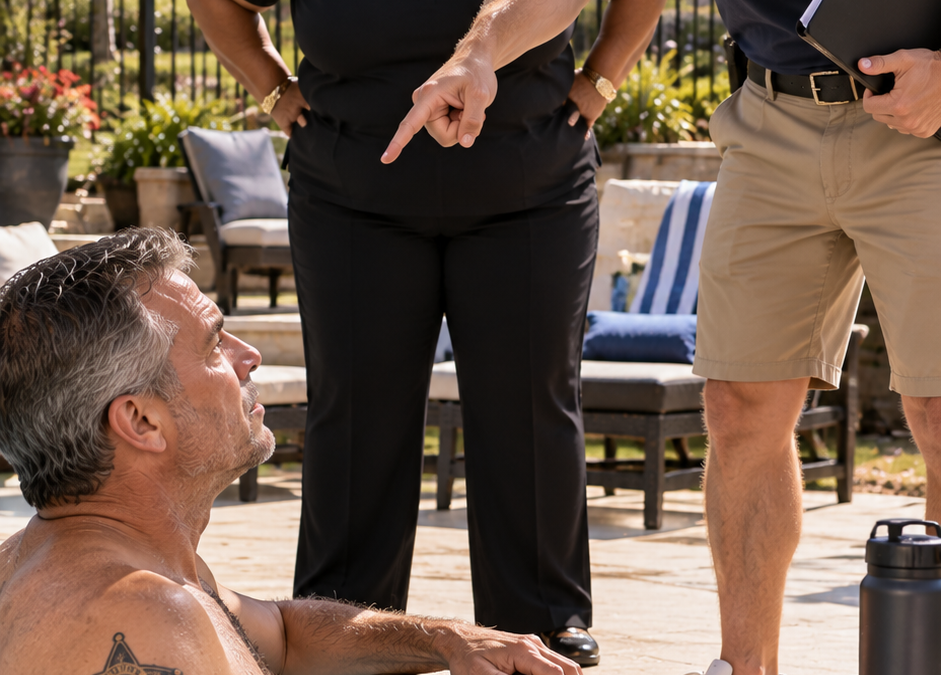
A young man in his mid-twenties was walking toward me.
Khaki shorts.
Polo shirt.
Clipboard under one arm.
A laminated card clipped to his collar.
White background.
Blue border.
Large block letters:
HOA ENFORCEMENT
He stopped at the edge of my pool and pointed down at me.
“Out of the pool.”
I stared at him.
“I’m sorry?”
“You heard me.”
His tone carried the confidence of somebody who had practiced sounding official long before anybody gave him actual authority.
“This pool is now HOA community property.”
He pulled the laminated card off his shirt and held it up.
“Only registered HOA members with current pool authorization are permitted access.”
I looked toward the gate.
Then toward my back door.
A brass key hung from a hook beside it.
Orange plastic tag.
14B.
My lot number.
The same lot number printed on the deed that described the pool behind me as a private residential amenity attached exclusively to my property.
I looked back at him.
“You’re saying I’m trespassing?”
He smiled.
“Exactly.”
He seemed genuinely pleased to say it.
“You have sixty seconds to collect your things or I’ll have you removed from the premises.”
I stayed in the water.
Not because I wanted to challenge him.
Because I have spent most of my adult life listening to people say things that aren’t true.
And one lesson has served me extremely well.
When someone is making a mistake confidently, don’t interrupt too early.
Let them finish.
“Do you know whose pool this is?” I asked.
“I don’t care whose name is on the lease.”
That line came out too cleanly.
Practiced.
“HOA bylaws override private-use arrangements. This pool falls under HOA jurisdiction.”
He raised his chin.
“That’s final.”
Then he pulled out his phone.
“I’m documenting unauthorized pool use for the compliance file.”
He began taking pictures of me.
Standing in my pool.
Behind my house.
On my deeded property.
While two home-security cameras mounted beneath the eaves recorded him from different angles.
He hadn’t noticed either one.
That was fine with me.
He announced that HOA security would be called next.
There was no HOA security department.
I knew that already.
Apparently, he had created a title, printed a badge, and built an organization around himself.
I climbed out of the pool.
Not because he ordered me to.
I wanted to be standing for what I suspected was coming next.
I picked up my towel.
He watched me with visible satisfaction.
Then he said it.
“My mother is the HOA board president.”
There it was.
Not authority.
Inheritance.
He pointed toward the gate.
“This pool falls under HOA jurisdiction. You have sixty seconds to collect your belongings before I have you removed.”
I dried my face.
Said nothing.
He mistook silence for surrender.
Made a note on his clipboard.
Nodded once.
The kind of nod a man gives when he thinks he’s just won something.
What he had actually done in less than five minutes was enter private property without permission, assert powers his organization didn’t possess, photograph a homeowner under a false trespass claim, and memorialize the entire encounter in his own handwriting while my cameras recorded every second.
He had come to document me.
Instead, he documented himself.
“You’ll receive a formal notice by Monday,” he said. “I’d take it seriously.”
Then he walked out through the gate.
Didn’t ask permission.
Didn’t apologize.
Didn’t look back.
I stood barefoot on the warm concrete.
The pool water moved in widening circles.
The key marked 14B still hung beside the door.
Everything around me looked exactly as it had ten minutes earlier.
But something had changed.
Not because Karen Aldrich’s son had irritated me.
I had been irritated by better men than him.
What changed was that I finally understood the kind of operation Karen had built inside this neighborhood.
And I also understood something neither Karen nor her son knew yet.
For eleven years, I had served as the sheriff of this county.
I had deliberately told almost nobody in the subdivision.
I wanted to live here as a neighbor.
Not a badge.
Not a title.
Not a man people behaved differently around because they knew what office I occupied.
Dylan had just walked into the backyard of the one homeowner most likely to know exactly where private rules ended and actual law began.
And he had done it carrying his own evidence.
PART2
I bought the house eight months earlier.
Four bedrooms.
Quiet street.
Mature trees.
In-ground pool.
Private backyard.
The listing described the pool as a major selling point.
The deed was more useful.
Deeds usually are.
The language was unambiguous.
The pool was a private residential amenity attached to Lot 14B.
Not part of the community pool system.
Not shared property.
Not under any separate recreational easement.
Mine.
I read that paragraph three times before closing.
Old habit.
When you’ve spent a career dealing with disputes, warrants, affidavits, probable cause statements, property descriptions, contracts, and people who swear something says what it does not actually say, you learn to read slowly.
I moved in on a Thursday.
By Saturday, an HOA welcome packet was waiting in my mailbox.
Glossy folder.
Color tabs.
Photograph of the board.
Karen Aldrich stood in the center.
Blazer.
Perfect posture.
Smile that looked more managerial than friendly.
I attended my first HOA meeting two weeks later.
Mostly curiosity.
I wanted to know what kind of neighborhood I had moved into.
Karen entered as though she were chairing a corporate acquisition.
Printed agendas.
Hole-punched packets.
Violation summary.
She read eleven property addresses aloud in the first ten minutes.
Then moved to maintenance.
Assessments.
Compliance.
I listened.
When homeowner questions opened, I raised my hand.
“My monthly statement includes a community pool maintenance fee.”
Karen looked toward me.
“Correct.”
“I have a private pool.”
“Yes.”
“It’s on my deed. I don’t use the community pool.”
She gave me the patient expression adults sometimes use on children who have interrupted at an inconvenient time.
“All pool-adjacent properties contribute to neighborhood aquatic infrastructure.”
I wrote that down.
Word for word.
Not because it made sense.
Because it didn’t.
All pool-adjacent properties contribute to neighborhood aquatic infrastructure.
That sentence sounded official.
It meant almost nothing.
And sentences like that are often load-bearing walls in organizations built on intimidation.
Nobody else questioned her.
Several people nodded.
I started paying attention.
The board supposedly had five seats.
Karen held the presidency.
Two members voted with her on nearly everything.
The fourth seat had been open for months.
The fifth had been vacant more than a year.
No election had been scheduled to fill either.
Then there was Dylan.
Karen’s son.
No board seat.
No appointment in the governing documents.
No legitimate enforcement title that I could find.
Yet he drove around the subdivision in Karen’s second vehicle, photographed yards, left notices, warned residents, and wore his homemade HOA ENFORCEMENT badge.
Nobody challenged him.
That interested me.
Fear doesn’t always come from knowing what someone can do.
Sometimes it comes from not knowing.
That was Karen’s real system.
Ninety-six homes.
Ninety-six families.
Most weren’t sure where the rules ended.
They weren’t sure which fines were enforceable.
They didn’t know who could lien what.
They didn’t know whether Dylan could actually order them around.
So they complied.
The Pattersons lived three houses away.
Harold and Margaret.
Both in their seventies.
Their crime was a ceramic garden gnome.
Eighteen inches tall.
Hand-painted.
Gift from their daughter.
Karen fined them eight hundred dollars for an “unauthorized decorative installation in a designated visibility zone.”
Harold paid.
Not because he believed the gnome violated anything.
He told me over the fence:
“I can’t afford to find out what happens if I don’t.”
That sentence bothered me more than the fine.
On the east side lived Sandra.
Single mother.
Two children.
Two jobs.
Her driveway developed a hairline crack after a winter freeze.
Normal wear.
Karen’s notice required repair using an HOA-approved contractor.
Sandra called independent contractors first.
Quotes ranged between $350 and $425.
The HOA-approved contractor charged $1,200.
She paid because the notice threatened escalating penalties.
Then there was Roy.
Retired teacher.
He painted his fence a soft beige listed on the HOA’s approved color chart.
Two weeks after the work was complete, Karen changed the chart.
His color disappeared.
The following Monday, Roy received a violation.
He still had the original guidelines.
Dated.
Approved.
Initialed.
I started keeping notes.
Nothing formal at first.
Small notebook.
Date.
Resident.
Fine.
Reason.
What Karen said.
What Dylan did.
I wasn’t conducting an investigation.
Not yet.
I was doing what I’ve always done before deciding whether something is a pattern.
I documented.
I also kept my occupation to myself.
I drove an unmarked vehicle.
No campaign sticker.
No sheriff decal.
No special plate anyone outside law enforcement would recognize.
After eleven years in office and years before that in law enforcement, I wanted one address where I could be a man who occasionally needed to clean leaves out of his pool.
That privacy mattered.
Karen and Dylan behaved around me exactly the way they behaved around everyone else.
That turned out to be useful.
I ordered a certified copy of the HOA’s recorded CC&Rs.
Then I read them.
Every page.
Section 7.4 governed pools.
Not all pools.
The community pool.
Maintenance.
Guest rules.
Shared access.
Operating hours.
Safety standards.
There was nothing extending HOA control to private pools inside individually deeded lots.
Nothing.
Karen had taken a rule governing the central community facility and stretched it into jurisdiction over privately owned pools.
Then she built fines around that interpretation.
Two days after Dylan entered my backyard, Karen knocked on my front door.
10:15 in the morning.
Dylan stood behind her.
Same badge.
Same clipboard.
Karen held out a document.
I took it.
Official-looking formatting.
Reference number.
Bold header.
Fine amount in a box.
$250.
Violation:
HOA POOL SAFETY ORDINANCE 12B
Failure to maintain current pool access authorization.
“You have fourteen days to pay or contest,” Karen said.
Then:
“I’d recommend paying.”
I read the notice from top to bottom.
Slowly.
Karen shifted her weight.
Dylan stood perfectly still.
“What section of the recorded CC&Rs authorizes Ordinance 12B?”
Karen didn’t hesitate.
“All pools are subject to HOA safety oversight.”
“I’ve read the CC&Rs.”
Her eyes narrowed slightly.
“Can you give me the section number?”
“The ordinance speaks for itself.”
“No. An ordinance does not establish its own authority.”
She gave me the look people use when they think specificity is disrespect.
Dylan cut in.
“We’ve already removed three other residents from their pools this month.”
I turned toward him.
“Three?”
“Yes.”
“Private pools?”
“You’re not a special case.”
He thought that helped.
It didn’t.
It meant this was bigger.
I nodded.
“Thank you.”
Karen looked surprised.
“I’ll review it.”
I closed the door.
Then I went to my filing cabinet.
Section 7.4.
Read it again.
Community pool only.
No private-pool jurisdiction.
I photographed the page.
Timestamp.
Saved one copy locally.
One to secure storage.
Then I found meeting minutes.
Ordinance 12B had been created by board amendment.
That meant the next question was whether the amendment itself had been valid.
Before I reached that part, Karen sent an email.
9:14 Tuesday night.
Subject:
FINAL NOTICE — HOA COMPLIANCE ACTION PENDING
The third paragraph threatened a lien against my property if I refused to pay.
Recorded against the deed.
Could affect sale.
Refinance.
Transfer.
That was escalation.
A $250 fine is nuisance money.
A lien threat is different.
Karen had moved from bluffing about pool access to threatening legal encumbrance against property under authority she might not possess.
I printed the email.
Added it to the folder.
Then forwarded it to two people.
No message.
They knew me well enough to understand why I was sending it.
One worked in the county attorney’s office.
The other was a prosecutor I’d worked with for six years.
I still didn’t tell them to do anything.
I wanted documentation first.
The following week, I went door to door.
No uniform.
No badge.
No official introduction.
“I’m your neighbor. I’m looking at HOA compliance practices. If you have documentation you’d be comfortable sharing, I’d like to see it.”
That was all.
The Pattersons let me in.
Margaret checked the street before closing the door.
That told me something.
Fear had become habit.
They showed me the gnome violation.
Eight hundred dollars.
Harold had called Karen asking for the rule.
Karen said the board had broad aesthetic authority.
Then told him he could request a hearing.
Hearing fee:
Fifty dollars.
And, according to Karen, no resident had ever won one.
They paid instead.
Margaret kept everything in a shoebox.
Every notice.
Every year.
Chronological.
I photographed the gnome violation with permission.
Sandra’s documents were more complicated.
Her driveway repair quotes were exactly as she’d said.
Three independent contractors:
$350.
$390.
$425.
The approved contractor:
$1,200.
I photographed the invoice.
Then noticed the billing service.
Wrote it down.
The contractor’s name looked familiar.
I’d seen it in an HOA newsletter sponsor acknowledgment.
Maybe coincidence.
Maybe not.
I circled it in my notes.
Roy had the cleanest paper trail.
Original approved color chart.
Date.
His painter’s invoice.
Date.
Revised HOA color chart.
Date.
Violation notice.
Date.
There was no ambiguity.
His fence had been compliant when painted.
Karen changed the rule afterward.
Then punished him retroactively.
“I didn’t paint my fence wrong,” Roy said.
“She moved the target after I stopped moving.”
I requested one year of board minutes.
Residents were entitled to them.
Karen’s assistant, Pam, sent them within forty-eight hours.
I suspect Pam had long since stopped asking whether Karen wanted things released and simply followed written policy when a request was proper.
I read every page.
Four major amendments had been passed in eleven months.
Pool Ordinance 12B.
Revised color standards.
Noise restriction.
Vehicle rule.
Each amendment had exactly two affirmative votes.
Karen.
One ally.
The governing bylaws required three affirmative votes to amend association rules.
Plain language.
No ambiguity.
Three.
They had two.
Every one of those amendments was procedurally defective.
Including the pool ordinance.
The ordinance Dylan cited when he entered my backyard.
The ordinance Karen used for my fine.
The ordinance supporting the lien threat.
I spread everything across my dining table.
Deed.
Section 7.4.
Ordinance 12B.
Minutes.
Karen’s email.
Patterson gnome fine.
Sandra’s contractor invoice.
Roy’s fence documents.
My notebook.
Fourteen entries now.
I still didn’t act.
Because once you move officially, you need to know exactly what you’re moving on.
Eleven days after Karen handed me the violation, I walked outside at 7:15 in the morning.
My pool gate had been padlocked.
Heavy steel lock.
Orange HOA notice taped at eye level.
PROPERTY UNDER HOA COMPLIANCE REVIEW
ACCESS SUSPENDED
Dylan stood ten feet away on my lawn.
Arms folded.
Waiting.
“HOA has temporarily suspended pool access pending compliance.”
I looked at the lock.
Then him.
Then the notice.
“Okay.”
His expression changed.
He wanted anger.
I went inside.
Called a locksmith.
Then opened my security system.
Pool-gate camera.
Rewound.
6:28 a.m.
Dylan’s car stopped on the street.
He walked along the side of my home.
Opened my private side gate.
Carried tools and a padlock.
Four minutes at the pool gate.
6:32.
Lock secured.
No prior notice.
No board meeting.
No vote.
No court order.
He had simply decided my access to my own pool could be physically restricted.
I saved the footage.
Named the file with date and time.
Backed it up twice.
The locksmith arrived forty minutes later.
Three minutes of work.
Lock off.
I put it in a paper bag.
I’ve spent enough time around evidence rooms to know one rule applies even at home.
Don’t throw away the thing that proves what happened.
Karen called police before noon.
Two officers from a neighboring precinct arrived at 12:47.
Neither knew me personally.
That was useful.
Karen intercepted them near the curb.
I watched from inside.
She had her folder.
Violation notice.
Compliance paperwork.
Dylan’s photos.
She spoke for several minutes.
They listened.
Then came to my door.
I answered.
They explained there had been a complaint involving HOA access and asked whether I would step outside.
“Of course.”
I gave them nothing beyond what they asked for.
One inspected the pool gate.
No padlock by then.
They examined the property.
Talked quietly.
Then wrote the incident as a civil dispute.
No criminal element established at the time of response.
Reasonable based on the narrow information they had.
Karen read the notation.
Then turned toward several neighbors watching nearby.
“See?”
Her voice carried.
“Even the police confirmed HOA authority.”
The officer looked at her.
He hadn’t confirmed anything.
He had written civil dispute.
Those are not remotely the same thing.
Harold Patterson looked toward the ground.
Sandra stood across the street.
I memorized the officer’s badge number.
Not to punish him.
Because the record needed clarification later.
After everyone left, I went back inside.
Opened county code.
Found the provision I’d already had in mind.
Unlawful interference with private residential property access.
A non-owner physically restricting lawful access to private property without legal authority.
Class B misdemeanor under the applicable county code framework.
I read the elements twice.
Then matched them to the security footage.
Entry.
Private property.
Padlock.
No consent.
No court order.
No valid authority.
No notice.
Dylan had put himself squarely inside the problem.
That afternoon, I made the call I’d been waiting to make.
I didn’t call Karen.
The next major HOA notice went to all ninety-six houses.
COMMUNITY SAFETY AND COMPLIANCE FORUM
Attendance strongly encouraged.
Thursday.
7:00 p.m.
Community room.
The subject was enforcement.
I was the enforcement problem.
I arrived twenty minutes early.
Sat toward the back.
Same way I always did.
Sandra entered with her daughter.
Pattersons three rows ahead.
Roy in the middle.
Greg two houses down sat near the front.
People noticed me.
Some nodded.
Others looked away.
Nobody was rude.
They were cautious.
That’s what fear looks like after it becomes culture.
Karen opened at exactly seven.
Board table.
Microphone.
Printed agenda.
Dylan sat at the far right.
Not listed as a board member.
Agenda called him:
Documentation Support
Three-ring binder in front of him.
Karen summarized my “violations.”
Refusal to pay.
Interference with enforcement.
Noncompliance.
Potential lien action.
Every phrase sounded pre-cleared.
Dylan presented photographs from my pool incident.
His photographs.
The ones he had taken while trespassing.
He displayed the violation.
Ordinance 12B.
Then the police incident notation.
The board allies nodded as though “civil dispute” meant law enforcement endorsement.
Karen returned to the podium.
“This is not about one pool.”
She paused.
“This is about whether the rules in this community mean something.”
Then:
“If one resident can simply ignore HOA authority, everything we’ve built here falls apart.”
Several people nodded.
Not all because they agreed.
Some because nodding had become safer than being noticed.
Karen finally looked toward me.
“Mr. Hale, would you like to respond?”
I stood.
Opened the folder.
“Three questions.”
The room got quieter.
“First: Was Pool Safety Ordinance 12B adopted with the vote required by Section 4.7 of the governing bylaws?”
Karen’s expression shifted.
“The ordinance was properly adopted.”
“How many affirmative votes?”
Dwight, her strongest board ally, interrupted.
“This is not a legal proceeding.”
I looked at him.
“No. It’s a question.”
Then back to Karen.
“How many affirmative votes?”
She didn’t answer.
“Second: Is the recorded vote for that amendment contained in the minutes residents are entitled to inspect?”
Karen said:
“Our records are maintained according to HOA policy.”
“Is that a yes?”
“The board operates transparently.”
I nodded.
“Third: Before enforcing Ordinance 12B against privately owned residential pools, did the HOA attorney review whether the recorded CC&Rs permit the board to regulate pools explicitly listed on individual deeds as private amenities?”
Silence.
Not one answer.
I closed the folder.
“Thank you.”
Sat down.
Karen moved immediately to a vote.
Formal lien action against my property.
Pending compliance.
Karen:
Yes.
Dwight:
Yes.
Patrice:
Yes.
Two remaining members:
No.
Three to two.
Ironically, the first vote they’d managed to take with three affirmative votes in a long time.
The room went still.
People looked at me.
I gave them nothing.
Because the vote was never the meeting I was preparing for.
I thanked Karen.
Left.
Outside, the air felt cooler.
Behind me, chairs scraped.
Voices resumed.
I walked home.
One week later, Karen, Dylan, Dwight, Patrice, and the third aligned board member each received certified letters.
County letterhead.
Return receipt.
Invitation to discuss legal issues related to the HOA’s enforcement actions and associated property violations.
Location:
County Sheriff’s Office.
Third floor conference room.
Wednesday.
9:00 a.m.
I signed the letters.
I didn’t put “Sheriff” beside my name in the body.
Didn’t need to.
I later learned Karen told the others it was probably some county mediation procedure.
She brought their HOA attorney.
Garrett.
Community-association law.
Expensive suit.
Expensive briefcase.
They arrived at 8:55.
A uniformed deputy opened the conference-room door.
County seal on the wall.
State flag.
County flag.
Framed commendations.
I was seated at the head of the table.
In uniform.
Badge visible.
Nameplate in front of me.
The deputy county attorney sat to my right.
Her name was Ellen.
She had the file.
Dylan entered first.
Stopped.
Actually stopped mid-step.
One foot inside.
One still in the hallway.
His eyes went to my uniform.
Then badge.
Then nameplate.
Then face.
Back to badge.
I had seen that look many times in my career.
The moment when someone realizes the assumptions they carried into a room were never attached to reality.
He turned toward Karen.
Karen looked at me.
For three full seconds, nobody spoke.
Three seconds in a silent conference room is a very long time.
“Please,” I said.
“Sit.”
They sat.
Garrett opened his briefcase.
Didn’t look at Karen.
The board members arranged themselves along one side.
I introduced myself.
Full name.
County sheriff.
Eleven years in office.
I explained that Ellen from the county attorney’s office had been briefed.
Nobody was detained.
The meeting was informational.
They were free to leave.
Then I opened the manila folder.
“Let’s begin with the pool.”
I slid my deed across.
Lot 14B.
Private residential amenity.
Exclusive to the parcel.
No shared ownership.
No community-pool classification.
“The pool Dylan ordered me to leave is private property.”
I looked toward him.
“That has been true since before Karen was elected.”
Karen inhaled.
“The HOA has always—”
I slid the CC&Rs across.
Section 7.4 tabbed.
“Community pool.”
Garrett leaned forward.
Read.
Then read again.
Third paragraph.
Scope clearly limited to the shared facility.
He made a note.
Underlined something.
Karen read the same page.
Stopped talking.
“The second issue is the padlock.”
Dylan shifted.
I described the footage.
6:28 a.m.
His car.
Side gate.
Tools.
Padlock.
6:32 secured.
No board vote.
No notice.
No court order.
No legal authority.
I didn’t need to play the video.
He knew what he’d done.
I knew.
Ellen knew.
Garrett knew what the facts meant.
“Dylan, physically restricting a homeowner’s access to private residential property without lawful authority implicates county criminal law.”
His voice changed.
“I was following the ordinance.”
Then:
“My mother said—”
I looked at him.
He stopped.
Garrett wrote more.
“The third issue is the ordinance.”
I laid down the meeting minutes.
Four amendments.
Two votes each.
Then the bylaws.
Three affirmative votes required.
“Ordinance 12B was never validly enacted.”
Dwight stared at the tabletop.
Patrice looked toward the county flag.
Karen sat very still.
“Neither were the revised color rule, the noise amendment, or the vehicle restriction.”
I paused.
“Every enforcement action based on those amendments is legally vulnerable.”
Nobody spoke.
“The fourth matter is the lien threat.”
Karen’s 9:14 email went on the table.
Her words.
Her warning.
Her intention to encumber my deed.
“Threatening lien action based on a void rule, applied to property outside the rule’s scope, raises questions beyond ordinary HOA administration.”
I looked around the table.
“The county attorney received this yesterday.”
Karen stood.
I said:
“You’re free to leave.”
She remained standing.
“This meeting is not detention.”
She looked at Garrett.
He looked at his legal pad.
Not at her.
Karen slowly sat down again.
That told me everything.
Garrett finally asked:
“Has your office reached a formal conclusion?”
Ellen answered before I did.
“Review is active.”
Garrett nodded.
“What happens next?”
“That depends significantly on cooperation and corrective action.”
Forty minutes.
That was the entire meeting.
Karen and Dylan left first.
Garrett followed.
He walked separately.
Dwight and Patrice stayed.
Neither looked at the other.
Finally Dwight asked:
“What does cooperation look like?”
Ellen handed him her card.
“Preserve records. Do not destroy anything. Respond accurately.”
Patrice asked whether they were personally liable for the lien vote.
I said:
“That’s a question for your own attorney.”
Then I added:
“In my experience, people who come forward early and tell the truth tend to have very different outcomes from people who don’t.”
She took Ellen’s card with both hands.
When they left, I stayed in the conference room.
County flag moving slightly in the air conditioning.
Sunlight on the civic-center plaza.
Forty minutes.
Karen had spent years building her reputation.
But she built the legal structure underneath it badly.
Two votes instead of three.
Private property treated as common property.
Made-up enforcement authority.
Retaliatory fines.
A son with no formal office acting like a compliance officer.
The operation didn’t collapse because I was sheriff.
That mattered procedurally.
But what destroyed Karen’s authority was simpler.
Documents.
Her own documents.
The county attorney opened a formal review twelve days later.
Certified notices went to Karen, Dylan, board members, and HOA counsel.
Karen withdrew the lien action before it could be formally recorded.
The police incident record was clarified after supervisory review.
The original notation remained what it had actually been:
A civil-dispute response.
Not a finding that the HOA controlled my pool.
Then came the administrative review of the four amendments.
All four were invalidated because the board had not met its own required voting threshold.
Pool Ordinance 12B.
Color rule.
Noise provision.
Vehicle restriction.
Years of enforcement built on decisions that had never been validly adopted.
Dylan’s padlock case proceeded separately.
He ultimately accepted a plea on the unlawful property-access offense.
Community service.
No jail.
That was appropriate.
I had no interest in ruining a young man’s life because he’d confused his mother’s power with his own.
Consequences were enough.
The morning after our sheriff’s-office meeting, Dylan came back to my property before seven.
This time he did not enter the yard.
He removed what remained of the compliance materials at the gate.
Later, the padlock was returned in a plastic bag.
No note.
No apology.
I kept it with the original evidence.
Not because I wanted a trophy.
Records matter.
The financial review took longer.
Once the four amendments were declared invalid, every fine issued under them became contestable.
The remaining board voted to offer refunds rather than force ninety-six homeowners into individual appeals.
The Pattersons received their eight hundred dollars.
Harold brought the check over just to show me.
He held it like he couldn’t quite believe the paper existed.
“Margaret wants to put the gnome back out.”
“She should.”
“You think they’ll fine us?”
“No.”
He smiled.
“Good.”
Sandra got twelve hundred dollars back.
The amount she had paid the approved driveway contractor.
That contractor became its own problem.
An independent audit of the HOA’s operating account found quarterly payments from the contractor to an LLC registered under Karen’s maiden name.
I was not part of the civil investigation that followed.
Didn’t need to be.
Once proper people had the records, the process could work without me.
Roy received his refund.
More importantly, the HOA gave him a written acknowledgment that his fence had complied with the rules at the time it was painted.
He framed that letter.
Not because of the money.
Because for years Karen had made him feel like facts didn’t matter if she could change the rule afterward.
Across the neighborhood, refunds totaled a little over fourteen thousand dollars.
Not millions.
But each payment carried its own story.
Fourteen thousand dollars extracted in increments small enough that most residents had decided fighting cost more than surrender.
Karen resigned on a Tuesday.
Email.
“Personal reasons.”
Sent to Pam.
Not directly to the board.
Pam forwarded it.
By Thursday, Dwight and Patrice resigned too.
The third aligned member followed.
For the first time in three years, Cedarwood held a legitimate board election.
Saturday morning.
Forty-one households represented.
Highest turnout anyone remembered.
Harold Patterson was elected vice president.
Margaret became secretary.
Sandra became treasurer.
Roy joined the nominating committee.
When the last board seat was opened, someone called my name from the back.
Greg, I think.
A few people agreed.
I stood.
“Thank you.”
Then:
“No.”
There were laughs.
I smiled.
“This neighborhood needs neighbors running the HOA.”
Not a sheriff.
Not a prosecutor.
Not somebody bringing county authority into a volunteer organization.
They had better people already in the room.
The neighborhood changed slowly afterward.
That’s the part I remember most.
Not the resignations.
Not the county letters.
Not Dylan’s expression when he saw my badge.
People came outside again.
The Pattersons put the gnome back in the flower bed.
Not hidden.
Right near the walkway.
Eighteen inches of ceramic rebellion.
Sandra planted flowers along her front porch.
Roy repainted his fence.
The original beige.
The color that had been valid before Karen rewrote the rule.
He played music from a speaker while he worked.
People stopped by.
Some helped.
Some just talked.
Someone planted sunflowers on the east side.
Too tall for whatever Karen’s old landscaping rule probably said.
Nobody measured them.
At the new board’s first meeting, Harold opened by saying:
“If someone asks what rule authorizes something, we are going to answer with the actual rule.”
That got applause.
Then he added:
“If we can’t find one, we’re going to assume we don’t have one.”
More applause.
Simple.
Almost embarrassingly simple.
But Karen’s system had survived because nobody demanded that sentence.
My own pool returned to being what it had been before Dylan entered my yard.
A pool.
Nothing symbolic about it.
No legal battleground.
No “aquatic infrastructure.”
Just water behind a house.
I went back to it one Saturday in late October.
Afternoon sun lower than August.
Air cooler.
Same chair.
Same water bottle.
Same brass key by the back door.
Orange tag:
14B.
The pool gate opened normally.
No padlock.
No orange notice.
No young man in khaki shorts carrying a clipboard.
I floated on my back.
For the first time in weeks, I wasn’t thinking about minutes, votes, liens, statutes, contractor invoices, or board records.
I was thinking about nothing.
That was the point.
People imagine stories like this end when somebody powerful gets exposed.
They don’t.
They end when ordinary life becomes ordinary again.
Karen’s biggest mistake wasn’t threatening the sheriff.
She didn’t know who I was.
And I don’t believe homeowners should need to be sheriffs to have their property rights respected.
That would be a terrible lesson.
Her mistake was believing the rules only mattered when they served her.
She believed nobody would read Section 7.4.
Nobody would count the votes.
Nobody would compare an ordinance to the bylaws.
Nobody would question Dylan’s fake authority.
Nobody would save an email.
Nobody would back up a camera.
Nobody would ask:
“Where does it actually say you can do this?”
For years, she was almost right.
Ninety-five households learned to pay first and ask questions never.
Then Dylan opened the wrong gate.
People still occasionally ask what I thought when he said:
“My mother is the HOA president.”
I remember exactly what I thought.
Nothing dramatic.
Just:
That explains a lot.
He believed authority could be inherited socially.
Karen had authority, therefore he had authority.
Karen controlled the board, therefore her rules were law.
A laminated badge made him enforcement.
A clipboard made him official.
A phone camera made him the person creating the record.
He never considered that someone else might be keeping a better record.
That’s the part I have tried to explain to younger deputies over the years too.
Authority is not performance.
A uniform doesn’t make every action lawful.
A badge doesn’t replace jurisdiction.
A title doesn’t replace procedure.
If anything, the more authority people think you possess, the more careful you have to be about its limits.
Karen understood only the first half.
She liked authority.
She hated limits.
That’s why her system broke.
One afternoon after the new board took office, Margaret Patterson knocked on my door.
She had the gnome.
The actual gnome.
Held against her chest.
“I need an opinion.”
“On what?”
“Placement.”
I laughed.
She pointed toward the flower bed.
“Harold says front and center. I think that looks aggressive.”
“It’s a garden gnome.”
“Exactly.”
We walked over.
Harold was waiting.
He had already dug a small hole.
I said:
“You’re asking the sheriff where to legally place a gnome?”
Harold nodded seriously.
“This is official business.”
I looked at the bed.
“Six inches to the left.”
Margaret laughed.
Harold moved it.
“Perfect.”
That gnome stayed.
Nobody measured it.
Nobody photographed it.
Nobody charged anyone eight hundred dollars.
Another day, Roy stopped me near the mailbox.
“Question.”
“What?”
“Fence still beige enough?”
“Don’t start.”
He grinned.
“I want a professional opinion.”
“I’m not a painter.”
“But you are apparently the person people ask about everything now.”
“That’s exactly what I’m trying to avoid.”
He laughed and walked away.
Those conversations mattered more than the conference room reveal.
People weren’t afraid anymore.
Not of being seen talking to me.
Not of being noticed by a board member.
Not of a surprise letter.
The HOA still existed.
There were still dues.
Common landscaping.
Pool maintenance.
Insurance.
Rules.
But the rules were written down.
Votes were counted correctly.
Minutes were available.
Appeals didn’t require paying for the privilege of asking a question.
The board learned something Karen never had.
Good governance is boring.
It should be.
If a neighborhood association regularly makes people afraid, something has gone wrong.
Dylan completed his community service.
I heard through someone else that he moved out of Karen’s house the following year.
I never spoke to him again.
That was fine.
Some people expect stories like this to end with a confrontation.
An apology.
Maybe Dylan returning to my pool gate and saying he’d been wrong.
Real life rarely organizes itself that neatly.
He faced consequences.
The record was corrected.
That was sufficient.
Karen stayed in the neighborhood for several months after resigning.
She stopped attending meetings.
Her house became noticeably quieter.
No parade of homeowners at the door.
No clipboard.
No HOA materials being loaded into her car.
I saw her once at the grocery store.
We were in different aisles.
She noticed me.
I nodded.
She looked away.
I kept shopping.
I didn’t need anything from her.
That may have been the point at which I knew it was truly finished.
When someone has occupied your attention through conflict, freedom isn’t always defeating them.
Sometimes it’s reaching the moment when seeing them doesn’t change your heartbeat.
I kept the orange compliance notice.
Top drawer of my home office.
I kept Karen’s lien email.
I kept the invalid ordinance.
The padlock too.
Not displayed.
Not framed.
Filed.
A record.
My career taught me that memory gets emotional.
Paper stays boring.
Boring is useful.
One year later, the board asked residents to approve an updated version of the pool rules.
For the actual community pool.
The proposal went out thirty days before the vote.
Marked changes.
Legal review attached.
Open question period.
All five board seats occupied.
The amendment passed four to one.
Correct quorum.
Correct notice.
Correct scope.
Harold called me afterward.
“You proud of us?”
“Deeply moved.”
“I can hear the emotion.”
“Try not to abuse your newfound authority.”
He lowered his voice theatrically.
“I already ordered three people out of their private pools.”
I hung up on him.
He called back laughing.
That’s what normal sounds like.
One Saturday, almost exactly a year after Dylan first walked into my backyard, I sat beside the pool again.
Same late-August heat.
Same angle of afternoon sun.
I remembered him opening the gate.
Pointing.
“Out of the pool.”
At the time, he thought the most important fact in that backyard was that his mother ran the HOA.
It wasn’t.
The most important fact wasn’t that I was sheriff either.
It was simpler.
He had crossed onto land that wasn’t his.
He had ordered the lawful owner to leave.
Everything that followed came from refusing to check that basic fact.
The deed was clear.
The CC&Rs were clear.
The vote requirement was clear.
The camera footage was clear.
Karen and Dylan had built an entire enforcement system by assuming nobody would ever place those things next to each other.
I did.
So did the county attorney.
Then the neighborhood finally did too.
I stepped into the pool.
Water warm from the sun.
Floated toward the deep end.
The gate remained closed.
Not locked.
Just closed.
That’s how it should be.
There is a difference between protection and control.
A gate can protect privacy without trapping the person who owns what’s behind it.
A rule can protect a neighborhood without becoming a weapon.
A board can govern without making people afraid.
And authority can exist without constantly proving itself.
Karen never understood that.
Dylan definitely didn’t.
The key was still hanging beside the back door.
Small brass key.
Orange tag.
14B.
The right key for the right lock.
That’s ultimately what the whole situation came down to.
Karen had spent years forcing the wrong key into everything.
Wrong rule.
Wrong vote.
Wrong authority.
Wrong property.
For a while, force made it seem like the key fit.
Then someone finally checked the lock.
And once that happened, the door opened exactly the way it was supposed to.








