𝗣𝗔𝗥𝗧 𝟮 HOA Karen Went Crazy When I Planted Kudzu and Goats—Then 43 Neighbors Turned on Her
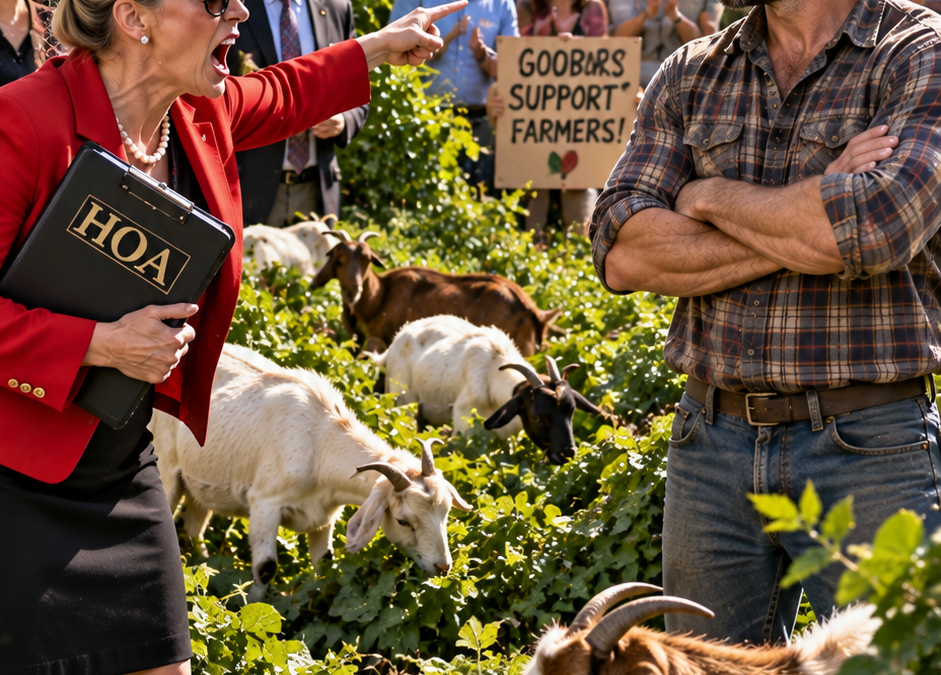
PART2
The first fine arrived before I planted anything.
Five hundred dollars.
“Severe turf discoloration.”
I put it in a folder.
Then another arrived.
Five hundred more.
I put that one in the same folder.
Three houses down, Sylvia Chen received hers.
Sylvia was seventy-one, retired after thirty years as a pharmacist, and possessed the terrifying patience of a woman who had spent most of her career explaining prescription instructions to people determined not to listen.
She brought the notice over.
“Apparently my yard is severely discolored.”
I looked across the street.
Her grass was dormant.
Nothing more.
“Looks dangerous.”
“I was afraid of that.”
She sat at my kitchen table.
“They want five hundred dollars.”
“So do they from me.”
“I followed every water restriction.”
“So did I.”
She shook her head.
“This can’t be legal.”
“Legal and enforceable aren’t always the same thing.”
She looked at me.
“You’ve been reading the bylaws.”
“How can you tell?”
“You’ve got that face.”
“What face?”
“The one you had when the city tried putting the stop sign on the wrong side of the easement.”
I poured her coffee.
“I found something.”
That got her attention.
I turned the covenants toward her.
Section Seven.
Subsection C.
It had been written years before Brenda became president.
The language was almost thoughtful.
During drought conditions, homeowners were encouraged to replace traditional turf with native or drought-resistant ground cover requiring minimal irrigation.
Then came the prohibited-species list.
Bamboo.
English ivy.
Japanese knotweed.
A few ornamentals.
No kudzu.
Sylvia read the paragraph.
Then looked at me.
“No.”
“Yes.”
“Walt.”
“Yes.”
“You aren’t.”
“I am considering all lawful drought-resistant options.”
She started laughing.
“You’re going to plant kudzu.”
“I didn’t say that.”
“You didn’t have to.”
Kudzu is famous for a reason.
Given warmth, sun, and enough soil, it grows like something trying to collect back rent from the continent.
I’ve seen abandoned buildings swallowed by it.
Telephone poles.
Fences.
Cars.
The joke down South is that if you park too long, you need to leave the engine running so the kudzu knows the vehicle isn’t abandoned.
I did not need that much.
I needed one thing.
Green.
Brenda had demanded one hundred percent natural green coverage.
I intended to give her exactly that.
Before ordering anything, I kept reading.
That was when I found Brenda’s second mistake.
Earlier that spring, she had pushed through a landscaping amendment banning mechanical cutting equipment on newly established ground cover during drought conditions.
Her stated concern was soil compaction and root damage.
No gas mower.
No electric mower.
No rotary blades.
The rule was absurdly specific.
And it said absolutely nothing about livestock.
I leaned back in my chair.
Read it again.
Then checked county agricultural regulations.
Small ruminants were permitted temporarily for vegetation management on private residential land if properly enclosed and registered.
My backyard already had a six-foot cedar fence.
The front could be contained with temporary mesh.
I wrote one word on my legal pad.
GOATS.
Then I went to bed smiling.
The kudzu arrived Saturday.
Sixty root crowns packed in damp burlap.
The nursery driver unloaded them and stared at my quarter-acre front yard.
“You know what this is?”
“Kudzu.”
“You’re sure?”
“Very.”
He handed me the receipt.
Then a note from the nursery owner.
HOPE YOU KNOW WHAT YOU’RE DOING, BUDDY.
Fair.
Ruth Alvarez watched from next door while I planted.
Ruth was sixty-eight, widowed, sharp, and incapable of pretending something was boring when it wasn’t.
She leaned over the fence with sweet tea.
“Walt.”
“Ruth.”
“That’s kudzu.”
“Yes.”
“My sister had kudzu eat a gas station in Alabama.”
“I’ve heard good things.”
“It covered both pumps.”
“Efficient.”
She studied me.
“Does Brenda know?”
“Not yet.”
Ruth slowly smiled.
“Oh.”
“What?”
“Nothing.”
“You’re enjoying this.”
“I’ve lived on this street eleven years. Let me have something.”
The first shoots appeared within a week.
By the second, green vines were spreading across the bare soil.
By the third, I had achieved Brenda’s dream.
One hundred percent natural green coverage.
Not a single brown patch visible from the street.
Unfortunately for Brenda, the lawn now looked like an archaeological site being reclaimed by jungle.
The vine wrapped around my mailbox.
Crawled toward the porch.
Climbed a decorative rock.
Explored the edge of the driveway.
I kept it away from structures and neighboring property.
Mostly.
One tendril reached toward Brenda’s peonies two lots down.
I cut that one by hand.
I wasn’t trying to destroy the neighborhood.
I was making a point.
A very green point.
Kids started calling my house “the jungle.”
Marcus Reyes came over one evening and stood with a beer staring at my yard.
Marcus was an electrician.
Two kids.
Mortgage.
Too much common sense to volunteer for an HOA board.
He shook his head.
“You’re either the smartest man on this street or the dumbest.”
“Give it time.”
“My daughter thinks you’re getting a tiger.”
“No tiger.”
“Disappointing.”
Then he became serious.
“We got another fine.”
“How much?”
“Seven hundred.”
“For?”
“Five for the lawn.”
“And two hundred because the swing set is visible.”
I looked across the street.
His daughters were playing on it.
One was six.
The other four.
“Unsightly recreational equipment?”
“That’s the phrase.”
His jaw tightened.
“I started calculating how many weeks of these fines we can take before it starts coming out of groceries.”
That changed something for me.
Until then, my fight with Brenda had felt personal.
I could afford a few stupid fines while challenging them.
Marcus couldn’t.
Neither could some of the retirees.
Brenda wasn’t enforcing standards anymore.
She was turning drought into a revenue stream.
That night, I stopped thinking about embarrassing her.
I started thinking about how to break the rule itself.
Brenda discovered the kudzu after returning from a design conference in Houston.
She did not call.
She sent landscapers.
At eight Tuesday morning, I heard hedge trimmers.
I walked outside wearing a bathrobe and slippers.
Two men from Callaway Premium Lawn Care were standing near my property line cutting vines.
Callaway.
As in Brenda Callaway’s husband.
Naturally.
“Morning.”
The older man shut off the trimmer.
“Mr. Osborne?”
“Yes.”
“HOA sent us.”
“To do what?”
“Remove invasive growth.”
“From my property?”
He looked uncomfortable.
“That’s the order.”
“Do you have a signed work authorization from me?”
“No.”
“Court order?”
“No.”
“County order?”
“No.”
“Then you’re trespassing.”
The younger man looked toward the truck.
I continued.
“My doorbell camera has your arrival, company name, license plate, and both of you crossing my boundary with cutting equipment.”
They packed up in under two minutes.
I filed a complaint.
County code enforcement wasn’t exactly mobilized by the Great Kudzu Crisis of Meadowbrook Court.
But the report created something more useful.
A timestamp.
Brenda had now authorized a private company connected to her family to enter my property without consent.
Paper trails matter.
Especially around people who believe paperwork only works in one direction.
She called that afternoon.
“What have you done?”
“Good afternoon, Brenda.”
“What is growing in your yard?”
“Ground cover.”
“That is not approved turf.”
“Ordinance doesn’t require turf.”
“It requires green lawn coverage.”
“Wrong.”
I read her own language.
“Natural green coverage.”
Silence.
“That plant is invasive.”
“Not prohibited under the covenants.”
“You know perfectly well that isn’t what the rule intended.”
“I thought rules were absolute.”
Another silence.
Then she changed tactics.
“It is encroaching toward my property.”
“I’ve trimmed the boundary manually.”
“You need to remove all of it.”
“I’ll need that in writing.”
She hung up.
Four days later, certified mail.
Violation notice.
Invasive nuisance.
Unsightly vegetation.
Seventy-two hours to trim, prune, and reduce.
Five-hundred-dollar fine.
I read it twice.
Then called Curtis Vance.
Curtis ran a small goat operation forty minutes outside town.
Mostly Boer and Kiko goats.
He also rented them for brush control.
“What’s the job?”
“Kudzu.”
He laughed.
“How much?”
“Quarter acre.”
“My girls will think it’s Christmas.”
“How many?”
“Four should handle it.”
“Names?”
“What?”
“If they’re going to become part of litigation, I want names.”
He paused.
“Biscuit.”
“Okay.”
“Nugget.”
“Sure.”
“Ranch.”
“Interesting.”
“And Sassafras.”
I wrote them down.
“Thursday?”
“Thursday.”
Then I filed a temporary vegetation-management permit with the county.
Paid the small registration fee.
Printed the agricultural code.
Highlighted containment requirements.
Printed Brenda’s mower ban.
Highlighted that too.
Created copies.
Put everything in a new folder.
Thirty-one years in the Army had taught me that if something is ridiculous but documented, you are already halfway to winning.
The goats arrived Thursday.
Biscuit exited first.
Then Nugget.
Ranch.
And Sassafras.
Within thirty seconds, they were eating.
Not nibbling.
Eating.
Kudzu disappeared into them with astonishing efficiency.
Ruth came outside holding her phone.
“Walt!”
“Morning.”
“You have goats!”
“Registered agricultural vegetation-control livestock.”
“You practiced that sentence.”
“Yes.”
She laughed so hard the camera shook.
The Reyes girls appeared five minutes later.
Marcus caught his youngest before she climbed the mesh barrier.
“Can I pet Nugget?”
“Not while he’s working.”
“He has a job?”
“Very important one.”
By noon, we had spectators.
Lawn chairs.
Drinks.
Children.
One neighbor brought popcorn.
Sylvia arrived with a folding chair and grapes.
She looked around.
“I’ve lived here forty-one years.”
“Congratulations.”
“This is the first entertaining HOA dispute we’ve ever had.”
Brenda arrived around three.
She stopped in the road.
I swear her entire body froze.
One goat stood on its hind legs pulling kudzu from a vine.
Another was chewing beside my mailbox.
Neighbors sat watching.
Ruth’s phone was still recording.
Brenda walked toward me.
Slowly.
Like she feared sudden movement might cause additional livestock to materialize.
“Those are goats.”
“Yes.”
“You have livestock.”
“Yes.”
“In Whispering Pines.”
“Correct.”
“This is residential property.”
“Still true.”
Her voice rose.
“Remove them.”
“No.”
She pointed at the kudzu.
“You were ordered to control this vegetation.”
“I am.”
“With goats?”
“Yes.”
“This is insane.”
“Mechanical mowers are prohibited on new drought ground cover.”
“I wrote that rule to stop turf damage.”
“I know.”
“It doesn’t mean you can bring farm animals onto your front lawn.”
“County agricultural code says I can for vegetation management with adequate containment.”
I held up the stamped permit.
Her face changed.
I continued.
“Temporary electric mesh.”
Another paper.
“Six-foot permanent fencing at rear.”
Another.
“Waste-management plan.”
Another.
“Livestock registration.”
Another.
She stared at my folder.
“Did you prepare for this?”
“Very.”
Ruth laughed from her chair.
Brenda turned toward her.
“This is not funny.”
Ruth lowered her phone.
“It is a little funny.”
Brenda pointed at me.
“I will cite you for sanitation.”
“Curtis cleans twice daily.”
“Odor.”
“Covered compost container.”
“Flies.”
“Fly control listed on page four.”
“Noise.”
At that exact moment, Biscuit bleated.
A child laughed.
I looked at Brenda.
“Documented goat disturbance.”
She turned red.
“I am calling the sheriff.”
“Tell them Sassafras is armed.”
Sylvia almost fell out of her chair laughing.
Deputy Ramirez arrived forty minutes later.
He parked.
Got out.
Then stood beside his cruiser looking at the scene.
Four goats.
Kudzu.
Temporary fencing.
Thirty neighbors.
Lawn chairs.
Brenda.
Me.
He looked back toward his car like he was considering leaving and claiming he never found the address.
Then he approached.
“Afternoon.”
“Deputy.”
“I got a livestock complaint.”
I pointed.
“Those would be the livestock.”
He looked at the goats.
“Right.”
Brenda stepped forward.
“This man is operating an illegal farm.”
Ramirez took out his notebook.
“How many animals?”
“Four!”
He looked at me.
“Four?”
“Four.”
Brenda continued.
“It is unsanitary, unsafe, aesthetically disgusting, and completely incompatible with residential zoning.”
Ramirez looked at me.
“Sir?”
I handed him the folder.
He opened it.
Water restrictions.
Ordinance 14C.
Drought-ground-cover clause.
Mechanical-equipment ban.
County livestock registration.
Vegetation-management permit.
Fencing requirements.
Sanitation plan.
Board meeting minutes showing Brenda herself had sponsored the mower restriction.
Ramirez read slowly.
Very slowly.
Partway through, his mouth twitched.
He turned away for a minute and called someone.
Probably his sergeant.
Maybe code enforcement.
When he returned, he was trying extremely hard to remain professional.
“Mrs. Callaway.”
“Yes?”
“These goats are properly registered.”
Her face fell slightly.
“They’re contained.”
Another fraction.
“They’re being used for documented vegetation control.”
She opened her mouth.
“And based on the HOA rule you provided, mechanical rotary cutting is restricted on newly established drought ground cover.”
Brenda stared.
“That isn’t what I meant.”
Ramirez nodded.
“I understand.”
“Then remove them.”
“I can’t.”
“What?”
“There’s no county violation.”
She looked stunned.
“Those are livestock.”
“Yes, ma’am.”
“In a front yard.”
“For temporary vegetation control.”
“Eating kudzu!”
“That appears to be the vegetation.”
The crowd started laughing.
Ramirez glanced at me.
Then back at Brenda.
“I don’t have a law against a lawn being mowed by teeth.”
The applause started immediately.
I did not start it.
I would like that reflected in the historical record.
Sylvia stood.
Marcus whistled.
The kids cheered.
Ramirez looked horrified by his sudden role as folk hero.
He handed me the folder.
Then leaned closer.
“Off the record?”
“Yeah?”
“This is the best call I’ve had all year.”
He left.
Brenda remained on the sidewalk.
Alone.
Everybody watched.
For once, she had no citation ready.
No clause.
No laminated page.
She walked home.
Quickly.
Ruth kept filming.
That became important.
Her video went online that evening.
The caption read:
WHEN YOUR HOA FINES YOU FOR A BROWN LAWN DURING A DROUGHT, SO YOUR NEIGHBOR PLANTS KUDZU AND HIRES GOATS.
Forty thousand views by morning.
Two million within days.
Someone added music.
Someone made a goat reaction edit.
Someone zoomed in on Brenda’s face when Ramirez said “mowed by teeth.”
That clip did numbers I still don’t understand.
Local television arrived.
A reporter stood in my driveway while Sassafras chewed behind her.
“Mr. Osborne, what would you say to the HOA?”
I considered it.
Then said:
“Read your own rulebook before you write the next rule.”
She held the microphone closer.
“I didn’t break their rules.”
I pointed toward the yard.
“I followed them.”
“The HOA demanded green coverage during a drought.”
“So I installed drought-resistant ground cover.”
“They banned mechanical mowing.”
“So I used goats.”
“That’s not rebellion.”
I looked directly at the camera.
“That’s compliance.”
That quote traveled farther than the goats.
And once it did, something changed inside Whispering Pines.
People stopped being afraid.
Sylvia challenged her fine.
Then another neighbor.
Then six more.
Marcus began collecting every notice his family had received.
Ruth started building a spreadsheet.
Forty-three households eventually joined.
Brown lawns.
Dormant roses.
Swing sets.
Sandboxes.
Vegetable beds.
Chalk drawings.
Trash cans visible too long.
Mailbox colors.
One widow had received lien threats after refusing to violate state watering rules.
That one made me furious.
Brenda had counted on everyone feeling alone.
Five hundred dollars seems powerful when you’re one homeowner staring at one letter.
Forty-three homeowners holding forty-three letters?
That’s evidence.
Ruth came over one evening with a legal pad.
“We’re calling a meeting.”
“Good.”
“You’re speaking.”
“No.”
She stared at me.
“You started this.”
“I planted a vine.”
“And imported livestock.”
“Temporarily.”
“Walt.”
“You should speak.”
Her eyes widened.
“I hate public speaking.”
“You have the records.”
“So do you.”
“They’re your records now.”
She looked offended.
“That’s manipulative.”
“Leadership.”
“You are insufferable.”
“I served thirty-one years. I’m licensed.”
She sighed.
Then sat down.
“All right.”
We practiced her statement twice.
By the third run, she didn’t need notes.
Brenda tried to fight back.
She issued two more notices against me.
Both collapsed under her own covenants.
Then she proposed an emergency livestock ban.
That failed because land-use amendments required thirty days’ notice and a resident vote.
For the first time in six years, Brenda no longer controlled enough votes.
Even Harold Puit, one of her loyal board members, began looking nervous.
He had followed her to my yard during one inspection.
He barely spoke.
I could see him realizing the board had created a legal mess.
The emergency meeting happened Thursday.
I had never seen the clubhouse that full.
Every chair taken.
People along the walls.
Overflow into the parking lot.
Doors propped open.
Borrowed speaker outside.
Brenda sat at the front beside the board.
Perfect blouse.
Perfect silver hair.
Perfectly controlled expression.
Almost.
Ruth brought forty-three fine notices.
Water records.
Photographs.
Copies of 14C.
A poster.
WE FOLLOWED THE LAW.
THIS BOARD DIDN’T.
Brenda opened with a prepared statement about “protecting long-term neighborhood value during challenging environmental circumstances.”
Nobody applauded.
Then residents began speaking.
Mrs. Patterson, a retired teacher, stood first.
Her voice shook.
She read her five-hundred-dollar violation for dormant rose bushes.
“These roses have been here twenty-two years.”
She held up photographs.
“2011 drought.”
Same brown stems.
“2015.”
Same.
“They recover when the rain returns.”
She looked at Brenda.
“You fined me because my plant stayed alive the way plants survive drought.”
Next came a father with two young children.
He had been fined for a sandbox.
“It’s behind my driveway.”
He held the letter.
“My kids are seven and four.”
The room went silent.
“This says their sandbox reduces community appeal.”
Another woman spoke from the back.
Widow.
Cane.
Fixed income.
She had called the office three times explaining she could not legally water more.
Nobody returned her calls.
The HOA threatened a lien.
Then Marcus stood.
He opened his folder.
Three thousand dollars in fines.
Grass.
Swing set.
Dry patch beneath a shade tree.
He looked at Brenda.
“My daughters thought the HOA was going to take our house.”
That hit the room harder than anything else.
Brenda tried responding.
“Nobody was taking anyone’s home.”
Marcus held up the lien warning.
“Then why did you send this?”
She had no answer.
One after another, neighbors spoke.
Their frustration had been individual before.
Now it became collective.
That is a powerful transition.
Fear is private.
Anger organizes.
Harold sat beside Brenda looking like he had accidentally boarded the wrong airplane and was waiting for a safe place to jump.
Ruth finally called me.
“Walt?”
I stood near the back.
Every face turned.
“You want to add anything?”
I looked around.
Then toward Brenda.
Then out the open doors where the goats had become a neighborhood legend.
“No.”
People laughed softly.
I smiled.
“The goats already made my statement.”
Even Brenda nearly smiled at that.
For one second.
Then Ruth raised the motion.
Remove Brenda Callaway as president.
Remove two board members who had supported 14C without legal review.
The vote wasn’t close.
Hands rose across the room.
Almost every one.
Someone tried counting.
Then stopped.
“Overwhelming majority.”
The room exploded.
Applause.
Cheers.
Brenda sat frozen.
Six years of control ended in minutes.
She tried a procedural challenge.
Insufficient notice.
The HOA attorney cleared his throat.
Then said the meeting had been properly noticed under the same emergency provision Brenda had used to pass 14C.
That was beautiful.
She stared at him.
He looked uncomfortable.
The rule she had used to create the problem became the rule used to remove her.
Harold resigned before anyone voted on him.
“Family obligations.”
Of course.
Ruth became interim president.
Against her will.
Which was probably why people trusted her.
Her first motion:
Repeal Ordinance 14C.
Unanimous.
Second:
Cancel all drought-related fines.
Passed.
Third:
Refund every payment collected under the ordinance.
Passed.
Forty-three households.
Money returned.
The reserve fund took the hit.
Brenda had planned to use some of it for a new decorative entrance fountain.
Nobody mourned the fountain.
Marcus framed his refund check before depositing it.
His daughter asked if they could buy a goat.
He sent her to his wife.
Smart man.
Biscuit, Nugget, Ranch, and Sassafras stayed another ten days.
By then, most of the kudzu was gone.
Curtis arrived with the trailer.
I helped load them.
Sassafras resisted.
Not emotionally.
She found one final vine.
Curtis laughed.
“You know I’ve gotten four calls this week.”
“For goats?”
“Other HOA neighborhoods.”
I looked at him.
“Seriously?”
“They want aesthetic-compliance packages.”
I laughed.
“You should double your rate.”
“Thinking about it.”
“You need a slogan.”
“What?”
“Don’t fight your HOA. Rent a goat.”
Curtis wrote that down.
I hope he paid someone for marketing later.
When the trailer disappeared, I felt oddly disappointed.
The yard looked empty.
For weeks it had been a neighborhood gathering place.
Kids.
Neighbors.
Chairs.
Laughter.
Turns out four goats can produce more community spirit than six years of mandatory landscaping standards.
By fall, I reseeded the yard.
Not fescue.
Buffalo grass.
Native.
Heat tolerant.
Low water demand.
The kind of grass designed for the climate instead of a brochure.
Ruth’s grandchildren helped.
Poorly.
Enthusiastically.
Sylvia supervised with grapes.
By spring, the yard came in thick.
Low.
Green.
But green on its own terms.
That mattered.
The new board rewrote the landscaping rules.
No mandatory irrigated turf during restrictions.
Native ground cover allowed.
Dormancy explicitly permitted.
Water-wise gardens encouraged.
And at Ruth’s insistence, one additional line:
“Properly contained livestock may be used for temporary vegetation management where allowed under state and county law.”
Someone called it the Osborne Clause.
I opposed the name.
Nobody cared.
The newsletter changed too.
Brenda had used it to publish lists of violation addresses.
Ruth replaced that with potlucks, maintenance notices, and community events.
Fines became rare.
Actual obstruction.
Safety issues.
Serious neglected hazards.
Not wrong shades of mailbox green.
That was all most of us had ever wanted.
Reason.
Brenda sold her house in October.
Quietly.
Weekday morning.
Moving truck.
No farewell party.
Ruth later heard she moved two developments over.
Four months afterward, word reached us that Brenda had joined that HOA’s architectural committee.
Her first dispute?
Mailbox paint.
Wrong green.
Some people learn.
Some people relocate.
The next June, drought restrictions returned.
Someone posted a picture of kudzu in the community group.
Caption:
DO WE STILL HAVE THE OSBORNE CLAUSE?
Within minutes, someone replied with a goat emoji.
Then fifty more.
Tradition established.
I still have Ruth’s photograph.
Sassafras standing on her hind legs.
Mouth full of kudzu.
My mailbox almost completely buried in leaves behind her.
I framed it.
It hangs in the hallway.
People assume I keep it because I beat Brenda.
That’s part of it.
I am not a saint.
Watching an unreasonable person get defeated by her own paperwork is satisfying.
But the photograph reminds me of something larger.
For weeks, Brenda had convinced people they were powerless.
Sylvia thought she had to pay.
Marcus thought the fines might start cutting into food money.
That widow believed the HOA might eventually lien her home.
Everyone treated each notice as a private fight.
Then one ridiculous green yard and four hungry goats made everyone look at the same thing together.
The rule was stupid.
Not because I said so.
Because once everyone saw it applied literally, the stupidity became impossible to hide.
That is the danger of writing rules for control instead of purpose.
Eventually someone follows them exactly.
And when they do, the difference becomes obvious.
Brenda wanted green lawns.
I gave her the greenest lawn in Whispering Pines.
She wanted it controlled.
Her own rules prevented mechanical cutting.
So I found another method.
She wanted enforcement.
I documented every enforcement decision.
She wanted paperwork.
I read every page.
That was the part she never expected.
People like Brenda depend on one assumption.
Nobody else will read closely enough.
They write rules fast.
Amend them whenever convenient.
Quote sections selectively.
Rely on residents being busy.
Jobs.
Kids.
Mortgages.
Life.
Who has time to read ninety-one pages of HOA covenants?
A retired combat engineer with insomnia and too much coffee.
That’s who.
One Sunday morning the following spring, Ruth sat on my porch.
New HOA president.
Still complaining about it.
The buffalo grass moved gently in the breeze.
No goats.
No kudzu.
No violation letters.
She looked toward my yard.
“You know what bothers me?”
“Many things.”
“Brenda never learned.”
“No.”
“She’ll do it again.”
“Probably.”
“Doesn’t that bother you?”
I thought about it.
“Less than it used to.”
“Why?”
“Because we learned.”
She looked at me.
“That’s enough?”
“It has to be.”
I pointed toward the houses.
“Forty-three people now know how to read the rules.”
Ruth smiled.
“Terrifying.”
“For future HOA presidents?”
“Very.”
We drank coffee.
Kids rode bikes down Meadowbrook Court.
Marcus was fixing the swing set.
Sylvia waved from her porch.
Nobody measured anyone’s grass.
Nobody photographed mailboxes.
Nobody threatened liens over dormant plants.
Just neighbors.
That summer, the buffalo grass browned slightly in August.
Not much.
Enough.
I received no letter.
No fine.
Ruth saw me staring at it one morning.
“Worried?”
“No.”
“You sure?”
I nodded.
“Grass is allowed to be grass now.”
That was the real victory.
Not kudzu.
Not goats.
Not two million internet views.
Not Brenda losing her presidency.
It was ordinary life returning.
Rules doing what rules were supposed to do.
Protect people where necessary.
Then getting out of the way.
After thirty-one years in the Army, I thought I understood regulations.
Orders.
Procedures.
Chain of command.
It took a Texas drought, one impossible HOA ordinance, sixty kudzu crowns, and four goats named Biscuit, Nugget, Ranch, and Sassafras to teach me the final version.
If someone believes rules only bend in their direction, don’t waste all your energy arguing with them.
Read the rules.
Read every word.
Understand them better than the person who wrote them.
Then follow them so precisely that their own logic has nowhere left to hide.
Brenda demanded one hundred percent green coverage.
I gave it to her.
She banned mechanical cutting.
I obeyed.
She wanted enforcement documented.
I documented everything.
She demanded compliance.
So I complied harder than she ever imagined anyone would.
And in the end, I never had to break a single rule.
I only had to follow hers all the way to the truth.
Have you finished reading the story and want to read it again?
HOA Karen Went Crazy When I Planted Kudzu and Goats—Then 43 Neighbors Turned on Her
She fined me for letting my lawn turn brown during a drought.
So I planted the greenest thing I could legally find.
Then I brought in four goats and watched her own rulebook turn the entire neighborhood against her.
My name is Walt Osborne, and I spent thirty-one years in the Army learning that some of the worst decisions in the world begin with someone who refuses to admit reality has changed.
That summer, reality was simple.
Texas had run out of water.
By late June, the reservoirs feeding our county system had dropped low enough for the state to impose mandatory restrictions.
Outdoor watering was allowed only during two short morning windows each week.
Hose timers required.
Sprinkler systems restricted.
Violations came with real fines.
The kind issued by people who could actually enforce them.
So naturally, every fescue lawn in Whispering Pines began turning brown.
Mine did.
Sylvia Chen’s did.
Marcus Reyes’ did.
Every yard along Meadowbrook Court slowly changed from spring green to the color of toasted wheat.
Nobody liked it.
Nobody panicked either.
It was drought.
Grass goes dormant.
Rain eventually returns.
Everyone understood that except Brenda Callaway, president of the Whispering Pines Homeowners Association.
Brenda had run the HOA for six years and had developed the dangerous habit of treating personal preference as natural law.
Mailbox posts had approved shades.
Not green.
Specific green.
Sherwood Forest Green was acceptable.
Hunter Green was not.
I once watched her issue three notices to a retired dentist because his post was apparently half a shade too dark.
A basketball hoop left in a driveway overnight constituted “visual deterioration.”
A child’s chalk drawing could remain on pavement for forty-eight hours before becoming a community standards problem.
So when the drought arrived and the lawns started browning, Brenda didn’t see an agricultural fact.
She saw insubordination.
Two weeks into the restrictions, she pushed through Ordinance 14C.
The letter arrived in my mailbox on a Thursday.
I opened it at the kitchen table.
Read it once.
Then again.
Then a third time because sometimes stupidity deserves verification.
“All front-facing lawns shall maintain no less than one hundred percent natural green coverage at all times.”
No exposed dirt.
No dead turf.
No visible discoloration.
Five-hundred-dollar weekly fine.
Compounding.
Possible lien action after six weeks.
I drove straight to the clubhouse.
Brenda was laminating the ordinance when I arrived.
“Brenda.”
She smoothed one corner before looking at me.
“Mr. Osborne.”
“The state says I can’t water enough to keep fescue green.”
“The state handles water restrictions.”
“And you handle grass?”
“The HOA handles community standards.”
“Those two rules contradict each other.”
She smiled.
Not kindly.
“That sounds like a personal budgeting issue.”
I stood there for several seconds.
Thirty-one years in uniform had taught me many things.
One was never to interrupt an officer while he was confidently walking toward a cliff.
Another was to read the entire order.
So I went home.
Made coffee.
Opened all ninety-one pages of the Whispering Pines covenants.
And started reading.
By two in the morning, I found exactly what Brenda had missed.
The HOA required green coverage.
The bylaws encouraged drought-tolerant ground cover.
And nowhere—anywhere—did they prohibit kudzu.
That was when the summer became interesting.
PART2
The first fine arrived before I planted anything.
Five hundred dollars.
“Severe turf discoloration.”
I put it in a folder.
Then another arrived.
Five hundred more.
I put that one in the same folder.
Three houses down, Sylvia Chen received hers.
Sylvia was seventy-one, retired after thirty years as a pharmacist, and possessed the terrifying patience of a woman who had spent most of her career explaining prescription instructions to people determined not to listen.
She brought the notice over.
“Apparently my yard is severely discolored.”
I looked across the street.
Her grass was dormant.
Nothing more.
“Looks dangerous.”
“I was afraid of that.”
She sat at my kitchen table.
“They want five hundred dollars.”
“So do they from me.”
“I followed every water restriction.”
“So did I.”
She shook her head.
“This can’t be legal.”
“Legal and enforceable aren’t always the same thing.”
She looked at me.
“You’ve been reading the bylaws.”
“How can you tell?”
“You’ve got that face.”
“What face?”
“The one you had when the city tried putting the stop sign on the wrong side of the easement.”
I poured her coffee.
“I found something.”
That got her attention.
I turned the covenants toward her.
Section Seven.
Subsection C.
It had been written years before Brenda became president.
The language was almost thoughtful.
During drought conditions, homeowners were encouraged to replace traditional turf with native or drought-resistant ground cover requiring minimal irrigation.
Then came the prohibited-species list.
Bamboo.
English ivy.
Japanese knotweed.
A few ornamentals.
No kudzu.
Sylvia read the paragraph.
Then looked at me.
“No.”
“Yes.”
“Walt.”
“Yes.”
“You aren’t.”
“I am considering all lawful drought-resistant options.”
She started laughing.
“You’re going to plant kudzu.”
“I didn’t say that.”
“You didn’t have to.”
Kudzu is famous for a reason.
Given warmth, sun, and enough soil, it grows like something trying to collect back rent from the continent.
I’ve seen abandoned buildings swallowed by it.
Telephone poles.
Fences.
Cars.
The joke down South is that if you park too long, you need to leave the engine running so the kudzu knows the vehicle isn’t abandoned.
I did not need that much.
I needed one thing.
Green.
Brenda had demanded one hundred percent natural green coverage.
I intended to give her exactly that.
Before ordering anything, I kept reading.
That was when I found Brenda’s second mistake.
Earlier that spring, she had pushed through a landscaping amendment banning mechanical cutting equipment on newly established ground cover during drought conditions.
Her stated concern was soil compaction and root damage.
No gas mower.
No electric mower.
No rotary blades.
The rule was absurdly specific.
And it said absolutely nothing about livestock.
I leaned back in my chair.
Read it again.
Then checked county agricultural regulations.
Small ruminants were permitted temporarily for vegetation management on private residential land if properly enclosed and registered.
My backyard already had a six-foot cedar fence.
The front could be contained with temporary mesh.
I wrote one word on my legal pad.
GOATS.
Then I went to bed smiling.
The kudzu arrived Saturday.
Sixty root crowns packed in damp burlap.
The nursery driver unloaded them and stared at my quarter-acre front yard.
“You know what this is?”
“Kudzu.”
“You’re sure?”
“Very.”
He handed me the receipt.
Then a note from the nursery owner.
HOPE YOU KNOW WHAT YOU’RE DOING, BUDDY.
Fair.
Ruth Alvarez watched from next door while I planted.
Ruth was sixty-eight, widowed, sharp, and incapable of pretending something was boring when it wasn’t.
She leaned over the fence with sweet tea.
“Walt.”
“Ruth.”
“That’s kudzu.”
“Yes.”
“My sister had kudzu eat a gas station in Alabama.”
“I’ve heard good things.”
“It covered both pumps.”
“Efficient.”
She studied me.
“Does Brenda know?”
“Not yet.”
Ruth slowly smiled.
“Oh.”
“What?”
“Nothing.”
“You’re enjoying this.”
“I’ve lived on this street eleven years. Let me have something.”
The first shoots appeared within a week.
By the second, green vines were spreading across the bare soil.
By the third, I had achieved Brenda’s dream.
One hundred percent natural green coverage.
Not a single brown patch visible from the street.
Unfortunately for Brenda, the lawn now looked like an archaeological site being reclaimed by jungle.
The vine wrapped around my mailbox.
Crawled toward the porch.
Climbed a decorative rock.
Explored the edge of the driveway.
I kept it away from structures and neighboring property.
Mostly.
One tendril reached toward Brenda’s peonies two lots down.
I cut that one by hand.
I wasn’t trying to destroy the neighborhood.
I was making a point.
A very green point.
Kids started calling my house “the jungle.”
Marcus Reyes came over one evening and stood with a beer staring at my yard.
Marcus was an electrician.
Two kids.
Mortgage.
Too much common sense to volunteer for an HOA board.
He shook his head.
“You’re either the smartest man on this street or the dumbest.”
“Give it time.”
“My daughter thinks you’re getting a tiger.”
“No tiger.”
“Disappointing.”
Then he became serious.
“We got another fine.”
“How much?”
“Seven hundred.”
“For?”
“Five for the lawn.”
“And two hundred because the swing set is visible.”
I looked across the street.
His daughters were playing on it.
One was six.
The other four.
“Unsightly recreational equipment?”
“That’s the phrase.”
His jaw tightened.
“I started calculating how many weeks of these fines we can take before it starts coming out of groceries.”
That changed something for me.
Until then, my fight with Brenda had felt personal.
I could afford a few stupid fines while challenging them.
Marcus couldn’t.
Neither could some of the retirees.
Brenda wasn’t enforcing standards anymore.
She was turning drought into a revenue stream.
That night, I stopped thinking about embarrassing her.
I started thinking about how to break the rule itself.
Brenda discovered the kudzu after returning from a design conference in Houston.
She did not call.
She sent landscapers.
At eight Tuesday morning, I heard hedge trimmers.
I walked outside wearing a bathrobe and slippers.
Two men from Callaway Premium Lawn Care were standing near my property line cutting vines.
Callaway.
As in Brenda Callaway’s husband.
Naturally.
“Morning.”
The older man shut off the trimmer.
“Mr. Osborne?”
“Yes.”
“HOA sent us.”
“To do what?”
“Remove invasive growth.”
“From my property?”
He looked uncomfortable.
“That’s the order.”
“Do you have a signed work authorization from me?”
“No.”
“Court order?”
“No.”
“County order?”
“No.”
“Then you’re trespassing.”
The younger man looked toward the truck.
I continued.
“My doorbell camera has your arrival, company name, license plate, and both of you crossing my boundary with cutting equipment.”
They packed up in under two minutes.
I filed a complaint.
County code enforcement wasn’t exactly mobilized by the Great Kudzu Crisis of Meadowbrook Court.
But the report created something more useful.
A timestamp.
Brenda had now authorized a private company connected to her family to enter my property without consent.
Paper trails matter.
Especially around people who believe paperwork only works in one direction.
She called that afternoon.
“What have you done?”
“Good afternoon, Brenda.”
“What is growing in your yard?”
“Ground cover.”
“That is not approved turf.”
“Ordinance doesn’t require turf.”
“It requires green lawn coverage.”
“Wrong.”
I read her own language.
“Natural green coverage.”
Silence.
“That plant is invasive.”
“Not prohibited under the covenants.”
“You know perfectly well that isn’t what the rule intended.”
“I thought rules were absolute.”
Another silence.
Then she changed tactics.
“It is encroaching toward my property.”
“I’ve trimmed the boundary manually.”
“You need to remove all of it.”
“I’ll need that in writing.”
She hung up.
Four days later, certified mail.
Violation notice.
Invasive nuisance.
Unsightly vegetation.
Seventy-two hours to trim, prune, and reduce.
Five-hundred-dollar fine.
I read it twice.
Then called Curtis Vance.
Curtis ran a small goat operation forty minutes outside town.
Mostly Boer and Kiko goats.
He also rented them for brush control.
“What’s the job?”
“Kudzu.”
He laughed.
“How much?”
“Quarter acre.”
“My girls will think it’s Christmas.”
“How many?”
“Four should handle it.”
“Names?”
“What?”
“If they’re going to become part of litigation, I want names.”
He paused.
“Biscuit.”
“Okay.”
“Nugget.”
“Sure.”
“Ranch.”
“Interesting.”
“And Sassafras.”
I wrote them down.
“Thursday?”
“Thursday.”
Then I filed a temporary vegetation-management permit with the county.
Paid the small registration fee.
Printed the agricultural code.
Highlighted containment requirements.
Printed Brenda’s mower ban.
Highlighted that too.
Created copies.
Put everything in a new folder.
Thirty-one years in the Army had taught me that if something is ridiculous but documented, you are already halfway to winning.
The goats arrived Thursday.
Biscuit exited first.
Then Nugget.
Ranch.
And Sassafras.
Within thirty seconds, they were eating.
Not nibbling.
Eating.
Kudzu disappeared into them with astonishing efficiency.
Ruth came outside holding her phone.
“Walt!”
“Morning.”
“You have goats!”
“Registered agricultural vegetation-control livestock.”
“You practiced that sentence.”
“Yes.”
She laughed so hard the camera shook.
The Reyes girls appeared five minutes later.
Marcus caught his youngest before she climbed the mesh barrier.
“Can I pet Nugget?”
“Not while he’s working.”
“He has a job?”
“Very important one.”
By noon, we had spectators.
Lawn chairs.
Drinks.
Children.
One neighbor brought popcorn.
Sylvia arrived with a folding chair and grapes.
She looked around.
“I’ve lived here forty-one years.”
“Congratulations.”
“This is the first entertaining HOA dispute we’ve ever had.”
Brenda arrived around three.
She stopped in the road.
I swear her entire body froze.
One goat stood on its hind legs pulling kudzu from a vine.
Another was chewing beside my mailbox.
Neighbors sat watching.
Ruth’s phone was still recording.
Brenda walked toward me.
Slowly.
Like she feared sudden movement might cause additional livestock to materialize.
“Those are goats.”
“Yes.”
“You have livestock.”
“Yes.”
“In Whispering Pines.”
“Correct.”
“This is residential property.”
“Still true.”
Her voice rose.
“Remove them.”
“No.”
She pointed at the kudzu.
“You were ordered to control this vegetation.”
“I am.”
“With goats?”
“Yes.”
“This is insane.”
“Mechanical mowers are prohibited on new drought ground cover.”
“I wrote that rule to stop turf damage.”
“I know.”
“It doesn’t mean you can bring farm animals onto your front lawn.”
“County agricultural code says I can for vegetation management with adequate containment.”
I held up the stamped permit.
Her face changed.
I continued.
“Temporary electric mesh.”
Another paper.
“Six-foot permanent fencing at rear.”
Another.
“Waste-management plan.”
Another.
“Livestock registration.”
Another.
She stared at my folder.
“Did you prepare for this?”
“Very.”
Ruth laughed from her chair.
Brenda turned toward her.
“This is not funny.”
Ruth lowered her phone.
“It is a little funny.”
Brenda pointed at me.
“I will cite you for sanitation.”
“Curtis cleans twice daily.”
“Odor.”
“Covered compost container.”
“Flies.”
“Fly control listed on page four.”
“Noise.”
At that exact moment, Biscuit bleated.
A child laughed.
I looked at Brenda.
“Documented goat disturbance.”
She turned red.
“I am calling the sheriff.”
“Tell them Sassafras is armed.”
Sylvia almost fell out of her chair laughing.
Deputy Ramirez arrived forty minutes later.
He parked.
Got out.
Then stood beside his cruiser looking at the scene.
Four goats.
Kudzu.
Temporary fencing.
Thirty neighbors.
Lawn chairs.
Brenda.
Me.
He looked back toward his car like he was considering leaving and claiming he never found the address.
Then he approached.
“Afternoon.”
“Deputy.”
“I got a livestock complaint.”
I pointed.
“Those would be the livestock.”
He looked at the goats.
“Right.”
Brenda stepped forward.
“This man is operating an illegal farm.”
Ramirez took out his notebook.
“How many animals?”
“Four!”
He looked at me.
“Four?”
“Four.”
Brenda continued.
“It is unsanitary, unsafe, aesthetically disgusting, and completely incompatible with residential zoning.”
Ramirez looked at me.
“Sir?”
I handed him the folder.
He opened it.
Water restrictions.
Ordinance 14C.
Drought-ground-cover clause.
Mechanical-equipment ban.
County livestock registration.
Vegetation-management permit.
Fencing requirements.
Sanitation plan.
Board meeting minutes showing Brenda herself had sponsored the mower restriction.
Ramirez read slowly.
Very slowly.
Partway through, his mouth twitched.
He turned away for a minute and called someone.
Probably his sergeant.
Maybe code enforcement.
When he returned, he was trying extremely hard to remain professional.
“Mrs. Callaway.”
“Yes?”
“These goats are properly registered.”
Her face fell slightly.
“They’re contained.”
Another fraction.
“They’re being used for documented vegetation control.”
She opened her mouth.
“And based on the HOA rule you provided, mechanical rotary cutting is restricted on newly established drought ground cover.”
Brenda stared.
“That isn’t what I meant.”
Ramirez nodded.
“I understand.”
“Then remove them.”
“I can’t.”
“What?”
“There’s no county violation.”
She looked stunned.
“Those are livestock.”
“Yes, ma’am.”
“In a front yard.”
“For temporary vegetation control.”
“Eating kudzu!”
“That appears to be the vegetation.”
The crowd started laughing.
Ramirez glanced at me.
Then back at Brenda.
“I don’t have a law against a lawn being mowed by teeth.”
The applause started immediately.
I did not start it.
I would like that reflected in the historical record.
Sylvia stood.
Marcus whistled.
The kids cheered.
Ramirez looked horrified by his sudden role as folk hero.
He handed me the folder.
Then leaned closer.
“Off the record?”
“Yeah?”
“This is the best call I’ve had all year.”
He left.
Brenda remained on the sidewalk.
Alone.
Everybody watched.
For once, she had no citation ready.
No clause.
No laminated page.
She walked home.
Quickly.
Ruth kept filming.
That became important.
Her video went online that evening.
The caption read:
WHEN YOUR HOA FINES YOU FOR A BROWN LAWN DURING A DROUGHT, SO YOUR NEIGHBOR PLANTS KUDZU AND HIRES GOATS.
Forty thousand views by morning.
Two million within days.
Someone added music.
Someone made a goat reaction edit.
Someone zoomed in on Brenda’s face when Ramirez said “mowed by teeth.”
That clip did numbers I still don’t understand.
Local television arrived.
A reporter stood in my driveway while Sassafras chewed behind her.
“Mr. Osborne, what would you say to the HOA?”
I considered it.
Then said:
“Read your own rulebook before you write the next rule.”
She held the microphone closer.
“I didn’t break their rules.”
I pointed toward the yard.
“I followed them.”
“The HOA demanded green coverage during a drought.”
“So I installed drought-resistant ground cover.”
“They banned mechanical mowing.”
“So I used goats.”
“That’s not rebellion.”
I looked directly at the camera.
“That’s compliance.”
That quote traveled farther than the goats.
And once it did, something changed inside Whispering Pines.
People stopped being afraid.
Sylvia challenged her fine.
Then another neighbor.
Then six more.
Marcus began collecting every notice his family had received.
Ruth started building a spreadsheet.
Forty-three households eventually joined.
Brown lawns.
Dormant roses.
Swing sets.
Sandboxes.
Vegetable beds.
Chalk drawings.
Trash cans visible too long.
Mailbox colors.
One widow had received lien threats after refusing to violate state watering rules.
That one made me furious.
Brenda had counted on everyone feeling alone.
Five hundred dollars seems powerful when you’re one homeowner staring at one letter.
Forty-three homeowners holding forty-three letters?
That’s evidence.
Ruth came over one evening with a legal pad.
“We’re calling a meeting.”
“Good.”
“You’re speaking.”
“No.”
She stared at me.
“You started this.”
“I planted a vine.”
“And imported livestock.”
“Temporarily.”
“Walt.”
“You should speak.”
Her eyes widened.
“I hate public speaking.”
“You have the records.”
“So do you.”
“They’re your records now.”
She looked offended.
“That’s manipulative.”
“Leadership.”
“You are insufferable.”
“I served thirty-one years. I’m licensed.”
She sighed.
Then sat down.
“All right.”
We practiced her statement twice.
By the third run, she didn’t need notes.
Brenda tried to fight back.
She issued two more notices against me.
Both collapsed under her own covenants.
Then she proposed an emergency livestock ban.
That failed because land-use amendments required thirty days’ notice and a resident vote.
For the first time in six years, Brenda no longer controlled enough votes.
Even Harold Puit, one of her loyal board members, began looking nervous.
He had followed her to my yard during one inspection.
He barely spoke.
I could see him realizing the board had created a legal mess.
The emergency meeting happened Thursday.
I had never seen the clubhouse that full.
Every chair taken.
People along the walls.
Overflow into the parking lot.
Doors propped open.
Borrowed speaker outside.
Brenda sat at the front beside the board.
Perfect blouse.
Perfect silver hair.
Perfectly controlled expression.
Almost.
Ruth brought forty-three fine notices.
Water records.
Photographs.
Copies of 14C.
A poster.
WE FOLLOWED THE LAW.
THIS BOARD DIDN’T.
Brenda opened with a prepared statement about “protecting long-term neighborhood value during challenging environmental circumstances.”
Nobody applauded.
Then residents began speaking.
Mrs. Patterson, a retired teacher, stood first.
Her voice shook.
She read her five-hundred-dollar violation for dormant rose bushes.
“These roses have been here twenty-two years.”
She held up photographs.
“2011 drought.”
Same brown stems.
“2015.”
Same.
“They recover when the rain returns.”
She looked at Brenda.
“You fined me because my plant stayed alive the way plants survive drought.”
Next came a father with two young children.
He had been fined for a sandbox.
“It’s behind my driveway.”
He held the letter.
“My kids are seven and four.”
The room went silent.
“This says their sandbox reduces community appeal.”
Another woman spoke from the back.
Widow.
Cane.
Fixed income.
She had called the office three times explaining she could not legally water more.
Nobody returned her calls.
The HOA threatened a lien.
Then Marcus stood.
He opened his folder.
Three thousand dollars in fines.
Grass.
Swing set.
Dry patch beneath a shade tree.
He looked at Brenda.
“My daughters thought the HOA was going to take our house.”
That hit the room harder than anything else.
Brenda tried responding.
“Nobody was taking anyone’s home.”
Marcus held up the lien warning.
“Then why did you send this?”
She had no answer.
One after another, neighbors spoke.
Their frustration had been individual before.
Now it became collective.
That is a powerful transition.
Fear is private.
Anger organizes.
Harold sat beside Brenda looking like he had accidentally boarded the wrong airplane and was waiting for a safe place to jump.
Ruth finally called me.
“Walt?”
I stood near the back.
Every face turned.
“You want to add anything?”
I looked around.
Then toward Brenda.
Then out the open doors where the goats had become a neighborhood legend.
“No.”
People laughed softly.
I smiled.
“The goats already made my statement.”
Even Brenda nearly smiled at that.
For one second.
Then Ruth raised the motion.
Remove Brenda Callaway as president.
Remove two board members who had supported 14C without legal review.
The vote wasn’t close.
Hands rose across the room.
Almost every one.
Someone tried counting.
Then stopped.
“Overwhelming majority.”
The room exploded.
Applause.
Cheers.
Brenda sat frozen.
Six years of control ended in minutes.
She tried a procedural challenge.
Insufficient notice.
The HOA attorney cleared his throat.
Then said the meeting had been properly noticed under the same emergency provision Brenda had used to pass 14C.
That was beautiful.
She stared at him.
He looked uncomfortable.
The rule she had used to create the problem became the rule used to remove her.
Harold resigned before anyone voted on him.
“Family obligations.”
Of course.
Ruth became interim president.
Against her will.
Which was probably why people trusted her.
Her first motion:
Repeal Ordinance 14C.
Unanimous.
Second:
Cancel all drought-related fines.
Passed.
Third:
Refund every payment collected under the ordinance.
Passed.
Forty-three households.
Money returned.
The reserve fund took the hit.
Brenda had planned to use some of it for a new decorative entrance fountain.
Nobody mourned the fountain.
Marcus framed his refund check before depositing it.
His daughter asked if they could buy a goat.
He sent her to his wife.
Smart man.
Biscuit, Nugget, Ranch, and Sassafras stayed another ten days.
By then, most of the kudzu was gone.
Curtis arrived with the trailer.
I helped load them.
Sassafras resisted.
Not emotionally.
She found one final vine.
Curtis laughed.
“You know I’ve gotten four calls this week.”
“For goats?”
“Other HOA neighborhoods.”
I looked at him.
“Seriously?”
“They want aesthetic-compliance packages.”
I laughed.
“You should double your rate.”
“Thinking about it.”
“You need a slogan.”
“What?”
“Don’t fight your HOA. Rent a goat.”
Curtis wrote that down.
I hope he paid someone for marketing later.
When the trailer disappeared, I felt oddly disappointed.
The yard looked empty.
For weeks it had been a neighborhood gathering place.
Kids.
Neighbors.
Chairs.
Laughter.
Turns out four goats can produce more community spirit than six years of mandatory landscaping standards.
By fall, I reseeded the yard.
Not fescue.
Buffalo grass.
Native.
Heat tolerant.
Low water demand.
The kind of grass designed for the climate instead of a brochure.
Ruth’s grandchildren helped.
Poorly.
Enthusiastically.
Sylvia supervised with grapes.
By spring, the yard came in thick.
Low.
Green.
But green on its own terms.
That mattered.
The new board rewrote the landscaping rules.
No mandatory irrigated turf during restrictions.
Native ground cover allowed.
Dormancy explicitly permitted.
Water-wise gardens encouraged.
And at Ruth’s insistence, one additional line:
“Properly contained livestock may be used for temporary vegetation management where allowed under state and county law.”
Someone called it the Osborne Clause.
I opposed the name.
Nobody cared.
The newsletter changed too.
Brenda had used it to publish lists of violation addresses.
Ruth replaced that with potlucks, maintenance notices, and community events.
Fines became rare.
Actual obstruction.
Safety issues.
Serious neglected hazards.
Not wrong shades of mailbox green.
That was all most of us had ever wanted.
Reason.
Brenda sold her house in October.
Quietly.
Weekday morning.
Moving truck.
No farewell party.
Ruth later heard she moved two developments over.
Four months afterward, word reached us that Brenda had joined that HOA’s architectural committee.
Her first dispute?
Mailbox paint.
Wrong green.
Some people learn.
Some people relocate.
The next June, drought restrictions returned.
Someone posted a picture of kudzu in the community group.
Caption:
DO WE STILL HAVE THE OSBORNE CLAUSE?
Within minutes, someone replied with a goat emoji.
Then fifty more.
Tradition established.
I still have Ruth’s photograph.
Sassafras standing on her hind legs.
Mouth full of kudzu.
My mailbox almost completely buried in leaves behind her.
I framed it.
It hangs in the hallway.
People assume I keep it because I beat Brenda.
That’s part of it.
I am not a saint.
Watching an unreasonable person get defeated by her own paperwork is satisfying.
But the photograph reminds me of something larger.
For weeks, Brenda had convinced people they were powerless.
Sylvia thought she had to pay.
Marcus thought the fines might start cutting into food money.
That widow believed the HOA might eventually lien her home.
Everyone treated each notice as a private fight.
Then one ridiculous green yard and four hungry goats made everyone look at the same thing together.
The rule was stupid.
Not because I said so.
Because once everyone saw it applied literally, the stupidity became impossible to hide.
That is the danger of writing rules for control instead of purpose.
Eventually someone follows them exactly.
And when they do, the difference becomes obvious.
Brenda wanted green lawns.
I gave her the greenest lawn in Whispering Pines.
She wanted it controlled.
Her own rules prevented mechanical cutting.
So I found another method.
She wanted enforcement.
I documented every enforcement decision.
She wanted paperwork.
I read every page.
That was the part she never expected.
People like Brenda depend on one assumption.
Nobody else will read closely enough.
They write rules fast.
Amend them whenever convenient.
Quote sections selectively.
Rely on residents being busy.
Jobs.
Kids.
Mortgages.
Life.
Who has time to read ninety-one pages of HOA covenants?
A retired combat engineer with insomnia and too much coffee.
That’s who.
One Sunday morning the following spring, Ruth sat on my porch.
New HOA president.
Still complaining about it.
The buffalo grass moved gently in the breeze.
No goats.
No kudzu.
No violation letters.
She looked toward my yard.
“You know what bothers me?”
“Many things.”
“Brenda never learned.”
“No.”
“She’ll do it again.”
“Probably.”
“Doesn’t that bother you?”
I thought about it.
“Less than it used to.”
“Why?”
“Because we learned.”
She looked at me.
“That’s enough?”
“It has to be.”
I pointed toward the houses.
“Forty-three people now know how to read the rules.”
Ruth smiled.
“Terrifying.”
“For future HOA presidents?”
“Very.”
We drank coffee.
Kids rode bikes down Meadowbrook Court.
Marcus was fixing the swing set.
Sylvia waved from her porch.
Nobody measured anyone’s grass.
Nobody photographed mailboxes.
Nobody threatened liens over dormant plants.
Just neighbors.
That summer, the buffalo grass browned slightly in August.
Not much.
Enough.
I received no letter.
No fine.
Ruth saw me staring at it one morning.
“Worried?”
“No.”
“You sure?”
I nodded.
“Grass is allowed to be grass now.”
That was the real victory.
Not kudzu.
Not goats.
Not two million internet views.
Not Brenda losing her presidency.
It was ordinary life returning.
Rules doing what rules were supposed to do.
Protect people where necessary.
Then getting out of the way.
After thirty-one years in the Army, I thought I understood regulations.
Orders.
Procedures.
Chain of command.
It took a Texas drought, one impossible HOA ordinance, sixty kudzu crowns, and four goats named Biscuit, Nugget, Ranch, and Sassafras to teach me the final version.
If someone believes rules only bend in their direction, don’t waste all your energy arguing with them.
Read the rules.
Read every word.
Understand them better than the person who wrote them.
Then follow them so precisely that their own logic has nowhere left to hide.
Brenda demanded one hundred percent green coverage.
I gave it to her.
She banned mechanical cutting.
I obeyed.
She wanted enforcement documented.
I documented everything.
She demanded compliance.
So I complied harder than she ever imagined anyone would.
And in the end, I never had to break a single rule.
I only had to follow hers all the way to the truth.








