HOA Karen Turned My Ranch Lawn Into Her Private Shortcut—Then Ordered Me to Accept It as “Community Access”
**part 2**
I was already awake.
Ranchers who claim they sleep until sunrise are either retired, lying, or raising decorative goats.
I had been in the kitchen since five, drinking coffee and watching mist lift off the lower pasture. Claire sat across from me in a robe, reading the weather on her tablet while pretending not to be more interested in the security camera notifications.
The fence crew had finished shortly after midnight.
Not some improvised wall thrown up in anger.
Not wire strung from tree to tree.
I had hired a licensed fencing contractor, obtained the county permit where required for the frontage section, verified the recorded boundary with a surveyor, and placed every post entirely inside my property line.
The eastern crossing now had a clean four-rail steel ranch fence with a locked service gate.
Six feet inside the fence, the old lawn irrigation zone had been upgraded with motion-triggered sprinkler heads.
They didn’t spray the public road.
They didn’t reach the sidewalk.
They didn’t cross onto HOA land.
They watered my grass.
Very enthusiastically.
Claire looked at my phone when it buzzed.
“How many?”
I opened the camera feed.
“Victoria. Four workers. Two board members.”
“Coffee?”
“Definitely.”
We walked onto the porch.
The morning air smelled like wet earth, cedar, and hay.
At the far end of the lawn, Victoria stood in front of the new fence as if it had materialized specifically to insult her.
She was wearing white trousers, beige heels, a cream blouse, and a coral-pink blazer this time. Her sunglasses were perched on top of her blonde bob despite the fact that the sun had barely cleared the ridge.
Beside her stood two men I recognized from the HOA board.
One was Malcolm Reed, the treasurer, a nervous-looking accountant who always seemed to be apologizing with his eyebrows.
The other was Gary Timmons, vice president and owner of a dental practice in town. Gary had spent the previous year telling everyone Cedar Ridge was “the premier residential community in the county,” usually while standing six feet from a drainage ditch full of shopping bags.
Victoria rattled the gate.
“Daniel!”
I sipped my coffee.
Claire leaned against the porch rail.
“She’s using your government name.”
“She means business.”
Victoria rattled the gate again.
“Daniel Mercer!”
I raised one hand.
“Morning.”
“What is this?”
“Fence.”
“I can see that.”
“Good start.”
Claire turned away because she was already laughing.
Victoria marched along the fence looking for an opening.
There wasn’t one.
“This barrier is unauthorized.”
“By whom?”
“The HOA.”
“Then I’m devastated.”
“You were explicitly instructed not to interfere with the access corridor.”
“I remember.”
“Then remove it.”
“No.”
Her workers stood behind her, carrying tools but making no effort to approach the fence.
One of them was the same man who had questioned her the previous evening.
He gave me a tiny nod.
Victoria apparently noticed.
“Why is everyone standing around?”
The man answered, “Because there’s a fence.”
“I am aware there is a fence.”
“Just making sure.”
Gary Timmons looked at the steel posts.
“I have to admit, Victoria, this seems pretty permanent.”
“It’s illegal.”
“How do you know?”
“Because we didn’t approve it.”
Malcolm Reed slowly turned toward her.
“Do we approve fences outside Cedar Ridge?”
Victoria ignored him.
That was the first crack.
Small, but visible.
The problem with dictators is that they become accustomed to being obeyed long before anyone confirms whether they actually possess authority.
Victoria had spent two years running the HOA like a tiny private government. She decided acceptable mailbox colors, holiday-light dates, patio furniture visibility, guest parking, basketball hoop placement, shed roofs, lawn heights, trash can storage, and, according to one furious resident named Mrs. Bell, “the emotional tone of porch curtains.”
People had learned that arguing with Victoria generated letters.
Then hearings.
Then fines.
Then more letters explaining why the previous letters had been necessary.
She had built power out of exhaustion.
I had one advantage most Cedar Ridge residents didn’t.
I wasn’t in Cedar Ridge.
Victoria pointed toward my gate.
“Open it.”
“No.”
“We need access.”
“Use the road.”
“That adds twelve minutes.”
“I’ve survived worse.”
“We have workers scheduled.”
“Schedule better.”
Her face hardened.
Then she did something I had expected but still hoped she wouldn’t.
She turned to the crew and said, “Go around.”
The lead worker frowned.
“Around where?”
“The fence.”
“That’s pasture.”
“Yes.”
“That’s still his property.”
Victoria lowered her voice.
“Go.”
The four men looked at one another.
None moved.
Then one younger worker, clearly unfamiliar with the dispute, stepped off the gravel shoulder and walked toward a narrow gap between the fence and a cluster of lilacs.
He crossed the survey line.
The nearest motion sensor clicked.
There was half a second of silence.
Then three sprinkler heads rose from the grass with a mechanical hiss.
A blast of cold irrigation water caught him squarely across the chest.
He jumped backward.
The second sprinkler rotated.
The third joined in.
Suddenly the entire section of lawn erupted in sweeping arcs of water.
The young worker yelled and ran the wrong direction.
That triggered another sensor.
A new sprinkler activated.
He changed direction again.
Another one fired.
Within seconds he was sprinting through a perfectly legal irrigation system that seemed, through pure coincidence, to possess a personal grudge.
Claire made a sound beside me that I can only describe as a strangled squeak.
The other workers were doubled over laughing.
Gary Timmons turned away, shoulders shaking.
Even Malcolm covered his mouth.
The young man finally escaped onto the gravel, soaked from shoulders to boots.
He looked at me.
I raised my coffee.
“Sorry. Motion irrigation.”
He stared at Victoria.
“You knew about this?”
She was too furious to answer.
Then the rotating spray caught the edge of her white trousers.
Victoria jumped sideways.
Her beige heel sank into the soft ground.
She tried to yank it free.
The heel stayed.
Her foot came out.
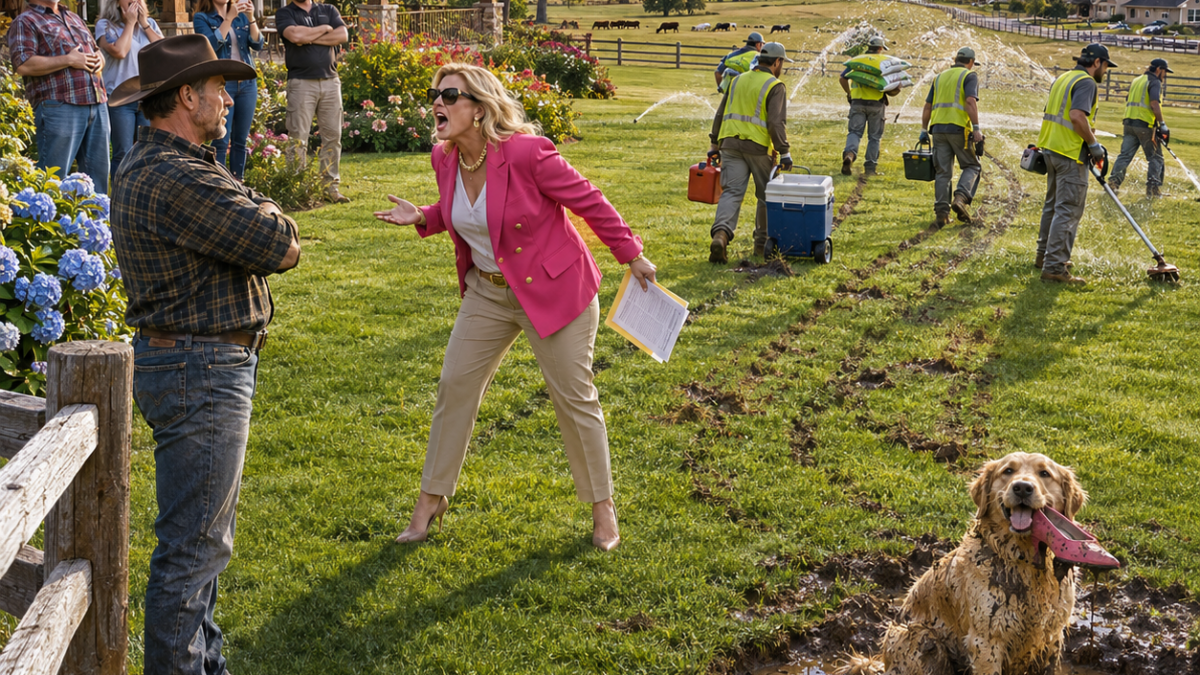
For one extraordinary second, the president of Cedar Ridge HOA stood barefoot on one side, wearing one shoe on the other, holding a yellow folder above her head while an irrigation sprinkler rotated toward her with the slow inevitability of a lighthouse beam.
Gary said, “Victoria, I think it’s coming back.”
She turned.
Too late.
Water hit the folder.
Papers exploded.
Violation notices fluttered onto the grass like wounded pigeons.
One sheet stuck to her blazer.
Another landed on Malcolm’s windshield.
The workers completely lost composure.
I did not laugh.
Not visibly.
That took everything I had.
Victoria grabbed her shoe from the mud and stormed toward my porch.
The fence kept her sixty yards away.
“TURN THESE OFF!”
“They’re watering my lawn.”
“You are deliberately targeting HOA employees!”
“No. The sensors detect movement.”
“That is the same thing.”
“Only if HOA employees keep entering my property.”
She pointed a dripping sheet of paper at me.
“You planned this.”
“I planned irrigation.”
“You planned humiliation.”
“That part appears self-service.”
Claire went inside.
Not because she was afraid.
Because she was laughing too hard to remain upright.
Victoria’s eyes narrowed.
“I will have this fence removed.”
“You won’t.”
“I’ll call the county.”
“Please do.”
“I’ll call law enforcement.”
“Even better.”
That stopped her for half a beat.
People who rely on bluffing become uneasy around someone who welcomes documentation.
Gary noticed too.
He walked closer to Victoria.
“Maybe we should confirm the property status before escalating.”
“We already confirmed it.”
“When?”
“The board reviewed the plat.”
“Which plat?”
“The subdivision plat.”
Gary stared at her.
Then at my ranch.
Then back at her.
“His ranch isn’t on our subdivision plat.”
Victoria’s expression changed.
Barely.
But I saw it.
So did Malcolm.
Victoria snapped, “There are implied access rights.”
I called across the lawn.
“No, there aren’t.”
“You don’t know that.”
“I do.”
“You’re not an attorney.”
“No.”
“Then stop pretending you understand easements.”
I set my coffee on the porch rail.
“Victoria, there are express easements, prescriptive easements, easements by necessity, and a few other theories that depend on state law and actual facts. None of them appear because an HOA president wants to save twelve minutes.”
Malcolm blinked.
Gary looked at me.
Victoria said nothing.
I continued.
“You’ve crossed my land for less than three months. You started after I objected. You never had permission. You never had a recorded easement. You have direct road access to every property you service.”
Gary slowly turned to her.
“Is that true?”
Victoria recovered quickly.
“The HOA counsel advised us—”
“Which counsel?” Malcolm asked.
She looked at him.
“What?”
“Which attorney advised us we had access rights?”
“This is not the place.”
“It seems like a pretty good place.”
That was crack number two.
Victoria pulled out her phone.
“I’m calling the county.”
“Go ahead,” I said.
She called.
She spoke loudly enough for everyone to hear.
She described an “unlawful obstruction of established community access.”
She described “hazardous water devices.”
She described “unauthorized construction.”
She did not mention that the alleged community corridor was located entirely on somebody else’s four-thousand-acre ranch.
That part apparently felt optional.
The county code office told her someone would come by.
Victoria smiled.
“There. We’ll settle this properly.”
“I agree.”
For the first time that morning, she looked uncertain.
About forty minutes later, a white county pickup rolled into my driveway.
A man named Robert Haines stepped out.
Robert had been a county building and land-use inspector for nearly twenty years. He had a gray mustache, reading glasses hanging from his shirt, and the permanently unimpressed expression of a man who had seen homeowners build decks over septic tanks and then complain that the government had failed them.
He shook my hand.
“Morning, Dan.”
Victoria stared.
“You know him?”
Robert looked at her.
“I know most property owners who file permits properly.”
Her mouth tightened.
I handed him my permit packet.
He reviewed the fence line.
Checked the setback.
Looked at the gate.
Inspected the irrigation heads.
Then he crouched beside one survey marker.
“This the survey Thompson Land Services completed last week?”
“Yes.”
“Recorded?”
“Yesterday afternoon.”
Victoria stepped forward.
“I object to this inspection.”
Robert looked over his glasses.
“To me inspecting the thing you called me to inspect?”
Gary coughed.
Malcolm stared at the ground.
Victoria pointed toward the lawn.
“This fence blocks established HOA access.”
Robert stood.
“Where’s the easement?”
“The board recognizes implied access.”
“That wasn’t my question.”
She opened her wet folder.
Several papers had fused together.
She pulled at them.
One ripped in half.
Robert waited.
She finally produced a photocopy of the Cedar Ridge subdivision map.
Robert unfolded it.
He studied the page.
Then he looked toward the fence.
Then toward the subdivision.
Then back at Victoria.
“This doesn’t show an easement across Mercer property.”
“It doesn’t need to.”
Robert handed it back.
“Yes, it does.”
“The route has become customary.”
“How long?”
Victoria hesitated.
“Long enough.”
“How long?”
“Several months.”
Robert scratched his mustache.
“That’s not how easements work.”
She stiffened.
“The community relies on this access.”
“Why?”
“It saves time.”
“That isn’t necessity.”
“It improves operational efficiency.”
“That’s also not necessity.”
“It benefits dozens of homeowners.”
Robert looked at the ranch.
“Still not necessity.”
Her voice sharpened.
“Are you saying one man can obstruct an entire community?”
Robert glanced at me.
“He owns the land.”
The sentence hit harder than shouting would have.
Victoria looked almost offended by the simplicity of it.
Robert continued. “Mr. Mercer’s fence is on his surveyed boundary. The portion requiring county approval has a valid permit. The irrigation equipment is on his property. It does not spray onto the public roadway. I don’t see a code violation.”
Victoria stared at him.
“What about the access?”
“What access?”
“The HOA route.”
Robert tapped the subdivision plat.
“There is no HOA route.”
That was crack number three.
And this time, everybody heard it.
The workers stopped pretending not to listen.
Gary folded his arms.
Malcolm removed his glasses and cleaned them, which I would later learn was what he did whenever he realized money was about to become a problem.
Victoria tried another angle.
“The HOA has been maintaining that corridor.”
I spoke.
“You’ve been walking over my lawn.”
“We performed grounds activity.”
“You crushed grass.”
“We enhanced usability.”
“You made a dirt line.”
Robert lifted a hand.
“Let’s keep this simple.”
He looked at me.
“Do you consent to HOA workers crossing here?”
“No.”
He looked at Victoria.
“Then stop crossing.”
Her face went pale beneath her makeup.
“You can’t make that determination.”
“I’m not determining ownership. The deed and survey do that. I’m telling you I see no county basis to force him to remove a legal fence.”
She looked at me.
That was the moment the arrogance finally began turning into fear.
Not because she suddenly respected my rights.
Because she realized I had prepared.
“Show me the deed,” she said.
“No.”
Her chin lifted.
“If you’re so certain, show me.”
“You can pull the public record yourself.”
“Then you don’t have it.”
I smiled.
“I didn’t say that.”
I walked into the house.
When I returned, I carried an old leather document case my father had kept in the office safe.
Inside was a certified copy of the Mercer family’s original recorded land conveyance, subsequent deeds, modern parcel descriptions, survey records, tax maps, and a title report my attorney had ordered after Victoria’s first written threat.
I didn’t hand Victoria the originals.
I handed Robert the certified copies.
He reviewed them slowly.
The workers had gone quiet.
Gary stepped closer.
Malcolm did too.
Robert finally nodded.
“Looks clean.”
Victoria scoffed.
“Of course it looks clean. That doesn’t address historical community use.”
“There was no community here historically,” I said.
Cedar Ridge had been built fourteen years earlier on what had once been a combination of timber acreage and a failed horse farm east of us.
My grandfather used to hunt quail there.
My father had watched bulldozers cut the first subdivision road through the hills.
I remembered when the entrance monument was poured.
There was nothing ancient about Cedar Ridge except the confidence of people who moved into new houses and assumed everything outside their windows had been waiting for their arrival.
Victoria looked at Robert.
“What about annexation?”
I almost laughed.
“Annexation by whom?”
“The HOA.”
Robert actually blinked.
“Homeowners associations don’t annex ranches.”
She recovered. “Boundary expansion.”
“Not without ownership documents, covenants, consent, or some legal basis you haven’t shown me.”
“My attorney will review this.”
“You should probably let one.”
Gary turned toward her.
“You told us counsel had already reviewed it.”
The silence after that question was different.
Not funny.
Not awkward.
Dangerous.
Victoria looked at him.
“I said the board had sufficient authority.”
“No,” Gary replied. “At the meeting Tuesday, you said our attorney agreed the access was enforceable.”
Malcolm nodded.
“I wrote it in the minutes.”
Victoria’s eyes flickered toward him.
“You misunderstood me.”
“I’m the secretary pro tem when Linda’s absent. I wrote down exactly what you said.”
She raised her voice.
“This is an internal board matter.”
Gary pointed at the fence.
“No. This is apparently an external ranch matter.”
I had to look away.
Victoria was losing control, and the people she had spent years intimidating were beginning to notice.
That is how authority sometimes dies.
Not in one dramatic explosion.
In a sequence of ordinary moments when everyone in the room realizes the emperor has been sending violation notices without pants.
Robert packed up his papers.
“Mr. Mercer, your fence can remain.”
“Thank you.”
He looked at Victoria.
“And I strongly recommend you keep employees off property after the owner has explicitly denied permission.”
She folded her arms.
“Are you threatening me?”
“No. I’m explaining what the words ‘private property’ mean.”
The lead worker turned his head to hide another laugh.
Victoria heard him.
“You think this is funny?”
The man shrugged.
“I think I’m wet.”
That finished Gary.
He burst out laughing.
Not a polite chuckle.
A full, helpless laugh.
Victoria stared at him in disbelief.
Then she turned to Malcolm.
“You too?”
Malcolm shook his head.
“I’m mostly thinking about liability.”
That word changed everything.
Liability.
Victoria’s face hardened.
“What liability?”
Malcolm put his glasses back on.
“We sent employees onto private property after written objections.”
“Under board authority.”
“Maybe not.”
“We issued fines.”
“To someone who isn’t a member.”
“We asserted access rights.”
“That may not exist.”
“We threatened enforcement.”
“Without counsel?”
Victoria snapped, “I am the president of this association.”
Malcolm answered quietly.
“That’s not the same as being the association’s attorney.”
For the first time since I had met Victoria Vale, nobody rushed to fill the silence after she spoke.
She looked smaller.
Still angry.
Still upright.
Still clutching the soggy remains of her yellow folder.
But smaller.
She pointed at me.
“This isn’t over.”
I nodded.
“Good.”
That surprised her.
“What?”
“I said good.”
“You think you want a legal fight?”
“No.”
I looked at Malcolm.
“But I do want a written record.”
That sentence sent him back into accounting mode immediately.
“What kind of record?”
I pulled another folder from beneath my arm.
Not yellow.
Brown.
Plain.
Inside were copies of every violation notice Victoria had sent me, photographs of workers crossing my property, security footage timestamps, emails from Cedar Ridge employees, letters I had sent denying permission, certified-mail receipts proving those letters had been delivered, and a log of dates when the HOA had entered after receiving them.
Victoria stared at the folder.
I could almost see her doing the math backward.
“You’ve been documenting us.”
“I’ve been documenting my property.”
“For months?”
“For as long as necessary.”
Gary looked at Malcolm.
Malcolm looked ill.
I continued.
“I’m not asking the HOA for money today. I’m not demanding anything dramatic. I want one written statement confirming Cedar Ridge claims no easement over Mercer Ranch, recognizes the boundary, withdraws every notice and fine issued against me, and instructs employees and contractors not to enter without permission.”
Victoria laughed.
It sounded forced.
“You think we’re signing that?”
“I think your board may want to.”
“Never.”
Malcolm looked at her.
“We should discuss it.”
“No.”
“Victoria—”
“I said no.”
Gary stepped in.
“Then we’re calling counsel today.”
She glared at him.
“Fine.”
“And we’re sending him everything.”
Her expression froze.
“Everything?”
“All notices. Minutes. Emails. Access instructions. Contractor communications.”
“Those are internal.”
“Exactly.”
Victoria’s grip tightened on the wet folder.
I did not know then what was in those internal emails.
Neither did Gary.
Neither did Malcolm.
But Victoria knew.
And the look on her face told me I wasn’t the only person who had been keeping records.
The county inspector left around eight.
The workers left five minutes later.
Gary and Malcolm drove away without Victoria.
She remained beside the fence.
Alone.
For nearly a minute she stared at the lawn.
Then at me.
The sprinklers had shut off.
Morning light stretched across the ranch.
She looked down at her mud-stained heel.
“You embarrassed me on purpose.”
I shook my head.
“I built a fence.”
“You could have warned me.”
“I told you not to enter.”
“You knew what the sprinklers would do.”
“They water grass.”
“You enjoyed it.”
That one I didn’t answer.
She pointed toward the ranch house.
“You people think you can hide behind old deeds forever.”
“My family isn’t hiding behind anything.”
“You could have cooperated.”
“You could have asked.”
“I did.”
“No. You ordered.”
Her mouth tightened.
I walked closer to the fence.
“You want to know the difference, Victoria?”
She said nothing.
“When neighbors ask for something, they accept that the answer might be no. When dictators ask, they call refusal a violation.”
She stared at me for several seconds.
Then she put on her sunglasses.
“You’ll regret making me look foolish.”
I looked at her muddy shoe.
“I didn’t make you do anything.”
She left.
By ten-thirty that morning, Cedar Ridge’s attorney had apparently received the file.
At eleven-fifteen, Malcolm called me.
His voice sounded different.
Less formal.
More human.
“Dan, this is Malcolm Reed.”
“I know.”
“Are you represented?”
“Yes.”
“Could I have your attorney’s contact information?”
I gave it to him.
He paused.
“Also, for what it’s worth, I’m sorry.”
That surprised me.
“For what part?”
Another pause.
“All of it.”
At noon, my attorney, Rachel Coleman, called.
Rachel had represented ranchers, farmers, commercial property owners, and people who bought lake cabins without understanding shared-driveway agreements. She had the rare ability to make complicated property law sound boring, which was useful because boring law is often the most dangerous kind.
She had reviewed Victoria’s notices two weeks earlier.
Now she sounded almost cheerful.
“The HOA attorney contacted me.”
“That fast?”
“Apparently their board sent him a packet.”
“And?”
“He wants to resolve this immediately.”
“What does immediately mean?”
“It means he has read enough to become interested in minimizing nouns like damages, fees, trespass, and insurance.”
I leaned back in my office chair.
“What did Victoria send him?”
“She didn’t.”
“What?”
“The board did.”
I smiled.
Rachel continued.
“There’s more.”
“Of course there is.”
“Your HOA president apparently directed staff to use the ranch route before the board formally voted on anything.”
“That doesn’t surprise me.”
“She also represented in meeting minutes that counsel had approved the access theory.”
“Did he?”
“No.”
I closed my eyes.
Somewhere outside, a tractor started.
Rachel said, “He had never been asked.”
That was worse than I expected.
“So she lied to her board.”
“Potentially. I’d phrase it more carefully until they finish reviewing records.”
“Fair.”
“And Dan?”
“Yeah?”
“She sent at least one email instructing a contractor to continue crossing because, quote, ‘Mercer will eventually stop resisting once fines begin accumulating.’”
I stared out the window.
The humor vanished for a moment.
Not because I was surprised she was arrogant.
Because the email proved something that had bothered me from the beginning.
This had never been confusion.
Victoria knew I objected.
She knew she lacked permission.
She simply believed pressure would make ownership irrelevant.
That changed the emotional weight of it.
My family had spent generations paying taxes on that land, repairing fences, clearing storms, fighting drought, burying animals, raising kids, rebuilding barns, and keeping the ranch alive through years when cattle prices barely covered feed.
Victoria had looked at all of that and reduced it to inconvenience.
Twelve minutes.
That was what our rights were worth to her.
Twelve minutes of driving.
Rachel asked, “You still there?”
“Yeah.”
“What do you want?”
The answer came easily.
“The crossing stops permanently.”
“Obviously.”
“All notices withdrawn.”
“Yes.”
“Written acknowledgment that the ranch isn’t subject to Cedar Ridge covenants.”
“Good.”
“Contractors notified.”
“Good.”
“No retaliation against residents or board members who challenged her.”
Rachel paused.
“That one may be outside your standing.”
“I know. Put it in as a requested governance assurance, not a demand.”
She laughed softly.
“You’ve been listening.”
“My wife says it’s ruining my personality.”
Claire shouted from the kitchen, “It needed structure.”
Rachel heard her.
“I like Claire.”
“So does everybody.”
We agreed that I would not seek a dramatic lawsuit if the HOA corrected the records, stopped entry, paid the modest legal and survey expenses their conduct had forced me to incur, and confirmed everything in writing.
I wasn’t interested in owning somebody’s clubhouse.
I wanted my land left alone.
But Victoria had one more move.
At three that afternoon, a private towing truck appeared at the eastern gate.
The driver stopped outside my fence.
He did not enter.
He called the number on my warning sign.
I answered.
“Mercer Ranch.”
“Mr. Mercer?”
“Yes.”
“This is Dale with County Line Towing. I’ve got a work order from Cedar Ridge HOA to remove an obstruction.”
I stared at the phone.
“What obstruction?”
“The new gate.”
I actually laughed.
Dale did not.
“Yeah,” he said. “That’s why I’m calling.”
“Did they tell you it’s on private property?”
“They told me it’s an unapproved barrier across HOA access.”
“It’s entirely on my ranch.”
There was a pause.
“Thought so.”
“You can confirm with the county inspector if you want.”
“Already planning to.”
“Who authorized the tow?”
He read the name.
“Victoria Vale.”
Of course.
I asked him to email the work order.
He did.
Twenty minutes later, Rachel had a copy.
Thirty minutes after that, Cedar Ridge’s attorney had it.
Forty-five minutes after that, Gary Timmons called me.
He didn’t say hello.
“She did WHAT?”
I held the phone away from my ear.
“Apparently ordered a towing company to remove my gate.”
“She had no authorization.”
“I gathered.”
“We are in an emergency board meeting right now.”
“Sounds fun.”
“It is not fun.”
In the background I heard Victoria’s voice.
“Who are you talking to?”
Gary said, “Dan.”
Then Victoria shouted, “Hang up.”
Gary responded, “No.”
That one word told me more than any board minutes could.
He stepped away from the noise.
“Dan, I need to ask something. Did the towing company touch anything?”
“No.”
“Enter the ranch?”
“No.”
“Good.”
“Driver did exactly what a professional should do. He stopped and verified.”
“Thank God.”
“Gary?”
“Yes?”
“Tell your board something for me.”
“I’m listening.”
“This stopped being about a shortcut a while ago.”
He was quiet.
“I know.”
The emergency meeting lasted almost three hours.
I learned the details later through formal correspondence and, eventually, conversations with residents after the situation became public inside Cedar Ridge.
Victoria fought every step.
She insisted she possessed executive authority.
She claimed the towing order was “preventive.”
She accused Malcolm of disloyalty.
She accused Gary of undermining leadership.
She accused the county inspector of favoritism.
She accused me of setting “weaponized sprinklers.”
That phrase became legendary.
Mrs. Bell printed it on a coffee mug.
The board’s attorney attended remotely and spent most of the meeting explaining things Victoria apparently believed could be defeated through louder repetition.
No, the HOA did not have an easement.
No, saving driving time did not create an easement by necessity.
No, three months of disputed use did not establish a prescriptive right.
No, the HOA could not fine a nonmember ranch owner under Cedar Ridge restrictions merely because his land was nearby.
No, the HOA president could not send contractors onto private property after express refusal.
And absolutely no, she could not authorize a tow company to remove a permitted fence from land the HOA did not own.
According to Gary, that last answer produced ten seconds of silence.
Then Victoria said, “I disagree.”
Their attorney replied, “You are free to disagree with me. You are not free to make law by disagreement.”
I wish I had been there.
At six-forty that evening, I received an email from Cedar Ridge’s attorney.
All access operations across Mercer Ranch were suspended immediately.
Every violation notice issued to me was withdrawn.
Every threatened fine was voided.
No contractor, employee, director, officer, or agent of the HOA was authorized to enter my property without express permission.
The association would review its records and send a formal boundary acknowledgment the following morning.
I forwarded the email to Claire.
She read it.
“Is that it?”
“Legally? Mostly.”
“Victoria?”
“Still president.”
Claire gave me a look.
“Temporarily.”
She knew.
The next morning, Cedar Ridge residents woke to a board notice announcing a special meeting.
By eight-thirty, people were texting each other screenshots.
By nine, someone had posted video of the sprinkler incident in a private neighborhood group.
I hadn’t posted it.
One of the workers had recorded part of the scene on his phone.
The clip showed Victoria shouting, the young worker stepping onto my lawn, sprinklers activating, the entire crew backing away, Victoria losing a shoe in mud, and Gary saying, very clearly, “Victoria, I think it’s coming back,” moments before water soaked her folder.
It spread through Cedar Ridge faster than a rumor about dues increases.
Residents began asking questions.
Why had HOA money been spent pursuing access across land they did not own?
How much had been paid to contractors?
Why had legal advice been misrepresented?
Why had violation notices been sent to a nonmember?
Why had a towing service been contacted?
And, most dangerously for Victoria, what else had been done under supposed “executive authority” without proper approval?
Once people discover one locked door has no lock, they start checking the others.
Mrs. Bell brought three years of violation letters to the meeting.
A retired teacher brought records of fines over a bird feeder.
A couple from Birch Court produced emails showing Victoria had demanded they remove a garden bench because she considered it “visually passive-aggressive.”
Nobody knew what that meant.
Victoria apparently didn’t either.
Another resident brought a citation for leaving a garage open for twenty-two minutes while unloading groceries.
A man named Leonard showed up with a folder titled “Mailbox War,” which I still consider one of the finest administrative document titles ever created.
The meeting began at seven.
I didn’t attend.
It wasn’t my HOA.
I sat on my porch with Claire while evening settled over the ranch.
Cattle moved slowly through the lower pasture.
The repaired lawn looked almost normal already.
The new fence cast long shadows across the grass.
At seven-thirty, Claire checked her phone.
“Mrs. Bell says they’re yelling.”
“At each other?”
“Mostly at Victoria.”
“Healthy democracy.”
At seven-forty-five, another message arrived.
“She tried to adjourn the meeting.”
“Did it work?”
“Nope.”
At eight-ten:
“Attorney speaking now.”
At eight-twenty-two:
“Residents are furious.”
At eight-forty-one:
“Vote coming.”
Claire set the phone on the porch table.
“You nervous?”
“No.”
“You’re lying.”
“A little.”
“Why? Your property issue is already resolved.”
I thought about that.
She was right.
The fence stood.
The legal dispute was effectively over.
The HOA had backed down.
Yet something still mattered.
Maybe because bullies rarely hurt only one person.
Maybe because I had watched Victoria treat workers like servants, board members like props, residents like subjects, and my family’s ranch like vacant space available to whichever clipboard arrived first.
I wanted the system around her to finally say no.
Not me.
Everyone.
Claire’s phone buzzed.
She read the message.
Then smiled.
“Forty-eight hours.”
“What?”
“From the county inspection to now.”
She handed me the phone.
The message from Mrs. Bell was short.
PRESIDENT REMOVED.
UNANIMOUS AMONG ELIGIBLE DIRECTORS.
SPECIAL REVIEW STARTING TOMORROW.
I leaned back in the porch chair.
No fireworks.
No cheering.
Just relief.
The kind that settles into your shoulders after you realize you no longer need to brace for the next envelope.
Claire raised her iced tea.
“To hostile water devices.”
I raised mine.
“To irrigation.”
The official letter arrived the following morning.
Cedar Ridge HOA formally acknowledged that Mercer Ranch was not subject to the association’s declaration, had never been annexed into the development, and contained no recorded HOA access easement across the disputed lawn.
All prior notices were withdrawn with prejudice under the association’s internal records.
The HOA agreed to reimburse my reasonable survey, permit, and attorney expenses associated with defending the boundary.
It instructed employees and contractors not to enter without written permission.
The board also apologized.
Not Victoria.
The board.
Her removal had been effective immediately.
Gary became interim president for ninety days with one stated goal: “Make the HOA boring again.”
I respected that slogan.
Malcolm remained treasurer.
He later mailed me a handwritten note.
Dan—
I’m sorry we allowed one person’s certainty to substitute for verification. We should have asked for documents before making demands. We didn’t.
That won’t happen again.
—Malcolm
I kept the note.
Not because I needed the apology.
Because accountability is rare enough to deserve preservation.
Victoria, meanwhile, attempted one final performance.
Three days after her removal, she drove to the ranch in a white SUV.
She stopped outside the new fence.
I was repairing a section of irrigation line near the barn when I saw her.
She wore dark slacks this time.
Practical improvement.
No pink blazer.
No yellow folder.
No workers.
No board members.
Just Victoria.
I walked over.
She stayed on the public side of the fence.
That alone represented progress.
“I suppose you’re satisfied,” she said.
“I suppose I am.”
“You destroyed my reputation.”
“No.”
Her jaw tightened.
“You humiliated me in front of my board.”
“No.”
“You turned the residents against me.”
“No.”
She stepped closer.
“Stop saying no.”
I smiled.
“You never liked that word.”
She stared at me.
I continued calmly.
“I didn’t send your emails. I didn’t make your board minutes inaccurate. I didn’t order workers onto someone else’s property. I didn’t call a towing company. I didn’t fine people over bird feeders and garage doors.”
“That has nothing to do with you.”
“Exactly.”
She looked away toward the pasture.
For once, she had no audience.
No folder.
No title.
Nothing to hide behind.
The ranch stretched behind me exactly as it had before Cedar Ridge existed.
Wind moved through the grass.
A hawk circled over the creek.
One of our older cows stood beside a water trough staring at Victoria with the slow suspicion cattle reserve for unfamiliar machinery and people carrying clipboards.
Victoria noticed.
“That animal keeps looking at me.”
“She’s territorial.”
“Very funny.”
“She’s never fined anybody.”
Victoria almost smiled.
Almost.
Then it disappeared.
“You think I was wrong about everything.”
“No.”
That surprised her.
“What?”
“You were right that the shortcut was faster.”
She stared at me.
I shrugged.
“It probably did save twelve minutes.”
“Then why make such a ridiculous issue out of it?”
That question told me she still didn’t understand.
“Because faster isn’t the same as yours.”
She said nothing.
I rested one hand on the fence rail.
“You could have come to my porch three months ago and said, ‘Dan, our maintenance crews lose time driving around the ranch. Would you consider letting them cross occasionally?’”
“You would have said no.”
“Maybe.”
“Exactly.”
“But then you’d have had an answer.”
She shook her head.
“A community can’t function if every individual gets to say no.”
“A community can’t stay free if nobody can.”
For once, she had no response.
She looked at the fence.
Then at the sprinklers.
“Are those still motion activated?”
“Yes.”
She took one step backward.
I couldn’t help it.
I laughed.
She glared at me.
“They’re off.”
“You could have said that.”
“I could have.”
“That isn’t funny.”
“A little.”
She turned toward her SUV.
Before she reached it, I called after her.
“Victoria.”
She stopped.
“You know what the strangest part is?”
She looked back.
“I never wanted a fight.”
Her expression softened for half a second.
Then hardened again.
“You enjoyed winning.”
I thought about that.
Maybe I had.
Not because she lost.
Because the boundary held.
There is a difference.
“I enjoyed going back to normal.”
She got into her SUV and drove away.
I never saw her cross my lawn again.
Cedar Ridge changed after that.
Not overnight.
Organizations don’t become healthy simply because one difficult person leaves.
But the new board adopted written procedures requiring legal review before claiming rights over neighboring property.
Enforcement letters had to identify the specific covenant involved.
Board votes were recorded more carefully.
Contractor instructions had to come through management instead of individual officers.
Residents were given clearer hearing rights.
And Gary kept his promise.
The HOA became boring.
Spectacularly boring.
I heard about meetings devoted to reserve funds, roof standards, drainage maintenance, insurance renewals, landscaping bids, and actual association business.
Nobody declared sovereignty over adjacent ranches.
A remarkable improvement.
The lawn recovered within weeks.
By early summer, the worn shortcut disappeared beneath thick grass.
Claire planted lavender along one section of the fence.
I added a bench beneath the cottonwood.
Sometimes, in the evenings, we sat there watching the sky turn orange behind the hills.
The ranch had always looked biggest at sunset.
Four thousand acres sounds enormous on paper.
Standing in the middle of it feels different.
You notice how little of land ownership is really about possession.
Mostly it’s responsibility.
Fences break.
Creeks flood.
Pastures dry.
Animals get sick.
Trees fall.
Taxes come due.
Equipment fails when you need it most.
My father used to say nobody truly owns a ranch.
“You just spend your turn keeping it from falling apart.”
He had inherited it from his father.
I inherited it from him.
One day my children would decide whether they wanted the same burden.
That was their choice.
Not Victoria’s.
Not Cedar Ridge’s.
Not anyone holding a folder with enough bold lettering to make a bad idea look official.
Months later, Gary called me.
“Got something you’ll appreciate.”
“What?”
“The maintenance company proposed a new route.”
“Across my ranch?”
“No.”
“Then I already like it.”
“They changed the schedule and divided crews by section. Saves seventeen minutes.”
I laughed.
“So the solution was planning?”
“Apparently.”
“Tell Victoria.”
“Absolutely not.”
He paused.
“Also, Mrs. Bell wants to know if your sprinklers are commercially available.”
“Why?”
“She said something about the architectural committee.”
“Do not encourage her.”
“No promises.”
After we hung up, I walked outside.
The sun was dropping behind the western ridge.
My cattle were moving through the pasture in a loose line.
Claire was watering flowers near the porch.
The fence stood exactly where the survey said it should.
Nothing dramatic remained.
No workers.
No violation notices.
No yellow folder.
Just grass.
That might sound like an anticlimax.
It wasn’t.
Peace is only boring to people who haven’t had someone try to regulate it.
I walked to the edge of the lawn where the shortcut used to run.
For months, that faint strip of flattened grass had irritated me every time I saw it.
Now I had trouble finding it.
Nature had erased Victoria’s corridor without ceremony.
The grass didn’t remember her board vote.
The soil didn’t care about her violation notices.
The sunset wasn’t subject to architectural review.
And the ranch had never needed permission to remain what it already was.
Claire came up behind me.
“You’re staring at grass.”
“I’m appreciating grass.”
“You’ve officially become your father.”
“He had excellent grass.”
“He yelled at rabbits.”
“They knew what they did.”
She laughed and slipped her hand into mine.
We stood there while the last sunlight turned the pasture gold.
I thought about Victoria’s first words to me.
We’re cutting across your lawn.
You can’t stop us.
That had been her entire mistake.
Not crossing the lawn.
Not even the letters.
Her mistake was believing ownership disappeared when authority spoke loudly enough.
She thought a board title created rights.
She thought repetition created law.
She thought fines created jurisdiction.
She thought employees following orders created permission.
She thought my calm meant weakness.
Most of all, she thought the only kind of resistance worth fearing was loud resistance.
She was wrong.
I had never needed to shout.
I needed a survey.
A permit.
A camera.
A file.
A competent attorney.
And, as it turned out, an extremely enthusiastic irrigation system.
The county record stayed where it had always been.
The fence stayed where the property line had always been.
The HOA stayed where its authority ended.
Every blade of grass on my side remained mine to maintain, neglect, mow, irrigate, or stare at like an aging rancher who had become emotionally attached to turf.
And Victoria?
She learned, in the wettest and most public way possible, that “community necessity” is not a magic phrase.
She learned that a clipboard is not a deed.
She learned that confidence is not jurisdiction.
She learned that saving twelve minutes does not give you twelve feet of somebody else’s land.
And she learned one final thing I suspect bothered her more than losing the presidency.
The fence had a gate.
I could have opened it at any time.
I simply chose not to.
THE STORY ENDS HERE
# HOA Karen Turned My Ranch Lawn Into Her Private Shortcut—Then Ordered Me to Accept It as “Community Access”
She marched strangers across my private ranch every morning and called it a “community necessity.”
When I told her to stop, she threatened to fine me for protecting land my family had owned for more than a century.
HOA Karen thought my silence meant surrender. She had no idea what I was waiting for.
“WE’RE CUTTING ACROSS YOUR LAWN AS A SHORTCUT. IT’S FASTER FOR THE COMMUNITY, AND YOU CAN’T STOP US.”
Those were the exact words Victoria Vale shouted at me from the edge of my front pasture while six maintenance workers crossed my grass in a crooked line behind her.
The sun was dropping over the western ridge, turning the sky copper and violet, and the light caught Victoria’s bright pink blazer so hard she looked less like an HOA president and more like an emergency flare with expensive sunglasses.
I stood twenty yards away beside my split-rail fence, wearing an old dark-green flannel shirt, faded jeans, boots that had been resoled twice, and the same wide-brimmed hat my father used to complain made me look older than I was. My arms were folded, but that was mostly because I didn’t trust myself to point.
Behind Victoria, her workers were walking straight across the lawn I had spent years maintaining between the ranch house and the east pasture. They were carrying weed trimmers, toolboxes, bags of fertilizer, and one rolling cooler that left two ugly tracks in the grass.
They weren’t lost.
They weren’t there by accident.
This had become routine.
For nearly three months, HOA employees and contractors had been cutting through my property because Victoria had decided the route saved them twelve minutes on the drive between two sections of the neighboring subdivision.
Twelve minutes.
Apparently that was enough, in Victoria’s mind, to erase a century of property law.
“This is private land,” I said.
Victoria smiled the way people smile when they believe they are explaining something obvious to someone stupid.
“So is half the infrastructure around here.”
“That doesn’t make it yours.”
“The board has determined this route provides reasonable operational access.”
“You mean my yard.”
“I mean a community corridor.”
“No,” I said. “You mean my yard.”
A worker carrying a gas can slowed down as he passed us. He looked at Victoria, then at me, then deliberately stared at the ground like a man hoping invisibility could be achieved through eye contact avoidance.
Victoria tucked her yellow HOA folder beneath one arm.
“You continue to misunderstand the situation, Daniel.”
Nobody who liked me called me Daniel.
My name is Dan Mercer. I was fifty-three years old at the time, and the land beneath Victoria’s beige heels had belonged to my family since 1921. Four thousand acres of pasture, wooded hills, creek bottoms, cattle ground, hay fields, and one carefully maintained patch of lawn surrounding a ranch house that had been rebuilt three times and had never once belonged to an HOA.
The subdivision east of us was newer than my youngest tractor.
Victoria acted as though history began the morning she was elected president.
She pulled several papers from her folder and held them toward me.
“These are your final notices.”
“I’m not a member of your HOA.”
“That is under review.”
I stared at her.
Even one of the workers stopped walking.
Victoria continued with complete seriousness. “Your property affects the visual and operational environment of Cedar Ridge Estates. The board therefore retains limited enforcement interests.”
I almost admired the sentence.
It took genuine talent to assemble that many meaningless words and say them without laughing.
I took the notices.
The first demanded that I permit “ongoing pedestrian and maintenance access.”
The second warned me not to obstruct “established community movement.”
The third threatened escalating fines beginning at $500 per day if I installed gates, fencing, landscaping, equipment, or “water features” that interfered with the shortcut.
That last phrase made me pause.
“Water features?”
Victoria lifted her chin. “We anticipated you might attempt something childish.”
I looked past her toward the old irrigation risers running along the lawn.
Then I looked back at her.
“Smart board.”
“We try.”
A faint smile must have crossed my face because she immediately narrowed her eyes.
“What?”
“Nothing.”
“Then understand this clearly. The board has voted. This is non-negotiable. We are taking action today.”
“Action?”
“We’ll be placing temporary route markers across the lawn.”
Two workers at the back of the group were carrying fluorescent stakes.
That changed the temperature of the conversation.
I stepped forward.
Not aggressively.
Just enough to make every worker stop.
“Do not drive a stake into my land.”
Victoria snapped her fingers.
Actually snapped them.
At grown men.
“Proceed.”
Nobody moved.
Her cheeks reddened.
“I said proceed.”
One worker cleared his throat. “Ma’am, he’s telling us this is private property.”
“He has been notified.”
“That isn’t what I asked.”
She turned on him. “Are you employed by Cedar Ridge or not?”
The man glanced at me.
I could see exactly what he was thinking.
He had probably been hired to trim hedges, not participate in a property dispute with a rancher standing on four thousand acres of evidence.
I spoke calmly.
“Guys, I’m not blaming any of you. I’m telling you directly that I do not consent to entry, marking, construction, or continued crossing. You’ve heard me say it.”
That mattered.
Victoria knew it mattered too.
Her expression tightened.
“You’re making a serious mistake.”
“Maybe.”
“You cannot interfere with community operations.”
“Watch me.”
The breeze lifted the corner of one violation notice.
Somewhere behind the barn, one of my cattle bawled.
Victoria took one step toward me, lowered her voice, and said, “You rural people always think owning acreage makes you kings.”
I looked around at the ranch.
“No. Mostly it makes us tired.”
A worker coughed into his fist to hide a laugh.
Victoria shot him a look sharp enough to prune trees.
Then she pointed at me with the yellow folder.
“You have until tomorrow morning. If you block that route, the HOA will take enforcement action.”
I didn’t argue.
I didn’t explain.
I didn’t show her a deed.
I didn’t tell her what I had spent the previous ten days doing at the county offices.
I simply folded the notices, slipped them into my shirt pocket, and stepped aside.
Victoria mistook that for surrender.
She smiled, turned, and led the workers across my lawn toward the subdivision gate.
I watched their boots press down the grass one more time.
Then I waited until the last pink flash of Victoria’s blazer disappeared behind the cedar trees.
My wife, Claire, came out onto the porch holding two glasses of iced tea.
“She leave?”
“For now.”
Claire handed me a glass.
“Did you tell her?”
“No.”
Her eyebrows went up.
“Any particular reason?”
I looked toward the eastern edge of the lawn, where the workers’ shortcut had worn a pale path through the grass.
Then I looked at the flatbed trailer parked behind the equipment shed.
On it sat three hundred feet of steel fencing, freshly painted posts, two automatic gates, rolls of wire, a box of warning placards, six motion sensors, and an irrigation controller I had picked up that afternoon.
Claire followed my gaze.
A slow smile appeared.
“Oh,” she said.
“Yeah.”
“When?”
“Tonight.”
At 6:12 the next morning, my driveway camera sent an alert to my phone.
Victoria Vale had returned.
And this time she had brought witnesses.
**part 2**
I was already awake.
Ranchers who claim they sleep until sunrise are either retired, lying, or raising decorative goats.
I had been in the kitchen since five, drinking coffee and watching mist lift off the lower pasture. Claire sat across from me in a robe, reading the weather on her tablet while pretending not to be more interested in the security camera notifications.
The fence crew had finished shortly after midnight.
Not some improvised wall thrown up in anger.
Not wire strung from tree to tree.
I had hired a licensed fencing contractor, obtained the county permit where required for the frontage section, verified the recorded boundary with a surveyor, and placed every post entirely inside my property line.
The eastern crossing now had a clean four-rail steel ranch fence with a locked service gate.
Six feet inside the fence, the old lawn irrigation zone had been upgraded with motion-triggered sprinkler heads.
They didn’t spray the public road.
They didn’t reach the sidewalk.
They didn’t cross onto HOA land.
They watered my grass.
Very enthusiastically.
Claire looked at my phone when it buzzed.
“How many?”
I opened the camera feed.
“Victoria. Four workers. Two board members.”
“Coffee?”
“Definitely.”
We walked onto the porch.
The morning air smelled like wet earth, cedar, and hay.
At the far end of the lawn, Victoria stood in front of the new fence as if it had materialized specifically to insult her.
She was wearing white trousers, beige heels, a cream blouse, and a coral-pink blazer this time. Her sunglasses were perched on top of her blonde bob despite the fact that the sun had barely cleared the ridge.
Beside her stood two men I recognized from the HOA board.
One was Malcolm Reed, the treasurer, a nervous-looking accountant who always seemed to be apologizing with his eyebrows.
The other was Gary Timmons, vice president and owner of a dental practice in town. Gary had spent the previous year telling everyone Cedar Ridge was “the premier residential community in the county,” usually while standing six feet from a drainage ditch full of shopping bags.
Victoria rattled the gate.
“Daniel!”
I sipped my coffee.
Claire leaned against the porch rail.
“She’s using your government name.”
“She means business.”
Victoria rattled the gate again.
“Daniel Mercer!”
I raised one hand.
“Morning.”
“What is this?”
“Fence.”
“I can see that.”
“Good start.”
Claire turned away because she was already laughing.
Victoria marched along the fence looking for an opening.
There wasn’t one.
“This barrier is unauthorized.”
“By whom?”
“The HOA.”
“Then I’m devastated.”
“You were explicitly instructed not to interfere with the access corridor.”
“I remember.”
“Then remove it.”
“No.”
Her workers stood behind her, carrying tools but making no effort to approach the fence.
One of them was the same man who had questioned her the previous evening.
He gave me a tiny nod.
Victoria apparently noticed.
“Why is everyone standing around?”
The man answered, “Because there’s a fence.”
“I am aware there is a fence.”
“Just making sure.”
Gary Timmons looked at the steel posts.
“I have to admit, Victoria, this seems pretty permanent.”
“It’s illegal.”
“How do you know?”
“Because we didn’t approve it.”
Malcolm Reed slowly turned toward her.
“Do we approve fences outside Cedar Ridge?”
Victoria ignored him.
That was the first crack.
Small, but visible.
The problem with dictators is that they become accustomed to being obeyed long before anyone confirms whether they actually possess authority.
Victoria had spent two years running the HOA like a tiny private government. She decided acceptable mailbox colors, holiday-light dates, patio furniture visibility, guest parking, basketball hoop placement, shed roofs, lawn heights, trash can storage, and, according to one furious resident named Mrs. Bell, “the emotional tone of porch curtains.”
People had learned that arguing with Victoria generated letters.
Then hearings.
Then fines.
Then more letters explaining why the previous letters had been necessary.
She had built power out of exhaustion.
I had one advantage most Cedar Ridge residents didn’t.
I wasn’t in Cedar Ridge.
Victoria pointed toward my gate.
“Open it.”
“No.”
“We need access.”
“Use the road.”
“That adds twelve minutes.”
“I’ve survived worse.”
“We have workers scheduled.”
“Schedule better.”
Her face hardened.
Then she did something I had expected but still hoped she wouldn’t.
She turned to the crew and said, “Go around.”
The lead worker frowned.
“Around where?”
“The fence.”
“That’s pasture.”
“Yes.”
“That’s still his property.”
Victoria lowered her voice.
“Go.”
The four men looked at one another.
None moved.
Then one younger worker, clearly unfamiliar with the dispute, stepped off the gravel shoulder and walked toward a narrow gap between the fence and a cluster of lilacs.
He crossed the survey line.
The nearest motion sensor clicked.
There was half a second of silence.
Then three sprinkler heads rose from the grass with a mechanical hiss.
A blast of cold irrigation water caught him squarely across the chest.
He jumped backward.
The second sprinkler rotated.
The third joined in.
Suddenly the entire section of lawn erupted in sweeping arcs of water.
The young worker yelled and ran the wrong direction.
That triggered another sensor.
A new sprinkler activated.
He changed direction again.
Another one fired.
Within seconds he was sprinting through a perfectly legal irrigation system that seemed, through pure coincidence, to possess a personal grudge.
Claire made a sound beside me that I can only describe as a strangled squeak.
The other workers were doubled over laughing.
Gary Timmons turned away, shoulders shaking.
Even Malcolm covered his mouth.
The young man finally escaped onto the gravel, soaked from shoulders to boots.
He looked at me.
I raised my coffee.
“Sorry. Motion irrigation.”
He stared at Victoria.
“You knew about this?”
She was too furious to answer.
Then the rotating spray caught the edge of her white trousers.
Victoria jumped sideways.
Her beige heel sank into the soft ground.
She tried to yank it free.
The heel stayed.
Her foot came out.
For one extraordinary second, the president of Cedar Ridge HOA stood barefoot on one side, wearing one shoe on the other, holding a yellow folder above her head while an irrigation sprinkler rotated toward her with the slow inevitability of a lighthouse beam.
Gary said, “Victoria, I think it’s coming back.”
She turned.
Too late.
Water hit the folder.
Papers exploded.
Violation notices fluttered onto the grass like wounded pigeons.
One sheet stuck to her blazer.
Another landed on Malcolm’s windshield.
The workers completely lost composure.
I did not laugh.
Not visibly.
That took everything I had.
Victoria grabbed her shoe from the mud and stormed toward my porch.
The fence kept her sixty yards away.
“TURN THESE OFF!”
“They’re watering my lawn.”
“You are deliberately targeting HOA employees!”
“No. The sensors detect movement.”
“That is the same thing.”
“Only if HOA employees keep entering my property.”
She pointed a dripping sheet of paper at me.
“You planned this.”
“I planned irrigation.”
“You planned humiliation.”
“That part appears self-service.”
Claire went inside.
Not because she was afraid.
Because she was laughing too hard to remain upright.
Victoria’s eyes narrowed.
“I will have this fence removed.”
“You won’t.”
“I’ll call the county.”
“Please do.”
“I’ll call law enforcement.”
“Even better.”
That stopped her for half a beat.
People who rely on bluffing become uneasy around someone who welcomes documentation.
Gary noticed too.
He walked closer to Victoria.
“Maybe we should confirm the property status before escalating.”
“We already confirmed it.”
“When?”
“The board reviewed the plat.”
“Which plat?”
“The subdivision plat.”
Gary stared at her.
Then at my ranch.
Then back at her.
“His ranch isn’t on our subdivision plat.”
Victoria’s expression changed.
Barely.
But I saw it.
So did Malcolm.
Victoria snapped, “There are implied access rights.”
I called across the lawn.
“No, there aren’t.”
“You don’t know that.”
“I do.”
“You’re not an attorney.”
“No.”
“Then stop pretending you understand easements.”
I set my coffee on the porch rail.
“Victoria, there are express easements, prescriptive easements, easements by necessity, and a few other theories that depend on state law and actual facts. None of them appear because an HOA president wants to save twelve minutes.”
Malcolm blinked.
Gary looked at me.
Victoria said nothing.
I continued.
“You’ve crossed my land for less than three months. You started after I objected. You never had permission. You never had a recorded easement. You have direct road access to every property you service.”
Gary slowly turned to her.
“Is that true?”
Victoria recovered quickly.
“The HOA counsel advised us—”
“Which counsel?” Malcolm asked.
She looked at him.
“What?”
“Which attorney advised us we had access rights?”
“This is not the place.”
“It seems like a pretty good place.”
That was crack number two.
Victoria pulled out her phone.
“I’m calling the county.”
“Go ahead,” I said.
She called.
She spoke loudly enough for everyone to hear.
She described an “unlawful obstruction of established community access.”
She described “hazardous water devices.”
She described “unauthorized construction.”
She did not mention that the alleged community corridor was located entirely on somebody else’s four-thousand-acre ranch.
That part apparently felt optional.
The county code office told her someone would come by.
Victoria smiled.
“There. We’ll settle this properly.”
“I agree.”
For the first time that morning, she looked uncertain.
About forty minutes later, a white county pickup rolled into my driveway.
A man named Robert Haines stepped out.
Robert had been a county building and land-use inspector for nearly twenty years. He had a gray mustache, reading glasses hanging from his shirt, and the permanently unimpressed expression of a man who had seen homeowners build decks over septic tanks and then complain that the government had failed them.
He shook my hand.
“Morning, Dan.”
Victoria stared.
“You know him?”
Robert looked at her.
“I know most property owners who file permits properly.”
Her mouth tightened.
I handed him my permit packet.
He reviewed the fence line.
Checked the setback.
Looked at the gate.
Inspected the irrigation heads.
Then he crouched beside one survey marker.
“This the survey Thompson Land Services completed last week?”
“Yes.”
“Recorded?”
“Yesterday afternoon.”
Victoria stepped forward.
“I object to this inspection.”
Robert looked over his glasses.
“To me inspecting the thing you called me to inspect?”
Gary coughed.
Malcolm stared at the ground.
Victoria pointed toward the lawn.
“This fence blocks established HOA access.”
Robert stood.
“Where’s the easement?”
“The board recognizes implied access.”
“That wasn’t my question.”
She opened her wet folder.
Several papers had fused together.
She pulled at them.
One ripped in half.
Robert waited.
She finally produced a photocopy of the Cedar Ridge subdivision map.
Robert unfolded it.
He studied the page.
Then he looked toward the fence.
Then toward the subdivision.
Then back at Victoria.
“This doesn’t show an easement across Mercer property.”
“It doesn’t need to.”
Robert handed it back.
“Yes, it does.”
“The route has become customary.”
“How long?”
Victoria hesitated.
“Long enough.”
“How long?”
“Several months.”
Robert scratched his mustache.
“That’s not how easements work.”
She stiffened.
“The community relies on this access.”
“Why?”
“It saves time.”
“That isn’t necessity.”
“It improves operational efficiency.”
“That’s also not necessity.”
“It benefits dozens of homeowners.”
Robert looked at the ranch.
“Still not necessity.”
Her voice sharpened.
“Are you saying one man can obstruct an entire community?”
Robert glanced at me.
“He owns the land.”
The sentence hit harder than shouting would have.
Victoria looked almost offended by the simplicity of it.
Robert continued. “Mr. Mercer’s fence is on his surveyed boundary. The portion requiring county approval has a valid permit. The irrigation equipment is on his property. It does not spray onto the public roadway. I don’t see a code violation.”
Victoria stared at him.
“What about the access?”
“What access?”
“The HOA route.”
Robert tapped the subdivision plat.
“There is no HOA route.”
That was crack number three.
And this time, everybody heard it.
The workers stopped pretending not to listen.
Gary folded his arms.
Malcolm removed his glasses and cleaned them, which I would later learn was what he did whenever he realized money was about to become a problem.
Victoria tried another angle.
“The HOA has been maintaining that corridor.”
I spoke.
“You’ve been walking over my lawn.”
“We performed grounds activity.”
“You crushed grass.”
“We enhanced usability.”
“You made a dirt line.”
Robert lifted a hand.
“Let’s keep this simple.”
He looked at me.
“Do you consent to HOA workers crossing here?”
“No.”
He looked at Victoria.
“Then stop crossing.”
Her face went pale beneath her makeup.
“You can’t make that determination.”
“I’m not determining ownership. The deed and survey do that. I’m telling you I see no county basis to force him to remove a legal fence.”
She looked at me.
That was the moment the arrogance finally began turning into fear.
Not because she suddenly respected my rights.
Because she realized I had prepared.
“Show me the deed,” she said.
“No.”
Her chin lifted.
“If you’re so certain, show me.”
“You can pull the public record yourself.”
“Then you don’t have it.”
I smiled.
“I didn’t say that.”
I walked into the house.
When I returned, I carried an old leather document case my father had kept in the office safe.
Inside was a certified copy of the Mercer family’s original recorded land conveyance, subsequent deeds, modern parcel descriptions, survey records, tax maps, and a title report my attorney had ordered after Victoria’s first written threat.
I didn’t hand Victoria the originals.
I handed Robert the certified copies.
He reviewed them slowly.
The workers had gone quiet.
Gary stepped closer.
Malcolm did too.
Robert finally nodded.
“Looks clean.”
Victoria scoffed.
“Of course it looks clean. That doesn’t address historical community use.”
“There was no community here historically,” I said.
Cedar Ridge had been built fourteen years earlier on what had once been a combination of timber acreage and a failed horse farm east of us.
My grandfather used to hunt quail there.
My father had watched bulldozers cut the first subdivision road through the hills.
I remembered when the entrance monument was poured.
There was nothing ancient about Cedar Ridge except the confidence of people who moved into new houses and assumed everything outside their windows had been waiting for their arrival.
Victoria looked at Robert.
“What about annexation?”
I almost laughed.
“Annexation by whom?”
“The HOA.”
Robert actually blinked.
“Homeowners associations don’t annex ranches.”
She recovered. “Boundary expansion.”
“Not without ownership documents, covenants, consent, or some legal basis you haven’t shown me.”
“My attorney will review this.”
“You should probably let one.”
Gary turned toward her.
“You told us counsel had already reviewed it.”
The silence after that question was different.
Not funny.
Not awkward.
Dangerous.
Victoria looked at him.
“I said the board had sufficient authority.”
“No,” Gary replied. “At the meeting Tuesday, you said our attorney agreed the access was enforceable.”
Malcolm nodded.
“I wrote it in the minutes.”
Victoria’s eyes flickered toward him.
“You misunderstood me.”
“I’m the secretary pro tem when Linda’s absent. I wrote down exactly what you said.”
She raised her voice.
“This is an internal board matter.”
Gary pointed at the fence.
“No. This is apparently an external ranch matter.”
I had to look away.
Victoria was losing control, and the people she had spent years intimidating were beginning to notice.
That is how authority sometimes dies.
Not in one dramatic explosion.
In a sequence of ordinary moments when everyone in the room realizes the emperor has been sending violation notices without pants.
Robert packed up his papers.
“Mr. Mercer, your fence can remain.”
“Thank you.”
He looked at Victoria.
“And I strongly recommend you keep employees off property after the owner has explicitly denied permission.”
She folded her arms.
“Are you threatening me?”
“No. I’m explaining what the words ‘private property’ mean.”
The lead worker turned his head to hide another laugh.
Victoria heard him.
“You think this is funny?”
The man shrugged.
“I think I’m wet.”
That finished Gary.
He burst out laughing.
Not a polite chuckle.
A full, helpless laugh.
Victoria stared at him in disbelief.
Then she turned to Malcolm.
“You too?”
Malcolm shook his head.
“I’m mostly thinking about liability.”
That word changed everything.
Liability.
Victoria’s face hardened.
“What liability?”
Malcolm put his glasses back on.
“We sent employees onto private property after written objections.”
“Under board authority.”
“Maybe not.”
“We issued fines.”
“To someone who isn’t a member.”
“We asserted access rights.”
“That may not exist.”
“We threatened enforcement.”
“Without counsel?”
Victoria snapped, “I am the president of this association.”
Malcolm answered quietly.
“That’s not the same as being the association’s attorney.”
For the first time since I had met Victoria Vale, nobody rushed to fill the silence after she spoke.
She looked smaller.
Still angry.
Still upright.
Still clutching the soggy remains of her yellow folder.
But smaller.
She pointed at me.
“This isn’t over.”
I nodded.
“Good.”
That surprised her.
“What?”
“I said good.”
“You think you want a legal fight?”
“No.”
I looked at Malcolm.
“But I do want a written record.”
That sentence sent him back into accounting mode immediately.
“What kind of record?”
I pulled another folder from beneath my arm.
Not yellow.
Brown.
Plain.
Inside were copies of every violation notice Victoria had sent me, photographs of workers crossing my property, security footage timestamps, emails from Cedar Ridge employees, letters I had sent denying permission, certified-mail receipts proving those letters had been delivered, and a log of dates when the HOA had entered after receiving them.
Victoria stared at the folder.
I could almost see her doing the math backward.
“You’ve been documenting us.”
“I’ve been documenting my property.”
“For months?”
“For as long as necessary.”
Gary looked at Malcolm.
Malcolm looked ill.
I continued.
“I’m not asking the HOA for money today. I’m not demanding anything dramatic. I want one written statement confirming Cedar Ridge claims no easement over Mercer Ranch, recognizes the boundary, withdraws every notice and fine issued against me, and instructs employees and contractors not to enter without permission.”
Victoria laughed.
It sounded forced.
“You think we’re signing that?”
“I think your board may want to.”
“Never.”
Malcolm looked at her.
“We should discuss it.”
“No.”
“Victoria—”
“I said no.”
Gary stepped in.
“Then we’re calling counsel today.”
She glared at him.
“Fine.”
“And we’re sending him everything.”
Her expression froze.
“Everything?”
“All notices. Minutes. Emails. Access instructions. Contractor communications.”
“Those are internal.”
“Exactly.”
Victoria’s grip tightened on the wet folder.
I did not know then what was in those internal emails.
Neither did Gary.
Neither did Malcolm.
But Victoria knew.
And the look on her face told me I wasn’t the only person who had been keeping records.
The county inspector left around eight.
The workers left five minutes later.
Gary and Malcolm drove away without Victoria.
She remained beside the fence.
Alone.
For nearly a minute she stared at the lawn.
Then at me.
The sprinklers had shut off.
Morning light stretched across the ranch.
She looked down at her mud-stained heel.
“You embarrassed me on purpose.”
I shook my head.
“I built a fence.”
“You could have warned me.”
“I told you not to enter.”
“You knew what the sprinklers would do.”
“They water grass.”
“You enjoyed it.”
That one I didn’t answer.
She pointed toward the ranch house.
“You people think you can hide behind old deeds forever.”
“My family isn’t hiding behind anything.”
“You could have cooperated.”
“You could have asked.”
“I did.”
“No. You ordered.”
Her mouth tightened.
I walked closer to the fence.
“You want to know the difference, Victoria?”
She said nothing.
“When neighbors ask for something, they accept that the answer might be no. When dictators ask, they call refusal a violation.”
She stared at me for several seconds.
Then she put on her sunglasses.
“You’ll regret making me look foolish.”
I looked at her muddy shoe.
“I didn’t make you do anything.”
She left.
By ten-thirty that morning, Cedar Ridge’s attorney had apparently received the file.
At eleven-fifteen, Malcolm called me.
His voice sounded different.
Less formal.
More human.
“Dan, this is Malcolm Reed.”
“I know.”
“Are you represented?”
“Yes.”
“Could I have your attorney’s contact information?”
I gave it to him.
He paused.
“Also, for what it’s worth, I’m sorry.”
That surprised me.
“For what part?”
Another pause.
“All of it.”
At noon, my attorney, Rachel Coleman, called.
Rachel had represented ranchers, farmers, commercial property owners, and people who bought lake cabins without understanding shared-driveway agreements. She had the rare ability to make complicated property law sound boring, which was useful because boring law is often the most dangerous kind.
She had reviewed Victoria’s notices two weeks earlier.
Now she sounded almost cheerful.
“The HOA attorney contacted me.”
“That fast?”
“Apparently their board sent him a packet.”
“And?”
“He wants to resolve this immediately.”
“What does immediately mean?”
“It means he has read enough to become interested in minimizing nouns like damages, fees, trespass, and insurance.”
I leaned back in my office chair.
“What did Victoria send him?”
“She didn’t.”
“What?”
“The board did.”
I smiled.
Rachel continued.
“There’s more.”
“Of course there is.”
“Your HOA president apparently directed staff to use the ranch route before the board formally voted on anything.”
“That doesn’t surprise me.”
“She also represented in meeting minutes that counsel had approved the access theory.”
“Did he?”
“No.”
I closed my eyes.
Somewhere outside, a tractor started.
Rachel said, “He had never been asked.”
That was worse than I expected.
“So she lied to her board.”
“Potentially. I’d phrase it more carefully until they finish reviewing records.”
“Fair.”
“And Dan?”
“Yeah?”
“She sent at least one email instructing a contractor to continue crossing because, quote, ‘Mercer will eventually stop resisting once fines begin accumulating.’”
I stared out the window.
The humor vanished for a moment.
Not because I was surprised she was arrogant.
Because the email proved something that had bothered me from the beginning.
This had never been confusion.
Victoria knew I objected.
She knew she lacked permission.
She simply believed pressure would make ownership irrelevant.
That changed the emotional weight of it.
My family had spent generations paying taxes on that land, repairing fences, clearing storms, fighting drought, burying animals, raising kids, rebuilding barns, and keeping the ranch alive through years when cattle prices barely covered feed.
Victoria had looked at all of that and reduced it to inconvenience.
Twelve minutes.
That was what our rights were worth to her.
Twelve minutes of driving.
Rachel asked, “You still there?”
“Yeah.”
“What do you want?”
The answer came easily.
“The crossing stops permanently.”
“Obviously.”
“All notices withdrawn.”
“Yes.”
“Written acknowledgment that the ranch isn’t subject to Cedar Ridge covenants.”
“Good.”
“Contractors notified.”
“Good.”
“No retaliation against residents or board members who challenged her.”
Rachel paused.
“That one may be outside your standing.”
“I know. Put it in as a requested governance assurance, not a demand.”
She laughed softly.
“You’ve been listening.”
“My wife says it’s ruining my personality.”
Claire shouted from the kitchen, “It needed structure.”
Rachel heard her.
“I like Claire.”
“So does everybody.”
We agreed that I would not seek a dramatic lawsuit if the HOA corrected the records, stopped entry, paid the modest legal and survey expenses their conduct had forced me to incur, and confirmed everything in writing.
I wasn’t interested in owning somebody’s clubhouse.
I wanted my land left alone.
But Victoria had one more move.
At three that afternoon, a private towing truck appeared at the eastern gate.
The driver stopped outside my fence.
He did not enter.
He called the number on my warning sign.
I answered.
“Mercer Ranch.”
“Mr. Mercer?”
“Yes.”
“This is Dale with County Line Towing. I’ve got a work order from Cedar Ridge HOA to remove an obstruction.”
I stared at the phone.
“What obstruction?”
“The new gate.”
I actually laughed.
Dale did not.
“Yeah,” he said. “That’s why I’m calling.”
“Did they tell you it’s on private property?”
“They told me it’s an unapproved barrier across HOA access.”
“It’s entirely on my ranch.”
There was a pause.
“Thought so.”
“You can confirm with the county inspector if you want.”
“Already planning to.”
“Who authorized the tow?”
He read the name.
“Victoria Vale.”
Of course.
I asked him to email the work order.
He did.
Twenty minutes later, Rachel had a copy.
Thirty minutes after that, Cedar Ridge’s attorney had it.
Forty-five minutes after that, Gary Timmons called me.
He didn’t say hello.
“She did WHAT?”
I held the phone away from my ear.
“Apparently ordered a towing company to remove my gate.”
“She had no authorization.”
“I gathered.”
“We are in an emergency board meeting right now.”
“Sounds fun.”
“It is not fun.”
In the background I heard Victoria’s voice.
“Who are you talking to?”
Gary said, “Dan.”
Then Victoria shouted, “Hang up.”
Gary responded, “No.”
That one word told me more than any board minutes could.
He stepped away from the noise.
“Dan, I need to ask something. Did the towing company touch anything?”
“No.”
“Enter the ranch?”
“No.”
“Good.”
“Driver did exactly what a professional should do. He stopped and verified.”
“Thank God.”
“Gary?”
“Yes?”
“Tell your board something for me.”
“I’m listening.”
“This stopped being about a shortcut a while ago.”
He was quiet.
“I know.”
The emergency meeting lasted almost three hours.
I learned the details later through formal correspondence and, eventually, conversations with residents after the situation became public inside Cedar Ridge.
Victoria fought every step.
She insisted she possessed executive authority.
She claimed the towing order was “preventive.”
She accused Malcolm of disloyalty.
She accused Gary of undermining leadership.
She accused the county inspector of favoritism.
She accused me of setting “weaponized sprinklers.”
That phrase became legendary.
Mrs. Bell printed it on a coffee mug.
The board’s attorney attended remotely and spent most of the meeting explaining things Victoria apparently believed could be defeated through louder repetition.
No, the HOA did not have an easement.
No, saving driving time did not create an easement by necessity.
No, three months of disputed use did not establish a prescriptive right.
No, the HOA could not fine a nonmember ranch owner under Cedar Ridge restrictions merely because his land was nearby.
No, the HOA president could not send contractors onto private property after express refusal.
And absolutely no, she could not authorize a tow company to remove a permitted fence from land the HOA did not own.
According to Gary, that last answer produced ten seconds of silence.
Then Victoria said, “I disagree.”
Their attorney replied, “You are free to disagree with me. You are not free to make law by disagreement.”
I wish I had been there.
At six-forty that evening, I received an email from Cedar Ridge’s attorney.
All access operations across Mercer Ranch were suspended immediately.
Every violation notice issued to me was withdrawn.
Every threatened fine was voided.
No contractor, employee, director, officer, or agent of the HOA was authorized to enter my property without express permission.
The association would review its records and send a formal boundary acknowledgment the following morning.
I forwarded the email to Claire.
She read it.
“Is that it?”
“Legally? Mostly.”
“Victoria?”
“Still president.”
Claire gave me a look.
“Temporarily.”
She knew.
The next morning, Cedar Ridge residents woke to a board notice announcing a special meeting.
By eight-thirty, people were texting each other screenshots.
By nine, someone had posted video of the sprinkler incident in a private neighborhood group.
I hadn’t posted it.
One of the workers had recorded part of the scene on his phone.
The clip showed Victoria shouting, the young worker stepping onto my lawn, sprinklers activating, the entire crew backing away, Victoria losing a shoe in mud, and Gary saying, very clearly, “Victoria, I think it’s coming back,” moments before water soaked her folder.
It spread through Cedar Ridge faster than a rumor about dues increases.
Residents began asking questions.
Why had HOA money been spent pursuing access across land they did not own?
How much had been paid to contractors?
Why had legal advice been misrepresented?
Why had violation notices been sent to a nonmember?
Why had a towing service been contacted?
And, most dangerously for Victoria, what else had been done under supposed “executive authority” without proper approval?
Once people discover one locked door has no lock, they start checking the others.
Mrs. Bell brought three years of violation letters to the meeting.
A retired teacher brought records of fines over a bird feeder.
A couple from Birch Court produced emails showing Victoria had demanded they remove a garden bench because she considered it “visually passive-aggressive.”
Nobody knew what that meant.
Victoria apparently didn’t either.
Another resident brought a citation for leaving a garage open for twenty-two minutes while unloading groceries.
A man named Leonard showed up with a folder titled “Mailbox War,” which I still consider one of the finest administrative document titles ever created.
The meeting began at seven.
I didn’t attend.
It wasn’t my HOA.
I sat on my porch with Claire while evening settled over the ranch.
Cattle moved slowly through the lower pasture.
The repaired lawn looked almost normal already.
The new fence cast long shadows across the grass.
At seven-thirty, Claire checked her phone.
“Mrs. Bell says they’re yelling.”
“At each other?”
“Mostly at Victoria.”
“Healthy democracy.”
At seven-forty-five, another message arrived.
“She tried to adjourn the meeting.”
“Did it work?”
“Nope.”
At eight-ten:
“Attorney speaking now.”
At eight-twenty-two:
“Residents are furious.”
At eight-forty-one:
“Vote coming.”
Claire set the phone on the porch table.
“You nervous?”
“No.”
“You’re lying.”
“A little.”
“Why? Your property issue is already resolved.”
I thought about that.
She was right.
The fence stood.
The legal dispute was effectively over.
The HOA had backed down.
Yet something still mattered.
Maybe because bullies rarely hurt only one person.
Maybe because I had watched Victoria treat workers like servants, board members like props, residents like subjects, and my family’s ranch like vacant space available to whichever clipboard arrived first.
I wanted the system around her to finally say no.
Not me.
Everyone.
Claire’s phone buzzed.
She read the message.
Then smiled.
“Forty-eight hours.”
“What?”
“From the county inspection to now.”
She handed me the phone.
The message from Mrs. Bell was short.
PRESIDENT REMOVED.
UNANIMOUS AMONG ELIGIBLE DIRECTORS.
SPECIAL REVIEW STARTING TOMORROW.
I leaned back in the porch chair.
No fireworks.
No cheering.
Just relief.
The kind that settles into your shoulders after you realize you no longer need to brace for the next envelope.
Claire raised her iced tea.
“To hostile water devices.”
I raised mine.
“To irrigation.”
The official letter arrived the following morning.
Cedar Ridge HOA formally acknowledged that Mercer Ranch was not subject to the association’s declaration, had never been annexed into the development, and contained no recorded HOA access easement across the disputed lawn.
All prior notices were withdrawn with prejudice under the association’s internal records.
The HOA agreed to reimburse my reasonable survey, permit, and attorney expenses associated with defending the boundary.
It instructed employees and contractors not to enter without written permission.
The board also apologized.
Not Victoria.
The board.
Her removal had been effective immediately.
Gary became interim president for ninety days with one stated goal: “Make the HOA boring again.”
I respected that slogan.
Malcolm remained treasurer.
He later mailed me a handwritten note.
Dan—
I’m sorry we allowed one person’s certainty to substitute for verification. We should have asked for documents before making demands. We didn’t.
That won’t happen again.
—Malcolm
I kept the note.
Not because I needed the apology.
Because accountability is rare enough to deserve preservation.
Victoria, meanwhile, attempted one final performance.
Three days after her removal, she drove to the ranch in a white SUV.
She stopped outside the new fence.
I was repairing a section of irrigation line near the barn when I saw her.
She wore dark slacks this time.
Practical improvement.
No pink blazer.
No yellow folder.
No workers.
No board members.
Just Victoria.
I walked over.
She stayed on the public side of the fence.
That alone represented progress.
“I suppose you’re satisfied,” she said.
“I suppose I am.”
“You destroyed my reputation.”
“No.”
Her jaw tightened.
“You humiliated me in front of my board.”
“No.”
“You turned the residents against me.”
“No.”
She stepped closer.
“Stop saying no.”
I smiled.
“You never liked that word.”
She stared at me.
I continued calmly.
“I didn’t send your emails. I didn’t make your board minutes inaccurate. I didn’t order workers onto someone else’s property. I didn’t call a towing company. I didn’t fine people over bird feeders and garage doors.”
“That has nothing to do with you.”
“Exactly.”
She looked away toward the pasture.
For once, she had no audience.
No folder.
No title.
Nothing to hide behind.
The ranch stretched behind me exactly as it had before Cedar Ridge existed.
Wind moved through the grass.
A hawk circled over the creek.
One of our older cows stood beside a water trough staring at Victoria with the slow suspicion cattle reserve for unfamiliar machinery and people carrying clipboards.
Victoria noticed.
“That animal keeps looking at me.”
“She’s territorial.”
“Very funny.”
“She’s never fined anybody.”
Victoria almost smiled.
Almost.
Then it disappeared.
“You think I was wrong about everything.”
“No.”
That surprised her.
“What?”
“You were right that the shortcut was faster.”
She stared at me.
I shrugged.
“It probably did save twelve minutes.”
“Then why make such a ridiculous issue out of it?”
That question told me she still didn’t understand.
“Because faster isn’t the same as yours.”
She said nothing.
I rested one hand on the fence rail.
“You could have come to my porch three months ago and said, ‘Dan, our maintenance crews lose time driving around the ranch. Would you consider letting them cross occasionally?’”
“You would have said no.”
“Maybe.”
“Exactly.”
“But then you’d have had an answer.”
She shook her head.
“A community can’t function if every individual gets to say no.”
“A community can’t stay free if nobody can.”
For once, she had no response.
She looked at the fence.
Then at the sprinklers.
“Are those still motion activated?”
“Yes.”
She took one step backward.
I couldn’t help it.
I laughed.
She glared at me.
“They’re off.”
“You could have said that.”
“I could have.”
“That isn’t funny.”
“A little.”
She turned toward her SUV.
Before she reached it, I called after her.
“Victoria.”
She stopped.
“You know what the strangest part is?”
She looked back.
“I never wanted a fight.”
Her expression softened for half a second.
Then hardened again.
“You enjoyed winning.”
I thought about that.
Maybe I had.
Not because she lost.
Because the boundary held.
There is a difference.
“I enjoyed going back to normal.”
She got into her SUV and drove away.
I never saw her cross my lawn again.
Cedar Ridge changed after that.
Not overnight.
Organizations don’t become healthy simply because one difficult person leaves.
But the new board adopted written procedures requiring legal review before claiming rights over neighboring property.
Enforcement letters had to identify the specific covenant involved.
Board votes were recorded more carefully.
Contractor instructions had to come through management instead of individual officers.
Residents were given clearer hearing rights.
And Gary kept his promise.
The HOA became boring.
Spectacularly boring.
I heard about meetings devoted to reserve funds, roof standards, drainage maintenance, insurance renewals, landscaping bids, and actual association business.
Nobody declared sovereignty over adjacent ranches.
A remarkable improvement.
The lawn recovered within weeks.
By early summer, the worn shortcut disappeared beneath thick grass.
Claire planted lavender along one section of the fence.
I added a bench beneath the cottonwood.
Sometimes, in the evenings, we sat there watching the sky turn orange behind the hills.
The ranch had always looked biggest at sunset.
Four thousand acres sounds enormous on paper.
Standing in the middle of it feels different.
You notice how little of land ownership is really about possession.
Mostly it’s responsibility.
Fences break.
Creeks flood.
Pastures dry.
Animals get sick.
Trees fall.
Taxes come due.
Equipment fails when you need it most.
My father used to say nobody truly owns a ranch.
“You just spend your turn keeping it from falling apart.”
He had inherited it from his father.
I inherited it from him.
One day my children would decide whether they wanted the same burden.
That was their choice.
Not Victoria’s.
Not Cedar Ridge’s.
Not anyone holding a folder with enough bold lettering to make a bad idea look official.
Months later, Gary called me.
“Got something you’ll appreciate.”
“What?”
“The maintenance company proposed a new route.”
“Across my ranch?”
“No.”
“Then I already like it.”
“They changed the schedule and divided crews by section. Saves seventeen minutes.”
I laughed.
“So the solution was planning?”
“Apparently.”
“Tell Victoria.”
“Absolutely not.”
He paused.
“Also, Mrs. Bell wants to know if your sprinklers are commercially available.”
“Why?”
“She said something about the architectural committee.”
“Do not encourage her.”
“No promises.”
After we hung up, I walked outside.
The sun was dropping behind the western ridge.
My cattle were moving through the pasture in a loose line.
Claire was watering flowers near the porch.
The fence stood exactly where the survey said it should.
Nothing dramatic remained.
No workers.
No violation notices.
No yellow folder.
Just grass.
That might sound like an anticlimax.
It wasn’t.
Peace is only boring to people who haven’t had someone try to regulate it.
I walked to the edge of the lawn where the shortcut used to run.
For months, that faint strip of flattened grass had irritated me every time I saw it.
Now I had trouble finding it.
Nature had erased Victoria’s corridor without ceremony.
The grass didn’t remember her board vote.
The soil didn’t care about her violation notices.
The sunset wasn’t subject to architectural review.
And the ranch had never needed permission to remain what it already was.
Claire came up behind me.
“You’re staring at grass.”
“I’m appreciating grass.”
“You’ve officially become your father.”
“He had excellent grass.”
“He yelled at rabbits.”
“They knew what they did.”
She laughed and slipped her hand into mine.
We stood there while the last sunlight turned the pasture gold.
I thought about Victoria’s first words to me.
We’re cutting across your lawn.
You can’t stop us.
That had been her entire mistake.
Not crossing the lawn.
Not even the letters.
Her mistake was believing ownership disappeared when authority spoke loudly enough.
She thought a board title created rights.
She thought repetition created law.
She thought fines created jurisdiction.
She thought employees following orders created permission.
She thought my calm meant weakness.
Most of all, she thought the only kind of resistance worth fearing was loud resistance.
She was wrong.
I had never needed to shout.
I needed a survey.
A permit.
A camera.
A file.
A competent attorney.
And, as it turned out, an extremely enthusiastic irrigation system.
The county record stayed where it had always been.
The fence stayed where the property line had always been.
The HOA stayed where its authority ended.
Every blade of grass on my side remained mine to maintain, neglect, mow, irrigate, or stare at like an aging rancher who had become emotionally attached to turf.
And Victoria?
She learned, in the wettest and most public way possible, that “community necessity” is not a magic phrase.
She learned that a clipboard is not a deed.
She learned that confidence is not jurisdiction.
She learned that saving twelve minutes does not give you twelve feet of somebody else’s land.
And she learned one final thing I suspect bothered her more than losing the presidency.
The fence had a gate.
I could have opened it at any time.
I simply chose not to.








