𝗣𝗔𝗥𝗧 𝟮 HOA Karen Tried to Shut Down My Ranch Wedding—Then She Saw Who Was Standing Beside Me at the Altar
𝗣𝗔𝗥𝗧 𝟮
That phrase appeared several times.
Because of that designation, she claimed, my ranch was now subject to Ridgerest Valley’s architectural rules, event policies, and community restrictions.
Then the letter came to the real point.
I was planning a wedding.
Apparently someone at Ridgerest knew.
Any gathering of more than twenty people, the letter said, required registration with the association at least thirty days in advance.
Failure to register could result in fines of $250 per day.
I read the letter three times.
Not because it was convincing.
Because I was searching for the one thing that would make it relevant.
A deed restriction.
An annexation agreement.
An easement.
A plat reference.
A recorded covenant.
There was nothing.
Only the phrase:
Designated community zone.
I folded the letter.
Placed it in a manila folder.
On the tab, I wrote:
RIDGEREST HOA
Then I went back to work.
Eleven days later, another letter arrived.
This one accused me of failing to cooperate.
The tone was sharper.
There was also a new alleged violation.
An “unapproved temporary structure.”
That was apparently the wedding arbor.
Roy Aldridge had helped me build it.
Roy’s grandfather belonged to the same Aldridge family that had sold my father the sixty acres in 1971.
Roy was sixty-three, thin, sun-darkened, and one of those men who could build almost anything without appearing hurried.
The arbor consisted of cedar posts, crosspieces, and wire.
Eight feet tall.
Simple.
Strong.
Beautiful.
And entirely on my property.
The second letter also announced that Ridgerest’s compliance coordinator, Diane Foss, would visit the ranch.
I put that letter behind the first.
Still no response from me.
Roy came over the following Saturday.
We were stringing lights around the arbor when I handed him both letters.
He read them.
Then read the first again.
Finally, he placed them on his truck’s tailgate.
“They think they own your ranch.”
“Apparently.”
He stared toward the western fence.
“From two miles away.”
“Apparently authority travels farther than I thought.”
Roy looked at me.
Then he smiled.
“Your granddad would have enjoyed this.”
“I’m not sure enjoyed is the word.”
“Oh, Earl would’ve loved it.”
Then he picked up the lights and went back to work.
That was the last conversation I had about it before calling Patricia Bain.
Patricia practiced property law in Glenwood Springs.
Two-room office.
Twenty years of land disputes.
No interest in theatrics.
When I arrived, she read Ranata’s letters while I looked at old survey maps framed on her wall.
After several minutes, she put the pages down.
“They haven’t cited anything.”
“That was my reading.”
“No deed restriction.”
“No.”
“No covenant.”
“No.”
“No recorded plat?”
“Not connecting them to me.”
Patricia pulled the Ridgerest Valley plat.
We laid it beside my deed.
Eighty-seven lots.
Approximately 210 acres.
Every one of them west of a clearly marked eastern subdivision boundary.
Then we compared that boundary with the description in my deed.
Patricia measured twice.
She picked up her pen.
On a yellow legal pad she wrote one word:
Nothing.
She turned it toward me.
“That,” she said, “is what they currently have connecting their HOA to your land.”
I looked at the word.
“Nothing.”
“Exactly.”
She ordered a full title search.
Eight days later, we received forty-four pages tracing Crestwood Valley Ranch back to Earl’s 1947 purchase.
No HOA.
No CC&Rs.
No community-zone designation.
No encumbrance giving Ridgerest any regulatory interest in the ranch.
Nothing.
I added the title report to the folder.
It was no longer a thin folder.
Diane Foss arrived on Wednesday morning.
White SUV.
HOA placard.
Camera.
Clipboard.
She walked the perimeter of my wedding meadow taking photographs as though she were inspecting a construction site.
I watched from the porch.
She photographed the arbor.
The chairs.
The temporary path toward the meadow.
The eastern gate.
Eventually she came toward me.
“Mr. Crestwood?”
“Yes.”
“I’ve documented seven violations.”
“That many?”
She did not appreciate the question.
She began reading.
Unapproved temporary structure.
Unregistered event seating.
Access modification.
Temporary electrical installation.
Several others.
The total fine was $1,400.
She held out the report.
I accepted it.
Then she gave me another document to sign.
“What’s this?”
“Acknowledgment of inspection.”
“I’m not signing it.”
“It only confirms receipt.”
“I received the report. That should be enough.”
Her expression tightened.
“The association reserves all enforcement rights.”
“I understand what you’re telling me.”
Then I said the same thing I had said to Ranata.
“Thank you for coming.”
Diane left.
I photographed her SUV before it disappeared down the road.
Recorded the time.
Added her report to the file.
That evening, Roy called.
He had seen her vehicle.
He also had news.
Ranata had been speaking publicly at Ridgerest meetings about my property.
According to Roy, she had described Crestwood Valley Ranch as a property “within the association’s jurisdiction” that had been ignoring community standards for years.
My wedding was supposedly an “unauthorized commercial event.”
That wording interested me.
I wrote it down.
Not because it frightened me.
Because people reveal a great deal when they believe nobody is keeping a record.
Patricia mailed her first formal response on April 22.
Two pages.
Precise.
Instrument 1947-00412.
Instrument 2005-08831.
Clean title search.
Ridgerest plat.
Distance between the subdivision and my property.
Then the question.
Produce the recorded instrument granting Ridgerest Valley HOA authority over Crestwood Valley Ranch.
A deed restriction.
Recorded covenant.
Plat notation.
Easement.
Anything.
Fourteen days.
Patricia ended with a warning that further enforcement without a legal foundation could expose the association to claims involving trespass and interference with lawful use of the property.
The deadline passed.
Nothing.
Twenty-one days.
Nothing.
Then, on day twenty-eight, Patricia received a call from Carl Briggs.
Denver attorney.
Outside counsel for Ridgerest.
He said the association was reviewing the matter.
Patricia called me afterward.
“He didn’t cite anything either.”
“I’m shocked.”
“You shouldn’t be sarcastic with your lawyer.”
“I’m practicing for marriage.”
“That poor woman.”
I laughed.
Then Patricia became serious.
“Your wedding is six weeks away.”
“I know.”
“They might continue.”
“I know.”
She paused.
“Part of me wants to let them.”
“So do I.”
Because there are times when stopping someone from making a mistake is useful.
And there are times when they have already been given the documents, the warning, and the opportunity to stop, and additional patience simply allows the record to become clearer.
We chose patience.
I formally requested the HOA’s governing documents.
Carl Briggs responded with the declaration and the subdivision plat.
Still no document connecting Crestwood Valley Ranch to Ridgerest.
But his cover letter did something useful.
It identified the alleged source of Ranata’s “community zone” authority.
Article 7, Section 4.
That evening, I sat at my kitchen table with coffee and the declaration.
I found Article 7.
Section 4.
Then I read it.
Once.
Twice.
A third time.
The board could create community zones for coordinating activities within Ridgerest Valley Estates.
Those designations applied to common areas and lots within the recorded plat identified in Exhibit A.
I underlined those words.
Within the recorded plat.
Exhibit A was the same plat we already had.
Eighty-seven lots.
Two hundred ten acres.
A mile and a half from my fence.
The HOA had finally cited the authority supporting its community-zone theory.
That authority expressly said it did not apply to me.
I called Patricia.
“You should read Article Seven again.”
“I have.”
“Section four.”
“Yes.”
“Within the recorded plat.”
Silence.
Then:
“Carl sent you this?”
“He did.”
Another pause.
“He sent us the clause that defeats his own client’s argument.”
“That was my interpretation.”
“It is a strong interpretation.”
I could hear her smiling.
That document went into the file with the limiting phrase highlighted.
A week before the wedding, Carl called Patricia again.
His tone had changed.
He had “concerns.”
He used the phrase “potential overreach.”
Twice.
Patricia called me immediately.
“He knows.”
“How much?”
“He’s read Article Seven.”
“What does he want?”
“Informal resolution.”
“Meaning?”
“They withdraw quietly. You let the rest go quietly.”
“What do you recommend?”
“A written acknowledgment that they have no jurisdiction over Crestwood Valley Ranch.”
“And if they won’t give it?”
“Then we continue.”
I looked through my kitchen window toward the meadow.
The arbor stood straight.
Wildflowers moved in a light breeze.
Guests would begin arriving in seven days.
“Continue,” I said.
There was another detail about the wedding I had deliberately kept out of every HOA conversation.
My best man.
His name did not appear on any guest list available to Ridgerest.
He and I had known each other since college.
We had spent our twenties arguing about engineering, land use, water, roads, and almost everything else.
Our careers went in very different directions.
I came back to the ranch.
He eventually entered public life.
By the time I was getting married, he was serving as governor.
That fact meant almost nothing to me personally.
To me, he was still the man who had once helped me replace a starter motor in a parking lot using the wrong size wrench and language that would have made his communications staff resign.
When I asked him to be my best man, he said yes before I finished the sentence.
We agreed on one thing.
No spectacle.
No announcement.
No political event.
He would come as my friend.
There would be security, of course.
That could not be avoided.
But otherwise, he was simply another wedding guest in a dark suit.
Ranata Holloway had no idea.
That mattered only because of what happened next.
I woke before sunrise on my wedding morning.
There was frost in the lowest grass.
I walked the perimeter.
Eastern gate.
Creek.
North corner.
Western fence.
Meadow.
My grandfather had walked those lines.
My father had walked them.
I walked them because doing so settled me.
The chairs were ready.
The arbor was ready.
Wildflowers moved along the fence.
By nine, catering trucks arrived.
By ten, the musicians were setting up.
Around eleven, I heard a vehicle grinding up the access road.
White SUV.
Ranata.
She stopped at the gate.
Got out.
Storm-gray blazer.
Clipboard.
Of course.
“This event is not authorized.”
I stood beside the arbor.
She continued toward me.
“You need to shut it down immediately or I will have this property cleared by county enforcement before your guests finish their appetizers.”
I let her finish.
Then I said, “My attorney has already communicated with your counsel.”
“I’m speaking as president of the association.”
“And I’m speaking as the owner of this ranch.”
“You remain in noncompliance.”
“With what?”
“Our community-event regulations.”
“This ranch is not in your community.”
“It falls within the designated zone.”
“Your attorney has your declaration.”
“So do I.”
“Then you should read Article Seven.”
Her eyes narrowed.
“Mr. Crestwood, I am not here to debate legal language.”
That sentence almost made me laugh.
Because legal language was the only thing that mattered.
“The wedding is proceeding.”
“Then I will contact enforcement.”
“That is your decision.”
I started back toward the house.
Ranata followed several steps.
“You understand county officers can remove people from an unauthorized event.”
I stopped.
“From private property?”
“If the event is unlawful.”
“What law am I violating?”
“The association’s restrictions.”
“That is not a law.”
Her face hardened.
“This attitude is exactly why the board had to act.”
Before I could answer, another vehicle entered the property.
Black SUV.
Then a second.
Ranata turned.
Her expression changed slightly.
The first SUV stopped near the house.
Two security personnel stepped out.
Then my best man opened the rear door and emerged.
Dark suit.
No tie yet.
Garment bag in one hand.
He looked toward me.
“James!”
I raised my hand.
Ranata stared.
She knew his face.
Most people in Colorado did.
He came toward us.
Then he noticed Ranata.
“Everything all right?”
“Fine,” I said.
Ranata looked from him to me.
Then back again.
“Governor?”
He gave her the polite expression public officials develop after years of being recognized by strangers.
“Yes, ma’am.”
She glanced at the clipboard.
Then at the security vehicles.
Then toward the chairs.
I said, “He’s my best man.”
For the first time in three months, Ranata Holloway had no prepared sentence.
Her mouth opened.
Closed.
Then opened again.
“I wasn’t aware.”
“I didn’t think it was relevant.”
The governor looked at me.
“What did I miss?”
“Property dispute.”
He nodded.
“Ah.”
He knew me well enough not to ask for details five hours before my wedding.
Ranata, however, seemed suddenly eager to explain.
“There appears to be some confusion regarding HOA jurisdiction over the property.”
Interesting.
Five minutes earlier there had been no confusion.
There had been noncompliance.
Enforcement.
County removal.
Now there was “some confusion.”
The governor looked at her.
Then at me.
“Is your lawyer handling it?”
“Yes.”
“Then it sounds like your lawyer is handling it.”
That was all he said.
He did not threaten her.
Did not invoke his office.
Did not call anyone.
Did not interfere with a private civil matter.
He simply picked up his garment bag.
“You planning to get married in ranch clothes?”
I looked down at myself.
“Eventually.”
“Emily may have opinions.”
“She usually does.”
He headed toward the house.
I looked back at Ranata.
She was still holding the clipboard.
But differently.
Lower now.
Not against her chest.
She said, “I’ll speak with our counsel.”
“That would be appropriate.”
Then she left.
No county enforcement arrived.
Nobody cleared the meadow.
Nobody touched the chairs.
And before the guests finished their appetizers, I was already married.
Emily came down the aisle just after four.
I remember very little about the guests.
Very little about the music.
Very little about anything beyond her.
The light came through the meadow exactly the way Roy said my grandfather had always loved.
Golden from the eastern ridge.
Warm against the cedar arbor.
Wildflowers moving behind her.
The governor stood beside me.
Not as governor.
As my friend.
Roy sat two rows back.
Patricia was there too.
She had accepted the invitation months earlier, long before we knew how useful her presence might feel.
When Emily reached me, she looked once toward my best man.
Then whispered:
“He told me about the HOA lady.”
“Of course he did.”
“She really came here today?”
“Yes.”
Emily looked at me.
“On our wedding day?”
“Yes.”
She took my hand.
“Please tell me you didn’t spend the morning arguing about property records.”
“I barely mentioned them.”
“That is the most romantic thing you have ever done.”
Then we got married.
No HOA interruption.
No deputies.
No enforcement team.
No one shut off the band.
The only unauthorized activity that evening was Roy giving a speech nobody had approved in advance.
He told three stories about my grandfather.
Two were embarrassing.
One was probably false.
All three made Emily laugh.
I would have paid a $250 daily fine for that alone.
Six days after the wedding, Patricia filed our petition for declaratory judgment.
We were finished waiting.
Fifty-one pages.
My deed.
Complete title search.
Ridgerest plat.
CC&Rs.
Article 7, Section 4.
Ranata’s letters.
Diane’s $1,400 compliance report.
Certified correspondence.
Carl Briggs’s response.
Everything.
We asked the court to declare that Crestwood Valley Ranch was not subject to Ridgerest Valley HOA jurisdiction.
We asked for the fines to be voided.
We asked for an injunction preventing future enforcement.
Carl Briggs responded three weeks later.
Twenty-two pages.
Lots of language about administrative authority.
Community coordination.
Longstanding practices.
General board powers.
He used “community zone” repeatedly.
He barely dealt with the four words that mattered.
Within the recorded plat.
The hearing took place August 14.
Garfield County District Court.
Patricia and I arrived early.
Ranata sat across the aisle with Carl Briggs and two board members.
Gerald Fitch, treasurer.
Sylvia Payne, secretary.
Ranata had her clipboard.
Same storm-gray blazer.
Patricia presented our case in less than forty minutes.
The 1947 deed.
The 2005 deed.
The clean title.
The subdivision plat.
Then Article 7, Section 4.
She read it aloud.
When she reached the limiting phrase, she slowed down.
“Within the recorded plat.”
Then she read it again.
The judge, Margaret Solless, looked at Exhibit A.
Then at Carl.
“Is Mr. Crestwood’s property within this plat?”
“No, Your Honor, but—”
“How far outside?”
“Approximately a mile and a half.”
The judge looked at him.
“A mile and a half?”
“Yes.”
Carl returned to the board’s general powers.
Community coordination.
Administrative designations.
The judge stopped him.
“Where is the instrument extending those powers to petitioner’s ranch?”
“The community-zone designation itself—”
“Where is it recorded?”
“It is an administrative determination.”
“That was not my question.”
Silence.
She repeated it.
“Where is the instrument recorded?”
There was none.
Carl eventually pointed to Article 7.
The judge read it.
Then looked at him.
“This language says the designation applies within the recorded plat.”
“Yes, Your Honor.”
“Petitioner is not within the recorded plat.”
“No.”
“Then why was he fined?”
Carl tried to explain.
He did his job.
He was professional.
He was careful.
But there are arguments that cannot survive their own documents.
This was one.
Judge Solless ruled from the bench.
Crestwood Valley Ranch was not subject to Ridgerest Valley HOA jurisdiction.
The community-zone designation had no legal effect on my land.
The $1,400 fines were void.
The HOA was permanently prohibited from future site visits, fines, enforcement notices, or assertions of jurisdiction over the ranch.
Then came the part Ranata probably had not expected.
Attorney’s fees.
The court found the association’s position legally untenable and the litigation avoidable.
Patricia would submit our fees.
The hearing had taken less than an hour.
I closed the binder.
Across the room, Ranata stood.
She left the clipboard on the table.
I never found out whether she forgot it or simply decided she no longer wanted to carry it.
Either possibility suited me.
Ridgerest appealed.
Patricia was unsurprised.
“They’ll argue general authority again,” she told me.
“And?”
“And Article Seven will still say the same thing.”
Four months later, the Colorado Court of Appeals rejected the challenge.
Same declaration.
Same plat.
Same result.
The HOA could not expand its jurisdiction through an internal administrative designation beyond the land actually subject to its recorded governing documents.
The final attorney-fee award was $11,400.
Ridgerest paid it.
The check arrived in January.
I deposited it.
Then I put a copy inside the Ridgerest file.
That file had begun with one absurd letter.
By then it held an entire history of what happens when an institution mistakes repetition for authority.
I did not celebrate Ranata’s defeat.
I know that sounds strange after everything she did.
But by January, I did not care enough to hate her.
My wedding had happened.
My marriage had begun.
The ranch remained ours.
Those things mattered.
The rest was administration.
One evening, I walked into the meadow.
Winter had stripped it down.
No wildflowers.
No chairs.
No band.
The arbor remained.
Its cedar posts had darkened.
A little snow rested along one crosspiece.
I put my hand against the wood.
Roy had been right.
My grandfather would have liked the wedding.
I think my father would have too.
The governor had returned to Denver the next morning.
Before leaving, he stood with me at the gate.
“Interesting HOA you’ve got.”
“Not mine.”
He smiled.
“Apparently that was the problem.”
He understood.
The important part of that wedding-day moment was never that a governor had appeared and frightened an HOA president.
That would have been too simple.
His office did not decide the dispute.
He did not make a phone call.
He did not use state power to solve a private property disagreement.
The deed did.
The plat did.
The recorded declaration did.
The court did.
The governor’s arrival merely created one revealing moment.
Ranata had spent months speaking to me as though resistance itself proved guilt.
She threatened enforcement because she expected the title of HOA president to be the largest title in the conversation.
Then someone arrived with a larger title.
And suddenly she discovered words like “confusion.”
But titles were never the point.
Her authority would have been equally nonexistent if my best man had been a mechanic.
The legal record would not have changed.
Instrument 1947-00412 would still have existed.
Instrument 2005-08831 would still have existed.
Article 7 would still have limited community zones to the recorded plat.
Crestwood Valley Ranch would still have been a mile and a half outside it.
That is the lesson I carried away from the whole thing.
When someone arrives with apparent authority and tells you what you must do with your land, your house, your business, or your property, confidence is not evidence.
A logo is not jurisdiction.
A clipboard is not jurisdiction.
A board vote is not jurisdiction.
A threatening letter is not jurisdiction.
Even a lawyer’s argument cannot create a property interest that was never recorded.
There has to be a foundation.
A deed.
A covenant.
An easement.
A statute that actually applies.
Something.
If the foundation is absent, all the certainty in the world is just performance.
My grandfather understood that without ever saying it in those terms.
He bought land in 1947.
Recorded the deed.
Kept the paper.
My father did the same.
When the ranch transferred to me, I did the same.
Four generations did not preserve Crestwood Valley Ranch by shouting louder than everyone else.
They preserved it by knowing what belonged to them and keeping the documents that proved it.
The following spring, the wildflowers returned along the meadow fence.
Emily and I walked out there one evening after dinner.
She stopped beneath the arbor.
The lights were gone.
The chairs were gone.
Only cedar remained.
She looked toward the gate.
“Was that where she stood?”
“Ranata?”
“Yes.”
“About there.”
Emily smiled.
“Threatening to shut down our wedding?”
“Before the appetizers.”
“That part was ambitious.”
“She was committed.”
Emily slipped her hand into mine.
Then she looked across the meadow.
“And this is where you stood?”
“Right here.”
“When your best man arrived?”
“Almost.”
She laughed.
“I wish I could have seen her face.”
I thought about it.
Then shook my head.
“No.”
“Why?”
“Because I’m glad you were inside.”
She looked at me.
“You didn’t want me involved?”
“I wanted you thinking about our wedding.”
That quieted her.
After a moment, she rested her head against my shoulder.
We stood there until the light began disappearing behind the ridge.
The creek moved below us.
Aspens stirred higher up the slope.
Nothing about the meadow looked different from before the dispute.
That was the best part.
The boundary had not moved.
The title had not changed.
The wildflowers returned where my grandmother had planted them.
The cedar arbor remained where Roy and I had set it.
And on the second drawer of my grandfather’s rolltop desk sat a manila folder containing the document that had outlasted every letter, every fine, every threat, every board resolution, every court filing, and every storm-gray blazer that had tried to make itself more important than the land beneath it.
Instrument 1947-00412.
March 14, 1947.
I still know the number from memory.
I probably always will.
Because my grandfather’s deed had been telling the truth for decades before Ranata Holloway ever arrived at my gate.
All we had to do was read it.
Have you finished reading the story and want to read it again?
HOA Karen Tried to Shut Down My Ranch Wedding—Then She Saw Who Was Standing Beside Me at the Altar
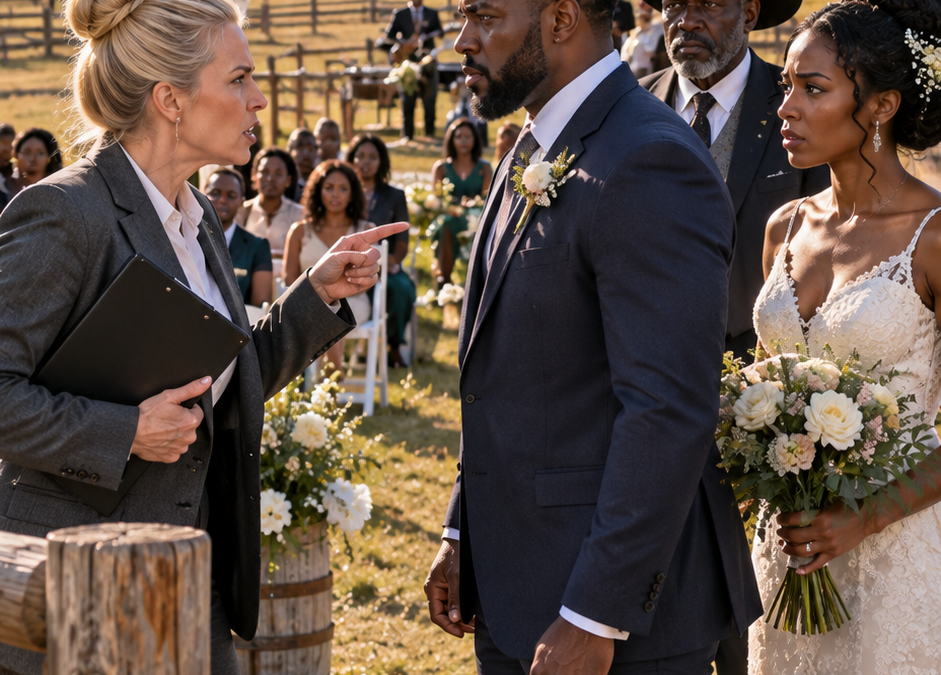
Three hours before I was supposed to marry the woman I loved in the same meadow where four generations of my family had walked, the HOA president arrived at my gate and threatened to have county enforcement clear every guest from my ranch before dinner was served.
She stood there with a clipboard, a storm-gray blazer, and the absolute confidence of someone who had repeated the same false claim so often that she no longer understood the difference between authority and performance.
What she did not know was that the man scheduled to stand beside me when I said my vows was already on his way—and the moment she recognized him, the entire expression on her face changed.
“This event is not authorized.”
Ranata Holloway said it without raising her voice.
She did not need to.
People who believe they possess institutional authority rarely shout at first.
They expect the title, the clipboard, the official language, and the possibility of punishment to do the work for them.
“You need to shut it down immediately,” she continued, “or I will have this property cleared by county enforcement before your guests finish their appetizers.”
I looked at her.
Then I looked beyond her.
Twenty-four white folding chairs stood in neat rows in the meadow.
The cedar arbor Roy Aldridge and I had built was wrapped in wildflowers and soft strands of Edison lights.
Yellow blossoms lined the old eastern fence where my grandmother had planted the first seeds decades earlier.
The band was testing its microphones near the barn.
From the house came the sound of women laughing.
One of those voices belonged to Emily, my bride.
I could hear her through the kitchen window.
For a moment, that was the only sound I wanted to listen to.
Ranata shifted the clipboard against her chest.
“Mr. Crestwood?”
“I heard you.”
“Then you understand the seriousness of the situation.”
I looked toward the house again.
Inside my grandfather’s old rolltop desk, in the second drawer, sat a manila folder containing the document that mattered far more than anything Ranata carried.
Crestwood Valley Ranch — Original Grant.
My grandfather had written those words himself.
Inside was a deed recorded March 14, 1947.
Instrument number 1947-00412.
The beginning of everything.
Ranata did not know that number.
She did not know the history behind it.
And, more importantly, she did not yet understand that the road her SUV had traveled, the gate she was gripping, the meadow she was threatening to clear, and every fence post she could see belonged to me without a single HOA covenant attached to any of it.
I had spent three months proving exactly that.
So I did not argue.
I simply said, “The wedding is going forward.”
Her jaw tightened.
“Then you are choosing noncompliance.”
“No,” I said. “I’m choosing to get married.”
And I walked back toward the house.
My grandfather’s name was Earl Crestwood.
He bought the original ranch in 1947.
Three hundred forty acres in western Colorado, running from the base of the eastern ridge down toward the creek bed that old survey maps called Ridge Crest Draw.
He paid eleven thousand dollars in cash.
That money represented seven years of work on other men’s land.
Fence repair.
Cattle.
Hay.
Equipment maintenance.
Anything that paid.
Earl was not the sort of man whose life made newspapers.
He did not build a corporation.
He did not become famous.
He simply wanted enough land that when he woke before sunrise, the work waiting outside belonged to him.
My father grew up there.
He learned to repair a pump before he learned to drive.
He could tell how hard the wind was blowing by watching the aspens high on the eastern slope.
He knew where the creek would overflow during spring runoff and where it would shrink into shallow stone channels by August.
In 1971, he bought sixty additional acres along the northeastern corner from the Aldridge family.
That brought the ranch to four hundred acres.
It remained four hundred acres when it came to me.
My name is James Crestwood.
I trained as a civil engineer.
For years, I lived between two worlds.
Engineering gave me drawings, calculations, specifications, tolerances.
The ranch gave me weather, soil, animals, water, and the knowledge that no calculation survives long if the person making it refuses to look at the ground.
When my father suffered a stroke in 2004, I came home.
The following year, he transferred Crestwood Valley Ranch to me through a warranty deed.
Instrument number 2005-08831.
The title was clean.
No HOA restrictions.
No liens.
No competing ownership claims.
No recorded community covenant.
Nothing.
I knew because the title had been examined more than once.
The first time was during a barn refinance in 2009.
The second was when I consulted a lawyer about the northern boundary.
Both examinations reached the same conclusion.
Crestwood Valley Ranch was ours.
Separately owned.
Separately recorded.
Entirely outside Ridgerest Valley Estates.
That subdivision sat roughly two miles west of my property.
Its recorded eastern boundary was still more than a mile and a half from my western fence.
That should have ended the story before it began.
Instead, one Tuesday in April, three months before my wedding, I found an envelope in my mailbox.
Ridgerest Valley HOA.
Navy-blue logo.
Stylized mountain.
The letter was signed by Ranata Holloway.
President.
According to her, Crestwood Valley Ranch had recently been identified as falling within something called the HOA’s “designated community zone.”
That phrase appeared several times.
Because of that designation, she claimed, my ranch was now subject to Ridgerest Valley’s architectural rules, event policies, and community restrictions.
Then the letter came to the real point.
I was planning a wedding.
Apparently someone at Ridgerest knew.
Any gathering of more than twenty people, the letter said, required registration with the association at least thirty days in advance.
Failure to register could result in fines of $250 per day.
I read the letter three times.
Not because it was convincing.
Because I was searching for the one thing that would make it relevant.
A deed restriction.
An annexation agreement.
An easement.
A plat reference.
A recorded covenant.
There was nothing.
Only the phrase:
Designated community zone.
I folded the letter.
Placed it in a manila folder.
On the tab, I wrote:
RIDGEREST HOA
Then I went back to work.
Eleven days later, another letter arrived.
This one accused me of failing to cooperate.
The tone was sharper.
There was also a new alleged violation.
An “unapproved temporary structure.”
That was apparently the wedding arbor.
Roy Aldridge had helped me build it.
Roy’s grandfather belonged to the same Aldridge family that had sold my father the sixty acres in 1971.
Roy was sixty-three, thin, sun-darkened, and one of those men who could build almost anything without appearing hurried.
The arbor consisted of cedar posts, crosspieces, and wire.
Eight feet tall.
Simple.
Strong.
Beautiful.
And entirely on my property.
The second letter also announced that Ridgerest’s compliance coordinator, Diane Foss, would visit the ranch.
I put that letter behind the first.
Still no response from me.
Roy came over the following Saturday.
We were stringing lights around the arbor when I handed him both letters.
He read them.
Then read the first again.
Finally, he placed them on his truck’s tailgate.
“They think they own your ranch.”
“Apparently.”
He stared toward the western fence.
“From two miles away.”
“Apparently authority travels farther than I thought.”
Roy looked at me.
Then he smiled.
“Your granddad would have enjoyed this.”
“I’m not sure enjoyed is the word.”
“Oh, Earl would’ve loved it.”
Then he picked up the lights and went back to work.
That was the last conversation I had about it before calling Patricia Bain.
Patricia practiced property law in Glenwood Springs.
Two-room office.
Twenty years of land disputes.
No interest in theatrics.
When I arrived, she read Ranata’s letters while I looked at old survey maps framed on her wall.
After several minutes, she put the pages down.
“They haven’t cited anything.”
“That was my reading.”
“No deed restriction.”
“No.”
“No covenant.”
“No.”
“No recorded plat?”
“Not connecting them to me.”
Patricia pulled the Ridgerest Valley plat.
We laid it beside my deed.
Eighty-seven lots.
Approximately 210 acres.
Every one of them west of a clearly marked eastern subdivision boundary.
Then we compared that boundary with the description in my deed.
Patricia measured twice.
She picked up her pen.
On a yellow legal pad she wrote one word:
Nothing.
She turned it toward me.
“That,” she said, “is what they currently have connecting their HOA to your land.”
I looked at the word.
“Nothing.”
“Exactly.”
She ordered a full title search.
Eight days later, we received forty-four pages tracing Crestwood Valley Ranch back to Earl’s 1947 purchase.
No HOA.
No CC&Rs.
No community-zone designation.
No encumbrance giving Ridgerest any regulatory interest in the ranch.
Nothing.
I added the title report to the folder.
It was no longer a thin folder.
Diane Foss arrived on Wednesday morning.
White SUV.
HOA placard.
Camera.
Clipboard.
She walked the perimeter of my wedding meadow taking photographs as though she were inspecting a construction site.
I watched from the porch.
She photographed the arbor.
The chairs.
The temporary path toward the meadow.
The eastern gate.
Eventually she came toward me.
“Mr. Crestwood?”
“Yes.”
“I’ve documented seven violations.”
“That many?”
She did not appreciate the question.
She began reading.
Unapproved temporary structure.
Unregistered event seating.
Access modification.
Temporary electrical installation.
Several others.
The total fine was $1,400.
She held out the report.
I accepted it.
Then she gave me another document to sign.
“What’s this?”
“Acknowledgment of inspection.”
“I’m not signing it.”
“It only confirms receipt.”
“I received the report. That should be enough.”
Her expression tightened.
“The association reserves all enforcement rights.”
“I understand what you’re telling me.”
Then I said the same thing I had said to Ranata.
“Thank you for coming.”
Diane left.
I photographed her SUV before it disappeared down the road.
Recorded the time.
Added her report to the file.
That evening, Roy called.
He had seen her vehicle.
He also had news.
Ranata had been speaking publicly at Ridgerest meetings about my property.
According to Roy, she had described Crestwood Valley Ranch as a property “within the association’s jurisdiction” that had been ignoring community standards for years.
My wedding was supposedly an “unauthorized commercial event.”
That wording interested me.
I wrote it down.
Not because it frightened me.
Because people reveal a great deal when they believe nobody is keeping a record.
Patricia mailed her first formal response on April 22.
Two pages.
Precise.
Instrument 1947-00412.
Instrument 2005-08831.
Clean title search.
Ridgerest plat.
Distance between the subdivision and my property.
Then the question.
Produce the recorded instrument granting Ridgerest Valley HOA authority over Crestwood Valley Ranch.
A deed restriction.
Recorded covenant.
Plat notation.
Easement.
Anything.
Fourteen days.
Patricia ended with a warning that further enforcement without a legal foundation could expose the association to claims involving trespass and interference with lawful use of the property.
The deadline passed.
Nothing.
Twenty-one days.
Nothing.
Then, on day twenty-eight, Patricia received a call from Carl Briggs.
Denver attorney.
Outside counsel for Ridgerest.
He said the association was reviewing the matter.
Patricia called me afterward.
“He didn’t cite anything either.”
“I’m shocked.”
“You shouldn’t be sarcastic with your lawyer.”
“I’m practicing for marriage.”
“That poor woman.”
I laughed.
Then Patricia became serious.
“Your wedding is six weeks away.”
“I know.”
“They might continue.”
“I know.”
She paused.
“Part of me wants to let them.”
“So do I.”
Because there are times when stopping someone from making a mistake is useful.
And there are times when they have already been given the documents, the warning, and the opportunity to stop, and additional patience simply allows the record to become clearer.
We chose patience.
I formally requested the HOA’s governing documents.
Carl Briggs responded with the declaration and the subdivision plat.
Still no document connecting Crestwood Valley Ranch to Ridgerest.
But his cover letter did something useful.
It identified the alleged source of Ranata’s “community zone” authority.
Article 7, Section 4.
That evening, I sat at my kitchen table with coffee and the declaration.
I found Article 7.
Section 4.
Then I read it.
Once.
Twice.
A third time.
The board could create community zones for coordinating activities within Ridgerest Valley Estates.
Those designations applied to common areas and lots within the recorded plat identified in Exhibit A.
I underlined those words.
Within the recorded plat.
Exhibit A was the same plat we already had.
Eighty-seven lots.
Two hundred ten acres.
A mile and a half from my fence.
The HOA had finally cited the authority supporting its community-zone theory.
That authority expressly said it did not apply to me.
I called Patricia.
“You should read Article Seven again.”
“I have.”
“Section four.”
“Yes.”
“Within the recorded plat.”
Silence.
Then:
“Carl sent you this?”
“He did.”
Another pause.
“He sent us the clause that defeats his own client’s argument.”
“That was my interpretation.”
“It is a strong interpretation.”
I could hear her smiling.
That document went into the file with the limiting phrase highlighted.
A week before the wedding, Carl called Patricia again.
His tone had changed.
He had “concerns.”
He used the phrase “potential overreach.”
Twice.
Patricia called me immediately.
“He knows.”
“How much?”
“He’s read Article Seven.”
“What does he want?”
“Informal resolution.”
“Meaning?”
“They withdraw quietly. You let the rest go quietly.”
“What do you recommend?”
“A written acknowledgment that they have no jurisdiction over Crestwood Valley Ranch.”
“And if they won’t give it?”
“Then we continue.”
I looked through my kitchen window toward the meadow.
The arbor stood straight.
Wildflowers moved in a light breeze.
Guests would begin arriving in seven days.
“Continue,” I said.
There was another detail about the wedding I had deliberately kept out of every HOA conversation.
My best man.
His name did not appear on any guest list available to Ridgerest.
He and I had known each other since college.
We had spent our twenties arguing about engineering, land use, water, roads, and almost everything else.
Our careers went in very different directions.
I came back to the ranch.
He eventually entered public life.
By the time I was getting married, he was serving as governor.
That fact meant almost nothing to me personally.
To me, he was still the man who had once helped me replace a starter motor in a parking lot using the wrong size wrench and language that would have made his communications staff resign.
When I asked him to be my best man, he said yes before I finished the sentence.
We agreed on one thing.
No spectacle.
No announcement.
No political event.
He would come as my friend.
There would be security, of course.
That could not be avoided.
But otherwise, he was simply another wedding guest in a dark suit.
Ranata Holloway had no idea.
That mattered only because of what happened next.
I woke before sunrise on my wedding morning.
There was frost in the lowest grass.
I walked the perimeter.
Eastern gate.
Creek.
North corner.
Western fence.
Meadow.
My grandfather had walked those lines.
My father had walked them.
I walked them because doing so settled me.
The chairs were ready.
The arbor was ready.
Wildflowers moved along the fence.
By nine, catering trucks arrived.
By ten, the musicians were setting up.
Around eleven, I heard a vehicle grinding up the access road.
White SUV.
Ranata.
She stopped at the gate.
Got out.
Storm-gray blazer.
Clipboard.
Of course.
“This event is not authorized.”
I stood beside the arbor.
She continued toward me.
“You need to shut it down immediately or I will have this property cleared by county enforcement before your guests finish their appetizers.”
I let her finish.
Then I said, “My attorney has already communicated with your counsel.”
“I’m speaking as president of the association.”
“And I’m speaking as the owner of this ranch.”
“You remain in noncompliance.”
“With what?”
“Our community-event regulations.”
“This ranch is not in your community.”
“It falls within the designated zone.”
“Your attorney has your declaration.”
“So do I.”
“Then you should read Article Seven.”
Her eyes narrowed.
“Mr. Crestwood, I am not here to debate legal language.”
That sentence almost made me laugh.
Because legal language was the only thing that mattered.
“The wedding is proceeding.”
“Then I will contact enforcement.”
“That is your decision.”
I started back toward the house.
Ranata followed several steps.
“You understand county officers can remove people from an unauthorized event.”
I stopped.
“From private property?”
“If the event is unlawful.”
“What law am I violating?”
“The association’s restrictions.”
“That is not a law.”
Her face hardened.
“This attitude is exactly why the board had to act.”
Before I could answer, another vehicle entered the property.
Black SUV.
Then a second.
Ranata turned.
Her expression changed slightly.
The first SUV stopped near the house.
Two security personnel stepped out.
Then my best man opened the rear door and emerged.
Dark suit.
No tie yet.
Garment bag in one hand.
He looked toward me.
“James!”
I raised my hand.
Ranata stared.
She knew his face.
Most people in Colorado did.
He came toward us.
Then he noticed Ranata.
“Everything all right?”
“Fine,” I said.
Ranata looked from him to me.
Then back again.
“Governor?”
He gave her the polite expression public officials develop after years of being recognized by strangers.
“Yes, ma’am.”
She glanced at the clipboard.
Then at the security vehicles.
Then toward the chairs.
I said, “He’s my best man.”
For the first time in three months, Ranata Holloway had no prepared sentence.
Her mouth opened.
Closed.
Then opened again.
“I wasn’t aware.”
“I didn’t think it was relevant.”
The governor looked at me.
“What did I miss?”
“Property dispute.”
He nodded.
“Ah.”
He knew me well enough not to ask for details five hours before my wedding.
Ranata, however, seemed suddenly eager to explain.
“There appears to be some confusion regarding HOA jurisdiction over the property.”
Interesting.
Five minutes earlier there had been no confusion.
There had been noncompliance.
Enforcement.
County removal.
Now there was “some confusion.”
The governor looked at her.
Then at me.
“Is your lawyer handling it?”
“Yes.”
“Then it sounds like your lawyer is handling it.”
That was all he said.
He did not threaten her.
Did not invoke his office.
Did not call anyone.
Did not interfere with a private civil matter.
He simply picked up his garment bag.
“You planning to get married in ranch clothes?”
I looked down at myself.
“Eventually.”
“Emily may have opinions.”
“She usually does.”
He headed toward the house.
I looked back at Ranata.
She was still holding the clipboard.
But differently.
Lower now.
Not against her chest.
She said, “I’ll speak with our counsel.”
“That would be appropriate.”
Then she left.
No county enforcement arrived.
Nobody cleared the meadow.
Nobody touched the chairs.
And before the guests finished their appetizers, I was already married.
Emily came down the aisle just after four.
I remember very little about the guests.
Very little about the music.
Very little about anything beyond her.
The light came through the meadow exactly the way Roy said my grandfather had always loved.
Golden from the eastern ridge.
Warm against the cedar arbor.
Wildflowers moving behind her.
The governor stood beside me.
Not as governor.
As my friend.
Roy sat two rows back.
Patricia was there too.
She had accepted the invitation months earlier, long before we knew how useful her presence might feel.
When Emily reached me, she looked once toward my best man.
Then whispered:
“He told me about the HOA lady.”
“Of course he did.”
“She really came here today?”
“Yes.”
Emily looked at me.
“On our wedding day?”
“Yes.”
She took my hand.
“Please tell me you didn’t spend the morning arguing about property records.”
“I barely mentioned them.”
“That is the most romantic thing you have ever done.”
Then we got married.
No HOA interruption.
No deputies.
No enforcement team.
No one shut off the band.
The only unauthorized activity that evening was Roy giving a speech nobody had approved in advance.
He told three stories about my grandfather.
Two were embarrassing.
One was probably false.
All three made Emily laugh.
I would have paid a $250 daily fine for that alone.
Six days after the wedding, Patricia filed our petition for declaratory judgment.
We were finished waiting.
Fifty-one pages.
My deed.
Complete title search.
Ridgerest plat.
CC&Rs.
Article 7, Section 4.
Ranata’s letters.
Diane’s $1,400 compliance report.
Certified correspondence.
Carl Briggs’s response.
Everything.
We asked the court to declare that Crestwood Valley Ranch was not subject to Ridgerest Valley HOA jurisdiction.
We asked for the fines to be voided.
We asked for an injunction preventing future enforcement.
Carl Briggs responded three weeks later.
Twenty-two pages.
Lots of language about administrative authority.
Community coordination.
Longstanding practices.
General board powers.
He used “community zone” repeatedly.
He barely dealt with the four words that mattered.
Within the recorded plat.
The hearing took place August 14.
Garfield County District Court.
Patricia and I arrived early.
Ranata sat across the aisle with Carl Briggs and two board members.
Gerald Fitch, treasurer.
Sylvia Payne, secretary.
Ranata had her clipboard.
Same storm-gray blazer.
Patricia presented our case in less than forty minutes.
The 1947 deed.
The 2005 deed.
The clean title.
The subdivision plat.
Then Article 7, Section 4.
She read it aloud.
When she reached the limiting phrase, she slowed down.
“Within the recorded plat.”
Then she read it again.
The judge, Margaret Solless, looked at Exhibit A.
Then at Carl.
“Is Mr. Crestwood’s property within this plat?”
“No, Your Honor, but—”
“How far outside?”
“Approximately a mile and a half.”
The judge looked at him.
“A mile and a half?”
“Yes.”
Carl returned to the board’s general powers.
Community coordination.
Administrative designations.
The judge stopped him.
“Where is the instrument extending those powers to petitioner’s ranch?”
“The community-zone designation itself—”
“Where is it recorded?”
“It is an administrative determination.”
“That was not my question.”
Silence.
She repeated it.
“Where is the instrument recorded?”
There was none.
Carl eventually pointed to Article 7.
The judge read it.
Then looked at him.
“This language says the designation applies within the recorded plat.”
“Yes, Your Honor.”
“Petitioner is not within the recorded plat.”
“No.”
“Then why was he fined?”
Carl tried to explain.
He did his job.
He was professional.
He was careful.
But there are arguments that cannot survive their own documents.
This was one.
Judge Solless ruled from the bench.
Crestwood Valley Ranch was not subject to Ridgerest Valley HOA jurisdiction.
The community-zone designation had no legal effect on my land.
The $1,400 fines were void.
The HOA was permanently prohibited from future site visits, fines, enforcement notices, or assertions of jurisdiction over the ranch.
Then came the part Ranata probably had not expected.
Attorney’s fees.
The court found the association’s position legally untenable and the litigation avoidable.
Patricia would submit our fees.
The hearing had taken less than an hour.
I closed the binder.
Across the room, Ranata stood.
She left the clipboard on the table.
I never found out whether she forgot it or simply decided she no longer wanted to carry it.
Either possibility suited me.
Ridgerest appealed.
Patricia was unsurprised.
“They’ll argue general authority again,” she told me.
“And?”
“And Article Seven will still say the same thing.”
Four months later, the Colorado Court of Appeals rejected the challenge.
Same declaration.
Same plat.
Same result.
The HOA could not expand its jurisdiction through an internal administrative designation beyond the land actually subject to its recorded governing documents.
The final attorney-fee award was $11,400.
Ridgerest paid it.
The check arrived in January.
I deposited it.
Then I put a copy inside the Ridgerest file.
That file had begun with one absurd letter.
By then it held an entire history of what happens when an institution mistakes repetition for authority.
I did not celebrate Ranata’s defeat.
I know that sounds strange after everything she did.
But by January, I did not care enough to hate her.
My wedding had happened.
My marriage had begun.
The ranch remained ours.
Those things mattered.
The rest was administration.
One evening, I walked into the meadow.
Winter had stripped it down.
No wildflowers.
No chairs.
No band.
The arbor remained.
Its cedar posts had darkened.
A little snow rested along one crosspiece.
I put my hand against the wood.
Roy had been right.
My grandfather would have liked the wedding.
I think my father would have too.
The governor had returned to Denver the next morning.
Before leaving, he stood with me at the gate.
“Interesting HOA you’ve got.”
“Not mine.”
He smiled.
“Apparently that was the problem.”
He understood.
The important part of that wedding-day moment was never that a governor had appeared and frightened an HOA president.
That would have been too simple.
His office did not decide the dispute.
He did not make a phone call.
He did not use state power to solve a private property disagreement.
The deed did.
The plat did.
The recorded declaration did.
The court did.
The governor’s arrival merely created one revealing moment.
Ranata had spent months speaking to me as though resistance itself proved guilt.
She threatened enforcement because she expected the title of HOA president to be the largest title in the conversation.
Then someone arrived with a larger title.
And suddenly she discovered words like “confusion.”
But titles were never the point.
Her authority would have been equally nonexistent if my best man had been a mechanic.
The legal record would not have changed.
Instrument 1947-00412 would still have existed.
Instrument 2005-08831 would still have existed.
Article 7 would still have limited community zones to the recorded plat.
Crestwood Valley Ranch would still have been a mile and a half outside it.
That is the lesson I carried away from the whole thing.
When someone arrives with apparent authority and tells you what you must do with your land, your house, your business, or your property, confidence is not evidence.
A logo is not jurisdiction.
A clipboard is not jurisdiction.
A board vote is not jurisdiction.
A threatening letter is not jurisdiction.
Even a lawyer’s argument cannot create a property interest that was never recorded.
There has to be a foundation.
A deed.
A covenant.
An easement.
A statute that actually applies.
Something.
If the foundation is absent, all the certainty in the world is just performance.
My grandfather understood that without ever saying it in those terms.
He bought land in 1947.
Recorded the deed.
Kept the paper.
My father did the same.
When the ranch transferred to me, I did the same.
Four generations did not preserve Crestwood Valley Ranch by shouting louder than everyone else.
They preserved it by knowing what belonged to them and keeping the documents that proved it.
The following spring, the wildflowers returned along the meadow fence.
Emily and I walked out there one evening after dinner.
She stopped beneath the arbor.
The lights were gone.
The chairs were gone.
Only cedar remained.
She looked toward the gate.
“Was that where she stood?”
“Ranata?”
“Yes.”
“About there.”
Emily smiled.
“Threatening to shut down our wedding?”
“Before the appetizers.”
“That part was ambitious.”
“She was committed.”
Emily slipped her hand into mine.
Then she looked across the meadow.
“And this is where you stood?”
“Right here.”
“When your best man arrived?”
“Almost.”
She laughed.
“I wish I could have seen her face.”
I thought about it.
Then shook my head.
“No.”
“Why?”
“Because I’m glad you were inside.”
She looked at me.
“You didn’t want me involved?”
“I wanted you thinking about our wedding.”
That quieted her.
After a moment, she rested her head against my shoulder.
We stood there until the light began disappearing behind the ridge.
The creek moved below us.
Aspens stirred higher up the slope.
Nothing about the meadow looked different from before the dispute.
That was the best part.
The boundary had not moved.
The title had not changed.
The wildflowers returned where my grandmother had planted them.
The cedar arbor remained where Roy and I had set it.
And on the second drawer of my grandfather’s rolltop desk sat a manila folder containing the document that had outlasted every letter, every fine, every threat, every board resolution, every court filing, and every storm-gray blazer that had tried to make itself more important than the land beneath it.
Instrument 1947-00412.
March 14, 1947.
I still know the number from memory.
I probably always will.
Because my grandfather’s deed had been telling the truth for decades before Ranata Holloway ever arrived at my gate.
All we had to do was read it.








