HOA Karen Called 911 to Shut Down My Backyard Yoga Class—She Had No Idea Who Was Teaching It
HOA Karen Called 911 to Shut Down My Backyard Yoga Class—She Had No Idea Who Was Teaching It
She called 911 over people quietly stretching on yoga mats and told police she was stopping an “illegal gathering.”
HOA Karen threatened me with $800-a-day fines even though my ranch had never belonged to her association.
Then the patrol car rolled through my gate—and the officer took one look at the woman leading my class.
“Your backyard yoga class is an unauthorized gathering, and I’m calling 911 right now to have every one of these people removed.”
Karen Whitmore shouted that from the other side of my fence while fifteen adults sat quietly on yoga mats beneath the cottonwoods.
Nobody was playing loud music. Nobody was drinking. Nobody was blocking a road. The loudest sound on my four-thousand-acre ranch was probably a meadowlark somewhere behind the barn.
That did not stop Karen.
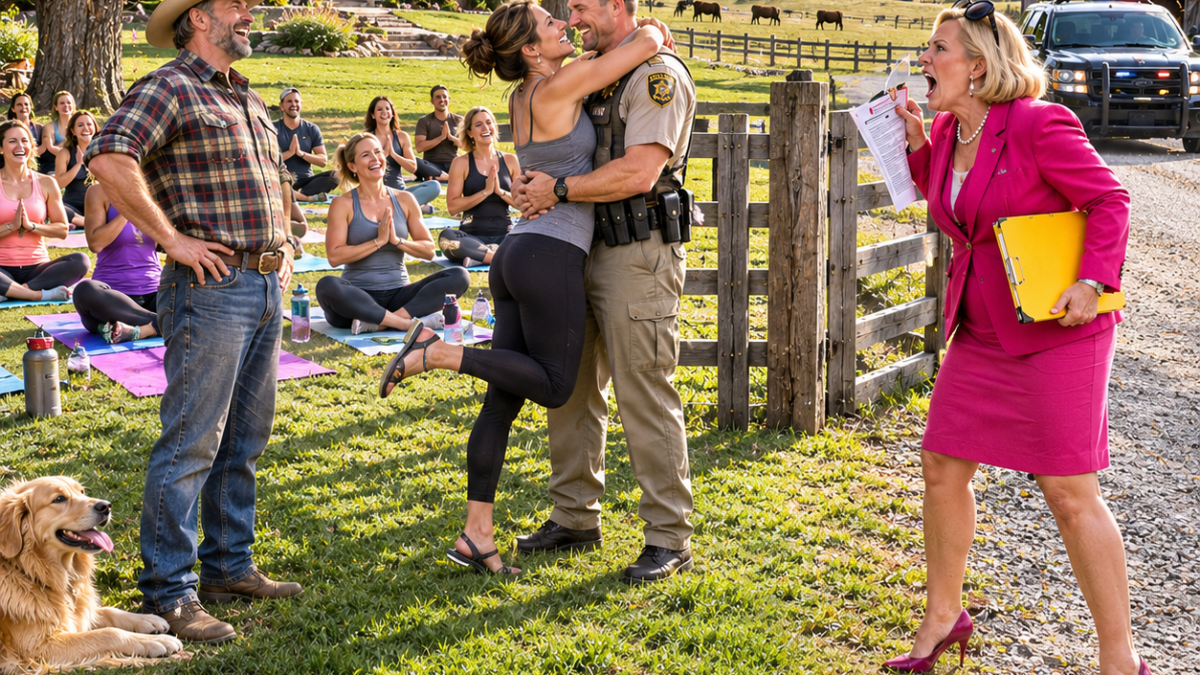
She stood beside the fence in a bright pink blazer, matching skirt, beige heels, and sunglasses perched on top of her perfectly arranged blonde hair. Her yellow HOA folder was tucked beneath one arm while she held her phone dramatically to her ear with the other.
Behind me, our instructor calmly said, “Inhale slowly.”
Fifteen people inhaled.
Karen pointed through the fence.
“See? Organized activity!”
I stared at her.
“You caught us.”
She narrowed her eyes.
“This is not funny, Jack.”
“I agree. Breathing has gotten completely out of control.”
A couple of people on the mats started laughing.
Karen’s face turned red.
She yanked a violation notice from her folder and held it up.
“Eight hundred dollars per day until these gatherings permanently cease.”
“Which HOA rule am I violating?”
“Unauthorized group occupancy.”
“I’m on private agricultural property.”
“Your activities affect Willow Crest.”
“That still doesn’t make my ranch part of Willow Crest.”
“You have been told repeatedly that external activities visible or audible from association property fall under community standards.”
I glanced toward Willow Crest Estates beyond the county road. The nearest house sat hundreds of yards from the class.
“What exactly can they hear?”
“Voices.”
At that moment the instructor said softly, “Exhale.”
Karen jabbed her finger toward us.
“That!”
I almost admired the commitment.
My wife, Sarah, sat on a blue mat near the back. She covered her face with both hands.
Karen continued.
“I called the non-emergency line twice. Apparently nobody there understands the seriousness of this situation, so I’m escalating.”
My smile disappeared.
“You called 911?”
“I am reporting an active illegal gathering.”
“There is no emergency.”
“That is for law enforcement to determine.”
She raised the phone.
“Yes, dispatcher, I need officers immediately. There is a large unauthorized event occurring beside Willow Crest, and the property owner refuses to disperse it.”
I heard the dispatcher ask something.
Karen answered, “At least thirty people.”
I counted.
Fifteen students.
One instructor.
Me.
“You’re doubling the attendance now?”
She turned away.
“They’re becoming confrontational.”
Nobody had moved.
I pulled out my own phone and started recording.
Karen lowered her voice.
“You’ll regret making this difficult.”
Then gravel crunched at the far end of my driveway.
A county patrol cruiser rolled slowly through the ranch gate.
No lights.
No siren.
Just one vehicle moving toward a group of adults who were now transitioning peacefully into seated stretches.
Karen smiled like cavalry had arrived.
“There. Now we’ll see how funny you think this is.”
The cruiser stopped.
A tall officer stepped out.
He looked toward me.
Then toward the yoga mats.
Then directly at the instructor.
His serious expression disappeared.
A huge grin spread across his face.
“Jack?”
He started walking toward us.
Karen hurried forward holding her HOA notice like evidence in a murder trial.
“Officer, thank God. I’m the HOA president and I need this gathering dispersed immediately.”
He barely heard her.
He was looking past me.
At the instructor.
Then he laughed.
“Oh, you have got to be kidding me.”
Karen smiled triumphantly.
I didn’t.
Because I knew exactly what he had just realized.
And Karen was about to find out why calling the police had been the worst possible move she could have made.
part 2
Officer Daniel Mercer walked past Karen, came straight to me, and shook my hand.
“Jack Dawson. Haven’t seen you since the livestock fundraiser.”
“Been a while.”
He nodded toward the yoga group.
“You finally started doing this?”
“Sarah talked me into hosting.”
“I heard.”
Karen stepped between us.
“Officer, if the social reunion is finished, I need you to address the active violation.”
Daniel looked at her.
Then he looked over my shoulder.
The instructor had risen from her mat.
She was a woman in her early forties wearing black yoga pants, a gray athletic top, and her hair tied back. She walked toward us with an amused expression.
Daniel smiled.
“Hey, honey.”
Karen froze.
The instructor kissed him lightly on the cheek.
“Hey.”
Daniel nodded toward the class.
“How’s turnout?”
“Good. We’re almost finished.”
He looked toward two mats near the center.
“Mrs. Peterson still cheating on balance poses?”
An older woman shouted, “I heard that, Daniel.”
Everyone laughed.
Karen did not.
Her phone was still in her hand.
She looked from Daniel to the instructor.
Then back again.
“You know her?”
Daniel smiled.
“She’s my wife.”
For perhaps three full seconds, Karen said absolutely nothing.
That might have been a personal record.
His wife, Emily Mercer, held out her hand.
“Emily.”
Karen stared at it without taking it.
“I know who you are.”
Emily slowly lowered her hand.
“That’s a little awkward considering we’ve never met.”
Karen found her voice.
“This does not change the fact that the event is unauthorized.”
Daniel looked at me.
“Unauthorized by whom?”
“The Willow Crest Homeowners Association.”
He glanced toward the subdivision.
Then back toward my ranch.
“This property isn’t in Willow Crest.”
“That is disputed.”
“No,” I said. “You dispute it. The county records don’t.”
Karen snapped open her folder.
“The HOA adopted a community-impact policy covering disruptive external gatherings.”
Daniel read the notice she handed him.
His eyebrows climbed.
“Eight hundred dollars per day?”
“Until permanent compliance.”
He looked toward the class.
A woman in her sixties was lying on her back with her eyes closed.
Two ranch hands were sitting cross-legged.
Sarah was drinking water.
Emily had a small battery-powered speaker beside her mat, but it was turned so low I could barely hear it from the fence.
Daniel looked at Karen again.
“What exactly is the emergency?”
“This gathering exceeds community occupancy limits.”
“Which occupancy limit?”
“Our association limit.”
“But this isn’t association property.”
“The participants include Willow Crest residents.”
Daniel paused.
“Residents aren’t allowed to leave the HOA?”
“That is not what I said.”
“It’s what you’re describing.”
Karen’s cheeks reddened.
“The problem is the scale and frequency.”
Emily folded her arms.
“We meet once a week.”
“The HOA has not approved weekly commercial activity.”
“It isn’t commercial,” I said.
Karen swung toward me.
“I have photographs of money changing hands.”
“Donation jar.”
“For Emily’s veterans wellness charity,” Sarah added from behind us.
That shut Karen up for roughly half a second.
Then she recovered.
“Money is money.”
Emily’s expression changed.
She had stayed remarkably patient until then.
“The donations pay for free movement and stress-management classes for veterans, farmworkers, teachers, nurses, and first responders.”
Karen looked toward Daniel as if this somehow strengthened her argument.
“Then you admit this is organized.”
Emily blinked.
“Yes. Yoga classes are usually organized.”
A man on a mat coughed to hide a laugh.
Karen pointed toward the lawn.
“Look at all those people.”
Daniel counted.
“Fifteen.”
“More were here earlier.”
“Two left early,” Emily said. “So seventeen total.”
Karen had reported thirty.
Daniel looked at her.
“How many people did you tell dispatch were here?”
“That was an estimate.”
“You told them thirty.”
“I was observing from a distance.”
“You’re standing forty feet away.”
Her mouth tightened.
Daniel took out a small notebook.
“Did you tell dispatch people were becoming confrontational?”
Karen looked at me.
“Mr. Dawson became hostile.”
I raised my phone.
“I’ve been recording since before you called.”
Karen stared at it.
Daniel nodded.
“That’ll make this easier.”
There are moments when a person realizes the stage they built for someone else has become their own trap.
I watched it happen in Karen’s eyes.
She immediately changed topics.
“The issue isn’t my wording. The issue is unlawful noise.”
Daniel listened.
We all listened.
Wind moved through the cottonwoods.
Somewhere near the barn, a cow gave one lazy call.
Emily’s speaker played soft instrumental music at a volume approximately equal to a refrigerator.
Daniel said, “I don’t hear a noise violation.”
“The breathing exercises carry.”
I genuinely thought I had misunderstood her.
“The breathing?”
“It is repetitive.”
Emily looked at Daniel.
Daniel looked at me.
I looked toward Sarah.
Sarah had both lips pressed together so tightly they had nearly disappeared.
Daniel asked, “What time does the class end?”
“Seven fifteen,” Emily said.
He checked his watch.
“Seven oh three.”
“Our county nighttime noise standard doesn’t even begin for hours,” he said. “And nothing here appears remotely close to an unreasonable sound level anyway.”
Karen shook the HOA notice.
“County standards do not supersede association standards.”
“On HOA property, that may be something you discuss with your association attorney,” Daniel said. “On Jack’s ranch, your rules don’t become county law.”
She looked personally offended.
“I am president of Willow Crest.”
Daniel nodded politely.
“I’m a deputy sheriff. Neither title lets us make rules on property we don’t control.”
That sentence traveled through the class like a breeze.
Nobody cheered.
Nobody needed to.
Karen heard it.
Her next mistake was reaching for status.
“I know Sheriff Collins.”
“So do I.”
“He understands the importance of maintaining community order.”
Daniel smiled.
“He hired me.”
Karen looked down at the notice.
Then at Emily.
“This is highly inappropriate.”
Emily’s eyebrows rose.
“What is?”
“Your husband responding to a complaint involving your own event.”
That was, surprisingly, the first reasonable thing Karen had said.
Daniel nodded.
“You’re right about one point. Since Emily is involved, I’m going to have another deputy document the complaint so there’s no question about conflict.”
Karen’s face brightened.
She thought she had recovered.
Daniel radioed for the second unit that dispatch had apparently already sent because Karen had described the call as escalating.
Five minutes later, Deputy Marcus Lee arrived.
Marcus was younger than Daniel and had the kind of expression that suggested he had heard almost every strange complaint people could invent.
Daniel explained his connection to Emily and stepped back.
Marcus spoke with Karen first.
Then me.
Then several class participants.
He walked the property edge.
Checked the road.
Observed parking.
Listened to the sound level.
Asked whether anyone was blocking a driveway.
No.
Whether alcohol was being served.
No.
Whether admission was being charged.
No.
Whether any amplified sound had generated a county complaint from another resident.
No.
He contacted dispatch.
Then returned.
“Ms. Whitmore, I’m not finding a law-enforcement violation here.”
Karen pointed at the mats.
“What about occupancy?”
“This is an outdoor private gathering.”
“There are limits.”
“Not the HOA limits you’re showing me.”
“What about noise?”
“I can barely hear the music while standing beside it.”
“The talking?”
“People are allowed to talk.”
Karen’s eyes narrowed.
“The lights come on after dark.”
I pointed toward the string lights hanging between two wooden posts.
“They’re fifteen-watt warm bulbs.”
Marcus stared at them.
“Those?”
“Yes,” Karen said.
“They illuminate the yoga area.”
“Lights have a habit of doing that.”
Daniel coughed.
Emily stared at the ground.
I knew everyone was fighting the same battle.
Karen didn’t notice.
She was too committed to winning.
“I have photographs taken from Willow Crest showing visible light pollution.”
“From where?”
“My upstairs window.”
I looked toward her house.
The upper floor was probably eight hundred yards away.
“So you used a zoom lens?”
“The equipment is irrelevant.”
Marcus wrote something down.
“What time did the lights stay on?”
“Nine thirty.”
“That wasn’t a yoga night,” Sarah said.
Karen turned toward her.
“They were illuminated.”
“That was my birthday.”
Twenty-five people had been here.
Family.
Dinner.
Cake.
A bonfire inside a legal fire ring.
Apparently Karen had been documenting that too.
Marcus asked, “Have you been photographing this property regularly?”
Karen realized what the question sounded like.
“I document violations.”
“From your home?”
“Yes.”
“Using magnification?”
She hesitated.
“I have a camera.”
I filed that information away.
Not because photography from her property was automatically illegal.
Because Karen had spent weeks building a surveillance archive of my backyard while simultaneously claiming fifteen people breathing quietly created a safety emergency.
Her sense of proportion fascinated me.
Marcus closed his notebook.
“Here’s where we are. I see no criminal issue, no county noise violation, no emergency, and no reason to disperse this group. If there’s a civil HOA question, you can address that through appropriate civil channels. But you should not use 911 to resolve a routine association dispute.”
Karen stiffened.
“I had reason to believe the situation was escalating.”
Marcus looked toward the yoga class.
Emily had resumed the final relaxation portion.
Everyone lay silently on their mats.
One elderly man had apparently fallen asleep.
A faint snore floated across the lawn.
Marcus looked back at Karen.
“Doesn’t seem especially escalated.”
The snoring got louder.
Daniel bit his lip.
I lost the battle.
I laughed.
Karen shot me a look.
“You’re enjoying this.”
“I’m trying very hard not to.”
The sleeping man snored again.
Marcus smiled.
“Sir, unless that gentleman becomes significantly more dangerous, we’re done here.”
Karen tried one last angle.
“What about parking?”
I pointed toward the gravel strip along my barn.
Every car was fully inside my property.
None blocked the county road.
Marcus nodded.
“Looks fine.”
Then Daniel’s radio crackled.
Dispatch asked for his status.
He replied that there was no enforcement issue and both units were clear.
Karen’s shoulders dropped.
Not much.
But enough.
She had summoned two deputies expecting them to remove my guests.
Instead, they had documented that there was nothing to remove.
Emily walked back over after dismissing the class.
Daniel smiled at her.
“Kids okay?”
“My mom has them.”
“I’ll pick you up when you’re done cleaning.”
One of the participants offered Daniel a bottle of water.
He accepted it.
Karen looked offended by that too.
Maybe hydration violated architectural standards.
Before leaving, Marcus spoke quietly with her.
I couldn’t hear every word, but I caught “non-emergency line,” “actual emergency,” and “future calls.”
She nodded stiffly.
Then she turned and walked back toward Willow Crest.
Her beige heels clicked against the gravel.
Halfway to the road, one heel landed in a soft patch beside my irrigation ditch.
She sank nearly three inches.
Karen lurched.
The yellow folder flew open.
Violation notices scattered across the grass.
Nobody laughed immediately.
We were adults.
We had standards.
Then one sheet blew directly onto a yoga mat.
The man who had been snoring woke up, looked at it, and said, “Is this my final pose?”
That ended us.
Even Emily laughed.
Karen gathered her papers without looking back.
By the time she disappeared toward Willow Crest, the sky had turned purple.
The class ended the way it always did.
Quiet conversation.
People rolling mats.
Neighbors sharing produce Sarah had placed in baskets near the porch.
Emily collected the donation jar.
Daniel waited beside his cruiser until she finished.
Nothing about the evening had been dangerous.
That was what bothered me most.
Karen hadn’t called because she believed anyone needed help.
She called because ordinary channels had not produced the answer she wanted.
She had tried the HOA notices.
She had called the non-emergency line.
Nobody shut us down.
So she escalated the language until a peaceful class sounded like an urgent public-safety problem.
That crossed a line for me.
The next morning, I called Mark Ellison.
Mark was the attorney who had handled our family’s property issues for years.
He answered with, “What did the HOA do now?”
“They called 911 on yoga.”
Silence.
Then, “You’re going to have to give me more than that.”
I explained everything.
The $800 daily fine.
Karen’s claim that our gathering fell under Willow Crest occupancy rules.
Her description to dispatch.
The two deputies.
The fact that Emily was Daniel’s wife.
Mark listened without interrupting.
When I finished, he said, “First, don’t build your response around the deputy’s wife being the instructor.”
“Why?”
“Because legally, it’s funny but not important.”
“Very funny.”
“Extremely funny. Still not important.”
He explained that the real issues were jurisdiction and process.
Was my ranch subject to Willow Crest covenants?
No.
Could the HOA impose its private gathering rules on property outside the recorded declaration?
Not based on anything we had seen.
Was my class violating county land-use, business, parking, fire, or noise rules?
We needed to verify.
That last part mattered.
I didn’t want to become Karen in reverse.
I didn’t want to assume I was right because I felt right.
So we checked.
County planning confirmed that small private social and wellness gatherings incidental to residential and agricultural use were not prohibited under my circumstances.
The donation jar did not automatically convert the class into a commercial studio, though Mark recommended we document the charitable purpose and keep the scale modest.
The sheriff’s office confirmed no noise citation had been issued.
The fire marshal had no occupancy concern for fifteen adults on an open lawn.
Parking remained entirely on my property.
Everything Karen had presented as an emergency turned out to be either nonexistent or a private HOA rule that did not reach my ranch.
Mark drafted a cease-and-desist letter.
It was professional.
Almost disappointingly so.
I suggested the subject line:
RE: WEAPONIZED DOWNWARD DOG.
Mark declined.
He has very little imagination.
The actual letter identified my parcels, cited the recorded Willow Crest declaration, demanded withdrawal of the $800-per-day penalties, and instructed the board to stop representing that its rules applied to my property.
It also requested preservation of communications related to Karen’s calls to law enforcement and any claims that the gathering posed a safety hazard.
Sarah read it over breakfast.
“No jokes?”
“Mark hates freedom.”
Mark ignored me.
“Jack, you want the letter to look reasonable when someone else reads it.”
“Someone like a judge?”
“Hopefully never a judge. Maybe an insurance company. Maybe the board attorney. Maybe residents.”
That was another lesson I had learned from him.
Good legal strategy often means writing for the person who will read the document after your opponent has lost control of the situation.
We sent it at nine fourteen.
Karen replied at ten oh two.
Forty-eight minutes.
A personal best.
She accused me of “exploiting law-enforcement relationships to intimidate HOA leadership.”
I called Mark.
“I exploited law enforcement?”
“Apparently.”
“I didn’t call them.”
“I know.”
“She did.”
“I know.”
“Daniel didn’t even make the final determination.”
“I know.”
“Marcus did.”
“Jack.”
“What?”
“Stop helping. Her email is already excellent.”
By “excellent,” Mark meant excellent evidence.
Karen continued for six paragraphs.
She claimed the ranch was part of Willow Crest’s “community influence area.”
She claimed visible gatherings could reduce residential tranquility.
She claimed the HOA had broad equitable authority to regulate “external nuisance activities.”
Then she wrote the sentence Mark printed immediately:
“Formal ownership boundaries should not be used as a shield against reasonable community control.”
Mark placed it on his desk.
“I’m framing this eventually.”
“Get in line.”
The HOA’s attorney responded three hours later.
His email was very different.
He acknowledged receipt.
Said counsel was reviewing the matter.
Requested that all further communications go through him.
And asked Karen to stop contacting me directly.
That last instruction lasted until six forty-five that evening.
She appeared at my eastern fence.
No folder this time.
Just sunglasses, a pink blouse, and fury.
“You went to a lawyer.”
“You called 911 over stretching.”
“You made me look incompetent.”
“I didn’t make you call.”
“You knew the responding officer.”
“I know a lot of deputies.”
“You knew his wife was teaching.”
“Yes.”
“And you said nothing.”
I stared at her.
“Was I supposed to interrupt your emergency call and explain the guest list?”
“You let me walk into that.”
“You walked here by yourself.”
She folded her arms.
“This class is creating tension in the community.”
“Karen, the class contains people from your community.”
“That’s part of the problem.”
I actually laughed.
“You’re angry your residents like coming here?”
“I’m angry that you’re undermining HOA cohesion.”
“How?”
“People come to your property, socialize outside HOA programs, and then complain about our rules.”
That stopped me.
For the first time, I understood that yoga had almost nothing to do with it.
Karen wasn’t trying to regulate sound.
She was trying to regulate influence.
Emily’s classes had become popular.
Some Willow Crest residents attended.
They met people from outside the subdivision.
They talked.
They relaxed.
They discovered that life did not collapse when everything wasn’t approved by committee.
Karen saw that as a threat.
“You don’t want quiet,” I said.
“What?”
“You want control.”
“That is absurd.”
“Then why does it matter where your residents do yoga?”
“Because organized activities should go through the association.”
“Why?”
“So they can be properly supervised.”
“These are adults.”
“That doesn’t eliminate community responsibility.”
“They’re doing breathing exercises.”
She pointed toward me.
“You think every issue becomes ridiculous if you describe it sarcastically.”
“No. You’re doing most of that work yourself.”
She left furious.
The following week, Willow Crest sent a formal notice suspending the fines while counsel reviewed jurisdiction.
Suspending.
Not withdrawing.
Mark rejected it.
He wanted rescission.
He also requested the board minutes where the $800 penalty had supposedly been authorized.
Those minutes were revealing.
Karen had proposed a new “External Activity Impact Policy” after residents began attending events on neighboring properties.
The board approved a rule concerning HOA common areas and member lots.
Nothing in the minutes authorized enforcement against non-HOA land.
Karen had taken a rule applying inside Willow Crest and stretched it across my fence because she wanted it to.
The board secretary confirmed as much.
That became important because several directors had no idea Karen had sent me fines.
Robert Hale, the vice president, called me personally.
“Jack, I need to ask you something.”
“Go ahead.”
“Did Karen tell you the board voted specifically to stop your class?”
“Yes.”
Silence.
“We didn’t.”
“Figured.”
“We approved the activity policy.”
“For HOA property.”
“Yes.”
“Did anyone authorize her to fine me?”
Another silence.
“Not that I can find.”
The emergency board meeting was scheduled for Thursday.
Karen objected.
The other directors insisted.
By then the yoga incident had spread through Willow Crest.
Not because I publicized it.
Because half the class lived there.
Mrs. Peterson, the seventy-year-old woman Daniel teased about balance poses, apparently had the social reach of a regional newspaper.
She told three neighbors.
Those neighbors told six.
By Tuesday, someone had created a parody flyer:
EMERGENCY YOGA RESPONSE TEAM.
BREATHE RESPONSIBLY.
I did not create it.
I did save a copy.
Thursday evening, Sarah and I walked into the Willow Crest clubhouse and found nearly every chair occupied.
Emily came too.
Daniel did not.
That was intentional.
He wanted no suggestion that his position had anything to do with HOA governance.
Marcus wasn’t there either.
The sheriff’s office had already provided the relevant call record through proper channels.
Karen sat at the front beside the board.
Her pink blazer was back.
At that point, I had begun wondering whether she owned clothes in any other color.
Robert opened the meeting.
“We are here to discuss enforcement actions involving the Dawson ranch and concerns surrounding emergency-service calls.”
Karen leaned toward her microphone.
“I object to the characterization.”
Robert looked at her.
“You’ll have time to speak.”
She leaned back.
Barely.
The HOA attorney joined by video.
He started with jurisdiction.
The recorded declaration did not include my ranch.
No annexation existed.
No agreement extended Willow Crest’s gathering restrictions to my parcel.
The board’s External Activity Impact Policy applied to association-controlled property and member lots.
It did not authorize Karen to issue daily fines against me.
Simple.
Clear.
Bad for Karen.
Then the treasurer spoke.
“Were any fines actually entered into our accounting system?”
The management company representative answered.
“Yes.”
People murmured.
“How much?”
“Eight hundred dollars per day beginning with the first notice.”
“For how many days?”
“Nine.”
Seven thousand two hundred dollars.
For yoga.
An elderly man behind me whispered, “I need to stretch more expensively.”
Sarah elbowed me before I could respond.
Robert looked toward Karen.
“Who instructed management to enter those charges?”
Karen answered.
“I did.”
“Under what authority?”
“The board policy.”
“Counsel just said it didn’t apply.”
“That is counsel’s interpretation.”
The attorney’s face on the monitor became very still.
I had seen that expression before.
It was the professional version of a person deciding whether to become offended.
He said, “It is the interpretation I gave when the policy was drafted.”
Robert turned to Karen.
“You knew that?”
“I knew counsel preferred a narrower application.”
The room erupted.
A woman near the front stood.
“Then why did you tell us the ranch was violating HOA rules?”
Karen pointed toward her.
“Please sit down.”
“No.”
That surprised Karen more than anything else.
The woman was named Linda Carver.
She attended Emily’s Tuesday class.
“I live on Birch Lane,” Linda said. “You sent residents a message saying Jack was operating an illegal event business and that the HOA was taking enforcement action. Was that true?”
Karen answered, “He was hosting recurring organized gatherings.”
“That wasn’t the question.”
There it was.
The sentence had followed her here too.
Linda repeated it.
“Was it an illegal event business?”
Karen looked toward counsel.
Counsel did not rescue her.
“The activity had commercial characteristics.”
Emily stood.
“It’s a charitable donation class.”
Karen looked at her.
“You accept money.”
“We suggest five-dollar donations. Nobody is turned away. The money funds free wellness sessions.”
“For whom?”
“Veterans, teachers, farmworkers, first responders.”
Someone applauded.
Then more joined.
Karen tapped the microphone.
“This is not relevant.”
Emily sat down.
Robert disagreed.
“It’s relevant because your notice describes a commercial entertainment operation.”
I had never seen that wording.
Mark had.
He handed me a copy.
There it was.
COMMERCIAL ENTERTAINMENT ACTIVITY.
I stared at Emily.
She whispered, “Apparently child’s pose is show business.”
I nearly choked.
The meeting moved to the 911 call.
The HOA attorney was careful.
He explained that whether a particular call was improper under law was a matter for public authorities, not the board.
But the board could evaluate whether Karen had accurately represented the situation while acting as HOA president.
Dispatch records reflected her claim of approximately thirty people.
There had been seventeen at most.
She reported escalating confrontation.
Video showed no confrontation before officers arrived.
She characterized the event as posing an immediate community-safety concern.
Deputies found no law-enforcement violation.
Robert asked Karen why she called 911 instead of continuing through non-emergency channels.
“I had already called non-emergency twice.”
“And they didn’t send anyone?”
“They failed to act.”
“Did they tell you it was an emergency?”
“No.”
“So you decided it was one?”
“I believed immediate intervention was necessary.”
Mrs. Peterson raised her hand.
Robert recognized her.
She stood slowly.
“Karen, I was there.”
“I know.”
“I’m seventy-two.”
Karen said nothing.
“My hip replacement is six years old. I can barely touch my toes. What exactly did you think I was about to do?”
Laughter exploded across the clubhouse.
Even Robert smiled.
Mrs. Peterson continued.
“I was lying on a mat trying not to fall asleep.”
“You were part of an unauthorized gathering.”
“I’ve had more dangerous afternoons at the grocery store.”
More laughter.
Karen tapped her folder.
“Individual participants are not the issue.”
Mrs. Peterson nodded.
“Good. Because I plan to keep going.”
She sat down to applause.
Karen looked like she wanted to ban applause.
The treasurer went next.
He had reviewed the financial impact.
Management time.
Attorney review.
Administrative processing.
Emergency meeting costs.
The HOA had spent thousands responding to an enforcement effort Karen had launched without confirmed jurisdiction.
Then came something even worse for her.
The board secretary had found an email from counsel sent before the first fine.
It said:
“Because the Dawson property is outside the recorded Willow Crest declaration, the association should not attempt direct monetary enforcement against the owner without a separately established legal basis.”
Karen had received it.
She had replied:
“Understood, but stronger pressure may encourage voluntary compliance.”
Nobody spoke for several seconds after that was read.
I felt my anger return.
Not because she misunderstood.
Because she understood enough.
She knew there was a jurisdiction problem.
She decided pressure might work anyway.
Robert removed his glasses.
“Karen, did you intentionally send fines you knew might be unenforceable in order to pressure Jack into canceling the classes?”
“No.”
“Then explain your email.”
“I meant community pressure.”
“You personally instructed management to assess $800 a day.”
“I believed the policy gave us leverage.”
The attorney interrupted.
“Leverage and legal authority are not interchangeable.”
That sentence ended her defense.
Karen tried to pivot.
“The classes still create legitimate community concerns.”
Linda spoke again.
“No, they create community.”
The room quieted.
She continued.
“My husband died last year. I barely left my house for four months. Emily’s class was the first place I went where I didn’t feel like everyone was watching me grieve. Sarah brought me tomatoes. Jack fixed my car battery when it died. Mrs. Peterson makes terrible jokes. Those people helped me.”
Mrs. Peterson raised a hand.
“My jokes are excellent.”
The room laughed softly.
Linda smiled.
Then her voice broke.
“You called that a nuisance.”
Karen looked down.
For the first time all night, she seemed to understand how bad the word sounded.
Linda sat.
I had known she attended class.
I didn’t know the rest.
Sarah squeezed my hand.
That was when the fight changed for me.
Until then, I had been defending my property rights.
Suddenly I understood we were defending something more.
The yoga classes mattered because they gave people a place to be ordinary together.
No gates.
No clubhouse reservations.
No board approval.
No status.
Just mats on grass.
Some people came for exercise.
Some came because they were lonely.
Some came because farm work had wrecked their backs.
Some came because Emily knew how to make a room—or a lawn—feel quiet without making anyone feel invisible.
Karen had looked at the same thing and seen an unapproved gathering.
Robert called for a recess.
The board entered a closed session with counsel.
Residents stayed in the room.
Nobody approached Karen.
She remained at the table staring into her folder.
Twenty minutes later, the directors returned.
Robert read the motions.
First, all fines and notices against my ranch were immediately rescinded.
Second, the association formally acknowledged that its gathering policy did not apply to my property.
Third, Willow Crest would reimburse reasonable documented legal expenses arising from the improper enforcement attempt.
Fourth, any future contact with law enforcement made in an official HOA capacity had to be accurately documented and could not be used as a substitute for civil enforcement.
Then came the last motion.
“Remove Karen Whitmore as president effective immediately.”
Karen’s head snapped up.
“This is ridiculous.”
Robert didn’t answer.
The vote was four to one.
Karen supplied the one.
Again.
If persistence were the same thing as wisdom, she would have been unstoppable.
The motion passed.
People applauded.
Karen gathered her folder.
Her hands were shaking.
She stood.
“This board will regret surrendering its authority.”
Robert answered calmly.
“We are defining its authority.”
She looked at me.
“This is what you wanted.”
I stood.
“No.”
“You wanted me removed.”
“I wanted you to leave my backyard alone.”
“You humiliated me.”
“You called the police on breathing.”
That was not my most mature line.
It was, however, accurate.
Several people laughed.
Karen’s eyes hardened.
“You think this is over because people like you.”
“No. It’s over because your rules stop at my property line.”
She left.
Outside, the sunset had faded to deep purple.
Sarah and I walked toward my truck.
Linda caught up with us.
“Jack.”
I turned.
She hugged Sarah first.
Then me.
“Thank you.”
“For what?”
“For not canceling.”
I hadn’t realized cancellation had ever felt like an option.
Then I remembered Laura—no, Sarah, my wife in this story—asking me after Karen’s first notice whether continuing was worth the trouble.
At the time, I had said yes because I resented being told no.
Now I had a better reason.
“Class is Tuesday,” I said.
Linda smiled.
“I’ll be there.”
Karen remained on the board as an ordinary director for just under a month.
Then she resigned.
According to Robert, she could not tolerate the new requirement that enforcement notices include a specific citation to the covenant provision and verification that the property was actually subject to it.
I considered that requirement revolutionary.
Apparently Karen considered it oppression.
The HOA issued a written apology.
Unlike the first drafts, the final version did not say “if anyone felt inconvenienced.”
Mark killed that sentence immediately.
It acknowledged that enforcement had been directed against property outside Willow Crest’s jurisdiction and that the board regretted the escalation.
Good enough.
The $7,200 in fake fines disappeared.
No lien was filed.
No county citation existed.
No class was canceled.
Our settlement covered legal expenses and a modest amount of documented costs related to the dispute.
There was no giant courtroom award.
No handcuffs.
No dramatic prosecutor.
Just records, responsibility, and a board forced to admit its president had exceeded her authority.
That was justice enough for me.
The yoga classes continued.
In fact, they grew.
Not dramatically.
Emily refused to let them become huge.
“If I need a microphone,” she said, “we’ve ruined yoga.”
We capped attendance.
People signed up informally.
Parking stayed near the barn.
Sessions ended before dark except in summer, when we used the warm string lights.
The five-dollar donation jar stayed.
Some people paid.
Some didn’t.
Nobody cared.
Within six months, Emily’s small wellness fund had enough money to offer free Saturday sessions at the veterans center in town.
Daniel occasionally attended.
He was terrible.
Absolutely terrible.
A man who could run several miles without complaint somehow became confused when asked to place one foot behind the other.
Emily would say, “Warrior Two.”
Daniel would somehow produce “Deputy Falling Into Fence.”
I enjoyed those classes tremendously.
One evening, he wobbled out of a balance pose and landed on both feet with a grunt.
I said, “Should I call 911?”
He stared at me.
Emily laughed so hard she had to sit down.
The joke became permanent.
Any time somebody dropped a water bottle:
“911?”
Somebody’s mat folded wrong:
“911?”
A goat wandered near the fence:
“Definitely 911.”
Emily finally banned the phrase during meditation because people kept laughing.
The class became exactly what Karen claimed to protect but never understood.
A community.
Willow Crest residents came.
Farm families came.
A librarian came.
Two mechanics came.
Three nurses.
A retired firefighter.
A high-school counselor.
One accountant who could hold a plank longer than any human being I had ever seen.
Nobody asked who belonged to which association.
Nobody cared how expensive anyone’s house was.
The ranch flattened those distinctions.
You put your mat on the grass.
You took off your shoes.
You tried not to fall over.
That was enough.
Months passed.
Then Karen’s house appeared on the market.
Sarah found the listing.
She always found these things before I did.
“Jack.”
The tone told me this was going to be good.
I came into the kitchen.
Her laptop was open.
Karen’s house looked pristine.
White kitchen.
Stone fireplace.
Large master bedroom.
Landscaped backyard.
And under “Lifestyle Features”:
“Quiet community adjacent to expansive private ranchland, offering peaceful open-space views.”
I stared.
Sarah stared.
Then she scrolled.
“Listen to this one.”
I waited.
“Perfect setting for wellness-focused living.”
I sat down.
“No.”
“Yes.”
“The woman who called the police on yoga is selling wellness-focused living?”
Sarah nodded.
I started laughing.
“I want to buy the house.”
“No.”
“Just for the irony.”
“We already have four thousand acres.”
“I’ll use it as a meditation room.”
“No.”
“Community healing center?”
“No.”
“Emergency yoga dispatch headquarters?”
Sarah closed the laptop.
“You are why I can’t leave you unsupervised.”
Karen sold the house four months later.
The buyers were a couple named Paul and Rebecca Chen.
They introduced themselves politely.
More importantly, Rebecca came to yoga her second week in Willow Crest.
She approached me after class.
“I hope this isn’t weird.”
“What?”
“We bought Karen’s house.”
I looked at her.
Then toward Willow Crest.
“Which one?”
She told me.
I started laughing.
Rebecca looked nervous.
“Is that bad?”
“No. It’s perfect.”
She had already heard part of the story from neighbors.
Not all of it.
I gave her the short version.
She stared at Emily.
“So your husband was the officer?”
Emily nodded.
Rebecca covered her mouth.
“Oh, no.”
Daniel, who happened to be rolling up mats, said, “Oh, yes.”
Rebecca attended almost every Tuesday after that.
Six months later, she offered her backyard for a winter class when our ranch lawn became too muddy.
I looked at the address.
Karen’s old house.
I said yes immediately.
Sarah accused me of having impure motives.
She was correct.
The first class there took place on a mild January afternoon.
Ten mats lay across Karen’s former lawn.
No emergency calls.
No violation notices.
No yellow folder.
Just people stretching quietly behind the house from which Karen had once photographed my ranch as evidence.
There was something beautifully absurd about it.
I stood near the patio holding coffee.
Rebecca walked over.
“You look way too happy.”
“You have no idea.”
She smiled.
“Want a mat?”
“I’m supervising community standards.”
She laughed.
Emily heard me.
“No, you’re participating.”
“I wore boots.”
“You own socks.”
“I’m holding coffee.”
“Put it down.”
Ten minutes later, I was on a yoga mat in Karen’s former backyard attempting to touch my toes.
I failed badly.
Daniel looked over.
“Need me to call somebody?”
“I hate you.”
“Breathe through it.”
For once, I understood why Karen hated yoga.
The humiliation could be profound.
Two years after the original confrontation, Willow Crest invited Emily to lead a free wellness session during its annual summer picnic.
Not on my ranch.
Inside the subdivision.
Officially approved.
The new board president, Elena Morales, introduced her.
“I think we can safely say yoga is no longer considered an emergency.”
Everyone laughed.
I stood near the back with Daniel.
He leaned toward me.
“You know there are fifty people here.”
“Somebody should alert dispatch.”
He nodded gravely.
“Clearly escalating.”
Emily pointed at us.
“You two. Quiet.”
“Yes, ma’am.”
That afternoon, I thought about how easily the entire situation could have gone differently.
If I had screamed at Karen.
If Daniel had tried to use his badge to defend his wife instead of stepping aside.
If Marcus had mocked Karen rather than documenting the facts.
If Mark had built our legal response around embarrassment instead of jurisdiction.
Any of those choices would have muddied the issue.
Instead, the facts remained simple.
My ranch was private property.
Willow Crest’s rules did not automatically extend beyond its recorded boundaries.
My gathering was small, peaceful, and lawful.
No county noise violation existed.
No public-safety emergency existed.
Karen had taken a disagreement and tried to manufacture authority by escalating it.
That strategy worked only until people checked.
I learned something else too.
HOA abuse rarely begins with bulldozers or dramatic seizures.
Sometimes it begins with a letter.
Then a second letter.
Then a fine.
Then a phrase like “community impact.”
Then a person with a title begins assuming that nobody will challenge the boundary between influence and authority.
If no one challenges it, the assumption grows.
Karen had been successful before because most people wanted peace.
They paid small fines.
Changed landscaping.
Moved decorations.
Canceled events.
Not always because the rules were valid.
Because fighting felt exhausting.
That taught her the wrong lesson.
She thought compliance meant consent.
She thought silence meant jurisdiction.
My ranch gave her nowhere to hide that assumption.
The property line was too clear.
The county records were too clear.
And, unfortunately for Karen, the yoga class was too ridiculous a target.
You can call a group of people sitting quietly on mats an “unauthorized occupancy event.”
You can print it in bold.
You can put a logo above it.
You can charge eight hundred dollars per day.
You can even call 911.
Eventually somebody is going to look at fifteen adults breathing under a sunset and ask the obvious question.
What exactly is the emergency?
The answer was Karen.
Not because she was physically dangerous.
Because she had turned her need for control into a crisis everyone else was expected to obey.
Once the board understood that, they finally stopped rewarding it.
One Tuesday evening, long after Karen moved away, we finished class under a sky streaked orange and violet.
Most people had gone.
Emily was packing her speaker.
Daniel was loading mats into their car.
Sarah and I sat on the porch.
Linda stayed behind.
She had become one of our most reliable regulars.
She looked healthier than she had the first year.
Not magically transformed.
Life doesn’t work that way.
But lighter.
She sat beside Sarah.
“You know what’s funny?”
“What?” I asked.
“I used to hate Tuesdays.”
“Why?”
“My husband died on a Tuesday.”
I said nothing.
She looked toward the empty mats.
“For months, every Tuesday felt like I was waiting for something terrible to happen again.”
Sarah touched her arm.
Linda smiled.
“Now I come here.”
She looked across the pasture.
“Still don’t love Tuesdays.”
“Understandable.”
“But they belong to something else too.”
That stayed with me.
Karen had seen mats.
Cars.
People.
Lights.
She counted them.
Measured them.
Photographed them.
Filed them into categories.
Noise.
Occupancy.
Gathering.
Violation.
She never saw Linda.
She never saw the veteran who told Emily the breathing exercises helped him sleep.
She never saw the nurse who came directly from twelve-hour shifts.
She never saw the farmhand whose back pain improved enough that he stopped missing work.
Rules can be useful.
But when rules become more important than people, somebody has forgotten what community is supposed to mean.
The sunset faded.
Daniel called to Emily.
“Kids are asking if we’re getting pizza.”
“We are now.”
He looked at me.
“You coming?”
“Can’t.”
“Why?”
I pointed toward the lawn.
“Unauthorized gathering cleanup.”
He nodded gravely.
“Want me to call backup?”
“Get off my property.”
He laughed.
Emily threw a rolled yoga strap at him.
It missed.
That somehow became my problem because he claimed the ranch was unsafe.
I told him to file an HOA complaint.
Sarah groaned.
Some jokes never die.
The following spring, I found one of Karen’s old violation notices in a desk drawer.
Eight hundred dollars per day.
Unauthorized gathering.
External noise.
Excessive occupancy.
The paper felt strangely flimsy.
I remembered how threatening it had looked when she held it against my fence.
That is another thing authority depends on.
Context.
A threatening letter feels powerful when you don’t know whether the person sending it has the right to send it.
Once the question is answered, it becomes paper.
I took it outside.
Not to burn it.
Mark would have complained.
I put it in a frame inside the little shed where Emily stored spare mats.
Sarah saw it later.
Underneath, I had added a small label.
EMERGENCY YOGA INCIDENT
ATTENDANCE: 17
CASUALTIES: 0
DEEP BREATHS: NUMEROUS
Sarah stared at it.
“You’re twelve years old.”
“I’m fifty-five.”
“Physically.”
Emily loved it.
Daniel requested one addition.
CALL RESPONSE TIME: EXCELLENT.
I refused.
Some artistic integrity remains.
The ranch is still mine.
All four thousand acres.
The lawn still fills with mats every Tuesday when weather allows.
String lights still come on after sunset.
People still breathe too loudly for Karen’s standards.
Daisy the cow occasionally watches through the fence like she is evaluating technique.
Daniel still cannot balance.
Emily still pretends he can improve.
Sarah still tells everyone I was the hardest person to convince to attend my own yoga class.
That is true.
I thought yoga was lying on the ground while someone whispered about breathing.
Turns out that is roughly accurate.
I still like it.
More importantly, nobody needs permission from Willow Crest to be there.
We follow county law.
We respect our neighbors.
We keep parking orderly.
We keep sound reasonable.
We clean up.
If somebody raises a legitimate concern, we listen.
That is what responsible property ownership looks like.
It is not the same thing as surrendering control to the loudest person with a folder.
Karen believed community required permission.
I learned that community requires trust.
She believed leadership meant deciding what other people were allowed to do.
I learned that leadership often means knowing where your authority ends.
She believed the police would make her HOA rules real.
Instead, the deputies did the simplest thing imaginable.
They checked the facts.
No emergency.
No unlawful gathering.
No county violation.
No jurisdiction.
Nothing to shut down.
Karen had called 911 expecting uniforms to validate her authority.
Instead, the call created a record showing how far she had stretched the truth.
She wanted my class dispersed.
It grew stronger.
She wanted neighbors to stop coming to my ranch.
More came.
She tried to make yoga a symbol of disorder.
It became one of the most peaceful places our little corner of the county had.
She wanted everyone to understand that she was in control.
Within weeks, her own board removed her from the president’s chair.
That is the kind of irony you cannot plan.
The final humiliation wasn’t that Daniel’s wife was the instructor.
That was merely funny.
It wasn’t that Karen’s former backyard later hosted yoga.
That was poetic.
It wasn’t even that her real-estate listing advertised “wellness-focused living.”
Although I will treasure that forever.
Her real defeat was simpler.
For months she had told people that order depended on her controlling everything around Willow Crest.
Then she left.
Nothing collapsed.
The subdivision continued.
The ranch continued.
The classes continued.
Neighbors still helped one another.
Property values did not crash because someone did a sun salutation beyond the fence.
People discovered they could live beside things they did not control.
Maybe that was the lesson Karen never wanted to learn.
One evening, Sarah and I sat beneath the porch light after everyone had gone.
The last orange strip of sunset was disappearing behind the pasture.
She leaned back in her chair.
“Remember when Karen said the breathing was repetitive?”
I laughed.
“I try not to.”
“I think about that every class.”
“Why?”
“Because breathing is generally repetitive.”
“That’s the goal.”
She smiled.
“I wonder what Karen is doing now.”
“Hopefully breathing quietly.”
Sarah laughed.
Then we sat without talking.
A breeze moved through the cottonwoods.
Somewhere beyond the barn, cattle shifted in the grass.
The string lights over the yoga lawn glowed softly.
Nothing about it needed approval from Karen.
Nothing about it needed drama.
It was simply my land, my neighbors, and a peaceful evening under a wide sky.
That was all I had wanted from the beginning.
And after everything Karen tried to turn it into, that ordinary peace felt like the sweetest kind of victory.
THE STORY ENDS HERE
HOA Karen Called 911 to Shut Down My Backyard Yoga Class—She Had No Idea Who Was Teaching It
She called 911 over people quietly stretching on yoga mats and told police she was stopping an “illegal gathering.”
HOA Karen threatened me with $800-a-day fines even though my ranch had never belonged to her association.
Then the patrol car rolled through my gate—and the officer took one look at the woman leading my class.
“Your backyard yoga class is an unauthorized gathering, and I’m calling 911 right now to have every one of these people removed.”
Karen Whitmore shouted that from the other side of my fence while fifteen adults sat quietly on yoga mats beneath the cottonwoods.
Nobody was playing loud music. Nobody was drinking. Nobody was blocking a road. The loudest sound on my four-thousand-acre ranch was probably a meadowlark somewhere behind the barn.
That did not stop Karen.
She stood beside the fence in a bright pink blazer, matching skirt, beige heels, and sunglasses perched on top of her perfectly arranged blonde hair. Her yellow HOA folder was tucked beneath one arm while she held her phone dramatically to her ear with the other.
Behind me, our instructor calmly said, “Inhale slowly.”
Fifteen people inhaled.
Karen pointed through the fence.
“See? Organized activity!”
I stared at her.
“You caught us.”
She narrowed her eyes.
“This is not funny, Jack.”
“I agree. Breathing has gotten completely out of control.”
A couple of people on the mats started laughing.
Karen’s face turned red.
She yanked a violation notice from her folder and held it up.
“Eight hundred dollars per day until these gatherings permanently cease.”
“Which HOA rule am I violating?”
“Unauthorized group occupancy.”
“I’m on private agricultural property.”
“Your activities affect Willow Crest.”
“That still doesn’t make my ranch part of Willow Crest.”
“You have been told repeatedly that external activities visible or audible from association property fall under community standards.”
I glanced toward Willow Crest Estates beyond the county road. The nearest house sat hundreds of yards from the class.
“What exactly can they hear?”
“Voices.”
At that moment the instructor said softly, “Exhale.”
Karen jabbed her finger toward us.
“That!”
I almost admired the commitment.
My wife, Sarah, sat on a blue mat near the back. She covered her face with both hands.
Karen continued.
“I called the non-emergency line twice. Apparently nobody there understands the seriousness of this situation, so I’m escalating.”
My smile disappeared.
“You called 911?”
“I am reporting an active illegal gathering.”
“There is no emergency.”
“That is for law enforcement to determine.”
She raised the phone.
“Yes, dispatcher, I need officers immediately. There is a large unauthorized event occurring beside Willow Crest, and the property owner refuses to disperse it.”
I heard the dispatcher ask something.
Karen answered, “At least thirty people.”
I counted.
Fifteen students.
One instructor.
Me.
“You’re doubling the attendance now?”
She turned away.
“They’re becoming confrontational.”
Nobody had moved.
I pulled out my own phone and started recording.
Karen lowered her voice.
“You’ll regret making this difficult.”
Then gravel crunched at the far end of my driveway.
A county patrol cruiser rolled slowly through the ranch gate.
No lights.
No siren.
Just one vehicle moving toward a group of adults who were now transitioning peacefully into seated stretches.
Karen smiled like cavalry had arrived.
“There. Now we’ll see how funny you think this is.”
The cruiser stopped.
A tall officer stepped out.
He looked toward me.
Then toward the yoga mats.
Then directly at the instructor.
His serious expression disappeared.
A huge grin spread across his face.
“Jack?”
He started walking toward us.
Karen hurried forward holding her HOA notice like evidence in a murder trial.
“Officer, thank God. I’m the HOA president and I need this gathering dispersed immediately.”
He barely heard her.
He was looking past me.
At the instructor.
Then he laughed.
“Oh, you have got to be kidding me.”
Karen smiled triumphantly.
I didn’t.
Because I knew exactly what he had just realized.
And Karen was about to find out why calling the police had been the worst possible move she could have made.
part 2
Officer Daniel Mercer walked past Karen, came straight to me, and shook my hand.
“Jack Dawson. Haven’t seen you since the livestock fundraiser.”
“Been a while.”
He nodded toward the yoga group.
“You finally started doing this?”
“Sarah talked me into hosting.”
“I heard.”
Karen stepped between us.
“Officer, if the social reunion is finished, I need you to address the active violation.”
Daniel looked at her.
Then he looked over my shoulder.
The instructor had risen from her mat.
She was a woman in her early forties wearing black yoga pants, a gray athletic top, and her hair tied back. She walked toward us with an amused expression.
Daniel smiled.
“Hey, honey.”
Karen froze.
The instructor kissed him lightly on the cheek.
“Hey.”
Daniel nodded toward the class.
“How’s turnout?”
“Good. We’re almost finished.”
He looked toward two mats near the center.
“Mrs. Peterson still cheating on balance poses?”
An older woman shouted, “I heard that, Daniel.”
Everyone laughed.
Karen did not.
Her phone was still in her hand.
She looked from Daniel to the instructor.
Then back again.
“You know her?”
Daniel smiled.
“She’s my wife.”
For perhaps three full seconds, Karen said absolutely nothing.
That might have been a personal record.
His wife, Emily Mercer, held out her hand.
“Emily.”
Karen stared at it without taking it.
“I know who you are.”
Emily slowly lowered her hand.
“That’s a little awkward considering we’ve never met.”
Karen found her voice.
“This does not change the fact that the event is unauthorized.”
Daniel looked at me.
“Unauthorized by whom?”
“The Willow Crest Homeowners Association.”
He glanced toward the subdivision.
Then back toward my ranch.
“This property isn’t in Willow Crest.”
“That is disputed.”
“No,” I said. “You dispute it. The county records don’t.”
Karen snapped open her folder.
“The HOA adopted a community-impact policy covering disruptive external gatherings.”
Daniel read the notice she handed him.
His eyebrows climbed.
“Eight hundred dollars per day?”
“Until permanent compliance.”
He looked toward the class.
A woman in her sixties was lying on her back with her eyes closed.
Two ranch hands were sitting cross-legged.
Sarah was drinking water.
Emily had a small battery-powered speaker beside her mat, but it was turned so low I could barely hear it from the fence.
Daniel looked at Karen again.
“What exactly is the emergency?”
“This gathering exceeds community occupancy limits.”
“Which occupancy limit?”
“Our association limit.”
“But this isn’t association property.”
“The participants include Willow Crest residents.”
Daniel paused.
“Residents aren’t allowed to leave the HOA?”
“That is not what I said.”
“It’s what you’re describing.”
Karen’s cheeks reddened.
“The problem is the scale and frequency.”
Emily folded her arms.
“We meet once a week.”
“The HOA has not approved weekly commercial activity.”
“It isn’t commercial,” I said.
Karen swung toward me.
“I have photographs of money changing hands.”
“Donation jar.”
“For Emily’s veterans wellness charity,” Sarah added from behind us.
That shut Karen up for roughly half a second.
Then she recovered.
“Money is money.”
Emily’s expression changed.
She had stayed remarkably patient until then.
“The donations pay for free movement and stress-management classes for veterans, farmworkers, teachers, nurses, and first responders.”
Karen looked toward Daniel as if this somehow strengthened her argument.
“Then you admit this is organized.”
Emily blinked.
“Yes. Yoga classes are usually organized.”
A man on a mat coughed to hide a laugh.
Karen pointed toward the lawn.
“Look at all those people.”
Daniel counted.
“Fifteen.”
“More were here earlier.”
“Two left early,” Emily said. “So seventeen total.”
Karen had reported thirty.
Daniel looked at her.
“How many people did you tell dispatch were here?”
“That was an estimate.”
“You told them thirty.”
“I was observing from a distance.”
“You’re standing forty feet away.”
Her mouth tightened.
Daniel took out a small notebook.
“Did you tell dispatch people were becoming confrontational?”
Karen looked at me.
“Mr. Dawson became hostile.”
I raised my phone.
“I’ve been recording since before you called.”
Karen stared at it.
Daniel nodded.
“That’ll make this easier.”
There are moments when a person realizes the stage they built for someone else has become their own trap.
I watched it happen in Karen’s eyes.
She immediately changed topics.
“The issue isn’t my wording. The issue is unlawful noise.”
Daniel listened.
We all listened.
Wind moved through the cottonwoods.
Somewhere near the barn, a cow gave one lazy call.
Emily’s speaker played soft instrumental music at a volume approximately equal to a refrigerator.
Daniel said, “I don’t hear a noise violation.”
“The breathing exercises carry.”
I genuinely thought I had misunderstood her.
“The breathing?”
“It is repetitive.”
Emily looked at Daniel.
Daniel looked at me.
I looked toward Sarah.
Sarah had both lips pressed together so tightly they had nearly disappeared.
Daniel asked, “What time does the class end?”
“Seven fifteen,” Emily said.
He checked his watch.
“Seven oh three.”
“Our county nighttime noise standard doesn’t even begin for hours,” he said. “And nothing here appears remotely close to an unreasonable sound level anyway.”
Karen shook the HOA notice.
“County standards do not supersede association standards.”
“On HOA property, that may be something you discuss with your association attorney,” Daniel said. “On Jack’s ranch, your rules don’t become county law.”
She looked personally offended.
“I am president of Willow Crest.”
Daniel nodded politely.
“I’m a deputy sheriff. Neither title lets us make rules on property we don’t control.”
That sentence traveled through the class like a breeze.
Nobody cheered.
Nobody needed to.
Karen heard it.
Her next mistake was reaching for status.
“I know Sheriff Collins.”
“So do I.”
“He understands the importance of maintaining community order.”
Daniel smiled.
“He hired me.”
Karen looked down at the notice.
Then at Emily.
“This is highly inappropriate.”
Emily’s eyebrows rose.
“What is?”
“Your husband responding to a complaint involving your own event.”
That was, surprisingly, the first reasonable thing Karen had said.
Daniel nodded.
“You’re right about one point. Since Emily is involved, I’m going to have another deputy document the complaint so there’s no question about conflict.”
Karen’s face brightened.
She thought she had recovered.
Daniel radioed for the second unit that dispatch had apparently already sent because Karen had described the call as escalating.
Five minutes later, Deputy Marcus Lee arrived.
Marcus was younger than Daniel and had the kind of expression that suggested he had heard almost every strange complaint people could invent.
Daniel explained his connection to Emily and stepped back.
Marcus spoke with Karen first.
Then me.
Then several class participants.
He walked the property edge.
Checked the road.
Observed parking.
Listened to the sound level.
Asked whether anyone was blocking a driveway.
No.
Whether alcohol was being served.
No.
Whether admission was being charged.
No.
Whether any amplified sound had generated a county complaint from another resident.
No.
He contacted dispatch.
Then returned.
“Ms. Whitmore, I’m not finding a law-enforcement violation here.”
Karen pointed at the mats.
“What about occupancy?”
“This is an outdoor private gathering.”
“There are limits.”
“Not the HOA limits you’re showing me.”
“What about noise?”
“I can barely hear the music while standing beside it.”
“The talking?”
“People are allowed to talk.”
Karen’s eyes narrowed.
“The lights come on after dark.”
I pointed toward the string lights hanging between two wooden posts.
“They’re fifteen-watt warm bulbs.”
Marcus stared at them.
“Those?”
“Yes,” Karen said.
“They illuminate the yoga area.”
“Lights have a habit of doing that.”
Daniel coughed.
Emily stared at the ground.
I knew everyone was fighting the same battle.
Karen didn’t notice.
She was too committed to winning.
“I have photographs taken from Willow Crest showing visible light pollution.”
“From where?”
“My upstairs window.”
I looked toward her house.
The upper floor was probably eight hundred yards away.
“So you used a zoom lens?”
“The equipment is irrelevant.”
Marcus wrote something down.
“What time did the lights stay on?”
“Nine thirty.”
“That wasn’t a yoga night,” Sarah said.
Karen turned toward her.
“They were illuminated.”
“That was my birthday.”
Twenty-five people had been here.
Family.
Dinner.
Cake.
A bonfire inside a legal fire ring.
Apparently Karen had been documenting that too.
Marcus asked, “Have you been photographing this property regularly?”
Karen realized what the question sounded like.
“I document violations.”
“From your home?”
“Yes.”
“Using magnification?”
She hesitated.
“I have a camera.”
I filed that information away.
Not because photography from her property was automatically illegal.
Because Karen had spent weeks building a surveillance archive of my backyard while simultaneously claiming fifteen people breathing quietly created a safety emergency.
Her sense of proportion fascinated me.
Marcus closed his notebook.
“Here’s where we are. I see no criminal issue, no county noise violation, no emergency, and no reason to disperse this group. If there’s a civil HOA question, you can address that through appropriate civil channels. But you should not use 911 to resolve a routine association dispute.”
Karen stiffened.
“I had reason to believe the situation was escalating.”
Marcus looked toward the yoga class.
Emily had resumed the final relaxation portion.
Everyone lay silently on their mats.
One elderly man had apparently fallen asleep.
A faint snore floated across the lawn.
Marcus looked back at Karen.
“Doesn’t seem especially escalated.”
The snoring got louder.
Daniel bit his lip.
I lost the battle.
I laughed.
Karen shot me a look.
“You’re enjoying this.”
“I’m trying very hard not to.”
The sleeping man snored again.
Marcus smiled.
“Sir, unless that gentleman becomes significantly more dangerous, we’re done here.”
Karen tried one last angle.
“What about parking?”
I pointed toward the gravel strip along my barn.
Every car was fully inside my property.
None blocked the county road.
Marcus nodded.
“Looks fine.”
Then Daniel’s radio crackled.
Dispatch asked for his status.
He replied that there was no enforcement issue and both units were clear.
Karen’s shoulders dropped.
Not much.
But enough.
She had summoned two deputies expecting them to remove my guests.
Instead, they had documented that there was nothing to remove.
Emily walked back over after dismissing the class.
Daniel smiled at her.
“Kids okay?”
“My mom has them.”
“I’ll pick you up when you’re done cleaning.”
One of the participants offered Daniel a bottle of water.
He accepted it.
Karen looked offended by that too.
Maybe hydration violated architectural standards.
Before leaving, Marcus spoke quietly with her.
I couldn’t hear every word, but I caught “non-emergency line,” “actual emergency,” and “future calls.”
She nodded stiffly.
Then she turned and walked back toward Willow Crest.
Her beige heels clicked against the gravel.
Halfway to the road, one heel landed in a soft patch beside my irrigation ditch.
She sank nearly three inches.
Karen lurched.
The yellow folder flew open.
Violation notices scattered across the grass.
Nobody laughed immediately.
We were adults.
We had standards.
Then one sheet blew directly onto a yoga mat.
The man who had been snoring woke up, looked at it, and said, “Is this my final pose?”
That ended us.
Even Emily laughed.
Karen gathered her papers without looking back.
By the time she disappeared toward Willow Crest, the sky had turned purple.
The class ended the way it always did.
Quiet conversation.
People rolling mats.
Neighbors sharing produce Sarah had placed in baskets near the porch.
Emily collected the donation jar.
Daniel waited beside his cruiser until she finished.
Nothing about the evening had been dangerous.
That was what bothered me most.
Karen hadn’t called because she believed anyone needed help.
She called because ordinary channels had not produced the answer she wanted.
She had tried the HOA notices.
She had called the non-emergency line.
Nobody shut us down.
So she escalated the language until a peaceful class sounded like an urgent public-safety problem.
That crossed a line for me.
The next morning, I called Mark Ellison.
Mark was the attorney who had handled our family’s property issues for years.
He answered with, “What did the HOA do now?”
“They called 911 on yoga.”
Silence.
Then, “You’re going to have to give me more than that.”
I explained everything.
The $800 daily fine.
Karen’s claim that our gathering fell under Willow Crest occupancy rules.
Her description to dispatch.
The two deputies.
The fact that Emily was Daniel’s wife.
Mark listened without interrupting.
When I finished, he said, “First, don’t build your response around the deputy’s wife being the instructor.”
“Why?”
“Because legally, it’s funny but not important.”
“Very funny.”
“Extremely funny. Still not important.”
He explained that the real issues were jurisdiction and process.
Was my ranch subject to Willow Crest covenants?
No.
Could the HOA impose its private gathering rules on property outside the recorded declaration?
Not based on anything we had seen.
Was my class violating county land-use, business, parking, fire, or noise rules?
We needed to verify.
That last part mattered.
I didn’t want to become Karen in reverse.
I didn’t want to assume I was right because I felt right.
So we checked.
County planning confirmed that small private social and wellness gatherings incidental to residential and agricultural use were not prohibited under my circumstances.
The donation jar did not automatically convert the class into a commercial studio, though Mark recommended we document the charitable purpose and keep the scale modest.
The sheriff’s office confirmed no noise citation had been issued.
The fire marshal had no occupancy concern for fifteen adults on an open lawn.
Parking remained entirely on my property.
Everything Karen had presented as an emergency turned out to be either nonexistent or a private HOA rule that did not reach my ranch.
Mark drafted a cease-and-desist letter.
It was professional.
Almost disappointingly so.
I suggested the subject line:
RE: WEAPONIZED DOWNWARD DOG.
Mark declined.
He has very little imagination.
The actual letter identified my parcels, cited the recorded Willow Crest declaration, demanded withdrawal of the $800-per-day penalties, and instructed the board to stop representing that its rules applied to my property.
It also requested preservation of communications related to Karen’s calls to law enforcement and any claims that the gathering posed a safety hazard.
Sarah read it over breakfast.
“No jokes?”
“Mark hates freedom.”
Mark ignored me.
“Jack, you want the letter to look reasonable when someone else reads it.”
“Someone like a judge?”
“Hopefully never a judge. Maybe an insurance company. Maybe the board attorney. Maybe residents.”
That was another lesson I had learned from him.
Good legal strategy often means writing for the person who will read the document after your opponent has lost control of the situation.
We sent it at nine fourteen.
Karen replied at ten oh two.
Forty-eight minutes.
A personal best.
She accused me of “exploiting law-enforcement relationships to intimidate HOA leadership.”
I called Mark.
“I exploited law enforcement?”
“Apparently.”
“I didn’t call them.”
“I know.”
“She did.”
“I know.”
“Daniel didn’t even make the final determination.”
“I know.”
“Marcus did.”
“Jack.”
“What?”
“Stop helping. Her email is already excellent.”
By “excellent,” Mark meant excellent evidence.
Karen continued for six paragraphs.
She claimed the ranch was part of Willow Crest’s “community influence area.”
She claimed visible gatherings could reduce residential tranquility.
She claimed the HOA had broad equitable authority to regulate “external nuisance activities.”
Then she wrote the sentence Mark printed immediately:
“Formal ownership boundaries should not be used as a shield against reasonable community control.”
Mark placed it on his desk.
“I’m framing this eventually.”
“Get in line.”
The HOA’s attorney responded three hours later.
His email was very different.
He acknowledged receipt.
Said counsel was reviewing the matter.
Requested that all further communications go through him.
And asked Karen to stop contacting me directly.
That last instruction lasted until six forty-five that evening.
She appeared at my eastern fence.
No folder this time.
Just sunglasses, a pink blouse, and fury.
“You went to a lawyer.”
“You called 911 over stretching.”
“You made me look incompetent.”
“I didn’t make you call.”
“You knew the responding officer.”
“I know a lot of deputies.”
“You knew his wife was teaching.”
“Yes.”
“And you said nothing.”
I stared at her.
“Was I supposed to interrupt your emergency call and explain the guest list?”
“You let me walk into that.”
“You walked here by yourself.”
She folded her arms.
“This class is creating tension in the community.”
“Karen, the class contains people from your community.”
“That’s part of the problem.”
I actually laughed.
“You’re angry your residents like coming here?”
“I’m angry that you’re undermining HOA cohesion.”
“How?”
“People come to your property, socialize outside HOA programs, and then complain about our rules.”
That stopped me.
For the first time, I understood that yoga had almost nothing to do with it.
Karen wasn’t trying to regulate sound.
She was trying to regulate influence.
Emily’s classes had become popular.
Some Willow Crest residents attended.
They met people from outside the subdivision.
They talked.
They relaxed.
They discovered that life did not collapse when everything wasn’t approved by committee.
Karen saw that as a threat.
“You don’t want quiet,” I said.
“What?”
“You want control.”
“That is absurd.”
“Then why does it matter where your residents do yoga?”
“Because organized activities should go through the association.”
“Why?”
“So they can be properly supervised.”
“These are adults.”
“That doesn’t eliminate community responsibility.”
“They’re doing breathing exercises.”
She pointed toward me.
“You think every issue becomes ridiculous if you describe it sarcastically.”
“No. You’re doing most of that work yourself.”
She left furious.
The following week, Willow Crest sent a formal notice suspending the fines while counsel reviewed jurisdiction.
Suspending.
Not withdrawing.
Mark rejected it.
He wanted rescission.
He also requested the board minutes where the $800 penalty had supposedly been authorized.
Those minutes were revealing.
Karen had proposed a new “External Activity Impact Policy” after residents began attending events on neighboring properties.
The board approved a rule concerning HOA common areas and member lots.
Nothing in the minutes authorized enforcement against non-HOA land.
Karen had taken a rule applying inside Willow Crest and stretched it across my fence because she wanted it to.
The board secretary confirmed as much.
That became important because several directors had no idea Karen had sent me fines.
Robert Hale, the vice president, called me personally.
“Jack, I need to ask you something.”
“Go ahead.”
“Did Karen tell you the board voted specifically to stop your class?”
“Yes.”
Silence.
“We didn’t.”
“Figured.”
“We approved the activity policy.”
“For HOA property.”
“Yes.”
“Did anyone authorize her to fine me?”
Another silence.
“Not that I can find.”
The emergency board meeting was scheduled for Thursday.
Karen objected.
The other directors insisted.
By then the yoga incident had spread through Willow Crest.
Not because I publicized it.
Because half the class lived there.
Mrs. Peterson, the seventy-year-old woman Daniel teased about balance poses, apparently had the social reach of a regional newspaper.
She told three neighbors.
Those neighbors told six.
By Tuesday, someone had created a parody flyer:
EMERGENCY YOGA RESPONSE TEAM.
BREATHE RESPONSIBLY.
I did not create it.
I did save a copy.
Thursday evening, Sarah and I walked into the Willow Crest clubhouse and found nearly every chair occupied.
Emily came too.
Daniel did not.
That was intentional.
He wanted no suggestion that his position had anything to do with HOA governance.
Marcus wasn’t there either.
The sheriff’s office had already provided the relevant call record through proper channels.
Karen sat at the front beside the board.
Her pink blazer was back.
At that point, I had begun wondering whether she owned clothes in any other color.
Robert opened the meeting.
“We are here to discuss enforcement actions involving the Dawson ranch and concerns surrounding emergency-service calls.”
Karen leaned toward her microphone.
“I object to the characterization.”
Robert looked at her.
“You’ll have time to speak.”
She leaned back.
Barely.
The HOA attorney joined by video.
He started with jurisdiction.
The recorded declaration did not include my ranch.
No annexation existed.
No agreement extended Willow Crest’s gathering restrictions to my parcel.
The board’s External Activity Impact Policy applied to association-controlled property and member lots.
It did not authorize Karen to issue daily fines against me.
Simple.
Clear.
Bad for Karen.
Then the treasurer spoke.
“Were any fines actually entered into our accounting system?”
The management company representative answered.
“Yes.”
People murmured.
“How much?”
“Eight hundred dollars per day beginning with the first notice.”
“For how many days?”
“Nine.”
Seven thousand two hundred dollars.
For yoga.
An elderly man behind me whispered, “I need to stretch more expensively.”
Sarah elbowed me before I could respond.
Robert looked toward Karen.
“Who instructed management to enter those charges?”
Karen answered.
“I did.”
“Under what authority?”
“The board policy.”
“Counsel just said it didn’t apply.”
“That is counsel’s interpretation.”
The attorney’s face on the monitor became very still.
I had seen that expression before.
It was the professional version of a person deciding whether to become offended.
He said, “It is the interpretation I gave when the policy was drafted.”
Robert turned to Karen.
“You knew that?”
“I knew counsel preferred a narrower application.”
The room erupted.
A woman near the front stood.
“Then why did you tell us the ranch was violating HOA rules?”
Karen pointed toward her.
“Please sit down.”
“No.”
That surprised Karen more than anything else.
The woman was named Linda Carver.
She attended Emily’s Tuesday class.
“I live on Birch Lane,” Linda said. “You sent residents a message saying Jack was operating an illegal event business and that the HOA was taking enforcement action. Was that true?”
Karen answered, “He was hosting recurring organized gatherings.”
“That wasn’t the question.”
There it was.
The sentence had followed her here too.
Linda repeated it.
“Was it an illegal event business?”
Karen looked toward counsel.
Counsel did not rescue her.
“The activity had commercial characteristics.”
Emily stood.
“It’s a charitable donation class.”
Karen looked at her.
“You accept money.”
“We suggest five-dollar donations. Nobody is turned away. The money funds free wellness sessions.”
“For whom?”
“Veterans, teachers, farmworkers, first responders.”
Someone applauded.
Then more joined.
Karen tapped the microphone.
“This is not relevant.”
Emily sat down.
Robert disagreed.
“It’s relevant because your notice describes a commercial entertainment operation.”
I had never seen that wording.
Mark had.
He handed me a copy.
There it was.
COMMERCIAL ENTERTAINMENT ACTIVITY.
I stared at Emily.
She whispered, “Apparently child’s pose is show business.”
I nearly choked.
The meeting moved to the 911 call.
The HOA attorney was careful.
He explained that whether a particular call was improper under law was a matter for public authorities, not the board.
But the board could evaluate whether Karen had accurately represented the situation while acting as HOA president.
Dispatch records reflected her claim of approximately thirty people.
There had been seventeen at most.
She reported escalating confrontation.
Video showed no confrontation before officers arrived.
She characterized the event as posing an immediate community-safety concern.
Deputies found no law-enforcement violation.
Robert asked Karen why she called 911 instead of continuing through non-emergency channels.
“I had already called non-emergency twice.”
“And they didn’t send anyone?”
“They failed to act.”
“Did they tell you it was an emergency?”
“No.”
“So you decided it was one?”
“I believed immediate intervention was necessary.”
Mrs. Peterson raised her hand.
Robert recognized her.
She stood slowly.
“Karen, I was there.”
“I know.”
“I’m seventy-two.”
Karen said nothing.
“My hip replacement is six years old. I can barely touch my toes. What exactly did you think I was about to do?”
Laughter exploded across the clubhouse.
Even Robert smiled.
Mrs. Peterson continued.
“I was lying on a mat trying not to fall asleep.”
“You were part of an unauthorized gathering.”
“I’ve had more dangerous afternoons at the grocery store.”
More laughter.
Karen tapped her folder.
“Individual participants are not the issue.”
Mrs. Peterson nodded.
“Good. Because I plan to keep going.”
She sat down to applause.
Karen looked like she wanted to ban applause.
The treasurer went next.
He had reviewed the financial impact.
Management time.
Attorney review.
Administrative processing.
Emergency meeting costs.
The HOA had spent thousands responding to an enforcement effort Karen had launched without confirmed jurisdiction.
Then came something even worse for her.
The board secretary had found an email from counsel sent before the first fine.
It said:
“Because the Dawson property is outside the recorded Willow Crest declaration, the association should not attempt direct monetary enforcement against the owner without a separately established legal basis.”
Karen had received it.
She had replied:
“Understood, but stronger pressure may encourage voluntary compliance.”
Nobody spoke for several seconds after that was read.
I felt my anger return.
Not because she misunderstood.
Because she understood enough.
She knew there was a jurisdiction problem.
She decided pressure might work anyway.
Robert removed his glasses.
“Karen, did you intentionally send fines you knew might be unenforceable in order to pressure Jack into canceling the classes?”
“No.”
“Then explain your email.”
“I meant community pressure.”
“You personally instructed management to assess $800 a day.”
“I believed the policy gave us leverage.”
The attorney interrupted.
“Leverage and legal authority are not interchangeable.”
That sentence ended her defense.
Karen tried to pivot.
“The classes still create legitimate community concerns.”
Linda spoke again.
“No, they create community.”
The room quieted.
She continued.
“My husband died last year. I barely left my house for four months. Emily’s class was the first place I went where I didn’t feel like everyone was watching me grieve. Sarah brought me tomatoes. Jack fixed my car battery when it died. Mrs. Peterson makes terrible jokes. Those people helped me.”
Mrs. Peterson raised a hand.
“My jokes are excellent.”
The room laughed softly.
Linda smiled.
Then her voice broke.
“You called that a nuisance.”
Karen looked down.
For the first time all night, she seemed to understand how bad the word sounded.
Linda sat.
I had known she attended class.
I didn’t know the rest.
Sarah squeezed my hand.
That was when the fight changed for me.
Until then, I had been defending my property rights.
Suddenly I understood we were defending something more.
The yoga classes mattered because they gave people a place to be ordinary together.
No gates.
No clubhouse reservations.
No board approval.
No status.
Just mats on grass.
Some people came for exercise.
Some came because they were lonely.
Some came because farm work had wrecked their backs.
Some came because Emily knew how to make a room—or a lawn—feel quiet without making anyone feel invisible.
Karen had looked at the same thing and seen an unapproved gathering.
Robert called for a recess.
The board entered a closed session with counsel.
Residents stayed in the room.
Nobody approached Karen.
She remained at the table staring into her folder.
Twenty minutes later, the directors returned.
Robert read the motions.
First, all fines and notices against my ranch were immediately rescinded.
Second, the association formally acknowledged that its gathering policy did not apply to my property.
Third, Willow Crest would reimburse reasonable documented legal expenses arising from the improper enforcement attempt.
Fourth, any future contact with law enforcement made in an official HOA capacity had to be accurately documented and could not be used as a substitute for civil enforcement.
Then came the last motion.
“Remove Karen Whitmore as president effective immediately.”
Karen’s head snapped up.
“This is ridiculous.”
Robert didn’t answer.
The vote was four to one.
Karen supplied the one.
Again.
If persistence were the same thing as wisdom, she would have been unstoppable.
The motion passed.
People applauded.
Karen gathered her folder.
Her hands were shaking.
She stood.
“This board will regret surrendering its authority.”
Robert answered calmly.
“We are defining its authority.”
She looked at me.
“This is what you wanted.”
I stood.
“No.”
“You wanted me removed.”
“I wanted you to leave my backyard alone.”
“You humiliated me.”
“You called the police on breathing.”
That was not my most mature line.
It was, however, accurate.
Several people laughed.
Karen’s eyes hardened.
“You think this is over because people like you.”
“No. It’s over because your rules stop at my property line.”
She left.
Outside, the sunset had faded to deep purple.
Sarah and I walked toward my truck.
Linda caught up with us.
“Jack.”
I turned.
She hugged Sarah first.
Then me.
“Thank you.”
“For what?”
“For not canceling.”
I hadn’t realized cancellation had ever felt like an option.
Then I remembered Laura—no, Sarah, my wife in this story—asking me after Karen’s first notice whether continuing was worth the trouble.
At the time, I had said yes because I resented being told no.
Now I had a better reason.
“Class is Tuesday,” I said.
Linda smiled.
“I’ll be there.”
Karen remained on the board as an ordinary director for just under a month.
Then she resigned.
According to Robert, she could not tolerate the new requirement that enforcement notices include a specific citation to the covenant provision and verification that the property was actually subject to it.
I considered that requirement revolutionary.
Apparently Karen considered it oppression.
The HOA issued a written apology.
Unlike the first drafts, the final version did not say “if anyone felt inconvenienced.”
Mark killed that sentence immediately.
It acknowledged that enforcement had been directed against property outside Willow Crest’s jurisdiction and that the board regretted the escalation.
Good enough.
The $7,200 in fake fines disappeared.
No lien was filed.
No county citation existed.
No class was canceled.
Our settlement covered legal expenses and a modest amount of documented costs related to the dispute.
There was no giant courtroom award.
No handcuffs.
No dramatic prosecutor.
Just records, responsibility, and a board forced to admit its president had exceeded her authority.
That was justice enough for me.
The yoga classes continued.
In fact, they grew.
Not dramatically.
Emily refused to let them become huge.
“If I need a microphone,” she said, “we’ve ruined yoga.”
We capped attendance.
People signed up informally.
Parking stayed near the barn.
Sessions ended before dark except in summer, when we used the warm string lights.
The five-dollar donation jar stayed.
Some people paid.
Some didn’t.
Nobody cared.
Within six months, Emily’s small wellness fund had enough money to offer free Saturday sessions at the veterans center in town.
Daniel occasionally attended.
He was terrible.
Absolutely terrible.
A man who could run several miles without complaint somehow became confused when asked to place one foot behind the other.
Emily would say, “Warrior Two.”
Daniel would somehow produce “Deputy Falling Into Fence.”
I enjoyed those classes tremendously.
One evening, he wobbled out of a balance pose and landed on both feet with a grunt.
I said, “Should I call 911?”
He stared at me.
Emily laughed so hard she had to sit down.
The joke became permanent.
Any time somebody dropped a water bottle:
“911?”
Somebody’s mat folded wrong:
“911?”
A goat wandered near the fence:
“Definitely 911.”
Emily finally banned the phrase during meditation because people kept laughing.
The class became exactly what Karen claimed to protect but never understood.
A community.
Willow Crest residents came.
Farm families came.
A librarian came.
Two mechanics came.
Three nurses.
A retired firefighter.
A high-school counselor.
One accountant who could hold a plank longer than any human being I had ever seen.
Nobody asked who belonged to which association.
Nobody cared how expensive anyone’s house was.
The ranch flattened those distinctions.
You put your mat on the grass.
You took off your shoes.
You tried not to fall over.
That was enough.
Months passed.
Then Karen’s house appeared on the market.
Sarah found the listing.
She always found these things before I did.
“Jack.”
The tone told me this was going to be good.
I came into the kitchen.
Her laptop was open.
Karen’s house looked pristine.
White kitchen.
Stone fireplace.
Large master bedroom.
Landscaped backyard.
And under “Lifestyle Features”:
“Quiet community adjacent to expansive private ranchland, offering peaceful open-space views.”
I stared.
Sarah stared.
Then she scrolled.
“Listen to this one.”
I waited.
“Perfect setting for wellness-focused living.”
I sat down.
“No.”
“Yes.”
“The woman who called the police on yoga is selling wellness-focused living?”
Sarah nodded.
I started laughing.
“I want to buy the house.”
“No.”
“Just for the irony.”
“We already have four thousand acres.”
“I’ll use it as a meditation room.”
“No.”
“Community healing center?”
“No.”
“Emergency yoga dispatch headquarters?”
Sarah closed the laptop.
“You are why I can’t leave you unsupervised.”
Karen sold the house four months later.
The buyers were a couple named Paul and Rebecca Chen.
They introduced themselves politely.
More importantly, Rebecca came to yoga her second week in Willow Crest.
She approached me after class.
“I hope this isn’t weird.”
“What?”
“We bought Karen’s house.”
I looked at her.
Then toward Willow Crest.
“Which one?”
She told me.
I started laughing.
Rebecca looked nervous.
“Is that bad?”
“No. It’s perfect.”
She had already heard part of the story from neighbors.
Not all of it.
I gave her the short version.
She stared at Emily.
“So your husband was the officer?”
Emily nodded.
Rebecca covered her mouth.
“Oh, no.”
Daniel, who happened to be rolling up mats, said, “Oh, yes.”
Rebecca attended almost every Tuesday after that.
Six months later, she offered her backyard for a winter class when our ranch lawn became too muddy.
I looked at the address.
Karen’s old house.
I said yes immediately.
Sarah accused me of having impure motives.
She was correct.
The first class there took place on a mild January afternoon.
Ten mats lay across Karen’s former lawn.
No emergency calls.
No violation notices.
No yellow folder.
Just people stretching quietly behind the house from which Karen had once photographed my ranch as evidence.
There was something beautifully absurd about it.
I stood near the patio holding coffee.
Rebecca walked over.
“You look way too happy.”
“You have no idea.”
She smiled.
“Want a mat?”
“I’m supervising community standards.”
She laughed.
Emily heard me.
“No, you’re participating.”
“I wore boots.”
“You own socks.”
“I’m holding coffee.”
“Put it down.”
Ten minutes later, I was on a yoga mat in Karen’s former backyard attempting to touch my toes.
I failed badly.
Daniel looked over.
“Need me to call somebody?”
“I hate you.”
“Breathe through it.”
For once, I understood why Karen hated yoga.
The humiliation could be profound.
Two years after the original confrontation, Willow Crest invited Emily to lead a free wellness session during its annual summer picnic.
Not on my ranch.
Inside the subdivision.
Officially approved.
The new board president, Elena Morales, introduced her.
“I think we can safely say yoga is no longer considered an emergency.”
Everyone laughed.
I stood near the back with Daniel.
He leaned toward me.
“You know there are fifty people here.”
“Somebody should alert dispatch.”
He nodded gravely.
“Clearly escalating.”
Emily pointed at us.
“You two. Quiet.”
“Yes, ma’am.”
That afternoon, I thought about how easily the entire situation could have gone differently.
If I had screamed at Karen.
If Daniel had tried to use his badge to defend his wife instead of stepping aside.
If Marcus had mocked Karen rather than documenting the facts.
If Mark had built our legal response around embarrassment instead of jurisdiction.
Any of those choices would have muddied the issue.
Instead, the facts remained simple.
My ranch was private property.
Willow Crest’s rules did not automatically extend beyond its recorded boundaries.
My gathering was small, peaceful, and lawful.
No county noise violation existed.
No public-safety emergency existed.
Karen had taken a disagreement and tried to manufacture authority by escalating it.
That strategy worked only until people checked.
I learned something else too.
HOA abuse rarely begins with bulldozers or dramatic seizures.
Sometimes it begins with a letter.
Then a second letter.
Then a fine.
Then a phrase like “community impact.”
Then a person with a title begins assuming that nobody will challenge the boundary between influence and authority.
If no one challenges it, the assumption grows.
Karen had been successful before because most people wanted peace.
They paid small fines.
Changed landscaping.
Moved decorations.
Canceled events.
Not always because the rules were valid.
Because fighting felt exhausting.
That taught her the wrong lesson.
She thought compliance meant consent.
She thought silence meant jurisdiction.
My ranch gave her nowhere to hide that assumption.
The property line was too clear.
The county records were too clear.
And, unfortunately for Karen, the yoga class was too ridiculous a target.
You can call a group of people sitting quietly on mats an “unauthorized occupancy event.”
You can print it in bold.
You can put a logo above it.
You can charge eight hundred dollars per day.
You can even call 911.
Eventually somebody is going to look at fifteen adults breathing under a sunset and ask the obvious question.
What exactly is the emergency?
The answer was Karen.
Not because she was physically dangerous.
Because she had turned her need for control into a crisis everyone else was expected to obey.
Once the board understood that, they finally stopped rewarding it.
One Tuesday evening, long after Karen moved away, we finished class under a sky streaked orange and violet.
Most people had gone.
Emily was packing her speaker.
Daniel was loading mats into their car.
Sarah and I sat on the porch.
Linda stayed behind.
She had become one of our most reliable regulars.
She looked healthier than she had the first year.
Not magically transformed.
Life doesn’t work that way.
But lighter.
She sat beside Sarah.
“You know what’s funny?”
“What?” I asked.
“I used to hate Tuesdays.”
“Why?”
“My husband died on a Tuesday.”
I said nothing.
She looked toward the empty mats.
“For months, every Tuesday felt like I was waiting for something terrible to happen again.”
Sarah touched her arm.
Linda smiled.
“Now I come here.”
She looked across the pasture.
“Still don’t love Tuesdays.”
“Understandable.”
“But they belong to something else too.”
That stayed with me.
Karen had seen mats.
Cars.
People.
Lights.
She counted them.
Measured them.
Photographed them.
Filed them into categories.
Noise.
Occupancy.
Gathering.
Violation.
She never saw Linda.
She never saw the veteran who told Emily the breathing exercises helped him sleep.
She never saw the nurse who came directly from twelve-hour shifts.
She never saw the farmhand whose back pain improved enough that he stopped missing work.
Rules can be useful.
But when rules become more important than people, somebody has forgotten what community is supposed to mean.
The sunset faded.
Daniel called to Emily.
“Kids are asking if we’re getting pizza.”
“We are now.”
He looked at me.
“You coming?”
“Can’t.”
“Why?”
I pointed toward the lawn.
“Unauthorized gathering cleanup.”
He nodded gravely.
“Want me to call backup?”
“Get off my property.”
He laughed.
Emily threw a rolled yoga strap at him.
It missed.
That somehow became my problem because he claimed the ranch was unsafe.
I told him to file an HOA complaint.
Sarah groaned.
Some jokes never die.
The following spring, I found one of Karen’s old violation notices in a desk drawer.
Eight hundred dollars per day.
Unauthorized gathering.
External noise.
Excessive occupancy.
The paper felt strangely flimsy.
I remembered how threatening it had looked when she held it against my fence.
That is another thing authority depends on.
Context.
A threatening letter feels powerful when you don’t know whether the person sending it has the right to send it.
Once the question is answered, it becomes paper.
I took it outside.
Not to burn it.
Mark would have complained.
I put it in a frame inside the little shed where Emily stored spare mats.
Sarah saw it later.
Underneath, I had added a small label.
EMERGENCY YOGA INCIDENT
ATTENDANCE: 17
CASUALTIES: 0
DEEP BREATHS: NUMEROUS
Sarah stared at it.
“You’re twelve years old.”
“I’m fifty-five.”
“Physically.”
Emily loved it.
Daniel requested one addition.
CALL RESPONSE TIME: EXCELLENT.
I refused.
Some artistic integrity remains.
The ranch is still mine.
All four thousand acres.
The lawn still fills with mats every Tuesday when weather allows.
String lights still come on after sunset.
People still breathe too loudly for Karen’s standards.
Daisy the cow occasionally watches through the fence like she is evaluating technique.
Daniel still cannot balance.
Emily still pretends he can improve.
Sarah still tells everyone I was the hardest person to convince to attend my own yoga class.
That is true.
I thought yoga was lying on the ground while someone whispered about breathing.
Turns out that is roughly accurate.
I still like it.
More importantly, nobody needs permission from Willow Crest to be there.
We follow county law.
We respect our neighbors.
We keep parking orderly.
We keep sound reasonable.
We clean up.
If somebody raises a legitimate concern, we listen.
That is what responsible property ownership looks like.
It is not the same thing as surrendering control to the loudest person with a folder.
Karen believed community required permission.
I learned that community requires trust.
She believed leadership meant deciding what other people were allowed to do.
I learned that leadership often means knowing where your authority ends.
She believed the police would make her HOA rules real.
Instead, the deputies did the simplest thing imaginable.
They checked the facts.
No emergency.
No unlawful gathering.
No county violation.
No jurisdiction.
Nothing to shut down.
Karen had called 911 expecting uniforms to validate her authority.
Instead, the call created a record showing how far she had stretched the truth.
She wanted my class dispersed.
It grew stronger.
She wanted neighbors to stop coming to my ranch.
More came.
She tried to make yoga a symbol of disorder.
It became one of the most peaceful places our little corner of the county had.
She wanted everyone to understand that she was in control.
Within weeks, her own board removed her from the president’s chair.
That is the kind of irony you cannot plan.
The final humiliation wasn’t that Daniel’s wife was the instructor.
That was merely funny.
It wasn’t that Karen’s former backyard later hosted yoga.
That was poetic.
It wasn’t even that her real-estate listing advertised “wellness-focused living.”
Although I will treasure that forever.
Her real defeat was simpler.
For months she had told people that order depended on her controlling everything around Willow Crest.
Then she left.
Nothing collapsed.
The subdivision continued.
The ranch continued.
The classes continued.
Neighbors still helped one another.
Property values did not crash because someone did a sun salutation beyond the fence.
People discovered they could live beside things they did not control.
Maybe that was the lesson Karen never wanted to learn.
One evening, Sarah and I sat beneath the porch light after everyone had gone.
The last orange strip of sunset was disappearing behind the pasture.
She leaned back in her chair.
“Remember when Karen said the breathing was repetitive?”
I laughed.
“I try not to.”
“I think about that every class.”
“Why?”
“Because breathing is generally repetitive.”
“That’s the goal.”
She smiled.
“I wonder what Karen is doing now.”
“Hopefully breathing quietly.”
Sarah laughed.
Then we sat without talking.
A breeze moved through the cottonwoods.
Somewhere beyond the barn, cattle shifted in the grass.
The string lights over the yoga lawn glowed softly.
Nothing about it needed approval from Karen.
Nothing about it needed drama.
It was simply my land, my neighbors, and a peaceful evening under a wide sky.
That was all I had wanted from the beginning.
And after everything Karen tried to turn it into, that ordinary peace felt like the sweetest kind of victory.








