HOA Karen Tried to Shut Down My 150-Year-Old Farm and Force Me to Sell—She Thought Her Subdivision Owned My Land
**part 2**
Sarah followed me into the house without saying anything until the screen door slammed behind us. Then she set the tomato basket on the kitchen counter hard enough to make three tomatoes roll onto the floor.
“Can they actually do that?”
“No.”
“You answered too fast.”
“Because the answer is no.”
“She said lien. She said forced sale.”
“Karen also said my hay bales violate landscape presentation.”
“That doesn’t mean I want to gamble the farm on her being ridiculous.”
I looked at Sarah and saw the worry she was trying not to show. That changed my mood faster than anything Karen had said.
Sarah had married into this farm twenty-eight years earlier. She had endured calving seasons, drought, frozen water lines, machinery breakdowns, hailstorms, and one memorable summer when our youngest bull discovered that fences were more of a philosophical suggestion than a physical barrier.
She loved the place as much as I did.
I reached across the counter and took her hand.
“They cannot lawfully annex us with a board vote.”
“You’re sure?”
“I’m sure enough to open the cabinet.”
That made her breathe a little easier.
My office had once been my grandfather’s bedroom. The original pine floor still creaked near the window. Against one wall sat an old gray fireproof cabinet containing the documents my father had told me never to lose.
I unlocked it.
Inside were property tax records, surveys, agricultural-use filings, conservation maps, water-right documents, and a brown archival envelope my father had handled like scripture.
I opened it carefully.
The original 1874 land grant was thick, yellowed, and surprisingly heavy.
The first version of our property had been smaller than the farm was today, but later deeds and purchases had expanded it until our family holdings totaled just over four thousand acres.
Every transaction was recorded.
Every boundary was documented.
And none of those records said anything about Willow Crest.
That made sense.
Willow Crest hadn’t existed when most of the acreage was assembled.
Its developer had purchased land east of County Road 14 from another family decades later. The subdivision declarations applied to those recorded lots.
Not mine.
Karen’s association could vote to outlaw purple roofs, plastic flamingos, six-foot garden gnomes, or lawn chairs shaped like giant clams.
It still couldn’t regulate my farm.
I called our attorney, Mark Ellison.
He answered on the third ring.
“Please tell me the tractor didn’t catch fire again.”
“That was one time.”
“It was two.”
“The second was technically a combine.”
“Jack, what happened?”
“The HOA next door says it’s shutting down the farm.”
Silence.
Then Mark said, “I’m sorry, what?”
I explained.
The notices.
The daily penalties.
The forced-sale threat.
The claim that the board had voted to begin enforcement.
By the time I finished, Mark had stopped making jokes.
“Send me photographs of every notice. Do not destroy anything. Do not sign anything. Do not meet with them alone.”
“Already recording.”
“Good. And Jack?”
“Yeah?”
“If they try to file a lien, call me before you call them.”
That sentence stayed with me.
Not because I believed Karen had authority.
Because Mark believed she might be foolish enough to act as if she did.
The next morning, he arrived at seven thirty with coffee, a laptop, and the expression of a man who had found a puzzle irritating enough to become entertaining.
Sarah placed Karen’s violation notices on the kitchen table.
Mark read them in silence.
Then he lifted one sheet.
“This is fascinating.”
“Legally?”
“Psychologically.”
He pointed to a paragraph stating that the HOA had jurisdiction over “all properties materially affecting the visual environment of Willow Crest.”
“Where did that language come from?”
“No idea.”
“It’s not in their recorded declaration.”
“You checked?”
“I checked before driving here.”
That was why I liked Mark.
He didn’t arrive with opinions.
He arrived with records.
He pulled up the county recorder’s database and showed us the Willow Crest declaration.
Specific subdivision.
Specific plat.
Specific lots.
Specific common areas.
My farm appeared nowhere.
Then he pulled up the most recent boundary survey we had commissioned after replacing the eastern fence.
Again, there was no overlap.
“Karen appears to believe that because your farm affects their view, they can regulate it.”
Sarah folded her arms.
“So if her house affects our view, can we regulate that?”
Mark smiled.
“I strongly recommend against founding the Harper Farm Architectural Committee.”
“Too late,” I said. “First rule: no pink blazers after Labor Day.”
Sarah laughed for the first time since Karen arrived.
It helped.
Then Mark opened the violation notice again.
The laughter faded.
“She also claims you ignored prior hearings.”
“I was never invited to any hearing.”
“Exactly.”
He showed me a line referring to “the owner’s repeated refusal to participate in association dispute resolution.”
“I’m not an association owner.”
“I know.”
“Then what does that mean?”
“It means someone may have created a paper trail designed to make it look like you are.”
That bothered me.
I could deal with arrogance.
Fabricated process was different.
Mark drafted a formal cease-and-desist letter before lunch. It identified our parcel numbers, referenced the recorded title chain, enclosed the latest survey, and demanded that the HOA withdraw every notice, cease representing that it had jurisdiction over the farm, and refrain from filing any lien or taking any physical enforcement action.
He also sent copies to the HOA’s management company, registered agent, board secretary, and attorney.
At one twenty-six that afternoon, Karen replied personally.
Her email began:
“Mr. Harper’s reliance on antique documents does not reflect the current character of our community.”
Mark read that sentence twice.
Then he slowly removed his glasses.
“Antique documents.”
“That sounds bad.”
“It sounds wonderful.”
“For us?”
“Very.”
He continued reading.
Karen argued that Willow Crest residents had paid premium prices for “high aesthetic integrity” and that agricultural activities adjacent to the development created a “continuing nuisance condition.”
She insisted that the board possessed authority to take “corrective action affecting neighboring parcels whose condition materially damages association property values.”
Mark stared at the screen.
“She is putting all of this in writing.”
“Helpful?”
“Extremely.”
Sarah leaned over my shoulder.
“Can she make a nuisance complaint?”
“Anyone can complain,” Mark said. “That does not mean they win. Agricultural operations often have separate statutory protections depending on the state and circumstances, particularly when the farm predates the surrounding residential development.”
I looked toward the eastern window.
Willow Crest rooftops rose beyond the pasture.
“They built next to us.”
“Exactly.”
That afternoon, I drove to the county planning office carrying copies of the deeds, survey, agricultural zoning record, and Karen’s notices.
The clerk at the counter read the first page.
Then she read it again.
“You have four thousand acres?”
“Just over.”
“And this HOA is next door?”
“Yes.”
“Not on the parcel?”
“No.”
She glanced toward the back office.
“I need to get Mr. Ortega.”
Daniel Ortega was the county’s senior zoning inspector. He was sixty-ish, silver-haired, patient, and almost unnervingly calm.
He looked at the subdivision map.
Then at my farm map.
Then at the HOA notices.
“What exactly does she want shut down?”
“Apparently everything.”
“The cattle?”
“Yes.”
“The barn?”
“Yes.”
“The tractors?”
“Visually offensive.”
He looked at me.
“I have three brothers who would agree with her about certain tractor brands.”
I laughed.
Then he became serious.
“The county has received complaints.”
“From Karen?”
“The complainant information is public in this context. Yes. Several.”
He opened a digital file.
Noise complaint.
Odor complaint.
Dust complaint.
Dilapidated structure complaint.
Unauthorized livestock concentration complaint.
Improper commercial agricultural use complaint.
Most had already been screened.
None had resulted in violations.
Daniel tapped the screen.
“We inspected your agricultural classification last year.”
“I remember.”
“You’re compliant.”
“So what happens now?”
“I can inspect again and issue a current written finding. I can also confirm whether the HOA has submitted anything purporting to create jurisdiction.”
“Can they?”
“Not through my office.”
That was enough for me.
We scheduled the inspection for Thursday morning.
Karen somehow learned about it before I made it home.
At five forty-three, she was standing near my fence with two board members and a man holding a camera.
Not a phone.
A professional camera.
Sarah saw them from the porch.
“What is she doing now?”
“Apparently producing a documentary.”
We walked down together.
Karen smiled as we approached.
“Mr. Harper. Perfect timing.”
“Why is there a camera?”
“This dispute concerns the entire community.”
The cameraman lowered his lens slightly.
“I’m with Channel Eight.”
That surprised me.
Karen had called local news.
She turned toward the reporter beside him.
“We are documenting what happens when legacy properties refuse to adapt to modern residential standards.”
I looked at the reporter.
“Did she tell you my farm isn’t in the HOA?”
The reporter immediately looked at Karen.
Karen replied before she could speak.
“The farm directly affects HOA residents.”
“That wasn’t my question.”
Karen continued as though I had not spoken.
“The board has received dozens of complaints about odor, machinery, visual blight, and declining property appeal.”
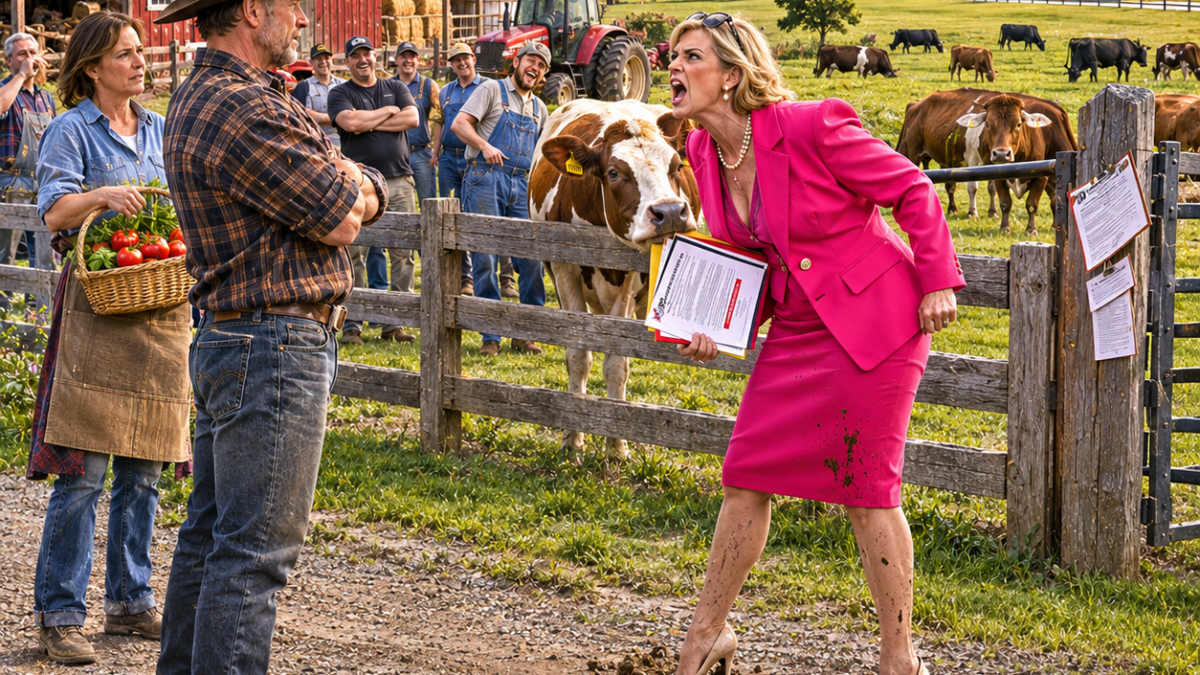
One of my cows chose that moment to stick her head through the fence and sniff Karen’s yellow folder.
Karen jerked backward.
The cow stretched farther.
“Shoo.”
The cow did not shoo.
Instead, she caught the corner of one violation notice with her tongue.
Karen pulled.
The cow pulled.
For three magnificent seconds, the president of Willow Crest Estates engaged in a tug-of-war with a Hereford named Daisy.
Sarah turned completely around.
Her shoulders were shaking.
The cameraman lowered his camera, but not before I saw the red recording light.
Karen finally won.
The notice came free with one corner soaked in cow slobber.
“This,” she said, breathing hard, “is precisely the kind of uncontrolled livestock interaction residents are complaining about.”
I looked at Daisy.
“She’s usually more selective with legal documents.”
The reporter laughed.
Karen did not.
That clip aired at ten o’clock.
By breakfast the next morning, half the county had apparently seen it.
My brother called first.
“Tell Daisy I’m proud of her.”
Then my feed supplier called.
Then the owner of the hardware store.
Then a retired teacher I hadn’t spoken to in six years.
Apparently, rural communities can distribute a cow-related humiliation faster than any social-media department ever invented.
Karen, however, doubled down.
She posted a long statement in the Willow Crest resident portal claiming my farm represented an “outdated land-use model incompatible with contemporary residential expectations.”
Someone leaked it.
Mark printed it.
He was building a folder of his own now.
Unlike Karen’s, his was getting more dangerous every day.
Thursday morning arrived clear and cold.
Daniel Ortega pulled into my driveway at nine.
A second county vehicle followed.
Karen arrived four minutes later.
Then three board members.
Then the HOA manager.
Then Channel Eight.
Again.
I had to admire the commitment.
Karen had apparently convinced herself that publicity would pressure the county.
She wore a bright coral-pink blazer this time, white trousers, and beige heels that had absolutely no business being within five hundred yards of livestock.
Mark stood beside me near the eastern fence.
Daniel began with the land-use records.
Agricultural zoning.
Confirmed.
Longstanding farm use.
Confirmed.
Structures shown on county records.
Confirmed.
Barn status.
Legal nonconforming historical structure where relevant, with subsequent repairs properly permitted.
Livestock operation.
Lawful.
Equipment storage.
Ordinary agricultural use.
Then he walked the eastern boundary.
The orange survey stakes from our last professional survey were still visible in several locations.
Karen followed him.
“The issue isn’t merely zoning.”
Daniel kept walking.
“It’s aesthetics.”
He kept walking.
“The HOA has adopted updated standards.”
He stopped.
“Ma’am, does your HOA own this parcel?”
“The farm affects our community.”
“That wasn’t my question.”
I liked Daniel more every minute.
Karen tightened her grip on the folder.
“We have enforcement rights relating to external impacts.”
“Show me the recorded instrument.”
Karen opened the folder.
For a moment, I thought she actually had something.
She produced the HOA declaration.
Daniel looked at the first page.
Then the legal description.
Then the subdivision plat attached at the back.
He looked toward my land.
“Mr. Harper’s parcel isn’t here.”
“The board interprets the aesthetic provisions broadly.”
“The board cannot interpret a legal description broadly.”
The reporter stepped closer.
Karen’s face changed.
Not much.
Just enough.
She had expected a confrontation over taste.
Instead, she was being asked about ownership.
Mark chose that moment to unroll our professional survey across the hood of his SUV.
I brought out the archival envelope.
Karen looked at it.
“What is that?”
I opened it carefully.
The parchment inside was thick and yellowed with age.
“My family’s original land grant.”
She actually laughed.
Sharp.
Dismissive.
Exactly as I expected.
“You cannot seriously believe a document from the nineteenth century overrides modern community standards.”
Mark looked at me.
I looked at him.
Neither of us needed to say anything.
Daniel, however, did.
“A valid chain of title does not stop being valid because the paper is old.”
Karen’s smile weakened.
I laid the 1874 document beside the modern title report.
Then the later deeds.
Then the current survey.
The story of the farm was visible in paper.
1874.
1891.
1912.
1936.
1958.
1977.
1999.
Present day.
Every transfer.
Every acquisition.
Every boundary.
Every parcel number.
No Willow Crest.
No HOA declaration.
No annexation.
No covenant attachment.
Nothing.
Daniel reviewed the documents carefully and compared them to county records on his tablet.
Then he turned toward Karen.
“This property is not within the recorded Willow Crest subdivision.”
Karen crossed her arms.
“That does not address the nuisance issue.”
“We’ve addressed your complaints separately. No county zoning violation has been found.”
“The odor is undeniable.”
Daniel looked toward the cattle.
“It’s a farm.”
Several people laughed.
Karen flushed.
“The visual impact remains.”
“The county does not enforce your association’s preferred view.”
“The residents paid for a luxury environment.”
“And Mr. Harper’s family owns agricultural land next to it.”
Karen pointed toward the barn.
“That structure is one hundred fifty years old.”
“Approximately.”
“Exactly.”
She said it as though she had proven something.
Daniel waited.
Karen continued.
“It’s obsolete.”
My father had joined us by then.
He was seventy-eight, thin, gray-haired, and still stubborn enough to climb onto tractors I had specifically told him not to climb onto.
He spoke from behind me.
“So am I. You planning to remove me too?”
The Channel Eight cameraman made a sound that might have been a laugh.
Karen ignored him.
Daniel finished his inspection and entered notes into his tablet.
Then he said, clearly enough for everyone to hear, “The county finds no zoning basis to shut down this agricultural operation. The farm predates the neighboring subdivision by many decades, the parcel remains privately owned agricultural land, and no recorded annexation into Willow Crest appears in the county records I reviewed.”
Karen’s folder lowered slightly.
“What about the board vote?”
Daniel looked genuinely puzzled.
“What about it?”
“The board voted to require compliance.”
“A private HOA board cannot vote county agricultural land into its subdivision.”
For the first time since I met her, Karen had no immediate response.
The reporter seized the silence.
“Ms. Whitmore, did the board verify ownership before issuing fines?”
Karen recovered.
“We relied on our management materials.”
The HOA manager’s head snapped toward her.
That was interesting.
“What materials?” the reporter asked.
Karen glanced at him.
He looked furious.
“Our internal boundary documents.”
Mark stepped forward.
“Can we see those?”
“This is not a legal hearing.”
“No,” Mark said. “But your board has threatened a lien and forced sale against my client’s property, so I’m very interested in the documents you relied upon.”
Karen looked toward the other directors.
One of them, a man named Robert Hale, was already pale.
He turned to the HOA manager.
“Do we have boundary documents showing this farm in the association?”
The manager answered quietly.
“No.”
Karen interrupted.
“That is not what we discussed.”
He looked at her.
“We discussed view impact.”
“You said the association had enforcement options.”
“I said we had enforcement options within Willow Crest.”
That sentence landed like a dropped tool in an empty barn.
Robert turned toward Karen.
“You told us counsel believed we could proceed.”
“I summarized counsel’s position.”
Mark’s eyebrows rose.
“Excellent. Let’s see the opinion.”
Karen’s jaw tightened.
“It was verbal.”
The HOA manager shook his head.
“No, it wasn’t.”
Everyone looked at him.
He took out his phone.
“Counsel emailed us six weeks ago.”
Karen said his name sharply.
“Thomas.”
He ignored her.
“He said the farm appeared outside the declaration and recommended against sending enforcement notices until title counsel confirmed jurisdiction.”
Silence.
Even the cattle seemed quieter.
Robert stared at Karen.
“You told us the legal review was complete.”
Karen’s confidence finally cracked.
“It was substantially complete.”
“That’s not what he just said.”
“We had to act. Residents were demanding action.”
Robert pointed toward my farm.
“So you threatened to force a sale of property our lawyer told us might not even be ours to regulate?”
Karen looked toward the camera.
That was when she realized every word was being recorded.
She lowered her voice.
“This discussion should happen privately.”
I almost laughed.
She had invited the news.
Now she wanted privacy.
Mark folded his arms.
“Actually, I think the important part has already happened.”
Daniel handed me a written inspection summary before leaving. It stated that the county had found no basis for the requested agricultural shutdown and confirmed the parcel’s current zoning and recorded location outside the subdivision plat.
He did not “fine the HOA” on the spot because that wasn’t his job.
Real government doesn’t work like Karen imagined HOA government worked.
Different offices have different authority.
That mattered.
Mark wanted every step clean.
That afternoon, he sent the county finding, the title report, the survey, the recorded deeds, and the HOA manager’s written account to the association attorney.
Then he set a deadline.
Withdraw every fine.
Withdraw every shutdown demand.
Confirm in writing that the HOA claimed no current jurisdiction over the farm.
Confirm that no lien would be recorded.
Stop entering the property without permission.
If they refused, we would file for declaratory and injunctive relief and seek recovery of whatever damages and fees the law allowed.
At four eleven, the association attorney called Mark.
At four forty, Karen emailed the board.
At five twelve, Robert Hale called me personally.
“Mr. Harper, I owe you an apology.”
“That was fast.”
“I just read the attorney’s original email.”
I waited.
He exhaled.
“We were not given the full picture.”
“That doesn’t explain why the board voted.”
“No.”
At least he was honest.
“We should have demanded the documents ourselves.”
“Yes.”
“I’m calling an emergency meeting tomorrow.”
Karen apparently spent that night trying to save her presidency.
By morning, Willow Crest residents had received a message from her claiming the farm dispute had been “mischaracterized by outside media.”
That might have worked if there were no video of her threatening to shut down the farm.
Unfortunately for Karen, Channel Eight had video.
And Daisy.
The cow clip had become local legend.
Someone printed a still image of Karen pulling the notice away from Daisy and wrote:
LEGAL REVIEW IN PROGRESS.
I saw it taped to the counter at the feed store.
I took a picture.
Sarah made me promise not to send it to Karen.
“I wasn’t going to.”
“You were absolutely going to.”
“I was considering my options.”
“Jack.”
“Fine.”
The emergency board meeting began at seven that evening.
The clubhouse parking lot was full before six thirty.
Mark advised me to attend but not grandstand.
“I never grandstand.”
Sarah looked at him.
Mark looked at Sarah.
They both started laughing.
“I’m serious.”
“That’s what worries me,” Sarah said.
The meeting room was designed for maybe seventy people.
More than a hundred showed up.
Some stood along the walls.
Others crowded into the hallway.
Karen sat at the front table wearing navy instead of pink.
I wondered if somebody had advised her that the pink blazer had become evidence.
Robert Hale opened the meeting.
“We are here to address enforcement actions involving the Harper agricultural property.”
Someone near the back shouted, “The farm that was there before our houses?”
Applause.
Karen reached for the microphone.
Robert stopped her.
“I’ll chair tonight.”
Her expression told me she considered that sentence treason.
The HOA attorney, Martin Voss, joined by video conference.
He began with facts.
Willow Crest’s recorded declaration applied to the platted subdivision lots and common areas.
My property was not included.
He had reviewed county records.
No annexation instrument had been found.
No signed covenant had been found.
No document granting Willow Crest architectural authority over the farm had been found.
A woman in the second row raised her hand.
“So why were fines sent?”
Martin paused.
“That question is for the board.”
Everyone looked at Karen.
She straightened.
“The board was responding to legitimate resident complaints.”
“That isn’t an answer,” someone said.
She continued.
“For months, members reported livestock odor, machinery noise, unattractive structures, dust, and negative visual conditions affecting premium homes.”
A man stood near the aisle.
“My house backs up to the farm.”
Karen nodded.
“Then you understand.”
“Yes. I bought a house next to a farm.”
Laughter.
He continued.
“The cows did not sneak in after closing.”
More laughter.
Karen glared.
He sat down.
Another homeowner stood.
“Our listing literally advertised ‘pastoral farm views.’”
That one hurt.
The room changed.
People started talking over one another.
“Mine did too.”
“So did ours.”
“They charged us extra for the western lots.”
“The brochure had pictures of the barn.”
I turned toward Sarah.
She was staring at me.
“No.”
“Oh, yes.”
Robert asked for quiet.
Then a resident walked to the front carrying a glossy sales brochure from the developer.
On the cover was a photograph of Willow Crest at sunset.
In the distance stood my red barn.
Underneath the image were the words:
LUXURY LIVING BESIDE TIMELESS RURAL LANDSCAPES.
The room erupted.
I leaned toward Mark.
“Please tell me Karen fined them for visual pollution.”
He whispered, “I would pay money for that exhibit.”
Karen was losing control.
Not because I had given a speech.
Because reality had become funnier than anything I could have invented.
The subdivision had marketed my farm as part of its charm.
Then its president tried to eliminate the farm for ruining the subdivision’s aesthetics.
Robert held up the brochure.
“Was the board aware of this?”
Karen answered, “Marketing language is not legally relevant.”
Martin Voss spoke through the monitor.
“The marketing itself does not establish jurisdiction, but it certainly undermines the narrative that the farm’s mere existence is a newly discovered condition.”
That was lawyer language for this looks terrible.
Then Robert addressed the attorney’s earlier warning.
“Martin, did you advise us not to proceed until jurisdiction was confirmed?”
“Yes.”
“When?”
“Six weeks ago.”
“Was that advice sent to the president?”
“Yes.”
“To management?”
“Yes.”
“To the full board?”
“No. I sent it to Ms. Whitmore and management because they requested the review.”
Robert turned to Karen.
“Why didn’t you forward it?”
“I believed the attorney was being overly cautious.”
Martin’s face on the monitor remained perfectly still.
I would have paid to know what he was thinking.
Robert asked, “Did you tell the board counsel supported enforcement?”
“I said counsel had identified possible pathways.”
Martin interrupted.
“I did not identify a pathway for HOA enforcement against the Harper property.”
Another wave of murmurs moved through the room.
Karen reached for the microphone.
“The community elected us to protect property values, not hide behind technicalities.”
That was the sentence that destroyed whatever support she had left.
A deed was a technicality.
A survey was a technicality.
Property ownership was a technicality.
The attorney’s warning was a technicality.
Anything standing between Karen and what she wanted became a technicality.
My father whispered from beside me, “She’d argue with a stop sign.”
“She’d fine it for being red.”
He smiled.
Robert called for a short recess.
The board disappeared into a side room with counsel connected remotely.
Residents surrounded me.
Some apologized.
Some wanted to explain that they had never complained.
A few admitted they had complained about smell but never supported shutting down the farm.
I appreciated the distinction.
Farm smells are real.
Tractors are loud.
Dust crosses roads.
Country life is not a scented candle labeled Rustic Morning.
I never expected neighbors to love every part of it.
I expected them to understand that moving beside a working farm did not transform the farm into a decorative backdrop.
Twenty-eight minutes later, the board returned.
Karen sat stiffly at the end of the table.
Robert read the resolution.
All purported fines against my property were immediately rescinded.
All enforcement notices were voided.
The HOA acknowledged that no recorded document currently placed my farm under association jurisdiction.
The board prohibited any further enforcement activity against outside parcels without written legal confirmation.
The association would reimburse my reasonable documented legal expenses arising from the improper notices, subject to a written settlement.
Then Robert paused.
“Finally, I move that Karen Whitmore be removed as president of the Willow Crest Homeowners Association effective immediately.”
The room went silent.
Karen turned toward him.
“You cannot be serious.”
“I am.”
“This is a reaction to media pressure.”
“This is a reaction to what we just learned.”
“I acted for the community.”
“You withheld counsel’s warning.”
“I exercised judgment.”
“You threatened property we don’t control.”
“I protected homeowners.”
Robert looked tired.
“You exposed homeowners.”
That was the line.
Karen stared at him.
The vote was called.
Four in favor.
One opposed.
Karen voted for herself.
Technically, she voted against removing herself, but the emotional effect was the same.
Even under those circumstances, she remained her strongest supporter.
When Robert announced the result, the room filled with applause.
I didn’t clap.
Neither did Sarah.
It wasn’t because we felt sorry for Karen.
I simply didn’t want the victory reduced to humiliation.
What mattered was that the threat was over.
The farm was safe.
The title was clean.
The board’s authority had finally been forced back inside its actual boundaries.
Karen gathered her papers.
For once, the yellow folder looked small.
As residents began leaving, she approached me.
Mark stepped closer automatically.
I nodded to let him know I was fine.
Karen stopped several feet away.
“You’re pleased with yourself.”
“I’m relieved.”
“You made me look ridiculous.”
I almost answered too quickly.
Then I thought about it.
“No.”
She laughed bitterly.
“Please.”
“You invited television cameras to watch you try to shut down a farm you didn’t control.”
“You could have handled this privately.”
“Mark sent you a private cease-and-desist.”
“You escalated.”
“You brought contractors to my fence.”
“I never brought contractors.”
She was right.
Unlike the gazebo situation some people might imagine, she had not brought demolition crews.
Her threat had been paperwork, fines, county complaints, liens, and forced sale.
I corrected myself.
“You brought the county complaints, the fines, the lien threat, and the television cameras.”
Her lips pressed together.
“You know what I mean.”
“I do. That’s the problem.”
She looked past me toward my father.
Then toward Sarah.
“The farm is unpleasant for people who paid a great deal of money to live here.”
Sarah answered before I could.
“Then maybe the people selling those houses shouldn’t have advertised the farm as a beautiful rural view.”
Karen’s face flushed.
“That brochure is irrelevant.”
“No,” Sarah said. “It’s hilarious.”
I looked down because I was trying not to smile.
Karen noticed.
“This is exactly what I mean. None of you take community standards seriously.”
I looked at her.
“We take our community seriously. That’s different.”
She folded her arms.
“You think because your family has been here a long time, you can do whatever you want.”
“No.”
I pointed toward the courthouse records Mark had copied.
“I think because we own the land, operate legally, comply with agricultural rules, pay our taxes, and maintain our permits, you don’t get to invent authority over it.”
She looked toward the windows.
Outside, the western sky had gone deep orange.
The silhouette of my barn was visible beyond the subdivision.
The same view Willow Crest had used to sell houses.
I said, “You didn’t hate the farm when it increased property values.”
She looked back at me.
“You hated that you couldn’t control it.”
That ended the conversation.
The settlement took another month.
Nothing about real legal matters happens as quickly as people imagine.
Documents were reviewed.
Insurance representatives became involved.
Language was negotiated.
Mark insisted on precision.
The final agreement did four things that mattered to me.
The HOA formally withdrew every fine and violation notice.
It confirmed that it had no present covenant authority over my farm.
It agreed not to file any lien or other title claim based on those withdrawn notices.
And it reimbursed the reasonable attorney fees I had incurred defending against the improper enforcement effort.
There was no dramatic million-dollar payout.
No judge pounding a gavel.
No sheriff arriving to arrest an HOA board.
That would have made a louder story.
It would not have made a more believable one.
The most important legal victory was boring.
My deed stayed clean.
My farm stayed operating.
The association backed down in writing.
And the people who had treated Karen’s confidence as authority finally learned the difference.
The county closed her agricultural complaints without violations.
Daniel Ortega sent me the final documentation.
At the bottom of his email he added one sentence:
“Please tell Daisy the county has no aesthetic objection to her.”
I printed that too.
It now hangs in the feed room.
My father says it is the most important government document our family has received since 1874.
He is joking.
Mostly.
Karen remained on the board as an ordinary director for less than three weeks.
Then she resigned entirely.
According to neighbors, she continued insisting she had been betrayed.
The strange thing was that nobody really betrayed her.
Robert had trusted her.
Management had warned her.
Counsel had warned her.
The records were available.
The survey stakes were visible.
The subdivision plat was public.
Karen’s problem was not that information had been hidden.
Her problem was that information disagreed with her.
Once she decided the farm should obey her standards, every contrary fact became an inconvenience.
That kind of certainty can look powerful for a while.
Until someone opens the file.
Life returned to normal surprisingly quickly.
Cattle still needed feeding.
Fence still needed repair.
The south tractor still leaked hydraulic fluid from a place my mechanic swore he had fixed twice.
My father still showed up before sunrise even though he was supposedly retired.
Sarah still kept a kitchen calendar more accurate than any computerized farm-management system I had ever purchased.
And the barn still stood.
That barn mattered more to me after the fight.
Not because Karen nearly removed it.
She never had the lawful power to do that.
But because the argument forced me to remember how much history was stored inside something people could dismiss as “old.”
My great-great-grandfather, William Harper, built the original section in the 1870s.
He used timber cut locally.
The first roof had been cedar shakes.
A later generation added metal roofing.
My grandfather reinforced the north wall after a storm.
My father rebuilt the loft stairs.
I replaced several exterior boards and upgraded wiring to code.
The barn changed because farms change.
That is how old things survive.
They are maintained.
Adapted.
Protected.
Not frozen.
Not erased.
One evening, my father and I sat on the tailgate of my truck watching cattle move across the western pasture.
He nodded toward Willow Crest.
“You know what your great-great-grandfather would’ve thought of all that?”
“The houses?”
“He’d have liked indoor plumbing.”
I laughed.
“He would’ve loved central air.”
“Probably.”
Then Dad became quiet.
“He would’ve hated somebody telling him his barn was ugly.”
“That seems likely.”
“He thought everything he built was handsome.”
“Was it?”
“No.”
We both laughed.
Then he looked at me.
“You handled it better than I would have.”
“That is absolutely not true.”
“At your age? I’d have yelled.”
“You yell now.”
“I’m old. It’s one of the benefits.”
He was right about one thing.
I had learned that losing my temper would have helped Karen.
Her entire strategy depended on portraying me as a stubborn farmer refusing reasonable modernization.
If I screamed at cameras, threatened board members, or drove a tractor through the subdivision entrance, she could point to me and say, See?
Instead, we used deeds.
Surveys.
Emails.
Meeting records.
County findings.
The least exciting weapons imaginable.
They were devastating.
Two months later, Willow Crest elected a new board.
Robert became interim president only long enough to organize the election, then stepped aside.
A woman named Elena Morales won the presidency.
Her first contact with me came by phone.
“Mr. Harper?”
“Jack is fine.”
“Jack, I’m Elena Morales. I’m the new Willow Crest president.”
“My condolences.”
She laughed.
“That seems to be the standard response.”
“What can I do for you?”
“I wanted to ask permission to walk the eastern fence with you.”
That word mattered.
Permission.
“Why?”
“We’re planning landscaping near the common-area trail, and I want to make sure we don’t cross your line.”
I nearly looked around to make sure I was still living in the same universe.
“When?”
“Whenever works for you.”
We met Saturday morning.
Elena arrived wearing jeans and hiking shoes.
No blazer.
No yellow folder.
She brought a survey.
I brought mine.
We walked the boundary together.
At one point she stopped beside an orange survey marker.
“So this is the famous line?”
“Apparently.”
She smiled.
“I heard Karen called these outdated.”
“She called the 1874 grant outdated. The survey was only three years old.”
“That sounds about right.”
We found one location where Willow Crest’s landscaper had stacked mulch several feet onto my side.
Elena immediately called the contractor.
“Move it back.”
No argument.
No jurisdiction theory.
No emergency board vote.
Just move the mulch.
It was almost disappointing.
Afterward, we stood near the fence while Daisy inspected Elena’s jacket.
Elena wisely kept all paperwork out of reach.
“I’ve heard about her,” she said.
“Daisy has a legal reputation.”
“I’m not taking chances.”
That spring, the relationship between the farm and subdivision changed.
Not perfectly.
People still complained sometimes.
One resident called about a tractor starting at six in the morning.
I explained that harvest schedules do not recognize HOA quiet hours.
Another complained about manure smell during spreading.
I explained what manure does and why.
He did not become a fan.
But Elena handled complaints as neighbor issues instead of declarations of war.
Sometimes we adjusted when we reasonably could.
Sometimes Willow Crest residents had to accept that farms make noise and smell like farms.
That was coexistence.
Not control.
The funniest moment came in June.
Willow Crest announced its annual “Heritage Summer Festival.”
Apparently the new board wanted to repair relations with the surrounding rural community.
Elena called me.
“I have a strange question.”
“Those are usually the expensive ones.”
“Would you let us use a photo of your barn on the festival flyer?”
I was silent.
She started laughing before I answered.
“I know.”
“The unauthorized eyesore?”
“I know.”
“The visual pollution?”
“I know.”
“The obsolete structure destroying property values?”
“Jack.”
“I just want to make sure we’re discussing the same barn.”
She laughed harder.
“Yes. That barn.”
I agreed under one condition.
The flyer had to identify it correctly.
HARPER FAMILY FARM — ESTABLISHED 1874.
No pretending it belonged to Willow Crest.
No calling it a community amenity.
No cropping out the farm name.
Elena agreed instantly.
The flyer looked good.
Really good.
The red barn sat beneath a wide blue sky with the pasture behind it.
My father stared at it for almost a minute.
“Your great-great-grandfather would’ve liked this.”
“You said he thought everything he built was handsome.”
“He was right about the barn.”
I noticed my father had changed his story.
I let him.
The festival itself brought several hundred people to the subdivision park.
Willow Crest invited local farmers, craftspeople, food vendors, and the county historical society.
They asked if I would set up a small display about the farm’s history.
Sarah loved the idea.
I pretended I didn’t.
Then spent three days choosing photographs.
We displayed a reproduction of the 1874 grant, pictures of the barn through different decades, old harvest photographs, and one black-and-white image of my grandfather as a teenager standing beside a tractor.
Daniel Ortega stopped by.
So did Mark.
Mark stood in front of the land-grant reproduction.
“You should put Karen’s email next to this.”
“Which one?”
“The one about antique documents.”
Sarah overheard him.
“No.”
I looked at her.
“She’s right,” I said.
Sarah narrowed her eyes.
“You two are terrible.”
Mark shrugged.
“I’m a lawyer.”
“That is not a defense.”
By late afternoon, families were walking around the historical display.
Children asked questions about cattle.
Older residents told me stories about farms where they had grown up.
Several Willow Crest homeowners apologized again for what happened.
One man admitted that he had originally supported Karen.
“I thought you were refusing reasonable rules.”
“I was.”
He looked confused.
I smiled.
“They just weren’t rules that applied to me.”
He laughed.
“Fair enough.”
Then he became serious.
“I should’ve checked.”
That sentence meant more than another apology.
Because that was the whole problem.
People assumed.
Karen sounded official.
The notices looked official.
The folder looked official.
The board vote sounded official.
Most people did not ask the basic question.
Where does the authority actually come from?
When they finally asked, everything collapsed.
Karen’s house went on the market in August.
I found out because Sarah saw the listing.
She called me into the kitchen.
“You need to see this.”
The real-estate photographs showed a beautiful home with a stone patio, spotless kitchen, large windows, and a backyard facing west.
The listing description included:
“Sweeping sunset views across preserved rural landscape.”
I stared at the screen.
Sarah stared at me.
Then we both lost it.
Preserved rural landscape.
The farm Karen tried to shut down had become a selling point for her house.
“I’m framing this,” I said.
“You are not framing someone’s real-estate listing.”
“Mark framed her email.”
“Mark is a bad influence.”
“That’s why we pay him.”
The house sold four months later.
Karen moved away in January.
I did not attend the closing.
I did not drive past with a tractor.
I did not put up a sign.
I considered none of those things.
Sarah would like the record to state that very clearly.
The new owners were a couple named Nathan and Mia.
They introduced themselves before moving in completely.
They stood outside the fence.
They did not enter.
Nathan said, “We wanted to meet the neighbors.”
Mia looked toward the cattle.
“We should probably tell you that we love the farm.”
“Give it until manure-spreading season.”
She laughed.
“We grew up around horses.”
That helped.
Nathan pointed toward the red barn.
“That’s the one from the subdivision brochure, right?”
I smiled.
“It has appeared in a few publications.”
I did not explain.
He would learn eventually.
Everybody did.
A year after the confrontation, the farm’s 150th anniversary arrived.
Technically, the original grant date gave us a specific day in September.
Sarah decided we were celebrating.
I said we didn’t need anything elaborate.
Sarah interpreted that as permission to invite nearly two hundred people.
We cleaned the barn.
Hung lights from the rafters.
Set up tables outside.
Displayed family photographs along one wall.
My father wore a clean white shirt and complained about everything while secretly enjoying himself.
Elena came.
Robert came.
Daniel came.
Mark came.
Several Willow Crest families came.
Even the Channel Eight reporter showed up briefly because somebody at the station remembered the original story.
Daisy was kept away from legal documents.
Around sunset, Sarah asked me to say a few words.
I hate speeches.
I stood beneath the barn doors with generations of family photographs behind me and looked across the crowd.
For a moment, I remembered Karen standing at the fence.
Pink blazer.
Yellow folder.
Absolute certainty.
She had told me the farm was obsolete.
An eyesore.
An obstacle to progress.
But what I saw that evening was not a relic.
I saw my father talking to a young couple from Willow Crest.
I saw children examining old tools.
I saw neighbors eating at tables in the shade of cottonwoods planted before most of us were born.
I saw the barn glowing red in the sunset.
I saw Sarah near the garden, laughing.
History wasn’t dead.
It was standing all around us.
So I kept the speech short.
“My family has been fortunate to care for this land since 1874. We didn’t create all of it, and we won’t be the last people responsible for it. A farm survives because every generation understands that ownership is temporary but stewardship continues. Thank you for helping us celebrate one hundred fifty years.”
That was enough.
My father disagreed.
He raised his glass.
“And the barn is staying!”
Everyone laughed.
I shook my head.
“Thanks, Dad.”
He looked proud of himself.
Later that evening, after most people had gone, I walked alone toward the eastern fence.
The lights of Willow Crest were visible through the trees.
Porch lights.
Kitchen windows.
Cars pulling into driveways.
Ordinary life.
No enemy territory.
Just neighbors.
That mattered too.
It would have been easy to turn the entire subdivision into the villain.
But most residents had never threatened me.
Some had complained.
Some had trusted Karen.
Some had been wrong.
Then they corrected themselves.
Karen was the problem because she turned preference into authority.
She could have knocked on my door and said, “Some residents are struggling with the smell. Is there anything we can reasonably discuss?”
We might have discussed timing manure spreading when practical.
We might have talked about planting additional trees near one visible equipment area.
Neighbors compromise.
What I could never compromise was ownership itself.
I could not let an HOA establish the precedent that it could regulate my land simply because its residents could see it.
Because once you accept authority that does not exist, getting rid of it becomes much harder.
That was why the old documents mattered.
Not because they were old.
Because they were clear.
My father joined me at the fence.
“You thinking?”
“Unfortunately.”
“Dangerous habit.”
We stood quietly.
Then he said, “Your mother would’ve been worried during all that.”
“I know.”
“She would’ve liked Sarah’s festival.”
“I know.”
“And she would’ve hated that pink jacket.”
I laughed.
“You don’t know that.”
“I was married to her forty-six years. I know exactly what jackets she hated.”
We walked back toward the barn.
The doors were open.
Warm light spilled onto the ground.
One hundred fifty years earlier, my great-great-grandfather could never have imagined luxury houses beyond the eastern field.
He could never have imagined homeowners associations, digital property records, zoning databases, television cameras, or a cow becoming locally famous for chewing legal paperwork.
But he would have understood the basic issue.
Someone points at your land and says it belongs under their control.
You answer with the boundary.
That is what boundaries are for.
Months later, Mark mailed me a package.
Inside was a framed copy of Karen’s email.
The sentence was highlighted:
“Mr. Harper’s reliance on antique documents does not reflect the current character of our community.”
Below it, Mark had placed a small reproduction of the 1874 land grant.
At the bottom of the frame, he added a brass plate.
ANTIQUE DOCUMENT: 1
MODERN COMMUNITY PROGRESS: 0
Sarah stared at it.
“No.”
“It’s going in my office.”
“No.”
“It’s already framed.”
“That doesn’t make it tasteful.”
“It makes it efficient.”
My father loved it.
It hangs above my desk to this day.
Not because I want to remember Karen.
Because I want to remember the lesson.
Authority should always be questioned when it reaches beyond its boundary.
A confident voice is not a statute.
A board resolution is not a deed.
A violation notice is not ownership.
A threat of a lien does not make a lien lawful.
And a neighborhood cannot purchase houses beside a working farm, market the rural view, then decide the farm itself is defective because reality comes with tractors, cattle, dust, mud, noise, and smells.
The farm is still here.
The red barn still stands.
Cattle still graze the western pasture.
Tractors still start before sunrise when the work requires it.
Hay still gets stacked where hay needs to be stacked.
Some evenings smell like cut grass.
Others smell very much like cattle.
The sunset still turns the fields gold.
The county records still show our name.
The survey markers still follow the same eastern boundary.
And every now and then, Daisy still stretches her head through that fence looking for something interesting to chew.
I keep legal papers farther away now.
Karen wanted to force my farm to become something prettier from her window.
Instead, she learned the most embarrassing lesson of her presidency in front of her board, her neighbors, county officials, and television cameras.
The land was never hers to regulate.
The barn was never hers to condemn.
The cattle were never hers to remove.
And the future of a farm that had survived one hundred fifty years was never going to be decided by a woman who had lived next to it for three months.
She left.
The farm stayed.
And in the end, that was the only vote that mattered.








