HOA Karen Tried to Evict Me From My Own Private Lake Because I Refused to Join Her HOA
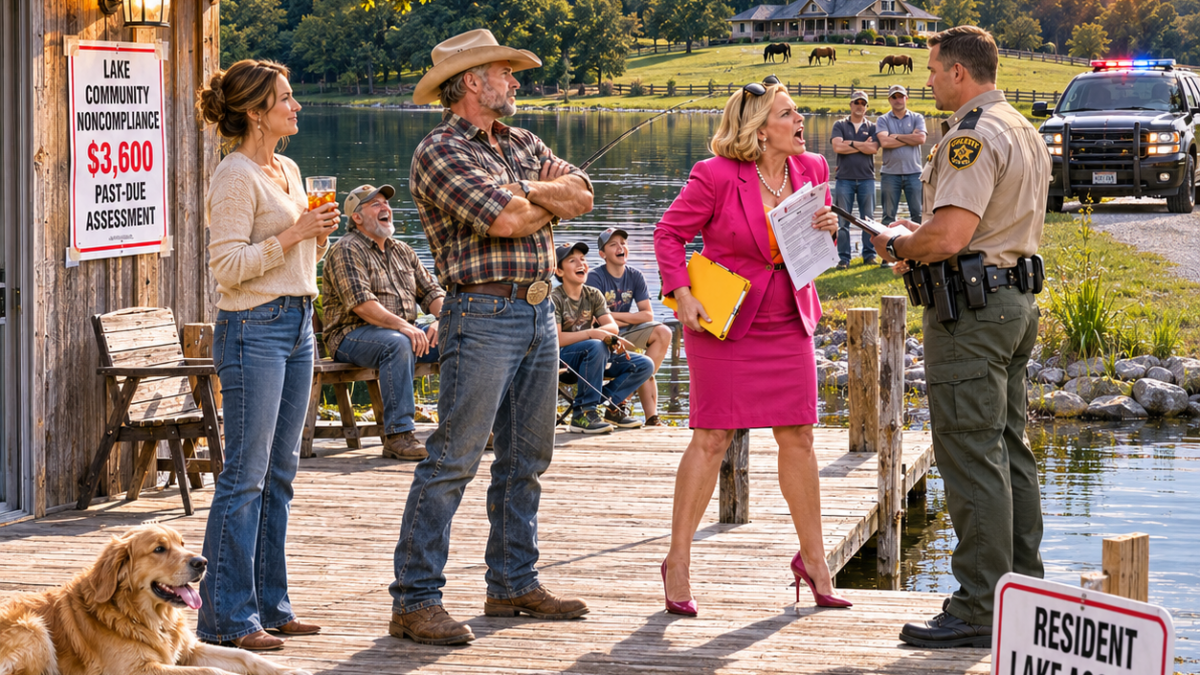
HOA Karen Tried to Evict Me From My Own Private Lake Because I Refused to Join Her HOA
HOA Karen created a “lake association,” billed me for access to water my family had owned for generations, then called police to have me removed from my own dock.
She stood on my private shoreline demanding back fees while my wife and I watched the sunset over a lake that had been in our deed since 1921.
The part she never bothered to verify was simple: her HOA ended at the subdivision fence, while my property kept going straight into the water.
“You refuse to join the lake HOA and pay your share of the fees, so I’m calling the police right now to have you removed from this shoreline.”
Victoria Vale screamed those words into her phone while standing halfway down my dock as if volume could change a deed.
The evening sun sat low above the western ridge, turning the lake copper and purple. My wife, Claire, was sitting near the boathouse with a glass of iced tea. My brother had brought his fishing rod. Two of my nephews were skipping stones farther down the bank. Behind us, four thousand acres of pasture rolled away toward the hills, exactly as they had since my grandfather was young.
Victoria looked spectacularly out of place.
Bright pink blazer.
Matching skirt.
Cream heels sinking between the dock planks.
Yellow HOA folder clamped under one arm.
She had taped a white notice to the boathouse door.
**LAKE COMMUNITY NONCOMPLIANCE — $3,600 PAST-DUE ASSESSMENT.**
I read it once.
Then twice.
“You’re charging me for using my own lake?”
“You are refusing mandatory participation.”
“Mandatory under what?”
“The Willow Crest Lake Community Association.”
“That didn’t exist three months ago.”
“It exists now.”
“Am I a member?”
“You became subject to it by proximity.”
I stared at her.
“Proximity?”
“Your property touches the lake.”
“My property surrounds most of the lake.”
“Exactly. You receive the greatest benefit.”
Claire covered her mouth with her glass.
I knew that look.
She was trying not to laugh.
Victoria pointed toward the water.
“The community is paying for shoreline beautification, access planning, environmental monitoring, signage, and recreational management. You cannot continue enjoying those benefits while refusing your financial obligations.”
“The signs are on your side.”
“They benefit the entire lake.”
“You installed two signs.”
“That is not the point.”
One of them said **RESIDENT LAKE ACCESS — MEMBERS ONLY.**
It stood fifty yards away on Willow Crest common property and pointed toward a tiny artificial viewing platform that did not connect to my shoreline.
Victoria raised her phone again.
“Yes, dispatcher? The property owner is refusing to cooperate. I need an officer to remove him from restricted lake frontage.”
I looked down at my boots.
Then at the dock beneath them.
Then at the stone marker beside the boathouse with my grandfather’s initials carved into it.
“Victoria.”
She held up one finger.
“I’m speaking with law enforcement.”
“You’re asking them to remove me from my dock.”
“Until your membership status is resolved.”
“I built this dock.”
“That does not exempt you from community rules.”
A patrol cruiser appeared beyond the gate.
Gravel crackled beneath its tires.
Victoria smiled.
“There.”
She closed her phone.
“Now perhaps you’ll understand this is serious.”
The cruiser stopped beside my pickup.
The driver’s door opened.
Deputy Daniel Ross stepped out.
He took three steps toward the lake, saw me, and grinned.
“Jack Mercer?”
“Evening, Dan.”
Victoria’s smile disappeared.
Dan looked from me to the lake, then toward Victoria standing on my dock with her folder.
“Dispatch said somebody was being illegally occupying shoreline property.”
Victoria rushed toward him.
“Yes. This man refuses to join the lake association and continues using restricted waterfront without paying required fees.”
Dan glanced at me.
Then back at her.
“Which waterfront?”
She pointed beneath her feet.
“This one.”
Dan looked down.
Then he looked at me again.
“Jack, isn’t this your dock?”
“It was this morning.”
Claire turned away before Victoria could see her laughing.
Dan took the violation notice Victoria handed him.
He read the first page.
Then the second.
His expression slowly changed.
Not into anger.
Into something much worse for Victoria.
Confusion.
He looked at her.
“Ma’am, who told you your HOA owns this shoreline?”
Victoria straightened.
“The board voted to establish authority over the entire lake.”
Dan stared at her for a long moment.
Then he looked across the water.
And somewhere behind me, my brother whispered, “Oh, this is about to get good.”
**part 2**
Deputy Ross didn’t laugh immediately.
That made it worse.
He stood on the gravel beside my dock, reading Victoria’s notice with the careful patience of a man trying to determine whether he had misunderstood something obvious.
Finally he tapped one paragraph with his finger.
“This says the Willow Crest Lake Community Association can suspend shoreline access for unpaid dues.”
“Yes,” Victoria said.
“And you’re saying Mr. Mercer’s access is suspended.”
“Until he joins and pays the outstanding assessments.”
Dan looked at me.
“Jack, are you part of Willow Crest?”
“No.”
“Ever signed their declaration?”
“No.”
“Any voluntary lake agreement?”
“No.”
“Did you give them access rights?”
“No.”
Victoria sighed loudly.
“Officer, that is exactly the problem. He refuses to participate.”
Dan lowered the paper.
“Refusing to join an association generally does not make someone a member of it.”
“This is not an ordinary HOA.”
“I gathered that.”
“It is a lake governance organization.”
Dan nodded once.
“What government created it?”
“The homeowners.”
“No. I mean what public authority gave it jurisdiction over private property outside the subdivision?”
Victoria’s jaw tightened.
“The board vote established jurisdiction.”
Claire made a tiny choking sound behind me.
I looked over.
She was pretending the iced tea had gone down the wrong way.
Dan kept his expression professional.
“Ma’am, an HOA board can adopt rules for property legally subject to its governing documents. It cannot vote itself ownership of somebody else’s land.”
“You’re oversimplifying.”
“I’m a deputy. Simple is useful.”
She opened her folder.
“I have maps.”
That got my attention.
Victoria unfolded a color printout and spread it across the hood of the cruiser.
A blue line surrounded the lake.
The Willow Crest subdivision appeared along the eastern bank.
My ranch occupied nearly everything else.
Someone had drawn a red dashed line around the entire water body and labeled it **COMMUNITY LAKE MANAGEMENT ZONE.**
Dan looked at the map.
“Who prepared this?”
“Our board.”
“County survey?”
“No.”
“Engineer?”
“No.”
“Recorded plat?”
“It is based on the recorded plat.”
I stepped closer.
“No, it isn’t.”
Victoria pointed at me.
“Please stop interfering.”
“It’s my lake.”
“It is a community resource.”
“Your map moved my property line.”
“It clarified shared-use boundaries.”
Dan glanced toward me.
“Jack, do you have your deed handy?”
“House safe.”
“You don’t need to get it right now.”
Victoria looked triumphant.
“Exactly. He has no proof.”
Dan turned toward her.
“I didn’t say that.”
He pulled out his phone and opened the county parcel map.
Cell coverage around the ranch wasn’t great, so it took a few seconds to load.
Victoria stood beside him with her arms crossed.
When the map appeared, Dan zoomed in.
My ranch parcel wrapped around most of the water.
Willow Crest touched only a narrow section along the eastern edge.
More importantly, the parcel layer showed the lakebed inside my recorded ranch boundary.
Dan studied it.
“Looks like the county map agrees with Jack.”
Victoria leaned closer.
“That map is outdated.”
“It was updated last quarter.”
“It does not reflect the new association.”
“An association doesn’t change parcel ownership.”
She took a breath and tried another angle.
“The community has recreational expectations.”
Dan looked at her.
“What does that mean?”
“Our homeowners purchased properties believing they would have lake access.”
“From who?”
“The developer.”
I finally spoke.
“The developer sold them a view.”
Victoria turned.
“The marketing materials advertised lakeside living.”
“They also advertised mountain views. Do you own the mountains?”
Claire lost the battle.
She laughed.
Victoria’s head snapped toward her.
“This is not funny.”
Claire set down her glass.
“You called police to remove my husband from our dock because your brochure said ‘lake lifestyle.’ It’s a little funny.”
Victoria pointed toward the water.
“Your family has enjoyed unrestricted access for years while community members pay for maintenance.”
I raised an eyebrow.
“What maintenance have you done to my lake?”
“We funded water-quality testing.”
“On your drainage pond.”
“It connects to the watershed.”
“That is not this lake.”
“We installed invasive-species signage.”
“On your walking trail.”
“We hired consultants.”
“For what?”
“Long-term lake stewardship.”
“Did any of them step onto my property?”
She hesitated.
That hesitation mattered.
Dan noticed.
“So,” he said, “has the association been entering Mr. Mercer’s property?”
“No.”
I looked at her.
“Victoria.”
She frowned.
“There have been visual inspections.”
“From where?”
“Appropriate locations.”
“That isn’t an answer.”
Dan lifted a hand.
“Let’s stay on the immediate call.”
He looked toward the dock.
“Ma’am, dispatch logged this as an unlawful-occupancy complaint. Based on what I can see, I do not have grounds to remove Mr. Mercer from property county records identify as his.”
Victoria’s eyes widened.
“You haven’t reviewed our bylaws.”
“Your bylaws are not an arrest warrant.”
“I’m requesting enforcement.”
“Of what criminal law?”
She opened her mouth.
Closed it.
Opened it again.
“Unauthorized shoreline access.”
“That sounds like an HOA rule.”
“It is.”
“Against someone who says he isn’t in the HOA.”
“He is refusing membership.”
Dan nodded slowly.
“Yes. We have established that.”
My brother walked farther down the dock because he knew if he stayed nearby, he would laugh out loud.
Victoria tried again.
“At minimum, I want him ordered away from the waterfront until ownership is clarified.”
Dan looked around.
“Ma’am, you are currently the person standing on the disputed property.”
That finally silenced her.
Not for long.
“You’re saying I’m trespassing?”
“I’m saying Mr. Mercer owns this parcel according to the public map, he says he didn’t invite you onto his dock, and you’re asking me to remove him.”
She looked at me.
“You invited the community to cooperate.”
“I invited Robert over for coffee in February.”
“That demonstrated openness to lake management.”
“No. That demonstrated openness to coffee.”
Dan turned his head.
He coughed.
I knew that cough.
He was laughing into his shoulder.
Then another patrol vehicle arrived.
A younger deputy, Marcus Lee, stepped out and walked down toward us.
Dan handed him the notice.
Marcus read it.
Then looked at the lake.
Then looked at me.
“Your lake?”
“According to my deed.”
Marcus handed the paper back.
“Then I think we’re done.”
Victoria looked from one deputy to the other.
“You can’t simply dismiss an HOA complaint.”
Dan answered calmly.
“We dismiss civil complaints from criminal enforcement all the time.”
“This is not merely civil.”
“What crime has he committed?”
“Nonpayment.”
“That is not a crime.”
“Unauthorized use.”
“Of his own dock?”
“The association disputes ownership rights.”
“Then that’s a civil property dispute. You resolve it through records, counsel, or court. Not by asking us to evict someone on the spot.”
Victoria’s shoulders went rigid.
The sunset had faded to deep purple now. Lights from my house reflected across the water. Somewhere out beyond the boathouse, a bass broke the surface.
The lake was peaceful.
Victoria was not.
She turned toward me.
“You think this is over?”
“No.”
That surprised her.
She narrowed her eyes.
“I’m glad we agree.”
“So am I.”
She picked up her folder.
Dan stepped aside.
“Ma’am, before you leave, did Mr. Mercer ask you to leave the dock?”
I answered.
“I am now.”
Victoria looked at me.
“You’re ordering the HOA president off community shoreline?”
“I’m asking Victoria Vale to leave Mercer Ranch.”
“This will go in the record.”
“Please put it in bold.”
Claire laughed again.
Victoria walked back toward the bank.
Her heels clicked hard on the dock until one heel slipped between two planks.
She caught herself on the railing.
Nobody laughed.
At least not immediately.
She straightened, looked around with pure fury, and continued walking.
Marcus waited until she was nearly at the gate.
Then he looked down at her heels.
“Probably not approved marine footwear.”
Dan turned away.
Claire laughed so hard she had to sit down.
Even I lost it.
Victoria heard us.
She didn’t turn around.
Her pink blazer disappeared past the gate.
Dan stayed for another ten minutes.
Not to drink anything.
Despite the version of events that eventually circulated through Willow Crest, he did not sit on my dock drinking beer while mocking their president.
He did accept bottled water.
Claire gave Marcus one too.
Dan asked about the property history.
I explained that my great-grandfather bought the original acreage in 1921. The lake was partly natural and partly enlarged by a small dam built decades later for livestock water and irrigation storage. The deed history included the surrounding land and the lakebed. Over time, parcels were sold off along the eastern edge, eventually becoming Willow Crest.
The subdivision developer never bought the lake.
Never bought shoreline rights from us.
Never secured a recreational easement.
Never negotiated boat access.
What they had was a scenic view and a narrow common parcel near a creek feeding into the lake.
That was all.
Dan nodded.
“Then get your records together.”
“Already planning to.”
“Because she’ll come back.”
“I know.”
“You want an incident number?”
“Yes.”
He wrote it down.
“That way tonight is documented.”
I looked toward the gate.
“Thanks.”
Dan shrugged.
“Just understand something. I can tell her I don’t have grounds to remove you. I can document the call. But if they’re claiming some complicated property right, the sheriff’s office isn’t going to decide title.”
“I understand.”
“That’s for lawyers and courts.”
“I know a good lawyer.”
He smiled.
“I figured you would.”
After the cruisers left, we stayed by the lake.
That was important to me.
Victoria had already taken enough of the evening.
I wasn’t giving her the rest.
Claire sat beside me near the end of the dock.
“You knew Dan?”
“Since high school.”
“You could have mentioned that.”
“I didn’t know he’d get the call.”
She leaned against my shoulder.
“The look on her face when he said your name…”
“I saw it.”
“She expected handcuffs.”
“She expected theater.”
“What she got was a parcel map.”
“That’s better.”
The lake darkened until the last orange line disappeared behind the hills.
My family kept fishing.
Someone started the grill.
The nephews argued about who had thrown the farthest stone.
Ordinary life returned.
But I kept looking toward that white notice on the boathouse.
$3,600.
Past-due assessment.
Suspension of shoreline rights.
A threat to remove my family from land we had occupied for more than a century.
That wasn’t ridiculous anymore.
It was dangerous in a quieter way.
Not because Victoria had enough authority to accomplish it.
Because she believed she did.
The next morning, I called Melissa Grant.
Melissa had represented our family through easement disputes, agricultural contracts, water-use questions, and one particularly unpleasant boundary disagreement involving a neighbor who thought GPS on his phone was superior to a licensed survey.
She listened while I explained everything.
Then she asked one question.
“Did you keep the notice?”
“Yes.”
“Good.”
“I also have the incident number.”
“Better.”
“And Victoria gave the deputy a homemade map showing the whole lake as HOA management territory.”
Silence.
“Homemade?”
“Color printer. Red dotted line.”
She sighed.
“Send me a photo.”
I did.
Thirty seconds later my phone rang again.
“Jack.”
“Yes?”
“This map changes the property boundary.”
“I noticed.”
“Who prepared it?”
“She said the board.”
“Is it recorded anywhere?”
“No.”
“Does it have a surveyor’s seal?”
“No.”
“County reference number?”
“No.”
“Then it is artwork.”
“That’s roughly what I thought.”
Melissa spent the morning pulling records.
By lunch, she had the original deed history, the subdivision declaration, the recorded plat, the title report from our last refinancing, and the easement schedule.
At two o’clock, she called me into her office.
A full-size survey map covered her conference table.
She pointed at Willow Crest.
“This is their declaration boundary.”
Then at my ranch.
“This is yours.”
Then at the lake.
“And here is the recorded lakebed parcel.”
I nodded.
“So?”
“So Victoria has no basis for mandatory membership that I can find.”
“What about lake maintenance?”
“Who maintains the dam?”
“I do.”
“Shoreline erosion?”
“Me.”
“Invasive plants?”
“Me.”
“Water testing?”
“I pay for agricultural testing twice a year.”
“Fish stocking?”
“My father stocked bass. I haven’t in years.”
“Any association contribution?”
“None.”
“Any easement granting residents recreational use?”
“None.”
“Any covenant that runs with your property?”
“None.”
She sat back.
“Then they’re trying to invoice you for a club you never joined so you can use property you already own.”
“That sums it up.”
Melissa looked at the $3,600 notice.
“Where did this number come from?”
“Three years of $1,200 annual dues.”
“But the lake HOA was created this year.”
“I asked that.”
“What did she say?”
“She said the obligation was retroactive because I had benefited historically.”
Melissa stared at me.
“Jack, some days I worry my profession is becoming too complicated.”
“Then Victoria restores your faith?”
“She reminds me basic words still matter.”
She drafted a cease-and-desist letter that afternoon.
It was not dramatic.
Good legal letters rarely are.
It stated that I was not a member of the Willow Crest HOA or its newly formed lake committee or association.
My parcel was not subject to their declaration.
No recorded covenant or easement imposed the claimed fees.
The HOA had no authority to suspend my use of my own shoreline.
No representative was authorized to enter my ranch for enforcement.
The association was instructed to withdraw the notices and preserve all documents related to its lake program.
Melissa also requested the legal basis for the HOA’s claim over my lake.
Their response came the next morning.
Victoria wrote it herself.
That was mistake number one.
“Historical use of the lake by Willow Crest residents establishes community expectations that cannot be defeated by outdated private title claims.”
Melissa read that sentence twice.
Then looked at me.
“Historical use?”
“There hasn’t been historical use.”
“Never?”
“Kids occasionally sneaked down to fish before we installed better fencing. I sent them home.”
“Any permission?”
“A few families have asked. Sometimes I said yes.”
“In writing?”
“Usually text messages.”
“Any general public access?”
“No.”
“Any HOA-maintained dock?”
“No.”
“Boat launch?”
“No.”
She nodded.
“Good.”
I frowned.
“Why good?”
“Because they may be drifting toward an implied-access theory without understanding how fact-specific those arguments are.”
“Can they claim rights because I let neighbors fish sometimes?”
“Not based on what you’ve told me. Permission is generally the opposite of hostile adverse use. But we’ll document everything carefully.”
That was the first moment the situation stopped being funny to me.
I had been generous with neighbors for years.
If someone’s grandson wanted to catch a bass, I usually said yes.
If a family wanted wedding pictures by the lake, Claire often let them use the western bank.
We weren’t running a fortress.
We were being neighbors.
Now Victoria was trying to transform kindness into ownership.
That made me angry.
Not loud angry.
Cold angry.
The kind that makes you organize folders.
I spent that evening finding old messages.
“Jack, mind if the kids fish Saturday?”
“Sure. Stay near the north dock.”
“Can my parents walk down to the lake for pictures?”
“Absolutely. Gate code is…”
“Would you mind if we launch kayaks for an hour?”
“Fine with me. Please clean them first so we don’t introduce invasive plants.”
Permission.
Over and over.
Not a public right.
Not an HOA entitlement.
Permission from the owner.
Melissa smiled when she saw them.
“Keep all of these.”
Then we found something better.
The original Willow Crest sales brochure.
My father had saved one because he thought the developer’s language was hilarious.
It advertised:
**EXPANSIVE VIEWS OF HISTORIC MERCER LAKE.**
Views.
Not access.
On another page:
**Select homes enjoy panoramic vistas overlooking privately held ranchland and water.**
Privately held.
The developer knew.
The buyers were told.
The HOA had been built around that fact.
Victoria was not correcting an ambiguity.
She was manufacturing one.
Three days after the police call, a certified letter arrived.
The HOA had increased my claimed balance to $4,100.
Five hundred dollars had been added as an “enforcement administration charge.”
I laughed when I saw it.
Then I called Melissa.
“I got another fine.”
“I did too.”
“You got fined?”
“No. They copied me.”
“What now?”
“Failure to participate in mandatory shoreline governance.”
“Is that a real phrase?”
“It is now.”
“What do we do?”
“We stop asking nicely.”
Melissa filed a formal demand with the HOA’s registered agent and insurer.
She also requested county land-record confirmation and contacted the planning department about the unauthorized map being distributed as though it reflected official boundaries.
That got attention.
The county did not care that Victoria had drawn a blue lake and a red line on a piece of paper.
They did care that the document carried language at the bottom reading:
**BOUNDARY REFERENCE — LAKE COMMUNITY MANAGEMENT AREA**
with a small line beneath it:
**Based on county parcel information.**
A planning technician called me.
“Did the county prepare this?”
“No.”
“Did a surveyor?”
“No.”
“Then they need to stop presenting it in a way that implies official status.”
Two days later, County Land Records sent written confirmation.
The Mercer parcel included the relevant lakebed and shoreline areas shown on the recorded instruments.
Willow Crest had no recorded ownership interest in the lake.
No annexation instrument had been filed.
No lake-access easement benefited the association.
No covenant attached my ranch to the HOA declaration.
Melissa forwarded the letter to Victoria, the board, their manager, their attorney, and their insurer.
Victoria replied within nineteen minutes.
“County records do not address community governance principles.”
Melissa forwarded that to me.
Underneath she wrote:
**She is arguing with the concept of land records now.**
The next escalation came on Saturday.
I was repairing a fence near the north pasture when Claire called.
“Jack.”
Her voice was different.
“What?”
“There are people at the lake.”
I dropped the fencing tool into the truck bed.
“How many?”
“About fifteen.”
“Victoria?”
“Yes.”
“What are they doing?”
“She has a table.”
“A table?”
“And signs.”
Of course she did.
I drove back toward the house.
At the eastern gate, I found Victoria, three HOA board members, eight residents, and a folding registration table set up beside the road.
A banner read:
**WILLOW CREST LAKE ACCESS MEMBERSHIP DAY**
Below it:
**REGISTER TODAY — HELP PROTECT OUR WATER**
I stopped the truck.
For a moment I just stared.
Then I got out.
Victoria smiled.
“Good morning.”
“What is this?”
“Community outreach.”
“On my gate?”
“We are on the public-road side.”
That was true.
Barely.
The table sat outside my fence.
I couldn’t object to that.
But taped to the table was another map.
Her map.
The red dashed line still surrounded my entire lake.
I pointed at it.
“The county told you that isn’t an official boundary.”
“It is clearly labeled as an association planning map.”
Now it was.
Someone had added those words in tiny print.
A resident approached the table.
Victoria handed him a brochure.
I held out my hand.
“Can I see one?”
She hesitated.
Then gave it to me.
The front page showed a photograph of my lake.
My dock.
My boathouse.
My western shoreline.
Claire had taken that photograph two summers earlier and posted it to her private neighborhood group after a charity picnic.
Across the image were the words:
**YOUR LAKE. YOUR COMMUNITY. YOUR RESPONSIBILITY.**
I felt my jaw tighten.
“Where did you get this photo?”
“It was publicly shared.”
“No, it wasn’t.”
“It was on social media.”
“In a closed neighborhood group.”
“That is social media.”
I looked at the next page.
Membership benefits included:
“Managed shoreline access.”
“Member fishing privileges.”
“Future boat-launch rights.”
“Community event use.”
I looked up.
“You’re selling access to my property?”
Victoria immediately shook her head.
“We’re establishing a framework.”
“This brochure promises fishing privileges.”
“Subject to implementation.”
“Future boat launch?”
“Subject to feasibility.”
“On whose land?”
“We haven’t selected the final location.”
“There is no shoreline location you control large enough for a launch.”
“That is exactly why cooperation is important.”
There it was.
She wanted leverage.
The fees were not about maintenance.
The membership campaign was not about water quality.
The entire lake association was designed to create political pressure until I surrendered access.
I folded the brochure.
“You could have asked.”
“We did.”
“No. Robert asked me two years ago whether I would consider allowing HOA residents to launch kayaks.”
“And you refused.”
“I said I’d consider a limited permit system if the HOA carried insurance and funded invasive-species controls.”
“You imposed unreasonable conditions.”
“Insurance is unreasonable?”
“You made cooperation impossible.”
“No. I made uncontrolled access impossible.”
Victoria leaned closer.
“You own four thousand acres, Jack. Nobody needs that much exclusive shoreline.”
That sentence did more than all the fines.
At least now she had said the quiet part aloud.
This was not about law.
It was about envy disguised as governance.
I stepped back.
“Then buy it.”
“What?”
“If the HOA wants shoreline, make me an offer.”
She stared at me.
“I’m not selling.”
“Then stop behaving like I already did.”
Several residents looked uncomfortable.
One of the board members, Robert Mills, quietly took a brochure and began reading it.
His expression changed.
“Victoria.”
She ignored him.
“Jack, communities evolve.”
“So do boundaries when people sign deeds.”
“You are impossible.”
“No. I’m specific.”
Robert came closer.
“Victoria, does the board approve this brochure?”
She turned.
“We approved the lake initiative.”
“That’s not what I asked.”
Her expression tightened.
“This is implementation material.”
“Who approved the fishing privileges?”
“They’re proposed.”
“It doesn’t say proposed.”
“Robert, not now.”
He looked at me.
Then back at her.
“Actually, now seems appropriate.”
The residents around the table became quiet.
Victoria smiled too widely.
“We’ll discuss internal matters later.”
Robert held up the brochure.
“This uses Mr. Mercer’s dock.”
“It is an illustrative image.”
“Do we have permission?”
She didn’t answer.
He looked at me.
“No.”
Robert closed his eyes.
The morning ended earlier than Victoria planned.
The table came down.
The banner disappeared.
The brochures went into a cardboard box.
Robert personally walked over to me before leaving.
“I’m sorry.”
“You didn’t know?”
“No.”
“You’re on the board.”
“I know.”
“That should worry you.”
“It does.”
He looked toward Victoria packing the table into her SUV.
“More than you know.”
The emergency HOA meeting was scheduled for Tuesday.
Before it happened, Melissa discovered the financial records.
The lake association had already collected nearly $18,000 in “founding assessments.”
Not from me.
From Willow Crest residents.
Some thought the money funded actual lake maintenance.
It didn’t.
Most of it had paid consultants, marketing material, legal research, signage, and planning for future access improvements.
One proposed budget contained a line item for:
**WESTERN SHORE COMMUNITY DOCK FEASIBILITY — $45,000**
The western shore was mine.
Another line item:
**NORTH BANK KAYAK LAUNCH — PRELIMINARY CONSTRUCTION**
Also mine.
The HOA had not purchased land.
Had not secured an easement.
Had not even received permission to conduct soil testing.
Yet Victoria had begun budgeting for facilities on my ranch.
Melissa stared at the spreadsheet.
“This is extraordinary.”
“Illegal?”
“Planning something on someone else’s property isn’t automatically illegal. Spending association funds based on misleading assumptions may be a governance problem. Entering your land or constructing anything would be different.”
“They haven’t built.”
“Good.”
“They’ve measured.”
She looked at me.
“What?”
I remembered Victoria’s hesitation when Dan asked about inspections.
“There were orange stakes near the north bank last week. I assumed they were mine from the fence survey.”
“Did you put them there?”
“No.”
Melissa sat up.
“Photograph them.”
We drove out that afternoon.
Six small orange stakes marked a line from the roadside toward the water.
Each had handwritten numbers.
One had the initials **WCLA**.
Willow Crest Lake Association.
Melissa took photographs.
Then she called the number on a small survey tag attached to one stake.
A local engineering company answered.
The truth came out within an hour.
Victoria had hired them to perform a preliminary visual site assessment for a possible kayak launch.
She represented the north bank as “association-controlled future recreational property.”
The engineer had never been given a deed.
Their technician had crossed my fence believing permission had been secured.
Now we had the second contractor who had been misled about ownership.
That changed the board meeting.
Tuesday night, the Willow Crest clubhouse was packed.
Claire came with me.
So did Melissa.
I didn’t want the meeting to become a circus, but half the neighborhood had already heard about the police call, the brochures, and the survey stakes.
Victoria sat at the front table wearing an ivory blazer this time.
Her yellow folder was beside her.
Robert sat three chairs away.
He didn’t look at her.
The meeting began with financial questions.
Janet Holloway, the treasurer, asked about the $45,000 dock feasibility allocation.
Victoria called it “long-range planning.”
Janet asked where the dock would be built.
Victoria said, “A suitable western shoreline location.”
Janet pulled up the county map.
“The HOA owns no western shoreline.”
“We are negotiating access.”
I looked at Melissa.
She raised one eyebrow.
Janet continued.
“With who?”
Victoria glanced toward me.
“Mr. Mercer has been invited to cooperate.”
Melissa stood.
“My client has received no purchase offer, easement proposal, lease proposal, or written request regarding a dock.”
Victoria said, “He has repeatedly rejected community participation.”
“That is not negotiation.”
Robert leaned into his microphone.
“Did the board authorize spending money to study facilities on Mr. Mercer’s property?”
Victoria answered.
“The board approved lake-development planning.”
“That isn’t what I asked.”
“The distinction is artificial.”
“No,” Robert said. “The property line is not artificial.”
That earned the first applause.
Victoria looked irritated.
Then Janet brought up the engineering invoice.
“Sixteen hundred dollars for preliminary north-bank assessment.”
She looked at me.
“Mr. Mercer, did you authorize anyone to enter your property?”
“No.”
The room shifted.
Victoria immediately said, “The engineer remained within the management zone.”
Melissa stood again.
“There is no recorded management zone.”
Victoria pointed at her.
“We have planning maps.”
Melissa remained calm.
“You have drawings.”
A few residents laughed.
Victoria’s face hardened.
Robert asked, “Did you tell the engineering firm we controlled the property?”
“They understood the project.”
“That is not an answer.”
The property manager, who had been silent until then, opened his laptop.
“I have the work order.”
Victoria looked toward him.
“Kevin.”
He ignored her.
He read:
“‘Site owned or controlled by Willow Crest Lake Association.’”
The room went silent.
Robert turned toward Victoria.
“Did you sign this?”
She didn’t answer.
He repeated the question.
“Did you sign this?”
“Yes.”
A woman in the audience whispered, “Oh my God.”
Victoria raised both hands.
“Controlled does not necessarily mean owned.”
Robert stared at her.
“What control do we have?”
“Community governance rights.”
“Based on what?”
“The lake resolution.”
Martin Cho, the association attorney, finally leaned toward his microphone.
“I need to address that.”
Victoria looked at him.
“Martin, we’ve already discussed this.”
“Yes.”
“And my advice has not changed.”
Her face tightened.
He continued.
“The lake resolution does not grant the HOA jurisdiction over nonmember property. It cannot. The board has no unilateral mechanism to impose covenants or access obligations on neighboring land.”
Someone asked, “Then why are we charging lake dues?”
Martin answered.
“You may charge members for lawful association programs.”
“Can those dues fund docks on his ranch?”
“Not without acquiring rights to use the land.”
Another resident asked, “Do we have rights?”
“No.”
The answer landed harder than any speech.
No.
One syllable.
Eighteen thousand dollars collected.
Brochures printed.
Maps distributed.
Police called.
Survey stakes planted.
And the legal answer was still no.
Victoria tried to recover.
“The long-term goal was to obtain cooperation.”
I stood.
“By fining me?”
She looked at me.
“You refused every reasonable approach.”
“You sent me a bill before you sent me an agreement.”
“That bill reflected your share.”
“My share of what?”
“Lake stewardship.”
“Who repaired the spillway last spring?”
She hesitated.
I answered.
“I did.”
“Who pays the dam inspection?”
Silence.
“I do.”
“Who clears storm debris from the inlet?”
Nothing.
“Who pays insurance on the shoreline structures?”
Nothing.
“Who paid for erosion control on the west bank?”
Nothing.
I looked around the room.
“I’m not asking anybody here to feel sorry for me. I own the property. Those costs are mine. But don’t send me a $3,600 bill for ‘lake maintenance’ when the HOA hasn’t maintained my lake.”
Victoria snapped, “The community adds value through stewardship planning.”
Ben Carter, sitting two rows back, whispered loudly, “They maintain it emotionally.”
Laughter rolled across the room.
Victoria struck the table with her palm.
“This is serious.”
Ben nodded.
“Very. The lake could suffer from insufficient paperwork.”
Even Robert smiled.
Victoria glared at him.
“You’re allowing this?”
“I’m allowing homeowners to react.”
“You have lost control of the meeting.”
Robert looked at her.
“No. I think the problem is that one person had too much control before the meeting.”
That stopped the laughter.
Then the resident questions began.
A retired teacher named Helen stood.
“I paid twelve hundred dollars because the letter said membership was mandatory.”
Victoria said, “For lake-area homes.”
“Does my deed require it?”
Martin Cho answered before Victoria could.
“Not based on the documents I have reviewed.”
Helen looked stunned.
“So I paid a voluntary fee I was told was mandatory?”
The treasurer lowered her head.
Another man stood.
“Same here.”
Then another.
Within five minutes, at least twenty residents said they had believed the lake assessment was legally required.
Janet turned toward Victoria.
“What exactly did your enrollment letter say?”
Kevin, the property manager, already had it open.
He read:
“‘All Willow Crest homes within the lake-benefit area are required to enroll in the association’s shoreline stewardship program.’”
Martin raised a hand.
“I did not approve that language.”
Victoria’s expression turned defensive.
“You approved the concept.”
“I approved a voluntary recreational and environmental committee.”
“The board wanted participation.”
“Wanting participation does not make it mandatory.”
The room erupted.
Residents weren’t angry because I owned the lake.
They were angry because Victoria had misled them too.
That was the moment her power collapsed.
Not when the police refused to remove me.
Not when the county confirmed my deed.
Not when Melissa challenged the fees.
It collapsed when the people who had tolerated her realized she had used the same trick on them.
Say something confidently.
Put it on letterhead.
Call it mandatory.
Assume nobody will read the underlying documents.
Robert made the first motion.
Immediate suspension of all lake-association enforcement activity.
Passed four to one.
Victoria voted no.
Janet made the second.
Refund all assessments represented as mandatory unless homeowners affirmatively chose to remain in a voluntary program after receiving corrected disclosures.
Passed four to one.
Victoria voted no.
Then Robert made the third.
“Formal withdrawal of all notices, fees, access restrictions, and claims against Mercer Ranch.”
Victoria leaned forward.
“You’re surrendering the community’s future.”
Robert looked at her.
“No. We’re recognizing someone else’s property.”
Four hands went up.
Victoria kept hers down.
The motion passed.
Then came the governance investigation.
Victoria stood.
“This is retaliation.”
Martin answered calmly.
“No. This is a board exercising oversight.”
“I created the lake program.”
“That does not exempt it from the bylaws.”
“I acted in the community’s interest.”
Janet looked at the invoices.
“You spent resident funds planning facilities on land we do not own.”
“We were pursuing access.”
“You told the engineer we controlled the land.”
“That was administrative shorthand.”
From the back, Ben said, “That’s a lot of shorthand.”
The laughter returned.
Victoria picked up her folder.
For the first time, it looked small.
She had always carried it like armor.
Tonight it was just paper.
The board voted to suspend her presidential authority pending investigation.
Four to one.
She stood behind the table.
“You cannot humiliate me like this.”
Robert’s voice stayed even.
“Victoria, nobody here called police to remove you from property you own.”
That line ended the meeting.
Not officially.
But emotionally.
She sat down.
The fight had gone out of her.
Over the next several weeks, the legal cleanup moved quickly.
Melissa prepared a detailed settlement proposal.
The HOA withdrew every claim over my ranch.
It acknowledged in writing that I was not a member.
It acknowledged that no lake-association fee applied to me.
It agreed not to represent my property as community-controlled, community-managed, or available for member recreation.
It reimbursed the cost of removing survey stakes and paid the small expense associated with my attorney’s emergency work.
More importantly, the engineer provided a written statement confirming the site visit had been based on inaccurate information about property control.
The brochure campaign ended.
The fake management map disappeared.
The county sent the HOA a written caution against presenting unofficial boundary graphics in a manner likely to be confused with recorded parcel maps.
Nobody got dragged into a dramatic courtroom showdown because once the documents were laid out, the legal position was too weak to justify one.
But Melissa did prepare a draft declaratory action in case they tried again.
She showed me the first page.
“What’s this?”
“Insurance.”
“I thought insurance was your favorite word.”
“No. My favorite word is ‘recorded.’”
I laughed.
She wasn’t wrong.
The board investigation into Victoria lasted almost a month.
The final report was devastating in the least dramatic possible language.
She had exceeded delegated authority.
She had represented voluntary programs as mandatory.
She had approved communications not reviewed by counsel.
She had authorized vendors based on inaccurate statements about property control.
She had directed expenditure of HOA funds without adequate confirmation of legal access.
She had escalated a civil disagreement by requesting police intervention.
That last sentence was my favorite.
It sounded so polite.
It meant:
She called the cops on a rancher for standing on his own dock.
The board removed her as president.
She resigned as a director three days later.
Her resignation letter said she had been “punished for visionary leadership.”
Ben printed that phrase on a T-shirt.
Claire made him promise never to wear it to HOA meetings.
He wore it to my barbecue instead.
The lake program survived.
That surprised me.
But it changed completely.
Robert became interim president.
The new program was voluntary.
It focused on runoff reduction, invasive-species education, and water-quality information for Willow Crest residents.
No access promises.
No fake shoreline rights.
No mandatory fees outside the actual HOA authority.
No maps with red dashed lines invading my ranch.
A few months later, Robert drove over and parked outside my gate.
He called first.
That detail mattered.
I opened the gate.
He walked down toward the dock.
“Beautiful afternoon.”
“It usually is.”
He smiled.
“I came to ask something.”
“Careful.”
“I know.”
We sat near the boathouse.
He explained that the HOA wanted to fund professional testing of the creek that ran through Willow Crest before entering my lake.
Not my lake itself.
Their creek.
Their runoff.
Their responsibility.
“If we share the results with you,” he said, “would you share your lake testing so we can compare trends?”
I thought about it.
“That’s reasonable.”
He looked surprised.
“That easy?”
“You asked.”
He laughed.
“I’m beginning to understand that distinction.”
“I’ve been trying to explain it.”
“We also wondered if you’d allow two environmental consultants onto the north bank once a year to collect samples.”
“Under a written access agreement?”
“Yes.”
“Scheduled in advance?”
“Yes.”
“Insurance?”
“Yes.”
“No public recreational rights created?”
He smiled.
“Martin wrote that in bold.”
“Then probably.”
Robert looked across the water.
“You know what’s frustrating?”
“What?”
“Victoria could have gotten most of what she claimed to want.”
I nodded.
“That’s the funny part.”
“If she had asked?”
“If she had asked.”
The original conflict had never been between private ownership and environmental responsibility.
That was the story Victoria told because it made her sound heroic.
The actual conflict was between cooperation and coercion.
I was willing to cooperate.
I was not willing to surrender control because somebody printed a new logo.
Those are very different things.
Summer returned.
My family used the lake the way we always had.
Claire swam in the mornings.
My brother fished near the west bank.
The nephews got older and finally learned that skipping stones directly beside someone’s fishing line was a bad idea.
Cattle drank from designated points along the southern shore.
I repaired the dock.
We replaced three weathered boards.
One afternoon, I found the original HOA violation notice in the workshop.
**SUSPENSION OF SHORELINE PRIVILEGES.**
I stared at that phrase for a while.
Then I framed it.
Claire found it hanging in the boathouse.
“You’re becoming Ben.”
“Absolutely not.”
“You framed paperwork.”
“It’s historical.”
“You used his exact argument.”
I pointed toward the lake.
“This document once attempted to suspend my privilege to stand right here.”
She laughed.
“Fine. Keep it.”
Underneath, Ben later added a small brass plaque.
I did not authorize it.
It read:
**PRIVILEGES RESTORED BY OWNER.**
I left that too.
Victoria stayed in Willow Crest for another six months.
I rarely saw her.
Then one September afternoon, her SUV stopped near the eastern gate while I was checking fence.
She got out.
No pink blazer.
No yellow folder.
Jeans.
White blouse.
Sunglasses.
She looked almost ordinary.
“Jack.”
“Victoria.”
She looked toward the lake.
“Still yours?”
I nodded.
“Most days.”
She almost smiled.
“I deserved that.”
I leaned against the fence.
“What brings you out?”
“I’m moving.”
“I heard.”
“Of course you did.”
“Small community.”
“Scottsdale.”
“Arizona?”
“Yes.”
“Any lakes?”
Her eyes narrowed.
“I specifically chose a property without one.”
I laughed.
To my surprise, she did too.
Then she became serious.
“I wanted to say something before I left.”
I waited.
“I should not have called the sheriff.”
“That would have been my first suggestion.”
“I thought if law enforcement came, you would realize the association was serious.”
“I realized you were serious.”
“That isn’t what I mean.”
“I know.”
She looked down at the gravel.
“I also should not have told homeowners the lake program was mandatory.”
I said nothing.
“And I should not have authorized the survey.”
Still nothing.
She looked irritated.
“You’re making this difficult.”
“You’re doing fine.”
She exhaled.
“I was wrong.”
There it was.
No folder.
No microphone.
No board.
No reporter.
Just two people beside a fence.
I nodded.
“Yes.”
She gave me an annoyed look.
“You could say something gracious.”
“I appreciate you saying it.”
“That’s better.”
We stood quietly.
Then she looked toward the water.
“You know, I still think one person owning that much lakefront is ridiculous.”
I laughed.
“And there she is.”
“I’m serious.”
“I know.”
“Hundreds of families could enjoy it.”
“Some do.”
“What?”
“I let neighbors come down sometimes.”
She stared at me.
“You do?”
“All the time.”
“Then why did you fight us?”
“I didn’t fight people using the lake.”
“You fought access.”
“I fought you turning permission into entitlement.”
She looked confused.
So I explained.
“If Helen asks whether her granddaughter can fish for an afternoon, I can say yes.”
“If Robert asks whether environmental consultants can sample water, I can say yes.”
“If the HOA wants to negotiate a licensed recreation agreement someday, I can listen.”
“But once you say I have no right to say no because your board voted, we have a problem.”
She looked across the fence.
“That distinction mattered more to you than the actual use.”
“Of course.”
“Why?”
“Because choice is ownership.”
She was quiet after that.
Eventually she nodded.
“I understand.”
I wasn’t sure she fully did.
But it was closer than we had ever gotten.
Before leaving, she pointed toward the lake.
“You should charge people.”
“For fishing?”
“Yes.”
“Why?”
“Because they value it.”
I smiled.
“You really cannot stop being an HOA president.”
She rolled her eyes.
“Goodbye, Jack.”
“Goodbye, Victoria.”
She drove away.
Her house sold that winter.
The listing mentioned “beautiful nearby views of privately owned Mercer Lake.”
Privately owned.
Ben sent me a screenshot.
He circled those words in red.
Of course he did.
The following spring, Willow Crest held a community picnic.
Robert asked whether I would allow a small group to use the grassy area near the eastern shore.
They offered insurance.
They offered cleanup.
They limited attendance.
They put everything in writing.
I said yes.
Claire looked at me after I signed the access agreement.
“Victoria would have a stroke.”
“She’s in Arizona.”
“She can feel it.”
The picnic went perfectly.
Families brought food.
Children fished from the bank under supervision.
Nobody drove onto the ranch without permission.
Nobody left trash.
Nobody tried to launch boats.
Nobody claimed my dock.
Nobody handed me a bill.
At sunset, Robert walked over with two plates of barbecue.
“You realize this is almost exactly the kind of community lake event Victoria wanted.”
I took one plate.
“No.”
He laughed.
“You’re going to explain the distinction again.”
“Yes.”
“Go ahead.”
“She wanted a right.”
“And this?”
“Is permission.”
Robert nodded.
“There it is.”
We ate beside the lake.
That night taught me something too.
Boundaries do not destroy communities.
Healthy boundaries make communities possible.
When people know where rights end and permission begins, cooperation becomes easier.
Nobody has to wonder whether generosity will later be used as evidence of obligation.
Nobody has to defend every small kindness like it might become a permanent claim.
The strange thing was that after the legal dispute ended, I became more willing to share access, not less.
Because now the rules were clear.
The lake was mine.
The decision was mine.
And because the decision remained mine, I could say yes without worrying that yes meant forever.
Years have passed since Victoria stood on my dock yelling into her phone.
The lake still looks almost exactly the same.
Morning mist settles over it in October.
The western ridge turns gold in late afternoon.
Bass still strike near the reeds.
Cattle still come down to the southern watering area.
My family still gathers on the dock when the weather is good.
Willow Crest still sits along the eastern edge.
But the relationship changed.
Residents stopped seeing the ranch as empty land waiting for the subdivision to absorb it.
The board stopped treating proximity as jurisdiction.
Their lake committee now calls itself the Watershed Stewardship Group.
Voluntary.
Focused on their property.
Focused on actual environmental work.
They even send me their annual report.
The first year, Robert included a handwritten note.
**No dues enclosed.**
I laughed for five minutes.
Deputy Dan still brings up the call.
I ran into him at the feed store one morning.
He looked at me.
“Still illegally occupying your lake?”
“Every day.”
“Shameless.”
“I’ve expanded operations.”
“Oh?”
“Sometimes I fish.”
He shook his head.
“Career criminal.”
We laughed.
That’s how the story survived locally.
Not as a giant legal war.
As the night an HOA president tried to have a rancher evicted from his own water.
People embellished it.
One version claimed Dan arrested Victoria.
He didn’t.
Another claimed I produced the 1921 deed from inside my shirt like some old Western land baron.
I didn’t.
Another said Claire handed Dan whiskey on the dock.
Definitely not.
Reality was simpler.
Victoria called.
Dan came.
He looked at the county map.
He asked basic questions.
And the authority Victoria had imagined disappeared because nobody outside her folder could find it.
That was the pattern through the entire dispute.
The more official the records became, the less powerful she became.
Her map said one thing.
The recorded plat said another.
Her notice said I owed dues.
My deed said I owed her nothing.
Her brochure promised access.
The title report showed no easement.
Her board resolution claimed stewardship.
The bylaws limited authority.
She had paperwork.
I had records.
Those are not the same.
One summer evening, long after Victoria moved, I sat near the end of the dock with Claire.
The water was so still the sunset looked doubled.
Orange above.
Orange below.
She leaned against me.
“Do you ever think about selling?”
“The ranch?”
“The lakefront.”
“No.”
“Never?”
I looked around.
“My grandfather taught me to fish right there.”
I pointed toward the north bank.
“My father taught me to swim near the boathouse.”
Then toward the western shore.
“We scattered part of Mom’s ashes up on that ridge.”
Claire nodded.
“That’s what I thought.”
The lake had financial value.
Of course it did.
But ownership isn’t only economics.
Sometimes land becomes memory with coordinates.
Victoria saw unused capacity.
Untapped recreation.
Potential dues.
A management zone.
I saw my grandfather walking along the bank in muddy boots.
I saw my father repairing the dock.
I saw Claire standing barefoot in the shallows the summer we were married.
I saw Christmas mornings when fog covered the water.
I saw drought years when the lake dropped six feet and we worried about cattle.
I saw storms.
Birthdays.
Funerals.
Ordinary Tuesdays.
No HOA resolution could measure that.
And no association fee could create it.
That was why the phrase “pay your share” irritated me so much.
My share?
I had paid my share every year.
Taxes.
Repairs.
Dam maintenance.
Insurance.
Erosion control.
Fence work.
Water testing.
Time.
Labor.
Responsibility.
Victoria wanted to collect the benefit without assuming the burden.
Then she called that fairness.
It wasn’t.
Fairness is not everyone receiving the same thing.
Sometimes fairness is everyone respecting what belongs to someone else.
The last reminder came one November morning.
Ben drove onto the ranch with his grandson.
They wanted to fish.
He stopped at the gate and called me even though he knew the code.
“Permission to enter the lake management zone?”
I looked out my kitchen window.
“You’re standing at my gate.”
“Correct.”
“You’ve been here fifty times.”
“I respect governance.”
“Come in.”
“Do I owe twelve hundred dollars?”
“Ben.”
“Retroactive assessments?”
“Get off the phone.”
“Shoreline privilege surcharge?”
I hung up.
Ten minutes later, he was on my porch laughing.
His grandson looked confused.
“What’s funny?”
Ben pointed toward the lake.
“Your grandpa once almost joined an HOA he didn’t belong to.”
“I never almost joined.”
“Technicality.”
“You’re teaching him lies.”
“Community history.”
We walked down to the dock.
The boy cast his line.
Ben sat beside me.
After a while, he looked across the water.
“You know, Victoria would’ve loved seeing all these people use the place.”
“Probably.”
“She just couldn’t understand that asking worked better than ordering.”
“That was the whole problem.”
Ben nodded.
“Some people think power is getting others to do what you want.”
“What do you think?”
He looked at his grandson.
“Power is being able to hear no without losing your mind.”
I laughed.
“That’s surprisingly wise.”
“I’m getting old.”
“You’ve always been old.”
“Careful. I’ll form an association.”
We sat there until sunset.
The water turned orange.
Then purple.
Then almost black.
The same colors I had watched the evening Victoria stood on my dock demanding that police remove me.
Nothing physical had changed.
The dock remained.
The shoreline remained.
The deed remained.
The lake remained.
What changed was the illusion surrounding them.
Victoria believed authority came from insisting hard enough.
From printing notices.
From collecting votes.
From saying “community” whenever somebody questioned her.
But authority has a source.
A contract.
A deed.
A statute.
A covenant.
An easement.
Consent.
Something real.
Without that, a folder is just a folder.
A vote is just a room full of people agreeing with each other.
And a loud voice is still just noise over water.
Victoria tried to turn my private lake into community property because she believed proximity created entitlement.
She tried to bill me for access to my own shoreline.
She tried to have police remove me when I refused.
Then she discovered something every HOA board should understand before sending its first violation letter.
Rules have boundaries too.
Her boundary ended at Willow Crest.
Mine began at the old fence.
And beyond that fence lay four thousand acres, one quiet lake, one old dock, and a century of records she never bothered to read.
The best revenge was not watching her lose the presidency.
It was not the laughter at the emergency meeting.
It was not the refunds.
It was not even seeing her fake management map disappear.
The best revenge was quieter.
It was sitting on that same dock months later, watching neighbors fish there because I had invited them.
They were welcome.
Not entitled.
There was no argument.
No police.
No fines.
No yellow folder.
Just people enjoying the water because one person asked and another person said yes.
Victoria had tried to force a community into existence.
After she left, we built a better one through respect.
And every evening when the sun drops behind the ridge and turns Mercer Lake orange, I remember the moment she stood on my dock and told me I could be evicted from my own shoreline.
She thought she was defending community rights.
In reality, she was about to learn the simplest property rule on earth.
Before you tell someone to get off the land, make very sure it isn’t theirs.








